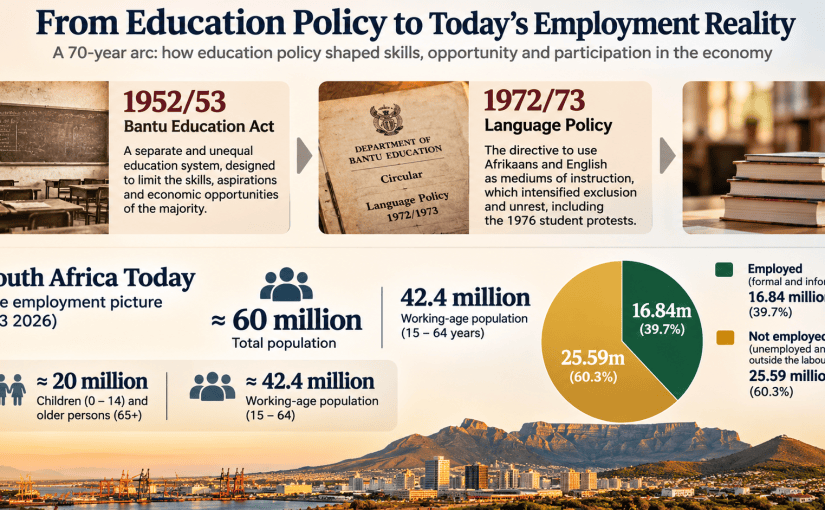
An historical and economic inquiry into policy, misunderstanding and South Africa’s unrealised productive potential.
Editorial principle
Do not make the article comfortable by removing the difficult questions. Make it possible for people to answer them without first having to defend their identities.
This inquiry invites people to examine the thinking, intentions, assumptions and fears that shaped the decisions of the period. It does not seek to erase historical injustice, distribute responsibility equally or prescribe what people should believe. It seeks to recover perspectives that may not have been heard and to understand what different questions might have made possible.
In particular, I welcome contributions from White South Africans who lived through the period, participated in its institutions or have access to the thinking and records of those who did.
1. Returning to the Past: Reversing the Scenario
During an STRLDi systems-thinking session, we used the Soweto Uprising as a reverse-scenario exercise. Rather than beginning with the outcome in June 1976, we worked backwards to examine the education and language-policy decisions of the early 1970s, particularly the 1973 and 1974 medium-of-instruction arrangements.
An important distinction must be made at the outset. This inquiry is not about the introduction of the Bantu Education Act in 1953. It focuses on the subsequent language and medium-of-instruction policy sequence and the questions surrounding its intention, communication, implementation and reception.
The exercise asks us to look beyond the immediate confrontation and examine what the country might have been trying to achieve, what the different parties understood, and where the conversations necessary to connect policy with the country’s economic future may have failed.
The purpose is not to establish that a different policy would necessarily have prevented the uprising. It is to investigate whether a different understanding of the circumstances, intentions and expectations might have opened another trajectory.
2. The Demographic and Productive Challenge
South Africa’s 1970 census recorded approximately 21.45 million people. Black Africans constituted approximately 70.2% of the population, compared with 17.5% who were White.
| Population group, 1970 | Population | Share |
|---|---|---|
| Black African | 15.06 million | 70.2% |
| White | 3.75 million | 17.5% |
| Coloured | 2.02 million | 9.4% |
| Indian/Asian | 0.62 million | 2.9% |
| Total | 21.45 million | 100% |
Source: Historical South African population census series, reproduced in World Bank historical demographic data [1].
The central question is whether the educational arrangements were preparing the majority of the population to participate in the wider productive economy.
Access to education is not the same as preparation for productive participation. Language capability, Mathematics, Science and technical education influence whether people can enter engineering, manufacturing, commerce, research and international trade.
South Africa already had significant industrial infrastructure. Steel production, synthetic fuels, electricity generation, railways and mining demonstrated the country’s industrial ambitions. The question is how the capabilities associated with these industries were being developed and who had access to the opportunities they created.
3. Language, Capability and Nation-Building
The policy sequence deserves closer examination.
In 1973, Departmental Circular No. 2 established a 50:50 English–Afrikaans medium-of-instruction arrangement in the relevant White-area secondary schools. In 1974, regional directives in the Southern Transvaal addressed the application of the arrangement in African schools. For Standards 5 and Forms 1 and 2, English was prescribed for General Science and practical subjects, including Agricultural Science, while Afrikaans was prescribed for Mathematics, Arithmetic and Social Studies. Three language subjects were also included: the learner’s African language, English and Afrikaans [2].
This raises an interesting question about the thinking behind the policy.
Could Afrikaans leaders have recognised that African learners needed capabilities extending beyond their immediate communities? Could language proficiency, Mathematics and Science have been viewed as important to wider participation in the national economy and international trade?
English offered access to international commerce. Afrikaans was associated with the state and significant parts of the industrial establishment. African languages represented numerous linguistic communities, with different levels of mutual intelligibility.
A national productive-systems perspective therefore needs to examine both language diversity and the practical requirements of communication across educational, technical and commercial environments.
South Africa’s language groups
South Africa has 12 official languages, including South African Sign Language. The indigenous African languages belong to different linguistic groupings. Related languages are not necessarily mutually intelligible.
The following grouping uses the 2022 Census data for languages most often spoken in the household. The totals below are calculated by aggregating the individual language counts [3].
| Language group | Main languages | 2022 population, approximately |
|---|---|---|
| Nguni | isiZulu, isiXhosa, isiNdebele, siSwati | 24.55 million |
| Sotho–Tswana | Sesotho, Sepedi, Setswana | 15.62 million |
| Other African language groups | Xitsonga, Tshivenda | 4.26 million |
| Afrikaans and English | Afrikaans, English | 11.59 million |
| Other languages | Sign language, Khoi, Nama, San, Shona, Chichewa, Portuguese and others | 3.85 million |
| Total | 59.88 million |
Source: Statistics South Africa, Census 2022 in Brief, Table 3.8. Figures are household-language classifications, not ethnic population counts.
How many dialects are there?
There is no single agreed national count of South African dialects.
A 2025 linguistic study by Mathe and Chokoe identifies approximately 23–33 dialects of Sesotho sa Leboa, drawing on earlier classifications by Van Warmelo, Mokgokong and Van Wyk. The researchers also examine the extent to which speakers of different varieties understand one another [4].
Three distinctions matter:
- Language diversity: People speak different languages.
- Mutual intelligibility: Speakers of related languages may or may not understand one another adequately.
- Shared working language: People need practical means of communicating across education, training, households and productive sectors.
The question is not whether South Africa should abandon its linguistic diversity. It is whether the country has sufficiently developed the language capabilities that enable people to acquire knowledge, work across regions and participate in national and international production.
This is the context in which the 1970s language-policy decisions deserve examination.
4. The Household and the Burden of Change
Many Black households were affected by migrant labour. Men frequently worked away from home, including in the mines, while women carried substantial responsibilities for household survival and children’s development.
Any educational redirection involving additional language requirements, more demanding Mathematics and Science, and preparation for different forms of employment needed to account for these circumstances.
What did the system assume households could absorb?
Were policymakers sufficiently aware of the demands placed on women, children and families? Did the implementation arrangements provide the necessary support? Could the concerns of households have been understood before educational expectations were imposed?
The question is not only what learners were expected to achieve, but whether schools, households and the wider economy provided the conditions necessary to achieve it.
5. What Did Fear Keep Both Sides from Asking?
This is the part of the inquiry I particularly want to open up.
We have accounts of the resistance to the language policy and the experiences of Black students, teachers and families. But I would also like to hear from those who developed, administered, supported or questioned the policy.
What were they trying to achieve?
What did they believe South Africa needed educationally and economically? Was there an intention to develop wider language, mathematical and scientific capabilities among African learners? Was the policy connected to the requirements of the industrial economy and international trade?
If so, why was this not sufficiently communicated, understood and adopted? And if preparing African learners for the wider world was the intended outcome, why did the policy have to be imposed in this manner?
I would also like to understand what different White communities were thinking. Were there disagreements among Afrikaans educators, industrialists, policymakers and families? Did some recognise the difficulties of the arrangements? Were there alternative proposals that did not gain acceptance?
The other side of the conversation matters equally. What did African families and educators understand about the intentions of the policy? Did they see an opportunity for wider participation, or did the manner of implementation make the policy appear to be another imposition on their children’s future?
Fear may have operated differently on the two sides. For some, it may have been fear of losing cultural identity, political control or economic position. For others, it may have been fear of losing linguistic identity, educational opportunity, family security or the ability to determine their children’s future. What did each side believe it stood to lose, and how much of that understanding was based on what it knew about the other?
What Each Side Saw — and What It Did Not See
There is another dimension to this question that deserves attention: who did each community actually see when it thought about the other?
When Black women thought about Afrikaners, whom did they see? They saw white men — the men they associated with the oppression they believed they would have to fight against. The image of the Afrikaner, in this experience, was predominantly male.
When Afrikaners thought about the Black population, whom did they see? They saw women, youth and children. Where were the Black men? Many were away from their homes and communities, working in the mines and other centres of employment under the migrant labour system. The Black men Afrikaners encountered in political discussions were often older political leaders of their own generation, representing a relatively small minority of the wider Black population.
The two communities were therefore seeing very different representations of one another. Black women saw white men as the people they believed they would have to confront. Afrikaners saw a Black population in which women, youth and children were highly visible, while many adult Black men were absent from everyday community life. The political representatives they did encounter were not necessarily representative of the wider population.
What did this difference in visibility mean for how each side understood the other? Did it influence what they believed about the other community’s intentions, aspirations and capacity? Did the absence of many Black men from everyday community encounters leave Afrikaners with an incomplete picture of the Black population? And what did Black women’s experience of Afrikaner men lead them to believe about the people and institutions they associated with oppression?
Who is visible, who is absent, and why they are absent can shape how one community imagines another. Could this have contributed to the fears each side developed, and to the difficulty of understanding what the other was thinking and trying to achieve?
The Questions We May Not Have Asked
I am not suggesting that misunderstanding alone explains the Soweto Uprising. Nor am I suggesting that the historical consequences of the policy can be set aside. I am asking whether the inability to understand one another contributed to a breakdown in communication that might have been addressed earlier.
Could both sides have failed to ask questions that might have revealed what the other was seeing, fearing and trying to achieve?
I would particularly welcome responses from White South Africans who lived through this period. What did you understand then? What do you understand now? What was being discussed within your families, schools, workplaces and institutions that may not have entered the public historical record?
I would equally welcome reflections from Black South Africans who experienced this period. What did you see, what did you believe was happening, and what do you understand differently today?
Understanding another person’s mental model does not require agreeing with it. It requires being willing to discover what that person was seeing, what they were not seeing, and why.
The purpose of opening this conversation is not to revisit the past in order to establish who was right. It is to understand what people saw, what they feared, what they intended, and what they may not have understood about one another. That is where the possibility of a different understanding begins.
6. Forgiving Others — and Forgiving Ourselves
Perhaps both sides need to forgive one another. But perhaps both also need to forgive themselves.
Forgiveness should not be confused with absolution, forgetting or the removal of historical responsibility. It may, however, allow people to acknowledge what happened, examine their own part in it and participate in a different future.
What did we believe? What did we do? What did we fail to question? What did we inherit? What would we do differently today?
This is where I see an interesting possibility in The Ubuntu Lab.
The organisation describes its purpose as building learning infrastructure to help humanity understand itself and others. Its work includes Seum, a civic space; Arch, a curriculum; Muse, a cultural platform; and Lens, a humanity research and development laboratory. Its stated origin dates to 2012, under the mentorship of Archbishop Desmond Tutu [5].
I am interested in whether learning environments of this kind could help people examine their own mental models, encounter different perspectives and develop the capacity to engage beyond inherited divisions.
The Ubuntu Lab is not presented here as a solution to South Africa’s historical divisions. Rather, it is an example worth examining when considering how structured learning, dialogue and self-reflection might support a more productive national conversation.
The important distinction is between asking people to forgive and helping them understand themselves sufficiently to move forward.
7. Education, Mathematics and Scientific Capability: The Productive Consequences
The inquiry must ultimately return to the economic system.
A question that continues to surface in our own national context is: Why study Mathematics and Science when there is no manufacturing?
The question reverses the relationship between capability and production. Mathematics and Science are not merely qualifications for industries that already exist. They are among the capabilities needed to plan, establish and expand those industries.
South Africa’s contemporary indicators illustrate the scale of the developmental challenge.
Mathematics and Science
South Africa’s TIMSS 2023 results provide a useful baseline [6].
| Assessment | Mathematics | Science |
|---|---|---|
| Grade 5 | 362 | 308 |
| Grade 9 | 397 | 362 |
The scores are international scale scores, not percentages. Grade 5 performance declined between 2019 and 2023 in both subjects. The Department of Basic Education also identifies significant socioeconomic, home-language and school-resource differences in performance.
These results matter because scientific and mathematical proficiency underpin engineering, infrastructure, industrial processing, agricultural technology, research and production planning.
Manufacturing and agriculture
The productive structure also needs attention.
| Indicator | 2024 |
|---|---|
| Manufacturing value added as a share of GDP | 11.2% |
| Manufacturing value added, current prices | Approximately R939 billion |
| Agriculture, forestry and fishing value added, current prices | Approximately R214 billion |
| Manufacturing real annual growth | -0.5% |
| Agriculture, forestry and fishing real annual growth | -8.0% |
Sources: Statistics South Africa, GDP 2024 and SDG Country Report 2025 [7][8].
The figures show why productive capability cannot be separated from educational capability. A country needs people who can design, calculate, engineer, grow, process, manufacture, manage quality and trade.
Employment: The unequal distribution of opportunity
Statistics South Africa’s third-quarter 2026 labour-force results report an official unemployment rate of 33.7% [9].
| Population group | Men | Women |
|---|---|---|
| Black African | 34.1% | 41.4% |
| Coloured | 24.0% | 26.1% |
| Indian/Asian | 14.3% | 15.9% |
| White | 8.7% | 9.7% |
These are official population-group classifications, not separate measurements of Afrikaner identity. The distinction matters when interpreting the data.
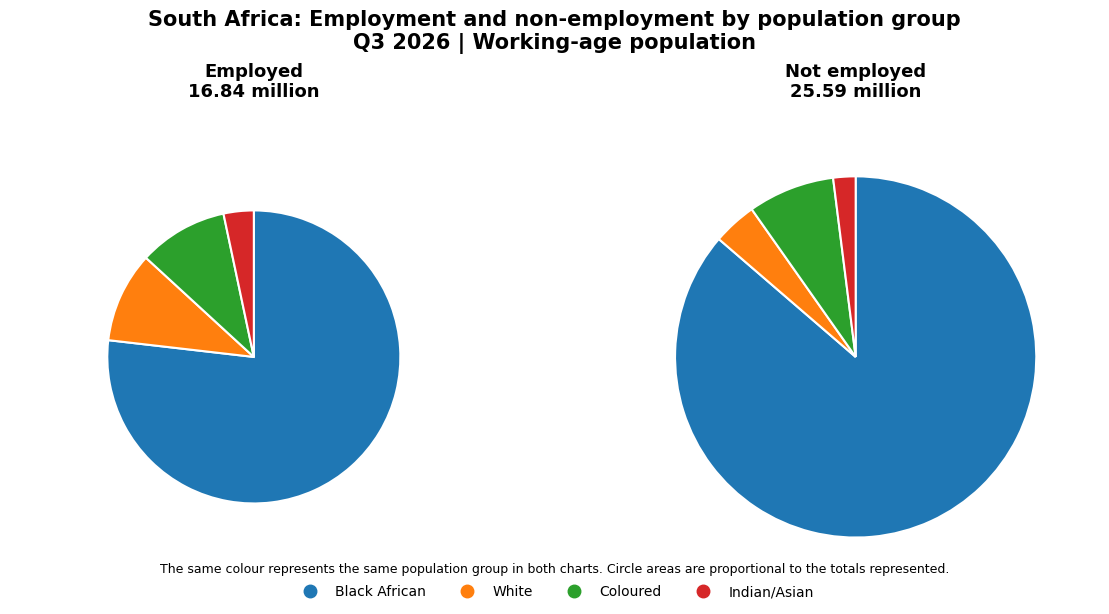
The national challenge is to expand productive participation across all communities. It is not sufficient for national income to increase if household incomes, employment opportunities and ownership of productive assets remain unevenly distributed.
The development objective should therefore include:
- Higher Mathematics and Science proficiency.
- Greater agricultural productivity and value addition.
- Expansion of manufacturing and industrial capability.
- Wider access to domestic and international trade.
- Lower unemployment across population groups.
- Rising household incomes and broader participation in productive enterprise.
8. What Would We Ask Differently Today?
The reverse-scenario exercise takes us back to the questions that might have been asked before the confrontation.
What if policymakers had understood the circumstances of the households affected by the policy? What if African families and educators had been able to influence its design and implementation? What if the economic rationale, if one existed, had been communicated and tested with those expected to participate? What if different perspectives within White communities had also been heard?
We cannot establish that a different conversation would necessarily have prevented the uprising. We can, however, examine what was missing and what alternative decisions might have made possible.
Today, South Africa does not need complete agreement on its history before acting on its shared developmental priorities.
It can improve Mathematics and Science, expand agriculture, strengthen manufacturing, develop enterprises and create employment while continuing to examine the historical questions.
The ultimate objective is a country in which Black African and White children have the opportunity to become scientists, engineers, agriculturalists, manufacturers, researchers and entrepreneurs; where businesses across communities can participate in international trade; and where economic growth translates into rising household incomes and productive opportunities.
We cannot spend another generation negotiating the pain of the past while leaving the productive potential of the future undeveloped.
I would welcome contributions from those who lived through the period, particularly White South Africans who can shed light on the thinking behind the 1973–1974 policy arrangements. I would also welcome documentary evidence, institutional records, personal recollections and alternative interpretations.
What were you trying to achieve? What did you understand? What did you fail to see? What would you ask differently today?
The purpose of returning to the past is not to remain there. It is to understand the decisions, assumptions, and missed connections sufficiently well to build a different future.
References and Sources
Historical policy and the Soweto Uprising
[1] World Bank. Historical South African population series, 1910–1976, based on South African population census reports. Historical demographic table.
[2] The Plight of Afrikaans: Has the Demise of Afrikaans-Medium Public Schools Been Pronounced Within the Educational Framework of South Africa? Obiter, 2025. Discussion of Departmental Circular No. 2 of 1973 and the Southern Transvaal Regional Circular No. 2 of 1974. Read the study.
[3] Statistics South Africa. Census 2022 in Brief, Table 3.8: Distribution of population aged one year and older by language most often spoken in the household. Download Census 2022 in Brief.
Linguistics
[4] Mathe, D.S. and Chokoe, S. (2025). Mutual Intelligibility Among Sesotho sa Leboa Dialects: A Linguistic Overview. Literator, 46(1). Read the research.
Ubuntu and learning infrastructure
[5] The Ubuntu Lab. Organisational purpose, programmes and institutional background. https://www.theubuntulab.org/.
Education and productive capability
[6] Department of Basic Education, South Africa. TIMSS 2023 Information Sheet. Grade 5 and Grade 9 Mathematics and Science results. Read the report.
[7] Statistics South Africa. Sustainable Development Goals Country Report 2025, Indicator 9.2.1: Manufacturing value added as a proportion of GDP, 2015–2024.
[8] Statistics South Africa. Gross Domestic Product, Fourth Quarter 2024, annual industry estimates and value added. GDP publication.
[9] Statistics South Africa. Quarterly Labour Force Survey, Quarter 3, 2026. Unemployment by population group and sex. Download QLFS Q3 2026.


