
“Many of the problems we now face arise as unanticipated side effects of our past actions. All too often, the policies we implement to solve important problems fail, make the problem worse, or create new problems.”
— John Sterman, MIT Sloan School of Management

Why This Law Matters
Leaders are judged by their ability to solve problems. Whether in government, business or community organisations, success is often measured by how quickly a response can be designed, implemented and seen to produce results. When productivity improves, customer complaints decline, agricultural output increases or unemployment falls, it is natural to conclude that the intervention has worked. Early success reinforces confidence in the decision and encourages leaders to continue investing in the same solution.
Unfortunately, this confidence can become one of leadership’s greatest blind spots. Complex systems have a remarkable ability to reward interventions in the short term while quietly preserving the very structures that produced the problem in the first place. The visible behaviour improves, yet the underlying causal relationships remain untouched. As a result, the problem eventually returns, often larger, more expensive and more difficult to solve than before.
This explains why some organisational and national problems seem impossible to eliminate. Every few years they return, despite repeated investments, policy reforms and renewed political commitment. Governments launch another programme. Organisations introduce another restructuring. Consultants recommend another initiative. Additional resources are committed because the previous intervention appeared to work. What often goes unnoticed is that the improvement was temporary because the intervention changed the symptoms of the problem rather than the structure producing it.
The Third Law of Dynamic Complexity therefore challenges leaders to think beyond immediate results. It reminds us that the true measure of an intervention is not whether behaviour improves today, but whether the underlying causal structure has changed sufficiently to prevent the problem from returning tomorrow.
Understanding the Law
Peter Senge’s Third Law states:
Behaviour grows better before it grows worse.
This deceptively simple observation describes one of the most misleading characteristics of dynamic complexity. Many interventions appear successful immediately after they are introduced. Productivity improves. Service delivery becomes faster. Customer satisfaction increases. Agricultural production recovers. Public confidence grows. The visible behaviour of the system moves in exactly the direction leadership had hoped.
That initial improvement is precisely what makes these interventions so attractive.
Low-leverage interventions would rarely survive if they failed immediately. Instead, they often produce encouraging short-term results. The organisation responds positively, people celebrate the improvement and leadership concludes that the problem has been solved. Unfortunately, what appears to be success may simply be the beginning of a much longer causal process.
The key words in this law are not merely “grows better” but “before it grows worse.” The improvement is temporary because the intervention has acted upon the visible behaviour rather than upon the underlying structure producing that behaviour. Since the structure itself has not changed, it continues operating beneath the surface. After a period of delay, its causal influence gradually reasserts itself until the original problem begins to reappear.
By the time the problem returns, leadership seldom associates it with yesterday’s intervention. The delay between cause and effect has hidden the relationship. Instead, the organisation simply concludes that another intervention is required.
The cycle begins again.
Peter Senge’s Demonstrations
The Domino Effect
Peter Senge illustrates this law using a memorable cartoon from The New Yorker. A man sits comfortably in an armchair watching a giant domino falling towards him. He reaches forward and pushes it away, believing the danger has passed. One can almost hear him saying, “At last, I can relax.”
What he cannot see is that the domino he has pushed has begun a much larger chain reaction. One domino topples another, which topples another, until eventually the sequence circles around behind him and strikes him unexpectedly from the opposite direction.
The humour lies in the man’s confidence.
The systems lesson lies in what he cannot see.
The problem did not disappear.
It simply travelled through the system before returning.
Why Low-Leverage Interventions Seduce Us
Senge explains that low-leverage interventions would be far less appealing if they did not produce early success. Yet many of them do. New houses are built. The unemployed receive training. Starving children receive food. Orders begin increasing. People stop smoking. Parents relieve a child’s immediate stress. Managers avoid difficult conversations with employees. In every case, the intervention produces a genuine short-term improvement.
This early success creates confidence that leadership has found the correct solution.
Unfortunately, confidence based solely on immediate behaviour can be misleading.
The Hidden Delay
Compensating feedback almost always involves a delay. There is a period of time between the initial benefit and the eventual consequence. During this interval the intervention appears successful because the deeper causal structure has not yet completed its response.
This delay explains why systemic problems are so difficult to recognise. The problem may not return for two, three or even four years. By then, a different management team may be in place, another minister may hold office or a new chief executive may have taken responsibility. The connection between yesterday’s intervention and today’s problem is therefore lost.
The Political Trap
Senge argues that this behaviour encourages short-term political decision-making. Leaders are often rewarded for producing immediate improvements that satisfy shareholders, voters, boards or supervisors. The intrinsic quality of the intervention becomes less important than whether it creates visible short-term success.
Complex systems willingly accommodate this expectation because compensating feedback requires time before it becomes visible. The intervention looks successful long before the system reveals its full response.
The STRLDi Interpretation
Understanding Why the Law Exists
STRLDi interprets the Third Law as follows:
When we do not see and understand the underlying causal structure behind a persistent or resistant problem, we respond by introducing an intervention intended to correct it. Initially, the system appears to respond favourably and the problem begins to diminish. However, because the underlying causal structure has not changed, it continues operating beneath the surface. After a period of delay, its causal forces reassert themselves, causing the problem to return—often in a more severe form than before. Believing the intervention worked previously, we respond by applying the same or an even stronger intervention, thereby reinforcing the cycle.
This interpretation shifts our attention from behaviour to structure.
The intervention changes behaviour.
The structure determines whether that change will last.
Unless leadership changes the structure itself, the system will eventually return to behaving exactly as its underlying causal relationships require.
Why Behaviour Improves First
The behaviour improves first because interventions usually act directly upon events rather than upon structure. Events are visible and respond quickly. Structures are largely invisible and change much more slowly. Leadership therefore experiences immediate behavioural improvement while the deeper causal relationships continue operating beneath the surface.
Eventually, those deeper relationships complete their causal cycle. Once they do, behaviour begins returning towards its original pattern because the system has never stopped producing it.
The intervention was successful.
It simply was not sufficiently systemic.
An Organisational Example: Performance Management
Consider an organisation experiencing declining productivity. Management introduces a new performance management system supported by revised performance indicators, continuous feedback, rewards for high-performing employees and regular goal alignment. The initiative is carefully designed and employees initially respond positively. Productivity improves, managers become encouraged and the organisation celebrates the apparent success of the intervention.
Suppose, however, that the organisation already suffers from low levels of trust. Employees perceive promotions as unfair, believe performance measures are biased or fear that the system is primarily intended to identify poor performers rather than develop them. These structural conditions remain largely invisible during the initial implementation because the new performance system temporarily focuses everyone’s attention on improving results.
As time passes, however, the underlying structure begins reasserting itself. Employees who feel disadvantaged quietly support one another in resisting the system. Some question the legitimacy of the performance measures. Others challenge management’s intentions, withhold information, or disengage from the process altogether. Performance gradually begins declining once again, despite the continued existence of the performance management system.
Leadership now faces a familiar dilemma.
The intervention appeared successful.
Why, then, has the problem returned?
The answer is that the intervention successfully influenced behaviour without addressing the underlying structure of mistrust that continued generating the problem.
A National Example: Responding to Repeated Drought – The Hidden Risk of Symptomatic Solutions
Overview: The “Success” of Short-Term Adaptation
When a nation faces persistent drought and declining agricultural productivity, the standard strategic response is to promote drought-resistant crops (DRCs). This intervention—supported by financial programs and technical training—is designed to stabilize rural incomes and secure food supplies. In the short term, these measures are often hailed as a success: yields recover, and agricultural confidence returns. This phenomenon illustrates a key systems thinking principle: initially, the behavior grows better.
The Hidden Mechanism: Altering the Hydrological Cycle
The primary focus of DRC adoption is individual plant survival with minimal water. However, an executive-level analysis reveals a critical unintended consequence: reduced transpiration.
- Traditional crops participate in the hydrological cycle by recycling soil moisture into the atmosphere, contributing to humidity and cloud formation.
- DRCs are biologically engineered to conserve water by opening their stomata less frequently, thereby releasing significantly less moisture back into the landscape.
As these crops are scaled across large territories, the ecological structure begins to shift. The landscape slowly loses its natural capacity to sustain its own water cycle, leading to weaker regional rainfall, drier soils, and diminished groundwater recharge.
Behaviour Over Time of Botswana’s Annual Rainfall (1901–2024)
One of the first habits of a systems thinker is to look beyond individual events and examine the behaviour of the system over time. Rather than focusing only on individual drought years or unusually wet seasons, we ask a different question: How is the behaviour of the entire system changing?

The most striking feature of this Behaviour Over Time graph is not the annual fluctuations in rainfall but the changing behaviour of the system’s highest rainfall events. Prior to the mid-1970s, Botswana experienced several exceptionally wet years with annual rainfall reaching approximately 550–650 mm. In contrast, the highest rainfall events recorded during the subsequent five decades generally remained between approximately 430 mm and 510 mm. While rainfall continues to fluctuate considerably from year to year, the upper boundary of the system appears to have shifted downward.

This observation does not, by itself, explain why the behaviour has changed. Behaviour Over Time graphs describe what the system is doing; they do not reveal what is causing the behaviour. That distinction is fundamental to systems thinking. Before searching for explanations, leaders must first discipline themselves to observe the behaviour objectively.
The changing pattern therefore raises an important systemic question rather than providing an immediate conclusion.
What structural changes could explain why Botswana’s highest rainfall years appear to be becoming less frequent and less intense over time?
It is precisely this question that prepares us for the next stage of systems inquiry. Rather than searching for answers near the visible symptom of declining rainfall, systems thinking encourages us to investigate the underlying causal structures that may have been quietly shaping this behaviour over many decades. Only by understanding those structures can we distinguish between temporary climatic variation and long-term systemic change.
The Reinforcing Cycle of Scarcity
Because these changes unfold gradually over years or decades, they are rarely attributed to the original intervention. This creates a reinforcing feedback loop that traps the system in a cycle of scarcity:
- Drought triggers the planting of more DRCs.
- Increased DRCs lead to less atmospheric moisture.
- Lower moisture results in less rainfall and drier landscapes.
- Drier landscapes necessitate even more DRCs to maintain survival.
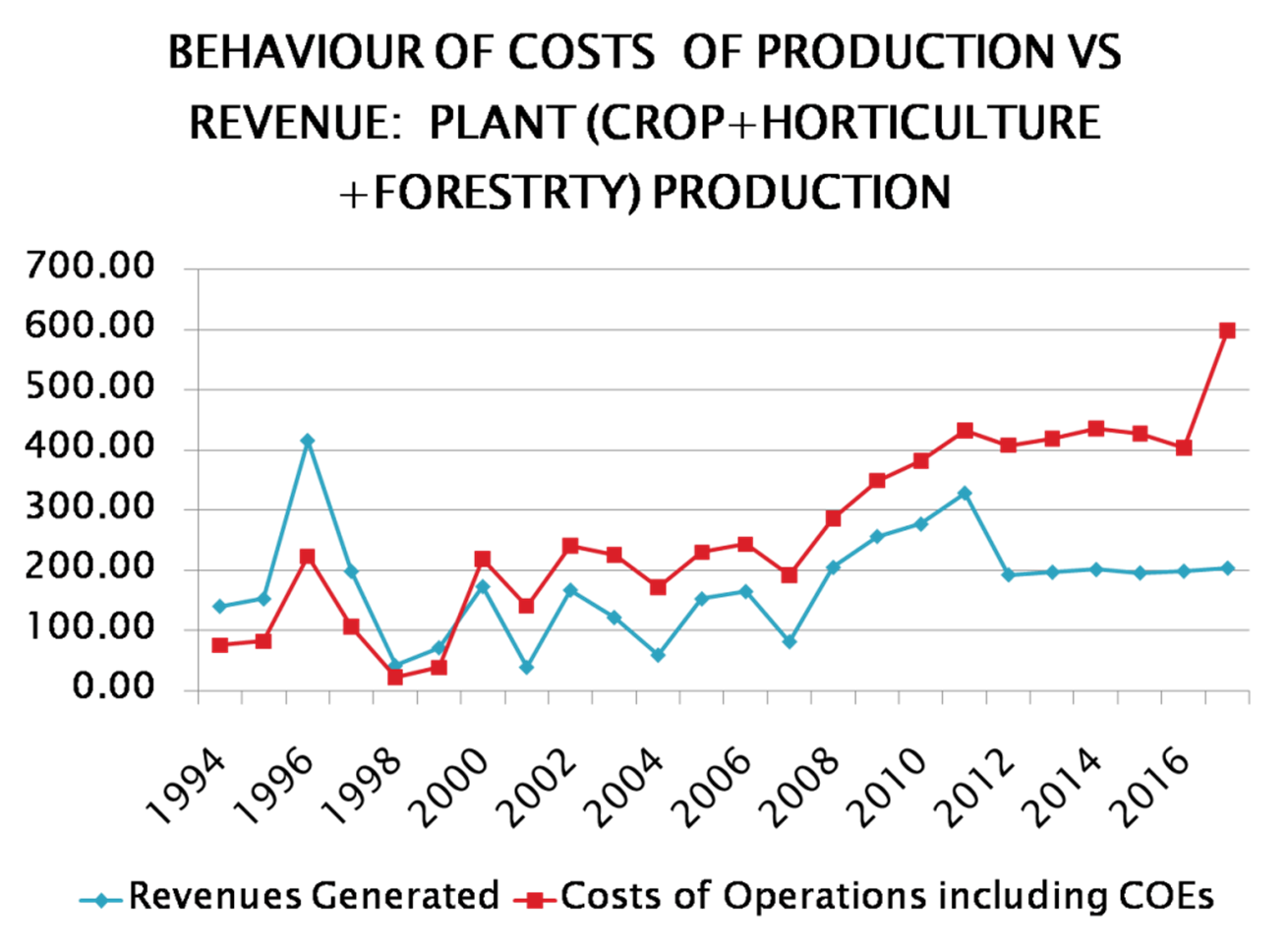
The Behaviour Over Time graph above illustrates one possible response of the crop production system. As rainfall becomes less favourable, maintaining production increasingly depends on additional inputs such as irrigation, water abstraction, drought adaptation measures, improved seed varieties, fertilisers and other production support. Crop production can therefore be sustained, and even improved initially, but only through progressively higher operating costs. Revenue from crop production eventually stabilises while the cost of producing that output continues rising, steadily reducing the economic sustainability of the sector.
This is the Third Law of Dynamic Complexity at work. Behaviour grows better before it grows worse. The intervention initially succeeds because it enables agricultural production to continue under increasingly difficult climatic conditions. However, if the underlying structures influencing rainfall and long-term water availability remain unchanged, the cost of sustaining production continues rising.
The sector appears to be succeeding, yet it is doing so at an increasingly higher cost. Eventually, the system reaches a point where the intervention itself becomes progressively more difficult to sustain, signalling the need to understand and address the deeper structures producing the behaviour rather than continually responding to its symptoms.
The Strategic Question
One possible explanation deserving further investigation is whether repeated replacement of higher-transpiration vegetation with drought-resistant crops gradually altered evapotranspiration across agricultural landscapes, thereby influencing land-atmosphere moisture feedbacks over time.
Without this, over time, the system will begin to reproduce itself, organizing around scarcity rather than abundance. If left unchecked, this cycle can lead to ecological collapse and desertification, where the land and atmosphere reinforce conditions that favor only the hardiest, lowest-transpiring species, such as cacti.
Strategic Leadership Lesson: The Third Law of Dynamic Complexity
The critical lesson for leadership is not that DRCs are a “wrong” choice—they are often the most appropriate immediate response—but that they must be managed with an understanding of the underlying causal structure.
This case study demonstrates the Third Law of Dynamic Complexity: interventions that respond only to visible symptoms without changing the underlying structure may reduce a problem today while creating the conditions for its future return.
The Executive Mandate: Systems leaders must move beyond asking, “Did our intervention work?” and instead ask: “What new structure did our intervention begin creating?”. True resilience requires addressing the fundamental health of the water cycle rather than just the immediate survival of the harvest.
So, did the problem get worse?
Why did that happen?
To understand this, we now take a look at Law #7 & Law #4.
Previous < — Law #2 Next –> Law #4


You must be logged in to post a comment.