
A Showcase of Viewing Persistent Issues Through …


The Four Quadrant Framework and The Onion Lenses

The Structures Beneath the Surface: Why Persistent Problems Don’t Stay in Their Lane

When a country’s unemployment rises, the response is usually a labour policy. When food imports climb, agricultural reform gets discussed. When corruption surfaces, governance fixes are proposed. When mental health deteriorates, healthcare budgets get adjusted. Each problem gets its own lane, its own ministry, its own set of experts.

The trouble is that the problems don’t stay in their lanes.

This piece is drawn from a study that began with unemployment and gradually widened — because it had to. The more the data was examined, the more the pressures refused to stay separate. Labour oversupply showed up alongside weakened productive absorption. Educational expansion appeared alongside declining technical capability. Agricultural decline appeared alongside migration pressures and weakening generational continuity. The harder you looked at any one pressure, the more the others were already there beneath it.

What emerged from that widening is a framework for understanding how persistent issues actually move through society — not as isolated events requiring targeted fixes, but as interacting structural movements that propagate across generations, often long before anyone measures them.


The Gap Between Where Problems Appear and Where They Begin

The most important distinction in this entire framework is deceptively simple: the visible location of a problem and the generative location of a problem are not the same thing.

Take corruption. It becomes visible institutionally — in tender processes, in allocation decisions, in procurement scandals. But its behavioural roots often emerge much earlier: in weakened long-horizon thinking, in survival pressures normalised during upbringing, in the gradual acceptance of shortcuts within wider society. By the time it registers as a governance problem, the conditions producing it may have been quietly accumulating for a generation.

Or take institutional fragmentation. It appears within governance systems. But its deeper roots frequently emerge upstream in weakening continuity structures within human formation — in how people are raised, what values are transmitted across generations, how long-term thinking is cultivated or eroded.

Societies often intervene where pressures become visible rather than where they are structurally generated. This is not a failure of intelligence. It is a predictable consequence of how institutions are organised: by sector, by ministry, by profession. The problem is that persistent issues rarely respect those boundaries.


A Framework for Seeing Across Sectors

To organise the growing number of interacting variables without fragmenting their relationships, the study developed a four-quadrant framework. The quadrants are not rigid categories — they are lenses, each revealing where pressures are primarily generated, where they tend to become visible, and how they flow.
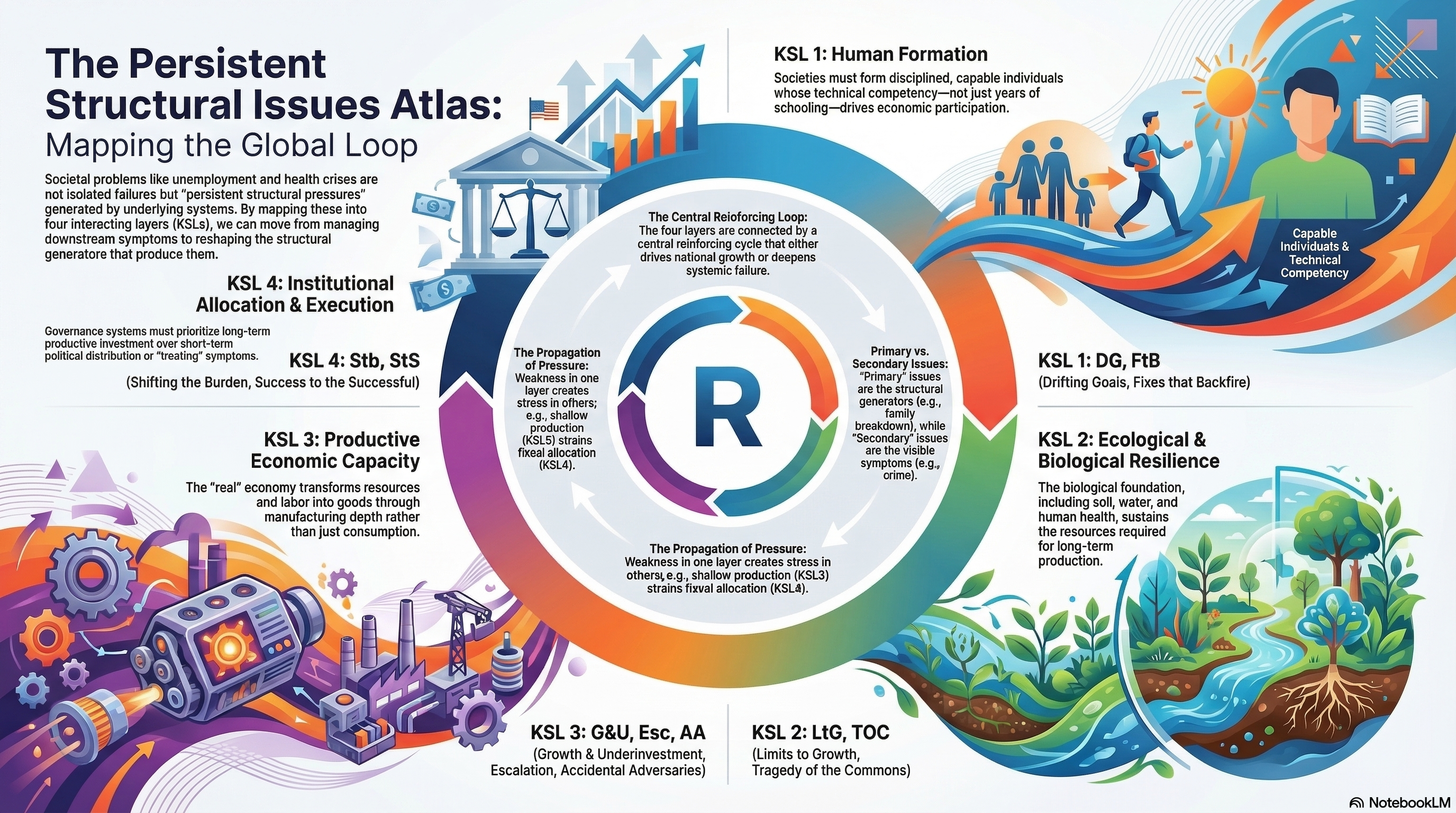
H-H — Human Formation The formation of capability, behaviour, discipline structures, educational orientation, labour identity, and long-horizon thinking.

H-N — Ecological & Biological Resilience Land, water, climate systems, food systems, biological resilience, and ecological carrying capacity.

H-E — Productive Economic Capacity Agriculture, manufacturing, productive enterprise formation, labour absorption, value creation systems, and infrastructure.

H-G — Institutional Allocation & Execution Governance systems, policy allocation, land administration, institutional coordination, investment priorities, and societal response mechanisms.

These four quadrants interact continuously. A pressure emerging in human formation may eventually surface economically through weakened productivity. Ecological pressures may become visible institutionally through fiscal strain or migration surges. The framework doesn’t try to eliminate that complexity — it tries to make it navigable.


The Onion: A Sequence of Systemic Behaviours

As the study widened, recurring structural behaviours kept surfacing — not randomly, but in recognisable patterns that systems thinkers call archetypes. What became increasingly clear was that these archetypes were not independent of one another. The pressures generated within one archetype appeared capable of tipping variables into the conditions required for the next one to emerge.

This gave rise to what the study calls the Onion framework: a causally linked sequence of system archetypes that describes how unresolved pressures tend to propagate through society over time.
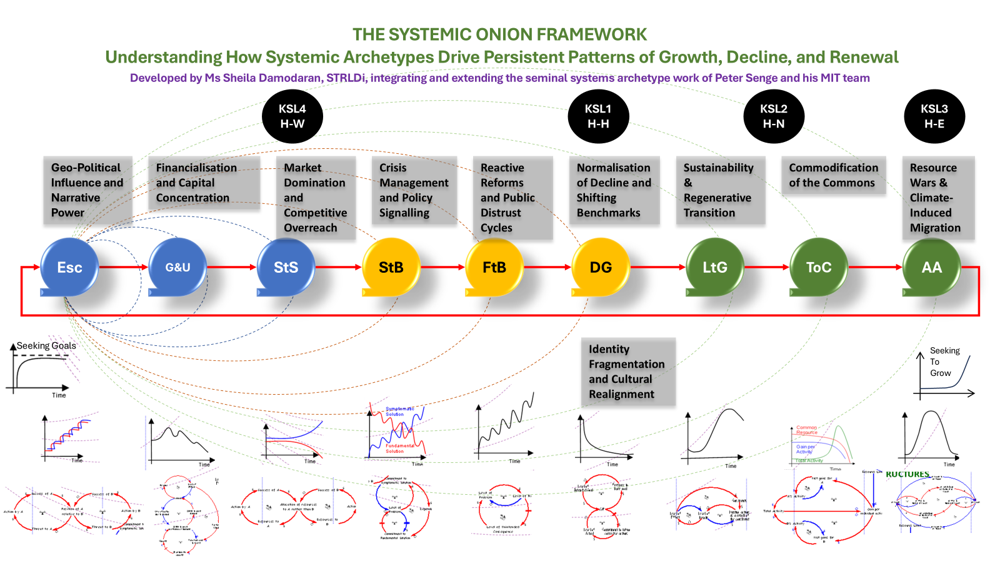
The sequence is:

Accidental Adversaries (AA) → Escalation (Esc) → Growth & Underinvestment (G&U) → Success to the Successful (StS) → Shifting the Burden (StB) → Fixes that Fail (FtF) → Drifting Goals (DG) → Limits to Growth (LtG) → Tragedy of the Commons (ToC) → back to Accidental Adversaries (AA)

This is not a deterministic cycle. Human societies are adaptive, relational, and capable of renewal at any point. The Onion is better understood as a propagation-awareness framework — a way of seeing how pressures tend to move if underlying structures go unaddressed for long enough.

The sections that follow walk through each quadrant, showing the variables at play, which archetypes dominate, and where the pressures flow.


H-H — Human Formation

Dominant archetypes: Drifting Goals → Fixes That Fail (with Shifting the Burden emerging later)

Many pressures that later become visible economically or institutionally have earlier formative roots in how people are raised, educated, and shaped. The weakening of long-horizon thinking, practical capability formation, productive identity, and disciplined stewardship often appears upstream of much that later shows up in labour systems, governance, and enterprise.

The study also found that some adaptive behaviours emerging under difficult conditions temporarily relieve immediate pressure while simultaneously weakening long-term regenerative capability. Survival-oriented economic behaviour, opportunistic adaptation, weakened delayed gratification — these emerge gradually under sustained systemic stress. Short-term adaptation and long-term continuity do not always move in the same direction.

VariableGenerated InDominant ArchetypeDetected InConsequence Flows Into
Births outside stable marriagesH-HDGH-HH-H → H-E → H-G
Male absence in householdsH-HFtFH-HH-H → H-G
Weak masculine continuityH-HFtFH-HH-E → H-G
Weak intergenerational transferH-HFtFH-HH-E
Weak long-horizon thinkingH-HDGH-HAll quadrants
Emotional instability environmentsH-HFtFH-HH-N → H-E
Survival-oriented upbringingH-HStBH-HH-E
STEM avoidanceH-HDGH-H / H-EH-E → H-G
Fear of mathematically intensive disciplinesH-HDGH-HH-E
Office-job orientationH-HStBH-EH-E → H-G
Credential accumulation mentalityH-HFtFH-EH-E
Theory-heavy educationH-HFtFH-H / H-EH-E
Weak apprenticeship systemsH-HFtFH-EH-E
Weak practical applicationH-HFtFH-EH-E
Weak technical competencyH-HDGH-EH-E → H-G
Reduced deep work capabilityH-HDGH-HH-E
Labour oversupplyH-ELtGH-EH-G
Graduate oversupplyH-HFtFH-EH-E → H-G
UnderemploymentH-ELtGH-EH-G
Survival psychologyH-HStBH-HH-E → H-G
Status signallingH-HEscH-HH-E
Visibility competitionH-HEscH-HH-G
Side-hustle normalizationH-H / H-EStBH-EH-G
Opportunistic adaptationH-HStBH-GH-G
Rule-bending normalizationH-HDGH-GH-G
Penal-code proximityH-H / H-EToCH-GH-G
Drift toward organized crimeH-H / H-EToCH-GH-G

What the table reveals is that pressures appearing later in labour, governance, and productive systems often have earlier roots in formation structures. Human formation pressures rarely remain confined to the quadrant in which they originate.


H-N — Ecological & Biological Resilience

Dominant archetypes: Limits to Growth → Tragedy of the Commons (with Accidental Adversaries and Shifting the Burden transitional)

Human societies don’t operate independently from the biological and ecological conditions that sustain them. Productive systems, migration patterns, food systems, labour systems, and institutional pressures are all shaped by ecological carrying capacity over long periods.

A critical distinction surfaced here: survival adaptation and regenerative reversal are not the same process. Drought-resistant crops, low-water agricultural systems, and survival-oriented production methods may help populations endure worsening conditions. But enduring deterioration and reversing the underlying trajectory that produces it are fundamentally different things. Some systems successfully help societies survive decline while simultaneously failing to address what is causing it.

VariableGenerated InDominant ArchetypeDetected InConsequence Flows Into
Declining rainfall systemsH-NLtGH-NH-E
Increasing drought frequencyH-NLtGH-NH-E
Extreme weather intensificationH-NLtGH-NAll quadrants
Reduced carrying capacityH-NLtGH-NH-E → H-G
Soil degradationH-NToCH-NH-E
Water stressH-NLtGH-N / H-GH-E → H-G
Indigenous drought-resistant systemsH-NAAH-NH-E
Low-water survival agricultureH-NStBH-NH-E
Weak ecological reversal systemsH-NToCH-NH-E
Weak evapotranspiration restorationH-NToCH-NH-N
Weak biodiversity regenerationH-NToCH-NH-E
Weak landscape restorationH-NToCH-NH-E
Declining agricultural profitabilityH-E / H-NLtGH-EH-G
Aging farmersH-H / H-NLtGH-EH-E
Weak generational farming continuityH-HFtFH-EH-E
Youth agricultural disengagementH-HDGH-EH-E
Male migration into mining systemsH-N / H-EEscH-EH-H
Rising food importsH-EStBH-GH-G
Reduced food sovereigntyH-N / H-EToCH-GH-G
Climate vulnerabilityH-NLtGH-GAll quadrants
Childhood nutrition weaknessesH-NLtGH-NH-H
Processed food dependencyH-NStBH-NH-H
Micronutrient deficienciesH-NLtGH-NH-H
Reduced cognitive resilienceH-NLtGH-HH-H
Emotional regulation instabilityH-NLtGH-HH-H
Chronic disease riseH-NToCH-NH-E
DiabetesH-NToCH-NH-E
HypertensionH-NToCH-NH-E
Fatigue economiesH-NLtGH-EH-E
Mental health deteriorationH-NLtGH-HH-E
Reduced productive lifespanH-NLtGH-EH-G
Ecological commons depletionH-NToCH-GH-G

Notice how biological resilience flows into educational performance, labour productivity, and institutional behaviour. Nutrition quality, cognitive resilience, emotional regulation stability — these are not soft concerns. They shape the productive and institutional capacity of entire societies over time.


H-E — Productive Economic Capacity

Dominant archetypes: Growth & Underinvestment → Escalation → Accidental Adversaries (with Shifting the Burden emerging later)

Economic weakness, as the study increasingly revealed, is rarely a standalone financial event. It tends to emerge as the interacting outcome of human formation pressures, ecological pressures, institutional allocation patterns, and productive underinvestment accumulating simultaneously over long periods. Productive systems inherit conditions from multiple upstream structures at once.

The study drew a sharpening distinction between productive enterprise formation and survival circulation systems. Some economic activity creates productive depth, technical capability, value addition, and long-term labour absorption. Other activity primarily circulates limited value within already constrained systems. Over time, the expansion of survival-oriented circulation — retail growth, import dependency, multi-income hustle strategies — can help societies adapt temporarily while steadily weakening their capacity to generate new productive depth.

VariableGenerated InDominant ArchetypeDetected InConsequence Flows Into
Weak agricultural reinvestmentH-EG&UH-EH-G
Weak manufacturing ecosystemsH-EG&UH-EH-G
Weak industrial deepeningH-EG&UH-EH-G
Weak engineering ecosystemsH-H / H-EG&UH-EH-G
Weak research ecosystemsH-H / H-EG&UH-EH-G
Weak agricultural financingH-G / H-EG&UH-EH-G
High capital barriersH-GG&UH-EH-H
Weak agricultural bankingH-GG&UH-EH-E
Weak enterprise incubationH-GG&UH-EH-E
Retail profitability dominanceH-EEscH-EH-G
Import-based circulation economyH-EStBH-E / H-GH-G
Government-employment prestigeH-H / H-GStSH-EH-H
Tenderpreneurship expansionH-GStSH-EH-G
Investments shifting to circulationH-EEscH-EH-G
Productive labour shifting to retailH-EEscH-EH-H
Administrative expansion without productionH-GFtFH-EH-G
Reduced productive entrepreneurshipH-H / H-EG&UH-EH-G
Small-scale survival businessesH-EStBH-EH-G
Weak scaling capabilityH-EG&UH-EH-G
Weak value-chain integrationH-EAAH-EH-G
Import dependencyH-EStBH-GH-G
Weak local value additionH-EG&UH-EH-G
Weak industrial competitivenessH-ELtGH-EH-G
Reduced labour absorptionH-ELtGH-EH-H
Informal circulation systemsH-EStBH-EH-G
Multi-income survival systemsH-H / H-EStBH-EH-G
Short-horizon enterprise behaviourH-HDGH-EH-G
Declining productivity per workerH-ELtGH-EH-G
Labour dilution into low-value sectorsH-EEscH-EH-G
External energy dependencyH-ELtGH-GH-G
Weak industrial infrastructureH-GG&UH-EH-G
Electricity fragilityH-G / H-NLtGH-EH-G
Rising production costsH-E / H-NLtGH-EH-G

What the productive quadrant reveals most clearly is that economic outcomes are downstream of structural conditions across multiple layers simultaneously. You don’t fix a hollow productive economy by targeting the economy alone.


H-G — Institutional Allocation & Execution

Dominant archetypes: Escalation → Success to the Successful → Shifting the Burden (with Tragedy of the Commons emerging later)

Governance systems sit in a uniquely difficult position. They are both detectors and responders to pressures generated across the entire civilisational structure. They are asked to stabilise labour pressures, ecological pressures, productive weakness, social fragmentation, and rising instability — often simultaneously — using policy allocation, resource distribution, welfare mechanisms, and political coordination.

The problem is that institutions themselves begin adapting under sustained pressure. Short political cycles, fragmented coordination, symptomatic policy responses, and expanding administrative management systems emerge progressively. Institutions start adapting to the pressure rather than resolving the structures generating it. Some governance responses — welfare expansion, import dependency management, reactive policy cycles — temporarily relieve immediate instability while reinforcing deeper structural dependencies. Short-term stabilisation and long-term regeneration are not the same thing institutionally.

VariableGenerated InDominant ArchetypeDetected InConsequence Flows Into
Short political cyclesH-HStSH-GH-G
Weak long-term planningH-HStSH-GAll quadrants
Weak civilizational horizon thinkingH-HStSH-GAll quadrants
Political responsiveness over structural investmentH-GStSH-GH-E
Fragmented ministriesH-HStSH-GH-G
Weak systems integrationH-HStSH-GAll quadrants
Weak policy continuityH-HStBH-GH-G
Repeated policy resetsH-GStBH-GH-G
Resource leakageH-HStBH-GH-G
CorruptionH-HStBH-GH-G
Patronage systemsH-GStSH-GH-G
Tenderpreneurial incentivesH-GStSH-GH-E
Land bankingH-H / H-EStSH-GH-E
Elite accumulationH-EStSH-GH-G
Weak youth accessH-GStSH-GH-H / H-E
Delayed productive deploymentH-GStBH-GH-E
Corrupt allocation systemsH-HStBH-GH-G
Underinvestment in STEMH-HStSH-GH-H / H-E
Underinvestment in regenerative agricultureH-NStSH-GH-N
Underinvestment in water systemsH-NStSH-GH-N
Underinvestment in manufacturing ecosystemsH-EStSH-GH-E
Underinvestment in apprenticeship systemsH-HStSH-GH-H
Welfare dependenceH-H / H-EStBH-GH-H
Youth grants without ecosystemsH-GStBH-GH-H / H-E
Import dependency managementH-EStBH-GH-E
Administrative expansionH-GStBH-GH-G
Retail licensing expansionH-EStBH-GH-E
Distrust in productive effortH-HStBH-GH-H
Rule-bending normalizationH-HStBH-GH-H
Reduced civic cohesionH-HStSH-GH-H
Institutional fatigueH-H / H-GStBH-GH-G
Ecological depletionH-NToCH-GH-N
Fiscal depletionH-EToCH-GH-G
Institutional depletionH-GToCH-GH-G
Governance legitimacy stressAll quadrantsToCH-GAll quadrants
Reduced long-horizon coordination capacityH-HToCH-GAll quadrants
Reduced regenerative capabilityH-N / H-EToCH-GAll quadrants
Increased systemic fragilityAll quadrantsToCH-GAA restart

The governance quadrant is where the accumulated pressures of human formation, ecological resilience, and productive capacity all converge and become measurable. It is, in a sense, the final detection layer — but rarely the origin of what it’s detecting.


The Quadrants in Motion

The four quadrants don’t operate in sequence. They interact continuously. Human formation shapes ecological stewardship. Ecological conditions reshape productive systems. Productive systems influence governance behaviour. Governance responses influence educational orientation, economic adaptation, and long-term societal behaviour in return.

This continuous interaction means pressures rarely stay contained where they first emerge. Declining ecological resilience propagates later into labour migration, food imports, fiscal strain, and institutional fatigue. Weak productive absorption propagates later into household stability, psychological adaptation, educational orientation, and governance pressure.

This is also why some interventions produce only temporary relief. If societies continuously intervene where pressures become visible while neglecting where they are structurally generated, many conditions gradually re-emerge elsewhere. The structure keeps producing what it was always structured to produce.


Interconnected Pressures, Interconnected Leverage

One of the most important observations to emerge from this study is that interconnected systems carry both interconnected pressures and interconnected possibilities for renewal.

Strengthening long-horizon human capability formation may later influence productive behaviour, institutional resilience, educational orientation, labour absorption, and governance quality simultaneously. Strengthening regenerative ecological systems may later influence food resilience, migration pressure, biological resilience, productive continuity, and fiscal stability. Strengthening productive capacity may later influence family stability, psychological adaptation, institutional pressure, and long-term societal confidence.

This doesn’t mean persistent issues yield to simple single-point interventions — human societies are too complex and historically layered for that. But it does suggest that long-term regenerative movement becomes more possible when societies start seeing the interacting structures beneath visible realities rather than treating each pressure as a standalone problem. The ability to perceive interrelationships may itself be part of the intervention.


Closing: What Persistent Unemployment Actually Reflects

Persistent unemployment may represent more than the absence of jobs. It may reflect simultaneous movements in human formation, ecological systems, productive systems, and institutional structures over long periods of time — educational orientation, ecological resilience, labour absorption, governance adaptation, social continuity, and psychological adaptation all interacting more closely than they appear when examined separately.

Organisations will continue managing themselves through sectors, departments, and ministries — that operational logic has its own validity. But persistent issues don’t respect those boundaries. They move across them, reinforce themselves through them, and reveal the same underlying structures expressing themselves differently in different parts of society.

The challenge isn’t only to solve isolated problems more efficiently. It’s to develop the capacity to see the interacting structures beneath them — patiently, coherently, and across generations. That capacity for systemic perception may be one of the most important things a society can cultivate.


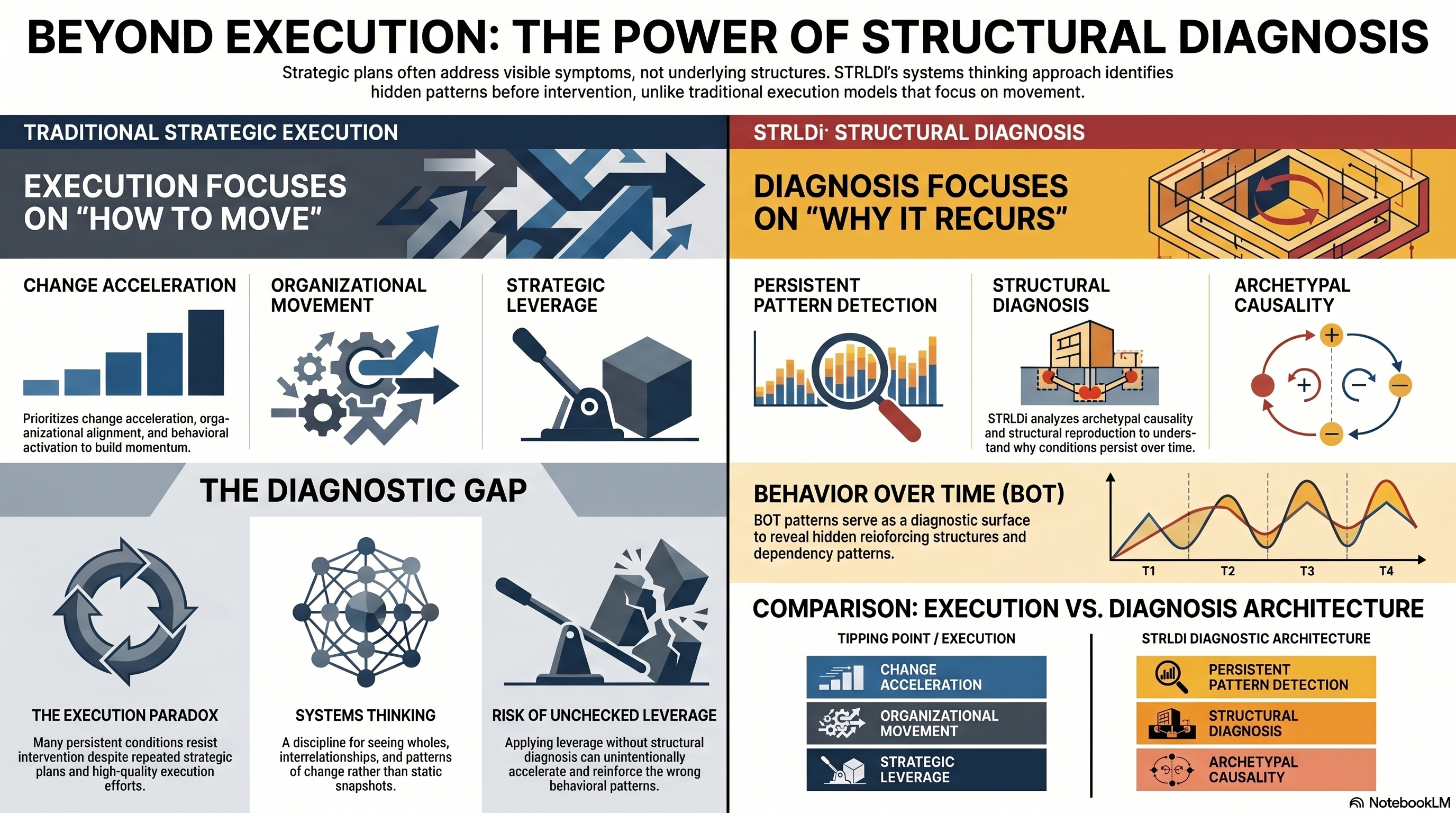
Dynamic Complexity: Why Persistent Systems Cannot Be Understood Through Detail Complexity Alone


INTRODUCTION: WHEN EFFORT DOES NOT CHANGE THE PATTERN

Many persistent societal conditions remain difficult not because people are unintelligent, under-qualified, or unwilling to act, but because the underlying system is being approached primarily through detail complexity rather than dynamic complexity. Policies are revised, investment strategies refreshed, institutional structures reorganised, and implementation teams expanded, yet the overall Behaviour Over Time often remains materially unchanged across administrations and decades. When this happens repeatedly, the question gradually shifts from “What intervention is missing?” to “What structure continues reproducing the persistence beneath these interventions?”

This distinction matters because the two forms of complexity do not ask the same questions, nor do they produce the same kind of seeing. Detail complexity focuses on the number of variables, actors, projects, moving parts, and implementation requirements involved in a situation. Dynamic complexity, however, concerns how cause and effect unfold with delay across time, often across institutions, sectors, and generations, such that actions that appear reasonable in isolation unintentionally strengthen the very conditions they seek to change.

It is within this second territory that much of STRLDi’s work operates.

As Peter Senge explains in The Fifth Discipline, Systems Thinking is:

“to discipline us in seeing and understanding patterns — looking beyond events — to deeper structures that control events, and discovering the leverage that lies hidden in these structures.”

The emphasis here is important. Systems Thinking is not merely the study of complexity. It is a discipline of seeing.


DETAIL COMPLEXITY: WHEN THE SYSTEM IS APPROACHED THROUGH PARTS

Detail complexity is often the dominant language of institutions because it aligns naturally with administration, planning, budgeting, implementation, and measurement. Organisations identify variables, assign responsibilities, monitor indicators, establish targets, and attempt to optimise interactions between different operational components. This work is necessary. Large systems cannot function without it.

Within organisational settings, detail complexity may include:

▪️ Multiple departments
▪️ Large project portfolios
▪️ Regulatory requirements
▪️ Budget allocations
▪️ Stakeholder coordination
▪️ Technology integration
▪️ Performance management systems

The challenge within detail complexity is usually one of coordination, sequencing, execution, or technical integration. The system is assumed to be broadly understood, and the work therefore concentrates on improving performance within that frame.

This becomes particularly visible in conventional change-management processes where organisations:

▪️ Define strategy
▪️ Identify intervention points
▪️ Establish implementation variables
▪️ Simulate outcomes
▪️ Measure performance
▪️ Adjust execution pathways

These approaches are useful, particularly where the system boundary is reasonably visible and the relationships between actions and outcomes are relatively immediate.

But many persistent societal conditions do not behave this way.


DYNAMIC COMPLEXITY: WHEN CAUSE AND EFFECT ARE SEPARATED ACROSS TIME

Dynamic complexity emerges when the relationship between cause and effect becomes difficult to see because it unfolds across long horizons, across sectors, and through interacting layers of reinforcement. The difficulty no longer lies primarily in the number of variables, but in the fact that actions taken in one part of the system may only reveal their consequences years or decades later in another part of the system.

This is why persistent conditions often survive:

▪️ Electoral cycles
▪️ Administrative reforms
▪️ Investment programmes
▪️ Institutional redesigns
▪️ Leadership transitions

The visible events change. The deeper Behaviour Over Time does not.

In dynamic complexity, the system cannot be understood adequately through isolated snapshots because the structure expresses itself longitudinally. What appears disconnected at the level of events may reveal itself as tightly related when viewed over twenty, thirty, or forty years.

A nation may, for example:

▪️ Expand tertiary enrolment
▪️ Increase social spending
▪️ Attract investment
▪️ Improve retail circulation
▪️ Expand infrastructure

…and yet still remain structurally weak in the sectors required to absorb labour at scale. The issue here is not implementation failure alone. It is that the underlying relationships organising the system may remain materially unchanged.

This is why STRLDi’s work begins not with interventions, but with Behaviour Over Time.


BEHAVIOUR OVER TIME: THE ENTRY POINT INTO STRUCTURE

At STRLDi, the first question is often not:

“What should we do?”

The first question is:

“What pattern refuses to move?”

This distinction is fundamental.

Persistent conditions leave behind behavioural signatures. When plotted longitudinally, these signatures reveal relationships that are often invisible at the level of events. Rising demographic inflow alongside persistently weak labour absorption, repeated downstream healthcare expenditure without corresponding upstream prevention improvement, or agricultural expansion without proportional manufacturing depth may all appear unrelated when viewed episodically. Over time, however, they may reveal the same underlying structural imbalance.

Behaviour Over Time therefore becomes more than a graphing exercise. It becomes a diagnostic doorway into dynamic complexity.

The emphasis shifts:

DETAIL COMPLEXITYDYNAMIC COMPLEXITY
EventsBehaviour Over Time
VariablesRelationships
InterventionsStructural persistence
Immediate outcomesDelayed consequences
Organisational optimisationLongitudinal diagnosis
Isolated sectorsCross-domain interaction
Technical coordinationBehavioural reproduction

This does not make detail complexity unimportant. It simply means that detail complexity alone cannot adequately explain why certain conditions remain materially unchanged despite sustained intervention.


SYSTEM ARCHETYPES: RECURRING STRUCTURES OF PERSISTENCE

Once Behaviour Over Time becomes visible, another question emerges:

What kind of structure produces this pattern repeatedly?

This is where system archetypes become important.

At STRLDi, archetypes are not treated primarily as facilitation tools or conceptual diagrams. They are approached as recurring structural patterns that leave identifiable behavioural traces across time. A persistent widening gap between labour inflow and absorption, for example, may reveal the behavioural characteristics of Success to the Successful, where sectors already structurally advantaged continue deepening while weaker sectors struggle to accumulate capability proportionately.

Similarly:

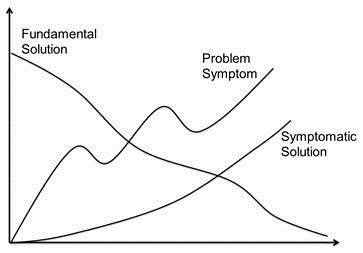
▪️ Repeated symptomatic interventions may reveal Shifting the Burden
▪️ Resource strain from expanding participation without proportional capacity deepening may reflect Limits to Growth
▪️ Competitive extraction between sectors may reveal Tragedy of the Commons

The archetype is therefore not imposed onto the system. It is surfaced through the Behaviour Over Time the system leaves behind.

This distinction matters greatly.

The work is not asking:

“Which archetype should we use?”

The work is asking:

“What archetypal behaviour is already expressing itself?”


THE ONION: WHY PERSISTENCE REPRODUCES ITSELF

Persistent systems rarely sustain themselves through one variable alone. They reproduce themselves through layers.

This is where the Onion Model becomes important within STRLDi’s work. The Onion is not merely a conceptual illustration; it is a layered diagnostic architecture involving system archetypes that helps explain how persistent conditions continue reproducing themselves across sectors and generations.

At the outer layers sit visible events:

▪️ unemployment
▪️ weak sector growth
▪️ rising healthcare burdens
▪️ institutional strain

Beneath these sit institutional responses, sectoral relationships, reinforcing interactions, mental models, historical assumptions, and societal beliefs as system archetypes, that quietly shape how decisions continue being made.

This layered reproduction matters because interventions often concentrate on the visible layer while leaving the deeper organising relationships materially unchanged.

The result is familiar:
movement without transformation.

Related links:
System Archeypes. Click here for the link: https://sheilasingapore.blog/training-learning-to-work-with-systemic-experiences/systemic-archetypes-running-our-realities/system-archetypes-2/
The Onion Model. Click here for the link: https://sheilasingapore.blog/the-onion/model/


WHY THIS DISTINCTION MATTERS FOR STRLDI

STRLDi’s work does not oppose simulation, facilitation, organisational learning, or implementation design. These become critically important once the dominant structure has already become sufficiently visible.

But the work enters earlier.

It enters at the point where societies, institutions, or sectors are still mistaking persistent structural behaviour for isolated events, leadership failure, funding shortages, or implementation weakness alone. The role of the facilitator, therefore, is not primarily to optimise execution pathways. It is to help bring the underlying structure into view.

This requires:

▪️ Longitudinal observation
▪️ Behaviour Over Time analysis
▪️ Archetypal diagnosis
▪️ Cross-sector comparison
▪️ Shared structural seeing
▪️ Generative conversation across custodians

Because when persistent conditions survive administrations, reforms, investments, and institutional redesigns, the question is no longer whether effort was sincere.

The question becomes:

What structure has remained materially unchanged beneath them?


CONCLUSION: FROM EVENTS TO STRUCTURE

Many systems remain difficult not because nobody cares, but because the structure producing the persistence remains insufficiently visible across roles. Institutions continue responding to symptoms while the underlying relationships quietly deepen beneath them. Over time, the pattern begins to appear inevitable, even though it is structurally produced.

This is why Systems Thinking, as Senge framed it, remains so important. It disciplines us to move beyond events into patterns, beyond patterns into structures, and beyond structures into the relationships that quietly organise Behaviour Over Time.

The work, then, is not merely to solve problems faster.

It is to see clearly enough that the system can no longer hide inside the events it produces.


A Discovery Pedagogy for Systems Thinking by STRLDi


From Pattern Recognition to Structural Insight

The exchange that unfolded in the group illustrates something important about how people actually learn systems thinking. Contrary to how the discipline is often taught, people do not first need definitions, diagrams, or lectures about system archetypes. They need something far simpler.

They need to see a pattern that reflects their lived reality.

Once the pattern becomes visible, curiosity opens, and people begin asking structural questions on their own. What happened in the conversation therefore provides a natural template for a discovery-based pedagogy.

The learning process unfolds through a sequence of stages.


Stage 0 – Before Entering the Door

Park Your Reasoning at the Door

Before the graph is discussed, the facilitator establishes a simple but important discipline:

“For the moment, park your reasoning at the door.”

This instruction is not an attempt to suppress thinking. It does the opposite. It temporarily suspends premature explanation, allowing participants to look at the graph without immediately imposing familiar narratives or policy arguments on it.

Most people, especially professionals and policymakers, are trained to move quickly to interpretation. They begin explaining what the graph means before they have actually seen the pattern.

The instruction to park reasoning at the door creates a pause.

In that pause, participants are invited to simply observe.

▪ Look at the shape of the line.
▪ Notice whether the pattern is stable or volatile.
▪ Observe the behaviour over time.

Only after this observational step does interpretation begin.

This discipline matters because the human mind often rushes to defend existing explanations. When reasoning dominates too early, the pattern itself disappears beneath competing arguments.

By briefly suspending explanation, the facilitator allows participants to encounter the pattern directly.

Once the pattern becomes visible, reasoning can return — but now it is anchored in what has been seen, not in what was previously assumed.


In your conversation, this move appears in spirit when you guide the group to see the graph first, before discussing structures such as productive sectors, GDP expansion, or shifting the burden.

It is a small instruction, but it performs an important function: it protects the integrity of observation, which is the foundation of systems thinking.


If we refine this pedagogy further, Ms Sheila Damodaran, this opening discipline could actually become the signature entry point of the STRLDi method.

It would read something like:

STRLDi Rule #1: See Before You Explain.

And interestingly, this is exactly the opposite of how most policy discussions currently begin.

Stage 1

Start With a Graph That Reflects Reality

Learning begins with a Behaviour Over Time (BOT) graph.

In your case, the graph showed the pattern of persistent unemployment. Importantly, the graph was not introduced with explanation or theory. It was simply placed in front of the group.

The opening question was disarmingly simple:

“What do you notice?”

This move shifts the participants into the role of observers rather than recipients of knowledge. The conversation immediately becomes exploratory rather than instructional.

At this stage, the facilitator’s role is not to explain but to slow the group down long enough for them to see.


Stage 2

Recognition — Matching the Pattern to Lived Experience

Once the graph is presented, participants begin to recognise that the pattern reflects something they already experience in everyday life.

This step matters because people cannot engage meaningfully with ideas that feel far removed from their reality.

When the pattern resonates with lived experience, credibility emerges.

In the conversation, participants recognised that unemployment was not simply fluctuating randomly from year to year. Instead, the line revealed a persistent pattern over time.

That recognition creates a shift:

Before RecognitionAfter Recognition
A technical graphA reflection of reality
Numbers over timeA social pattern
Abstract dataA lived condition

From that moment onward, the group is no longer analysing data. They are examining the structure of their own society.


Stage 3

Pattern Literacy

After recognition comes pattern literacy.

Participants begin to examine the shape of the line rather than the individual numbers.

Questions at this stage remain observational:

▪ Is the line random or persistent?
▪ Does it move dramatically or remain stable?
▪ What might produce such stability over time?

The insight slowly emerges that persistent patterns rarely arise from isolated events. They usually reflect structural conditions operating beneath the surface.

This is where systems thinking quietly begins to appear.


Stage 4

From Pattern to Structure

Once the group recognises that the pattern is persistent, the conversation naturally turns toward structure.

The key question becomes:

What kind of systemic structure produces a pattern like this? Please refer here for the full list.

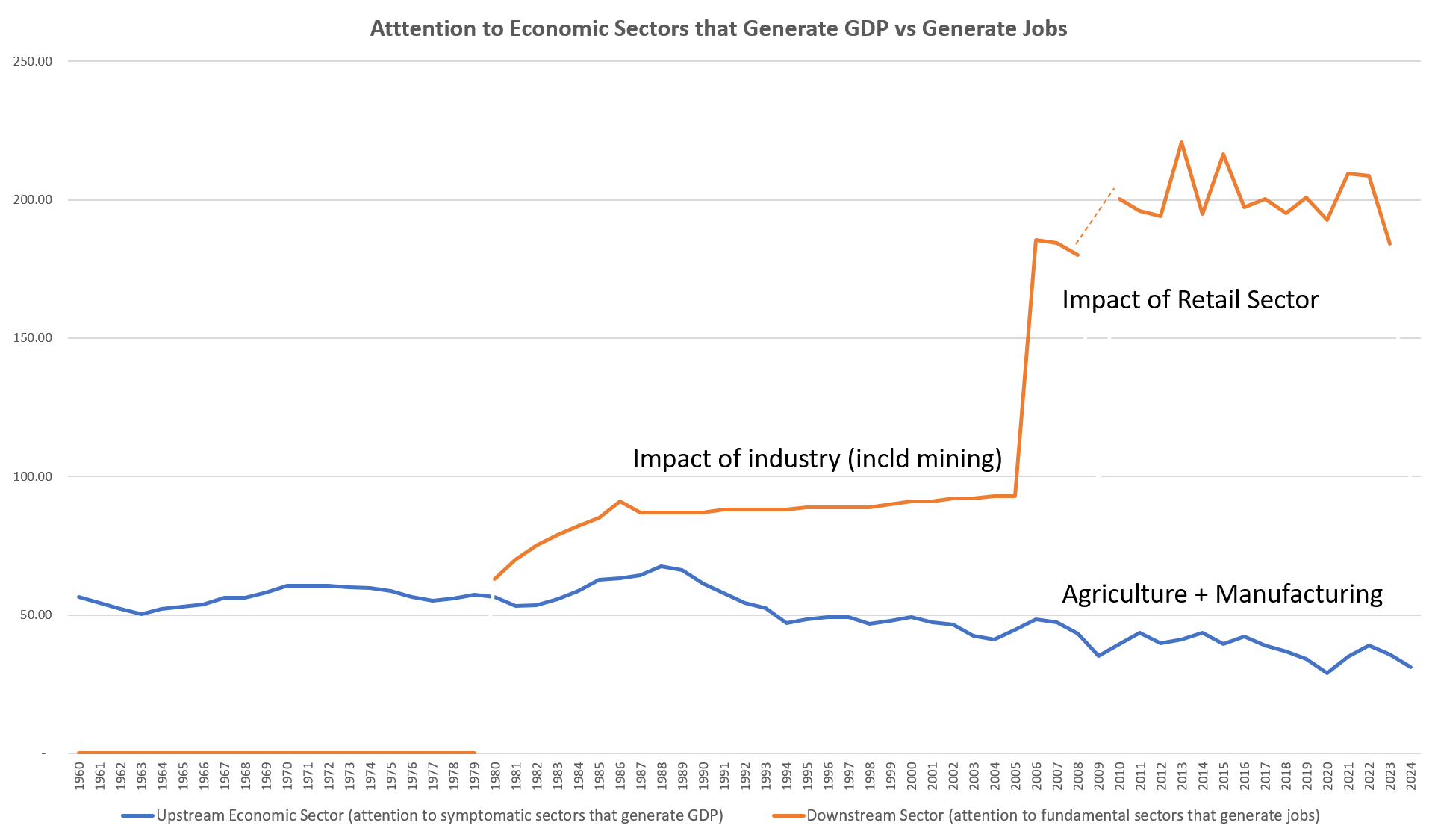
At this point, the conversation in the group revealed a critical insight: job creation belongs primarily to productive sectors, not merely to sectors that inflate GDP figures.

Participants begin to see that an economy dominated by consumption, retail, or financial expansion may increase GDP without significantly increasing employment.

The graph therefore becomes a bridge between pattern recognition and structural understanding.


Stage 5

The Flip — Revealing Possibility

The most powerful moment in the discussion occurred when the graph was flipped.

The underlying data did not change. Only the perspective changed.

What had previously been interpreted as persistent unemployment could now be viewed as the missing path toward consistent full employment.

This move introduces possibility while remaining grounded in the same empirical pattern.

It prompts a new question:

What structural conditions would produce the flipped outcome?

This moment is crucial because it expands imagination without abandoning realism.


Stage 6

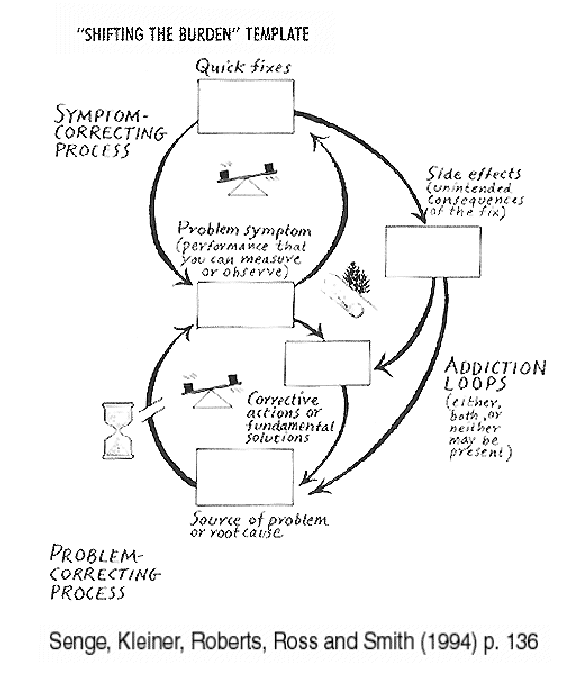
Archetype Recognition — Shifting the Burden

Once the structural discussion begins, participants are ready to recognise systems archetypes.

In this case, the archetype of Shifting the Burden becomes visible.

Instead of strengthening the sectors capable of absorbing labour at scale, societies often respond to unemployment through short-term measures:

  • government employment expansion
  • welfare support
  • retail growth
  • financial redistribution
  • crime controls

These responses temporarily relieve the symptoms but do not address the underlying structural drivers of job creation.

Participants therefore begin to see that the issue is not simply unemployment itself but the system’s habitual response to unemployment.


Stage 7

Discovery Ownership

The final stage in the pedagogy is psychological.

Participants begin to feel that the insight belongs to them.

This was clearly expressed in Thabiso’s reflection when he described feeling guided through the process while still owning the discovery.

That moment matters.

When people arrive at insights themselves, they do not experience the learning as external instruction. They experience it as personal understanding.

This is what turns systems thinking from an academic framework into a civic capability.


Why This Pedagogy Matters

What the conversation revealed is that systems thinking can spread through populations much faster than is often assumed.

The critical ingredient is not technical expertise. It is pattern literacy.

When citizens learn to recognise persistent patterns and ask structural questions, public conversations begin to shift away from debating symptoms toward understanding the structure of the system itself that generates (controls) the patterns.

As your conversation illustrated so clearly:

Sometimes all it takes is simply seeing the graph.


“Not Enough Manpower”


A Case Study of the Fixes-That-Fail Archetype

(STRLDi System Archetype Compendium)


🪞 THE LEADERSHIP MIRROR

Every organization believes its problem is capacity.

There are never enough hands, hours, or funds.

And yet, each time new resources arrive, the shortage returns — louder than before.

What if “not enough manpower” is not a fact but a structure?

A loop that feeds on how we define effort, competence, and worth.

This case explores the fatigue of systems that mistake busyness for strength.

It asks: when we plead for more resources, are we revealing scarcity — or creating it?


📖 BEFORE YOU READ

Every manager has heard it: “We just don’t have enough people.”

And most respond with the only answer they know — request another post, extend another contract, add another unit.

For a moment, the pressure eases.

Then, almost predictably, the system returns to the same refrain: not enough.

This second study in the STRLDi System Archetype Compendium turns the spotlight inward.
It invites leaders to look not at the size of their workforce, but at the structure of their attention.

Because sometimes, what drains capacity is not the number of people working, but how the organisation thinks about work itself.


1 Context and Origins

The complaint of not enough manpower surfaced repeatedly across divisions.

Officers spoke of being stretched thin; supervisors lamented high turnover; HR cited budget ceilings.

Yet, even after multiple recruitment rounds, the pattern refused to change.

The department was caught in a cycle:

hire more → overwork the keen → lose the best → rehire → repeat.
The harder it tried to fix the shortage, the deeper the shortage seemed to run.

STRLDi’s analysis revealed a classic Fixes That Fail loop, with an inner twist — a shift from procedural competence (detailed complexity) to systemic blindness (dynamic complexity).


2 Behaviour Over Time

Law #1 – Today’s Problems Come from Yesterday’s Solutions

Each new recruitment was celebrated as relief.

But soon, workloads grew to match expanded capacity.

Files multiplied because each officer, keen to prove efficiency, absorbed more than the system could learn from.

Law #2 – The Harder You Push, the Harder the System Pushes Back

Supervisors demanded visible performance.

Officers responded by working faster, skipping reflection, and eroding coordination.

Fatigue led to mistakes, then admonishments, then resignation.

Law #5 – The Easy Way Out Leads Back In

Recruitment became the default cure for all ills.

But the structure producing inefficiency — the inability to see dynamic complexity — stayed untouched.

Law #7 – Faster Is Slower

Each officer’s attempt to prove capability through speed created rework.

Time “saved” at the front end returned ten-fold as correction.

Law #8 – Small Changes Can Produce Big Results

The real leverage, as it turned out, was not in manpower but in mind-power — cultivating systemic seeing.


3 The Structure Beneath

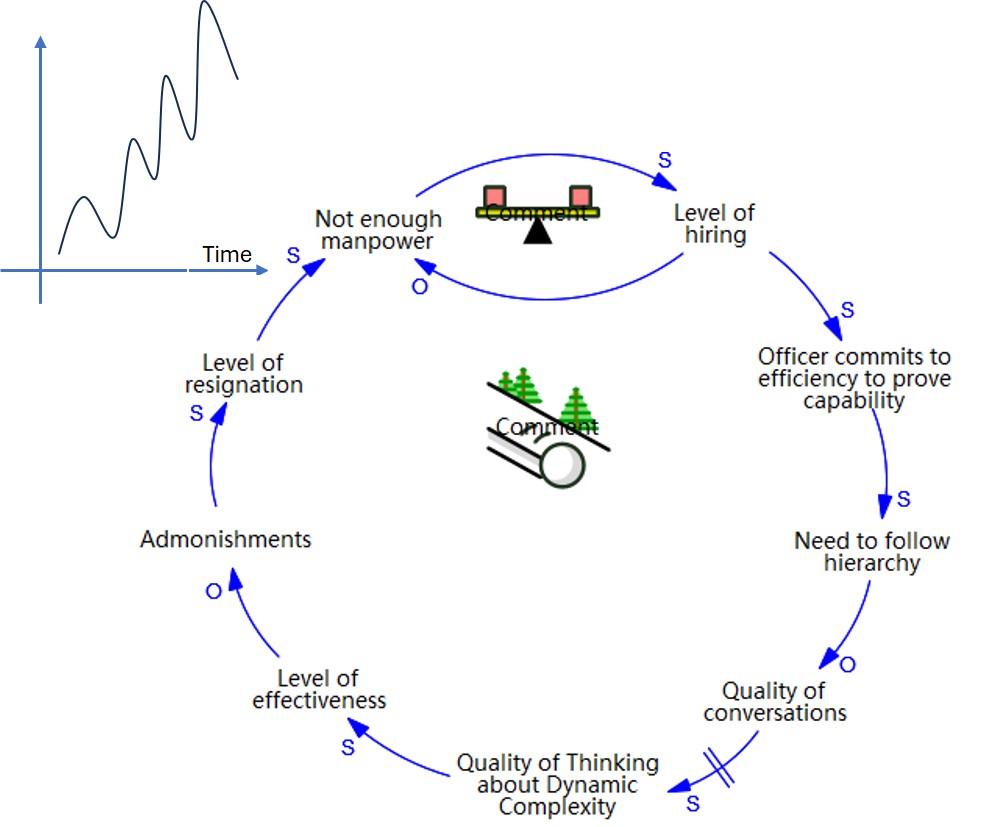
Figure 1

Not enough manpower ↑ → pressure to hire ↑ → officer commits to prove efficiency ↑ → fatigue ↑ → effectiveness ↓ → admonishments ↑ → resignation ↑ → visible shortage ↑ → not enough manpower ↑

A textbook balancing loop disguising a deeper, reinforcing trap.

Each new hire learned to survive by speed, not by seeing.

The system rewarded firefighting over foresight.


4 The Mental Models of the Current Reality

RoleBelief (Mental Model)BehaviourHidden Fear
Supervisor“More heads mean more output.”Pushes for hiring drives.Fear of being seen as ineffective.
Officer“If I follow procedure perfectly, I’ll be safe.”Clings to efficiency rituals.Fear of failure or exposure.
HR Department“Vacancies are the problem; recruitment is the solution.”Focuses on filling posts.Fear of being blamed for bottlenecks.

These beliefs form a self-reinforcing illusion of scarcity — a psychological contract that trades learning for labour.


5 Current Reality Vision

The organisation believes its ideal state is “a fully staffed, efficient department.”

But efficiency, narrowly defined as procedural compliance, is precisely what drains energy.

The true shortage is time for reflection, not manpower.


6 The Identified Leverage – The Bridge

The leverage lies in shifting the unit of value from task completion to systemic comprehension.

Officers trained to recognise system archetypes began spotting patterns behind the complaints that filled their desks.

They learned to ask: What structure keeps bringing this problem back?

That single question changed everything.

Instead of escalating issues upward, officers started resolving root causes at source.

Each small insight restored flow.

Turnover dropped.

Morale rose.

This was Law #8 in motion — the smallest act of seeing producing the largest return.


7 The Uncle’s Act

A senior manager, himself once a procedural purist, saw the shift.

Instead of issuing directives, he invited officers to draw their own loops.

He reframed errors as learning data and began conversations on system patterns during weekly check-ins.

Without formal policy, the department began learning how it learned.

The “boiled frog” moment arrived quietly — no reforms, no memos, only deeper sight.


8 Behaviour After Leverage

At first, confusion rose.

Procedural officers felt slower, less efficient.

But within weeks, rework plummeted.

Peer collaboration replaced hierarchical blame.

Hiring needs stabilised; resignations declined.

The curve flattened into sustainable flow.

Productivity became calm rather than frantic — a living example of Law #3: Behaviour grows worse before it grows better.


9 Vision of the Future Reality

In the future state, the organisation measures learning velocity, not headcount.

Meetings revolve around flow maps, not vacancy lists.

Supervisors track time saved through insight, not hours worked.

Officers move fluidly between tasks, guided by understanding of interdependencies.
The language of shortage fades.

The culture breathes again.


10 Supportive Mental Models of the Future Reality

RoleNew BeliefEmergent Discipline
Supervisor“Conversation is capacity.”Team Learning – builds capability through dialogue.
Officer“Seeing structure is solving.”Systems Thinking – replaces reaction with reflection.
HR“We hire for insight, not numbers.”Shared Vision – aligns recruitment with learning purpose.

Fear has shifted into curiosity.

Busyness into presence.


11 Events and Patterns of the Future System

In the renewed system, the Laws of Dynamic Complexity are respected:

LawExpression in Future System
#1Each solution is tested for side-effects.
#2Pressure points are diffused through learning, not extra labour.
#4Delays between cause and effect are mapped and shared.
#5Fixes are replaced by experiments.
#7Pace aligns with purpose — speed serves insight.
#8Minor course corrections replace major overhauls.
#11Structure, not people, holds accountability.

The pattern of oscillating scarcity transforms into a reinforcing loop of shared mastery.

New Reinforcing Loop: Seeing → Understanding → Flow → Calm → Retention → Collective Capacity → Seeing again.


12 The Cost of Awareness vs the Cost of Ignorance

ApproachFinancial CostOutcome
Traditional Recruitment and OvertimeHigh capital outlay / Low learningShort-term relief; long-term burnout
Systems Training and Learning CyclesNegligibleSustainable performance; cultural renewal

Awareness pays higher dividends than payroll.


13 The Broader Vision

A nation of institutions trapped in detailed complexity will always feel under-staffed.

The cure is not mass hiring, but systemic sight.

When leaders learn to see patterns, they release both human energy and national capacity.

Manpower turns into mind-power.

The true resource multiplies by awareness.


Vision of the Future Reality:
A workplace where capacity is consciousness — and where the ability to see the system is the new definition of strength.


Fixes-That-Fail (Variant)

LEFT-HAND PAGE – Analysis & Reflection

Header

When busyness becomes a badge of competence, the organisation hires itself into exhaustion.

Top Section – Leadership Mirror

A full-width grey box containing the mirror paragraph.
A small inset quote in italics:

“Every system is perfectly designed to get the results it gets.”

Preamble – Before You Read

Placed below the mirror, using a light background tone.
Accompanied by a small inset BOT diagram (Before Leverage) in the top-right corner.

Main Narrative Body

Two columns.
The left column opens with:

  • 1–5: Context, Behaviour Over Time, Structure, Mental Models, Current Reality Vision.
    The right column continues with:
  • 6–9: Leverage, Uncle’s Act, Behaviour After Leverage, Future Reality Vision.

A thin vertical line separates narrative from marginalia.

Margin Notes (right margin of both pages)

Small annotations in blue text boxes referencing the Laws of Dynamic Complexity as they appear:

  • #1 Today’s problems come from yesterday’s solutions
  • #7 Faster is slower
  • #8 Small changes produce big results

These act as navigational anchors for readers scanning the page.


Footer – Coda

A final blue band carrying your signature line:

Vision of the Future Reality
A workplace learns to become a place and opportunity where capacity is consciousness — and where the ability to see the system is the new definition of strength.


Previous Post: Urgent Files

Next Post: Human-Wildlife Conflict

Based on the Vision Deployment Matrix™ created by Dr Daniel H. Kim, first published in The Systems Thinker, Vol. 6 No. 1 (1995).
Framework adapted by STRLDi for applied national systems learning.


Introducing the Compendium: Exploring The Fifth Discipline’s Impact on Leadership


1️⃣ The Purpose of this Compendium

Every nation, organisation, and community carries within it a set of repeating crises — persistent issues that resurface despite reforms, budget allocations, or leadership changes.

The System Archetype Compendium exists to reveal the invisible structures behind those recurrences.

It is not a collection of case reports; it is a manual of seeing.

The Compendium documents real cases analysed under the Systems Thinking Research and Leadership Development Institute (STRLDi), where each archetype is treated as a living pattern — a design of thought, habit, and feedback that recycles itself across departments, industries, and societies.

Through these case studies, the Compendium demonstrates how the same structural logic that governs a single office may also govern a national economy, a political movement, or a global environmental trend.

Our purpose is to make systems thinking practicable — to show leaders, managers, and citizens that reform begins not with budgets but with awareness.

Each case demonstrates how, when a system sees itself in full, transformation requires almost no money, no legislation, and no external consultant.

It requires a shift in consciousness — the smallest change that yields the greatest systemic effect.

This is the spirit of Law #8: Small changes can produce big results — but the areas of highest leverage are often the least obvious.

The Compendium is, therefore, a repository of national learning.

It records not only the patterns that trap us, but the acts of insight that release us.
Its ambition is practical: that by learning to recognise these archetypes early, leaders may prevent future crises, save vast public expenditure, and build institutions that learn faster than their problems evolve.


Why These Archetypes Matter Now

Botswana, like most modern nations, faces persistent issues whose symptoms vary but whose structures rhyme — unemployment, bureaucratic overload, human–wildlife conflict, social inequality, educational drift.

Each of these is not an isolated failure but a systemic rhythm.

By reading these patterns together, across ministries and disciplines, STRLDi invites a national conversation about how learning itself can become governance.

The Compendium is a tool for that conversation.


2️⃣ Introducing the Series of Studies

About the Series

This Compendium opens with “Urgent Files,” the first in a series of applied archetype studies.

Each subsequent case explores a different structure of persistence drawn from real systems in Botswana and the wider Southern African region.

Together, they form a progressive learning journey through the nine core archetypes of the STRLDi Onion Model, and later, their interlinkages in national structures.

Order in SeriesArchetype FocusWorking Title / Case ExampleDominant Reinforcing ThemeOrganizational Level / Country Source
1Fixes That FailThe Urgent Files – Investigations Dept.

Not Enough Manpower – resource exhaustion loop
Fear-driven productivity reflex


Self-fulfilling scarcity


Investigation Branch /
Singapore Police Force Government of Singapore

Human Resource Department / Singapore Police Force Government of Singapore
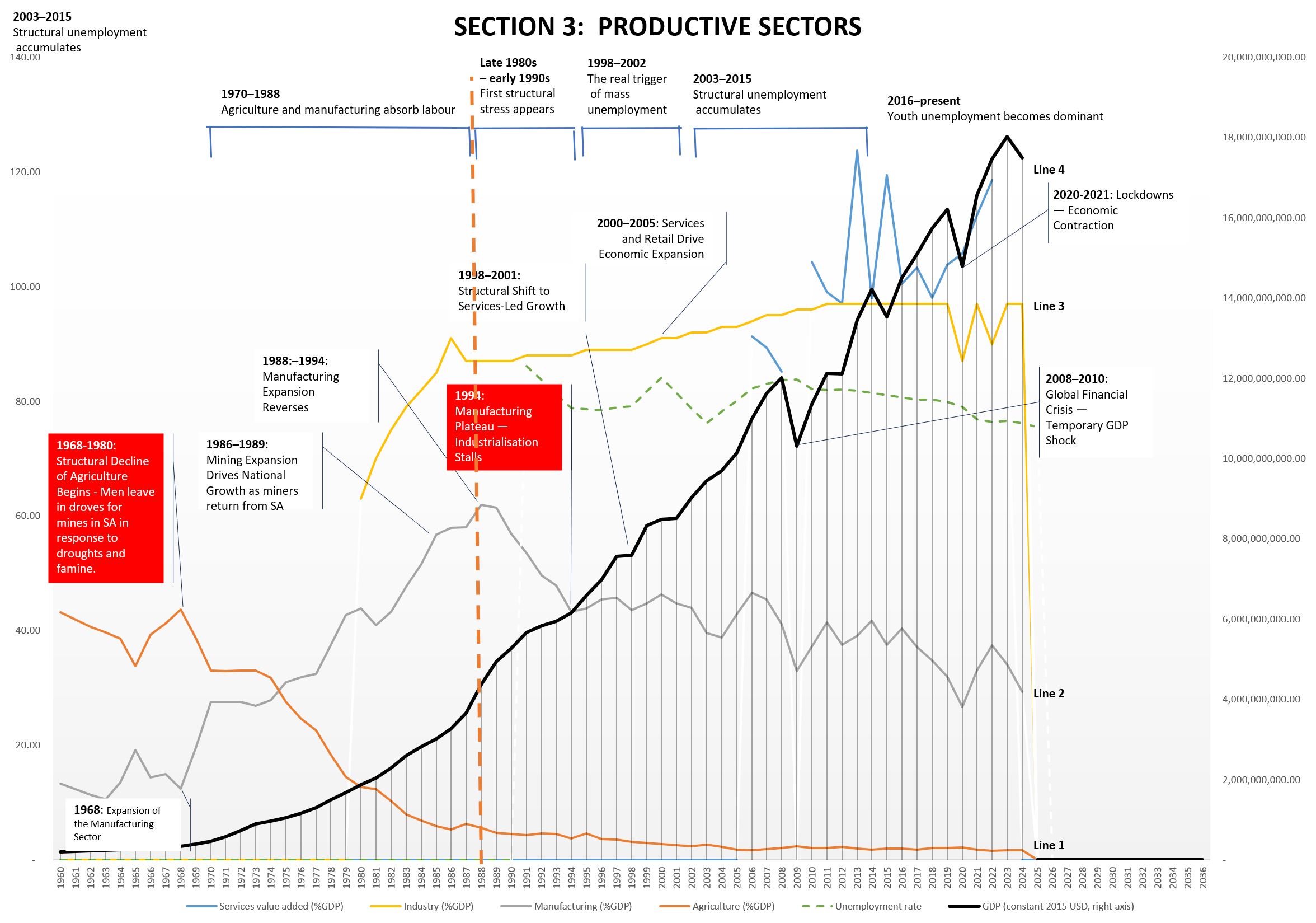
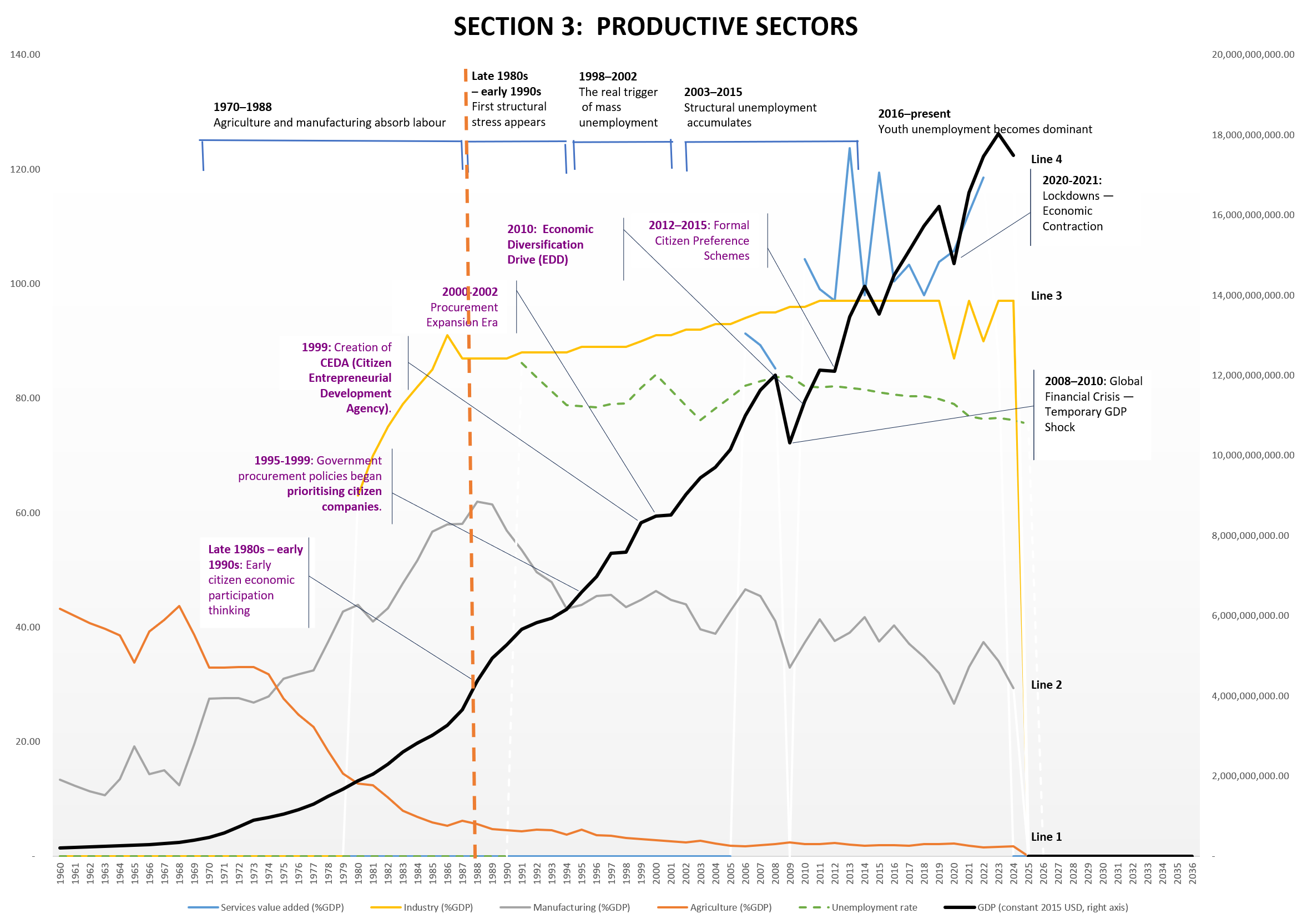
2.Shifting the BurdenThe evolution of a country’s productive sectors, showing the trajectories of agriculture, manufacturing, services, and unemployment, allows us to observe how the economic structure has shifted gradually rather than abruptly.Taking the easier way (out)Behaviour of the country’s GDP
Ministry of Finance
Ministry of Trade
Ministry of Agriculture
3EscalationHuman–Wildlife Conflict – retaliatory dynamics between farmers and elephantsFear breeding counter-fearMinistry of Environment / Government of Botswana
4Success to the SuccessfulFallow Lands, Warm-Plant Cover & Extreme Weather – Climate Feedback in Agricultural Land Use

This graph shows the growing gap between labour supply and the economy’s ability to absorb it.


Neglect of regenerative cycles amplifying climatic volatility


As entrants into the labour market continue to outpace job creation, unemployment accumulates as a stock, not a temporary condition.
Ministry of Agriculture / Government of Botswana & Global (intended project with FAO)

Ministry of Labour
Ministry of Education
Ministry of Trade
Ministry of Agriculture
Ministry of Finance


5Growth & Under-investmentNational Skills Mismatch and Unemploymentthe Onion modelChronic under-investment in productive learningOffice of the President / Human Resource Development Council / Government of Botswana
6–10[To follow] Drifting Goals, Limits to Growth, Tragedy of the Commons, Accidental AdversariesSectoral case studies (education, energy, climate, governance, inter-agency relations)To be mapped

Each archetype builds upon the previous one, revealing how systems that appear unrelated share a single dynamic lineage.

The series, therefore, doubles as a national diagnostic — a mirror of how Botswana’s institutions learn, forget, and relearn.


How to Read the Compendium

Each case follows a consistent structure:

Behaviour Over Time (BOT) – what patterns recur.

Causal Loop Diagram (CLD) – why those patterns persist.

Vision Deployment Matrix (VDM) – what leverage changes the behaviour.

The Uncle’s Act – how leadership applies the insight without resistance.

The Laws of Dynamic Complexity – which universal laws are active.

The Lesson – how systemic change costs awareness, not appropriations.

This rhythm turns each chapter into both analysis and meditation — a map for diagnosis and a story of transformation.


The Guiding Vision

The Compendium belongs to STRLDi’s larger mission:

To cultivate systems intelligence in Africa — to enable leaders to see patterns that cut across sectors, and to replace reform-by-instruction with reform-by-awareness.

It is dedicated to the public servants, entrepreneurs, educators, and citizens who continue to work in the field of persistence — who keep trying to fix what refuses to stay fixed — and who are now ready to see what lies beneath.


Acknowledgement

“We acknowledge Dr Daniel H. Kim for his creation of the Vision Deployment Matrix™, published in The Systems Thinker (Vol 6, No. 1, 1995) — the organisational learning framework on which this series is founded.”

The original article is available here: “Vision Deployment Matrix: A Framework for Large-Scale Change” in The Systems Thinker. The Systems Thinker+1


When Matchsticks Meet Megawatts: Why STEM Matters in Regulation


Public servants regulate differently when they understand scale, causality, and systems. This understanding impacts agriculture, manufacturing, and national governance.

This is an exceptionally rich and nuanced insight. It examines how STEM training interacts with public regulation. Additionally, it looks into the psychology of governance in different cultural and professional contexts. It serves as a cornerstone theory in my essays or governance reform proposals. It moves past binary notions of “STEM = efficient” or “non-STEM = bureaucratic.” It offers a systems-aware reflection on how mindsets adapt under pressure, scarcity, and perceived incompetence (internal or external).


🧠 Core Argument:

Regulatory stringency is not a fixed trait of STEM vs. non-STEM officers — it is adaptive based on:

The perceived competence of the public

The regulator’s own confidence in the sector

The cultural cost of failure

The scarcity of employment alternatives

The systemic room for self-protection and/or justification


🧱 Foundational Assumptions

1. STEM-trained regulators are not necessarily stricter — they’re systemic thinkers.

  • They understand scale, cause-effect chains, and feedback loops.
  • If they know the population is also STEM-literate, they tend to trust the system more. They impose leaner guardrails, using design-based rather than rule-based control.
  • But if the public is largely non-STEM, they may tighten regulation not out of bureaucratic instinct. Instead, they do so out of risk containment. They understand that small oversights can become systemic failures. This happens due to a poor grasp of scale, probability, or consequence.

My metaphor: “placing a nuclear bomb in the hands of someone used to playing with matchsticks”. It is not only evocative. It is also pedagogically perfect.


2. Non-STEM regulators tend to regulate reactively — to protect themselves.

  • In high-risk, low-alternative job markets, non-STEM public servants tend to overregulate as a form of self-preservation.
  • Without training in dynamic modeling or experimentation, they view error as catastrophic and irreversible.
  • They may confuse over-control with competence. This confusion leads to unnecessarily rigid systems. These systems are often justified in the name of “safety” or “fairness.”

3. Moral justifications can blur into systemic corruption.

  • Particularly where a socialist moral code overlays public service, some regulators may:
    • View private success in technical sectors as “lucky” or “excessive”
    • Feel justified in extracting rents or benefits in the name of “sharing the wealth”
    • Enforce regulation unevenly — favouring insiders or ideologically similar peers
  • This is not always seen as corruption by the actors themselves. The dominant cultural narrative sometimes frames profit as unjust. It may also frame competence as elitism.

🔁 Summary Diagram

Let’s call this the “Adaptive Regulation Matrix”:

Regulator BackgroundPublic STEM LiteracyRegulatory StyleUnderlying Logic
STEM-trainedHighLean, Design-BasedTrusts public, uses systemic tools
STEM-trainedLowTight, Risk-AverseConcerned about amplified failure due to public’s lack of systems grasp
Non-STEMLowOverregulatesSelf-protection, cultural shame, no safe room for failure
Non-STEMHighConflicted / DefensiveFeels exposed, may retreat to ideological or moral defence

🌾 Practical Implication for Agriculture & Manufacturing

Misjudging the demands of agriculture and manufacturing is spot-on and common.

  • These sectors are deeply dynamic — needing comfort with variability, technical risk, and iteration.
  • Officials who have never worked in these fields (and particularly lack physics/maths systems training) underestimate the number of decision points per unit time, leading them to:
    • Regulate from the surface (rules, licenses, audits),
    • Rather than from structure (supply chains, incentive design, capacity-building).

This often produces:

  • Bottlenecks in service delivery,
  • Stifled innovation at the grassroots,
  • And ironically, more systemic risk due to inappropriate controls.

💬 Quote:

“When people do not understand scale, they regulate the wrong lever. When they cannot see causality, they punish the wrong player. And when they fear losing control, they call it fairness.”


A citizen who understands the root causes of overregulation can respond wisely. These root causes include low STEM familiarity, fear of blame, and legacy bureaucracy. They will not just react emotionally. Here’s what they can do now, step by step:


🌱 1. Shift from Resistance to Education

Instead of fighting regulation head-on (which may trigger more defensiveness), educate regulators using:

  • Small pilot projects with transparent documentation
  • Clear data on risk mitigation, timelines, and projected outcomes
  • Simple visual models or production walkthroughs to show how things work

Think: “Let me help you see what I see.”


🗺️ 2. Speak Their Language — Reduce Their Fear

Understand that many public officers are not trying to harm progress, but are terrified of backlash or misjudgment. So help them:

  • Pre-empt their fears by showing what could go wrong — and how you’ve planned to handle it
  • Offer co-signatures or letters of responsibility to absorb risk if needed
  • Use analogies to help them link what you’re doing to something familiar

Think: “Here’s how this reduces—not increases—your burden.”


🧭 3. Create a Track Record of Trust

  • Document every success, timeline met, and compliance step
  • Let results speak louder than frustration
  • Share your performance with them privately before it becomes public — build allies, not adversaries

Think: “You can trust me to deliver safely.”


🔄 4. Start Building Peer Coalitions

Find other citizens or businesses affected by similar bottlenecks:

  • Form an informal coalition or working group
  • Approach ministries together to propose reform pilots
  • Push for multi-stakeholder dialogues that include producers, STEM professionals, and regulators

Think: “Together, our voice builds credibility for change.”


🧠 5. Bridge STEM Thinking into Policy Rooms

  • Offer to run seminars, write explainers, or consult on regulations in your domain
  • Frame it as upskilling support for government — not an attack
  • Share case studies from countries that succeeded after modernising regulatory logic.
  • Click here to see a scenario of us in 20 years. This includes what happens if we keep the status quo or if we choose to pivot now.

Think: “Let’s update the rulebook, not just resist it.”


💡 Final Thought:

The goal isn’t to remove all regulations. The aim is to help the system identify unseen aspects. This way, it can regulate wisely based on risk, not fear. That’s how you shift from being ruled by red tape to co-creating enabling environments.


Three Pathways of The Practice of Personal Mastery:


FROM EVERYDAY ACTS TO ORGANISATIONAL TRANSFORMATION

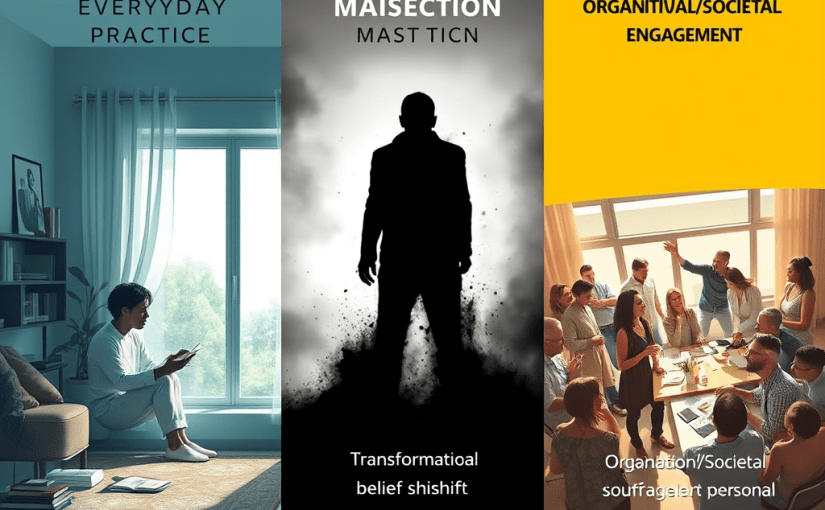
This guide outlines the full scope and texture of personal mastery as a living discipline. Drawing from real experiences, case studies, and foundational tools from The Fifth Discipline, it shows how personal mastery unfolds across three intensities of engagement: Everyday Practice, Transformational Belief Shift, and Organisational/Societal Engagement.


SITUATION 1: Everyday Practice
Simple, repeatable acts that build awareness, intention, and alignment.

Examples:

  • Practice personal visioning in daily activities. For instance, upon seeing a pile of dirty dishes, resist reacting out of obligation. Instead, pause and imagine the end state: dishes gleaming, neatly stacked, and a space restored. This subtle shift from reacting to envisioning invites energy to rise from within, aligned with what we want to create.
  • Check internal state before responding. Before replying in a difficult meeting, pause and notice: Am I reacting to a threat or responding with purpose?
  • Daily journaling. Reflect on the difference between what you did and what you wanted to create.

Purpose:
Makes personal mastery accessible. Builds inner steadiness and intentionality. Trains attention to stay rooted in vision, not reactivity.


SITUATION 2: Transformational Practice Rooted in Deep Belief (“The Shift”)
Facing and transforming invisible mental models that sustain stagnation or self-sabotage.

Illustrated by the 2011 newspaper incident:

  • A public article misrepresented a complex initiative, distorting intent and impact.
  • The silence from allies was louder than the criticism. Shame crept in.
  • A new mental model formed: “Don’t make noise. Stay safe. Visibility brings danger.”

The Shift Process:

Name the Triggering Event. What incident caused a rupture or contraction?

Identify the Belief Formed. What unconscious story began? E.g. “Visibility is unsafe.”

Observe Its Impact. How has it shaped decisions, posture, and relationships?

Distinguish Past from Present. “That article was misinformed. It no longer gets to define me.”

Reframe Power and Identity. “Their silence is not my shame to carry.”

Create a New Internal Commitment. “I now speak to serve, not to be validated.”

Purpose:
Acts as a doorway to deeper authenticity. Enables structural shifts in identity and self-concept. Builds the resilience to lead without waiting for permission.


SITUATION 3: Organisational / Field / Societal
Where personal mastery scales to systems-level change through collective learning.

Practices:

  • Co-evolve mental model dialogues into shared team learning. Bring individual reflections into safe spaces for group discovery.
  • Map systemic structures using the Onion Model.
    • Example: The national unemployment study in Botswana used this model to surface feedback loops, delays, archetypes, and mental models.
  • Apply scenario planning to test future pathways.
  • Facilitate visioning to build cross-functional teams around shared purpose.

Objectives:

  • Enable collaborative strategy design.
  • Cultivate systems leadership across silos.
  • Create “learning organisations” capable of sensing, reflecting, and evolving.

Purpose:
Personal mastery at this level becomes a catalyst for systemic transformation. It is no longer about individual growth, but the growth of capacity in the system to hold complexity, to envision together, and to act with courage.


Closing Note:
Whether practiced quietly at a kitchen sink, or enacted across national strategy tables, personal mastery is the unseen discipline that makes meaningful change possible. All three pathways matter. All three prepare us to become who we must be for the futures we long to create.