
“Often we are puzzled by the causes of our problems; when we merely need to look at our own solutions to other problems in the past.”
— Peter M. Senge, The Fifth Discipline
1. The Law (Peter Senge’s Original wording)
Law #1: Today’s Problems Come From Yesterday’s Solutions
2. Understanding the Law
Perhaps no law in The Fifth Discipline is more important for those entrusted with leading institutions, sectors, nations and regions than the first. It immediately challenges one of the most deeply held assumptions in management and public policy—that today’s problems originate in today’s circumstances. Peter Senge argues otherwise. He suggests that many of the difficulties confronting us today are neither accidental nor new. They are often the delayed consequences of decisions, policies and interventions that once appeared entirely appropriate, rational and successful.
This observation fundamentally changes the nature of leadership. Instead of beginning with the question, “How do we solve the problem before us?”, the systems thinker begins with a different enquiry: “What previous intervention, introduced to solve an earlier problem, has contributed to the reality we are experiencing today?” The difference between these two questions is profound. The first searches for another solution. The second searches for the structure that has quietly connected yesterday’s decisions to today’s outcomes.
3. Peter Senge’s Demonstration
Peter Senge illustrates this law through four examples that, although drawn from very different contexts, exhibit precisely the same systemic behaviour.
The first is the story of a rug merchant who repeatedly stamps on a bump appearing beneath an expensive carpet. Each time the bump disappears, it simply reappears elsewhere. Only after lifting the carpet does he discover an angry snake moving beneath it. The visible bump was never the problem. It was merely the observable behaviour of a hidden structure.
The second example concerns a company that introduces a successful sales rebate programme. Quarterly sales improve immediately, only to decline sharply in the following quarter because customers simply brought forward purchases they would otherwise have made later. Revenue was not created. It was shifted through time.
The third example involves an organisation that aggressively reduces inventory to lower carrying costs. Inventory falls, but delivery delays increase, customer complaints multiply, and sales personnel redirect their effort from generating new business towards managing dissatisfied customers. One problem has been reduced, while another has quietly emerged.
Finally, Senge describes efforts to eliminate drug trafficking from one district of a city. Crime falls temporarily in one location only to increase elsewhere, or new forms of criminal behaviour emerge in response to changes in supply and price. The intervention relocates the symptom without changing the conditions producing it.
Each example appears different.
Each follows exactly the same systemic logic.
4. The Mathematics Hidden Beneath the Stories
Viewed scientifically, these examples are not primarily stories about management. They are demonstrations of dynamic behaviour produced by interacting feedback structures.
In every case, the intervention introduced is a balancing response. It seeks to reduce the visible gap between the present condition and a desired condition. The bump is pressed down. Sales are increased. Inventory is reduced. Crime is suppressed.
Yet in every case, the behaviour being managed is being generated by an underlying reinforcing structure that remains fundamentally unchanged.
Mathematically, the balancing intervention reduces the observable symptom, while the reinforcing process continues generating behaviour beneath the surface. Initially, the balancing effect dominates and the intervention appears successful. Over time, however, the reinforcing dynamics continue accumulating until they once again become visible, often through a different variable, in another location, or after a significant delay. The original problem has not disappeared. It has simply changed its expression.
This distinction is central to systems thinking. Behaviour is not the structure. Behaviour is the consequence of structure operating over time.
5. A National Illustration: Singapore’s Population Policy
THE POPULATION CONTROL STORY
Here is another example of a young nation learning to understand the consequences of controlling its population—except that it would only fully appreciate those consequences from the vantage point of its future.
Singapore in the 1960s was a young country struggling to establish itself. It had only recently gained independence from its British colonial rulers and, shortly thereafter, separated from neighbouring Malaya, with whom it had long shared its people, history, trade and natural resources. Overnight, it found itself having to survive as an independent nation with very limited land, no significant natural resources of its own, inadequate water supplies and insufficient agricultural land to feed its people. Much of its raw materials, food and water continued to come from Malaysia.
The challenge facing the young nation was formidable.
- Today, Singapore occupies approximately 722 square kilometres and supports a population of about 5.6 million people, giving it one of the highest population densities in the world at nearly 7,900 persons per square kilometre. By comparison, Botswana occupies 600,370 square kilometres—more than 800 times the land area of Singapore—yet has a population of only about 2.3 million, averaging just four persons per square kilometre. The contrast illustrates the vastly different structural realities confronting the two countries.
- Singapore also inherited a multicultural society comprising predominantly Chinese, Malay and Indian communities whose traditions were deeply rooted in agrarian cultures where larger families were both economically valuable and socially desirable.
- At the very time Singapore was seeking to industrialise, attract investment and build a modern economy, it also had to ensure that housing, schools, hospitals, transport and employment could keep pace with a rapidly growing population concentrated on a very small island strategically located along one of the world’s busiest shipping routes.
- National leaders concluded that unless population growth could be moderated, the country’s ability to provide adequate infrastructure and public services (schools, hospitals, housing, etc.) would be overwhelmed.
Consequently, one of the earliest major public policies introduced after independence was the well-known “Stop at Two” campaign, encouraging every family to have no more than two children.
The policy achieved exactly what it had been designed to accomplish.
Over successive decades, fertility steadily declined. Families that had once averaged five children gradually reduced to three, then two, and eventually one child—or, increasingly, none at all. Singapore’s Total Fertility Rate fell from approximately 5.45 births per woman in 1960 to only 1.20 births per woman by 2016, one of the lowest fertility rates in the world. Rising educational attainment, increasing participation of women in the workforce, higher living costs, changing aspirations and limited personal time reinforced the trend as many couples delayed marriage, postponed childbirth or chose not to have children altogether.
Success, however, quietly created a new structural reality.
When each generation produces fewer children than the one before it, the reinforcing process that once generated population growth begins reinforcing population decline instead. Simply stated, one child cannot replace two adults. Over time, the domestic labour force becomes progressively smaller just as economic development continues expanding opportunities for employment. Singapore eventually found itself confronting a very different problem from the one it had originally set out to solve.
The solution to this new challenge was equally significant.
To sustain continued economic growth, Singapore progressively opened its doors to foreign workers, professionals and permanent residents. Immigration became an increasingly important source of labour, skills and economic capacity. By 2014, Singapore’s total population had reached approximately 5.47 million, comprising 3.87 million residents (citizens and permanent residents) and approximately 1.6 million non-residents. By 2016, the population had increased further to 5.61 million. More significantly, foreigners—including permanent residents and non-residents—had come to represent a substantial proportion of the nation’s population and workforce.
The question for systems thinking is not whether the original policy succeeded.
It undoubtedly did.
The question is whether the policy also changed the reinforcing structure producing population behaviour—or whether it simply changed the behaviour observed over a particular period of time.

Singapore’s general economic indicators
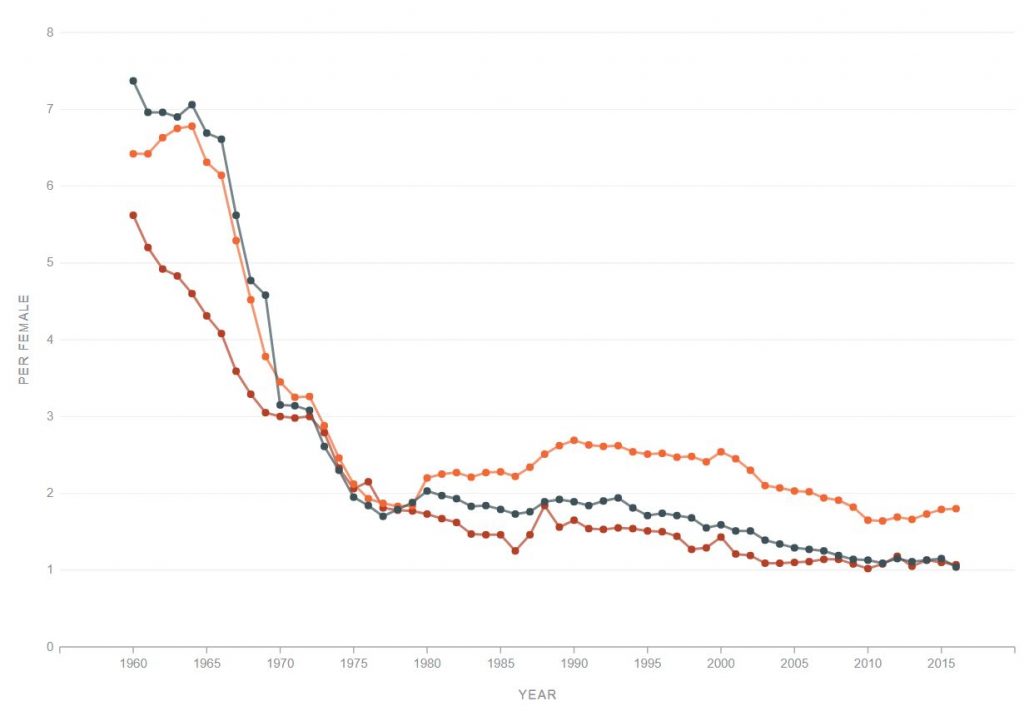
Ratio of male Chinese (red), Malay (orange) and Indian (blue) to females, 1960-2016 A high ratio suggests an influx of male migrants.
[Note: We shall present here data that shows the proportion of contribution to the population by citizens and residents when it becomes available.]
LEARNINGS: KEY QUESTIONS
- So, where did today’s problems come from? Yesterday’s solution. Right!
- How long ago was yesterday’s solution? Sixty years ago. Right!
- Would that mean, that we would need to wait 60 years from today’s solutions to learn the consequence of tomorrow’s problems? What could have happened to see sooner that this was coming?
To do this, let us put two figures side by side. One where population were controlled and the other that was not.

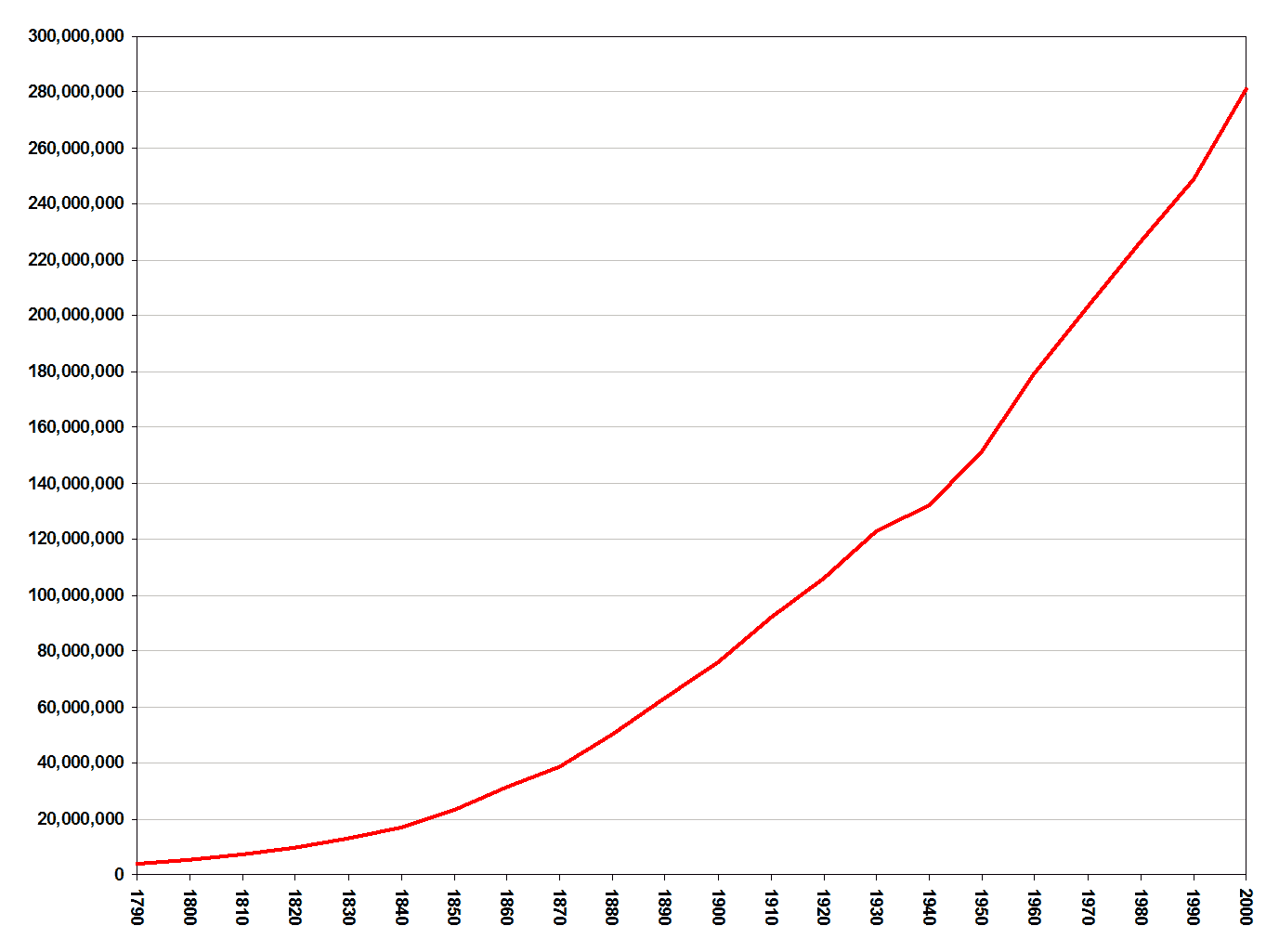
A close-up view The population of United States 1790-2000
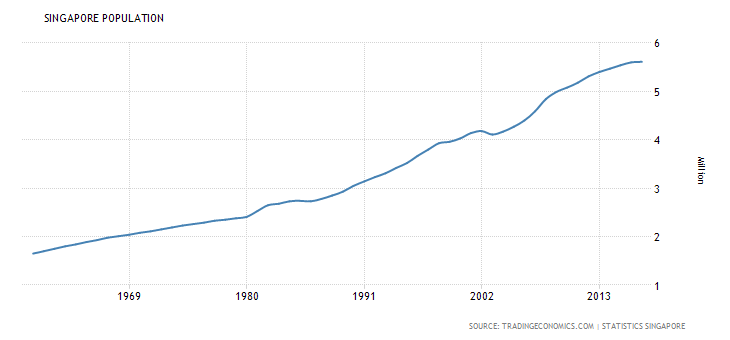
The population of Singapore (after increasing the proportion of foreigners to 64%)1960-2016
What do you notice?
Seeing the Structure
Population growth is fundamentally a reinforcing process. Every generation creates the conditions from which the next generation emerges. Left undisturbed, population does not behave as a balancing structure seeking equilibrium. It either reinforces positively or reinforces negatively depending upon the interactions occurring within the system.
Singapore’s policy represented a balancing intervention imposed upon a reinforcing structure. It successfully moderated the visible behaviour required at one point in the nation’s development. Over time, however, the reinforcing structure continued responding to changing economic, social and cultural conditions. Rising educational attainment, increased workforce participation, changing aspirations, higher living costs and delayed family formation collectively reinforced declining fertility. Eventually, the challenge confronting Singapore was no longer excessive population growth but insufficient population replacement.
The structure had not disappeared.
It had changed direction.
The Leadership Implication
The lesson extends far beyond population policy.
Every major institution introduces balancing interventions through legislation, regulation, taxation, incentives, strategic plans, organisational redesign and public policy. These interventions are essential instruments of governance. The question is whether they are informed by an equally deep understanding of the reinforcing structures whose behaviour they seek to influence.
The responsibility of institutional stewardship is therefore not merely to determine whether a policy achieves its immediate objective. It is to determine whether the policy is altering the structure producing the behaviour or merely modifying its visible expression. This distinction determines whether today’s success becomes tomorrow’s challenge.
A society that understands reinforcing structures gradually requires fewer corrective interventions because its citizens increasingly regulate their own behaviour through shared understanding. Leadership evolves from governing primarily through policy towards governing through knowledge, evidence and collective learning. This is one of the defining characteristics of a learning organisation, a learning nation and, ultimately, a learning civilisation.
6. Key Questions for Institutional Reflection
The purpose of these questions is not to test knowledge, but to discipline observation. Before attempting to solve any persistent problem, leaders should first pause to examine the behaviour they are observing, the structures that may be producing it, and the assumptions informing their interventions. The quality of our questions often determines the quality of our understanding.
Observing Behaviour
- What problem has become visible today?
- Is this genuinely a new problem, or could it be the delayed consequence of an earlier decision, policy or intervention?
- How long ago might “yesterday” actually have been? Five years? Twenty years? Sixty years? An entire generation?
- What evidence suggests that the behaviour has been developing over time rather than appearing suddenly?
Looking for Structure
- What reinforcing or balancing structures could be producing the behaviour we are observing?
- Are we responding to a symptom, or have we identified the structure generating the symptom?
- Which variables are interacting to produce this behaviour over time?
- What important variables are missing from the data currently informing our decisions?
Examining Existing Solutions
- Which earlier solution appears to have created today’s circumstances?
- Was that solution inappropriate, or was it appropriate for the understanding available at the time?
- What assumptions guided the original intervention?
- Which of those assumptions may no longer hold today?
Thinking Across Time
- If today’s solution becomes part of tomorrow’s structure, what behaviours are we unintentionally beginning to create?
- What consequences might emerge five, ten or fifty years from now if the present intervention continues unchanged?
- If future leaders were to examine today’s decisions, what problems might they inherit from us?
- What information would allow us to recognise those consequences before they become visible events?
Governing Through Understanding
- Could greater public, organisational or stakeholder understanding reduce the need for additional policies and regulations?
- What knowledge would people require in order to regulate their own behaviour rather than relying primarily upon external controls?
- How might better understanding of the underlying structure change the decisions people make?
- What would leadership look like if its primary responsibility became making systemic structures visible rather than merely correcting undesirable events?
Connecting to the Next Law
Law #1 teaches us that today’s problems frequently originate from yesterday’s solutions. It also invites a deeper question. If problems are generated by structures unfolding through time, who, then, is responsible? Is the problem the consequence of one person’s decision, or does it arise from the interactions of many people operating within the same system?
This question leads naturally to Law #11 — There Is No Blame. Once we begin seeing behaviour as the product of systemic structures rather than isolated actions, leadership shifts from assigning fault to understanding relationships. It is through this transition that organisations, sectors, nations and societies begin moving from reactive management towards genuine institutional learning.
7. STRLDi Interpretation
Peter Senge states the First Law simply:
Today’s problems come from yesterday’s solutions.
Its power lies in its simplicity. Yet, upon closer examination, the law invites a deeper question. Why do yesterday’s solutions repeatedly become today’s problems? More importantly, why does this pattern continue to repeat itself across organisations, governments, sectors and even civilisations?
The STRLDi interpretation proposes that today’s problems arise because yesterday’s solutions were designed to address yesterday’s understanding of the problem. In most cases, those solutions were both rational and appropriate given the information available at the time. However, they were frequently directed towards the visible symptoms of a situation rather than the underlying systemic structure generating the behaviour. Consequently, while the immediate problem appeared to improve, the deeper causal relationships remained largely unchanged.
This understanding reveals that the First Law is not describing a single event or an isolated management mistake. It is describing a continuous evolutionary process. Yesterday’s problems were themselves the consequences of solutions implemented even earlier. Today’s problems emerge from yesterday’s solutions. Unless we understand the structures producing these behaviours, today’s solutions will, in turn, become tomorrow’s problems. The law therefore describes an ongoing chain of cause and consequence unfolding across time rather than a series of disconnected events.
Seen in this way, every generation inherits structures it did not create. Through its decisions, policies and interventions, each generation modifies those structures before passing them on to the next. Leadership therefore becomes far more than solving the problems of the present. It becomes an act of stewardship in which today’s decisions shape the realities future generations will inherit. The quality of that inheritance depends not simply on the quality of today’s solutions, but on the depth of understanding upon which those solutions are based.
The implication for institutional leaders is profound. Sustainable improvement is achieved not by continually searching for better solutions to recurring problems, but by progressively improving our understanding of the structures that generate those problems in the first place. As our understanding of systemic structure deepens, our interventions become more aligned with the natural behaviour of the system. Solutions increasingly build future capability rather than creating future difficulty.
The First Law therefore points beyond problem solving. It calls leaders towards structural understanding. It reminds us that every intervention becomes part of the system it seeks to improve, and every decision contributes to the structures that will shape tomorrow’s behaviour. The enduring question for every steward of an organisation, sector, nation or international institution is therefore not simply, “Does this solve today’s problem?” but rather, “What future behaviour will this decision begin to create?”
Only when leadership consistently asks that second question do today’s solutions begin to create tomorrow’s possibilities rather than tomorrow’s problems.
8. Link to the Companion Law
From Law #1 to Law #11
Law #1 naturally leads to Peter Senge’s final law: There Is No Blame.
If today’s problems are frequently the delayed consequences of yesterday’s well-intentioned solutions, then assigning responsibility to today’s leaders, today’s institutions or today’s generation is rarely sufficient. By the time the consequences become visible, the original decisions may have been taken decades earlier, under entirely different circumstances and in response to challenges that were themselves very real.
Systems thinking therefore redirects our attention away from blame and towards understanding. The critical question is no longer “Who created this problem?” but “What structure connected yesterday’s decisions to today’s outcomes?” Once that structure becomes visible, responsibility shifts from defending past decisions towards redesigning the conditions that future generations will inherit.
Law #1 therefore, teaches us where today’s problems originate.
Law #11 teaches us how responsible stewards should respond.
Together they invite leaders to move beyond solving isolated problems and towards designing institutions capable of learning across generations. That, ultimately, is the purpose of systems thinking.
Next –> Law #2


You must be logged in to post a comment.