
Why This Law Matters
Human beings naturally seek relief from discomfort. When confronted with a persistent problem, our instinct is to look for a remedy that produces the quickest and most visible improvement. If the intervention appears successful, confidence in the solution grows and we are encouraged to apply it again whenever the problem reappears. Rarely do we stop to ask what effect repeated dependence on that intervention may be having on the system’s own ability to solve the problem.
This law warns us that not every successful intervention is a healthy one. Some solutions achieve immediate results while quietly weakening the very capabilities the system requires for its long-term survival. Over time, the intervention itself becomes increasingly necessary because the underlying system has lost the capacity to perform functions it once carried out naturally. What began as a temporary remedy gradually becomes a permanent requirement.
This phenomenon extends well beyond organisations. Individuals, families, businesses, governments and even nations can become dependent upon external interventions that were originally intended only to provide temporary support. The greater the dependence becomes, the more difficult it is for the system to recover its own capability. Eventually, the intervention no longer supports the system; the system begins supporting the intervention.
Understanding the Law
At first glance, the title of this law appears exaggerated. How could a cure become worse than the disease it was intended to treat? Systems thinking answers this question by directing our attention away from the immediate effects of the intervention and towards its influence on the long-term capability of the system itself.
Every intervention produces at least two forms of feedback. The first is the symptomatic response, where the visible problem is reduced and conditions appear to improve. The second is the systemic response, which often develops much more slowly and affects the underlying capability of the system to resolve similar problems independently in the future. When the intervention repeatedly substitutes for the system’s own capacity to respond, that capacity gradually weakens through lack of use.
This is why systems thinkers describe the pattern as “Shifting the Burden to the Intervenor.” Instead of strengthening the system itself, responsibility for solving the problem is progressively transferred to an external helper. Each successful intervention increases confidence in the helper while reducing investment in developing the system’s own capabilities. The intervention therefore becomes increasingly indispensable, not because the original problem has grown worse, but because the system has become progressively less capable of solving it without assistance.
The danger lies in the fact that this transition occurs almost invisibly. Each intervention appears reasonable when viewed independently. The dependency develops gradually over many repeated cycles of assistance until the system eventually reaches a point where removing the intervention appears more threatening than the original problem itself. By then, the cure has become more difficult to escape than the disease it was intended to address.
Peter Senge’s Demonstrations
Peter Senge introduces this law through the familiar example of alcoholism. Social drinking may initially appear to relieve stress, anxiety or low self-esteem. The temporary relief reinforces the behaviour and encourages repeated use whenever similar emotional pressures arise. Over time, however, alcohol gradually becomes the primary mechanism through which the individual copes with life’s difficulties. The original stresses remain unresolved while new problems emerge, including declining health, damaged relationships, reduced self-esteem and increasing dependency. The apparent cure eventually becomes more destructive than the condition it originally sought to relieve.
Senge argues that the same systemic structure appears throughout organisations, governments and societies. Well-intentioned interventions frequently produce short-term improvements while simultaneously weakening the recipient’s own ability to solve similar problems independently. Systems thinkers describe this recurring structure as “Shifting the Burden to the Intervenor.” Whether the intervenor is a government agency, a welfare programme, an international donor, a consultant or another organisational support function, the long-term consequence is often the same: the receiving system becomes increasingly dependent upon continued assistance.
To illustrate the universality of this pattern, Senge presents several examples. Governments may respond to struggling communities through continuing welfare or relief programmes that alleviate immediate hardship while unintentionally reducing local capacity for long-term self-reliance. Businesses may repeatedly engage consultants to solve operational problems rather than developing the capabilities of their own managers. Individuals may shift the burden of performing simple calculations to electronic calculators, or families may transfer responsibilities once carried by extended family structures to external institutions. In every case, the intervention succeeds in reducing the immediate symptom while gradually transferring responsibility away from the system itself.
Senge observes that these interventions often become addictive because each successful application reinforces reliance upon the intervenor. The more the intervention appears to work, the more frequently it is used. Consequently, the intervenor’s influence expands while the receiving system’s own capability contracts. Over time, the solution evolves from being a temporary source of assistance into an essential component of the system’s continued functioning.
For this reason, Senge concludes that lasting solutions must do more than remove symptoms. They must strengthen the ability of the system to shoulder its own burdens. Effective interventions therefore focus not only on immediate improvement but also on building the knowledge, confidence, structures and capabilities that enable the system eventually to function successfully without continued external assistance. Only then does the cure restore health rather than creating dependency.
The STRLDi Interpretation
When the Cure Has a Goal of Its Own
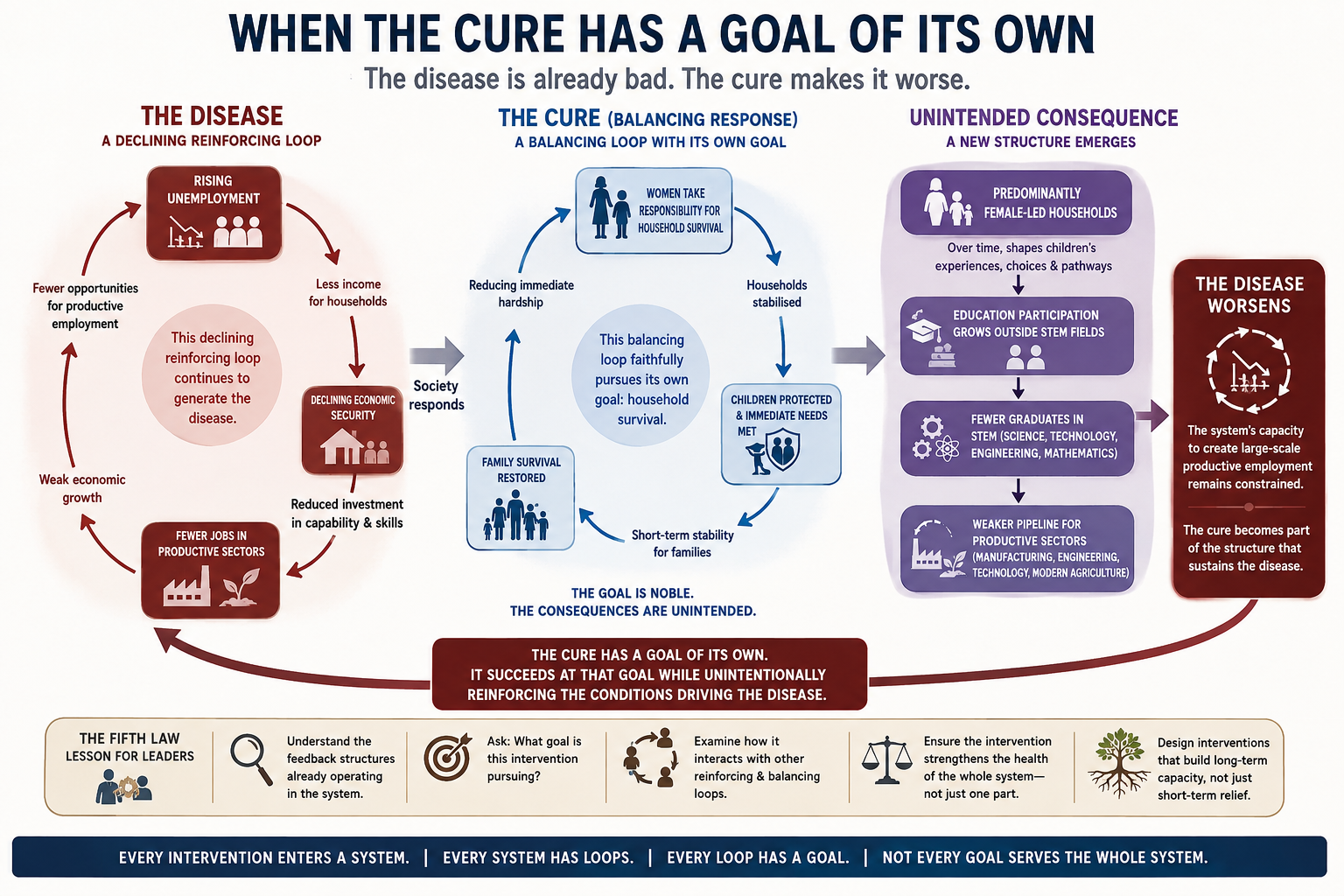
The Fifth Law is commonly understood to mean that an intervention may eventually become more harmful than the problem it was intended to solve. While this is true, the STRLDi unemployment study suggests that the law extends even further. The disease is already weakening the system. The cure can make the disease worse. A balancing loop faithfully pursues its own goal. If that goal is disconnected from the health of the larger system, the balancing loop can stabilise one part of the system while accelerating the decline of another. Unless we understand how these interacting feedback structures influence one another, interventions intended to solve one problem may unintentionally strengthen another.
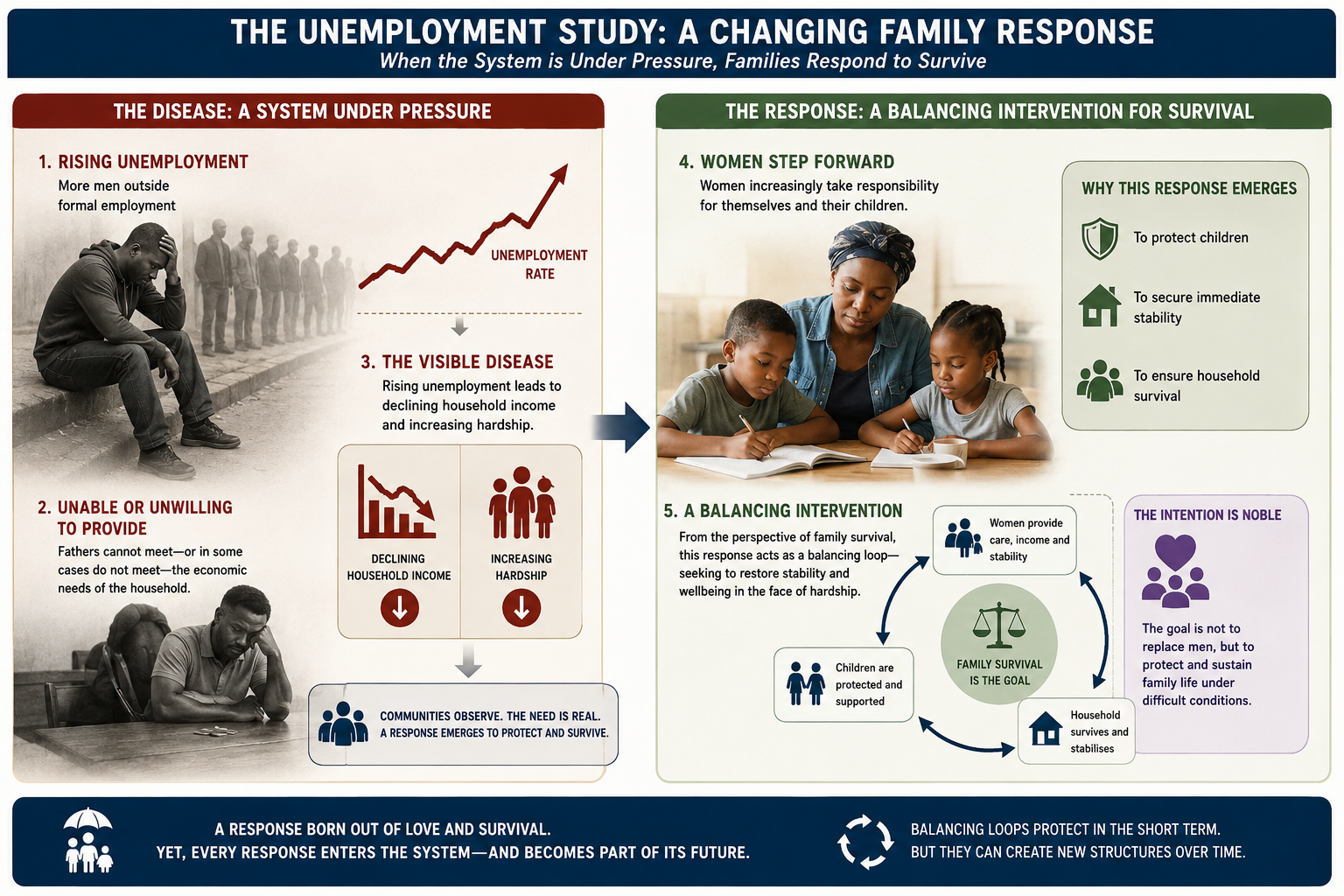
A systems intervention never occurs in isolation. Every intervention enters an existing network of reinforcing and balancing feedback loops that are already responding to conditions within the system. The intervention therefore becomes part of that larger structure. If the original problem is being generated by a declining reinforcing loop, introducing a balancing response may temporarily relieve the visible symptoms without changing the reinforcing structure that continues producing the decline. Instead, the balancing loop begins pursuing its own objective, often with unintended consequences that reinforce the original problem.
The Unemployment Study
The national unemployment study illustrates this dynamic through the changing structure of the family. As unemployment increased and growing numbers of men found themselves outside formal employment, many fathers gradually became unable—or in some cases unwilling—to provide economic security for their households. The visible disease confronting society was therefore rising unemployment and declining household income. Communities naturally responded to protect themselves against these worsening conditions.
The response was both understandable and immediate. Women increasingly assumed responsibility for the survival of themselves and their children, often choosing to raise families independently rather than remaining in relationships where economic support could no longer be relied upon. From the perspective of family survival, this response represented a balancing intervention. It sought to restore stability, protect children and secure the immediate wellbeing of the household under increasingly difficult circumstances.
When Survival Creates a New Structure
The balancing response, however, was pursuing a different goal from the unemployment system itself. Its objective was the survival of the household, not the restoration of productive employment. Over time, large numbers of children therefore grew up in predominantly female-led households. Within the unemployment study, this emerging family structure became an important systemic condition rather than simply a social outcome.
The study suggests that this changing structure has important implications for national capability formation. As successive generations progressed through the education system, participation became increasingly concentrated in disciplines outside the STEM fields that underpin manufacturing, engineering, technology and productive agriculture. These sectors form the productive foundation upon which expanding formal employment depends. Consequently, while educational attainment continued improving, the capability profile required to strengthen the country’s productive economy did not expand at the same rate.
The Cure Begins to Reinforce the Disease
The consequence is deeply systemic. The balancing response succeeded in helping many families survive under difficult economic conditions. Yet over time, the broader system continued producing fewer graduates equipped for the sectors responsible for creating large-scale productive employment. The country’s capacity to expand manufacturing, modern agriculture and other STEM-intensive industries therefore remained constrained, making it increasingly difficult to generate the very employment opportunities required to address the original problem.
The system had not failed because the balancing response was irrational. It had failed because the balancing response was successfully achieving its own objective while the declining reinforcing loop driving unemployment remained largely unchanged. The cure therefore became part of the structure sustaining the disease. What initially protected households gradually contributed to conditions that made long-term recovery increasingly difficult.
The System Must Heal Itself
The Fifth Law therefore carries an important lesson for leaders responsible for persistent national challenges. Every intervention has a purpose, but not every purpose serves the health of the larger system. Before introducing corrective action, leaders must first understand the feedback structures already operating within the system and ask whether the proposed intervention strengthens the system’s long-term capacity or merely helps it cope with the symptoms.
The STRLDi interpretation therefore extends Peter Senge’s original insight. The cure becomes worse than the disease not simply because it creates dependency, but because it may become part of another feedback structure pursuing its own legitimate goal while unintentionally reinforcing the conditions producing the original problem. Only by understanding the interaction of these feedback structures can leaders design interventions that strengthen the system rather than merely shifting the burden from one part of the system to another.
The disease is already bad. The cure makes it worse.

The Disease Is Already Bad. The Cure Makes It Worse.
Why does that happen? Why would we apply a cure only to make the disease worse than it already is? In medicine, such an outcome would almost certainly be described as a misdiagnosis. The treatment itself may have been entirely appropriate—just not for the disease the patient was actually suffering from.
So, when does a misdiagnosis occur?
Did you say, when we did not correctly understand the cause of the disease?
Exactly.
It is no different when dealing with systemic issues. When we attempt to solve what is inherently a systemic problem using linear causal thinking, we are, in effect, misdiagnosing the issue. We search for a direct cause, identify an immediate remedy and expect the problem to disappear. Yet systemic issues are rarely produced through linear cause-and-effect relationships. They emerge from circular causality, where reinforcing and balancing feedback loops continually interact to generate the behaviour we observe.
Consequently, the intervention is directed towards the symptom rather than the structure producing it. The treatment may temporarily relieve the visible effects, but because the underlying causal structure remains unchanged, the problem continues to regenerate itself. Worse still, the intervention itself now becomes part of the system, interacting with existing feedback loops and producing behaviours that were never anticipated. The disease was already bad. The cure has now made it worse.
This is why the Fifth Law deserves to be understood as a lesson in systemic diagnosis. Before prescribing a cure, leaders must first ask whether they have correctly diagnosed the structure producing the behaviour. A solution that is entirely appropriate for a linear problem may become profoundly damaging when applied to a systemic problem. In systems thinking, the greatest danger is not applying the wrong cure. It is correctly applying the right cure to the wrong diagnosis.
However, when we say we don’t have time, we begin to run into Law #6.
Take a look at the Urgent File case study? What does it look like should we apply the understanding of this law to the case?
Previous < — Law #3 Next –> Law #6


You must be logged in to post a comment.