
PROGRAMME STRUCTURE
COMPRESSED FORMAT
May–August 2026 | 60 Hours | 8 Days Equivalent
PROGRAMME OVERVIEW
▪️ Introduction to the Internal Capacity Build
▪️ Purpose of the Programme
▪️ Why the Programme Was Established
▪️ The Broader Direction of STRLDi
▪️ Persistent Issues & Systems Behaviour Over Time
▪️ The Unemployment Study as a Working Case
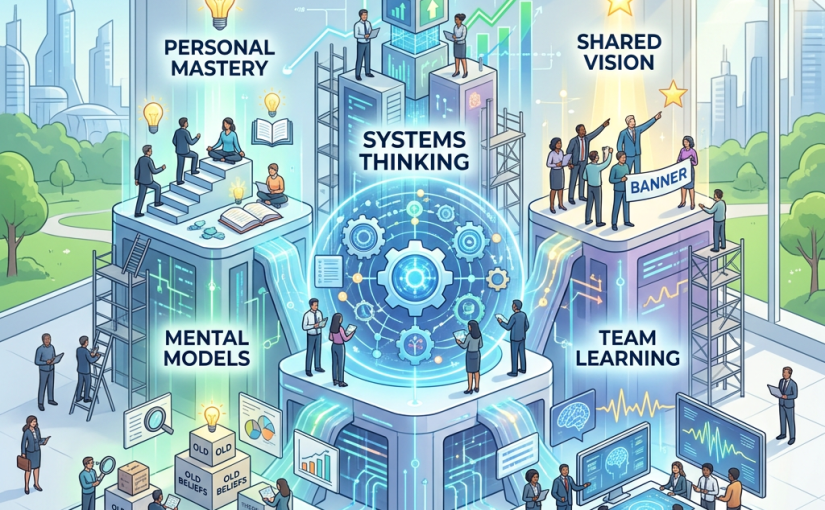
▪️ The Five Disciplines Framework
▪️ Detailed Complexity vs Dynamic Complexity
▪️ Systems Thinking Foundations
▪️ Systems Observation & Inquiry Practice
▪️ Introduction to Systems Archetypes
▪️ Personal Mastery & Reflective Practice
▪️ Mental Models & Institutional Thinking
▪️ Dialogue & Shared Understanding
▪️ Learning Organisation Foundations
▪️ Leadership Development Orientation
▪️ Research & Systems Inquiry Pathway
▪️ Strategy Stewardship Development
PARTICIPANT ORIENTATION & GUIDANCE
▪️ Participant Guide Sheet
▪️ Learning Rhythm & Participation Expectations
▪️ Reading & Reflection Expectations
▪️ Reflection & Observation Practice Between Sessions
▪️ Coordination & Engagement Structure
PROGRAMME STRUCTURE & SESSION FLOW
▪️ Programme Structure Overview
▪️ Session Progression Overview
▪️ Session Schedule & Calendar
▪️ Joining Instructions & Session Preparation
STRLDi ORGANISATIONAL DIRECTION
▪️ Organisational Configuration of STRLDi
▪️ Long-Horizon Direction of the Work
▪️ Closing Reflection on the Programme Direction
PROGRAMME INTENT
This programme is a compressed internal capacity-building pathway for the STRLDi team. It draws from the longer Leaders for Learning structure and compresses a 25-day development pathway into an 8-day equivalent, spread across May to August 2026.
At this stage, the programme is used to prepare my own corporate team, as the work is expanding — particularly here in Africa — where we are engaging with persistent national issues, often at the level of ministries and Heads of State. The depth of practice required is quite high, which is why the format has remained primarily offline and experiential.
It is designed as an in-person, deeply immersive programme. The intention is not just to transfer knowledge, but to build internal capability — where participants begin to see systems, think differently, and act differently over time. That kind of shift is difficult to achieve through recordings alone.
Participants are assumed to have between 0–25% understanding of the Five Disciplines, systems thinking, BOTs, system archetypes, and applied national strategy work. The programme therefore does not assume mastery. It begins by helping participants understand the language, meaning, and discipline of the work before asking them to apply it.
The purpose is not to create experts in three months. The purpose is to form a small internal team that can begin to see persistent issues structurally, understand how the work is held, and prepare to support STRLDi’s future national, institutional, and regional engagements.
PARTICIPANT PROFILE
This programme is for the internal STRLDi team.
▪️ Cohort size: 8-15 participants
▪️ Participant level: mixed
▪️ Entry: selected by Sheila Damodaran
▪️ Format: cohort-based, not drop-in
▪️ Mid-cycle entry: not permitted
The cohort structure matters because the programme builds progressively. Participants are expected to move together from basic exposure, into structured practice, and then into early readiness for organisational work.
TOTAL STRUCTURE
▪️ Total duration: 60 hours
▪️ Delivery equivalent: 8 days
▪️ Programme period: May–August 2026
▪️ Session format: 13–14 sessions
▪️ Session length: 4 hours + 1 hour social / meal time
▪️ Venue: STRLDi training room
▪️ Food arrangement: participant potluck
▪️ Materials: STRLDi blog notes, selected readings, and post-session exercises
PROGRAMME DATES
2026 INTERNAL CAPACITY BUILD CALENDAR
Programme Rhythm
The Internal Capacity Build Programme is structured as a recurring developmental practice rather than a traditional training course.
Sessions are intentionally spaced to allow participants time for:
▪️ reading
▪️ observation exercises
▪️ reflection
▪️ assignment completion
▪️ and practical application between sessions.
Participants are encouraged to review the calendar regularly and plan attendance in advance wherever possible.
| Month | Week 1 (Saturday) 11:00–17:00 | Week 2 (Saturday) 11:00–17:00 | Week 3 (Sunday) 12:00–17:00 | Week 4 (Saturday) 08:00–13:00 / 14:00 |
|---|---|---|---|---|
| May | 9 May | 17 May | 24 May | – |
| June | 6 June | 13 June | 21 June | 28 June |
| July | 4 July | 11 July | 19 July | 26 July |
| August | 1 August | 8 August | 16 August | 30 August |
| September | 5 Sept | 12 Sept | 20 Sept | 27 Sept |
Current Progression Status
The programme is presently completing the foundational building blocks of Systems Thinking, including the historical development of the Five Disciplines and the Laws of Dynamic Complexity. Participants should expect some sessions to adjust in pacing where deeper discussion or conceptual clarification is required. The emphasis remains on understanding before acceleration.
The rhythm is designed to maintain continuity while allowing recovery and preparation time. The final part of September may serve either as integration and consolidation, or as an extension depending on participant progress.
DISCIPLINE STRUCTURE
The programme is anchored around three core disciplines:
▪️ Systems Thinking
▪️ Mental Models
▪️ Team Learning
It also introduces:
▪️ Personal Mastery
▪️ Shared Vision
Personal Mastery and Shared Vision are treated as integrating anchors, not full standalone modules in this compressed version. They help participants understand how personal clarity, commitment, and collective direction support systems work.
1. SYSTEMS THINKING
4 Days | 8 Sessions
Systems Thinking is the primary discipline of this programme. It teaches participants to move from reacting to events toward seeing patterns over time, feedback loops, and underlying structures.
Most people enter persistent issues through what is visible: unemployment figures, corruption reports, poor school outcomes, failed projects, rising prices, service complaints, or public frustration. Systems Thinking asks participants to pause and examine what has been happening over time before proposing action.
Participants will be introduced to:
▪️ Detailed complexity vs dynamic complexity
▪️ Behaviour Over Time (BOT)
▪️ Feedback Causal Loops
▪️ Reinforcing and Balancing Causal Loops
▪️ System Archetypes
▪️ Persistent issues as patterns, not events
▪️ Data required to diagnose persistence
The purpose of Systems Thinking in this programme is not to make participants fluent in diagrams alone. The purpose is to train them to ask better questions:
▪️ What has this issue been doing over time?
▪️ What keeps repeating?
▪️ What has been tried before?
▪️ Why did earlier effort not hold?
▪️ What data would help us see the structure?
Expected outputs include:
▪️ BOT sketches
▪️ Early causal observations
▪️ Identification of possible system archetypes
▪️ Four-quadrant issue mapping
▪️ News-article relevance notes
▪️ Personal life-experience reflections
2. MENTAL MODELS
1 Day | 2 Sessions
Mental Models introduces participants to the discipline of seeing how assumptions shape action. Systems do not persist only because of external structures. They also persist because people carry beliefs, habits, fears, identities, and inherited ways of interpreting reality.
Participants will examine how individuals, teams, ministries, and institutions move quickly from what they observe to what they assume, conclude, and act upon. This is important because many interventions are shaped by assumptions that are never tested against data.
Participants will be introduced to:
▪️ Assumptions and beliefs
▪️ The Ladder of Inference
▪️ Espoused theory vs theory-in-use
▪️ Defensive reasoning
▪️ Institutional mental models
▪️ How mental models reinforce persistent outcomes
The purpose is not to accuse people of “wrong thinking”. The purpose is to help participants recognise that thinking itself can become part of the structure that keeps an issue in place.
Expected outputs include:
▪️ Personal assumption reflections
▪️ Institutional mental model observations
▪️ Notes linking assumptions to repeated behaviour
▪️ Analysis of public narratives in selected articles
3. TEAM LEARNING
2 Days | 4 Sessions
Team Learning introduces participants to the discipline of thinking together. Many teams meet, report, debate, agree, or comply, but they do not necessarily learn together.
This discipline is essential because STRLDi’s work cannot be carried by one person alone. Persistent issues cut across ministries, sectors, roles, and levels of authority. If groups cannot hold inquiry together, the work collapses into opinion, hierarchy, defensiveness, or premature agreement.
Participants will be introduced to:
▪️ Dialogue vs discussion
▪️ Advocacy and inquiry
▪️ Suspending assumptions
▪️ Holding the field of inquiry
▪️ Listening for structure, not only position
▪️ Moving from individual views to collective insight
The purpose of Team Learning is to prepare participants for rooms where senior people, technical officers, planners, and stakeholders may hold different views. The discipline is not to force agreement. The discipline is to hold the conversation long enough for structure to become visible.
Expected outputs include:
▪️ Team-learning observations
▪️ Dialogue practice notes
▪️ Reflection on difficult conversations
▪️ Questions that shift debate toward inquiry
4. PERSONAL MASTERY AND SHARED VISION
1 Day | 2 Sessions
Personal Mastery and Shared Vision are introduced as integration anchors.
Personal Mastery helps participants clarify what they are trying to create and what current reality they must face honestly. This matters because systems work requires the ability to hold tension without escaping into blame, avoidance, urgency, or pleasing.
Shared Vision helps participants understand the difference between compliance, agreement, and commitment. This is important because national and organisational work often fails when people comply with a plan but do not carry responsibility for its direction.
Participants will be introduced to:
▪️ Personal clarity
▪️ Creative tension
▪️ Current reality
▪️ Shared direction
▪️ Commitment vs compliance
▪️ Vision as a discipline, not slogan
The purpose is to ensure that participants do not treat systems thinking as a set of tools. The work must be carried with integrity, discipline, and commitment.
Expected outputs include:
▪️ Personal positioning notes
▪️ Commitment reflections
▪️ Notes on current reality vs desired future
▪️ Shared direction observations
SESSION FLOW ACROSS THE PROGRAMME
Sessions 1–3
Entering the Five Disciplines and Dynamic Complexity
These sessions introduce the three-legged stool, the Five Disciplines, detailed vs dynamic complexity, and the laws of dynamic complexity. Participants begin learning why persistent issues cannot be understood through events alone.
Sessions 4–8
Systems Thinking Practice
These sessions focus on BOTs, feedback loops, system archetypes, unemployment as a persistent issue, and four-quadrant ministry mapping. Participants begin applying systems thinking to real and public issues.
Sessions 9–10
Mental Models
These sessions focus on personal and institutional assumptions, the Ladder of Inference, espoused theory vs theory-in-use, and how assumptions shape repeated policy and organisational behaviour.
Sessions 11–12
Team Learning
These sessions focus on dialogue, inquiry, defensive routines, holding tension, and supporting conversations across difference.
Sessions 13–14
Integration
These sessions bring together Systems Thinking, Mental Models, Team Learning, Personal Mastery, and Shared Vision. Participants prepare a final persistent-issue note that demonstrates early readiness.
REQUIRED PARTICIPANT WORK
Each participant is expected to engage in:
▪️ Pre-reading
▪️ Post-reading
▪️ Life-experience exercises
▪️ News-article relevance notes
▪️ BOT sketches
▪️ Reflection notes
▪️ Between-session observations
▪️ Final persistent-issue note
The reading is not for academic completion. It is used to prepare the mind to recognise what shows up in practice.
READING STRUCTURE
Pre-Reading
Pre-reading will draw mainly from The Fifth Discipline by Peter Senge and selected STRLDi notes. Participants are expected to read enough to enter the session with basic familiarity.
Post-Reading
Post-reading will draw from The Systems Thinker and selected articles relevant to BOTs, archetypes, mental models, team learning, and dynamic complexity. This reading helps participants see how the ideas are used beyond the session.
News Article Practice
Participants will select articles from newspapers, Google News, or other credible sources and write short notes on their relevance. The purpose is to train participants to distinguish between:
▪️ event
▪️ trend
▪️ pattern
▪️ structure
▪️ missing data
SESSION OUTPUT STANDARD
Each session must produce visible output.
The expected output categories are:
▪️ Practice — what participants attempted during the session
▪️ Application — where the concept applies in life, organisation, or public systems
▪️ Research — what must be observed, read, or investigated further
No session is complete if it ends only in discussion.
ATTENDANCE AND ABSENCE HANDLING
Full attendance is expected.
Missed sessions must be made up through:
▪️ Online materials
▪️ Catch-up with attending participants
Attendance and follow-up will be tracked by Bernice.
The programme will not pause because a participant is absent. The responsibility to catch up sits with the participant.
SESSION OWNERSHIP
▪️ Session opening: Bernice
▪️ Session closure: Bernice
▪️ Documentation: Bernice
▪️ Attendance tracking: Bernice
▪️ Programme coordination: Rea
▪️ Content and facilitation: Sheila Damodaran
Bernice’s role is to help maintain session continuity and record discipline. Rea’s role is to ensure the programme remains coordinated and aligned week to week.
LINK TO LIVE STRLDI WORK
This programme prepares participants for eventual engagement with live STRLDi work.
Direct application to contracts begins only when STRLDi engages formal contracts. Until then, the work remains:
▪️ Preparatory
▪️ Simulated
▪️ Observational
This protects the quality of the work and ensures participants do not enter live engagements before they are ready.
EXPECTED FINAL OUTPUT
By the end of the programme, each participant should have produced:
▪️ BOT sketches
▪️ News-article relevance notes
▪️ Life-experience reflections
▪️ At least one four-quadrant issue map
▪️ At least one mental model reflection
▪️ At least one team-learning observation
▪️ One final persistent-issue note
The final persistent-issue note should show whether the participant can begin to:
▪️ Identify an issue
▪️ Observe its behaviour over time
▪️ Ask what data is needed
▪️ locate the issue across systems
▪️ Identify possible assumptions
▪️ Frame the conversation needed for further inquiry
FINAL POSITIONING
This programme is not designed to produce polished presenters or quick consultants.
It is designed to begin forming a disciplined internal team that can:
▪️ see more carefully
▪️ ask better questions
▪️ resist premature solutions
▪️ work with data over time
▪️ hold inquiry with others
▪️ prepare for real organisational and national work
The work begins with learning, but it does not end there. It is intended to build the capacity to support STRLDi’s future work with organisations, ministries, institutions, and national systems.
Assignments and Progression
A central feature of the STRLDi Internal Capacity Build Programme is the Progression Assignment Framework.
Assignments are designed to help participants move beyond understanding concepts to observing, questioning and applying them in their own work, organisations and communities. They are therefore developmental rather than examinational, and become progressively more integrated with each stage of the programme.
The objective is to cultivate disciplined observation, reflective practice and increasingly deeper conversations throughout the learning journey.
Programme Progression Notes
Before each session, participants will receive a Progression Note.
Each Progression Note serves as the guide for the upcoming stage of the programme and typically includes:
- Session objectives
- Required pre-reading
- Assignment(s) to be completed
- Submission guidance
- Preparation for the following session
- Any additional coordination information
Participants should therefore make it a practice to review the relevant Progression Note before every session.
Assignment List
The complete sequence of programme assignments is maintained separately in the Assignment List – Participant Observation & Practice.
This page provides participants with an overview of all assignments across the programme, allowing them to see how each assignment contributes to the overall learning journey.
Assignment List – Participant Observation & Practice
How Assignments Are Used
The programme uses two complementary resources:
1. Assignment List
The Assignment List provides the complete catalogue of assignments for the programme and shows the overall progression of learning.
Click here: https://sheilasingapore.blog/portfolio/assignment-list-participant-observation-practice/
2. Progression Notes
Each Progression Note identifies which assignments are to be completed before the next session, together with the relevant readings and preparation required.
Participants should therefore refer to both resources throughout the programme.
Submission
There is no expectation that responses be lengthy. Participants are encouraged to focus on thoughtful observation, careful reasoning and practical application. The quality of reflection is valued far more than the quantity of writing.
As the programme progresses, assignments increasingly build upon one another, gradually strengthening participants’ ability to recognise patterns, interpret organisational behaviour and engage more confidently with increasingly complex leadership and institutional challenges.
ASSIGNMENT SUBMISSION & PARTICIPANT DEVELOPMENT PROCEDURE
Purpose
The Internal Capacity Build Programme is intended to develop disciplined observation, reflection, and systems inquiry capabilities over time.
Assignments are therefore not treated as isolated training exercises. They form part of each participant’s developmental record and progression pathway throughout the programme.
For this reason, all assignments, reflections, readings, and developmental notes are maintained within the Participant Development Repository.
Participant Development Repository
Repository Location:
https://drive.google.com/drive/folders/1_C29jZlvxe6WnoKnZnPhlvy1ElF2UY6l
Participants should become familiar with navigating the repository and locating their individual folders.
The repository serves as:
▪️ an assignment submission location
▪️ a participant development record
▪️ a progression monitoring system
▪️ a reflection archive
▪️ and a learning portfolio that develops over time
Gmail Address Requirement
Participants who have not yet provided a Gmail address should forward one to the Capacity Build Coordination Lead.
The repository currently operates through Google Drive permissions and therefore requires Gmail-linked access.
Assignment Placement Procedure
Upon completion of an assignment:
▪️ Open the Participant Development Repository
▪️ Open the Participant Development Progress folder
▪️ Open your individual participant folder
▪️ Upload the completed assignment into your folder
Participants should use clear file naming conventions wherever possible.
Example:
Assignment 03 – Detailed vs Dynamic Complexity – Nancy Diphupu
Assignment 04 – Four Houses Mapping – Brunoh Paledi
Submission Timeline
Assignments should be uploaded no later than two days before the scheduled session.
This provides sufficient time for:
▪️ participant progression review
▪️ tracker updates
▪️ reflection review
▪️ and trainer preparation
Late submissions may still be accepted but may not be reflected in the tracker before the upcoming session.
Participant Notification Process
After uploading an assignment, participants should send a short message to the Capacity Build Coordination Lead confirming submission.
Example:
“Assignment #3 uploaded.”
No additional explanation is required unless clarification is being requested.
Capacity Build Coordination Responsibilities
Upon receiving submission notifications, the Capacity Build Coordination Lead will:
▪️ Confirm receipt
▪️ Update the Participant Progression Tracker
▪️ note outstanding submissions
▪️ Identify progression gaps where necessary
▪️ alert the trainer regarding assignment completion status
Participant Reflection Process
Participants are encouraged to complete the Participant Reflection Form throughout the programme.
Reflections are not assessments.
They are intended to help participants:
▪️ identify emerging insights
▪️ surface questions
▪️ monitor personal development
▪️ recognise shifts in thinking
▪️ and strengthen learning discipline over time
Reflection entries may be completed whenever participants feel it would support their learning process.
Participant Progression Tracker
Participants are encouraged to review the Participant Progression Tracker periodically.
The tracker helps participants observe:
▪️ attendance progression
▪️ assignment completion
▪️ reading progression
▪️ participation milestones
▪️ and overall development through the programme
The intention is not compliance.
The intention is developmental awareness.
Development Philosophy
The programme is not designed around perfection.
It is designed around disciplined practice.
Participants are therefore encouraged to submit work that reflects genuine observation and inquiry rather than attempting to produce polished or “correct” answers.
The quality of systems thinking develops through repeated observation, reflection, and dialogue over time.
PARTICIPANT GUIDE SHEET
Here is the participant guide sheet for Sessions 1–3, written for participants with 0–25% familiarity. It is grounded in the STRLDi development pathway: participants begin by seeing patterns, not events, then deepen into feedback, archetypes, structures, time delays and BOTs. (sheilasingapore.blog)
Sessions 1–3: Entering the Five Disciplines and Dynamic Complexity
PURPOSE OF SESSIONS 1–3
These first three sessions prepare participants to enter the work with enough discipline to understand why persistent issues do not change through effort alone. The aim is not to teach concepts as tools to be memorised, but to begin training the mind to recognise patterns over time, interrelationships, and the difference between merely complicated problems and problems that are dynamically complex.
By the end of Session 3, participants should begin to understand that STRLDi does not approach persistent issues by asking, “What solution do we add?” The more disciplined question is: what structure is producing this behaviour, and why does the behaviour continue despite intervention?
SESSION 1
THE THREE-LEGGED STOOL, THE FIVE DISCIPLINES, AND DYNAMIC COMPLEXITY
SESSION OBJECTIVE
Session 1 introduces the foundation of the STRLDi practice by locating participants inside the broader architecture of The Fifth Discipline and the Learning Organisation. Participants are introduced to the three-legged stool as a way of understanding that the work stands only when three capacities are held together: discipline, research, and application.
The session also introduces the Five Disciplines as the developmental base of the work: Systems Thinking, Mental Models, Team Learning, Personal Mastery, and Shared Vision. Participants are not expected to master these disciplines in one session. The purpose is to understand what each discipline contributes, and why STRLDi uses them together rather than separately.
CORE DEFINITIONS
Systems Thinking is the discipline of seeing how parts interact over time to produce outcomes. It helps participants move beyond events and isolated explanations toward the deeper structures that generate behaviour.
Mental Models are the assumptions, beliefs, and inherited ways of seeing that shape how individuals and institutions interpret reality. They matter because people often act from what they assume is true, even when the data shows something else.
Team Learning is the discipline of thinking together. It is not ordinary teamwork; it is the ability of a group to suspend defensiveness, inquire together, and produce a higher quality of collective intelligence.
Personal Mastery is the discipline of clarifying what one is trying to create while remaining grounded in current reality. It develops the internal capacity to hold tension without collapsing into blame, avoidance, or premature solutions.
Shared Vision is the discipline of building commitment around a future that people genuinely want to create. It is different from compliance, agreement, or strategic slogans.
DETAILED VS DYNAMIC COMPLEXITY
Participants are introduced to the difference between detailed complexity and dynamic complexity.
Detailed complexity refers to situations with many parts, many actors, many rules, many documents, or many activities. A ministry may have many departments, reports, programmes, committees, and policies. This can make the work look complicated, but the complication alone does not explain why outcomes persist.
Dynamic complexity refers to situations where cause and effect are separated by time, distance, and feedback. Actions taken today may produce consequences years later. A policy meant to solve one problem may reinforce another. This is where persistent national issues live.
SESSION REFERENCES
▪️ The Systems Thinker articles on:
- Learning organisations
- Dynamic complexity
- Feedback thinking
- The difference between events, patterns, and structures
POST-SESSION READING
▪️ The Fifth Discipline by Peter Senge
Suggested focus:
▪️ Chapter 1 — “Give Me a Lever Long Enough…”
▪️ Chapter 4 — “The Laws of the Fifth Discipline”
▪️ Chapter 5 — “A Shift of Mind”
POST-SESSION EXERCISE
Life Experience Exercise
Participants must identify one issue in their own life, workplace, family, or community that has remained unresolved despite repeated effort. They should write one page answering:
▪️ What keeps repeating?
▪️ What has been tried before?
▪️ Why did the effort not hold?
▪️ What pattern may be present over time?
News Article Exercise
Select one current article from Google News or a local newspaper. Write a short note explaining:
▪️ What is the event being reported?
▪️ What pattern might sit behind it?
▪️ Which discipline might help us understand it better?
▪️ Why might this matter for organisational or national work?
ASSIGNMENTS:
See Assignments #1 & #3 on Assignment List
PREPARATION FOR ORGANISATIONAL WORK
Participants begin learning how to stop rushing to answers. This session prepares them to enter organisational settings with better questions, especially where issues have remained stuck for years.
SESSION 2
BEHAVIOUR OVER TIME: SEEING PATTERNS BEFORE EXPLAINING THEM
SESSION OBJECTIVE
Session 2 introduces participants to Behaviour Over Time (BOT) as the discipline of seeing how an issue moves before attempting to explain why it moves. Participants are guided away from describing events and toward identifying repeated patterns, direction, pace, timing, acceleration, decline, stagnation, and delay. The session helps participants understand that a persistent issue cannot be diagnosed properly unless its behaviour is first seen over time.
BOT work is not graphing for decoration. It is the first discipline of restraint: before naming a cause, proposing a solution, or blaming a ministry, the participant must ask, what has this issue been doing over time?
CORE DEFINITIONS
Behaviour Over Time (BOT) refers to the observed movement of a variable across time. It may show growth, decline, fluctuation, stagnation, collapse, recovery, or repeated cycles.
A variable is something that can increase or decrease. Examples include unemployment, school completion, agricultural output, crime reports, household income, public expenditure, electricity reliability, or imports.
A persistent issue is not merely a problem that appears today. It is an issue whose behaviour repeats, deepens, resists correction, or spills into other areas over time.
PRE-READING
▪️ The Fifth Discipline — Chapter 5, “A Shift of Mind”
▪️ The Fifth Discipline — Chapter 6, “Nature’s Templates”
POST-READING
▪️ The Systems Thinker articles on Behaviour Over Time graphs
▪️ The Systems Thinker articles on moving from events to patterns
POST-SESSION EXERCISE
Life Experience Exercise
Choose one issue in your own life or workplace that has repeated over time. Sketch a simple BOT curve and answer:
▪️ What increased, decreased, or repeated?
▪️ When did the pattern begin?
▪️ What did you first think was causing it?
▪️ What does the pattern suggest when you step back?
News Article Exercise
Select one news article on unemployment, education, agriculture, crime, corruption, or health. Write:
▪️ What event is reported?
▪️ What variable could be tracked over time?
▪️ What data would be needed?
▪️ What would make this issue persistent rather than temporary?
PREPARATION FOR ORGANISATIONAL WORK
Participants begin learning that organisations and governments often respond to events because patterns have not been made visible. This session prepares participants to request and interpret time-based evidence before entering diagnosis.
ASSIGNMENTS:
Please complete the assignments listed for Session 2 in the Assignment List – Participant Observation & Practice.
- Assignment 5 — Identification of news reports illustrating Balancing and Reinforcing Causal Loop Structures
- Assignment 6 — Identification of organisational statements illustrating Balancing and Reinforcing Causal Loop Structures
The Assignment List serves as the master reference and will always contain the latest assignment descriptions, submission requirements and updates.
SESSION 3
FEEDBACK LOOPS: HOW SYSTEMS SPEAK BACK
SESSION OBJECTIVE
Session 3 introduces feedback loops as the basic grammar of systems thinking. Participants learn that systems do not simply move in straight lines. Actions create effects, those effects return to influence future action, and over time these feedback relationships produce patterns that may either grow, stabilise, or resist change.
The objective is for participants to stop thinking only in “A causes B” terms and begin seeing circular causality. This is essential for STRLDi work because persistent national issues often remain unresolved when leaders act as though causes are linear, immediate, and located in one department.
CORE DEFINITIONS
Feedback occurs when the result of an action returns to influence the condition that produced it.
Reinforcing feedback amplifies movement. It can produce growth, decline, escalation, collapse, or widening gaps.
Balancing feedback seeks stability, correction, or control. It can solve problems, but it can also hold a system in place when the correction is too weak or misdirected.
Polarity discipline requires participants to track whether relationships move in the same direction or opposite direction. This prevents casual diagramming.
PRE-READING
▪️ The Fifth Discipline — Chapter 4, “The Laws of the Fifth Discipline”
▪️ The Fifth Discipline — Chapter 5, “A Shift of Mind”
POST-READING
▪️ The Systems Thinker articles on reinforcing and balancing loops
▪️ The Systems Thinker articles on causal loop diagrams
POST-SESSION EXERCISE
Life Experience Exercise
Identify one repeating personal or organisational pattern. Write:
▪️ What action was taken?
▪️ What result came back?
▪️ Did the result make the original issue stronger, weaker, or unchanged?
▪️ Is the loop reinforcing or balancing?
News Article Exercise
Choose one article on public policy, youth unemployment, price increases, crime, or agriculture. Identify:
ASSIGNMENTS:
Please complete the assignments listed for Session 2 in the Assignment List – Participant Observation & Practice.
- Assignment 7 — Identify words, conditions and situations commonly associated with:
- Reinforcing Loops
- Balancing Loops
Build a dictionary of commonly used words.
- Assignment 8 — Growth Ministries versus Stabilising Ministries
- Assignment 9 — Study Laws 1–6 of Dynamic Complexity
- Assignment 10 — Understanding how countries measure unemployment
- Assignment 11 — Following Human Benefit
- Assignment 12 — The Rise of the Creative Economy
The Assignment List serves as the master reference and will always contain the latest assignment descriptions, submission requirements and updates.
SESSIONS 4 & 5
THE LAWS OF DYNAMIC COMPLEXITY
SESSION OBJECTIVE
Sessions 2 and 3 introduce participants to the Laws of Dynamic Complexity as a way of understanding why many interventions fail even when they appear logical. These sessions help participants see that systems often resist change because the structure of the system is stronger than the intention of the people working inside it.
The objective is for participants to begin recognising that persistent issues are not stubborn because people are lazy, careless, or uninformed. They persist because actions are often taken at the wrong level, with the wrong time horizon, and without seeing the feedback that the system is producing.
CORE MEANING
The Laws of Dynamic Complexity are not slogans. They are disciplined observations about how complex systems behave when human beings try to change them without understanding feedback, delay, and structure.
Participants are expected to begin seeing these laws in lived experience, public policy, organisational behaviour, and national development patterns.
THEMES TO BE COVERED
SESSION 4 — SEEING WHY FIXES FAIL
This session focuses on laws that explain why well-intended actions often produce short-term relief but long-term persistence.
Participants examine how:
▪️ Today’s problems can come from yesterday’s solutions
▪️ The harder people push, the harder the system can push back
▪️ behaviour may improve before it worsens
▪️ Easy solutions can lead back to the problem
▪️ Faster effort is not always better movement
The purpose is to help participants stop interpreting resistance as failure of effort alone. They begin to see that the system may be responding exactly as its structure allows.
SESSION 5 — SEEING WHERE LEVERAGE HIDES
This session focuses on laws that explain why real leverage is often not obvious.
Participants examine how:
▪️ Cause and effect may not be close in time and space
▪️ Small, well-placed actions can produce large effects
▪️ Dividing a system into pieces can destroy understanding
▪️ Growth can create pressure that requires capacity investment
▪️ Solutions may require slower, more disciplined sequencing
This prepares participants for later work with Behaviour Over Time graphs, system archetypes, and national data.
PRE-READING
▪️ The Fifth Discipline by Peter Senge
Suggested focus:
▪️ Chapter 4 — “The Laws of the Fifth Discipline”
▪️ Chapter 6 — “Nature’s Templates: Identifying the Patterns That Control Events”
POST-READING
▪️ The Systems Thinker articles on:
▪️ Fixes That Fail
▪️ Shifting the Burden
▪️ Limits to Growth
▪️ Growth and Underinvestment
▪️ Leverage points
▪️ Behaviour Over Time graphs
POST-SESSION EXERCISE
Life Experience Exercise
Choose one situation where a “solution” created another problem later. Write one page answering:
▪️ What was the original problem?
▪️ What was the solution applied?
▪️ What improved in the short term?
▪️ What worsened later?
▪️ Which Law of Dynamic Complexity does this illustrate?
News Article Exercise
Select one current article from Google News or a newspaper. Write a short note explaining:
▪️ What issue is being reported?
▪️ Is the article focused on an event, a trend, or a structure?
▪️ Which Law of Dynamic Complexity may be visible?
▪️ What data would be needed to test whether this is a persistent issue?
PREPARATION FOR ORGANISATIONAL WORK
Sessions 4 and 5 prepare participants to enter organisational and national work with better discipline. They begin learning that identifying a persistent issue requires more than concern, opinion, or visibility. It requires the ability to ask: what behaviour has occurred over time, what data can reveal it, and what structure may be producing it?
EXPECTED OUTPUT AFTER SESSION 5
By the end of Session 5, each participant should have produced:
▪️ One personal life-experience reflection
▪️ Two short news-article relevance notes
▪️ One early example of detailed vs dynamic complexity
▪️ One example of a possible persistent issue
▪️ One question about what data would be needed to understand the issue over time
The purpose is not perfection. The purpose is to begin building the discipline of noticing.
SESSION 6
SYSTEM ARCHETYPES: RECOGNISING REPEATING STRUCTURES
SESSION OBJECTIVE
Session 6 introduces system archetypes as recurring structures that produce familiar patterns of persistence. Participants learn that many issues appear different on the surface, but underneath them sit similar structures such as Fixes that Fail, Shifting the Burden, Limits to Growth, Growth and Underinvestment, Success to the Successful, and Escalation.
The objective is not to memorise archetype names. It is to begin recognising the structure behind behaviour. Participants must understand that archetypes are not labels to attach quickly, but diagnostic patterns that must be supported by BOTs, data, and disciplined reasoning.
CORE DEFINITIONS
A system archetype is a recurring structure of feedback that explains why certain patterns repeat across different settings.
Fixes that Fail occurs when a solution improves a situation in the short term but worsens it later.
Shifting the Burden occurs when a symptomatic solution reduces pressure while the fundamental solution remains underused or delayed.
Growth and Underinvestment occurs when demand or pressure grows faster than the system’s capacity to support it.
Limits to Growth occurs when initial growth meets a constraint that slows or reverses progress.
PRE-READING
▪️ The Fifth Discipline — Chapter 6, “Nature’s Templates”
▪️ The Fifth Discipline — relevant sections on archetypes
POST-READING
▪️ The Systems Thinker articles on system archetypes
▪️ Articles on Fixes that Fail, Shifting the Burden, Limits to Growth, Growth and Underinvestment
POST-SESSION EXERCISE
Life Experience Exercise
Choose one recurring issue from your personal or work life. Ask:
▪️ Was there a short-term fix?
▪️ Did the problem return?
▪️ Was a deeper solution delayed?
▪️ Which archetype may be present?
News Article Exercise
Select one public issue reported in the news. Write:
▪️ What is the visible issue?
▪️ What repeated behaviour is suggested?
▪️ Which archetype might explain it?
▪️ What data would be needed before confirming the archetype?
PREPARATION FOR ORGANISATIONAL WORK
Participants begin preparing to work with organisations by learning not to accept the visible problem as the real problem. The archetype becomes the bridge between observed behaviour and structural explanation.
SESSION 7
UNEMPLOYMENT AS A PERSISTENT ISSUE: FROM EVENT TO STRUCTURE
SESSION OBJECTIVE
Session 7 applies Systems Thinking to unemployment as a dominant persistent issue. Participants learn that unemployment is not simply the absence of jobs, nor is it resolved by creating jobs in the ordinary sense. Its persistence must be examined through labour absorption, productive sectors, household behaviour, education pathways, sector growth, policy cycles, and institutional ownership.
The session introduces the idea that unemployment often becomes politically visible during elections but structurally disappears afterward because it is not held by one ministry end-to-end. Participants begin to see why persistent issues require cross-quadrant analysis rather than departmental solutions.
CORE DEFINITIONS
Unemployment as an event refers to the current number, announcement, complaint, or policy response.
Unemployment as a pattern refers to how employment, labour force participation, sector absorption, and household survival have moved over time.
Unemployment as structure refers to the underlying relationships between education, production, policy, sector growth, household choices, and institutional accountability.
Labour absorption capacity refers to the ability of productive sectors to absorb people into meaningful work over time.
PRE-READING
▪️ STRLDi unemployment study summary or relevant blog notes
▪️ The Fifth Discipline — Chapter 5 and Chapter 6
POST-READING
▪️ The Systems Thinker articles on BOTs and archetypes
▪️ Articles on Growth and Underinvestment and Shifting the Burden
POST-SESSION EXERCISE
Life Experience Exercise
Identify one area where effort has been applied repeatedly but the issue remains. Write:
▪️ What was done?
▪️ What changed temporarily?
▪️ What did not change structurally?
▪️ What would need to be tracked over time?
News Article Exercise
Select a current article on unemployment, youth enterprise, skills, labour, or sector growth. Write:
▪️ Is the article treating unemployment as an event, programme, or structure?
▪️ Which ministries or sectors are implicated?
▪️ What data would reveal whether this is persistent?
▪️ What is not being said?
PREPARATION FOR ORGANISATIONAL WORK
Participants begin learning how to handle a real national issue without rushing into solutions. The discipline is to see unemployment as a system condition that spills across human, economic, governance, and nature systems.
SESSION 8
FOUR-QUADRANT MAPPING: LOCATING ISSUES ACROSS HUMAN SYSTEMS
SESSION OBJECTIVE
Session 8 introduces the four-quadrant framework used to locate ministries and persistent issues across Human–Human, Human–Nature, Human–Economy, and Human–Governance systems. Participants learn that persistent issues are rarely owned by one ministry because they move across relationships, land, production, authority, institutions, and the lived experience of people.
The objective is to help participants see that government structures may be organised by departments, but persistent issues behave across boundaries. This prepares participants to understand the size, scope, number of stakeholders, and sequence of work required before any national-level engagement is designed.
CORE DEFINITIONS
Human–Human systems concern relationships, identity, family, culture, education, health, gender, youth, and social behaviour.
Human–Nature systems concern land, water, agriculture, housing, environment, climate, food systems, and settlement.
Human–Economy systems concern labour, enterprise, productivity, trade, infrastructure, sectors, income, and production.
Human–Governance systems concern authority, law, coordination, policy, finance, public institutions, planning, justice, accountability, and trust.
PRE-READING
▪️ STRLDi meeting notes on four-quadrant ministry mapping
▪️ The Fifth Discipline — Chapter 6
POST-READING
▪️ Articles on systems mapping
▪️ Articles on cross-sector coordination and persistent public issues
POST-SESSION EXERCISE
Life Experience Exercise
Choose one issue in your community. Place it across the four quadrants and write:
▪️ Where does it first appear?
▪️ Where does it spill over?
▪️ Which quadrant is most ignored?
▪️ Which actor is assumed to own it?
News Article Exercise
Select one article on corruption, unemployment, water, health, crime, or education. Map:
▪️ Which quadrant the article focuses on
▪️ Which quadrants are missing
▪️ Which ministries are implicated
▪️ What data would be needed to understand the issue over time
PREPARATION FOR ORGANISATIONAL WORK
Participants begin learning how to estimate scope. This matters because national work requires knowing which institutions must be involved, how many participants may be needed, and what sequence of engagement is required.
SESSION 9
MENTAL MODELS: THE THINKING THAT HOLDS SYSTEMS IN PLACE
SESSION OBJECTIVE
Session 9 introduces Mental Models as the discipline of surfacing the assumptions that shape what people see, ignore, defend, or repeat. Participants learn that systems persist not only because of external structures, but because people inside the system carry beliefs, habits, fears, identities, and inherited conclusions that make certain actions feel normal.
The objective is for participants to begin seeing the relationship between thought and structure. A system may continue not because no one knows there is a problem, but because the assumptions that hold the current response remain unexamined.
CORE DEFINITIONS
Mental Models are deeply held assumptions, generalisations, images, and stories that influence how people understand the world and act within it.
The Ladder of Inference describes how people move quickly from data to meaning, assumptions, conclusions, beliefs, and action without noticing each step.
Defensive reasoning occurs when people protect themselves from discomfort, embarrassment, uncertainty, or loss of status rather than inquire into the truth of the situation.
PRE-READING
▪️ The Fifth Discipline — chapter on Mental Models
▪️ Chris Argyris-related notes or summaries on defensive routines, where available
POST-READING
▪️ The Systems Thinker articles on Mental Models
▪️ Articles on the Ladder of Inference
POST-SESSION EXERCISE
Life Experience Exercise
Choose one situation where you reacted strongly. Write:
▪️ What did you observe?
▪️ What meaning did you give it?
▪️ What assumption did you make?
▪️ What action followed?
▪️ What else could have been true?
News Article Exercise
Select one article where blame is visible. Write:
▪️ Who is being blamed?
▪️ What assumption appears to be driving the story?
▪️ What data is missing?
▪️ How might the issue look different if assumptions were surfaced?
PREPARATION FOR ORGANISATIONAL WORK
Participants begin learning that working with leaders requires careful handling of assumptions. The task is not to embarrass people, but to make thinking visible enough that better choices become possible.
SESSION 10
MENTAL MODELS IN INSTITUTIONS: FROM PERSONAL ASSUMPTION TO POLICY BEHAVIOUR
SESSION OBJECTIVE
Session 10 extends Mental Models from the individual to the institutional level. Participants learn that ministries, organisations, and sectors also carry assumptions. These assumptions may appear in policies, budget choices, programme designs, public messaging, stakeholder engagement, and what data is collected or ignored.
The objective is to help participants see that persistent issues are often reinforced by institutional mental models that remain unnamed. These mental models may explain why obvious leverage points remain neglected while familiar programmes are repeated.
CORE DEFINITIONS
Institutional mental models are shared assumptions embedded in policies, routines, procedures, budget habits, reporting systems, and language.
Espoused theory is what an institution says it values.
Theory-in-use is what the institution actually does repeatedly.
Policy behaviour is the repeated pattern produced by policy decisions over time, not the intention stated in policy documents.
PRE-READING
▪️ The Fifth Discipline — Mental Models chapter
▪️ Review Session 9 notes
POST-READING
▪️ The Systems Thinker articles on organisational learning
▪️ Articles on espoused theory and theory-in-use
POST-SESSION EXERCISE
Life Experience Exercise
Identify one organisation you know. Write:
▪️ What does it say it values?
▪️ What does it repeatedly reward?
▪️ Where do these differ?
▪️ What mental model may be operating?
News Article Exercise
Select one policy-related article. Write:
▪️ What is the stated intention?
▪️ What repeated policy behaviour is visible?
▪️ What assumption may be driving the response?
▪️ What evidence would test that assumption?
PREPARATION FOR ORGANISATIONAL WORK
Participants begin learning to read institutions carefully. This prepares them for work with managers, senior officials, and decision-makers where the visible policy may not reveal the deeper operating logic.
SESSION 11
TEAM LEARNING: THINKING TOGETHER WITHOUT COLLAPSING INTO POSITIONS
SESSION OBJECTIVE
Session 11 introduces Team Learning as the discipline of thinking together. Participants learn that many teams talk, debate, agree, report, or comply, but do not truly think together. Team Learning becomes essential when complex work requires people from different roles, ministries, sectors, or disciplines to hold a shared field of inquiry.
The objective is for participants to understand that systems work cannot be carried by one person alone. If the group cannot hold inquiry, suspend assumptions, and listen for structure, the work will collapse back into opinion, position, hierarchy, and defensiveness.
CORE DEFINITIONS
Team Learning is the discipline through which a group develops the capacity to think and act together.
Dialogue is a shared inquiry where participants suspend certainty and listen for what is trying to emerge.
Discussion is a process of presenting views, comparing positions, making decisions, or reaching agreement.
Defensive routines are habits that protect individuals or groups from embarrassment, threat, or exposure, but prevent learning.
PRE-READING
▪️ The Fifth Discipline — Team Learning chapter
▪️ Review Mental Models notes from Sessions 9–10
POST-READING
▪️ The Systems Thinker articles on dialogue
▪️ Articles on team learning and defensive routines
POST-SESSION EXERCISE
Life Experience Exercise
Recall a meeting where people talked past each other. Write:
▪️ What positions were defended?
▪️ What was not being said?
▪️ What assumptions were protected?
▪️ What would dialogue have required?
News Article Exercise
Select one article involving public disagreement. Write:
▪️ What positions are visible?
▪️ What shared concern may sit underneath?
▪️ What question could shift the conversation from debate to inquiry?
PREPARATION FOR ORGANISATIONAL WORK
Participants begin preparing to support rooms where senior people may disagree, defend, or avoid difficult questions. The discipline is not to force agreement, but to hold inquiry long enough for structure to become visible.
SESSION 12
TEAM LEARNING IN PRACTICE: HOLDING THE FIELD OF INQUIRY
SESSION OBJECTIVE
Session 12 deepens Team Learning by moving from concept into practice. Participants learn how to hold a conversation where multiple views, tensions, data points, institutional pressures, and emotional reactions are present at the same time. This is critical for STRLDi work because persistent issues often sit inside uncomfortable conversations that institutions would rather simplify.
The objective is to help participants practise how to remain with complexity without rushing to resolution. This prepares them for work with cross-functional groups, ministries, SOEs, private sector actors, and community-facing institutions.
CORE DEFINITIONS
The field of inquiry is the shared space in which a group is thinking together.
Suspension means holding one’s assumptions where they can be examined, rather than acting from them immediately.
Advocacy and inquiry means being able to state one’s view while genuinely testing and exploring it with others.
Generative conversation is conversation that creates new understanding, not merely agreement.
PRE-READING
▪️ The Fifth Discipline — Team Learning chapter
▪️ Review Sessions 9–11 notes
POST-READING
▪️ The Systems Thinker articles on dialogue and generative conversation
▪️ Articles on advocacy and inquiry
POST-SESSION EXERCISE
Life Experience Exercise
Practise one conversation during the week where you deliberately ask more than you tell. Write:
▪️ What did you notice?
▪️ What assumption did you suspend?
▪️ Did the conversation shift?
▪️ What was difficult?
News Article Exercise
Choose one public issue involving multiple stakeholders. Write:
▪️ Who needs to be in the room?
▪️ What tension must be held?
▪️ What question could open inquiry?
▪️ What would shut the conversation down?
PREPARATION FOR ORGANISATIONAL WORK
Participants begin preparing to support real group processes. This is where the work moves from analysis into facilitation discipline.
SESSION 13
PERSONAL MASTERY AND SHARED VISION: HOLDING INTENT WITHOUT COLLAPSING INTO COMPLIANCE
SESSION OBJECTIVE
Session 13 introduces Personal Mastery and Shared Vision as integration anchors. Participants learn that systems work requires personal clarity as much as technical capability. Without personal discipline, people collapse into blame, fear, avoidance, pleasing, or premature action. Without shared vision, groups confuse compliance or agreement with commitment.
The objective is to help participants locate themselves inside the work. They must begin asking: what am I trying to create, what current reality must I face, and what collective future is worth committing to?
CORE DEFINITIONS
Personal Mastery is the discipline of clarifying personal aspiration while remaining honest about current reality.
Creative tension is the gap between vision and current reality. It is not stress; it is the energy that comes from holding both honestly.
Shared Vision is a collective picture of a future people genuinely want to create.
Commitment differs from compliance. Compliance follows instructions; commitment carries responsibility.
PRE-READING
▪️ The Fifth Discipline — Personal Mastery chapter
▪️ The Fifth Discipline — Shared Vision chapter
POST-READING
▪️ The Systems Thinker articles on Personal Mastery
▪️ The Systems Thinker articles on Shared Vision
POST-SESSION EXERCISE
Life Experience Exercise
Write one page answering:
▪️ What do I want to help create through this work?
▪️ What current reality must I face honestly?
▪️ Where do I avoid tension?
▪️ What would commitment look like?
News Article Exercise
Select one article about national development, youth, economy, education, or governance. Write:
▪️ What future is being implied?
▪️ Is it a vision, slogan, promise, or compliance demand?
▪️ What current reality is not being faced?
▪️ What would make the vision credible?
PREPARATION FOR ORGANISATIONAL WORK
Participants begin learning that national and organisational work cannot be carried by tools alone. It requires people who can hold vision, tension, reality, and commitment without escaping into slogans or fixes.
SESSION 14
INTEGRATION: FROM LEARNING TO STRUCTURED READINESS
SESSION OBJECTIVE
Session 14 integrates the full internal capacity build. Participants bring together Systems Thinking, Mental Models, Team Learning, Personal Mastery, and Shared Vision into one applied frame. The purpose is to assess whether participants can begin moving from exposure to readiness.
The objective is not certification of mastery. It is to determine whether participants can now enter future STRLDi work with greater discipline: able to notice patterns, ask better questions, identify data needs, hold conversations, and understand why persistent issues require structure before solutions.
CORE DEFINITIONS
Integration is the ability to hold multiple disciplines together in practice.
Readiness means being able to participate responsibly in real work when contracts or institutional engagements begin.
Structured readiness means participants can work with preparation, discipline, evidence, and coordination, rather than enthusiasm alone.
PRE-READING
▪️ Review all previous session notes
▪️ Review selected STRLDi blog notes on persistent issues and programme architecture
POST-READING
▪️ Revisit The Systems Thinker articles most relevant to the participant’s chosen issue
▪️ Review one article on BOTs, one on archetypes, one on Mental Models, and one on dialogue
POST-SESSION EXERCISE
Final Integration Exercise
Each participant prepares a short structured note on one persistent issue.
The note must include:
▪️ Issue selected
▪️ Why it appears persistent
▪️ What BOT data would be needed
▪️ Which quadrant or quadrants it touches
▪️ Which mental models may be present
▪️ What kind of conversation would be needed
▪️ What further research is required
News Article Exercise
Select one final article and write:
▪️ What is the visible event?
▪️ What is the likely pattern?
▪️ What structure might be present?
▪️ What data is needed?
▪️ What would a systems thinker avoid doing too quickly?
PREPARATION FOR ORGANISATIONAL WORK
Participants close the internal cycle by understanding that live work begins only when STRLDi engages formal contracts. Until then, their work remains preparatory, simulated, and observational. The discipline is to become ready before being visible.
EXPECTED OUTPUT AFTER SESSION 14
By the end of the programme, each participant should have produced:
▪️ BOT sketches
▪️ News-article relevance notes
▪️ Life-experience reflections
▪️ At least one ministry or quadrant map
▪️ At least one mental model reflection
▪️ At least one team-learning observation
▪️ One final persistent-issue note
The purpose is not to produce experts in three months. The purpose is to form a core group that can begin to see, hold, and support the work with more discipline.
Why We Are Doing What We Are Doing Now
A Note to the STRLDi Internal Team
Team,
It is important that we understand why STRLDi is undertaking the work currently in front of us. The meetings, presentations, research, stakeholder engagements, coordination and study work are not isolated activities. They are part of a deliberate sequence.
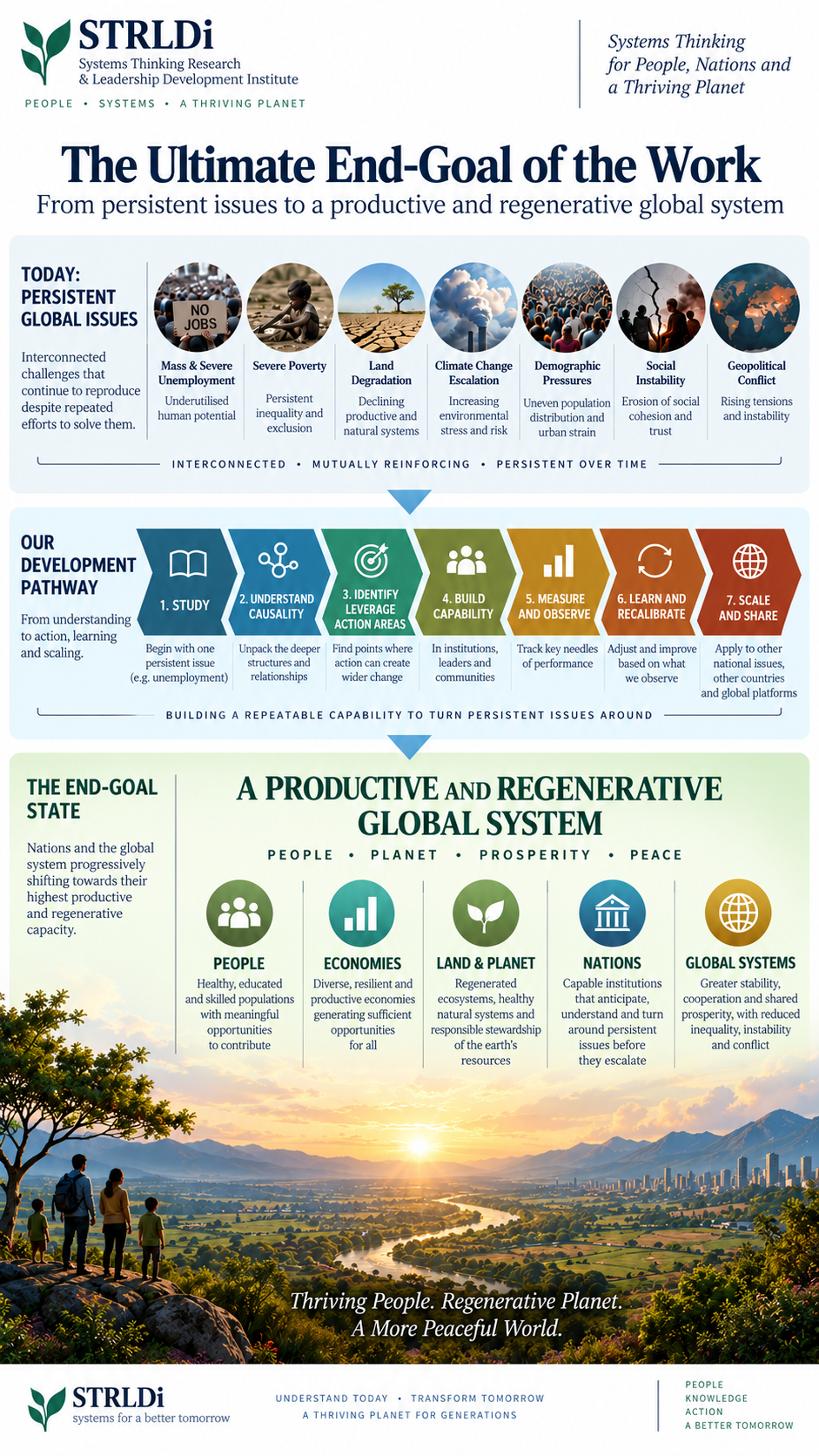
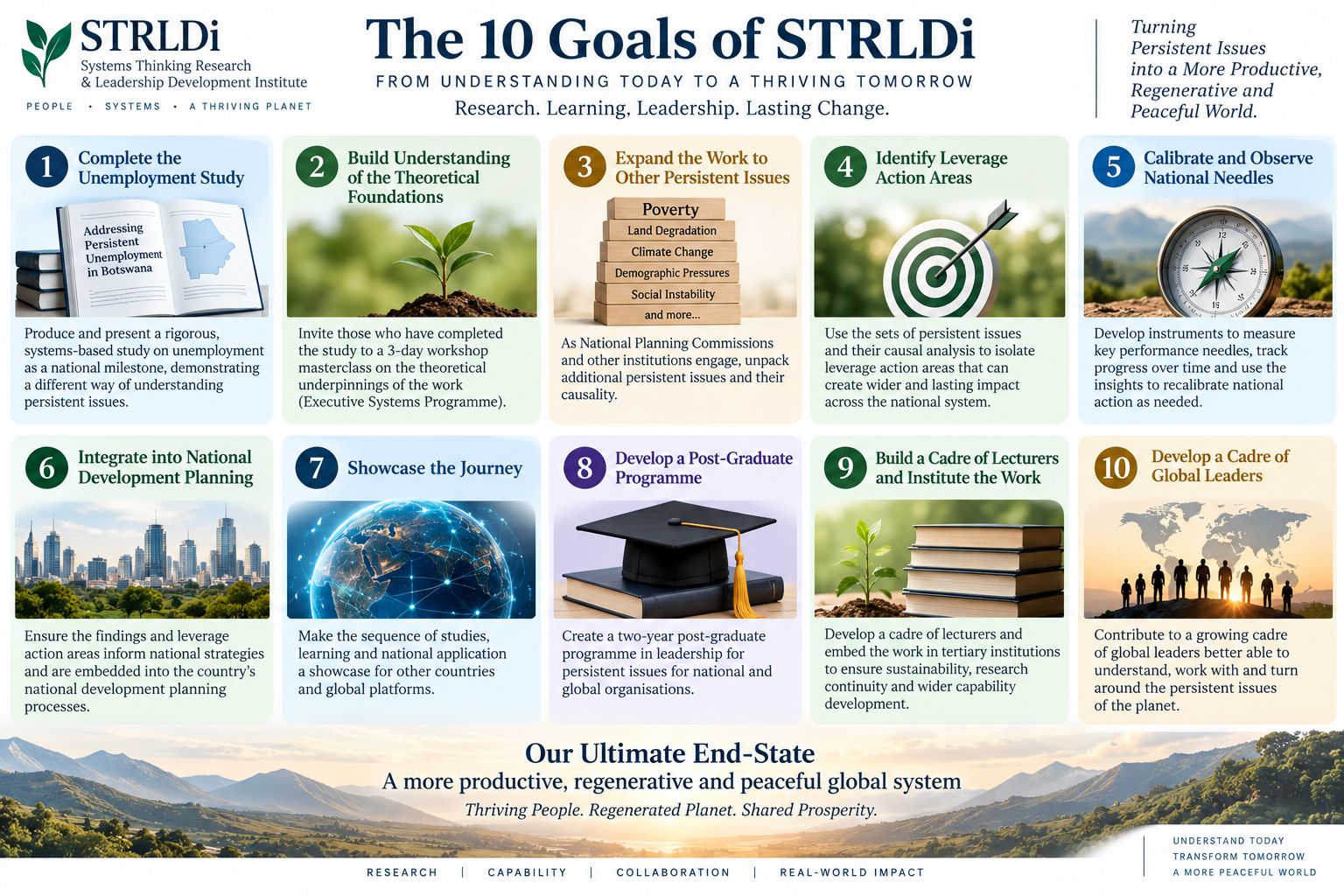
1. We are completing the Unemployment Study
The study itself is a major milestone. It is the foundation from which the next stages of the work become possible. Without completing and presenting the study properly, we cannot move credibly into the larger work that follows.
2. We are building understanding before asking for action
As the study is presented, those engaging seriously with the work can be invited to deepen their understanding through the 3-Day Executive Systems Programme.
The intention is not simply for people to agree with the findings. It is for leaders to begin understanding the theoretical foundations that allow us to see persistent issues differently.
3. We are progressively bringing the national system into the conversation
This is why our current sequence of engagements matters.
We are working towards presentations and discussions with:
- Permanent Secretaries and productive-sector institutions
- Ministers and national leaders
- The Presidency and current and former Presidencies
- Parliament
- National planning structures
- SADC and regional platforms
As a general rule, we engage the people working inside the system before moving upwards to their leaders. This allows understanding to develop through the system rather than simply being announced from the top.
4. We are not stopping with unemployment
Unemployment is the first major persistent issue being unpacked through this work. As national planning structures engage with the methodology, the country can begin identifying and unpacking other persistent issues that the national system continues to fight—directly or indirectly—without permanently resolving.
5. We are looking for leverage
As persistent issues are studied together, we can begin identifying:
- underlying causal structures
- relationships between issues
- common systemic patterns
- leverage action areas
These can then provide a deeper input into national strategy and development planning.
6. We are learning to measure whether the system is actually moving
The work must eventually develop instruments that measure the important needles of performance.
These indicators can be observed over time and used to determine whether leverage actions are working—or whether the nation needs to recalibrate.
7. We are building a repeatable national capability
The sequence of:
Study → Understanding → Leverage → Action → Measurement → Learning → Recalibration
can become a repeatable national capability for turning persistent issues around.
8. We are preparing to showcase the journey
As countries undertake this work, the sequence itself can become a showcase of how persistent issues can be understood and turned around for other countries and global platforms.
9. We are working towards institutionalising the knowledge
Over time, STRLDi intends to develop a two-year postgraduate programme in leadership for national and global organisations dealing with persistent issues.
Alongside this, we must develop a cadre of lecturers and practitioners capable of carrying the work into tertiary institutions and beyond STRLDi itself.
10. We are ultimately contributing to a different kind of global leadership
The long-term goal is to help develop a growing cadre of leaders around the world who are better able to understand, work with and turn around the persistent issues facing the planet.
What This Means for the Team Now
What we are doing now may sometimes appear to be simply arranging meetings, preparing presentations, following up stakeholders or coordinating people. It is not.
We are helping to build the first steps of a much larger pathway:
From understanding one persistent issue → to building national capability → to institutionalising the work → to developing global leadership capable of helping societies move towards their highest productive and regenerative capacity.
That is why the quality of our work, our preparation, our coordination and the way we engage people matters.
We are not simply organising meetings. We are helping to open a pathway.
And the pathway begins with getting this first study—and the conversations around it—right.


