
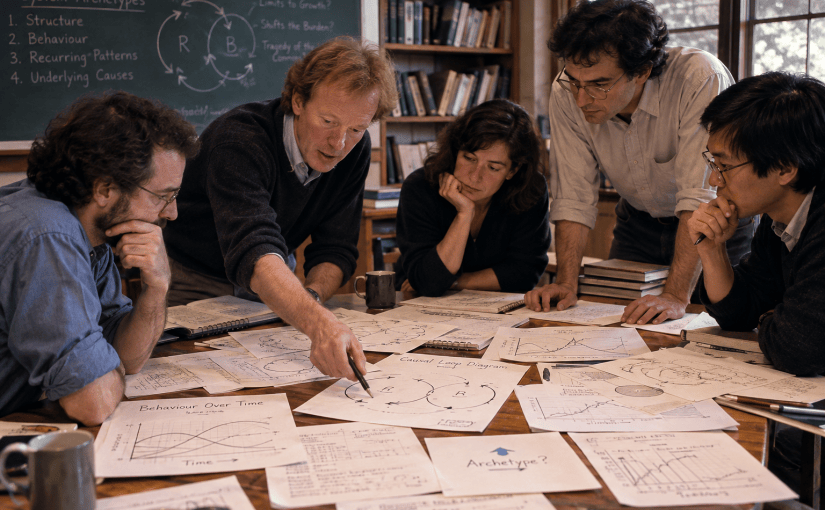
To Uncover What Was Hidden Yet Repeatedly Shaping Behaviour
The journey toward system archetypes was not simply a search for a collection of useful diagrams. It emerged from a practical and intellectual problem within systems thinking: how do we help people see recurring structures when the situations in which those structures appear look different, and when the structure itself is not immediately visible?
In The Fifth Discipline, Senge describes system archetypes as “generic structures” that recur across apparently different situations and argues that they provide a way of learning to see structures in our personal and organisational lives. He also makes the important point that experienced managers often recognise these recurring “plot lines” intuitively, but do not necessarily have the language to explain what they are seeing. (FlipHTML5)
The development work was therefore concerned with making something that was often sensed, but not yet clearly articulated, available for deliberate inquiry. The Fifth Discipline Fieldbook subsequently turned this into a practical learning pathway through material such as Starting with Storytelling, Links and Loops, the Archetype Family Tree, Systems Sleuth and Enriching the Archetype. The historical account of the work also identifies Peter Senge, Michael Goodman and Jennifer Kemeny, with contributions from the MIT system dynamics community including John Sterman, among those involved in developing and communicating the archetypes. (Google Books)
Six Reasons We Can Trace Through Their Work
These are not six reasons stated by Senge as a numbered list. They are six purposes that can be traced through The Fifth Discipline, The Fifth Discipline Fieldbook and the development of the archetype practice.
1. To recognise recurring structures beneath apparently different situations
One of the most important insights Senge identifies is that certain patterns of structure recur again and again. He compares archetypes to basic sentences or simple stories whose themes are repeatedly retold with different characters and settings; the same structural pattern can therefore appear in a wide variety of management situations. The implication is significant: what looks like a completely new problem may contain a structure that has already appeared elsewhere. (FlipHTML5)
This is why the archetypes are more than a catalogue of management problems. They allow the practitioner to ask whether the apparent uniqueness of a situation is masking a recurring structural configuration.
2. To give language to what experienced practitioners were already sensing
Senge observes that archetypes can produce a sense of déjà vu—the feeling of “There it is again.” Experienced managers may recognise the recurring plot line intuitively, yet not know how to explain it; the archetypes provide a language that can make explicit what might otherwise remain simply “management judgment.” (FlipHTML5)
This is an important distinction. The archetype does not necessarily create the insight in the first instance; it can give structure and language to an insight that was already being experienced, making it available for examination, discussion and learning.
3. To move perception beyond events and snapshots toward structure
Senge repeatedly distinguishes seeing events from seeing the structures generating them. In The Fifth Discipline, he argues that structures of which we are unaware can hold us prisoner, while learning to see the structures within which we operate begins the process of freeing us from previously unseen forces. He also identifies thinking in terms of processes of change rather than snapshots as a central systems-thinking move. (studylib.net)
The archetype therefore belongs to a larger movement of perception:
Events → Behaviour Over Time → recurring behaviour → structure → archetype
The archetype is not the starting point. It becomes meaningful because the behaviour has begun to reveal something worth explaining.
4. To recondition perception
Here Senge is explicit. He writes that the purpose of systems archetypes is to recondition our perceptions, making us more able to see the structures at play and the leverage within those structures. He goes further: merely seeing a particular structure with the help of a consultant may solve a problem without necessarily changing the thinking that produced it; the deeper objective is for systems thinking to become an active, continuing way of seeing. (FlipHTML5)
This makes the archetypes fundamentally different from a set of diagnostic labels. They are intended to change what the practitioner notices. The question is no longer simply, “What happened?” but increasingly, “What structure am I looking at, and what is it producing over time?”
5. To reveal leverage that is otherwise difficult to see
Senge connects archetype recognition directly to leverage. He argues that as people learn to recognise more archetypes, they can see more places where leverage exists in difficult situations and can explain those opportunities to others; elsewhere he makes the point that leverage in real-life systems is often not obvious to the people operating within them. (FlipHTML5)
This matters because the point of seeing structure is ultimately not merely to describe it. Structure changes where we look for intervention. Instead of responding automatically at the point where the pressure is most visible, the practitioner begins to ask where a relatively small change in the structure might produce a more enduring change in behaviour.
6. To make systems thinking an active way of thinking and working
The final reason brings the others together. Senge says that mastering the archetypes starts an organisation on the path of putting the systems perspective into practice and that, when managers begin thinking in terms of archetypes, systems thinking becomes an active daily agent continually revealing how we create our reality. (FlipHTML5)
This is consistent with the purpose of The Fifth Discipline Fieldbook, which was designed not simply as a theoretical companion but as a practical resource for use in meetings, planning, reflection and organisational challenges. Its sequence of storytelling, links and loops, archetype work and further modelling shows an intention to build a practice of seeing, rather than merely transfer knowledge about diagrams. (Penguin Random House Higher Education)
What, Then, Was Being Uncovered?
What was being uncovered was not information that had been deliberately hidden. It was something more subtle: recurring relationships and structures that could remain invisible when attention stayed at the level of events, individual actions and immediate explanations. Senge’s formulation that structures of which we are unaware can hold us prisoner captures the significance of the journey; the archetypes offered a way to make recurring structural behaviour more visible, discussable and actionable. (studylib.net)
There is also an important intellectual progression here. Feedback loops and delays are the building blocks; system archetypes are recurring configurations of those building blocks; Behaviour Over Time is the behavioural evidence through which those configurations become recognisable. Senge’s work therefore does not ask us to leap from an event to an archetype: it points toward learning to see the structure beneath the event and recognising that similar structures can generate similar behaviour across very different contexts. (FlipHTML5)
And this is where STRLDi takes the inquiry one step further.
Read Before Continuing: The Perceptual Problem
Before we ask what happens when system archetypes become internalised, it is useful to revisit the problem they are helping us address: what happens to perception when we are working inside dynamic complexity and moving faster than the system can reveal itself?
In What Is the Magic Number, Before You Start Caring Enough to Slow Down, to the Speed of Systems Thinking?, I explore the mismatch between the speed at which we habitually respond and the speed at which dynamic systems reveal their behaviour. The article introduces the Sea of Dots, Behaviour Over Time, the stereogram moment and the discipline of allowing patterns to stabilise before moving toward structure and archetype.
Read the accompanying article:
What Is the Magic Number, Before You Start Caring Enough to Slow Down, to the Speed of Systems Thinking?
STRLDi Interpretation
Why System Archetypes Were Uncovered
The Mind Can Weave Its Own Causality
The journey into system archetypes can be understood not only as a search for recurring structures, but also as an attempt to address a more fundamental difficulty: the mind does not simply receive reality; it actively constructs meaning from what it encounters. We do not observe events and neutrally wait for causality to reveal itself. The mind is constantly making connections, filling gaps, selecting evidence and constructing explanations, often before the underlying behaviour has had enough time to reveal its structure. Fear, experience, ideology, institutional interests and inherited mental models can therefore become invisible guides to thought, allowing us to move from an event to an explanation without ever testing whether the explanation is supported by the behaviour of the system.
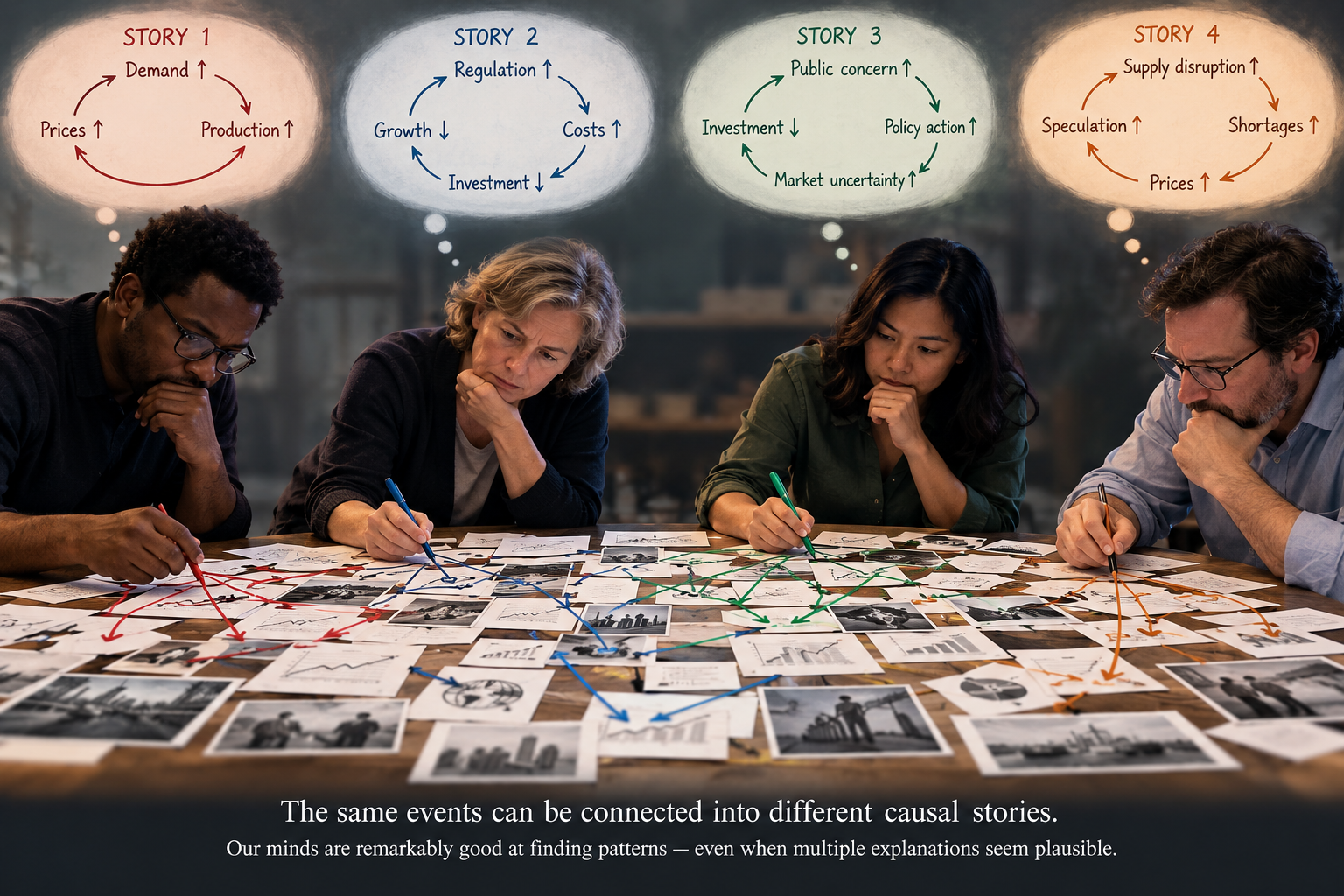
This means that causality can be constructed before it is established. An event occurs, the mind searches for meaning, and an explanation that feels coherent can quickly become the explanation, particularly when it confirms what we already believe or what we need others to believe. In dynamic complexity this becomes especially consequential because the consequences of an action may be separated from it by time, distance, feedback and boundaries; the first explanation can therefore become embedded long before the system has had sufficient time to reveal what is actually generating the behaviour.
The deliberate construction of causal stories makes this capacity particularly visible. Spin doctors are an obvious illustration of the human ability to arrange events, select connections and construct a causal narrative that leads an audience toward a desired interpretation. The systems-thinking challenge is therefore not simply to find a convincing story, but to develop a discipline that asks whether the causal explanation can withstand examination against the behaviour and structure of the system.
Learning to See What Is Hidden in the Chaos
A Stereogram Practice for Systems Thinkers
If the mind can weave its own causality, then we need to understand something about the act of seeing itself. One of the difficulties we encounter when working with dynamic complexity is that the mind is presented with far more information than it can hold with equal attention. Events, numbers, complaints, interventions, opinions and consequences appear as a sea of dots, each demanding attention and each seemingly important, yet somewhere within that apparent disorder there may be a structure that matters far more than any individual dot. The challenge is therefore not simply to gather more information or to look harder, but to develop the ability to key the mind into what is important without being captured by the chaos.
This is one reason I use stereograms in the development of systems-thinking practitioners. A stereogram appears at first to be nothing more than a field of apparently unrelated marks, and yet, when the eyes find the correct way of seeing it, an image that was already there suddenly becomes visible; nothing has been added to the picture and nothing has been removed from it, but the observer’s relationship with what is in front of them has changed. The image was not created by the act of seeing it; the act of seeing simply made the existing structure perceptible.
That experience is surprisingly close to what we ask of the systems-thinking practitioner. When we enter a persistent problem, we are rarely presented with a neat causal structure waiting to be copied onto a page; instead, we encounter events, stories, statistics, institutional responses, competing explanations and years of accumulated experience, and our natural tendency is to organise these quickly into something that feels familiar enough to understand. The danger is that we may recognise our explanation before we have recognised the system.
The stereogram gives the practitioner an opportunity to experience this distinction rather than merely hear it explained. At first, the mind searches for an object and finds none, and it is tempting to conclude that there is nothing there; then, sometimes quite suddenly, the hidden form appears, and the experience is unmistakable because the dots have not changed — perception has changed. That is the discipline we want to cultivate when working with complex and persistent problems: not the ability to impose order more quickly, but the capacity to remain sufficiently attentive for the order that matters to emerge.
The Practice
I would encourage the team to begin with simple stereograms and resist the temptation to look at the answer. Spend some time simply looking, allowing the eyes to find the depth rather than forcing the image to appear, and notice what happens when the hidden form suddenly becomes visible; then look away and return to the same image, because the second experience often teaches something different from the first. The objective is not to become good at stereograms. The objective is to experience what happens in your own perception when something that was present all along becomes visible.
Begin with a few simple examples and progressively move toward more complex images. The following provide a useful starting point:
Practice 1 — Learning how to see
Hidden 3D: How to View Stereograms
Practice 2 — A beginner’s gallery
Hidden3DImage Gallery
Practice 3 — A larger collection
Hidden-3D Stereogram Gallery
Practice 4 — Different depths and more demanding images
University of Amsterdam 3D Art Gallery
Practice 5 — Random-dot stereograms
Random-Dot Stereogram Examples
Do not rush through the galleries. One image properly experienced is more useful than twenty images quickly identified, because what we are practising is not visual entertainment but the suspension of premature interpretation; once the hidden image appears, stay with the experience long enough to notice that you did not manufacture the answer, you allowed your perception to reorganise itself.
From Stereogram to System
There is a reason this matters for the work we are doing with events, Behaviour Over Time, patterns and structure. Events are our dots; they are real and they matter, but they do not necessarily tell us what the system is producing, and when we treat every event as equally significant we can become overwhelmed by the quantity of information while remaining unable to see the organising behaviour beneath it. Behaviour Over Time begins to give those dots continuity, recurrence begins to reveal itself, and what previously appeared as scattered information can begin to acquire depth.
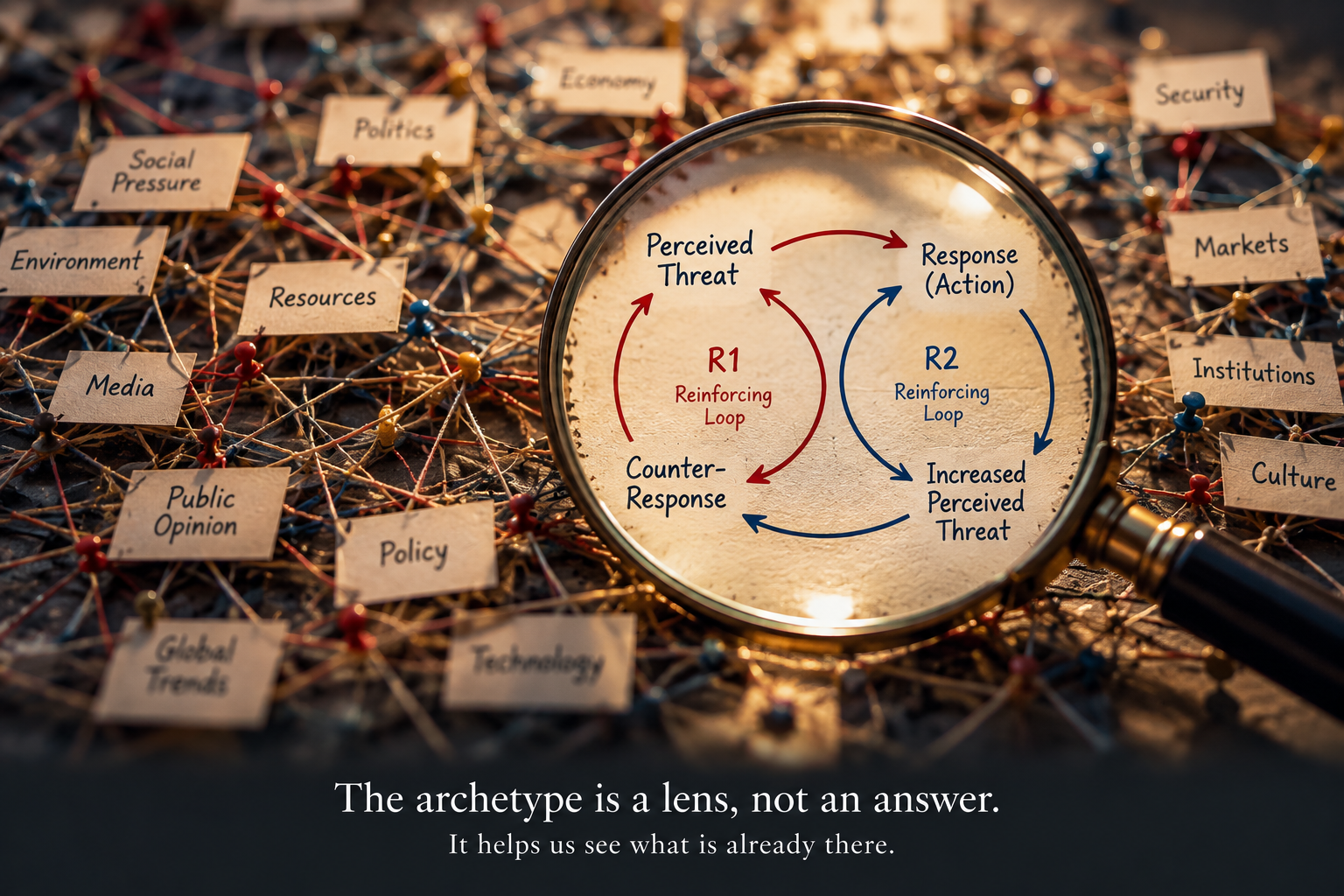
This is also why I am careful about the use of system archetypes. An archetype should not be something we recognise first and then impose upon the problem; it should become a useful lens only when the behaviour has stabilised sufficiently for us to recognise something recurring in the structure. The archetype is therefore closer to the magnifying glass than the answer: it helps us see what is already there, rather than telling us what ought to be there.
The same discipline applies when we begin to construct causal structures. We cannot determine the polarity of a loop because a variable sounds like a solution, because something is being used more frequently, or because a familiar archetype normally contains a particular relationship; the arrows must be traced, the relationships examined, and the loop understood before its behaviour is named. This is not an academic nicety, because the moment we allow a familiar mental model to replace what the structure is actually showing us, we have stopped discovering the system and started drawing our own assumptions.
The Sequence Becomes a Discipline of Seeing
The stereogram gives us an experience of why sequence matters. We cannot force the hidden image into existence simply by deciding what it should be, and we cannot make a system archetype valid simply because a problem resembles a familiar story. The discipline is to remain with what is observable long enough for behaviour to establish itself, and then to ask what structure could plausibly account for that behaviour.
This is why the sequence matters:
Events → Behaviour Over Time → recurring behaviour → structure → archetype
Events are where inquiry begins, but they are not where causal explanation should end. Behaviour Over Time allows us to see whether what appears to be an isolated event is actually part of a persistent movement; recurring behaviour then gives us grounds to search for the relationships and feedback structure capable of producing it. The archetype comes later, as recognition of a recurring structural configuration—not as a template imposed at the beginning.
The sequence therefore becomes more than a methodology for conducting an analysis. It becomes a discipline for protecting the mind from its own speed. It creates a track along which inquiry can move without allowing every new event, anecdote or compelling explanation to redefine the problem before the system has had an opportunity to reveal itself.
The Archetype Becomes a Cognitive Reference Track
Once a recurring structure has been established, the archetype becomes a kind of cognitive reference track. When the mind begins to wander into explanations supplied by fear, assumption, anecdote or an inherited mental model, the practitioner can recognise the departure and return the inquiry to the structure. The archetype does not tell the practitioner what to think; it helps the practitioner notice when thinking has begun to move away from what the system’s behaviour can support.
This becomes increasingly important as the practitioner works with dynamic complexity because the field is rarely quiet. New events arrive, stakeholders offer explanations, institutions defend positions, competing narratives emerge, experts advance different diagnoses and individuals bring their own experiences into the conversation. Without a disciplined reference point, every new event can pull the inquiry onto another track.
Internalised archetypes therefore have a different function from simply knowing the names of Success to the Successful, Shifting the Burden, Escalation or any other structure. The practitioner learns to recognise the structural territory and, more importantly, learns to return to it when the mind starts constructing another explanation.
The Training Wheels Are Meant to Disappear
The bicycle training-wheel analogy helps explain what internalisation actually means. The training wheels do not ride the bicycle for the child; they provide enough constraint for the child to develop a new motor pathway until balance becomes increasingly natural. In the same way, internalised archetypes can provide cognitive guardrails while the practitioner develops the discipline to remain with causality, feedback, delay and structure rather than being carried away by the first compelling explanation.

The objective is therefore not dependence on archetypes. A practitioner who must constantly ask, “Which archetype is this?” has not yet developed the deeper capability; the archetype should gradually become part of how the practitioner sees, just as the cyclist eventually rides without thinking about the training wheels.
The practitioner gradually develops mental tracks along which systemic inquiry can move efficiently. This makes it possible to work with dynamic complexity without being scattered by every new event, narrative, fear, anecdote or proposed solution that enters the field.
From Manipulating Perception to Testing Perception
This brings us to an important ethical distinction. The purpose is not to manipulate the mind into accepting a preferred explanation. It is to discipline the mind so that it can remain accountable to the structure. That distinction matters because the same human capacity to construct causality can be used in fundamentally different ways: one can construct a causal story to influence how others perceive events, or one can discipline one’s own thinking so that causal claims are continually tested against Behaviour Over Time and the structure that produces it.
Spin doctors use causality to shape perception; systems practitioners use disciplined causality to test perception. The former can lead people toward a desired interpretation; the latter should lead the practitioner back toward what the system’s behaviour and structure can actually support. This is why systems thinking, properly practised, is not another technique for becoming more persuasive; it is a discipline for becoming more accountable to what the system is actually doing.
The purpose of system archetypes, then, is not merely that recurring patterns exist and are worth cataloguing. Recognising those patterns can help develop a different way of thinking—one less vulnerable to the mind’s tendency to manufacture explanations from events and more capable of remaining with evidence until structure becomes visible. The archetype is not the answer; it is part of the discipline that teaches the mind where to look for an answer.
The Question I Want You to Practise
So, when you work with the stereograms, do not ask only, “Can I see the hidden image?” Ask instead: What did I do differently when I could not see it? What happened when I stopped trying to find an answer and allowed my perception to change? How quickly do I impose meaning when the information in front of me appears chaotic?
And perhaps most importantly:
Can I remain with the dots long enough for the structure to reveal itself?
That is the practice.
We are not trying to see more. We are learning to see what matters.

Read the Accompanying Application
When a Nation Learns to See — Systems Thinking Research & Leadership Development Institute (STRLDi)
Read “When a Nation Learns to See”
The architecture now is:
Senge and colleagues — Why uncover archetypes?
- Recognise recurring structures
- Give language to recurring experience
- Move perception from events to structure
- Recondition perception
- Reveal leverage
- Make systems thinking an active practice
STRLDi — What happens when the discipline is internalised?
- The Mind Can Weave Its Own Causality
- The Sequence Becomes a Discipline of Seeing
- The Archetype Becomes a Cognitive Reference Track
- The Training Wheels Are Meant to Disappear
- From Manipulating Perception to Testing Perception
The STRLDi five do not compete with Senge’s six. They take the question one step further: Senge helps us understand why the archetypes were uncovered and what they were intended to make possible; STRLDi asks what happens to the practitioner’s mind when that discipline is repeatedly practised until it becomes internalised.
From Structure to History: Can We See the Archetypes at Work?
The value of uncovering system archetypes becomes more tangible when we turn from diagrams and conceptual explanations to the annals of history. History gives us something important to work with: events have already happened, the sequence is available to examine, and in many cases the behaviour unfolded over sufficient time for the underlying relationships to become visible. The question is not whether history was “caused by an archetype,” but whether, when we reconstruct the sequence, a recognisable structural pattern can be seen beneath the events.
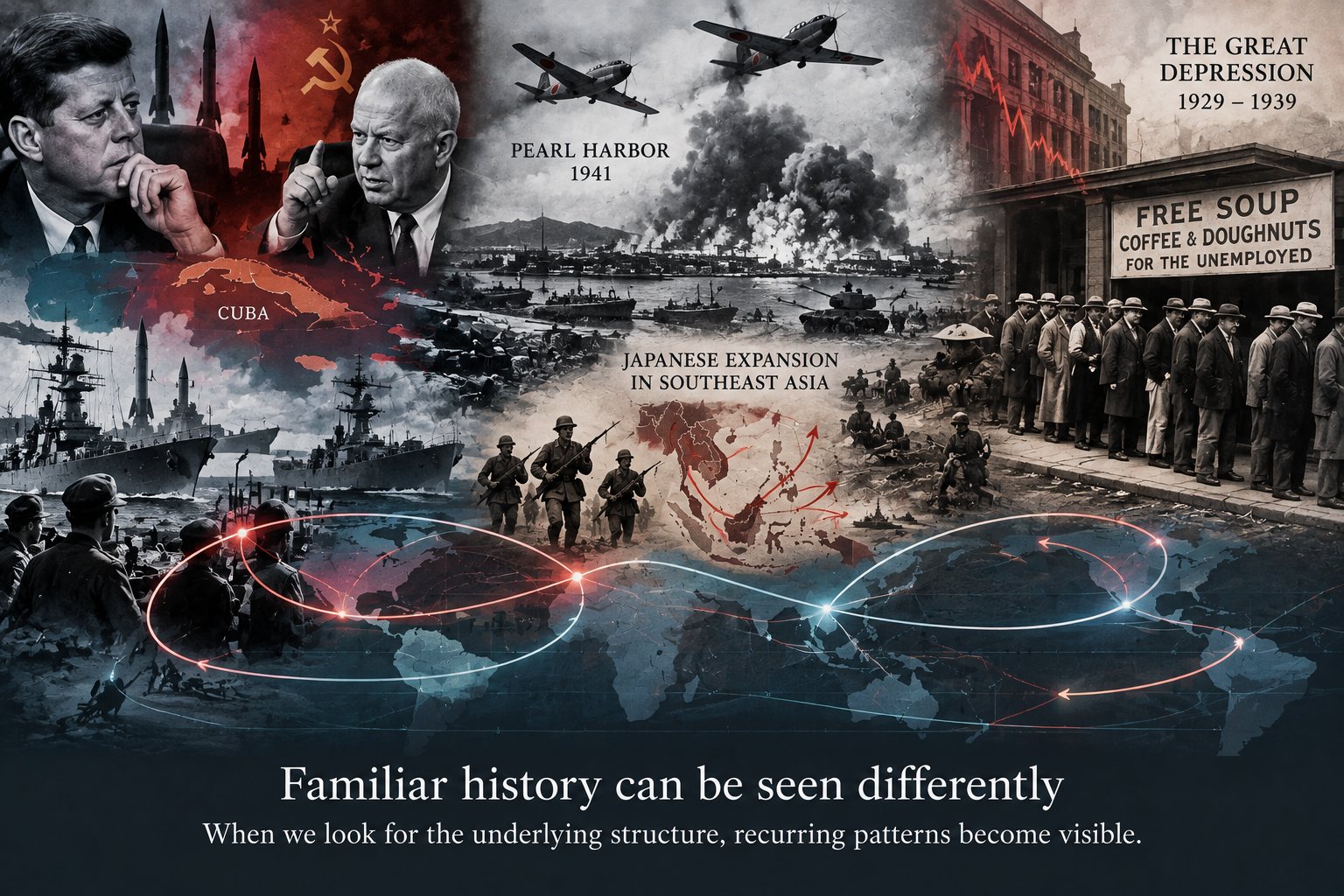
The Cuban Missile Crisis provides one of the clearest examples. The Soviet deployment of missiles in Cuba was interpreted by the United States as a strategic threat; the United States responded with a naval quarantine and military preparations, while the Soviet Union continued to resist American demands and the crisis intensified. Each side’s actions became part of the other’s assessment of threat and justification for further action, creating the reciprocal pattern characteristic of Escalation.
Perceived threat → response → increased perceived threat → counter-response → increased perceived threat.
The importance of the example is not simply that the crisis became dangerous. It is that the structure can be traced through the behaviour. We can see two actors responding to one another, each response altering the conditions under which the other acts, until the interaction itself becomes a source of further escalation.
Once we begin looking this way, other familiar episodes of history invite the same examination.
Pearl Harbor → Hiroshima — Escalation
Japan’s expansion across China and Southeast Asia, the tightening of U.S. economic restrictions and the breakdown of negotiations created a progressively more confrontational relationship. Japan attacked Pearl Harbor on 7 December 1941; the United States entered the war, and the conflict ultimately culminated in the atomic bombings of Hiroshima and Nagasaki in August 1945. Read structurally, the sequence raises the question of whether actions intended to alter the strategic balance repeatedly became the conditions for further counter-actions, producing an escalation far beyond the circumstances from which the conflict began.
The Japanese Expansion into Southeast Asia — Fixes That Fail
Japan’s expansion into Southeast Asia was closely connected to its growing shortage of strategic resources, particularly after the United States froze Japanese assets and imposed an embargo on oil and other materials. Military expansion offered a way of addressing the immediate resource constraint, but it simultaneously widened the conflict, brought Japan into direct war with the United States and other Allied powers, and ultimately produced a strategic situation far more difficult than the one the intervention was intended to resolve. The immediate response addressed one pressure while creating consequences that intensified the wider problem—a sequence that can be examined through the lens of Fixes That Fail.
The Great Depression — Reinforcing Collapse
The Great Depression offers a different structural behaviour. Following the 1929 crash, banking failures, withdrawals and hoarding reduced money and credit; falling prices increased the real burden of debt, while bankruptcies and unemployment further reduced spending and economic activity. These interacting processes reinforced one another, turning an initial financial shock into a prolonged economic contraction.
Here the systems-thinking practitioner can look beyond the crash as an event and examine the reinforcing structure that produced persistent deterioration. The archetype is not assigned because the Depression has a convenient story; rather, the behaviour invites us to trace what was reinforcing what.
Now Turn the Lens Back to History
These examples are deliberately familiar. You have probably heard each story before. The invitation is to hear it differently.
Choose three episodes from the annals of history—from your country, your profession, your organisation or the wider world—and see whether you can uncover an archetype within them. Do not begin by asking, “Which archetype is this?” Begin with the history: What happened? What happened next? What changed over time? What responded to what? What consequence fed back into the system? Where was there a delay?
Only after you have traced the behaviour and structure should you ask:
What archetype, if any, has the history earned?
And the more demanding question:
Can you find three historical examples in which you can see the complete structure—not merely a situation that resembles the story of an archetype?
Do not begin with the archetype. Begin with the behaviour. Trace the structure. Then see whether the archetype is there.


You must be logged in to post a comment.