
Summary
This story traces a journey that began in the late 1980s with a simple question: How does management work in practice?
What followed became more than three decades of inquiry, practice, facilitation, research, and institution-building across Singapore, Vietnam, Indonesia, China, India, and Botswana.
Beginning with the observation of recurring patterns while serving in the Singapore Police Force, the journey evolved through the discovery of Behaviour Over Time patterns, System Archetypes, and the disciplines of organisational learning introduced through the work of Peter Senge, Daniel Kim, and Diane Cory. The experience led not only to the development of internal capability within the Singapore Police Force, but also to the creation of the Learning Organisation Practitioners Network (LOPN), an early effort to build a wider community of practice around systems thinking and organisational learning.
A personal vision articulated in 2000—to explore how these disciplines might contribute to addressing persistent issues at organisational, national, and global levels—provided the direction for the years that followed. Through hundreds of leadership development programmes, facilitation engagements, strategic planning initiatives, organisational learning interventions, and national studies involving thousands of participants, the work expanded across sectors and countries. A recurring focus was helping leaders, institutions, and governments develop the capacity to recognise persistent issues, surface underlying systemic structures, and identify leverage areas capable of informing strategy, policy, and long-term development.
The journey eventually led to national-level work in Botswana, the development of the Onion Framework, the establishment of the Systems Thinking Research & Leadership Development Institute (STRLDi), and ongoing research into persistent issues affecting communities, organisations, economies, and nations.
At its heart, this is the story of a continuing search to understand why certain issues persist, how people learn to see the structures that produce them, and what it takes to build systems that learn.
PIVOT ONE: LEARNING TO SEE
Every journey begins with a question.
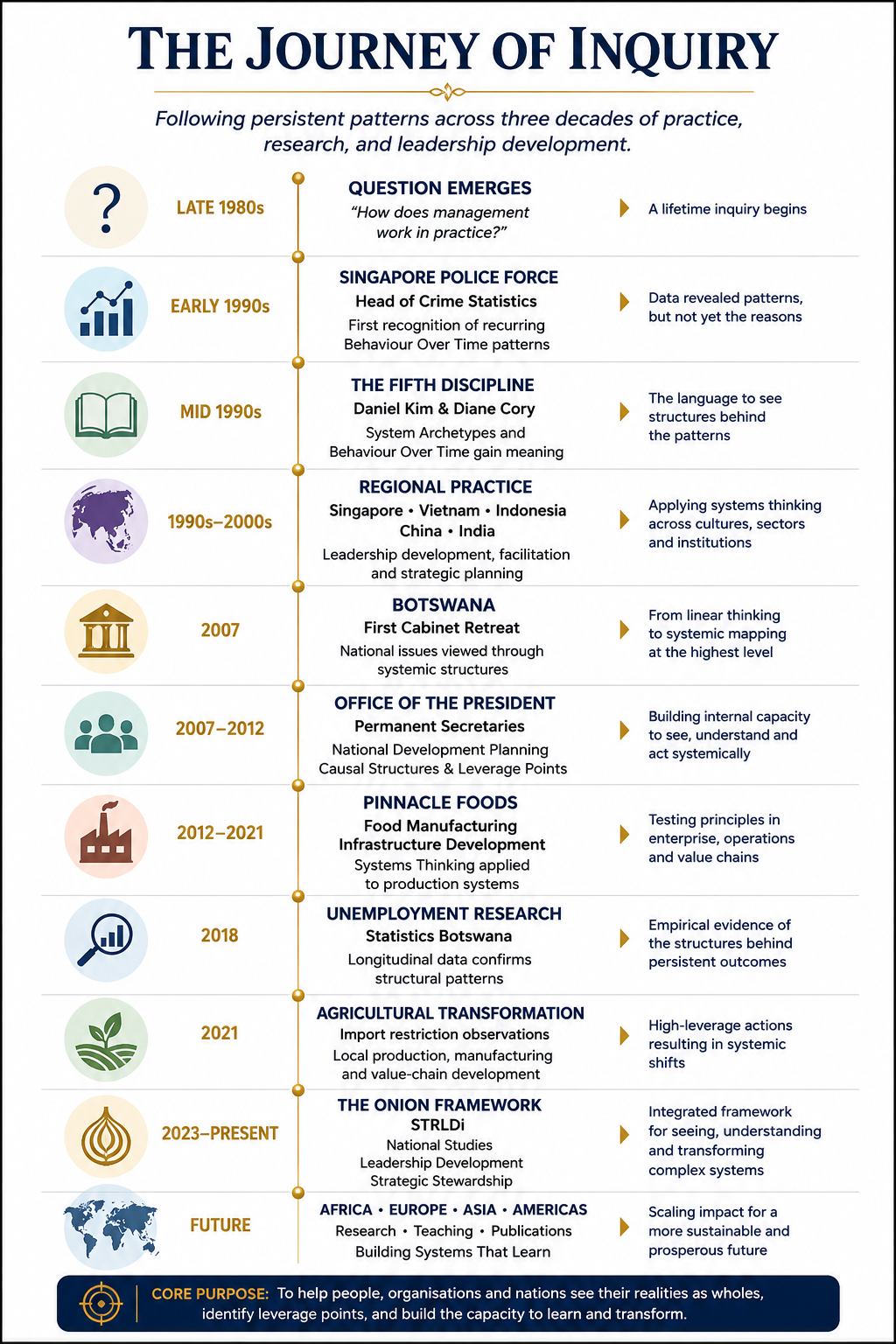
Mine began in the late 1980s with a deceptively simple one: How does management work in practice?
At the time, I was less interested in management theory than in understanding why some organisations, communities, and institutions appeared capable of sustained improvement while others remained trapped by recurring challenges despite significant effort, resources, and good intentions. What began as a professional question would eventually become a decades-long inquiry spanning public service, leadership development, organisational learning, national development, research, manufacturing, and systems thinking across multiple countries.
In the early 1990s, while serving as Head of Crime Statistics in the Singapore Police Force, I began noticing distinct patterns in the data. Certain behaviours appeared remarkably persistent. Interventions came and went, yet many of the underlying patterns remained. Singapore was experiencing historically low crime levels during this period, yet the data continued to reveal recurring patterns that raised deeper questions. Why did some problems diminish while others persisted? What produced these behaviours over time?
I could see the patterns, but I could not yet explain them.
The First Encounter with The Fifth Discipline (1996)
The first major turning point came in 1996, when I attended a one-week introduction to The Fifth Discipline conducted by Dr Daniel Kim and Diane Cory, associates of Peter Senge. During that programme, I encountered concepts that would fundamentally change how I understood organisations, leadership, and persistent issues.
Learning to See Behaviour Over Time
For the first time, the crime patterns I had been observing began to make sense. What had previously appeared as statistical trends could now be understood as Behaviour Over Time patterns generated by deeper systemic structures.
The data had not changed.
What changed was my ability to see.
Over the following years, I found myself noticing Behaviour Over Time patterns everywhere—in organisational performance, economic indicators, public policy, education, accidents, and community development. The challenge was no longer gathering information. The challenge was learning how to recognise the structures that produced recurring outcomes.
This period laid the foundation for a lifelong inquiry into dynamic complexity, system archetypes, and the search for leverage points hidden beneath visible events.
Deepening the Practice (1999–2000)
A second and equally important turning point followed in 1999, when I was selected to participate in a year-long development programme led by Daniel Kim and Diane Cory. The programme was designed to build internal capability and prepare participants to serve as internal consultants and change agents within their organisations.
During this period, I also supported fellow participants as a Teaching Assistant, deepening both my understanding of the disciplines and my ability to facilitate learning in others.
The experience strengthened my appreciation that systems thinking was not simply a set of tools. It was a discipline of helping people learn to see, think, and act differently together. Facilitating that learning process became as important to me as understanding the concepts themselves.
The Emergence of a Personal Vision
As the programme drew to a close in early 2000, participants were invited to articulate a personal vision. Mine extended beyond organisational learning. I found myself wondering what might become possible if these disciplines could be applied to persistent issues operating across sectors, nations, and international institutions.
At the time, I wrote of wanting to see this work contribute to organisations such as the United Nations, the African Union, and other institutions grappling with complex and persistent global challenges.
The path was unclear, but the intention was set.
Looking back, many of the decisions that followed can be traced back to that vision and the desire to understand what it would take to make such an aspiration practical.
Building Internal Capability within the Singapore Police Force
The year-long programme was not simply an individual learning experience. It formed part of a broader effort within the Singapore Police Force (SPF) to strengthen the organisation’s capability in the practice of The Fifth Discipline and organisational learning.
During this period, I was involved in assuming leadership in supporting the introduction and application of the disciplines across the organisation. The work extended beyond understanding the concepts themselves. It included helping senior officers appreciate both the theory and practical application of systems thinking, organisational learning, shared vision, team learning, mental models, and personal mastery within the context of policing and public service.
As part of this effort, I supported fellow participants as an Internal Trainer & Facilitator, facilitated learning activities, and contributed to the development of a growing cadre of internal facilitators. The objective was not to rely on external consultants indefinitely, but to build internal capability so that the disciplines could become embedded within the organisation’s own leadership and management practices.
The work also extended into organisational planning and leadership processes. This included facilitating strategic conversations, supporting Commissioners’ Meetings, and contributing to corporate planning initiatives involving both internal units and external stakeholders. Through these engagements, systems thinking became increasingly integrated into discussions on strategy, organisational development, community partnerships, and long-term planning.
Looking back, this period provided my first sustained experience of helping an entire organisation learn together. It reinforced a lesson that would remain central throughout my later work: lasting change rarely comes from a single programme or leader. It emerges when people throughout a system develop the capacity to think, learn, and act together.
Extending the Learning Beyond the Singapore Police Force
As the work within the Singapore Police Force matured, I became increasingly aware that many of the challenges facing organisations extended beyond the boundaries of any single institution. If organisational learning was to have broader impact, leaders from different sectors would need opportunities to learn together, exchange experiences, and explore how the disciplines might be applied within their own contexts.
This led to the establishment of the Learning Organisation Practitioners Network (LOPN) in Singapore. The network was created to provide a bridge between the learning taking place within the public sector and the wider community of business leaders, practitioners, educators, and professionals interested in organisational learning and systems thinking.
LOPN became a practitioner-led learning community dedicated to exploring both the theory and practice of The Fifth Discipline. Through regular monthly sessions, workshops, and multi-day learning programmes, participants were able to deepen their understanding of systems thinking while building relationships with others engaged in similar journeys.
The network grew through shared commitment rather than formal structures. Organisations offered meeting venues, participants contributed resources, learning materials were printed and shared collectively, and gatherings frequently extended into potluck meals and informal conversations. The community itself became an expression of the learning principles it sought to promote.
An important aspect of the network was its connection to the wider international field. Over time, respected practitioners and thought leaders such as Michael Goodman, Peter Stroh, Robert Fritz, and others were invited to engage with the community. These interactions provided opportunities for local practitioners to connect directly with emerging international practices while contributing their own experiences to the broader conversation.
Looking back, LOPN represented far more than a professional network. It was an early experiment in building a community of practice around organisational learning and systems thinking. It demonstrated that the disciplines could thrive beyond organisational boundaries and reinforced my belief that meaningful change often requires learning communities that cut across sectors, institutions, and professions.
In many respects, LOPN helped lay the foundations for later systems thinking communities as well as SoL Singapore and strengthened my conviction that the work needed to reach beyond individual organisations to engage society more broadly.
PIVOT TWO: LEARNING TO APPLY
Expanding the Inquiry Across Countries
Over the following years, my work expanded across Singapore, Vietnam, Indonesia, China, India, and eventually Botswana. The countries differed significantly in culture, governance structures, economic development, institutional maturity, and the norms, habits, and values that shaped behaviour. These differences influenced how people responded to challenges and how societies adapted to them.
Yet beneath these variations, many of the same persistent structures continued to appear.
Leaders wrestled with recurring issues in performance, coordination, implementation, learning, and long-term development. The expressions differed; the underlying dynamics often did not. What appeared as separate problems frequently turned out to be different manifestations of similar systemic structures.
Learning Through Practice
Over the course of more than three decades, this work expanded through leadership development programmes, facilitation engagements, strategic planning initiatives, organisational learning interventions, and systemic inquiry projects conducted across multiple countries.
Collectively, these engagements involved hundreds of workshops, planning sessions, and learning events, reaching thousands of leaders, managers, professionals, public servants, and community stakeholders.
These engagements became an extended laboratory for observing how persistent issues emerged, evolved, and responded to intervention under very different cultural and institutional conditions.
Discovering the Importance of Persistence
As my understanding deepened, I became increasingly convinced that systems thinking begins not with theory but with persistence.
Persistent issues rarely exist in isolation. They are interconnected.
They are signals that something beneath the surface is continuously generating familiar outcomes. They invite us to look beyond visible events and examine the structures producing them.
This insight would eventually shape much of the work that followed.
Botswana: Applying Systems Thinking at National Scale
The opportunity to explore these ideas at national scale emerged in Botswana, where I was invited to facilitate what became the country’s first Cabinet Retreat.
The experience marked another significant turning point. For the first time, many national issues could be viewed simultaneously through both linear and systemic lenses.
Blind spots that had remained hidden became visible. Connections between seemingly unrelated challenges began to emerge. Questions traditionally addressed within individual ministries revealed themselves to be part of larger structures. Missing plans could often be identified because issues were no longer viewed in isolation but as elements within an interconnected whole.
Working with Government Leadership
The work subsequently expanded through engagements with the Office of the President, Permanent Secretaries, and technocrats involved in National Development Plan (NDP) processes. A central intention of the initiative, championed by Permanent Secretary to the President, Mr Eric Molale, was to strengthen the ability of ministries to recognise and understand persistent issues before they became recurring development challenges.
The effort was not limited to introducing systems thinking concepts. It sought to build practical capability in the Five Disciplines of the Learning Organisation, enabling leaders and officials to examine issues from both linear and systemic perspectives. By surfacing underlying systemic structures, ministries were better positioned to identify leverage areas that could inform policy, strategy, and future National Development Plan priorities.
Equally important was the aspiration to develop a broader community of practitioners across government. The intention was that the disciplines would not remain the domain of a small specialist group, but would gradually become part of everyday conversations, planning discussions, and decision-making processes. As more leaders developed familiarity with the language and practice of the disciplines, systems thinking could begin to influence not only what government planned, but also how government thought.
Together, we identified major causal structures influencing outcomes across government, while ministries developed additional causal loops to better understand their own persistent challenges.
What began as leadership development gradually evolved into a process of helping institutions learn to see themselves more clearly.
The most important lesson from this period was that management changes when people begin to see reality as a whole. As leaders develop a shared understanding of the structures influencing outcomes, the nature of leadership shifts from control toward stewardship.
The objective is no longer simply to manage isolated problems.
The objective becomes strengthening the system’s capacity to learn.
Developing Systemic Capability for National Development
What began as leadership development gradually evolved into something larger.
The intention was not simply to introduce systems thinking concepts, but to strengthen the capacity of government to recognise and understand persistent issues before they became recurring development challenges. Through the leadership of the Office of the President and the support of senior officials, the work expanded into a portfolio of persistent national issues intended to support the development of systemic capability within government and strengthen the quality of National Development Planning.
A growing number of leaders, technocrats, and practitioners were introduced to the disciplines and practices of organisational learning, with the aspiration that systems thinking would become more than a specialist skill. Many of whom now occupy senior positions within government. The longer-term aim was to cultivate a shared language and way of thinking that could help ministries see beyond individual mandates and better understand the interconnected structures shaping national outcomes.
Over time, more than twenty persistent issue areas were explored through this lens. Some were located within specific sectors. Others, such as unemployment, cut across multiple ministries and institutions, making them particularly difficult to understand and address through conventional planning approaches. These inquiries helped reveal how seemingly separate challenges were often connected through deeper systemic structures operating across government, communities, households, and the economy.
One of the persistent issues explored through this broader effort was unemployment. The journey that eventually led to the STRLDi unemployment study spanned many years and involved multiple institutions, leaders, planners, educators, and researchers seeking to better understand why unemployment persisted despite significant effort and investment.
Read:
The Long Road to Seeing Unemployment Systemically
https://strldi.weebly.com/blog/the-long-road-to-seeing
Applying the Work to Production Systems
During this same period, another strand of learning was developing in parallel through the establishment of Pinnacle Foods & Hospitality Group.
Here, systems thinking was being applied within food production, manufacturing, value-chain development, and agricultural coordination. The experience provided an opportunity to test many of the same principles being explored in government and organisational settings.
Questions of capacity, incentives, coordination, learning, resilience, and long-term investment appeared just as relevant within production systems as they did within public institutions.
The experience reinforced an important lesson: systems do not recognise the boundaries we create between sectors. The same patterns influencing governments and organisations frequently appear within businesses, communities, industries, and supply chains. Understanding how those patterns interact became an increasingly important part of the inquiry.
PIVOT THREE: LEARNING TO CONNECT THE WHOLE
Another important realisation emerged through years of facilitation across organisations, sectors, and countries. Many organisations were struggling with remarkably similar challenges and investing significant effort to overcome them. Yet their progress was often constrained by forces beyond their immediate control.
Over time, I began noticing that many of the structures affecting organisational performance did not originate within the organisation itself. They were being reinforced by structures operating within families, communities, educational systems, governance arrangements, economic conditions, and even natural systems. Organisations were frequently attempting to solve problems whose origins lay outside their boundaries.
This observation helped explain why some organisational interventions produced only temporary improvements. Even when leaders acted decisively, larger structures often continued to generate the very conditions they were attempting to change. The organisation could improve its response, but the source of the issue frequently remained active elsewhere.
This insight changed the direction of my work. It became increasingly clear that the limits of organisational transformation could only be understood by examining the larger systems within which organisations were embedded. The challenge was no longer simply helping organisations learn. It was helping sectors, communities, institutions, and nations learn together.
This realisation ultimately shaped my role as a bridge across organisational, sectoral, and national boundaries, connecting conversations that were often taking place separately but were, in reality, deeply interconnected. It also reinforced the importance of developing leaders capable of seeing beyond the boundaries of their own institutions and recognising the wider structures influencing their outcomes.
PIVOT FOUR: LEARNING THROUGH PRODUCTION SYSTEMS
While the work in leadership development, government transformation, and national studies continued to expand, another strand of learning was unfolding in parallel. Beginning in 2012, I became increasingly involved in the establishment of Pinnacle Foods & Hospitality Group, a venture focused on food manufacturing, value addition, and agricultural development.
At first glance, food production may appear far removed from systems thinking. Yet I soon discovered that many of the same dynamics I had been observing in organisations and governments were equally present within production systems. Questions of coordination, incentives, capacity development, resilience, long-term investment, market behaviour, and learning surfaced repeatedly.
The experience reinforced an important lesson. Systems do not recognise the boundaries we create between sectors. The same patterns that influence public institutions often appear within businesses, communities, and industries. Understanding how those patterns interact becomes increasingly important as systems become more interconnected.
This work also provided a practical opportunity to explore the relationship between agriculture, manufacturing, food security, employment, and national development. Rather than studying these issues from a distance, I was now experiencing many of them directly. The lessons gained through production systems deepened my appreciation for the challenges faced by entrepreneurs, farmers, manufacturers, and policymakers attempting to create long-term value under conditions of uncertainty.
The COVID-19 period further reinforced these observations. Supply chains were disrupted, markets shifted, and long-standing assumptions were challenged. Yet these disruptions also revealed opportunities for countries to rethink local production, resilience, and the coordination of critical sectors.
One example emerged in Botswana following the government’s decision to restrict vegetable imports from neighbouring countries. The policy generated significant debate and adjustment challenges, yet it also accelerated conversations about local production, value addition, agricultural coordination, and manufacturing capability. For me, the development represented another example of how structural shifts can create opportunities for learning and adaptation when viewed through a systemic lens.
PIVOT FIVE: LEARNING TO PROVE
One of the enduring challenges facing systemic work has always been evidence. Many recurring patterns can be observed through experience, interviews, facilitation, and organisational history. Yet longitudinal data provides a different level of confidence.
That opportunity emerged through the Botswana unemployment research, undertaken using data provided by Statistics Botswana. For years, many of the patterns identified through facilitation and systemic inquiry had remained largely anecdotal. The availability of robust data created an opportunity to examine whether those observations would withstand empirical scrutiny.
The study represented more than an investigation into unemployment. It became an opportunity to test whether patterns observed through years of practice could be validated through evidence. The findings revealed complex relationships spanning education, family structures, labour participation, economic development, and national productivity.
Rather than pointing to a single cause, the work demonstrated how multiple structures interact over time to reinforce persistent outcomes. Importantly, many of the patterns previously observed through facilitation became visible within the data itself. The research strengthened confidence that Behaviour Over Time analysis could serve as a practical tool for understanding national issues and identifying areas of leverage.
For me, the significance of the research was not that it provided all the answers. Rather, it demonstrated that systemic inquiry could move beyond observation and be supported by rigorous analysis. It showed that many issues presented as isolated challenges were, in fact, interconnected expressions of deeper structural conditions.
FROM INQUIRY TO INSTITUTION
As the years progressed, a broader pattern began to emerge from the accumulated work across organisations, governments, communities, industries, and national studies.
Many persistent issues appeared to involve more than a single system archetype. Different structures frequently interacted with one another, reinforcing behaviours and making change more difficult than it initially appeared. The challenge was no longer simply identifying individual patterns. It was understanding how multiple patterns combined to create the realities people experienced.
This question eventually contributed to the development of the Onion Framework.
The Onion emerged from decades of observing how systemic structures interact across multiple levels of reality. Rather than examining persistent issues through a single lens, the framework seeks to reveal the layered structures influencing behaviour over time. It provides a way of moving beyond symptoms and isolated interventions toward a more integrated understanding of persistent challenges.
The development of the Onion also reinforced another insight. Many people intuitively recognise that problems are connected, yet struggle to explain how those connections operate. The framework was developed to help leaders, researchers, practitioners, and policymakers navigate that complexity more effectively.
These experiences ultimately contributed to the establishment of the Systems Thinking Research & Leadership Development Institute (STRLDi).
STRLDi serves as a platform for research, leadership development, systemic inquiry, and strategic stewardship. Its purpose is not simply to teach systems thinking, but to strengthen society’s capacity to understand and respond to persistent issues. The work spans organisational learning, leadership development, national studies, agricultural transformation, manufacturing development, policy inquiry, and the continuing refinement of systemic frameworks.
Through publications, research initiatives, workshops, leadership programmes, and collaborative engagements, STRLDi continues to explore many of the questions that first emerged decades ago.
THE INQUIRY CONTINUES
Looking back, I can see that each turning point contributed something important.
The Singapore Police Force taught me to recognise recurring patterns.
The Fifth Discipline provided the language to understand them.
Years of facilitation across countries revealed how similar structures could appear in very different contexts.
Botswana provided an opportunity to apply and deepen the work at national scale.
The unemployment study demonstrated the value of combining systemic inquiry with empirical evidence.
Production systems and manufacturing reinforced the importance of grounding ideas in practical realities.
The Onion Framework emerged from the search to understand how multiple structures interact.
STRLDi became the institutional home for continuing that inquiry.
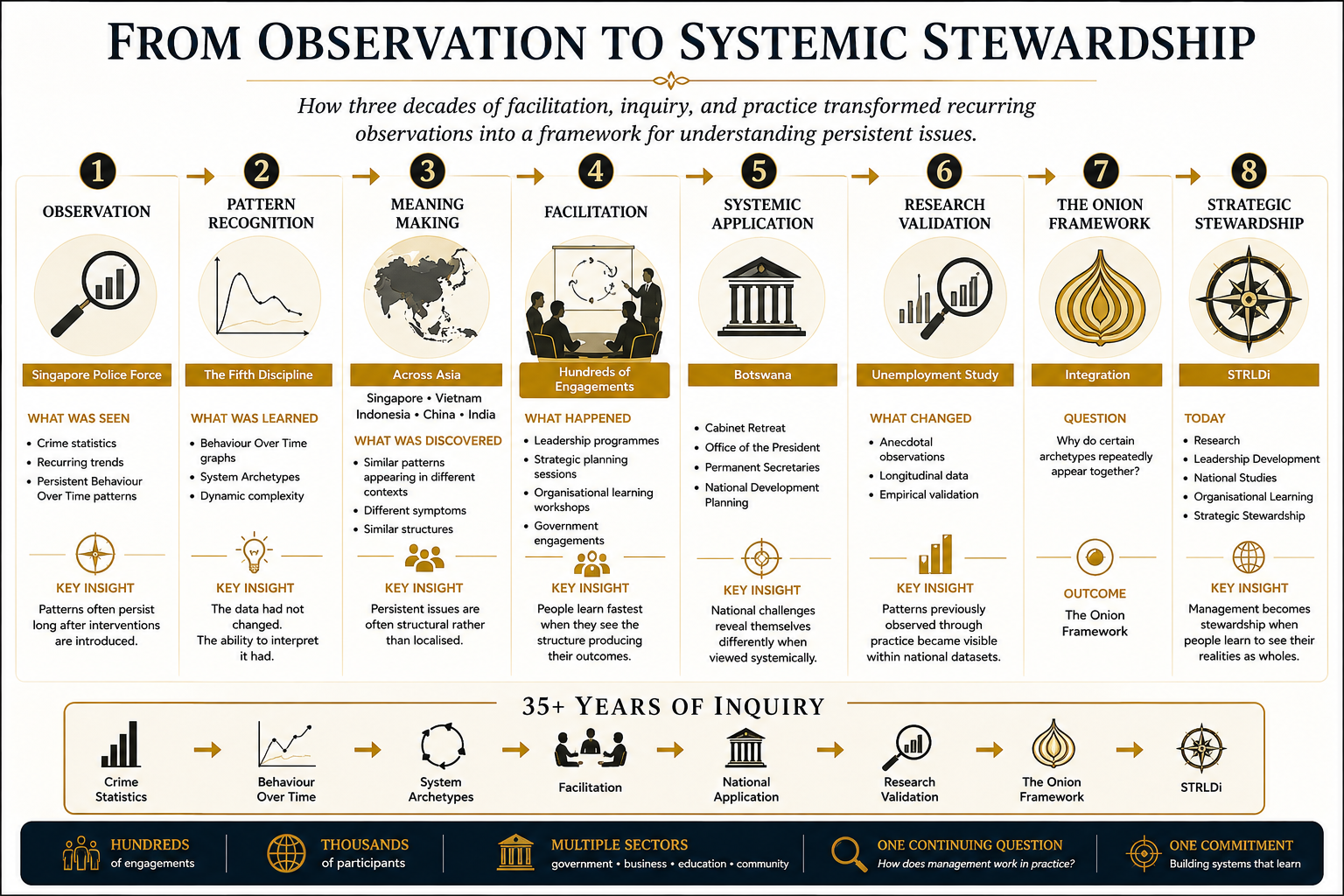
Today, STRLDi serves as a research, leadership development, and strategic stewardship platform dedicated to understanding persistent issues and building the capacity to address them.
Our work spans leadership development, systemic research, national studies, organisational learning, and strategic transformation. Through publications, training programmes, research initiatives, and collaborative engagements, we continue to explore the same question that first emerged in the late 1980s.
How does management work in practice?
After more than three decades, my answer is very different from the one I would have given at the beginning of the journey.
Management works best when people learn to see their realities as wholes, understand the structures shaping outcomes, and develop the capacity to learn together. The strongest organisations, communities, and nations are not those with the most managers. They are those that have learned how to learn.
Today, STRLDi serves as both a research platform and a living laboratory. The work continues through leadership development, national studies, organisational learning, agricultural transformation, manufacturing development, and the ongoing refinement of frameworks designed to help leaders recognise and respond to persistent issues.
The inquiry continues.
LOCAL / GLOBAL PRESENTATIONS:
2022 Aug 20 – Rhodes Medical Centre, Switzerland. Session coordinated by Noel Tan out of Singapore.
2022 Oct 20 – Virtual Learning Practice. A collaboration of Global SoL Community of Practice & National Mentorship Movement https://mailchi.mp/2185f786ac03/virtual-learning-practice-invitation-15519160?e=9d575c853f


You must be logged in to post a comment.