

The Four Quadrant Framework and The Onion Lenses
The Structures Beneath the Surface: Why Persistent Problems Don’t Stay in Their Lane
When a country’s unemployment rises, the response is usually a labour policy. When food imports climb, agricultural reform gets discussed. When corruption surfaces, governance fixes are proposed. When mental health deteriorates, healthcare budgets get adjusted. Each problem gets its own lane, its own ministry, its own set of experts.
The trouble is that the problems don’t stay in their lanes.
This piece is drawn from a study that began with unemployment and gradually widened — because it had to. The more the data was examined, the more the pressures refused to stay separate. Labour oversupply showed up alongside weakened productive absorption. Educational expansion appeared alongside declining technical capability. Agricultural decline appeared alongside migration pressures and weakening generational continuity. The harder you looked at any one pressure, the more the others were already there beneath it.
What emerged from that widening is a framework for understanding how persistent issues actually move through society — not as isolated events requiring targeted fixes, but as interacting structural movements that propagate across generations, often long before anyone measures them.
The Gap Between Where Problems Appear and Where They Begin
The most important distinction in this entire framework is deceptively simple: the visible location of a problem and the generative location of a problem are not the same thing.
Take corruption. It becomes visible institutionally — in tender processes, in allocation decisions, in procurement scandals. But its behavioural roots often emerge much earlier: in weakened long-horizon thinking, in survival pressures normalised during upbringing, in the gradual acceptance of shortcuts within wider society. By the time it registers as a governance problem, the conditions producing it may have been quietly accumulating for a generation.
Or take institutional fragmentation. It appears within governance systems. But its deeper roots frequently emerge upstream in weakening continuity structures within human formation — in how people are raised, what values are transmitted across generations, how long-term thinking is cultivated or eroded.
Societies often intervene where pressures become visible rather than where they are structurally generated. This is not a failure of intelligence. It is a predictable consequence of how institutions are organised: by sector, by ministry, by profession. The problem is that persistent issues rarely respect those boundaries.
A Framework for Seeing Across Sectors
To organise the growing number of interacting variables without fragmenting their relationships, the study developed a four-quadrant framework. The quadrants are not rigid categories — they are lenses, each revealing where pressures are primarily generated, where they tend to become visible, and how they flow.
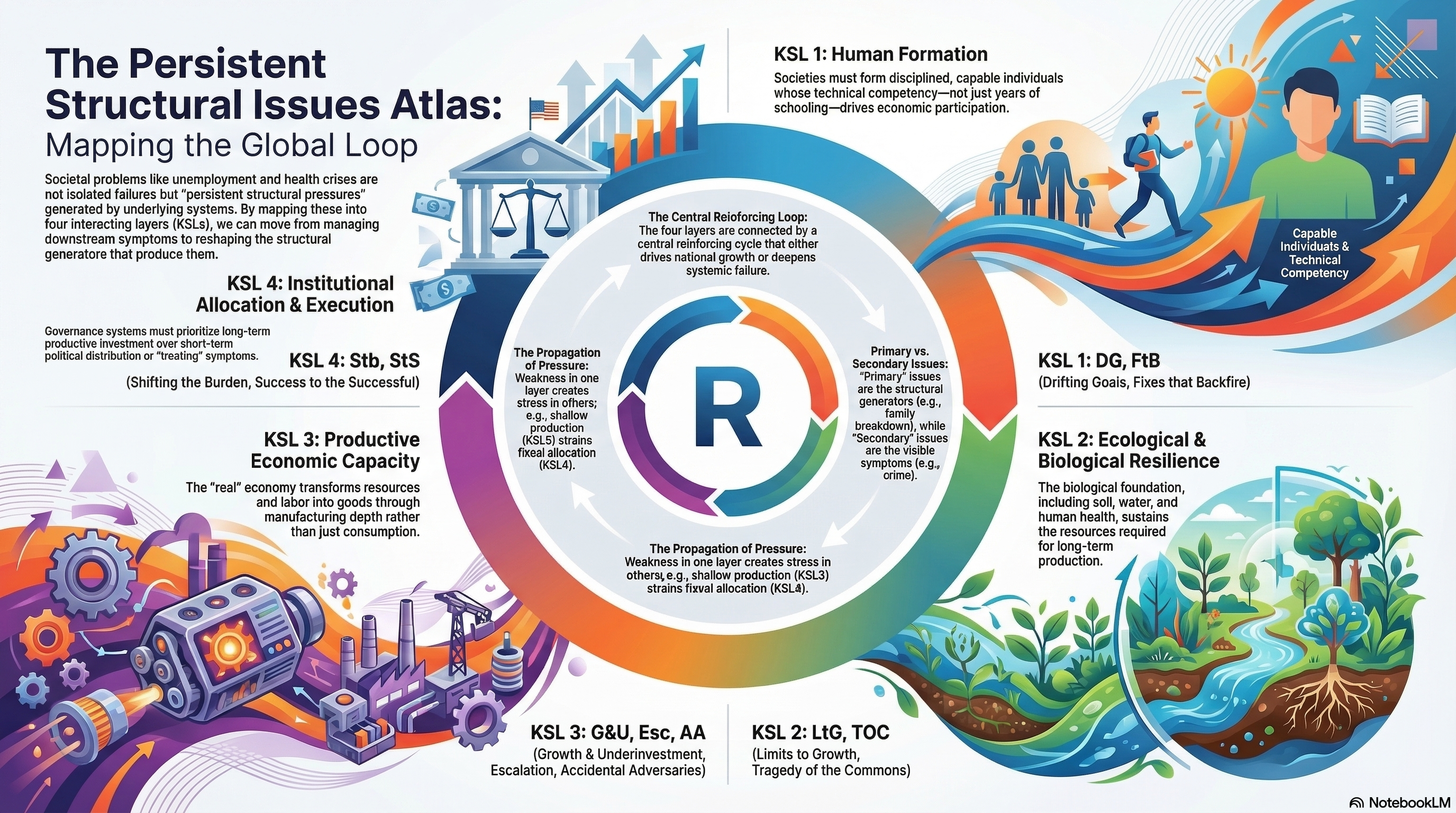
H-H — Human Formation The formation of capability, behaviour, discipline structures, educational orientation, labour identity, and long-horizon thinking.
H-N — Ecological & Biological Resilience Land, water, climate systems, food systems, biological resilience, and ecological carrying capacity.
H-E — Productive Economic Capacity Agriculture, manufacturing, productive enterprise formation, labour absorption, value creation systems, and infrastructure.
H-G — Institutional Allocation & Execution Governance systems, policy allocation, land administration, institutional coordination, investment priorities, and societal response mechanisms.
These four quadrants interact continuously. A pressure emerging in human formation may eventually surface economically through weakened productivity. Ecological pressures may become visible institutionally through fiscal strain or migration surges. The framework doesn’t try to eliminate that complexity — it tries to make it navigable.
The Onion: A Sequence of Systemic Behaviours
As the study widened, recurring structural behaviours kept surfacing — not randomly, but in recognisable patterns that systems thinkers call archetypes. What became increasingly clear was that these archetypes were not independent of one another. The pressures generated within one archetype appeared capable of tipping variables into the conditions required for the next one to emerge.
This gave rise to what the study calls the Onion framework: a causally linked sequence of system archetypes that describes how unresolved pressures tend to propagate through society over time.
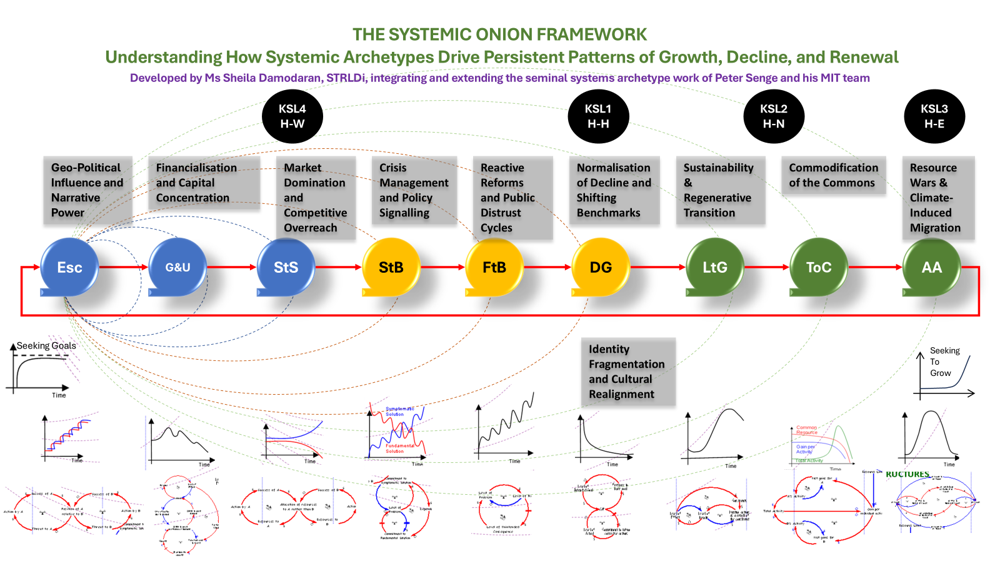
The sequence is:
Accidental Adversaries (AA) → Escalation (Esc) → Growth & Underinvestment (G&U) → Success to the Successful (StS) → Shifting the Burden (StB) → Fixes that Fail (FtF) → Drifting Goals (DG) → Limits to Growth (LtG) → Tragedy of the Commons (ToC) → back to Accidental Adversaries (AA)
This is not a deterministic cycle. Human societies are adaptive, relational, and capable of renewal at any point. The Onion is better understood as a propagation-awareness framework — a way of seeing how pressures tend to move if underlying structures go unaddressed for long enough.
The sections that follow walk through each quadrant, showing the variables at play, which archetypes dominate, and where the pressures flow.
H-H — Human Formation
Dominant archetypes: Drifting Goals → Fixes That Fail (with Shifting the Burden emerging later)
Many pressures that later become visible economically or institutionally have earlier formative roots in how people are raised, educated, and shaped. The weakening of long-horizon thinking, practical capability formation, productive identity, and disciplined stewardship often appears upstream of much that later shows up in labour systems, governance, and enterprise.
The study also found that some adaptive behaviours emerging under difficult conditions temporarily relieve immediate pressure while simultaneously weakening long-term regenerative capability. Survival-oriented economic behaviour, opportunistic adaptation, weakened delayed gratification — these emerge gradually under sustained systemic stress. Short-term adaptation and long-term continuity do not always move in the same direction.
| Variable | Generated In | Dominant Archetype | Detected In | Consequence Flows Into |
|---|---|---|---|---|
| Births outside stable marriages | H-H | DG | H-H | H-H → H-E → H-G |
| Male absence in households | H-H | FtF | H-H | H-H → H-G |
| Weak masculine continuity | H-H | FtF | H-H | H-E → H-G |
| Weak intergenerational transfer | H-H | FtF | H-H | H-E |
| Weak long-horizon thinking | H-H | DG | H-H | All quadrants |
| Emotionally unstable environments | H-H | FtF | H-H | H-N → H-E |
| Survival-oriented upbringing | H-H | StB | H-H | H-E |
| Crime | H-E / H-H | StB | H-H | H-N → H-E |
| STEM avoidance | H-H | DG | H-H / H-E | H-E → H-G |
| Fear of mathematically intensive disciplines | H-H | DG | H-H | H-E |
| Office-job orientation | H-H | StB | H-E | H-E → H-G |
| Credential accumulation mentality | H-H | FtF | H-E | H-E |
| Theory-heavy education | H-H | FtF | H-H / H-E | H-E |
| Weak apprenticeship systems | H-H | FtF | H-E | H-E |
| Weak practical application | H-H | FtF | H-E | H-E |
| Weak technical competency | H-H | DG | H-E | H-E → H-G |
| Reduced deep work capability | H-H | DG | H-H | H-E |
| Labour oversupply | H-E | LtG | H-E | H-G |
| Graduate oversupply | H-H | FtF | H-E | H-E → H-G |
| Education–Employment Mismatch | H-E | DG | H-E | H-E → H-G→ H-H |
| Underemployment | H-E | LtG | H-E | H-G |
| Survival psychology | H-H | StB | H-H | H-E → H-G |
| Status signalling | H-H | Esc | H-H | H-E |
| Visibility competition | H-H | Esc | H-H | H-G |
| Side-hustle normalization | H-H / H-E | StB | H-E | H-G |
| Opportunistic adaptation | H-H | StB | H-G | H-G |
| Rule-bending normalization | H-H | DG | H-G | H-G |
| Penal-code proximity | H-H / H-E | ToC | H-G | H-G |
| Drift toward organized crime | H-H / H-E | ToC | H-G | H-G |
What the table reveals is that pressures appearing later in labour, governance, and productive systems often have earlier roots in formation structures. Human formation pressures rarely remain confined to the quadrant in which they originate.
H-N — Ecological & Biological Resilience
Dominant archetypes: Limits to Growth → Tragedy of the Commons (with Accidental Adversaries and Shifting the Burden transitional)
Human societies don’t operate independently from the biological and ecological conditions that sustain them. Productive systems, migration patterns, food systems, labour systems, and institutional pressures are all shaped by ecological carrying capacity over long periods.
A critical distinction surfaced here: survival adaptation and regenerative reversal are not the same process. Drought-resistant crops, low-water agricultural systems, and survival-oriented production methods may help populations endure worsening conditions. But enduring deterioration and reversing the underlying trajectory that produces it are fundamentally different things. Some systems successfully help societies survive decline while simultaneously failing to address what is causing it.
| Variable | Generated In | Dominant Archetype | Detected In | Consequence Flows Into |
|---|---|---|---|---|
| Declining rainfall systems | H-N | LtG | H-N | H-E |
| Increasing drought frequency | H-N | LtG | H-N | H-E |
| Extreme weather intensification | H-N | LtG | H-N | All quadrants |
| Reduced carrying capacity | H-N | LtG | H-N | H-E → H-G |
| Soil degradation | H-N | ToC | H-N | H-E |
| Water stress | H-N | LtG | H-N / H-G | H-E → H-G |
| Indigenous drought-resistant systems | H-N | AA | H-N | H-E |
| Low-water survival agriculture | H-N | StB | H-N | H-E |
| Weak ecological reversal systems | H-N | ToC | H-N | H-E |
| Weak evapotranspiration restoration | H-N | ToC | H-N | H-N |
| Weak biodiversity regeneration | H-N | ToC | H-N | H-E |
| Weak landscape restoration | H-N | ToC | H-N | H-E |
| Declining agricultural profitability | H-E / H-N | LtG | H-E | H-G |
| Aging farmers | H-H / H-N | LtG | H-E | H-E |
| Weak generational farming continuity | H-H | FtF | H-E | H-E |
| Youth agricultural disengagement | H-H | DG | H-E | H-E |
| Male migration into mining systems | H-N / H-E | Esc | H-E | H-H |
| Rising food imports | H-E | StB | H-G | H-G |
| Reduced food sovereignty | H-N / H-E | ToC | H-G | H-G |
| Climate vulnerability | H-N | LtG | H-G | All quadrants |
| Health / Disease Outcomes | H-E | FtB | H-N | All quadrants |
| Childhood nutrition weaknesses | H-N | LtG | H-N | H-H |
| Processed food dependency | H-N | StB | H-N | H-H |
| Micronutrient deficiencies | H-N | LtG | H-N | H-H |
| Reduced cognitive resilience | H-N | LtG | H-H | H-H |
| Emotional regulation instability | H-N | LtG | H-H | H-H |
| Chronic disease rise | H-N | ToC | H-N | H-E |
| Diabetes | H-N | ToC | H-N | H-E |
| Hypertension | H-N | ToC | H-N | H-E |
| Fatigue economies | H-N | LtG | H-E | H-E |
| Mental health deterioration | H-N | LtG | H-H | H-E |
| Reduced productive lifespan | H-N | LtG | H-E | H-G |
| Ecological commons depletion | H-N | ToC | H-G | H-G |
Notice how biological resilience flows into educational performance, labour productivity, and institutional behaviour. Nutrition quality, cognitive resilience, emotional regulation stability — these are not soft concerns. They shape the productive and institutional capacity of entire societies over time.
H-E — Productive Economic Capacity
Dominant archetypes: Growth & Underinvestment → Escalation → Accidental Adversaries (with Shifting the Burden emerging later)
Economic weakness, as the study increasingly revealed, is rarely a standalone financial event. It tends to emerge as the interacting outcome of human formation pressures, ecological pressures, institutional allocation patterns, and productive underinvestment accumulating simultaneously over long periods. Productive systems inherit conditions from multiple upstream structures at once.
The study drew a sharpening distinction between productive enterprise formation and survival circulation systems. Some economic activity creates productive depth, technical capability, value addition, and long-term labour absorption. Other activity primarily circulates limited value within already constrained systems. Over time, the expansion of survival-oriented circulation — retail growth, import dependency, multi-income hustle strategies — can help societies adapt temporarily while steadily weakening their capacity to generate new productive depth.
| Variable | Generated In | Dominant Archetype | Detected In | Consequence Flows Into |
|---|---|---|---|---|
| Weak agricultural reinvestment | H-E | G&U | H-E | H-G |
| Weak manufacturing ecosystems | H-E | G&U | H-E | H-G |
| Weak industrial deepening | H-E | G&U | H-E | H-G |
| Weak engineering ecosystems | H-H / H-E | G&U | H-E | H-G |
| Weak research ecosystems | H-H / H-E | G&U | H-E | H-G |
| Weak agricultural financing | H-G / H-E | G&U | H-E | H-G |
| High capital barriers | H-G | G&U | H-E | H-H |
| Weak agricultural banking | H-G | G&U | H-E | H-E |
| Weak enterprise incubation | H-G | G&U | H-E | H-E |
| Retail profitability dominance | H-E | Esc | H-E | H-G |
| Import-based circulation economy | H-E | StB | H-E / H-G | H-G |
| Government-employment prestige | H-H / H-G | StS | H-E | H-H |
| Tenderpreneurship expansion | H-G | StS | H-E | H-G |
| Investments shifting to circulation | H-E | Esc | H-E | H-G |
| Productive labour shifting to retail | H-E | Esc | H-E | H-H |
| Administrative expansion without production | H-G | FtF | H-E | H-G |
| Reduced productive entrepreneurship | H-H / H-E | G&U | H-E | H-G |
| Small-scale survival businesses | H-E | StB | H-E | H-G |
| Weak scaling capability | H-E | G&U | H-E | H-G |
| Weak value-chain integration | H-E | AA | H-E | H-G |
| Import dependency | H-E | StB | H-G | H-G |
| Weak local value addition | H-E | G&U | H-E | H-G |
| Weak industrial competitiveness | H-E | LtG | H-E | H-G |
| Reduced labour absorption | H-E | LtG | H-E | H-H |
| Informal circulation systems | H-E | StB | H-E | H-G |
| Multi-income survival systems | H-H / H-E | StB | H-E | H-G |
| Short-horizon enterprise behaviour | H-H | DG | H-E | H-G |
| Declining productivity per worker | H-E | LtG | H-E | H-G |
| Labour dilution into low-value sectors | H-E | Esc | H-E | H-G |
| External energy dependency | H-E | LtG | H-G | H-G |
| Weak industrial infrastructure | H-G | G&U | H-E | H-G |
| Electricity fragility | H-G / H-N | LtG | H-E | H-G |
| Rising production costs | H-E / H-N | LtG | H-E | H-G |
What the productive quadrant reveals most clearly is that economic outcomes are downstream of structural conditions across multiple layers simultaneously. You don’t fix a hollow productive economy by targeting the economy alone.
H-G — Institutional Allocation & Execution
Dominant archetypes: Escalation → Success to the Successful → Shifting the Burden (with Tragedy of the Commons emerging later)
Governance systems sit in a uniquely difficult position. They are both detectors and responders to pressures generated across the entire civilisational structure. They are asked to stabilise labour pressures, ecological pressures, productive weakness, social fragmentation, and rising instability — often simultaneously — using policy allocation, resource distribution, welfare mechanisms, and political coordination.
The problem is that institutions themselves begin adapting under sustained pressure. Short political cycles, fragmented coordination, symptomatic policy responses, and expanding administrative management systems emerge progressively. Institutions start adapting to the pressure rather than resolving the structures generating it. Some governance responses — welfare expansion, import dependency management, reactive policy cycles — temporarily relieve immediate instability while reinforcing deeper structural dependencies. Short-term stabilisation and long-term regeneration are not the same thing institutionally.
| Variable | Generated In | Dominant Archetype | Detected In | Consequence Flows Into |
|---|---|---|---|---|
| Short political cycles | H-H | StS | H-G | H-G |
| Weak long-term planning | H-H | StS | H-G | All quadrants |
| Weak civilizational horizon thinking | H-H | StS | H-G | All quadrants |
| Political responsiveness over structural investment | H-G | StS | H-G | H-E |
| Fragmented ministries | H-H | StS | H-G | H-G |
| Weak systems integration | H-H | StS | H-G | All quadrants |
| Weak policy continuity | H-H | StB | H-G | H-G |
| Repeated policy resets | H-G | StB | H-G | H-G |
| Public-Service Performance / Frustration | H-H | DG | H-G | H-E |
| Resource leakage | H-H | StB | H-G | H-G |
| Corruption | H-H | StB | H-G | H-G |
| Patronage systems | H-G | StS | H-G | H-G |
| Tenderpreneurial incentives | H-G | StS | H-G | H-E |
| Land Conflict / Land-Use Conflict | H-N | Esc | H-G | H-E |
| Land banking | H-H / H-E | StS | H-G | H-E |
| Housing Challenges | H-G | G&U | H-H | H-E |
| Elite accumulation | H-E | StS | H-G | H-G |
| Weak youth access | H-G | StS | H-G | H-H / H-E |
| Delayed productive deployment | H-G | StB | H-G | H-E |
| Corruption | H-H | StB | H-E | H-G |
| Corrupt allocation systems | H-H | StB | H-G | H-G |
| Underinvestment in STEM | H-H | StS | H-G | H-H / H-E |
| Underinvestment in regenerative agriculture | H-N | StS | H-G | H-N |
| Underinvestment in water systems | H-N | StS | H-G | H-N |
| Underinvestment in manufacturing ecosystems | H-E | StS | H-G | H-E |
| Underinvestment in apprenticeship systems | H-H | StS | H-G | H-H |
| Welfare dependence | H-H / H-E | StB | H-G | H-H |
| Youth grants without ecosystems | H-G | StB | H-G | H-H / H-E |
| Import dependency management | H-E | StB | H-G | H-E |
| Administrative expansion | H-G | StB | H-G | H-G |
| Retail licensing expansion | H-E | StB | H-G | H-E |
| Distrust in productive effort | H-H | StB | H-G | H-H |
| Rule-bending normalization | H-H | StB | H-G | H-H |
| Reduced civic cohesion | H-H | StS | H-G | H-H |
| Institutional fatigue | H-H / H-G | StB | H-G | H-G |
| Ecological depletion | H-N | ToC | H-G | H-N |
| Fiscal depletion | H-E | ToC | H-G | H-G |
| Institutional depletion | H-G | ToC | H-G | H-G |
| Governance legitimacy stress | All quadrants | ToC | H-G | All quadrants |
| Reduced long-horizon coordination capacity | H-H | ToC | H-G | All quadrants |
| Reduced regenerative capability | H-N / H-E | ToC | H-G | All quadrants |
| Increased systemic fragility | All quadrants | ToC | H-G | AA restart |
The governance quadrant is where the accumulated pressures of human formation, ecological resilience, and productive capacity all converge and become measurable. It is, in a sense, the final detection layer — but rarely the origin of what it’s detecting.
The Quadrants in Motion
The four quadrants don’t operate in sequence. They interact continuously. Human formation shapes ecological stewardship. Ecological conditions reshape productive systems. Productive systems influence governance behaviour. Governance responses influence educational orientation, economic adaptation, and long-term societal behaviour in return.
This continuous interaction means pressures rarely stay contained where they first emerge. Declining ecological resilience propagates later into labour migration, food imports, fiscal strain, and institutional fatigue. Weak productive absorption propagates later into household stability, psychological adaptation, educational orientation, and governance pressure.
This is also why some interventions produce only temporary relief. If societies continuously intervene where pressures become visible while neglecting where they are structurally generated, many conditions gradually re-emerge elsewhere. The structure keeps producing what it was always structured to produce.
Interconnected Pressures, Interconnected Leverage
One of the most important observations to emerge from this study is that interconnected systems carry both interconnected pressures and interconnected possibilities for renewal.
Strengthening long-horizon human capability formation may later influence productive behaviour, institutional resilience, educational orientation, labour absorption, and governance quality simultaneously. Strengthening regenerative ecological systems may later influence food resilience, migration pressure, biological resilience, productive continuity, and fiscal stability. Strengthening productive capacity may later influence family stability, psychological adaptation, institutional pressure, and long-term societal confidence.
This doesn’t mean persistent issues yield to simple single-point interventions — human societies are too complex and historically layered for that. But it does suggest that long-term regenerative movement becomes more possible when societies start seeing the interacting structures beneath visible realities rather than treating each pressure as a standalone problem. The ability to perceive interrelationships may itself be part of the intervention.
Closing: What Persistent Unemployment Actually Reflects
Persistent unemployment may represent more than the absence of jobs. It may reflect simultaneous movements in human formation, ecological systems, productive systems, and institutional structures over long periods of time — educational orientation, ecological resilience, labour absorption, governance adaptation, social continuity, and psychological adaptation all interacting more closely than they appear when examined separately.
Organisations will continue managing themselves through sectors, departments, and ministries — that operational logic has its own validity. But persistent issues don’t respect those boundaries. They move across them, reinforce themselves through them, and reveal the same underlying structures expressing themselves differently in different parts of society.
The challenge isn’t only to solve isolated problems more efficiently. It’s to develop the capacity to see the interacting structures beneath them — patiently, coherently, and across generations. That capacity for systemic perception may be one of the most important things a society can cultivate.


One thought on “A Showcase of Viewing Persistent Issues Through …”