
Here is a smoother version that preserves your ideas and sequence without introducing new concepts:
Why This Law Matters
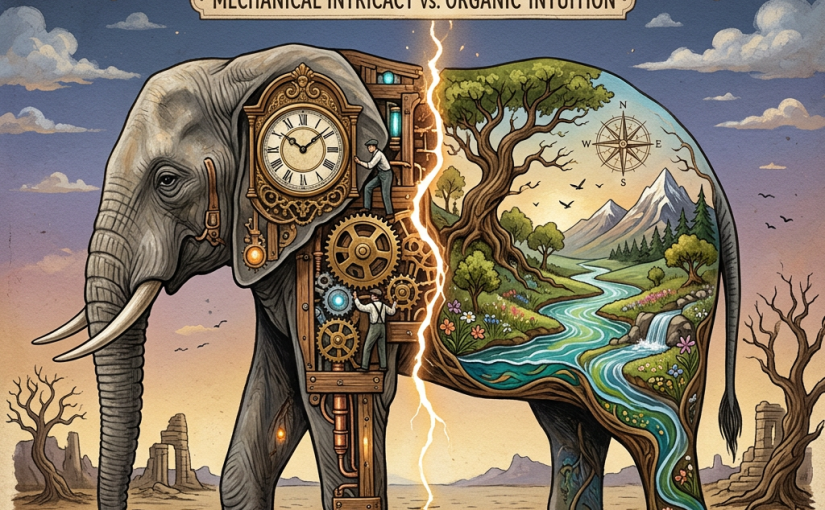
What would happen if you divided an elephant in half?
Dividing an elephant in half does not produce two small elephants. What happens instead? You no longer have an elephant—you have a very dead and messy one. The elephant ceases to exist as the living system it once was because the whole is greater than the sum of its parts. Once divided, its integrity is lost, and understanding the whole from its disconnected pieces becomes impossible.
Living systems possess integrity. Their character depends upon the whole. To understand the most challenging managerial issues, we must first understand the whole system that generates those issues. This requires us to step back from the individual trees to see and understand the forest before attempting to manage it. Only then can we appreciate how the different parts interact to produce the behaviour we observe.

Yet this is rarely how organisations respond to problems. Instead, responsibility is divided according to organisational roles or functions—Training, Human Resources, Operations, Marketing, Finance, and so on. Each function addresses the portion of the problem that falls within its mandate, often without understanding how its actions interact with those of other parts of the organisation.
The result is frequently suboptimal decisions, duplicated effort, wasted time and resources, fragmented initiatives, and, ultimately, dissatisfied customers. The organisation may become highly efficient at managing individual parts while becoming increasingly ineffective at addressing the problem as a whole.
For this reason, Law #10 is one of the most frequently misunderstood of Senge’s Laws of Dynamic Complexity. It is not simply about organisational structure or collaboration between departments. It is about recognising that living systems cannot be understood—or effectively managed—by breaking them into isolated pieces.
Why This Law Matters
Modern organisations are built upon division. We divide work into departments, professions, ministries, disciplines, committees and specialised units because specialisation improves efficiency, accountability and technical competence. Over time, however, these organisational divisions also become intellectual boundaries that shape how people understand problems. Managers become experts within their own functions while gradually losing sight of the interactions that connect their work to the rest of the organisation.
Many of the challenges confronting organisations today are not departmental problems but systemic problems. They emerge from the continuous interaction between people, processes, policies and institutions rather than from the failure of any single component. When these interactions are overlooked, organisations attempt to solve complex problems by assigning them to individual departments, creating task forces or establishing new units of responsibility. While these responses often appear logical, they rarely resolve the underlying issue because the behaviour is being generated by the relationships between the parts rather than by the parts themselves.
The Tenth Law reminds us that living systems possess integrity. Their behaviour cannot be fully understood by separating them into independent pieces because the properties that matter most emerge from their interactions. Dividing a system into smaller components may simplify analysis, but it frequently destroys the very relationships responsible for producing the behaviour we are attempting to understand. Consequently, solving complex organisational problems requires seeing the whole system before attempting to improve any individual part.
Understanding the Law
A living system is fundamentally different from a mechanical assembly. A machine can often be dismantled into individual components, repaired separately and reassembled without altering its essential character. Living systems, by contrast, derive their identity from the continuous interactions among their constituent parts. Whether examining an ecosystem, a human body, an economy or an organisation, the behaviour of the whole cannot be explained solely by studying each component in isolation.
Systems thinking therefore shifts attention away from the characteristics of individual elements towards the relationships that connect them. Departments, ministries and professions undoubtedly perform specialised functions, yet the performance of the organisation depends far more on how these functions interact than on how efficiently each operates independently. Improvements within one area may unintentionally create constraints elsewhere if the interactions between them remain poorly understood.
This principle also explains why many organisational reforms produce disappointing results despite considerable effort and investment. Organisations frequently reorganise reporting structures, establish new divisions or redistribute responsibilities in the hope that structural changes alone will resolve persistent problems. While such changes may improve administrative efficiency, they seldom alter the feedback structures responsible for producing organisational behaviour. Without understanding the system as an integrated whole, reforms often rearrange the pieces while leaving the underlying dynamics unchanged.
Peter Senge’s Demonstrations
Peter Senge introduces this law through another ancient Sufi story in which three blind men encounter an elephant for the first time. Each attempts to describe the animal based upon the single part he is touching. One, holding the ear, concludes that an elephant resembles a large rug. Another, grasping the trunk, insists that it is like a hollow pipe. The third, holding the leg, confidently describes it as a sturdy pillar. Each description is accurate from the perspective of the individual observer, yet none of them comes close to describing the elephant itself.
The story illustrates one of the central limitations of reductionist thinking. Each observer possesses valid information, but none possesses sufficient perspective to understand the integrity of the whole. Their disagreement does not arise because one person is correct and the others mistaken. Rather, each is attempting to explain an integrated system from the viewpoint of a single component. As the Sufi tale concludes, “Given these men’s way of knowing, they will never know an elephant.” The limitation lies not in what they observe but in the method by which they seek understanding.
Senge extends this analogy to modern organisations. The heads of manufacturing, marketing, finance, operations, research or human resources often possess deep expertise within their respective functions. Each understands the challenges confronting his or her department with considerable clarity, yet persistent organisational problems rarely originate within one function alone. They emerge through the interaction of policies, incentives and decisions that span multiple parts of the organisation. Consequently, each department may diagnose the symptoms correctly while simultaneously misunderstanding the system producing those symptoms.
Senge further introduces what he calls the principle of the system boundary. The appropriate boundary for analysis is not determined by organisational charts, departmental structures or reporting relationships. Instead, the boundary must include every significant interaction responsible for producing the behaviour under investigation. Some problems may require examining only the interactions between several departments, while others demand understanding the dynamics of an entire industry or national economy. The appropriate system boundary is therefore defined by causality, not by administrative convenience.
To reinforce this principle, Senge describes how cities, corporations and institutions frequently create new problems by shifting rather than resolving them. Wealthier populations move from city centres into expanding suburbs, corporations continually acquire new businesses while neglecting mature operations, and organisations reorganise responsibilities without addressing the interactions that generate the underlying behaviour. In every case, the apparent solution simply relocates the problem beyond the existing boundary of concern. The system itself remains unchanged.
Senge concludes with one of the most memorable statements in The Fifth Discipline: “Sometimes people go ahead and divide an elephant in half anyway.” The result is not two smaller elephants but a mess. Once the interactions that give the system its integrity are separated, the leverage required to understand or improve the whole disappears. The observer is left examining disconnected pieces while the behaviour of the living system remains hidden.
The STRLDi Interpretation
Mental Models Divide the Elephant
The Sufi story is often interpreted as a lesson about perspective. STRLDi suggests that it is something even more fundamental. The blind men do not simply represent different perspectives; they represent different mental models. Before organisations divide themselves into departments, professions or functions, the human mind has already divided reality into manageable pieces. The elephant is first divided in thought long before it is divided in organisational practice.
A mental model acts as a frame through which reality is interpreted. Every frame performs two functions simultaneously. First, it determines what falls within the boundaries of our attention. We naturally observe those aspects of reality that fit comfortably within the frame through which we are looking. Secondly, the frame excludes everything that lies beyond its boundaries. It filters, simplifies and reduces complexity so that the mind can understand what would otherwise appear overwhelming.
This explains why each blind man confidently described a different elephant. Each description was accurate within the limits of the frame through which the elephant was experienced. The ear genuinely resembled a broad piece of leather. The trunk genuinely felt like a hollow pipe. The leg genuinely resembled a sturdy pillar. The problem was not that any of them were wrong. The problem was that each mental model transformed a part into the whole.
Frames Resist What Lies Beyond Them
Mental models possess another characteristic that makes systemic understanding difficult. They naturally resist information that does not fit within their existing frame. Anything that contradicts or extends the current way of seeing is often dismissed as irrelevant, exceptional or incorrect because the frame itself lacks the capacity to interpret it. The limitation therefore lies not in reality but in the structure through which reality is perceived.
For this reason, people rarely recognise that they are looking through a frame at all. The frame becomes reality. Everything beyond it gradually disappears from conscious attention, not because it does not exist, but because the mental model has no place in which to accommodate it. In this sense, mental models divide the elephant into pieces that become manageable for the mind, while simultaneously making the whole increasingly difficult to perceive.
Expanding the Frame
Systems thinking does not require abandoning one’s mental model; it requires expanding it. The critical question therefore becomes not, “What do I already see?” but rather, “What can I not yet see?” This question begins to stretch the boundaries of the existing frame and creates space for relationships, interactions and patterns that were previously invisible.
As the frame widens, the observer begins to recognise that each individual part derives its meaning from its relationship to the whole. An ear is no longer simply an ear; it becomes the ear of an elephant. A trunk is no longer merely a pipe-like structure; it becomes part of a living organism. The significance of every component changes because it is now understood within the context of the entire system.
Seeing the Whole Changes the Meaning of the Parts
This is perhaps the deepest lesson of the Tenth Law. The whole does not merely explain the parts; it transforms their meaning. Once the elephant is seen as an integrated living system, every individual part acquires a different significance because it is understood through its relationship with every other part.
STRLDi therefore proposes that the journey of systems thinking is not simply about seeing a bigger picture. It is about continually enlarging the mental frame through which reality is understood until the integrity of the whole begins to emerge. Only then can the observer appreciate not merely what each part is, but what each part means within the living system of which it forms an inseparable part.
Notice what happened in the urgent file case study when we overlooked the leverage point. Rather than addressing the issue at its source, the organisation was forced to spend considerably more time, effort and resources reversing the consequences generated by the system as a whole. What was the real cost of failing to see the whole elephant?
Previous < — Law #9 Next –> Law #11


You must be logged in to post a comment.