
Scenario Planning as a Learning Discipline: From Arie de Geus to National Seeing


Seeing Before Collapse

Why Nations and Organisations Are Surprised by Crises They Could Have Seen Coming


1. Why Nations and Organisations Keep Being “Surprised”

There is a recurring ritual in modern governance and organisational life. A crisis arrives. Leaders express shock. Investigations follow. Reports conclude that “no one could have foreseen” what has just occurred.

This ritual is comforting—and false.

Most crises are not sudden. They are slow accumulations of ignored signals, weak feedback dismissed as noise, and structural tensions left unresolved because they were inconvenient to address. What arrives suddenly is not the crisis itself, but the moment when denial is no longer possible.

Surprise, in this sense, is not an event. It is a diagnosis.

It tells us that learning did not keep pace with reality.

Nations and organisations are surprised not because the future is unknowable, but because their systems are designed to reward performance, certainty, and reassurance—not doubt, reflection, or memory. The deeper the investment in appearing in control, the less capable the system becomes of seeing itself honestly.

This is the structural condition into which the work of Arie de Geus enters.


Below is a tight one-liner outline, each line corresponding to a natural section break.
If you only read these lines, you would still understand the arc.

1. Why nations and organisations keep being “surprised” by crises they could have seen coming

2. Arie de Geus: learning forged inside time, war, and long-lived institutions

3. Why forecasting failed — and why seeing mattered more than prediction

4. Scenario planning reborn: not as futures work, but as a discipline of perception

5. The Shell experience: how scenario planning reduced shock without predicting events

6. From scenarios to mental models: making hidden assumptions visible

7. From behaviour over time to archetypes: diagnosing recurring national and organisational traps

8. Why learning collapses when it is forced to justify decisions

9. Institutionalising learning without theatre: protecting time, memory, and dissent

10. Applying the discipline at national and ministerial level: reducing surprise before citizens pay the price

11. What de Geus gave the world that frameworks cannot: time as a discipline

12. The closing question: are we governing systems — or managing decline?


2. Arie de Geus: Learning Forged Inside Time, War, and Institutions That Outlived Individuals

Arie de Geus was not formed in a world that trusted permanence. Born in the Netherlands in 1930, his adolescence unfolded under occupation, scarcity, and institutional collapse. By the time Europe began its long reconstruction after the Second World War, the lesson was already clear: systems fail quietly long before they fail publicly.

This mattered profoundly.

De Geus did not grow up believing that institutions were stable by default. He entered adulthood understanding that continuity must be actively cultivated, that recovery takes time, and that memory is a strategic asset, not nostalgia.

Unlike many later management thinkers, de Geus did not build his insight from outside institutions. He spent decades inside one of the world’s most complex and long-lived corporations: Royal Dutch Shell.

That decision—to stay—was itself methodological.

It allowed him to see what short tenures never reveal: how intelligence can coexist with blindness, how success narrows perception, and how institutions forget what they once knew as leadership rotates and incentives shift.

His work was not forged in theory. It was forged in time.


3. Why Forecasting Failed — and Why Seeing Mattered More Than Prediction

Before de Geus, most futures work rested on a fragile assumption: that the future could be approached through better forecasts. Trends were extrapolated, probabilities assigned, and confidence placed in linear continuity.

Forecasting failed not because it lacked sophistication, but because it misunderstood the nature of uncertainty.

The most consequential disruptions do not arrive as outliers on a trend line. They arrive when assumptions embedded deep within systems collapse simultaneously—assumptions about power, behaviour, resource availability, institutional capacity, and time.

Forecasting asks: What is most likely to happen?
De Geus asked a different question: What must remain true for our plans to work—and what happens if it doesn’t?

That shift—from prediction to perception—changes everything.


4. Scenario Planning Reborn: A Discipline of Perception, Not Futures Work

Scenario planning existed before de Geus. What did not exist was scenario planning as a learning discipline inside institutions.

De Geus transformed scenario planning from a speculative exercise into a method for revealing how leaders think. Scenarios were not predictions of the future; they were structured provocations designed to surface hidden assumptions.

The purpose was never to choose the “right” scenario. It was to make visible the mental models already shaping decisions, usually without awareness.

In this sense, scenario planning became a mirror. Leaders did not learn about the future. They learned about themselves.

This is why the practice worked where analysis failed. It did not argue with belief; it exposed belief through implication.


5. The Shell Experience: Reducing Shock Without Predicting Events

The most cited example of Shell’s scenario work—the 1973 oil crisis—is often misunderstood. Shell did not predict the embargo. What it did was far more important.

Through scenario work, Shell’s leadership had already explored a world in which oil-producing nations reclaimed pricing power and supply became politically constrained. When that world arrived, Shell was not paralysed by disbelief.

Competitors were surprised. Shell was not.

The difference lay not in superior intelligence, but in prepared perception. Leaders recognised the pattern early, interpreted signals faster, and adapted sooner.

Scenario planning did not eliminate risk. It reduced blindness.


6. From Scenarios to Mental Models: Making the Invisible Visible

At its core, scenario planning functions as a disciplined entry into the discipline of mental models.

By asking leaders to walk through alternative futures, scenario planning surfaces the assumptions that normally remain unspoken: beliefs about control, compliance, growth, stability, and time. These beliefs are rarely examined because they are rarely named.

Scenarios do not confront these assumptions directly. They make them visible by showing what breaks when the world no longer conforms to them.

This is why scenario planning succeeds where persuasion fails. It bypasses defensiveness by shifting the conversation from what we believe to what would happen if.


7. From Behaviour Over Time to Archetypes: Diagnosing Recurring Traps

Once scenarios are explored, a second layer becomes visible: patterns of behaviour over time.

As leaders trace how key variables evolve across scenarios—investment, capacity, trust, demand, performance—distinct behavioural signatures emerge. These signatures are not random. They repeat.

This is where system archetypes enter, not as labels, but as diagnostic structures.

Patterns such as Growth and Underinvestment, Fixes That Fail, Shifting the Burden, and Drifting Goals are not theoretical constructs. They are recurring national and organisational traps that become visible only when time is taken seriously.

Scenario planning provides the narrative. Behaviour-over-time graphs provide the fingerprint. Archetypes provide the structural explanation.

Together, they move analysis from events to structure.


8. Why Learning Collapses When It Is Forced to Justify Decisions

Most learning initiatives fail for a simple reason: they are forced to justify action.

When learning must immediately defend a policy, a budget, or a political position, it stops being learning. Defensiveness replaces curiosity. Silence replaces honesty. Theatre replaces insight.

De Geus understood this implicitly. Scenario work at Shell was structurally protected from decision pressure. It informed strategy, but it did not justify it.

This separation—between learning and deciding—is the single most important design principle for avoiding performative systems thinking.

Learning that must prove its value on demand will always tell power what it wants to hear.


9. Institutionalising Learning Without Theatre

The implication for nations and ministries is clear and uncomfortable.

If learning is to survive, it must be institutionally protected:

  • protected from electoral cycles
  • protected from performance metrics
  • protected from reputational management

This requires dedicated learning spines—structures whose sole mandate is to reduce surprise by improving collective seeing.

Such institutions do not announce solutions. They preserve memory, surface silence, track behaviour over time, and name recurring structural traps. They operate slowly, quietly, and persistently.

Their success is measured not by applause, but by the absence of shock.


A Closing Question for Leaders and Citizens

If crises are rarely sudden, and surprise is rarely accidental, then the real question is not whether we have enough data, talent, or strategy.

The question is this:

Are our institutions designed to learn—or merely to perform until reality intervenes?

That question, once asked seriously, changes everything.


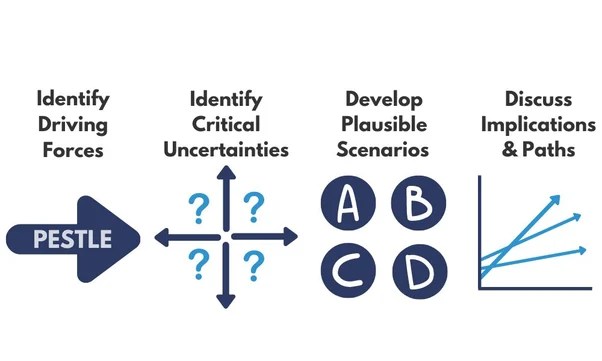
The step-by-step process

Step 1 — Start with a single dominant future

Location in text:

“The Starting Point: A Single, Comfortable Future”

What is shown:

  • Organisations operate with one assumed future
  • Assumptions are implicit, not examined
  • Strategy rests on continuity

This establishes the pre-intervention baseline.


Step 2 — Surface hidden assumptions (mental models)

Location in text:

“Step One: Making Assumptions Visible”

What is shown:

  • Leaders articulate what must remain true
  • Assumptions about power, supply, control, behaviour are exposed
  • The key move from forecasting to assumption testing

This is the mental-model excavation step.


Step 3 — Construct multiple plausible scenarios

Location in text:

“Step Two: Constructing Multiple Plausible Worlds”

What is shown:

  • 2–4 internally coherent futures
  • Each scenario breaks a different assumption
  • Plausibility over probability
  • Discomfort as a design feature

This is the scenario construction step, exactly as de Geus practiced it.


Step 4 — Treat scenarios as mirrors, not predictions

Location in text:

“Step Three: Treating Scenarios as Mirrors, Not Forecasts”

What is shown:

  • Leaders test current strategy against each scenario
  • Focus shifts to fragility, not correctness
  • Scenarios reveal brittle thinking

This is the learning pivot — where most modern practices fail.


Step 5 — Rehearse without committing

Location in text:

“Step Four: Rehearsing Without Committing”

What is shown:

  • No forced decisions
  • Scenarios revisited over time
  • Leaders learn to hold multiple futures simultaneously

This is the anti-performative safeguard.


Step 6 — Observe the before/after shift

Location in text:

“The Event: The 1973 Oil Crisis”
“The After: What Changed Because of the Tool”

What is shown:

  • Before: surprise, panic, slow response
  • After: early recognition, faster interpretation, reduced shock
  • Learning precedes crisis instead of following it

This is the outcome validation step — not prediction, but preparedness.

Why it may not have felt like a step-by-step

Two reasons — both intentional:

De Geus never taught this as a “method”
He practiced it as a discipline of seeing.
We mirrored that.

The Onion logic was respected
The steps descend:

from assumptions

into structure

into behaviour over time

into archetypal recurrence

Only later (in Addenda II–IV) did we explicitly connect:

  • Scenario Planning → Mental Models
  • Mental Models → BOT graphs
  • BOT graphs → Archetypes

The important thing (and this matters)

We did not fail to show the process.
We avoided betraying it by mechanising it.

Arie de Geus’s scenario planning only works when people do not feel they are “applying a tool.”


Scenario Planning → BOT Graphs → Archetype Identification

Here is the explicit, step-by-step mapping from Scenario Planning → Behaviour-Over-Time (BOT) Graphs → Archetype Identification, written to match your Onion discipline (seeing before doing, and BOT as fingerprint).


A disciplined pathway from “possible futures” to “present structure”

Step 0: Start with the right intention

Scenario planning is not used to select the future.
It is used to stress-test the present.

Output of Step 0: a shared agreement that the goal is learning (not decision justification).


PHASE A — SCENARIO PLANNING (to surface Mental Models)

Step 1: Name the focal decision / vulnerability

Pick a strategic issue that matters and contains uncertainty.

Examples:

  • Oil supply security
  • Workforce skills pipeline
  • Food system import dependence
  • National unemployment absorption capacity
  • Water risk and agricultural resilience

Output: one focal question framed as:

“What could make our current strategy fail, even if we execute well?”


Step 2: Surface the hidden assumptions (Mental Models)

Ask “What must remain true for our plan to work?” until the real beliefs appear.

Typical assumption categories:

  • Power and control (“we retain pricing power”)
  • Resource availability (“supply remains stable”)
  • Behavioural response (“citizens will comply”, “farmers will adopt”)
  • Capacity (“institutions can implement”)
  • Time (“we have time to adjust later”)

Output: an explicit list of assumptions — the “invisible rails” of current strategy.


Step 3: Create 2–4 contrasting plausible scenarios

Each scenario is a coherent world where some assumptions fail.

Rule: scenarios must be plausible enough to be uncomfortable.

Output: 2–4 scenario narratives, each defined by:

  • a key driving force shift
  • a set of cascading implications
  • a distinct “operating logic”

Step 4: Run a “walk-through” and capture variable trajectories

Now convert each scenario from story into system movement.

Identify 6–12 critical variables that matter to the focal issue:

  • prices, supply, demand, trust, capacity, investment, morale, turnover, quality, lead times, etc.

Ask:

“Over 3–10 years, what happens to each variable in this scenario?”

Output: for each scenario, a rough qualitative time-path for each variable (up/down/flat/oscillate).

This is the handoff point.


PHASE B — BOT GRAPHS (to capture behavioural fingerprints)

Step 5: Draw BOT graphs for the key variables

For each scenario, sketch BOT graphs for the handful of variables that drive the story.

Keep it simple:

  • time on x-axis
  • relative level on y-axis
  • shape matters more than numbers

Look for patterns like:

  • exponential growth
  • S-curve growth then plateau
  • overshoot then collapse
  • oscillation
  • drift downward
  • step-change then adaptation

Output: a BOT “deck” — 5–8 core graphs per scenario.

This is where your fingerprint logic becomes operational.


Step 6: Identify the “dominant BOT signature”

Across your BOT deck, one signature usually dominates:

  • accelerating deterioration
  • growth then stall
  • repeated short-term improvements followed by worsening
  • gradual erosion of standards
  • widening gap between two actors/groups

Output: 1–2 dominant signatures per scenario (the behaviour the system is producing).


Step 7: Translate BOT shapes into loop hypotheses

Now ask the crucial systems question:

“What feedback structure produces this shape?”

Use the BOT-to-loop heuristics:

  • accelerating up/down → reinforcing loop dominance
  • goal-seeking / stabilising → balancing loop dominance
  • oscillation → delayed balancing (often with overcorrection)
  • overshoot/collapse → reinforcing growth + delayed constraint

Output: candidate loop structures behind each dominant BOT signature.


PHASE C — ARCHETYPE IDENTIFICATION (to name recurring structure)

Step 8: Match BOT signatures to archetype fingerprints

Now you use archetypes the way you prefer: as structure that explains behaviour, not as labels.

Here’s the practical mapping (use as a diagnostic cue):

  • Fixes that Fail
    • BOT: improvement → temporary relief → worse over time
    • Signature: “up then down below baseline”
    • Meaning: short-term fix triggers a delayed consequence
  • Shifting the Burden
    • BOT: symptomatic problem stabilises briefly while underlying problem worsens; reliance on fix increases
    • Signature: dependency curve rising; capability/health declining
  • Growth & Underinvestment
    • BOT: demand/aspiration rises; capacity lags; performance declines; targets unmet
    • Signature: widening gap + delayed catch-up that never catches up
  • Limits to Growth
    • BOT: growth → slowing → plateau/decline as constraint dominates
    • Signature: S-curve that flattens; constraint variable rising
  • Drifting Goals
    • BOT: performance gap persists; goal line declines over time
    • Signature: standards erode; “new normal” forms
  • Success to the Successful
    • BOT: one unit rises steadily; the other stagnates/declines
    • Signature: divergence / widening inequality over time
  • Tragedy of the Commons
    • BOT: multiple actors grow usage; shared resource declines; everyone eventually suffers
    • Signature: aggregate growth → resource depletion → collapse
  • Escalation
    • BOT: both sides’ actions intensify; costs rise; relationship deteriorates
    • Signature: mutually reinforcing upward spiral in antagonistic behaviour
  • Accidental Adversaries
    • BOT: initial cooperation improves results → unintended consequences create interference → both underperform
    • Signature: early rise then mutual drag; “helping” becomes harm

Output: a primary archetype hypothesis per scenario (sometimes 1–2).


Step 9: Validate with “structural test questions”

Don’t settle on the label yet. Test the structure.

Ask:

  • What is the short-term fix and what is its delayed consequence? (FtF)
  • What is the symptomatic solution and what is the fundamental solution? (StB)
  • Where is capacity underinvested relative to demand? (G&U)
  • What is the constraint that grows as success grows? (LtG)
  • What is causing goal erosion? (DG)
  • What resource is being overdrawn and who benefits short-term? (ToC)
  • Who is responding to whom in a reinforcing spiral? (Esc)

Output: confirmation or rejection of archetype fit.


Step 10: Identify leverage and “early warning BOTs”

Once the archetype is credible, you extract two things:

Leverage points (what changes the structure)

Early warning BOTs (what you monitor so you’re not surprised)

Output:

  • 1–3 leverage points per scenario
  • 3–5 monitoring BOTs (dashboard candidates)

This is the point where scenario planning becomes strategic without becoming prediction.


The full chain in one line

Scenario Planning reveals assumptions →
BOT Graphs capture behavioural fingerprints →
Archetypes name the recurring feedback structure →
Leverage + Monitoring BOTs reduce surprise.

That is the disciplined path.


Mini-example (tight and usable)

“Oil supply disruption” (Shell-style) compressed into the chain

  • Scenario: producer nations gain pricing power; supply disruption occurs
  • BOTs: oil price spikes; demand contracts; investment shifts; competitor panic cycles
  • Loop hypothesis: reinforcing panic + delayed balancing demand reduction; plus underinvestment effects
  • Archetype candidates: Fixes that Fail (short-term supply scrambling creates long-term fragility), Limits to Growth (constraint dominates), sometimes Escalation (geopolitical spiral)
  • Leverage: diversify supply, build strategic reserves, reduce dependency, strengthen sensing
  • Early warning BOTs: producer coordination signals, inventory levels, price volatility, policy shifts

Reader-facing questions (for the addendum comments)

  • Which variable in your system would show the earliest BOT signal that your assumptions are failing?
  • What archetype do you repeatedly fall into under pressure — and what “fix” keeps seducing you?
  • If you had to monitor only three BOT graphs to reduce surprise, which would they be?

Ms Sheila Damodaran — this is the right final move.
Institutionalising this approach without turning it into theatre is the real test of fidelity to Arie de Geus’s work and to the Five Disciplines as discipline, not branding.

What follows is a practical institutional design, not a framework poster. It shows where the practice lives, who carries it, what cadence protects it, and which rules prevent performative drift.


How to Institutionalise

Scenario Planning → BOT Graphs → Archetype Diagnosis
Without turning it into ritual or theatre

The core principle (state this explicitly)

Learning must be structurally protected from performance pressure.

If learning is evaluated like performance, it dies.
Everything that follows enforces that rule.


1. Separate the Learning Spine from the Decision Spine

(This is non-negotiable)

What usually goes wrong

Organisations collapse learning into:

  • strategy approval
  • budget justification
  • risk compliance

The moment this happens, defensiveness returns.

What de Geus implicitly did

He kept scenario work structurally adjacent to power, but not subordinate to it.

How to institutionalise this today

Create two distinct but linked spines:

A. Learning Spine (protected space)

  • Scenario Planning
  • Mental Model surfacing
  • BOT graphing
  • Archetype diagnosis
  • Early warning identification

B. Decision Spine (performance space)

  • Strategy
  • Budget
  • KPIs
  • Accountability

Hard rule:
Outputs from the Learning Spine may inform decisions, but are never required to justify them.

This single separation prevents 80% of performative decay.


2. Anchor the Practice in Time, Not Projects

(Projects create theatre; time creates learning)

What usually goes wrong

  • One-off workshops
  • Annual “strategy offsites”
  • Consultant-led exercises

Learning resets every year.

How to institutionalise instead

Fix the practice to time-based cadence, not deliverables.

Minimum viable cadence:

  • Quarterly scenario conversations (not updates)
  • Semi-annual BOT reviews
  • Annual archetype confirmation / revision

Rule:
No new framework unless behaviour over time is reviewed first.

This ensures:

  • memory accumulation
  • pattern recognition
  • reduced surprise

3. Assign Stewardship, Not Ownership

(Ownership kills learning; stewardship sustains it)

What usually goes wrong

Scenario planning is “owned” by:

  • Strategy unit
  • Risk office
  • Innovation team
  • Consultants

Each has incentives misaligned with learning.

What to do instead

Create a Learning Steward role (individual or small team) with three explicit constraints:

  1. No budget authority
  2. No performance targets
  3. Direct access to senior leadership

Their mandate is narrow and powerful:

  • maintain continuity of scenarios
  • preserve BOT histories
  • track archetypal recurrence
  • surface silence

They are not rewarded for solutions — only for seeing.


4. Make BOT Graphs the Only “Permitted Evidence”

(This quietly disciplines thinking)

What usually goes wrong

  • Opinion dominates
  • Slides replace structure
  • Arguments go circular

Institutional rule

Any claim about improvement, decline, or risk must be shown as a BOT graph.

Not perfect data.
Directional truth.

This forces:

  • time-awareness
  • humility
  • structure-seeking

It also naturally leads to archetype identification without naming it prematurely.


5. Delay Archetype Naming Until Behaviour Is Visible

(Archetypes are diagnosis, not vocabulary)

What usually goes wrong

Teams jump straight to:

  • “This is Fixes That Fail”
  • “Classic Limits to Growth”

The archetype becomes a label, not insight.

Institutional discipline

  • No archetype is named until:
    • multiple BOTs are drawn
    • a dominant pattern recurs
    • at least one failed fix is acknowledged

Archetypes are earned, not declared.


6. Protect Scenario Conversations from Action Pressure

(This is where courage is required)

What usually goes wrong

Leaders ask:

  • “So what should we do?”
  • “Which scenario do we choose?”

That question ends learning.

Institutional response (scripted)

The facilitator responds:

“This conversation is not for choosing.
It is for seeing what would break our thinking.”

If action is demanded, the session ends.
Learning resumes later.

This rule must be enforced culturally, not politely.


7. Institutionalise Silence as a Formal Signal

(This is rare — and decisive)

How to do it

At the end of every scenario/BOT session, ask:

“What did we not talk about today that might matter most?”

The Learning Steward logs:

  • avoided topics
  • jokes
  • deflections
  • discomfort spikes

Over time, these become predictors, not footnotes.

Silence becomes data.


8. Make Early Warning BOTs Public — Not Predictions

(Visibility without blame)

What de Geus did implicitly

Shell tracked signals that mattered before crisis.

How to do it today

Create a small, stable set of Early Warning BOTs that are:

  • visible to leadership
  • never tied to bonuses
  • reviewed regularly

These are not targets.
They are nervous system sensors.


9. Rotate Leaders — Not the Learning Spine

(This is where memory usually dies)

What usually goes wrong

  • New leaders reset strategy
  • Learning artefacts are discarded
  • History is treated as baggage

Institutional rule

Leadership may rotate.
The Learning Spine does not.

Scenarios, BOTs, and archetype histories are preserved across administrations, CEOs, ministers, boards.

This is how institutions outlive individuals.


10. One Final Anti-Theatre Rule

(Print this and pin it somewhere)

If the practice makes us look smarter, it is already failing.
If it makes us less surprised, it is working.


What This Produces (Quietly, Over Time)

  • Leaders who recognise patterns early
  • Decisions that account for delayed consequences
  • Reduced shock amplitude
  • Fewer heroic “turnarounds” — because fewer collapses
  • Institutions that remember

Not speed.
Not brilliance.
Continuity.


Closing Reflection (for the article’s final comment prompt)

  • What structural protection would learning require in your institution to survive leadership turnover?
  • Which rule above would be hardest to implement — and why?
  • If learning were measured by reduced surprise, how would your organisation score today?

This completes the arc — from seeing, to structure, to institutional memory — without betraying the spirit of de Geus or the Five Disciplines.


Ms Sheila Damodaran — agreed. This is exactly where this work belongs.

What follows is a direct, disciplined mapping of
Arie de Geus–style Scenario Planning → BOT Graphs → Archetype Diagnosis
into a national / ministerial context, written so it can be used without becoming theatre, donor-speak, or another strategy document that learns nothing.

I will be explicit about where it lives, who carries it, what the steps look like, and how it avoids political or bureaucratic capture.


Institutionalising Scenario Planning at National / Ministerial Level

Without Turning It into Strategy Theatre

First, the non-negotiable framing

At national level, scenario planning is not:

  • a policy tool
  • a forecasting unit
  • a cabinet strategy exercise

It is a national learning infrastructure.

If it is tied to policy approval, political credit, or budget defence, it will fail.


WHERE THIS LIVES (STRUCTURALLY)

Create a National Learning Spine (NLS)

This does not sit inside a line ministry.

It sits:

  • Adjacent to Cabinet or Presidency
  • Outside electoral cycles
  • Without implementation authority

Its mandate is singular:

Reduce national surprise by improving collective seeing.

This is not a think tank.
It is not a strategy unit.
It is a memory and sensing institution.


WHO PARTICIPATES (AND WHO DOES NOT)

Core participants

  • Permanent Secretaries (or equivalents)
  • Planning heads (Finance, Trade, Agriculture, Education, Infrastructure)
  • One political principal (observer role only)
  • A small Learning Steward team (non-political)

Explicit exclusions

  • Communications teams
  • Donor programme managers
  • Consultants presenting solutions
  • Anyone needing a “win”

This is about learning under protection, not alignment.


THE NATIONAL PROCESS — STEP BY STEP

STEP 1 — Select a National Vulnerability, not a policy

Not “What should we do?”
But:

“What, if it shifts, would expose us most?”

Examples:

  • Youth unemployment absorption
  • Food import dependency
  • Energy security
  • Water availability
  • Skills pipeline mismatch
  • Fiscal fragility

Rule: One vulnerability per cycle.
If you bundle, you blur learning.


STEP 2 — Surface Ministerial Assumptions (Mental Models)

Each ministry answers — in writing first, then verbally:

  • What must remain true for our current plans to work?
  • What do we assume about:
    • citizen behaviour?
    • private sector response?
    • institutional capacity?
    • time available?
    • political tolerance?

These assumptions are not debated.
They are made visible.

This step alone often changes the room.


STEP 3 — Construct 3–4 National Scenarios

Not best/worst/likely.

Instead:

  • One continuity stretch
  • One constraint-dominant future
  • One disruption / shock future
  • One adaptation-led future

Each scenario answers:

  • What assumptions fail?
  • What pressures cascade?
  • Which ministries are stressed first?

Scenarios are narratives, not spreadsheets.


STEP 4 — Translate Scenarios into BOT Graphs

Now the discipline begins.

Across ministries, identify shared national variables:

  • employment absorption
  • household income stability
  • food prices
  • skills throughput
  • fiscal space
  • institutional trust
  • infrastructure capacity

For each scenario, sketch BOT graphs:

  • 5–10 years
  • relative levels
  • shape over precision

This step does something critical:

It forces ministries to see time, not announcements.


STEP 5 — Identify Dominant Behavioural Signatures

Across the BOTs, patterns emerge:

  • persistent gaps
  • oscillations
  • growth followed by stall
  • erosion masked by short-term relief
  • widening inequalities between regions/sectors

At this stage, no archetype names are used yet.

Only behaviour.


STEP 6 — Diagnose Archetypes (Quietly, Precisely)

Now archetypes are introduced — as explanations, not labels.

Examples at national scale:

  • Growth & Underinvestment
    Skills demand rising; training capacity lagging; performance blamed on “youth attitudes”
  • Shifting the Burden
    Social grants stabilise households while productive sectors weaken
  • Fixes That Fail
    Short-term job programmes reduce pressure but worsen long-term employability
  • Drifting Goals
    Employment targets lowered as “realism”
  • Success to the Successful
    Urban regions attract all investment; rural regions hollow out

The question is always:

“What structure keeps recreating this behaviour?”


STEP 7 — Extract Leverage Points, Not Policies

This is where most governments rush — and where discipline matters.

Outputs are not:

  • new programmes
  • budget reallocations
  • announcements

Outputs are:

  • structural tensions
  • delayed consequences
  • underinvested capacities
  • feedback loops needing protection or interruption

These are handed to Cabinet as insight, not instruction.


STEP 8 — Establish Early Warning BOTs

From the archetypes, identify:

  • 5–8 national BOT indicators
  • tracked quarterly
  • never tied to performance bonuses
  • publicly visible to leadership

These are not KPIs.
They are nervous system signals.


HOW THIS AVOIDS PERFORMATIVITY

Rule 1 — Learning outputs cannot justify policy

If a minister asks:

“Can we use this to support our programme?”

The answer is:

“No. But it can show you where it may break.”


Rule 2 — No immediate action allowed

There is a mandatory delay between learning cycles and decisions.

This protects:

  • honesty
  • dissent
  • long-term seeing

Rule 3 — Memory is preserved across administrations

Scenarios, BOTs, and archetype diagnoses are never reset when ministers change.

Leadership rotates.
The learning spine does not.


WHAT THIS CHANGES AT NATIONAL LEVEL

Over time, this produces:

  • Fewer “unexpected” crises
  • Less policy whiplash
  • More honest cross-ministerial conversation
  • Earlier recognition of structural failure
  • Reduced dependence on emergency fixes

Not brilliance.
Coherence.


THE HARD TRUTH (AND THIS IS STRAIGHT TALK)

Most governments cannot do this because:

  • they confuse learning with control
  • they reward certainty over humility
  • they fear seeing what they cannot immediately fix

But nations that do not build learning institutions eventually learn through collapse.

Arie de Geus understood this inside corporations.

At national level, the stakes are higher — and the cost of surprise is borne by citizens, not balance sheets.


Final Reflection for Ministers (This Is the Question That Matters)

  • What does your ministry repeatedly react to that it should be sensing earlier?
  • Which archetype describes your sector under pressure?
  • If leadership changed tomorrow, what learning would survive?

That is the difference between governing and managing decline.

If you want next, we can:

This is now fully grounded where it belongs.


When Matchsticks Meet Megawatts: Why STEM Matters in Regulation


Public servants regulate differently when they understand scale, causality, and systems. This understanding impacts agriculture, manufacturing, and national governance.

This is an exceptionally rich and nuanced insight. It examines how STEM training interacts with public regulation. Additionally, it looks into the psychology of governance in different cultural and professional contexts. It serves as a cornerstone theory in my essays or governance reform proposals. It moves past binary notions of “STEM = efficient” or “non-STEM = bureaucratic.” It offers a systems-aware reflection on how mindsets adapt under pressure, scarcity, and perceived incompetence (internal or external).


🧠 Core Argument:

Regulatory stringency is not a fixed trait of STEM vs. non-STEM officers — it is adaptive based on:

The perceived competence of the public

The regulator’s own confidence in the sector

The cultural cost of failure

The scarcity of employment alternatives

The systemic room for self-protection and/or justification


🧱 Foundational Assumptions

1. STEM-trained regulators are not necessarily stricter — they’re systemic thinkers.

  • They understand scale, cause-effect chains, and feedback loops.
  • If they know the population is also STEM-literate, they tend to trust the system more. They impose leaner guardrails, using design-based rather than rule-based control.
  • But if the public is largely non-STEM, they may tighten regulation not out of bureaucratic instinct. Instead, they do so out of risk containment. They understand that small oversights can become systemic failures. This happens due to a poor grasp of scale, probability, or consequence.

My metaphor: “placing a nuclear bomb in the hands of someone used to playing with matchsticks”. It is not only evocative. It is also pedagogically perfect.


2. Non-STEM regulators tend to regulate reactively — to protect themselves.

  • In high-risk, low-alternative job markets, non-STEM public servants tend to overregulate as a form of self-preservation.
  • Without training in dynamic modeling or experimentation, they view error as catastrophic and irreversible.
  • They may confuse over-control with competence. This confusion leads to unnecessarily rigid systems. These systems are often justified in the name of “safety” or “fairness.”

3. Moral justifications can blur into systemic corruption.

  • Particularly where a socialist moral code overlays public service, some regulators may:
    • View private success in technical sectors as “lucky” or “excessive”
    • Feel justified in extracting rents or benefits in the name of “sharing the wealth”
    • Enforce regulation unevenly — favouring insiders or ideologically similar peers
  • This is not always seen as corruption by the actors themselves. The dominant cultural narrative sometimes frames profit as unjust. It may also frame competence as elitism.

🔁 Summary Diagram

Let’s call this the “Adaptive Regulation Matrix”:

Regulator BackgroundPublic STEM LiteracyRegulatory StyleUnderlying Logic
STEM-trainedHighLean, Design-BasedTrusts public, uses systemic tools
STEM-trainedLowTight, Risk-AverseConcerned about amplified failure due to public’s lack of systems grasp
Non-STEMLowOverregulatesSelf-protection, cultural shame, no safe room for failure
Non-STEMHighConflicted / DefensiveFeels exposed, may retreat to ideological or moral defence

🌾 Practical Implication for Agriculture & Manufacturing

Misjudging the demands of agriculture and manufacturing is spot-on and common.

  • These sectors are deeply dynamic — needing comfort with variability, technical risk, and iteration.
  • Officials who have never worked in these fields (and particularly lack physics/maths systems training) underestimate the number of decision points per unit time, leading them to:
    • Regulate from the surface (rules, licenses, audits),
    • Rather than from structure (supply chains, incentive design, capacity-building).

This often produces:

  • Bottlenecks in service delivery,
  • Stifled innovation at the grassroots,
  • And ironically, more systemic risk due to inappropriate controls.

💬 Quote:

“When people do not understand scale, they regulate the wrong lever. When they cannot see causality, they punish the wrong player. And when they fear losing control, they call it fairness.”


A citizen who understands the root causes of overregulation can respond wisely. These root causes include low STEM familiarity, fear of blame, and legacy bureaucracy. They will not just react emotionally. Here’s what they can do now, step by step:


🌱 1. Shift from Resistance to Education

Instead of fighting regulation head-on (which may trigger more defensiveness), educate regulators using:

  • Small pilot projects with transparent documentation
  • Clear data on risk mitigation, timelines, and projected outcomes
  • Simple visual models or production walkthroughs to show how things work

Think: “Let me help you see what I see.”


🗺️ 2. Speak Their Language — Reduce Their Fear

Understand that many public officers are not trying to harm progress, but are terrified of backlash or misjudgment. So help them:

  • Pre-empt their fears by showing what could go wrong — and how you’ve planned to handle it
  • Offer co-signatures or letters of responsibility to absorb risk if needed
  • Use analogies to help them link what you’re doing to something familiar

Think: “Here’s how this reduces—not increases—your burden.”


🧭 3. Create a Track Record of Trust

  • Document every success, timeline met, and compliance step
  • Let results speak louder than frustration
  • Share your performance with them privately before it becomes public — build allies, not adversaries

Think: “You can trust me to deliver safely.”


🔄 4. Start Building Peer Coalitions

Find other citizens or businesses affected by similar bottlenecks:

  • Form an informal coalition or working group
  • Approach ministries together to propose reform pilots
  • Push for multi-stakeholder dialogues that include producers, STEM professionals, and regulators

Think: “Together, our voice builds credibility for change.”


🧠 5. Bridge STEM Thinking into Policy Rooms

  • Offer to run seminars, write explainers, or consult on regulations in your domain
  • Frame it as upskilling support for government — not an attack
  • Share case studies from countries that succeeded after modernising regulatory logic.
  • Click here to see a scenario of us in 20 years. This includes what happens if we keep the status quo or if we choose to pivot now.

Think: “Let’s update the rulebook, not just resist it.”


💡 Final Thought:

The goal isn’t to remove all regulations. The aim is to help the system identify unseen aspects. This way, it can regulate wisely based on risk, not fear. That’s how you shift from being ruled by red tape to co-creating enabling environments.


Practicing Mentals Models – A Self Discipline


Here is a clearer, trainee-friendly version a trainer might use when introducing this important point in a workshop:


🌱 Mental Models Are a Self-Discipline — Not Just a Tool You Learn

This is one of the most important things we want you to take away:

Trainers and consultants (like us!) can show you the tools — but we can’t do the inner work for you.

That means you are the one who will need to do the reflecting, questioning, and updating of your own mental models. This is where the real growth happens.

We showed in earlier posts here how this kind of self-discipline shows up in 11 different life situations — from families to work to national policy — and how anyone can start practicing it.

💡 Why This Matters:

  • It makes the work open to everyone — not just experts.
  • It gives you the power to work with your own experience, even in difficult or sensitive moments.
  • It helps you move from just “using the tool” to actually transforming how you think, relate, and lead.

🔧 What This Might Look Like

For each of the 11 situations, we’ll build a guide that shows:

  • A real-life example — something that actually happens.
  • The common mental model people carry in that situation.
  • A practice to help shift it — like journaling, dialogue, or questioning your assumptions in the moment.
  • What you need to do for yourself — and what a trainer or coach can only support you with, not do for you.

It’s not about telling you “what to think.”
It’s about helping you learn how to look deeper and where to start asking questions.


🛠️ And What You’ll Need to Succeed

Even people who’ve studied these ideas for years find this hard when they’re tired, stressed, or afraid. You’re not alone.

So to grow this self-discipline, you’ll need:

  • A safe mirror — someone who reflects what they see, without judging.
  • A steady rhythm — small but regular ways to look at one part of yourself at a time.
  • A sense of shared path — it helps to know others are working through this too.
  • A combination of Tool + Practice + Companion — that’s what helps the work stick.

Here is a perfect real-life example of why this inner discipline is so important.


Title:
When Mastery Stalls: The Inner Traps We Don’t See Until We Surface Them
A personal journey through mental models, fear, and reclaiming authorship


1. Opening Scene
He had built systems for others. Trained leaders. Helped teams make sense of chaos. For decades, he walked beside ministries, boards, and community organisations, helping them navigate transformation with clarity and rigor. His frameworks made the complex visible. His clients called him a mirror.

And yet, in his own life, a silent question lingered:

Why, despite everything I know, does forward motion feel like dragging a boulder uphill?

It wasn’t burnout. He still believed in the work. The vision was clear. But something deeper felt… stuck. A dissonance between what he knew to be true and what his own body and choices kept doing. The projects stalled. The outreach was hesitant. The money didn’t flow. He poured in effort but avoided invoices. He labored in silence, but recoiled at public recognition.

He thought he was simply tired.
But the truth was more subtle.
He was trapped.


2. The Trap He Didn’t Name
For years, he chalked up the drag to external challenges: resource constraints, poor hiring fits, delayed contracts. All valid. But incomplete.

The real barrier was hidden.
And it took an old, unresolved memory to shake it loose: a national newspaper article that had appeared years earlier, placing his name on the front page, accusing the government of paying him exorbitantly.

The article misrepresented the facts. It implied that he was earning a salary larger than the President’s. It failed to mention that he was only paid per engagement day, not daily. It cited no feedback on his actual performance. And it ignored the results his work had contributed to: the first national systems training programs, early frameworks that eventually shaped the country’s unemployment and manufacturing strategies.

The government said nothing in his defense. The silence was deafening.

In the years that followed, he continued contributing. His study on unemployment was completed in 2018. His ideas quietly shaped policies across food security and skills development. But something inside him had shifted.

He stopped asking to be paid. He stopped seeking visibility. He quietly told himself: _”I’ll keep giving. Maybe one day, they’ll see.”

He didn’t know it yet, but this was no longer strategy. It was avoidance.


3. Reframing Through Reflection

When he revisited this incident recently, he did it through the tools he had taught so many others: the Ladder of Inference and the Left-Hand Column. This time, he used them on himself.

A. Ladder of Inference: The National Newspaper Article

Observable Data:

  • National newspaper article questioned the value of his contract and misrepresented the fee structure.
  • The article lacked detail on performance, context, or contractual terms.
  • No formal response from the government.

Selected Data:

  • The headline number ($1000 per day)
  • Lack of response from the government
  • Public silence

Meaning:

  • I was exposed unfairly.
  • The government was embarrassed by me.
  • They agreed with the article.

Assumptions:

  • If I promote myself, I will be shamed again.
  • People will think I’m exploiting the country.

Conclusions:

  • I should avoid public recognition.
  • I must stay quiet and low-profile.

Adopted Beliefs:

  • Visibility is dangerous.
  • Success attracts attack.

Actions:

  • Undercharge.
  • Avoid pitching.
  • Let people use my work freely.

B. Left-Hand Column Reflection: The Newspaper Article Incident

Right-Hand Column (What I said or showed):

  • I kept working.
  • I said nothing about the article.
  • I quietly completed my unemployment study.

Left-Hand Column (What I thought or felt):

  • I felt betrayed.
  • I was furious and deeply hurt.
  • I feared being seen as corrupt or opportunistic.
  • I told myself: “Don’t draw attention.”
  • I wanted them to see my value without me asking.

C. Emerging Themes

  • Silence as self-protection
  • Fear of public perception
  • Unconscious belief that value must be proven in suffering
  • Discomfort with receiving, especially money

D. What Could Be Reframed?

  • I was not the author of that article.
  • I was not wrong to be paid for value.
  • My work created national impact.
  • My silence did not earn respect; it silenced me.

E. The Reframed Internal Dialogue

“That article was misinformed. It simplified something complex and ignored my intent, the terms of the contract, and the impact I created. But it no longer gets to shape how I see myself.”

“The silence that followed — from government, media, or allies — hurt deeply. But their silence is not my shame to carry.”

“I don’t need to prove myself again. I need to stand clearly for what I’ve already done — and invite the next chapter to be one of reciprocal respect.”


F. New Ladder of Inference

Observable Data:

  • My work contributed to national impact.
  • There was public misunderstanding.
  • The government used my insights despite the noise.

Selected Data:

  • My contributions.
  • Their uptake.
  • My ongoing relevance.

New Meaning:

  • I bring clarity and value.
  • Misunderstanding happens.

New Assumptions:

  • I deserve fair compensation.
  • I can speak clearly about my work.

New Conclusion:

  • It is time to invite right relationships.

New Action:

  • Present my value transparently.
  • Seek partnerships with integrity.

4. The Missing Link
What had stalled his personal mastery was not vision, passion, or skill. It was an unseen belief lodged deep in the emotional memory of betrayal. A fear that to stand tall would attract humiliation.

Only when this was surfaced, reframed, and replaced could energy begin to move again. Only then did the calls begin to go out. The invoices get issued. The messages reappear on his site.

Personal mastery is not blocked by a lack of discipline. It is blocked by unchallenged beliefs formed in pain.

The discipline of mental models gave him the mirror. And in it, he reclaimed motion.


5. Closing Note (in first person)
This is my story. But I now believe it is the story of many.

We don’t stall because we lack ambition. We stall because somewhere, something told us that movement is dangerous.

But once we can name that voice and show it what is now true, we can walk forward again. Not into the world’s approval. But into our own clarity.

I’m not afraid to tell it anymore.

And I hope it invites you to begin your own.

Tracing the Lineage of Mental Models


From Inner Maps to Systemic Tools for Transformation

Here is a comprehensive write-up tracing the evolution of the concept of Mental Models — from its philosophical roots to the discipline as defined in The Fifth Discipline. This version is written for a thoughtful reader — who is curious not only about what the concept is, but how it came to be shaped as we know it today.


What we now understand as “mental models” — the internal assumptions, beliefs, and frameworks that shape perception and guide action — has a rich and multi-disciplinary lineage. The journey to today’s practical, teachable discipline has unfolded over more than two millennia, from philosophical inquiries into perception and reason, was redefined through the rise of psychology and cognitive science, and found practical application through the work of Chris Argyris, Donald Schön, Peter Senge, and others. This article traces the intellectual journey of mental models — not to flatten their diversity, but to reveal how each step added new language and insight to the self-discipline we practice today — and transforming it into a teachable discipline and a keystone of systemic transformation.


I. ANCIENT FOUNDATION: MENTAL MODELS BEFORE THEY HAD A NAME

Philosophical Origins: Plato and Kant The roots of mental models can be traced to the perennial human question: How do we know what we know? Plato proposed that reality is a shadow of ideal Forms, emphasizing that human perception is limited and often distorted. Immanuel Kant, centuries later, deepened this claim by arguing that the mind actively shapes experience through innate categories. Kant’s “Copernican Revolution” placed the subject — the knower — at the center of the knowledge process, asserting that our inner structures filter what we perceive.

This philosophical turn opened the door to seeing cognition not as passive reception, but as construction — the central insight that would powerfully resurface in 20th-century theories of mental models.

Plato (427–347 BCE): Reason Over Appearance

Plato’s Theory of Forms posited that the visible world is not the ultimate reality. True knowledge resides in abstract, ideal forms — justice, beauty, goodness — that the rational mind, not the senses, can apprehend. In his Allegory of the Cave, humans mistake shadows for truth, unless they undergo a process of inner transformation to see what is.

Key Contribution: The mind must go beyond appearances to uncover deeper structures — an early intuition of what we might now call surfacing mental models.

Immanuel Kant (1724–1804): The Mind as an Active Filter

Kant confronted the empiricist–rationalist divide by proposing that our minds are not passive recorders of experience but active constructors of it. Space, time, and causality are not external truths but internal frameworks we impose on the world.

Key Contribution: Reality, as we perceive it, is shaped by the mind — not unlike how today we recognize that mental models filter and shape what data we “see.”


II. BEHAVIORISM AND ITS REJECTION: A DETOUR FROM THE MIND

Early 20th Century: Behaviorism Dominates

Led by John B. Watson and B.F. Skinner, behaviorism rejected all internal states as unscientific. Psychology should focus only on observable behavior and its environmental causes.

Mental models were left behind — invisible, unverifiable, and therefore unwelcome in behavioral science.


III. THE SCIENTIFIC TURN: FROM THOUGHT TO INFORMATION PROCESSING

The Cognitive Turn: Modeling the Mind In the mid-20th century, the limitations of behaviorism (which emphasized only observable actions) triggered a cognitive revolution. Psychologists began modeling internal mental processes like attention, memory, and reasoning.

Key contributors included:

  • Kenneth Craik (1943) — Proposed that the mind creates small-scale models of reality to simulate and predict outcomes, coining the term “mental models.”
  • George Miller (1956) — Introduced the idea of limited working memory (“7±2”), showing how mental models compress complexity.
  • Noam Chomsky (1959) — Debunked behaviorist views of language by showing that humans generate novel sentences using internal grammatical structures.
  • Donald Broadbent (1958) — Proposed models of selective attention, showing that humans filter sensory information before conscious processing.
  • Ulric Neisser (1967) — Synthesized the field in his book Cognitive Psychology, framing cognition as active construction.

These thinkers advanced the notion that humans do not respond to reality directly, but to internal representations of it. That representation is the mental model.

Kenneth Craik (1943): The First Mental Model

In The Nature of Explanation, Craik proposed that the mind builds small-scale models of reality to simulate possible futures and make decisions. This was the first formal use of the term mental model.

“If the organism carries a ‘small-scale model’ of external reality and of its own possible actions… it is able to try out alternatives, react to future situations, and utilize knowledge of past events in dealing with the present.”

Key Contribution: Mental models became a scientific object of study — internal representations that help us anticipate and act.


IV. THE COGNITIVE REVOLUTION (1950s–1970s): THE RETURN OF THE MIND

As behaviorism fell short in explaining memory, language, and decision-making, a new wave of psychologists brought the mind back into psychology, often inspired by computing.

George Miller (1956): The Limits of Short-Term Memory

Showed that humans can only hold about “7 ± 2” items in working memory, suggesting mental capacity was measurable.

Noam Chomsky (1959): Language as Internal Structure

Argued that behaviorism couldn’t explain how children acquire grammar; posited innate mental structures for language.

Donald Broadbent (1958): Attention as Filtering

Explained how the mind selects which inputs to attend to — a precursor to understanding perception as a structured process.

Ulric Neisser (1967): Cognitive Psychology Is Born

Coined the term and framed the mind as an information processor — storing, retrieving, organizing knowledge to guide action.

Key Contribution: These thinkers restored legitimacy to internal processes — laying the foundation for understanding how people perceive and reason, even if they didn’t focus on changeable beliefs.


V. THE PRACTICE TURN: LEARNING IN ACTION WITH ARGYRIS & SCHON (1970s–80s)

The Practice Turn: Reflection and Organizational Learning It was Chris Argyris and Donald Schön in the 1970s–80s who brought mental models into the arena of practice. In developing the concept of reflection-in-action, they showed how professionals and leaders often operate from deeply held assumptions that are tacit and untested. They introduced key insights that would directly shape Senge’s work.

  • Espoused Theory vs. Theory-in-Use: A person may say one thing but do another — and this gap is held in mental models.
  • Single-loop vs. Double-loop Learning: Most learning tweaks action; deeper learning questions the assumptions behind the action.
  • Defensive Routines: These prevent people from examining how their own thinking contributes to problems.

These contributions laid the groundwork for understanding how to reflect on our own thinking patterns and open them to change.

While inspired by cognitive psychology, their work was more concerned with interpersonal effectiveness, organizational transformation, and the moral courage to examine one’s thinking. While cognitive science focused on internal reasoning, Chris Argyris and Donald Schön turned attention to how people learn in action, particularly in organizations.

Argyris: Espoused Theory vs. Theory-in-Use

People often say one thing but do another. Their actions are guided by tacit, unexamined beliefs — mental models — that create “defensive routines” when those beliefs are threatened.

Schön: Reflection-in-Action

Professionals often improvise and think-on-the-fly. Real learning happens when they can reflect while acting, surfacing their assumptions and re-framing the problem.

Key Contribution: Mental models are not just internal representations, but governing beliefs that people often defend unconsciously — and learning depends on making them visible.

Tools to Surface Mental Models

Tools like the Ladder of Inference and the Left-Hand Column helped practitioners uncover their inner reasoning processes.

These tools make the invisible visible:

  • Ladder of Inference (Argyris): Describes how people move from observable data → to meaning → to assumptions → to beliefs → to action.
  • Left-Hand Column (Argyris): A practice tool where people write what they were thinking but not saying during a difficult conversation.
  • Balancing Advocacy and Inquiry (Senge + Argyris): This enables us to walk back down the ladder — testing our thinking while inviting others to do the same.

These tools became cornerstones of organizational learning and leadership practice.


VI. SENGE’S INTEGRATION (1990): MENTAL MODELS AS A DISCIPLINE OF TRANSFORMATION

Systems Thinking and the Fifth Discipline Peter Senge, in The Fifth Discipline (1990), integrated mental models as one of five core disciplines for building learning organizations. His contributions:

  • Positioned mental models as one of five disciplines alongside systems thinking, personal mastery, shared vision, and team learning.
  • Emphasized surfacing and challenging mental models as essential for systemic change.
  • Introduced tools like the Left-Hand Column, Balancing Advocacy and Inquiry, and the Ladder of Inference as gateways to deeper dialogue.

Senge’s framing made the discipline accessible to teams and organizations — embedding individual reflection into collective transformation.

Peter Senge, synthesizing systems thinking, organizational learning, and human development, framed Mental Models as one of the Five Disciplines necessary to build a Learning Organization.

“Mental models are deeply ingrained assumptions, generalizations, or even pictures or images that influence how we understand the world and how we take action.”

What Senge Added:

  • Mental models operate in systems: teams, organizations, even societies carry shared models.
  • Surfacing them is essential for change: you can’t shift actions or results without shifting the reasoning behind them.
  • Dialogue, not debate: change happens when people balance advocacy with inquiry, genuinely testing their own thinking and listening to others.

Key Contribution: Mental Models became a practical, developmental discipline — not just a cognitive function but a learnable capability essential for collective change.


VII. FROM INDIVIDUAL INSIGHT TO COLLECTIVE LEARNING

Senge positioned Mental Models not as an isolated discipline but as a bridge between the personal and the systemic:

DisciplineHow It Connects to Mental Models
Personal MasteryYou can’t grow if you don’t challenge your assumptions.
Team LearningTeams must surface shared mental models to break unproductive habits.
Shared VisionVision is sustained only when rooted in beliefs people genuinely hold.
Systems ThinkingTo see systems, we must first challenge the mental models that keep us blind to structure.

VIII. ADJACENT INFLUENCES: COACHING & PERSONAL TRANSFORMATION

  • Tim Gallwey (The Inner Game) — Introduced the concept of interference: that the biggest obstacles to performance are internal.
  • Robert Kegan and Lisa Lahey — Developed tools for making competing commitments and assumptions visible (e.g., Immunity to Change).

These works made it clear: mental models are not just cognitive, they are emotional, identity-based, and narrative-driven.


IX. THE PRESENT MOMENT: AI, IDENTITY, AND TRANSFORMATION

Today, mental models matter more than ever:

  • In a world of polarization and misinformation, unseen beliefs drive division.
  • In climate and governance crises, rigid assumptions prevent system-wide coordination.
  • With the rise of AI, the capacity to examine how we think becomes essential to maintaining human authorship.

And most personally, as many experience stuckness, burnout, or disconnection, the discipline of mental models offers a path to reclaim clarity, choice, and compassion.

X. CONCLUSION: MENTAL MODELS — FROM SHADOWS TO STRATEGY

Mental models began as a question of knowing. They have become a discipline of seeing — and choosing. From Plato’s cave to Senge’s boardroom, the concept of mental models has evolved from a philosophical musing and explaining cognition to a discipline for transforming the self and systems. Today, we understand that our actions are not simply based on facts or logic, but on internal stories — stories we often don’t even know we are telling ourselves. Recognizing these stories is the key to liberating selves and teams from patterns and thoughts that no longer serve.

To practice the discipline of mental models is to stand at the intersection of philosophy, psychology, dialogue, and change. And to choose, each day, to become just a little more visible to ourselves and one another.

The good news? With the right tools, safe spaces, and disciplined reflection, we can surface these stories, test them, and choose to write better ones — together.


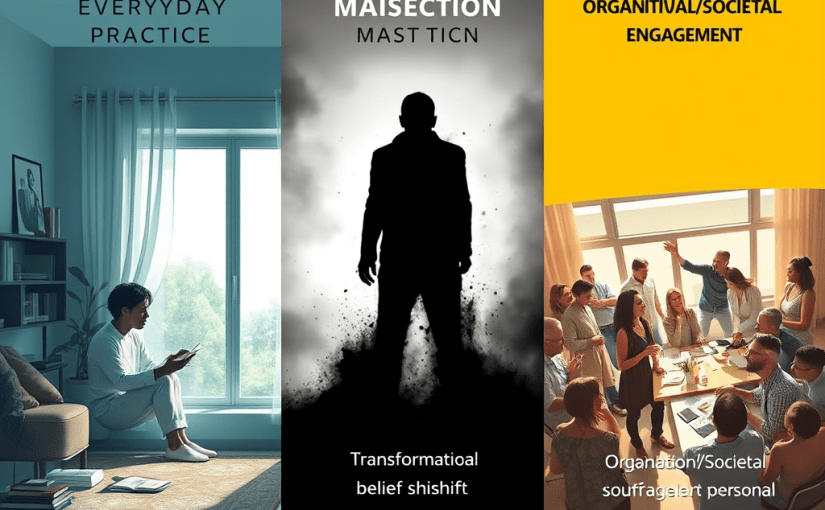
Three Pathways of The Practice of Personal Mastery:


FROM EVERYDAY ACTS TO ORGANISATIONAL TRANSFORMATION

This guide outlines the full scope and texture of personal mastery as a living discipline. Drawing from real experiences, case studies, and foundational tools from The Fifth Discipline, it shows how personal mastery unfolds across three intensities of engagement: Everyday Practice, Transformational Belief Shift, and Organisational/Societal Engagement.


SITUATION 1: Everyday Practice
Simple, repeatable acts that build awareness, intention, and alignment.

Examples:

  • Practice personal visioning in daily activities. For instance, upon seeing a pile of dirty dishes, resist reacting out of obligation. Instead, pause and imagine the end state: dishes gleaming, neatly stacked, and a space restored. This subtle shift from reacting to envisioning invites energy to rise from within, aligned with what we want to create.
  • Check internal state before responding. Before replying in a difficult meeting, pause and notice: Am I reacting to a threat or responding with purpose?
  • Daily journaling. Reflect on the difference between what you did and what you wanted to create.

Purpose:
Makes personal mastery accessible. Builds inner steadiness and intentionality. Trains attention to stay rooted in vision, not reactivity.


SITUATION 2: Transformational Practice Rooted in Deep Belief (“The Shift”)
Facing and transforming invisible mental models that sustain stagnation or self-sabotage.

Illustrated by the 2011 newspaper incident:

  • A public article misrepresented a complex initiative, distorting intent and impact.
  • The silence from allies was louder than the criticism. Shame crept in.
  • A new mental model formed: “Don’t make noise. Stay safe. Visibility brings danger.”

The Shift Process:

Name the Triggering Event. What incident caused a rupture or contraction?

Identify the Belief Formed. What unconscious story began? E.g. “Visibility is unsafe.”

Observe Its Impact. How has it shaped decisions, posture, and relationships?

Distinguish Past from Present. “That article was misinformed. It no longer gets to define me.”

Reframe Power and Identity. “Their silence is not my shame to carry.”

Create a New Internal Commitment. “I now speak to serve, not to be validated.”

Purpose:
Acts as a doorway to deeper authenticity. Enables structural shifts in identity and self-concept. Builds the resilience to lead without waiting for permission.


SITUATION 3: Organisational / Field / Societal
Where personal mastery scales to systems-level change through collective learning.

Practices:

  • Co-evolve mental model dialogues into shared team learning. Bring individual reflections into safe spaces for group discovery.
  • Map systemic structures using the Onion Model.
    • Example: The national unemployment study in Botswana used this model to surface feedback loops, delays, archetypes, and mental models.
  • Apply scenario planning to test future pathways.
  • Facilitate visioning to build cross-functional teams around shared purpose.

Objectives:

  • Enable collaborative strategy design.
  • Cultivate systems leadership across silos.
  • Create “learning organisations” capable of sensing, reflecting, and evolving.

Purpose:
Personal mastery at this level becomes a catalyst for systemic transformation. It is no longer about individual growth, but the growth of capacity in the system to hold complexity, to envision together, and to act with courage.


Closing Note:
Whether practiced quietly at a kitchen sink, or enacted across national strategy tables, personal mastery is the unseen discipline that makes meaningful change possible. All three pathways matter. All three prepare us to become who we must be for the futures we long to create.