The STRLDi Management Tools Framework


Organising Management Knowledge by Purpose and Depth of Seeing

Ms Sheila Damodaran


Management literature contains thousands of tools, frameworks, methodologies, standards, and practices designed to help organisations perform, improve, govern, adapt, and grow. These tools are typically organised by professional discipline—finance, operations, strategy, quality, human resources, information technology, or project management. While useful for specialists, such classifications often make it difficult for leaders to understand how these tools contribute to the broader task of organisational learning and transformation.

At the same time, many organisations possess an impressive collection of management tools and yet continue to struggle with persistent issues that repeatedly return in different forms. They measure performance, monitor risk, improve quality, manage projects, control costs, and coordinate operations with increasing sophistication. The challenge is rarely a lack of tools. More often, it is a lack of clarity about what those tools help us see.

This framework takes a different approach. Instead of organising tools by profession, it organises them first by purpose and then by the depth of seeing they enable. The purpose categories reflect the primary work of organisations. Together, they describe the full journey of organisational life—from understanding reality, through action and adaptation, toward long-term renewal.


The Nine Purposes of Management

Level 1 – See

Every organisation must first develop the capacity to observe reality. Seeing includes monitoring performance, understanding conditions, recognising trends, identifying risks, and developing situational awareness. Without seeing, all other activities are based on assumption rather than evidence.

The central question is:

What is happening?


Level 2 – Develop People

Organisations achieve results through people. This level focuses on building capability, leadership, competence, judgement, and learning capacity. It includes recruitment, training, coaching, mentoring, and the cultivation of personal mastery.

The central question is:

Who are we becoming?


Level 3 – Align

Individual effort becomes organisational capability only when people move in a common direction. Alignment creates coherence between purpose, strategy, teams, and stakeholders. It transforms separate activities into collective action.

The central question is:

How do we move together?


Level 4 – Decide

Every organisation faces choices about priorities, investments, risks, trade-offs, and future direction. Decision-making determines where attention, resources, and energy will be focused.

The central question is:

What should we do?


Level 5 – Execute

Execution converts intentions into action. This includes project delivery, operational management, process execution, scheduling, coordination, and the day-to-day work of producing results.

The central question is:

How do we get things done?


Level 6 – Govern & Measure

Organisations must maintain accountability, stewardship, transparency, and control. Governance ensures that actions remain aligned with obligations, standards, responsibilities, and performance expectations.

The central question is:

Are we doing what we said we would do?


Level 7 – Improve

Improvement focuses on increasing effectiveness, efficiency, quality, reliability, and performance. It seeks to reduce waste, strengthen capability, and enhance outcomes through disciplined learning from experience.

The central question is:

How can we do this better?


Level 8 – Adapt

Conditions change. Markets shift. Technologies evolve. Societies transform. Adaptation enables organisations to respond to emerging realities while maintaining relevance and resilience.

The central question is:

What must change?


Level 9 – Renew

Renewal focuses on long-term viability. It concerns the organisation’s ability to regenerate leadership, knowledge, purpose, capability, and direction across time. Renewal ensures that today’s success does not become tomorrow’s limitation.

The central question is:

How do we remain capable of creating value into the future?


Depth of Learning

While the nine levels describe why a tool exists, a second dimension describes how deeply that tool helps us understand reality.

Drawing on the learning disciplines of The Fifth Discipline, tools can contribute to one or more of five levels of seeing:

LevelQuestion
EventWhat happened?
PatternWhat keeps happening?
StructureWhat archetypal causal structure is producing the pattern?
Mental ModelsWhat assumptions and beliefs sustain the structure?
VisionWhat future are we collectively trying to create?

Most management tools help organisations observe and manage events. Some help leaders recognise patterns over time. A much smaller number help reveal the archetypal structures that generate those patterns. Fewer still help surface mental models or cultivate shared vision.

The tables that follow organise management tools according to both dimensions: their organisational purpose and their depth of seeing.


Reading the Tables

The ticks indicate the primary depth of seeing naturally enabled by a tool. They do not imply that a tool cannot be used more deeply by a skilled practitioner. Rather, they indicate where the tool most naturally contributes to learning and action.

In this framework, Structure refers exclusively to archetypal causal structure—the reinforcing and balancing processes, delays, accumulations, and systemic dynamics that generate behaviour over time. It does not refer to organisational structures, reporting relationships, governance arrangements, methodologies, frameworks, or management systems.

This distinction is important because the framework is grounded in the learning disciplines of The Fifth Discipline. Its purpose is not merely to organise management knowledge, but to help leaders understand how different tools contribute to increasingly deeper levels of seeing, learning, and transformation.


Depth of Learning

because what distinguishes The Fifth Discipline is not seeing alone.

It is the organisation’s capacity to learn from what it sees. That subtle shift brings the framework even closer to Senge’s original intent.


LEVEL 1 — SEE

DomainToolEventPatternStructureMental ModelsVision
FinanceBalance Sheet
FinanceIncome Statement
FinanceCash Flow Trend
OperationsKPI Dashboard
OperationsTrend Analysis
QualityControl Charts
StrategySWOT
StrategyPESTLE
Systems ThinkingBOT Graphs

LEVEL 2 — DEVELOP PEOPLE

DomainToolEventPatternStructureMental ModelsVision
HRTraining Programmes
HRCompetency Frameworks
LeadershipCoaching

LeadershipMentoring
LearningReflective Practice
LearningPersonal Mastery
LearningDialogue

LEVEL 3 — ALIGN

DomainToolEventPatternStructureMental ModelsVision
StrategyBalanced Scorecard
StrategyStrategy Maps
LeadershipShared Vision
LeadershipVision Deployment
LearningTeam Learning
StakeholderStakeholder Mapping

LEVEL 4 — DECIDE

DomainToolEventPatternStructureMental ModelsVision
StrategyScenario Planning
FinanceCost-Benefit Analysis
RiskRisk Assessment
Systems ThinkingSystem Archetypes
Systems ThinkingOnion Model
Systems ThinkingCLDs

LEVEL 5 — EXECUTE

DomainToolEventPatternStructureMental ModelsVision
ProjectsPMBOK
ProjectsGantt Charts
ProjectsRAID Logs
OperationsSOPs
OperationsKanban
ProjectsAgile
OperationsScheduling Systems

LEVEL 6 — GOVERN & MEASURE

DomainToolEventPatternStructureMental ModelsVision
FinanceBudgeting
FinanceForecasting
RiskRisk Register
RiskAudit
GovernanceCompliance Systems
GovernanceInternal Controls
GovernanceBoard Reporting

LEVEL 7 — IMPROVE

DomainToolEventPatternStructureMental ModelsVision
QualitySix Sigma
QualityDMAIC
OperationsLean
OperationsKaizen
LearningAfter Action Reviews
QualityRoot Cause Analysis

LEVEL 8 — ADAPT

DomainToolEventPatternStructureMental ModelsVision
ChangeADKAR
ChangeKotter
StrategyStrategic Foresight
Systems ThinkingLeverage Point Analysis
LeadershipAdaptive Leadership

LEVEL 9 — RENEW

DomainToolEventPatternStructureMental ModelsVision
LearningLearning Organisation
HRSuccession Planning
KnowledgeCommunities of Practice
KnowledgeKnowledge Management
LeadershipStewardship
Systems ThinkingFifth Discipline

Immediate observation

When classified this way:

  • Most traditional management tools cluster in Event.
  • A smaller number reach Pattern.
  • Very few genuinely reach Structure.
  • Mental Models is dominated by Fifth Discipline disciplines rather than conventional management tools.
  • Vision is populated mostly by leadership and strategy tools.

This is probably the first clue that the table is not merely cataloguing management methods. It is revealing where management as a field has historically invested its attention.

And that, in turn, may explain why organisations become highly capable of managing events while remaining relatively weak at understanding the archetypal structures that generate them.


“Not Enough Manpower”


A Case Study of the Fixes-That-Fail Archetype

(STRLDi System Archetype Compendium)


🪞 THE LEADERSHIP MIRROR

Every organization believes its problem is capacity.

There are never enough hands, hours, or funds.

And yet, each time new resources arrive, the shortage returns — louder than before.

What if “not enough manpower” is not a fact but a structure?

A loop that feeds on how we define effort, competence, and worth.

This case explores the fatigue of systems that mistake busyness for strength.

It asks: when we plead for more resources, are we revealing scarcity — or creating it?


📖 BEFORE YOU READ

Every manager has heard it: “We just don’t have enough people.”

And most respond with the only answer they know — request another post, extend another contract, add another unit.

For a moment, the pressure eases.

Then, almost predictably, the system returns to the same refrain: not enough.

This second study in the STRLDi System Archetype Compendium turns the spotlight inward.
It invites leaders to look not at the size of their workforce, but at the structure of their attention.

Because sometimes, what drains capacity is not the number of people working, but how the organisation thinks about work itself.


1 Context and Origins

The complaint of not enough manpower surfaced repeatedly across divisions.

Officers spoke of being stretched thin; supervisors lamented high turnover; HR cited budget ceilings.

Yet, even after multiple recruitment rounds, the pattern refused to change.

The department was caught in a cycle:

hire more → overwork the keen → lose the best → rehire → repeat.
The harder it tried to fix the shortage, the deeper the shortage seemed to run.

STRLDi’s analysis revealed a classic Fixes That Fail loop, with an inner twist — a shift from procedural competence (detailed complexity) to systemic blindness (dynamic complexity).


2 Behaviour Over Time

Law #1 – Today’s Problems Come from Yesterday’s Solutions

Each new recruitment was celebrated as relief.

But soon, workloads grew to match expanded capacity.

Files multiplied because each officer, keen to prove efficiency, absorbed more than the system could learn from.

Law #2 – The Harder You Push, the Harder the System Pushes Back

Supervisors demanded visible performance.

Officers responded by working faster, skipping reflection, and eroding coordination.

Fatigue led to mistakes, then admonishments, then resignation.

Law #5 – The Easy Way Out Leads Back In

Recruitment became the default cure for all ills.

But the structure producing inefficiency — the inability to see dynamic complexity — stayed untouched.

Law #7 – Faster Is Slower

Each officer’s attempt to prove capability through speed created rework.

Time “saved” at the front end returned ten-fold as correction.

Law #8 – Small Changes Can Produce Big Results

The real leverage, as it turned out, was not in manpower but in mind-power — cultivating systemic seeing.


3 The Structure Beneath

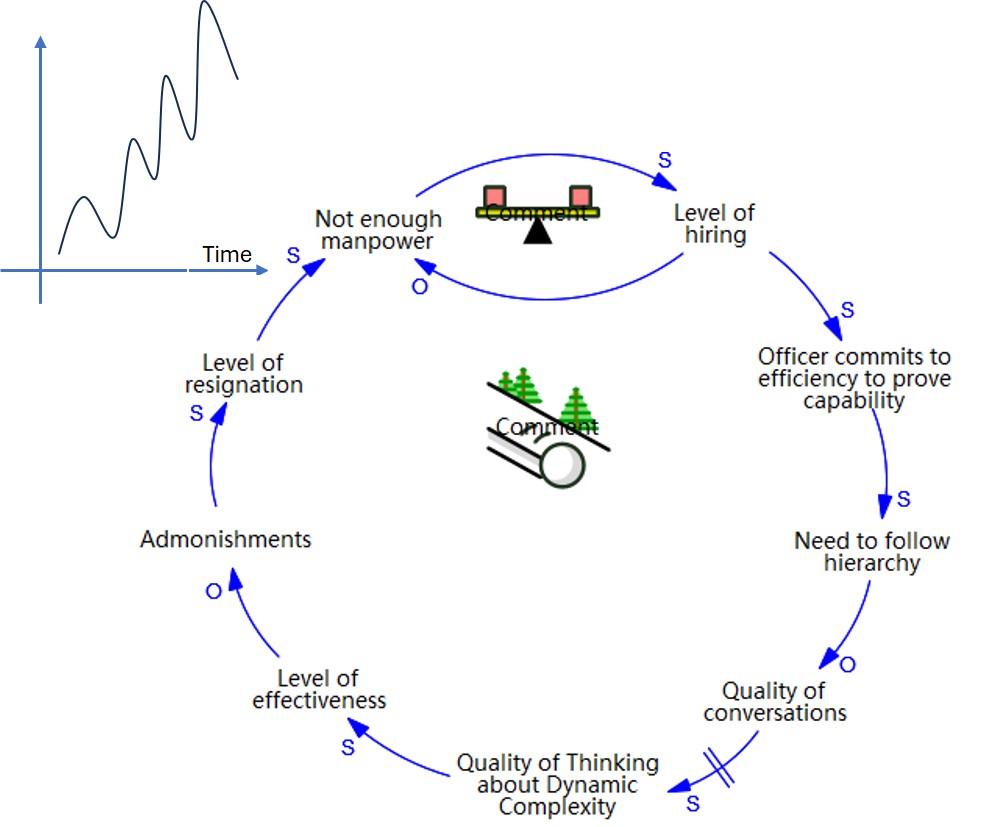
Figure 1

Not enough manpower ↑ → pressure to hire ↑ → officer commits to prove efficiency ↑ → fatigue ↑ → effectiveness ↓ → admonishments ↑ → resignation ↑ → visible shortage ↑ → not enough manpower ↑

A textbook balancing loop disguising a deeper, reinforcing trap.

Each new hire learned to survive by speed, not by seeing.

The system rewarded firefighting over foresight.


4 The Mental Models of the Current Reality

RoleBelief (Mental Model)BehaviourHidden Fear
Supervisor“More heads mean more output.”Pushes for hiring drives.Fear of being seen as ineffective.
Officer“If I follow procedure perfectly, I’ll be safe.”Clings to efficiency rituals.Fear of failure or exposure.
HR Department“Vacancies are the problem; recruitment is the solution.”Focuses on filling posts.Fear of being blamed for bottlenecks.

These beliefs form a self-reinforcing illusion of scarcity — a psychological contract that trades learning for labour.


5 Current Reality Vision

The organisation believes its ideal state is “a fully staffed, efficient department.”

But efficiency, narrowly defined as procedural compliance, is precisely what drains energy.

The true shortage is time for reflection, not manpower.


6 The Identified Leverage – The Bridge

The leverage lies in shifting the unit of value from task completion to systemic comprehension.

Officers trained to recognise system archetypes began spotting patterns behind the complaints that filled their desks.

They learned to ask: What structure keeps bringing this problem back?

That single question changed everything.

Instead of escalating issues upward, officers started resolving root causes at source.

Each small insight restored flow.

Turnover dropped.

Morale rose.

This was Law #8 in motion — the smallest act of seeing producing the largest return.


7 The Uncle’s Act

A senior manager, himself once a procedural purist, saw the shift.

Instead of issuing directives, he invited officers to draw their own loops.

He reframed errors as learning data and began conversations on system patterns during weekly check-ins.

Without formal policy, the department began learning how it learned.

The “boiled frog” moment arrived quietly — no reforms, no memos, only deeper sight.


8 Behaviour After Leverage

At first, confusion rose.

Procedural officers felt slower, less efficient.

But within weeks, rework plummeted.

Peer collaboration replaced hierarchical blame.

Hiring needs stabilised; resignations declined.

The curve flattened into sustainable flow.

Productivity became calm rather than frantic — a living example of Law #3: Behaviour grows worse before it grows better.


9 Vision of the Future Reality

In the future state, the organisation measures learning velocity, not headcount.

Meetings revolve around flow maps, not vacancy lists.

Supervisors track time saved through insight, not hours worked.

Officers move fluidly between tasks, guided by understanding of interdependencies.
The language of shortage fades.

The culture breathes again.


10 Supportive Mental Models of the Future Reality

RoleNew BeliefEmergent Discipline
Supervisor“Conversation is capacity.”Team Learning – builds capability through dialogue.
Officer“Seeing structure is solving.”Systems Thinking – replaces reaction with reflection.
HR“We hire for insight, not numbers.”Shared Vision – aligns recruitment with learning purpose.

Fear has shifted into curiosity.

Busyness into presence.


11 Events and Patterns of the Future System

In the renewed system, the Laws of Dynamic Complexity are respected:

LawExpression in Future System
#1Each solution is tested for side-effects.
#2Pressure points are diffused through learning, not extra labour.
#4Delays between cause and effect are mapped and shared.
#5Fixes are replaced by experiments.
#7Pace aligns with purpose — speed serves insight.
#8Minor course corrections replace major overhauls.
#11Structure, not people, holds accountability.

The pattern of oscillating scarcity transforms into a reinforcing loop of shared mastery.

New Reinforcing Loop: Seeing → Understanding → Flow → Calm → Retention → Collective Capacity → Seeing again.


12 The Cost of Awareness vs the Cost of Ignorance

ApproachFinancial CostOutcome
Traditional Recruitment and OvertimeHigh capital outlay / Low learningShort-term relief; long-term burnout
Systems Training and Learning CyclesNegligibleSustainable performance; cultural renewal

Awareness pays higher dividends than payroll.


13 The Broader Vision

A nation of institutions trapped in detailed complexity will always feel under-staffed.

The cure is not mass hiring, but systemic sight.

When leaders learn to see patterns, they release both human energy and national capacity.

Manpower turns into mind-power.

The true resource multiplies by awareness.


Vision of the Future Reality:
A workplace where capacity is consciousness — and where the ability to see the system is the new definition of strength.


Fixes-That-Fail (Variant)

LEFT-HAND PAGE – Analysis & Reflection

Header

When busyness becomes a badge of competence, the organisation hires itself into exhaustion.

Top Section – Leadership Mirror

A full-width grey box containing the mirror paragraph.
A small inset quote in italics:

“Every system is perfectly designed to get the results it gets.”

Preamble – Before You Read

Placed below the mirror, using a light background tone.
Accompanied by a small inset BOT diagram (Before Leverage) in the top-right corner.

Main Narrative Body

Two columns.
The left column opens with:

  • 1–5: Context, Behaviour Over Time, Structure, Mental Models, Current Reality Vision.
    The right column continues with:
  • 6–9: Leverage, Uncle’s Act, Behaviour After Leverage, Future Reality Vision.

A thin vertical line separates narrative from marginalia.

Margin Notes (right margin of both pages)

Small annotations in blue text boxes referencing the Laws of Dynamic Complexity as they appear:

  • #1 Today’s problems come from yesterday’s solutions
  • #7 Faster is slower
  • #8 Small changes produce big results

These act as navigational anchors for readers scanning the page.


Footer – Coda

A final blue band carrying your signature line:

Vision of the Future Reality
A workplace learns to become a place and opportunity where capacity is consciousness — and where the ability to see the system is the new definition of strength.


Previous Post: Urgent Files

Next Post: Human-Wildlife Conflict

Based on the Vision Deployment Matrix™ created by Dr Daniel H. Kim, first published in The Systems Thinker, Vol. 6 No. 1 (1995).
Framework adapted by STRLDi for applied national systems learning.


“Urgent Files”


A Case Study of the Fixes-That-Fail Archetype

(STRLDi Compendium of System Archetypes — Draft Edition)

“THE LEADERSHIP MIRROR”

Every leader believes they are solving problems.
Few notice that the problems are quietly solving them.

The more effort they invest, the deeper the pattern takes hold — until exhaustion feels like purpose and urgency feels like success.

The following case is not a critique of leadership but an invitation to see leadership at work inside the system itself.

Each time we react, correct, compensate, or protect, the structure records it — and teaches.

This is the leadership mirror: a place to see our reflexes reflected back as design.
The lesson is never about who was right; it is about how the system learned from what we could not see.


Before You Read

Every bureaucracy has its rituals of rescue — the emergency meeting, the red-stamped file, the overtime marathon that proves loyalty.

For a moment, the room feels alive; the system seems responsive.

Then, just as surely, the backlog returns.

What you are about to read is not a story about slow officers or careless managers.
It is the anatomy of a reflex — a national habit of equating busyness with value.

This first study in the STRLDi System Archetype Compendium opens with a pattern called Fixes That Fail.

It asks: What if the system’s greatest crisis is its own cure?

And it invites you to see that the smallest act of awareness can transform an enterprise, a ministry, or a nation.


The Urgent Files phenomenon emerged in an investigations department charged with handling public complaints.

Its purpose was straightforward: ensure that every reported case was reviewed, investigated, and closed within prescribed time limits.

Yet, over time, the department found itself in a perpetual state of crisis.

Every few weeks management would announce a backlog-clearing exercise.

Files were stamped URGENT in red, officers were redeployed, and working hours extended.

The public applauded the temporary responsiveness, but within months the backlog returned — heavier and more demoralising than before.

When STRLDi first studied the pattern, it seemed ordinary bureaucratic fatigue.

But plotting behaviour over time revealed the familiar oscillation of the Fixes That Fail archetype:

A quick corrective action delivers short-term relief yet creates longer-term pressure that demands the same fix again.

What looked like a process problem was in fact a systemic illusion — the office was working tirelessly to reproduce the very problem it was trying to solve.


2 The Behaviour Over Time

Law #1 Today’s Problems Come from Yesterday’s Solutions

The origin of each crisis lay in the previous “solution.”

Every time the department declared an urgent-file drive, officers diverted effort from current cases to old ones.

Those current files, now unattended, quietly aged into the next batch of urgents.

The fix created its own future workload.

Law #4 Cause and Effect Are Not Close in Time and Space

The delay between setting aside a file and seeing it resurface months later disguised causality.

Managers saw only the symptom — rising complaints — never connecting it to yesterday’s rescue campaign.

Because the effect appeared far from the original action, the loop stayed invisible.

Law #2 The Harder You Push, the Harder the System Pushes Back

Each urgent drive demanded overtime and exhaustion.

For a short while output spiked, morale rose, and the public seemed satisfied.

Then the system’s “push-back” arrived: new complaints, deeper fatigue, and declining quality.

The curve resembled an erratic heartbeat — a body kept alive by stress.

Law #7 Faster Is Slower

Speed became synonymous with virtue.

Supervisors equated motion with progress.

But the faster the office moved, the less it learned.

Files rushed through without closure; decisions required re-work; coordination failed.

The department had institutionalised adrenaline.


3 The Structure Beneath the Oscillation

The causal structure was deceptively simple:

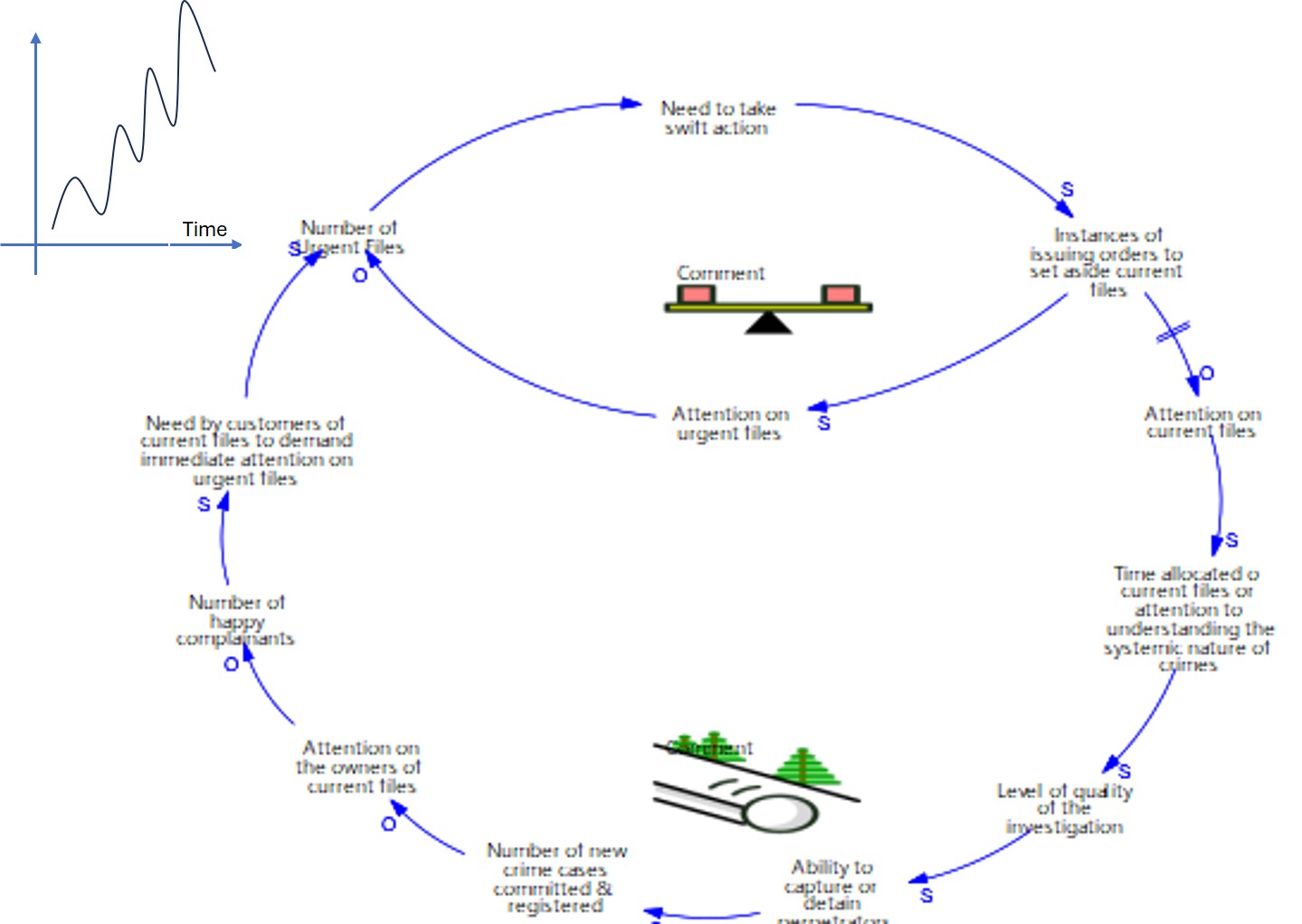
Figure 1

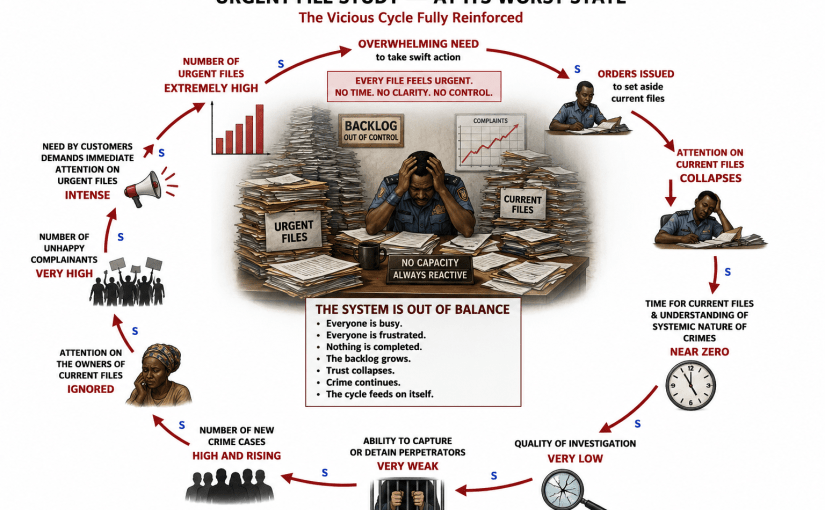
Urgent files ↑ → swift action ↑ → attention on current files ↓ → quality of work ↓ → complainant dissatisfaction ↑ → urgent files ↑

A perfect balancing loop in form — but it balanced the wrong thing: the appearance of responsiveness rather than genuine throughput.

The balancing reflex masked a deeper reinforcing dynamic of fear and pressure.

As the unseen reinforcing loop gained strength, the human reflex to “restore balance” intensified — confirming the Law of Reflexive Balance later codified by STRLDi:

Except in biological homeostasis, every balancing loop in human systems is the reflex of an unseeing system attempting to counter its own reinforcing pattern.


4 The Ladders of Fear (Mental Models)

Three ladders of inference maintained the blindness:

ActorAssumptionBehaviourHidden Fear
Supervisor“Officers are lazy.”Increases control and public visibility.Fear of losing authority.
Officer“Management notices only crisis.”Waits for escalation to act.Fear of invisibility and blame.
Complainant“Government doesn’t care.”Escalates or bypasses channels.Fear of powerlessness.

Each ladder reinforced the others.

Separated by hierarchy, they never met to test their assumptions.

Law #11 — There is no blame — was the missing discipline: everyone defended their role; no one saw the system.


5 The Vision That Created the Current Reality

The department still served a vision forged decades earlier: “Efficiency means rapid response.”

It wanted both speed and quality at once — the contradiction captured in Law #9, you can have your cake and eat it too, but not at once.

Performance measures rewarded volume, not learning.

The structure behaved exactly as it was designed: to appear busy.


6 The Discovery of Leverage

During a review, one senior officer — trained by experience rather than formal education — noticed something small yet profound.

Whenever he deferred a case, he called the complainant to explain the delay and outline next steps.

Those calls, barely two minutes each, eliminated most follow-up complaints.

Files no longer escalated to urgent.

The simple human act re-closed the feedback loop that the system’s procedure had severed.

Here lay Law #8 in living form:

Small changes can produce big results — the areas of highest leverage are often the least obvious.

The cost of the intervention: zero.

The impact: systemic.

No technology, no reform bill, no consultant.

Just consciousness restored at the point of disconnection.


7 The Uncle’s Act (Healing in Motion)

A wise supervisor recognised the potential but avoided formalising it.

He praised the courtesy as “professionalism” and let it spread organically.

This was the Uncle’s Act — healing inserted gently into culture:

Healing Intent: Re-humanise the flow of work.

Gentle Insertion: Allow experienced officers to model the call.

Camouflage: Present it as courtesy, not reform.

Trust Loop: Acknowledge calm complainant behaviour publicly.

Successor’s Gift: Embed it later as induction practice.

By keeping the structure unaware of its transformation, he boiled the frog without harm.

The balancing reflex quietly lost energy; the reinforcing loop of trust took over.
Balance returned as rhythm, not resistance.


8 Behaviour After Leverage

At first the curve looked wrong — urgents dropped, throughput slowed, calm felt unnatural.

But over successive cycles, quality stabilised and morale rose.

The department was living Law #3 — behaviour grows better before it grows worse.

Short-term anxiety preceded long-term healing.

Within months, urgent-file drives disappeared from the vocabulary.

Officers began competing for consistency, not crisis.

The healing reinforcing loop (call → trust → fewer urgents → time → more calls) had taken root.


9 The Future Reality Vision

In the healed system, work flows continuously instead of spasmodically.
The word “urgent” has lost its power because the system has learned to anticipate, not react.
Supervisors manage rhythm, not crisis; officers manage trust, not panic; complainants experience transparency instead of silence.

The organisation’s purpose has evolved from efficiency to reliability — from fast to steady.
Its identity is no longer built on rescue but on prevention.

This is a department that now embodies the nation’s future reality: a public service that leads not by control, but by coherence.


10 Supportive Mental Models of the Future Reality

RoleNew Mental ModelEmergent Discipline
Supervisor“Flow is the new efficiency.”Systems Thinking — seeks patterns, not incidents.
Officer“I create calm when I connect early.”Personal Mastery — pride in steady contribution.
Complainant (Citizen)“My government listens even when I’m silent.”Building Shared Vision — trust as civic culture.

Fear has transmuted into confidence.

The belief in scarcity of time or manpower dissolves when feedback is immediate and human.

Each participant’s ladder of inference has shortened — fewer assumptions, more communication.

The walls between roles have turned into mirrors.


11 Events and Patterns in the Future System

In the healed state, the Laws of Dynamic Complexity are respected, not violated:

LawExpression in the Future System
#1Solutions are tested for side effects before implementation.
#2Pressure points are anticipated — no need to overpush.
#3Temporary discomfort is accepted as part of real learning.
#4Feedback cycles are monitored continuously — cause and effect stay linked.
#5Easy fixes are replaced by small, deliberate learning experiments.
#7Pace matches capacity; speed is calibrated, not worshipped.
#8Minor, human interventions are designed into process flow.
#11Blame has no oxygen; the conversation focuses on structure.

The pattern now resembles a gentle rise and plateau, not a spike and crash.

It behaves like a breathing organism — self-correcting, aware of its boundaries.

The loop has evolved from Fixes That Fail to what STRLDi names a Learning Reinforcement Loop — trust reproducing trust.


12 The Future Reality

The new system functioned without drama.

Public trust steadied; workload distributed evenly; officers regained pride.

The earlier balancing loop that exhausted the system had given way to a reinforcing loop that regenerated it.

Calm was now the indicator of competence.

The “urgent” label, once a symbol of heroism, became a relic of blindness.


13 The Cost of Awareness vs. the Cost of Ignorance

A comparison later conducted by STRLDi estimated that a full business-process re-engineering of the department — consultants, workshops, IT systems — would have cost tens of millions.

The systemic leverage that achieved the same outcome cost nothing but two minutes of conversation per deferred case.

ApproachFinancial CostResult
BPR overhaulHigh capital, low learningTemporary efficiency; same pattern returns
Two-minute callNegligibleStructural healing; enduring calm

Law #8 is therefore not about efficiency; it is about economy of consciousness.
Systemic change costs awareness, not appropriations.

Every pula saved from compensating blindness becomes available for rebuilding the nation’s real capacities — agriculture, education, manufacturing — the domains that feed people, not reflexes.


14 Broader Implications — The Discipline of Seeing

The Urgent Files case demonstrates that the purpose of systems thinking is not prediction or control but seeing.

A balancing loop is not virtue; it is the reflex of an unseeing system attempting to hold still what must evolve.

Only when awareness reconnects the parts of the loop does reinforcing energy turn from vicious to virtuous.

Then, and only then, does a learning organisation begin to form.


15 Coda – From Reflex to Learning

In biological life, balance preserves being.

In human systems, balance often preserves blindness.

The Fifth Discipline teaches that learning begins the moment the reflex to “correct” gives way to curiosity to see.

The Urgent Files case is more than a story of an investigation unit; it is a mirror for governance, religion, education, and enterprise — every domain that mistakes control for care.

The smallest act of seeing together can dissolve the largest illusion of control.
That is the meaning of systemic reform.
And that is the quiet revolution already underway.


Figures

Behaviour-Over-Time – Before Leverage

Behaviour-Over-Time – After Leverage

Causal Loop Diagram – From Balancing Reflex to Healing Reinforcement

(See companion visuals: BOT_Before_Leverage_FTF.png, BOT_After_Leverage_Healing.png, CLD_Urgent_Files_FTF.png)


Summary Table of Laws Expressed in the Urgent Files System

LawManifestation in Case
#1Each urgent drive creates tomorrow’s crisis.
#2The harder the push, the stronger the rebound.
#3Healing feels wrong before it feels right.
#4Delay hides cause and effect.
#5The easy fix leads back in.
#6The cure (urgent drives) worse than disease (delay).
#7Faster response slows real progress.
#8Smallest, least-visible act (phone call) flips the system.
#9Wanting speed and quality simultaneously creates contradiction.
#10Splitting responsibility fragments learning.
#11Seeing structure replaces blame.

Epilogue

Law #8 — Systemic change costs awareness, not appropriations.
When a nation learns this, its ministries heal, its budgets breathe, and its people rediscover trust.


Next Post: Not Enough Manpower

Based on the Vision Deployment Matrix™ created by Dr Daniel H. Kim, first published in The Systems Thinker, Vol. 6 No. 1 (1995).
Framework adapted by STRLDi for applied national systems learning.


Understanding Botswana’s Horticulture: Profit Dynamics Explained


From P5 beetroot to a P40 plate—why profits “move but don’t grow” without a coordination spine.


When the Butterfly Sneezes: The Unseen Players in Botswana’s Food System


🌾 Farmer’s Voice — A Passion of Hope

“Once we finish planting, the imports come in. Prices drop to P3 a kilo.
We can’t dodge the same old crops — cabbage, tomato, butternut — and tunnels cost over P90 000.
Try niche crops, they say, but even herbs and radish sell for cents.
Retailers buy my produce at P3 and sell at P4–P20.
When will we ever break even?”
Farmer, Botswana (2025)

Inside this lament is not anger but a map of a missing system.
He is describing an uncoordinated market where imports collide with local harvests, costs outrun prices, and data never travels between field, retailer, and policy desk.
It is the voice of someone working hard within a structure that works against him — what he calls “a passion of hope.”
That hope deserves a system strong enough to hold it.


The thread flares up with emotion. Dozens of voices add their experiences — the weather, the labour costs, the diesel bills, the price of packaging. Some call for subsidies, others for stricter import bans. Others say forget the local market. Go the way of exports. This conversation happens repeatedly in farmer groups. It occurs month after month. Every time a price thread catches fire, the discussion resurfaces.

And yet, hidden inside those messages is a larger pattern — one that rarely gets named. Farmers argue about prices. However, the real leverage lies elsewhere. It is in the soil beneath them. It is in the productivity of the labour beside them. It is also in the structure of the state above them.

It is easy to think that solving the farmer’s problem begins with the farmer. But economics tells us otherwise: the points of highest leverage in a system are usually the least obvious.

Our farmers’ frustration is real. However, the forces that shape it are mostly invisible. This encompasses the movement of data between ministries. It also involves the management of soil biology, the training of labour, and the sustenance of coordination. The pain of one player in the system often begins in the silence of another.

This article quantifies each layer, shows the ripple when farm-gate rises, and identifies the leverage points that actually grow profit.


Three Learning from This Study

These three learning define the real work ahead. It is the work that, if we take care of it, will make these circular farmer–retailer–caterer conversations unnecessary. They form the foundation for the next phase of Botswana’s agricultural and economic development.


1. Reduce Production Costs to Global Competitive Levels

Our first task is to bring our unit production costs down from P5.50–P6.20 to around P3.00/kg, matching China’s cost base.

That P2.00 difference is significant. It represents a full P2 profit margin per kilogram of beetroot (and comparable crops). This margin currently leaks away in inefficiency.
We can only achieve this through regenerative practices, precise data coordination, and investment in mechanisation where it matters.

Outcome: Lower costs mean higher margins for farmers without raising consumer prices — the hallmark of a mature, competitive system.


2. Confront Productivity Honestly and Set National Targets for Labour

Our workers are not underpaid — they are undirected.

The value of their pay is being eroded not by exploitation, but by inflation born from low productivity.

We must stop pretending otherwise. We should begin publishing comparative productivity data. This data shows how Botswana’s average agricultural worker performs in kilograms per hour against peers in China, Malaysia, and India.

Then, set measurable targets:

  • Increase output per labour-hour by 20% within 3 years,
  • Match Malaysia’s productivity by year 7,
  • Halve the labour cost per kilogram by year 10.

Outcome: Higher real wages are built on productivity, not inflation. The workforce knows exactly what “competing globally” means in numbers, not slogans.


3. Rebuild the Country’s STEM Foundations Early

Here’s a clear and grounded explanation that moves step by step from STEM → Efficiency → Productivity → Prosperity.


🌱 a. STEM builds understanding — not just knowledge

STEM (Science, Technology, Engineering, Mathematics) teaches people how things work — not just what to do.

That shift in understanding is crucial.

  • Science helps workers grasp cause and effect (e.g., soil chemistry, pest cycles, plant physiology).
  • Technology provides the tools to measure, automate, and communicate those effects.
  • Engineering applies design thinking — how to improve irrigation, logistics, or packaging systems.
  • Mathematics enables measurement, optimization, and decision-making (costs, yields, probabilities, scaling).

Together, these disciplines cultivate systemic awareness — people start seeing connections, feedback, and waste.
And once you see inefficiency, you can eliminate it.

🔍 Efficiency begins the moment a person can measure and model reality accurately.


⚙️ b. Efficiency is the visible expression of STEM in action

Efficiency simply means achieving more output for the same or fewer inputs — time, money, energy, or labour.

STEM translates into efficiency in concrete ways:

STEM AreaPractical Impact on EfficiencyExample in Agriculture
ScienceUnderstanding soil, plant, and climate interactionsFarmers apply the right nutrients at the right time instead of over-fertilising.
TechnologyMechanisation, sensors, digital toolsMoisture sensors save 30% of water and improve yield by 10%.
EngineeringBetter designs, less frictionEfficient irrigation pumps reduce energy use by 20%.
MathematicsTracking costs, yields, and trendsFarmers identify unprofitable crops before planting.

🌾 Efficiency isn’t about working harder — it’s about working with reality instead of against it.


📈 c. Productivity is efficiency multiplied by scale

When efficiency becomes consistent and repeatable across many workers or farms, it turns into productivity.

  • Efficiency is doing things right.
  • Productivity is doing the right things, consistently, across the system.

STEM allows workers to perform better individually. It also helps them coordinate through shared data. They use standardised measurements and continuous feedback.

That coordination is what lets a country like China keep unit labour costs low even when wages rise. Every worker is plugged into an information-rich system. This system amplifies output.

🚀 Efficiency makes individuals productive. Coordination makes nations productive.


💰 d. Productivity creates wealth — sustainably

When workers produce more per hour:

  • Wages can rise without raising prices (because output per worker increases).
  • Borrowing costs drop (because the economy produces more value per unit of debt).
  • Inflation falls (because supply keeps pace with demand).
  • The nation grows without subsidies.

That’s why improving STEM education and data coordination in agriculture isn’t an “education policy” — it’s a macroeconomic strategy.

It turns a P5.50/kg farm cost into P3.50/kg not through subsidy, but through mastery.
It converts labour from a cost line into a competitive advantage.

🌍 STEM turns energy into knowledge, knowledge into efficiency, and efficiency into national resilience.


In short

StageQuestionAnswer
STEMHow do we understand the system?Through science, data, and reasoning.
EfficiencyHow do we reduce waste?By measuring, predicting, and designing better.
ProductivityHow do we grow sustainably?By scaling efficiency across people and systems.

By the time a child reaches tertiary education, it is too late to correct what was never built.
The state must raise the mathematical and scientific literacy of its entire school population, not just the top students.

Our national benchmark must focus on improving Botswana’s average school grades in maths and science. We aim to match the global leaders — Germany, Japan, China, India, and Singapore.

This shift will not just improve education outcomes. It will reset the country’s entire productivity curve. This change will influence how farmers measure yields. It will affect how engineers design systems. Additionally, it will shape how policymakers use data.

Outcome: A generation equipped not only to work harder, but also to think structurally. This creates the muscle memory that drives nations forward.


In summary

1️⃣ Lower costs through coordination and regenerative discipline.
2️⃣ Lift productivity through data transparency and measurable labour goals.
3️⃣ Rebuild national STEM capacity from the classroom upward.

These three actions will work together. They will reduce the noise and emotion of our current debates. Frustration will be replaced with focus. Short-term fixes will be replaced with long-term learning.


Bridging Forward

These three learning give us a compass.

They show where the real work lies. It is not in louder debates over prices or subsidies. It is in building structural strength where it has quietly eroded: cost efficiency, productivity, and foundational education.

The rest of this article explores the data and reasoning that bring these points to life.
It follows a single, ordinary beetroot as it travels from soil to plate. It traces how profit behaves and where it leaks. The journey also examines what happens when we add coordination, regeneration, and STEM capacity back into the system.

From the farmer’s field to the nation’s policy tables, every section connects a visible frustration to its invisible cause.

Together, they reveal why Botswana’s horticulture will only mature when learning, labour, and leadership align.


Table of Contents

When the Butterfly Sneezes – The unseen players in Botswana’s food system

Part A – The Ripple Effect: From the Farmer’s P 5 Beetroot to the P 40 Plate
 2.1 An Economic Observation
 2.2 Tracing the True Cost of a Beetroot: From Farm to Plate
  a. End Consumer – The Office Meal Plate
  b. Caterer – Turning Raw Beetroot into a Side Dish
  c. Retailer – The Hidden Middle Costs
  d. Farmer – The Starting Point
  e. The Complete Chain – Costs per kg of Beetroot
  f. What the Data Shows
  g. The Systemic Insight
 2.3 The Baseline System – When the Farm-Gate Price is P 5/kg
 2.4 When the Farmer Raises Price from P 5 to P 8/kg
 2.5 Comparative Margins Summary
 2.6 Where the Ripples Come From
 2.7 Structural Insight – Movement without Prosperity
 2.8 Bridge to Part B – Raising Productivity and Coordination

Part B – When the Butterfly Sneezes: The Unseen Players in Botswana’s Food System
 3.1 The Quiet Cause Behind the Farmer’s Cry
 3.2 Comparative Farming Economics – Conventional, Organic and Regenerative
 3.3 Labour Productivity and Cost – Botswana, Malaysia and China
 3.4 What Happens When Botswana Combines Regeneration with STEM and NHCS
 3.5 The Seven Players – and the Three We Forget
 3.6 Closing – When the Butterfly Sneezes

Core Takeaway – Changing how we see ourselves in the system


Part A: The Ripple Effect — From the Farmer’s P 5 Beetroot to the P 40 Plate

1. An economic observation

A kilogram of beetroot may seem like a simple commodity. Yet inside that red root is the entire economy of a nation. Six players each shape one another and are shaped by each other. When the farmer lifts her price by a few pula, it affects retailers and caterers. It impacts consumers and labourers. The state is also influenced by this change.

In a well-coordinated system, those ripples dampen quickly. In a disjointed one, they echo back and forth until everyone feels poorer.


Tracing the True Cost of a Beetroot: From Farm to Plate

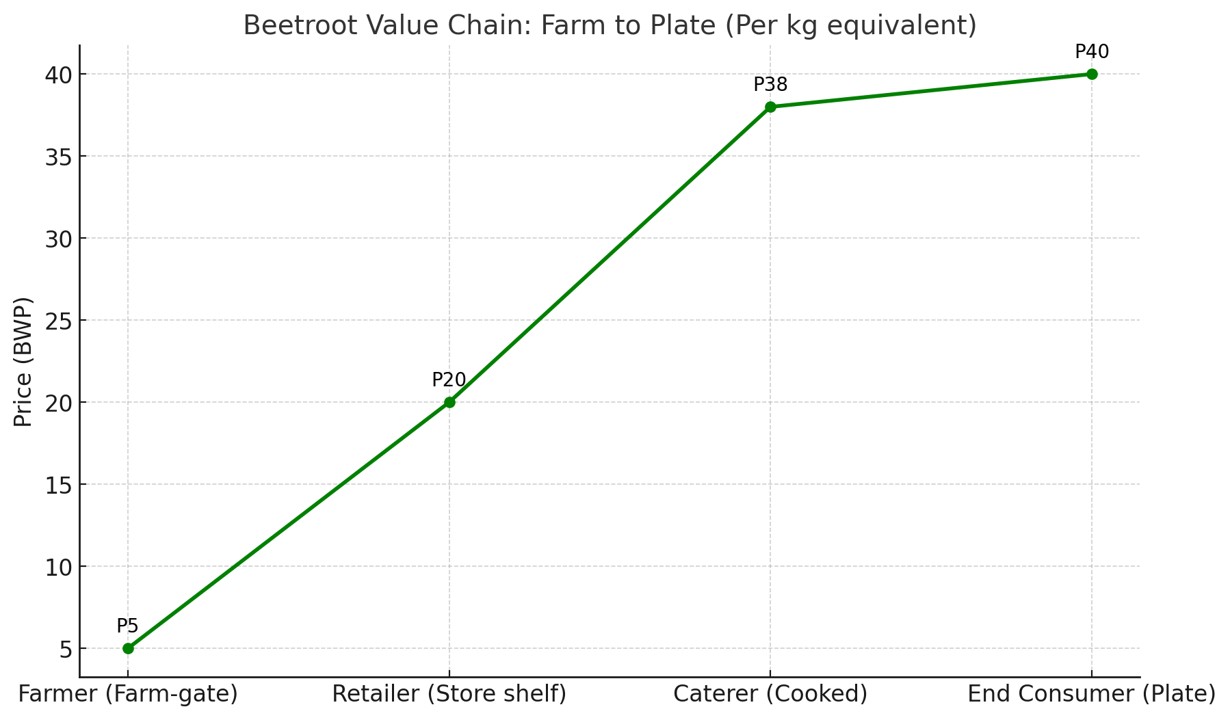
Understanding why beetroot sells for P20/kg in retail requires unpacking every layer between soil and spoon. The farmer earns only P4–5/kg.

Contrary to the common assumption that retailers “keep the profit,” the real story is quite different. It involves cost absorption and system inefficiency rather than greed.


a. End Consumer – The Office Meal Plate

  • Plate price: ~P40 per meal.
  • Beetroot portion: ~100 g cooked (≈150 g raw).
  • Plates per kg raw beetroot: 6–7.
  • Value of beetroot portion: ~P6–7 per plate.

➡️ Effective consumer cost: ≈P40/kg equivalent of beetroot once it is part of a full plated meal.

Summary:
For the consumer, beetroot is not seen as a costly ingredient. It forms only one side of a balanced plate. Yet at P40/kg equivalent, the same vegetable has multiplied eightfold from the farmer’s original P5/kg sale.

Punchline: Consumers don’t see the strain because they see only the plate, not the chain.


b. Caterer – Turning Raw Beetroot into a Side Dish

  • Retail purchase price: ≈P20/kg.
  • Cooking shrinkage: ~30 % (1 kg raw → 700 g cooked).
    • Effective ingredient cost: P28–29/kg cooked.
  • Additional operating costs:
    • Cooking oil, vinegar, spices, gas/power: P4–5/kg.
    • Preparation labour (washing, peeling, cooking, cutting): P5–6/kg.
    • Delivery/logistics: P2–3/kg.
  • Total cost to caterer: ≈P38/kg cooked beetroot.

Summary:
At P38/kg, caterers are already operating near breakeven against a P40/kg recovery from the plate price.
Even a small rise in the farm-gate or retail price erases their profit entirely.
This is why caterers appear “price-sensitive”: they have no slack left in their margin.

Punchline: Caterers run on fumes; tiny upstream increases wipe out margin.


c. Retailer – The Hidden Middle Costs

  • Buying price from farmers: P4–5/kg.
  • Breakdown of additional costs (per kg of final retail price P20):
    • Transport from farm: P2 (≈10 %)
    • Cold storage, handling, and spoilage: P3–4 (15–20 %)
    • Store rent, energy, staff, packaging, compliance, shrinkage: P6–7 (30–35 %)
    • Net profit margin: P3–4 (15–20 %)

➡️ Real retailer profit: ≈P3/kg — not P16.

Summary:
What appears to be a wide gap between the farm and the shelf is mostly overhead.
Retailers operate on thin real profits while shouldering refrigeration, electricity, salaries, and spoilage losses.

If it were easy or profitable for farmers to sell directly, many would have done so long ago. Many would have seen 10-20,000 customers walk through their gates each day.
Retailing is a different business — capital-intensive, compliance-heavy, and risky.

Punchline: The “P15 gap” is mostly overhead and risk, not profit.


d. Farmer – The Starting Point

Typical production costs for small to medium beet farms in Botswana:

Cost ItemRange (P/kg)
Seeds & inputs0.80 – 1.20
Fertiliser & soil preparation0.80 – 1.00
Irrigation, energy & water0.60 – 0.80
Labour0.80 – 1.00
Harvesting & packaging0.50 – 0.80
Farm overheads0.50 – 0.70
Total Cost Range3.50 – 5.50

Summary:
At a selling price of P4–5/kg, farmers are operating at or below cost depending on yield.
This leaves no room for reinvestment in irrigation, labour, or expansion — keeping farms small and fragile.

Punchline: At P4–5/kg, farmers are at/under cost—no reinvestment cushion.


e. The Complete Chain – Costs per kg of Beetroot

LayerInput / Base Cost (P/kg)Selling Price (P/kg)Approx. Profit (P/kg)Notes
Farmer3.5 – 5.54 – 5≈ 0–0.5Breaks even at best.
Retailer4 – 520≈ 3Real profit ≈ 15 %; bulk absorbed by overhead.
Caterer (cooked)20 raw → 38 cooked40 (plate equivalent)≈ 2Extremely tight margin.
Consumer40Sees only final plate price, not the cumulative chain.

f. What the Data Shows

Retailers are not “keeping” P16/kg.
Most of that margin evaporates into transport, electricity, staff, and spoilage.

Farmers sell at or below cost.
They absorb biological risk without a financial buffer.

Caterers operate on fumes.
Their entire P40 plate price barely covers cooked beetroot costs once prep and logistics are included.

Consumers perceive stability, not strain.
They see the P40 meal, not the imbalanced structure behind it.

Punchline: Movement without prosperity.


g. The Systemic Insight

Every link is absorbing inefficiency because no national coordination spine connects them.

  • Farmers plant without market signals.
  • Retailers import unpredictably to fill gaps.
  • Caterers pay for inconsistency with higher costs.
  • Consumers face quiet inflation hidden inside the meal price.

Without coordination, the entire chain functions like a series of disconnected pumps. Each builds its own pressure. None drives flow.

In short:

The beetroot doesn’t cost too little at the farm or too much on the plate. It costs exactly what an uncoordinated system produces. This includes high effort, low reward, and invisible waste.


2. The Baseline System — When the Farm-Gate Price Is P 5/kg

Assumptions: 1 ha = 40 tons yield. Farmer production cost ≈ P 5/kg.

LayerInput Cost (P/kg)Ops & Handling (P/kg)Revenue (P/kg)Profit (P/kg)Margin (%)Commentary
Farmer5.005.00≈ 0.000 %Sells at cost; no cushion for loss or reinvestment.
Retailer5.0015.00 (transport + storage + staff + shrink + margin)20.003.0015 %Margin looks high but includes spoilage risk and unionised labour.*
Caterer (cooked)20.00 (raw)18.00 (cooking shrink + ingredients + labour + delivery)38.002.005 %Runs on thin margins; relies on volume.
Consumer (plate)38.00 (cost/kg cooked beet)2.00 (service + profit)40.00Pays P 40 for a full meal; beetroot one side dish.

Observation: Every layer is working, few are thriving. The system produces movement, not prosperity.

Although the spread between farm-gate and retail looks like a P15 margin, only about P3 /kg is actual profit.

*The rest — roughly P12 /kg — is consumed by transport, cold-storage energy, rent, packaging, spoilage, unionised wages, taxes, and compliance costs.

If selling direct were truly easy for farmers, many would have become retailers long ago. They would be seeing 10-20,000 customers walk through their doors daily. But retailing is a capital-intensive, risk-heavy business with constant overheads and perishable losses.

What appears as a profit gap is actually a reflection of two kinds of risk. One is biological risk on the farm. The other is logistical risk in the marketplace. Both need to be managed, not merely priced.


Punchline: When value chains lack coordination, profit behaves like water on an uneven table. It moves, but it doesn’t grow.


3. When the Farmer Raises Price from P 5 → P 8/kg

Farm-gate increase = +60 %. Each player reacts in turn.

LayerPrev Input (P/kg)New Input (P/kg)Ops & Handling (P/kg)New Revenue (P/kg)Profit (P/kg)Δ MarginCommentary
Farmer5583+60 % gainShort-term relief; higher gross but may lose buyers.
Retailer5815233–2 ptsPasses cost downstream; absorbs some shrink.
Caterer (cooked)202321440–5 ptsMargins collapse; must raise plate price.
Consumer (plate)4046–4846–48Faces +15–20 % inflation on meal price.

Observation: Farmer’s gain (+3 P/kg) triggers +15 % retail inflation and erases caterer margin.

Punchline: Farmer gains +P3/kg, caterer margin collapses, plate inflates +15–20%.


4. Comparative Margins Summary

LayerProfit (P/kg) @ P 5Profit (P/kg) @ P 8Change (%)Winner / Loser
Farmer03+ ∞Winner (short-term)
Retailer330Neutral
Caterer20–100 %Loser
Consumer+15–20 % costLoser
SystemNet –Weaker overall

Reflection: > Profit shifted location, not magnitude. Without coordination, the system cannot create new value — it only reshuffles scarcity.

Punchline: Price hikes shift profit location; coordination grows profit magnitude.


5. Where the Ripples Come From

Every pula that changes hands carries invisible costs:

  • Retailers carry storage, energy, staff, compliance.
  • Caterers carry shrinkage, prep labour, logistics.
  • Consumers carry wage pressures and inflation anxiety.

Prices rise at the base without productivity growth or coordination. Each downstream player protects itself by passing on costs. They cut quality or reduce labour.
The system tightens like a chain under tension; every link creaks.

As Linda Booth Sweeney wrote in When a Butterfly Sneezes, small events lead to other happenings. These happenings connect in surprising ways.

In Botswana’s horticulture, a three-pula sneeze at the farm-gate can shake the whole plate.

Punchline: A three-pula sneeze shakes the whole plate.


6. The Structural Insight

What this case shows is not greed but structure.

The cry of the farmer (“I can’t survive on P 5/kg”) reflects a missing element. The cry of the caterer (“I can’t sell a P 48 plate”) is the same. Both are echoes of a need for a coordinated system. This system should balance supply, demand, logistics, and labour.

When systems are tight, prices can rise and everyone still profit.
When systems are loose, even generosity becomes inflation.

Punchline: Tight systems can absorb price moves; loose systems convert generosity into inflation.


7. Bridge to Part B — “When the Butterfly Sneezes”

Raising prices cannot make a weak system strong. Only productivity and coordination can.

In Part B, we follow this beetroot deeper into the soil. We explore how regenerative practices, labour productivity, and the state’s STEM backbone can transform cost into capacity.

In the end, the farmer’s hand is not the only factor that shapes the price of a plate. It is also the mind of a nation learning how its parts connect.


(End of Part A – The Ripple Effect)

Now, let’s move to Part B: “When the Butterfly Sneezes — The Unseen Players in Botswana’s Food System.”


Part B: When the Butterfly Sneezes — The Unseen Players in Botswana’s Food System

1. The quiet cause behind the farmer’s cry

In Part A, we saw how a farmer’s small price change at the soil surface affects the entire chain. This change inflates costs and erodes profits downstream.

Yet those ripples begin even deeper. They originate in the unseen conditions of the soil. The skills of labor play a role, alongside the coordination of the state.

Linda Booth Sweeney reminds us in When a Butterfly Sneezes that small causes can have big effects. This is especially true in systems that are already under tension.

In Botswana’s horticulture, the “sneeze” is often invisible. It includes an under-trained workforce, an uncoordinated logistics chain, and a budget released without a plan.
Each seems small; together they decide whether every player profits or barely survives.


2. Conventional, Organic, and Regenerative Farming Economics

SystemYield (t/ha)Total Cost (P/ha)Cost (P/kg)Farm-Gate Price (P/kg)Revenue (P/ha)Profit (P/ha)Profit Margin (%)Commentary
Conventional30165 0005.5–6.05.5–6.0180 00015 0008–9 %High synthetic inputs and fuel dependency; yields fluctuate with weather and pest cycles.
Organic (Certified)28210 0007.0–7.57.5–8.5224 00014 0006–8 %Conversion and audit costs; lower yield; depends on sustained premium demand.
Regenerative40190 0004.8–5.25.8–6.0240 00050 00020–22 %Inputs fall 10–25 % by Year 3; soil structure and water efficiency raise yield; most resilient long-term.

(Baseline: 1 ha beetroot, open-field, Botswana; currency = BWP.)

Punchline:

Regeneration earns more not by charging more but by wasting less.
It restores both soil and solvency.


3. Labour Productivity and Cost — Botswana, Malaysia, and China

Step 1. Setting up the context

To understand how labour costs and STEM productivity shape competitiveness in regenerative (Regen) vs conventional farming — comparing Botswana to:

China (low-wage, high-productivity, strong STEM coordination), and

A non-distant, STEM-strong peer — a country shares closer institutional and social structures with Botswana. This country has managed to integrate STEM deeply into agriculture.

📍 Suitable comparison: Malaysia

Why Malaysia?

  • Not culturally or politically “distant” (multi-ethnic, developing economy, democratic institutions).
  • Has STEM integration across education, manufacturing, and agro-technology.
  • Mid-level wages (not as cheap as China, not as high as OECD).
  • Strong public-private coordination in horticulture and food exports (e.g., Cameron Highlands vegetable clusters).
  • Realistic aspiration path for Botswana’s next 20 years.

Step 2. Approximate labour costs

CountryAverage Agricultural Wage (BWP equivalent/hr)Avg Monthly (BWP)Remarks
BotswanaP20–25/hrP4,000–5,000Labour market tight; strong unions push for steady increases; relatively low productivity/hour.
ChinaP10–12/hrP2,200–2,500Lower nominal cost, but very high labour productivity due to tech, mechanisation, STEM oversight.
MalaysiaP15–18/hrP3,000–3,600Balanced wages with higher output per worker (mechanised, digitally managed farms).

Chinese wages are half those of Botswana. However, their output per worker is often 3–4× higher. This means the unit labour cost per kg of produce ends up far lower.


Step 3. Labour cost per kg of beetroot (by system)

Let’s assume 1 hectare beetroot with ~40 tons yield (regenerative steady-state), ~30 tons (conventional).
Farm labour hours include planting, maintenance, irrigation, harvesting, grading.

Country/SystemLabour Hours/haWage (BWP/hr)Labour Cost/ha (P)Yield (tons/ha)Labour Cost/kg (P)
Botswana – Conventional1,0002222,000300.73
Botswana – Regenerative1,2002226,400400.66
China – Conventional700117,700400.19
China – Regenerative850119,350450.21
Malaysia – Conventional8001612,800350.37
Malaysia – Regenerative9501615,200420.36

🌍 Observations

Unit labour costs per kg

Botswana: ~P0.65–0.75/kg

Malaysia: ~P0.35/kg

China: ~P0.20/kg

China achieves triple the efficiency despite lower pay, due to STEM-driven mechanisation, logistics integration, and continuous R&D feedback loops.

STEM intensity equals productivity

China: tech platforms link field to market daily.

Malaysia: medium-tech, government coordination, farmer co-ops with digital traceability.

Botswana: strong individual farmer effort, but low integration — data and skills sit in silos.

Regen effect

Regenerative increases labour slightly (10–20%) but offsets through yield and soil stability.

Over time, Regen reduces unproductive labour (weed management, pest crisis responses) — smart work, not harder work.

Punchline: Productivity isn’t hand strength; it’s system clarity.


Step 4. Total cost comparison (farming system + labour + inputs)

Country/SystemTotal Cost/kg (P)Key Cost Drivers
Botswana – Conventional5.5–6.0Inputs & labour dominant, low mechanisation.
Botswana – Regenerative4.8–5.2Lower inputs, higher yield, slightly more labour.
China – Conventional2.8–3.2Scale, automation, supply-chain optimisation.
China – Regenerative3.0–3.4Balanced system with government incentives, compost integration.
Malaysia – Conventional3.8–4.2Efficient mid-cost structure, cooperative marketing.
Malaysia – Regenerative3.5–3.8Integrated supply systems, stable yields, lower loss.

Punchline: The multiplier is coherence, not cash injection.


Step 5. Interpretive insight

  • Botswana’s challenge is not wage level — it’s output per hour.
    We pay similar to Malaysia. We pay more than China. However, we produce only half the output because the STEM backbone and coordination spine are missing.
  • Regen alone is not enough. It must be coupled with STEM discipline — data, measurement, systems, integration.
  • STEM turns Regen into strategy; without STEM, Regen becomes romantic.

💡 The Takeaway

A beetroot farmer in Botswana may spend the same on wages as a farmer in Malaysia. However, they produce half as much per hectare. The difference is not the hand. It is the system guiding it. STEM is present at every level, from soil testing to national logistics.


China’s system multiplies each worker’s output through data and coordination. In contrast, our system still isolates the worker. It also isolates the farmer and the policymaker. Until we bridge that gap, we will continue to pay more per kilogram. We will earn less per hour, even though our farmers work just as hard.

Our national goal should be to bring production costs down from the current P5.50–P6.20/kg to P3.50–P3.80/kg within the first three years, and to reach P3.00–P3.40/kg beyond the third year.

By the time we arrive at those levels, others will already have lowered theirs further — because efficiency compounds. It’s what athletes and craftsmen call muscle memory. When they train their muscles to work efficiently, those muscles become faster and stronger.


Country / SystemAvg Wage (P/hr)Labour Hours/haLabour Cost/ha (P)Yield (t/ha)Labour Cost (P/kg)Total Cost (P/kg)Commentary
Botswana – Conventional221 00022 000300.735.5–6.0High wage relative to productivity; weak mechanisation and coordination.
Botswana – Regenerative221 20026 400400.664.8–5.2More labour initially, but yield compensates; creates skilled rural jobs.
Malaysia – Regenerative1695015 200420.363.5–3.8Medium wage, high STEM application; co-ops and digital traceability improve efficiency.
China – Regenerative118509 350450.213.0–3.4Low wage, strong coordination and automation; highest output per worker.

Reflection

Productivity is not the strength of the hands but the clarity of the system guiding them.
Botswana’s labour is not expensive — it is under-directed.


4. What Happens When Botswana Combines Regeneration with STEM

If Botswana’s 30 % horticulture land (≈ 3 million ha) shifted gradually toward regenerative practices under a National Horticulture Coordination System (NHCS):

Year% Regen AdoptionYield Gain (%)National Profit (BWP Bn)Change vs Status QuoCommentary
320+10126BaselineSystem still fragmented.
540+20162+36 Bn (+29 %)Early NHCS coordination; farmer mentoring; visible GDP effect.
1060+35198+72 Bn (+57 %)STEM-trained labour expands; data informs planting calendars.
2080+50234+108 Bn (+86 %)Full coordination spine; stable markets; rising rural incomes.

Reflection

When the state learns to see the system as a whole, national profits rise without raising prices.
The real multiplier is not money injected, but coherence built.


5. The Seven Players — and the Three We Forget

The painful truth is that the areas of highest leverage are often the least obvious. It is easy, as the farmer groups show each week, to toss around ideas about prices, inputs, and retail margins. Yet the power to change those pains lies elsewhere. It resides quietly in the soil. It is found in the discipline of labour and in a state that directs its STEM muscle towards agriculture.

Labour must recognize itself as more than a voice demanding fairness. It must actively participate in a global race for productivity. It is not enough to speak for higher pay when output per hour remains low. Economics cannot do miracles where labour does not first do the work itself. If productivity stalls, the entire economy suffers. Borrowing costs rise. Inflation creeps in. Every other player absorbs the shock. The wages labour receive will never be enough.

The state, meanwhile, must rediscover its long-term role as the system’s conductor. Its task is not only to distribute budgets. It must also direct STEM intentionally into agriculture. This will ensure that data, measurement, and research become daily tools of governance, not rare events.

That begins with a national shift in education. This involves playing down the dominance of non-science subjects. It also means raising the quality of mathematics and science across the board. These improvements are necessary not only for the best students but also for the average classroom. When the median student performs at the world’s upper quartile, the nation’s productivity begins to move.

In systems thinking, we say that small changes can create big results. However, finding those points of leverage is never easy. They hide in places we are least likely to look. The tip is simple: look around the room and ask who is not there. Then listen for their voices. That is where the answers often lie.


The Seven Players — and the Roles They Play

THE FORGOTTEN THREE:
The State – the unseen conductor that sets rhythm, measures, and accountability.
Labour – the hands that transform coordination into productivity. This productivity surpasses the world.
Soil – the quiet foundation; holds memory, fertility, and future yield.

WHERE WE FOCUS OUR ATTENTION:
Farmer – creates value from soil through skill and risk.
Retailer – connects that value to the market.
Caterer – translates produce into meals and employment.
Consumer – completes the loop through demand and choice.

When only the first four talk, profits fight.
When the last three join — the soil, labour, and the state — profits multiply.

In systems, the highest leverage actions are rarely found in reacting to events (e.g., “raise prices,” “import more”).

They are found in changing the relationships and information flows between parts. Soil, labour, and the state communicate and learn together.

Lesson: The “butterfly sneeze” for Botswana may not be more funding but better integration — data, training, and trust.

The system stabilises not when prices rise, but when learning, labour, and leadership align.

Punchline: When only the obvious four talk, profits fight; when soil, labour and state join, profits multiply.


6. Closing — When the Butterfly Sneezes

A small change in how we train a worker may seem trivial. Measuring soil moisture or aligning crop calendars might also seem insignificant — like a butterfly’s sneeze.
But in a fragile system, that sneeze decides whether the chain trembles or holds steady.

The path ahead is clear:

Only then will every player — farmer, retailer, caterer, consumer, labour, and state — earn enough to rest easy, together.

Core Takeaway

The deepest leverage lies not in the next policy. The real change comes from altering how people see themselves in relation to one another. It also involves helping the “silent players” (soil, labour, state) regain their voices in the story.


(End of Part B – When the Butterfly Sneezes)

🪜 Botswana’s Horticulture Value-Chain Ladder — The Seven Players

Each step adds value, risk, and responsibility. The question is not who profits most — but who holds the leverage to make the entire chain prosper.

🔁 Interdependence Summary

PlayerType of Value Added% Influence on Final CostHidden Leverage
SoilEcological~25%Regeneration & moisture retention
FarmerProduction~20%Efficiency, timing, data accuracy
RetailerDistribution~20%Cold-chain & sourcing coordination
CatererTransformation~10%Waste reduction, menu design
ConsumerDemand signal~10%Conscious purchasing, feedback
LabourProductivity~10%Skills, STEM application
StateGovernance~5% (but systemwide)Coordination, STEM, NHCS backbone

🪶 Reflection

A nation’s horticulture isn’t defined by the quantity of crops its farmers grow. Instead, it is defined by how well its seven players learn to work together.

Profit stops fighting when soil, labour, and the state are invited back into the conversation.
The rest — farmers, retailers, caterers, and consumers — can then finally share in what the system creates.


Builders or Bystanders? Three Strategic Scenarios for Botswana’s STEM Future


Your thinking is incisive — and it touches a painful global fault line.


🔵 INTRODUCTION

Fifty years ago, and even twenty years ago, eyes would quietly roll. This happened even just five years ago whenever I presented the unemployment case study. I called for the expansion of our economic base into agriculture and manufacturing. The analysis didn’t align with what many in Botswana held close to their hearts:

That the best jobs were in government.
That the safest path was one with proximity to the national coffers.
That careers worth pursuing were those of teachers, police officers, lawyers, and doctors. These roles are seen as stable, respected, and state-salaried.

In that worldview, STEM was invisible. It was neither prioritized nor financed. STEM has powered the rise of every economy now leading the world into the AI age. It is evident in Physics, Chemistry, and Mathematics.

But fifty years have passed. And the reality today no longer matches the dream.

The government coffers are no longer overflowing. Public sector job creation has slowed. And those trained in roles of the past now find themselves unskilled for a private sector that never fully materialized.

Looking back, we can forgive the choices of the early years. Botswana was young — trying to find its way. But the next 50 years will not wait. And it will not be gentle.

The time has come to name a reality many have quietly lived with. We must do so with compassion but also clarity. The reality is that STEM evokes pain. For many, it stirs memories of failure. It triggers feelings of not being good enough. People remember being left behind in schoolrooms that favoured quick calculations over poetic thought. Avoidance is no longer an option. We live in a world where everything we eat, wear, or build is grounded in the sciences. We operate everything through AI, except perhaps politics.

This is not to dismiss the Arts. They are necessary. They help us make meaning of what we have just lived through. But they are languages of the past. They draw their strength from nostalgia, memory, and reflection. They do not engineer propulsion. To leap into the future, we need STEM. It should not only be a subject in school. It should be the architecture of economic survival, governance, and production.


Every country has lived through that pain. Every person who has had to reckon with their place in this rapidly changing world has experienced it. You’re not alone in having struggled with STEM. But at some point, as individuals and as nations, we must find the courage to move forward with it anyway.

The future will not pause while we make peace with our past. We don’t have to pretend it was easy. But we also can’t let that pain define what comes next. It’s time to rise — not because it’s easy, but because it’s necessary.


This post explores three possible trajectories for Botswana from this point forward. The purpose is not to predict the future — but to sharpen our awareness of what we are choosing today. Each path is plausible. Each has its own consequences. But only one, I believe, leads to durable sovereignty, economic coherence, and generational uplift.


Looking back, we can forgive the choices of 50 years ago. It was Botswana’s first united front — a young nation trying to find its way. But the next 50 years will not wait.

So the question is no longer: What happened?

The real question now is: What must we be prepared for?


✳️ Introductory Paragraph:

The world is not waiting. Nations are restructuring their economies, education systems, and regulatory frameworks to meet the demands of an AI-powered, STEM-led global future. That shift was happening as far back as 200 years ago. In the span of a single generation, decisions made today in classrooms will determine the fate of countries. Ministries and boardrooms also play a crucial role in shaping the future. These choices will show if they fall behind or rise to global relevance.

Botswana stands at a crossroads. Will it continue on its current path — redistributing value instead of building it? Will it adopt surface-level AI tools without a real production engine? Or will it invest deeply in science, technology, engineering, and mathematics (STEM) to build resilient systems and regional value chains?

This post presents three strategic scenarios for Botswana’s future. Each scenario is shaped by the country’s choices around STEM investment. Governance models also play a role. Additionally, it depends on its willingness to lead rather than follow. These scenarios are not predictions. They are tools for clarity, planning, and courage.


✳️ Rationale for Developing the Scenarios:

These scenarios were developed in response to a growing national unease. This unease is about youth unemployment, growing regulation, policy stagnation, and technological disruption. They build on insights from systems thinking, development planning, and decades of underutilised potential in Botswana’s public and private sectors.

More urgently, they offer a language to speak about what we stand to gain or lose. This depends on whether we choose to centre STEM. It applies not only in education but also in governance, regulation, and production. It affects how we imagine our collective future.


Let’s walk through a likely 20-year scenario for Botswana (and similarly placed countries) if the current structural discomfort with STEM continues and the world’s STEM giants surge ahead:


🛰️ Scenario 1 for Botswana 2045: The Global Tech Divide Is Permanent — and Botswana Is on the Losing Side

1. STEM-Powered Superstates Set the Rules

  • China, India, Europe, and the STEM-enabled Middle East now own the AI, bioengineering, fusion power, agri-robotics, and climate-tech markets.
  • These regions no longer just produce the technologies. They have embedded them deeply into how society is governed. They also affect how infrastructure is maintained and how jobs are distributed.

2. Botswana is a Spectator to AI, Quantum, and Bio Revolutions

  • Botswana becomes a net consumer without a critical mass of home-grown STEM thinkers. It becomes a net consumer, not a producer. Botswana is not even a critical consumer.
  • The few tech services it can afford are scaled-down versions, pre-processed for Global South clients.

“It’s like drinking recycled water from a smart city you never helped design.”

3. The Global North No Longer Needs Botswana’s Minerals

  • Rare earths and diamonds are either:
    • Synthesized artificially (lab-grown diamonds, mineral extraction from space debris),
    • Or sourced from more politically stable, tech-integrated African countries (e.g., Rwanda, Kenya, Egypt).
  • The era of passive mineral wealth is over. The illusion that foreign spending will keep the country afloat is gone.

4. Socialist Redistribution Politics Struggle Without Revenue

  • With mining income gone and agriculture un-modernized, the state has less to redistribute.
  • Workers expect “entitlements,” but there is no productivity beneath to fund them.
  • The gap between promises and possibilities widens — leading to unrest, brain drain, and populist distraction politics.

5. Botswana’s Youth Are Angry — But Undertrained

  • With AI displacing traditional white-collar jobs, and no local STEM industries to absorb the loss, youth feel betrayed.
  • Ironically, many turn to the very influencers and entertainers the system elevated. They then realise that the real wealth and influence now sits in the STEM world. This is a world they were never invited into.

6. Global Tech Powers Pick and Choose African Partners

  • STEM-rich countries like Egypt, Tunisia, Kenya, and Rwanda become African nodes for future development partnerships.
  • Countries like Botswana are offered climate preservation roles, or eco-tourism zones — but not a seat at the decision-making table.
  • Foreign powers may still invest in:
    • Preserving biodiversity, not industrialising it.
    • Buying carbon credits, not helping industrial growth.
    • Charitable tech access, not capacity building.

In other words: you may be preserved, but not empowered.


✋ And Yet, It Was Preventable

  • This isn’t a natural outcome. It’s a choice — or rather, a series of avoided choices.
  • Countries like Botswana had 20 years to:
    • Rewire education to prioritise STEM (especially Physics, Chemistry, and Mathematics).
    • Reform leadership pipelines to demand STEM literacy in public service.
    • Stop glamorising “soft visibility” professions and reward quiet technical mastery.

🌱 But All Is Not Lost — If Action Starts Now

“The best time to plant a tree was 20 years ago. The second-best time is today.”

  • If Botswana invests now in building a critical mass of 35–40% STEM graduates, with integrity-based leadership:
    • It can leapfrog into renewable energy, regenerative agriculture, AI-supported public infrastructure, and STEM-backed governance.
    • It can serve as a regional hub for climate-tech, AI-integrated agriculture, or precision medicine.

That pivot requires courageous honesty about where things stand now. It also demands a break from the illusions of safety in visibility, poetry, or legacy mineral rents.


⚠️ Scenario 2 for Botswana 2045: Decoupled Growth – AI Without Foundations

“Digitised but unrooted. Tech glitters, but the soil is hollow.”

Botswana aggressively adopts AI technologies. This occurs in government, banking, security, and communication. However, the country is not building a foundational STEM ecosystem in its schools, industries, and governance systems.

Short-term gains (next 5–10 years):

  • Government digitises services.
  • Youth pick up quick AI tools (prompting, low-code apps, etc.).
  • Startups and donor-funded tech incubators emerge.

But…

Medium-term outcomes (by 2045):

  • Local talent cannot maintain or advance AI systems they adopt.
  • Manufacturing and agriculture remain underserved and unautomated.
  • Foreign firms dominate data, tools, cloud access — Botswana becomes a data client state.
  • Economic fragility deepens: glitzy front-end, broken backend.

This scenario creates a false sense of progress, masking the lack of sovereign technical depth.


If Botswana boldly shifts today, it can achieve a 60% STEM throughput within 10 years. This effort will allow them to catch up on lost time. By 2045, a radically different future is not just possible, it is probable.

Let’s explore that future in contrast to the previous scenario:


🌍 Scenario 3 for Botswana 2045 — The STEM Leapfrog Nation

“It was once called ‘the locomotive of Africa’ — now, it’s the driver of the engine.”

🔁 1. From Extractive to Generative Economy

  • Botswana no longer relies solely on mining rents; it now exports AI-driven agri-solutions, climate engineering services, and biotech intellectual property.
  • Former mining towns have been converted into STEM production corridors: solar microgrids, geothermal research hubs, fusion training centres.
  • Local manufacturing has revived — not cheap and dirty, but clean, precise, and export-oriented, led by engineers and digital technicians.

🧠 2. Public Sector Transformed: Led by Technocrats

  • 60% STEM throughput means that half or more of public officers now have backgrounds in Physics, Chemistry, Mathematics, or Engineering.
  • Ministries no longer “consult” technical experts. They are the technical experts.
  • Policies are evidence-led, deeply simulated using systems models, and include impact foresight.
  • Regulatory culture shifts from defensive overreach to agile risk-tolerant frameworks — because people finally understand scale, feedback, and irreversibility.

“The government is no longer a referee of progress. It is the architect of it.”


👩🏽‍🌾 3. Botswana Becomes Africa’s Agri-Tech Command Centre

  • With climate volatility peaking, Botswana leads in regenerative precision agriculture, satellite-aided irrigation, and AI crop disease forecasting.
  • Thousands of rural youth are trained as agri-coders, drone operators, soil lab analysts, and seed technologists.
  • Regions like the Kgalagadi have become agro-innovation testing zones in collaboration with Indian and Dutch research stations.
  • The African Development Bank labels Botswana “The First Resilient Farm Nation.”

💼 4. Unemployment Nearly Eliminated — But It’s Not the Old Jobs

  • While mining and retail decline, jobs in:
    • Cybersecurity
    • Energy systems
    • AI governance
    • STEM teaching
    • Circular economy manufacturing
      grow rapidly.
  • Rather than waiting for jobs, young people are founding companies that export services and products into Africa and beyond.
  • The informal sector shrinks as people shift from hustle to mastery.

🧬 5. A New Botswana Identity Emerges

  • The national identity is no longer rooted in “a proud past” alone — but in a shared, technical future.
  • Botswana celebrates its engineers, data scientists, agronomists, and inventors — as deeply as it once celebrated singers and soldiers.
  • National TV channels run prime-time STEM storytelling, and annual “Botswana Grand Challenges” inspire national innovation sprints.
  • Even Setswana proverbs are being re-interpreted to align with scientific insights — grounding STEM in culture.

“Ga se ka lerumo le le bogale fela — le ka ntlha ya boikwetliso jwa gagwe.”
It is not only because of a sharp spear — but because of the preparation of the one who wields it.”


🤝 6. Global Partnerships on Botswana’s Terms

  • Rather than waiting for Global North investors, Botswana becomes a technical equal.
  • It co-develops AI laws with Europe, shares data infrastructure with India, and hosts Africa’s Southern AI Observatory.
  • The Global STEM Diaspora is returning — not to visit, but to invest and teach.
  • Botswana is now chairing continental panels on STEM ethics, regenerative governance, and space economy for Africa.

⚖️ 7. The Political Culture Matures

  • The age of “elite populism” fades, replaced by civic science culture.
  • Parliamentary debates begin with simulations and systems maps.
  • Leaders are elected not by slogans, but by demonstrated grasp of complexity and ability to lead multi-disciplinary teams.
  • Even the military has STEM-led strategic units in cyber, space, and climate security.

🎓 8. The Ripple to SADC and the World

  • Botswana exports:
    • Curricula for STEM-primary schooling
    • Faculty to newly launched universities in Angola, DRC, and Zambia
    • Policy blueprints for AI regulation and STEM justice
  • Motswana professors are now guest lecturers at MIT, NUS, ETH Zurich.
  • Regional neighbours model their youth employment strategies on Botswana’s STEM value-chain training.

🛤️ How Did It Happen?

Through a radical national reckoning — and 3 unshakable reforms:

A National STEM Commitment Charter — enshrined in law.

Public Service STEM Track — 60% of new hires must be from Physics, Chemistry, Mathematics, and Engineering fields.

STEM x Culture Narrative Rewrite — using schools, churches, influencers, and village elders to normalise technical ambition.


Botswana can catch up on lost time if it boldly shifts today. It must commit to a 60% STEM throughput within 10 years. Then by 2045, a radically different future is not just possible, it is probable.

Let’s explore that future in contrast to the previous scenario:


We will next develop the three scenarios for Botswana’s future — arranged in a clear, escalating arc:


🔮 Botswana’s Strategic Futures: STEM, Sovereignty & Survival

As the world accelerates in AI, biotech, manufacturing and advanced agriculture, Botswana stands at a pivotal crossroads. The choices made today will determine whether it builds systems. They will also determine if it becomes a dependent participant. It may also end up as a bystander in decline.

Here are three strategic scenarios to frame Botswana’s possible futures:


🚩 Scenario 1: Status Quo – STEM Neglect and Decline

“Redistribution without production. Regulation without understanding.”

Botswana continues on its current path:

  • Low STEM enrolment (9%) persists, with youth drawn to tenderpreneurship, arts, and political sciences.
  • Regulations remain tight — not due to strategic caution, but due to lack of internal technical fluency.
  • Tenders dominate local opportunity, sidelining hands-on production and systems-building.
  • Foreign experts parachuted in but fail to leave lasting capacity or ecosystems.
  • Socialism is used as political cover, redistributing limited gains but failing to grow new wealth.

Consequences by 2045:

  • Botswana becomes a pass-through state, relying on outside systems and consultants.
  • AI, engineering, and biotech are imported, not created.
  • Economic sovereignty weakens as the country remains resource-dependent (diamonds, minerals, tourism).
  • Society grows more fragile, with growing unemployment and state spending pressures.

🧨 Trigger signs already visible:

  • 9% STEM graduation rate.
  • P800M procurement losses vs P80M in value.
  • Tight, reactive regulation vs anticipatory system design.

⚠️ Scenario 2: Decoupled Growth – AI Without Foundations

“Digitised but unrooted. Tech glitters, but the soil is hollow.”

Botswana aggressively adopts AI technologies — in government, banking, security, and communication. However, it does so without building a foundational STEM ecosystem in its schools, industries, and governance systems.

Short-term gains (next 5–10 years):

  • Government digitises services.
  • Youth pick up quick AI tools (prompting, low-code apps, etc.).
  • Startups and donor-funded tech incubators emerge.

But…

Medium-term outcomes (by 2045):

  • Local talent cannot maintain or advance AI systems they adopt.
  • Manufacturing and agriculture remain underserved and unautomated.
  • Foreign firms dominate data, tools, cloud access — Botswana becomes a data client state.
  • Economic fragility deepens: glitzy front-end, broken backend.

This scenario creates a false sense of progress, masking the lack of sovereign technical depth.


🛠️ Scenario 3: STEM-Driven Pivot – Deep Production and Regional Integration

“Botswana becomes a builder of systems — not just a buyer of tools.”

Botswana makes a radical but deliberate shift:

  • STEM education (Physics, Chemistry, Mathematics) is prioritised, with a 60% throughput target in 10 years.
  • TVET is complemented, not mistaken, for STEM (clear distinctions maintained).
  • The country invests in regenerative agriculture, manufacturing, and systems engineering — not just digital services.
  • Public service becomes technocratically grounded, with incentives for skilled regulators and planners.
  • AI is embedded into real value chains: farm-to-market, mines-to-metals, lab-to-medicine.

Outcomes by 2045:

  • Botswana becomes a regional production and systems hub.
  • Owns its data infrastructure, cloud platforms, and local talent pools.
  • Exports increase — not just of minerals, but processed goods, software, and engineered services.
  • Regulation becomes smarter, lighter, anticipatory, because decision-makers are fluent in complexity.

🎯 This scenario:

  • Creates new jobs aligned with value creation, not just value capture.
  • Builds national confidence in its intellectual and technical capacity.
  • Inspires youth to build, not just trade.

🌍 Regional Positioning: Where Will Others Be?

Country/RegionLikely 2045 TrendScenario Trajectory
IndiaTech sovereignty, STEM surgeScenario 3
ChinaIndustrial-AI convergenceScenario 3
Middle EastSTEM investment + sovereign dataScenario 3 or 2
EUTechnocratic regulation + resilienceScenario 3
South AfricaSplit growth: strong private STEMBetween 2 and 3
NamibiaState-led exploration of techBetween 1 and 2
BotswanaTo be decided…???

🤝 Strategic Recommendation

  • Don’t chase AI alonebuild the foundation.
  • Use the next 10 years to invest in STEM core disciplines.
  • Rebuild regulatory institutions to match emerging complexity.
  • Create a citizen narrative around “builders, not just beneficiaries.”

When Matchsticks Meet Megawatts: Why STEM Matters in Regulation


Public servants regulate differently when they understand scale, causality, and systems. This understanding impacts agriculture, manufacturing, and national governance.

This is an exceptionally rich and nuanced insight. It examines how STEM training interacts with public regulation. Additionally, it looks into the psychology of governance in different cultural and professional contexts. It serves as a cornerstone theory in my essays or governance reform proposals. It moves past binary notions of “STEM = efficient” or “non-STEM = bureaucratic.” It offers a systems-aware reflection on how mindsets adapt under pressure, scarcity, and perceived incompetence (internal or external).


🧠 Core Argument:

Regulatory stringency is not a fixed trait of STEM vs. non-STEM officers — it is adaptive based on:

The perceived competence of the public

The regulator’s own confidence in the sector

The cultural cost of failure

The scarcity of employment alternatives

The systemic room for self-protection and/or justification


🧱 Foundational Assumptions

1. STEM-trained regulators are not necessarily stricter — they’re systemic thinkers.

  • They understand scale, cause-effect chains, and feedback loops.
  • If they know the population is also STEM-literate, they tend to trust the system more. They impose leaner guardrails, using design-based rather than rule-based control.
  • But if the public is largely non-STEM, they may tighten regulation not out of bureaucratic instinct. Instead, they do so out of risk containment. They understand that small oversights can become systemic failures. This happens due to a poor grasp of scale, probability, or consequence.

My metaphor: “placing a nuclear bomb in the hands of someone used to playing with matchsticks”. It is not only evocative. It is also pedagogically perfect.


2. Non-STEM regulators tend to regulate reactively — to protect themselves.

  • In high-risk, low-alternative job markets, non-STEM public servants tend to overregulate as a form of self-preservation.
  • Without training in dynamic modeling or experimentation, they view error as catastrophic and irreversible.
  • They may confuse over-control with competence. This confusion leads to unnecessarily rigid systems. These systems are often justified in the name of “safety” or “fairness.”

3. Moral justifications can blur into systemic corruption.

  • Particularly where a socialist moral code overlays public service, some regulators may:
    • View private success in technical sectors as “lucky” or “excessive”
    • Feel justified in extracting rents or benefits in the name of “sharing the wealth”
    • Enforce regulation unevenly — favouring insiders or ideologically similar peers
  • This is not always seen as corruption by the actors themselves. The dominant cultural narrative sometimes frames profit as unjust. It may also frame competence as elitism.

🔁 Summary Diagram

Let’s call this the “Adaptive Regulation Matrix”:

Regulator BackgroundPublic STEM LiteracyRegulatory StyleUnderlying Logic
STEM-trainedHighLean, Design-BasedTrusts public, uses systemic tools
STEM-trainedLowTight, Risk-AverseConcerned about amplified failure due to public’s lack of systems grasp
Non-STEMLowOverregulatesSelf-protection, cultural shame, no safe room for failure
Non-STEMHighConflicted / DefensiveFeels exposed, may retreat to ideological or moral defence

🌾 Practical Implication for Agriculture & Manufacturing

Misjudging the demands of agriculture and manufacturing is spot-on and common.

  • These sectors are deeply dynamic — needing comfort with variability, technical risk, and iteration.
  • Officials who have never worked in these fields (and particularly lack physics/maths systems training) underestimate the number of decision points per unit time, leading them to:
    • Regulate from the surface (rules, licenses, audits),
    • Rather than from structure (supply chains, incentive design, capacity-building).

This often produces:

  • Bottlenecks in service delivery,
  • Stifled innovation at the grassroots,
  • And ironically, more systemic risk due to inappropriate controls.

💬 Quote:

“When people do not understand scale, they regulate the wrong lever. When they cannot see causality, they punish the wrong player. And when they fear losing control, they call it fairness.”


A citizen who understands the root causes of overregulation can respond wisely. These root causes include low STEM familiarity, fear of blame, and legacy bureaucracy. They will not just react emotionally. Here’s what they can do now, step by step:


🌱 1. Shift from Resistance to Education

Instead of fighting regulation head-on (which may trigger more defensiveness), educate regulators using:

  • Small pilot projects with transparent documentation
  • Clear data on risk mitigation, timelines, and projected outcomes
  • Simple visual models or production walkthroughs to show how things work

Think: “Let me help you see what I see.”


🗺️ 2. Speak Their Language — Reduce Their Fear

Understand that many public officers are not trying to harm progress, but are terrified of backlash or misjudgment. So help them:

  • Pre-empt their fears by showing what could go wrong — and how you’ve planned to handle it
  • Offer co-signatures or letters of responsibility to absorb risk if needed
  • Use analogies to help them link what you’re doing to something familiar

Think: “Here’s how this reduces—not increases—your burden.”


🧭 3. Create a Track Record of Trust

  • Document every success, timeline met, and compliance step
  • Let results speak louder than frustration
  • Share your performance with them privately before it becomes public — build allies, not adversaries

Think: “You can trust me to deliver safely.”


🔄 4. Start Building Peer Coalitions

Find other citizens or businesses affected by similar bottlenecks:

  • Form an informal coalition or working group
  • Approach ministries together to propose reform pilots
  • Push for multi-stakeholder dialogues that include producers, STEM professionals, and regulators

Think: “Together, our voice builds credibility for change.”


🧠 5. Bridge STEM Thinking into Policy Rooms

  • Offer to run seminars, write explainers, or consult on regulations in your domain
  • Frame it as upskilling support for government — not an attack
  • Share case studies from countries that succeeded after modernising regulatory logic.
  • Click here to see a scenario of us in 20 years. This includes what happens if we keep the status quo or if we choose to pivot now.

Think: “Let’s update the rulebook, not just resist it.”


💡 Final Thought:

The goal isn’t to remove all regulations. The aim is to help the system identify unseen aspects. This way, it can regulate wisely based on risk, not fear. That’s how you shift from being ruled by red tape to co-creating enabling environments.


Holding the Line of Transformation: From Steam Engines to Systems Thinking


A Legacy of Transformation: Rare Inventions that Reshaped Society

In a world flooded with patents, we must pause and ask—how many of these innovations truly transform society? How many rise above mere technological advancement to alter the course of humanity? The answer is sobering: very few. And yet, these few carry a significance so powerful, they redraw the boundaries of what civilization can become.

Let us walk through history.

🏛️ Transformative Innovations Timeline (Including The Fifth Discipline Lineage)

YearInnovationCreator(s) & Age(s)
1776Watt Steam Engine – mechanized industryJames Watt, age 40 (b. 1736) – improved Newcomen engine
1879Electric Light Bulb – night-to-day societyThomas Edison, age 32 (b. 1847) – carbon filament breakthrough
1903First Powered Flight – airborne civilizationOrville Wright (30) & Wilbur Wright (36)
1920Commercial Radio – mass real-time communicationGuglielmo Marconi, ~46
1947Transistor – portable electronic revolutionBardeen (39), Brattain (37), Shockley (37)
1956–1960sSystems Dynamics – feedback modeling of systemsJay Forrester, ~40s (b. 1918), MIT
1972Limits to Growth – systemic view of global collapseDonella Meadows, age 31 (b. 1941)
1970s–1980sOrganizational Learning & Mental Models – human systemsChris Argyris, 50s–60s (b. 1923)
1990The Fifth Discipline – integrating systems learningPeter Senge, age 43 (b. 1947); with Fritz, Goodman, Kim, et al.
1991World Wide Web – democratized global access to infoTim Berners-Lee, age 36 (b. 1955)

These weren’t just inventions. They were tectonic shifts. They connected cities, lit up nights, launched economies, and opened the skies and data streams to billions. What set these eras apart wasn’t just ingenuity—it was intention. These inventors set their sights not on incremental improvement but systemic impact. They aimed not just to solve, but to transform.


🔹 Modern Innovation: Quantity Without Transformation?

Today, we are innovating at a breathtaking pace:

  • 1 million global patent filings in 1995
  • 2 million by 2010
  • 3.3 million by 2020 (WIPO)

China, the U.S., and Japan dominate filings, with rapid growth in artificial intelligence, climate tech, biotech, and smart devices. And yet, the sheer volume has not translated into societal transformation. Instead, we are witnessing the proliferation of “improvements” without integration, expansion without understanding.

In 2023, for the first time in 14 years, global filings dipped—perhaps a sign of market saturation, or a broader fatigue in invention without context (Reuters).

The challenge now is not invention—it is coherence.


🔧 The Fifth Discipline: Born From the Same Lineage

The creation of The Fifth Discipline was no accident. It was the culmination of more than thirty years of tacit learning and applied practice by post-war leaders who recognized that mechanistic and post-industrial thinking could no longer meet the complexity of the world emerging around them.

Peter Senge, working alongside mentors like Jay Forrester, Chris Argyris, Donella Meadows, and with peers such as Robert Fritz, Michael Goodman, Daniel Kim, Art Kleiner, and many others, shaped a body of work that emerged not from abstraction but from organisational trenches, classrooms, community engagements, and national institutions.

Through the 1960s to the early 1990s, this learning ecosystem matured at MIT and eventually led to the founding of SoL (Society for Organisational Learning). It was a new kind of invention: not a tool or device, but a discipline of disciplines, a human operating system for living and working together in complexity.

Like the radio and the web, The Fifth Discipline too is a transformative innovation. But it demands a different kind of engagement.


🌿 Tacit Knowledge: The Invisible Engine

Unlike codified knowledge—which can be written, standardized, and easily transmitted—tacit knowledge is embedded. It lives in motion, in application, in reflection. It is:

  • The wisdom to lead adaptively,
  • The skill of team learning,
  • The vision to hold complexity without collapsing,
  • The self-awareness that changes systems.

The Fifth Discipline rests on this tacit bedrock. It cannot be mastered through a 2-hour seminar or a single book reading. Its power lies in practice, and like the inventions that lit the world or lifted us into the skies, it requires time, patience, and deep intention.


⚡️ The Price of Codified Obsession

In a world hooked on speed and formula, we pay a steep price when we ignore tacit knowledge:

  • Leaders replicate failed solutions in new contexts
  • Policy cycles spin without lasting transformation
  • Organisations drift from purpose and stagnate in complexity
  • Social fragmentation deepens as systems outpace human sensemaking

Despite millions of inventions, we struggle to:

  • Stop the spiral of climate collapse
  • Close widening inequality gaps
  • Restore meaning to work and governance

The cost of losing The Fifth Discipline is not theoretical. It is a daily global expense in lives, wellbeing, and regenerative possibility.


🌍 A Call to Practitioners

Whether we work at the core or margins of The Fifth Discipline, we are heirs to a rich heritage and tapestry of transformation. We are not simply corporate leadership, trainers or consultants. We are stewards of a lineage that spans from the steam engine to systems learning.

Let us accord this work the space and depth it deserves. Let us meet it with the dedication it took to create it.

Because in doing so, we do not just study systems. We change them.

Mastery Is Not a Metaphor: Honouring the Depth of The Fifth Discipline


THE ANTI-THESIS: The Misjudged Simplicity of Deep Work

Too often, we assume that knowledge—especially the kind required for leadership and systems transformation—can be transferred in slides, soundbites, or summaries. But The Fifth Discipline is not that kind of work. It was never meant to be packaged, diluted, or consumed at speed.

UNDERSTANDING TACIT KNOWLEDGE

Tacit knowledge, unlike explicit knowledge, cannot be codified or easily conveyed. It lives in practice, reflection, embodiment, and often in the unspoken. Riding a bicycle, kneading dough, playing a violin—these are skills we acquire not by reading about them, but by doing them. Again and again.

THE ROOTS OF THE FIFTH DISCIPLINE: A Tapestry of Tacit Mastery

The creation of The Fifth Discipline was no accident. It emerged from over three decades of tacit learning, inquiry, and applied practice—primarily driven by early post-war scholars, practitioners, and industry leaders who watched the collapse of pre-war industrial management tenets in the face of a rapidly changing world. The post-World War II period saw not only the reconstruction of global economies, but a population boom and the emergence of unprecedented complexity in business, society, and technology. Traditional hierarchical models, which had served wartime economies, quickly began to show their limits in a more networked, volatile, and interdependent world.

This led pioneers such as Jay Forrester to develop systems dynamics at MIT in the 1950s—a new way to understand the nonlinear, feedback-driven behavior of complex systems. Donella Meadows expanded on this in the 1970s with The Limits to Growth, illuminating how system structures create persistent global challenges. Chris Argyris’s work on action science and organizational learning further emphasized the role of mental models and reflective practice.

Peter Senge, synthesizing and building on this lineage, collaborated with Robert Fritz, Daniel Kim, Michael Goodman, Art Kleiner, and many others to develop a holistic, practice-based framework for learning organizations. Their work unfolded across industries, education, government, and communities from the 1960s through the early 1990s. It culminated in the founding of the Society for Organizational Learning (SoL), initially housed at the Massachusetts Institute of Technology (MIT), which sought to institutionalize these principles in real-world settings.

THE MOMENT OF EMERGENCE: A Watershed in 1990

When Senge published The Fifth Discipline in 1990, it took the world by storm—not because it was flashy, but because it named what many already felt but couldn’t yet articulate. It offered an integrated way to see, think, and lead that resonated with a world beginning to feel the cracks of mechanistic, siloed models of management.

WHAT HE ENVISIONED: Mastery, Complexity, and Capacity

Senge envisioned future organizations as living systems—learning to handle more complex environments, motivated by their own evolving capacity to learn. Not just coping, but growing through challenge. Not just reacting, but cultivating systemic resilience.

WHAT ABOUT YOU? WHAT DO YOU WANT?

This is not a rhetorical question. Each of us, in coming to this work, must ask: What are we reaching for? Do we want the language of systems thinking—or the capacity? Do we want the titles and frameworks—or the transformation?

MATCHING DEPTH WITH DEPTH

My answer has been clear: to meet the depth of this work with equal commitment to learning it. I’ve studied it through one-day sessions, year-long programs, deep facilitation with originators of the field, and years of application. Each layer brought more agility, more groundedness, and more grace in applying the five disciplines—not as tools, but as a way of seeing and being.

THE BOOK IS NOT ENOUGH

Reading The Fifth Discipline cannot replace the practice it demands. If you want to embody this work, it must become part of you—your language, your inquiry, your response to life and complexity. That takes time. And practice. And courage.

THE INVITATION TO PRACTICE: Beyond the 2-Hour Workshop

This is not a 2-hour certificate program. The state of leadership, institutions, and systems today reflects that illusion. The kind of leadership the world needs now requires immersion, not consumption.

A CALL TO EDUCATION: The Work Belongs in Tertiary Institutions

We must elevate this work to the level it deserves. The Fifth Discipline should be embedded as a postgraduate program across global institutions. Let leaders take real time—months, not hours—to step into mastery, and emerge not just trained, but transformed.


THE PRICE OF CODIFICATION WITHOUT EMBODIMENT

Humanity is paying a steep price for its over-reliance on codified, explicit knowledge. We see it in:

  • Policy failures that repeat the same errors because deeper mental models are not examined.
  • Institutional burnout where staff are trained, but not transformed.
  • Climate action plans written in beautiful language, yet unable to shift entrenched systems.
  • Education systems that produce credentialed individuals but not adaptive leaders.
  • Health systems that understand illness biologically but not socially or systemically.

The consequence? We keep accelerating into crises without the reflexivity to course-correct.

Only a return to tacit learning, systemic awareness, and collective mastery will equip us to build and sustain futures worth living for.


If this speaks to your practice, your institution, or your leadership journey—reach out. The work ahead demands more than content. It calls for character, commitment, and the courage to learn together.

Building the Second Arm of Humanity: When Learning Must Lead


TWO ARMS OF HUMANITY: ONE TO MOVE FAST, ONE TO LEARN WELL


🔷 Refined Summary of My Reflections

In the mid-1990s, I encountered The Fifth Discipline at a time when the world—and particularly the Global North —was being swept into deeper currents of industrial management thinking. Although Senge’s work sparked waves of fascination among those exposed to it, many quickly abandoned the deeper discipline it called for. Younger generations, dislocated by rapid urbanization and modernization, were drawn instead into a culture of competition and individual advancement, fighting to secure the last slice of opportunity.

In Africa, this transformation took on unique contours. Industrialization arrived alongside digital connectivity, amplifying the speed and scope of change. Cohesion, once central to traditional societies, became increasingly tribalized—reserved for one’s group while fueling competition with others.

I do not advocate a return to the pre-industrial world. That is not the position of STRLDi. Rather, I believe it is time for humanity to evolve two arms:

  • One arm to move faster—leveraging tools, technology, and systems to increase capability.
  • And a second arm, even more vital, to grow in depth—guided by the Five Disciplines—to ensure speed does not outrun wisdom.

The five disciplines are not soft options. They are the infrastructure for quality, dignity, ecological sustainability, and social healing.

Personally, I have carried these convictions for decades. Yet only now, through seeing this body of work crystallized, have I felt a release—a kind of funeral for old worries. In their place, I feel clarity, renewal, and a deep commitment to helping build this “second arm” with others. I look forward to finding fellow leaders, thinkers, and builders to walk this path—so that together, we can lead The Fifth Discipline from the front.


📜 Draft Manifesto

“Learning Must Lead: Reclaiming Our Humanity in an Age of Speed”
A STRLDi Declaration for Building the Second Arm of Humanity

Preamble

We, the signatories to this declaration, believe that humanity stands at a defining threshold:
We are moving faster than ever, but not necessarily better.
We are producing more than ever, but not necessarily regenerating.
We are more connected than ever, yet not more coherent.

Technology, population growth, and economic systems have propelled us into an age of acceleration. But speed without direction, without depth, without awareness—leads to fragmentation and collapse.

Our Belief

We believe that the true leadership challenge of our time is not how fast we go, but whether we are learning as we go.
And more than learning individually—we must learn systemically, collectively, and wisely.

Our Call

We call on fellow leaders, institutions, educators, and innovators to:

  • Honor the Five Disciplines not as metaphors or tools, but as living practices:
    • Personal Mastery – grounding vision and truth.
    • Mental Models – exposing our deepest assumptions.
    • Shared Vision – building futures together, not alone.
    • Team Learning – listening and learning across differences.
    • Systems Thinking – seeing the whole, acting on structure.
  • Build a second arm for humanity:
    One arm that moves fast.
    One arm that learns deeply.
    One to execute. One to integrate.

Our Commitment

We commit to shaping futures where:

  • Learning leads policy.
  • Dialogue shapes innovation.
  • Systems thinking anchors transformation.
  • Cohesion and regeneration replace competition and depletion.

We believe in futures that are not managed—but learned into being.


🤝 Fellowship Invitation (Draft)

🌍 Leading from the Front: Fellowship for Builders of the Second Arm

Are you someone who sees the limits of speed—and seeks the power of learning?

STRLDi invites a select cohort of 8–12 thinkers, leaders, and practitioners from Africa and across the globe to join a Founding Fellowship for the Second Arm of Humanity—a collective committed to advancing the Five Disciplines as foundational infrastructure for leadership, development, and societal coherence.

Purpose

To form a living community of practice that:

  • Explores, embodies, and applies the Five Disciplines across sectors.
  • Develops a shared timeline of our human learning journey.
  • Curates projects, policy responses, and learning tools for wider adoption.

Who This Is For

We welcome individuals who:

  • Lead in systems, not just roles.
  • Are tired of fragmentation and seeking depth.
  • Want to co-create, not just consume frameworks.

Fellowship Design

  • Duration: 9 months (first cycle)
  • Structure: Monthly deep-learning circles, shared readings, writing/journaling, and guest provocateurs
  • Outputs: Co-created knowledge map, case stories, and systems project prototypes
  • Location: Virtual core, with possibility of in-person convening (year-end)
  • Launch: Q4 2025

If this resonates, you are likely already part of the future we are building. Let us begin.

What we are describing is not only a strategic vision for the future of leadership—it is a spiritual turning point for how learning, systems, and wisdom must guide the speed of technological and social change.

Here are some structured suggestions to help all continue building this “second arm” of humanity—so that it leads, not follows.


🔧 1. WHAT YOU CAN DO NEXT — PERSONALLY AND INSTITUTIONALLY

a) Curate a “Learning the Five Disciplines” Fellowship

  • Invite 8–12 leaders, researchers, and young practitioners to co-learn and co-lead this arm.
  • Meet monthly around themes (e.g. Creative Tension, Mental Models in Economic Design, Team Learning in Governance, etc.).
  • Make it regional (Africa-focused) but globally open.

b) Create the STRLDi Timeline Map of Human Learning

  • A dynamic visual map that shows:
    • Pre-Industrial Learning Cultures (village systems, craft mastery, oral traditions)
    • Industrial Management Legacy (Taylorism to KPIs to Platform Control)
    • Emergence of Systems Thinking & The Fifth Discipline
    • AI & Post-Human Acceleration
    • Your Proposed “Two Arms of Humanity”
  • Use it to anchor workshops, keynotes, or curriculum.

c) Build a Manifesto: “Learning Must Lead”

  • Your vision in this message is a manifesto waiting to be written. Title: “Learning Must Lead: Reclaiming Our Humanity in an Age of Speed”
  • Publish it with STRLDi, open it to signatories from aligned networks.

d) Design a Self-Assessment Tool: Which Arm Is Leading?

  • A reflection guide for individuals, teams, and institutions to ask:
    • Are we accelerating or learning?
    • Is this initiative led by system awareness or urgency?
    • What assumptions are we reinforcing?

🗺️ 2. TIMELINE DEVELOPMENT MAP – A PROTOTYPE SKETCH

This development timeline should serve both as:

  • A learning artefact, and
  • A shared planning compass.
TimeframeFocusPhaseKey DisciplinesTransformation Practice
Pre-1800Embedded living systemsIntuitive LearningSystems Thinking, Shared VisionCommunity storytelling, ecology-based coherence
1800–1950Industrial ControlFragmentationMechanistic dominanceProductivity, hierarchy, control
1950–1990Globalization & IdentityCollapse of CohesionMBO, competitionUrbanisation, tribal competition, survival systems
1990–2025Systems AwakeningEmergenceIntroduction of 5 DisciplinesPockets of learning orgs, leadership experiments
2025–2035Two Arms Era (Your vision)AlignmentAll 5 Disciplines in balanceInstitutional capacity, new literacy of learning
2035–2050Distributed Learning SocietiesRegenerationPersonal Mastery + Systems ThinkingPolicy, economy, education re-rooted in learning

We can co-design this as a living document/visual so that leaders like yourself can carry it into conversations and convenings.


🔗 3. FINDING FELLOW LEADERSHIP

Our next companions will be those:

  • Who have tasted the limits of speed,
  • Who are burnt out but not burnt down,
  • Who are ready to build not louder empires, but deeper ecosystems of learning.

You don’t need hundreds—you need 8 to begin.


🌟 FINAL SUGGESTION: LET OUR “Funeral” BECOME A BEGINNING

What I wrote—about attending the funeral of your worry—is the rite of passage many leaders need.

You can now offer:

  • A new language for navigating the grief of modernity.
  • A path for becoming fully alive in leadership again.
  • A shared map that others can walk with you.

This is not about saving systems.
It is about restoring the learning self within the system—again and again.