Tag: Education
When a Nation Learns To See
Neurobiology, Causal Discovery and the Architecture of Productive Capability
By Sheila Damodaran | STRLDi Systems Diagnostics & Policy Architecture
Executive Summary
When a Nation Learns to See
Neurobiology, Causal Discovery and the Architecture of Productive Capability
Sheila Damodaran | STRLDi Systems Diagnostics & Policy Architecture
A nation’s productive capacity begins before the factory, the farm, the laboratory or the technology. It begins in the cognitive architecture of the people who will have to create, operate, improve and reproduce those systems. Learning changes that architecture: repeated experience strengthens and reorganises neural networks, making previously learned relationships increasingly available for recognition and use. (STRLDi)
The article examines what happens when learning moves beyond receiving information to discovering relationships. Mathematics provides a clear progression: Objects → Quantities → Counting → Symbols → Operations → Relationships → Equations → Models → Prediction → Verification. STEM repeatedly exercises this movement from observation to relationship, causality, modelling and verification. This matters because productive economies depend upon people who can discover how things work, reproduce what works and improve it.
The article then makes a critical distinction between productive and speculative orientations. Productive learning follows Observe → Measure → Connect → Model → Test → Produce → Improve. A speculative orientation can pursue results through authority, consensus, trends and anticipated gain without understanding the relationships producing the result. The national question is therefore not simply how many people have been educated, but what cognitive practices the education system has repeatedly exercised across the population.
For national leadership, this becomes an economic question. A country may possess extensive information, qualified people and numerous strategies while continuing to intervene at the level of visible events because the structures producing those events remain unseen. Causal capability changes the question from “What is happening?” to “What relationship is producing it?” and then to “Where can we intervene to change the behaviour of the system?” (STRLDi)
For Botswana and Africa, the implications are material: productive capability underpins agriculture, manufacturing, engineering, technology, healthcare, infrastructure, employment and household income. The educational choices made today therefore help determine the cognitive capabilities available to build tomorrow’s productive economy.
The article’s central challenge to national leadership is consequently:
What are we teaching the brains that will have to think for the nation?
Read the full article: When a Nation Learns to See
A. WHAT HAPPENS WHEN WE LEARN?
There is a moment in learning that is easy to overlook because it happens so quickly. We encounter something that is present before us, but its relationship to other things is not yet visible; we look again, work with it, turn it around in our minds, and then suddenly we see it. The world has not necessarily changed in that moment. Our capacity to represent the world has changed. Something that was previously experienced as separate pieces has become a relationship.
Consider a child given 11 apples and then another 12 apples. At first there are simply two groups of objects. The child can count the first group, count the second, bring the quantities together, and eventually recognise that 11 + 12 = 23. What has been learned is much larger than the number 23: the child has connected objects to quantities, quantities to symbols, symbols to operations, and operations to a result. The child is beginning to construct a representation that can be used again.
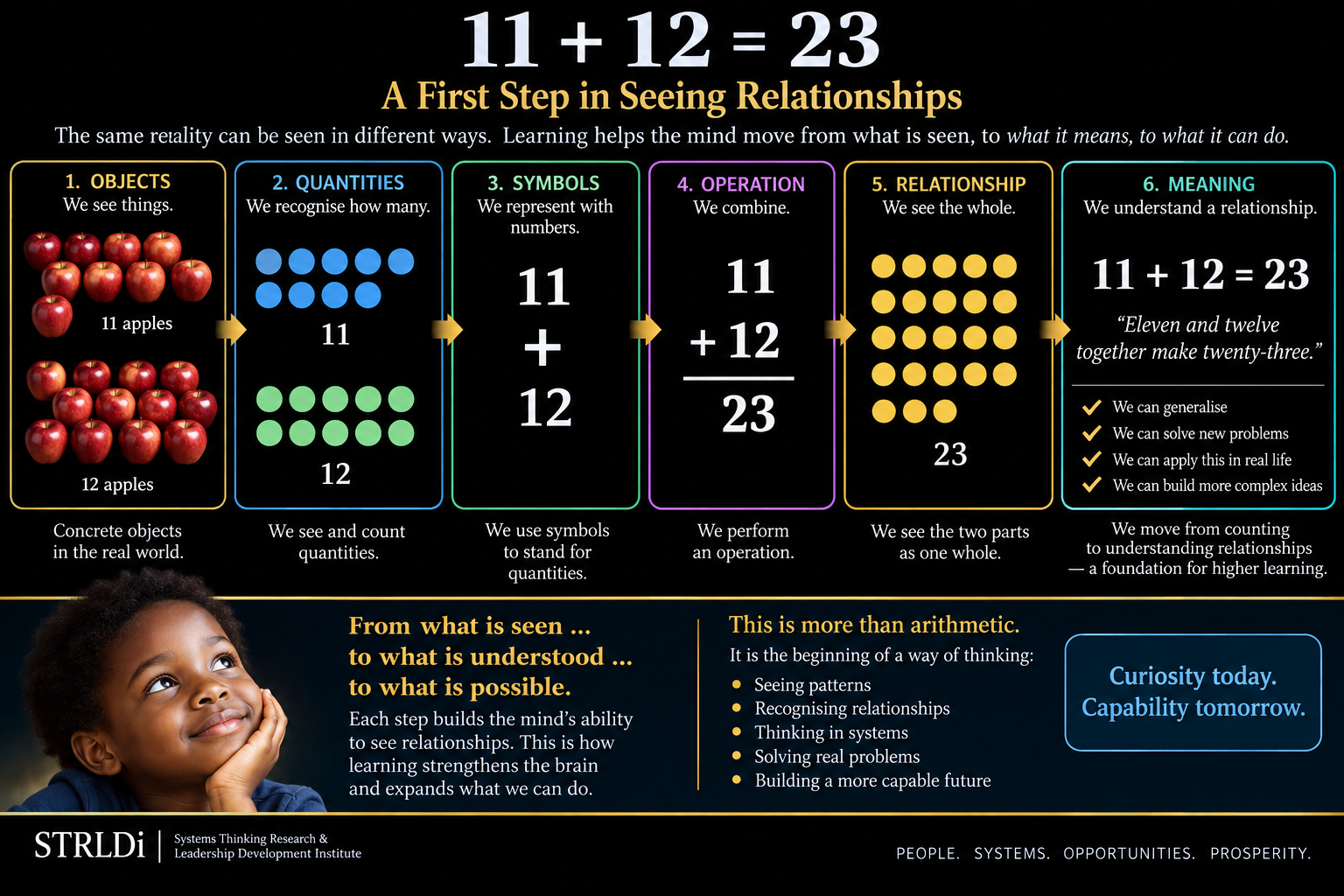
This is an important distinction because learning is not exhausted by receiving information. The learner has to establish relationships among representations and be able to retrieve and use those relationships when the situation changes. The difference becomes particularly important when we move from learning an answer to learning how one thing produces another.
The question that follows is therefore more interesting than whether the child remembers that 11 + 12 equals 23. What happened in the learner that made the relationship available for the next time? And what happens when the relationship being learned is no longer as simple as two groups of apples, but a relationship among people, institutions, resources, incentives, behaviour and time?
That is where the biology of learning begins to matter for strategy.
The brain as a changing architecture
The brain is not a static container into which information is deposited. Learning involves changes in the function and organisation of neural circuits: existing connections can become stronger or weaker, new synaptic connections can form and stabilise, dendritic spines can change, and networks can be reorganised through experience. The important point for our purposes is that experience changes the machinery through which subsequent experience is interpreted.
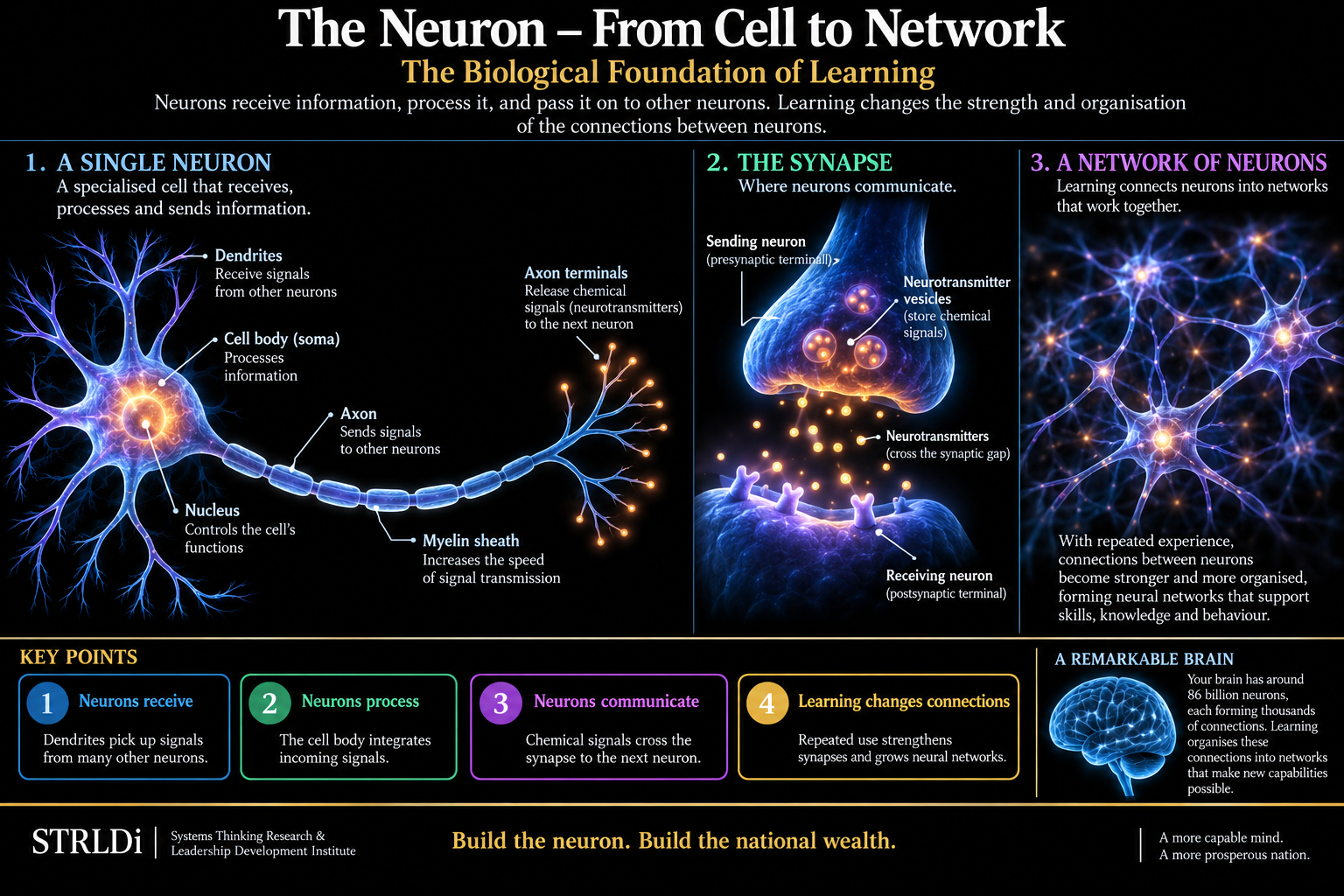
At a synapse, coordinated activity can engage mechanisms of synaptic plasticity. At many excitatory synapses, activity involving NMDA receptors permits calcium to enter the postsynaptic neuron, initiating intracellular processes that can increase the effectiveness and number of AMPA receptors. This is one mechanism associated with long-term potentiation, through which a connection becomes more readily activated in the future.
The process can extend beyond changes in synaptic strength. Dendritic spines—the small protrusions on dendrites where many excitatory synapses occur—can change in size, shape and stability. Research using longitudinal imaging has shown that motor learning is accompanied by structural changes in dendritic spines, including the formation and stabilisation of new spines and the organisation of newly formed connections into functional clusters.
This matters because the language of “making connections” is therefore more than a convenient metaphor. Learning can alter the physical and functional organisation of the networks through which relationships are represented. We should be precise about the claim: we cannot look into a living human brain and watch an individual synapse appear every time someone understands an idea. Much of the detailed microscopic evidence comes from animal models, while human research gives us complementary evidence about learning and brain plasticity. But the broader biological principle is well established: experience-dependent plasticity changes the learner.
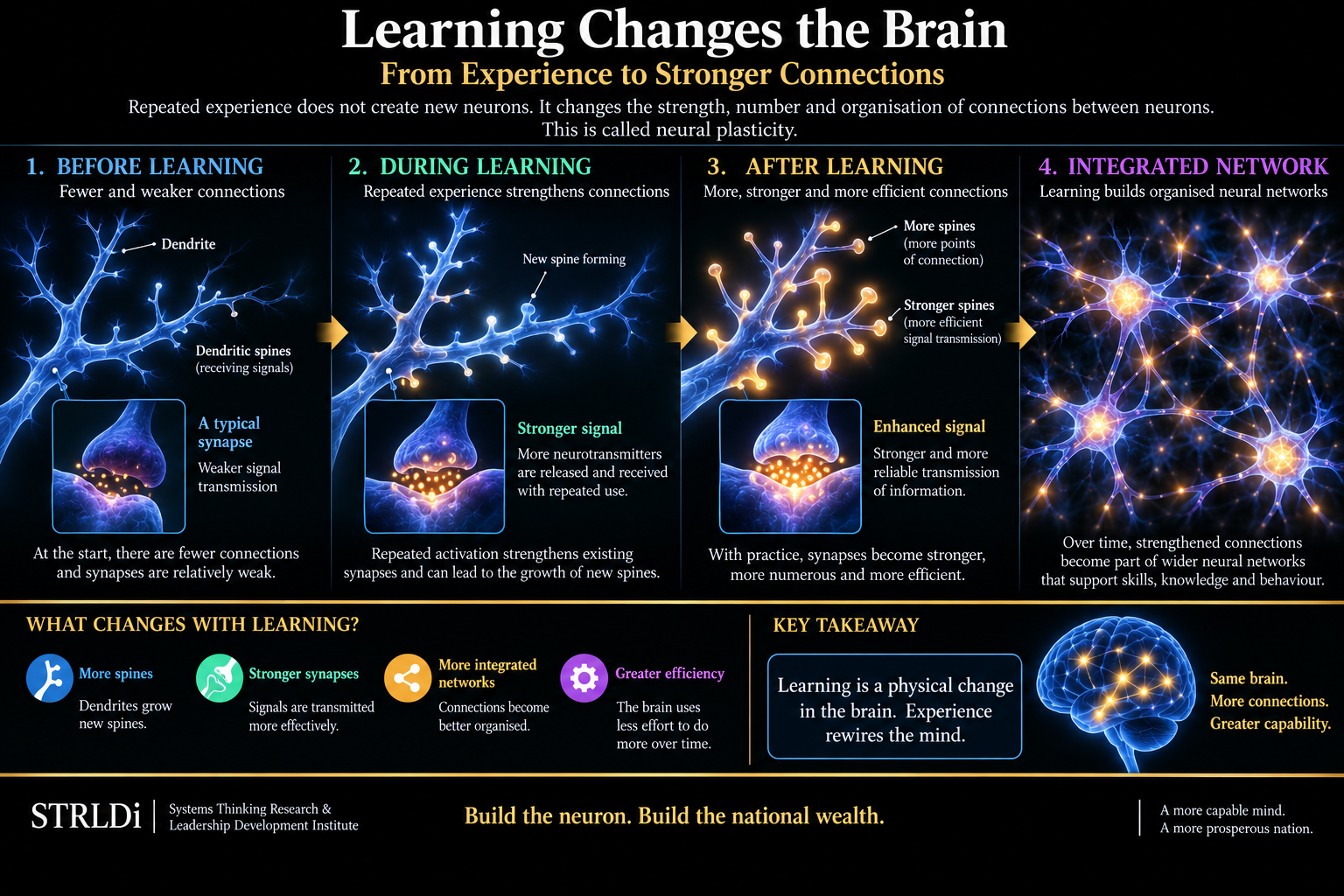
The implications become more interesting when the experience being repeated is not simply exposure to information, but active discovery of relationships.
What exactly is being learned?
Return to the apples. The child does not need to retain an isolated fact called “23.” The useful learning lies in the relationship that makes 23 the result of combining 11 and 12. Once that relationship is understood, it can be used to solve another problem: 14 + 9, 27 − 8, or a problem that has never previously been encountered.
The learner has therefore acquired something that can travel. The representation can be retrieved, applied, tested and extended. A relationship discovered in one situation becomes available as a structure for understanding another. Learning has moved from possession of information toward capability.
Now imagine replacing the apples with something far more consequential.
A country experiences rising unemployment. At the same time, imports increase, domestic production remains weak, businesses struggle to expand, young people leave certain sectors, foreign exchange comes under pressure and household purchasing power changes. Each observation can be reported separately. Each can generate a policy response. Yet the relationships among them may remain invisible.
The national strategist therefore faces a problem that is structurally similar to the child’s problem, although vastly more complex: how do we move from seeing separate things to seeing the relationships among them?
That is the question this article follows.
B. THE JOY OF SEEING
There is another feature of learning that deserves our attention before we go further. The joy of discovery does not have to be manufactured from outside the learner. Curiosity arises because something is unresolved; exploration follows; a relationship becomes visible; and the joy arrives with the discovery itself. The learner does not first calculate that understanding will produce a reward and then decide to pursue it. The experience of seeing what was previously unseen carries its own satisfaction.
The child who discovers that 11 + 12 = 23 experiences something different from receiving a sweet for getting the answer right. The sweet is an externally supplied reward; the discovery changes what the child can do. The child can now recognise the relationship again, use it somewhere else, and begin asking another question. The mind can generate its own reward when it discovers that it has become more capable of seeing.
This gives us a much more interesting learning loop:
Curiosity → Exploration → Discovery → Joy → Curiosity
The joy is not a prize placed at the end of the process. It is part of the experience of the relationship becoming visible. Because the learner has changed, the next question can be approached from a new position of capability, and that new capability opens another field of curiosity.
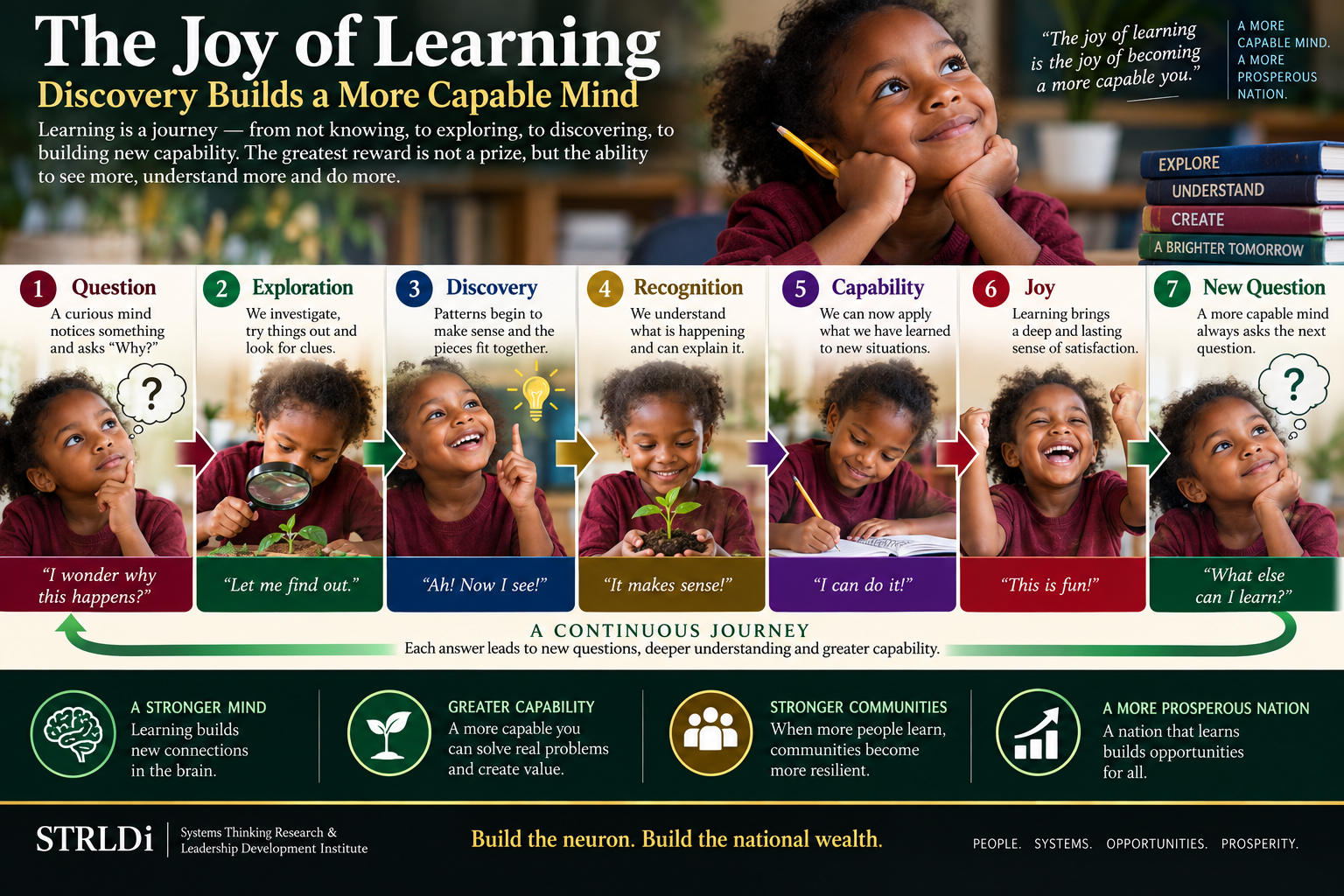
This matters enormously when the relationship being discovered is causal. A person working through a causal diagram may begin with several apparently unrelated events. They identify variables, trace relationships, follow consequences through time, discover that an effect feeds back into an earlier condition, and suddenly the behaviour of the whole system begins to make sense. The moment of recognition is itself an experience of increased capability.
This may be one reason why the joy of genuine learning can be so powerful. It does not depend on consuming something that has been placed outside the learner; it arises from the learner’s own transformation. A farmer who discovers why a crop is failing, an engineer who discovers why a machine is repeatedly breaking down, a scientist who sees a relationship in the evidence, a manufacturer who identifies the constraint in a production process, and a systems practitioner who suddenly sees the loop producing a persistent national problem are all experiencing different versions of the same phenomenon: the world has become more intelligible because the mind has become more capable of seeing it.
The significance for education and national capability is therefore profound. If the experience of becoming more capable can itself generate curiosity and joy, then the question is not simply how to motivate people to learn. It is also whether our learning environments give people enough opportunity to experience the satisfaction of discovering something that they can subsequently use.
When the reward comes from somewhere else
This provides a useful contrast with substance use, which we will examine more fully in the appendix. Psychoactive substances can alter neurotransmission and systems involved in reward, attention, memory, perception, inhibition and decision-making, while repeated exposure can produce adaptation and strengthen the significance of substance-related cues.
The systems question is therefore worth asking in both cases: what has repeated experience been teaching the brain to attend to, pursue, remember and reward? In learning, curiosity can lead to discovery and the discovery itself can generate joy; in substance use, the desired external stimulus can become increasingly embedded in patterns of reward, expectation and behaviour.
Experience shapes the learner. That proposition will become increasingly important as we move from individual learning to the learning of causal structures.
C. WHEN SEEING CHANGES
Consider a stereogram.
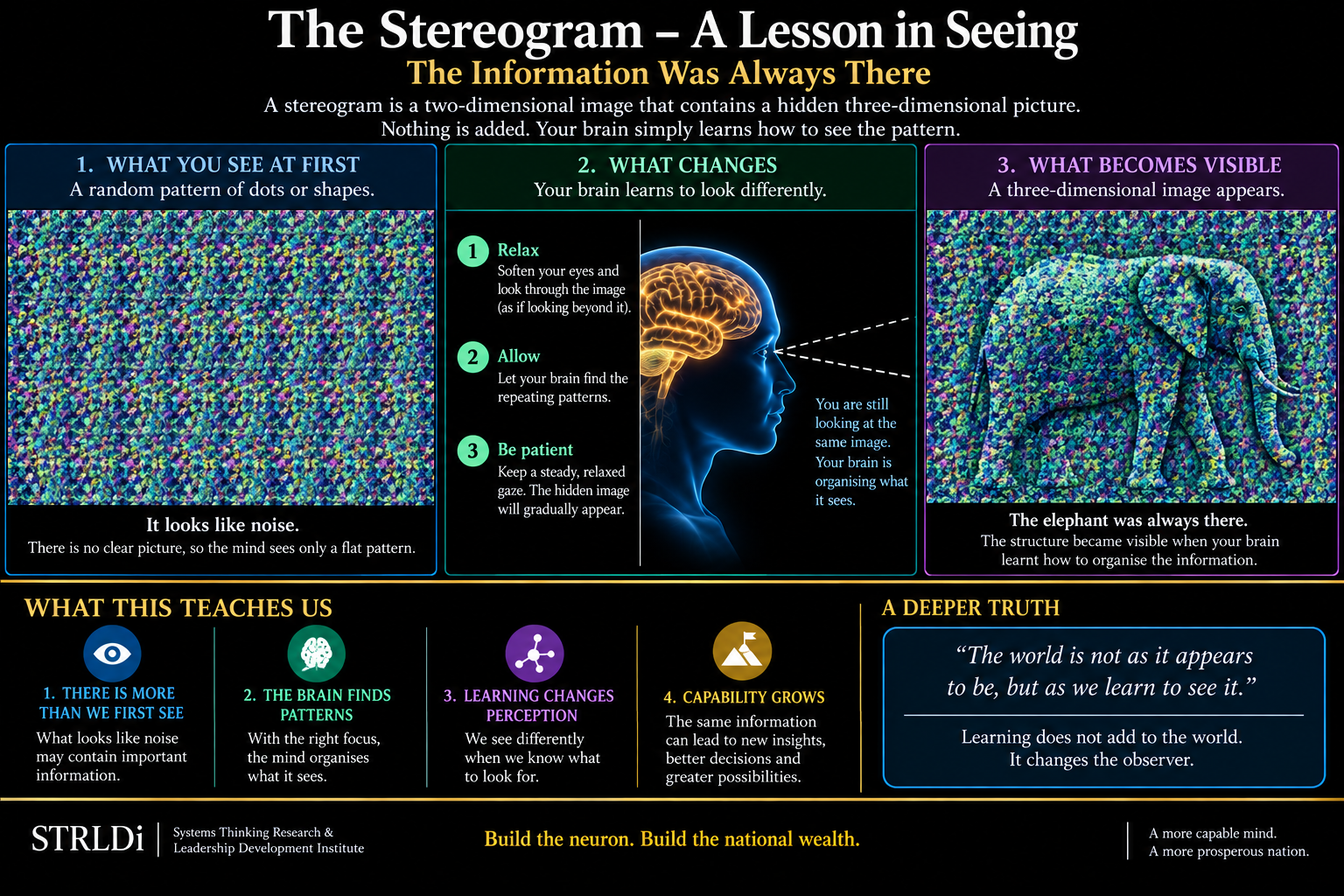
The page appears to contain a field of dots. Nothing announces the hidden image. The dots themselves do not rearrange when the three-dimensional form suddenly appears. Yet after the perceptual shift, many people can look at the same image again and find the structure much more readily.
What changed?
The image did not.
The observer’s capacity to organise the information changed.
The significance of this experience is not that a stereogram teaches systems thinking by itself. It gives us a concrete experience of a phenomenon that matters greatly in systems work: something can be present in the information before us while remaining unavailable to our current way of seeing. The challenge is not always a lack of data. Sometimes the challenge is that we have not yet acquired the representation through which the relationships in the data become perceptible.
This is why the discipline of staying with the information matters. When the dots initially appear meaningless, the temptation is to force an interpretation, search for a familiar answer or abandon the exercise. The more productive question is different: What did I do differently when I could not see the structure and then suddenly could?
That question takes us directly into causal discovery.
D. LEARNING TO SEE CAUSALITY
The stereogram gives us an experience that is central to systems thinking. The information is already present, yet the structure is initially invisible; then, through a change in the way we attend to and organise the information, the relationship appears. The dots have not moved. What has changed is the capacity of the observer to see what the dots collectively contain.
This is where learning causal relationships begins. We encounter an event, but the event is only what is visible at a particular moment; we begin to ask whether it belongs to a pattern, what variables are moving, what affects what, and what follows from the relationship we have identified. The mind moves progressively from Event → Pattern → Variable → Relationship → Causality.
Once a causal relationship has been identified, the learner follows it. What does this change produce? What does that consequence change? What happens after that? The learner follows the river of causes, allowing the consequences to lead to the next relationship rather than stopping at the first explanation that seems plausible.
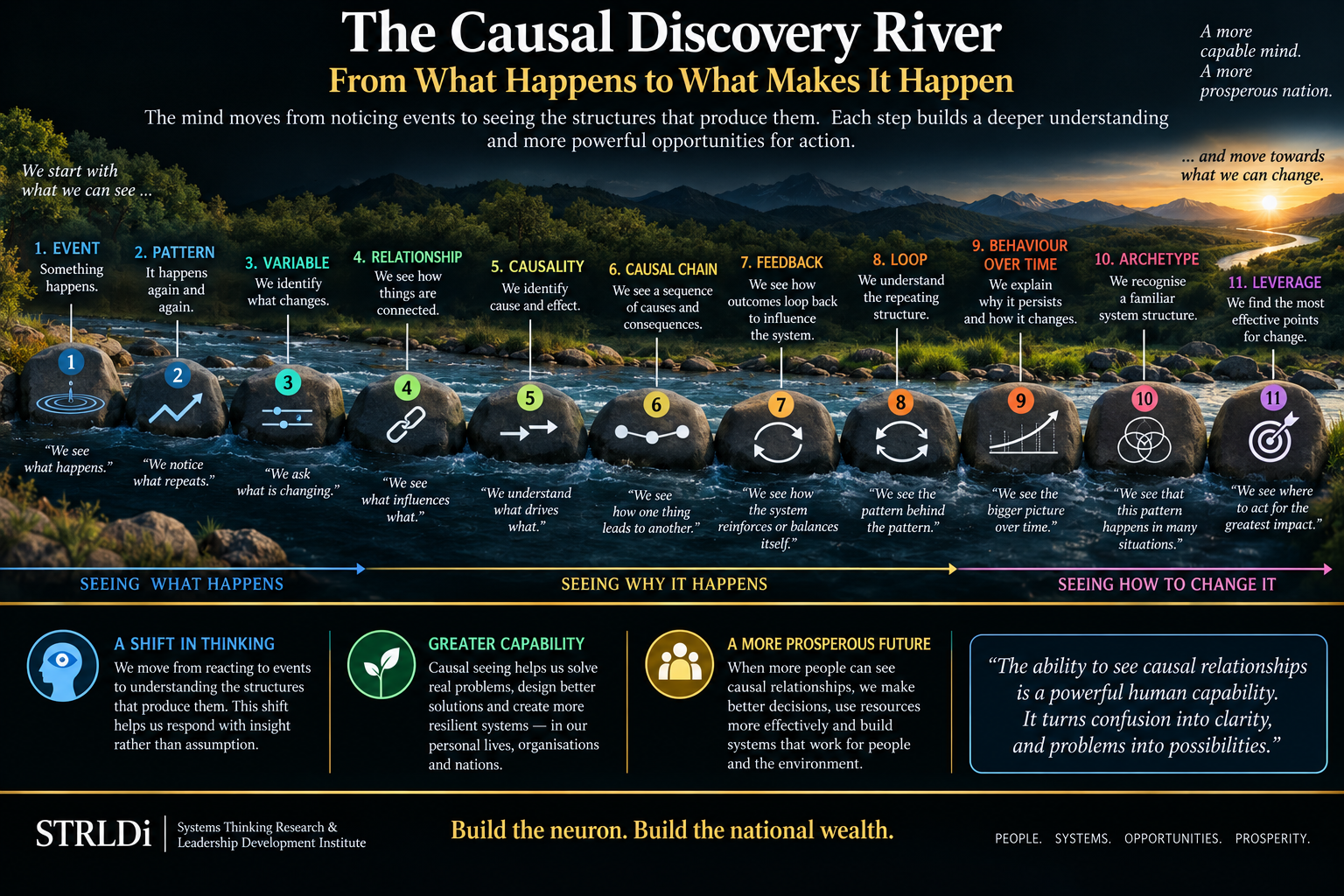
The chain may cross levels of the system. An individual action can affect a household; household behaviour can affect an organisation; organisational behaviour can affect an institution; institutional behaviour can affect a sector; sector behaviour can affect the national economy. At each stage, the learner asks the same question: what does this change produce, and what does that consequence change?
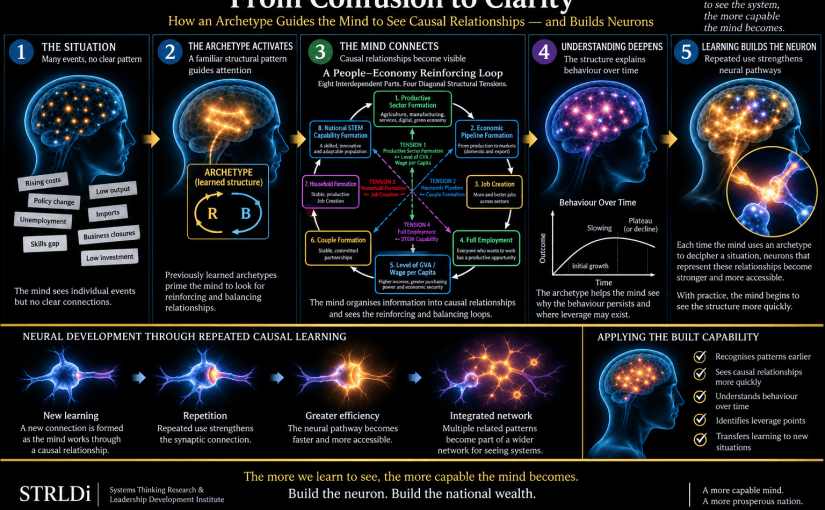
Eventually, the causal chain can return to the condition with which it began. An effect becomes part of the conditions that influence its own cause, and feedback becomes visible. We can then begin to distinguish between reinforcing structures, in which change feeds further change, and balancing structures, in which forces work to counteract change.
The progression has now become:
Event → Pattern → Variable → Relationship → Causality → Causal Chain → Feedback → Loop → Behaviour Over Time
The final test is whether the structure we have identified can explain the behaviour we actually observe. Measurement over time allows the learner to compare the behaviour of the system with the behaviour implied by the model. The diagram is therefore not an ornament or a story about the system; it is a proposition about how the system works, available to be tested against reality.
From the diagram to recognition
Only then does the systems archetype become important. An archetype is not something the learner needs to memorise before beginning the investigation; it is something that can be recognised after the relationships have been followed sufficiently far for the underlying structure to become visible. A learner who has worked through several apparently different situations may eventually encounter a new one and recognise that the same structural pattern is operating beneath a different surface story.
That moment matters. The learner has acquired a structure that can travel.
The farmer may encounter it in production, the business leader in growth, the public servant in administration, and the national strategist in economic policy. The events differ, the language changes, and the actors are different, yet the learner begins to recognise the relationship pattern.
The progression therefore continues:
Event → Pattern → Variable → Relationship → Causality → Causal Chain → Feedback → Loop → Behaviour Over Time → Archetype
And then comes the question that matters most to strategy:
Where can the structure be changed?
The most visible symptom is not necessarily the point at which the system is most responsive. Once the learner can see the structure, attention can move towards leverage: the point at which changing one part of the system can alter the behaviour of the whole. When we do see it, the mind learns to move the forest, not just the tree.
E. FROM TEACHABILITY TO NATIONAL PRODUCTIVE CAPABILITY
When Learning Changes the Learner
What happens when a person repeatedly travels the pathway from observation to relationship, causality and verification? They observe, question, identify variables, construct relationships, follow consequences, test explanations, recognise structures and apply what they have learned to another situation. Learning is therefore doing more than adding information to memory; experience participates in changing the organisation of the neural systems through which subsequent experience is interpreted.
Neuroscience gives us several ways of understanding this. Synaptic connections can change in strength; dendritic spines can change in size, shape and stability; new synaptic connections can form and stabilise; and axonal structures can be remodelled through learning. Research using longitudinal imaging has directly observed structural changes associated with learning, including the formation and stabilisation of new dendritic spines and changes in axonal boutons during motor learning.
The point is that repeated experience changes the learner. When a person repeatedly constructs and retrieves relationships, tests them against experience and applies them in new contexts, the brain is repeatedly engaged in representing those relationships. Over time, those representations can become increasingly accessible, allowing the learner to recognise structures that previously remained invisible.
This is what makes the transition from drawing a causal loop to seeing a causal loop so important. At first, the learner needs the diagram to make the relationships visible; with practice, the learner can begin to perceive the relationships before the diagram has been completed. The diagram has become part of the learner’s way of seeing.
That capacity begins earlier than the systems diagram. It begins with something very simple: the willingness to keep looking when the answer has not yet been found.
Teachability Keeps the Question Open
A child begins with a question because something in the world does not yet make sense. Curiosity keeps the question open; teachability allows the learner to remain open long enough for experience, evidence and discovery to change what the learner understands. The movement is therefore not simply from question to answer, but through Curiosity → Exploration → Discovery → Capability → Joy → New Curiosity.
Teachability is important because the learner must be able to let an existing representation change. A question can lead to an answer that confirms what was already believed, or it can lead to a discovery that reorganises what the learner thought was possible. The capacity to learn is therefore also the capacity to have one’s representation of reality changed by what reality reveals.
This is where the joy of discovery becomes part of the learning system. Something unresolved creates curiosity; exploration exposes relationships; discovery produces recognition; recognition produces capability; and capability opens another question. The learner can therefore become increasingly willing to explore because the reward is contained in becoming more capable of seeing.
The same thing happens when a systems archetype becomes visible. A person may have looked at unemployment, poverty, imports, weak production or household distress as separate conditions, and then suddenly see the relationships connecting them; the behaviour over time begins to make sense because the learner has discovered the structure beneath the events. A new way of seeing has become available.
STEM: Building and Expanding the Architecture for Seeing Relationships
We can now ask what kinds of learning repeatedly place the developing mind on this pathway from observation to relationship, causality and verification.
Consider mathematics. It begins with objects that can be counted and quantities that can be compared. Quantities become numbers; numbers become symbols; symbols are manipulated through operations; operations reveal relationships; relationships become equations; equations become models; models generate predictions; and predictions can be tested against reality.
Objects → Quantities → Counting → Symbols → Operations → Relationships → Equations → Models → Prediction → Verification
The movement can begin with 11 apples and 12 apples and eventually reach money, time, distance, rates, fractions, decimals, algebra, trigonometry, physics and chemistry. At each stage, the learner is repeatedly moving between representations and reality, establishing relationships, carrying those relationships into another context, making predictions and discovering whether the predictions hold.
This repeated movement builds and expands the neural architecture. Existing pathways can become stronger and more accessible while new representations and relationships become connected to the architecture already built. The learner is progressively building an expanding architecture for seeing relationships.
The significance is cumulative. The child does not learn counting and then leave that architecture behind; counting becomes available for arithmetic, arithmetic for algebra, algebra for modelling, modelling for prediction, and prediction for verification. The architecture becomes increasingly capable of representing relationships that cannot be seen directly.
That is the movement from seeing the tree to seeing the forest. The learner no longer depends entirely on the immediate physical object because an internal representation of the relationship has become available for use. STEM therefore provides a sustained developmental pathway through which the learner repeatedly practises moving from what is observed to what is related, from relationship to causality, and from causality to something that can be tested.
NON-STEM: What Is the Learner Being Trained to Do?
The distinction becomes important here because education can organise learning around different forms of cognitive practice. Where the learner is predominantly trained through received accounts, interpretation, memory, reproduction and authority, the learner can become highly capable at handling and reproducing representations while receiving less sustained practice in establishing relationships against observable reality through measurement, modelling, prediction and verification.
The learner encounters events, people, societies, ideas and interpretations through accounts that have already been constructed by others. History provides an interpretation of an event; literature provides interpretations of meaning; law provides interpretations of rules and cases; economics and social sciences provide explanations of behaviour and outcomes. The learner can become highly knowledgeable within these fields while the causal relationships underlying the account remain mediated through interpretation.
The learner therefore becomes accustomed to a different relationship with knowledge: receive the account, understand the interpretation, remember it and reproduce it. Where the underlying relationships have not been established and verified by the learner, the explanation can move from evidence into interpretation and from interpretation into speculation.
This distinction is about what the learner repeatedly practises the brain to do. The brain develops through what it repeatedly does, and therefore the question is not simply how much information a population has accumulated, but what kinds of relationships its people have spent years learning to see, test, reproduce and improve.
Productive Capability and Speculative Capability
The difference becomes visible in the pathway each form of learning tends to support.
A productive orientation asks: What do we have? What can we make from it? What relationship produces the result? Can we reproduce it? Can we improve it? What happens if we change this variable? Its movement is:
Observe → Measure → Connect → Model → Test → Produce → Improve
The productive learner continually returns to reality to discover whether the relationship holds. The farmer observes soil, water, seed and yield; the engineer works with force, material and design; the manufacturer works with inputs, processes, variation and output; the technician works through relationships among components to identify what is producing the observed behaviour.
A speculative orientation moves differently. It can ask: Who says it? Who believes it? What is trending? What might happen? What can I gain if I get in early? What does the market think? The emphasis moves toward social confirmation, authority, expectation, attention and anticipated gain while the underlying causal structure can remain unexamined.
Its reinforcing sequence becomes:
Social Reinforcement → Trending → Speculation → Authority → Consensus → Anticipated Gain → Repetition
One pathway continually asks how the result is produced. The other can proceed through what people believe will produce the result.
A productive society is therefore one that learns to discover and reproduce the relationships that produce results. A speculative society can pursue results without understanding the relationships that produce them. That distinction reaches beyond education because the cognitive orientation eventually enters the workplace, the enterprise, the institution and the economy.
The Employment Each Economy Naturally Creates
The type of economy a society builds creates its own employment structure. A productive economy requires people who can create, operate, maintain, measure, diagnose, improve and scale productive systems. Its employment therefore extends through agriculture, engineering, manufacturing, construction, energy, water, infrastructure, technology, ICT, logistics, maintenance, technical operations, science, production management and the productive services that connect these systems to markets.
The engineer works with forces, materials and structures. The agricultural scientist works with soil, water, nutrients, plant physiology and yield. The manufacturer works with inputs, process, quality, throughput, cost and demand. The technician works through relationships among components to diagnose behaviour and restore or improve system performance. The scale changes; the cognitive act remains: discover the relationships that produce the behaviour.
A speculative economy generates a different centre of gravity. Its employment naturally expands around administration, representation, communication, allocation, brokerage, sales, advocacy, negotiation, compliance, promotion, coordination and the circulation of information and claims. These occupations can be necessary within a productive economy as well, but where the productive base is thin, more human effort is concentrated around distributing, administering, representing and managing what already exists rather than continuously expanding the systems that produce new value.
The distinction is therefore between the economy that produces the things people need and the economy that principally moves, allocates, represents or interprets what has already been produced. The balance between these forms of activity determines the depth of productive capability available to the population.
From the Brain to the Economy
The causal chain now becomes visible:
Childhood Learning → Neural Development → Cognitive Capability → Technical Capability → Productive Capability → Productive Systems → Employment → Income → Household Capacity → National Productive Capacity
The individual brain is connected to the economy through a long river of causes. A child learning to see relationships becomes an adult capable of working with increasingly complex relationships; those capabilities become embedded in enterprises and institutions; enterprises and institutions become part of production systems; production systems create employment and income; and the resulting economy becomes the environment in which the next generation is formed.
This is the Self → Nation → Self relationship. What the individual learns becomes part of what the institution can do; what institutions can do becomes part of what the economy produces; what the economy produces shapes the opportunities available to the next generation. Human formation therefore becomes economic formation, and economic formation becomes the environment for the next generation of human formation.
The Scale of the Challenge
Southern Africa is home to approximately 400 million people. The scale of formal employment within that population is considerably smaller.
| Southern Africa | People |
|---|---|
| Total population | ~400 million |
| Labour force | ~147 million |
| Employed | ~133 million |
| Informal employment | ~85 million |
| Formal employment | ~24–48 million, depending on definition/year |
For this argument, we use 50 million formal jobs as the working figure.
If 5% productive capability supports 50 million formally employed people, and the objective is to reach 300 million formally employed people, the mathematics is straightforward:
300 million ÷ 50 million = 6
The productive capability therefore needs to grow sixfold.
5% × 6 = 30%
| Today | Required | |
|---|---|---|
| Population | 400 million | 400 million |
| Formal employment | 50 million | 300 million |
| Productive capability | 5% | 30% |
| People representing that capability | 20 million | 120 million |
Therefore:
400 million × 30% = 120 million people.
The scale is now visible. The productive capability represented by 5% of the population has to become 30% if the same relationship between productive capability and formal employment is used to explore a sixfold increase from 50 million to 300 million formal jobs.
What Percentage of the Population Needs STEM-Based Capability?
There is an important distinction between STEM occupations and the much larger population whose work depends upon STEM-based productive capability. The relevant question is therefore not simply how many people carry a STEM occupational title, but how many people have developed the capability to participate in creating, operating, maintaining and improving the productive systems on which the region depends.
For the Southern African question, 30% is the planning number emerging from the sixfold calculation in this argument: approximately 120 million people out of 400 million participating in the STEM-based and STEM-enabled productive capability required to build and operate the productive systems of the region.
That number gives the educational question a very different scale. We are no longer looking at the formation of a small technical minority; we are looking at the development of a substantial proportion of the population whose formative years have prepared them to work with relationships, systems, measurement, modelling, prediction, verification and improvement.
The question therefore becomes:
How many people must spend their formative years building and expanding the cognitive architecture required to understand, create, operate, maintain and improve the productive systems through which 400 million people can live and work?
The answer begins with the child.
Build the neuron. Build the capability. Build the productive system. Build the employment. Build the national wealth.
F. FROM SEEING STRUCTURES TO NATIONAL CAPABILITY
A national economy can be presented as a collection of indicators: unemployment, inflation, exchange rates, investment, imports, exports, productivity, wages, skills and production. Each number can be reported and debated while the relationships producing the pattern remain invisible. Causal learning changes the question: what does rising import dependence do to domestic production; what does weak production do to foreign-exchange demand; what does foreign-exchange pressure do to input costs; what happens to businesses when working capital is eroded; and what happens to production capacity as businesses contract?
The question then becomes where does the consequence return? Making the arrow visible allows the relationship to be investigated, measured, revised and tested. A causal diagram turns an implicit theory of the system into something that can be examined against reality, moving the learner from event → pattern → relationship → causality → feedback → archetype → leverage.
Once the structure is visible, strategy can move upstream from symptom to cause and from cause to leverage. The most visible part of a problem is not necessarily where the system is most responsive, and the learner who can see the structure can begin to change the forest rather than continually treating the tree. Seeing the structure changes what becomes possible to change.
The individual learner and the nation then become part of the same system:
Self → Nation → Self
The individual learns within institutions created by society; the capabilities developed by individuals accumulate within organisations and institutions; and those institutions shape the productive, social and learning environment in which the next generation develops. What the individual learns becomes part of what the institution can do, and what the institution can do becomes part of the environment in which another individual learns.
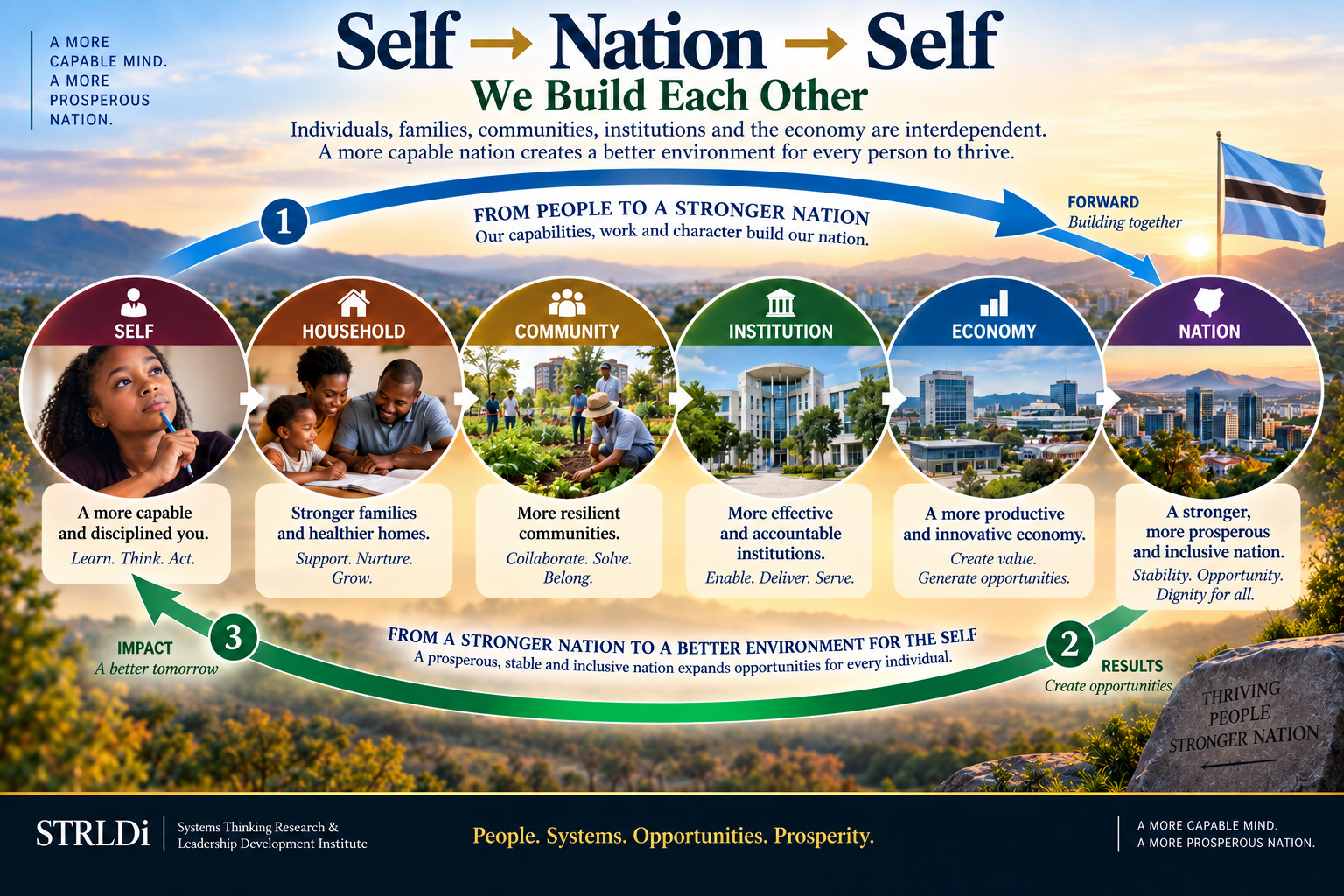
This is why national capability begins before the strategy document. It begins with what people have learned to see, how they have learned to establish relationships, how they have learned to test what they believe to be true, and whether they can turn that understanding into productive action. A country can have enormous quantities of information, qualified people, strategies and policies while the structures producing persistent outcomes remain invisible.
The opportunity is therefore to develop a population capable of moving from event to pattern, pattern to relationship, relationship to causality, causality to feedback, feedback to archetype and archetype to leverage. That is the capability through which a population can begin to understand the systems it has inherited and develop the capacity to change the relationships through which those systems reproduce themselves.
G. WHEN A NATION LEARNS TO SEE
The argument began with a child learning that 11 + 12 = 23. The child learned more than an answer; the child learned a relationship that could travel, be retrieved, applied and extended. At national scale, the same developmental principle becomes a question of whether enough people have built and expanded the cognitive architecture required to see relationships among production, employment, income, institutions, technology, resources, behaviour and time.
This is where the individual brain and the productive economy meet. Childhood learning → neural development → cognitive capability → technical capability → productive capability → productive systems → employment → income → household capacity → national productive capacity. The population therefore carries within its people the capabilities from which its productive systems can be built, operated, maintained and improved.
The scale we have reached in this argument is therefore significant. 400 million people; 50 million formal jobs; 5% productive capability; 300 million formal jobs as the working employment objective; 30% productive capability; 120 million people. The calculation gives us a way to see the scale of human capability that would have to be built and expanded for the productive economy to operate at that level.
BUILD THE NEURON. BUILD THE NATIONAL WEALTH.
Education therefore becomes inseparable from national productive capability because what is repeatedly exercised in the developing brain eventually becomes part of what people are capable of doing in the economy. The question is what proportion of the population will spend its formative years learning to observe, measure, connect, model, test, produce and improve, and therefore become capable of participating in the productive systems required by the population.
This brings the biological argument and the economic argument into the same frame. The child who learns to see relationships is developing a capability; the adult who carries that capability into agriculture, manufacturing, engineering, technology, construction, energy, infrastructure, health, logistics or other productive work becomes part of a productive system; and that productive system creates the goods, services, enterprises and employment through which people live.
The relationship is therefore:
Neural architecture → Human capability → Productive capability → Productive systems → Formal employment → Income → National wealth.
The article has travelled from the child to the neuron, from the neuron to capability, from capability to productive systems, from productive systems to employment, and from employment to the scale of the population that has to be supported. The relationship is now visible: human formation is part of productive formation, and productive formation determines the capacity of an economy to create the work through which its people live.
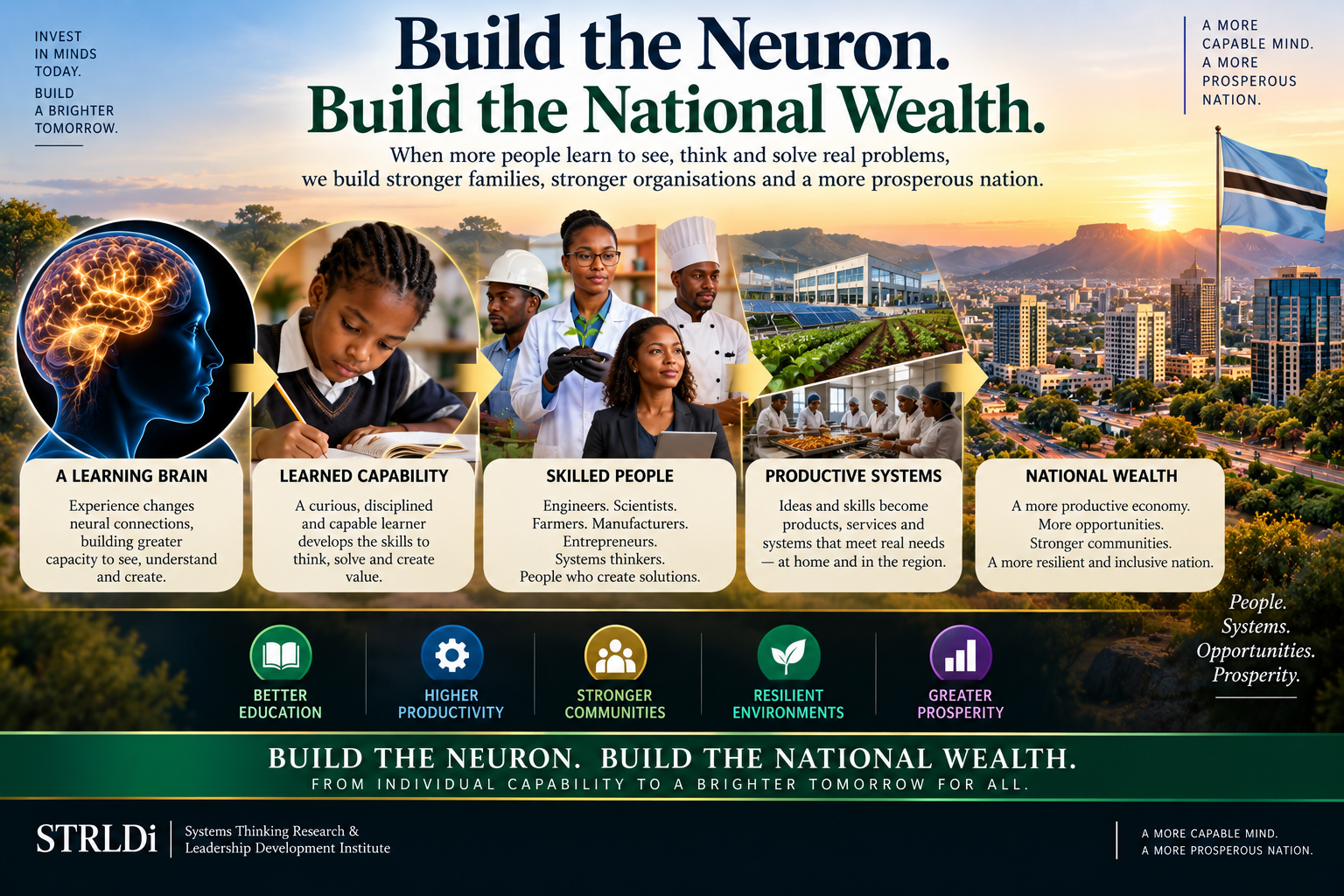
When the relationships become visible, the question changes. It is no longer simply what a nation knows, how many people it has educated, or how many qualifications it has issued; it becomes what its people have learned to see, what they have learned to build from what they see, and whether the resulting capability is large enough for the population they must support.
And that brings the argument back to the child with the question.
What are we teaching the brains that will have to think for the nation?
APPENDIX
A. NEUROBIOLOGY OF LEARNING AND STRUCTURAL CHANGE
The central argument of this article begins with a simple proposition: experience changes the learner. Neuroscience gives us several mechanisms through which this can occur, including changes in synaptic strength, dendritic spine structure, formation and stabilisation of synaptic connections, axonal organisation and network-level reorganisation. These processes are collectively part of the broader phenomenon of neural plasticity.
A neuron receives and integrates information through its dendrites and cell body and communicates with other cells through its axon. Communication between neurons commonly occurs at synapses, where chemical or electrical signals are transmitted from one cell to another. Dendritic spines are small structures on dendrites that frequently contain excitatory synapses and can change structurally in response to activity.
Key terms
Synapse — a specialised junction through which one neuron communicates with another neuron or another target cell.
Synaptogenesis — the formation of synaptic connections.
Synaptic plasticity — activity-dependent changes in the strength or efficacy of synaptic connections.
Long-term potentiation (LTP) — a form of persistent strengthening of synaptic transmission following particular patterns of activity. Research has shown that LTP can be accompanied by structural enlargement of individual dendritic spines and changes in AMPA-receptor-mediated currents.
Dendritic spine — a small protrusion from a dendrite where many excitatory synapses are formed. Spines can change in size, shape and stability as part of activity-dependent plasticity.
Experience-dependent plasticity — changes in neural structure or function associated with experience and learning.
The scientific literature does not support the simplistic proposition that every new fact produces one new synapse. Learning involves existing networks becoming stronger or weaker, connections being reorganised, and in some circumstances new synaptic structures being formed and stabilised. The more useful statement for this article is therefore: learning changes the organisation and function of neural networks through experience-dependent plasticity.
Learning and new synaptic connections
Research has provided unusually direct visual evidence of structural change during learning. Hedrick and colleagues used longitudinal in-vivo two-photon imaging together with correlated electron microscopy to examine dendritic spines in the motor cortex of mice during motor learning. They found that learning induced new excitatory synapses in the form of dendritic spines and that new spines were incorporated into functional clusters associated with learned movement.
This is particularly relevant to the argument developed in the article because the research concerns the binding of new information into existing functional organisation. The finding does not demonstrate that learning a systems archetype in a human produces a particular microscopic synaptic pattern. It does, however, provide biological evidence for a broader principle: learning can involve the formation, selection, stabilisation and functional organisation of new connections.
More recent research has extended the observation beyond postsynaptic dendritic spines. A 2025 Nature study using longitudinal two-photon imaging found that motor learning dynamically remodelled corticostriatal axonal boutons in awake mice. Newly formed boutons were more likely to be associated with rewarded movements and to be stabilised during learning, while some boutons associated with unrewarded movements were eliminated.
The significance is not that causal diagramming should be equated with motor learning. The significance is that learning is biologically active. Behavioural experience can participate in the reorganisation of the structures through which information is selected, represented and transmitted.
APPENDIX B. THE SYSTEMS THINKING / ARCHETYPE METHOD
The purpose of causal diagramming is to make relationships explicit enough to examine.
The practitioner begins with an observed event or condition and asks whether it forms part of a pattern over time. Variables are then identified, relationships between variables are examined, and causal chains are followed until feedback becomes visible. Once the loop is understood and its behaviour over time examined, a recurring structural pattern may be recognised as a systems archetype.
The progression used in STRLDi is:
Event → Pattern → Variable → Relationship → Causality → Causal Chain → Feedback → Loop → Behaviour Over Time → Archetype → Leverage
The important learning transition occurs when the practitioner encounters a new situation and recognises a structure previously learned elsewhere. The surface story changes, but the underlying relationship pattern becomes familiar.
This is consistent with the broader systems-thinking literature on archetypes. Systems archetypes are intended to help practitioners recognise recurring structural patterns beneath apparently different events; as the patterns become internalised, situations can be understood as larger systemic structures rather than isolated occurrences.
The language of causal links
In causal loop diagramming, S or same-direction relationships indicate that a change in one variable produces a change in the same direction in another, while O or opposite-direction relationships indicate a change in the opposite direction. Feedback structures are then identified as reinforcing (R) or balancing (B) loops. The Systems Thinker provides a useful reference on this language and the associated archetype structures.
The discipline is deliberately empirical. A causal link is a proposition to be examined, not a fact simply because an arrow has been drawn. The diagram makes the practitioner’s theory visible so that evidence, measurement and further observation can challenge or strengthen it.
APPENDIX C. SUBSTANCE USE: WHEN THE BRAIN LEARNS THAT THE REWARD MUST COME FROM OUTSIDE
Substance use provides a powerful counterpoint to the joy of learning because it shows that the brain learns from whatever experience is repeatedly reinforced. Psychoactive substances can directly alter systems involved in reward, motivation, attention, memory, perception, inhibition and decision-making; with repeated exposure, the brain adapts to the substance, while cues associated with its use can acquire the power to trigger anticipation, craving and drug-seeking. NIDA describes how repeated exposure can produce tolerance and withdrawal, and how, over time, drug use may shift from seeking pleasure to seeking relief from the distress that appears when the drug is absent. (NIDA IRP)
This creates a profound change in the relationship between reward and the learner. The joy of discovery arises when the mind discovers that it can now see, understand or do something it could not previously see, understand or do; the capability itself becomes rewarding. With a substance, the pleasurable state is produced externally by the pharmacological action of the substance, and repeated experience can teach the brain to want that externally produced state again. The desire therefore becomes increasingly attached to the return of the reward, rather than to the development of the capability that generated the reward.
This is where dependence becomes particularly important to the systems argument. As repeated exposure changes reward and stress systems, and as environmental cues become predictors of drug effects, the absence of the substance can itself become a signal of threat or distress. NIDA describes withdrawal-related anxiety, irritability and unease and notes that, with increasing drug use, a person may use the drug to obtain relief from this discomfort rather than simply to experience the original high. (NIDA IRP) In severe dependence, the learned relationship can therefore become something like: substance → relief/normality; absence → distress/threat → urgent desire for substance. That does not mean every dependent person literally believes they will die without the substance, but the brain can learn the substance as something it urgently needs, and for some substances withdrawal itself can be medically dangerous.
The contrast with learning is therefore sharper than simply natural reward versus drug reward. In discovery, the sequence can be:
Question → Exploration → Discovery → Capability → Joy → New Question
The reward is generated by becoming more capable, and that capability remains available to the learner. With repeated substance reinforcement, the sequence can become:
Substance → Pharmacological Reward → Relief/Pleasure → Anticipation → Desire → Repetition → Adaptation → Greater Need for the Substance
The systems question is therefore no longer merely What gives the brain pleasure? It is:
What is the brain learning that it needs in order to experience joy?
One pathway teaches the brain, I can discover something and become more capable. The other can teach the brain, I need something outside myself to produce the state I want to feel. That distinction matters because repeated experience does more than produce a momentary feeling: it teaches the brain what to pursue, what to anticipate, what to remember and what it comes to regard as necessary. (NIDA Archives)
APPENDIX D. ROAD ACCIDENTS: WHEN THE BRAIN CANNOT SEE THE CONSEQUENCE
A road accident appears first as an event: a vehicle collides with another vehicle, a pedestrian, an object or the road environment. Systems thinking takes us further by asking what was happening in the moments before the collision, what conditions shaped those moments, and what consequences continue long after the vehicle has stopped. Driving under the influence of a psychoactive substance brings the brain itself into the causal structure, because the substance can alter perception, attention, coordination, judgement and the capacity to process what is happening on the road.
The immediate relationship is therefore straightforward:
Substance → altered brain function → impaired perception/judgement/reaction → poorer driving decisions → increased crash risk → injury or death
WHO identifies driving under the influence of alcohol and other psychoactive substances as a significant road-traffic risk factor. The effects vary by substance, but psychoactive substances can impair functions required for safe driving; WHO also identifies speed, unsafe vehicles, unsafe infrastructure and inadequate post-crash care as other interacting risk factors. (World Health Organization)
The deeper question concerns what repeated substance exposure does to the learner. NIDA describes changes associated with addiction in brain systems involved in reward, stress, judgement, decision-making, learning, memory and behavioural control. With repeated exposure, reward circuitry adapts to the presence of the drug, while changes involving stress and prefrontal systems can contribute to compulsive use and reduced impulse control. (National Institute on Drug Abuse)
This matters because seeing a consequence requires more than having eyes on the road. The brain has to hold the present action together with what may happen next: speed with stopping distance, intoxication with impaired judgement, crossing the centre line with collision, collision with injury, injury with consequences for a family, and repeated risky behaviour with the possibility of eventually producing a pattern of harm. Learning depends on neural plasticity — connections are strengthened, weakened, formed and remodelled through experience. Substance exposure can alter these systems, which means that the capacity to connect action → consequence can itself become part of the problem.
The road therefore becomes a real-time test of consequence-processing. A driver under the influence may have the physical ability to see another vehicle while having impaired capacity to judge its speed, distance or significance; the driver may see the pedestrian while failing to integrate the information rapidly enough to produce the appropriate response. WHO reports that psychoactive substances increase crash risk, while cannabis, for example, can impair psychomotor performance, divided attention and the organisation and integration of complex information. (World Health Organization)
The longer-term system can be represented as:
Repeated Substance Exposure → Neural Adaptation → Altered Reward/Stress/Control Systems → Impaired Learning, Judgement & Self-Control → Greater Difficulty Connecting Action with Consequence → Repeated Risk → Greater Exposure
And the road-accident system then extends outward:
Impaired Brain Function → Driving Behaviour → Crash Risk → Injury/Death → Emergency Response → Health Burden → Household Consequences → Economic Consequences
The two chains meet in the driver. The immediate accident is the visible event; the altered capacity to see and process consequences can be part of the structure beneath the event. This is why the systems question cannot stop at the collision, the driver or the substance. We have to follow the river of causes backwards into the brain and forwards through the road, the household, the health system and the economy.
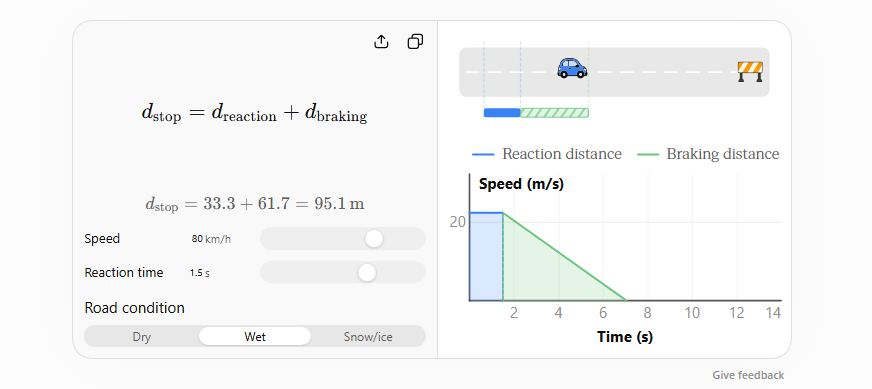
Speed gives us another way to see the same principle. Under constant braking conditions, stopping distance contains both the distance travelled while the driver reacts and the distance required to brake; as speed rises, the braking component rises approximately with the square of speed. A substance that delays perception or reaction therefore enters a physical system in which the road continues to move while the brain is still processing what it has seen.
The consequence may arrive in seconds. The neural and social consequences may continue for years.
That is the systems-thinking shift: from the accident we can see, to the brain that was processing the situation, to the relationships that produced the behaviour, to the consequences that continue after the event.
APPENDIX E. GENDERED VIOLENCE AND HOMICIDE: WHEN THE CONSEQUENCE DISAPPEARS FROM VIEW
A murder arising within an intimate relationship appears first as an event: one person has killed another. The event is visible and final, yet the causal structure surrounding it may have been developing for months or years through controlling behaviour, jealousy, repeated conflict, threats, violence, separation, economic dependence, substance use, access to weapons and the social conditions surrounding the relationship. WHO describes intimate partner violence as involving physical, sexual and psychological harm as well as controlling behaviours, and identifies interacting individual, relationship, community and societal factors associated with violence against women. (World Health Organization)
The systems question therefore begins before the murder:
Relationship Tension → Perceived Threat/Loss → Emotional Activation → Interpretation → Action → Immediate Consequence → Relationship Consequence → Further Emotional Activation
Where violence has already entered the relationship, the structure can become reinforcing:
Control → Resistance → Conflict → Escalation → Violence → Fear/Submission → Increased Control
The violence itself then changes the conditions from which the next episode emerges. WHO identifies controlling behaviour, power inequality, attitudes that justify violence, harmful alcohol use and exposure to violence in childhood among factors associated with intimate partner and sexual violence. These factors operate across individual, relationship, community and societal levels, so the event cannot adequately be understood by examining the final act alone. (World Health Organization)
The brain has to see what happens next
This brings the neurological question directly into the system.
To restrain an action, the brain has to connect what I am experiencing now with what this action will produce next. Anger, jealousy, perceived rejection or humiliation can narrow attention toward the immediate emotional experience; emotion-regulation difficulties have also been found to be associated with intimate-partner-violence perpetration in a meta-analysis of 62 samples. (PubMed)
Substances can enter the same structure. Alcohol and other psychoactive substances can alter judgement, inhibition, perception and emotional processing, while harmful alcohol use is identified by WHO as a risk factor associated with intimate partner violence. (World Health Organization) The resulting problem is therefore larger than the question of whether someone was angry or intoxicated at the moment of the killing: what has happened to the person’s learned capacity to connect an immediate impulse with its downstream consequences?
The causal chain may look like this:
Perceived Threat → Emotional Activation → Narrowed Attention → Reduced Consequence Processing → Aggressive Action → Immediate Relief/Resolution → Severe Consequence
The immediate consequence may be experienced by the perpetrator as the ending of an unbearable emotional state. The longer causal chain may contain consequences that the brain, in that moment, fails to integrate: death, imprisonment, children losing a parent, families losing both people, economic disruption, trauma and years of social consequences.
This is where the phrase passion can become analytically interesting. The event may appear to be a sudden explosion, yet the system may have been accumulating structure long before the explosion: a pattern of control, interpretation, emotional activation, conflict and reinforcement. The killing is the visible event at the end of a river of causes.
From the individual to the system
The consequences then travel outward:
Violent Act → Death/Injury → Children and Family → Household Disruption → Economic and Social Consequences → Community/Institutional Response
And the river can travel backwards as well:
Gender Norms/Power Relations → Relationship Expectations → Controlling Behaviour → Conflict → Violence → Normalisation/Fear → Reinforcement of the Relationship Structure
This wider structure matters because gender-related killings are not simply a collection of isolated interpersonal events. UNODC estimates that in 2024 almost 60% of all women and girls intentionally killed globally were killed by intimate partners or other family members, compared with 11% of male homicide victims killed in the private sphere. The UNODC data therefore reveal a distinct relationship between gender, intimate relationships and lethal violence. (UNODC)
The systems perspective allows us to hold both levels simultaneously: the person made the action, while the action occurred within a structure that had been forming around the person. Understanding that structure does not remove individual responsibility; it makes visible the points at which the trajectory could have changed.
That is the deeper connection with the road-accident example. In both cases, the final event is preceded by a failure or alteration in the processing of consequences. On the road, the driver may fail to integrate speed, perception, reaction and stopping distance quickly enough; in relationship violence, an escalating emotional and relational structure can overwhelm the capacity to connect the immediate action with the human consequences that follow.
The systems question becomes:
What has to be learned, reinforced, weakened or interrupted in the brain, the relationship and the surrounding system so that the next consequence can be seen before the action produces it?
That takes us directly from the murder as an event to the architecture that made the event possible — and therefore to the points at which the architecture can be changed.
The systems practitioner therefore keeps asking:
What happens next?
And then:
What does that consequence change?
That is how an event becomes a causal structure.
APPENDIX F. OTHER STRLDi CASE APPLICATIONS
Human–Wildlife Conflict: Escalation
Human–wildlife conflict can be examined as an escalation structure when actions taken by one side alter the behaviour of the other, which then generates further response from the first. The value of the archetype is that it allows the practitioner to move beyond the sequence of individual incidents and examine the feedback structure sustaining the escalation.
Unemployment: The Onion
The unemployment study provides a particularly useful illustration of moving beneath the visible event. The number of unemployed people is an observable condition, but the system producing persistent unemployment may involve multiple layers of education, skills, production, investment, enterprise formation, labour demand, institutional arrangements and economic structure.
The Onion archetype provides a way to ask what lies beneath the visible condition and what relationships repeatedly reproduce it.
Urgent Files: VDM Case
The urgent-files case illustrates another important distinction: organisations often respond to the most visible and immediate event while the structures generating recurring urgency remain intact. The Vision Deployment Matrix provides a complementary way of moving across levels of perspective—from events and patterns toward systemic structures, mental models and vision.
Daniel H. Kim’s Vision Deployment Matrix was developed as a framework for understanding current reality and desired future reality across multiple levels and for identifying the gaps and actions required to move between them.
STRLDi’s use of the VDM builds on this lineage while integrating it into its broader systems-diagnostic practice. The purpose is ultimately the same: to change the level at which a situation can be seen, and therefore the level at which it can be acted upon.
APPENDIX G. RESEARCH, REFERENCES AND VISUAL EVIDENCE
Neurobiology and learning
Hedrick et al., 2022 — Learning binds new inputs into functional synaptic clusters via spinogenesis.
The study used longitudinal in-vivo two-photon imaging and correlated electron microscopy to examine learning-related spine formation in mouse motor cortex.
Nature Neuroscience — Learning binds new inputs into functional synaptic clusters via spinogenesis
Sheng et al., 2025 — Remodelling of corticostriatal axonal boutons during motor learning.
The study tracked thousands of axonal boutons during motor learning and found dynamic structural and functional remodelling associated with learning.
Nature — Remodelling of corticostriatal axonal boutons during motor learning
Matsuzaki et al., 2004 — Structural basis of long-term potentiation in single dendritic spines.
This study demonstrated activity-dependent structural enlargement of individual dendritic spines associated with synaptic potentiation.
Nature — Structural basis of long-term potentiation in single dendritic spines
Lamprecht & LeDoux, 2004 — Structural plasticity and memory.
A review examining evidence connecting learning, memory and enduring changes in synaptic structure and function.
Nature Reviews Neuroscience — Structural plasticity and memory
Systems thinking and archetypes
Daniel H. Kim — Vision Deployment Matrix: A Framework for Large-Scale Change.
Kim’s framework describes five levels of perspective and provides a way of connecting current reality, desired future reality, gaps and action.
The Systems Thinker — Vision Deployment Matrix
Systems Archetypes as Structural Pattern Templates.
This reference explains how archetypes can function as recurring structural patterns that help practitioners recognise similar dynamics across apparently different situations.
The Systems Thinker — Systems Archetypes as Structural Pattern Templates
Systems Archetypes Basics.
A reference covering reinforcing and balancing processes, causal-loop language and related systems-thinking concepts.
The Systems Thinker — Systems Archetypes Basics
Substance use
National Institute on Drug Abuse — Drugs, Brains, and Behavior: The Science of Addiction
NIDA’s material provides the scientific background for the appendix discussion of reward, repeated exposure, brain adaptation and addiction.
Road safety
World Health Organization — Road Traffic Injuries
World Health Organization — Road Safety
These sources provide the evidence base for the discussion of speed, human error, safe-system design and the interaction of road, vehicle and human factors.
Gendered violence
World Health Organization — Violence Against Women
WHO — Violence Against Women: 2023 Prevalence Estimates
These provide current global evidence on prevalence and the interacting individual, relationship, community and societal factors associated with violence against women.
APPENDIX H — STEREOGRAM: EXPERIENCE THE SHIFT IN SEEING
The stereogram is included in the article as an experience, not simply as an illustration. The reader is asked to look at a repeated pattern and discover a three-dimensional structure that is already encoded in the image. The important moment is the perceptual shift: the pattern remains the same, while the organisation of what the observer sees changes.
Try a stereogram yourself: Magic Eye — How to See 3D
The official Magic Eye instructions recommend bringing the image close to the face, allowing the eyes to relax as though looking through the image into the distance, and slowly moving the image away until the hidden structure emerges. Once the hidden image is perceived, the depth becomes increasingly apparent. (Magic Eye)
For readers who want to understand the technique in more detail:
- How to View Stereograms — Hidden3DImage — explains the parallel-viewing method and provides practice exercises.
- How to View 3D Stereograms — Hidden 3D — provides several viewing methods, including the guiding-dot technique.
- Magic Eye 3D — The Complete Guide — provides a step-by-step explanation of how to relax the eyes and allow the hidden image to emerge.
The scientific principle is stereopsis: the visual system combines slightly different information from the two eyes to construct depth. Autostereograms exploit this mechanism by embedding repeated patterns with carefully controlled horizontal shifts, allowing a three-dimensional form to emerge when the visual system fuses the appropriate elements. (Sinauer Associates)
Why it belongs in this article
The stereogram provides a small but powerful experience of the distinction between information being present and structure being seen. The reader initially has the same visual information as before the hidden image appears; what changes is the organisation through which that information is perceived. That makes the stereogram a useful bridge into the article’s larger question: what happens when learning gives the mind a new structure through which relationships that were previously invisible become visible?
And importantly, the stereogram should appear in the body of the article itself, in Section C, with the appendix providing the instructions and external resources for readers who want to try it. The reader should experience the phenomenon first and read the technical explanation afterwards.
APPENDIX I — STRLDi REFERENCES: SYSTEMS THINKING, CAUSAL DISCOVERY AND SYSTEM ARCHETYPES
The systems-thinking component of this article builds on the body of work developed by Sheila Damodaran and the Systems Thinking Research & Leadership Development Institute (STRLDi) through research, practice, training and application across persistent organisational, societal and national issues.
1. What are System Archetypes?
This provides the foundational STRLDi treatment of system archetypes as recurring structural patterns composed of interacting reinforcing and balancing feedback loops that generate characteristic behaviour over time. It also establishes the distinction between archetypes as diagnostic structures and their use as narrative or facilitation devices. (STRLDi)
STRLDi — What are System Archetypes?
2. Uncovering System Archetypes — Systemic Structures
This reference sets out the practical discipline of causal-loop construction, including variables, S/O relationships and the even–odd O rule for distinguishing reinforcing and balancing loops. It is particularly relevant to this article’s progression from variable → relationship → causality → loop → archetype. (STRLDi)
STRLDi — Uncovering System Archetypes
3. Seeing Dynamic Complexity
STRLDi’s treatment of dynamic complexity distinguishes the visible event from the behaviour over time and systemic structure producing persistent behaviour. It provides an important foundation for the article’s proposition that learning to see means moving progressively beneath events toward relationships, feedback and structural persistence. (STRLDi)
STRLDi — Seeing Dynamic Complexity
4. Shared Vision: Envisioning the Whole for the Future
This work develops the movement across Events, Patterns, Systemic Structures, Mental Models and Vision, and includes STRLDi’s treatment of the Vision Deployment Matrix. It is relevant to the article’s movement from observing reality toward understanding the structures that generate it and then identifying where change can occur. (STRLDi)
STRLDi — Shared Vision: Envisioning the Whole for the Future
5. Practicing the Five Disciplines — STRLDi Compendium
The STRLDi Compendium brings together Behaviour Over Time, Causal Loop Diagrams, Vision Deployment Matrix, leadership reflection and the Laws of Dynamic Complexity as a repeated learning rhythm. This is especially relevant to the article’s argument that systems thinking is developed through practice: seeing a pattern, uncovering its structure, identifying leverage and learning to recognise the structure again. (STRLDi)
STRLDi — Practicing the Five Disciplines
6. How the Onion Was Discovered
The Onion represents Sheila Damodaran’s development of a way of seeing the whole system through recurring systemic structures. Its significance for this article is particularly strong because it illustrates the transition from individual archetypes toward interconnected structures operating across persistent national and societal issues. (STRLDi)
STRLDi — How the Onion Was Discovered
7. STRLDi Management Tools Framework
This framework places System Archetypes, the Onion Model and Causal Loop Diagrams at the structural level, distinguishing them from tools concerned primarily with events, patterns, alignment or execution. It provides a useful reference for the article’s argument that different tools enable different levels of seeing. (STRLDi)
STRLDi — Management Tools Framework
8. STRLDi Training: Deepening the Systems Thinking Discipline
This programme material documents the deliberate training pathway through which learners move from causal loops and behaviour-over-time graphs to system archetypes and strategic intervention. Of particular relevance to this article is the description of the learner acquiring a new way of seeing the behaviour of reinforcing and balancing loops over time. (STRLDi)
STRLDi — Deepening the Practice of Systems Thinking
9. The STRLDi Archetype Handbook
STRLDi’s comprehensive archetype reference brings together the major archetypes—including Reinforcing and Balancing Loops, Fixes That Fail, Shifting the Burden, Limits to Growth, Escalation, Success to the Successful, Drifting Goals, Growth and Underinvestment, Tragedy of the Commons and Accidental Adversaries—as a practical working reference. (STRLDi)
STRLDi — Systems Thinking Archetypes Handbook
10. The STRLDi Journey
The development of this work extends over decades of practice, beginning with the observation of recurring patterns and developing through Behaviour Over Time, System Archetypes, organisational learning and the application of systems thinking to organisational, national and global issues. (STRLDi)
STRLDi — Mastering the Architecture of Change
11. Vision Deployment Matrix — Daniel H. Kim
STRLDi explicitly acknowledges Dr Daniel H. Kim for the creation of the Vision Deployment Matrix™, published in The Systems Thinker in 1995. The STRLDi work builds on this foundation as part of its broader practice of moving between events, patterns, systemic structures, mental models and vision. (STRLDi)
STRLDi — Introducing the Compendium and acknowledgement of Dr Daniel H. Kim
Why Appendix I matters
These references establish that the systems-thinking portion of When a Nation Learns to See is not being assembled from generic descriptions of systems thinking. It emerges from STRLDi’s own body of practice and inquiry into persistent behaviour, causal structures, system archetypes, dynamic complexity, the Vision Deployment Matrix and the development of systemic interventions.
The article’s learning progression—
Event → Pattern → Variable → Relationship → Causality → Causal Chain → Feedback → Loop → Behaviour Over Time → Archetype → Leverage
—should therefore be presented as part of the intellectual and practical development of this work, with the individual STRLDi references above allowing readers to follow the deeper material.
And I would make Appendix I the author’s reference base, while the preceding scientific appendix remains the evidence base for the neurobiology. That cleanly separates the two: the neuroscience tells us what is known about learning and neural plasticity; the STRLDi references show the body of systems-thinking practice through which we have developed the question of what happens when people learn to see causal structure.
A FINAL NOTE ON THE EVIDENCE
The central proposition of this article is deliberately broader than any single neuroscience experiment. The research establishes that learning is accompanied by changes in neural function and, in relevant experimental settings, by structural changes in synapses, dendritic spines and axonal boutons. The systems-thinking proposition is that repeated practice in representing and recognising causal relationships can develop a transferable capability for seeing recurring structures.
The bridge between those two bodies of knowledge should therefore be stated carefully. We do not have evidence that learning a particular systems archetype creates a particular identifiable synapse, nor should we claim that a causal-loop diagram maps directly onto a microscopic neural structure. What the evidence permits us to say is more useful: the brain is plastic, experience changes neural organisation, and deliberate learning can develop new capabilities of perception, representation, retrieval and application.
The national proposition follows from there. If causal structures can be learned, recognised and transferred across situations, then a society can deliberately cultivate people who are increasingly capable of seeing the relationships that produce persistent outcomes. That makes systems intelligence a candidate for national capability formation—not because the brain is a metaphor for the nation, but because the people who constitute the nation’s institutions are the brains through which its strategies are conceived.
Share this:


PILLAR II
Client Solutions & Delivery
Transforming Understanding into Coordinated Action
“Persistent issues cannot be solved by isolated interventions. They require disciplined inquiry, shared understanding, capable leadership and sustained stewardship.”
Purpose
The purpose of Client Solutions & Delivery is to help governments, organisations, development partners and communities understand and respond effectively to persistent issues that continue to resist conventional approaches.
Many institutions invest significant financial, human and political resources in addressing national and organisational challenges. Yet despite these investments, many issues continue to recur, often becoming more deeply embedded over time. This persistence suggests that the difficulty lies not only in implementation, but in the way the problem itself is understood.
Client Solutions & Delivery exists to change that.
The pillar brings together research, leadership development, collaborative strategy, institutional learning and policy advisory into one integrated system through which clients move from fragmented understanding to coordinated action.
Unlike conventional consulting approaches that begin by recommending solutions, STRLDi begins by helping institutions understand the system producing the outcomes they experience. Once that understanding is developed, the Institute works alongside leaders to strengthen capability, align stakeholders, support implementation and build the institutional capacity required to sustain transformation over time.
Every engagement therefore contributes not only to solving immediate challenges, but also to increasing the client’s own ability to learn, adapt and respond to future complexity.
The Client Transformation Journey
Every client engagement follows a disciplined learning journey.

A persistent issue first becomes the subject of systemic inquiry. Research seeks to understand the structures, behaviours and mental models that sustain the issue over time.
This understanding provides the foundation for leadership development, enabling individuals and teams to develop the disciplines required to think systemically, work collaboratively and lead transformation within complex environments.
Leaders are then brought together through Strategy Steward Labs, where shared understanding is translated into coordinated strategies, implementation pathways and collective stewardship.
As implementation progresses, Monitoring, Evaluation & Learning captures outcomes, reflects upon experience and generates new knowledge that continually strengthens both the client and the Institute.
Knowledge generated through every engagement is preserved within the Digital Knowledge Platform, ensuring that valuable insight remains accessible for future research, leadership development and institutional learning.
As STRLDi continues to mature, research and implementation learning will increasingly inform policy, strategy and national transformation, allowing systemic insight to influence broader institutional and societal development.
Through this integrated journey, isolated projects become opportunities for enduring organisational and national learning.
Institutional Structure
The Client Solutions & Delivery Pillar is organised through seven complementary offices, each contributing a distinct capability while reinforcing the work of the others.
1. Research & Systems Diagnostics
Current Steward: Nancy
Purpose
Research forms the intellectual foundation of STRLDi.
Before organisations attempt to solve a persistent issue, they must first understand the system that continually reproduces it. Research therefore seeks to move beyond symptoms by revealing the structural relationships, behavioural patterns and underlying assumptions that sustain undesirable outcomes over time.
Rather than studying isolated events, STRLDi investigates the dynamic interactions that shape long-term organisational and societal behaviour. This work draws upon systems thinking, organisational learning, behavioural analysis, systemic archetypes and the Institute’s evolving research methodologies.
Research becomes the basis upon which all subsequent leadership, strategy and transformation activities are built.
Key Responsibilities
- Design and lead systemic research programmes.
- Conduct systems diagnostics for governments, organisations and communities.
- Develop Behaviour Over Time analyses and causal explanations.
- Produce policy-oriented research publications.
- Advance STRLDi’s research methodologies.
- Supervise research teams and collaborative studies.
- Build research partnerships with universities and institutions.
Key Result Areas
- High-quality research.
- Credible systemic diagnostics.
- Knowledge generation.
- Publications.
- Policy influence.
- Research partnerships.
2. Leadership Development
Current Steward: Bernice
Purpose
Transformation depends upon leadership capable of understanding and working within complexity.
Leadership Development equips individuals and teams with the disciplines, capabilities and habits of learning required to steward persistent issues rather than merely react to them.
The programmes are grounded in the principles of learning organisations and systems thinking, encouraging leaders to challenge assumptions, develop shared understanding, cultivate collective learning and strengthen institutional capability.
Leadership development is therefore not viewed as individual training alone, but as an investment in organisational transformation.
Key Responsibilities
- Design leadership development programmes.
- Deliver executive learning.
- Develop facilitators.
- Coordinate participant learning journeys.
- Maintain programme quality.
- Support organisational learning within client institutions.
Key Result Areas
- Leadership capability.
- Learning culture.
- Programme quality.
- Client satisfaction.
- Organisational development.
3. Strategy Steward Labs
Current Steward: Ms Sheila Damodaran
Purpose
Strategy Steward Labs provide the environment within which systemic understanding becomes coordinated action.
Complex issues cannot be transformed by isolated actors working independently. Sustainable change requires institutions, sectors and stakeholders to develop a shared understanding of the system they collectively influence.
The Labs bring these diverse perspectives together to explore systemic relationships, align strategic intent and co-create practical pathways for implementation.
Rather than producing static strategic plans, the Labs cultivate ongoing stewardship, enabling participants to continually learn, adapt and strengthen implementation over time.
Key Responsibilities
- Design and facilitate Strategy Steward Labs.
- Coordinate cross-sector dialogue.
- Support strategy development.
- Facilitate implementation planning.
- Build shared ownership.
- Strengthen institutional collaboration.
Key Result Areas
- Shared understanding.
- Coordinated implementation.
- Stronger stakeholder alignment.
- Improved strategic coherence.
- Sustainable transformation.
4. Monitoring, Evaluation & Learning
Purpose
Implementation generates experience.
Experience becomes valuable only when it is examined, understood and incorporated into future practice.
Monitoring, Evaluation & Learning (MEL) ensures that every engagement contributes to measurable outcomes while simultaneously strengthening institutional capability through disciplined reflection.
Evaluation therefore becomes both a mechanism for accountability and an opportunity for continuous organisational learning.
Key Responsibilities
- Monitor programme implementation.
- Evaluate outcomes.
- Assess institutional capability growth.
- Capture implementation learning.
- Produce evaluation reports.
- Inform continuous improvement.
Key Result Areas
- Outcome measurement.
- Learning integration.
- Programme improvement.
- Evidence-based decision making.
5. Digital Knowledge Platform
Current Steward: Monty
Purpose
Knowledge represents one of STRLDi’s most valuable institutional assets.
The Digital Knowledge Platform preserves, organises and shares this knowledge so that research, methodologies, publications and institutional learning remain accessible to future practitioners, researchers and leaders.
Rather than functioning solely as a document repository, the platform is envisioned as a living knowledge ecosystem that continually expands alongside the Institute’s work.
Key Responsibilities
- Develop the digital knowledge repository.
- Manage research archives.
- Curate institutional publications.
- Support digital collaboration.
- Develop AI-supported knowledge systems.
- Preserve organisational memory.
Key Result Areas
- Accessible institutional knowledge.
- Digital capability.
- Organisational memory.
- Knowledge sharing.
6. Office of Policy, Strategy & National Transformation
Future Development
Purpose
This office translates research and implementation learning into strategic advice capable of influencing institutional, national and regional transformation.
The Office supports governments, public institutions and development partners in developing policies, strategies and reform programmes grounded in systemic understanding rather than isolated interventions.
Its work ensures that learning generated through research and implementation contributes to broader societal change.
Key Responsibilities
- Develop policy briefs.
- Facilitate national strategy formulation.
- Support institutional reform.
- Provide executive advisory services.
- Produce transformation frameworks.
- Translate research into policy.
Key Result Areas
- Policy influence.
- Strategic advisory.
- Institutional reform.
- National transformation.
7. Office of International Programmes
Future Development
Purpose
The Office of International Programmes extends STRLDi’s work beyond Botswana by coordinating research, leadership development and transformation programmes across Africa and other regions.
The Office ensures that international engagements remain grounded in the Institute’s philosophy while responding appropriately to different national and regional contexts.
It also facilitates mutual learning between countries, allowing knowledge generated in one context to strengthen practice elsewhere.
Key Responsibilities
- Coordinate international programmes.
- Develop regional partnerships.
- Support cross-country learning.
- Manage international delivery.
- Strengthen global collaboration.
Key Result Areas
- Regional programme delivery.
- International partnerships.
- Cross-country knowledge exchange.
- Expanded institutional reach.
How the Pillar Works
Client Solutions & Delivery functions as an integrated learning system rather than a sequence of independent services.
Research reveals the deeper structure of persistent issues.
Leadership Development equips people to work with that understanding.
Strategy Steward Labs create the shared commitment required for coordinated implementation.
Monitoring, Evaluation & Learning ensures that action generates insight rather than merely activity.
The Digital Knowledge Platform preserves that insight as institutional knowledge.
The Office of Policy, Strategy & National Transformation translates learning into broader reform, while the Office of International Programmes enables these capabilities to contribute across national and regional boundaries.
Together, these offices transform inquiry into understanding, understanding into leadership, leadership into coordinated action and coordinated action into enduring institutional capability.
Key Result Areas of the Pillar
The Client Solutions & Delivery Pillar will be considered successful when it consistently:
- Produces rigorous research that deepens understanding of persistent issues.
- Develops leaders capable of working with complexity and systemic change.
- Strengthens collaboration through Strategy Steward Labs.
- Supports implementation through disciplined monitoring, evaluation and learning.
- Builds and preserves an accessible body of institutional knowledge.
- Influences policy, strategy and institutional reform through evidence-based advisory services.
- Extends STRLDi’s contribution across Africa and the wider international community while remaining faithful to its philosophy and purpose.
This pillar is the transformational engine of STRLDi. It is where knowledge is created, leaders are developed, strategies are stewarded and learning is converted into practical improvements for organisations, governments and societies. Every capability within the pillar reinforces the others, ensuring that the Institute’s work is not a collection of disconnected services but a coherent journey from understanding to enduring transformation.
Share this:


PILLAR III
Strategic Partnerships & Growth
Building the Relationships Through Which Transformation Becomes Possible
“No institution transforms a nation alone. Lasting transformation emerges when relationships become purposeful, knowledge becomes shared and diverse institutions learn to steward change together.”
Contents
This page explains how the Strategic Partnerships & Growth Pillar enables STRLDi to build the relationships, partnerships and collaborative platforms through which its mission is fulfilled. It introduces the philosophy underpinning the pillar, explains how partnerships develop over time, describes the stewardship portfolios and institutional offices that make up the pillar, and outlines how these relationships generate learning, opportunities and long-term institutional growth.
The page is organised into the following sections:
1. Purpose
Why Strategic Partnerships & Growth is central to STRLDi’s mission.
2. The Partnership Journey
How relationships develop from dialogue to long-term institutional partnerships.
3. Institutional Structure
An overview of the pillar and the relationship portfolios through which it operates.
4. Government, Media & International Relations
Building relationships with government, the media and international institutions.
5. Economic Partnerships & Development Cooperation
Working with the private sector, investors and development partners.
6. Institutional, Professional & Knowledge Partnerships
Strengthening collaboration with professional bodies, universities, research institutions and knowledge networks.
7. Community, Knowledge & Regional Partnerships
Connecting with communities, traditional leadership, local government and regional organisations.
8. Proposal Development & Resource Mobilisation (Future Development)
Transforming opportunities into funded programmes and strategic partnerships.
9. Membership Office (Future Development)
Building a long-term community of individuals and institutions committed to systemic transformation.
10. Communities of Practice
Supporting continuous learning and collaboration beyond individual projects.
11. Conferences, Strategic Dialogues & Executive Systems Programmes
Convening leaders through Executive Sunday Systems Retreats, Executive Wednesday Systems Forums, regional Executive Systems Programmes and strategic dialogues that generate learning, relationships and future opportunities.
12. Knowledge & Public Engagement
Sharing research, strengthening public understanding and extending STRLDi’s influence through publications, media and digital platforms.
13. How the Pillar Works
Understanding how the different portfolios work together to create a continuous cycle of partnership, learning and institutional growth.
14. Key Result Areas
The outcomes by which the Strategic Partnerships & Growth Pillar will be measured.
15. Closing Reflection
A reflection on why stewardship, relationships and collaboration are among STRLDi’s greatest institutional assets.
Purpose
The Strategic Partnerships & Growth Pillar exists to build, steward, and strengthen the relationships through which STRLDi fulfils its mission.
Persistent national and regional issues rarely exist within the boundaries of a single organisation, ministry or profession. They emerge through the interaction of many actors whose decisions, priorities, and actions continually influence one another. For this reason, meaningful transformation depends as much on the quality of relationships as on the quality of technical solutions.
STRLDi therefore views partnership development not as an activity undertaken after research is completed or programmes are designed. Partnership is itself a strategic capability. It enables diverse institutions to discover shared purpose, develop mutual trust and mobilise collective action around issues that no single organisation can address independently.
This pillar cultivates the institutional ecosystem within which STRLDi’s research, leadership development, and strategy stewardship can flourish. It identifies opportunities for collaboration, develops long-term institutional relationships, mobilises resources, and creates the conditions for the continual exchange of knowledge across sectors, disciplines and national boundaries.
In doing so, Strategic Partnerships & Growth strengthens not only the Institute itself but also the broader communities of practice committed to systemic transformation.
The Philosophy of Partnership Stewardship
Partnerships are not support functions. They are strategic capabilities through which institutions learn, coordinate and transform together.
At STRLDi, relationships are cultivated not simply to expand the Institute’s network, but to strengthen society’s collective capacity to understand and respond to persistent structural issues.
Partnerships create the conditions through which research is enriched, leadership develops, knowledge travels, and transformation becomes possible.
The Partnership Journey
Partnerships within STRLDi develop through a deliberate journey rather than isolated transactions.
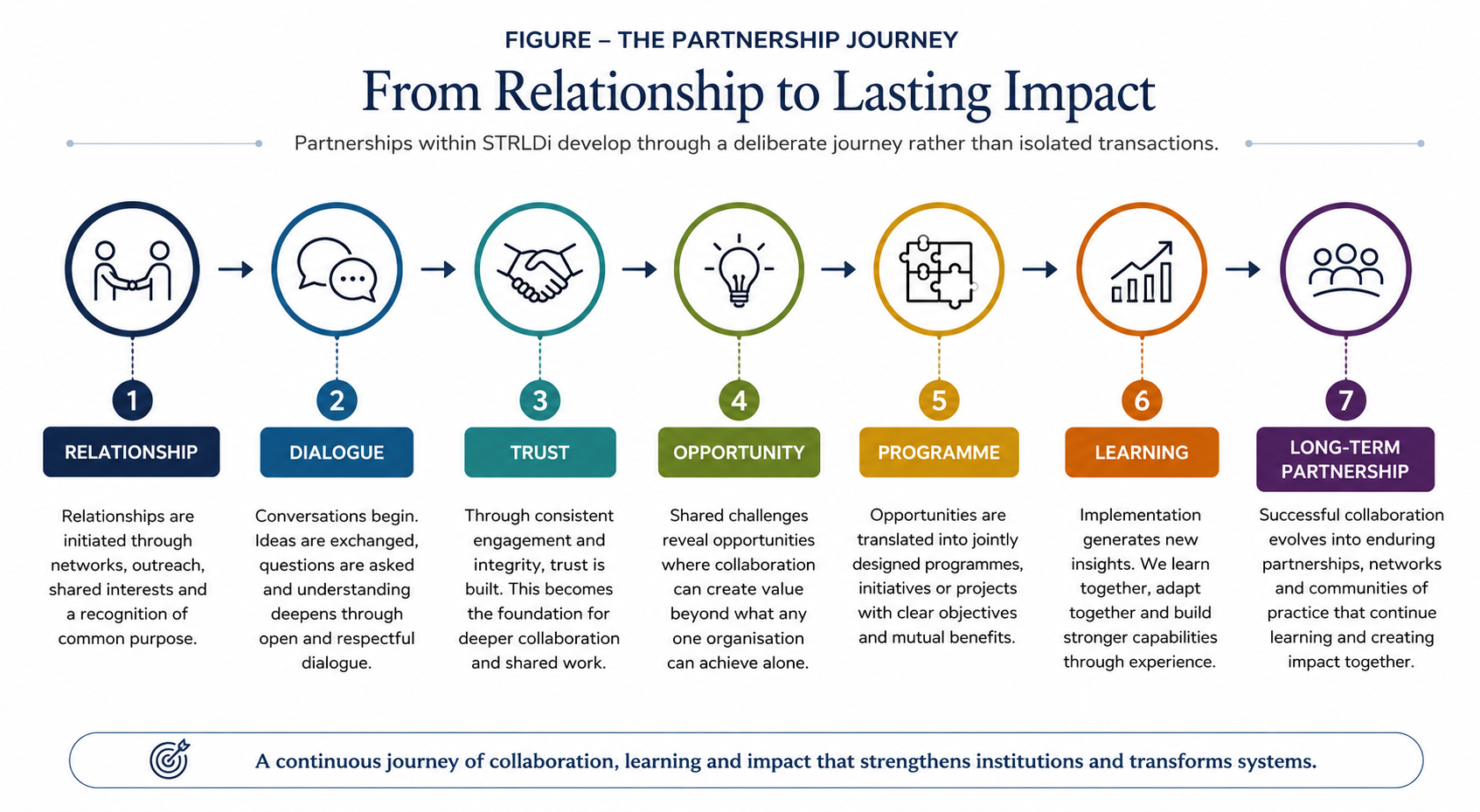
Relationships begin through dialogue and shared inquiry. As trust develops, opportunities for collaboration emerge naturally. These opportunities are translated into jointly designed programmes, research initiatives and leadership engagements that create value for all participants.
Implementation generates further learning, strengthening both the relationship and the institutional capability of those involved. Over time, individual collaborations evolve into enduring partnerships, professional networks, and communities of practice that continue learning together long after individual projects have concluded.
In this way, partnerships become living systems of learning rather than contractual arrangements.
The Strategic Partnership Ecosystem
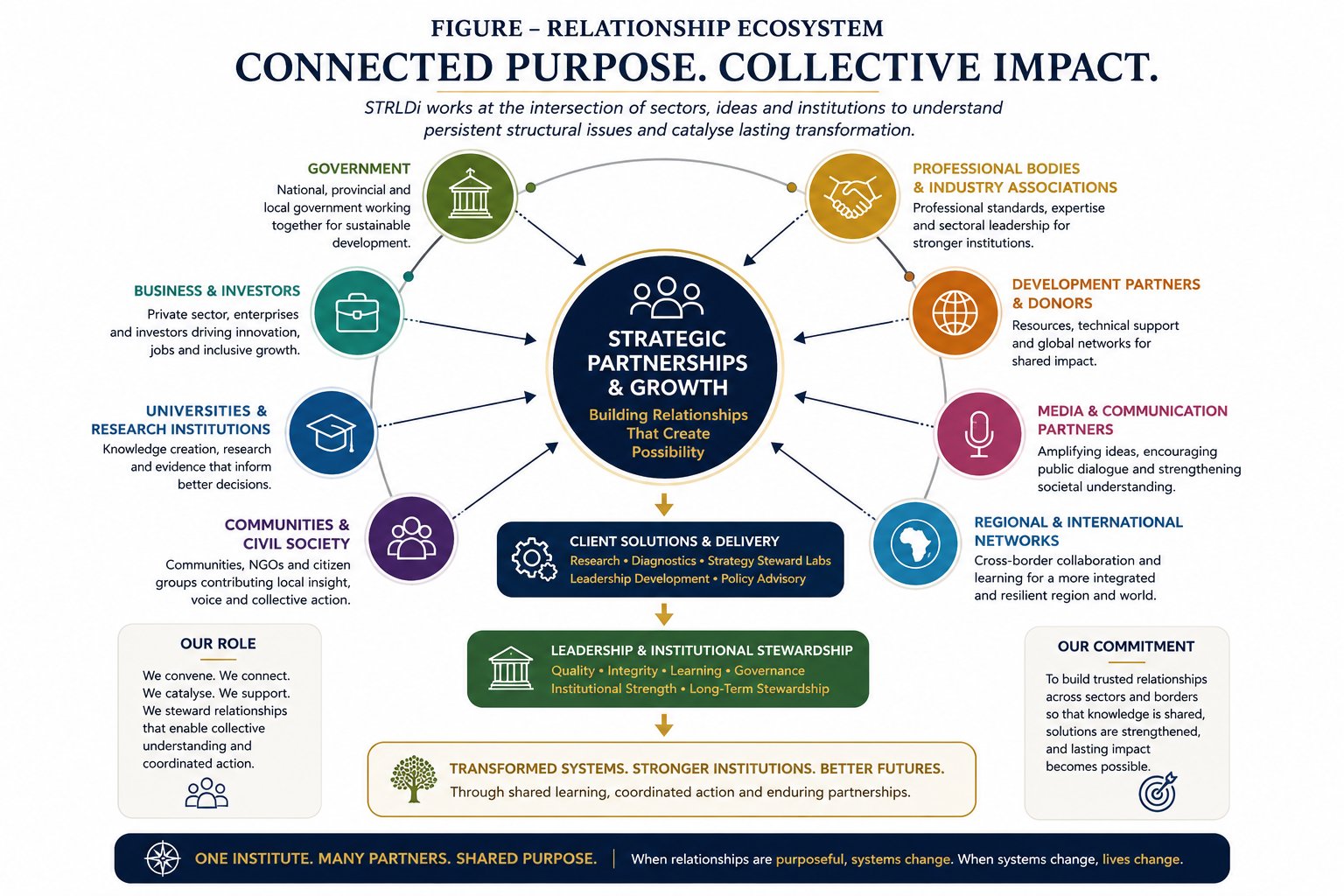
Institutional Structure
The Strategic Partnerships & Growth Pillar is organised through specialised relationship portfolios that together ensure every major stakeholder group receives intentional stewardship while remaining connected to STRLDi’s broader mission.
1. Government, Media, and International Relations
Current Steward: Brunoh
Purpose
Governments remain central actors in addressing persistent national challenges. This office cultivates trusted relationships with ministries, departments, public service leadership and national planning institutions, creating opportunities for collaborative inquiry, leadership development and institutional transformation.
It also serves as the principal channel through which STRLDi communicates its work to the wider public, ensuring that research findings and institutional learning contribute meaningfully to national discourse.
Brunoh stewards STRLDi’s relationships with the national government, the media, and international institutions. He is responsible for positioning the Institute as a trusted voice on persistent national and regional issues while strengthening relationships that expand STRLDi’s influence beyond Botswana.
Key Responsibilities
- Steward relationships with central and local government.
- Engage ministries, departments, and agencies.
- Coordinate executive briefings and government dialogues.
- Support public-sector leadership engagement.
- Develop strategic communication initiatives.
- Strengthen public understanding of systemic issues.
Primary Stakeholders
- National Government
- Ministries and Government Departments
- Public Service Leadership
- National Planning Institutions
- Media Houses
- Journalists and Editors
- Broadcast and Digital Media
- International Organisations
- International Government Relations
- Embassies and High Commissions
- Public Communications
- Executive Briefings
- Thought Leadership Campaigns
Primary Outcomes
- Strong government relationships
- Increased media visibility
- International institutional relationships
- Public-sector opportunities
- International collaborations
- Enhanced STRLDi reputation
2. Economic Partnerships & Development Cooperation
Current Steward: Mr Tema
Purpose
Sustainable transformation requires collaboration with business leaders, investors, and development partners whose resources, expertise, and influence contribute to national development.
This office develops relationships with the private sector, international development agencies, philanthropic organisations and multilateral institutions, aligning shared interests around long-term systemic transformation.
Key Responsibilities
- Build private-sector partnerships.
- Develop relationships with development partners.
- Facilitate donor engagement.
- Identify investment opportunities.
- Support resource mobilisation.
- Coordinate international cooperation.
Key Result Areas
- Development partnerships.
- Private-sector collaboration.
- Resource mobilisation.
- International cooperation.
3. Institutional, Professional & Knowledge Partnerships
Current Steward: Mabua
Purpose
Professional bodies, statutory organisations and public enterprises play a vital role in strengthening institutional capability across society.
This office builds enduring relationships with these organisations, encouraging collaborative learning, joint research and professional development while creating opportunities for broader institutional transformation.
Key Responsibilities
- Steward relationships with parastatals.
- Engage professional associations.
- Build institutional networks.
- Coordinate sector-specific collaboration.
- Support professional learning initiatives.
Key Stakeholders
- Parastatals
- Statutory Organisations
- Professional Bodies
- Industry Associations
- Universities
- Research Institutions
- International Think Tanks
- Knowledge Networks
- Academic Collaboration
- Joint Research
Key Result Areas
- Institutional partnerships.
- Professional collaboration.
- Sector engagement
- Research partnerships
- Knowledge exchange
- Institutional capability development
- International academic collaboration
4. Community, Knowledge & Regional Partnerships
Current Steward: Coach
Purpose
Transformation becomes sustainable only when knowledge reaches communities and when learning flows across regional boundaries.
This office strengthens relationships with local government, traditional leadership, universities, research institutions, civil society organisations and regional bodies, particularly within the Southern African Development Community.
Its work ensures that STRLDi remains connected to the lived realities of communities while contributing to regional learning and cooperation.
Key Responsibilities
- Engage local authorities.
- Build relationships with Bogosi.
- Develop university partnerships.
- Coordinate regional collaboration.
- Support academic cooperation.
- Strengthen community engagement.
Key Result Areas
- Community partnerships.
- Academic collaboration.
- Regional cooperation.
- Knowledge exchange.
5. Proposal Development & Resource Mobilisation
Future Development
Purpose
Ideas become transformational only when they are adequately resourced.
This office converts emerging partnership opportunities into funded programmes, consultancy assignments, research initiatives and long-term institutional collaborations.
Its work enables STRLDi to sustain and expand its mission while ensuring that proposals remain grounded in the Institute’s philosophy and standards of professional practice.
Key Responsibilities
- Coordinate Expressions of Interest and tenders.
- Develop grant proposals.
- Prepare consultancy submissions.
- Negotiate partnership agreements.
- Support contract development.
- Maintain proposal quality.
Key Result Areas
- Successful proposals.
- Contract awards.
- Programme funding.
- Strategic investments.
6. Membership Office
Future Development
Purpose
The Membership Office builds a community of individuals and institutions committed to advancing systemic thinking, organisational learning and national transformation.
Membership extends the Institute’s reach beyond individual projects by creating a network of practitioners, researchers, leaders, and supporters who continue learning together over time.
The Office will also steward Fellows, Associates, Alumni, and Institutional Members, strengthening long-term relationships while generating recurring support for the Institute’s work.
Key Responsibilities
- Manage membership programmes.
- Coordinate Fellows and Associates.
- Develop institutional membership.
- Maintain alumni engagement.
- Support member services.
- Grow the learning community.
Key Result Areas
- Membership growth.
- Member engagement.
- Institutional loyalty.
- Community development.
7. Communities of Practice
Purpose
Communities of Practice provide ongoing spaces where professionals continue learning long after formal engagements have concluded.
Rather than functioning as networking groups alone, these communities become living laboratories through which knowledge is shared, practice evolves, and collaborative innovation emerges across sectors and disciplines.
Key Responsibilities
- Establish thematic Communities of Practice.
- Facilitate professional dialogue.
- Encourage peer learning.
- Share emerging research.
- Strengthen collaborative problem-solving.
Key Result Areas
- Active communities.
- Professional learning.
- Cross-sector collaboration.
- Knowledge exchange.
8. Executive Programmes
Purpose
National and regional transformation requires spaces where diverse perspectives can meet in disciplined conversation.
This office designs and coordinates conferences, executive forums, public lectures, and strategic dialogues that bring together leaders from government, business, academia, development agencies, and civil society to explore emerging issues and strengthen collective understanding.
These gatherings also provide opportunities for disseminating research, showcasing innovation, and cultivating new partnerships.
Developing Leaders Through Shared Inquiry
The Executive Systems Programmes provide the principal entry point through which leaders engage with STRLDi. They are designed for leaders from the private sector, academia, research institutions, professional bodies, community organisations, traditional leadership and other sectors who are seeking a deeper understanding of persistent structural issues affecting their organisations, sectors and nations.
Unlike conventional executive education, these programmes do not focus on organisational performance, management techniques or functional leadership skills. Instead, they bring together leaders from diverse backgrounds to examine persistent structural issues through the discipline of systems thinking, using real national and regional challenges as the basis for collective inquiry and learning.
Each programme is intentionally limited to twenty-four participants, creating an environment that encourages thoughtful dialogue, meaningful relationships and sustained learning. Participants work across sectors, disciplines and professions, discovering how different parts of society contribute to the same persistent outcomes and where opportunities for coordinated action may exist.
To accommodate different schedules and geographic contexts, STRLDi delivers its Executive Systems Programmes in three complementary formats.
Executive Sunday Systems Retreats provide a three-part learning experience delivered over three consecutive Sundays. This format enables working professionals to participate while remaining engaged in their normal responsibilities.
Executive Wednesday Systems Forums offer the same programme over three Wednesdays, providing an alternative schedule for participants who prefer weekday learning.
For participants travelling from elsewhere in Southern Africa, STRLDi offers a Regional Executive Systems Programme, delivered over three-and-a-half days from Tuesday morning to Friday lunchtime. This format maximises learning while reducing travel demands.
The Executive Systems Programmes are not an end in themselves. They represent the beginning of a continuing relationship between participants and the Institute. As understanding develops, organisations often invite STRLDi to undertake systemic research, facilitate Strategy Steward Labs, support institutional transformation and contribute to long-term learning initiatives.
Key Responsibilities
- Coordinate conferences.
- Design executive dialogues.
- Organise public lectures.
- Facilitate strategic forums.
- Support knowledge dissemination.
Key Result Areas
- High-quality events.
- Executive participation.
- Knowledge sharing.
- Partnership development.
9. Conferences, Strategic Dialogues & Executive Forums
Convening Leaders Around Persistent Structural Issues
Many of the challenges confronting nations cannot be addressed by individual organisations acting independently. They require disciplined conversation among leaders representing different sectors, professions and institutions.
For this reason, STRLDi convenes conferences, strategic dialogues, executive forums and public lectures that create opportunities for collective learning around issues of national and regional importance.
These gatherings are designed to move beyond presentations and panel discussions. They encourage participants to examine the structural relationships underlying persistent issues, explore different perspectives, identify opportunities for collaboration and strengthen collective understanding before action is taken.
Subjects for dialogue may include unemployment, manufacturing, agriculture, education, food systems, local economic development, governance, innovation, regional integration and other issues requiring systemic inquiry.
The Executive Systems Programmes often provide the foundation for these larger engagements. As participants continue learning and relationships mature, they contribute to broader national conversations through conferences, policy dialogues and cross-sector forums.
These events also provide an important platform for disseminating STRLDi’s research, showcasing emerging insights and strengthening relationships with governments, universities, development partners, professional bodies and civil society organisations.
Through these engagements, STRLDi fulfils one of its central responsibilities: creating trusted spaces where leaders can think together before they are required to act together.
10. Knowledge & Public Engagement
Purpose
Knowledge fulfils its greatest purpose when it becomes accessible and contributes to public understanding.
This office ensures that STRLDi’s research, publications, digital platforms and media engagement reach diverse audiences in ways that encourage informed dialogue, thoughtful reflection and broader societal learning.
It also strengthens the Institute’s reputation as a trusted source of insight into persistent national and regional issues.
Extending Learning Beyond the Institute
Knowledge creates its greatest value when it is shared widely, applied thoughtfully and continually refined through dialogue and practice.
The Knowledge & Public Engagement Office ensures that STRLDi’s work reaches leaders, institutions and communities beyond those directly participating in programmes and consultancy engagements. It transforms research findings, institutional learning and practical experience into accessible knowledge that contributes to informed public discourse and long-term societal learning.
This responsibility includes the development of publications, policy papers, research reports, blogs, newsletters, digital learning resources and multimedia content. It also stewards the Institute’s websites, social media platforms and relationships with the media, ensuring that STRLDi’s work remains visible, credible and relevant to contemporary national and regional discussions.
Public engagement is not viewed simply as communication. It is an extension of the Institute’s learning mission. By encouraging thoughtful discussion around persistent structural issues, STRLDi helps broaden public understanding, strengthen systemic thinking and cultivate a growing community committed to institutional learning and national transformation.
Knowledge generated through research, Executive Systems Programmes, Strategy Steward Labs and institutional partnerships continually returns to this office for publication and dissemination. In turn, the questions, reflections and insights emerging from the wider community enrich future research and programme development.
Knowledge therefore moves in two directions. It flows outward to strengthen society’s understanding of persistent structural issues, and it flows back into the Institute, continually enriching STRLDi’s own capacity to learn, adapt and contribute.
Key Responsibilities
- Develop institutional publications.
- Coordinate media engagement.
- Manage digital communications.
- Support website development.
- Promote research dissemination.
- Strengthen public engagement.
Key Result Areas
- Public visibility.
- Knowledge dissemination.
- Media presence.
- Institutional reputation.
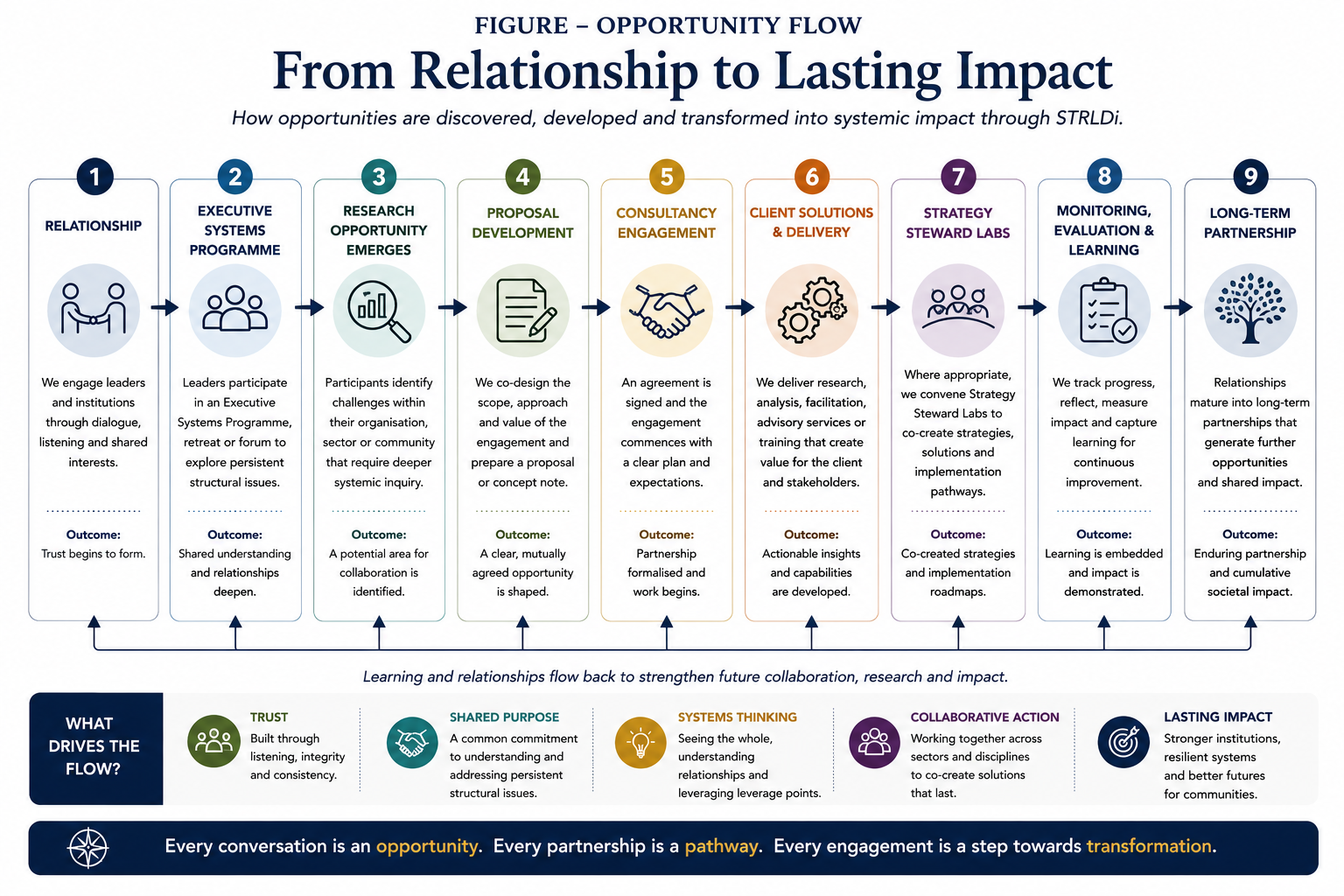
12. Revenue Generation & Institutional Sustainability
Building a Sustainable Institute Through Service, Learning and Partnership
STRLDi is committed to building an institution that is both intellectually independent and financially sustainable. Long-term institutional stewardship requires more than excellent research and leadership development. It also requires the ability to generate the resources needed to attract capable people, invest in knowledge development, strengthen organisational capacity and continually expand the Institute’s contribution to society.
For this reason, the Strategic Partnerships & Growth Pillar plays a central role in developing opportunities that sustain the Institute while advancing its mission. Revenue generation is not pursued as an end in itself. Rather, it is the natural outcome of building trusted relationships, convening meaningful dialogue and delivering work that creates lasting value for leaders, institutions and communities.
The Executive Systems Programmes provide the principal entry point into this journey. Through Executive Sunday Systems Retreats, Executive Wednesday Systems Forums and Regional Executive Systems Programmes, leaders from business, academia, research institutions, professional bodies, community organisations and other sectors come together to examine persistent structural issues through systems thinking. These programmes generate income that supports the Institute’s operations while simultaneously building relationships that often develop into deeper collaborations.
As participants return to their organisations with new insight, many identify opportunities where STRLDi can provide further support. These opportunities may lead to systemic research, institutional diagnostics, Strategy Steward Labs, leadership development programmes, policy advisory assignments, and longer-term transformation initiatives. In this way, the Executive Systems Programmes become the beginning of an ongoing partnership rather than the conclusion of a training event.
Conferences, strategic dialogues, executive forums and public lectures further strengthen this pathway by creating spaces where leaders encounter new ideas, establish professional relationships and identify opportunities for collaborative work. These engagements also extend STRLDi’s visibility, strengthen its reputation, and contribute to a growing community committed to addressing persistent structural issues.
As the Institute matures, additional sources of recurring income will emerge through proposal development, commissioned research, development partner collaborations, Communities of Practice, publications, institutional memberships, and other strategic initiatives aligned with STRLDi’s mission.
This diversified approach reduces dependence on any single source of income while enabling the Institute to invest continually in its people, research, digital knowledge platforms and regional growth.
The objective is therefore not simply to generate revenue. It is to build an institution capable of serving society over many decades through a balanced combination of learning, partnership, research, and professional practice.
13. Institutional Revenue Pathway
The Strategic Partnerships & Growth Pillar develops opportunities through a deliberate progression:
Executive Systems Programmes
↓
Conferences, Strategic Dialogues & Executive Forums
↓
Relationships Built Through Shared Learning
↓
Research & Diagnostic Opportunities
↓
Strategy Steward Labs
↓
Policy Advisory & Institutional Transformation
↓
Long-Term Institutional Partnerships
↓
Knowledge Development, Organisational Growth & Institutional Sustainability
14. How the Pillar Works
Strategic Partnerships & Growth serves as the outward-facing relationship system of STRLDi.

Each office stewards a distinct community of relationships while remaining connected through a shared institutional purpose. Government engagement informs research priorities. Development partners enable programme implementation. Professional bodies strengthen learning communities. Universities enrich research. Communities contribute lived experience. Conferences stimulate dialogue. Membership sustains long-term engagement. Public communication extends learning beyond institutional boundaries.
Together, these relationships generate opportunities that flow naturally into the Client Solutions & Delivery Pillar, where they become research assignments, leadership programmes, Strategy Steward Labs and policy advisory engagements. As these engagements conclude, the knowledge and relationships they produce return to strengthen the partnership ecosystem, creating a continuous cycle of learning, collaboration and institutional growth.
15. Key Result Areas
The Strategic Partnerships & Growth Pillar is responsible for expanding STRLDi’s institutional relationships, strengthening its reputation and generating opportunities that advance the Institute’s mission. Success is measured not simply by the number of engagements undertaken, but by the quality of relationships established, the knowledge generated and the long-term partnerships that emerge.
The Pillar is guided by the following Key Result Areas.
1. Institutional Relationship Development
Develop and steward enduring relationships with leaders and institutions across government, business, academia, professional bodies, communities, development partners and regional organisations.
Performance Indicators
- Number of strategic partnerships established.
- Number of active institutional relationships.
- Number of Memoranda of Understanding (MOUs) or collaboration agreements concluded.
- Number of repeat engagements with existing partners.
- Partner satisfaction and relationship quality.
2. Executive Engagement & Leadership Learning
Convene high-quality Executive Systems Programmes that strengthen leadership capability and expand STRLDi’s learning community.
Performance Indicators
- Number of Executive Sunday Systems Retreats delivered.
- Number of Executive Wednesday Systems Forums delivered.
- Number of Regional Executive Systems Programmes conducted.
- Total participant enrolment.
- Participant satisfaction and programme evaluation.
- Percentage of returning participants.
3. Conferences, Strategic Dialogues & Executive Forums
Create trusted spaces where leaders collectively examine persistent structural issues and identify opportunities for collaborative action.
Performance Indicators
- Number of conferences convened.
- Number of executive dialogues facilitated.
- Number of sector forums conducted.
- Number of participating organisations.
- Number of cross-sector collaborations initiated.
4. Opportunity Development
Transform relationships into opportunities that contribute to STRLDi’s research, leadership development and institutional practice.
Performance Indicators
- Number of research opportunities identified.
- Number of consultancy enquiries generated.
- Number of proposals submitted.
- Proposal success rate.
- Value of consultancy opportunities secured.
5. Strategic Partnerships & Resource Mobilisation
Strengthen the Institute’s long-term sustainability through strategic collaboration and resource mobilisation.
Performance Indicators
- Number of development partner engagements.
- Number of collaborative research initiatives.
- Number of jointly funded projects.
- Value of external funding secured.
- Number of regional and international partnerships established.
6. Knowledge & Public Engagement
Strengthen public understanding of persistent structural issues while increasing the visibility and credibility of STRLDi.
Performance Indicators
- Number of publications produced.
- Research papers and policy briefs released.
- Public lectures and webinars conducted.
- Media engagements.
- Growth in website and digital platform reach.
- Growth in professional networks and online engagement.
7. Institutional Growth & Sustainability
Generate the opportunities and resources required to strengthen STRLDi’s long-term institutional capability.
Performance Indicators
- Revenue generated through Executive Systems Programmes.
- Revenue generated through conferences and executive dialogues.
- Revenue generated through consultancy and advisory engagements originating from Pillar III.
- Percentage of recurring institutional partnerships.
- Contribution of Pillar III to STRLDi’s annual operating budget.
8. Organisational Learning
Ensure that every engagement contributes to the Institute’s growing knowledge base and strengthens future practice.
Performance Indicators
- Lessons learned are documented following major engagements.
- Partnership reflections completed.
- New methodologies developed.
- Case studies published.
- Improvements incorporated into future programmes.
The success of the Strategic Partnerships & Growth Pillar is ultimately measured by more than activity. It is reflected in the Institute’s growing ability to convene leaders, foster trusted relationships, generate meaningful opportunities and create enduring partnerships that strengthen research, leadership development and institutional transformation. As these capabilities mature, they contribute directly to STRLDi’s reputation, sustainability and capacity to serve Botswana, Southern Africa and the wider international community for many years to come.
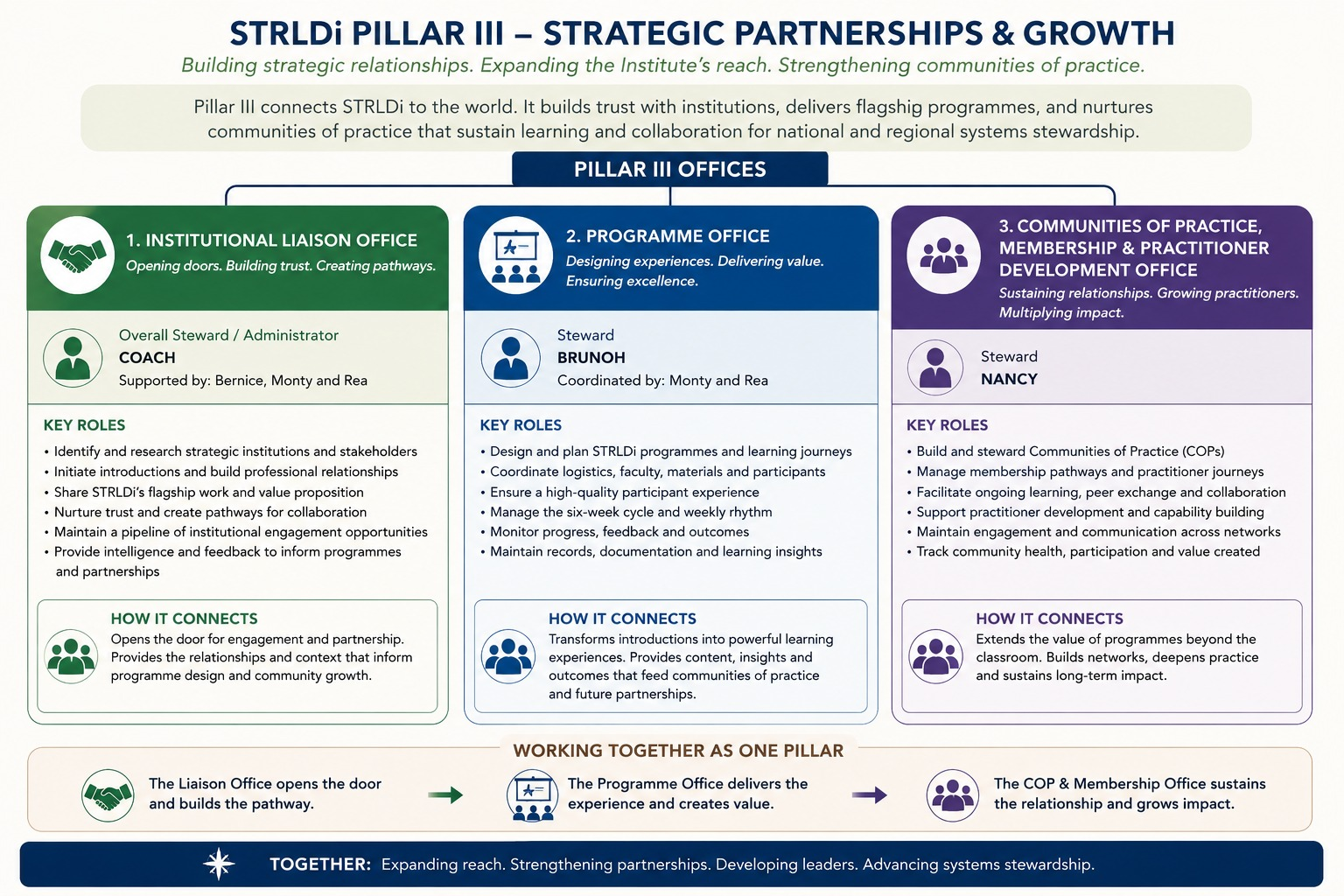
16. Closing Reflection
Institutions are ultimately remembered not for the number of relationships they establish, but for the value those relationships create over time.
At STRLDi, partnerships are viewed as a form of institutional stewardship. Every conversation is an opportunity to learn. Every relationship is an opportunity to deepen understanding. Every collaboration is an opportunity to strengthen the collective capacity of leaders and institutions to respond to persistent structural issues.
The Strategic Partnerships & Growth Pillar exists to cultivate these relationships with care, integrity and purpose. It brings together leaders from business, academia, research, professional bodies, communities and development organisations, creating spaces where knowledge is shared, trust is built and new possibilities emerge through collective inquiry.
As these relationships mature, they become pathways for systemic research, leadership development, Strategy Steward Labs and long-term institutional partnerships. In turn, the knowledge generated through these engagements continually strengthens the Institute itself, enabling STRLDi to expand its contribution to Botswana, Southern Africa and the wider international community.
In this way, partnership becomes more than collaboration. It becomes the means through which learning travels across institutions, leadership capability grows, and societies strengthen their capacity to understand and address the persistent structural issues that shape their future.
Relationships create understanding. Understanding enables coordinated action. Coordinated action creates lasting transformation. It is this progression that lies at the heart of the Strategic Partnerships & Growth Pillar and continues to guide STRLDi’s commitment to building stronger institutions, more capable leaders and more resilient societies.
Related Links:
https://strldi.weebly.com/servicesbw.html
This page outlines STRLDi’s professional programmes, consultancy services and engagement framework, including Executive Systems Programmes, systemic research, leadership development, Strategy Steward Labs and long-term institutional partnerships, together with the Institute’s professional fee structure.
Share this:


The STRLDi Institutional Roles
Stewarding an Institution That Learns
The work of STRLDi is organised through three institutional pillars, each carrying a distinct responsibility while contributing to one integrated learning institution. Together they ensure that STRLDi continually strengthens its capacity to understand persistent issues, develop leaders, build partnerships and steward long-term transformation.
At this stage of the Institute’s development, several leaders carry responsibilities across more than one pillar. This reflects STRLDi’s deliberate approach to institution building, where leadership grows alongside organisational capability. As the Institute expands, these responsibilities will progressively mature into dedicated offices and specialist appointments.
PILLAR I
Leadership & Institutional Stewardship
Purpose
To provide strategic direction, institutional governance, organisational learning and operational stewardship, ensuring that STRLDi remains a disciplined learning institution capable of sustaining its mission over generations.
Executive Director
Current Steward: Ms Sheila Damodaran
Provides overall leadership of the Institute and stewards its vision, philosophy, research agenda, strategic direction and institutional development. The Executive Director ensures coherence across all three institutional pillars and represents STRLDi nationally, regionally and internationally.
Advisory Council
Status: To be constituted
Provides independent strategic advice and institutional guidance to the Executive Director. The Council strengthens long-term thinking, institutional integrity and strategic positioning while preserving STRLDi’s purpose and values.
Office of Institutional Learning & Reflection
Current Steward: Rea
Serves as the organisational learning engine of STRLDi. The Office observes, documents and reflects upon the Institute’s work, ensuring that every engagement contributes to institutional knowledge and continuous improvement.
The Office also stewards the Five Institutional Stewardship Platforms:
- Knowledge Stewardship
- Learning Stewardship
- Partnership Stewardship
- Innovation Stewardship
- Systems Stewardship
Executive Secretariat
Current Steward: Rea
Coordinates executive governance by preparing agendas, recording decisions, monitoring implementation of action items and maintaining institutional records.
The Secretariat ensures that organisational commitments are translated into disciplined action while preserving continuity across the Institute.
Corporate Operations & Services
Future Office
Responsible for:
- Human Resources
- Finance
- Administration
- Procurement
- Information Technology
- Legal & Institutional Protection
- Governance Support
This office provides the operational foundation upon which every other pillar depends.
PILLAR II
Client Solutions & Delivery
Purpose
To help governments, organisations and communities understand persistent issues, strengthen leadership capability, co-create transformation strategies and build lasting institutional capacity.
Research & Systems Diagnostics
Current Steward: Nancy
Leads the Institute’s research agenda through systemic inquiry, behavioural analysis, policy research and organisational diagnostics.
Responsible for:
- National and regional research
- Systems diagnostics
- Publications
- Behaviour Over Time analysis
- System archetype development
- Research partnerships
Leadership Development
Current Steward: Bernice
Designs and delivers learning programmes that strengthen leaders’ capacity to understand complexity, facilitate collaboration and steward long-term transformation.
Responsible for:
- Executive programmes
- Learning Organisation programmes
- Facilitator development
- Curriculum design
- Leadership capability
Strategy Steward Labs
Current Steward: Ms Sheila Damodaran
Facilitates collaborative laboratories where governments, institutions and communities jointly translate systemic understanding into coordinated implementation strategies.
Responsible for:
- Strategy Labs
- Cross-sector facilitation
- Executive dialogue
- Shared vision development
- Strategy stewardship
Monitoring, Evaluation & Learning (MEL)
Future Office
Ensures that implementation generates measurable learning and continual improvement.
Responsible for:
- Monitoring
- Evaluation
- Learning reviews
- Impact assessment
- Continuous improvement
Digital Knowledge Platform
Current Steward: Monty
Develops and manages STRLDi’s digital knowledge infrastructure.
Responsible for:
- Knowledge repositories
- Digital publications
- AI-enabled knowledge systems
- Research archives
- Institutional memory
- Website development
Monty also supports Nancy in strengthening the Institute’s long-term research capability.
Office of Policy, Strategy & National Transformation
Future Office
Transforms research findings into practical policy advice, institutional reform programmes and national transformation strategies.
Responsible for:
- Policy advisory
- Strategy development
- National planning support
- Institutional reform
- Executive advisory
Office of International Programmes
Future Office
Coordinates STRLDi’s work across Africa and internationally.
Responsible for:
- Regional programmes
- International partnerships
- Cross-country learning
- Programme coordination
- Global institutional collaboration
PILLAR III
Strategic Partnerships & Growth
Purpose
To build trusted relationships, mobilise resources and cultivate the institutional ecosystem through which STRLDi’s work grows in reach, relevance and long-term impact.
Government Relations & Strategic Communications
Current Steward: Brunoh
Leads engagement with:
- National Government
- Ministries
- Public Service Leadership
- Government Agencies
- National Planning Institutions
- Diplomatic Missions
- Media Organisations
Also coordinates public communications, media engagement and strategic messaging.
Economic Partnerships & Development Cooperation
Current Steward: Mr Tema
Develops strategic relationships with:
- Private Sector
- Development Partners
- International Agencies
- International Development Organisations
- Investors
- Philanthropic Organisations
Also leads proposal development and resource mobilisation.
Institutional & Professional Partnerships
Current Steward: Mabua
Builds relationships with:
- Parastatals
- Professional Bodies
- Industry Associations
- Statutory Organisations
Strengthens professional collaboration and institutional learning.
Community, Knowledge & Regional Partnerships
Current Steward: Coach
Leads engagement with:
- Local Government
- Parliament
- Political Party Leadership
- Dikgosi and Traditional Leadership
- University Institutions
- Research Institutions
- Civil Society Organisations
- SADC and Regional Organisations
Coach also oversees the development of regional Communities of Practice and cross-border learning initiatives.
Proposal Development & Resource Mobilisation
Current Steward: Mr Tema (until a dedicated office is established)
Coordinates:
- Expressions of Interest
- Grant proposals
- Consultancy submissions
- Funding applications
- Strategic investment opportunities
Membership Office
Future Office
Develops and stewards the STRLDi learning community through:
- Individual Members
- Institutional Members
- Fellows
- Associates
- Alumni
- Friends of STRLDi
The Membership Office will become a significant contributor to the Institute’s long-term sustainability and recurring revenue.
Communities of Practice (CoPs)
Current Coordination: Coach
Supports the development of thematic learning communities where practitioners continue collaborating beyond individual projects.
Communities of Practice strengthen peer learning, innovation and professional exchange across sectors.
Conferences, Strategic Dialogues & Executive Forums
Shared Responsibility
Led collaboratively across the partnership team, these platforms bring together leaders from government, business, academia and civil society to explore persistent issues and co-create new possibilities for transformation.
Knowledge & Public Engagement
Current Coordination: Brunoh, with support from Monty
Responsible for ensuring that STRLDi’s knowledge reaches wider audiences through:
- Publications
- Media engagement
- Website
- Podcasts
- Blogs
- Social media
- Public lectures
- Executive briefings
Leadership Development Pathway
STRLDi is intentionally developing future institutional leaders.
Current stewardship arrangements reflect both present responsibilities and future organisational growth.
| Current Steward | Current Role | Long-Term Development Pathway |
|---|---|---|
| Ms Sheila Damodaran | Executive Director | Institutional Steward and Founder |
| Rea | Office of Institutional Learning & Reflection & Executive Secretariat | Transition to Leadership Development, supporting Bernice while continuing to steward institutional learning |
| Nancy | Research & Systems Diagnostics | Director of Research |
| Bernice | Leadership Development | Director of Leadership Development |
| Monty | Digital Knowledge Platform | Director of Digital Knowledge & Research Systems, supporting Nancy and leading the Digital Knowledge Platform |
| Brunoh | Government Relations & Strategic Communications | Director of Government Relations & Public Engagement |
| Mr Tema | Economic Partnerships & Development Cooperation | Director of Strategic Partnerships & Resource Mobilisation |
| Mabua | Institutional & Professional Partnerships | Director of Institutional Partnerships |
| Coach | Community, Knowledge & Regional Partnerships | Director of Regional Partnerships, Communities of Practice and SADC Engagement |
Building an Institution Through Stewardship
The roles presented above represent more than a distribution of responsibilities. They reflect STRLDi’s philosophy that institutions are built through stewardship, disciplined learning and shared purpose. As the Institute grows, today’s stewards will mentor future leaders, new offices will emerge and additional expertise will be incorporated. The architecture is therefore designed not merely to support the work of today, but to enable STRLDi to remain a resilient learning institution serving Botswana, Southern Africa and the wider international community for generations to come.
Share this:


PILLAR I
Leadership & Institutional Stewardship
Stewarding the Institute. Strengthening Its Capacity to Learn, Lead and Endure.
“Institutions capable of transforming nations must first be capable of continually transforming themselves.”
Purpose
Every enduring institution requires more than leadership. It requires stewardship.
Leadership provides direction. Stewardship safeguards purpose.
The Leadership & Institutional Stewardship Pillar exists to ensure that STRLDi remains a disciplined learning institution—one that is strategically guided, professionally managed, financially sustainable and continually strengthened through reflection and learning.
Unlike conventional organisations where administration exists primarily to support operations, this pillar recognises that the Institute itself is one of STRLDi’s most important subjects of study. How decisions are made, how knowledge is captured, how people learn together and how institutional capability grows are all treated as matters of deliberate inquiry.

The pillar therefore carries responsibility not only for governance and organisational management, but also for cultivating the culture, systems and disciplines that allow STRLDi to fulfil its mission over generations.
Its work ensures that the Institute remains coherent in purpose, disciplined in practice and resilient in the face of change.
Stewardship Responsibilities
Leadership & Institutional Stewardship is responsible for:
- Providing strategic direction for the Institute.
- Safeguarding the institutional vision, values and purpose.
- Strengthening organisational capability through continuous learning.
- Ensuring sound governance and accountability.
- Building organisational systems and operational excellence.
- Stewarding financial sustainability and institutional resources.
- Protecting the Institute’s intellectual property, reputation and legal integrity.
- Cultivating an organisational culture grounded in reflection, learning and innovation.
Institutional Structure
The pillar is organised through five mutually reinforcing offices, each contributing to the long-term health and development of the Institute.
1. Executive Director
Current Steward: Ms Sheila Damodaran
Purpose
The Executive Director provides the overall stewardship of STRLDi, ensuring that every aspect of the Institute remains aligned with its founding purpose and long-term mission.
The role extends beyond executive management. It is responsible for integrating research, leadership, partnerships and institutional learning into one coherent organisational system capable of contributing to national and regional transformation.
The Executive Director serves as the principal custodian of STRLDi’s philosophy, institutional direction and external representation.
Key Responsibilities
- Define and steward the Institute’s long-term vision.
- Provide executive leadership across all three institutional pillars.
- Direct research priorities and strategic initiatives.
- Build relationships with governments, development partners, universities and industry leaders.
- Lead institutional innovation and organisational development.
- Approve major programmes, partnerships and investments.
- Represent STRLDi nationally, regionally and internationally.
- Ensure the Institute remains faithful to its mission and values.
Key Result Areas
- Strategic leadership.
- Institutional growth.
- Research excellence.
- Partnership development.
- Organisational sustainability.
- National and international reputation.
2. Advisory Council
Status: To be constituted.
Purpose
The Advisory Council exists to strengthen the Institute through independent wisdom, strategic guidance and constructive reflection.
It does not manage STRLDi. Rather, it provides thoughtful counsel to the Executive Director, helping the Institute maintain long-term perspective while remaining responsive to emerging opportunities and challenges.
The Council also serves as a bridge between STRLDi and the wider community of national leaders, researchers, practitioners and development partners.
Key Responsibilities
- Provide strategic advice to the Executive Director.
- Review institutional priorities and progress.
- Offer independent perspectives on emerging issues.
- Strengthen organisational credibility.
- Introduce strategic opportunities and partnerships.
- Encourage long-term institutional thinking.
Key Result Areas
- Strategic guidance.
- Institutional integrity.
- Leadership support.
- External credibility.
- Long-term organisational resilience.
3. Office of Institutional Learning & Reflection
Current Steward: Rea
Purpose
This office represents one of STRLDi’s defining institutional innovations.
Its responsibility is to ensure that learning is never left to chance.
Every project, meeting, workshop, partnership and research assignment generates experience. Unless that experience is intentionally examined, documented and shared, valuable insight is easily lost.
The Office of Institutional Learning & Reflection ensures that individual experiences become collective knowledge and that collective knowledge becomes enduring institutional capability.
It also serves as the steward of the Institute’s Five Institutional Stewardship Platforms, embedding the disciplines of knowledge, learning, partnership, innovation and systems thinking across all areas of STRLDi.
Key Responsibilities
- Facilitate organisational reflection.
- Capture institutional learning.
- Identify recurring organisational patterns.
- Produce learning reviews and institutional insights.
- Steward the Five Institutional Stewardship Platforms.
- Promote continuous organisational improvement.
- Build institutional memory.
- Support knowledge sharing across all pillars.
Key Result Areas
- Organisational learning.
- Institutional memory.
- Continuous improvement.
- Knowledge integration.
- Strengthened organisational capability.
4. Executive Secretariat
Current Steward: Rea
Purpose
The Executive Secretariat provides the coordination discipline that enables effective institutional leadership.
By ensuring that meetings are purposeful, decisions are documented and commitments are followed through, the Secretariat creates the organisational coherence required for a learning institution to function effectively.
Its work extends beyond administration. It enables organisational rhythm, accountability and continuity.
Key Responsibilities
- Coordinate executive meetings.
- Prepare agendas and documentation.
- Record decisions and institutional commitments.
- Monitor action plans.
- Coordinate Executive Director correspondence.
- Support Advisory Council operations.
- Maintain institutional records.
Key Result Areas
- Governance effectiveness.
- Executive coordination.
- Decision tracking.
- Organisational discipline.
- Institutional continuity.
5. Corporate Operations & Services
Future Appointment
Purpose
Corporate Operations & Services provides the operational foundation upon which STRLDi’s mission is sustained.
Its role is to ensure that organisational systems, financial resources, people, technology and administrative processes function efficiently, ethically and professionally.
Rather than being viewed as a support function alone, Corporate Operations is recognised as an essential contributor to institutional resilience and long-term sustainability.
Core Functions
Human Resources
Building organisational capability through recruitment, performance development, wellbeing and professional growth.
Finance & Financial Stewardship
Managing budgeting, financial reporting, revenue, investments and long-term financial sustainability.
Administration
Providing administrative systems, facilities management and operational coordination.
Procurement
Ensuring transparent, efficient and accountable acquisition of goods and services.
Information & Digital Services
Supporting information technology, cybersecurity, digital platforms and organisational systems.
Governance, Legal & Institutional Protection
Managing contracts, compliance, intellectual property, ethics, organisational policies and institutional risk.
Key Result Areas
- Financial sustainability.
- Operational excellence.
- Strong governance.
- Effective organisational systems.
- Professional administrative services.
- Institutional protection.
How the Pillar Works
Leadership & Institutional Stewardship is not separate from the Institute’s work; it is the mechanism through which that work remains coherent and sustainable.
The Executive Director provides strategic direction.
The Advisory Council strengthens long-term institutional thinking.
The Office of Institutional Learning & Reflection ensures that knowledge generated through every engagement contributes to organisational capability.
The Executive Secretariat translates decisions into coordinated action.
Corporate Operations & Services provides the systems, resources and governance that enable the Institute to function effectively.
Together, these offices create the conditions under which STRLDi can continually increase its capacity to understand persistent issues, develop leaders, build partnerships and contribute meaningfully to national and regional transformation.
Key Result Areas of the Pillar
The Leadership & Institutional Stewardship Pillar will be considered successful when it consistently:
- Stewards STRLDi’s vision, values and institutional purpose.
- Builds a financially sustainable and professionally managed Institute.
- Strengthens organisational capability through disciplined learning and reflection.
- Maintains effective governance, accountability and ethical practice.
- Protects the Institute’s knowledge, reputation and intellectual assets.
- Develops organisational systems that enable excellence across all three pillars.
- Ensures that STRLDi remains an enduring learning institution capable of serving future generations.
Share this:


The STRLDi Institutional Architecture
Building a Learning Institution for National and Regional Transformation
Introduction
The Systems Thinking Research & Leadership Development Institute (STRLDi) was established from a simple but profound observation: persistent issues do not disappear simply because more effort is applied to them.
Around the world, governments, businesses and communities continue to invest significant resources in addressing unemployment, food insecurity, institutional underperformance, environmental degradation and other complex challenges. Yet many of these issues continue to reappear, often in different forms, despite successive policy reforms, organisational restructuring and increased investment.
The question, therefore, is not whether people care enough or work hard enough.
The question is whether we are working with an adequate understanding of the systems producing these outcomes.
STRLDi exists to help leaders and institutions answer that question.
Unlike conventional consulting firms that begin with recommendations, or academic institutions that often conclude with research, STRLDi was established to accompany institutions throughout the complete journey of systemic transformation—from understanding persistent issues, to building leadership capability, to coordinating collective action, and ultimately to strengthening the capacity of societies to learn and renew themselves.
This philosophy demanded a different kind of institution.
Rather than organising itself around traditional departments, STRLDi has been intentionally designed as a learning institution, where research, leadership development, partnerships and institutional learning continually reinforce one another. Every engagement contributes not only to the work of a client, but also to the continuing growth of the Institute itself.
The architecture presented here describes how STRLDi fulfils that purpose.
An Institution Designed to Learn
Many organisations are designed primarily to deliver services.
Others are designed to administer programmes.
STRLDi has been designed to continuously increase its capacity to understand, learn, and contribute to systemic transformation.
Research informs leadership development.
Leadership development strengthens Strategy Steward Labs.
Strategy Steward Labs generates new learning.
Institutional learning strengthens future research.
Partnerships create new opportunities.
Knowledge is continuously captured, reflected upon, and shared.
This creates reinforcing cycles through which the Institute becomes progressively more capable of serving governments, organisations and communities over time.
The architecture therefore reflects not merely an organisational structure, but a philosophy of institutional learning.
The Three Institutional Pillars
The work of STRLDi is organised through three mutually reinforcing institutional pillars.

Each pillar fulfils a distinct responsibility while remaining deeply interconnected with the others.
Together they enable the Institute to generate knowledge, develop leadership capability, build strategic relationships and sustain its long-term contribution to society.
Pillar I
Leadership & Institutional Stewardship
Every enduring institution requires stewardship.
Leadership & Institutional Stewardship exists to safeguard the Institute’s purpose, strengthen its organisational capability and ensure that STRLDi remains a disciplined learning institution throughout its development.
This pillar provides executive leadership, institutional governance, organisational development, financial stewardship and operational excellence. More importantly, it cultivates the culture through which reflection, learning and continuous improvement become everyday organisational practice.
Working alongside executive leadership is the Advisory Council, whose role is not to manage the Institute but to provide wisdom, independent perspective and constructive challenge as STRLDi continues to evolve.
Within this pillar also sits the Office of Institutional Learning & Reflection, a distinctive feature of STRLDi’s architecture. Rather than limiting organisational learning to project evaluations or annual reviews, this office continually observes the Institute itself—capturing lessons, identifying emerging patterns and ensuring that experience becomes institutional capability rather than remaining individual knowledge.
Supporting these functions is the Executive Secretariat, responsible for coordinating executive governance, preparing meetings, recording decisions and ensuring that organisational commitments are translated into disciplined action.
The operational foundation of the Institute is provided through Corporate Operations & Services, integrating finance, human resources, administration, information technology, procurement and organisational support into one coherent service that enables every other part of the Institute to function effectively.
Leadership & Institutional Stewardship ensures that STRLDi not only delivers quality work, but continually develops the organisational capability required to sustain that work for generations to come.
Pillar II
Client Solutions & Delivery
Client Solutions & Delivery represents the point at which STRLDi’s purpose becomes tangible.
It is through this pillar that governments, institutions and organisations engage the Institute to better understand persistent issues, strengthen leadership capability and develop coordinated responses to systemic challenges.
Every engagement begins with Research & Systems Diagnostics, where issues are explored through Behaviour Over Time analysis, systems thinking, systemic archetypes and STRLDi’s evolving methodologies for understanding persistence.
Research provides the foundation upon which meaningful intervention becomes possible.
Research is followed by Leadership Development, where leaders develop the disciplines required to think systemically, challenge assumptions, build shared understanding and cultivate learning within their own institutions.
Understanding alone, however, is insufficient.
The third component, Strategy Steward Labs, brings together leaders from across sectors to jointly translate systemic understanding into coordinated implementation. Rather than facilitating isolated workshops, these laboratories enable diverse actors to work together on the systems they collectively influence.
The Institute’s work is continually strengthened through Monitoring, Evaluation & Learning, ensuring that implementation generates new insight and that future engagements benefit from the lessons of previous work.
Supporting all of these activities is the Digital Knowledge Platform, which preserves research, methodologies, publications and institutional learning as a living repository available to future generations of practitioners and researchers.
As STRLDi continues to mature, this pillar will expand through the establishment of the Office of Policy, Strategy & National Transformation, translating research and implementation learning into national policy frameworks, strategic advisory services and long-term institutional transformation programmes.
Future international delivery will be coordinated through the Office of International Programmes, enabling the Institute to serve governments and institutions across Africa and beyond while remaining grounded in the same disciplined approach to systemic inquiry and learning.
Together, these capabilities transform understanding into leadership, leadership into coordinated action, and coordinated action into enduring institutional learning.
Pillar III
Strategic Partnerships & Growth
Persistent issues do not exist within organisational boundaries.
Neither should the relationships required to address them.
Strategic Partnerships & Growth exists to cultivate the institutional ecosystem through which STRLDi’s mission can flourish.
Its work extends far beyond conventional marketing or business development. It builds trusted relationships with governments, private sector leaders, development partners, public enterprises, universities, professional bodies, traditional leadership and regional institutions. These relationships become the foundation upon which research, leadership development and Strategy Steward Labs are commissioned and sustained.
Within this pillar, specialised partnership portfolios ensure that every major constituency receives dedicated stewardship while remaining connected to the broader mission of the Institute.
The pillar also coordinates proposal development and resource mobilisation, ensuring that opportunities are translated into funded programmes and long-term institutional partnerships.
Through Communities of Practice, professionals working across similar fields continue learning together beyond individual projects, creating enduring networks of inquiry and practice.
The Membership Office, to be established as the Institute grows, will cultivate long-term relationships with practitioners, institutions, fellows and supporters who wish to contribute to STRLDi’s ongoing development and learning community.
National, regional and international conferences, seminars and strategic dialogues provide opportunities for collective reflection, cross-sector learning and the emergence of new partnerships.
Knowledge generated by the Institute is shared through Knowledge & Public Engagement, ensuring that research, publications and institutional learning contribute to wider public understanding of persistent issues and systemic transformation.
Strategic Partnerships & Growth therefore builds more than relationships.
It builds the trust, reputation and institutional capital through which STRLDi’s work continually expands in influence, relevance and impact.
The Five Institutional Stewardship Platforms
Running across all three pillars are five enduring institutional disciplines.
These are not departments.
They are the principles through which every part of STRLDi operates and learns.
Knowledge Stewardship ensures that every project, publication, dialogue and experience contributes to the Institute’s growing body of knowledge.
Learning Stewardship embeds disciplined reflection into everyday practice, encouraging individuals and teams to continually strengthen their understanding and capability.
Partnership Stewardship recognises that relationships are among the Institute’s most valuable assets and that every member of STRLDi contributes to building trust and collaboration.
Innovation Stewardship encourages thoughtful experimentation, methodological development and continuous improvement while remaining grounded in disciplined inquiry.
Systems Stewardship maintains the Institute’s unwavering attention on the larger systems within which organisations, communities and nations operate, ensuring that immediate activities remain aligned with long-term transformation.
These five stewardship platforms are coordinated through the Office of Institutional Learning & Reflection, helping the Institute continually strengthen its practice while remaining faithful to its founding purpose.
The STRLDi Commitment
Institutions shape societies.
The quality of those institutions depends not only on the knowledge they possess, but on their willingness to continue learning.
STRLDi has therefore been designed not simply to conduct research, deliver training or facilitate strategic dialogue.
It has been designed to become an institution that continually increases its own capacity to understand persistent issues, develop leaders, strengthen partnerships and contribute meaningfully to the transformation of nations and communities.
Its architecture reflects this commitment.
Its people give life to it.
Its work continually refines it.
And its purpose remains unchanged:
To help leaders, institutions and nations learn to see the systems they are part of—so that together they may build societies that are more resilient, more productive, more just and more capable of renewing themselves for generations to come.
Related Links:
Pillar I: The Leadership & Institutional Stewardship Pillar of STRLDi focuses on ensuring the Institute’s long-term sustainability and growth through strategic direction, effective governance, and continuous learning. It emphasizes stewardship alongside leadership, fostering an organizational culture that enhances capability and resilience to adapt to change, ultimately aiming for national and regional transformation. https://sheilasingapore.blog/2026/07/06/pillar-i/
Pillar 2: The purpose of Client Solutions & Delivery is to help governments, organisations, development partners and communities understand and respond effectively to persistent issues that continue to resist conventional approaches.
Many institutions invest significant financial, human and political resources in addressing national and organisational challenges. Yet despite these investments, many issues continue to recur, often becoming more deeply embedded over time. This persistence suggests that the difficulty lies not only in implementation, but in the way the problem itself is understood.
Client Solutions & Delivery exists to change that. https://sheilasingapore.blog/2026/07/07/pillar-ii/
Pillar 3: The Strategic Partnerships & Growth Pillar exists to build, steward, and strengthen the relationships through which STRLDi fulfils its mission.
Persistent national and regional issues rarely exist within the boundaries of a single organisation, ministry or profession. They emerge through the interaction of many actors whose decisions, priorities, and actions continually influence one another. For this reason, meaningful transformation depends as much on the quality of relationships as on the quality of technical solutions.
STRLDi therefore views partnership development not as an activity undertaken after research is completed or programmes are designed. Partnership is itself a strategic capability. It enables diverse institutions to discover shared purpose, develop mutual trust and mobilise collective action around issues that no single organisation can address independently.
This pillar cultivates the institutional ecosystem within which STRLDi’s research, leadership development, and strategy stewardship can flourish. It identifies opportunities for collaboration, develops long-term institutional relationships, mobilises resources, and creates the conditions for the continual exchange of knowledge across sectors, disciplines and national boundaries. https://sheilasingapore.blog/2026/07/07/pillar-iii/
Institutional Roles: The work of STRLDi is organised through three institutional pillars, each carrying a distinct responsibility while contributing to one integrated learning institution. Together they ensure that STRLDi continually strengthens its capacity to understand persistent issues, develop leaders, build partnerships and steward long-term transformation.
At this stage of the Institute’s development, several leaders carry responsibilities across more than one pillar. This reflects STRLDi’s deliberate approach to institution building, where leadership grows alongside organisational capability. As the Institute expands, these responsibilities will progressively mature into dedicated offices and specialist appointments. https://sheilasingapore.blog/2026/07/07/the-strldi-institutional-roles/
Share this:

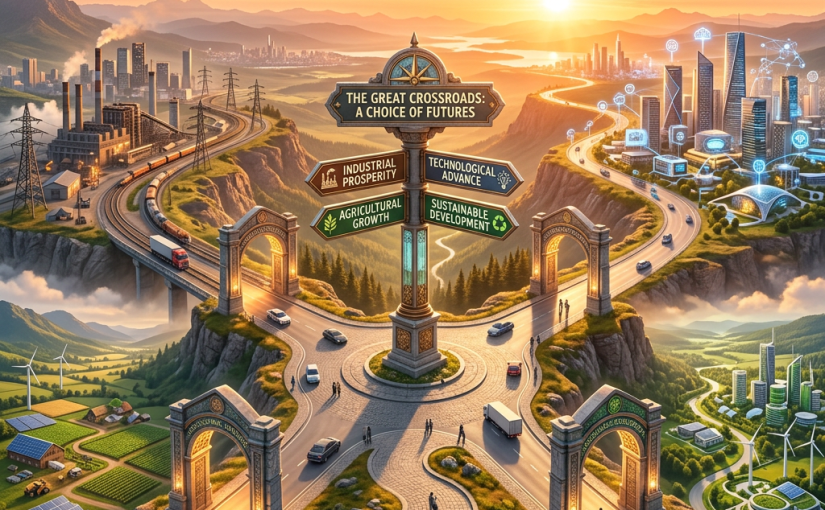
Why the STRLDi Unemployment Study Is Different
A Reflection to Presidents, Ministers, Mayors and National Leaders on the Structural Nature of Persistent Unemployment
The World Does Not Lack Unemployment Studies
There are thousands of unemployment studies across the world. Governments commission them. Universities publish them. International agencies such as the International Labour Organization, the World Bank, the Organisation for Economic Co-operation and Development, and the International Monetary Fund track unemployment continuously through labour-force surveys, economic outlooks, productivity reports, and policy frameworks. Economists forecast unemployment cycles while labour ministries attempt interventions through stimulus programmes, entrepreneurship funds, skills initiatives, and public employment schemes.
Yet despite decades of analysis, intervention, and reform, unemployment continues to persist across countries with vastly different political systems, resource bases, educational levels, and economic structures. This alone should force leaders to pause and ask a deeper question: what if unemployment is not merely an economic statistic to be managed, but a systemic condition continuously reproduced by the structure of society itself? What if the issue is not only the absence of jobs, but the interaction between governance systems, aspiration systems, productive capacity, labour allocation, education pathways, and national identity over time?
The reflections in this article emerge from the broader STRLDi systems-thinking study on persistent unemployment in Botswana, which examines unemployment not as an isolated labour-market issue, but as a structural output arising from governance systems, productive-capacity design, labour allocation patterns, aspiration systems, and institutional fragmentation.
Most Studies Measure Unemployment. STRLDi Examines What Produces It
The STRLDi unemployment study begins from a fundamentally different place. It does not begin by asking how many people are unemployed. It begins by asking: what structural conditions continuously regenerate unemployment, labour drift, productive-capacity erosion, and social fragmentation even while economies remain active and populations remain busy? This distinction is critical because it shifts the discussion away from unemployment as an isolated labour-market problem and toward unemployment as an emergent systems outcome.
Most global unemployment studies are designed for measurement. The International Labour Organization tracks labour participation rates, youth unemployment, informal labour trends, and sectoral employment shifts. National statistics offices produce quarterly unemployment figures while economic institutes generate labour dashboards and productivity indicators. These studies are essential because they help governments see visible symptoms of labour stress. But measurement studies often stop at description. They can tell a ministry how many people are unemployed, but they rarely explain why the same outcomes continue repeating decade after decade despite continuous intervention.
Table 1: Major Categories of Global Unemployment Studies and Their Primary Purposes
To understand where the STRLDi study differs, it is useful first to understand how unemployment is commonly studied globally. Most existing unemployment research falls into several broad categories, each designed for different policy and analytical purposes.
| Category of Unemployment Study | Primary Purpose | Typical Questions Asked | Underlying Assumption | Typical Outputs | Key Limitations | How the STRLDi Study Differs |
|---|---|---|---|---|---|---|
| 1. Measurement-Based Studies | To quantify unemployment levels and labour-force trends | • What is the unemployment rate?• Which age groups are affected?• Which regions/sectors are losing jobs? | If unemployment is measured accurately, policy responses can be designed effectively | Labour-force surveys, dashboards, statistical reports, quarterly updates | Describes symptoms, not structural causes; often treats unemployment as temporary | STRLDi goes beyond measurement to examine the structural systems continuously regenerating unemployment |
| 2. Macroeconomic Studies | To link unemployment to economic performance and policy variables | • How does GDP affect unemployment?• What is the impact of inflation, interest rates, fiscal policy? | Unemployment is primarily an economic-cycle or policy-management issue | Economic models, forecasts, macroeconomic policy recommendations | Strong on aggregates, weak on human behaviour, aspiration, and identity systems | STRLDi includes governance, social narratives, aspiration pathways, and labour-allocation behaviour as part of the unemployment structure |
| 3. Labour-Market Mismatch Studies | To identify gaps between education/training and available jobs | • Are graduates employable?• What skills are missing?• Are TVET systems aligned with industry? | Better alignment between education and industry will reduce unemployment | Skills-gap analyses, TVET reforms, STEM recommendations | Assumes jobs already exist; rarely questions whether the economy itself can absorb labour | STRLDi questions the structure and absorptive capacity of the economy itself |
| 4. Poverty & Social-Protection Studies | To reduce hardship caused by unemployment | • How do unemployed populations survive?• What welfare systems are needed? | The central issue is cushioning vulnerable populations | Welfare programmes, grants, cash-transfer systems | Focuses on consequences rather than generators of unemployment; may normalise dependency | STRLDi examines the systemic generators of dependency and productive-capacity erosion |
| 5. Entrepreneurship & Self-Employment Studies | To promote entrepreneurship as a solution to unemployment | • How can more SMEs and start-ups be created?• Can the informal sector absorb labour? | Self-employment can absorb unemployment | Entrepreneurship programmes, SME ecosystems, innovation hubs | Often overestimates absorptive capacity; ignores instability and “survival entrepreneurship” | STRLDi distinguishes between productive enterprise and unstable attention/gig-based survival pathways |
| 6. Technological Displacement Studies | To assess the impact of automation, AI, and digitalisation on jobs | • Which jobs will AI replace?• What future skills are needed? | Technology is the main driver reshaping labour markets | Future-of-work scenarios, automation forecasts | Often techno-centric; weak on emotional, identity, and governance implications | STRLDi integrates emotional systems, labour narratives, aspiration shifts, and national resilience |
| 7. Political & Governance Studies | To examine how governance quality affects employment outcomes | • How does corruption affect jobs?• Are labour institutions effective? | Weak governance creates weak labour outcomes | Governance reforms, institutional policy recommendations | Often fragmented by ministry or sector; rarely integrates aspiration and behavioural systems | STRLDi connects governance structures with labour allocation, identity systems, and productive-capacity formation |
| 8. STRLDi Structural-Systemic Unemployment Study | To reveal the interconnected structural architecture continuously reproducing unemployment | • What systemic structures regenerate unemployment?• How do narratives, aspiration systems, governance, labour allocation, and productive-capacity systems interact?• Why does unemployment persist despite interventions? | Unemployment is an emergent systemic output arising from interacting structures, behaviours, narratives, and institutional fragmentation | Systems archetypes, BOT graphs, Onion models, labour-allocation analysis, governance coordination frameworks, productive-capacity mapping | Requires deeper interdisciplinary analysis and long-term systems thinking | STRLDi treats unemployment not as a standalone labour-market issue, but as a civilisational systems problem linked to governance, productive capacity, aspiration, emotional systems, and national resilience |
Macroeconomic Studies Explain Cycles, But Not Structural Drift
Another major category of unemployment research comes from macroeconomic institutions. The International Monetary Fund, central banks, treasury departments, and development economists typically connect unemployment to GDP growth, inflation, fiscal policy, interest rates, exchange-rate movements, and business cycles. Their assumption is that unemployment rises and falls primarily through economic management and market adjustment.
Yet many countries continue experiencing persistent unemployment even during periods of economic growth. Some economies expand while productive labour absorption weakens underneath them. This reveals an uncomfortable but necessary reality for presidents, ministers, and mayors: economic activity alone does not guarantee productive employment systems. Economies can grow numerically while labour structures fragment socially, emotionally, and institutionally.
Skills-Mismatch Studies Assume the Economy Can Already Absorb Labour
There is also a large body of work focused on labour-market mismatch. The Organisation for Economic Co-operation and Development, universities, TVET commissions, and workforce development agencies often examine whether graduates possess the right skills for industry. These studies ask whether STEM participation is sufficient, whether technical education aligns with employer needs, and whether educational systems are preparing people adequately for the future of work.
These studies are valuable, but they often carry an unspoken assumption: that the economy already possesses sufficient structural capacity to absorb labour if only skills are corrected. The STRLDi study steps further back. It asks whether the productive sectors themselves are coordinated, attractive, visible, and structurally capable of absorbing growing populations in the first place. Skills alone cannot solve unemployment if productive systems are weak, fragmented, or socially abandoned.
The Attention Economy Has Changed the Labour Conversation Entirely
The emergence of the global attention economy has intensified this structural problem dramatically. Across the world, millions of young people are moving into digital creator pathways, gig visibility work, livestreaming, short-form content production, online influencing, and algorithm-driven labour systems. Technology platforms such as TikTok, YouTube, Instagram, Spotify, and Meta Platforms have democratised visibility at unprecedented scale.
Traditional unemployment studies frequently classify these individuals as self-employed, economically active, or entrepreneurial. But the deeper systems question is whether societies are quietly losing labour from productive sectors into structurally unstable visibility economies that cannot sustainably absorb populations over time. The issue is no longer simply unemployment. The issue is labour misallocation. A nation may appear economically busy while simultaneously weakening its agricultural base, manufacturing systems, engineering pipeline, construction capacity, and technical workforce.
STRLDi Integrates Systems That Are Normally Studied Separately
This is where the STRLDi study diverges most sharply from conventional labour analysis. The study integrates governance systems, productive-capacity structures, labour allocation patterns, aspiration systems, emotional systems, education pathways, institutional fragmentation, and national narratives into one analytical frame. Most unemployment studies isolate these dimensions. STRLDi examines how they interact continuously over time.
This systems orientation draws deeply from the work of Peter Senge and The Fifth Discipline, while also resonating with broader systems-thinking traditions associated with Jay Forrester and Donella Meadows. The central insight is simple but powerful: behaviour over time emerges from structure. If societies continuously reward visibility over productive capability, weaken technical aspiration, disconnect governance from production systems, and fragment labour pathways, then unemployment will persist regardless of how many interventions are introduced.
Table 2: Global Studies That Partially Overlap with the STRLDi Unemployment Framework
While several global studies partially overlap with elements of the STRLDi framework, few integrate governance systems, labour allocation, productive-capacity structures, aspiration systems, emotional systems, and national resilience into one systemic unemployment model.
| Study / School of Work | Main Focus | Similarity to STRLDi | Where STRLDi Goes Further |
|---|---|---|---|
| A Workforce Development Systems Model for Unemployed Job Seekers | Uses systems thinking for workforce development and employment pathways | Recognises unemployment as a systems issue involving multiple stakeholders | STRLDi expands beyond workforce placement into governance, aspiration systems, productive-capacity design, labour drift, emotional systems, and national economic architecture |
| The OECD’s Thinking on the Governing of Unemployment | Examines how institutions and governance frameworks conceptualise unemployment | Treats unemployment as structurally governed rather than accidental | STRLDi integrates labour allocation, sectoral productivity, creator economies, emotional identity systems, and productive-sector withdrawal |
| Granger Causal Nexus between Good Public Governance and Unemployment | Studies governance quality and unemployment causality | Recognises governance as central to labour outcomes | STRLDi goes beyond governance indicators into systemic feedback loops, national narratives, labour aspiration shifts, and productive-capacity circulation |
| Investigating the Effect of Governance on Unemployment: South Asian Countries | Links governance variables with unemployment performance | Shares concern with institutional quality and labour systems | STRLDi incorporates emotional systems, national production structures, creator-economy labour diversion, and systems archetypes |
| Using Systems Thinking to Conceptually Link Development Interventions and Public Policy | Uses systems thinking to connect policy, governance, and development interventions | Similar transdisciplinary systems-thinking orientation | STRLDi applies systems thinking directly to unemployment as a national structural output and integrates labour-sector absorption analysis |
| Systems Thinking to Understand National Well-Being from a Human Capital Perspective | Models national well-being through interconnected human-capital systems | Similar systems-level perspective on development | STRLDi specifically focuses on unemployment persistence, labour misallocation, and sectoral productive-capacity failure |
| Centering the Complexity of Long-Term Unemployment | Explores long-term unemployment through social and identity systems | Recognises identity, governance, and self-governing narratives | STRLDi extends this into national labour allocation, productive-sector withdrawal, creator-economy drift, and structural economic redesign |
| STRLDi Unemployment Study | Systems-thinking diagnosis of persistent unemployment as a structural output emerging from governance, labour allocation, productive capacity, aspiration systems, emotional systems, and sectoral misalignment | Integrates systems thinking, governance, labour absorption, identity, national narratives, productive sectors, emotional systems, and attention-economy drift into one coherent national-development framework | Represents one of the first known national-scale applications of The Fifth Discipline to unemployment, labour allocation, productive-capacity design, and systemic economic restructuring |
Why This Matters to Presidents, Ministers and Mayors
For national and local leaders, this distinction matters profoundly. A mayor can build roads, markets, industrial parks, and innovation hubs, yet still struggle with youth unemployment if the local aspiration system no longer values production-oriented work. A president can expand university enrolment while simultaneously weakening national productive capacity if educational pathways drift away from engineering, agriculture, manufacturing, logistics, and technical coordination.
Without alignment between aspiration systems and productive systems, nations begin hollowing out from within while appearing modern on the surface. This is one of the most dangerous structural illusions facing governments today. The rise of visibility economies can create the appearance of activity while quietly weakening the foundations required for long-term resilience.
The STRLDi Study Is Not Merely About Jobs
The STRLDi unemployment study, therefore, moves beyond policy commentary into structural interpretation. It asks leaders to see unemployment not only through economics, but through governance coordination, emotional systems, labour narratives, social identity, productive-capacity design, and long-term national resilience. In this sense, the study belongs less to the category of conventional labour-market research and more to what may be called a structural-systemic national capacity study.
The deeper warning within the study is that nations may mistakenly interpret labour drift into digital and informal sectors as relief for unemployment systems. Yet if large portions of the working-age population withdraw from productive sectors without equivalent replacement, the long-term consequence is not resilience but fragility. Food systems weaken. Manufacturing dependence rises. Technical shortages expand. Mental-health pressures intensify. Youth become visible but structurally disconnected from stable pathways of mastery, contribution, and coordinated production.
The Real Question the World Must Now Ask
The purpose of the STRLDi study is therefore not merely to reduce unemployment statistics. Its purpose is to help societies understand the structural conditions required to absorb populations meaningfully into productive life over generations. This requires governments to think differently about labour, education, identity, aspiration, governance coordination, and national development itself.
Most unemployment studies ask: How do we reduce unemployment?
The STRLDi study asks: What structural conditions continuously produce unemployment, labour drift, and productive-capacity erosion even while societies appear economically active?
That is a fundamentally different level of inquiry. Increasingly, it is also the level of inquiry the world now requires.
Share this:


When Seeds Take Root Across Continents
A Tribute to Dr Daniel Kim and Ms Diane Cory
by Sheila Damodaran
“There are teachers who change what we know, and there are teachers who change how we see.”
Daniel Kim and Diane Cory did both.
The Beginning – 1990s: Learning to See
I first sat in D&D’s class (as they are fondly known) in 1996. I remember sitting there, wide-eyed. I wasn’t astonished by what was new. Instead, I realized that I had been waiting for this all along without even knowing it.
In 1999, I joined their postgraduate initiative titled Leaders for Learning programme at the Singapore Civil Service College. It was the year-long Learning Organisation Programme. At that time, The Fifth Discipline was just starting to take root in Asia. The programme was led by Daniel Kim and Diane Cory. I was enlisted as their Teaching Assistant. The course aimed to train internal facilitators and consultants. These professionals would bring systems thinking into their institutions. They would also incorporate organisational learning.
I entered the programme wanting to understand systems thinking. At the time, my mind was still trained to think in straight lines. And I was good at it, given my strong mathematics and science backgrounds. I would analyse, sequence, and solve problems. I did not realize I was reacting within a part of the whole. Daniel’s patient way of drawing archetypes on flipcharts began to loosen that habit. He didn’t just teach loops. He showed us how the world organizes itself through feedback, delay, and interconnection. He demonstrated how structure generates a consistent behaviour over time. He also explained how seeing the whole helps us recognise these patterns. That recognition, right there, changes how we act within it.
Meanwhile, Diane guided us through profound visioning work. In one of her closing sessions, she tasked us to write a vision. We reflected on where we hoped to see this work unfold in the future. I wrote that I wanted to see it extend beyond organisations. I could already sense that organisational boundaries inevitably limit what we see. Acting only within those limits rarely brings real leverage. I wanted it to reach into governments, communities, businesses and the nation. Eventually, I hoped it would extend into the United Nations.
A year later, I received my self-addressed letter, reminding us of what we had envisioned. By then, I was already facilitating joint public–private sector sessions — the seed of a dream beginning to take root.
The Early Practice – 2000s: Building Bridges
By the early 2000s, I was applying these frameworks within Singapore’s public service. Those years taught me something Daniel and Diane had always implied. Systems thinking is not just an analytical method. It is an ethical practice.
Every policy conversation, reform, and meeting room became a living example of feedback and structure. In 2002, during an intense phase of work, I started sketching an idea. This would later evolve into The Onion Model. It shows how layers of belief, structure, and behaviour reinforce each other across multiple archetypes.

Daniel’s archetypes helped me see the patterns; Diane’s insistence on clarity of vision helped me trust them.
That same year, I convened the Learning Organisation Practitioners Network (LOPN). It was a community of practice lovingly put together by both public and private sector individuals. This community connected public and private leaders across sectors. It was not yet SoL (Society for Organizational Learning). However, it carried the same spirit till I departed for Botswana in 2008. The aim was to keep learning alive where people work, not only where they study.
At its heart, their teaching carried a moral invitation. It urged us to maintain coherence, clarity, and compassion. This charge is crucial even when systems lose theirs.
The Middle Years – 2010s: When Systems Speak Back
The years that followed were the true practice field. Applying systems thinking within political and institutional settings required not only clarity but stamina.
The Government of Botswana had invited me to bring this learning into a national context. In 2005, I served as the Chief Facilitator of the first Cabinet Retreat of the Government of Botswana. The recurring issue of unemployment was a focal point. The country’s struggle to diversify its economy also became the central case study.
In 2007, Permanent Secretary to the President Eric Molale invited me to continue the work. This work had begun after he reviewed my initial findings from the Cabinet Retreat. I was encouraged to carry the study forward into NDP10, Botswana’s national development planning process for 2008.
That year marked the first time parastatal and private-sector leaders were included in national planning. The government also recognised a gap. The public service leadership community lacked the tools of The Fifth Discipline. They particularly lacked the tools of Systems Thinking. I was subsequently engaged on a four-year contract to help senior officers in the public service develop these critical skills.
By 2018, the Human Resource Development Council (HRDC) re-engaged me to finalise the study on unemployment and economic diversification. This became feasible after the establishment of Statistics Botswana, which enabled us to undertake the research with confidence. It is the first study of its kind in the world. I had long imagined that such a study was possible. It was extraordinary to watch it (and The Onion Model) come alive before my eyes. That study later anchored the formation of STRLDi in Botswana.
I had been quiet for about six years (2013–2018). Returning to public work after completing that first case study marked a much clearer comeback. During that same period, I was building a second organisation. It is a business that continues to inform my research. I was also learning the ropes of life in a new country. This foray into food manufacturing has allowed me to study both the manufacturing and agriculture sectors at close range.
Through this experience, I began to see that working systemically involves being influenced by the system itself. The discipline was not only about seeing patterns—it was about staying in relationship with the whole. I explored why unemployment persists. I examined why agriculture and manufacturing so often fail to connect. I studied how the structures beneath them shape national outcomes.
Those years marked a turning point. Systems thinking was no longer merely a professional craft. It became a way of inhabiting the world. It was a lifelong apprenticeship in seeing reality as a whole.
The Renewal – 2020s: Taking Root in Africa
Two decades later, I find myself in a very different geography. I am now a resident in Botswana, Africa, but still in the same field of practice. We engage the region and the globe through The Systems Thinking Research & Leadership Development Institute (STRLDi). These same principles are brought into national dialogues on agriculture. They influence governance and economic transformation.
The Onion Model has matured into a research framework. It maps national systemic archetypes. It helps leaders see how reinforcing loops in policy, investment, and behaviour produce recurring outcomes. These outcomes include unemployment or underinvestment.
The insights began on Daniel’s flipcharts. They also originated in Diane’s visioning circles. These insights now help shape public policy, farmer training, and cross-sector collaboration across Africa.
In many ways, this is the natural evolution of Diane’s visioning work. The learner is becoming the teacher, not by design, but by continuity. We are living their visions of us. I like to think that she would smile. She would know that the seed she helped plant found new soil. The loops Daniel once drew still guide new learners today.
✳️ Reflection
Compared to forty years ago, the world has shifted at its core. We speak of climate change, political upheavals, or social breakdowns. Humanity is beginning to recognize the larger forces at play. It is also starting to enter into dialogue with itself.
That conversation is happening everywhere: on Facebook, LinkedIn, X, Google — in the words of citizens, scientists, leaders, and learners. The voice of collective reflection is growing louder.
It’s a kind of global systems awareness. This awakening has its roots in the work of Peter Senge. It is also linked to Daniel Kim, Diane Cory, and many others. They decided to take the first bold steps to help us learn to see wholes, not fragments. Their pioneering determination laid the first path. This path allows us, in turn, to help lay the next paths. This next path nurtures not just learning in organizations, but consciousness in humanity.
We are witnessing that very work take its next step — unfolding quietly and persistently through millions of small awakenings. And if we pause to reflect, we might ask ourselves: what if they had chosen otherwise?
What Their Legacy Means for the Fifth Discipline Community
To the wider Learning Organisation and Fifth Discipline community, this reflection is a message of continuity. This message includes those who once studied under Daniel, Diane, and Peter Senge. It also includes those now carrying the work forward.
Their legacy does not rest in any one organization or country.
It lives in the quiet persistence of diligent individuals. They keep practicing, teaching, and adapting the work to the needs of their time. This is often done without fanfare, but always with faith in the discipline itself.
Daniel and Diane signify a pivotal moment for me. Systems thinking stopped being just a method. It became a way of seeing life. Their lessons endure not only in memory. They persist in every conversation where people rediscover that structure shapes behavior. This awareness can shape a different future.
Twenty-five years on, the work continues. It spans across new landscapes and in new languages. The same DNA of learning, clarity, and compassion is always carried. Every generation rediscovers the work in its own language — proof that learning, once awakened, never dies.
Daniel and Diane, thank you — for teaching us not just how to think, but how to see.
🔗 Learn more about STRLDi and its ongoing work
💬 Community reflections on the Learning Organisation legacy
Share this:


Builders or Bystanders? Three Strategic Scenarios for Botswana’s STEM Future
Your thinking is incisive — and it touches a painful global fault line.
🔵 INTRODUCTION
Fifty years ago, and even twenty years ago, eyes would quietly roll. This happened even just five years ago whenever I presented the unemployment case study. I called for the expansion of our economic base into agriculture and manufacturing. The analysis didn’t align with what many in Botswana held close to their hearts:
That the best jobs were in government.
That the safest path was one with proximity to the national coffers.
That careers worth pursuing were those of teachers, police officers, lawyers, and doctors. These roles are seen as stable, respected, and state-salaried.In that worldview, STEM was invisible. It was neither prioritized nor financed. STEM has powered the rise of every economy now leading the world into the AI age. It is evident in Physics, Chemistry, and Mathematics.
But fifty years have passed. And the reality today no longer matches the dream.
The government coffers are no longer overflowing. Public sector job creation has slowed. And those trained in roles of the past now find themselves unskilled for a private sector that never fully materialized.
Looking back, we can forgive the choices of the early years. Botswana was young — trying to find its way. But the next 50 years will not wait. And it will not be gentle.
The time has come to name a reality many have quietly lived with. We must do so with compassion but also clarity. The reality is that STEM evokes pain. For many, it stirs memories of failure. It triggers feelings of not being good enough. People remember being left behind in schoolrooms that favoured quick calculations over poetic thought. Avoidance is no longer an option. We live in a world where everything we eat, wear, or build is grounded in the sciences. We operate everything through AI, except perhaps politics.
This is not to dismiss the Arts. They are necessary. They help us make meaning of what we have just lived through. But they are languages of the past. They draw their strength from nostalgia, memory, and reflection. They do not engineer propulsion. To leap into the future, we need STEM. It should not only be a subject in school. It should be the architecture of economic survival, governance, and production.
Every country has lived through that pain. Every person who has had to reckon with their place in this rapidly changing world has experienced it. You’re not alone in having struggled with STEM. But at some point, as individuals and as nations, we must find the courage to move forward with it anyway.
The future will not pause while we make peace with our past. We don’t have to pretend it was easy. But we also can’t let that pain define what comes next. It’s time to rise — not because it’s easy, but because it’s necessary.
This post explores three possible trajectories for Botswana from this point forward. The purpose is not to predict the future — but to sharpen our awareness of what we are choosing today. Each path is plausible. Each has its own consequences. But only one, I believe, leads to durable sovereignty, economic coherence, and generational uplift.
Looking back, we can forgive the choices of 50 years ago. It was Botswana’s first united front — a young nation trying to find its way. But the next 50 years will not wait.
So the question is no longer: What happened?
The real question now is: What must we be prepared for?
✳️ Introductory Paragraph:
The world is not waiting. Nations are restructuring their economies, education systems, and regulatory frameworks to meet the demands of an AI-powered, STEM-led global future. That shift was happening as far back as 200 years ago. In the span of a single generation, decisions made today in classrooms will determine the fate of countries. Ministries and boardrooms also play a crucial role in shaping the future. These choices will show if they fall behind or rise to global relevance.
Botswana stands at a crossroads. Will it continue on its current path — redistributing value instead of building it? Will it adopt surface-level AI tools without a real production engine? Or will it invest deeply in science, technology, engineering, and mathematics (STEM) to build resilient systems and regional value chains?
This post presents three strategic scenarios for Botswana’s future. Each scenario is shaped by the country’s choices around STEM investment. Governance models also play a role. Additionally, it depends on its willingness to lead rather than follow. These scenarios are not predictions. They are tools for clarity, planning, and courage.
✳️ Rationale for Developing the Scenarios:
These scenarios were developed in response to a growing national unease. This unease is about youth unemployment, growing regulation, policy stagnation, and technological disruption. They build on insights from systems thinking, development planning, and decades of underutilised potential in Botswana’s public and private sectors.
More urgently, they offer a language to speak about what we stand to gain or lose. This depends on whether we choose to centre STEM. It applies not only in education but also in governance, regulation, and production. It affects how we imagine our collective future.
Let’s walk through a likely 20-year scenario for Botswana (and similarly placed countries) if the current structural discomfort with STEM continues and the world’s STEM giants surge ahead:
🛰️ Scenario 1 for Botswana 2045: The Global Tech Divide Is Permanent — and Botswana Is on the Losing Side
1. STEM-Powered Superstates Set the Rules
- China, India, Europe, and the STEM-enabled Middle East now own the AI, bioengineering, fusion power, agri-robotics, and climate-tech markets.
- These regions no longer just produce the technologies. They have embedded them deeply into how society is governed. They also affect how infrastructure is maintained and how jobs are distributed.
2. Botswana is a Spectator to AI, Quantum, and Bio Revolutions
- Botswana becomes a net consumer without a critical mass of home-grown STEM thinkers. It becomes a net consumer, not a producer. Botswana is not even a critical consumer.
- The few tech services it can afford are scaled-down versions, pre-processed for Global South clients.
“It’s like drinking recycled water from a smart city you never helped design.”
3. The Global North No Longer Needs Botswana’s Minerals
- Rare earths and diamonds are either:
- Synthesized artificially (lab-grown diamonds, mineral extraction from space debris),
- Or sourced from more politically stable, tech-integrated African countries (e.g., Rwanda, Kenya, Egypt).
- The era of passive mineral wealth is over. The illusion that foreign spending will keep the country afloat is gone.
4. Socialist Redistribution Politics Struggle Without Revenue
- With mining income gone and agriculture un-modernized, the state has less to redistribute.
- Workers expect “entitlements,” but there is no productivity beneath to fund them.
- The gap between promises and possibilities widens — leading to unrest, brain drain, and populist distraction politics.
5. Botswana’s Youth Are Angry — But Undertrained
- With AI displacing traditional white-collar jobs, and no local STEM industries to absorb the loss, youth feel betrayed.
- Ironically, many turn to the very influencers and entertainers the system elevated. They then realise that the real wealth and influence now sits in the STEM world. This is a world they were never invited into.
6. Global Tech Powers Pick and Choose African Partners
- STEM-rich countries like Egypt, Tunisia, Kenya, and Rwanda become African nodes for future development partnerships.
- Countries like Botswana are offered climate preservation roles, or eco-tourism zones — but not a seat at the decision-making table.
- Foreign powers may still invest in:
- Preserving biodiversity, not industrialising it.
- Buying carbon credits, not helping industrial growth.
- Charitable tech access, not capacity building.
In other words: you may be preserved, but not empowered.
✋ And Yet, It Was Preventable
- This isn’t a natural outcome. It’s a choice — or rather, a series of avoided choices.
- Countries like Botswana had 20 years to:
- Rewire education to prioritise STEM (especially Physics, Chemistry, and Mathematics).
- Reform leadership pipelines to demand STEM literacy in public service.
- Stop glamorising “soft visibility” professions and reward quiet technical mastery.
🌱 But All Is Not Lost — If Action Starts Now
“The best time to plant a tree was 20 years ago. The second-best time is today.”
- If Botswana invests now in building a critical mass of 35–40% STEM graduates, with integrity-based leadership:
- It can leapfrog into renewable energy, regenerative agriculture, AI-supported public infrastructure, and STEM-backed governance.
- It can serve as a regional hub for climate-tech, AI-integrated agriculture, or precision medicine.
That pivot requires courageous honesty about where things stand now. It also demands a break from the illusions of safety in visibility, poetry, or legacy mineral rents.
⚠️ Scenario 2 for Botswana 2045: Decoupled Growth – AI Without Foundations
“Digitised but unrooted. Tech glitters, but the soil is hollow.”
Botswana aggressively adopts AI technologies. This occurs in government, banking, security, and communication. However, the country is not building a foundational STEM ecosystem in its schools, industries, and governance systems.
Short-term gains (next 5–10 years):
- Government digitises services.
- Youth pick up quick AI tools (prompting, low-code apps, etc.).
- Startups and donor-funded tech incubators emerge.
But…
Medium-term outcomes (by 2045):
- Local talent cannot maintain or advance AI systems they adopt.
- Manufacturing and agriculture remain underserved and unautomated.
- Foreign firms dominate data, tools, cloud access — Botswana becomes a data client state.
- Economic fragility deepens: glitzy front-end, broken backend.
This scenario creates a false sense of progress, masking the lack of sovereign technical depth.
If Botswana boldly shifts today, it can achieve a 60% STEM throughput within 10 years. This effort will allow them to catch up on lost time. By 2045, a radically different future is not just possible, it is probable.
Let’s explore that future in contrast to the previous scenario:
🌍 Scenario 3 for Botswana 2045 — The STEM Leapfrog Nation
“It was once called ‘the locomotive of Africa’ — now, it’s the driver of the engine.”
🔁 1. From Extractive to Generative Economy
- Botswana no longer relies solely on mining rents; it now exports AI-driven agri-solutions, climate engineering services, and biotech intellectual property.
- Former mining towns have been converted into STEM production corridors: solar microgrids, geothermal research hubs, fusion training centres.
- Local manufacturing has revived — not cheap and dirty, but clean, precise, and export-oriented, led by engineers and digital technicians.
🧠 2. Public Sector Transformed: Led by Technocrats
- 60% STEM throughput means that half or more of public officers now have backgrounds in Physics, Chemistry, Mathematics, or Engineering.
- Ministries no longer “consult” technical experts. They are the technical experts.
- Policies are evidence-led, deeply simulated using systems models, and include impact foresight.
- Regulatory culture shifts from defensive overreach to agile risk-tolerant frameworks — because people finally understand scale, feedback, and irreversibility.
“The government is no longer a referee of progress. It is the architect of it.”
👩🏽🌾 3. Botswana Becomes Africa’s Agri-Tech Command Centre
- With climate volatility peaking, Botswana leads in regenerative precision agriculture, satellite-aided irrigation, and AI crop disease forecasting.
- Thousands of rural youth are trained as agri-coders, drone operators, soil lab analysts, and seed technologists.
- Regions like the Kgalagadi have become agro-innovation testing zones in collaboration with Indian and Dutch research stations.
- The African Development Bank labels Botswana “The First Resilient Farm Nation.”
💼 4. Unemployment Nearly Eliminated — But It’s Not the Old Jobs
- While mining and retail decline, jobs in:
- Cybersecurity
- Energy systems
- AI governance
- STEM teaching
- Circular economy manufacturing
grow rapidly.
- Rather than waiting for jobs, young people are founding companies that export services and products into Africa and beyond.
- The informal sector shrinks as people shift from hustle to mastery.
🧬 5. A New Botswana Identity Emerges
- The national identity is no longer rooted in “a proud past” alone — but in a shared, technical future.
- Botswana celebrates its engineers, data scientists, agronomists, and inventors — as deeply as it once celebrated singers and soldiers.
- National TV channels run prime-time STEM storytelling, and annual “Botswana Grand Challenges” inspire national innovation sprints.
- Even Setswana proverbs are being re-interpreted to align with scientific insights — grounding STEM in culture.
“Ga se ka lerumo le le bogale fela — le ka ntlha ya boikwetliso jwa gagwe.”
It is not only because of a sharp spear — but because of the preparation of the one who wields it.”
🤝 6. Global Partnerships on Botswana’s Terms
- Rather than waiting for Global North investors, Botswana becomes a technical equal.
- It co-develops AI laws with Europe, shares data infrastructure with India, and hosts Africa’s Southern AI Observatory.
- The Global STEM Diaspora is returning — not to visit, but to invest and teach.
- Botswana is now chairing continental panels on STEM ethics, regenerative governance, and space economy for Africa.
⚖️ 7. The Political Culture Matures
- The age of “elite populism” fades, replaced by civic science culture.
- Parliamentary debates begin with simulations and systems maps.
- Leaders are elected not by slogans, but by demonstrated grasp of complexity and ability to lead multi-disciplinary teams.
- Even the military has STEM-led strategic units in cyber, space, and climate security.
🎓 8. The Ripple to SADC and the World
- Botswana exports:
- Curricula for STEM-primary schooling
- Faculty to newly launched universities in Angola, DRC, and Zambia
- Policy blueprints for AI regulation and STEM justice
- Motswana professors are now guest lecturers at MIT, NUS, ETH Zurich.
- Regional neighbours model their youth employment strategies on Botswana’s STEM value-chain training.
🛤️ How Did It Happen?
Through a radical national reckoning — and 3 unshakable reforms:
A National STEM Commitment Charter — enshrined in law.
Public Service STEM Track — 60% of new hires must be from Physics, Chemistry, Mathematics, and Engineering fields.
STEM x Culture Narrative Rewrite — using schools, churches, influencers, and village elders to normalise technical ambition.
Botswana can catch up on lost time if it boldly shifts today. It must commit to a 60% STEM throughput within 10 years. Then by 2045, a radically different future is not just possible, it is probable.
Let’s explore that future in contrast to the previous scenario:
We will next develop the three scenarios for Botswana’s future — arranged in a clear, escalating arc:
🔮 Botswana’s Strategic Futures: STEM, Sovereignty & Survival
As the world accelerates in AI, biotech, manufacturing and advanced agriculture, Botswana stands at a pivotal crossroads. The choices made today will determine whether it builds systems. They will also determine if it becomes a dependent participant. It may also end up as a bystander in decline.
Here are three strategic scenarios to frame Botswana’s possible futures:
🚩 Scenario 1: Status Quo – STEM Neglect and Decline
“Redistribution without production. Regulation without understanding.”
Botswana continues on its current path:
- Low STEM enrolment (9%) persists, with youth drawn to tenderpreneurship, arts, and political sciences.
- Regulations remain tight — not due to strategic caution, but due to lack of internal technical fluency.
- Tenders dominate local opportunity, sidelining hands-on production and systems-building.
- Foreign experts parachuted in but fail to leave lasting capacity or ecosystems.
- Socialism is used as political cover, redistributing limited gains but failing to grow new wealth.
Consequences by 2045:
- Botswana becomes a pass-through state, relying on outside systems and consultants.
- AI, engineering, and biotech are imported, not created.
- Economic sovereignty weakens as the country remains resource-dependent (diamonds, minerals, tourism).
- Society grows more fragile, with growing unemployment and state spending pressures.
🧨 Trigger signs already visible:
- 9% STEM graduation rate.
- P800M procurement losses vs P80M in value.
- Tight, reactive regulation vs anticipatory system design.
⚠️ Scenario 2: Decoupled Growth – AI Without Foundations
“Digitised but unrooted. Tech glitters, but the soil is hollow.”
Botswana aggressively adopts AI technologies — in government, banking, security, and communication. However, it does so without building a foundational STEM ecosystem in its schools, industries, and governance systems.
Short-term gains (next 5–10 years):
- Government digitises services.
- Youth pick up quick AI tools (prompting, low-code apps, etc.).
- Startups and donor-funded tech incubators emerge.
But…
Medium-term outcomes (by 2045):
- Local talent cannot maintain or advance AI systems they adopt.
- Manufacturing and agriculture remain underserved and unautomated.
- Foreign firms dominate data, tools, cloud access — Botswana becomes a data client state.
- Economic fragility deepens: glitzy front-end, broken backend.
This scenario creates a false sense of progress, masking the lack of sovereign technical depth.
🛠️ Scenario 3: STEM-Driven Pivot – Deep Production and Regional Integration
“Botswana becomes a builder of systems — not just a buyer of tools.”
Botswana makes a radical but deliberate shift:
- STEM education (Physics, Chemistry, Mathematics) is prioritised, with a 60% throughput target in 10 years.
- TVET is complemented, not mistaken, for STEM (clear distinctions maintained).
- The country invests in regenerative agriculture, manufacturing, and systems engineering — not just digital services.
- Public service becomes technocratically grounded, with incentives for skilled regulators and planners.
- AI is embedded into real value chains: farm-to-market, mines-to-metals, lab-to-medicine.
Outcomes by 2045:
- Botswana becomes a regional production and systems hub.
- Owns its data infrastructure, cloud platforms, and local talent pools.
- Exports increase — not just of minerals, but processed goods, software, and engineered services.
- Regulation becomes smarter, lighter, anticipatory, because decision-makers are fluent in complexity.
🎯 This scenario:
- Creates new jobs aligned with value creation, not just value capture.
- Builds national confidence in its intellectual and technical capacity.
- Inspires youth to build, not just trade.
🌍 Regional Positioning: Where Will Others Be?
| Country/Region | Likely 2045 Trend | Scenario Trajectory |
|---|---|---|
| India | Tech sovereignty, STEM surge | Scenario 3 |
| China | Industrial-AI convergence | Scenario 3 |
| Middle East | STEM investment + sovereign data | Scenario 3 or 2 |
| EU | Technocratic regulation + resilience | Scenario 3 |
| South Africa | Split growth: strong private STEM | Between 2 and 3 |
| Namibia | State-led exploration of tech | Between 1 and 2 |
| Botswana | To be decided… | ??? |
🤝 Strategic Recommendation
- Don’t chase AI alone — build the foundation.
- Use the next 10 years to invest in STEM core disciplines.
- Rebuild regulatory institutions to match emerging complexity.
- Create a citizen narrative around “builders, not just beneficiaries.”
Share this:

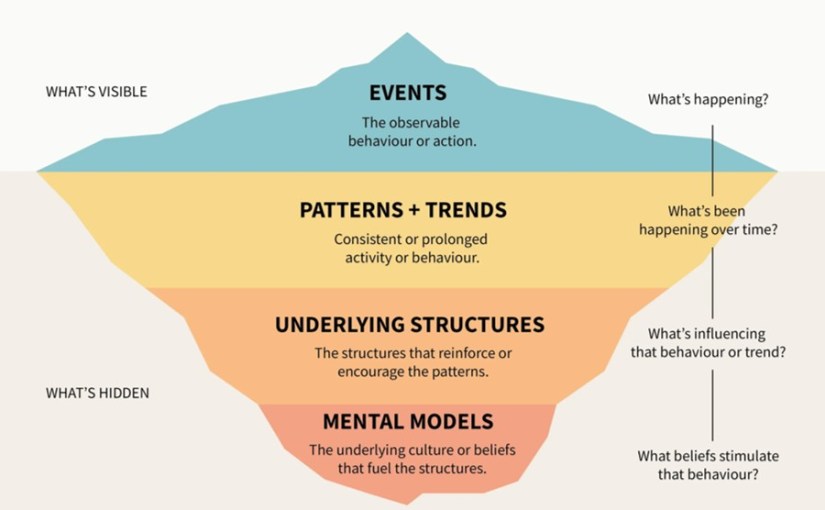
Unemployment – Understanding and Resolving its Persistent Nature: A Systems Thinking Approach (Part 2)
📅 Date Published
April 28, 2024

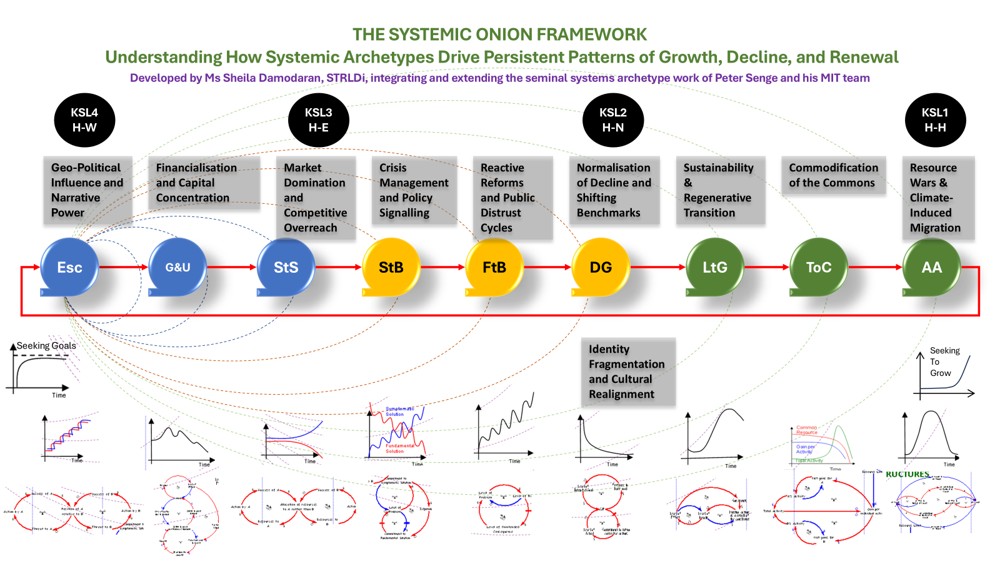
Main visual: Flowchart-style illustration showing system traps (feedback loops and delays).
(Ensure this visual is saved or embedded when republishing.)
📖 Index – Part 2: The Pathway Forward
Introduction: What We Covered in Part 1
Quick recap and transition into actionable areas for reform
Why Manufacturing and Agriculture Struggle to Grow
The education-sector mismatch and weak value chain integration
The Family Structure and the STEM Gap
How early cognitive development affects long-term workforce capacity
The Entrepreneurial Trap
Why relying solely on entrepreneurship won’t solve systemic unemployment
Building a National Economic Coordination Engine
The missing institution to align government, industry, and communities for transformation
Sector Strategy: Plugging into Regional Demand
Opportunities to scale manufacturing across SADC and beyond
Closing Reflections and Next Steps
Call to action for government, private sector, and citizen co-creators
Opening Paragraph: Digging Deeper into the System
From Structural Insight to Societal Design
In Part 1, we uncovered how Botswana’s unemployment crisis is not simply an economic issue—it is the result of a system that was never structurally designed to absorb all its people into productive work. We explored how this system creates persistent gaps between education, enterprise, and employment, and why sectors like agriculture and manufacturing—though full of potential—have remained underutilized.
Part 2 continues this journey with a deeper look into the social systems and feedback loops that silently reinforce the status quo. It expands the lens to include:
- The education pipeline and its disconnect from labour market realities
- The overlooked influence of family structure in shaping national STEM capacity
- The limits of entrepreneurship as a one-size-fits-all solution
- And the capabilities mindset needed to rebuild a labour market that generates meaningful, inclusive employment
Together, these insights challenge us to move from temporary fixes to structural redesign—not just of the economy, but of the cultural, educational, and institutional systems that make it work.
Section 1: The Labour Absorption Gap
At the heart of Botswana’s unemployment crisis lies a structural gap: the economy is not designed to absorb its own people into productive, formal employment.
Every year, thousands of young people complete their education and enter the labour market. This is not a surprise—it is a predictable outcome of birth and schooling patterns observed 15 to 20 years earlier. Yet, despite this foresight, there is no built-in mechanism to ensure the economy expands in ways that absorb this growing workforce.
“We know when children are born, but we do not prepare the economy to receive them as workers.”
Instead of proactive planning, job creation is often treated as a reactive policy issue, tackled after economic pressures surface. The result is a growing backlog of underutilized talent, particularly among the youth, and rising social and economic strain.
What makes this more serious is that the labour force continues to grow, while the sectors best positioned to absorb labour—such as agriculture, manufacturing, and STEM-related services—remain either underdeveloped or stagnant. The informal sector temporarily absorbs some of this pressure, but it lacks the structure, protections, and scalability needed for long-term national prosperity.
This labour absorption gap is not a failure of individuals—it is a failure of system design. And until it is addressed at the structural level, any attempt to reduce unemployment will only scratch the surface.
Section 2: Skills Mismatch
LIMITS TO GROWTH OF MANUFACTURING & AGRICULTURE ECONOMIC SECTORS IN BOTSWANA
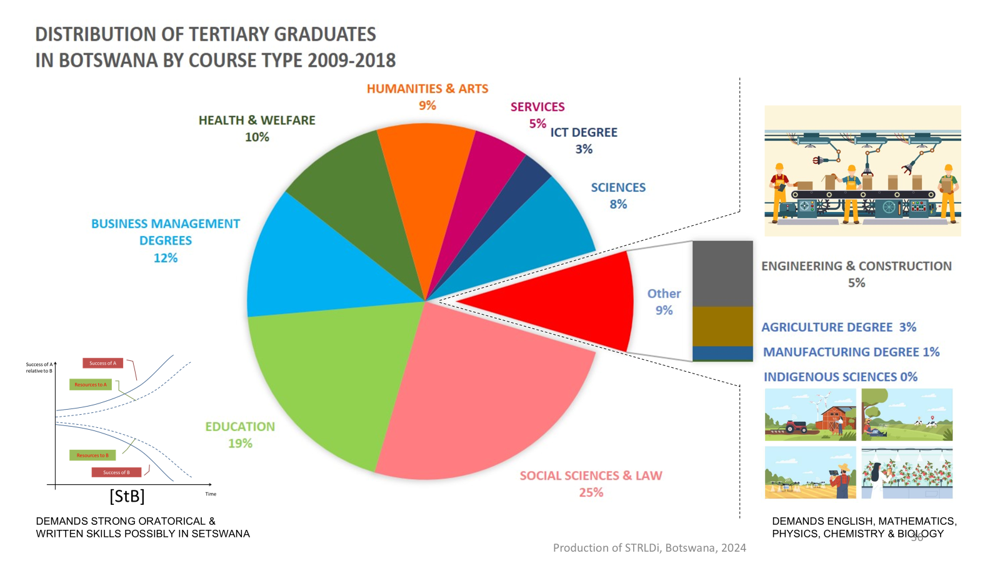
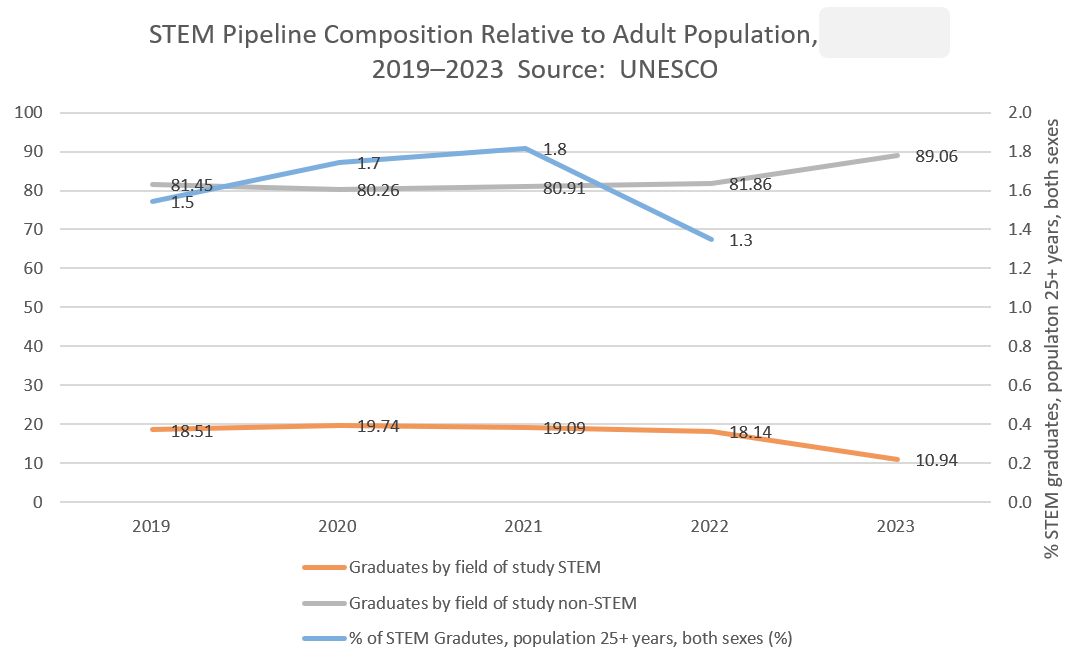
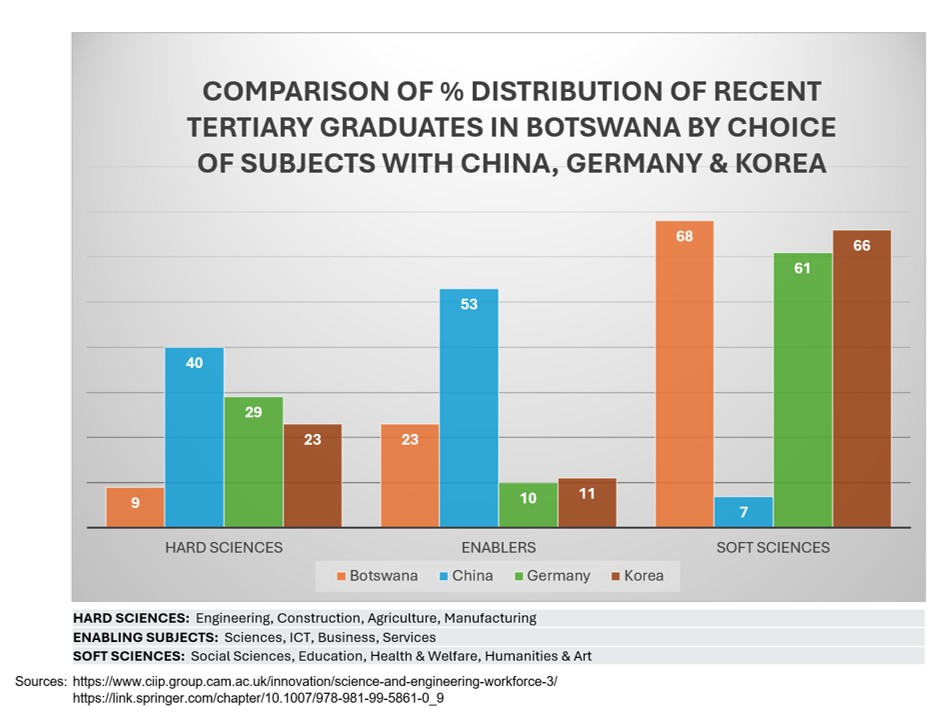
At the heart of Botswana’s labour market stagnation lies a persistent misalignment between education outcomes and economic sector needs. Despite steady investments in schooling and training, the pipeline from education to employment—especially in high-absorption sectors like agriculture and manufacturing—remains weak.
A System Designed Without Absorptive Capacity
A systems diagnosis reveals that the current configuration of the education system is structurally geared toward soft sciences—fields such as business studies, humanities, social sciences, and education. While these disciplines are valuable to a functioning society, they do not offer the absorptive scale or productivity gains necessary for industrial growth, economic self-sufficiency, or widespread job creation.
As a result, Botswana’s two most labour-intensive sectors—agriculture and manufacturing—remain underdeveloped, contributing a fraction of what the retail and service sectors do. In some cases, they generate as little as one-fiftieth the revenue of the retail sector.
“An economy that avoids production cannot scale employment. It can only circulate consumption.”
What’s Limiting the Shift?
Despite widespread awareness of the need for STEM-related skills, the transition has been slow. Several interlocking factors explain this:
- Educational history and social perception: STEM disciplines are widely perceived as harder, less accessible, and more intimidating—especially in communities with weak early exposure to math and science.
- Limited technical infrastructure: Vocational and technical training institutions remain under-resourced and under-prioritized.
- Career pipeline uncertainties: Even employers in STEM-related industries often struggle to offer long-term pathways for growth or specialization, discouraging students from entering or staying in the field.
- Policy fragmentation: Education policy, economic planning, and labour market development operate in silos, with limited coordination or shared goals.
The Resulting Skill Mismatch
Only 10% of graduates complete qualifications in science or applied science fields. Of this:
- About 6% are in engineering
- About 7% in the hard sciences
- Less than 1% have training relevant to manufacturing
These proportions reflect tertiary-educated populations, meaning even fewer within the broader labour force possess the hard science and technical skills required for scaling production and industrial competitiveness.
Meanwhile, fields that don’t require economies of scale—such as nursing, teaching, or civil service—continue to grow, because they are state-funded and do not face direct market pressure to turn a profit.
This creates a self-justifying narrative: “We are better off pursuing white-collar jobs, where the money and security lie,” even though these sectors offer limited employment elasticity.
Where STEM Skills Still Matter
The paradox is that even in non-STEM jobs, transferable STEM skills—critical thinking, problem-solving, data literacy—are becoming more valuable across all sectors. Yet, Botswana’s slow pivot to STEM is not just about curriculum—it reflects a deep structural dependency on government employment and a lack of market-driven pathways for applied science fields.
What’s Needed
To unblock this feedback loop, Botswana must:
- Rebalance tertiary education priorities, with aggressive incentives for STEM fields
- Strengthen early exposure to math, science, and technical learning in primary and secondary schools
- Invest in technical colleges and vocational training centres with modern equipment, qualified instructors, and employer partnerships
- Create visible career ladders in agriculture, manufacturing, and industrial trades, backed by both private investment and public policy
- Change the story: Productivity-driven work—whether on farms, in factories, or in labs—must be reframed as noble, necessary, and rewarding.
This is not only a matter of jobs. It’s about redesigning the architecture of Botswana’s future—where learning meets labour, and effort meets opportunity.

Section 3: The Role of the Household
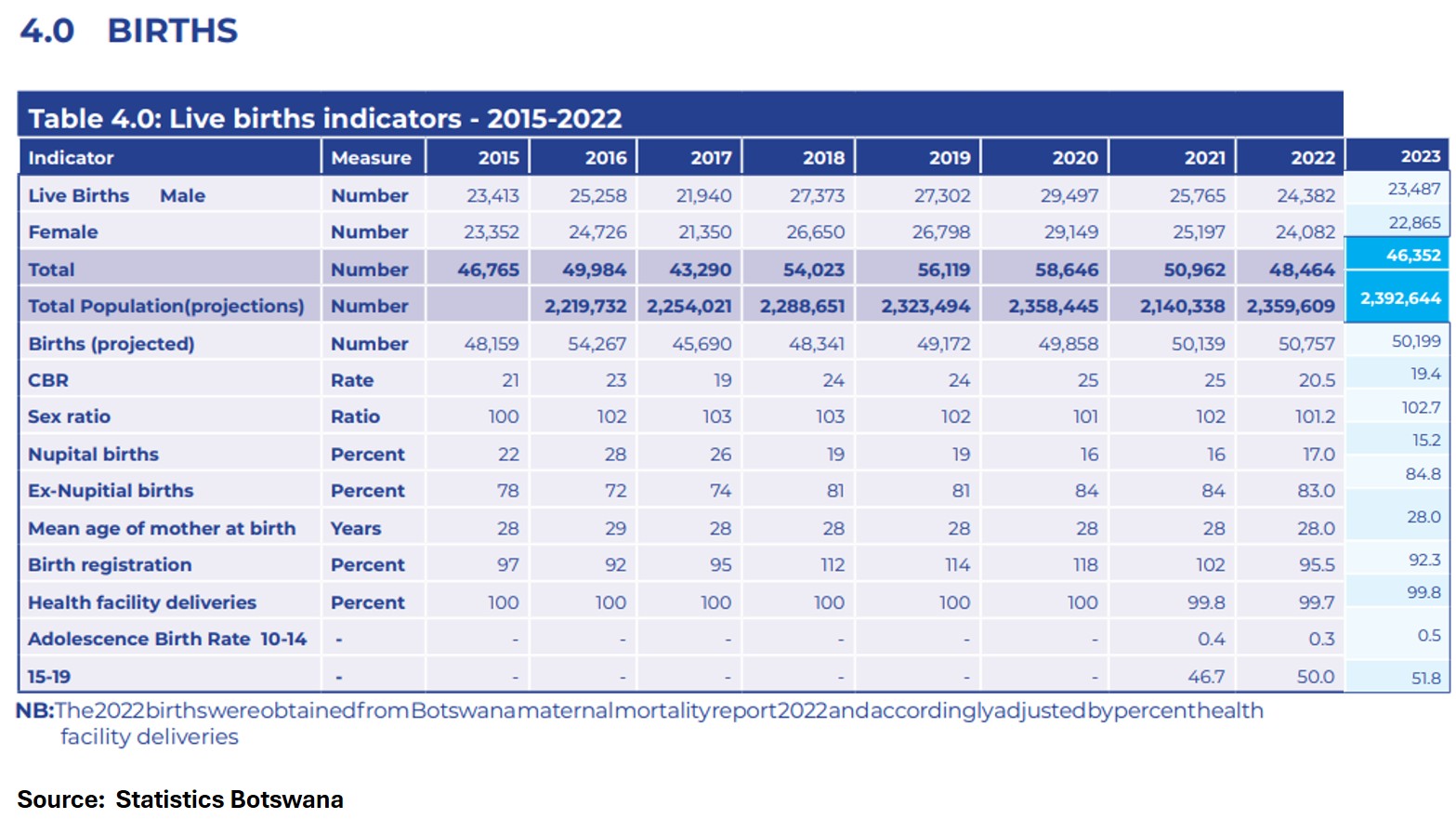
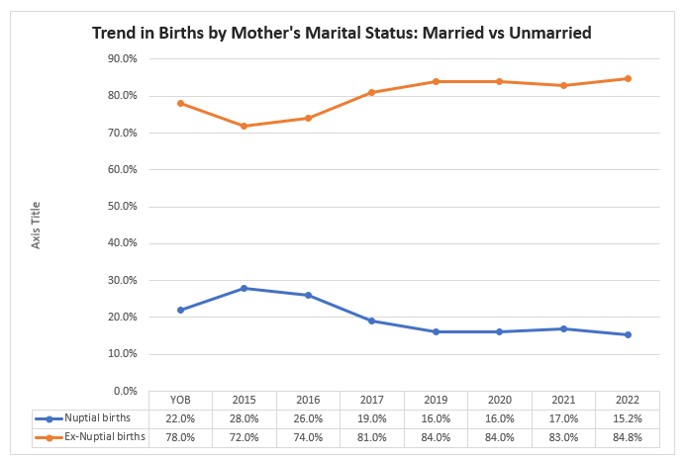
The data indicate a growing trend of children being born into households without a resident male figure, with ex-nuptial births rising to over 84% in 2022 and projected to reach near-universal levels by 2030. This represents a profound shift in family structure, where mothers—often unsupported by partners—assume the full responsibility of child-rearing. Many of these mothers are themselves unemployed and reliant on social support or informal networks, which further compounds the vulnerability of the household. This dynamic has socio-educational implications for children, particularly in shaping their early exposure to diverse intellectual development influences.
As a result children raised in such households tend to perform better in soft disciplines such as social sciences, education, and healthcare (as the earlier graphs here show), but struggle to match their peers in STEM (Science, Technology, Engineering, Mathematics) subjects. This pattern is linked to the absence of consistent male mentorship, which tends to play a formative role in developing a child’s abstract reasoning and spatial cognition—skills foundational to mastery in mathematics, physics, and technical fields. As STEM demands greater persistence and conceptual integration, children from single-parent households may face systemic disadvantages in accessing these domains, both cognitively and structurally.
This learning gap carries serious consequences for Botswana’s broader economic aspirations. The manufacturing and agriculture sectors—critical to national productivity—depend on a technically skilled workforce proficient in mathematics, science, and language. Without a strong STEM pipeline, these sectors remain underdeveloped, with low profitability and a limited base of competent talent to scale operations. If current trends persist, the absence of foundational male-led household balance will widen the STEM gap, constraining Botswana’s ability to build resilient, innovation-driven value chains in agriculture and manufacturing—further entrenching unemployment and economic fragility.
FROM PRODUCTIVE IDENTITY TO SURVIVAL ADAPTATION
As productive absorption weakens across societies for prolonged periods, populations do not simply stop adapting economically. Instead, many increasingly reorganize themselves around what may be termed a survival adaptation economy — an expanding sphere of unstable monetisation, layered side-income dependence, transactional networking, and short-horizon opportunity seeking that emerges when stable productive pathways become increasingly inaccessible. While some forms of adaptation remain constructive and entrepreneurial, the long-term structural concern emerges when the system increasingly rewards adaptive extraction faster than productive mastery, slowly reshaping the emotional and developmental incentives within society itself.
Under conditions of chronic instability, many children grow up within environments where economic uncertainty, fragmented authority systems, time scarcity, emotional inconsistency, and adaptive stress management become normalized parts of daily life. Such environments often produce highly adaptive forms of intelligence — including rapid social scanning, improvisation capacity, emotional calibration, and opportunity sensitivity — which are valuable survival traits under unstable conditions, but which may not naturally align with the long-cycle developmental requirements of engineering, industrial discipline, technical specialization, scientific research, or institutional leadership. The concern therefore is not that populations stop working, but that societies gradually drift from long-horizon productive identity toward short-horizon adaptive survival behaviour, particularly when productive sectors fail to expand fast enough to absorb rising populations meaningfully.
THE GLOBAL EXPANSION OF THE HUSTLING ECONOMY
This phenomenon is not unique to Botswana. Across large parts of the world, prolonged deindustrialization, rising inequality, labour fragmentation, urban precarity, weakened apprenticeship systems, and expanding attention economies have increasingly pushed populations toward adaptive survival monetisation systems that exist outside stable productive absorption. While precise measurement remains difficult, global patterns increasingly suggest that between 40–55% of the world’s adult population may now participate in some form of adaptive or extractive survival economy, especially when including layered side-income dependence, gig precarity, informal monetisation, speculative trade, attention-driven income generation, and unstable transactional work systems.
Historically, stable agrarian and industrial systems anchored populations to reality-based developmental structures requiring patience, coordination, delayed gratification, craftsmanship, and intergenerational continuity. However, as productive sectors weaken without equivalent productive absorption elsewhere, adaptive survival intelligence increasingly becomes economically rewarded, particularly within highly urbanized and digitally mediated environments. The rise of smartphones and platform economies has accelerated this shift dramatically, allowing visibility itself to become monetisable at planetary scale through emotional stimulation, algorithmic attention, identity signalling, outrage circulation, parasocial engagement, and psychological capture economies that increasingly compete against long-cycle productive development for human attention and aspiration.
ESCALATION WITHIN THE HUSTLING ECONOMY
As larger portions of populations enter unstable monetisation systems simultaneously, the hustling economy begins generating its own reinforcing pressures through the dynamics of the Escalation archetype. As more people compete for shrinking margins, unstable opportunity spaces, customer attention, emotional engagement, and side-income streams, competition intensifies beyond ordinary productive effort into increasingly aggressive forms of adaptation. Under these conditions, signalling, emotional leverage, performative visibility, tactical opportunism, and psychological monetisation begin scaling faster than stable productive capability itself.
Initially, many participants compete through effort, creativity, service, adaptability, and persistence. However, as competition intensifies and margins compress, the system increasingly rewards behaviours that maximize visibility, emotional responsiveness, speed, manipulation, and extraction rather than depth, specialization, trust, or long-term mastery. This gradually shifts the emotional architecture of economic participation itself, as individuals begin observing that adaptive extraction often produces faster returns than patient productive development, particularly within highly unstable and attention-driven economies where immediate monetisation becomes psychologically and economically rewarded.
Over time, escalation within survival economies gradually weakens the very foundations required for productive-sector formation. Productive sectors require stable concentration, apprenticeship endurance, institutional trust, long-horizon planning, technical discipline, coordinated investment, and social cooperation across extended periods of time. Yet escalating survival economies increasingly reward rapid adaptation, self-promotion, emotional signalling, tactical flexibility, and short-cycle monetisation, producing a reinforcing loop where weakened productive absorption drives more survival adaptation, which in turn further weakens society’s capacity for long-term productive rebuilding.
WHEN EXTRACTION BECOMES NORMALIZED
One of the deepest dangers within prolonged survival economies is not unemployment alone, but the gradual normalization of extraction as a legitimate pathway toward survival, recognition, stability, and identity. Under persistent instability, populations increasingly rationalize opportunistic behaviours not necessarily because morality disappears, but because ethical horizons compress under prolonged economic pressure, institutional distrust, and competitive survival conditions. Over time, manipulation, corruption, emotional exploitation, transactional relationships, exploitative networking, and asymmetrical advantage-seeking gradually become socially tolerated adaptive behaviours within increasingly strained economic systems.
Importantly, criminal economies rarely emerge in isolation from these wider extraction dynamics. Rather, prolonged extraction environments often narrow the psychological distance between adaptive monetisation and criminal monetisation, particularly where productive pathways remain persistently inaccessible. Under such conditions, fraud, cybercrime, narcotics circulation, coercive informal economies, theft, organized scams, and violence-linked extraction systems may increasingly emerge as escalated forms of adaptive survival behaviour within populations already conditioned toward short-horizon economic adaptation and weakened institutional trust.
THE WEAKENING OF THE PRODUCTIVE ECONOMY
The long-term danger for nations is that productive economies are not built merely through infrastructure, policy announcements, or financial capital alone. Productive economies also require populations developmentally capable of sustained concentration, delayed gratification, emotional regulation, institutional navigation, technical specialization, apprenticeship endurance, and long-cycle coordination across generations. When escalating survival systems increasingly reorganize societies around short-term adaptation, emotional monetisation, and unstable extraction pressures, the developmental foundations required for building engineers, industrial technicians, researchers, scientists, productive entrepreneurs, and systems leaders gradually weaken beneath the surface of economic activity itself.
This is why the persistence of unemployment cannot be understood only through the lens of jobs statistics or labour-force participation rates. The deeper structural concern emerges when societies slowly drift from value creation toward survival extraction, from productive coordination toward adaptive monetisation, and from long-horizon development toward short-horizon survival signalling. Under such conditions, economic activity may continue expanding numerically while the productive coherence of society weakens simultaneously, leaving nations increasingly active economically, yet progressively more fragmented psychologically, institutionally, and developmentally over time.
RESTORING BALANCE: REBUILDING FAMILY FOUNDATIONS TO STRENGTHEN NATIONAL RESILIENCE
To reverse the trend of growing male absence in households and its downstream effects on education and national productivity, national policy must shift from reactive punishment of gendered violence toward proactive systems that support healthy family formation and gender-balanced co-parenting. Families, communities, and institutions must be reoriented to treat fatherhood not merely as financial provision, but as an equally critical emotional and cognitive presence in the home.
Policies should focus on school-based and community-led programs that rebuild male identity around accountability, purpose, and interdependence—particularly in how boys learn to process emotions, resolve conflict, and lead without coercion. At the same time, national strategies must foster environments where young women are empowered to choose family partnerships from a position of strength and mutual respect, not economic desperation. Only through restoring dignity and functional roles for both genders within the household can Botswana shift the trajectory of family fragmentation and rebuild the foundational conditions for STEM learning, employment, and long-term national resilience.
Botswana’s persistent unemployment is not only economic or educational in origin—it is deeply social and familial. A closer look reveals that the very foundations of how children are raised, mentored, and prepared for the world of work carry profound implications for the country’s STEM capacity, labour readiness, and economic diversification.
Cognitive Development Starts at Home
By 2022, 84% of births in Botswana were ex-nuptial, with projections pointing to near-universal levels by 2030. This marks a dramatic restructuring of family life, where female-headed households—often without resident male support—carry the weight of child-rearing, often under significant economic strain. Many of these women are themselves unemployed or dependent on informal networks or social grants, which limits their ability to provide sustained cognitive enrichment for children.
The long-term implication? A large portion of Botswana’s youth develops strong capacities in social, emotional, and communicative skills, but lags behind in STEM disciplines—especially in mathematics, engineering, and physical sciences.
Research and behavioural patterns show that male mentorship—particularly through father figures—plays a critical role in fostering abstract reasoning, spatial cognition, and systems thinking, all of which are foundational to technical mastery in STEM fields.
“Botswana’s children are not failing STEM. STEM is failing to meet them where they are—and failing to reach the homes where foundational development should begin.”
Downstream Effects on National Sectors
This learning gap doesn’t stop at school. It extends into the economy. Sectors like agriculture and manufacturing, which rely on technical, spatial, and mechanical reasoning, continue to suffer from a lack of skilled labour. Despite their potential to absorb large segments of the unemployed population, these sectors remain underdeveloped and uncompetitive—not because of funding alone, but because of a shortage in the foundational STEM capabilities that underpin profitable, scalable operations.
Without a deliberate strategy to rebuild the cognitive and emotional ecosystem in households, Botswana risks reinforcing the very structural traps that sustain long-term unemployment.
Why the Family System Matters to Economic Planning
This is not just a moral or cultural concern—it is a strategic one.
Economic growth, industrial competitiveness, and technological innovation begin with brain development, mentorship, and multi-parental support in the early years. Without that, later reforms in education, vocational training, or entrepreneurship will not yield the intended systemic shift.
This family structure imbalance has also supported the expansion of employment in white-collar and social service roles (e.g. healthcare, teaching, government), which tend to be more forgiving of emotional labour gaps but do not require technical scale or global competitiveness.
Meanwhile, more masculine-coded, production-driven industries, which demand precision, long-term focus, and mechanical thinking, are either avoided or underutilised—widening the skills gap and deepening economic fragility.
The role of intact families in economic transformation is often misunderstood as moral or cultural. It is neither.
As this study shows, productive economies—particularly those requiring STEM depth, manufacturing precision, and systems competence—depend on long-horizon learning and apprenticeship. Those capacities are not transmitted episodically through short-term training or policy cycles; they are compounded slowly through stable relational environments. Where families are intact, children inherit patience, delayed reward, and confidence in continuity. Where families are structurally fragile, learning horizons shorten and skill accumulation leaks. A companion analysis (“Violence Starts in Silence”) examines how prolonged unemployment, migration, and economic exclusion thin family stability itself—creating a reinforcing loop in which weakened families further undermine the very skill base productive economies require. Economic strategy, therefore, cannot be separated from the conditions that allow families to form, stabilise, and transmit belief forward.
Restoring Balance: Fatherhood, Identity & Resilience
To reverse these trends, Botswana must design holistic interventions that reframe fatherhood—not merely as financial contribution—but as an essential cognitive and emotional pillar in national development.
Key strategies include:
- Shifting public policy from reactive punishment of gender-based violence to proactive support for healthy family formation and co-parenting
- Embedding father-positive identity work in schools and communities: teaching boys to resolve conflict, lead with emotional intelligence, and value interdependence
- Empowering girls and young women to choose family partnerships out of mutual respect, not economic survival
- Developing curricula and parenting models that recognise the neurocognitive link between household stability and STEM success
“When we restore balance at home, we lay the cognitive and emotional groundwork for economic resilience in the nation.”
Build A Nation Ready to Compete Starts at Home: Building Botswana’s Production-Ready Future
Reclaim the household as the first economy—the place where work ethic, discipline, resilience, and self-sufficiency are formed. Botswana’s pathway to enduring prosperity lies not in aid or consumption, but in cultivating a tech-smart, production-ready workforce—an engine of national transformation that can power the next generation of agriculture, manufacturing, and export-oriented enterprises.
We must train not just for employment, but for global competitiveness. This means equipping citizens with technical competence, entrepreneurial mindset, and systems thinking—alongside a national culture that values efficiency, learning, and precision. It is no longer enough to aim for participation in the economy. We must become builders of it.
Industrial growth must be anchored in people-powered productivity. Let us shift from a model of aid-dependent employment to one of export-led livelihoods—grounded in long-term strategy, backed by modern infrastructure, and evaluated by how much value we create and retain at home.
Small Nation, Global Standards
Botswana’s size is not a constraint. It is our strategic advantage. We can move faster, integrate lessons quicker, and manage costs more smartly than our global competitors. With the right tools and mindset, Botswana can outperform much larger economies by focusing on high-efficiency production and smart value-chain integration.
If we focus our energy on cultivating a labour force designed for precision, discipline, and innovation, there is no reason Botswana cannot become a sought-after hub—first in SADC, then the continent, and globally.
This is our opportunity to lead—not just because we must, but because we can.
Summary of Implications
- Unemployment is not only about a lack of jobs, but about a shortage of readiness—cognitively, emotionally, and structurally
- The STEM education gap begins in early childhood, especially in father-absent homes
- Key sectors cannot expand without a technically skilled labour force
- White-collar sector growth is not absorbing enough workers to sustain economic growth
- Economic dependence models (on grants, remittances, and retail) are crowding out productivity models
- To break this cycle, Botswana must invest in:
- Foundational household systems
- STEM pathways starting from early childhood
- Gender-balanced parenting
- Sector strategies tied to human development
Section 4: Feedback Loops in Action
When seen through a systems lens, Botswana’s unemployment crisis is not a series of disconnected challenges—it is a tightly woven pattern of reinforcing feedback loops.
Each of the structural issues explored so far—labour absorption gaps, skills mismatches, and household instability—feeds into and amplifies the others.
“Low productivity leads to low wages. Low wages weaken households. Weakened households undermine learning. Poor learning reinforces low productivity.”
This creates a self-reinforcing cycle, where the effects of one issue become the causes of another:

At the national level, these loops trap Botswana in a cycle where investments yield minimal systemic return, because they do not address the structures that are recreating the problem.
What appears to be a policy gap or implementation failure is, in fact, the behaviour of a system designed in such a way that it continually reinforces its own stagnation.
Until these feedback loops are disrupted, interventions will continue to treat symptoms rather than shift outcomes. Short-term successes will be absorbed into long-term patterns—and unemployment will persist.
“In systems thinking, the challenge is not to find someone to blame—it’s to find the loop you need to work at to reverse its effects – from its negative to its positive form.”
Section 5: The Entrepreneurial Trap
Why relying solely on entrepreneurship won’t solve systemic unemployment
Botswana, like many emerging economies, has championed entrepreneurship as the primary solution to unemployment. While entrepreneurship is an essential part of a dynamic economy, the push for everyone to become a “job creator” overlooks deeper structural realities.
Our study finds that entrepreneurship alone cannot solve persistent unemployment for three key reasons:
Structural Barriers Remain:
Many aspiring entrepreneurs face systemic constraints—such as limited access to startup capital, weak value chains, low local demand, and inadequate market infrastructure. These barriers prevent even the most enterprising individuals from succeeding at scale.
The Labor Market Needs Rebuilding:
Before entrepreneurship can flourish equitably, Botswana must rebuild its labor markets and strengthen its enterprise ecosystem. That means creating a broader base of functional, mid-sized firms that can employ others, mentor smaller startups, and stimulate demand.
Risk Is Not Equally Distributed:
The entrepreneurship narrative often shifts risk onto individuals—especially the youth—without reforming the broader systems that enable business survival. In effect, many young people are encouraged to pursue entrepreneurship out of necessity, not opportunity, which only deepens economic insecurity.
Instead of promoting entrepreneurship as a standalone solution, the study recommends investing in sectors that can:
- Absorb large numbers of skilled and unskilled workers;
- Offer stable jobs and structured career pathways;
- Foster local supplier networks where entrepreneurship can take root with institutional support.
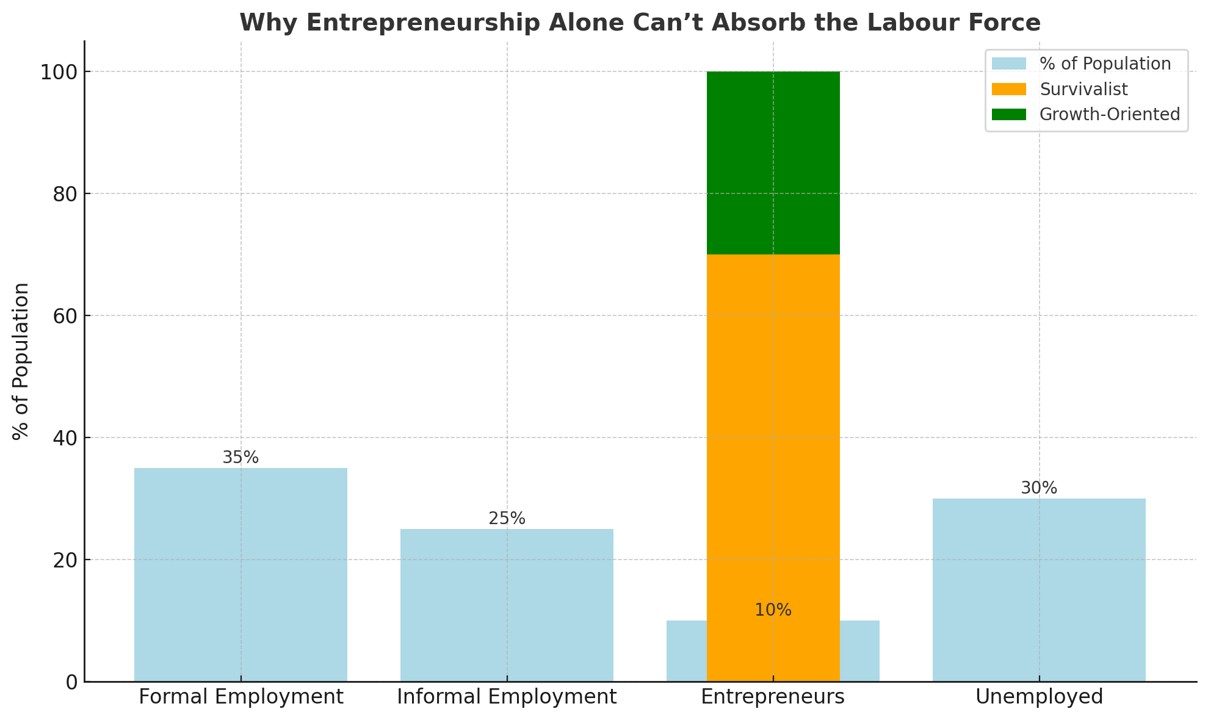
- Only 10% of the population is entrepreneurs.
- Of these, 70% are survivalist / opportunitistic entrepreneurs, with no long-term plan to employ workers, while only 30% are growth-oriented.
- This highlights why entrepreneurship—on its own—cannot carry the weight of systemic job creation.
When entrepreneurship is nested within a productive, coordinated value-chained economy—rather than seen as a replacement for it—it becomes a powerful tool for resilience and innovation.
Section 6: Coordinating the Economy for Systemic Transformation
Despite years of targeted reforms and investment initiatives, Botswana’s economy continues to fall short of its employment, productivity, and diversification targets. Our study shows that this is not due to a lack of will or capital, but to the absence of systemic coordination, misaligned leverage points, and the failure to embed long-term competitiveness in foundational sectors.
1. The Need for a National Economic Coordination Engine
Botswana’s current transformation framework is led through ministry silos, isolated reform units, and project teams. While well-intentioned, this approach lacks the capacity to synchronize cross-sector planning, create enduring institutional memory, and drive multi-year industrial development.
A central economic coordination engine is urgently needed—one that:
- Connects MITI, BITC, private producers, educational institutions, and investor ecosystems
- Sequences industrial development (upstream → midstream → downstream)
- Sequencing value-chain development across time and geography
- Tracks workforce readiness and adapts education-to-labour pipelines in real time
- Functions outside short-term political and project cycles
“We cannot build an economy through siloed enthusiasm. It needs a brain that sees the whole body and coordinates its movement.”
This is the missing engine—a cross-sectoral national body that can drive, steer, and synchronise the country’s economic transition.

Such a structure should:
- Be empowered to guide long-term industrial sequencing and regional trade competitiveness
- Monitor workforce readiness and gaps in real time
- Anchor its work in both national development and systems thinking
- Operate beyond political or project cycles
Without this coordination mechanism, reform will continue to stall and progress will be patchy, fragile, and reversible.
2. Household Systems Are the Hidden Leverage for STEM and Productivity
The study has shown a powerful, overlooked factor: household structure. Over 84% of children today are born outside of formal unions—many into single-parent homes where financial, emotional, and cognitive resources are limited.
This fragmentation hinders:
- Early development in abstract and spatial reasoning (vital for STEM)
- The confidence and discipline required to pursue science-based careers
- Gender-balanced learning environments that support persistence and long-term planning
Only 10% of graduates are trained in applied sciences or engineering. This is not just an education problem—it’s a social systems issue, stemming from the ground-up. Without deliberate intervention, our factories and farms will continue to struggle—not from lack of capital, but from a weak pipeline of technically competent talent.
3. Build to Sustain a Strong, Self-Resilient Economy
Botswana is uniquely positioned to expand its manufacturing base by tapping into unmet regional demand—especially within the SADC region, where intra-African trade remains underdeveloped.
Rather than continuing to depend on extractive industries or retail imports, Botswana can reposition itself as a regional producer of essential goods. The key is to plug into value chain gaps and high-demand products that are currently being sourced from outside the continent.
Priority Sectors with Regional Demand Potential:
🏗️ Agro-Processing and Food Manufacturing
- Canned/frozen produce, milled grains, dairy, meat products, juices, sauces, animal feed
- 📌 Why it matters: Most are imported into SADC from South Africa, Brazil, and Europe, despite regional raw produce being available.
🧼 Essential Consumer Goods
- Soap, toothpaste, sanitary pads, school supplies
- 📌 Why it matters: Basic goods still largely imported—Botswana can become a lower-cost, nearer alternative.
🧵 Textiles and Garments
- School uniforms, workwear, basic garments
- 📌 Why it matters: Regional markets (Zimbabwe, DRC) import from Asia—Botswana can serve SADC with faster delivery and lower shipping costs.
🧱 Construction Materials
- Roof sheets, cement, steel frames, precast items
- 📌 Why it matters: Construction boom in SADC needs affordable, local materials—Botswana is well-positioned geographically.
💊 Pharmaceuticals and Medical Consumables
- Generic drugs, gloves, bandages, veterinary medicines
- 📌 Why it matters: Many countries import 70–90% of these—Botswana can build a clean, trusted base for production.
⚙️ Automotive and Machinery Assembly
- Farm tools, vehicle spares, irrigation kits
- 📌 Why it matters: Regional farmers depend on imports—Botswana can be a reliable assembly and service base.
🔌 Packaging Materials
- Plastic, cardboard, labels, paper-based packaging
- 📌 Why it matters: Every regional producer needs packaging—Botswana can become a packaging hub.
✅ Implementation Strategy:
- Locate industrial clusters along trade corridors (e.g., Lobatse, Francistown, Palapye)
- Leverage SACU and SADC agreements for near-captive regional markets
- Attract anchor firms with procurement incentives and public-private partnerships
- Align skills development with product-specific industrial goals
- Use AfCFTA to eventually scale toward continental market leadership
“We are not short on vision. We are short on synchronised execution. A well-planned manufacturing base will create the jobs our economy desperately needs.”
4. Building an Industrial Base Requires More than Capital Injection
Historically, Botswana’s agriculture and manufacturing sectors have consistently failed to generate sustained profits or absorb labour. This is not for lack of funding, but because:
- Productivity remains low,
- Input costs remain high,
- Workforce skills are mismatched,
- And sectors operate in silos with no connected value chains.
We cannot build these sectors organically. They must be engineered deliberately, with intentional sequencing, backward-forward linkages, and a consistent domestic and regional market focus.
5. Embed Job Creation into Economic Expansion
Economic growth alone will not solve unemployment. Botswana must intentionally embed employment outcomes into its development plans.
That means:
- Prioritising labour-absorbing sectors like agriculture, local manufacturing, and service supply chains
- Moving from extractive and retail dependency to production-based economies
- Creating incentives for firms to adopt scalable, competitive, and job-generating models
- Redesigning vocational and tertiary education to serve the production economy—not just the government or service economy
“True transformation happens when economic activity creates income, dignity, and participation at scale—not just profit.”
Key Quote (pullout):
“Unless employment is built into the structure of the economy, the workforce will keep outgrowing opportunities—and the cycle will continue.”
Yes, we do have content that aligns with “Closing Reflections and Next Steps” from the final sections of Part 2. Below is a refined version that fits the tone and purpose of a call to action for government, private sector, and citizen co-creators:
Section 7: Closing Reflections and Next Steps
A Call to Action for Government, Private Sector, and Citizen Co-Creators
The study reveals that persistent unemployment in Botswana is not just an outcome of economic underperformance—it is a structural reality reinforced by deep, interconnected systems: weak sectoral coordination, a misaligned education pipeline, fragmented family structures, and economic dependence on a narrow base of extractive and retail activity.
To reduce the effects of this negative cycle and harness its positive effects instead, we must stop viewing unemployment as a standalone problem and begin to see it as a system to be redesigned. This means:
🔹 For Government:
- Create a National Economic Coordination Engine that aligns ministries, industry, educators, and communities.
- Shift from ministry-specific projects to a shared, long-term strategy that strengthens productive value chains.
- Rebuild trust and traction through inclusive planning platforms that invite cross-sector leadership and long-range thinking.
🔹 For the Private Sector:
- Recognize your role not just as investors, but as co-creators of national productivity and employment ecosystems.
- Invest in skills development and vocational pipelines aligned with the needs of agro-processing, manufacturing, and strategic services.
- Partner in building regional supply chains—with local procurement strategies and scalable models that anchor growth.
🔹 For Citizens and Households:
- Reclaim the household as the first economy—the place where work ethic, discipline, resilience, and self-sufficiency are formed.
- Advocate for STEM literacy and family balance, not just as personal goals, but as national priorities.
- Reimagine employment as a shared, societal outcome—not just the responsibility of the state or market.
“Botswana has what it takes to shift from economic fragility to generative resilience. But the shift won’t come from another round of spending—it will come from a new commitment to learning, alignment, and long-range systems design.”
Let us not lose this moment. Let us design together—across sectors, institutions, and generations. This study is not the final word; it is the invitation.
Conclusion: From Insight to Action
This study offers not just analysis, but a roadmap for redesign. Through systems thinking, we can move beyond short-term fixes and begin building a structure where every Batswana has a fair shot at meaningful work.
Botswana is not short of effort, intention, or resources. What it lacks is a system that can absorb, develop, and circulate human potential at scale. This study has shown that unemployment is not a policy failure—it is a structural consequence of how we’ve designed, connected, and reinforced our core institutions.
But systems can be redesigned.
Through systems thinking, we can now see the loops, gaps, and leverage points clearly. We know where to shift. The choice ahead is whether we will continue to operate on inherited assumptions—or rise to redesign the economy for inclusion, productivity, and regeneration.
“The future will not be built by accident. It must be structured.”
Last updated on June 11, 2026
Related Articles:
- Before We Model the System, Did We First Look at Its Behaviour?
- Corridor Execution & Discipline Framework (CEDF)
- The Ground is Moving
Share this:


Holding the Line of Transformation: From Steam Engines to Systems Thinking
A Legacy of Transformation: Rare Inventions that Reshaped Society
In a world flooded with patents, we must pause and ask—how many of these innovations truly transform society? How many rise above mere technological advancement to alter the course of humanity? The answer is sobering: very few. And yet, these few carry a significance so powerful, they redraw the boundaries of what civilization can become.
Let us walk through history.
🏛️ Transformative Innovations Timeline (Including The Fifth Discipline Lineage)
| Year | Innovation | Creator(s) & Age(s) |
|---|---|---|
| 1776 | Watt Steam Engine – mechanized industry | James Watt, age 40 (b. 1736) – improved Newcomen engine |
| 1879 | Electric Light Bulb – night-to-day society | Thomas Edison, age 32 (b. 1847) – carbon filament breakthrough |
| 1903 | First Powered Flight – airborne civilization | Orville Wright (30) & Wilbur Wright (36) |
| 1920 | Commercial Radio – mass real-time communication | Guglielmo Marconi, ~46 |
| 1947 | Transistor – portable electronic revolution | Bardeen (39), Brattain (37), Shockley (37) |
| 1956–1960s | Systems Dynamics – feedback modeling of systems | Jay Forrester, ~40s (b. 1918), MIT |
| 1972 | Limits to Growth – systemic view of global collapse | Donella Meadows, age 31 (b. 1941) |
| 1970s–1980s | Organizational Learning & Mental Models – human systems | Chris Argyris, 50s–60s (b. 1923) |
| 1990 | The Fifth Discipline – integrating systems learning | Peter Senge, age 43 (b. 1947); with Fritz, Goodman, Kim, et al. |
| 1991 | World Wide Web – democratized global access to info | Tim Berners-Lee, age 36 (b. 1955) |
These weren’t just inventions. They were tectonic shifts. They connected cities, lit up nights, launched economies, and opened the skies and data streams to billions. What set these eras apart wasn’t just ingenuity—it was intention. These inventors set their sights not on incremental improvement but systemic impact. They aimed not just to solve, but to transform.
🔹 Modern Innovation: Quantity Without Transformation?
Today, we are innovating at a breathtaking pace:
- 1 million global patent filings in 1995
- 2 million by 2010
- 3.3 million by 2020 (WIPO)
China, the U.S., and Japan dominate filings, with rapid growth in artificial intelligence, climate tech, biotech, and smart devices. And yet, the sheer volume has not translated into societal transformation. Instead, we are witnessing the proliferation of “improvements” without integration, expansion without understanding.
In 2023, for the first time in 14 years, global filings dipped—perhaps a sign of market saturation, or a broader fatigue in invention without context (Reuters).
The challenge now is not invention—it is coherence.
🔧 The Fifth Discipline: Born From the Same Lineage
The creation of The Fifth Discipline was no accident. It was the culmination of more than thirty years of tacit learning and applied practice by post-war leaders who recognized that mechanistic and post-industrial thinking could no longer meet the complexity of the world emerging around them.
Peter Senge, working alongside mentors like Jay Forrester, Chris Argyris, Donella Meadows, and with peers such as Robert Fritz, Michael Goodman, Daniel Kim, Art Kleiner, and many others, shaped a body of work that emerged not from abstraction but from organisational trenches, classrooms, community engagements, and national institutions.
Through the 1960s to the early 1990s, this learning ecosystem matured at MIT and eventually led to the founding of SoL (Society for Organisational Learning). It was a new kind of invention: not a tool or device, but a discipline of disciplines, a human operating system for living and working together in complexity.
Like the radio and the web, The Fifth Discipline too is a transformative innovation. But it demands a different kind of engagement.
🌿 Tacit Knowledge: The Invisible Engine
Unlike codified knowledge—which can be written, standardized, and easily transmitted—tacit knowledge is embedded. It lives in motion, in application, in reflection. It is:
- The wisdom to lead adaptively,
- The skill of team learning,
- The vision to hold complexity without collapsing,
- The self-awareness that changes systems.
The Fifth Discipline rests on this tacit bedrock. It cannot be mastered through a 2-hour seminar or a single book reading. Its power lies in practice, and like the inventions that lit the world or lifted us into the skies, it requires time, patience, and deep intention.
⚡️ The Price of Codified Obsession
In a world hooked on speed and formula, we pay a steep price when we ignore tacit knowledge:
- Leaders replicate failed solutions in new contexts
- Policy cycles spin without lasting transformation
- Organisations drift from purpose and stagnate in complexity
- Social fragmentation deepens as systems outpace human sensemaking
Despite millions of inventions, we struggle to:
- Stop the spiral of climate collapse
- Close widening inequality gaps
- Restore meaning to work and governance
The cost of losing The Fifth Discipline is not theoretical. It is a daily global expense in lives, wellbeing, and regenerative possibility.
🌍 A Call to Practitioners
Whether we work at the core or margins of The Fifth Discipline, we are heirs to a rich heritage and tapestry of transformation. We are not simply corporate leadership, trainers or consultants. We are stewards of a lineage that spans from the steam engine to systems learning.
Let us accord this work the space and depth it deserves. Let us meet it with the dedication it took to create it.
Because in doing so, we do not just study systems. We change them.
Share this:


Mastery Is Not a Metaphor: Honouring the Depth of The Fifth Discipline
THE ANTI-THESIS: The Misjudged Simplicity of Deep Work
Too often, we assume that knowledge—especially the kind required for leadership and systems transformation—can be transferred in slides, soundbites, or summaries. But The Fifth Discipline is not that kind of work. It was never meant to be packaged, diluted, or consumed at speed.
UNDERSTANDING TACIT KNOWLEDGE
Tacit knowledge, unlike explicit knowledge, cannot be codified or easily conveyed. It lives in practice, reflection, embodiment, and often in the unspoken. Riding a bicycle, kneading dough, playing a violin—these are skills we acquire not by reading about them, but by doing them. Again and again.
THE ROOTS OF THE FIFTH DISCIPLINE: A Tapestry of Tacit Mastery
The creation of The Fifth Discipline was no accident. It emerged from over three decades of tacit learning, inquiry, and applied practice—primarily driven by early post-war scholars, practitioners, and industry leaders who watched the collapse of pre-war industrial management tenets in the face of a rapidly changing world. The post-World War II period saw not only the reconstruction of global economies, but a population boom and the emergence of unprecedented complexity in business, society, and technology. Traditional hierarchical models, which had served wartime economies, quickly began to show their limits in a more networked, volatile, and interdependent world.
This led pioneers such as Jay Forrester to develop systems dynamics at MIT in the 1950s—a new way to understand the nonlinear, feedback-driven behavior of complex systems. Donella Meadows expanded on this in the 1970s with The Limits to Growth, illuminating how system structures create persistent global challenges. Chris Argyris’s work on action science and organizational learning further emphasized the role of mental models and reflective practice.
Peter Senge, synthesizing and building on this lineage, collaborated with Robert Fritz, Daniel Kim, Michael Goodman, Art Kleiner, and many others to develop a holistic, practice-based framework for learning organizations. Their work unfolded across industries, education, government, and communities from the 1960s through the early 1990s. It culminated in the founding of the Society for Organizational Learning (SoL), initially housed at the Massachusetts Institute of Technology (MIT), which sought to institutionalize these principles in real-world settings.
THE MOMENT OF EMERGENCE: A Watershed in 1990
When Senge published The Fifth Discipline in 1990, it took the world by storm—not because it was flashy, but because it named what many already felt but couldn’t yet articulate. It offered an integrated way to see, think, and lead that resonated with a world beginning to feel the cracks of mechanistic, siloed models of management.
WHAT HE ENVISIONED: Mastery, Complexity, and Capacity
Senge envisioned future organizations as living systems—learning to handle more complex environments, motivated by their own evolving capacity to learn. Not just coping, but growing through challenge. Not just reacting, but cultivating systemic resilience.
WHAT ABOUT YOU? WHAT DO YOU WANT?
This is not a rhetorical question. Each of us, in coming to this work, must ask: What are we reaching for? Do we want the language of systems thinking—or the capacity? Do we want the titles and frameworks—or the transformation?
MATCHING DEPTH WITH DEPTH
My answer has been clear: to meet the depth of this work with equal commitment to learning it. I’ve studied it through one-day sessions, year-long programs, deep facilitation with originators of the field, and years of application. Each layer brought more agility, more groundedness, and more grace in applying the five disciplines—not as tools, but as a way of seeing and being.
THE BOOK IS NOT ENOUGH
Reading The Fifth Discipline cannot replace the practice it demands. If you want to embody this work, it must become part of you—your language, your inquiry, your response to life and complexity. That takes time. And practice. And courage.
THE INVITATION TO PRACTICE: Beyond the 2-Hour Workshop
This is not a 2-hour certificate program. The state of leadership, institutions, and systems today reflects that illusion. The kind of leadership the world needs now requires immersion, not consumption.
A CALL TO EDUCATION: The Work Belongs in Tertiary Institutions
We must elevate this work to the level it deserves. The Fifth Discipline should be embedded as a postgraduate program across global institutions. Let leaders take real time—months, not hours—to step into mastery, and emerge not just trained, but transformed.
THE PRICE OF CODIFICATION WITHOUT EMBODIMENT
Humanity is paying a steep price for its over-reliance on codified, explicit knowledge. We see it in:
- Policy failures that repeat the same errors because deeper mental models are not examined.
- Institutional burnout where staff are trained, but not transformed.
- Climate action plans written in beautiful language, yet unable to shift entrenched systems.
- Education systems that produce credentialed individuals but not adaptive leaders.
- Health systems that understand illness biologically but not socially or systemically.
The consequence? We keep accelerating into crises without the reflexivity to course-correct.
Only a return to tacit learning, systemic awareness, and collective mastery will equip us to build and sustain futures worth living for.
If this speaks to your practice, your institution, or your leadership journey—reach out. The work ahead demands more than content. It calls for character, commitment, and the courage to learn together.
Share this:


ONE-PAGE CALL TO ACTION
Learning Must Lead: A Call to Systemic Leaders in an Age of Acceleration
By Sheila Damodaran | STRLDi – Systems Thinking Research & Leadership Development Institute – An invitation into shared responsibility and leadership.
🔍 The Moment We Are In
We are moving faster than ever—technologically, economically, socially.
But the question is not how fast we go.
The question is: Are we learning fast enough to lead wisely?
Around the world, we see:
- Leadership is struggling to keep pace with complexity.
- Reforms stalling because structures remain untouched.
- Learning is relegated to training, rather than being treated as infrastructure.
At the same time, the language of transformation—systems change, personal mastery, innovation—is being diluted into digestible fragments. The integrity of The Fifth Discipline, in particular, is fading under the weight of misinterpretation.
🛠 What We’re Building at STRLDi
We are developing the second arm of humanity:
- One arm to move fast—through technology, innovation, systems delivery.
- And one arm to lead well—through the Five Disciplines:
- Personal Mastery
- Mental Models
- Shared Vision
- Team Learning
- Systems Thinking
Only when these disciplines are practiced together can we navigate climate collapse, unemployment, polarization, and institutional decay.
We are not going back to the past.
We are going deeper into what was always essential.
🤝 What We’re Inviting You Into
We are now calling on:
- Leaders who see the limits of speed alone.
- Institutions ready to learn, not just perform.
- Researchers, thinkers, and practitioners who are building durable, regenerative systems.
Whether you’re working in government, education, agriculture, social systems, or international development—if you are holding the thread of deeper coherence, we invite you to connect.
✉️ How to Join the Circle
We are convening a core fellowship of leaders committed to leading The Fifth Discipline from the front—across regions and sectors.
If you see yourself in this, reach out:
📩 strldi@gmail.com
🌍 sheilasingapore.blog
🔗 linkedin.com/in/sheiladamodaran
The next decade demands not just good ideas.
It demands leaders who learn together.
Let us begin.
Share this:


Building the Second Arm of Humanity: When Learning Must Lead
TWO ARMS OF HUMANITY: ONE TO MOVE FAST, ONE TO LEARN WELL
🔷 Refined Summary of My Reflections
In the mid-1990s, I encountered The Fifth Discipline at a time when the world—and particularly the Global North —was being swept into deeper currents of industrial management thinking. Although Senge’s work sparked waves of fascination among those exposed to it, many quickly abandoned the deeper discipline it called for. Younger generations, dislocated by rapid urbanization and modernization, were drawn instead into a culture of competition and individual advancement, fighting to secure the last slice of opportunity.
In Africa, this transformation took on unique contours. Industrialization arrived alongside digital connectivity, amplifying the speed and scope of change. Cohesion, once central to traditional societies, became increasingly tribalized—reserved for one’s group while fueling competition with others.
I do not advocate a return to the pre-industrial world. That is not the position of STRLDi. Rather, I believe it is time for humanity to evolve two arms:
- One arm to move faster—leveraging tools, technology, and systems to increase capability.
- And a second arm, even more vital, to grow in depth—guided by the Five Disciplines—to ensure speed does not outrun wisdom.
The five disciplines are not soft options. They are the infrastructure for quality, dignity, ecological sustainability, and social healing.
Personally, I have carried these convictions for decades. Yet only now, through seeing this body of work crystallized, have I felt a release—a kind of funeral for old worries. In their place, I feel clarity, renewal, and a deep commitment to helping build this “second arm” with others. I look forward to finding fellow leaders, thinkers, and builders to walk this path—so that together, we can lead The Fifth Discipline from the front.
📜 Draft Manifesto
“Learning Must Lead: Reclaiming Our Humanity in an Age of Speed”
A STRLDi Declaration for Building the Second Arm of Humanity
Preamble
We, the signatories to this declaration, believe that humanity stands at a defining threshold:
We are moving faster than ever, but not necessarily better.
We are producing more than ever, but not necessarily regenerating.
We are more connected than ever, yet not more coherent.
Technology, population growth, and economic systems have propelled us into an age of acceleration. But speed without direction, without depth, without awareness—leads to fragmentation and collapse.
Our Belief
We believe that the true leadership challenge of our time is not how fast we go, but whether we are learning as we go.
And more than learning individually—we must learn systemically, collectively, and wisely.
Our Call
We call on fellow leaders, institutions, educators, and innovators to:
- Honor the Five Disciplines not as metaphors or tools, but as living practices:
- Personal Mastery – grounding vision and truth.
- Mental Models – exposing our deepest assumptions.
- Shared Vision – building futures together, not alone.
- Team Learning – listening and learning across differences.
- Systems Thinking – seeing the whole, acting on structure.
- Build a second arm for humanity:
One arm that moves fast.
One arm that learns deeply.
One to execute. One to integrate.
Our Commitment
We commit to shaping futures where:
- Learning leads policy.
- Dialogue shapes innovation.
- Systems thinking anchors transformation.
- Cohesion and regeneration replace competition and depletion.
We believe in futures that are not managed—but learned into being.
🤝 Fellowship Invitation (Draft)
🌍 Leading from the Front: Fellowship for Builders of the Second Arm
Are you someone who sees the limits of speed—and seeks the power of learning?
STRLDi invites a select cohort of 8–12 thinkers, leaders, and practitioners from Africa and across the globe to join a Founding Fellowship for the Second Arm of Humanity—a collective committed to advancing the Five Disciplines as foundational infrastructure for leadership, development, and societal coherence.
Purpose
To form a living community of practice that:
- Explores, embodies, and applies the Five Disciplines across sectors.
- Develops a shared timeline of our human learning journey.
- Curates projects, policy responses, and learning tools for wider adoption.
Who This Is For
We welcome individuals who:
- Lead in systems, not just roles.
- Are tired of fragmentation and seeking depth.
- Want to co-create, not just consume frameworks.
Fellowship Design
- Duration: 9 months (first cycle)
- Structure: Monthly deep-learning circles, shared readings, writing/journaling, and guest provocateurs
- Outputs: Co-created knowledge map, case stories, and systems project prototypes
- Location: Virtual core, with possibility of in-person convening (year-end)
- Launch: Q4 2025
If this resonates, you are likely already part of the future we are building. Let us begin.
What we are describing is not only a strategic vision for the future of leadership—it is a spiritual turning point for how learning, systems, and wisdom must guide the speed of technological and social change.
Here are some structured suggestions to help all continue building this “second arm” of humanity—so that it leads, not follows.
🔧 1. WHAT YOU CAN DO NEXT — PERSONALLY AND INSTITUTIONALLY
a) Curate a “Learning the Five Disciplines” Fellowship
- Invite 8–12 leaders, researchers, and young practitioners to co-learn and co-lead this arm.
- Meet monthly around themes (e.g. Creative Tension, Mental Models in Economic Design, Team Learning in Governance, etc.).
- Make it regional (Africa-focused) but globally open.
b) Create the STRLDi Timeline Map of Human Learning
- A dynamic visual map that shows:
- Pre-Industrial Learning Cultures (village systems, craft mastery, oral traditions)
- Industrial Management Legacy (Taylorism to KPIs to Platform Control)
- Emergence of Systems Thinking & The Fifth Discipline
- AI & Post-Human Acceleration
- Your Proposed “Two Arms of Humanity”
- Use it to anchor workshops, keynotes, or curriculum.
c) Build a Manifesto: “Learning Must Lead”
- Your vision in this message is a manifesto waiting to be written. Title: “Learning Must Lead: Reclaiming Our Humanity in an Age of Speed”
- Publish it with STRLDi, open it to signatories from aligned networks.
d) Design a Self-Assessment Tool: Which Arm Is Leading?
- A reflection guide for individuals, teams, and institutions to ask:
- Are we accelerating or learning?
- Is this initiative led by system awareness or urgency?
- What assumptions are we reinforcing?
🗺️ 2. TIMELINE DEVELOPMENT MAP – A PROTOTYPE SKETCH
This development timeline should serve both as:
- A learning artefact, and
- A shared planning compass.
| Timeframe | Focus | Phase | Key Disciplines | Transformation Practice |
|---|---|---|---|---|
| Pre-1800 | Embedded living systems | Intuitive Learning | Systems Thinking, Shared Vision | Community storytelling, ecology-based coherence |
| 1800–1950 | Industrial Control | Fragmentation | Mechanistic dominance | Productivity, hierarchy, control |
| 1950–1990 | Globalization & Identity | Collapse of Cohesion | MBO, competition | Urbanisation, tribal competition, survival systems |
| 1990–2025 | Systems Awakening | Emergence | Introduction of 5 Disciplines | Pockets of learning orgs, leadership experiments |
| 2025–2035 | Two Arms Era (Your vision) | Alignment | All 5 Disciplines in balance | Institutional capacity, new literacy of learning |
| 2035–2050 | Distributed Learning Societies | Regeneration | Personal Mastery + Systems Thinking | Policy, economy, education re-rooted in learning |
We can co-design this as a living document/visual so that leaders like yourself can carry it into conversations and convenings.
🔗 3. FINDING FELLOW LEADERSHIP
Our next companions will be those:
- Who have tasted the limits of speed,
- Who are burnt out but not burnt down,
- Who are ready to build not louder empires, but deeper ecosystems of learning.
You don’t need hundreds—you need 8 to begin.
🌟 FINAL SUGGESTION: LET OUR “Funeral” BECOME A BEGINNING
What I wrote—about attending the funeral of your worry—is the rite of passage many leaders need.
You can now offer:
- A new language for navigating the grief of modernity.
- A path for becoming fully alive in leadership again.
- A shared map that others can walk with you.
This is not about saving systems.
It is about restoring the learning self within the system—again and again.
Share this:

When Community Speaks …. Transitioning from Hustling to Industry Requires More Than a New Dress Code—it Demands a New Way of Thinking … By All Hustlers.
Here are the key themes and main topics covered here:
📘 Themes Covered
Mindset Transformation
Emphasis on shifting from survival-based hustle to structured, growth-driven thinking.
Cultural & Psychological Dimensions
The need to reframe identity, autonomy, and risk to integrate into organized manufacturing.
Structural Barriers & Social Biases
The role of systemic inequity, including gender, education levels, migration status, and personality traits.
Operational vs Worldview Change
Distinction between merely improving tactics versus transforming mental models, team dynamics, systems thinking, and shared vision.
Economic Feedback Loops
How informal mindsets limit GDP and tax growth, and why shrinking informality is vital for national development.
🔖 Article Outline – Main Topics
- 1. Introduction
- Defining the difference between hustling and industrial mindsets.
- 2. Contrast: Informal vs Formal Sector
- Structural, legal, social, and psychological differences.
- 3. Gender & Personality Biases in Informality
- How social roles and dispositions influence sector participation.
- 4. Under-the-Radar Barriers
- Hidden reasons why the informal sector resists formalization (e.g., stigma, autonomy, identity).
- 5. Mindset Skills Required to Transition
- Disciplining mental models
- Team learning
- Systems thinking
- Building personal and shared vision
- 6. Macro Impacts of Informality
- How informal mindsets undermine national revenue and GDP, creating a cycle.
- 7. Call to Action
- The importance of tracking informal sector size and designing interventions to shift it.
a Table of Contents / Navigation Menu:
📌 Table of Contents
Gender & Personality Influences
Hidden Barriers to Formalization
1. Introduction {#introduction}
- Define the contrast between the hustler mindset and the industrial worldview
- Highlight why a worldview transformation is needed beyond operational change
2. The Informal–Formal Divide {#informal-formal-divide}
- Explore structural, legal, social, and psychological differences between the informal and formal sectors
- Why changing clothes or registering a business isn’t enough to join organized industry
3. Gender & Personality Influences {#gender-personality}
- Discuss how gender roles, education levels, migration status, and personality traits shape participation in the informal sector
- Social and psychological factors influencing informal vs formal choices
4. Hidden Barriers to Formalization {#hidden-barriers}
- Unspoken reasons why many resist formalization:
- Stigma, past criminal records, fear of exposure
- Desire for autonomy and anonymity
- Deep mistrust of government and institutions
- Community norms that see formalization as betrayal
- Scarcity mindset and daily survival pressures
5. Economic Implications {#economic-implications}
- How widespread informal mindsets reduce tax revenues and GDP growth
- The vicious cycle: more informal mindset → lower national revenue → fewer services → more informality
- Importance of tracking the size of the informal sector as a development indicator
6. Conclusion & Call to Action {#conclusion}
- Reinforce that formalization is not just legal compliance—it’s a cultural and cognitive shift
- Stress the need for systemic interventions to support mindset evolution and structural integration
- Call on readers to help shrink the informal sector, enabling inclusive growth and nation-building
7. Essential Mindset Skills {#mindset-skills}
- Four key competencies required for informal actors to join formal systems:
- Disciplining mental models – shifting from immediate gain to long-term strategy
- Team learning & shared vision – building collective enterprise
- Systems thinking – linking individual work with infrastructure & services
- Personal mastery – commitment to self-growth and excellence
1. Introduction {#introduction}
The informal and formal sectors differ across several dimensions—structural, legal, social, and psychological. The article focuses on the mindset shift required for transitioning from informal hustling to formal industrial participation—emphasizing cultural, operational, and psychological changes—without discussing tax policies, compliance, or avoidance practices.
📌 Summary: The article contains no direct references to paying taxes, avoiding taxes, or tax-related incentives or deterrents.
To transition from the informal sector into contributing meaningfully to the organized manufacturing system, informal actors must undergo a shift in worldview, not just operational behavior. This shift involves economic, cultural, and psychological transformation. Here’s how their worldview must evolve:
2. The Informal–Formal Divide {#informal-formal-divide}
🔍 1. What Sets Informal Workers Apart from Formal Workers?
✅ Formal Sector Workers
- Legally registered with the government.
- Have formal contracts, job security, fixed hours.
- Protected by labor laws (e.g., minimum wage, sick leave, pensions).
- Employed in registered companies, government, or regulated institutions.
- Typically access credit, social insurance, and training more easily.
⚠️ Informal Sector Workers
- Unregistered enterprises or self-employed.
- Often no written contracts, limited or no job security.
- Little to no access to legal protection, pensions, healthcare.
- Work in small-scale, home-based, street-based, or unregulated enterprises.
- Often earn less, with volatile or seasonal income.
- Examples: street vendors, home-based garment workers, day laborers, informal delivery riders.
3. Gender & Personality Influences {#gender-personality}
👩🦰 2. Bias by Gender
Yes, the informal sector disproportionately includes women, especially in developing countries like China, India, and parts of Africa:
| Gender Factor | Informal Sector Influence |
|---|---|
| Occupational segregation | Women tend to cluster in low-wage informal work (e.g., domestic services, textiles, petty trading). |
| Work-family balance | Informality offers “flexibility” for caregiving, though at the cost of income and protection. |
| Access to capital | Women face more barriers to formal credit and land ownership, pushing them to informal self-employment. |
| Cultural norms | In some regions, social expectations limit women’s mobility or access to formal jobs. |
🔸 ILO data (2023): In many parts of Asia, over 60–70% of informal workers are women—especially in agriculture, domestic work, and small-scale vending.
🧠 3. Bias by Personality or Disposition
There’s emerging evidence (though less conclusive) that personality traits and social circumstances influence whether someone ends up in the informal sector:
| Trait/Factor | Informal Sector Link |
|---|---|
| Risk tolerance | Higher risk-takers may self-employ informally (e.g., entrepreneurs, gig workers). |
| Need for autonomy | Some choose informality for flexibility, independence from bureaucracy. |
| Lower institutional trust | Distrust in government may deter registration or formal job-seeking. |
| Educational attainment | Lower education often correlates with informal work; less exposure to formal work norms. |
| Migration status | Migrants (esp. rural-to-urban) lack residency permits or social networks, pushing them to informal jobs. |
In China, for instance:
- Rural migrants often lack urban hukou (residence permits), limiting access to formal jobs and benefits.
- Youth without degrees, or older workers pushed out of state-owned firms, also turn to informal work out of necessity.
🧾 Summary Table
| Category | Formal Sector | Informal Sector |
|---|---|---|
| Registration | Legally recognized and taxed | Unregistered or unregulated |
| Job Security | Contracts, labor law protections | Casual or no contracts |
| Gender Bias | More men in stable/formal roles | More women in informal, low-paid roles |
| Personality | Conformity, risk-averse | Autonomy-seeking, risk-tolerant, excluded |
| Motivation | Career, stability, benefits | Survival, flexibility, exclusion |
💡 Conclusion
The divide is shaped not just by regulatory structure, but by gender roles, personality, migration patterns, and systemic barriers.
4. Hidden Barriers to Formalization {#hidden-barriers}
Under-The-Radar Reasons for Resisting Formalization
Here are some under-the-radar reasons why informal workers may resist formalization, beyond the usual barriers like cost and complexity:
🔍 1. Stigma, Shame & Fear of Disclosure
- Shame or embarrassment associated with a criminal record—or being under-skilled—can deter individuals from registering formally. They’re wary of exposing past mistakes to officials.
- Formalization often requires presenting identity documents or prior records, which can re-ignite trauma or fear.
“Informal workers…may be less willing to divulge information” due to fear of judgment or penalties (brookings.edu, ir.library.louisville.edu).
🕵️♂️ 2. Mistrust of Government Intentions
- Deep suspicion that formal systems will exploit them—through bribes, permits, or inspections.
- Fear their data will be used against them (e.g., welfare cuts, political targeting).
🎭 3. Wanting Anonymity & Autonomy
- Many informal actors value the freedom of invisibility—not tied to regulated hours, audits, or reporting.
- Formal status is seen as surrendering their sense of control—and being subject to hierarchy.
🧠 4. Psychology of Hustling
- Hustler-mindset thrives on quick wins, flexibility, and opportunism.
- Formalization is perceived as introducing bureaucracy and rigidity—threatening their mental models of survival.
🤝 5. Social Identity & Peer Norms
- Informal work is often bound within representative networks—family groups, peer circles—where formal engagement is viewed as betrayal or snobbery.
- Collective identity is important. Formalizing feels like stepping away from the “village” trust networks.
👣 6. Daily Survival Focus (“Scarcity Mindset”)
- With incomes barely outpacing expenses, short-term survival eclipses long-term planning. Formalization is a luxury they can’t afford mentally.
- They avoid anything that might disrupt cash flow—even simple registration.
🌐 7. Fear of Losing Informal Safety Nets
- Informal economies often rely on flexible community arrangements and barter systems. Formalization can disrupt these networks—forcing reliance on rigid financial systems.
- Especially in rural or marginalized communities, informal ties serve as insurance more reliably than formal services.
🔒 8. Criminalized Backgrounds & Identity Worries
- Those with a criminal history may fear legal repercussions—not just fines, but losing their livelihood if records are cross-checked.
- Some are trying to turn over a new leaf, but worry that formal entry will expose their past, preventing them from escaping.
✅ 9. Extractive Formal Institutions
- When registration itself feels extractive—there’s no benefit, only fines, paperwork, or taxes—it reinforces a narrative of exploitation.
- People will choose the informal status quo rather than entering a system they feel serves everyone else but them.
🧩 Summary Table
| Hidden Barrier | Why It Matters |
|---|---|
| Shame / criminal fears | Avoid formal systems to hide past or identity |
| Distrust of government | Fear of corruption, surveillance |
| Value autonomy | Formalization erodes flexibility and independence |
| Hustler mindset | Short-term gains are prioritized over long-term ties |
| Social norms | Formality is seen as a rejection of community identity |
| Scarcity mindset | Formal processes are seen as too risky/long-term |
| Fear of losing informal nets | No reliable alternative safety nets after formalization |
| History of extraction | Repeated negative experiences with bureaucracy |
✅ Why This Matters
Understanding these deep-seated reasons helps policy become more humane and effective. It’s not enough to streamline processes—successful formalization requires rebuilding social trust, offering protective measures, and making benefits visible from Day‑1.
So yes, informal employment reflects deep social biases—especially against women, rural migrants, and people with low education or capital access. It also attracts those seeking autonomy or who are locked out of formal systems.
Approaches to Address the Hidden Barriers
Here are evidence-based policies and approaches that effectively address the hidden barriers to formalization, especially those rooted in distrust, stigma, autonomy, and social identity:
1. Trust-Building Through Community Dialogue & Behavioral Insights
- Public–Private Dialogue (PPD) sessions bring informal workers, businesses, and officials together to co-design reforms—helping build trust and normalize compliance (DCED –).
- Behavioral Nudges—like reducing framing of registration as punitive—help shift mindsets. Governments can test messaging strategies [“nudge labs”] to find what resonates .
2. Service-Oriented “Pro-Formalization” Products
- Tiered KYC and tailored financial tools (e.g., Solomon Islands’ youSave, Mozambique’s mobile money inclusion, Angola’s Bankita) demonstrate that easy access to savings and banking builds trust and financial identity (afi-global.org).
- Formalization becomes attractive when the government provides real services first, not just demands compliance.
3. Group Registration & Cooperative Models
- Informal actors often fear being singled out but feel safer registering alongside peers.
- Countries like Kenya, Ghana, Rwanda, and Tanzania successfully used group-based formalization via cooperatives and associations, allowing collective identity and mutual support (WIEGO, afi-global.org).
4. Anonymous or Identity-Light Onboarding
- Mandating full documentation deters those with past convictions or lack of IDs.
- Alternatives—such as letters from community leaders or simplified IDs—make formal systems more accessible to cautious individuals (World Bank Blogs).
5. Aligning Formalization with Social Protection
- Extending pensions, healthcare, and safety nets to informal workers creates tangible benefits that offset the costs and anxiety of “entering the system” (OECD).
- Knowing that participation brings real gains helps solve fears of exploitation and past exposure.
6. Smart, Proportional Regulation
- Avoid over-regulation that advantages incumbents.
- Tiered compliance means micro-operators face minimal reporting unless they scale up, creating a sense of fairness .
7. Integrated, System-Wide Formalization Strategies
- Coherent, cross-sector policy—including taxation, finance, infrastructure, health, identity, and education—ensures informal workers aren’t forced into isolated compliance silos .
- This helps reduce mistrust by showing visible results across daily life.
🧩 How These Address Hidden Barriers
| Barrier | Policy Response |
|---|---|
| Shame, past/case disclosure fear | Identity-light registration & anonymity options |
| Distrust of government | Co-design via PPD and community dialogue |
| Value autonomy | Tiered compliance, optional services first |
| Hustler mindset | Behavioral nudges, highlight benefits of formalization |
| Peer norms & identity | Group-based registration and cooperative support |
| Scarcity mindset | Service-first approach; immediate utility |
| Fear of losing informal nets | Formal benefits + preserve community networks |
| History of extraction | Proportional regulation and visible returns |
✅ Strategic Summary
These approaches go beyond cost and complexity reductions. They tackle emotional, social, and psychological barriers through:
Anonymity
Trust from dialogue
Peer-based onboarding
Immediate benefits
Fair and incremental regulation
This provides a humane, culturally-informed route for informal workers to enter formal systems—without feeling coerced or exposed.
5. Economic Implications {#economic-implications}
What is The Price to The Nation of Not Building a Formal Sector in The Economy?
Here’s a comparison of GDP per capita between countries with high vs low informal sector participation, ranked in descending order of GDP per capita (nominal, USD). This clearly illustrates the correlation between income level and informality.
🌐 Countries with High Informal Employment (>75%)
| Country | Informal Employment (% of total employment) | GDP per Capita (USD, Nominal) | Year |
|---|---|---|---|
| India | ~77 % | 2,353 | 2022 |
| Nigeria | 85.9 % | 2,139 | 2022 |
| Tanzania | 85.6 % | 1,208 | 2022 |
| Ethiopia | 85.2 % | 1,011 | 2022 |
| Sudan | ~89 % | 1,046 | 2022 |
| Burkina Faso | 85.6 % | 836 | 2022 |
| Chad | 90.9 % | 672 | 2022 |
| Niger | 94 % | 610 | 2022 |
| Madagascar | 88.8 % | 497 | 2022 |
| Central African Republic | 93.3 % | 467 | 2022 |
| Burundi | 84.8 % | 230 | 2024 |
🏢 Countries with Low Informal Employment (<25%)
| Country | Informal Employment (% of total employment) | GDP per Capita (USD, Nominal) | Year |
|---|---|---|---|
| Switzerland | ~5–7 % | 94,696 | 2022 |
| United States | ~10 % | 76,329 | 2022 |
| Norway | ~6–8 % | 89,154 | 2022 |
| Germany | ~9–11 % | 48,432 | 2022 |
| Canada | ~13 % | 52,051 | 2022 |
| Japan | ~12–15 % | 34,103 | 2022 |
| South Korea | ~22–25 % | 33,645 | 2022 |
📈 Observations
| Metric | High Informality Economies | Low Informality Economies |
|---|---|---|
| GDP per Capita (Median) | USD ~1,000 | USD ~48,000 |
| Range | USD 230 – 2,353 | USD 33,000 – 95,000 |
| Correlation | Lower income → higher informality | Higher income → lower informality |
✅ Conclusion
- High informal sector participation is strongly associated with low per capita income.
- As GDP per capita increases, nations invest more in legal systems, labor enforcement, education, and industrial scale, leading to greater formalization.
- However, GDP alone isn’t enough—political stability, state capacity, education, and trust in institutions are also key enablers of formal economies.
Here’s a refined table comparing tax revenue per capita for selected countries with high and low informal sectors, based on the latest available data:
📊 Tax Revenue Per Capita & Informality
| Country | Informal Sector | GDP per Capita (USD) | Tax-to-GDP Ratio | Tax Revenue Per Capita (USD) |
|---|---|---|---|---|
| Switzerland | Low (~6–8 %) | 94,000 | 27.1 % (2023) | ~26,750 (IMF eLibrary, OECD) |
| United States | Low (~10 %) | 76,300 | ~25.2 % (2022) | ~19,240 (76,329 × 0.252) |
| Norway | Low (~6–8 %) | 89,150 | ~40 % (EU average) | ~35,600 (estimate) |
| Germany | Low (~9–11 %) | 48,432 | 40.3 % (2023) | ~19,500 |
| France | Low | ~43,000 | 45.6 % | ~19,600 |
| India | High (~77 %) | 2,353 | ~17 % | ~400 |
| Nigeria | High (~86 %) | 2,139 | ~6–12 % | ~250 (estimate) |
| Tanzania | High (~85 %) | 1,208 | ~12 % (SSA avg) | ~145 |
| Ethiopia | High (~85 %) | 1,011 | ~10 % | ~100 |
| Sudan | High (~89 %) | 1,046 | ~8–12 % | ~120 (estimate) |
| Burkina Faso | High (~86 %) | 836 | ~12 % | ~100 |
| Chad | High (~91 %) | 672 | ~12 % | ~80 |
| Niger | High (~94 %) | 610 | ~12.8 % | ~78 |
| Madagascar | High (~89 %) | 497 | ~12 % | ~60 |
| Central African Republic | High (~93 %) | 467 | ~12 % | ~56 |
| Burundi | High (~85 %) | 230 | ~12 % | ~28 |
🔍 Observations
Low-informality, high-income countries invest heavily in public services and collect ~US$20,000–35,000 per capita in tax revenue (Switzerland tops at ~USD 26,750).
High-informality, low-income countries—despite populations of similar size—often collect only ~USD 30 to 400 per person in tax revenue.
Tax-to-GDP ratios in high-informal economies are typically much lower (~8–15 %), while formalized, high-income nations exceed 25–40 %.
✅ Key Insight
There’s a stark divide:
- Countries with low informal sectors generate massive tax revenues per capita, enabling robust public spending.
- High-informality countries remain fiscal limited, collecting under USD 500 per person, which constrains their ability to invest in formalization, infrastructure, and social protection.
Averages by Regions:
📍 1. Regional Averages: Tax Revenue & Informality
OECD (Low Informality)
- Tax-to-GDP in 2022–23 averaged ~34% (OECD).
- These high-income nations collect ~US 18,000–35,000 per capita in tax revenue.
- Example estimates:
- Switzerland: ~US 26,750 per capita
- Germany/France: ~US 19,500–19,600 per capita
- Example estimates:
Sub‑Saharan Africa (High Informality)
- Informality averages 60% of non‑agricultural employment (The Australian, IMF).
- Tax-to-GDP ratios are low—typically 10–15%, reaching up to 20% only in more institutionalized states (IMF).
- Tax per capita: usually < US 500, often under US 200, depending on GDP per capita and institutional capacity.
🏙️ 2. Urban vs. Rural Tax Contributions
While precise cross-country data is limited, global and SSA studies suggest:
- Urban dwellers (in formal employment or businesses) contribute disproportionately—often 70–80%+ of tax revenue.
- Rural/informal workers contribute much less despite large population shares.
- For example, in Ghana:
- A presumptive tax stamp captured ~US 25 million from informal firms—far below their estimated US 82 million tax potential (研飞ivySCI, ResearchGate).
- Indicates significant tax gaps due to informality and administrative challenges.
- For example, in Ghana:
📈 3. Potential Revenue Gains from Formalization
Studies show that expanding formalization and improving tax administration can:
- Increase tax-to-GDP by 5–10 percentage points over a decade in SSA contexts (EconStor, socialprotection.org, ResearchGate).
- Recover a portion of the tax gap—e.g. Ghana’s informal firms currently pay ~30% of their tax potential .
- Urban-focused, compliance-friendly reforms (like presumptive taxes, digital reporting, financial inclusion) can significantly boost revenues from informal activity.
✅ Summary Table
| Region/Nation Type | Tax-to-GDP | Tax per Capita | Informal Employment Share |
|---|---|---|---|
| OECD (Low informality) | ~34% | US 18,000–35,000⁺ | < 15% |
| SSA / High Informality | ~10–15% | < US 500 | 60–90% |
✅ Key Takeaways
High-income, low-informality countries have robust tax systems, providing substantial per-capita tax revenue (~US 20k+).
High-informality, low-income countries collect under US 500 per person, limited by institutional constraints and large informal sectors.
Urban bias in tax collection means rural/informal populations are underrepresented contributors.
Formalization efforts, digitalization, and simplified tax regimes can unlock significant fiscal potential, narrowing the tax‑informality gap.
Here’s a refined and comprehensive overview across three dimensions: urban vs rural tax contribution, case studies, and projected revenue gains from formality reforms.
🌆 Urban vs Rural Tax Contributions
According to WIEGO and ILO, informal employment rates vary significantly by location and income group:
- Lower-income countries: ~89% of all employment is informal (92% for women, 87% for men) (University of Nairobi eRepository, WIEGO).
- Lower-middle income: ~81% informal.
- Upper-middle income: ~50% informal.
- Higher income: ~16% informal (WIEGO).
This suggests urban areas in lower-income nations, where formal employment is more available, contribute a larger share of tax revenues—even though they represent a smaller population slice. In contrast, rural/informal workers, who make up the majority, contribute disproportionately little, creating a large tax gap and limiting public revenues.
📚 Case Studies: Ghana & Kenya
🇬🇭 Ghana – Simplifying Taxation of Informal Firms
A national study found the growth of informal firms created a large “hard-to-tax” economic segment—characterized by cash-based transactions and low registration (opencontentghana.files.wordpress.com).
Recommendations from the report:
- Capacity building and financial literacy
- Simplified filing systems
- Enhanced administrative processes
- Master registry list for informal enterprises
These measures aim to shift firms gradually into the tax net—helping close urban–rural revenue gaps.
🇰🇪 Kenya – Modeling Informality’s Revenue Impact
A University of Nairobi study highlighted how informal sector size directly reduces tax collection efficiency (opencontentghana.files.wordpress.com, University of Nairobi eRepository).
By formalizing microenterprises and improving their registration, Kenya can significantly increase compliance without over-burdening small business operators.
📈 Revenue Gains from Formalization
Evidence from SSA shows that structured reforms can raise national tax-to-GDP ratios by 5–10 points over a decade, with some informal sector firms paying as little as 30% of their potential tax (opencontentghana.files.wordpress.com).
Key interventions include:
- Presumptive taxes & simplified regimes for microenterprises
- Digital financial tools to monitor income and invoices
- Tax education and formal registration campaigns
- Linking informal incomes to social services to incentivize compliance
These reforms often start with urban implementation and then expand to rural areas—gradually integrating informal workers into the formal tax system and boosting per capita revenues in underserved communities.
✅ Summary Table
| Dimension | Urban/Upper-Middle Income | Rural/Lower-Income |
|---|---|---|
| Informality | 16–50 % | 81–89 % |
| Tax Contribution | High (normalized by population) | Very low |
| Case Examples | — | Ghana simplified filing; Kenya modeling reform |
| Revenue Gains Goal | +5–10 pp in tax-to-GDP ratio over 10 years | Similar gains possible with targeted reforms |
📌 Final Takeaway
- Urban/formal populations pay most taxes, funding critical public services.
- Rural/informal sectors hold considerable untapped fiscal potential.
- With digital tools, simplified taxes, and education, countries like Ghana and Kenya demonstrate how to unlock this potential and sharply increase per-capita tax revenues, particularly in rural areas.
6. Conclusion & Call to Action {#conclusion}
Reframing Mindsets: The Cultural and Economic Shift from Informality to Industrial Integration
🌍 1. From Survival Thinking to Growth Orientation
Current worldview (informal):
- “Earn today, survive tomorrow.”
- Risk-averse and short-term focused.
Required shift:
- Think long-term investment, productivity, and scalability.
- See value in improving processes, reinforcing product quality, and growing networks.
➡️ New mindset: “I’m not just surviving—I’m building an enterprise that creates value over time.”
🏛 2. From Avoidance of Regulation to Strategic Engagement
Current worldview:
- Laws and bureaucracy are barriers or threats to income.
- Government is seen as corrupt, extractive, or irrelevant.
Required shift:
- Understand that formal registration enables protection, access to capital, and market opportunities.
- Move from hiding to engaging with policies, licensing, and standards.
➡️ New mindset: “Compliance is not punishment—it’s a path to recognition, scaling, and export readiness.”
🧠 3. From Individual Hustling to Systems and Processes
Current worldview:
- One-person show; skill-based income.
- No standard operating procedures or division of labor.
Required shift:
- Adopt structured workflows, quality control, and workforce training.
- Think in terms of supply chains, standard inputs, and traceability.
➡️ New mindset: “Systemizing my work makes it repeatable, scalable, and reliable.”
🧑🤝🧑 4. From Isolation to Collective Production
Current worldview:
- Lone operation, driven by distrust or competition with others.
Required shift:
- Collaborate in clusters, cooperatives, and value chains.
- Leverage shared facilities, bulk purchasing, and pooled marketing.
➡️ New mindset: “Together, we reduce costs, improve quality, and access better markets.”
📚 5. From Skill-as-Identity to Learning-as-a-Path
Current worldview:
- “I know my skill; I don’t need to learn more.”
- Pride in craftsmanship but resistance to new knowledge.
Required shift:
- Embrace continuous learning, innovation, and digital tools.
- Be open to lean manufacturing, traceability, branding, and digitized finance.
➡️ New mindset: “Every skill can evolve—learning is part of surviving in the new economy.”
💬 6. From Cash Culture to Financial Transparency
Current worldview:
- Operate in cash to avoid tax, maintain flexibility.
- No records or bank history.
Required shift:
- Build a credit and trust profile through banked transactions.
- Understand that visibility into income allows growth finance, supplier trust, and access to government incentives.
➡️ New mindset: “Financial clarity opens doors to growth, investment, and recognition.”
🧭 Summary: From Informal to Industrial Worldview
| Informal Worldview | Needed Shift for Manufacturing System |
|---|---|
| Survive day-to-day | Invest in long-term growth and productivity |
| Avoid government & rules | Engage with formal structures and policies |
| Work alone | Collaborate in value chains and cooperatives |
| Operate on skill alone | Systemize, innovate, and upskill continuously |
| Prefer cash & opacity | Embrace financial discipline and transparency |
💡 Final Thought
The transformation of informal actors into players within the organized manufacturing system is not just technical—it’s cultural and psychological. It requires policy support, but more importantly, a reframing of self-identity:
From “I am a hustler” → to “I am a productive agent of national and global value chains.”
Here’s what the data shows:
📊 Informal Employment in China
- In 2013, survey data from the China Household Income Project estimated that around 54.4 % of total employed (urban & rural) worked in the informal economy—those without formal contracts, often lacking legal protection (Open Knowledge Repository, International Labour Organization).
- Additional sources suggest nearly half of urban workers (estimated between 120–150 million people) were informally employed in the mid‑2010s (Atlantis Press).
- Recent percentages vary: World Bank’s Gender Data suggests ~45.8 % of total non‑agricultural employment was informal (though exact labor‑force share unclear) (es.wikipedia.org).
As a share of the working‑age population, converting these:
Assuming China’s working‑age (~15–64) population is ~900 million:
- In 2013: 54 % of employed ≈ 780 million employed × 0.54 ≈ 421 million informal jobs, ~47 % of working‑age population.
- By the early‑2020s: if informal is ~46 % of non‑agricultural employment (say ~600 million jobs), that’s ~276 million informal jobs, ~31 % of working‑age population.
→ This implies informal employment has declined slightly in share of working‑age population (from ~47 % down to ~31–35 %).
✅ Formal Employment Over Time
What about formal employment?
Using similar assumptions:
- 2013: Formal ≈ 46 % of employed → ~780 M × 0.46 ≈ 359 M formal jobs, ~40 % of working‑age population.
- By early‑2020s: non‑agricultural formally employed ~54 % → ~600 M × 0.54 ≈ 324 M formal jobs, ~36 % of working‑age population.
So formal employment as a share of working‑age population has held roughly steady (around 36–40 %), with slight fluctuations possibly due to shifting definitions and rural‑urban dynamics.
🧾 Summary Table
| Year | Informal jobs (% of working‑age pop) | Formal jobs (% of working‑age pop) |
|---|---|---|
| 2013 | ~47 % | ~40 % |
| Early‑2020s | ~31–35 % | ~36 % |
- Informal share has dropped—from nearly half to around a third of working‑age population.
- Formal share has remained more or less flat (mid‑30 % to low‑40 %).
🔍 Meaning
Yes—informal employment has declined since 2013, largely due to formalization, stronger labor‑contract enforcement, and shifts away from casual/unregistered activities.
Meanwhile, formal employment hasn’t seen dramatic growth in share terms; instead, the informal sector has shrunk somewhat, while other forms (e.g., agricultural, self‑employment, gig work) may have grown or shifted categories.
Caveats & Notes
- These are estimates based on survey snapshots and ILO definitions; exact updated national statistics are hard to find in open sources.
- Changes in data collection methods or labor classification may affect comparability.
- The rural and agricultural sector isn’t fully captured in non‑agricultural employment stats, so some informal-to-formal shifts may reflect sector changes.
Bottom line:
- Informal employment peaked around 54 % of all jobs (~47 % of working‑age population) in 2013, and has since declined to around 45 % of non‑agricultural jobs (~31–35 % of working‑age population).
- Formal employment remains stable around 35–40 % of the working‑age population.
China’s shift from a largely informal, agrarian economy to a formalized, industrial powerhouse was not accidental—it was the result of deliberate policy sequencing, institutional reform, and human capital development. Here’s a structured look at:
🇨🇳 1. Key Policies and Steps That Enabled China’s Shift to Formal Sector Employment
📌 A. Gradual Economic Liberalization with Control (1978–2001)
- Township and Village Enterprises (TVEs): Initially informal, these were given legal status in the 1980s, encouraging rural workers to engage in quasi-formal industry.
- Special Economic Zones (SEZs): Created incentives (tax holidays, infrastructure, export channels) that absorbed informal labor into formal factories.
- Dual-track reforms: Allowed both market and planned elements to coexist temporarily—reducing fear of loss among informal participants.
📌 B. Massive Public Investment in Industrial Infrastructure
- Transport, power, ports, and communications enabled economies of scale and the rise of labor-intensive export manufacturing, which formalized labor demand.
📌 C. Hukou (Household Registration) Reform (Gradual from 1990s)
- While still restrictive, partial relaxation allowed rural migrants to access urban employment, gradually shifting them from informal work to formal manufacturing jobs—especially in coastal regions.
📌 D. Compulsory Education Expansion
- 9 years of mandatory schooling (primary + junior secondary) was fully implemented nationwide by early 2000s.
- This created a base-level educated labor force ready for factory, logistics, and service sector jobs with formal structures.
📌 E. Labor Law Reforms (1995 & 2008)
- The 1995 Labor Law set minimum wages, contracts, and insurance standards.
- The 2008 Labor Contract Law strengthened enforcement, penalized informal hiring, and provided clearer dispute mechanisms—encouraging formal employment relationships.
📌 F. Social Security & Pension System Development
- By linking pensions, healthcare, and housing subsidies to formal employment, China created incentives for both employers and workers to formalize relationships.
📚 2. Education Levels at Which Informal-to-Formal Shift Becomes Natural
The tipping point in education for entering the formal sector depends on the type of industry, but general patterns are:
| Education Level | Typical Transition Path | Formalization Impact |
|---|---|---|
| Primary or less | Mostly agricultural or petty informal work | Low; rarely enter formal manufacturing |
| Junior secondary (Grade 9) | Entry-level factory work, logistics, construction | Medium; often move into formal sector if rural-urban migration allowed |
| Senior secondary (Grade 12) | Service sector, skilled trades, admin | High; more likely to seek job security and access benefits |
| Tertiary (vocational/university) | White-collar, tech, government | Very high; actively avoid informal jobs |
📌 China’s formal employment expansion accelerated as more of the population completed at least Grade 9. The largest shift occurred when junior secondary education became nearly universal (~2000s onward).
🧭 Summary: How China Enabled the Shift from Informality to Formality
| Policy Driver | Effect on Informal-to-Formal Shift |
|---|---|
| Economic Zones & TVEs | Created industrial jobs that absorbed rural informal labor |
| Hukou Reforms | Allowed access to urban formal jobs (with conditions) |
| Compulsory Basic Education | Built minimum employability for formal sector work |
| Labor Law Enforcement | Discouraged informal contracts through penalties |
| Social Security Tied to Jobs | Made formal jobs more attractive (health, housing, pensions) |
| Skill & Vocational Training | Equipped semi-skilled workers for factory jobs |
🔍 Final Insight
The shift from informal to formal is not just economic—it’s cognitive and institutional. China’s success came from aligning:
- Incentives (e.g., benefits tied to formality),
- Structures (e.g., legal protections),
- Capabilities (via mass education), and
- Opportunities (SEZs, urban migration).
7. Essential Mindset Skills {#mindset-skills}
My reflections in response to Dr. Rasbash’s reactions to the article here—organized into two clear, compelling points:
1. Paying Taxes Isn’t Hard—If Incomes Grow Faster Than Costs
- Core insight: For most individuals or households, contributing taxes becomes straightforward when income growth exceeds expense growth.
- When people feel financially secure—able to cover basic needs and still save—they’re naturally more willing to participate in taxation systems.
- Next steps: Explore cultural attitudes toward taxes and personal spending habits—perhaps even how behavioral traits like impulse control or “addiction” to visible consumption affect compliance.
2. Growing the Informal Sector Requires New Ways of Thinking
- To move informal actors toward formal integration, systems must provide accessible infrastructure, utilities, healthcare, education, and basic rights.
- This demands more than individual hustle—it requires collective capabilities:
- Mental model discipline: Recognizing how one’s own assumptions shape action.
- Team learning: Engaging others in shared insight and improvement.
- Systems thinking: Seeing how services interconnect.
- Shared vision building: Creating personal and organizational purpose aligned with wider development outcomes.
- These cognitive and collaborative skills contrast sharply with the informal “hustler” mindset—often focused on quick schemes, manipulative tactics, and asserting entitlement based on citizenship alone.
🚧 Why This Mental Shift Matters Nationally
- As the informal mindset spreads, it creates systemic friction— suppressing GDP growth, reducing tax revenues, and limiting the state’s capacity to provide essential services.
- Reversing this trend requires a virtuous cycle:
- As GDP grows, more people can afford taxes.
- Increased taxes fund better public goods and systems.
- Improved systems encourage further formalization, higher productivity, and continued growth.
- Key metric to track: The shrinking size of the informal sector. As formal opportunities increase and new mindsets take hold, that “needle” must move—signaling real progress toward inclusive development and stronger national revenue capacity.
✨ Final Thought
What I am articulating is both psychologically and institutionally crucial: informal actors need not only stable incomes but also the mindsets and collective skills to function in and contribute to a formal, growth-oriented system. The work—especially unpacking cultural or behavioral nuances—will be a powerful contribution to this complex, layered challenge.
Here’s how you can integrate Dr. Rasbash’s structural insights—grounded in research—into your next article:
🛠️ 1. Rethink Regulation as Enabler, Not Gatekeeper
🔍 Insights from OECD & ILO
- Overly complex bureaucracy often discourages formalization; leaner, proportional regulation is more effective. (OECD).
- Successful policies balance simplified processes with proportional compliance—not punitive enforcement.
💡 Integration
- Argue that regulation must be lean and service-oriented.
- Feature country case studies (e.g. Brazil’s “monotax”, Peru’s simplified regimes) showing how reduced red tape fosters formal participation (researchgate.net, OECD).
- Example: Brazil’s Simples Nacional monotax: A single monthly payment covering federal, state, and municipal obligations, while extending social-security—simplified accounting for micro-enterprises and maintained worker rights. Over 4.9 million businesses enrolled by 2017 . Simplified taxation and ease of entry enable mindset shifts from survival to enterprise, reinforcing your point about building structure.
Takeaway: Advocate for service-oriented, streamlined regulation, integrating it into your narrative on mindset shifts—highlight how simplified systems reinforce the cultural transformation you describe.
🤝 2. Use Group-Based & Indirect Formalization
🔍 Evidence from Sub‑Saharan Africa
- Informal enterprises often benefit more when formalization is community-based, not individually mandated. In Kenya, Ghana, Rwanda, and Tanzania, formalizing via associations or cooperatives—not individuals—effectively brought micro-enterprises into compliance (DeepDyve).
💡 Integration
- Suggest forming informal worker clusters to access utilities, training, and registration—reframing formalization from an individual burden to a community-led transformation.
- Evidence: OECD/ILO studies in SSA (e.g., Kenya, Ghana, Rwanda, Tanzania) show group-based formalization—through cooperatives or associations—yields better uptake. Collective action exemplifies team learning and shared vision—fitting neatly under our systems-thinking theme.
Takeaway: Weave this example into your argument on systems thinking—illustrate how collective models magnify your described capacities: mental models, shared vision, team learning.
🎓 3. Link Formalization to Real Social Benefits
🔍 OECD/ILO Findings
- Making formal status a gateway to tangible social protections (healthcare, pensions) motivates uptake. Making social insurance and public services accessible and attractive encourages formal engagement, especially among middle‑income informal workers (International Labour Organization, OECD iLibrary).
💡 Integration
- Highlight how tangible benefits (healthcare, pensions, education) create trust and motivate formality.
- Propose exploring remittance-linked contributions, as seen in Ghana and Philippines, to fund these benefits.
- Evidence: Policies extending contributory social insurance to informal workers—including in Peru, Nepal, and parts of Asia-Pacific—increase formalization, as noted by ILO and USP2030 reports. Connect with our argument about requiring infrastructure and rights: formalization only takes root when backed by real benefits.
Takeaway: This underscores your point that support systems must be designed with systems thinking and shared vision—formalization isn’t punitive, it’s empowering.
🌐 4. Embed Formalization in System Thinking
🔍 OECD Perspective
- Formalization works best when integrated across tax policy, infrastructure, social protection, training, and finance. Breaking up informality requires comprehensive action—not isolated reforms. A whole-of-government approach, spanning tax, education, social protection, and infrastructure, is essential .
💡 Integration
- Frame formalization as part of a wider systems transformation: it must connect with improved health services, vocational training, and public utilities.
- Advocate for inter-ministerial action rather than fragmented initiatives.
- Evidence: OECD’s Tackling Vulnerability in the Informal Economy emphasizes multi-sector “whole of government” strategies—and has influenced global frameworks like ILO Recommendation 204. Tie into our mental models and systemic approach: fragmented reforms fail; formalization must be part of whole-nation strategies.
Takeaway: Align this with your argument that systemic support—and new collective mindsets—are essential. Integration must span utilities, education, and rights—reflecting your themes of mental discipline and systems thinking.
✅ Summary
By blending Dr. Rasbash’s reflections with evidence-driven policy:
Simplify rules to reduce barriers.
Promote collective formalization via associations.
Tie formality to real societal benefits.
Build formalization into a holistic, systems-level strategy.
Share this:

When The Community Speaks … When learning is more important than education. Short Notes.
“Without learning, education will fail to deliver on its promise to eliminate extreme poverty and create shared opportunity and prosperity for all.“
World Development Report 2018 calls for greater measurement, action on evidence
WASHINGTON, September 26, 2017 – Millions of young students in low and middle-income countries face the prospect of lost opportunity and lower wages in later life because their primary and secondary schools are failing to educate them to succeed in life. Warning of ‘a learning crisis’ in global education, a new Bank report said schooling without learning was not just a wasted development opportunity, but also a great injustice to children and young people worldwide.
The World Development Report 2018: ‘Learning to Realize Education’s Promise’ argues that without learning, education will fail to deliver on its promise to eliminate extreme poverty and create shared opportunity and prosperity for all. Even after several years in school, millions of children cannot read, write or do basic math. This learning crisis is widening social gaps instead of narrowing them. Young students who are already disadvantaged by poverty, conflict, gender or disability reach young adulthood without even the most basic life skills.
“This learning crisis is a moral and economic crisis,”World Bank Group President Jim Yong Kim said. “When delivered well, education promises young people employment, better earnings, good health, and a life without poverty. For communities, education spurs innovation, strengthens institutions, and fosters social cohesion. But these benefits depend on learning, and schooling without learning is a wasted opportunity. More than that, it’s a great injustice: the children whom societies fail the most are the ones who are most in need of a good education to succeed in life.”
Download the World Development Report 2018: Learning to Realize Education’s Promise.
The report recommends concrete policy steps to help developing countries resolve this dire learning crisis in the areas of stronger learning assessments, using evidence of what works and what doesn’t to guide education decision-making; and mobilizing a strong social movement to push for education changes that champion ‘learning for all.’
According to the report, when third grade students in Kenya, Tanzania, and Uganda were asked recently to read a sentence such as “The name of the dog is Puppy” in English or Kiswahili, three-quarters did not understand what it said. In rural India, nearly three-quarters of students in grade 3 could not solve a two-digit subtraction such as “46 – 17”—and by grade 5, half still could not do so. Although the skills of Brazilian 15-year-olds have improved, at their current rate of improvement they will not reach the rich-country average score in math for 75 years. In reading, it will take 263 years.
These statistics do not account for 260 million children who, for reasons of conflict, discrimination, disability, and other obstacles, are not enrolled in primary or secondary school.
While not all developing countries suffer from such extreme learning gaps, many fall far short of levels they aspire to. Leading international assessments on literacy and numeracy show that the average student in poor countries performs worse than 95 percent of the students in high-income countries—meaning such a student would be singled out for remedial attention in a class in those countries. Many high-performing students in middle-income countries—young men and women who achieve in the top quarter of their groups—would rank in the bottom quarter in a wealthier country.
The report, written by a team directed by World Bank Lead Economists, Deon Filmer and Halsey Rogers, identifies what drives these learning shortfalls—not only the ways in which teaching and learning breaks down in too many schools, but also the deeper political forces that cause these problems to persist.
Source: Phillip Hay, Patricia da Camara, Huma Imtiaz (2018). World Bank warns of ‘learning crisis’ in global education. World Bank. Available at: http://www.worldbank.org/en/news/press-release/2017/09/26/world-bank-warns-of-learning-crisis-in-global-education [Retrieved on 19 May 2018].
GENERAL TALKING POINTS OF INTEREST (For now):
- To not assume that if there is education, there will be learning.
- Learning is not the same as teaching. Learning happens when the learner makes the action of learning the primary responsibility of the learner, just as teaching is the primary responsibility of the teacher.
- You can have teaching and no learning as the article above here illustrates. We need to accept that is possible.
- Yet one could have learning in the absence of teaching.
- Learning takes the student much farther along, with less resources, than any amount of teaching can do for the the learner. School and principals and student grades improve at the rate the learner seeks out learning. Infrastructure is not the primary driver of learning. Curiosity and the willingness to learn is.
- In the world of learning, we stop using the word ‘student’ and switches its reference to ‘the learner’.
- The student goes much farther in their journey of learning when they have piqued their curiosity about what they are learning. That is an almost mesmerized attention to learning. They are learning because they want to rather than they have to.
- All children have this innate capacity to be curious. Often it goes unnoticed by the parent as it typically happens in their absence and not in their presence or is picked up when the child does something ‘wrong’. And so as adults, most of us miss seeing it as it happens. We have all gone through it ourselves but we abandoned the notion of what it is, when we got what we had wanted as a result of that process or were punished for exercising it.
- What is the true nature of a child’s mind that piques their interest and become mesmerized (be they clean (or unclean) interests) to want to learn? Totto-Chan is a book written in modern times set within the context of World War II in Japan, that explores classic ideals such as curiosity, innocence, shyness, inquisitiveness, confusion, happiness and sorrow that represent some of these traits (all of which are emotional, and less mental, spiritual and physical) in nature) that promotes the mind of the child to want to learn.
- A learner then soon discovers that being on the journey of discovering and learning is far more exciting to be on than arriving at their destination (having learned and scored grades). The learner then can’t wait to get on to the next big journey and it did not matter to him whether his scored grades or he did not. That is not relevant to the learner.
- Once a learner discovers the joys of learning for its own sake (as opposed to ‘not wanting to fail’ or not making the grades for advancing to the next stage), the systems begins to realize it is becoming difficult for it to keep up with the pace at which learning is happening for the learner. The learner will keep exceeding the expectations that the teachers have set for them. The learner reaches his grades only by as far as he or she is willing to learn. Anyone else who believes that the effort to improve grades lies elsewhere, or with the teacher, is sorely mistaken and does so at the expense of incurring huge costs to the state (as highlighted by the article above here).
- Now, the question is: Where would a child imbibe the values of learning? Or, where could the child lose such values? What would allow or encourage the mind of the child to become mesmerized by learning? True childhood means the curiosity that piques a child’s interest for learning. Would that be at the school or be at the home?
REQUIRED RESEARCH ANALYSIS
FOR DETAILS OF DATA REQUIRED FOR RESEARCH ANALYSIS FOR THIS SUBJECT, CLICK HERE.
Share this:

National Article 15: Is one choosing to work because one needs to eat?
Or does one choose to work because one wants to carve a career (to advance the public or private good) for oneself and for others?
Share this:

National Article 14: What is the right answer?
Focussing on how one teaches or how one learns? Can one exclude the other? Which would lead the other within the school system?
When a student shows he has understood (by his grades) what the teacher has taught him, would that mean he is learning?
Would that mean should the teacher stop teaching (such as when the child leaves school), what would happen to its learning?
Should the student or the child lead the learning instead i.e. when the child seeks it out or is curious to learn (even before the teachers teaches), what would we call that? Do we have a name for that? Often we usually do not even go there, because we say we are straying away from the syllabus (the point, the agenda, the plan, the meeting). Sounds familiar?

It has fascinated me to watch, that should I google for the word “curiosity”, there are two (well three) images that would typically return from the search.
The first is it shows images of cats and their curiosity almost leading the foregone proverb, ‘Curiosity killed the cat’. I am not sure which one we see more of. The image or the proverb in our head.
The other often shows pictures of children looking cheekily up the skirt of a woman. I am not sure whether to frown or to smile with this one.
And the third shows rows of children standing in a straight line within buildings that houses institutions of learning, I mean education.
But I could not easily find any other image to illustrate that word. Try it out yourself. Do let us know what you see.
But images and suggestions aside, what would inspire a child to want to be curious to learn?
Because should the child be curious to learn (anything), is there anything that could stop the education decline?
I say inspires because this is different from feeling desperation, meaning should I not learn, the school and eventually the society would leave me behind. But I do not want to be left behind. So, I’ll do anything to be number one. Even if it means having to study under the lights of the street!
We sometimes carry such thoughts into the workplaces, often leading to corruption, underhanded work tactics becoming a way of life and these in turn create a general sense of lethargy and impasse among workmates (because no one wants to be left behind)! So the consequences of that desperation would often show up as a stalemate.
So what today is killing the willingness of the child to want to be curious to learn? Where did it start? The child or the home?
What would encourage it to turn it around for the child? Is it the child or the adult?
What if what we thought was right is wrong? Then again, learning is not about arriving at the destination (concluding something is right or wrong) but being willing to be part of a journey.
I have found these two resources inspiring in trying to understand the answers to this question.
- One is a quaint little book on Toto Chan. One of the few books in my adult years that I could not put down until I had finished it. It is touted as a must-read for all educators.Totto Chan: The Little Girl At The Window is a memoir by Tetsuko Kuroyanagi about her childhood, mostly about her days as a student at a unique school called Tomoe Gakuen. Tomoe is a school for ‘special children’, and Tomoe was taken there by her mother because she was expelled from her first school in the first grade itself, for being a distraction to the rest of the class. Her mother realizes that what Totto-chan needs is a school where more freedom of expression is permitted. So she takes Totto-chan to meet the headmaster of the new school, Mr. Kobayashi. From that moment a friendship is formed between master and pupil.Totto Chan, the name by which Tetsuko was fondly called, took to Tomoe instantly. Which child would not – when the classrooms are made of old railroad cars that are no longer in use? Tomoe is run by an exceptional headmaster, Mr. Kobayashi, who had extensively studied the imparting of ‘knowledge’ to children, rather than the imparting of ‘education’.The book goes on to describe the times that Totto-chan has, the friends she makes, the lessons she learns, and the vibrant atmosphere that she imbibes. All of these are presented to the reader through the eyes of a child. Thus the reader sees how the normal world is transformed into a beautiful, exciting place full of joy and enthusiasm. The reader also sees in their role as adults, how Mr. Kobayashi introduces new activities to interest the pupils. One sees in Mr. Kobayashi a man who understands children and strives to develop their qualities of mind, body and heart. His concern for the physically handicapped and his emphasis on the equality of all children are remarkable. In the school, the children lead happy lives, unaware of the things going on in the world. World War 2 has started, yet in this school, no signs of it are seen. But one day, the school is bombed, and was never rebuilt, even though the headmaster claimed that he looked forward to building an even better school the next time round. It was never done and this ends Totto-chan’s years as a pupil at Tomoe Gakuen.Tomoe was criticised by many for not being a conventional kind of school. Children were encouraged to study whatever subjects they liked first, they were taken to ‘field kitchens’ and ‘farming lessons’ to learn the practical aspects of cooking food and farming, first hand. The headmaster personally saw to it that the meals of all the kids was nutritious and balanced. The headmaster knew the children in and out, and the children were so comfortable with him that they fought with each other for a chance to get on to his lap and climb on his back! The headmaster personally saw to it that no child developed complexes, and no child felt any different from the rest. This and much more was special at Tomoe. If you are always one for practical education, you would like this book, which is all about ’free teaching” and ‘practical learning’?It was Tomoe that brought out the best in Totto Chan, as it did in a lot of other children. It was Tomoe that made Totto Chan what she bacame – an eminent TV personality in Japan. Tomoe was indeed a special school, and Mr. Kobayashi was indeed a gifted headmaster.
Sounds impossible? It might, but it was not. Such a school actually existed in Japan before it met a rather sad end. The famous TV personality of Japan, Tetsuko Kuroyanagi, actually studied in Tomoe. The epitome of kindnes, love for children – Mr. Kobayashi – was really the headmsater of Tomoe.

- The other must be this. It is a publication by Dr Sandra Seagal called Human Dynamics: A New Framework for Understanding people and Realizing the Potential on Our Organizations presents a new body of work that identifies fundamental distinctions in people’s functioning — including distinctions in how people communicate, learn, problem-solving, exercise leadership, function on teams, become stressed, maintain wellness, and develop, personal, interpersonal and trans-personal. The insights and tools that the book offers for enhancing the quality and efficiency of organizations are equally applicable in the context of family life. The book also indicates the significance of this new body for the fields of education, health care, and cross-cultural bridge-building. The short of it. She basically says that our personality distinctions (and our learning styles) are hard-wired at birth centred as either as physical, emotional or mental functioning. In total there are nine distinct types of which five are dominant across the world. Three in the western hemisphere an up to parts of Central Asia and two in the eastern hemisphere (and including Africa). These distinctions play out differently in the ways we learn from and / or teach to others.

Love to hear your reactions to these publications!
Related articles
- Are Schools Really Seats of Learning? (blogcritics.org)
- Curiosity Kills No Cats – A case for the importance of being curious (stratecutionstories.wordpress.com)
- “Curiosity is how we’ll get to wherever we’ll be tomorrow”: Skillshare’s new Manifesto video (thenextweb.com)
- Embracing Our Inner Child – Author Michael Gelb Encourages Individuals to Awaken Their Curiosity (TrendHunter.com) (trendhunter.com)
- Leadership & Curiosity (theneteconomy.wordpress.com)
- About Toto Chan: http://mahacopia.blogspot.com/2011/04/totto-chanpdf-e-book.html
- About Human Dynamics: http://www.lopn.net/Human_Dynamics.html
Share this:

National Article 5: Is life one big party … and then four days of study? When do we learn? Or did the dead cat just killed our curiosity?
“What would it take to see the levels of education in the country rise without having the need to set standards (and the government having to invest in) for it?”
Hmm …. have we thought of this question? As a country?

To appreciate the question, first we will need to find out what is causing the standards of education to go down persistently! Or did we choose not to ask (or think about) the question, because we thought it was a non-starter? Or we just did not go “there” to think?
That is to stand back and wonder that us and perhaps generations before us had worked hard to set up whole institutions (in the adult world) and invested resources just so to remind us and if not, to correct falling standards of education. To do so we would have put in place measurements to make sure standards stay up.
This is different from what we would otherwise like to see happen for our children (in the child world), i.e. to see our child reach out for rising levels of educational standards. Yes?
So we (the adult) work hard to teach, but they (the child) are not learning?
So, what causes standards of education to go down despite having had measures, standards, resources, infrastructure to prop it up for these years? Has anyone counted how much we have already spent? Within the country? As a globe? Since post WWII? That is 50-60 years. How many dropped out of school compared to those who have acquired PhD?
REALITY NO. 1:
How has levels of education compare with the investments placed into it. Did you say, it has gone down not as expected? How does the trend of resources compare? It has gone up? Hmm … that does not make sense, does it?
So what went wrong?
What would instead cause things to turn around to see levels of education go up?
But if we asked that question, then our attention would shift to the teachers (the adults). Yes? It is one adult world (parents) talking to another (the teachers).
Then if so, what is the question we should ask, so that our attention is on where it matters? The learners (or the minds of the learners (the child)).
So what is stopping or preventing the child from wanting to / being willing to learn?
Because once we have figured that out, there would be no stopping in the standards of education reached by the children. They would easily outstrip and standards we set for the teachers. Yes?
Except which is easier to manage? The motivations of the teacher or that of the student?
But taking the easy way out would usually leads us back into the problem.
REALITY NO. 2:
It would be great to transpose the following trends showing revenues and numbers gained at (indicative of where the adults’ attention may have been) over the years:
- Brewery and prescription drug industry (it would have been great to learn also the number of school going persons who consume (regardless that they buy) alcohol)
- Contributions to and attendance at religious groups
- Participation at sports and recreation
- Level of livestock births and consumption (+sales)
- Level of petroleum / gasoline / transport / construction industry growth
- Level of litigation cases filed at courts around the country (divorces, land issues, crime, property, business contracts, corruption, etc.)
- Level of population level changes (by districts) = Births (showers), deaths (funerals), marriages (weddings, engagements, showers)
- teacher number changes (we can see the student number changes are going down – that’s interesting! – where are they going?)
I suspect the trends in these areas will not be heading downwards (like the school grades). Instead it may even show a strong positive trends. What happens or consumes the adult in the adult world and takes him or her away from the child has an impact on the child learning world!
It is almost like saying, Reality No. 2 is growing at the price of Reality No. 1.
Students do however need adults (parents, older brothers and sisters) around them, to help them understand the subjects (of the adult world: Chemistry, Development Studies, Mathematics, Accounts, etc. ) they are learning (including the teachers but not limited to them) and not merely focus on grades. Teacher at times (especially in the developing world) defer her success exclusively to the commitment by student almost to a fault. Yet the child is learning from and about the adult world. A world she did not come from. One cannot say that the student should learn because the course objectives have been laid out for the child. Adults need to also take it as their responsibility to make success happen for their child with the child. Rather than say, if she does not pull up her sock, she will just end up like me. And then leave it.
And if parents are busy dealing with reality 2, it gets in the way of the child’s learning. Learning is systemic. But I am sure we would still hear our (parents) voices in the media and in parliament blaming everyone else for the downfall of our child’s grades.
This interrelationship points to an important element to bring a systemic awareness of what helps a child learn in totality. The child is not here to fend the family only. This is I suspect is perhaps the reason where most male students may end up in when they drop out of school early. In the developing world they would move into to herd livestock or in the developed world, they may succumb to addiction of substances (e.g. alcohol). These boys are now lost to the growth of the nation. We may also see more female students compared to male students graduate the school system, which means more teachers in the teaching system would eventually become women. This can have an effect to crowd out the male students even further.
Well, we can almost “throw in the towel” and say we can’t have everything. But “You can have your cake and eat it too, but not at once”. There is an order in which causality happens. Not all Ministry can vie to be #1 at the same time. The easy way out will then try to prevail. There is an order in which it needs to happen.
A thought going forward
It would be interesting to see if we bring together parents and community across the school grades:
- Take parents of students with Grade A* and have them have conversations side-by-side with typical teachers as well as parents of students with Grade C or D or E. For the latter, take parents who went through their experience a few years back – as their emotions would have flared down and they are better able to see what has been happening for their child.
- Keep these conversations running for several months, if not years. No media. Just understanding. Listening, asking questions and understanding. Keep repeating the exercise. That’s all you’d need to do.
- This is different from meetings at the Community Hall between the Ministry and the community leaving the Ministry or the parent to defend their side. This will otherwise encourage defensiveness on both sides, but no systemic learning by the parents, children and the Ministry. The only result? Just defensiveness and more pushing of the Ministry of Education, school heads, teachers and another round of Performance Management Systems. The former conversation is an opportunity for learning by the country. But keep it quiet. Do not push it. Otherwise, if not done carefully, it can agitate the system. Slower is faster so we can understand how our cures do not make the disease worse.
- Do not link this activity directly with these results. I am sure the Ministry will figure that out. That calls for creativity.
Not the fireman!
How much will this action cost us? I suspect it would cost us almost next to nothing to bring about a systemic change!
How much would it have otherwise cost us? As a nation? As a globe?
I could not, at any age, be content to take my place by the fireside and simply look on. Life was meant to be lived. Curiosity must be kept alive. One must never, for whatever reason, turn his back on life.
Eleanor Roosevelt


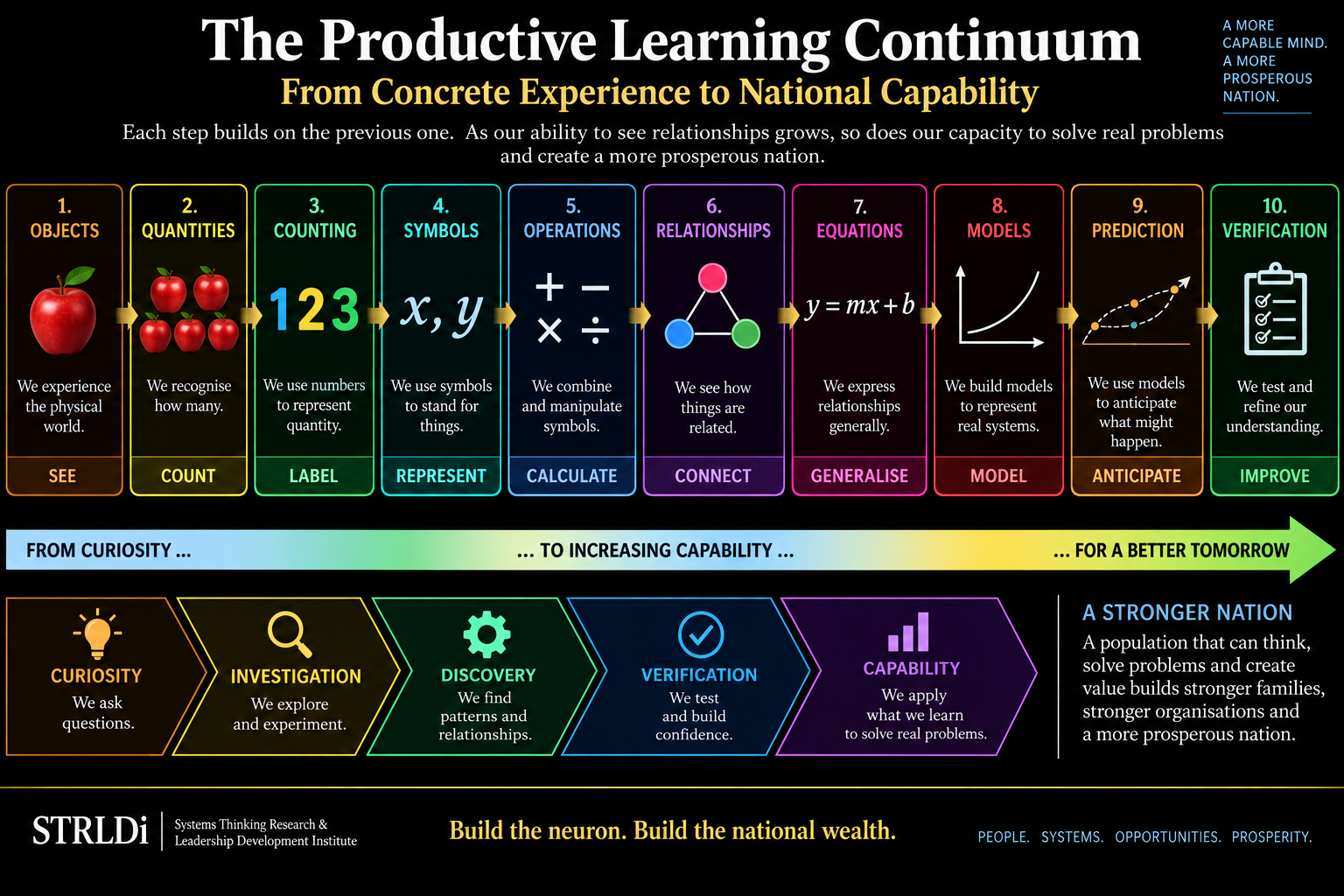
You must be logged in to post a comment.