Governance of the Institutional Liaison Office
A Companion Guide to National Stewardship, Institutional Engagement and Regional Expansion
Introduction
National transformation does not begin with projects. It begins with relationships. Before governments adopt new policies, before institutions collaborate across sectors and before communities participate in long-term change, leaders must first develop confidence in one another and in the institutions they represent. The Institutional Liaison Office exists to cultivate that confidence. It provides the gateway through which relationships are established, institutions are connected and national systems of collaboration begin to emerge.
Within the Systems Thinking Research and Leadership Development Institute (STRLDi), the Institutional Liaison Office is responsible for building and stewarding these relationships. It does not implement programmes or conduct research itself. Rather, it creates the institutional environment in which the Institute’s flagship study, leadership programmes and systems stewardship initiatives can be introduced, understood and sustained. This companion guide summarises the philosophy, structure and operating model of the Office, providing a concise overview of the governance framework described in the full operational manual.
Part 1 – The Purpose of the Institutional Liaison Office
This article would summarise the opening chapters of the manual by explaining why the Office exists, the distinction between relationship stewardship and programme delivery, the meaning of institutional stewardship, and how trusted relationships become the foundation upon which national transformation can occur.
Part 2 – Stewardship Rather than Representation
This section would explain that the Office does not merely represent STRLDi. Its role is to steward long-term institutional relationships that remain valuable beyond any individual project or engagement. It would introduce the principles of trust, continuity, neutrality and long-term partnership that underpin every institutional engagement.
Part 3 – The Governance Architecture
Here the companion would introduce the governance structure of the Office, explaining the role of the Institutional Liaison Office Coordinator, the Coordination Office and the four Stewardship Offices. Rather than reproducing detailed organisational charts, the article would explain how leadership, coordination, institutional intelligence and operational support combine to create one integrated Office capable of serving government, business, academia and communities simultaneously.
Part 4 – The Four Stewardship Offices
This section would provide a concise description of each Stewardship Office, explaining its mandate, the types of institutions it serves and how its work complements the others. Emphasis would be placed on the fact that the four Offices are not independent departments but specialised expressions of a single institutional stewardship system.
Part 5 – Institutional Intelligence and Coordination
Drawing from the manual’s chapters on coordination and the Institutional Relationship Management System (IRMS), this section would explain how institutional knowledge is captured, preserved and shared. It would describe why meeting preparation, briefing notes, follow-up actions and institutional history are essential to maintaining continuity as relationships develop over months and years.
Part 6 – The National Institutional Liaison and Coverage Roadmap
This article would summarise the philosophy of the Coverage Roadmap, explaining why institutional engagement begins with gateway leadership before progressing through national leadership, economic institutions, knowledge partnerships, public-sector engagement, community leadership and national consolidation. The emphasis would remain on the sequencing of relationships rather than on procedural detail.
Part 7 – The Strategic National Institutional Engagement Roadmap
This section would introduce the longer-term strategic roadmap, explaining how institutional engagement evolves over approximately two years from establishing a productive transformation agenda through productive capacity, institutional capability, public-sector execution, community mobilisation, regional integration and ultimately international partnerships. Rather than reproducing the full planning table, the article would explain the strategic logic behind its sequencing.
Part 8 – From Botswana to Southern Africa
The companion would then explain that Botswana serves as the Institute’s demonstration country. The governance model, stewardship philosophy and engagement methodologies developed in Botswana are intended to be refined before being replicated across Southern Africa. Expansion is therefore understood as the transfer of a proven institutional stewardship model rather than the duplication of organisational structures.
Part 9 – Building a Regional Community of Stewardship
This section would conclude the substantive discussion by describing the long-term vision of interconnected Institutional Liaison Offices across Southern Africa. Each country office would operate within its own national context while sharing common governance principles, stewardship practices and systems thinking methodologies, allowing knowledge and institutional learning to circulate throughout the region.
Conclusion – Stewarding Relationships that Transform Nations
The closing article would return to the central idea that institutional transformation begins with trusted relationships. The Institutional Liaison Office exists not simply to organise meetings or coordinate engagements, but to cultivate the institutional confidence required for leaders to think systemically, collaborate across sectors and steward long-term national development. Its success is measured not by the number of engagements conducted, but by the quality, continuity and strategic value of the relationships it builds. As the model matures in Botswana and expands across Southern Africa, the Office becomes more than an administrative function; it becomes a regional platform for institutional stewardship, leadership development and systems transformation.
INSTITUTIONAL LIAISON OFFICE MANUAL (FULL VERSION)
1. Purpose of the Institutional Liaison Office
1.1 Introduction
The Institutional Liaison Office serves as STRLDi’s principal platform for building, stewarding and strengthening institutional relationships that contribute to Botswana’s long-term productive transformation. It exists to cultivate trusted partnerships with leaders and institutions across government, business, professional bodies, communities, academia and international organisations, enabling collaborative leadership that addresses persistent national challenges through systems thinking.
Unlike a conventional stakeholder relations office, the Institutional Liaison Office does not measure success by the number of meetings held or institutions contacted. Its purpose is to guide institutions through a structured learning and leadership journey that progressively builds understanding, capability, collaboration and long-term stewardship. Every engagement is therefore part of a deliberate process that strengthens both individual institutions and the broader national system.
The Office recognises that sustainable transformation cannot be achieved by any single institution acting alone. Governments formulate policy, businesses create productive capacity, universities generate knowledge, professional bodies strengthen institutional practice, communities sustain implementation and international partners contribute experience and resources. The Institutional Liaison Office therefore exists to weave these contributions into an integrated national leadership ecosystem capable of addressing complex challenges that no organisation can solve independently.
1.2 Purpose
The purpose of the Institutional Liaison Office is to develop, steward and strengthen institutional relationships that advance STRLDi’s mission of building Botswana’s productive capacity through systems thinking, leadership development and cross-sector collaboration.
The Office ensures that every institutional relationship contributes to a coherent national transformation agenda by guiding leaders through the STRLDi Leadership Engagement Journey and by aligning institutional engagement with the National Institutional Engagement Roadmap.
1.3 Objectives
The Institutional Liaison Office pursues six strategic objectives.
Build trusted institutional relationships. Develop enduring relationships with leaders and institutions whose decisions influence Botswana’s economic, social and institutional development.
Support productive transformation. Prioritise institutional engagement that contributes directly to employment creation, productive enterprise, institutional capability and national competitiveness.
Develop systems leadership. Introduce leaders to systems thinking through the STRLDi Leadership Engagement Journey, enabling institutions to understand persistent challenges from a systemic rather than symptomatic perspective.
Strengthen collaboration. Create opportunities for institutions from different sectors to learn together, coordinate action and develop shared responses to complex national issues.
Build institutional intelligence. Maintain an accurate understanding of institutional priorities, leadership, capabilities, opportunities and emerging challenges in order to guide strategic engagement and decision-making.
Steward long-term partnerships. Sustain relationships beyond individual meetings by nurturing continuous learning, collaboration and institutional trust.
1.4 Guiding Philosophy
The Institutional Liaison Office operates on a simple principle:
Relationships are national assets.
Every meaningful improvement in national capability is ultimately realised through relationships between institutions and the leaders who guide them. Trust, shared understanding and sustained collaboration cannot be created through isolated engagements. They develop progressively through purposeful interaction, shared learning and mutual commitment to solving important challenges.
For this reason, the Office views every institutional engagement as the beginning—or continuation—of a long-term stewardship journey. The objective is not merely to introduce STRLDi’s work, but to develop relationships that enable institutions to learn together, strengthen one another and contribute collectively to Botswana’s long-term prosperity.
1.5 Operating Principles
The work of the Institutional Liaison Office is guided by the following principles.
Purpose before activity. Every engagement must contribute to STRLDi’s mission and the National Institutional Engagement Roadmap.
Relationships before transactions. Trust is developed over time through consistency, integrity and mutual respect.
Systems before symptoms. Institutional dialogue seeks to understand the systemic causes of persistent challenges rather than focusing only on immediate problems.
Learning before advocacy. STRLDi enters every engagement with curiosity and a commitment to shared learning.
Stewardship before ownership. Institutional relationships belong to STRLDi rather than individual team members and are managed on behalf of the Institute.
National interest before organisational interest. Every engagement should contribute to strengthening Botswana’s productive, institutional and leadership capability.
1.6 Scope
The Institutional Liaison Office provides a unified framework for planning, coordinating and stewarding STRLDi’s relationships with institutions across Botswana, the Southern African region and the international community.
Its work encompasses four permanent Stewardship Offices, each responsible for a defined institutional portfolio, while operating through a common Leadership Engagement Journey, a shared National Institutional Engagement Roadmap and an integrated Institutional Relationship Management System (IRMS). Together, these structures ensure that institutional engagement remains strategic, coordinated and aligned with STRLDi’s long-term mission.
2. The Institutional Liaison Office
2.1 Overview
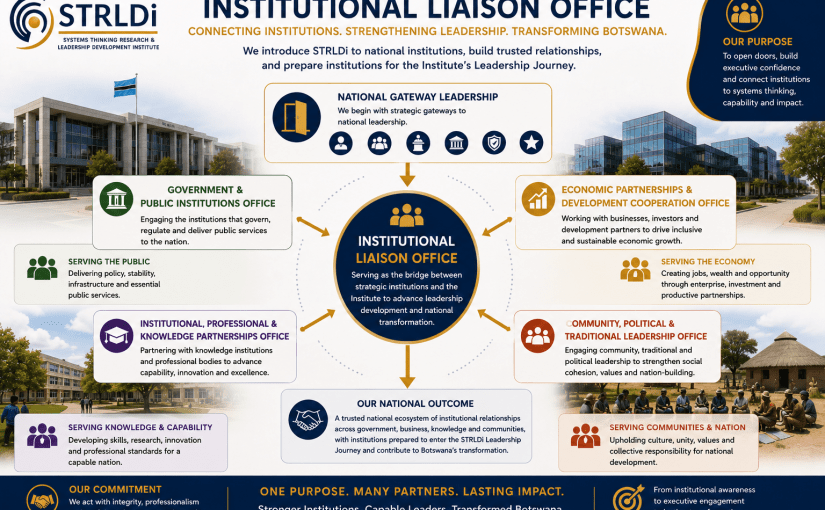
The Institutional Liaison Office is STRLDi’s institutional stewardship platform. It is responsible for developing, coordinating and sustaining relationships with institutions whose leadership, resources and influence contribute to Botswana’s long-term productive transformation. The Office serves as the Institute’s primary gateway for institutional engagement, ensuring that relationships are purposeful, coordinated and aligned with STRLDi’s mission.
The Office operates on the understanding that national transformation requires the combined efforts of government, business, professional institutions, communities, academia and international partners. No single institution possesses all the authority, knowledge or resources required to address persistent national challenges. The Institutional Liaison Office therefore creates the conditions through which these institutions can progressively learn, collaborate and steward long-term systemic change.
Every institutional relationship is managed through three common operating frameworks. The Leadership Engagement Journey provides the pathway through which institutions progress from initial discovery to long-term systems stewardship. The National Institutional Engagement Roadmap determines the sequence in which institutions are engaged to support Botswana’s productive transformation. The Institutional Relationship Management System (IRMS) records institutional intelligence, engagement history and relationship progress, ensuring continuity and informed decision-making.
2.2 Organisational Architecture
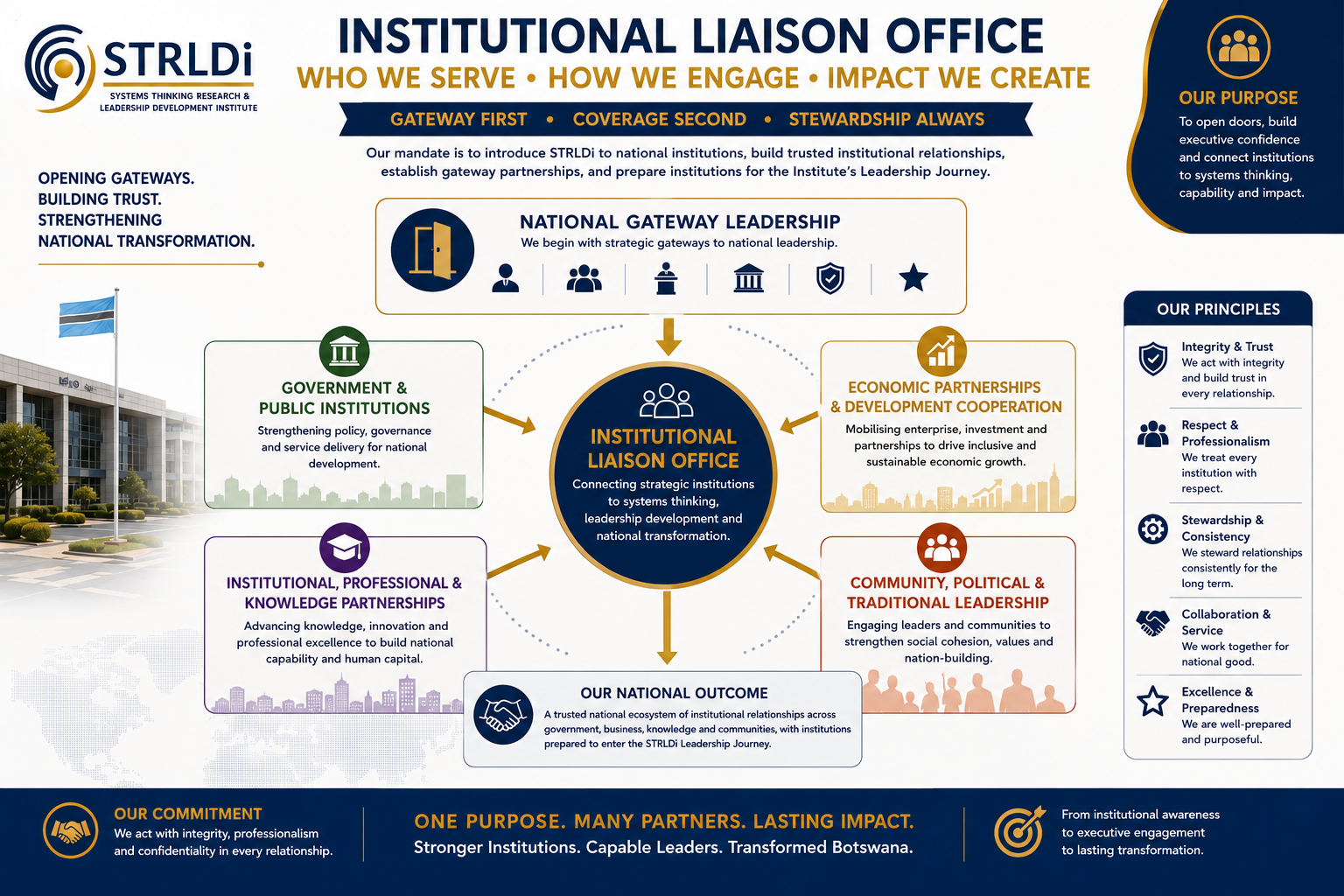
The Institutional Liaison Office consists of four permanent Stewardship Offices. Each Stewardship Office is responsible for a defined institutional portfolio and is led by a Steward who develops, nurtures and advances relationships within that portfolio. Although each office has a distinct mandate, they operate as one integrated Institutional Liaison Office under a common governance framework, shared operating procedures and a unified Institutional Relationship Management System.
The four Stewardship Offices are:
Government, Media & International Relations Office
Responsible for building trusted relationships with national and local government, public institutions, diplomatic missions, international organisations and the media. This office strengthens STRLDi’s public presence while creating opportunities for policy dialogue, executive engagement and international collaboration.
Economic Partnerships & Development Cooperation Office
Responsible for developing relationships with the private sector, investors, development partners, philanthropic organisations and multilateral institutions. This office strengthens Botswana’s productive economy by connecting leadership development with enterprise, investment, innovation and resource mobilisation.
Institutional, Professional & Knowledge Partnerships Office
Responsible for relationships with parastatals, statutory organisations, professional bodies, research institutes and knowledge networks. This office strengthens institutional capability by encouraging professional learning, applied research and cross-sector knowledge exchange.
Community, Political, Traditional Leadership, Knowledge & Regional Partnerships Office
Responsible for building relationships with community leadership, political leadership, Bogosi, tertiary institutions, civil society organisations and regional institutions. This office extends systems thinking into communities while strengthening regional cooperation and long-term leadership networks.
Together, these four Stewardship Offices provide STRLDi with comprehensive institutional coverage across Botswana and progressively expand its influence throughout Southern Africa and beyond.
2.3 How the Four Stewardship Offices Work Together
The four Stewardship Offices are not independent departments pursuing separate agendas. They function as complementary components of a single institutional stewardship system. Each office contributes its specialised relationships while supporting a shared national transformation agenda.
The National Institutional Engagement Roadmap determines which office assumes leadership at different stages of the Institute’s work. During the early stages of the roadmap, greater emphasis is placed on productive-sector institutions and economic partnerships that influence employment creation, enterprise development and investment. As institutional capability grows, leadership progressively expands to include government, professional institutions, communities, regional organisations and international partners. In this way, the Office builds Botswana’s institutional ecosystem in a deliberate and coherent sequence.
Although one Stewardship Office may lead a particular phase of the roadmap, the remaining offices continue to develop supporting relationships that prepare the next stages of institutional engagement. This coordinated approach enables the Institute to maintain strategic focus while steadily expanding the breadth and depth of its national relationships.
2.4 The Leadership Engagement Journey
Every institution engaged by the Institutional Liaison Office follows the same Leadership Engagement Journey. Regardless of sector, every relationship progresses through four stages that progressively deepen understanding, capability and long-term collaboration.
The journey begins with an Invitation to the Flagship Study, where institutional leaders are introduced to STRLDi’s work and invited to explore persistent national challenges through a systems thinking perspective.
Leaders who wish to deepen their understanding participate in the Executive Systems Programme, where they experience systems thinking in practice, develop a shared language for addressing complexity and begin connecting institutional priorities with national transformation.
Institutions that demonstrate commitment to collaborative leadership progress into the Systems Stewardship Programme, where leaders work across institutional boundaries to strengthen capability, design long-term solutions and develop collaborative leadership networks.
The journey culminates in National and Regional Systems Stewardship, where institutions become active contributors to Botswana’s productive transformation while strengthening collaboration across Southern Africa and the broader international community.
The Institutional Liaison Office therefore measures success not by the number of meetings conducted, but by the number of institutions that progress meaningfully through this journey and contribute to long-term systems stewardship.
2.5 The National Institutional Engagement Roadmap
The Institutional Liaison Office does not engage institutions opportunistically. Institutional engagement is guided by the National Institutional Engagement Roadmap, which establishes the strategic sequence through which STRLDi develops institutional relationships over time.
The roadmap begins with institutions that directly influence Botswana’s productive economy, including those responsible for investment, enterprise development, agriculture, manufacturing, finance, infrastructure and skills development. As these relationships mature, the roadmap progressively expands to include institutions responsible for strengthening government capability, professional excellence, community leadership, regional cooperation and international partnerships.
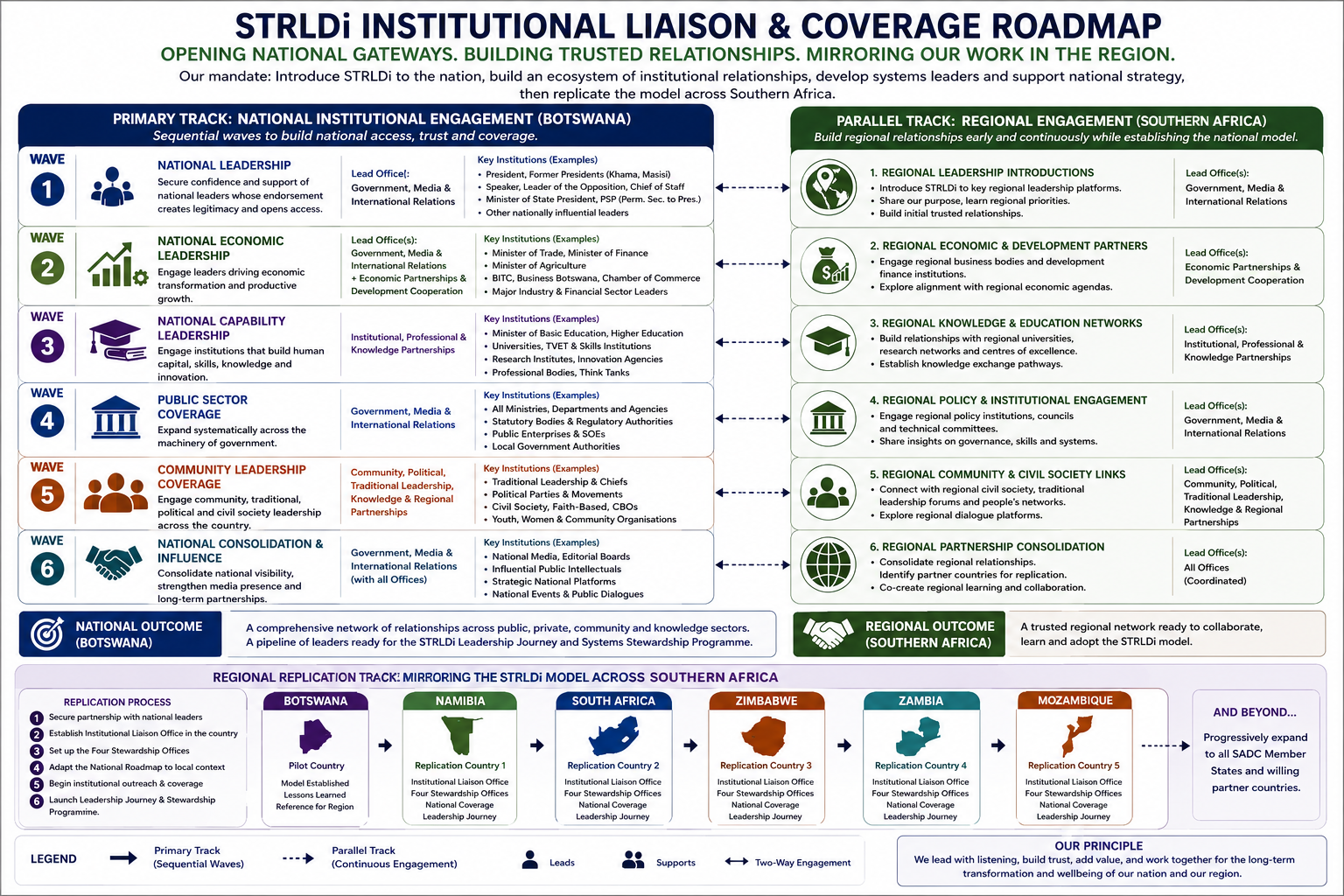
This staged approach enables STRLDi to concentrate its limited resources where they will have the greatest systemic influence while steadily building a national leadership network capable of supporting long-term productive transformation. The roadmap therefore provides every Stewardship Office with a clear understanding of institutional priorities, expected outcomes and the contribution each engagement makes to the Institute’s broader mission.
3. The Four Stewardship Offices
3.1 Purpose
The Institutional Liaison Office fulfils its mandate through four permanent Stewardship Offices. Each Stewardship Office is responsible for cultivating, strengthening and sustaining relationships within a defined institutional domain that contributes to Botswana’s productive transformation.
The Stewardship Offices are not separate departments operating independently. Together they form one integrated institutional stewardship system. While each office develops expertise within its own institutional portfolio, all four offices operate through a common Leadership Engagement Journey, a shared National Institutional Engagement Roadmap and a single Institutional Relationship Management System. This enables STRLDi to present one coherent institutional presence while engaging leaders from every major sector of society.
Each Stewardship Office is led by a Steward who is responsible for the quality, continuity and strategic development of relationships within the assigned institutional portfolio. The Steward works closely with the Institutional Liaison Office Coordinator, the Institutional Engagement Coordinator and the Institutional Intelligence and Executive Coordination function to ensure that engagements are properly planned, documented and aligned with the Institute’s strategic priorities.
3.2 Government, Media & International Relations Office
Current Steward: Brunoh
Purpose
Governments establish national policy, allocate public resources and create the enabling environment within which the productive economy develops. The media shapes public understanding of national priorities, while international institutions provide opportunities for learning, cooperation and strategic partnership. This Stewardship Office therefore develops trusted relationships with these institutions, ensuring that STRLDi contributes meaningfully to national dialogue while strengthening collaboration with regional and international partners.
The Office seeks to position STRLDi as a respected institutional partner capable of supporting governments and public leaders in understanding and addressing persistent national challenges through systems thinking. Rather than advocating predetermined solutions, it encourages collaborative inquiry, executive learning and long-term institutional stewardship.
Strategic Mandate
The Government, Media & International Relations Office provides STRLDi’s principal interface with public leadership and external institutional partners. It develops relationships that strengthen policy dialogue, public understanding and international cooperation while ensuring that the Institute’s work contributes constructively to national development.
As the country’s productive sectors mature, this office progressively broadens institutional engagement by strengthening relationships with regional organisations, diplomatic missions and international agencies whose experience and resources support Botswana’s long-term development aspirations.
Institutional Portfolio
The Office stewards relationships with institutions including:
- Office of the President
- Office of the Vice President
- Parliament
- Ministries and Government Departments
- Local Government
- District Commissioners
- Government Agencies
- Regulatory Authorities
- Media Houses
- Journalists and Editors
- Broadcasting Organisations
- Digital Media Platforms
- Embassies
- High Commissions
- International Organisations
- Regional Government Institutions
Core Responsibilities
The Office is responsible for:
- Developing trusted relationships with senior government leadership.
- Coordinating executive briefings and institutional dialogue.
- Supporting engagement with Ministers, Permanent Secretaries and Heads of Institutions.
- Strengthening STRLDi’s public communication and media engagement.
- Coordinating relationships with diplomatic missions and international organisations.
- Identifying opportunities for regional and international collaboration.
- Supporting national dialogue on persistent systemic challenges.
- Contributing institutional intelligence relating to public policy and governance.
Role within the National Institutional Engagement Roadmap
Throughout the National Institutional Engagement Roadmap this office provides the public-sector leadership necessary for productive transformation. During the early tiers of the roadmap it concentrates on ministries and agencies that influence enterprise development, agriculture, manufacturing, infrastructure, education and investment. As the roadmap progresses, its engagement expands across broader areas of government while strengthening regional and international cooperation.
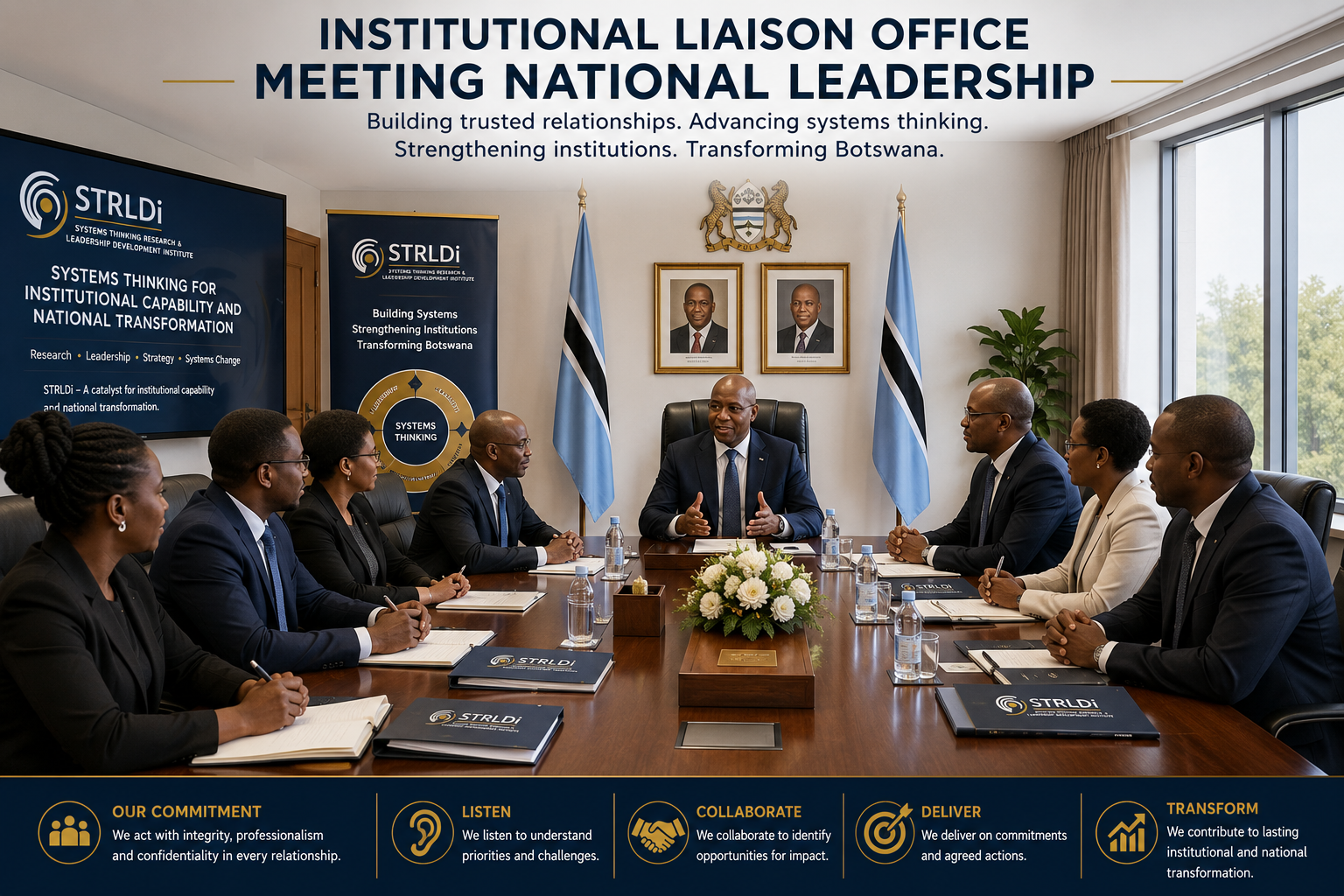
Role within the Leadership Engagement Journey
The Office introduces senior public leaders to STRLDi’s Flagship Study, facilitates their participation in the Executive Systems Programme and supports their continued involvement in Systems Stewardship. It maintains long-term relationships with government institutions to encourage collaborative leadership across the public sector.
Measures of Success
The effectiveness of the Office is demonstrated through:
- Strong executive relationships across government.
- Increased participation of public institutions in the Leadership Engagement Journey.
- Improved collaboration between government and other institutional sectors.
- Constructive media engagement and public understanding of systems thinking.
- Strong regional and international institutional partnerships.
- Sustained trust between STRLDi and public leadership.
3.3 Economic Partnerships & Development Cooperation Office
Current Steward: Mr Tema
Purpose
A productive economy depends upon institutions that invest, manufacture, innovate, finance enterprise and create employment. The Economic Partnerships & Development Cooperation Office exists to build enduring relationships with these institutions while encouraging collaborative leadership around Botswana’s long-term productive transformation.
The Office recognises that sustainable economic development requires more than financial investment. It requires institutions that understand how productive systems function, appreciate their interdependence and are willing to work collaboratively across sectors. By cultivating these relationships, the Office supports the growth of industries capable of creating meaningful employment, increasing national competitiveness and strengthening economic resilience.
Strategic Mandate
This Stewardship Office leads STRLDi’s engagement with institutions responsible for productive investment, enterprise development, development cooperation and economic growth. It creates opportunities for collaboration between government, business, development partners and philanthropic organisations while supporting initiatives that strengthen Botswana’s productive economy.
As the lead office during the early stages of the National Institutional Engagement Roadmap, it plays a central role in establishing the institutional partnerships that underpin national productive transformation.
Institutional Portfolio
The Office stewards relationships with institutions including:
- Business Botswana
- Botswana Investment and Trade Centre (BITC)
- Citizen Entrepreneurial Development Agency (CEDA)
- National Development Bank
- Commercial Banks
- Botswana Stock Exchange
- Development Finance Institutions
- Manufacturing Associations
- Agricultural Business Associations
- Investors
- Chambers of Commerce
- Philanthropic Foundations
- Development Partners
- Multilateral Institutions
- International Financial Organisations
Core Responsibilities
The Office is responsible for:
- Developing strategic partnerships with business and industry.
- Strengthening relationships with investors and development partners.
- Supporting productive sector collaboration.
- Identifying opportunities for enterprise development and investment.
- Encouraging collaboration between industry and government.
- Facilitating engagement with philanthropic and development organisations.
- Supporting initiatives that strengthen Botswana’s productive economy.
- Contributing institutional intelligence relating to economic development and investment.
Role within the National Institutional Engagement Roadmap
The Economic Partnerships & Development Cooperation Office leads the initial stages of the roadmap by engaging institutions that directly influence enterprise development, investment, manufacturing, agriculture, finance and employment creation. Its work establishes the productive foundation upon which subsequent institutional engagement is built.
Role within the Leadership Engagement Journey
The Office introduces business leaders, investors and development partners to the Flagship Study, facilitates their participation in the Executive Systems Programme and supports their progression towards long-term systems stewardship and collaborative national leadership.
Measures of Success
The effectiveness of the Office is demonstrated through:
- Strong strategic relationships with productive-sector institutions.
- Increased participation of business leaders in STRLDi programmes.
- Growth in collaborative economic initiatives.
- Strong partnerships with development agencies and investors.
- Enhanced resource mobilisation.
- Increased contribution of institutional partnerships to Botswana’s productive transformation.
The next part will continue in the same style with:
- 3.4 Institutional, Professional & Knowledge Partnerships Office
- 3.5 Community, Political, Traditional Leadership, Knowledge & Regional Partnerships Office
After completing all four offices, we will move to Section 4: Office Leadership and Coordination, where Coach, Monty and Bernice are positioned as the leadership and coordination platform that enables the four Stewardship Offices to operate as one integrated institutional system.
3.4 Institutional, Professional & Knowledge Partnerships Office
Current Steward: Mabua
Purpose
Strong institutions are built through capable professionals, sound governance, continuous learning and the effective application of knowledge. The Institutional, Professional & Knowledge Partnerships Office exists to cultivate relationships with organisations whose primary contribution is to strengthen institutional capability, professional practice, research and knowledge development. Through these partnerships, STRLDi expands the collective capacity of institutions to understand complexity, improve decision-making and support Botswana’s long-term development.
This Office recognises that productive transformation requires more than economic growth. Institutions must possess the capability to govern effectively, manage resources responsibly and continuously improve their performance. Professional bodies establish standards of practice, research institutions generate new knowledge and statutory organisations shape the quality of public administration. By strengthening relationships across this institutional landscape, the Office contributes to a culture of institutional excellence and lifelong learning.
Strategic Mandate
The Institutional, Professional & Knowledge Partnerships Office develops collaborative relationships that advance professional learning, institutional capability and knowledge exchange. It creates opportunities for institutions to learn from one another, to apply systems thinking within their own organisational contexts and to contribute collectively to national transformation.
The Office also strengthens STRLDi’s relationship with the national knowledge ecosystem by encouraging collaboration between researchers, practitioners, professional associations and public institutions. Through these partnerships, the Institute continually enriches its own work while contributing to the broader development of systems leadership within Botswana.
Institutional Portfolio
The Office stewards relationships with institutions including:
- Statutory Organisations
- Parastatal Organisations
- Professional Councils
- Professional Associations
- Institutes and Colleges
- Research Organisations
- Policy Institutes
- Think Tanks
- Centres of Excellence
- Standards and Accreditation Bodies
- Technical Advisory Organisations
- Knowledge Networks
Core Responsibilities
The Office is responsible for:
- Building long-term relationships with professional and statutory institutions.
- Promoting collaboration between research, policy and professional practice.
- Identifying opportunities for institutional learning and capability development.
- Encouraging participation in STRLDi leadership and systems programmes.
- Facilitating knowledge exchange between institutional partners.
- Supporting collaborative research and applied systems thinking.
- Maintaining institutional intelligence relating to professional and knowledge organisations.
- Strengthening Botswana’s institutional learning ecosystem.
Role within the National Institutional Engagement Roadmap
As the National Institutional Engagement Roadmap progresses beyond productive-sector institutions, this Office expands engagement with organisations responsible for strengthening governance, professional standards, technical capability and organisational learning. These relationships reinforce the institutional foundations required for sustainable national development and ensure that productive transformation is supported by capable organisations and skilled professionals.
Role within the Leadership Engagement Journey
The Office introduces institutional and professional leaders to the Flagship Study, facilitates participation in the Executive Systems Programme and encourages collaborative learning through the Systems Stewardship Programme. It supports institutions in embedding systems thinking within their organisational practice while contributing to a broader national community of learning.
Measures of Success
The effectiveness of the Office is demonstrated through:
- Strong partnerships with statutory and professional institutions.
- Increased participation of professional leaders in STRLDi programmes.
- Growth in collaborative research and knowledge initiatives.
- Strong institutional learning networks.
- Increased application of systems thinking within partner organisations.
- Greater collaboration between professional institutions and other sectors of the national leadership ecosystem.
3.5 Community, Political, Traditional Leadership, Knowledge & Regional Partnerships Office
Current Steward: Coach
Purpose
National transformation ultimately succeeds when leadership extends beyond formal institutions into communities, traditional structures, political leadership, educational institutions and regional partnerships. The Community, Political, Traditional Leadership, Knowledge & Regional Partnerships Office exists to strengthen these relationships, recognising that sustainable development depends upon broad societal participation and shared leadership across every level of society.
The Office provides STRLDi with a bridge between institutional leadership and the communities that experience the outcomes of national policy and economic development. It encourages dialogue that respects local knowledge, strengthens civic participation and recognises the important role of traditional leadership, political leadership and civil society in shaping Botswana’s future. At the same time, it cultivates relationships across the Southern African region to encourage shared learning and regional systems stewardship.
Strategic Mandate
The Community, Political, Traditional Leadership, Knowledge & Regional Partnerships Office develops collaborative relationships that strengthen community leadership, social cohesion, regional cooperation and knowledge exchange. It creates opportunities for dialogue across sectors and generations while encouraging institutions to recognise the interconnected nature of national and regional development.
The Office also supports STRLDi’s long-term aspiration to contribute to systems leadership beyond Botswana by developing partnerships with regional organisations, universities and institutions across Southern Africa. These relationships enable shared learning, comparative research and collaborative responses to challenges that transcend national boundaries.
Institutional Portfolio
The Office stewards relationships with institutions including:
- Bogosi (Traditional Leadership)
- Political Leadership
- Political Parties
- Civil Society Organisations
- Community-Based Organisations
- Faith-Based Organisations
- Universities
- Higher Education Institutions
- Leadership Networks
- Youth Organisations
- Women’s Organisations
- Regional Universities
- Regional Research Networks
- SADC Institutions
- Regional Development Organisations
Core Responsibilities
The Office is responsible for:
- Building trusted relationships with community and traditional leadership.
- Strengthening dialogue with political leadership across the national landscape.
- Developing partnerships with universities and higher education institutions.
- Supporting collaboration with civil society organisations.
- Encouraging community participation in systems leadership.
- Strengthening regional institutional partnerships.
- Facilitating knowledge exchange across Southern Africa.
- Maintaining institutional intelligence relating to community and regional partnerships.
Role within the National Institutional Engagement Roadmap
As the National Institutional Engagement Roadmap expands beyond Botswana’s core productive institutions, this Office strengthens the wider leadership ecosystem by engaging communities, educational institutions, regional organisations and leadership networks. These relationships broaden the impact of STRLDi’s work, ensuring that systems stewardship becomes embedded across society and progressively extends throughout the region.
Role within the Leadership Engagement Journey
The Office introduces community, political and regional leaders to the Flagship Study, facilitates participation in STRLDi’s learning programmes and supports the development of collaborative leadership networks that contribute to national and regional systems stewardship. It encourages institutions to move beyond individual organisational interests and to embrace shared responsibility for long-term societal wellbeing.
Measures of Success
The effectiveness of the Office is demonstrated through:
- Strong relationships with traditional, political and community leadership.
- Increased participation of universities and civil society organisations in STRLDi programmes.
- Growth in regional institutional partnerships.
- Strong collaborative leadership networks across sectors.
- Expanded knowledge exchange within Botswana and Southern Africa.
- Increased contribution of community and regional partnerships to long-term systems stewardship.
3.6 A Unified Institutional Liaison Office
Although the Institutional Liaison Office is organised into four Stewardship Offices, it functions as a single integrated team with a shared purpose. The Stewardship Offices have been established to provide focus and clarity of responsibility rather than to create organisational silos. Each Office develops specialised knowledge of its institutional landscape while contributing to a common national institutional engagement strategy.
This integrated approach enables STRLDi to engage a wide diversity of institutions without losing coherence. Government ministries, businesses, professional bodies, universities, traditional authorities, political leaders and community organisations experience one Institutional Liaison Office rather than four separate teams. Coordination, shared planning and institutional intelligence ensure that every engagement contributes to a common understanding of the country’s leadership landscape.
3.7 The Four Stewardship Offices
The four Stewardship Offices divide responsibility for Botswana’s institutional landscape into complementary portfolios. Each Steward is responsible for cultivating relationships, maintaining institutional intelligence and guiding engagement within his or her assigned portfolio. While each Office develops specialist knowledge of its respective sector, no Office operates independently of the others.
Many institutions require collaboration between two or more Stewardship Offices. For example, a university may also participate in national economic development, a professional body may advise government policy, or a traditional leadership institution may contribute to community development and education. The Institutional Liaison Office therefore encourages joint stewardship whenever institutional mandates overlap, ensuring that relationships remain integrated rather than fragmented.
3.8 Office Coordination and Operational Support
Institutional stewardship depends upon effective preparation, disciplined follow-up and reliable institutional intelligence. For this reason, the Stewardship Offices are supported by a shared operational platform that coordinates engagements before, during and after every institutional interaction.
The operational support team ensures that meetings are scheduled, agendas prepared, correspondence managed, engagement notes recorded and follow-up actions tracked. This allows the Stewards to concentrate on relationship building while maintaining a consistently professional standard of engagement across the Office. Operational coordination also strengthens continuity by ensuring that commitments are documented and shared rather than remaining with individual officers.
3.9 Institutional Intelligence and the IRMS
Every institutional engagement contributes to STRLDi’s understanding of the national leadership landscape. The Institutional Relationship Management System (IRMS) provides the mechanism through which this knowledge is captured, organised and preserved. Institutional profiles, engagement histories, leadership information, commitments and opportunities are maintained within the IRMS so that the Office develops an increasingly rich institutional memory over time.
Bernice serves as the custodian of this institutional intelligence. Working closely with Coach, Rea and Monty, she ensures that information gathered before and after engagements is incorporated into the IRMS, enabling every Stewardship Office to benefit from shared organisational knowledge rather than relying on individual recollection.
3.10 Dual Stewardship Responsibilities
The organisation structure reflects both functional leadership and institutional stewardship. Coach serves as the Institutional Liaison Office Coordinator, providing overall leadership, strategic direction and integration across the Office. In addition to this coordinating responsibility, Coach also serves as the Steward for the Community, Political, Traditional Leadership, Knowledge & Regional Partnerships Office.
This dual role reflects the strategic importance of community and national leadership engagement while ensuring that all four Stewardship Offices remain aligned under a single coordinating function. It does not create two separate positions but illustrates that one individual carries both an Office-wide leadership responsibility and stewardship for a specific institutional portfolio.
3.11 Reading the Organisation Structure
The organisation structure should be understood as a stewardship network rather than a traditional reporting hierarchy. It illustrates how institutional relationships are coordinated, supported and strengthened through collaboration across the Office.
The vertical relationships show overall coordination and stewardship responsibility. The horizontal relationships demonstrate operational collaboration between the support team and the four Stewardship Offices. Together, these relationships enable the Institutional Liaison Office to present a unified institutional presence while preserving continuity, professionalism and shared institutional memory across all engagements.
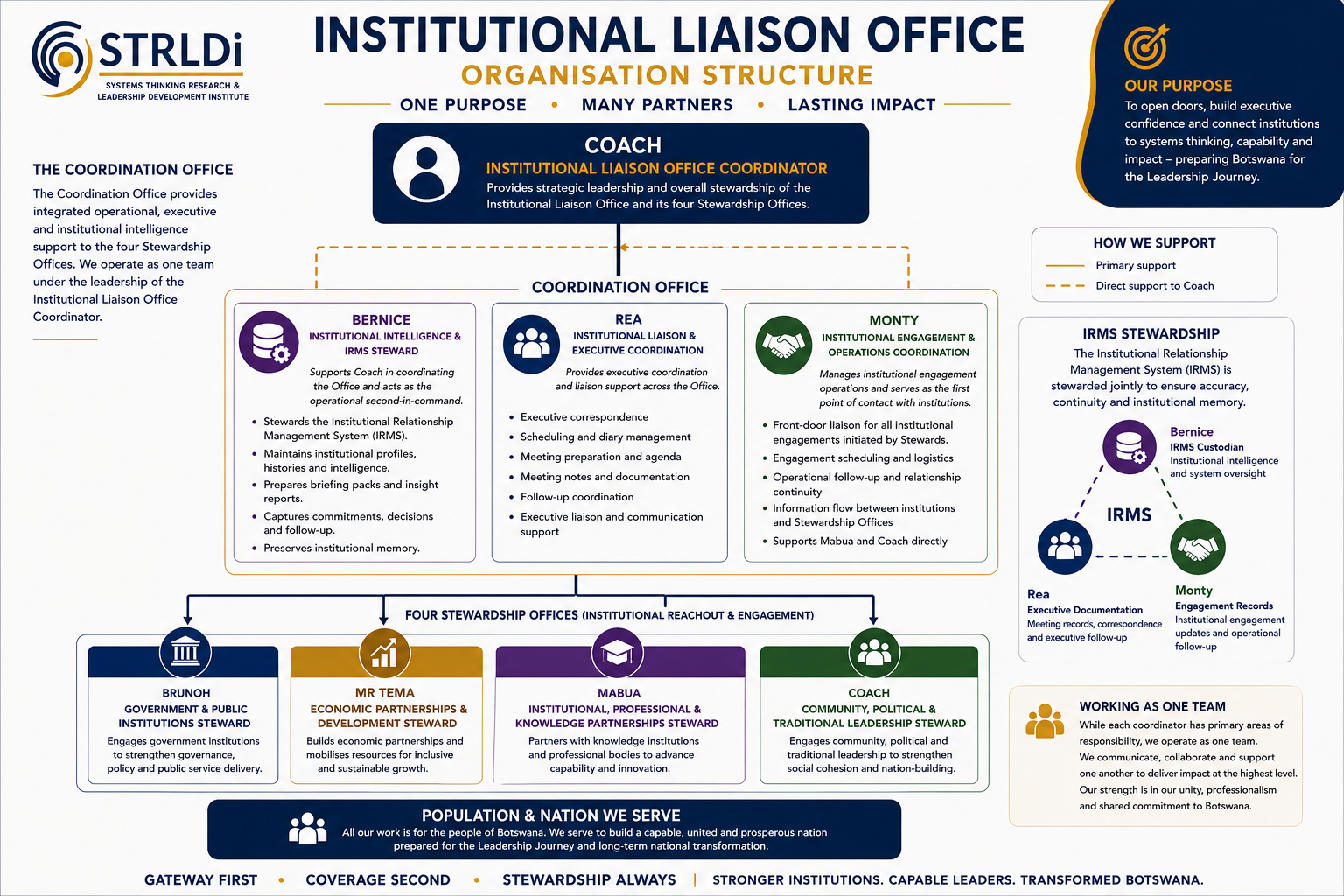
STRLDi Institutional Liaison Office Organisation Structure
4. Office Leadership and Coordination
4.1 Purpose
The Institutional Liaison Office functions as a single institutional stewardship system because its work is coordinated through a common leadership and operational structure. While the four Stewardship Offices develop relationships within their respective institutional portfolios, overall coordination ensures that institutional engagement remains strategic, integrated and aligned with STRLDi’s mission.
This coordination structure provides direction, consistency and continuity. It ensures that institutional intelligence is shared, engagements are properly prepared, follow-up actions are completed and relationships continue to develop regardless of changes in personnel or organisational priorities. By separating institutional stewardship from operational coordination, the Office enables each Stewardship Office to concentrate on building high-quality relationships while relying on a common platform for planning, administration and organisational learning.
The coordination structure also safeguards one of STRLDi’s fundamental principles: institutional relationships belong to the Institute rather than to individual officers. Every engagement, commitment and partnership is therefore managed through shared systems and documented processes that preserve institutional memory and support long-term continuity.
4.2 Principles of Coordination
The coordination of the Institutional Liaison Office is guided by five principles that shape the daily work of every member of the Office.
Unity of Purpose
All activities undertaken by the four Stewardship Offices contribute to a common national transformation agenda. Coordination ensures that institutional engagements reinforce rather than compete with one another.
Shared Institutional Stewardship
Relationships are collectively stewarded. Although individual officers may lead specific engagements, institutional knowledge, commitments and future opportunities remain organisational assets that are accessible to the wider Office.
Preparation and Professionalism
Every institutional engagement should demonstrate careful preparation, respect for the institution being engaged and a clear understanding of the purpose of the meeting. Professional preparation reflects the quality of STRLDi’s stewardship.
Continuity
Institutional relationships develop over many years. Effective coordination ensures that engagements continue seamlessly despite changes in leadership, staffing or organisational priorities.
Learning
Every engagement provides an opportunity to strengthen institutional understanding. Coordination therefore includes systematic reflection, documentation and continuous improvement so that future engagements benefit from accumulated experience.
4.3 Executive Leadership
The Executive Director provides the strategic leadership of the Institutional Liaison Office. This responsibility extends beyond approving engagements or representing the Institute publicly. The Executive Director establishes the strategic direction of institutional stewardship, determines engagement priorities and ensures that institutional relationships remain aligned with STRLDi’s mission, values and long-term objectives.
The Executive Director approves the National Institutional Engagement Roadmap, authorises strategic institutional partnerships and determines the Institute’s position on matters requiring executive judgement. The Executive Director also serves as STRLDi’s principal representative during engagements of national or international significance, particularly where institutional relationships require executive leadership or strategic decision-making.
In addition, the Executive Director nurtures the culture of stewardship that underpins the Office. This includes encouraging collaboration across the four Stewardship Offices, strengthening systems thinking within institutional engagements and ensuring that the Office continually develops its capability to support Botswana’s productive transformation.
4.4 Institutional Liaison Office Coordinator
The Institutional Liaison Office Coordinator provides operational leadership for the entire Office. The Coordinator ensures that the four Stewardship Offices function as one integrated institutional stewardship system and that all activities remain aligned with the National Institutional Engagement Roadmap and the Leadership Engagement Journey.
The Coordinator develops annual and quarterly engagement priorities, facilitates collaboration between Stewardship Offices and ensures that institutional engagements receive appropriate preparation and follow-up. Where engagements involve multiple institutional sectors, the Coordinator provides overall integration so that STRLDi presents a coherent institutional presence.
The Coordinator also oversees the quality of institutional stewardship by monitoring progress through the Leadership Engagement Journey, reviewing engagement outcomes, identifying emerging opportunities and supporting continuous improvement across the Office. Through regular planning meetings and operational reviews, the Coordinator ensures that institutional relationships continue to mature in accordance with the Institute’s long-term strategy.
Key Responsibilities
The Institutional Liaison Office Coordinator is responsible for:
- Leading the day-to-day operation of the Institutional Liaison Office.
- Coordinating the work of the four Stewardship Offices.
- Overseeing implementation of the National Institutional Engagement Roadmap.
- Monitoring institutional progress through the Leadership Engagement Journey.
- Allocating institutional engagement priorities.
- Supporting the professional development of Stewards.
- Reviewing the quality of institutional stewardship.
- Escalating strategic matters requiring Executive Director attention.
4.5 Institutional Engagement Coordinator
The Institutional Engagement Coordinator is responsible for translating strategic priorities into well-organised institutional engagements. While the Stewardship Offices develop and nurture relationships, the Institutional Engagement Coordinator ensures that each engagement is professionally planned, efficiently managed and successfully executed.
The role serves as the operational hub of the Institutional Liaison Office. It coordinates schedules, prepares engagement plans, confirms logistics, supports communication with institutional partners and monitors completion of agreed actions. By providing consistent operational support, the Coordinator enables the Stewards to devote greater attention to relationship development and strategic dialogue.
The Institutional Engagement Coordinator also maintains visibility across all planned engagements, helping to prevent duplication, identify opportunities for joint engagements and ensure that institutional commitments are fulfilled in a timely manner.
Key Responsibilities
The Institutional Engagement Coordinator is responsible for:
- Coordinating institutional engagement calendars.
- Preparing engagement schedules.
- Managing invitations and confirmations.
- Coordinating meeting logistics.
- Preparing briefing packs for engagements.
- Monitoring follow-up actions.
- Supporting communication between Stewardship Offices.
- Maintaining engagement records within the IRMS.
4.6 Institutional Intelligence and Executive Coordination
Institutional stewardship depends upon reliable institutional intelligence. The Institutional Intelligence and Executive Coordination function ensures that the Office develops and maintains an accurate understanding of every institution with which STRLDi engages. It captures institutional history, leadership profiles, engagement outcomes, strategic priorities and emerging opportunities, transforming individual experiences into organisational knowledge.
This function also supports executive preparation by producing briefing notes, institutional profiles, relationship histories and strategic summaries that enable the Executive Director and Stewards to engage institutions with confidence and continuity. Through careful documentation and analysis, it ensures that important knowledge is preserved and readily accessible whenever required.
Beyond maintaining records, the function contributes to organisational learning by identifying patterns across engagements, highlighting opportunities for collaboration and providing information that supports strategic planning. In this way, institutional intelligence becomes an active resource that continually strengthens the quality of STRLDi’s stewardship.
Key Responsibilities
The Institutional Intelligence and Executive Coordination function is responsible for:
- Maintaining institutional profiles.
- Recording institutional engagement histories.
- Preparing executive briefing documents.
- Maintaining leadership profiles.
- Recording strategic opportunities and risks.
- Producing institutional intelligence reports.
- Supporting preparation for executive engagements.
- Preserving institutional memory.
4.7 Working Rhythm of the Institutional Liaison Office
The effectiveness of the Institutional Liaison Office depends not only on well-defined roles but also on a disciplined operating rhythm that encourages planning, collaboration and continuous learning. Rather than responding reactively to engagement opportunities, the Office follows a regular cycle of planning, execution, review and improvement.
Each planning cycle begins with a review of the National Institutional Engagement Roadmap and the progress of institutions through the Leadership Engagement Journey. The four Stewardship Offices then coordinate their priorities, identify opportunities for joint engagement and prepare executive schedules. Throughout the cycle, institutional intelligence is updated continuously within the IRMS, ensuring that decisions are informed by current information rather than individual recollection.
The cycle concludes with structured reflection on completed engagements. Lessons learned, emerging opportunities and recommended improvements are documented and shared across the Office. This disciplined rhythm transforms individual engagements into organisational learning and enables the Institutional Liaison Office to strengthen its stewardship capability over time.
5. The Leadership Engagement Journey
5.1 Purpose
The Leadership Engagement Journey is the Institutional Liaison Office’s common operating framework for developing institutional relationships. It provides a structured pathway through which leaders and institutions progressively deepen their understanding of systems thinking, strengthen their leadership capability and become active contributors to Botswana’s long-term productive transformation.
Rather than treating institutional engagement as a series of isolated meetings, the Leadership Engagement Journey recognises that meaningful relationships develop over time. Trust is built gradually, understanding deepens through shared learning and collaboration becomes stronger as institutions gain confidence in one another. Every engagement undertaken by the Institutional Liaison Office therefore contributes to moving an institution forward along this journey.
The Journey also provides consistency across the four Stewardship Offices. Regardless of the sector being engaged, every institution follows the same developmental pathway. This ensures that government leaders, business executives, professional bodies, universities, community organisations and international partners experience a coherent approach to institutional stewardship while allowing each Stewardship Office to tailor its engagement to the needs of its respective institutional portfolio.
5.2 Principles of the Leadership Engagement Journey
The Leadership Engagement Journey is guided by several principles that shape every institutional engagement.
Leadership develops progressively. Institutional leaders rarely move from initial awareness to long-term collaboration through a single interaction. Capability grows through successive experiences that build understanding, confidence and trust.
Learning precedes partnership. Sustainable partnerships are built upon shared understanding. The Journey therefore creates opportunities for institutional leaders to explore systems thinking together before pursuing collaborative initiatives.
Relationships require stewardship. Institutional relationships flourish when they receive consistent attention, thoughtful preparation and purposeful follow-up. Every stage of the Journey therefore includes clear responsibilities for maintaining momentum.
Progress is determined by readiness rather than time. Institutions advance through the Journey when they demonstrate understanding, commitment and preparedness. Some may progress rapidly while others require longer periods of engagement. The emphasis is on the quality of development rather than the speed of progression.
Every institution remains connected. Not every institution will immediately advance to the next stage. Nevertheless, every relationship continues to be nurtured through appropriate communication, learning opportunities and engagement until the institution is ready to progress further.
5.3 Stage One — Invitation to the Flagship Study
The Leadership Engagement Journey begins with an invitation to STRLDi’s Flagship Study. This first engagement introduces institutional leaders to the Institute’s systems thinking perspective and provides an opportunity to explore persistent national challenges through a new lens. The objective is not to persuade institutions to adopt predetermined solutions but to stimulate thoughtful dialogue about the underlying structures that influence national outcomes.
During this stage, the Institutional Liaison Office seeks to understand the institution as much as it seeks to introduce STRLDi. Every engagement is therefore an opportunity to learn about the institution’s mandate, strategic priorities, current challenges, leadership aspirations and areas where systems thinking may contribute to improved understanding. Mutual learning establishes the foundation upon which future collaboration can be built.
Successful completion of this stage is characterised by curiosity, mutual respect and an openness to continued engagement. Institutions that demonstrate genuine interest are invited to deepen their understanding through the Executive Systems Programme.
Responsibilities of the Institutional Liaison Office
At this stage the Office:
- Identifies priority institutions through the National Institutional Engagement Roadmap.
- Conducts institutional research and prepares executive briefing material.
- Coordinates introductory meetings.
- Presents the Flagship Study.
- Documents institutional interests and observations.
- Records institutional intelligence within the IRMS.
- Determines readiness for progression to the Executive Systems Programme.
5.4 Stage Two — Executive Systems Programme
The Executive Systems Programme provides institutional leaders with a practical introduction to systems thinking and the disciplines that underpin STRLDi’s approach to leadership. It enables participants to move beyond awareness and begin developing a common language for understanding complexity, organisational learning and long-term transformation.
The programme encourages leaders from different sectors to learn together. As they explore systems thinking collectively, participants begin recognising the interconnected nature of national challenges and the importance of collaboration across institutional boundaries. This shared learning experience often becomes the catalyst for stronger institutional relationships and greater willingness to pursue collaborative initiatives.
For the Institutional Liaison Office, this stage represents an opportunity to strengthen trust while observing how institutions engage with systems thinking. Participants’ interests, leadership strengths and opportunities for future collaboration are carefully documented to inform subsequent stewardship.
Responsibilities of the Institutional Liaison Office
At this stage the Office:
- Coordinates participation in the Executive Systems Programme.
- Supports participant preparation.
- Maintains communication with participating institutions.
- Documents programme participation and feedback.
- Updates institutional profiles within the IRMS.
- Identifies opportunities for deeper collaboration.
- Assesses readiness for progression to the Systems Stewardship Programme.
5.5 Stage Three — Systems Stewardship Programme
Institutions entering the Systems Stewardship Programme move beyond learning to collaborative leadership. At this stage participants work alongside leaders from other institutions to strengthen their capacity to address persistent challenges through systems thinking, collective inquiry and shared action.
The emphasis shifts from understanding systems to practising stewardship. Institutions begin contributing their expertise, resources and leadership to initiatives that strengthen Botswana’s productive capability while learning from the experiences of others. Relationships deepen as collaboration becomes increasingly practical and sustained.
The Institutional Liaison Office plays a central role in facilitating these relationships. It identifies opportunities for joint initiatives, encourages collaboration across institutional boundaries and supports the development of long-term leadership networks that extend beyond individual programmes.
Responsibilities of the Institutional Liaison Office
At this stage the Office:
- Coordinates participation in Systems Stewardship activities.
- Facilitates cross-sector collaboration.
- Supports institutional networking.
- Documents collaborative initiatives.
- Maintains continuous engagement with participating institutions.
- Identifies emerging partnership opportunities.
- Records institutional progress within the IRMS.
5.6 Stage Four — National and Regional Systems Stewardship
The final stage of the Leadership Engagement Journey represents mature institutional partnership. Institutions no longer participate solely as programme participants but become active contributors to Botswana’s systems leadership ecosystem. They share knowledge, support collaborative initiatives, mentor emerging leaders and contribute to strengthening institutional capability across sectors.
At this stage, institutional relationships frequently extend beyond Botswana to include regional and international collaboration. Institutions participate in shared learning across Southern Africa, contribute to comparative research and strengthen regional leadership networks capable of addressing challenges that transcend national borders.
The Institutional Liaison Office continues its stewardship role by maintaining strategic relationships, supporting collaborative initiatives and identifying opportunities for institutions to contribute to national and regional systems leadership. Stewardship therefore becomes an ongoing commitment rather than the conclusion of a programme.
Responsibilities of the Institutional Liaison Office
At this stage the Office:
- Maintains long-term strategic relationships.
- Coordinates national and regional collaboration.
- Supports knowledge exchange between institutional partners.
- Identifies opportunities for collaborative leadership.
- Documents institutional contributions.
- Recognises exemplary systems stewardship.
- Sustains institutional engagement through continuing dialogue and shared learning.
5.7 Stewardship Across the Journey
Although the Leadership Engagement Journey is presented as four distinct stages, institutional stewardship is continuous. The role of the Institutional Liaison Office is not simply to move institutions from one programme to another but to accompany them throughout a long-term relationship that evolves as their needs, capabilities and contributions develop.
Every engagement contributes to this continuing journey. A meeting may strengthen trust, a programme may deepen understanding, a collaborative initiative may create new partnerships or a regional engagement may broaden institutional influence. The Institutional Liaison Office therefore views progress not as movement through a fixed sequence of events but as the steady maturation of institutional relationships grounded in shared learning, mutual respect and collective stewardship.
The Leadership Engagement Journey is consequently the thread that connects every activity undertaken by the Institutional Liaison Office. It provides the common pathway through which the four Stewardship Offices guide institutions towards increasingly meaningful participation in Botswana’s productive transformation and the broader advancement of systems leadership across the region.
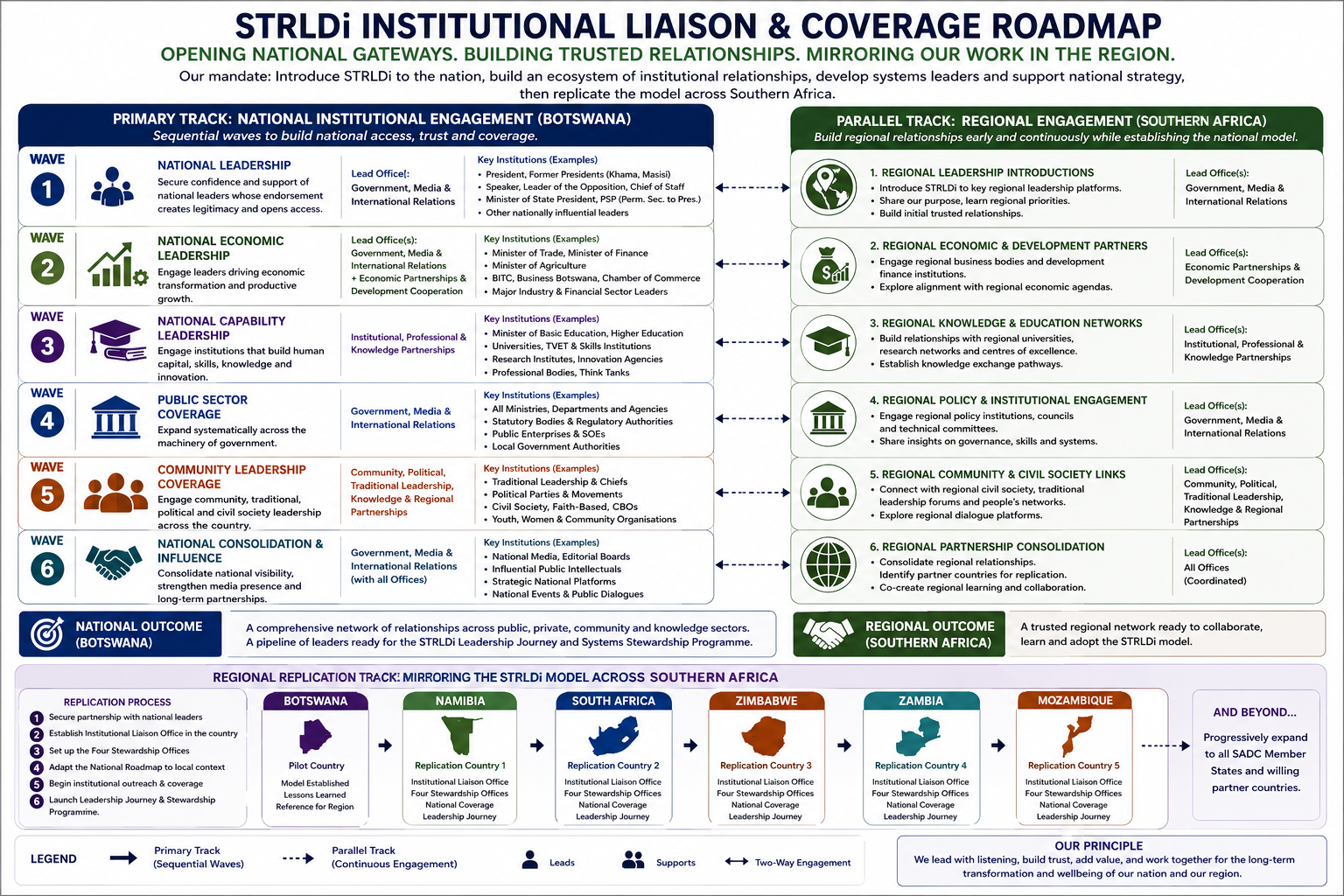
6. National Institutional Liaison and Coverage Roadmap
6.1 Purpose
The National Institutional Liaison and Coverage Roadmap provides the strategic framework through which the Institutional Liaison Office systematically introduces STRLDi to the institutions of a country. It establishes the order in which institutional relationships are developed, ensuring that the Office builds national awareness, trust and credibility before expanding into broader institutional coverage.
The Roadmap recognises that meaningful institutional stewardship cannot be achieved through isolated or opportunistic engagements. Every relationship contributes to a deliberate process of national introduction, institutional learning and long-term partnership. The objective is not merely to increase the number of institutional contacts, but to establish an interconnected network of leaders and institutions that understand STRLDi’s purpose and are willing to participate in an ongoing dialogue about systems thinking, leadership and national transformation.
While the Roadmap is illustrated using Botswana, it has been designed as a universal framework that can be applied in any country. The names of institutions may differ from one nation to another, but the principles of systematic institutional stewardship remain consistent.
6.2 Strategic Intent
The Institutional Liaison Office is the Institute’s public-facing platform. Its responsibility is to introduce STRLDi, cultivate trusted institutional relationships and prepare institutions for future participation in the Institute’s programmes. It does not implement national strategies, manage research programmes or facilitate Strategy Stewardship Labs. Those responsibilities belong to the wider Institute and occur only after institutions have chosen to continue their leadership journey.
Accordingly, the Roadmap is concerned with institutional coverage rather than programme delivery. It ensures that every major institutional sector within the country is engaged through a logical sequence that builds legitimacy, expands relationships and progressively establishes a national community of institutional leaders.
6.3 Guiding Principles
Implementation of the Roadmap is guided by the following principles.
Gateway before coverage. The Office first establishes relationships with influential leaders and institutions whose participation strengthens credibility and opens access to the wider institutional landscape.
Systematic expansion. Institutional engagement expands progressively across sectors rather than attempting simultaneous national coverage.
Leadership before programmes. The objective is to build trusted relationships and stimulate dialogue. Invitations into STRLDi’s learning programmes occur only after institutions have become familiar with the Institute and its work.
Parallel regional engagement. While national institutional coverage remains the primary focus, the Office simultaneously develops relationships with regional institutions that will support future replication of the STRLDi model across Southern Africa.
Replication through learning. Regional engagement is not undertaken to expand organisational presence alone. It prepares the conditions through which successful national models can later be mirrored in neighbouring countries.
6.4 National Coverage Waves
The Roadmap is implemented through six progressive waves of institutional engagement. Each wave builds upon the relationships established during the previous one while expanding STRLDi’s institutional presence across the country.
Wave One – National Leadership Gateway
The first wave focuses on national leaders whose participation establishes credibility and creates opportunities for broader institutional engagement. These leaders may not represent every sector of society, but their support signals that STRLDi is a serious national institution committed to constructive dialogue.
Typical engagements include the Head of State, former Heads of State, Speakers of Parliament, Leaders of the Opposition, senior officials within the Office of the President, and other nationally influential leaders whose engagement can facilitate wider institutional access.
The Government, Media & International Relations Office leads this wave with support from the remaining Stewardship Offices where appropriate.
Wave Two – National Economic Leadership
The second wave extends engagement to institutions responsible for Botswana’s productive economy. Relationships are established with ministries responsible for trade, finance, agriculture, industry and planning, together with business associations, investment agencies, financial institutions and major productive-sector organisations.
This wave positions STRLDi within the national conversation on productive transformation while strengthening relationships with institutions capable of influencing economic development.
The Government, Media & International Relations Office and the Economic Partnerships & Development Cooperation Office jointly lead this phase.
Wave Three – National Capability Leadership
The third wave expands engagement to institutions responsible for developing human capability, knowledge and innovation. Universities, colleges, research institutes, professional associations, centres of excellence and ministries responsible for education and skills development become central partners in strengthening the country’s long-term leadership capacity.
Leadership for this wave is shared between the Institutional, Professional & Knowledge Partnerships Office and the Community, Political, Traditional Leadership, Knowledge & Regional Partnerships Office.
Wave Four – Public Sector Coverage
Having established relationships with national leadership and key enabling institutions, the Institutional Liaison Office systematically expands across the wider machinery of government. Ministries, departments, regulatory authorities, public enterprises, statutory organisations and local government institutions are progressively engaged.
This wave ensures that systems thinking and institutional stewardship become visible across the public sector while strengthening relationships between government institutions and the Institute.
The Government, Media & International Relations Office provides leadership with support from the Institutional, Professional & Knowledge Partnerships Office.
Wave Five – Community Leadership Coverage
The fifth wave broadens institutional stewardship into communities through engagement with traditional leadership, political leadership, civil society, faith-based organisations, youth organisations, women’s organisations and community-based institutions.
The purpose is to extend the national conversation beyond formal institutions while recognising the important contribution of community leadership to long-term national development.
This wave is led by the Community, Political, Traditional Leadership, Knowledge & Regional Partnerships Office.
Wave Six – National Consolidation and Influence
The final national wave consolidates STRLDi’s institutional presence by strengthening relationships with national media, influential leadership platforms, cross-sector forums and organisations capable of sustaining public dialogue.
Rather than introducing new sectors, this wave reinforces the institutional ecosystem established during the previous phases, ensuring that relationships continue to mature and that national awareness of STRLDi remains strong.
Leadership is provided by the Government, Media & International Relations Office with support from all Stewardship Offices.
Table 6.1: Stewardship Responsibilities Across the National Coverage Roadmap
The table below summarises the leadership responsibilities of each Stewardship Office across the six national coverage waves. It provides an operational view of the roadmap, indicating which Office leads each wave and which Offices provide supporting stewardship. The table is intended as a planning and coordination tool and should be read together with the detailed explanation of each wave.
| Coverage Wave | Government, Media & International Relations | Economic Partnerships & Development Cooperation | Institutional, Professional & Knowledge Partnerships | Community, Political, Traditional Leadership, Knowledge & Regional Partnerships |
|---|---|---|---|---|
| Gateway Leadership Engagement | ● Lead | ○ Support | ○ Support | ○ Support |
| Wave 1 – National Leadership | ● Lead | ○ Support | ○ Support | ○ Support |
| Wave 2 – National Economic Leadership | ● Lead | ● Lead | ○ Support | — |
| Wave 3 – National Knowledge & Capability Leadership | ○ Support | ○ Support | ● Lead | ● Lead |
| Wave 4 – Systematic Public Sector Engagement | ● Lead | ○ Support | ● Lead | — |
| Wave 5 – Community, Political & Traditional Leadership | ○ Support | — | ○ Support | ● Lead |
| Wave 6 – National Consolidation & Influence | ● Lead | ○ Support | ○ Support | ○ Support |
Legend
- ● Lead – Stewardship Office with primary responsibility for planning, coordinating and leading engagements during the wave.
- ○ Support – Stewardship Office provides active support where institutional mandates overlap or complementary relationships are required.
- — – The Stewardship Office is not normally engaged during this wave unless a specific institutional opportunity requires cross-sector collaboration.
6.5 The National Coverage Waves
The manual would then continue with the narrative explanation of each wave:
- Gateway Leadership Engagement
- Wave 1 – National Leadership
- Wave 2 – National Economic Leadership
- Wave 3 – National Knowledge & Capability Leadership
- Wave 4 – Systematic Public Sector Engagement
- Wave 5 – Community, Political & Traditional Leadership
- Wave 6 – National Consolidation & Influence
6.5 Parallel Regional Engagement
While the six national waves remain the primary focus of the Institutional Liaison Office, regional engagement begins from the earliest stages of implementation and develops in parallel with national coverage.
The purpose of regional engagement is not immediate expansion but relationship building. The Office cultivates partnerships with regional universities, research institutions, business organisations, development partners, regional leadership platforms and the SADC Secretariat to learn from regional experience, contribute Botswana’s emerging practice and prepare the foundations for future country replication.
Regional engagement therefore progresses alongside national work without diverting attention from establishing a strong national model.
6.6 Strategic National Institutional Engagement Roadmap
While the Coverage Roadmap explains how the Institutional Liaison Office progressively reaches institutions across the country, the Strategic National Institutional Engagement Roadmap explains where national effort is concentrated over time. It provides the longer-term sequencing of institutional engagement to support national productive transformation and ensures that the Office’s engagement priorities remain aligned with the Institute’s strategic objectives.
Table 6.2 Strategic National Institutional Engagement Roadmap
| Tier | Weeks | Strategic Objective | Lead Stewardship Office | Government, Media & International Relations | Economic Partnerships & Development Cooperation | Institutional, Professional & Knowledge Partnerships | Community, Political, Traditional Leadership, Knowledge & Regional Partnerships |
|---|---|---|---|---|---|---|---|
| Tier 1 | 1–13 | Establish the national productive transformation agenda | Economic Partnerships | Secure government commitment and policy alignment. | Lead investment, enterprise, finance and productive-sector engagement. | Identify knowledge partners. | Map future community and regional partners. |
| Tier 2 | 14–26 | Strengthen productive capacity | Economic Partnerships | Engage enabling government institutions. | Lead agriculture, manufacturing, logistics, energy and finance partnerships. | Build technical partnerships. | Develop productive-region community relationships. |
| Tier 3 | 27–39 | Build institutional capability and innovation | Institutional, Professional & Knowledge | Support innovation policy. | Continue productive-sector collaboration. | Lead universities, research institutes and professional bodies. | Expand higher education and regional learning partnerships. |
| Tier 4 | 40–52 | Strengthen public-sector execution | Government, Media & International Relations | Lead ministries, regulators and public enterprises. | Support implementation partnerships. | Support capability development. | Prepare community leadership. |
| Tier 5 | 53–65 | Mobilise communities for productive transformation | Community, Political, Traditional Leadership | Maintain government relationships. | Support local enterprise. | Support extension and professional networks. | Lead community, traditional and political leadership engagement. |
| Tier 6 | 66–78 | Build national understanding and public ownership | Government, Media & International Relations | Lead media, public dialogue and national communication. | Promote productive-sector stories. | Disseminate institutional learning. | Support citizen participation. |
| Tier 7 | 79–91 | Strengthen Southern African regional integration | Community, Political, Traditional Leadership | Engage regional governments. | Develop regional business partnerships. | Expand regional knowledge partnerships. | Lead SADC and regional networks. |
| Tier 8 | 92–104 | Build continental and international strategic partnerships | Government, Media & International Relations (supported by all Offices) | Lead diplomatic engagement. | Lead development and investment partnerships. | Lead international knowledge partnerships. | Lead regional and international leadership partnerships. |
6.7 Country Replication
Once a mature Institutional Liaison model has been established within the pilot country, the Institute progressively mirrors the model in neighbouring countries. Replication is undertaken in partnership with national leaders and institutions within each country, adapting the Roadmap to local institutional arrangements while preserving the core principles of institutional stewardship.
The recommended sequence for regional expansion is:
- Botswana – Pilot and reference model.
- Namibia and South Africa – Parallel first replication partners.
- Zimbabwe.
- Zambia.
- Mozambique.
- Remaining SADC Member States as relationships and institutional readiness develop.
Each country establishes its own Institutional Liaison Office, adopts the four Stewardship Offices, implements its own National Institutional Liaison and Coverage Roadmap and progressively develops a national leadership community before introducing the Institute’s wider programmes.
7. Institutional Relationship Management System (IRMS)
7.1 Purpose
The Institutional Relationship Management System (IRMS) is the Institutional Liaison Office’s central repository for institutional knowledge. It provides a structured framework for recording, organising and using information about the institutions with which STRLDi engages. The IRMS ensures that institutional relationships are stewarded through reliable organisational knowledge rather than individual memory.
Institutional relationships often develop over many years and involve numerous meetings, correspondence, collaborative initiatives and leadership changes. Without a disciplined approach to managing institutional information, valuable knowledge is easily lost, resulting in duplicated effort, inconsistent engagement and missed opportunities. The IRMS preserves this knowledge, enabling every Stewardship Office to build upon previous engagements and maintain continuity regardless of changes in personnel.
The purpose of the IRMS is therefore not simply to store information but to strengthen institutional stewardship. By providing timely, accurate and accessible institutional intelligence, the system enables STRLDi to prepare thoroughly, engage confidently and sustain long-term partnerships that contribute to Botswana’s productive transformation.
7.2 Objectives
The IRMS supports the work of the Institutional Liaison Office by enabling the Office to:
- maintain comprehensive institutional profiles;
- preserve the history of every institutional relationship;
- support preparation for executive engagements;
- monitor institutional progress through the Leadership Engagement Journey;
- coordinate engagement across the four Stewardship Offices;
- identify emerging partnership opportunities;
- strengthen organisational learning; and
- provide accurate information for strategic decision-making.
Together, these objectives ensure that institutional stewardship remains informed, coordinated and consistent across the Institute.
7.3 Guiding Principles
The effectiveness of the IRMS depends upon the quality of the information it contains. Every member of the Institutional Liaison Office therefore shares responsibility for maintaining the integrity of the system. Four principles guide its use.
Accuracy. Information entered into the IRMS should be factual, current and verified. Assumptions, rumours and personal opinions should not be recorded as institutional intelligence.
Timeliness. Institutional information should be updated promptly following engagements. Delayed recording reduces accuracy and weakens continuity.
Consistency. Information should be recorded using agreed templates and terminology so that records remain clear, searchable and comparable across institutions.
Confidentiality. Institutional intelligence is entrusted to STRLDi for legitimate organisational purposes. Access should be managed responsibly and information handled with appropriate discretion.
7.4 Institutional Profile
Every institution engaged by STRLDi should have an institutional profile within the IRMS. The profile serves as the primary reference point for planning engagements and maintaining continuity.
An institutional profile normally includes:
- official name of the institution;
- institutional mandate;
- sector classification;
- leadership structure;
- key decision-makers;
- organisational overview;
- strategic priorities;
- current initiatives relevant to STRLDi;
- history of engagement with STRLDi;
- current stage within the Leadership Engagement Journey;
- opportunities for collaboration;
- risks or sensitivities requiring consideration; and
- next recommended engagement.
The profile should evolve as the relationship develops, providing an increasingly comprehensive understanding of the institution and its leadership.
7.5 Leadership Profiles
Institutional stewardship is ultimately exercised through relationships with people. The IRMS therefore maintains leadership profiles for individuals who play significant roles within partner institutions.
Leadership profiles should assist the Office in understanding the professional responsibilities, leadership interests and engagement history of institutional leaders. Their purpose is to improve preparation for future engagements and support continuity of institutional relationships.
Typical information includes:
- current position;
- previous engagement with STRLDi;
- participation in STRLDi programmes;
- leadership interests;
- institutional responsibilities;
- key areas of collaboration; and
- significant milestones within the Leadership Engagement Journey.
Leadership profiles should remain professional, factual and relevant to institutional stewardship.
7.6 Engagement Records
Every significant institutional engagement should be recorded within the IRMS. This includes meetings, presentations, workshops, correspondence, executive briefings, collaborative initiatives and other substantive interactions.
Each engagement record should capture sufficient information to enable another member of the Office to understand what occurred, what was agreed and what actions remain outstanding. Engagement records therefore become an important source of organisational learning and continuity.
Each record should normally include:
- date of engagement;
- participating institutions;
- attendees;
- purpose of the engagement;
- matters discussed;
- decisions reached;
- commitments made;
- agreed follow-up actions;
- responsible officers; and
- recommended next steps.
7.7 Leadership Engagement Journey Tracking
One of the IRMS’s most important functions is monitoring institutional progress through the Leadership Engagement Journey.
For every institution, the system records:
- current stage of the Leadership Engagement Journey;
- date of progression;
- evidence supporting progression;
- programme participation;
- collaborative initiatives undertaken;
- current level of engagement; and
- recommended actions to support further progression.
This enables the Institutional Liaison Office to understand not simply which institutions have been contacted but how relationships are maturing over time.
7.8 National Institutional Engagement Roadmap Monitoring
The IRMS also supports implementation of the National Institutional Engagement Roadmap by recording institutional engagement against the Roadmap’s strategic priorities.
This enables the Office to monitor:
- progress within each phase of the Roadmap;
- institutional coverage;
- sector balance;
- emerging partnership opportunities;
- areas requiring additional engagement; and
- overall implementation progress.
The Roadmap therefore becomes a living management tool rather than a static planning document.
7.9 Executive Briefing Support
One of the IRMS’s most valuable contributions is its ability to support executive preparation. Before significant engagements, the system provides consolidated institutional intelligence that enables the Executive Director and Stewards to prepare efficiently and engage with confidence.
Executive briefing packs should normally include:
- institutional overview;
- leadership profiles;
- history of engagement;
- strategic issues;
- opportunities for collaboration;
- current Leadership Engagement Journey status;
- recommended discussion topics;
- previous commitments; and
- suggested follow-up actions.
Thorough preparation reflects respect for institutional partners and strengthens the quality of executive engagement.
7.10 Institutional Intelligence Reviews
Institutional intelligence should not remain static. The Institutional Liaison Office should periodically review IRMS information to identify emerging trends, changing institutional priorities and opportunities for strengthening collaboration.
These reviews encourage the Office to move beyond individual engagements and recognise broader patterns across Botswana’s institutional landscape. They also contribute to strategic planning by helping the Institute identify where relationships are strengthening, where additional stewardship is required and where new opportunities may be emerging.
Institutional intelligence therefore becomes a strategic capability rather than simply an administrative record. It informs executive decision-making, strengthens collaboration across the four Stewardship Offices and supports STRLDi’s long-term contribution to Botswana’s productive transformation.
Excellent. From this point, the manual becomes the team’s operational guide. The Standard Operating Procedures should not merely list steps; they should explain the discipline behind STRLDi’s institutional stewardship. Each procedure should enable any Steward or Coordinator to perform the work consistently while preserving the quality of STRLDi’s relationships.
8. Standard Operating Procedures
8.1 Purpose
The Standard Operating Procedures (SOPs) establish the common methods through which the Institutional Liaison Office conducts its work. They translate the principles of institutional stewardship into consistent operational practice, ensuring that every engagement reflects STRLDi’s professionalism, values and long-term commitment to relationship building.
Although the four Stewardship Offices engage different institutional sectors, they all follow the same operational discipline. This consistency enables the Institute to maintain high standards of preparation, communication, documentation and follow-up, regardless of which Stewardship Office leads a particular engagement. It also strengthens organisational continuity by ensuring that institutional relationships are managed through shared processes rather than individual working styles.
The procedures described in this section provide the minimum operational standard for every institutional engagement. They may be supplemented where necessary to accommodate the unique requirements of a particular institution or engagement, provided that such adaptations remain consistent with the principles of institutional stewardship set out in this manual.
8.2 SOP 1 – Institutional Identification and Prioritisation
Institutional stewardship begins long before the first meeting is arranged. The first responsibility of every Stewardship Office is to identify institutions whose mandate, leadership and influence contribute meaningfully to the objectives of the National Institutional Engagement Roadmap. Institutional selection is therefore a strategic exercise rather than an administrative activity.
Potential institutions should be considered in relation to their contribution to Botswana’s productive transformation, their ability to influence systemic change and their readiness to engage in collaborative leadership. Priority should be given to institutions whose participation strengthens existing partnerships, fills important gaps within the institutional ecosystem or advances the current phase of the National Institutional Engagement Roadmap.
Before an institution is formally prioritised, the responsible Steward should conduct preliminary research to understand its mandate, organisational structure, strategic priorities and relevance to STRLDi’s work. This information forms the basis of the initial institutional profile within the IRMS and supports informed decision-making regarding future engagement.
Procedure
- Identify potential institutions relevant to the current phase of the National Institutional Engagement Roadmap.
- Review the institution’s mandate and strategic contribution.
- Assess its relevance to STRLDi’s mission and programmes.
- Determine the appropriate Stewardship Office responsible for the relationship.
- Create an initial institutional profile within the IRMS.
- Recommend an engagement priority to the Institutional Liaison Office Coordinator.
- Obtain approval for inclusion within the annual engagement programme.
8.3 SOP 2 – Institutional Research and Intelligence Preparation
Effective institutional stewardship depends upon informed engagement. Every significant interaction should therefore be preceded by appropriate institutional research that enables STRLDi representatives to understand the institution’s context before discussion begins.
Research should extend beyond publicly available information. Where appropriate, previous engagement records, leadership profiles, strategic documents, annual reports and institutional publications should be reviewed to develop a comprehensive understanding of the institution’s priorities and current environment. The objective is to approach every engagement with respect, preparation and genuine interest in the institution’s work.
Institutional intelligence should always be organised objectively. Information should distinguish clearly between verified facts, informed observations and matters requiring further clarification. This discipline strengthens the credibility of the Institutional Liaison Office while supporting sound executive judgement.
Procedure
- Review the institutional profile within the IRMS.
- Update leadership information.
- Review previous engagements.
- Examine current strategic priorities.
- Identify opportunities for collaboration.
- Note potential sensitivities.
- Update the institutional profile before engagement preparation begins.
8.4 SOP 3 – Engagement Planning
Institutional engagements should be purposeful. Every meeting, briefing or dialogue should have clearly defined objectives that contribute to the Leadership Engagement Journey and the National Institutional Engagement Roadmap. Careful planning ensures that institutional leaders understand why the engagement is taking place and how it contributes to a broader relationship.
Planning includes determining the purpose of the engagement, identifying participants, confirming logistics, preparing supporting documentation and agreeing upon the desired outcomes. Where multiple Stewardship Offices are involved, planning should clarify responsibilities so that participants present a coordinated institutional presence.
Well-planned engagements demonstrate respect for institutional partners while increasing the likelihood that meaningful dialogue will occur.
Procedure
- Confirm the purpose of the engagement.
- Identify participating institutions and representatives.
- Determine the appropriate STRLDi delegation.
- Prepare an agenda.
- Develop an executive briefing pack.
- Confirm venue, timing and logistics.
- Assign responsibilities to participating officers.
- Record the engagement schedule within the IRMS.
8.5 SOP 4 – Executive Brief Preparation
Executive engagements require disciplined preparation. Every briefing provided to the Executive Director or a Steward should present the information necessary to support informed, confident and productive dialogue without overwhelming the reader with unnecessary detail.
Briefing documents should be concise, factual and forward-looking. They should explain the institutional context, summarise previous engagements, identify strategic opportunities and recommend areas for discussion. Where appropriate, briefing papers should also include background information on significant institutional developments and any matters requiring executive attention.
The preparation of executive briefs is coordinated through the Institutional Intelligence and Executive Coordination function, with input from the relevant Stewardship Office.
Executive Brief Template
Every executive briefing should normally include:
- Purpose of the engagement.
- Institutional overview.
- Key institutional leaders.
- History of engagement.
- Current Leadership Engagement Journey status.
- Strategic issues.
- Opportunities for collaboration.
- Matters requiring executive attention.
- Recommended discussion points.
- Proposed follow-up actions.
8.6 SOP 5 – Conducting Institutional Engagements
Institutional engagements should reflect STRLDi’s commitment to professionalism, thoughtful inquiry and collaborative leadership. Every meeting is an opportunity to strengthen trust, deepen understanding and advance the Leadership Engagement Journey. Accordingly, the emphasis should be on meaningful dialogue rather than presentation alone.
Representatives of STRLDi should approach every engagement with humility, curiosity and respect for the institution’s experience. Listening is as important as presenting. Institutions should be encouraged to share their priorities, challenges and aspirations, allowing opportunities for collaboration to emerge naturally through conversation.
Where appropriate, engagements should conclude with a shared understanding of the next steps, ensuring that momentum is maintained beyond the meeting itself.
During the Engagement
Participants should:
- arrive fully prepared;
- observe agreed protocols;
- encourage open dialogue;
- listen actively;
- avoid making commitments beyond their authority;
- record significant observations;
- confirm agreed actions before closing the meeting.
8.7 SOP 6 – Post-Engagement Stewardship
The conclusion of a meeting marks the beginning of the next stage of stewardship. Timely follow-up demonstrates professionalism and reinforces the trust established during the engagement. Delayed or inconsistent follow-up weakens institutional relationships and reduces confidence in the Institute’s reliability.
Following every significant engagement, the responsible Steward should review the outcomes, confirm agreed actions and ensure that institutional records are updated. Follow-up communication should be courteous, timely and aligned with the commitments made during the meeting.
Institutional stewardship is sustained through consistent attention rather than occasional contact. Every engagement should therefore contribute to an ongoing relationship rather than stand as an isolated event.
Procedure
- Prepare the engagement record.
- Update the IRMS.
- Record agreed actions.
- Assign responsibilities.
- Send follow-up correspondence where appropriate.
- Schedule the next recommended engagement.
- Review institutional progression within the Leadership Engagement Journey.
8.8 Continuous Improvement
The Institutional Liaison Office continually reviews its operating procedures to ensure that they remain effective, practical and aligned with STRLDi’s evolving mission. Lessons arising from institutional engagements, participant feedback and organisational reflection should be incorporated into future revisions of these procedures.
Standardisation should never discourage learning. Instead, the procedures provide a stable foundation from which the Office continually improves its stewardship capability while adapting to new opportunities and changing institutional contexts. In this way, operational excellence becomes an expression of STRLDi’s commitment to continuous learning and systems thinking.
Excellent. We will complete the manual with the final two operational sections. These sections are intended to become the reference pages that staff return to repeatedly during their work.
9. Standard Templates and Registers
9.1 Purpose
The quality of institutional stewardship depends not only on the professionalism of the people involved but also on the consistency of the information they record. Standard templates and registers ensure that important information is captured systematically, institutional memory is preserved and every Stewardship Office works to the same standard.
Templates are not intended to create unnecessary administration. Their purpose is to reduce uncertainty, improve preparation and enable the Institutional Liaison Office to maintain reliable institutional intelligence. By recording information consistently, the Office strengthens collaboration across the four Stewardship Offices and ensures that institutional relationships remain organisational assets rather than individual knowledge.
Every official document generated by the Institutional Liaison Office should follow the approved templates contained in this section unless an alternative format has been authorised by the Executive Director or the Institutional Liaison Office Coordinator.
9.2 Institutional Register
The Institutional Register is the master record of all organisations engaged by STRLDi. It provides a consolidated view of the Institute’s institutional landscape and enables the Office to monitor coverage across sectors, identify engagement priorities and coordinate stewardship activities.
Each entry should contain sufficient information to identify the institution, understand its strategic relevance and determine its current status within the Leadership Engagement Journey. The Register should be reviewed regularly to ensure that institutional information remains current and that new organisations are incorporated as the National Institutional Engagement Roadmap evolves.
Minimum Information
- Institution name
- Sector
- Stewardship Office
- Assigned Steward
- Primary contact person
- Current Leadership Engagement Journey stage
- National Institutional Engagement Roadmap phase
- Date of last engagement
- Date of next planned engagement
- Current relationship status
9.3 Leadership Contact Register
The Leadership Contact Register provides a structured record of senior leaders within partner institutions. It enables the Office to maintain continuity of executive relationships and to respond quickly when preparing institutional engagements.
The Register should include only information relevant to institutional stewardship and official engagement. Personal information unrelated to professional responsibilities should not be recorded. Changes in leadership should be updated promptly so that institutional relationships remain current and accurate.
Typical information includes:
- Name
- Position
- Institution
- Office contact details
- Executive Assistant
- Previous STRLDi engagements
- Programme participation
- Preferred communication channel
- Areas of strategic interest
9.4 Institutional Engagement Register
Every significant institutional engagement should be recorded in the Institutional Engagement Register. This register provides a chronological history of the Institute’s interaction with each institution and enables the Office to monitor engagement frequency, follow-up actions and overall relationship development.
The Register also assists in evaluating the effectiveness of institutional stewardship by providing a record of completed activities and their outcomes. Regular review helps identify relationships requiring renewed attention and ensures that agreed commitments are fulfilled.
Each record should include:
- Date
- Institution
- Participants
- Purpose
- Summary of discussions
- Decisions reached
- Follow-up actions
- Responsible officer
- Next engagement date
9.5 Executive Briefing Template
Every executive engagement should be supported by a standard briefing document prepared through the Institutional Intelligence and Executive Coordination function. Consistent briefing enables STRLDi’s leadership to engage institutions with confidence while reducing the risk of overlooking important information.
The briefing should normally contain:
- Purpose of engagement
- Institutional overview
- Strategic context
- Leadership profiles
- History of engagement
- Current Leadership Engagement Journey stage
- Opportunities
- Risks or sensitivities
- Recommended discussion points
- Proposed follow-up actions
9.6 Engagement Report Template
Following every significant engagement, the responsible Steward should prepare an Engagement Report. The report provides an accurate account of the engagement while ensuring that institutional intelligence is incorporated into the IRMS.
The report should include:
- Meeting details
- Participants
- Key issues discussed
- Institutional observations
- Commitments made
- Opportunities identified
- Follow-up actions
- Recommended Leadership Engagement Journey progression
- Recommendations for future stewardship
9.7 Partnership Opportunity Register
Throughout institutional engagement, opportunities for collaboration frequently emerge. Unless systematically recorded, many of these opportunities are forgotten or delayed.
The Partnership Opportunity Register records prospective collaborative initiatives, enabling the Institutional Liaison Office to monitor their development and allocate responsibility for follow-up. The register should be reviewed regularly during Office planning meetings.
Information should include:
- Opportunity description
- Participating institutions
- Strategic significance
- Responsible Steward
- Current status
- Next action
- Target completion date
9.8 Annual Institutional Engagement Plan
At the beginning of each planning cycle, every Stewardship Office prepares an Annual Institutional Engagement Plan aligned with the National Institutional Engagement Roadmap. The plan translates strategic priorities into a manageable programme of institutional stewardship while enabling coordination across the four Stewardship Offices.
The Annual Plan should identify:
- Priority institutions
- Leadership Engagement Journey targets
- Major executive engagements
- Programme invitations
- Strategic partnerships
- Regional engagements
- Expected outcomes
- Performance indicators
10. Governance, Monitoring, Evaluation and Continuous Improvement
10.1 Purpose
The Institutional Liaison Office is committed to maintaining the highest standards of institutional stewardship. Governance, monitoring and evaluation provide the mechanisms through which the Office reviews its performance, strengthens accountability and continually improves the quality of its work.
Effective governance extends beyond administrative compliance. It ensures that institutional relationships remain aligned with STRLDi’s mission, that resources are used responsibly and that institutional engagement contributes meaningfully to Botswana’s productive transformation. Through regular reflection and disciplined review, the Office learns from experience and adapts its practice to changing circumstances.
10.2 Governance
The Executive Director has overall responsibility for the governance of the Institutional Liaison Office. Day-to-day operational governance is exercised through the Institutional Liaison Office Coordinator, supported by the Institutional Engagement Coordinator and the Institutional Intelligence and Executive Coordination function.
The four Stewardship Offices remain accountable for the quality of institutional relationships within their respective portfolios while operating under the common policies, procedures and standards established by this manual.
Governance therefore combines strategic leadership with distributed operational responsibility, ensuring that stewardship remains both coordinated and responsive.
10.3 Performance Monitoring
Performance monitoring enables the Office to understand whether its stewardship activities are contributing to the Institute’s objectives. Monitoring should focus not simply on the quantity of engagements but on the quality and maturity of institutional relationships.
Performance indicators may include:
- Institutional progression through the Leadership Engagement Journey.
- Coverage of the National Institutional Engagement Roadmap.
- Strength of institutional partnerships.
- Participation in STRLDi programmes.
- Collaborative initiatives established.
- Executive engagement quality.
- Timeliness of follow-up.
- Quality of institutional intelligence.
These indicators should be reviewed periodically to identify strengths, emerging challenges and opportunities for improvement.
10.4 Evaluation
Periodic evaluation provides a deeper assessment of the effectiveness of institutional stewardship. Evaluation considers not only what activities have been completed but also the extent to which they have strengthened relationships, enhanced institutional capability and advanced STRLDi’s strategic objectives.
Evaluation should examine:
- Progress against the Annual Institutional Engagement Plan.
- Development of institutional partnerships.
- Effectiveness of the Leadership Engagement Journey.
- Implementation of the National Institutional Engagement Roadmap.
- Quality of coordination across the four Stewardship Offices.
- Lessons arising from significant engagements.
Findings should inform future planning, programme development and revisions to this manual.
10.5 Continuous Learning
As a systems thinking organisation, STRLDi recognises that every engagement provides an opportunity for learning. Continuous improvement is therefore embedded within the work of the Institutional Liaison Office. Reflection is not reserved for annual reviews but forms part of the Office’s regular operating rhythm.
Following significant engagements, programmes or partnership initiatives, the responsible Stewardship Office should consider:
- What strengthened the relationship?
- What barriers emerged?
- What assumptions were challenged?
- What institutional intelligence was gained?
- How should future engagement be improved?
Capturing these reflections enables the Office to convert experience into institutional knowledge and progressively strengthen its stewardship practice.
10.6 Review of the Manual
This manual should be reviewed periodically to ensure that it continues to reflect STRLDi’s organisational development, strategic priorities and operational experience. Amendments should arise from practical learning, changes in the Institute’s work or significant developments in the institutional environment.
The Executive Director approves revisions following consultation with the Institutional Liaison Office Coordinator and the Stewards of the four Stewardship Offices. All approved revisions should be communicated promptly, incorporated into staff orientation and reflected in future editions of the manual.
The purpose of reviewing the manual is not to change established practice unnecessarily, but to ensure that the Institutional Liaison Office continues to embody STRLDi’s commitment to systems thinking, institutional stewardship and organisational learning.
Closing Statement
The Institutional Liaison Office exists to cultivate the relationships through which national transformation becomes possible. It does so by stewarding institutions rather than transactions, by developing partnerships rather than contacts, and by building a community of leaders committed to learning and collaborative action.
Through the Leadership Engagement Journey, the National Institutional Engagement Roadmap, the four Stewardship Offices and the Institutional Relationship Management System, the Office provides STRLDi with a disciplined yet adaptive framework for institutional stewardship. Every engagement, whether with a ministry, a business, a university, a traditional authority, a professional body or an international organisation, contributes to a larger purpose: strengthening Botswana’s capacity to address complexity through systems thinking and collaborative leadership.
The work of the Institutional Liaison Office is therefore not measured solely by the number of meetings held or partnerships formed. Its true measure lies in the quality of the relationships it nurtures, the leaders it develops and the institutional ecosystem it helps to build—one capable of supporting Botswana’s productive transformation for generations to come.


