
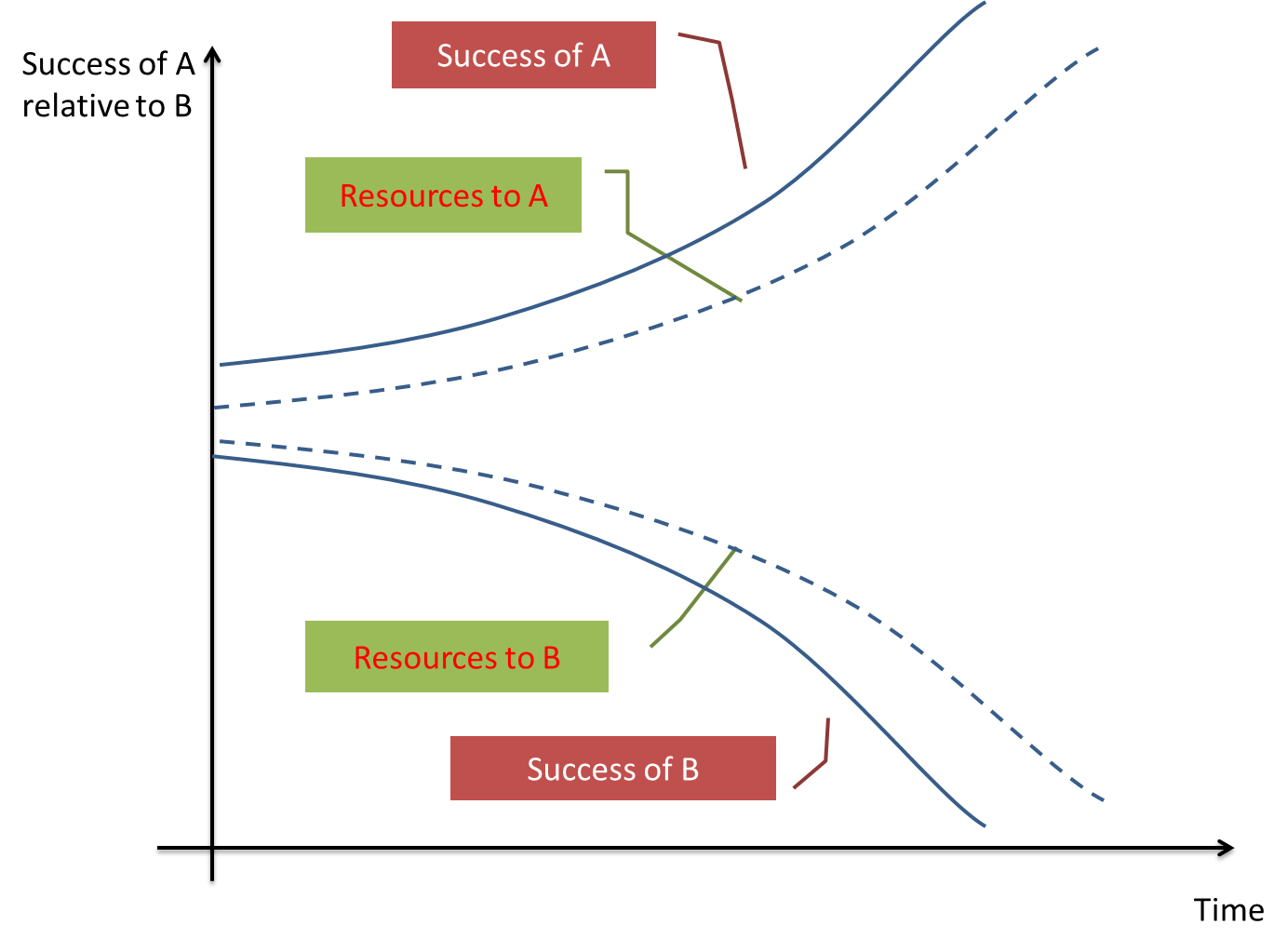
This archetype describes the phenomena of “the rich becoming richer and the poor becoming poor”.
Notice. We did not say when you will get rich!
EVENT
What the Structure Looks Like at A Point In Time (as an event)
We keep getting sidelined!
Why are some parts of the system becoming more successful while some other parts of the system are getting even more unsuccessful?
When the success of the other person can help bring success for me.
It is because the starting point is not the same!
THE STORY OF DIVIDES.

PATTERN
A management story illustrating the Behaviour of The Structure Playing out Over Time (BOT / VIDEO)
1. Observing the Widening Gap
When we see the gap widening between the rich and the poor, there is a hue and cry, and everyone on the poorer side of the divide wishes that this were not happening to them. But what causes this phenomenon to become systemic, such that it can reproduce itself over time and across generations? The phenomenon does not respect any particular boundary; it can emerge in families, communities, organisations, regions and entire economies.
Let me set a context within which we can begin to appreciate the causality behind the pattern. Rather than starting with a graph or a theoretical explanation, let us follow a simple story, set in corporate management, and observe how the structure unfolds over time.
2. The Beginning: Two Officers, Equal Opportunities
Let us assume that today is the first day for two new officers who have just joined an organisation: Officer A and Officer B. As their supervisor, I spend the day orientating them to the organisation, dividing my time equally between the two officers. At this point, both officers have equal access to my attention, and there is no obvious reason to expect that their careers will eventually follow very different trajectories.
A few days later, Officer B calls in sick and remains away from work for a week. During his absence, I continue orienting Officer A, who is present and available to learn. A week later, Officer B returns, and I resume my usual routine of dividing my time between the two officers. Nothing appears particularly significant to have happened, and neither officer may recognise that a small difference in their early experiences has begun to emerge.
3. The First Advantage: Who Gets the Project?
A week later, a project comes along that requires an officer’s attention. To whom should I delegate it: Officer A or Officer B? You might say Officer A, because he is now slightly ahead of Officer B in his understanding of the organisation, and you would be right; I therefore assign the project to Officer A.
Since Officer A is now responsible for the project, I continue to divide my time between supporting him and attending to the work itself. Two weeks later, he submits the completed project, which wins the department a budget of BWP 500,000. What began as a small difference in orientation has now produced a visible result, and that result will influence the decisions that follow.
4. The Allocation of Resources: The Gap Begins to Widen
I must now decide how to divide the budget between Officer A and Officer B. Since Officer A owns the successful project, I decide that he should receive the lion’s share: perhaps BWP 350,000 for Officer A and BWP 150,000 for Officer B. At this stage, the allocation may appear reasonable because Officer A has delivered the result that attracted the funding.
What does Officer A do with his BWP 350,000? He buys a colour copier machine and hires an assistant to help him with his work. Can Officer B afford to do the same with his BWP 150,000? No, you might say, and you would be right. The difference in resources now gives Officer A additional productive capacity, while Officer B has fewer means with which to develop a comparable capacity.
5. Reinforcement: Advantage Creates Further Advantage
Let us move forward. When another important project comes along, whom should I choose? Officer A now has a colour copier machine, an assistant, and experience from the previous project, while Officer B has neither the same resources nor the same experience. Naturally, I assign the more important projects to Officer A and leave the less important projects to Officer B.
By the end of the year, which officer has accumulated the greater range of experiences within the organisation? Officer A, of course. His initial advantage has enabled him to acquire more resources, handle more important work and develop greater experience, all of which make him a stronger candidate for the next opportunity. Meanwhile, Officer B’s smaller allocation and less demanding assignments limit his ability to build an equivalent record.
Notice what has happened: the difference is no longer simply about the officers’ original capabilities. The way opportunities and resources have been allocated is now helping to produce the difference in their capabilities.
6. The Second Advantage: The Returns Increase
Now a really important project comes along, one that could generate millions of pula in returns for the organisation. Whom do you think I should delegate it to? Officer A, certainly. Why? I remember that when I invested four days of my time in Officer A, he delivered a project that attracted BWP 500,000. I now reason that if the organisation has already invested BWP 350,000 in him, perhaps a much larger investment could produce returns worth millions.
The project is awarded to Officer A, and when he submits it, it attracts a budget of BWP 3 million. We have now moved from an initial difference in orientation to a substantial difference in the value of projects delivered and the resources attracted. How, then, should we divide the BWP 3 million between Officer A and Officer B? If we continue to allocate resources according to demonstrated success, Officer A is likely to receive the greater share once again.
7. Five Years Later: Who Has Developed Further?
At the end of one year, Officer A is gaining deeper experience, handling more important projects and working with greater resources. Officer B, meanwhile, continues to receive less demanding assignments, limiting his exposure to the experiences that would prepare him for more complex responsibilities. If we allow this pattern to continue year after year, what do you think will happen to the two officers after five years?
By then, Officer A may have a substantial portfolio of successful projects, a capable team, better equipment and a record of delivering high-value results. Officer B may have worked diligently throughout the same period, yet have fewer opportunities to demonstrate his capabilities and build an equally impressive record. The widening gap is becoming an outcome of the system’s repeated decisions, not merely a reflection of the difference that existed at the beginning.
8. Promotion: The Outcome Appears Justified
Eventually, the organisation conducts a promotion exercise, and both officers submit their CVs. Whose CV appears more impressive? Officer A’s, most likely. Who gets promoted? Again, the answer is likely to be Officer A, because his record shows greater experience, more significant projects and stronger results.
From the perspective of the promotion committee, the decision may appear entirely justified. Yet the committee may not consider how much of Officer A’s record was made possible by the earlier allocation of attention, opportunities, budgets and supporting resources, or how Officer B’s record was constrained by the corresponding lack of access. The outcome appears to reward merit, while the process that helped produce the difference in merit remains largely unseen.
9. Ten, Fifteen, Twenty Years: The Gap Becomes Structural
Now extend the story over five, ten, fifteen and twenty years. Where do you think Officer A is likely to be within the organisation, and where is Officer B? Officer A may progress into senior management, gaining access to larger budgets, influential networks, strategic projects and further opportunities to demonstrate leadership. Officer B may remain in a more junior position, not necessarily because he lacks ability, but because he has had fewer opportunities to build the experience and credentials that the organisation recognises and rewards.
At every stage, the next decision is influenced by the results of previous decisions. Officer A’s success justifies further investment in Officer A, while Officer B’s comparatively weaker record appears to justify investing less in Officer B. The original gap, which was barely visible at the beginning, has now become a structural difference in access to resources, experience, influence and advancement.
10. From an Organisation to an Economy
The same pattern can extend beyond the careers of Officer A and Officer B. In families, communities and entire economies, an initial advantage can be passed on through access to education, capital, property, networks and opportunities, allowing the advantage to persist across generations. Conversely, those who begin with fewer resources may find it increasingly difficult to acquire the means to improve their circumstances, even when they work diligently.
Over time, this can contribute to the phenomenon we observe as the rich becoming richer and the poor becoming poorer, with a widening gap between those who accumulate resources and those who struggle to do so. The particular actors may change, and the decisions may be made by different people at different times, but the underlying pattern can remain remarkably consistent. What began as a small difference can become a large and persistent divide because the system repeatedly directs opportunities and resources towards those who have already demonstrated success.
11. The Success to the Successful Archetype
This is the Success to the Successful archetype. Its defining behaviour is that an initial advantage attracts further resources, which produce further success, making the same actor or group more likely to receive the next opportunity. Meanwhile, the other actor or group receives fewer resources, has fewer opportunities to build capability and becomes less likely to attract future investment.
The critical point is that the gap does not necessarily widen because someone deliberately set out to create inequality. It can emerge through a succession of decisions that appear individually reasonable: assigning a project to the more experienced officer, allocating a larger budget to the successful project owner, and promoting the officer with the stronger CV. The systemic nature of the outcome lies in how these decisions interact and reinforce one another over time.
12. Does the Archetype Know When to Stop?
Now consider the final question: Does this story know when to stop? Does the system recognise that the initial difference between Officer A and Officer B has grown large enough, or that Officer B needs a different opportunity to demonstrate his capabilities? Not necessarily. Unless something changes the pattern of allocation and reinforcement, the system can continue directing opportunities towards the officer who is already ahead.
The archetype is not designed to stop itself. Its behaviour is to reinforce the existing distribution of success and opportunity, potentially allowing the gap to widen well beyond what anyone intended at the outset. That is why we must look beyond individual decisions and examine the structure that keeps producing the same pattern over time.
BEHAVIOUR OF THE GRAPH (PATTERN) OVER TIME
STRUCTURE
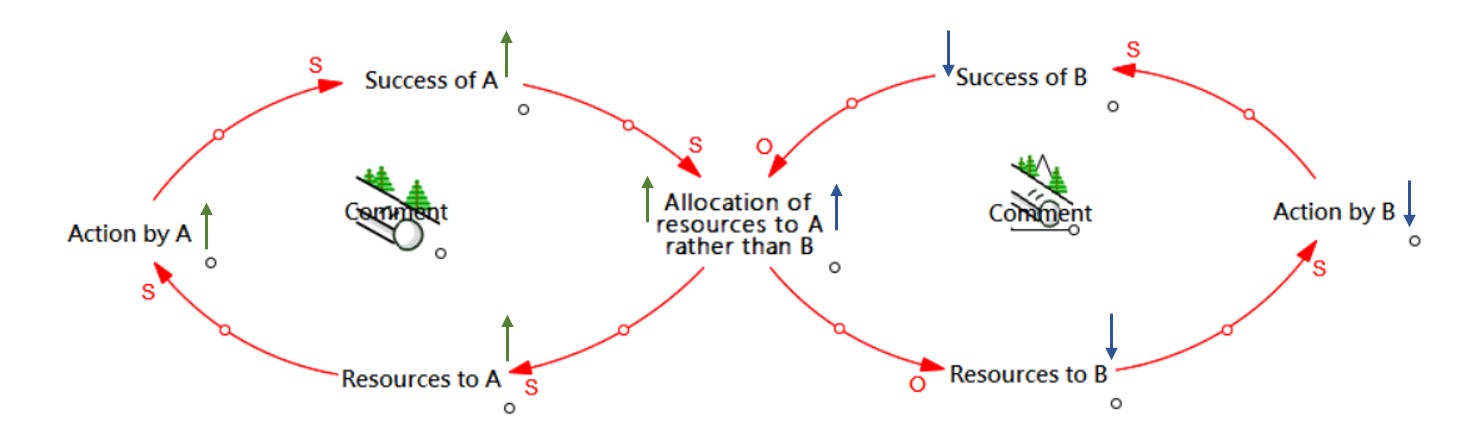
Description of the Archetype
Decisions are made in ways that allocate attention, opportunities and resources to one party at the expense of another. As one party accumulates success, it becomes increasingly likely to attract further resources, while the other party is progressively disadvantaged, potentially creating a widening gap between them over time.
This archetype can emerge whenever two or more individuals, groups or organisational units compete for limited attention, opportunities or resources. It invites us to examine whether the differences in their eventual success are necessarily inherent in their abilities, or whether they arise, at least in part, from differences in their starting positions and the subsequent allocation of resources. As these differences are reinforced over time, the less successful party may increasingly experience itself as a victim of the system, while the decisions that perpetuate its disadvantage continue to appear reasonable in isolation.
Rather than allowing this cycle to continue and deepen the conditions that produce further un-success, the archetype invites us to reconsider how we define success, how we allocate resources, and how our decisions influence the future capacity of those involved to succeed. The question is not simply who is succeeding today, but whether the way we distribute resources and opportunities is enabling others to succeed tomorrow.
MENTAL MODEL
Outlook that causes the structure to persist despite our efforts to resolve or resist problem-solving:
“Because that person (or department) is more successful, they must be good and others are not.”
FEAR OF FAILURE. LEARNING: TO LET IT GO SO NOT TO LET FEAR AFFECT THE WAY YOU SHAPE YOUR OUTLOOK, PERSPECTIVES, AND DECISION-MAKING.
MAKING A SYSTEMIC INTERVENTION
Treating the Structure: Systemic Interventions
1. Who is steering the archetype?
The first task is to determine who or what is steering the structure and whose success is being served by the decisions being made. In the Success to the Successful archetype, the supervisor may increasingly direct attention, opportunities and resources towards Officer A because A’s success has become evidence of the supervisor’s own effectiveness. What appears to be a sequence of reasonable management decisions can therefore become a pattern in which one party’s success is continually amplified at the expense of another’s, while the implications for the success of the organisation as a whole remain unseen.
The intervention must examine the interests, assumptions and decision-making practices that keep the pattern going. It must also question how success is defined, whose performance is recognised, and whether the allocation of resources is strengthening the organisation’s capacity to succeed or making it increasingly dependent on the success of selected individuals or units.
2. What is the trade-off?
The trade-off is the potential compromise of Law 9 and the order of causality through which the success of the whole is achieved. The success of the organisation, sector or nation cannot be determined by the success of Officer A or the supervisor in isolation. It depends on understanding how the success of B feeds the success of C, which in turn feeds the success of A, and how these relationships contribute to the success of the whole.
When resources are concentrated on A without understanding these dependencies, the organisation may achieve immediate results while weakening the conditions required for continued success. A may compensate through hard work, working smart, manipulating resources or playing organisational politics, but such responses do not necessarily restore the causal relationships on which sustainable success depends. The intervention must therefore move beyond redistributing resources to discovering, testing and implementing the order of causality that enables the whole system to succeed.
3. Complementary contributions: Pegasus Communications and STRLDi
Two complementary contributions inform this work.
Dr Daniel H. Kim and Pegasus Communications: Key Success Loops (KSLs). In his article, From Key Success Factors to Key Success Loops, Daniel H. Kim explains why identifying individual success factors is insufficient. Sustainable success requires understanding the interrelationships among those factors and identifying the reinforcing loops that make success self-sustaining. His approach directs attention towards the relationships that generate success and where investment can support the success of the system as a whole.
The Systems Thinker
STRLDi: The Onion and Behaviour Over Time (BOTs). STRLDi complements this contribution through its Onion model, available at The Onion — STRLDi’s model. The approach begins with the behaviour of the issue over time, using BOTs to surface and identify as many relevant system archetypes as possible. These archetypes are then examined in relation to one another, progressively revealing the Onion of archetypes associated with a persistent issue or an organisation.
The two contributions are aligned but serve distinct purposes within this process. Kim’s KSL approach helps establish the interrelationships that generate and sustain success; STRLDi’s Onion provides a way to investigate the multiple archetypes through which the behaviour of a persistent issue unfolds. The BOTs provide the observable patterns; the archetypes help reveal the structures behind those patterns; and the Onion brings the interacting archetypes into view as a wider systemic picture. These findings become inputs into determining the KSL for the issue or organisation under examination.
4. What does effective systemic intervention look like?
The intervention is not simply to ensure that everyone receives equal resources, nor is it to replace competition with collaboration as an end in itself. It is to establish how the contributions of different entities must be developed, connected and sustained for the success of the whole. This requires the organisation to examine its BOTs, surface the archetypes that may be shaping its behaviour, establish how those archetypes interact through the Onion, and use these findings to determine the causal relationships that must be strengthened or changed.
The desired outcome is a system in which decisions about attention, opportunities and resources are informed by their consequences for the wider network of dependencies. Rather than continually investing in those who are already successful, the organisation learns to identify which capabilities, relationships and contributions must succeed next to sustain the success of the whole. The effectiveness of the intervention is then assessed by observing whether the behaviour of the system changes over time, rather than by judging the immediate success of an individual intervention alone.
5. What it looks like when the system is working well
- Decisions about resource allocation reflect an understanding of how the success of each entity contributes to the success of others and the whole.
- The organisation uses BOTs to observe patterns, identify archetypes and examine how they interact through the Onion.
- The causal relationships that sustain success are discovered, tested and implemented rather than assumed.
- Resources are directed towards strengthening the capabilities and relationships on which the system’s future success depends.
- Interventions are evaluated by their effects on the behaviour of the whole system over time, including whether they strengthen or weaken the conditions for sustained success.
The ultimate objective is not to make Officer A less successful so that Officer B can catch up. It is to understand and change the structure so that A’s success is no longer pursued independently of B’s, C’s and the organisation’s success. That is the shift from treating the visible gap to intervening in the system that continually produces it.
TREATING THE STRUCTURE
(INPUT PEGASUS COMMUNICATIONS AKA DR DANIEL H. KIM
AVOIDING COMPETENCY TRAPS
The archetype suggests that success or failure may be due more to initial conditions than intrinsic merits.
Intervention:
- Look for reasons why the system was set up to create just “one winner” – investigate historical origins of competencies or identify potential competency traps, map internal view of “organizational” or “Market” success. What are the operating assumptions regarding success?
- Obtain external views of success. Ask “outsiders” for alternative strategies.
- Assess effects on the innovative spirit. Is the current system excluding or limiting the spirit of success? Continually scan for gaps and areas of improvement.
- Find ways to make teams collaborators rather than competitors
- Identify goals or objectives that define success at a level higher than the individual players A and B
What it looks like if the system was working well:
- “We can create win-win situations for everyone, including the organization as a whole”
- Decisions are being made in allocating resources to give appropriate attention to all parties.
EXAMPLES OF STS BOTs


StS Has Lived Among Us Since Time Immemorial — Before the Structure Was Named
1. The structure preceded its identification
Systems Thinking (StS) did not begin when Peter Senge and his team identified and presented system archetypes. The structures through which societies reproduce their conditions, reinforce particular behaviours, resist change and attempt to correct imbalances have existed for as long as human societies themselves. Long before these structures were formally identified, scholars encountered their manifestations in social organisation, economic development, institutional behaviour, poverty, inequality, unemployment and the recurring failure of interventions to resolve persistent problems.
The distinction is between encountering a structure and identifying its underlying architecture. Sociologists and economists observed recurring patterns, developed explanations for them and proposed interventions, often without explicitly mapping the feedback loops through which the conditions they studied were generated and sustained. Their work is therefore part of the intellectual history of humanity’s encounters with systemic behaviour, and it provides an opportunity to examine what happens when an intervention addresses a condition within a system without necessarily changing the structure that reproduces it.
This segment examines selected sociologists first, followed by economists. For each thinker, it records the thought, the intervention, the intervention’s R/B loop classification within the relevant system structure, and where the intervention stands in relation to the persistence of the issue. The loop classifications are STRLDi’s systems interpretations, not terminology retrospectively attributed to the scholars themselves; where the available evidence does not establish a definitive classification, that limitation must be stated rather than concealed.
2. The sociologists: encountering the structures of society
2.1 Karl Marx (1818–1883)
Thought. Marx examined how ownership of the means of production, class relations and the organisation of labour shape economic and social conditions. He argued that the relationship between capitalists, who control productive assets, and workers, who sell their labour, reproduces structural inequalities and generates conflict between opposing class interests.
Intervention — B (Balancing Loop). Marx proposed that the working class take political power and transform the existing relations of production and ownership. Within the Escalation archetype, this is the intervention by B: the working class acts to change its position in relation to the capitalist class. The intervention is B, even though the overall archetype remains R (Reinforcing) because the two balancing loops continue to interact through the opposing responses of the parties.
Where the intervention stands. Marx’s intervention sought to change the class relationship underlying the escalation. However, the transfer of political power and productive assets does not, by itself, establish that the structure generating opposing interests and reciprocal responses has been terminated. Marx’s intervention is B; the persistence of the Escalation archetype is R. The archetype can continue beyond Marx’s lifetime and beyond the political arrangements introduced in his name if the underlying structure remains active.
2.2 Émile Durkheim (1858–1917)
Thought. Durkheim examined how social institutions, norms and the division of labour sustain social cohesion. He also investigated anomie—a condition in which social regulation becomes insufficient or disrupted—and the consequences for individuals and society.
Intervention — B (Balancing Loop), as a structural interpretation. Strengthening social regulation, shared norms and institutional relationships can act as a corrective response when social cohesion weakens. This is classified as B where the intervention counteracts a departure from a desired condition of social integration. Durkheim’s work, however, does not mean that every institutional intervention is necessarily balancing; the classification depends on the specific mechanism being examined.
Where the intervention stands. Restoring social regulation may correct a disturbance without changing the wider conditions that repeatedly generate it. The systems question is whether the intervention merely restores the existing social order or changes the relationships responsible for recurring disintegration. The historical theory establishes Durkheim’s concern with social regulation; a definitive loop classification requires a specific causal structure.
2.3 Max Weber (1864–1920)
Thought. Weber examined authority, bureaucracy and rationalisation, explaining how institutions and administrative structures shape behaviour. His work also exposed the tension between the efficiency of formal administration and the constraints that bureaucratic systems can impose.
Intervention — B (Balancing Loop), where the objective is corrective. Administrative reform intended to correct organisational dysfunction and restore performance is a B intervention when it responds to a deviation from an established objective. This is a conditional classification of the intervention, not a claim that Weber prescribed one universal programme of administrative reform.
Where the intervention stands. Correcting bureaucratic dysfunction does not necessarily change the structures through which bureaucracy reproduces rigidity, concentrated authority or administrative self-preservation. The relevant question is whether the intervention corrects the performance of the existing arrangement or transforms the relationships generating the recurring dysfunction.
2.4 The sociological contribution: what was encountered?
These three thinkers approached different aspects of social organisation, but their work brings a common question into view: what relationships reproduce the conditions that society repeatedly attempts to correct? Marx focused on class relations and ownership, Durkheim on social regulation and cohesion, and Weber on authority and bureaucracy. Their interventions must be examined against the particular structures they addressed, rather than assigning a single loop classification to their entire body of work.
The significance for STRLDi is not that these thinkers lacked intellectual depth. It is that explaining a recurring condition, identifying its social causes and proposing an intervention are distinct from explicitly identifying the feedback structure that sustains it. That distinction allows us to recognise their contributions while asking a further question: does the intervention change the structure, or does it leave the mechanism of persistence intact?
3. The economists: encountering the structures of economic behaviour
3.1 Thomas Robert Malthus (1766–1834)
Thought. Malthus examined the relationship between population growth and the capacity of food production to sustain it. He argued that population could grow faster than subsistence resources, creating pressures that constrain living standards.
Intervention — B (Balancing Loop), in the corrective mechanism described. In Malthus’s account, mortality, delayed marriage and other restraints can counteract population growth when it exceeds available subsistence. These mechanisms are classified as B when they act to reduce the deviation between population and available resources. This classification describes the corrective mechanism, not a claim that every policy associated with Malthus is balancing.
Where the intervention stands. Restraining population or allowing scarcity to check growth does not necessarily transform the productive system’s capacity to supply food and other necessities. Technological development, agricultural productivity, institutions and resource allocation can alter the relationship between population and subsistence. The systems question is whether an intervention reduces pressure by constraining demand or changes the conditions governing productive capacity and resource availability.
3.2 John Maynard Keynes (1883–1946)
Thought. Keynes examined how inadequate aggregate demand could sustain unemployment and economic stagnation. He challenged the assumption that an economy would necessarily return quickly to full employment without intervention.
Intervention — B (Balancing Loop). Keynesian fiscal intervention seeks to counteract declining economic activity through public expenditure and other measures that support aggregate demand. Where falling output and employment trigger corrective expenditure intended to restore activity, the intervention operates as B, counteracting the initial decline.
Where the intervention stands. Stabilising aggregate demand can reduce unemployment and counter economic contraction. It does not, by itself, establish that the structures determining productive capacity, investment, sectoral development and the creation of sustainable employment have changed. The distinction is between stabilising economic performance and transforming the structure that determines what the economy produces, for whom, and with what capacity for future expansion.
3.3 Thorstein Veblen (1857–1929)
Thought. Veblen examined how institutions, social status and habits shape economic behaviour. His analysis of conspicuous consumption showed how people may consume to signal social position, rather than solely to satisfy practical needs.
Intervention — B (Balancing Loop), where the objective is institutional correction. An intervention intended to correct institutional arrangements that distort economic behaviour can be classified as B when it counteracts an identified deviation. However, Veblen’s analysis also reveals a different dynamic: status competition can operate through a reinforcing loop, as one person’s expenditure raises the standard against which others judge their own status, prompting further expenditure.
Where the intervention stands. Identifying the influence of social status on consumption does not automatically remove the institutions and incentives that reproduce status competition. A corrective intervention may constrain particular behaviours while leaving the reinforcing relationship intact. Veblen’s work therefore illustrates why the intervention must be distinguished from the feedback structure generating the behaviour.
4. What the economists’ interventions reveal
Malthus, Keynes and Veblen examined different relationships: population and subsistence, economic demand and employment, and institutions and consumption. The balancing classifications above refer to particular corrective mechanisms, not to the entirety of each economist’s theory. In Veblen’s case, the status competition he described also demonstrates how a reinforcing process can persist despite efforts to regulate its consequences.
The comparison raises a question for persistent economic issues. A policy can relieve scarcity, restore demand or regulate consumption without necessarily changing the relationships that generate recurring pressure. Equally, an intervention that changes productive capacity or the incentives governing investment may alter the structure itself. The loop classification must follow the mechanism demonstrated, not the reputation of the thinker or the stated intention of the policy.
5. The distinction between an intervention and the structure it encounters
The selected thinkers did not all use the language of system archetypes, and their work should not be presented as if they had. They encountered recurring behaviours in social and economic life, explained them through their respective disciplines and proposed interventions. STRLDi’s additional task is to examine the causal relationships, feedback loops and persistence mechanisms associated with those interventions.
Marx provides the clearest illustration for this segment. His proposed transfer of political power to the working class is the B intervention by B within the Escalation archetype. The archetype’s overall dynamic remains R because the two balancing loops continue to interact. The intervention can change who occupies the opposing positions without necessarily terminating the structure that generates their reciprocal responses.
The same analytical discipline must be applied to other persistent issues. A balancing intervention is not evidence that the reinforcing dynamic has ended. Nor does the persistence of a problem automatically prove that an intervention failed in every respect; it may have corrected one condition while leaving other causal relationships unchanged. What matters is identifying exactly what the intervention changes, which relationships remain active, and what continues to reproduce the issue.
6. Why this history matters to STRLDi
StS has lived among us in time immemorial. Human beings have encountered recurring patterns of conflict, scarcity, institutional rigidity, unemployment, inequality and social disintegration long before the structures underlying those patterns were formally named. The contributions of sociologists and economists form part of that history, even where their explanations and interventions did not explicitly use the system archetype framework.
Peter Senge and his team made an important contribution to identifying and communicating recurring system archetypes within organisational learning. The intellectual history presented here is not an attempt to diminish that contribution or to claim that earlier scholars had already formalised the same framework. It establishes that the behaviours existed before their architecture was identified, and that the history of interventions provides material through which the persistence of those behaviours can be examined.
The purpose is not to judge thinkers by whether their interventions were labelled R or B. It is to establish what structure was encountered, what intervention was proposed, which feedback mechanism that intervention activates, and whether the underlying relationships responsible for persistence were changed. This requires us to distinguish historical evidence from systems interpretation and to test each classification against the specific causal structure.
The question for humanity is no longer only why a problem exists, or what action might correct it. It is whether we can recognise the structure that keeps reproducing it—and learn to intervene so that it no longer has to.
The aspiration is that, as the world comes to understand system archetypes, persistent problems need not remain persistent simply because successive generations continue to encounter them without seeing the structures through which they are sustained.
We want humanity to see what it has been living with, understand what keeps it going, and learn how to stop reproducing it.
Internal status: This segment is not for public circulation. It is a working intellectual-history segment, with loop classifications identified as STRLDi interpretations where appropriate. Before external publication, the historical claims and each specific causal-loop classification should be supported by primary texts and explicit loop diagrams. The segment’s central distinction—between the intervention and the structure that persists—should remain intact.


