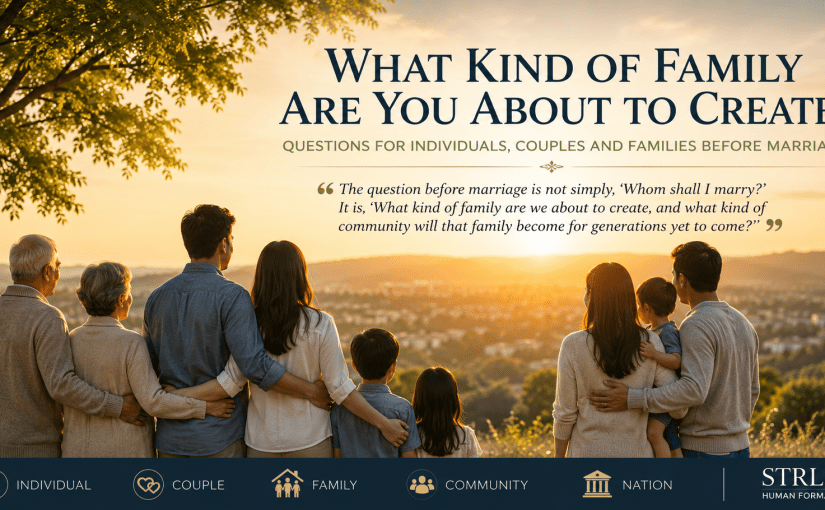
The question before marriage is not simply, ‘Whom shall I marry?’ It is, ‘What kind of family are we about to create, and what kind of community will that family become for generations yet to come?
From National Systems Research to the First Human Community
What Kind of Family Are You About to Create?
Questions for Individuals, Couples and Families Before Marriage
Contents
Introduction
Family Formation: The First Human Community
- Why the family is society’s first institution
- Why marriage is more than a personal decision
- The purpose of this framework
Part I – Questions for the Individual
1. The Man Who Has Not Yet Healed from a Previous Relationship
- Questions about Healing
- Questions about Readiness
- Questions about Commitment
- Questions about the Family He Hopes to Create
2. The Woman Without Children Who Has Not Yet Healed from a Previous Relationship
- Questions about Healing
- Questions about Readiness
- Questions about Commitment
- Questions about the Family She Hopes to Create
3. The Woman Who Has a Child and Has Not Yet Healed from Her Previous Relationship
- Questions about Healing
- Questions about Her Child
- Questions about the Man She Is Considering
- Questions about the Child’s Father
- Questions about Building a New Family
- Questions about Stewardship
4. The Man Who Has a Child and Is Entering a Relationship with a Woman Who Has No Children
- Questions about Healing
- Questions about His Child
- Questions about the Woman He Is Considering
- Questions about the Child’s Mother
- Questions about Building One Family
- Questions about Stewardship
5. The Woman with a Child Entering a Relationship with a Man Who Does Not Have a Child
- Questions about Healing
- Questions about Her Child
- Questions about the Man She Is Considering
- Questions about the Child’s Father
- Questions about Building a New Family
- Questions about Extended Families
- Questions about Stewardship
6. The Man Without Children Entering a Relationship with a Woman Who Has a Child
- Questions about Readiness
- Questions about the Child
- Questions about the Child’s Father
- Questions about the Woman He Is Considering
- Questions about Building One Family
- Questions about Extended Families
- Questions about Stewardship
Part II – Questions for the Couple
7. Questions Every Couple Should Ask Together
- Questions about Shared Values
- Questions about Trust
- Questions about Communication
- Questions about Conflict
- Questions about Commitment
- Questions about Finances
- Questions about Careers and Life Direction
- Questions about Children and Parenting
- Questions about Extended Families
- Questions about Building an Enduring Marriage
Part III – Questions for Parents
8. Parents Who Have Enjoyed an Intact Marriage
- Questions about Their Own Motives
- Questions about Listening
- Questions about the Person Their Child Loves
- Questions about Family Formation
- Questions about Supporting Rather than Controlling
- Questions about Becoming In-Laws
- Questions about Stewardship
Part IV – Questions for Every Family
9. Questions Every Family Should Ask
- Questions about Character
- Questions about Commitment
- Questions about Family Formation
- Questions about Relationships
- Questions about Future Generations
- The Question Above Every Other Question
Part V – From Family Formation to Nation Formation
10. The Narratives We Choose to Hold Dear
- Everyday Narratives that Shape Society
- From Individual Decisions to Social Patterns
- The Questions that Change What We Value
- Family Stewardship and Intergenerational Responsibility
- Narratives that Strengthen Human Capability
- From Household Choices to National Outcomes
Part VI – A Gift to Families
11. From Understanding Persistent Unemployment to Strengthening the First Human Community
- A Different Understanding of Persistent Unemployment
- The Family as Society’s First Institution
- Interrupting Reinforcing Cycles
- A Contribution to Human Formation
- Our Gift
Recommended Reading
A Learning Journey in Family Formation
- Understanding Yourself Before Marriage
- Preparing for Marriage Together
- Love, Communication and Relationships
- Blended Families
- Parents and Adult Children
- Understanding Families as Systems
- Systems Thinking and Human Formation
Closing Reflection
Building Families that Build Nations
- Family formation as the foundation of human formation.
- Human formation as the foundation of productive capability.
- Productive capability as the foundation of national prosperity.
- The family as society’s first and most enduring human community
Introduction
Family Formation: The First Human Community
Every human being belongs to a family. Whether that experience has been joyful or painful, stable or uncertain, the family is the first community into which we are born and the first place where we learn what it means to trust, to belong, to resolve conflict, to accept responsibility and to care for others. Long before we encounter schools, workplaces, governments or markets, we experience life through the relationships that exist within our families.
For this reason, the formation of a family is not merely a private decision between two adults. It is the creation of a new human community. The decisions made before marriage shape not only the lives of the couple but also the environment within which children may one day grow, grandparents may find new relationships, siblings may gain new family members, and future generations may develop their understanding of love, commitment, security and belonging.
Yet surprisingly little attention is given to the questions that precede this transition. Couples often ask whether they love one another, whether they are compatible, or whether they will be happy together. These are important questions. They are not, however, the only questions. Before creating a family, individuals and those who care about them have a responsibility to think beyond the wedding day and consider the kind of community they are about to establish.
The purpose of this paper is therefore not to tell people whom they should marry, nor to suggest that every family begins under identical circumstances. Rather, it seeks to present a framework of questions that may help individuals, couples and parents reflect carefully before making one of life’s most consequential decisions. Different life circumstances call for different questions. Some people enter marriage after healing from previous relationships, while others bring children, extended family responsibilities or other complexities into the relationship. The purpose of these questions is not to judge those circumstances but to ensure that they are thoughtfully understood before commitments are made.
Every family begins long before a wedding ceremony. It begins in the lives of the individuals who choose to form it. Each person brings into a relationship experiences, values, expectations, wounds, hopes, and responsibilities that inevitably shape the family they are about to create. Before two people can intentionally build a healthy family together, each must first understand the foundations they themselves are bringing into that new community.
For this reason, the questions that follow begin not with the couple, but with the individual. They are not intended to judge anyone’s past or prescribe a particular life journey. Rather, they invite thoughtful reflection towards oneself on whether the foundations being brought into marriage are capable of supporting the kind of family one hopes to build. Every family begins somewhere. These questions encourage us to begin with ourselves.
Part I – Questions for the Individual
The Man Who Has Not Yet Healed from a Previous Relationship
Every relationship leaves behind memories, lessons and, sometimes, wounds. Beginning a new relationship before understanding what remains unresolved from the previous one can unintentionally place new expectations upon a person who did not create those experiences. Before asking whether another person is the right life partner, a man should first consider whether he has become emotionally available to build a new family on its own foundations.
Questions about Healing
- Have I fully accepted that my previous relationship has ended?
- What emotions still influence my thinking?
- Have I forgiven the other person?
- Have I forgiven myself?
- What lessons have I learned that will help me become a better husband?
- What fears from that relationship still influence me today?
- If I met my former partner tomorrow, what emotions would still remain unresolved?
Questions about Readiness
- Am I seeking companionship, or am I seeking relief from loneliness?
- Am I choosing this woman because of who she is, or because she helps me forget someone else?
- If this relationship did not continue, would I still know who I am?
- Am I emotionally ready to make promises that I intend to keep for life?
Questions about the Family I Hope to Create
- What kind of family do I hope to build?
- What kind of husband do I hope to become?
- What kind of father do I hope my children will one day describe?
- What values do I hope will define our home?
- What atmosphere do I hope people experience when they enter our family?
The Woman Without Children Who Has Not Yet Healed from a Previous Relationship
The end of a relationship does not necessarily mark the end of its influence. A relationship may end physically while continuing emotionally through disappointment, mistrust, fear or regret. Time alone does not heal these experiences. Healing occurs when a person has reflected on what has happened, accepted what cannot be changed, learned from it and become emotionally available to begin again without asking a new relationship to repair the wounds of the last one.
Marriage invites two people to build a future together. That future is strongest when it is not overshadowed by unresolved questions from the past. Before deciding whether a man is the right life partner, a woman should first consider whether she is free to build a family upon new foundations rather than carrying forward expectations shaped by previous disappointments.
Questions about Healing
- Have I fully accepted that my previous relationship has ended?
- What emotions from that relationship remain unresolved?
- Have I forgiven the other person?
- Have I forgiven myself for decisions I now regret?
- What fears continue to influence the way I think about relationships?
- Can I speak about my previous relationship without anger, bitterness or the desire to prove something?
- What have I learned about myself through that experience?
- What strengths have emerged because of what I have been through?
Questions about Readiness
- Am I seeking a husband, or am I seeking someone to restore what I feel I have lost?
- Do I know who I am independently of being in a relationship?
- If this relationship did not continue, would I still feel emotionally secure?
- Am I choosing this man because I genuinely respect him, or because I am afraid of being alone?
- Am I emotionally available to commit myself to another person?
- Have I become the kind of woman I hope to bring into a lifelong marriage?
Questions about Commitment
- What qualities do I most admire in this man?
- What concerns have we openly discussed rather than avoided?
- Have we spoken honestly about our expectations of marriage?
- How do we each respond when we disagree?
- Do I trust his character, or do I simply enjoy his company?
- Would I still choose this relationship if life became significantly more difficult?
Questions about the Family I Hope to Create
- What kind of family do I hope to build?
- What kind of wife do I hope to become?
- What values do I hope will shape our home?
- What atmosphere do I hope our children will experience every day?
- How do I hope our family will relate to grandparents, siblings and the wider community?
- What kind of legacy do I hope our family will leave for the next generation?
Questions about Stewardship
Marriage is not only about finding someone to love. It is about accepting responsibility for the wellbeing of another person and for the family that may one day emerge from that relationship.
- Am I prepared to place the wellbeing of our future family alongside my own aspirations?
- What sacrifices am I prepared to make for the family we hope to build?
- How will I contribute to creating trust, stability and peace within our home?
- When our children one day observe our relationship, what do I hope they will learn about love, commitment and respect?
- If my future daughter asked me why I chose her father, what answer would I hope to give?
These questions are not intended to create doubt where confidence already exists. Rather, they invite a woman to reflect upon the kind of family she is preparing to build and the person she is becoming in the process. The quality of a future marriage depends not only upon finding the right partner, but also upon becoming someone capable of building a home where trust, belonging and enduring commitment can flourish.
The Woman Who Has a Child and Has Not Yet Healed from Her Previous Relationship
When a woman enters a new relationship with a child, she is not making decisions for herself alone. Her child is already part of an existing family system, with relationships, experiences and emotional needs that deserve careful consideration. A new relationship therefore has implications that extend beyond the couple. It affects the child, the prospective husband, both extended families and, in many cases, the child’s biological father.
This does not make the formation of a new family impossible. It does, however, make it more complex. The question is not whether a woman who has a child should marry again. The question is whether everyone involved has taken sufficient time to understand the responsibilities that accompany the creation of a new family. The child’s wellbeing deserves to be considered alongside the hopes and aspirations of the adults.
Questions about Healing
- Have I fully accepted that my previous relationship has ended?
- What emotions from that relationship still influence my decisions today?
- Have I forgiven the father of my child?
- Have I forgiven myself for decisions that I now wish had been different?
- What fears do I carry into this new relationship?
- Am I looking for a husband, or am I hoping someone will solve problems that remain unresolved?
- Have I become emotionally available to build a new family?
Questions about My Child
- What does my child need most at this stage of life?
- How has my previous relationship affected my child?
- Have I taken time to understand how my child feels about the changes taking place?
- Is my child emotionally ready to meet someone who may become part of our family?
- Am I protecting my child’s need for stability while I make decisions about my own future?
- If this relationship were not to continue, how would that affect my child?
Questions about the Man I Am Considering
- Does he understand that he is entering an existing family system?
- Has he shown genuine care and patience towards my child?
- Does he understand that my responsibilities as a mother will always remain part of our marriage?
- Have we discussed what role he hopes to play in my child’s life?
- Is he prepared for the responsibilities that accompany becoming a husband and, potentially, a father figure?
- Does he appreciate that earning a child’s trust takes time and cannot be demanded?
Questions about the Child’s Father
These questions are not intended to reopen past conflicts. They are intended to recognise that another parent may continue to influence the life of the child.
- What relationship currently exists between my child and his or her father?
- What responsibilities does the child’s father continue to fulfil?
- Have I been honest with my prospective husband about that relationship?
- What boundaries are necessary to protect peace within the new family?
- How will important decisions concerning the child be made?
- Have we discussed these matters openly before marriage rather than assuming they will resolve themselves afterwards?
Questions about Family Formation
- What kind of family are we hoping to create together?
- How will my child experience belonging within this new family?
- If we later have children together, how will every child experience equal love, fairness and security?
- What traditions do we hope to establish as a new family?
- How will we build trust between all members of the household?
- What values will define the culture of our home?
- What conversations should occur now rather than after marriage?
Questions about Stewardship
The formation of a family is an act of stewardship. It requires adults to think beyond their immediate desires and consider the long-term wellbeing of everyone whose lives will be shaped by their decisions.
- Am I making decisions that increase my child’s sense of safety and belonging?
- Am I giving this relationship sufficient time to develop naturally?
- Have I introduced this man into my child’s life gradually and thoughtfully?
- Are we building a family on carefully considered commitments, or are we allowing circumstances to determine our future?
- Twenty years from now, what do I hope my child will say about the way this family was formed?
These questions are not intended to discourage the formation of blended families. Rather, they recognise that a child already present within the relationship changes the structure of the family from its very beginning. Thoughtful preparation cannot eliminate every challenge, but it can help create a family in which trust, stability and belonging are intentionally nurtured for every member.
The Man Without Children Entering a Relationship with a Woman Who Has a Child
When a man without children enters a relationship with a woman who already has a child, he is making a decision that extends beyond choosing a life partner. He is also deciding whether he is prepared to become part of an existing family. Unlike two people who begin building a family together from the outset, he is entering a family system that already has relationships, routines, memories, responsibilities and emotional bonds. This does not diminish the possibility of building a loving and successful family, but it does require him to understand that he is not simply beginning something new; he is also joining something that already exists.
The quality of the future family will depend not only upon the relationship between the man and the woman but also upon the way in which the child experiences safety, belonging and acceptance. These questions are therefore intended to help a man consider not only whether he loves the woman, but also whether he is prepared for the responsibilities that accompany the family she already brings into the relationship.
Questions about Readiness
- Why am I choosing this relationship?
- What attracts me most to this woman?
- Have I taken sufficient time to understand her life before I become part of it?
- Am I emotionally prepared to become a husband and, potentially, a father figure at the same time?
- Am I entering this relationship with realistic expectations?
- Have I considered the responsibilities that already exist rather than only the future I hope to build?
Questions about the Child
A child is not an addition to the relationship. The child is already an integral member of the family the couple hopes to build.
- Am I willing to accept this child as part of the family I hope to create?
- What role do I hope to play in this child’s life?
- Do I understand that trust cannot be demanded but must be earned?
- Am I prepared to invest time, patience and consistency in building that relationship?
- How will I respond if the child initially struggles to accept me?
- What kind of relationship would I hope this child describes twenty years from now?
Questions about the Child’s Father
The presence of another biological parent introduces relationships that deserve thoughtful consideration rather than avoidance.
- What role does the child’s father currently play?
- How involved is he in the child’s life?
- What responsibilities continue to exist between him and the child?
- Have we discussed these matters openly and honestly?
- What boundaries will help maintain peace and clarity for everyone involved?
- How will disagreements affecting the child be handled?
Questions about the Woman I Am Considering
- Have we discussed our expectations of marriage honestly?
- Does she understand my hopes and concerns?
- Have we spoken openly about parenting?
- What values do we hope will shape our family?
- How do we resolve disagreement?
- What qualities in her give me confidence that we can build a stable family together?
- Have we allowed enough time to know one another beyond the excitement of a new relationship?
Questions about Building One Family
One of the greatest responsibilities facing any blended family is not simply living together but becoming one family.
- How will we create a sense of belonging for every member of the household?
- If we later have children together, how will every child experience equal love, dignity and opportunity?
- What family traditions shall we establish together?
- How will we make important decisions as parents?
- How will we ensure that our home becomes a place of stability rather than uncertainty?
- What kind of family culture do we hope future generations will inherit from us?
Questions about Extended Families
Marriage joins more than two individuals. It joins parents, grandparents, siblings and extended families into new relationships.
- How will my parents receive this woman and her child?
- How will her parents receive me?
- Have we discussed the role we hope our extended families will play in our lives?
- What expectations should be clarified before marriage?
- How can we encourage relationships that strengthen rather than divide our new family?
Questions about Stewardship
The decision to marry is ultimately a decision about stewardship. It is a commitment to care for the wellbeing of others over a lifetime.
- Am I prepared to love not only this woman but also the life that comes with her?
- Am I willing to place the long-term wellbeing of this family above my own convenience?
- Are we making decisions because they are carefully considered, or because circumstances are pushing us forward?
- If my future children asked me why I chose their mother, what answer would I hope to give?
- If her child asked me, years from now, “When did you decide I was your family?” what answer would I want to be able to give?
The answers to these questions do not determine whether a marriage will succeed. They do, however, encourage a man to recognise that marriage is not simply about finding a life partner. It is about intentionally creating a family in which every person—adult and child alike—can experience trust, belonging, security and the opportunity to flourish.
The Woman with a Child Entering a Relationship with a Man Who Does Not Have a Child
When a woman who has a child enters a relationship with a man who has never had children, she is making a decision that reaches beyond her own future. She is not only considering whether this man may become her husband, but also whether he is prepared to become part of a family that already exists. Her child is not an extension of the relationship; the child is already a person with emotional needs, established relationships, memories and a developing sense of identity. Any new relationship must therefore be considered from the perspective of both the adults and the child.
This requires honesty, patience and maturity from everyone involved. The man deserves the opportunity to understand the responsibilities he is accepting before making a lifelong commitment. Equally, the child deserves the opportunity to experience trust gradually rather than being expected to accept a new parental figure simply because the adults have decided to marry. The woman therefore carries a dual responsibility: to nurture a healthy relationship with the man she hopes to marry while also protecting the emotional wellbeing of her child.
These questions are intended to encourage thoughtful reflection before decisions are made that will shape the lives of everyone who becomes part of the new family.
Questions about Healing
- Have I fully accepted that my previous relationship has ended?
- Have I forgiven my former partner?
- Have I forgiven myself?
- Am I entering this relationship because I am ready to build a new family, or because I am trying to recover from the last one?
- What lessons have I learned that will help me become a better wife and mother?
- What fears or disappointments from my previous relationship still influence my thinking today?
- Am I emotionally available to make a lifelong commitment?
Questions about My Child
My child is not simply part of my history. My child is part of my future.
- What does my child need most from me at this stage of life?
- How has my child experienced the absence of his or her biological father?
- Is my child emotionally ready for someone new to become part of our lives?
- Am I protecting my child’s need for stability while this relationship develops?
- Have I introduced this man into my child’s life gradually and thoughtfully?
- Am I allowing my child sufficient time to develop trust naturally?
- If this relationship did not continue, how would that affect my child?
Questions about the Man I Am Considering
A man without children may not yet fully understand the responsibilities that accompany becoming part of an existing family. Those responsibilities deserve to be discussed openly rather than assumed.
- Does he understand that he is entering an existing family rather than beginning one from the beginning?
- Have I been honest with him about my responsibilities as a mother?
- Has he demonstrated patience, kindness and consistency towards my child?
- Does he understand that trust from a child cannot be demanded but must be earned?
- Has he asked thoughtful questions about my child rather than seeing my child as an obstacle to our relationship?
- Does he appear ready for the long-term responsibilities of becoming both a husband and a father figure?
Questions about the Child’s Father
The presence of another biological parent is part of the family’s reality. It should neither be ignored nor allowed to create unnecessary uncertainty.
- What relationship currently exists between my child and his or her father?
- What responsibilities does the father continue to fulfil?
- Have I spoken honestly with this man about those responsibilities?
- What boundaries will protect the peace and stability of our future family?
- How will decisions affecting the child be made?
- Have we discussed these matters before making lifelong commitments?
Questions about Building a New Family
Marriage is not simply the joining of two adults. It is the creation of a family in which every member should experience belonging.
- What kind of family are we hoping to create?
- How will my child know that he or she truly belongs?
- How will we build trust between all members of the household?
- If we are later blessed with children together, how will we ensure that every child experiences equal love, fairness and dignity?
- What values will define the culture of our home?
- What family traditions do we hope to establish together?
- What conversations should take place now rather than after marriage?
Questions about Extended Families
Marriage joins families as well as individuals. Grandparents, siblings and relatives all become part of the new family system.
- How will my parents receive this man?
- How will his parents receive both me and my child?
- Have we discussed the role we hope our extended families will play in our lives?
- Are there expectations that should be clarified before marriage?
- How can we encourage relationships that strengthen rather than divide our new family?
Questions about Stewardship
Creating a family is an act of stewardship. It calls adults to think beyond immediate happiness and to consider the lives that will be shaped by the decisions they make today.
- Am I making decisions that strengthen my child’s future?
- Have I given this relationship sufficient time to mature?
- Are we moving towards marriage because we have thoughtfully discerned our future together, or because circumstances are moving us in that direction?
- Am I helping this man understand the responsibilities he is accepting, rather than assuming he will learn them after marriage?
- Twenty years from now, what do I hope my child will say about the way this family was formed?
- If my child one day chooses a life partner, what example do I hope this family will have provided?
No set of questions can remove every uncertainty that accompanies marriage. They can, however, help ensure that decisions are made with greater clarity, honesty and foresight. A woman entering marriage with a child is not simply beginning a new chapter in her own life. She is shaping the future of her child, inviting another person into an existing family, and laying the foundations upon which a new human community may grow. The more intentionally those foundations are established, the greater the opportunity for every member of that family to experience trust, belonging, stability and hope.
Part II – Questions for the Couple
Questions Every Couple Should Ask Together
Choosing to marry is one of the most significant decisions two people will ever make. Yet, in many societies, much of the attention surrounding marriage is devoted to the wedding itself—the ceremony, the celebrations, the guests and the beginning of life together. Comparatively little time is spent asking a more fundamental question: What kind of family are we about to create?
Marriage is more than the union of two individuals. It is the intentional formation of the first human community that the couple will build together. Within that community, values will be practised, responsibilities shared, children nurtured, traditions established and relationships extended across generations. The quality of that community will influence not only the lives of the couple themselves, but also the lives of everyone who comes after them.
For this reason, the most important conversations before marriage are seldom about the wedding. They are about the family that will exist long after the wedding has been forgotten. Couples who invest time in these conversations are not attempting to predict every challenge they may encounter. Rather, they are learning how to think together, how to discern together, and how to build together.
The questions that follow are not intended to determine whether two people should marry. They are intended to help couples see beyond immediate affection and ask whether they are intentionally preparing to establish a family capable of remaining whole, nurturing future generations and contributing positively to the communities and nation of which it will become a part.
Questions about Shared Purpose
Every enduring family begins with a shared understanding of why it exists.
- Why do we want to marry?
- Beyond loving one another, what purpose do we hope our family will serve?
- What kind of home do we hope to create?
- What values do we want people to experience when they enter our home?
- What do we hope our children and grandchildren will one day say about our family?
- Are we building a marriage for ourselves alone, or are we intentionally creating a family that will bless others?
Questions about Character
Strong marriages are built upon character before they are sustained by compatibility.
- What qualities do we most admire in one another?
- What weaknesses do we each acknowledge?
- How do we help one another become better people?
- Are we able to challenge one another with honesty and kindness?
- What habits should we strengthen before we marry?
- What habits should we leave behind?
Questions about Trust
Trust is not established on the wedding day. It is built through consistent choices long before marriage begins.
- Can we speak honestly without fear?
- Do we trust one another with disappointment as much as with success?
- How do we rebuild trust when it is damaged?
- What promises do we believe are sacred?
- How will we protect trust throughout our marriage?
Questions about Communication and Conflict
Every marriage will experience disagreement. The question is not whether conflict will arise, but how it will be approached.
- How do we communicate when we disagree?
- Do we listen to understand or merely to respond?
- How do we apologise?
- How do we forgive?
- What subjects are difficult for us to discuss?
- How will we make important decisions together?
Questions about Previous Relationships
Every relationship has a history. Wisdom asks whether that history has been understood before a new future is built.
- Have we each found peace with our previous relationships?
- Are there responsibilities from previous relationships that remain?
- Have we been honest with one another about those responsibilities?
- Are there conversations that should take place before we marry?
- Have we mistaken the passage of time for genuine healing?
Questions about Children and Family Formation
Marriage creates a family. Where children already exist, it enlarges a family that has already begun.
- What responsibilities do we already carry?
- How will every child experience love, security and belonging?
- How will we speak about one another in front of our children?
- What traditions do we hope to establish as a family?
- How will we build trust patiently rather than expecting it immediately?
- What does fairness look like within our family?
Questions about Stewardship
Every family becomes the steward of relationships entrusted to it.
- What responsibilities accompany becoming a husband or wife?
- What responsibilities accompany becoming a parent or parent figure?
- How will we care for relationships that already exist?
- What sacrifices will family life require of us?
- What does faithfulness look like over the next thirty or forty years?
Questions about Work, Capability and Contribution
Families do not merely consume resources. They also develop the capabilities through which society flourishes.
- What attitudes towards work do we hope will characterise our family?
- How will we encourage curiosity, learning and discipline?
- How will we nurture the talents entrusted to our children?
- How will we encourage productive capability rather than dependence?
- What example will our own work and service provide?
- In what ways do we hope our family will contribute to our community and nation?
Questions about Extended Families
Marriage joins families as well as individuals.
- How will we honour our parents while establishing our own family?
- What relationships should be strengthened before marriage?
- How will we welcome one another’s families into our lives?
- What boundaries will help preserve healthy relationships?
- How will we resolve tensions should they arise?
Questions about the Future
Every family begins with hope. Stewardship requires that hope to be accompanied by thoughtful preparation.
- What kind of family do we hope to become twenty years from now?
- What kind of grandparents do we hope one day to be?
- What legacy do we hope our family will leave?
- What values should survive long after we are gone?
- What kind of society do we hope our family will help build?
The Conversation Above Every Other Conversation
As our understanding of family deepens, so too do the conversations we find worth having. We begin to recognise that marriage is not simply about choosing a life partner. It is about choosing the kind of human community we hope to create together. The questions become less concerned with the wedding day and more concerned with the generations that may one day emerge from the family we are forming.
The more we appreciate the interrelationships between family formation and nation formation, the more certain conversations naturally become important. We begin to ask not only whether we love one another, but whether we are preparing to build a relationship that is itself capable of remaining whole. We ask whether responsibilities from previous relationships have been understood and honoured, how children will experience continuity and belonging, how trust will be built with extended families, and whether important relationships should be nurtured before marriage rather than afterwards.
These questions are not intended to prescribe a single model of family life. Rather, they invite couples to recognise that the everyday narratives they choose to live by gradually become the foundations upon which families, communities and ultimately nations are built.
Ultimately, every couple preparing for marriage faces one question that stands above all the rest:
What kind of family are we intentionally choosing to create?
The answer to that question will shape far more than their own lives. It will influence the children they raise, the relationships they cultivate, the values they pass on, the capabilities they nurture and the communities they help to build. In this sense, every marriage is not only a personal commitment. It is an act of stewardship towards future generations, and a quiet but enduring contribution to the formation of society itself.
Part III – Questions for Parents
Parents Who Have Enjoyed an Intact Marriage
Parents who have built an enduring marriage often face one of the most delicate transitions of family life when their children become adults. For many years they have protected, guided and made decisions in the best interests of their children. Gradually, however, that responsibility changes. Adult sons and daughters must make their own decisions, including one of the most significant decisions of all—the choice of a life partner.
This transition requires wisdom from both generations. Parents who continue to control their adult children may weaken the very maturity they have worked hard to develop. Equally, parents who withdraw completely from the conversation may withhold the benefit of experience that could help their children avoid unnecessary pain. The challenge is neither to control nor to remain silent, but to offer wisdom in a way that preserves the dignity and responsibility of the adult child.
Parents who have themselves enjoyed an intact marriage possess something of great value. They have lived through the ordinary demands of building a family over many years. They understand that successful marriages are not sustained by emotion alone but by commitment, sacrifice, forgiveness, patience and shared purpose. Their experience does not make them infallible, but it does place upon them a responsibility to help their children think carefully about the families they hope to create.
The questions below are intended not only for parents to ask their children but also for parents to ask themselves. Discernment requires humility from every generation.
Questions about Our Own Motives
- Why do we have concerns about this relationship?
- Are our concerns based upon enduring principles or personal preferences?
- Are we reacting to circumstances, or have we taken time to understand them?
- Are we protecting our son or daughter, or are we protecting our own expectations?
- Have we distinguished between what is unfamiliar and what is genuinely unwise?
- Have we allowed fear to speak more loudly than understanding?
Questions about Listening
Before parents offer advice, they should first understand.
- Have we listened carefully to our son or daughter without interruption?
- Have we sought to understand before seeking to persuade?
- Have we asked questions rather than reached conclusions?
- Do we understand what our child sees in this relationship?
- Have we invited honest conversation without creating fear or defensiveness?
- Have we made it safe for our child to tell us the whole story?
Questions about the Person Our Child Loves
Every person deserves to be known as an individual before being defined by their circumstances.
- Have we taken time to know this person beyond first impressions?
- What strengths do we see in him or her?
- What qualities would make this person a good husband, wife, father or mother?
- Have we allowed one aspect of their life to overshadow the whole person?
- What evidence have we seen of maturity, responsibility and integrity?
- Have we been fair in our assessment?
Questions about Family Formation
Parents who have enjoyed an intact marriage understand that marriage creates far more than a couple.
- What kind of family do we believe our child hopes to build?
- Have we helped our child think beyond the wedding day?
- Have we discussed the responsibilities of marriage rather than only the happiness it may bring?
- Have we encouraged our child to think about future children, extended families and long-term commitments?
- Have we asked questions that enlarge perspective rather than narrow it?
Questions about Supporting Rather Than Controlling
The purpose of parental wisdom is not to make the decision on behalf of an adult child but to help that child make a well-considered decision.
- Are we offering wisdom or demanding agreement?
- If our child ultimately makes a different decision from the one we would make, how will we respond?
- Have we respected our child’s responsibility to choose?
- Have we created space for thoughtful reflection rather than emotional pressure?
- What questions might help our child see what we have learned through experience?
- Have we remembered that our role is to prepare our children for independent adulthood, not perpetual dependence?
Questions about Becoming In-Laws
Marriage creates new relationships for parents as well.
- If this marriage takes place, what kind of parents-in-law do we hope to become?
- How can we contribute to the strength of this new family rather than become another source of tension?
- How can we welcome new family members with grace while remaining true to our principles?
- What example do we hope to set for our grandchildren?
- How can we encourage unity between both families?
- What relationships do we hope will exist twenty years from now because of the way we respond today?
Questions about Stewardship
Ultimately, parents are stewards rather than owners of their children’s lives. Their task is not to determine every outcome but to pass on wisdom that equips the next generation to build strong families of their own.
- Have we shared the lessons of our own marriage honestly, including the difficulties we have overcome?
- Have we demonstrated the kind of marriage we hope our children will build?
- Have we encouraged our child to seek wisdom from others as well?
- Have we remembered that love sometimes asks difficult questions but always respects another person’s dignity?
- When our grandchildren one day ask how this family was formed, what story do we hope they will hear?
- Have we done everything within our responsibility to help our child think carefully, while allowing the final decision to remain theirs?
Parents cannot guarantee the future of their children’s marriages. They cannot choose a spouse on their behalf, nor should they attempt to do so. What they can offer is something no one else can provide: the wisdom that comes from years of building a family, the patience to ask questions that broaden understanding, and the reassurance that whatever decision is ultimately made, their love remains steadfast. Their influence is greatest not when they control the decision, but when they help their children become thoughtful stewards of the families they are about to create.
I would close the article with one final section that brings all the categories together. Otherwise, readers may leave thinking the paper is about different kinds of people rather than one common responsibility.
Part IV – Questions for Every Family
Questions Every Family Should Ask
Although every family begins under different circumstances, every family eventually faces the same responsibility: to become a place where its members experience trust, belonging, security, responsibility and hope. The circumstances under which a family begins may differ considerably, but the responsibility to intentionally build that family belongs to everyone.
The questions presented throughout this paper have therefore not been offered to separate people into different groups or to suggest that one family’s journey is more valuable than another’s. Rather, they recognise that different circumstances require different conversations. When those conversations are approached honestly and thoughtfully, they strengthen the foundations upon which healthy families are built.
Whatever our circumstances, every person contemplating marriage should be willing to pause and reflect upon a common set of questions.
Questions about Character
- Am I becoming the kind of person I hope my future spouse deserves?
- What qualities of character am I still developing?
- What habits do I need to change before asking another person to share my life?
- What do those closest to me say about my character?
- Am I prepared to continue growing throughout my marriage?
Questions about Commitment
- Do I understand that marriage is a lifelong commitment rather than simply a personal milestone?
- Have I considered what commitment will require when life becomes difficult?
- Am I prepared to place the wellbeing of my family alongside my own ambitions and aspirations?
- What sacrifices am I willing to make for the family I hope to build?
Questions about Family Formation
- What kind of family do I hope to create?
- What values will shape our home?
- What traditions do I hope future generations will inherit?
- What atmosphere do I hope visitors will experience when they enter our home?
- How will our family contribute to the wellbeing of our community?
Questions about Relationships
- How will we resolve conflict when we disagree?
- How will we make important decisions together?
- How will we strengthen trust over time?
- How will we protect our marriage from unnecessary pressures?
- What role will our extended families play in our lives?
Questions about Future Generations
Every decision made today becomes part of someone else’s future.
- What kind of childhood do I hope my children will experience?
- What lessons do I hope they will learn by watching our marriage?
- What stories do I hope they will tell about our family when they become adults?
- What kind of grandparents do I hope we will one day become?
- What legacy will remain after we are gone?
The Question Above Every Other Question
Every question in this paper ultimately leads to one that stands above all the rest.
What kind of family are we about to create?
Not simply what kind of wedding.
Not simply what kind of marriage.
But what kind of family.
Will it be a family in which trust grows, responsibilities are shared, forgiveness is practised, children experience security, grandparents are honoured, relationships are nurtured and future generations inherit a legacy of stability and hope?
No set of questions can guarantee that a marriage will succeed. Human relationships are too complex for that. Questions, however, can encourage thoughtful reflection before decisions become lifelong commitments. They can help individuals, couples and families recognise dimensions that may otherwise remain hidden until much later.
Perhaps wisdom is not measured by having all the right answers. Perhaps wisdom begins by asking the right questions before creating the family that future generations will one day call their own.
Part V – From Family Formation to Nation Formation
The Narratives We Choose to Hold Dear
Systems rarely change because people are told to behave differently. They change because people begin to see different relationships as important. As our attention shifts, so too do the questions we ask, the conversations we have, and ultimately the decisions we make. Over time, these decisions become the narratives through which societies reproduce themselves.
One of the unexpected insights emerging from STRLDi’s work is that the more we pay attention to the interrelationships between family formation and nation formation, the more certain narratives naturally become dear to us. We begin to value not only successful relationships, but relationships that contribute to the formation of healthy families, healthy communities and capable nations.
This change in perspective does not begin with rules. It begins with different questions. We become interested in whether relationships are being brought to a place of wholeness before new ones are formed. We become curious about how responsibilities are carried from one relationship into another. We become more attentive to how children experience transitions, how extended families are introduced into new relationships, and how trust is intentionally built rather than assumed.
The point is not to prescribe a single way of forming families. Rather, it is to recognise that every society carries narratives that quietly shape what people consider normal, responsible or desirable. Those narratives are rarely questioned because they are embedded in everyday practice.
Consider, for example, practices such as whether a prospective husband should meet the biological father of a child before marriage, or whether parents should get to know the person their son or daughter hopes to marry long before an engagement is announced. These examples are not presented as universal rules, nor are they offered as judgments. They are illustrations of a deeper question: What do our everyday practices reveal about the way we understand family, responsibility and stewardship?
As these conversations deepen, other narratives gradually emerge as worthy of greater attention.
- A marriage creates a family, not merely a couple.
- Every child deserves relationships that are intentionally built around trust, stability and belonging.
- Responsibilities from previous relationships should be understood rather than ignored.
- Families are strengthened when important relationships are formed deliberately rather than accidentally.
- The quality of future communities begins with the quality of today’s family conversations.
- Human capability is first formed within families before it is developed in schools, workplaces and institutions.
- The strength of productive sectors ultimately depends upon the quality of the human capability that families help to nurture over generations.
- Every generation becomes a steward of the human communities it passes to the next.
These narratives are not offered as conclusions but as invitations to think differently. They encourage us to move beyond asking whether a particular decision is right or wrong and instead ask a deeper systems question:
If this way of thinking were repeated across thousands of families for generations, what kind of society would it gradually create?
That question, perhaps more than any other, bridges the journey from family formation to nation formation. It reminds us that the future of a nation is shaped not only by the policies it adopts or the industries it builds, but also by the narratives its families quietly choose to live by.
Part VI – A Gift to Families
From Understanding Persistent Unemployment to Strengthening the First Human Community
This article is offered as a gift to individuals, couples, parents and families. It is the product of a much larger journey of inquiry that began not with marriage or family life, but with one of society’s most persistent and consequential challenges: unemployment.
For many years, STRLDi has sought to understand why unemployment persists across generations despite repeated economic reforms, investment programmes, labour market interventions and changes in public policy. Rather than examining unemployment as an isolated labour market phenomenon, the Institute adopted a systems perspective, exploring the interrelationships between economic structures, education, governance, demographics, communities and households. The objective was not simply to identify symptoms, but to understand the deeper structures that continually reproduce unemployment over time.
A Different Understanding of Persistent Unemployment
One of the most significant insights to emerge from this research is that persistent unemployment is not generated by the economy alone. It is the downstream expression of multiple reinforcing systems that interact continuously across generations. These systems include demographic dynamics, educational pathways, institutional capability, productive-sector development, household formation and family stability.
The study proposes that unemployment persists because these systems reinforce one another. Children are born into households that become the first environment of human formation. Those households influence educational development, aspirations, resilience, behaviour, values and the capacities that children eventually carry into schools, universities, workplaces and society. Over time, these influences shape the quantity, quality and distribution of human capability entering the national economy.
At the same time, the study observed that where the formation of intact families declines significantly over successive generations, the effects are no longer confined to individual households. They begin to influence the broader human capability available to society. As educational participation becomes increasingly concentrated away from the scientific, technical and productive disciplines upon which agriculture, manufacturing and other productive sectors depend, the nation’s capacity to generate employment grows more slowly than the rate at which new entrants join the labour force. The result is a reinforcing pattern in which unemployment continually reproduces itself across generations.
The Family as the First Human Community
These observations led to an important realisation. The family is not simply a private social institution. It is the first human community and one of the earliest environments in which a nation’s future productive capability is formed.
Within the family, children first learn trust, responsibility, discipline, cooperation, resilience, stewardship and service. These capacities do not remain within the household. They accompany individuals into classrooms, universities, workplaces, businesses, communities and public institutions. Every nation therefore inherits, in part, the cumulative outcomes of the families from which its citizens emerge.
Marriage is consequently much more than the union of two individuals. It is the intentional formation of a community that will shape the lives of future generations and, through them, contribute to the long-term capability of society itself.
Interrupting Reinforcing Cycles
Systems thinking teaches us that persistent outcomes are sustained by persistent structures. If unemployment is reproduced through reinforcing relationships across households, education, productive sectors and institutions, then meaningful national transformation requires more than economic reform alone. It also requires strengthening the human communities through which future generations are formed.
This article therefore seeks to intervene at one of the earliest points in that reinforcing structure. By encouraging thoughtful reflection before marriage, it aims to strengthen the quality of family formation before patterns of instability become embedded across generations. Every healthy family contributes to healthier communities. Healthier communities strengthen institutions. Stronger institutions enhance productive capability. Greater productive capability creates the conditions through which meaningful and sustained employment can grow.
In this way, the intentional formation of one family becomes part of the long-term formation of a nation.
A Contribution to Human Formation
This publication forms part of STRLDi’s broader programme on Human Formation. While the Institute’s work is often associated with national transformation, governance and economic development, these are ultimately expressions of deeper human systems. Institutions do not create themselves. Economies do not organise themselves. Communities do not sustain themselves. Each depends upon people whose character, judgement, resilience and capacity for cooperation were first shaped within families.
For this reason, the strengthening of families is not separate from national development. It is one of its earliest and most enduring foundations.
Our Gift
This article is therefore offered as a gift—not because it claims to provide all the answers, but because it invites deeper questions at one of life’s most important crossroads. It is our hope that individuals, couples, parents and families will pause before making lifelong commitments and ask not only whether they are ready for marriage, but also what kind of family they are about to create.
If these questions help even a small number of families build relationships characterised by trust, stability, responsibility, belonging and hope, they will have contributed to something far greater than successful marriages alone. They will have contributed to the formation of stronger communities, more capable institutions and nations better equipped to create opportunity for generations yet to come.
“Persistent unemployment is not merely an economic problem waiting for an economic solution. It is the downstream expression of interacting human systems whose earliest and most enduring foundation is the family.”
Recommended Reading
A Learning Journey in Family Formation
No single book can fully prepare an individual or a couple for the responsibilities of marriage and family life. Every author approaches the subject from a particular perspective—psychology, family systems, communication, faith, sociology, personal experience or leadership. Together, these works provide complementary insights that can help individuals, couples and families think more deeply about the kind of family they hope to create.
Readers are encouraged to engage with a range of perspectives. Some of the books presented here are grounded in decades of scientific research, others draw from therapeutic practice, while others reflect philosophical, cultural or faith-based traditions. Read together, they provide a rich foundation for understanding the formation of healthy families and communities.
Understanding Yourself Before Marriage
These books encourage personal reflection, emotional maturity and healing before entering lifelong commitments.
- Boundaries
- How We Love
- The Developing Mind
- King, Warrior, Magician, Lover
- Wild at Heart
- Fascinating Womanhood
Preparing for Marriage Together
These books explore communication, commitment, emotional connection and the practical realities of married life.
- The Seven Principles for Making Marriage Work
- Hold Me Tight
- The Meaning of Marriage
- Things I Wish I’d Known Before We Got Married
- Before You Say ‘I Do’
- Saving Your Marriage Before It Starts
- Men Are from Mars, Women Are from Venus
Understanding Love, Communication and Relationships
Healthy marriages are sustained not only by commitment but also by the ability to understand one another, communicate effectively and resolve conflict constructively.
- The Five Love Languages
- Crucial Conversations
- Nonviolent Communication
- Difficult Conversations
- Getting to Yes
Blended Families and Stepfamilies
For individuals entering marriages where one or both partners already have children, these works provide valuable guidance on the gradual formation of trust, belonging and family identity.
- The Smart Stepfamily
- Stepfamilies
- Surviving and Thriving in Stepfamily Relationships
Parents and Adult Children
As children become adults, parents move from directing decisions to offering wisdom. These books explore that important transition.
- Parenting Adult Children
- Doing Life with Your Adult Children
- Boundaries
Understanding Families as Systems
Families do not exist in isolation. They are dynamic systems in which every relationship influences every other relationship. These works provide deeper insight into the structure, dynamics and development of families across generations.
- Families and Family Therapy
- Family Therapy in Clinical Practice
- Family Evaluation
- Generation to Generation
- The Ecology of Human Development
Systems Thinking and Human Formation
The family is the first and most enduring human community. Understanding families through the lens of systems thinking helps us appreciate how individual choices shape relationships, institutions and society across generations.
- The Fifth Discipline
- Thinking in Systems
- The Social Animal
Concluding Reflection
The purpose of this reading list is not to prescribe a single philosophy of marriage or family life. Rather, it is to encourage thoughtful engagement with a range of perspectives that have shaped scholarship and practice in psychology, family systems, communication, leadership, personal development and human relationships. Each work contributes a different lens through which readers may better understand themselves, their relationships and the responsibilities that accompany the formation of a family.
The questions explored throughout this article invite reflection before marriage. These readings invite continued learning throughout life. Together they remind us that strong families are seldom the result of chance. They are built intentionally—through character, wisdom, mutual understanding, continual learning and the shared commitment to create a home in which every member can experience trust, belonging, responsibility and hope.


