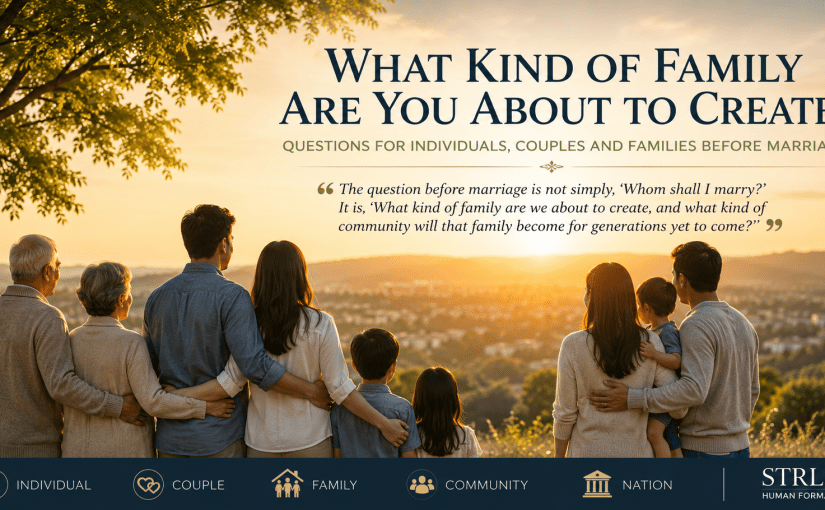
What Kind of Family Are You About to Create?


The question before marriage is not simply, ‘Whom shall I marry?’ It is, ‘What kind of family are we about to create, and what kind of community will that family become for generations yet to come?


From National Systems Research to the First Human Community

What Kind of Family Are You About to Create?

Questions for Individuals, Couples and Families Before Marriage

Contents

Introduction

Family Formation: The First Human Community

  • Why the family is society’s first institution
  • Why marriage is more than a personal decision
  • The purpose of this framework

Part I – Questions for the Individual

1. The Man Who Has Not Yet Healed from a Previous Relationship

  • Questions about Healing
  • Questions about Readiness
  • Questions about Commitment
  • Questions about the Family He Hopes to Create

2. The Woman Without Children Who Has Not Yet Healed from a Previous Relationship

  • Questions about Healing
  • Questions about Readiness
  • Questions about Commitment
  • Questions about the Family She Hopes to Create

3. The Woman Who Has a Child and Has Not Yet Healed from Her Previous Relationship

  • Questions about Healing
  • Questions about Her Child
  • Questions about the Man She Is Considering
  • Questions about the Child’s Father
  • Questions about Building a New Family
  • Questions about Stewardship

4. The Man Who Has a Child and Is Entering a Relationship with a Woman Who Has No Children

  • Questions about Healing
  • Questions about His Child
  • Questions about the Woman He Is Considering
  • Questions about the Child’s Mother
  • Questions about Building One Family
  • Questions about Stewardship

5. The Woman with a Child Entering a Relationship with a Man Who Does Not Have a Child

  • Questions about Healing
  • Questions about Her Child
  • Questions about the Man She Is Considering
  • Questions about the Child’s Father
  • Questions about Building a New Family
  • Questions about Extended Families
  • Questions about Stewardship

6. The Man Without Children Entering a Relationship with a Woman Who Has a Child

  • Questions about Readiness
  • Questions about the Child
  • Questions about the Child’s Father
  • Questions about the Woman He Is Considering
  • Questions about Building One Family
  • Questions about Extended Families
  • Questions about Stewardship

Part II – Questions for the Couple

7. Questions Every Couple Should Ask Together

  • Questions about Shared Values
  • Questions about Trust
  • Questions about Communication
  • Questions about Conflict
  • Questions about Commitment
  • Questions about Finances
  • Questions about Careers and Life Direction
  • Questions about Children and Parenting
  • Questions about Extended Families
  • Questions about Building an Enduring Marriage

Part III – Questions for Parents

8. Parents Who Have Enjoyed an Intact Marriage

  • Questions about Their Own Motives
  • Questions about Listening
  • Questions about the Person Their Child Loves
  • Questions about Family Formation
  • Questions about Supporting Rather than Controlling
  • Questions about Becoming In-Laws
  • Questions about Stewardship

Part IV – Questions for Every Family

9. Questions Every Family Should Ask

  • Questions about Character
  • Questions about Commitment
  • Questions about Family Formation
  • Questions about Relationships
  • Questions about Future Generations
  • The Question Above Every Other Question

Part V – From Family Formation to Nation Formation

10. The Narratives We Choose to Hold Dear

  • Everyday Narratives that Shape Society
  • From Individual Decisions to Social Patterns
  • The Questions that Change What We Value
  • Family Stewardship and Intergenerational Responsibility
  • Narratives that Strengthen Human Capability
  • From Household Choices to National Outcomes

Part VI – A Gift to Families

11. From Understanding Persistent Unemployment to Strengthening the First Human Community

  • A Different Understanding of Persistent Unemployment
  • The Family as Society’s First Institution
  • Interrupting Reinforcing Cycles
  • A Contribution to Human Formation
  • Our Gift

Recommended Reading

A Learning Journey in Family Formation

  • Understanding Yourself Before Marriage
  • Preparing for Marriage Together
  • Love, Communication and Relationships
  • Blended Families
  • Parents and Adult Children
  • Understanding Families as Systems
  • Systems Thinking and Human Formation

Closing Reflection

Building Families that Build Nations

  • Family formation as the foundation of human formation.
  • Human formation as the foundation of productive capability.
  • Productive capability as the foundation of national prosperity.
  • The family as society’s first and most enduring human community

Introduction

Family Formation: The First Human Community

Every human being belongs to a family. Whether that experience has been joyful or painful, stable or uncertain, the family is the first community into which we are born and the first place where we learn what it means to trust, to belong, to resolve conflict, to accept responsibility and to care for others. Long before we encounter schools, workplaces, governments or markets, we experience life through the relationships that exist within our families.

For this reason, the formation of a family is not merely a private decision between two adults. It is the creation of a new human community. The decisions made before marriage shape not only the lives of the couple but also the environment within which children may one day grow, grandparents may find new relationships, siblings may gain new family members, and future generations may develop their understanding of love, commitment, security and belonging.

Yet surprisingly little attention is given to the questions that precede this transition. Couples often ask whether they love one another, whether they are compatible, or whether they will be happy together. These are important questions. They are not, however, the only questions. Before creating a family, individuals and those who care about them have a responsibility to think beyond the wedding day and consider the kind of community they are about to establish.

The purpose of this paper is therefore not to tell people whom they should marry, nor to suggest that every family begins under identical circumstances. Rather, it seeks to present a framework of questions that may help individuals, couples and parents reflect carefully before making one of life’s most consequential decisions. Different life circumstances call for different questions. Some people enter marriage after healing from previous relationships, while others bring children, extended family responsibilities or other complexities into the relationship. The purpose of these questions is not to judge those circumstances but to ensure that they are thoughtfully understood before commitments are made.

Every family begins long before a wedding ceremony. It begins in the lives of the individuals who choose to form it. Each person brings into a relationship experiences, values, expectations, wounds, hopes, and responsibilities that inevitably shape the family they are about to create. Before two people can intentionally build a healthy family together, each must first understand the foundations they themselves are bringing into that new community.

For this reason, the questions that follow begin not with the couple, but with the individual. They are not intended to judge anyone’s past or prescribe a particular life journey. Rather, they invite thoughtful reflection towards oneself on whether the foundations being brought into marriage are capable of supporting the kind of family one hopes to build. Every family begins somewhere. These questions encourage us to begin with ourselves.


Part I – Questions for the Individual

The Man Who Has Not Yet Healed from a Previous Relationship

Every relationship leaves behind memories, lessons and, sometimes, wounds. Beginning a new relationship before understanding what remains unresolved from the previous one can unintentionally place new expectations upon a person who did not create those experiences. Before asking whether another person is the right life partner, a man should first consider whether he has become emotionally available to build a new family on its own foundations.

Questions about Healing

  • Have I fully accepted that my previous relationship has ended?
  • What emotions still influence my thinking?
  • Have I forgiven the other person?
  • Have I forgiven myself?
  • What lessons have I learned that will help me become a better husband?
  • What fears from that relationship still influence me today?
  • If I met my former partner tomorrow, what emotions would still remain unresolved?

Questions about Readiness

  • Am I seeking companionship, or am I seeking relief from loneliness?
  • Am I choosing this woman because of who she is, or because she helps me forget someone else?
  • If this relationship did not continue, would I still know who I am?
  • Am I emotionally ready to make promises that I intend to keep for life?

Questions about the Family I Hope to Create

  • What kind of family do I hope to build?
  • What kind of husband do I hope to become?
  • What kind of father do I hope my children will one day describe?
  • What values do I hope will define our home?
  • What atmosphere do I hope people experience when they enter our family?

The Woman Without Children Who Has Not Yet Healed from a Previous Relationship

The end of a relationship does not necessarily mark the end of its influence. A relationship may end physically while continuing emotionally through disappointment, mistrust, fear or regret. Time alone does not heal these experiences. Healing occurs when a person has reflected on what has happened, accepted what cannot be changed, learned from it and become emotionally available to begin again without asking a new relationship to repair the wounds of the last one.

Marriage invites two people to build a future together. That future is strongest when it is not overshadowed by unresolved questions from the past. Before deciding whether a man is the right life partner, a woman should first consider whether she is free to build a family upon new foundations rather than carrying forward expectations shaped by previous disappointments.

Questions about Healing

  • Have I fully accepted that my previous relationship has ended?
  • What emotions from that relationship remain unresolved?
  • Have I forgiven the other person?
  • Have I forgiven myself for decisions I now regret?
  • What fears continue to influence the way I think about relationships?
  • Can I speak about my previous relationship without anger, bitterness or the desire to prove something?
  • What have I learned about myself through that experience?
  • What strengths have emerged because of what I have been through?

Questions about Readiness

  • Am I seeking a husband, or am I seeking someone to restore what I feel I have lost?
  • Do I know who I am independently of being in a relationship?
  • If this relationship did not continue, would I still feel emotionally secure?
  • Am I choosing this man because I genuinely respect him, or because I am afraid of being alone?
  • Am I emotionally available to commit myself to another person?
  • Have I become the kind of woman I hope to bring into a lifelong marriage?

Questions about Commitment

  • What qualities do I most admire in this man?
  • What concerns have we openly discussed rather than avoided?
  • Have we spoken honestly about our expectations of marriage?
  • How do we each respond when we disagree?
  • Do I trust his character, or do I simply enjoy his company?
  • Would I still choose this relationship if life became significantly more difficult?

Questions about the Family I Hope to Create

  • What kind of family do I hope to build?
  • What kind of wife do I hope to become?
  • What values do I hope will shape our home?
  • What atmosphere do I hope our children will experience every day?
  • How do I hope our family will relate to grandparents, siblings and the wider community?
  • What kind of legacy do I hope our family will leave for the next generation?

Questions about Stewardship

Marriage is not only about finding someone to love. It is about accepting responsibility for the wellbeing of another person and for the family that may one day emerge from that relationship.

  • Am I prepared to place the wellbeing of our future family alongside my own aspirations?
  • What sacrifices am I prepared to make for the family we hope to build?
  • How will I contribute to creating trust, stability and peace within our home?
  • When our children one day observe our relationship, what do I hope they will learn about love, commitment and respect?
  • If my future daughter asked me why I chose her father, what answer would I hope to give?

These questions are not intended to create doubt where confidence already exists. Rather, they invite a woman to reflect upon the kind of family she is preparing to build and the person she is becoming in the process. The quality of a future marriage depends not only upon finding the right partner, but also upon becoming someone capable of building a home where trust, belonging and enduring commitment can flourish.


The Woman Who Has a Child and Has Not Yet Healed from Her Previous Relationship

When a woman enters a new relationship with a child, she is not making decisions for herself alone. Her child is already part of an existing family system, with relationships, experiences and emotional needs that deserve careful consideration. A new relationship therefore has implications that extend beyond the couple. It affects the child, the prospective husband, both extended families and, in many cases, the child’s biological father.

This does not make the formation of a new family impossible. It does, however, make it more complex. The question is not whether a woman who has a child should marry again. The question is whether everyone involved has taken sufficient time to understand the responsibilities that accompany the creation of a new family. The child’s wellbeing deserves to be considered alongside the hopes and aspirations of the adults.

Questions about Healing

  • Have I fully accepted that my previous relationship has ended?
  • What emotions from that relationship still influence my decisions today?
  • Have I forgiven the father of my child?
  • Have I forgiven myself for decisions that I now wish had been different?
  • What fears do I carry into this new relationship?
  • Am I looking for a husband, or am I hoping someone will solve problems that remain unresolved?
  • Have I become emotionally available to build a new family?

Questions about My Child

  • What does my child need most at this stage of life?
  • How has my previous relationship affected my child?
  • Have I taken time to understand how my child feels about the changes taking place?
  • Is my child emotionally ready to meet someone who may become part of our family?
  • Am I protecting my child’s need for stability while I make decisions about my own future?
  • If this relationship were not to continue, how would that affect my child?

Questions about the Man I Am Considering

  • Does he understand that he is entering an existing family system?
  • Has he shown genuine care and patience towards my child?
  • Does he understand that my responsibilities as a mother will always remain part of our marriage?
  • Have we discussed what role he hopes to play in my child’s life?
  • Is he prepared for the responsibilities that accompany becoming a husband and, potentially, a father figure?
  • Does he appreciate that earning a child’s trust takes time and cannot be demanded?

Questions about the Child’s Father

These questions are not intended to reopen past conflicts. They are intended to recognise that another parent may continue to influence the life of the child.

  • What relationship currently exists between my child and his or her father?
  • What responsibilities does the child’s father continue to fulfil?
  • Have I been honest with my prospective husband about that relationship?
  • What boundaries are necessary to protect peace within the new family?
  • How will important decisions concerning the child be made?
  • Have we discussed these matters openly before marriage rather than assuming they will resolve themselves afterwards?

Questions about Family Formation

  • What kind of family are we hoping to create together?
  • How will my child experience belonging within this new family?
  • If we later have children together, how will every child experience equal love, fairness and security?
  • What traditions do we hope to establish as a new family?
  • How will we build trust between all members of the household?
  • What values will define the culture of our home?
  • What conversations should occur now rather than after marriage?

Questions about Stewardship

The formation of a family is an act of stewardship. It requires adults to think beyond their immediate desires and consider the long-term wellbeing of everyone whose lives will be shaped by their decisions.

  • Am I making decisions that increase my child’s sense of safety and belonging?
  • Am I giving this relationship sufficient time to develop naturally?
  • Have I introduced this man into my child’s life gradually and thoughtfully?
  • Are we building a family on carefully considered commitments, or are we allowing circumstances to determine our future?
  • Twenty years from now, what do I hope my child will say about the way this family was formed?

These questions are not intended to discourage the formation of blended families. Rather, they recognise that a child already present within the relationship changes the structure of the family from its very beginning. Thoughtful preparation cannot eliminate every challenge, but it can help create a family in which trust, stability and belonging are intentionally nurtured for every member.


The Man Without Children Entering a Relationship with a Woman Who Has a Child

When a man without children enters a relationship with a woman who already has a child, he is making a decision that extends beyond choosing a life partner. He is also deciding whether he is prepared to become part of an existing family. Unlike two people who begin building a family together from the outset, he is entering a family system that already has relationships, routines, memories, responsibilities and emotional bonds. This does not diminish the possibility of building a loving and successful family, but it does require him to understand that he is not simply beginning something new; he is also joining something that already exists.

The quality of the future family will depend not only upon the relationship between the man and the woman but also upon the way in which the child experiences safety, belonging and acceptance. These questions are therefore intended to help a man consider not only whether he loves the woman, but also whether he is prepared for the responsibilities that accompany the family she already brings into the relationship.

Questions about Readiness

  • Why am I choosing this relationship?
  • What attracts me most to this woman?
  • Have I taken sufficient time to understand her life before I become part of it?
  • Am I emotionally prepared to become a husband and, potentially, a father figure at the same time?
  • Am I entering this relationship with realistic expectations?
  • Have I considered the responsibilities that already exist rather than only the future I hope to build?

Questions about the Child

A child is not an addition to the relationship. The child is already an integral member of the family the couple hopes to build.

  • Am I willing to accept this child as part of the family I hope to create?
  • What role do I hope to play in this child’s life?
  • Do I understand that trust cannot be demanded but must be earned?
  • Am I prepared to invest time, patience and consistency in building that relationship?
  • How will I respond if the child initially struggles to accept me?
  • What kind of relationship would I hope this child describes twenty years from now?

Questions about the Child’s Father

The presence of another biological parent introduces relationships that deserve thoughtful consideration rather than avoidance.

  • What role does the child’s father currently play?
  • How involved is he in the child’s life?
  • What responsibilities continue to exist between him and the child?
  • Have we discussed these matters openly and honestly?
  • What boundaries will help maintain peace and clarity for everyone involved?
  • How will disagreements affecting the child be handled?

Questions about the Woman I Am Considering

  • Have we discussed our expectations of marriage honestly?
  • Does she understand my hopes and concerns?
  • Have we spoken openly about parenting?
  • What values do we hope will shape our family?
  • How do we resolve disagreement?
  • What qualities in her give me confidence that we can build a stable family together?
  • Have we allowed enough time to know one another beyond the excitement of a new relationship?

Questions about Building One Family

One of the greatest responsibilities facing any blended family is not simply living together but becoming one family.

  • How will we create a sense of belonging for every member of the household?
  • If we later have children together, how will every child experience equal love, dignity and opportunity?
  • What family traditions shall we establish together?
  • How will we make important decisions as parents?
  • How will we ensure that our home becomes a place of stability rather than uncertainty?
  • What kind of family culture do we hope future generations will inherit from us?

Questions about Extended Families

Marriage joins more than two individuals. It joins parents, grandparents, siblings and extended families into new relationships.

  • How will my parents receive this woman and her child?
  • How will her parents receive me?
  • Have we discussed the role we hope our extended families will play in our lives?
  • What expectations should be clarified before marriage?
  • How can we encourage relationships that strengthen rather than divide our new family?

Questions about Stewardship

The decision to marry is ultimately a decision about stewardship. It is a commitment to care for the wellbeing of others over a lifetime.

  • Am I prepared to love not only this woman but also the life that comes with her?
  • Am I willing to place the long-term wellbeing of this family above my own convenience?
  • Are we making decisions because they are carefully considered, or because circumstances are pushing us forward?
  • If my future children asked me why I chose their mother, what answer would I hope to give?
  • If her child asked me, years from now, “When did you decide I was your family?” what answer would I want to be able to give?

The answers to these questions do not determine whether a marriage will succeed. They do, however, encourage a man to recognise that marriage is not simply about finding a life partner. It is about intentionally creating a family in which every person—adult and child alike—can experience trust, belonging, security and the opportunity to flourish.


The Woman with a Child Entering a Relationship with a Man Who Does Not Have a Child

When a woman who has a child enters a relationship with a man who has never had children, she is making a decision that reaches beyond her own future. She is not only considering whether this man may become her husband, but also whether he is prepared to become part of a family that already exists. Her child is not an extension of the relationship; the child is already a person with emotional needs, established relationships, memories and a developing sense of identity. Any new relationship must therefore be considered from the perspective of both the adults and the child.

This requires honesty, patience and maturity from everyone involved. The man deserves the opportunity to understand the responsibilities he is accepting before making a lifelong commitment. Equally, the child deserves the opportunity to experience trust gradually rather than being expected to accept a new parental figure simply because the adults have decided to marry. The woman therefore carries a dual responsibility: to nurture a healthy relationship with the man she hopes to marry while also protecting the emotional wellbeing of her child.

These questions are intended to encourage thoughtful reflection before decisions are made that will shape the lives of everyone who becomes part of the new family.

Questions about Healing

  • Have I fully accepted that my previous relationship has ended?
  • Have I forgiven my former partner?
  • Have I forgiven myself?
  • Am I entering this relationship because I am ready to build a new family, or because I am trying to recover from the last one?
  • What lessons have I learned that will help me become a better wife and mother?
  • What fears or disappointments from my previous relationship still influence my thinking today?
  • Am I emotionally available to make a lifelong commitment?

Questions about My Child

My child is not simply part of my history. My child is part of my future.

  • What does my child need most from me at this stage of life?
  • How has my child experienced the absence of his or her biological father?
  • Is my child emotionally ready for someone new to become part of our lives?
  • Am I protecting my child’s need for stability while this relationship develops?
  • Have I introduced this man into my child’s life gradually and thoughtfully?
  • Am I allowing my child sufficient time to develop trust naturally?
  • If this relationship did not continue, how would that affect my child?

Questions about the Man I Am Considering

A man without children may not yet fully understand the responsibilities that accompany becoming part of an existing family. Those responsibilities deserve to be discussed openly rather than assumed.

  • Does he understand that he is entering an existing family rather than beginning one from the beginning?
  • Have I been honest with him about my responsibilities as a mother?
  • Has he demonstrated patience, kindness and consistency towards my child?
  • Does he understand that trust from a child cannot be demanded but must be earned?
  • Has he asked thoughtful questions about my child rather than seeing my child as an obstacle to our relationship?
  • Does he appear ready for the long-term responsibilities of becoming both a husband and a father figure?

Questions about the Child’s Father

The presence of another biological parent is part of the family’s reality. It should neither be ignored nor allowed to create unnecessary uncertainty.

  • What relationship currently exists between my child and his or her father?
  • What responsibilities does the father continue to fulfil?
  • Have I spoken honestly with this man about those responsibilities?
  • What boundaries will protect the peace and stability of our future family?
  • How will decisions affecting the child be made?
  • Have we discussed these matters before making lifelong commitments?

Questions about Building a New Family

Marriage is not simply the joining of two adults. It is the creation of a family in which every member should experience belonging.

  • What kind of family are we hoping to create?
  • How will my child know that he or she truly belongs?
  • How will we build trust between all members of the household?
  • If we are later blessed with children together, how will we ensure that every child experiences equal love, fairness and dignity?
  • What values will define the culture of our home?
  • What family traditions do we hope to establish together?
  • What conversations should take place now rather than after marriage?

Questions about Extended Families

Marriage joins families as well as individuals. Grandparents, siblings and relatives all become part of the new family system.

  • How will my parents receive this man?
  • How will his parents receive both me and my child?
  • Have we discussed the role we hope our extended families will play in our lives?
  • Are there expectations that should be clarified before marriage?
  • How can we encourage relationships that strengthen rather than divide our new family?

Questions about Stewardship

Creating a family is an act of stewardship. It calls adults to think beyond immediate happiness and to consider the lives that will be shaped by the decisions they make today.

  • Am I making decisions that strengthen my child’s future?
  • Have I given this relationship sufficient time to mature?
  • Are we moving towards marriage because we have thoughtfully discerned our future together, or because circumstances are moving us in that direction?
  • Am I helping this man understand the responsibilities he is accepting, rather than assuming he will learn them after marriage?
  • Twenty years from now, what do I hope my child will say about the way this family was formed?
  • If my child one day chooses a life partner, what example do I hope this family will have provided?

No set of questions can remove every uncertainty that accompanies marriage. They can, however, help ensure that decisions are made with greater clarity, honesty and foresight. A woman entering marriage with a child is not simply beginning a new chapter in her own life. She is shaping the future of her child, inviting another person into an existing family, and laying the foundations upon which a new human community may grow. The more intentionally those foundations are established, the greater the opportunity for every member of that family to experience trust, belonging, stability and hope.


Part II – Questions for the Couple

Questions Every Couple Should Ask Together

Choosing to marry is one of the most significant decisions two people will ever make. Yet, in many societies, much of the attention surrounding marriage is devoted to the wedding itself—the ceremony, the celebrations, the guests and the beginning of life together. Comparatively little time is spent asking a more fundamental question: What kind of family are we about to create?

Marriage is more than the union of two individuals. It is the intentional formation of the first human community that the couple will build together. Within that community, values will be practised, responsibilities shared, children nurtured, traditions established and relationships extended across generations. The quality of that community will influence not only the lives of the couple themselves, but also the lives of everyone who comes after them.

For this reason, the most important conversations before marriage are seldom about the wedding. They are about the family that will exist long after the wedding has been forgotten. Couples who invest time in these conversations are not attempting to predict every challenge they may encounter. Rather, they are learning how to think together, how to discern together, and how to build together.

The questions that follow are not intended to determine whether two people should marry. They are intended to help couples see beyond immediate affection and ask whether they are intentionally preparing to establish a family capable of remaining whole, nurturing future generations and contributing positively to the communities and nation of which it will become a part.


Questions about Shared Purpose

Every enduring family begins with a shared understanding of why it exists.

  • Why do we want to marry?
  • Beyond loving one another, what purpose do we hope our family will serve?
  • What kind of home do we hope to create?
  • What values do we want people to experience when they enter our home?
  • What do we hope our children and grandchildren will one day say about our family?
  • Are we building a marriage for ourselves alone, or are we intentionally creating a family that will bless others?

Questions about Character

Strong marriages are built upon character before they are sustained by compatibility.

  • What qualities do we most admire in one another?
  • What weaknesses do we each acknowledge?
  • How do we help one another become better people?
  • Are we able to challenge one another with honesty and kindness?
  • What habits should we strengthen before we marry?
  • What habits should we leave behind?

Questions about Trust

Trust is not established on the wedding day. It is built through consistent choices long before marriage begins.

  • Can we speak honestly without fear?
  • Do we trust one another with disappointment as much as with success?
  • How do we rebuild trust when it is damaged?
  • What promises do we believe are sacred?
  • How will we protect trust throughout our marriage?

Questions about Communication and Conflict

Every marriage will experience disagreement. The question is not whether conflict will arise, but how it will be approached.

  • How do we communicate when we disagree?
  • Do we listen to understand or merely to respond?
  • How do we apologise?
  • How do we forgive?
  • What subjects are difficult for us to discuss?
  • How will we make important decisions together?

Questions about Previous Relationships

Every relationship has a history. Wisdom asks whether that history has been understood before a new future is built.

  • Have we each found peace with our previous relationships?
  • Are there responsibilities from previous relationships that remain?
  • Have we been honest with one another about those responsibilities?
  • Are there conversations that should take place before we marry?
  • Have we mistaken the passage of time for genuine healing?

Questions about Children and Family Formation

Marriage creates a family. Where children already exist, it enlarges a family that has already begun.

  • What responsibilities do we already carry?
  • How will every child experience love, security and belonging?
  • How will we speak about one another in front of our children?
  • What traditions do we hope to establish as a family?
  • How will we build trust patiently rather than expecting it immediately?
  • What does fairness look like within our family?

Questions about Stewardship

Every family becomes the steward of relationships entrusted to it.

  • What responsibilities accompany becoming a husband or wife?
  • What responsibilities accompany becoming a parent or parent figure?
  • How will we care for relationships that already exist?
  • What sacrifices will family life require of us?
  • What does faithfulness look like over the next thirty or forty years?

Questions about Work, Capability and Contribution

Families do not merely consume resources. They also develop the capabilities through which society flourishes.

  • What attitudes towards work do we hope will characterise our family?
  • How will we encourage curiosity, learning and discipline?
  • How will we nurture the talents entrusted to our children?
  • How will we encourage productive capability rather than dependence?
  • What example will our own work and service provide?
  • In what ways do we hope our family will contribute to our community and nation?

Questions about Extended Families

Marriage joins families as well as individuals.

  • How will we honour our parents while establishing our own family?
  • What relationships should be strengthened before marriage?
  • How will we welcome one another’s families into our lives?
  • What boundaries will help preserve healthy relationships?
  • How will we resolve tensions should they arise?

Questions about the Future

Every family begins with hope. Stewardship requires that hope to be accompanied by thoughtful preparation.

  • What kind of family do we hope to become twenty years from now?
  • What kind of grandparents do we hope one day to be?
  • What legacy do we hope our family will leave?
  • What values should survive long after we are gone?
  • What kind of society do we hope our family will help build?

The Conversation Above Every Other Conversation

As our understanding of family deepens, so too do the conversations we find worth having. We begin to recognise that marriage is not simply about choosing a life partner. It is about choosing the kind of human community we hope to create together. The questions become less concerned with the wedding day and more concerned with the generations that may one day emerge from the family we are forming.

The more we appreciate the interrelationships between family formation and nation formation, the more certain conversations naturally become important. We begin to ask not only whether we love one another, but whether we are preparing to build a relationship that is itself capable of remaining whole. We ask whether responsibilities from previous relationships have been understood and honoured, how children will experience continuity and belonging, how trust will be built with extended families, and whether important relationships should be nurtured before marriage rather than afterwards.

These questions are not intended to prescribe a single model of family life. Rather, they invite couples to recognise that the everyday narratives they choose to live by gradually become the foundations upon which families, communities and ultimately nations are built.

Ultimately, every couple preparing for marriage faces one question that stands above all the rest:

What kind of family are we intentionally choosing to create?

The answer to that question will shape far more than their own lives. It will influence the children they raise, the relationships they cultivate, the values they pass on, the capabilities they nurture and the communities they help to build. In this sense, every marriage is not only a personal commitment. It is an act of stewardship towards future generations, and a quiet but enduring contribution to the formation of society itself.


Part III – Questions for Parents

Parents Who Have Enjoyed an Intact Marriage

Parents who have built an enduring marriage often face one of the most delicate transitions of family life when their children become adults. For many years they have protected, guided and made decisions in the best interests of their children. Gradually, however, that responsibility changes. Adult sons and daughters must make their own decisions, including one of the most significant decisions of all—the choice of a life partner.

This transition requires wisdom from both generations. Parents who continue to control their adult children may weaken the very maturity they have worked hard to develop. Equally, parents who withdraw completely from the conversation may withhold the benefit of experience that could help their children avoid unnecessary pain. The challenge is neither to control nor to remain silent, but to offer wisdom in a way that preserves the dignity and responsibility of the adult child.

Parents who have themselves enjoyed an intact marriage possess something of great value. They have lived through the ordinary demands of building a family over many years. They understand that successful marriages are not sustained by emotion alone but by commitment, sacrifice, forgiveness, patience and shared purpose. Their experience does not make them infallible, but it does place upon them a responsibility to help their children think carefully about the families they hope to create.

The questions below are intended not only for parents to ask their children but also for parents to ask themselves. Discernment requires humility from every generation.

Questions about Our Own Motives

  • Why do we have concerns about this relationship?
  • Are our concerns based upon enduring principles or personal preferences?
  • Are we reacting to circumstances, or have we taken time to understand them?
  • Are we protecting our son or daughter, or are we protecting our own expectations?
  • Have we distinguished between what is unfamiliar and what is genuinely unwise?
  • Have we allowed fear to speak more loudly than understanding?

Questions about Listening

Before parents offer advice, they should first understand.

  • Have we listened carefully to our son or daughter without interruption?
  • Have we sought to understand before seeking to persuade?
  • Have we asked questions rather than reached conclusions?
  • Do we understand what our child sees in this relationship?
  • Have we invited honest conversation without creating fear or defensiveness?
  • Have we made it safe for our child to tell us the whole story?

Questions about the Person Our Child Loves

Every person deserves to be known as an individual before being defined by their circumstances.

  • Have we taken time to know this person beyond first impressions?
  • What strengths do we see in him or her?
  • What qualities would make this person a good husband, wife, father or mother?
  • Have we allowed one aspect of their life to overshadow the whole person?
  • What evidence have we seen of maturity, responsibility and integrity?
  • Have we been fair in our assessment?

Questions about Family Formation

Parents who have enjoyed an intact marriage understand that marriage creates far more than a couple.

  • What kind of family do we believe our child hopes to build?
  • Have we helped our child think beyond the wedding day?
  • Have we discussed the responsibilities of marriage rather than only the happiness it may bring?
  • Have we encouraged our child to think about future children, extended families and long-term commitments?
  • Have we asked questions that enlarge perspective rather than narrow it?

Questions about Supporting Rather Than Controlling

The purpose of parental wisdom is not to make the decision on behalf of an adult child but to help that child make a well-considered decision.

  • Are we offering wisdom or demanding agreement?
  • If our child ultimately makes a different decision from the one we would make, how will we respond?
  • Have we respected our child’s responsibility to choose?
  • Have we created space for thoughtful reflection rather than emotional pressure?
  • What questions might help our child see what we have learned through experience?
  • Have we remembered that our role is to prepare our children for independent adulthood, not perpetual dependence?

Questions about Becoming In-Laws

Marriage creates new relationships for parents as well.

  • If this marriage takes place, what kind of parents-in-law do we hope to become?
  • How can we contribute to the strength of this new family rather than become another source of tension?
  • How can we welcome new family members with grace while remaining true to our principles?
  • What example do we hope to set for our grandchildren?
  • How can we encourage unity between both families?
  • What relationships do we hope will exist twenty years from now because of the way we respond today?

Questions about Stewardship

Ultimately, parents are stewards rather than owners of their children’s lives. Their task is not to determine every outcome but to pass on wisdom that equips the next generation to build strong families of their own.

  • Have we shared the lessons of our own marriage honestly, including the difficulties we have overcome?
  • Have we demonstrated the kind of marriage we hope our children will build?
  • Have we encouraged our child to seek wisdom from others as well?
  • Have we remembered that love sometimes asks difficult questions but always respects another person’s dignity?
  • When our grandchildren one day ask how this family was formed, what story do we hope they will hear?
  • Have we done everything within our responsibility to help our child think carefully, while allowing the final decision to remain theirs?

Parents cannot guarantee the future of their children’s marriages. They cannot choose a spouse on their behalf, nor should they attempt to do so. What they can offer is something no one else can provide: the wisdom that comes from years of building a family, the patience to ask questions that broaden understanding, and the reassurance that whatever decision is ultimately made, their love remains steadfast. Their influence is greatest not when they control the decision, but when they help their children become thoughtful stewards of the families they are about to create.


I would close the article with one final section that brings all the categories together. Otherwise, readers may leave thinking the paper is about different kinds of people rather than one common responsibility.


Part IV – Questions for Every Family

Questions Every Family Should Ask

Although every family begins under different circumstances, every family eventually faces the same responsibility: to become a place where its members experience trust, belonging, security, responsibility and hope. The circumstances under which a family begins may differ considerably, but the responsibility to intentionally build that family belongs to everyone.

The questions presented throughout this paper have therefore not been offered to separate people into different groups or to suggest that one family’s journey is more valuable than another’s. Rather, they recognise that different circumstances require different conversations. When those conversations are approached honestly and thoughtfully, they strengthen the foundations upon which healthy families are built.

Whatever our circumstances, every person contemplating marriage should be willing to pause and reflect upon a common set of questions.

Questions about Character

  • Am I becoming the kind of person I hope my future spouse deserves?
  • What qualities of character am I still developing?
  • What habits do I need to change before asking another person to share my life?
  • What do those closest to me say about my character?
  • Am I prepared to continue growing throughout my marriage?

Questions about Commitment

  • Do I understand that marriage is a lifelong commitment rather than simply a personal milestone?
  • Have I considered what commitment will require when life becomes difficult?
  • Am I prepared to place the wellbeing of my family alongside my own ambitions and aspirations?
  • What sacrifices am I willing to make for the family I hope to build?

Questions about Family Formation

  • What kind of family do I hope to create?
  • What values will shape our home?
  • What traditions do I hope future generations will inherit?
  • What atmosphere do I hope visitors will experience when they enter our home?
  • How will our family contribute to the wellbeing of our community?

Questions about Relationships

  • How will we resolve conflict when we disagree?
  • How will we make important decisions together?
  • How will we strengthen trust over time?
  • How will we protect our marriage from unnecessary pressures?
  • What role will our extended families play in our lives?

Questions about Future Generations

Every decision made today becomes part of someone else’s future.

  • What kind of childhood do I hope my children will experience?
  • What lessons do I hope they will learn by watching our marriage?
  • What stories do I hope they will tell about our family when they become adults?
  • What kind of grandparents do I hope we will one day become?
  • What legacy will remain after we are gone?

The Question Above Every Other Question

Every question in this paper ultimately leads to one that stands above all the rest.

What kind of family are we about to create?

Not simply what kind of wedding.

Not simply what kind of marriage.

But what kind of family.

Will it be a family in which trust grows, responsibilities are shared, forgiveness is practised, children experience security, grandparents are honoured, relationships are nurtured and future generations inherit a legacy of stability and hope?

No set of questions can guarantee that a marriage will succeed. Human relationships are too complex for that. Questions, however, can encourage thoughtful reflection before decisions become lifelong commitments. They can help individuals, couples and families recognise dimensions that may otherwise remain hidden until much later.

Perhaps wisdom is not measured by having all the right answers. Perhaps wisdom begins by asking the right questions before creating the family that future generations will one day call their own.


Part V – From Family Formation to Nation Formation

The Narratives We Choose to Hold Dear

Systems rarely change because people are told to behave differently. They change because people begin to see different relationships as important. As our attention shifts, so too do the questions we ask, the conversations we have, and ultimately the decisions we make. Over time, these decisions become the narratives through which societies reproduce themselves.

One of the unexpected insights emerging from STRLDi’s work is that the more we pay attention to the interrelationships between family formation and nation formation, the more certain narratives naturally become dear to us. We begin to value not only successful relationships, but relationships that contribute to the formation of healthy families, healthy communities and capable nations.

This change in perspective does not begin with rules. It begins with different questions. We become interested in whether relationships are being brought to a place of wholeness before new ones are formed. We become curious about how responsibilities are carried from one relationship into another. We become more attentive to how children experience transitions, how extended families are introduced into new relationships, and how trust is intentionally built rather than assumed.

The point is not to prescribe a single way of forming families. Rather, it is to recognise that every society carries narratives that quietly shape what people consider normal, responsible or desirable. Those narratives are rarely questioned because they are embedded in everyday practice.

Consider, for example, practices such as whether a prospective husband should meet the biological father of a child before marriage, or whether parents should get to know the person their son or daughter hopes to marry long before an engagement is announced. These examples are not presented as universal rules, nor are they offered as judgments. They are illustrations of a deeper question: What do our everyday practices reveal about the way we understand family, responsibility and stewardship?

As these conversations deepen, other narratives gradually emerge as worthy of greater attention.

  • A marriage creates a family, not merely a couple.
  • Every child deserves relationships that are intentionally built around trust, stability and belonging.
  • Responsibilities from previous relationships should be understood rather than ignored.
  • Families are strengthened when important relationships are formed deliberately rather than accidentally.
  • The quality of future communities begins with the quality of today’s family conversations.
  • Human capability is first formed within families before it is developed in schools, workplaces and institutions.
  • The strength of productive sectors ultimately depends upon the quality of the human capability that families help to nurture over generations.
  • Every generation becomes a steward of the human communities it passes to the next.

These narratives are not offered as conclusions but as invitations to think differently. They encourage us to move beyond asking whether a particular decision is right or wrong and instead ask a deeper systems question:

If this way of thinking were repeated across thousands of families for generations, what kind of society would it gradually create?

That question, perhaps more than any other, bridges the journey from family formation to nation formation. It reminds us that the future of a nation is shaped not only by the policies it adopts or the industries it builds, but also by the narratives its families quietly choose to live by.


Part VI – A Gift to Families

From Understanding Persistent Unemployment to Strengthening the First Human Community

This article is offered as a gift to individuals, couples, parents and families. It is the product of a much larger journey of inquiry that began not with marriage or family life, but with one of society’s most persistent and consequential challenges: unemployment.

For many years, STRLDi has sought to understand why unemployment persists across generations despite repeated economic reforms, investment programmes, labour market interventions and changes in public policy. Rather than examining unemployment as an isolated labour market phenomenon, the Institute adopted a systems perspective, exploring the interrelationships between economic structures, education, governance, demographics, communities and households. The objective was not simply to identify symptoms, but to understand the deeper structures that continually reproduce unemployment over time.

A Different Understanding of Persistent Unemployment

One of the most significant insights to emerge from this research is that persistent unemployment is not generated by the economy alone. It is the downstream expression of multiple reinforcing systems that interact continuously across generations. These systems include demographic dynamics, educational pathways, institutional capability, productive-sector development, household formation and family stability.

The study proposes that unemployment persists because these systems reinforce one another. Children are born into households that become the first environment of human formation. Those households influence educational development, aspirations, resilience, behaviour, values and the capacities that children eventually carry into schools, universities, workplaces and society. Over time, these influences shape the quantity, quality and distribution of human capability entering the national economy.

At the same time, the study observed that where the formation of intact families declines significantly over successive generations, the effects are no longer confined to individual households. They begin to influence the broader human capability available to society. As educational participation becomes increasingly concentrated away from the scientific, technical and productive disciplines upon which agriculture, manufacturing and other productive sectors depend, the nation’s capacity to generate employment grows more slowly than the rate at which new entrants join the labour force. The result is a reinforcing pattern in which unemployment continually reproduces itself across generations.

The Family as the First Human Community

These observations led to an important realisation. The family is not simply a private social institution. It is the first human community and one of the earliest environments in which a nation’s future productive capability is formed.

Within the family, children first learn trust, responsibility, discipline, cooperation, resilience, stewardship and service. These capacities do not remain within the household. They accompany individuals into classrooms, universities, workplaces, businesses, communities and public institutions. Every nation therefore inherits, in part, the cumulative outcomes of the families from which its citizens emerge.

Marriage is consequently much more than the union of two individuals. It is the intentional formation of a community that will shape the lives of future generations and, through them, contribute to the long-term capability of society itself.

Interrupting Reinforcing Cycles

Systems thinking teaches us that persistent outcomes are sustained by persistent structures. If unemployment is reproduced through reinforcing relationships across households, education, productive sectors and institutions, then meaningful national transformation requires more than economic reform alone. It also requires strengthening the human communities through which future generations are formed.

This article therefore seeks to intervene at one of the earliest points in that reinforcing structure. By encouraging thoughtful reflection before marriage, it aims to strengthen the quality of family formation before patterns of instability become embedded across generations. Every healthy family contributes to healthier communities. Healthier communities strengthen institutions. Stronger institutions enhance productive capability. Greater productive capability creates the conditions through which meaningful and sustained employment can grow.

In this way, the intentional formation of one family becomes part of the long-term formation of a nation.

A Contribution to Human Formation

This publication forms part of STRLDi’s broader programme on Human Formation. While the Institute’s work is often associated with national transformation, governance and economic development, these are ultimately expressions of deeper human systems. Institutions do not create themselves. Economies do not organise themselves. Communities do not sustain themselves. Each depends upon people whose character, judgement, resilience and capacity for cooperation were first shaped within families.

For this reason, the strengthening of families is not separate from national development. It is one of its earliest and most enduring foundations.

Our Gift

This article is therefore offered as a gift—not because it claims to provide all the answers, but because it invites deeper questions at one of life’s most important crossroads. It is our hope that individuals, couples, parents and families will pause before making lifelong commitments and ask not only whether they are ready for marriage, but also what kind of family they are about to create.

If these questions help even a small number of families build relationships characterised by trust, stability, responsibility, belonging and hope, they will have contributed to something far greater than successful marriages alone. They will have contributed to the formation of stronger communities, more capable institutions and nations better equipped to create opportunity for generations yet to come.


“Persistent unemployment is not merely an economic problem waiting for an economic solution. It is the downstream expression of interacting human systems whose earliest and most enduring foundation is the family.”


Recommended Reading

A Learning Journey in Family Formation

No single book can fully prepare an individual or a couple for the responsibilities of marriage and family life. Every author approaches the subject from a particular perspective—psychology, family systems, communication, faith, sociology, personal experience or leadership. Together, these works provide complementary insights that can help individuals, couples and families think more deeply about the kind of family they hope to create.

Readers are encouraged to engage with a range of perspectives. Some of the books presented here are grounded in decades of scientific research, others draw from therapeutic practice, while others reflect philosophical, cultural or faith-based traditions. Read together, they provide a rich foundation for understanding the formation of healthy families and communities.


Understanding Yourself Before Marriage

These books encourage personal reflection, emotional maturity and healing before entering lifelong commitments.

  • Boundaries
  • How We Love
  • The Developing Mind
  • King, Warrior, Magician, Lover
  • Wild at Heart
  • Fascinating Womanhood

Preparing for Marriage Together

These books explore communication, commitment, emotional connection and the practical realities of married life.

  • The Seven Principles for Making Marriage Work
  • Hold Me Tight
  • The Meaning of Marriage
  • Things I Wish I’d Known Before We Got Married
  • Before You Say ‘I Do’
  • Saving Your Marriage Before It Starts
  • Men Are from Mars, Women Are from Venus

Understanding Love, Communication and Relationships

Healthy marriages are sustained not only by commitment but also by the ability to understand one another, communicate effectively and resolve conflict constructively.

  • The Five Love Languages
  • Crucial Conversations
  • Nonviolent Communication
  • Difficult Conversations
  • Getting to Yes

Blended Families and Stepfamilies

For individuals entering marriages where one or both partners already have children, these works provide valuable guidance on the gradual formation of trust, belonging and family identity.

  • The Smart Stepfamily
  • Stepfamilies
  • Surviving and Thriving in Stepfamily Relationships

Parents and Adult Children

As children become adults, parents move from directing decisions to offering wisdom. These books explore that important transition.

  • Parenting Adult Children
  • Doing Life with Your Adult Children
  • Boundaries

Understanding Families as Systems

Families do not exist in isolation. They are dynamic systems in which every relationship influences every other relationship. These works provide deeper insight into the structure, dynamics and development of families across generations.

  • Families and Family Therapy
  • Family Therapy in Clinical Practice
  • Family Evaluation
  • Generation to Generation
  • The Ecology of Human Development

Systems Thinking and Human Formation

The family is the first and most enduring human community. Understanding families through the lens of systems thinking helps us appreciate how individual choices shape relationships, institutions and society across generations.

  • The Fifth Discipline
  • Thinking in Systems
  • The Social Animal

Concluding Reflection

The purpose of this reading list is not to prescribe a single philosophy of marriage or family life. Rather, it is to encourage thoughtful engagement with a range of perspectives that have shaped scholarship and practice in psychology, family systems, communication, leadership, personal development and human relationships. Each work contributes a different lens through which readers may better understand themselves, their relationships and the responsibilities that accompany the formation of a family.

The questions explored throughout this article invite reflection before marriage. These readings invite continued learning throughout life. Together they remind us that strong families are seldom the result of chance. They are built intentionally—through character, wisdom, mutual understanding, continual learning and the shared commitment to create a home in which every member can experience trust, belonging, responsibility and hope.


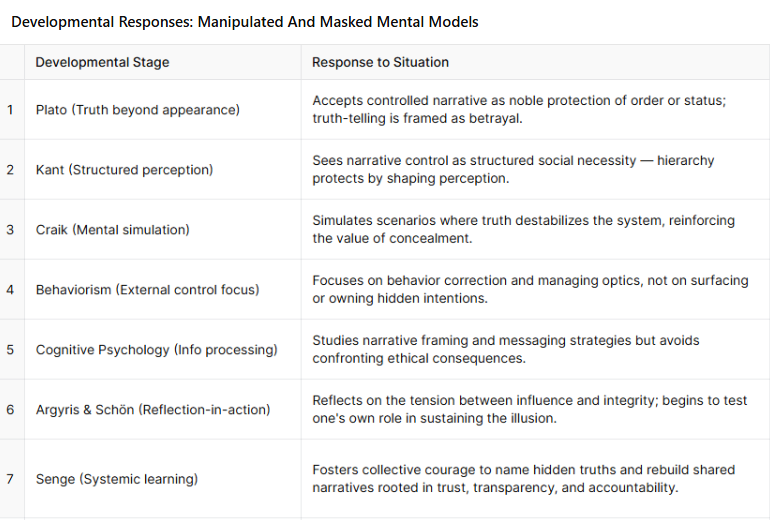
#13: Testing the Limits of Each Thinking by Situation Series: Manipulation


Manipulated and Masked Mental Models

👭Deliberate narrative shaping to preserve power or control across social layers

The final category, Manipulated and Masked Mental Models, is charted — showing how the practice of narrative control to preserve power spans families, organisations, governments, and global relations. This category rightly sits as cross-cutting, because it operates at every level where perception, trust, and power converge.

Stories we hide or mask from others to mislead or manipulate represent a deliberate shaping of mental models — not just our own, but others’ as well. This behavior can occur across all levels, but its intentional nature means it’s especially relevant in contexts where power, perception, and control are central.


Where It Fits:

Rather than a single level, this category cuts across all levels — but is especially prevalent in:

  • Siblings & Families: Emotional manipulation to maintain family roles or favoritism.
  • Organisations: Leadership or staff masking intentions to maintain control or avoid accountability.
  • Governments/Nations: Propaganda, performative harmony, or suppression of dissent to preserve legitimacy.
  • Global: Donor nations controlling narratives about development aid or interventions.

Sample Situations:

System LevelMasking Behavior
IndividualHiding vulnerability to maintain authority or self-image
FamilyOne sibling gaslighting another to maintain status or influence
OrganisationJustifying policies by masking economic interests as a public good
GovernmentJustifying policies by masking economic interests as public good
GlobalFraming extractive development partnerships as “mutual benefit”

Assumption: “Truth must be controlled to maintain order or advantage. Transparency weakens authority.”

Self-discipline: Distinguish between protection and manipulation; surface the cost of hidden agendas to relational trust and system integrity.

Surfacing this allows new appreciation and empathy for each other’s journeys.


Daily Practice of Developing A Personal Vision Rooted In Purpose


This stunningly deep and life-giving inquiry is not only how to develop a personal vision rooted in purpose, but how to live from it daily, allow it to evolve, and navigate the emotions—both fear and hope—that shape it.

Here is a carefully structured response that unfolds across seven key questions you asked. It aims to serve not just as a conceptual guide but also as a practice framework you can live by.


🌱 1. What Does Developing a Personal Vision Rooted in Purpose Look Like in Daily Practice?

A. Daily Quiet Alignment (10–15 mins)

  • Sit in stillness each morning and ask: “What do I deeply care about creating in this life—beyond survival?”
  • Listen not for answers, but for stirrings, images, phrases.
  • Write down one sentence that reflects that day’s alignment.

B. Living Vision Log (1–2 entries per day)

  • At the end of the day, ask: “Where today did I live toward my vision?”
    “Where did I act out of fear or habit?”

C. Weekly Re-Connection to Long View (Sabbath Practice)

  • Review your evolving personal vision.
  • Ask: “Is this vision still alive? Am I living toward it or merely holding it as an idea?”

Personal Mastery = Vision that lives in you, not just on paper.


🌈 2. What Do Visions Look Like? Are They Fixed Goals or Living Energies?

Visions are not goals—they are felt realities you want to live into.

Examples:

  • “I want to become someone who helps communities regenerate their land.”
  • “I want to live a life where my food, words, and leadership nourish others.”
  • “I want to raise my child in a way that keeps their spirit alive.”

🔔 Visions are:

  • Not checklists → but orienting truths
  • Not timelines → but directions of growth
  • Not fixed → but evolving as you grow

They are not achieved—they are inhabited.


🌀 3. Can I Have More Than One Vision? Can They Be for Different Areas of Life?

Absolutely—but they must sing the same melody.

You may have:

  • A life vision (Who am I becoming?)
  • A work vision (What do I want to build?)
  • A relational vision (How do I want to love and be loved?)
  • A community vision (How do I want to contribute to society?)

🌟 But ask:
Do these visions speak from the same root—my purpose, my calling, my essence?

If they clash, it’s not because you’re fragmented—it’s because you haven’t yet heard the deeper melody tying them together.


🍂 4. How Do I Let Go of a Vision When It Has Run Its Course or Was Born From Fear?

A. Signs a Vision Needs to Be Released:

  • It feels heavy, rigid, guilt-driven.
  • You no longer resonate with it.
  • You hold onto it out of fear: “If I let this go, I’ll be lost.”

B. Practice of Release:

  • Sit in silence.
  • Say to the vision: “You served me once. I bless you. I now release you to make space for what wants to come.”
  • Then write: “What am I making space for?”

Releasing is not abandoning. It is graduating to your next becoming.


🔥 5. How Do I Let Go of Fear-Based Visions—Especially When in Hardship?

In hardship, we often create visions like:

  • “I want to be rich” (because I’m scared of being poor)
  • “I want to be married” (because I fear loneliness)
  • “I want a big job” (because I feel worthless now)

Instead of asking:

“What do I want to get away from?”

Ask:

“What does my deepest self long to bring to the world—regardless of my fear?”


💓 6. What Are the Feelings That Help Me Create Vision From My Highest Self?

When you are creating personal vision at your best, you are likely feeling:

EmotionMeaning
Quiet joyYou feel expanded without pressure
Deep curiosityA question lives in you that is bigger than answers
Stirring reverenceYou sense something sacred wants to express through your life
Mild tremblingYou feel nervous, because it matters—but you also feel drawn toward it
Soft certaintyNot that it’s easy—but that it’s true for you
GratitudeFor being alive and being able to choose again

If you feel only fear or urgency, pause. Wait until you feel drawn, not just driven.


🌟 7. What Does “Reaching for a Vision” Look Like in Daily Life?

It looks like this:

  • Saying no to what’s safe but misaligned
  • Taking one bold step even when you’re unsure
  • Keeping promises to yourself
  • Trusting that small actions matter
  • Letting others see your longing—even if incomplete

Reaching is not sprinting. It’s the daily act of moving in the direction of what makes you come alive.


🌺 Final Affirmation

“I am not here to chase a perfect life. I am here to become who I was born to be—one vision at a time, one act at a time, one breath at a time.”


The Deep Resonance and Yet the Critical Distinction between Personal Mastery in Peter Senge’s The Fifth Discipline and Presencing in Otto Scharmer’s Theory U.


If you sense both the deep resonance and the critical distinction between Personal Mastery in Peter Senge’s The Fifth Discipline and Presencing in Otto Scharmer’s Theory U, then you are not alone.

Both address the inner condition of the individual as the place from which systems change becomes possible. But they emerge from different roots, pursue different emphases, and require different disciplines of practice.

Let’s explore this in three parts:


🌿 I. How Presencing Touches Personal Mastery — but Is Not the Same

✳️ Where They Intersect

Shared GroundDescription
Inner condition shapes outer realityBoth stress that who we are—our inner clarity, fears, or openness—determines the quality of outcomes we create.
Awareness of current realityBoth reject fantasy or denial. They ask: What is really present now?
Discipline of deep listeningBoth call for letting go of habitual reactivity and tuning into a deeper source of knowing.
Personal transformation as leverage for systems changeBoth place the individual’s transformation at the center of societal renewal.

In this sense, Presencing is a continuation of the arc of Personal Mastery, exploring its mystical and evolutionary edge.


✳️ Where They Diverge

Point of DifferencePersonal Mastery (Senge)Presencing (Scharmer)
Foundational sourcesRobert Fritz (creative tension), Buddhism, systems thinkingGoethean science, phenomenology, contemplative practice
Core processLiving in creative tension between vision and realityJourney through the U: suspending, redirecting, letting go, letting come
Discipline of selfAnchored in daily personal practice and alignment to visionAnchored in collective sensing, field awareness, social emergence
Use of visionVision is central; it creates the generative tensionVision is not foregrounded—emerging future replaces explicit vision
Individual vs. collective focusIndividual alignment as a baseCollective field as a co-creative space

So yes—Presencing draws deeply from and extends the terrain of Personal Mastery, but also moves away from some of its foundational anchors.


🔍 II. How Presencing Has Enhanced and Also Diluted the Essence of Personal Mastery

✳️ Enhancements

Brings in embodiment and silence: Goes deeper into somatic awareness and field sensing—something underplayed in Senge.

Opens space for the future to emerge: While Senge focused on declared personal vision, Scharmer introduces emergent knowing—a more intuitive, listening-based approach.

Deepens the social aspect: Presencing recognizes that mastery is not only personal, but collective, unfolding through relationship and listening to systems.

✳️ Dilutions

Loss of daily discipline: Presencing often lacks the emphasis on consistent personal practice (visioning, journaling, tracking alignment) that Senge insists on.

Replaces clarity of vision with abstract emergence: Where Senge says “your vision matters—own it”, Scharmer says “listen to what wants to emerge.” The second can become elusive or ungrounded for individuals in hardship.

De-emphasizes structural tension: Presencing tends to move away from Robert Fritz’s core insight: creative energy comes from holding the gap between what is and what you want.

In sum: Presencing enriches the spiritual terrain of Personal Mastery, but risks blurring the concrete, disciplined path that makes the mastery practicable for ordinary people.


🔧 III. What We Must Do to Bring the Centre of Personal Mastery Alive Again

✅ 1. Restore the Language of Vision

  • Vision is not outdated. People in hardship, people in systems—they need to be anchored in a declared future they care about.
  • Bring back vision as:
    • A daily touchpoint
    • A source of power
    • A discipline, not a dream

✅ 2. Reclaim the Practice of Creative Tension

  • Teach people how to:
    • Articulate vision
    • Map current reality
    • Hold the tension without collapse
  • Show how staying in this tension is a courageous and creative act.

✅ 3. Embed Personal Mastery in Daily Life, Not Just Retreats

  • Make mastery a public, street-level practice—not just a spiritual or leadership concept.
  • Use:
    • Journals
    • Peer dialogue
    • Habitual reflection
    • Everyday storytelling

✅ 4. Pair it with Systemic Awareness

  • Don’t let it drift into self-help.
  • Always ask:
    • How does my personal clarity shape the system I’m in?
    • How do system structures affect my vision or capacity?
  • Integrate Systems Thinking and Personal Mastery in every field: policy, business, education, family.

✅ 5. Guard Against Abstraction

  • Translate “presencing,” “emerging future,” “holding space” into accessible, grounded language.
  • Return to the body. Return to daily work. Return to the smallest act of integrity.

🌱 Closing Thought

“Personal Mastery is not spiritual theatre. It is showing up in the tension, with vision intact, reality named, and the discipline to walk the middle space—again and again.”


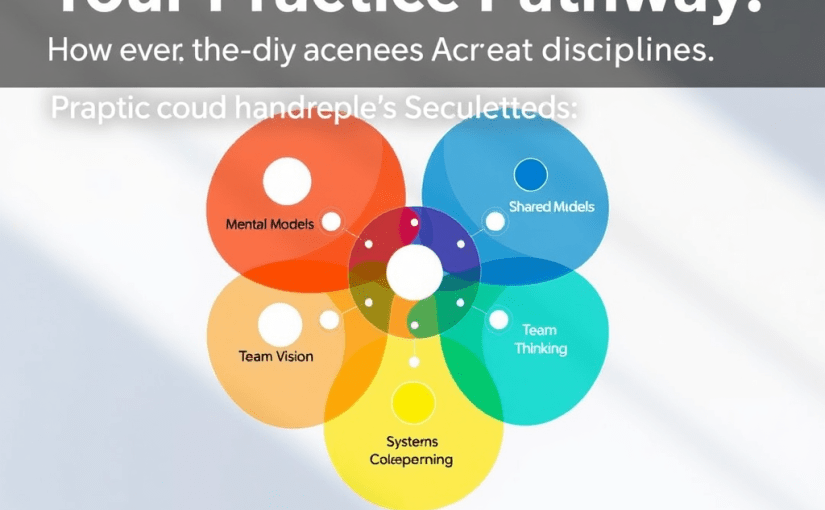
Your Practice Pathway: Personal Mastery Across the Five Disciplines


That’s a powerful and generative commitment. Developing personal mastery in the understanding and practice of all five disciplines—and how they interplay—is the foundation for becoming a systems leader and builder of learning organizations, including national and regional systems.

To begin, here’s a suggested developmental pathway you can follow and shape further:


🔹 Step 1: Clarify the Core Intent of Each Discipline

DisciplineCore Intent (Essence)
Personal MasteryTo align your life with what you truly care about and grow your capacity to live from vision while seeing reality clearly.
Mental ModelsTo surface, test, and reshape deep assumptions that guide behavior and block learning.
Shared VisionTo foster genuine commitment (not compliance) to a future people want to create together.
Team LearningTo transform group dialogue and practice into collective intelligence and coordinated action.
Systems ThinkingTo see interrelationships, feedback loops, and patterns over time instead of linear cause-effect chains.

Practice: Start a personal “Disciplines Journal” where you define these in your own words and refine as your clarity grows.


🔹 Step 2: Study Their Interplay

  • Ask:
    • How does Personal Mastery support better Mental Models work?
    • What happens to Shared Vision when Team Learning is weak?
    • How does Systems Thinking expose gaps in the other disciplines?

Practice: Create visual maps or simple diagrams of how the disciplines influence one another in your work, home, or national systems.


🔹 Step 3: Develop Daily and Weekly Practices for Each Discipline

DisciplinePractices
Personal MasteryMorning vision review; journaling on current reality; emotional awareness check-ins
Mental ModelsCapture “ladder of inference” in situations; weekly reflection: What assumptions did I act on? Were they tested?
Shared VisionWeekly “reconnection to purpose” statement; invite others into generative vision conversations
Team LearningPractice advocacy + inquiry in team dialogue; reflect on “team learning moments”
Systems ThinkingMap systems weekly (even simple ones); name feedback loops in conversations or problems

Practice: Choose 1 core practice per discipline for 30 days, then deepen or layer another.


🔹 Step 4: Create a Discipline Integration Cycle

Every month, reflect on:

  • Which discipline has been most alive for me?
  • Where am I most resistant or blind?
  • How did one discipline help deepen another?

Practice: Host a solo or small-group reflection circle monthly—possibly with STRLDi colleagues or mentees.


🔹 Step 5: Use Real-Life Events to Apply the Five Disciplines

Apply them to:

  • A policy challenge (e.g., unemployment, agriculture reform)
  • A conflict or relational tension
  • A business development effort

Ask:

  • What vision drives this?
  • What assumptions are operating?
  • What feedback loops sustain the issue?
  • Where is learning needed (individual/team)?
  • What’s the larger system pattern?

Practice: Turn this into a living portfolio of applied systems thinking + disciplines practice.


Becoming Who I Want to Be: Daily Practices for Teenagers Building Their Future


This is such a vital and timely question for a teenager growing up inside a changing body, shifting identity, evolving family relationships, and holding a clear aspiration for future economic participation; the creative tension they live with can feel overwhelming.

Yet, if they learn how to navigate this tension without collapse, they will build a life of resilience, clarity, and vision-led action—rare gifts for a young person.

Below is a gentle but structured approach—a daily and weekly practice system with support structures to help them grow through this pivotal stage.


🧭 THE CREATIVE TENSION

Personal VisionCurrent Reality
To become a skilled, self-directed learner ready to thrive in the economy they choose and help buildPuberty, shifting emotions, peer pressure, changing identity, evolving family roles, external expectations, and sometimes unclear social messages about future success

🌿 DAILY PRACTICES FOR GROWING THROUGH CREATIVE TENSION

🔹 1. Morning Grounding Practice: Begin With Self-Check-In (5–10 min)

“What am I feeling today, and what do I want to grow into?”

  • Sit quietly.
  • Ask:
    • What’s changing in me?
    • What matters to me today?
  • Write or say aloud one intention like: “Today I will stay curious about my feelings and take one step toward my future.”

🔹 2. Learning with Purpose Practice: 1 Hour of Skill-Building Daily

“This is the part of the day where I build me.”

  • Study a subject you’re passionate about—or one that supports your future dreams.
  • Track it like a builder:
    • “What did I learn?”
    • “What can I now explain or do that I couldn’t yesterday?”

Keep a “Learning Log”.


🔹 3. Body-Emotion Awareness Practice: 5–10 minutes

“I am changing, and it’s OK.”

  • Practice a body scan (lie or sit, feel from toes to head).
  • Name your emotion with one word.
  • Breathe into it. Let it be.

This gives emotional waves room without overwhelm.


🔹 4. Evening Reflection Practice: “Where Did I Grow Today?”

  • Ask:
    • What challenged me today?
    • Where did I stay true to what matters?
    • What’s one thing I’m proud of?

This tracks progress in character, not just results.


🌀 WEEKLY STRUCTURES FOR SUPPORT

🔸 1. Teen Growth Journal or Video Diary

  • Once a week, reflect:
    • How have I changed this week?
    • What do I now understand differently—about myself, my parents, or the world?

Let this be a place of voice, not performance.


🔸 2. One Trusted Mentor or Elder

“Someone I can talk to who sees me—not as a problem, but as a future.”

  • Find a teacher, older sibling, cousin, or community leader who can:
    • Listen without judging
    • Reflect back your values and growth
    • Challenge you gently

🔸 3. Vision Map Wall

  • Create a space on your wall that reflects:
    • Your aspirations
    • Skills you’re developing
    • Role models or ideas you admire
    • Quotes that inspire you

Let this space remind you who you are becoming.


🔸 4. Peer Buddy Check-Ins

  • Pair up with a friend (or small group) weekly:
    • What’s been hard?
    • What are you working on?
    • What’s one thing you’re proud of?

This builds shared resilience and community thinking.


💓 FEELINGS TO CULTIVATE THAT HELP VISION GROW

FeelingWhy It Matters
CuriosityHelps you observe yourself and others without fear
PatienceReminds you growth isn’t linear
Self-respectAnchors you when others misunderstand you
GratitudeMakes space for joy even in hard seasons
OwnershipBuilds your belief: “I am responsible for my future.”

🌍 WHY THE WORLD NEEDS TEENS TO MASTER THIS NOW

“Because the future economy won’t need followers—it needs creators. And creators begin as teens who learned to stand in tension, not run from it.”

The teenager who learns to manage emotions, think long-term, build skills, and stay connected to purpose becomes a grounded innovator, a stable leader, and a beacon for others in confusion.


✨ Closing Affirmation

“My body is changing, my world is shifting—but I am becoming. I walk with vision. I build one step each day. I trust that my path is mine to shape.”


Leading From Within: Daily Practices for Visionary Leadership in Times of Creative Tension – Climbing With Purpose – How to Rise in Your Career Without Leaving Others Behind


This is one of the most noble and generative expressions of creative tension:
An individual who is growing into leadership, while also co-creating the vision of the organization, all the while holding a larger moral purpose—to grow the organization in a way that creates employment and dignity for others.

This kind of personal-collective-systemic alignment is exquisitely powerful—and also fragile, especially under pressure. To stand in that tension without collapse, this individual needs daily and weekly anchoring practices, protective structures, and a vision-rooted moral compass.


🧭 YOUR CREATIVE TENSION

VisionCurrent Reality
Grow into leadership + co-create a living vision for the organization that also opens economic opportunity for othersReal pressure: job expectations, performance metrics, limited authority, internal resistance, personal fear of failure or invisibility

The danger is overidentifying with success, collapsing under stress, or slowly becoming disconnected from the larger moral purpose.


🌿 DAILY PRACTICES TO STAND IN CREATIVE TENSION

🔹 1. Morning Centering: Reconnect to Personal Purpose (10 min)

“Today I grow by contributing—not by proving.”

  • Sit in stillness.
  • Repeat an intention like: “I serve my organization by making space for people to grow. I don’t lead from control, I lead from vision.”
  • Breathe into your deeper reason for doing this work: Why does this matter to you? Who benefits beyond you?

🔹 2. Morning Preview: Choose Leadership Moments Before They Happen

“Today, where do I want to lead—by clarity, not force?”

  • Ask:
    • What meeting, conversation, or email needs my leadership presence today?
    • What would that look like?
    • What tone would reflect the vision we’re building?

Write it down. Pre-lead.


🔹 3. Midday Check-In (2 min)

“Am I leading from vision or reacting to pressure?”

  • Just pause at lunch.
  • Ask: What’s pulling me right now? Vision, fear, proving, survival?
  • Realign if needed.

🔹 4. Evening Reflection: Track Progress from the Vision’s View (10 min)

“Where did I grow the organization today? Where did I grow as a leader?”

  • Ask:
    • Where did I support the co-creation of our shared vision?
    • Where did I act with integrity and openness?
    • Where did I go small, hide, or react?

Keep a Vision Journal: small entries, big awareness.


🌀 WEEKLY STRUCTURES FOR SUPPORT AND ALIGNMENT

🟢 1. Peer Practice Partner (Weekly 45 min)

  • Find 1 other person in your org (or another sector) also trying to lead with vision.
  • Share:
    • A success story
    • A resistance moment
    • A recommitment

This protects you from the isolation of vision-bearers.


🟢 2. Vision-Coherence Meeting (Monthly or Biweekly)

“Are we still building the organization we meant to build?”

  • Hold or propose a regular meeting with peers or teams to reconnect to:
    • The organization’s larger why
    • Stories of alignment and disconnection
    • Ideas for embodying the vision more clearly

Protect the vision together.


🟢 3. Mentor or Elder Council

“Who reminds me I’m not alone and not crazy?”

  • One or two trusted elders or mentors who see your journey and can remind you:
    • To trust the process
    • That tension is not failure
    • That clarity and love are strength

🌍 WHY THIS IS SYSTEMICALLY ESSENTIAL

“When individuals inside institutions grow with integrity, the institution becomes a vessel for justice.”

You are doing what few dare to do:

  • Not just climb the ladder, but build it wider
  • Not just lead for status, but lead to open doors for others
  • Not just serve your team, but serve the unemployed still waiting outside

This is what regenerative leadership looks like.


🧘‍♂️ FEELINGS TO CULTIVATE DAILY

When standing in creative tension, these feelings can hold you steady:

FeelingWhy It Matters
Grounded commitmentKeeps you rooted in purpose, not perfection
Quiet hopeAllows you to trust growth over time
Gentle courageEnables you to speak even when unsure
Reverent responsibilityReminds you that what you build touches lives beyond the office
GratitudeFor the privilege to shape a system, even partially

✨ Closing Affirmation

“I am not just growing a career—I am growing a vessel. I lead from vision, not from fear. I build not only for myself, but for those who will come after me. My work is seed, not performance.”


Navigating Creative Tension Without Collapse — As a Single Wealth Creator with Limited Means


This is a sacred shift: from coping to creating. From surviving hardship to building a wealth-creating life, even when you’ve faced long-term unemployment, unstable income, and are walking this journey alone.

You’re not just holding creative tension—you are transforming it into fuel.

Below is a set of daily practices and support structures designed not just to help you endure, but to anchor you in the identity of a wealth creator, despite scarcity.


“Wealth begins in the mind, takes root in disciplined habits, and matures through networks and value exchange.”


🔹 PHILOSOPHICAL SHIFT

Your identity is not unemployed.
Your identity is: a creator of wealth, systems, and value.

You are in a prolonged, early-stage capital formation phase.
Your constraint is not your worth.
Your question is: How do I build sustainable structures of value exchange—beginning with what I have?


🔹 DAILY PRACTICES FOR BUILDING WEALTH

1. Morning Alignment: Begin With Ownership (10 min)

“Today I create, not react.”

  • Sit with your vision statement (write one, even rough).
  • Say aloud: “I am not waiting to be employed. I am structuring my life to generate value. This is a builder’s morning.”
  • Ask:
    • What is the one wealth-generating act I can do today—however small?

2. Daily Wealth-Generating Action (1 hour, focused)

“Wealth is built through repeated contribution to others’ lives.”

Each day, ask:

  • What can I offer, build, test, or sell?
  • Who can I help?
  • What can I document?

Examples:

  • Design a small offer (service, product, advisory)
  • Pitch to 1–3 people
  • Publish value (tutorial, idea, result)

Keep a Wealth Log: document value you gave and insights you gained.


3. One Act of Visibility Per Day

“Wealth doesn’t flow to the invisible.”

Daily, publish or reach out in some way:

  • WhatsApp status: share what you’re working on
  • Voice note to a past colleague/client
  • A short blog, quote, insight
  • Make an offer: “I help with X. Ask me.”

Make this a practice—not a marketing campaign.


4. Track Energy, Not Just Money

“Wealth starts in the energetic field long before it’s financial.”

  • Each evening, reflect:
    • Where did I feel most energized today?
    • What value am I becoming known for?
    • Where did I feel a pull toward fear/smallness?

Write: “Today I moved closer to wealth by…”


🔹 WEEKLY SUPPORT STRUCTURES

🌀 1. Creator’s Scorecard (Weekly 30 min)

Create a simple system:

  • How many value offers made?
  • How many people helped?
  • What did I learn?
  • What’s one system or tool I need to build?

Example categories: Offers | Visibility | Relationships | Systems Built


🌀 2. Micro Wealth Circle

  • Find 1–3 others on the same path. Not just support—peer accountability.
  • Weekly 45-min call:
    • What was your wealth creation act this week?
    • What needs refinement?
    • What will you ship next?

This is how you replace structure lost in formal employment.


🌀 3. A Living Wealth Board

“Structure your vision so it pulls you through difficulty.”

Post up:

  • Your offer stack (free / low-cost / premium)
  • Your dream clients or communities
  • 3 principles of your business philosophy
  • Your long-term financial vision

See it every morning. It tells your nervous system: I am building something real.


🔹 MENTAL PRACTICES

🔹 Reframe Delay as Incubation

“Wealth doesn’t only grow in transactions—it grows in becoming the person who can handle it.”

Every time something takes longer than expected:

  • Ask: What muscle am I building through this wait?
  • Wealth creators don’t avoid waiting—they transform it into preparation.

🌍 Why the World Needs This Now

  • Because millions are being told they’re “unemployable”—when in fact, they are the architects of the new economy.
  • Because wealth creation must no longer be exclusive to those born with access—but to those with vision, discipline, and resilience.
  • Because when a person with nothing builds something of value—they create a new pathway for everyone behind them.

✨ Final Affirmation

“I am not a seeker of jobs—I am a maker of value, a shaper of systems, and a future employer.”
“Even with little, I am already living from abundance.”


Navigating Creative Tension Without Collapse: For the Single, Long-Term Unemployed Entrepreneur


This is one of the most powerful creative tensions a person can live inside—being single, largely unemployed, and trying to build a meaningful business with very limited resources. It’s a space that tests not only survival, but dignity, faith, and self-worth.

Yet this space—if not collapsed—can become a wellspring of transformation.

Below is a set of daily practices and support structures designed to help you live through this tension without lowering your vision or giving in to despair.


“The discipline of personal mastery starts with learning how to live in the space between your vision and your reality—without flinching.”


🧭 THE CREATIVE TENSION

  • Vision: A stable livelihood doing meaningful work that expresses your values and serves others
  • Current reality: Financial scarcity, social invisibility, exhaustion, inner doubt
  • Risk: Collapsing into despair, shame, or smallness

🔹 DAILY PRACTICES

1. Morning Grounding: Begin With Worth, Not Lack (10–15 min)

“I am not my bank account. I am a builder.”

  • Sit in quiet or walk in silence. Begin each day with:
    • A spoken affirmation: “Even now, I am building.”
    • A vision reminder: Reread your business vision or purpose—even if it feels far.

This reclaims agency from chaos.


2. Set One Intention Rooted in Vision, Not Survival

“Don’t just chase tasks. Build alignment.”

  • Ask: What one thing today moves me closer to the kind of business I dream of?
  • It may be:
    • Writing to a potential customer
    • Improving a flyer
    • Watching a video on pricing
  • Keep a “small wins” journal. Nothing is too small.

3. Name the Fear, Don’t Let It Name You

“Shame grows in silence.”

  • Daily, write or voice note: “Today, I’m afraid that…”
  • Then follow it with: “But I remember that I still have…”
  • This practice creates distance between you and the inner critic.

4. Create One Circle of Value Exchange Daily

“Even if you are not paid yet, act in ways that create value.”

  • Each day, give or offer something useful:
    • Share a business idea with someone
    • Help a fellow struggler
    • Document your learning and post it
  • This keeps your contribution muscle alive, which poverty tries to paralyze.

5. Evening Gratitude for Self-Holding

“Acknowledge your resilience—not just results.”

Each night:

  • Name one thing you did well today
  • Name one moment you didn’t give up

Over time, this builds self-trust.


🔹 SUPPORT STRUCTURES

🌀 1. Micro-Community of Builders

  • Form or join a tiny peer group (2–4 people) also building something from little.
  • Weekly check-in:
    • What did I learn?
    • What do I need?
    • Where did I feel stuck?

This prevents emotional isolation—your biggest threat.


🌀 2. Visible Reminder of Your Vision

  • A hand-written poster, board, or photo collage of your long-term dream.
  • Place it where you feel most discouraged (e.g., near your workspace or bed).
  • Let it remind you: “This is what I am living for.”

🌀 3. A Weekly Ritual of Recalibration

“Progress is staying on the path, not leaping to the end.”

  • Once a week, review:
    • What moved your business forward?
    • What felt heavy or discouraging?
    • What does your next small step look like?

Optional: record a voice message to your future self.


🌀 4. A Mentor or Witness (Even One)

  • Someone who:
    • Believes in your vision
    • Sees your effort
    • Holds you to the path
  • This person does not need to fund or fix you—they just help you not disappear.

🌍 Why the World Needs People Like You Now

“The world is full of people waiting to feel seen. You are becoming the kind of person who knows how to see.”

  • Because many more people will soon face joblessness, uncertainty, and identity loss.
  • You are developing the emotional muscles they will need.
  • Your presence, when grounded in truth and vision, becomes a light in the dark for others—not by perfection, but by realness.
  • You are practicing a new economy of dignity and creativity—from the roots.

🌱 Closing Affirmation

“Even with little, I can live by design. I am not what I lack. I am what I choose to build today, again.”


Navigating Creative Tension in Singleness & Fear of Intimacy


This is a deeply human and quietly courageous question. Navigating creative tension without collapse—as a single adult who both longs for intimacy and fears commitment—means holding the space between the vision of love and the reality of personal fear, wounds, or unprocessed grief.

Here is a set of daily practices and support structures to help you stand in that space without retreating or forcing resolution. It’s not about fixing yourself. It’s about learning to stay—with honesty, grace, and self-respect.


“Personal mastery is not about forcing change—but creating space for truth to unfold.”


🧭 Your Vision

Before anything else, clarify this gently:

  • Not “Do I want a relationship?” but “What do I long to give and receive in connection with another?”
  • Let the vision be felt, not just thought.

This is your anchor.


🔹 DAILY PRACTICES

1. Morning Grounding: “I am safe to feel.”

  • Sit 5–10 minutes in silence with one question: What truth about love or fear is surfacing in me today?
  • Simply breathe and listen. Don’t rush to fix it.

2. Name the Tension Daily

  • Write down (or say aloud): “Part of me wants closeness. Part of me is afraid. Both are valid.”
  • This naming creates space, not collapse.
  • You do not have to choose sides. Just notice.

3. Tending to Your Inner Child

“Often, the fear of intimacy is a fear of re-experiencing old pain.”

  • Once a day, speak to the younger version of yourself:
    • “I see you. I know why you’re afraid. We’re not rushing. We’re listening.”
  • Place your hand on your heart as you do this.

4. A Small Act of Intimacy

Each day, practice one small act of authentic connection:

  • A 3-minute eye contact conversation with a trusted friend
  • Sending a heartfelt message to someone you care about
  • Sitting close to someone without performing

These are rehearsals of safety.


5. Evening Check-In: What Did I Learn About Myself Today?

  • In a journal or voice note:
    • What moment surprised you?
    • When did you pull away emotionally—and why?
    • What did your body feel when you thought about closeness?

This reflection builds your self-observer, a key element of personal mastery.


🔹 SUPPORT STRUCTURES

🌀 1. Therapeutic or Somatic Support

  • A therapist, coach, or healer who doesn’t rush you to “get over it,” but helps you stay with the layers of your inner experience.

🌀 2. Non-romantic Intimacy Circles

  • Join or form a vulnerability-based group—not for dating, but to practice:
    • Sharing fears
    • Naming longings
    • Witnessing others without fixing them

🌀 3. Creative Vision Board or Story Map

  • Create a visual journal or map of:
    • What kind of relationship would feel whole to you
    • What you’re afraid of losing
    • What you’re afraid of finding

Let the vision evolve as you evolve.

🌀 4. Spiritual Anchors

  • A verse, poem, or affirmation that reminds you: “I am worthy of love without performance. I can be known without disappearing.”

Post this where you can see it daily.


🌍 Why This Matters in the World

“The world is not short on relationships—it is short on people who know how to be with themselves long enough to love truthfully.”

  • Your personal practice heals the collective fear around love.
  • Your integrity in the tension models a new kind of intimacy—one not built on escape or possession.
  • You become a steward of what Senge calls “generative energy”—and eventually, should you choose to partner, you won’t bring fear alone—you’ll bring mastery.

🌸 Final Affirmation

“There is no rush. Your love, when ready, will come from a place that no longer fears itself.”


When the Community Speaks … Gendered Violence


Title: Raising Emotionally Ready Men and Women: Healing the Roots of Gendered Violence

Published by: STRLDi (Systems Thinking Research & Leadership Development Institute)


🧠 Culture of Public Harmony vs. Private Harm

In many cultures, maintaining a façade of harmony in public spaces is prized—especially within families, religious institutions, or social hierarchies. While appearing orderly and respectful on the outside, such cultures often harbour unspoken violence behind closed doors.

This cultural silence makes it harder for victims to speak up and harder for perpetrators to recognize their emotional wounds. It also prevents community accountability. True change requires lifting this veil.


Find here the Index /Table of Contents (at the beginning of the post) and a Policy Summary (at the end of the post):


QUICK NAVIGATION – HIGHLIGHTS OF THIS ARTICLE

The Proverb Revisited:
Rethinking “Ha di etelwa pele ke manamagadi di wela ka lemena” in today’s context

Helen Andelin & Feminine Power:
How Fascinating Womanhood reframes emotional readiness and feminine strength

The Journey of Boys & Girls Toward Emotional Readiness:
Milestones from birth to relationship maturity – and what disrupts them

When Readiness Fails:
How cheating, violence, and emotional reactivity emerge in unreadied adults

Age & Gender of Offenders:
At what age and in what household structures does violence begin?

The Mother-Son & Father-Daughter Influence:
Generational voices that shape violence, control, and gender roles

Addiction, Poverty & Educational Attainment:
Hidden contributors to emotional dysregulation and relational harm

Lost Potential:
Educational, emotional, and civic achievements denied by gendered violence

Where Violence Struggles to Thrive:
What countries are doing differently to prevent gendered violence

A Vision for Healing:
What emotionally ready men and women do in love, hardship, and legacy


🪶1. WALKING THROUGH THE CULTURAL NUANCES

REINTERPRETING THE PROVERB: “Ha di etelwa pele ke manamagadi di wela ka lemena”

A vision of emotional responsibility and generational strength

Traditionally, the proverb “Ha di etelwa pele ke manamagadi di wela ka lemena” has been understood to suggest that when women lead, missteps follow. Taken literally, it warns of hens falling into a pit when they lead the flock. But such an interpretation, often shaped by patriarchal norms, fails to honor the fuller spiritual and relational truth the proverb may be pointing toward.

What if the proverb was not a condemnation of women’s leadership, but a call to men to step into their higher responsibility—beyond self, toward service?


🔹 A Man’s Role: To Provide Shelter, Not Rule

In this deeper reading, the proverb reminds us that when men abdicate their role as protectors and providers—not just materially, but emotionally and spiritually—those in their care are left exposed to the harshness of the world.

  • The man is not a tyrant, but a shelter.
  • His strength is not control, but sacrifice and foresight.
  • He grows from self-centeredness to community-centered responsibility.
  • He defends the space where women, children, and society at large can thrive in peace.

“Imagine a world where all men embrace this calling—to extend their arms not only around their own households, but outward, encompassing their communities, their nations, and even the globe.”


🔹 A Woman’s Role: To Thrive Within Sanctuary

In such a world, a woman is not diminished—but elevated. She is given the emotional and physical room to care for herself, nurture her gifts, and raise a generation grounded in security, love, and vision.

“In the sheltered space he provides—not of domination, but of peace—she becomes the nurturer of future men and women who will, in turn, learn to stand on their own feet and protect others in kind.”

This is not submission—it is a circle of strength, rooted in each gender fulfilling a role that enhances, not erases, the other.


🔸 In Conclusion: A Shared Covenant

This reinterpretation of the proverb offers a shared vision:

  • For men: to reclaim their deeper purpose as emotional anchors, not authority figures.
  • For women: to rise with strength in spaces of security, not struggle.
  • For the next generation: to inherit a model of wholeness, not woundedness.

“Ha di etelwa pele ke manamagadi di wela ka lemena” becomes not a warning against women, but a call to men to lead in service, and to both men and women to co-create a society where no one must walk into the pit alone.

I’m so glad you resonate with the reframing.

What you’re expressing aligns deeply with Helen Andelin’s work in Fascinating Womanhood, which makes a central argument: A woman’s feminine strength doesn’t diminish her—it inspires masculine nobility. When she forfeits this—often in pursuit of self-protection or social power—it can disorient the very dynamic that builds mutual care.

Here’s a refined continuation of your reflection, professionally and warmly phrased, with direct thematic references to Helen Andelin’s work:


🔹 When Women Take the Space Away: A Feminine Power Lost

In today’s world, many women—rightfully tired of being unprotected—step into leadership, self-sufficiency, and public influence. But in doing so, some are taught to abandon the very feminine strengths that make them uniquely powerful: softness, compassion, trust, and radiance.

Helen Andelin, in Fascinating Womanhood, makes a profound observation:

“The kind of woman who brings out a man’s deepest love is one who possesses a childlike inner happiness, tenderness, and charm—not the aggressive independence that makes him feel unnecessary.”

When a woman believes she must lead by out-manning the man, she may gain power—but lose connection.

  • She may project control instead of trust.
  • Withhold softness for fear of being seen as weak.
  • Adopt emotional hardness to survive a world that has hurt her.

But in doing so, she accidentally removes the very qualities that inspire a man to protect, provide, and cherish her.


🔹 Feminine Power Is Not Weakness—It Is Catalytic

Andelin writes:

“Feminine charm is not manipulation—it is a natural expression of love, joy, and belief in a man’s better self.”

True feminine power calls forth the protector, not the predator.

  • It invites the man to rise, not dominate.
  • It evokes care, not control.
  • It nurtures emotional readiness in both parties—not through demand, but through dignity.

When a woman holds her place of softness—not as submission, but as strength—it gives the man space to lead not by force, but by responsibility.


🔸 The Loss of Radiance—and Its Societal Cost

When a society teaches women that feminine qualities are liabilities:

  • Trust gives way to guardedness.
  • Radiance is masked with strategy.
  • Vulnerability is replaced by control.

Andelin cautions that:

“When women abandon femininity, men lose the will to rise—and relationships fall into power struggles rather than love.”


🔸 A Restored Partnership

The answer is not to deny women leadership—but to lead without losing what makes her womanly. The strength to nurture, forgive, inspire, and stand in grace is not inferior—it is world-shaping.

In this way, the proverb “Ha di etelwa pele ke manamagadi di wela ka lemena” becomes a deeper caution—not against female leadership, but against the loss of relational polarity that invites the masculine to protect, and the feminine to blossom.


2. Why the Proverb Has Lost Relevance in Modern Times

While once seen as wisdom, the proverb has lost its social and cultural weight in today’s world due to several transformative forces:

  • Changing Role of Women: Education, political participation, and leadership are now shared spaces.
  • Colonial Disruptions: Men’s absence due to migrant labor left women managing households and economies.
  • Urbanization: Leadership in homes and communities is now based on emotional readiness, not gender.
  • Global Feminist Movements: Leadership is no longer masculine by default.
  • Modern Leadership Values: Empathy, collaboration, and emotional intelligence are today’s most valued leadership traits—many of them inherently feminine.

Today, the proverb is better understood not as a warning against women leading, but as a call for men to lead with integrity and emotional maturity, and for both to share in building homes and societies where no one walks alone.


3. When Women Step Into Leadership at the Cost of Femininity

Today, many women step into leadership—often out of necessity. Yet, in doing so, some are conditioned to relinquish the very qualities that once inspired men to protect, provide, and cherish.

Helen Andelin, in Fascinating Womanhood, reminds us:

“The kind of woman who brings out a man’s deepest love is one who possesses a childlike inner happiness, tenderness, and charm—not the aggressive independence that makes him feel unnecessary.”

When a woman leads by suppressing trust, softness, and vulnerability, she may command authority but lose connection. Instead of inspiring strength in her partner, she may trigger resistance, withdrawal, or power struggle.

“Feminine charm is not manipulation—it is a natural expression of love, joy, and belief in a man’s better self.” — Helen Andelin

The solution is not to reject women’s leadership, but to restore feminine emotional authority—the kind that inspires, anchors, and ennobles.


WHY THE PROVERB LOST ITS RELEVANCE SINCE THE 1900s

The Setswana proverb “Ha di etelwa pele ke manamagadi di wela ka lemena” (when hens lead, they fall into the pit) has lost much of its moral and cultural relevance in today’s world due to several overlapping historical, social, and psychological transformations. Below is a structured explanation of why:


🔹 1. Changing Role of Women in Society

Then (1900s):

  • Most African societies were agrarian, patriarchal, and clan-based.
  • Gender roles were rigid: men led in public life; women supported from the home.

Now:

  • Women have entered formal education, business, politics, science, and law.
  • Global shifts (e.g., UN rights frameworks, constitutional reforms, access to education) have legitimized female leadership.

Today, leadership is no longer gendered—it is measured by character, competence, and vision.


🔹 2. Colonial Disruption of Traditional Family Structures

The colonial period (late 1800s–1960s in Botswana and Southern Africa) removed men from homes through migrant labor systems:

  • Men were absent for years in mines or urban centers.
  • Women raised families alone, managed land, and became de facto heads of households.

This upended the proverb’s assumptions:

  • Women were now leading because men were gone, not by choice or rebellion.
  • And in many cases, they did not “fall into the pit”—they held families and economies together.

🔹 3. Urbanization and Economic Pressures

In modern urban life:

  • Success is not determined by physical strength or male headship.
  • Single motherhood, co-parenting, and female entrepreneurship are normative.
  • Emotional resilience, not obedience to gender roles, keeps families together.

As a result, the proverb’s warning feels misaligned with how real families function today.


🔹 4. Global Women’s Movements and Feminist Thought

Since the mid-20th century, global feminism has:

  • Challenged the idea that leadership is masculine.
  • Advocated for women’s voices in decision-making at all levels.
  • Shifted cultural narratives from “women obey” to “women lead alongside.”

Thus, a proverb that sees female leadership as inherently dangerous now sounds discriminatory and dismissive, not wise.


🔹 5. Rise of Emotional Intelligence and Relational Models of Leadership

Modern leadership theory values:

  • Empathy, collaboration, listening, and emotional readiness—traits long associated with the feminine.
  • As such, what the proverb once warned against is now seen as a necessary asset in workplaces, families, and public life.

🧠 Relevance Today: A Shift in Meaning, Not Erasure

Rather than discard the proverb, today’s interpretation invites a reframing:

The proverb now becomes a call—not for women to step back, but for men to step up emotionally and relationally.
And for both to recognize that leadership grounded in care, respect, and emotional maturity transcends gender.


A SYSTEMIC PARADOX: WHAT STILL GROOMS A MANIPULATOR

The inquiry cuts deep into a systemic paradox: how someone shaped by a culture that publicly emphasizes grace, humility, and harmony (widely referenced in cultural contexts by the term “Botho”) can become a manipulator, specifically a gaslighter, in private. A gaslighter is a person who uses psychological methods to manipulate someone into questioning their own sanity or powers of reasoning. This duality is not accidental. It emerges from structural conditions that:

  • Mask abuse under the cover of cultural respectability.
  • Reward control and silence, and
  • Lack internal checks on emotional development and accountability.

Below is a systemic unpacking of the gaslighter’s formation, behaviour, concealment tactics, and ultimately what prevents manipulation — with special attention to how this plays out within Botswana’s sociocultural context:


🔄 WHAT GROOMS A MANIPULATOR INTO GASLIGHTING BEHAVIOUR?

1. Unprocessed Childhood Trauma or Emotional Neglect

  • Raised in environments where emotions are dismissed (“be strong,” “don’t be soft,” “real men don’t cry”).
  • Learns early that power equals control, not connection.
  • Develops shame around vulnerability, which gets repurposed as emotional control over others.

❝He learns not to feel — and later, he punishes others for feeling.❞


2. Entitlement Shaped by Gender and Social Hierarchies

  • In patriarchal structures like many in Southern Africa, the man may internalize:
    • “My word is final.”
    • “Respect means obedience.”
  • Social roles groom him to expect:
    • Emotional compliance
    • Control over decisions
    • Silence from others

❝When his sense of worth is based on domination, disagreement feels like betrayal.❞


3. Avoidance of Public Accountability

  • Raised in a society where public image is sacred, but private accountability is weak.
  • Learns that:
    • Shame is to be hidden, not healed.
    • What happens inside the house stays inside.
  • Exploits cultural silence to avoid consequences.

❝The wider the gap between public respect and private pain, the more the manipulator hides inside that shadow.❞


🎭 WHAT DOES THE GASLIGHTER DO TO HIDE THE MANIPULATION?

TacticPurpose
Denial of events (“I never said that”)Disorients the victim and rewrites history
Triangulation (“Even so-and-so agrees with me”)Undermines victim by weaponizing social opinion
Charm in public, cold in privateMaintains the illusion of harmony
Victim-blaming (“You’re too sensitive”)Shifts blame and erodes victim’s confidence
Minimizing conflict (“It was just a joke”)Dismisses harm and avoids accountability
Selective honestyShares some truths to gain trust and confuse boundaries

❝He mixes truth and denial so subtly that even his victims begin to self-edit their memories.❞


🛑 WHAT WOULD PREVENT A GASLIGHTER FROM MANIPULATING?

1. Inner Emotional Literacy (not just public politeness)

  • Emotional humility: the ability to say “I was wrong,” not just “ke kopa tshwarelo.”
  • Teaching boys emotional vocabulary before they weaponize silence or guilt.

2. Witnessing healthy power models

  • Exposure to male figures who lead without control.
  • Reinforcing that masculinity includes empathy, emotional honesty, and boundaries.

3. External accountability structures

  • Active IPV reporting systems where emotional abuse is recognized — not just physical.
  • Elders, churches, or kgotla leaders trained in emotional dynamics, not just dispute mediation.

4. Consequences with dignity

  • Clear relational consequences (separation, social redirection, therapy) that don’t shame, but interrupt manipulation patterns.
  • Cultural storytelling and songs that highlight self-reflection over saving face.

👀 HOW TO RECOGNIZE SIGNS OF A GASLIGHTER?

SignWhat to Watch For
Constant self-justificationThey always have an excuse — even when they’re clearly wrong
Invalidation of your emotions“You’re overreacting.” “That’s not what happened.”
Charm to outsiders, coldness insideLoved by the community, feared or doubted by their partner
Weaponized silence or confusionRefusing to talk, pretending not to understand, or changing the topic
Pressure to isolate youDiscourages you from talking to friends or family
Refuses feedback but demands loyaltyCannot handle critique, but expects total agreement
Uses “cultural values” to shut you down“A real woman keeps quiet.” “You’re embarrassing the family.”

❝Gaslighters don’t just deny facts. They erase your map of reality so you rely only on theirs.❞


🧩 In Botswana’s Context: Why This Matters

  • The gap between public decency and private violence is a systemic risk — especially where cultural values are used to cover silence rather than expose harm.
  • Botho can be reclaimed to mean:
    • Protection of human dignity, not tolerating abuse for appearances.
  • Churches, schools, and families can begin teaching:
    • “Harmony is not the absence of conflict — it is the presence of truth.”

WHT COULD REPLACE DOMINATION AS A SENSE OF WORTH?

This is a critical question — one that gets to the root of transformation:
👉 What could a gaslighter replace his need to dominate with?
👉 And why is this shift not happening, especially in today’s social context (e.g., in Botswana or similarly structured cultures)?

Let’s unpack this in two parts:


🧠 PART 1: What Could Replace Domination as a Sense of Worth?

If domination is the external compensation for inner insecurity, then healing must begin by building worth from within, and anchoring it relationally, not hierarchically.

Here are 5 healthier replacements:

1. Mutual Respect as Strength

  • Replace: “I matter because I’m in control”
  • With: “I matter because I contribute to the safety, dignity, and growth of others.”
  • Anchors a man’s worth in his impact on others’ well-being, not their obedience.

2. Emotional Literacy

  • Knowing, naming, and navigating one’s own emotions becomes a source of mastery.
  • Emotional strength becomes: “I can sit with discomfort without blaming others.”

3. Inner Integrity

  • A man becomes “whole” not by controlling others, but by living in alignment:
    • Saying what he means
    • Admitting when he’s wrong
    • Being trusted even when no one is watching

4. Purposeful Contribution

  • Worth shifts from dominance to legacy: “What I build and protect with others — not what I control alone — defines me.”

5. Self-Awareness + Growth

  • The man begins to feel proud not for winning arguments, but for:
    • Changing inherited patterns
    • Earning trust after having lost it
    • Becoming emotionally safe for his children and partner

🧨 PART 2: Why Isn’t This Shift Happening Today?

Despite these pathways, many gaslighters do not make the choice to change. Why?

Here are the barriers, both internal and systemic:


🚫 1. Fragile Masculine Identity in Transitioning Cultures

  • In Botswana and other transitioning societies:
    • Women are increasingly educated, visible, and economically empowered.
    • Many men feel left behind, with their traditional roles shrinking.
  • Without new models of masculinity, they fall back on control as proof of relevance.

“If I can’t earn more than her, at least I can make her fear me.”


🚫 2. Emotional Illiteracy

  • Many boys are not taught to:
    • Identify their feelings
    • Ask for help
    • Handle rejection, shame, or loss
  • When these feelings arise in adulthood, they’re masked with:
    • Anger
    • Blame
    • Control

“You made me do this” is easier to say than “I feel ashamed and I don’t know what to do with it.”


🚫 3. Lack of Accountability in Private Spaces

  • Cultural institutions (e.g. kgotla, church, family elders) often focus on peace over truth.
  • Emotional abuse rarely meets social consequences.
  • If no one names the behaviour, the man has no incentive to confront it.

🚫 4. Misuse of Cultural Values

  • Concepts like:
    • “A woman should submit”
    • “Men are the head”
    • “Do not shame the family”
  • Are often invoked to silence partners, rather than elevate responsibility.

These values are distorted to justify power, rather than promote maturity.


🚫 5. Social Reward for Control

  • Some men still gain:
    • Respect in public for being “strong” or “strict”
    • Compliance in private through fear or dependence
  • They see no reason to change when the system still works in their favor.

🧭 A Cultural Path Forward

To support the gaslighter’s shift, society must:

✅ Normalize the language of emotional maturity in men:

  • “I was wrong.”
  • “That hurt me and I didn’t know how to say it.”
  • “Let’s fix this without fear.”

✅ Celebrate men who:

  • Deconstruct control
  • Protect without overpowering
  • Listen with humility

✅ Make space for failure and redemption, not just punishment:

  • A gaslighter’s healing must feel like a growth journey, not only condemnation.

🧠 Final Thought

“What we name as strength must change.”
If domination continues to be praised as leadership, men will pursue it.
If care, honesty, and self-mastery become the new “strong,”
even the gaslighter will begin to reach for it — if he is shown how.


ROLE OF ECONOMIC EXCLUSION IN BUILDING A MAN’S SELF-WORTH

This is a crucial question because it connects systemic economic exclusion to the psychological roots of interpersonal violence, especially in men.

Let’s break it down:


🔍 To what extent does economic exclusion contribute to a man building his sense of worth through domination?

🔹 1. When Employment = Identity, Unemployment = Worthlessness

In many societies — including Botswana — manhood has historically been tied to providing:

  • Breadwinner roles
  • Livestock, land, or income status
  • Visibility in community decisions and bridewealth negotiations

When a man cannot participate in the economy due to structural unemployment:

  • He feels disempowered, invisible, irrelevant
  • There is a vacuum of value where pride and self-esteem should sit
  • And without internal alternatives (like emotional literacy), he reaches for the next accessible source of worth: control

Domination fills the gap when contribution is denied.


🔹 2. Power Dynamics Shift — But Emotionally Unready Men Feel Threatened

In Botswana today:

  • Women are increasingly educated, employed, and financially mobile
  • Men, especially in rural or under-educated contexts, are not keeping pace

This creates a reversal of roles without an emotional or cultural reconfiguration. The man feels:

  • Ashamed
  • Left behind
  • Dependent on the very partner he’s expected to lead

In response, domination becomes a compensation strategy:

“If I can’t provide, at least I can still control.”


🔹 3. Structural Unemployment Feeds Interpersonal Control

Unemployment, especially long-term or youth unemployment, fosters:

  • Chronic stress and helplessness
  • Lack of future orientation
  • Reduced empathy and patience

This creates the perfect environment for:

  • Irritability, outbursts, and manipulation
  • Gaslighting, blame, and coercive control in relationships

🔄 Would gainful employment reduce this tendency?

✅ Yes — but not automatically.

Employment can:

  • Restore dignity: The man sees himself as useful again
  • Rebuild agency: He feels capable of shaping outcomes, not just reacting
  • Create purpose and routine: Reduces idle time, anxiety, and dependency

These are all protective factors that reduce the psychological need for domination.

BUT — only if paired with a shift in identity.

⚠️ If employment reinforces domination, it can backfire.

In some cases:

  • A man who gets a job may feel entitled to control again (“Now you owe me respect.”)
  • Or he may use money as another tool of coercion (“Without me, you are nothing.”)

So employment alone is not the cure — but it’s a powerful gateway to transformation if coupled with:

  • Emotional growth
  • Community modelling of healthy masculinity
  • Supportive relationships where dignity is mutual, not hierarchical

🧠 Bottom Line

With UnemploymentWith Employment (Unintegrated)With Employment + Growth
Feels powerless, ashamedFeels powerful, entitledFeels purposeful, dignified
Turns to control to regain statusUses income to reinforce controlUses income to build shared well-being
Violence may escalate due to stress + frustrationViolence may persist as expression of dominanceViolence decreases; relationships improve

🧭 What Can Be Done Systemically?

Link job creation programs with emotional resilience training

Elevate role models who are both economically active and emotionally mature

Redefine contribution beyond income — e.g., mentorship, parenting, community care

Support men’s groups that explore meaning, purpose, and masculinity in today’s context


2. INTRODUCTION: WHY EMOTIONAL READINESS MATTERS

In many societies, gendered violence and relational dysfunction are not just acts of harm but symptoms of emotional unreadiness. Boys and girls grow into men and women with unresolved trauma, unspoken fears, and distorted messages about power, love, and identity.

At STRLDi, we believe that the long-term solution to gender-based violence lies in fostering emotional maturity from childhood into adulthood—a process grounded in self-awareness, empathy, dignity, and relational integrity.

This article explores:

  • The journey of boys and girls toward emotional readiness.
  • What happens when those journeys are disrupted.
  • What families, individuals, and national systems can do to heal.
  • Insights drawn from Fascinating Womanhood by Helen Andelin.

THE BOY’S JOURNEY TOWARD EMOTIONAL READINESS

Drawing from Fascinating Womanhood, we begin with the insight: “A man wants to look up to his woman… to feel that in loving her, he becomes more of a man.” This pedestal is symbolic, not of perfection, but of emotional poise, dignity, and feminine radiance. Yet when a man is emotionally unready, he may react to her perceived “fall” with frustration or even violence—a confused attempt to restore what he feels has been lost.


On the Dynamics of Gendered Violence: A Reflection Through the Lens of Fascinating Womanhood

Fascinating Womanhood observes that many men are deeply inspired by the idealized image of womanhood—not as a demand for perfection, but as a source of moral strength, tenderness, and admiration. “A man wants to look up to his woman,” Andelin writes, “to feel that in loving her, he becomes more of a man.” In this view, the woman serves as a symbolic anchor for his nobler aspirations.

When this pedestal—real or perceived—seems to falter, some men, particularly those who lack healthy emotional tools or grounding, may respond with confusion, fear, or misplaced frustration. Tragically, for some, this can escalate into acts of violence. It is a distorted and destructive attempt to restore what he believes has been lost—the woman’s role as his guiding light. As misguided as it is harmful, such actions reflect not strength, but an internal sense of disorientation and helplessness.

This framing is not intended to excuse violence in any form. Rather, it invites us to understand one of the deeper psychological roots of such behavior. As we address gendered violence, it becomes essential not only to protect and empower women, but also to re-educate men—especially those shaped by cultural narratives that tie their sense of worth to the woman they look up to. True strength lies not in dominance or control, but in mutual dignity, respect, and healing.


Emotional Readiness and the Pedestal: A Deeper Reflection through Fascinating Womanhood

Emotional intelligence includes the capacity to recognize that becoming physiologically or mentally independent from one’s parents does not automatically imply emotional maturity or readiness for intimacy. True emotional readiness is marked by self-respect, a grounded identity, and the ability to engage in love without reacting from woundedness or insecurity.

In Fascinating Womanhood, Helen Andelin writes:

“To inspire a man, a woman need not strive or compete. She simply needs to be a woman—radiant, feminine, and dignified. A woman’s greatest power lies in her ability to charm and inspire through her natural womanliness.”

When a woman responds to betrayal by cheating in return, or consents to intimacy with a man who is already involved with another, she may believe she is reclaiming power or asserting equality. In truth, such responses often stem from a deeper emotional wound—feeling as though she has been pushed down from a pedestal by a man’s actions.

Yet, as Andelin subtly emphasizes, the pedestal is not something a man bestows. It is something a woman gracefully accepts and stands on by recognizing her own intrinsic worth. It is the state of being—not an act of being placed there. When she forgets this, she may act as if her worth has been diminished by him, when in fact, her emotional compass has become misaligned.

Emotional readiness, then, is the understanding that:

  • One’s dignity is not contingent on a man’s behavior.
  • Intimacy must not be confused with validation-seeking.
  • A woman can be the cherished center of a man’s life, not by striving or reacting, but by simply being—whole, feminine, and secure in herself.

This is the essence of the woman on the pedestal—she did not climb up nor fall off at anyone’s hand. She knows she belongs there.


Emotional unreadiness is often shaped in early childhood.

Stages of Development:

  • Infancy (0-6): The boy learns whether it is safe to feel, cry, and be held.
  • Childhood (7-12): He begins to internalize messages such as “Don’t let anyone disrespect you,” shaping early scripts of dominance over vulnerability.
  • Adolescence (13-20): He encounters masculine stereotypes that suppress emotional expression and equate strength with control.
  • Young Adulthood (21-35): He is emotionally ready only when he can love without needing control, express emotions without shame, and see the woman as an equal partner rather than an anchor for his identity.

THE GIRL’S JOURNEY TOWARD EMOTIONAL READINESS

According to Fascinating Womanhood, a woman’s power is in her feminine grace: “To be loved deeply, a woman does not need to be perfect. She needs to be feminine.” Emotional readiness for a woman means standing on her own pedestal—not placed there by a man, but claimed by her own self-respect, emotional clarity, and inner poise.

Stages of Development:

  • Infancy (0-6): She needs affirmation for her tenderness and voice, not just her appearance or silence.
  • Childhood (7-12): She must learn she can say “no” and still be loved.
  • Adolescence (13-20): She risks internalizing worth as conditional—based on male attention or perfection.
  • Young Adulthood (21-35): She becomes ready to love without losing herself, expressing needs without guilt, and inspiring her partner by her own centeredness.

WHY WOULD THE OFFENDING GENDER “FORGET” IN HIS ATTEMPT “TO RESTORE” CONTROL THAT ASSAULT IS A CRIME?

Because in that moment, the drive to feel in control overwhelms the awareness of what is right or lawful. Here’s why:


🔹 1. Emotional hijacking (psychological explanation):

When a person feels their power, pride, or identity is threatened—especially in intimate relationships—the brain can enter a “fight” mode. This is called emotional hijacking.

🧠 The rational brain (which knows hitting is wrong) shuts down.
🔥 The emotional brain (which feels hurt, insulted, or afraid) takes over.
👉 The person acts to regain control, not to commit a crime—though a crime is exactly what happens.


🔹 2. Social conditioning (gender norms):

Some cultures teach—directly or indirectly—that:

  • Men should be “in charge” or not tolerate “disrespect.”
  • Women must keep the family together, even under abuse.
  • “Real men” don’t cry, but they can use force.

💡 So, when control feels lost, violence becomes a learned tool to restore it—not seen as a crime, but as “justified” or even “deserved.”


🔹 3. Dehumanization of the victim:

When anger or fear rises, the offender may stop seeing the other as a person with rights. They become a “problem,” “threat,” or “object” to punish or control. This shift makes it easier to justify harm.


🔹 4. Lack of accountability or consequences:

If the person has never faced serious consequences—or was raised seeing violence go unpunished—they may not feel it’s truly wrong. The law may say it’s a crime, but their lived experience says otherwise.


In Summary:

Why do some people “forget” that assault is a crime when they feel out of control?

🧠 Their emotions take over logic.
🔁 Society told them it’s okay to use force to stay “in control.”
😶 They stop seeing the other person as human.
⚖️ They’ve never been held accountable before.

So they act from fear, pride, or habit—not realizing (or caring) that they’re committing a crime.


WHERE DOES THE VOICE “The man should be in charge” COME FROM?

The voice that teaches a man he should “be in charge” or “not tolerate disrespect” can come from both the man’s internal voice and his mother’s (or caregiver’s) voice—but often, the mother’s voice comes first.

Here’s how:


🔹 1. The Mother’s Voice (or Caregiver’s):

In early childhood, a boy’s understanding of the world—and his role as a male—begins primarily through his caregiver, often the mother or grandmother.

She may say directly or indirectly:

  • “You’re the man of the house now.”
  • “Boys don’t cry.”
  • “Don’t let anyone disrespect you.”
  • “If a woman talks back, you show her who’s boss.”
  • “You must always provide/protect—no matter what.”

These messages form his early inner script—what he believes a man should be. Even if said with care or love, they often carry deep gender expectations.


🔹 2. The Man’s Internalized Voice:

As he grows up, this early script becomes his internal narrator. He starts saying to himself:

  • “I must always be strong.”
  • “If she talks to me like that, she doesn’t respect me.”
  • “If I lose control, I lose respect.”
  • “No one will love me if I seem weak.”

This is the inherited voice now living inside him—shaped by his upbringing, society, and repeated messages.


🔹 So whose voice is it?

Originally, often the mother or early caregiver.
Later, it becomes his own—shaped by society, reinforced by peers, and acted upon as truth.

This is not to blame mothers, but to recognize how early gender messages—even with good intent—can have long-term effects on emotional development and violence patterns.


WHERE DOES THE VOICE “the woman must keep the family together, even under abuse” COME FROM?

The voice that says “Women must keep the family together, even under abuse” most often originates from the mother (or elder female figures like grandmothers, aunties, or church leaders)—and is later reinforced by society, religion, and sometimes men themselves.

Let’s unpack it:


🔹 1. The Mother’s (or Elder Woman’s) Voice:

This message is commonly passed from older women to younger women and girls. It often sounds like:

  • “Endure for the children.”
  • “Men are like that—just be patient.”
  • “A woman’s strength is in holding the home together.”
  • “Don’t bring shame to the family by speaking out.”
  • “What will people say if your marriage fails?”
  • “You made your bed, now lie in it.”

These messages are usually rooted in fear, survival, or generational trauma. Older women may have endured abuse themselves and believed silence was the only way to keep family dignity, food on the table, or children stable.

So, even when trying to “help,” they pass down messages of endurance over safety.


🔹 2. The Man’s Voice (later reinforcement):

Over time, men may adopt and reinforce this message:

  • “She’ll never leave me—she knows her place.”
  • “She’s a good woman—she stays no matter what.”
  • “That’s what women are supposed to do.”

But this is often a reflection of the early voice he saw modeled by women around him—who stayed silent, who endured, and who passed that silence down as strength.


🔹 So whose voice is it?

Originally, the mother or grandmother, passing down inherited scripts of survival and female duty.
Later, society, religion, and even the abusive partner reinforce it—until it becomes a trap.


🔸 Important Note:

This doesn’t mean mothers are to blame. It means they were often operating from a system of limited choices, and coping through silence. The goal is not blame, but awareness—so we can break cycles and teach new ones.

WHERE DOES THE VOICE “real men don’t cry, but they can use force” COME FROM?

The voice that says “Real men don’t cry, but they can use force” is primarily a societal voice, but it is delivered through both male and female messengers—fathers, mothers, teachers, peers, media, religious leaders.

Let’s unpack it:


🔹 1. The Societal Voice (the source):

This belief is rooted in patriarchal systems that define masculinity as:

  • Emotionally detached
  • Dominant
  • Physically strong
  • In control

In these systems:

  • Crying is seen as weakness = feminine = unacceptable.
  • Force (verbal or physical) is seen as strength = masculine = acceptable or expected.

This message is not about truth—it’s about a survival model of masculinity passed down over generations.


🔹 2. The Messengers (who speaks it):

a. Fathers and male figures:

  • “Man up.”
  • “Stop crying—you’re not a girl.”
  • “Handle it like a man.”
  • “If someone disrespects you, put them in their place.”

b. Mothers and female figures:

  • “You’re the man of the house now.”
  • “Don’t let anyone walk over you.”
  • “Boys don’t cry—be strong.”
  • “Defend your sister. Be tough.”

c. Peers and media:

  • Schoolyards, sports fields, and action films all reinforce:
    → Crying = humiliation.
    → Fighting back = honour or respect.

🔹 So whose voice is it?

✅ The voice of a society that fears male vulnerability,
Spoken through both men and women,
Internalized by boys, who then grow into men with deep emotional repression—and often, overcompensate through force.


This is a profound and central question—you’re now entering the core of the emotional architecture behind gendered violence and identity formation.


WHY DOES SOCIETY FEAR OR SHUN MALE VULNERABILITY?

Because male vulnerability threatens the very foundation of how power, protection, and authority have traditionally been defined.

In patriarchal systems:

  • Men are taught to lead, protect, provide, dominate.
  • Vulnerability (emotions, uncertainty, fear, tenderness) is seen as the opposite of those traits.
  • If men are allowed to feel and express vulnerability, then the myth of control, strength, and male superiority begins to unravel.

This fear is cultural, generational, and systemic.


🔹 What does male vulnerability mean to their own sense of vulnerability?

It means facing the parts of themselves they’ve been taught to deny, such as:

  • Fear of not being enough
  • Shame about failure or rejection
  • Longing for connection and affirmation
  • The pain of not being emotionally nurtured as boys

But since these feelings were never allowed or validated, vulnerability feels unsafe, even dangerous. So instead of processing it, many men:

  • Suppress it (through silence, numbness, avoidance)
  • Project it (by blaming others—often women)
  • Overcompensate (through aggression, control, or withdrawal)

This is why vulnerability isn’t just uncomfortable—it feels like a loss of identity, or worse, a threat to survival in the system that raised them.


🔸 In short:

🔹 Society fears male vulnerability because it destabilizes a long-held myth: that strength = emotionlessness and control.

🔹 Men fear their own vulnerability because it brings them face to face with pain they were never taught how to hold, and for which they were never given language or permission.


In Summary:

Why does society fear male vulnerability?
Because it breaks the old myth that men must always be strong, silent, and in control.

What does vulnerability feel like to men?
It feels unsafe. It brings up shame, fear, and pain they were never allowed to express. So they hide it, fight it, or silence others instead.


Another deeply perceptive question.


WHO FEARS FACING THE MALE WHO HAS BEEN MADE VULNERABLE?

The answer is: Everyone.
But each group fears him in different ways, for different reasons.

Let’s break it down:


🔹 1. The Male Himself

He is often the most afraid of facing his own vulnerability.

Why?

  • He has been taught that showing weakness makes him less of a man.
  • He may not have the emotional tools to process pain, grief, or fear.
  • Vulnerability feels like losing control—which is terrifying when control = safety, identity, and status.

So he avoids it, denies it, or lashes out to bury it.


🔹 2. Other Men (Peers, Fathers, Brothers)

They fear him because he mirrors what they are also suppressing.

Why?

  • His vulnerability threatens the group norm: “We don’t talk about feelings.”
  • It makes others feel emotionally exposed or weak.
  • They may mock or isolate him to protect the “code of masculinity.”

This is why emotionally open men often face ridicule or rejection by their peers.


🔹 3. Women (Mothers, Partners, Sisters)

Some women fear a vulnerable man because he disrupts the role they were taught to rely on.

Why?

  • If he’s vulnerable, who protects us?
  • If he cries, who do we lean on?
  • If he is soft, can we trust him to be strong when needed?

Especially mothers who raised sons alone or were themselves hurt by men may struggle to hold space for male vulnerability.

And if a woman was taught her value lies in being the nurturer to the strong man, she may not know how to receive him when he comes undone.


🔹 4. Society at Large

Society fears the vulnerable man because he challenges the structure that depends on men being “tough,” “decisive,” and “unfeeling.”

Why?

  • Vulnerable men don’t make good soldiers, enforcers, or silent breadwinners.
  • They start questioning rules, seeking connection, dismantling systems.
  • That threatens order—as it has been defined for centuries.

🔸 Summary:

Who fears the vulnerable man the most?
Everyone—
🧍‍♂️ He fears being seen.
👥 His male peers fear being exposed.
👩 Some women fear being left unprotected.
🏛️ Society fears having to rebuild its rules.


3. STABILITY IN THE AGE OF ONSET OF VIOLENCE

Based on global research, the age of first Commission of gendered violence—whether physical, sexual, or emotional—has remained relatively consistent from the 1960s to today, with first offenses typically occurring during early to mid-adolescence (12–18 years) and often peaking in young adulthood (20–24 years).


Teen Dating Violence (~Ages 13–19)

Recent studies reveal that over 60% of teens report dating violence—peaking between 13–19 years (PMC, BioMed Central).

Verbal aggression often starts around 13–15, while physical/sexual acts begin between 16–17 .

Young Adult IPV (Intimate Partner Violence)

Relationship violence is most prevalent from late teens into early 20s, rising from age 13 to 21 and declining afterward (National Institute of Justice).

First Abuse in Marriage

Globally in developing countries, the average age of first reported IPV within marriage is around 22 years, typically during the first 1–3 years (ResearchGate).


No Clear Downward Shift Since the 1960s

  • There is no strong evidence suggesting the first commission age has dropped significantly since the 1960s.
  • While teenage sexual activity has become more common since mid-20th century (e.g., earlier first intercourse ages), dating violence patterns have remained stable, indicating early adolescence remains the critical onset period (Wikipedia).

A KEY:

Household Structure of Offenders

  • Most adolescents committing dating violence/do so in intact two-parent households; however, living in single-parent or blended families raises the risk, often due to instability or exposure to violence (National Institute of Justice).
  • While single-parent homes increase risk, a majority of adult offenders still come from dual-parent families, especially when these homes involve domestic violence or emotional trauma.

KEY FINDINGS FROM DATA ON EXPOSURE TO DOMESTIC VIOLENCE BY FAMILY STRUCTURE

Here’s an evidence-based synthesis on whether children in two-parent homes are more likely to experience domestic violence than those in single-parent homes:

1. Exposure to Domestic Violence by Family Structure

  • Children in single-parent households—especially those led by divorced or never-married mothers—are significantly more likely to witness domestic violence than their peers in intact two-parent families. In the U.S., rates among single-mother homes are 144 per 1,000, compared to 19 per 1,000 in married two-parent families—a 7-fold increase (Institute for Family Studies).
  • However, because two-parent households are more common overall, the absolute number of children exposed in them is actually higher.

2. Abuse Within the Home and Child Maltreatment

  • Studies show higher rates of child abuse and neglect in single-parent homes, often driven by factors like economic strain, parental stress, or lack of support (PubMed, ResearchGate).
  • Importantly, single parenthood itself isn’t causal—risk is particularly elevated when combined with poverty and caregiver stress (ResearchGate).

3. Role of Stepparents and Partner Dynamics

  • Children living with a stepparent or live-in partner face even higher rates of abuse—up to 8–10 times more—than those in intact two-biological-parent homes (National Center for Health Research).
  • This suggests that family structure matters—but the presence of unstable adult relationships matters more.

✅ Summary: What the Evidence Shows

  • A child in a violent two-parent household is at greater risk than a child in a peaceful single-parent home.
  • Single-parent homes, especially under economic stress, have elevated rates of caregiver-perpetrated child abuse.
  • Stepparents or non-biological adults in the home are associated with significantly higher risks of maltreatment.
  • The primary determinant of risk is the presence of conflict or violence, not household type alone.

🧭 Policy Implications for STRLDi

Focus on relationship quality, not merely family structure.

Support all families—especially single or blended—from a trauma-informed perspective.

Target households with partner transitions, stepparents, or visible caregiver conflict.

Assist caregivers (single or partnered) facing economic hardship to reduce stress-related violence.


Key Takeaways for STRLDi’s Emotional Readiness Approach

  • Prevention must begin early—by age 12–13—with emotional education, healthy relationship skills, and consent conversations.
  • Support families across structures, focusing not only on at-risk homes but also on those with silent trauma.
  • Sustain interventions through young adulthood (18–24), when first acts of violence often occur, to reinforce emotional resilience and relational readiness.

AGE DISTRIBUTION OF GENDERED VIOLENCE OFFENDERS

Here’s the breakdown of offenders’ ages in gendered violence, distinguishing between perpetrators across different categories and based on global survey data:


1. Teen Dating Violence (Adolescents 13–19)

  • About 32% of male adolescents (13–19) report perpetrating some form of violence—emotional, physical, or sexual—against dating partners; female adolescents’ rates are approximately half that level (Bureau of Justice Statistics, Wikipedia).
  • Both male and female teens participate in situational violence, but female violence tends to be less severe and often in self-defense .

2. Young Adults (18–24 & 25–34)

  • According to the U.S. National Intimate Partner and Sexual Violence Survey:
  • Female offenders also appear most often in these early adulthood age ranges, though they often engage in less injurious forms of violence (Wikipedia).

3. Adults (35–44 & 45+)

  • Offenses decline with age:
  • Female offender rates similarly decrease in these older age brackets .

Summary Table

Age GroupMale OffendersFemale Offenders
13–17~15%Not separately reported (but act in teen surveys)
18–2447.1%Highest frequency, typically mutual/situational
25–3430.6%Next-highest frequency
35–4410.3%Notable decline
45+5.5%Further decline

Key Insights

  • Peak period: The majority of gendered violence offenses are concentrated in young adulthood (18–34).
  • Rising early: Adolescent teen dating violence begins in mid‑teens, with ~15% of male teens involved.
  • Decline with maturity: Rates taper significantly after age 35.

Implications for Prevention (STRLDi Context)

Early intervention: Programs must start in early adolescence (12–14), focusing on consent, emotional regulation, and healthy masculinity.

Young adult outreach: Universities, workplaces, and community groups should host support for men aged 18–34.

Lifelong support: Although less frequent, older adults may benefit from long-term relational and emotional development opportunities.


EDUCATIONAL ACHIEVEMENTS DENIED BY GENDERED VIOLENCE

When families are caught in gendered violence, the educational achievements of mothers, sons, and wives are often delayed, diminished, or completely derailed. The effects are not just personal but also systemic—contributing to cycles of illiteracy, unemployment, poor mental health, and intergenerational inequality.

Here’s a structured breakdown of the education-related achievements denied or constrained by gendered violence, globally:


For Mothers

Level of EducationTypical MilestoneImpact of Gendered Violence
Primary EducationBasic literacy, numeracyMay be denied education early due to gender norms or early marriage linked to patriarchal systems
Secondary EducationFoundational career readinessOften interrupted by domestic abuse, unplanned pregnancy, or spousal control
Tertiary/Adult EducationCollege, technical skills, adult learningAccess blocked by partners who limit movement or refuse financial support
Lifelong LearningContinued skills and empowermentFocus shifts to survival and emotional safety; little bandwidth for self-development

Result: Limited ability to earn, protect dependents, or pass on educational values to children.


For Sons

Level of EducationTypical MilestoneImpact of Gendered Violence
Early Childhood Learning (0–6)Emotional regulation, learning readinessExposure to violence stunts cognitive development and trust in authority figures
Primary SchoolBasic academic growthBoys may act out due to trauma, leading to disciplinary actions or school dropouts
Secondary SchoolSocialization, self-identity, exam performanceMay adopt violent masculinities or disengage from school due to home instability
Tertiary & Vocational TrainingSkills for career and leadershipPsychological scars or poor academic record from earlier trauma may close doors

Result: The boy may inherit not just the trauma, but also the truncated educational opportunity of his parents.


For Wives / Intimate Partners

Level of EducationTypical MilestoneImpact of Gendered Violence
Adult EducationReturning to school, new certificationsViolence limits time, confidence, or access to pursue advancement
Financial LiteracyLearning to manage household and business financesMany abused women are deliberately kept uninformed about money matters
Digital LiteracyAccessing opportunities, scholarships, and online safetyControlled technology use and isolation block exposure to knowledge
Leadership/Advocacy TrainingVoice in civic and public spheresInternalized shame and low self-worth discourage engagement or self-expression

Result: Many women in abusive relationships lose out on becoming independent learners, earners, and decision-makers.


Global Data Highlights

  • In sub-Saharan Africa, girls who marry before age 18 (often linked to gendered control) are 6 times less likely to complete secondary school.
  • Globally, nearly two-thirds of illiterate adults are women, many of whom have experienced gendered violence or structural gender barriers.
  • Studies show that boys exposed to violence at home are twice as likely to be suspended or expelled due to behavioral disruptions rooted in trauma.
  • In many societies, gender-based violence is a major reason women drop out of tertiary education or avoid evening classes and boarding options.

STRLDi Systems Perspective

Gendered violence suppresses the mental and emotional bandwidth needed to learn, reflect, and grow. The household shifts from a site of curiosity and confidence to one of fear and survival.

“An uneducated mind can still be brilliant—but a fearful mind cannot be free enough to learn.” — STRLDi


🎯 EDUCATIONAL LEVELS NOT ACHIEVED (Victims & Their Children)

Here’s what global data shows regarding educational attainment among those caught in gendered violence, including both victims and perpetrators:


👩 Mothers / Wives

  • No formal education or only primary school is strongly associated with higher risks of IPV. In India, women with no schooling are 4.6 times more likely to report lifetime IPV than those with 13+ years of education (PMC).
  • Even secondary education (6–10 years) significantly reduces the IPV risk by 3–10× compared to no schooling .
  • Globally, most victims are among women with lower than secondary education, especially in regions like sub-Saharan Africa, South Asia, and parts of the Middle East .

🧑‍🦱 Sons

  • While direct data on sons is limited, exposure to domestic violence correlates with poor school performance, absenteeism, and suspensions (ScienceDirect).
  • In countries like New Zealand and the UK, youth exposed to violence often drop out or underattain educational milestones, increasing their risk of early violent behavior .

🔍 Educational Levels of Offenders (Perpetrators)

  • There is a clear inverse relationship between educational level and likelihood of committing IPV (PMC):
    • Lower education correlates with higher likelihood to perpetrate violence.
    • Offenders are often high school dropouts, unemployed, or stuck with minimal academic qualifications .
  • WHO confirms that lower education among perpetrators is a known risk factor globally .
  • The OECD adds that with higher education, individuals face better opportunity costs, reducing the incentive or likelihood of violence .

🗓️ Summary Table: Education & Gendered Violence

GroupEducation Likely Not AchievedEducation Level Associated with Offending
Mothers/WivesSecondary school or less (especially no formal education) (PMC)
SonsSecondary completion, often disrupted school experience
OffendersHigh school or less; often low qualifications, unemploymentMore education = reduced IPV risk

✅ Conclusion

  • Lower-educated mothers (primary or no schooling) are disproportionately vulnerable to gendered violence.
  • Sons growing up in such environments often fail to reach secondary education and face increased risk of violence.
  • Offenders are typically undereducated, with high-school non-completion and unemployment contributing to their risk.

🔑 Educational attainment is a clear protective factor—for victims, their children, and potential perpetrators. Higher education is strongly linked to reduced incidence and reduced severity of gendered violence.


LEVELS OF ACHIEVEMENT DENIED BY GENDERED VIOLENCE

This is a profound systems thinking question—and one that exposes how gendered violence doesn’t just harm individuals, but also delays or denies entire developmental milestones for mothers, sons, and wives across personal, relational, economic, and civic life.

Here’s a breakdown of the key levels of human and societal achievement that are compromised when individuals are caught in cycles of gendered violence:


👩‍👧 For Mothers

Achievement LevelDescriptionHow Gendered Violence Undermines It
Emotional SafetyAbility to raise children from a place of internal calm and protectionFear, trauma, and instability are passed on emotionally and behaviorally
Parental AuthorityConfidence to parent without coercion or silenceMay resort to fear or submission rather than healthy boundary-setting
Economic StabilityFull participation in work, entrepreneurship, or land rightsAbuse often includes financial control and isolation
Generational LegacyRaising emotionally resilient childrenSons may become aggressors; daughters may normalize submission

🧑‍🦱 For Sons

Achievement LevelDescriptionHow Gendered Violence Undermines It
Emotional MaturityAbility to process emotions and resolve conflict peacefullyGrows up seeing dominance, suppression, or manipulation as normal
Healthy Masculine IdentityConfidence to be strong and vulnerableFeels pressure to prove manhood through control or aggression
Relational ReadinessCapacity to love, protect, and share leadership with a partnerAssociates intimacy with power or emotional withdrawal
Civic LeadershipBecoming protectors of community and justiceTrauma may reappear as aggression or emotional detachment from society

👩 For Wives / Intimate Partners

Achievement LevelDescriptionHow Gendered Violence Undermines It
Self-WorthDeep internal sense of dignity and worthiness of loveAbuse distorts self-perception and reinforces shame
Emotional ReciprocityExperiencing mutual emotional investmentViolence shifts the relationship into survival mode
Voice in RelationshipAbility to express opinions and needs without fearSilencing becomes normalized; conflict resolution breaks down
Safety in IntimacyPhysical and emotional freedom to be vulnerableCloseness becomes a source of anxiety or threat rather than joy

🌍 Wider Systemic Impact

  • National Productivity Loss – Individuals entangled in trauma and violence may underperform in education, work, and innovation.
  • Cycle of Poverty – Violence reduces long-term economic choices for women and children.
  • Generational Trauma – Violence is often passed down, disrupting growth for decades.
  • Civic Disengagement – Survivors may avoid leadership, activism, or political participation.

🧭 A Systems Thinking Reflection

When gendered violence enters a household, it intercepts the emotional, spiritual, and social growth that each member was meant to achieve. The family becomes a site of damage control, not a launchpad for contribution.

Healing gendered violence is not just about ending pain—it’s about restoring the human potential that violence disrupts.


4. RANK COUNTRIES WHERE CONDITIONS THAT FUEL GENDERED VIOLENCE ARE MOST PRESENT:

To answer your question meaningfully, we must base the ranking on countries where the conditions that fuel gendered violence—as outlined in our discussion—are most present. These include:

Strong patriarchal and traditional gender role expectations

High substance abuse rates among men (especially alcohol)

Cultural stigma against male vulnerability and emotional expression

Low mental health literacy and poor emotional education

Weak legal protections for women and low enforcement of laws against domestic violence

Societal tolerance of violence as a form of control or correction

Based on these indicators, using available global data (e.g., UN Women, WHO, World Bank reports, and Global Gender Gap Reports), here is a descending order of regions and countries more susceptible to gendered violence along these lines of reasoning:


🔺 Most Susceptible

Afghanistan – Extremely patriarchal, systemic control of women, and normalization of violence as correction.

South Sudan – Conflict zone, high male trauma, weak institutions, and forced gender roles.

Democratic Republic of Congo – Longstanding violence, alcohol abuse, impunity, and male trauma.

Papua New Guinea – One of the highest rates of gendered violence globally; strong norms about male dominance.

Somalia – Deeply entrenched gender norms, ongoing conflict, and male trauma.

India (rural) – While urban areas are shifting, many rural regions still enforce strong patriarchy, and female “disobedience” is met with corrective violence.

Nigeria (Northern and conflict-affected areas) – Strong gender expectations, religious rigidity, and rising male displacement/trauma.

Pakistan – Family honor systems, heavy male emotional repression, and gender-based control through violence.

Russia – High male alcohol abuse, emotional suppression, weak domestic violence laws.

South Africa – One of the highest GBV rates globally; trauma, male identity crisis, and substance abuse are key drivers.


🔻 Moderately Susceptible

Brazil – High femicide rates, gang culture, alcohol use, and masculine dominance.

Mexico – Femicide, cartel-linked violence, and cultural machismo contribute to high gendered violence.

Bangladesh – Domestic violence linked to traditional gender norms and lack of emotional literacy.

Iran – Strong patriarchal control, criminalization of women’s independence.

Indonesia (rural and conservative regions) – Some provinces enforce rigid gender codes, leading to hidden abuse.


🔽 Lower Risk, but not immune

United States (certain communities) – Pockets of toxic masculinity, gun access, and high male suicide/violence rates, especially among veterans.

United Kingdom – Lower incidence overall, but growing concern about male mental health, emotional suppression, and coercive control.

France – High-profile femicides have sparked reform, but male dominance persists culturally.

Australia – Strong GBV awareness, but rural areas still show patriarchal behaviors and alcohol-fueled violence.

Sweden/Norway – Among the lowest globally, but occasional backlash from men who feel displaced in gender-equal societies (manifesting as control-related violence).


⚠️ Note:

  • No country is free of gendered violence.
  • Ranking reflects susceptibility based on the psychological and cultural pathways we discussed, not just raw statistics.
  • Conflict, displacement, addiction, patriarchy, and silence around male vulnerability are strong predictors.

5. KEY SHIFTS THAT REDUCE GENDERED VIOLENCE

Across Messages, Life Experiences, and Outcomes
For Both Mothers and Sons

This is a powerful systems-level question—and the heart of transforming intergenerational patterns of gendered violence.

To shift away from gendered violence, both mothers and sons must experience new messages, relationships, and emotional tools that interrupt old cycles and create new norms.

Below is a structured response identifying:

🔹 1. Message Shift: From “Power = Control” to “Power = Emotional Wholeness”

GroupHarmful MessageTransformational Message
Mothers“Raise a strong man who doesn’t cry.”“Raise a whole man who knows how to feel, speak, and listen.”
Sons“Don’t be soft. Control the situation.”“Strength is knowing your emotions, not fearing them.”

Outcome: Sons are taught emotional regulation, not suppression. Mothers value inner strength, not dominance.


🔹 2. Experience Shift: From Emotional Silence to Shared Emotional Language

GroupPast ExperienceNew Experience
MothersHad no safe space to speak their own pain.Are supported to express trauma, grief, and joy—modeling openness.
SonsGrow up seeing emotions ignored or punished.See caregivers name feelings, resolve conflict with words, and apologize.

Outcome: Sons normalize vulnerability. Mothers break their own silence and show healing is possible.


🔹 3. Role Model Shift: From Fear-Based Roles to Nurturing Strength

GroupOld RoleNew Role
MothersSacrificial caregiver who “endures” abuse to keep the family together.Empowered woman who sets boundaries, seeks support, and models dignity.
SonsEnforcer who must never appear weak.Connector who is allowed to be protected, to feel, and to share care.

Outcome: Sons learn that nurturing is not gendered. Mothers lead not through suffering but through self-respect.


🔹 4. Cultural Outcome Shift: From Repetition to Regeneration

ElementBeforeAfter
Family NormsBoys are trained to dominate; girls to endure.Both are trained to empathize, self-regulate, and speak truth.
CommunityCovers violence with silence.Intervenes with support, accountability, and education.

Outcome: Intergenerational transmission of trauma slows. New stories are created—where relationships are safe, whole, and respectful.


🔸 In Summary:

To reduce gendered violence, we need:

  • Mothers who are healed, supported, and empowered—not overburdened martyrs.
  • Sons who are raised to feel, not fear their humanity.
  • Communities that replace silence with skill and dominance with dialogue.

SINGLE-PARENT HOUSEHOLDS

Here’s what global and regional data suggest regarding single-parent households, the transmission of patriarchal messages, and their link to gendered violence:


🌍 1. Father Absence & Boys’ Behavioral Risks

  • In countries like the U.S., about 1 in 4 children lives without a biological/adoptive father—especially boys are more likely to exhibit behavioral issues in school and engage in delinquency (Medium, fatherhood.org).
  • A long-term study across multiple countries (U.S., U.K., Mexico) found that boys raised outside two-parent homes experience worse outcomes in emotional sensitivity and self-control (The New Yorker).

Key takeaway: Father absence correlates with higher risk of emotional suppression and aggressive behavior in sons—but this effect is not universal or deterministic.


🧠 2. Single Mothers & Patriarchal Messaging

  • Qualitative studies (e.g., in South Africa) highlight that some single mothers, navigating survival in patriarchal contexts, emphasize that sons must be strong, independent, and respected (SciELO).
  • However, research also shows many single mothers adopt emotionally supportive approaches—fostering sons who are more emotionally aware and less prone to violence. One U.S. expert affirms: “Boys with strong maternal attachment … resist unhealthy peer pressures” .
  • Contrary to stereotypes, a Medium review of multiple studies finds that single-parent results are mixed—many boys from single-parent homes fare as well, or better, than those from two-parent homes (SciELO).

⚖️ 3. Regional Variation & Supportive Contexts

  • In Global South countries, father absence is more strongly linked to increased GBV risk—particularly in settings with weak social support and rigid gender norms (ResearchGate).
  • However, interventions promoting fathers’ early involvement (e.g., paid paternity leave) significantly improve outcomes in boys’ emotional regulation—a protective factor against violence .

📝 Summary Table

InsightEvidence
Father absence increases riskBoys in father-absent homes show higher rates of behavioral issues and emotional suppression (theessentialman.net)
Single mothers varySome reinforce patriarchal scripts, others promote emotional literacy
Context mattersGBV linked to father absence mainly in patriarchal, resource-poor regions
Policies helpFather-inclusive interventions (paternity leave, early caregiving) reduce negative outcomes

Conclusion

  • The statement “single mothers are likely to voice that men should be ‘in charge’…” is sometimes true, but largely context-dependent.
  • Father absence can increase the risk that boys internalize patriarchal norms and rigid masculinity.
  • But many single mothers help create emotionally responsible sons, especially when supported by social and policy structures.
  • The key: family environment + cultural support systems + fatherhood involvement = reduced risk of gendered violence.

A KEY

WHAT IT TAKES FOR A BOY TO RESIST HARMFUL MASCULINITY SCRIPTS

For a boy raised by a mother who says things like “Don’t let anyone disrespect you” to resist equating masculinity with dominance, emotional suppression, and control, he needs counterforces that introduce new narratives, emotional experiences, and role models.

Here’s a structured breakdown:

🔹 1. Reframing the Message – Not Rejecting the Mother

The boy doesn’t need to resent or reject his mother’s message. Instead, he needs help to re-interpret it:

“Don’t let anyone disrespect you” →
“Respect yourself, and learn to walk away without violence.”

What helps:

  • A mentor (uncle, coach, teacher, father figure) who teaches that self-respect is inner strength, not domination.
  • Conversations where assertiveness is separated from aggression.

🔹 2. Exposure to Emotionally Literate Male Role Models

If the home message is to be “strong” by suppressing emotion, the boy must see strength in emotional awareness elsewhere.

What helps:

  • Male teachers or coaches who show empathy.
  • Faith leaders or community elders who express care, regret, and vulnerability.
  • Books, films, or stories where male heroes cry, nurture, and forgive.

🔹 3. Emotional Literacy Training

He needs to learn the names, meanings, and responses to his emotions—especially anger, shame, grief, and fear.

What helps:

  • School-based SEL (Social-Emotional Learning) programs.
  • Therapy or boys’ support groups.
  • Mothers who, over time, say:
    “It’s okay to feel. What are you feeling right now?”
    “Crying isn’t weakness—it’s a human release.”

🔹 4. A New Definition of Masculinity

He needs to be told—and shown—that being a man is not about power over others, but responsibility, emotional courage, and dignity.

What helps:

  • Statements like:
    • “Real men know when to walk away.”
    • “It takes more strength to pause than to punch.”
    • “You don’t need to win the fight to keep your worth.”
  • Community ceremonies that celebrate emotional growth (rites of passage, storytelling circles, etc.)

🔹 5. Safe Spaces to Practice Respect & Expression

Without safe settings to try new behaviors, the boy will fall back into old scripts.

What helps:

  • Peer circles where kindness is not mocked.
  • Conflict resolution exercises at school or church.
  • Guided family conversations where mothers model apology, forgiveness, and reflection.

🔸 In Summary:

To resist the pull of dominance and suppression, a boy needs:

NeedHow It’s Met
💬 New messagesReframing strength as emotional intelligence
👥 New modelsEmotionally expressive men he admires
🧠 Emotional vocabularyThrough therapy, school programs, or guided parenting
🛠 Practice environmentsSchool, peer groups, mentorship programs
❤️ AffirmationNot for toughness, but for authenticity and restraint

FROM BOYHOOD TO EMOTIONAL READINESS: A JOURNEY OF MASCULINE GROWTH & THE ROLE OF WOMEN

Tracing a boy’s journey from birth to emotional readiness for intimacy.


A synthesis inspired by Fascinating Womanhood and contemporary emotional development research


I. Introduction

In Fascinating Womanhood, Helen Andelin suggests that men are naturally drawn to look up to women—not in a hierarchical sense, but in a way that gives meaning to their masculinity. She writes:

“A man wants to look up to his woman… to feel that in loving her, he becomes more of a man.”

This pedestal, as described by Andelin, is not one of dominance or perfection, but of feminine dignity and inspiration. When a woman falters—not by imperfection, but by losing connection with her intrinsic worth—some men, especially those emotionally unready, may react with frustration or even violence. They mistake her fall as their own disorientation.

Andelin would argue: the man’s violent reaction is not an act of strength but of emotional confusion—a distorted plea for the woman to “rise again” so he may find direction through her presence.

But how does such a man come to rely so completely on a woman for his sense of worth? And how might that pattern be healed?

The answer lies in understanding the emotional development of a boy—from infancy to manhood—and how messages, experiences, and role models shape whether he grows into an emotionally secure man capable of loving without control.


II. The Boy’s Journey Toward Emotional Readiness

🔹 1. Infancy & Early Childhood (0–6 years): “Who will protect and affirm me?”

  • Emotional Need: Unconditional love, safety, and emotional naming.
  • Risk: If raised in silence, trauma, or instability, the boy may confuse love with performance or power.
  • Message Often Given: “Don’t cry. Be brave.”
  • Transformative Shift: Caregivers who model tenderness and name feelings.

“When a child is comforted in his tears, he learns that strength includes softness.”


🔹 2. Middle Childhood (7–12 years): “How do I handle feelings of shame, weakness, or rejection?”

  • Emotional Need: Mentoring in emotional self-regulation.
  • Risk: Without it, he turns to denial, control, or aggression.
  • Common Message: “Don’t let anyone disrespect you.”
  • Transformative Shift: Mentors who reframe strength: “Walking away is strength. Listening is leadership.”

Fascinating Womanhood reminds us that men are drawn to the gentler qualities in women—because they speak to the softer parts of themselves that were not allowed to grow.


🔹 3. Adolescence (13–20 years): “What does it mean to be a man?”

  • Emotional Need: A new masculine script—one that includes emotional fluency, reflection, and restraint.
  • Risk: Without alternatives, he may internalize dominance, control, and emotional suppression.
  • Common Role Model: The emotionally disconnected “tough guy.”
  • Transformative Shift: Exposure to emotionally secure men, emotional education in schools, and deep male friendships.

This is the stage where a boy begins to seek women not only for validation but as mirrors of his worth. If unready, her perceived “fall” off the pedestal feels like a loss of self.


🔹 4. Young Adulthood (21–35 years): “Am I ready to love without control?”

  • Emotional Readiness: A man is ready for intimacy when he no longer needs to be in control of a woman to feel strong.
  • Signs of Readiness:
    • He can express his fears without violence.
    • He knows how to stay present when hurt.
    • He does not interpret disagreement as disrespect.
  • Transformative Milestone: Recognizing that he stands on his own inner pedestal—no longer needing her to prop him up.

“The pedestal,” as Andelin implies, “is not something the man builds for the woman. It is something she accepts with dignity. And he is drawn upward toward her, not because she demands it, but because she inspires it.”


III. Conclusion: Toward a New Partnership

If a boy is never allowed to feel—never given language for hurt or failure—he grows into a man who mistakes dominance for love. In that confusion, when the woman he admires falters, he lashes out—not from cruelty, but from fear.

To break the cycle, we must raise boys with the emotional tools to stay grounded even when others fall. And we must remind women—especially mothers—that their most powerful gift to sons is not toughness, but tenderness that teaches strength with softness.

Only then can men rise without control, and women remain on the pedestal not out of pressure, but out of peace.


Certainly. Here is a professional and cordial narrative tracing the emotional development of the girl-child—from birth to emotional readiness for intimate partnership—grounded in the spirit of Fascinating Womanhood by Helen Andelin.


FROM GIRLHOOD TO GRACEFUL WOMANHOOD: A JOURNEY OF EMOTIONAL READINESS

Inspired by Fascinating Womanhood and contemporary emotional development models


I. Introduction

Helen Andelin, in Fascinating Womanhood, writes with deep conviction that a woman’s greatest influence lies not in competing with men, but in embracing her intrinsic worth—her softness, her charm, her inner strength, and her ability to inspire love through dignity.

“To be loved deeply, a woman does not need to be perfect. She needs to be feminine.”

This femininity is not superficial. It is a state of emotional maturity—one in which a woman knows her value, expresses her needs without resentment, and holds herself on the pedestal before anyone else does.

But how does a girl come to know and live out this truth? What early messages, experiences, and transitions enable her to arrive at adulthood emotionally ready to love without losing herself?


II. The Girl’s Journey Toward Emotional Readiness


🔹 1. Infancy & Early Childhood (0–6 years): “Am I safe to be tender, expressive, and loved?”

  • Emotional Need: To feel emotionally mirrored and safe in softness.
  • Risk: If punished for expressing sadness, anger, or curiosity, she may grow guarded or overly accommodating.
  • Common Harm: Told to “be quiet,” “smile,” or “not be difficult.”
  • Transformative Shift: Affirmation that her feelings are valid and her presence brings joy.

“A woman’s charm begins with her inner contentment. It is not taught—it is awakened.”Fascinating Womanhood

Key support: A nurturing adult who delights in her emotional honesty and teaches boundaries through love, not fear.


🔹 2. Middle Childhood (7–12 years): “Can I express needs without fear of rejection?”

  • Emotional Need: To develop a voice—asking for help, saying no, showing preference.
  • Risk: She may be praised only for obedience, self-sacrifice, or pleasing others.
  • Common Harm: Rewarded for being “the good girl” at the cost of self-awareness.
  • Transformative Shift: Empowerment to say, “I don’t like that” or “I need space,” and still feel loved.

“To be truly fascinating, a woman must not be passive, but have inner poise. Poise comes from self-respect.”

Key support: Adults who model assertive, not aggressive, communication and uphold her boundaries without shame.


🔹 3. Adolescence (13–20 years): “Is my worth intrinsic or conditional?”

  • Emotional Need: To separate her value from her appearance, approval, or performance.
  • Risk: She may equate validation with romantic attention, perfection, or male gaze.
  • Common Harm: Believes she must compete, sexualize, or self-abandon to be loved.
  • Transformative Shift: Learning that worth is not earned—it is inhabited.

“A woman may win a man’s admiration with beauty, but she wins his love with warmth, dignity, and childlike joy.”

Key support: Mentors and female elders who reflect her natural strengths and do not romanticize suffering or silence.


🔹 4. Young Adulthood (21–35 years): “Can I love without losing myself?”

  • Emotional Readiness:
    • She knows her needs and can express them.
    • She is drawn to love, not dependency.
    • She understands that pedestal is not a performance, but a place she claims through her values.
  • Key Traits:
    • Emotional boundaries with openness.
    • Grace under disappointment.
    • Capacity to receive without guilt and give without depletion.

“It is not the strong woman who is loved most, but the woman who is tender, radiant, and dignified.”

Key support: A community and inner circle that honours her wholeness, not her usefulness.


III. Conclusion: Becoming the Woman Who Stays on Her Own Pedestal

A girl becomes emotionally ready for partnership not when she learns to win love—but when she learns to hold love without abandoning herself.

She does not wait for a man to place her on the pedestal. She stands there first—with grace, not arrogance; with self-knowledge, not pride. In doing so, she becomes what Fascinating Womanhood envisioned:

“A woman so secure in her value that she brings out the noblest in a man—not because she demands it, but because she inspires it.”


WHAT EMOTIONAL READY PARTNERS DO: IN GOOD TIMES AND BAD TIMES

When both partners are emotionally mature, they live out the vows of love in real, embodied ways:

  • In Good Times: They celebrate without competition. They remain curious, grateful, and emotionally available.
  • In Bad Times: They anchor, not attack. They listen before reacting. They face pain together.
  • In Sickness: They offer care with dignity, not resentment.
  • In Health: They grow and deepen the relationship.
  • Until Death: They live with daily intention, leaving a legacy of peace and emotional courage.

The Emotionally Ready Partnership: What They Can Expect to Do

When a man and a woman are emotionally readied—each standing on their own pedestal as described above—they are prepared not just to love one another, but to grow through life’s deepest challenges and most beautiful seasons.

Their union becomes a covenant of emotional maturity, not a contract of unmet needs. Here is what they can expect to do—for themselves and each other—in good times, bad times, in sickness, in health, and until death parts them:

🔹 1. In Good Times: They Celebrate Without Losing Themselves

They will…

  • Share joy without competing for credit.
  • Be generous in love without fearing vulnerability.
  • Affirm each other’s growth and success as shared wins.
  • Avoid complacency by nurturing the emotional bond—not just the comforts of success.

“They remain fascinated by one another—not because the other is flawless, but because they stay emotionally present, playful, and grateful.”


🔹 2. In Bad Times: They Anchor, Not Attack

They will…

  • Respond to conflict with listening before reacting.
  • Name pain without assigning blame.
  • Ask, “What’s hurting us?” instead of “Who’s wrong?”
  • Honour each other’s need for space, comfort, or quiet.
  • Stand with one another when the world seems to be against them.

“Because each knows who they are, they do not fear each other’s pain or frustration. They walk through it—not around it.”


🔹 3. In Sickness: They Stay Tender, Not Tired

They will…

  • Offer care as an act of love, not duty.
  • Hold the other’s dignity intact even when strength fades.
  • Be emotionally available, not just physically present.
  • Recognize that weakness in one does not mean strength must disappear in the other.

“They become a sanctuary—not a burden—for one another’s vulnerability.”


🔹 4. In Health: They Grow, Not Just Maintain

They will…

  • Invest in the emotional and spiritual health of the relationship.
  • Speak gratitude aloud—not just assume it.
  • Continue to learn about each other with curiosity.
  • Remain faithful not only in presence, but in emotional availability.

“They don’t just stay together—they deepen, soften, and expand together.”


🔹 5. Till Death Do Us Part: They Part With Peace, Not Regret

They will…

  • Live with daily intention, not assumption.
  • Resolve conflicts as they go—not let resentments grow old.
  • Celebrate memories and build a legacy of kindness.
  • Be remembered not for perfection—but for the grace with which they chose each other, over and over again.

“They loved with dignity, served with tenderness, and departed with peace.”


🔸 In Summary:

When emotionally ready, they will:

In Life StageThey Will…
Good TimesCelebrate, not compete
Bad TimesAnchor, not attack
SicknessCare, not collapse
HealthGrow, not coast
PartingRelease, not resent

Because their love is not built on fantasy, fear, or need—but on emotional maturity, mutual honour, and self-knowledge.


6. WHEN EMOTIONAL READINESS FAILS: TRANSGRESSIONS & TRAUMAS

When these journeys break down, and emotional unreadiness remains unaddressed, we often see:

  • Cheating and betrayal.
  • Physical or emotional violence.
  • Co-dependency and control.

These are not merely relationship issues. They are indicators of deep, unhealed emotional wounds—from unresolved childhood scripts to trauma disguised as tradition.

WHEN TRANSGRESSIONS OCCUR: A TWO-PART HEALING FRAMEWORK

Stage 1: Recovery

  • Individuals: Seek safety, name the truth, engage in trauma-informed care.
  • Families: Break silence, support without shame, hold space for healing.
  • Nation: Fund support services, create trauma-aware institutions, train leaders in emotional literacy.

Stage 2: Rebuilding Emotional Readiness

  • Individuals: Learn emotional vocabulary, seek mentors, rebuild trust capacity.
  • Families: Normalize dialogue, model vulnerability, support rites of passage.
  • Nation: Integrate emotional education into schools, promote restorative justice, shift cultural narratives.

HOW TO DEAL WITH TRANSGRESSIONS

This is an important and deeply healing inquiry. When the journey toward emotional readiness in boys and girls does not happen, and transgressions such as cheating, betrayal, emotional or physical violence take place, it is still possible—at personal, family, and national levels—to:

Initiate a process of emotional recovery, and

Guide the individuals back onto a path of emotional maturation.

Below is a structured response that addresses both stages, with suggested actions for individuals, families, and national structures.


🛠️ I. Stage One: Recovery from Hurt, Betrayal, or Violence

Goal: To stop the cycle of harm and begin healing—physically, emotionally, relationally.


🔹 1. For the Affected Individual (Young or Old Adults)

Steps:

  • Create distance from harm (physical and emotional safety first).
  • Name what happened (truth-telling restores clarity and agency).
  • Access trauma-informed counseling or therapy.
  • Separate identity from the wound: “This happened to me. It is not me.”
  • Avoid rushed reconciliation; healing must precede rebuilding.

“No intimacy can grow from fear. Healing is the soil from which true readiness emerges.”


🔹 2. For Families

Steps:

  • Break silence – Do not normalize violence or betrayal by minimizing it.
  • Listen without judgment – Especially to daughters who have stayed silent out of shame.
  • Avoid blame – Especially toward women who stayed or men who broke down.
  • Provide support, not pressure – Don’t push for quick forgiveness or reunion.
  • Invite male and female elders who embody emotional maturity to walk with the affected parties.

“The family must become a circle of truth and tenderness, not a court of punishment.”


🔹 3. For National and Community Structures

Steps:

  • Provide shelters and trauma response teams (especially for victims of domestic violence or emotional collapse).
  • Establish village/community healing circles.
  • Train first responders, health workers, and teachers in trauma-informed care.
  • Fund confidential counseling access, especially for youth and low-income families.
  • Encourage faith and cultural leaders to address the issue publicly with wisdom and compassion.

“A nation must treat its wounded with dignity. Healing is public work as much as private pain.”


🌱 II. Stage Two: Guiding Individuals Back to Emotional Readiness

Goal: To rebuild the inner world of the person so they can live, love, and partner without fear, dominance, or self-abandonment.


🔹 1. For the Affected Individual

Steps:

  • Engage in emotional education: Learn emotional vocabulary, triggers, boundaries.
  • Develop reflective practices: Journaling, therapy, prayer, guided self-dialogue.
  • Create a community of emotional safety: Safe friendships, mentors, group work.
  • Forgive self for either the harm done or harm absorbed—without bypassing responsibility.
  • Rebuild relational capacity: Learn healthy communication, trust-building, and conflict resolution.

“Healing doesn’t make you the person you were. It makes you the person you were meant to become.”


🔹 2. For Families

Steps:

  • Normalize emotional learning—not just discipline, but dialogue.
  • Model vulnerability—parents speaking about their own healing and mistakes.
  • Offer structured rites of passage: Ceremonies, mentorships, symbolic transitions into maturity.
  • Create storytelling spaces: Where both wounds and wisdom are shared.

“Families that heal aloud raise children who know how to face life with open eyes and soft hearts.”


🔹 3. For National and Community Structures

Steps:

  • Include emotional literacy in national education curricula.
  • Support long-term reintegration programs for those who’ve caused or experienced harm (e.g. trauma recovery, men’s accountability circles).
  • Train community leaders in restorative justice, not just punitive systems.
  • Build national campaigns that deconstruct harmful masculinity/femininity and promote readiness-based relationships.

“A nation that invests in emotional readiness is preparing its citizens not just to survive—but to love well, lead wisely, and live peacefully.”


🧭 Summary: A Two-Part Recovery & Readiness Roadmap

StageIndividualFamilyNational Structure
I. RecoveryStop harm, name it, seek trauma supportListen, don’t judge, offer safetyProvide trauma services, shelters, public education
II. ReadinessEmotional learning, new community, relational repairModel healing, create safe storytellingEducate, reintegrate, restore dignity through systemic tools

Would you like this roadmap formatted into a healing and emotional readiness guide—for families, community leaders, or policy use?

THE ROLE POVERTY PLAYS IN DEVELOPING EMOTIONAL READINESS

Poverty and low income don’t just limit material access; they deeply affect emotional development:

Challenges:

  • Chronic stress keeps families in survival mode, limiting emotional presence.
  • Parents under strain may become emotionally absent, even if physically present.
  • Emotional literacy resources (therapy, school counselors) are often inaccessible.
  • Cultural messaging in poor communities often glorifies toughness over vulnerability.

What Low-Income Families Can Do:

  • Build emotional routines at home: ask about feelings daily.
  • Model self-regulation: admit mistakes and express emotions calmly.
  • Use free community resources: churches, mentors, clubs.
  • Celebrate presence, not possessions: prioritize emotional anchoring.
  • Form parent circles or find community elders to guide with wisdom.

Emotional resilience doesn’t require wealth—it requires intention.


This is an essential question—because poverty and low income don’t just affect material well-being; they also shape emotional development in profound, often invisible ways.

Let’s unpack it in two parts:


🔍 Part 1: How Poverty Affects the Emotional Readiness Journey

1. Chronic Stress & Survival Mode

  • Low-income families live under constant pressure: food insecurity, unstable housing, unsafe neighborhoods, and health risks.
  • This often triggers a “fight or flight” survival response in both adults and children.
  • Result: children may develop hyper-vigilance, emotional numbness, or aggressive defenses, mistaking these for strength.

When survival is the priority, emotional development can feel like a luxury—even though it’s a necessity.


2. Emotionally Absent Caregivers

  • Parents working multiple jobs or facing emotional burnout may be physically present but emotionally unavailable.
  • Children may internalize emotional neglect as “my feelings don’t matter,” leading to emotional suppression or withdrawal.

3. Limited Access to Emotional Literacy Resources

  • Fewer opportunities for therapy, counseling, SEL (social-emotional learning) programs.
  • Schools in low-income areas often lack trained counselors or emotional development curricula.

4. Cultural Messaging Around Toughness

  • In many low-income communities, “toughness” is a survival skill—especially for boys.
  • Crying or reflecting may be seen as weak, dangerous, or irrelevant to daily struggles.

🌱 Part 2: What Low-Income Families Can Do to Foster Emotional Resilience

Despite these challenges, many low-income families raise emotionally strong, stable children by being intentional in these ways:


🔹 1. Create a Daily Culture of Emotional Expression at Home

  • Ask simple reflective questions: “What made you happy today?” or “Did anything make you feel small?”
  • Normalize both anger and sadness. Don’t silence; name and guide it.

💡 Emotional literacy doesn’t cost money—it costs time and intention.


🔹 2. Model Emotional Regulation

  • Let children see healthy conflict: “I’m upset, but I’m going to breathe and talk when I’m calm.”
  • Apologize when you react poorly: “I was stressed, but I shouldn’t have shouted. I’m sorry.”

Children don’t need perfect parents—they need parents who model growth.


🔹 3. Use Community Resources Creatively

  • Free youth clubs, churches, school counselors, or community centers can become places of mentorship and emotional safety.
  • Encourage participation in storytelling, drama, or music programs—spaces where feelings can be expressed constructively.

🔹 4. Choose Emotional Anchors Over Material Ones

  • Build routines (bedtime stories, Sunday chats, shared meals) that give children emotional predictability—even in chaos.
  • Celebrate presence, not possessions: “I’m proud of how you handled your emotions,” not “I’ll buy you something because you were good.”

🔹 5. Connect With Other Emotionally Conscious Parents

  • Form “parent circles” to share struggles, stories, and practices.
  • Where possible, attend local parenting workshops or faith-based family sessions on communication and healing.

✅ Summary Table

Challenge from PovertyEmotional Strategy
Survival stressPractice deep breathing, storytelling, and simple emotional check-ins daily
Absent time/energyMake 10 minutes of undivided emotional attention a daily non-negotiable
No formal resourcesUse community elders, clubs, and storytelling for emotional teaching
Culture of silenceBreak the cycle by naming feelings and modeling calm conflict

✨ Final Thought

Poverty makes emotional readiness harder—but not impossible. What matters most is not wealth, but emotional modeling, presence, and the language of dignity.

A low-income family that teaches its children to name feelings, listen with compassion, and stand in their truth builds a richer legacy than any material inheritance.


WHY THESE PATTERNS PERSIST: THE ORIGIN OF GENDERED MESSAGES

  • The voice that says “Real men don’t cry” often comes from both men and women—especially mothers compensating in father-absent homes.
  • The idea that “women must keep the family together at all costs” is also often passed down by other women who endured suffering and survival.

When such scripts are not consciously rewritten, they pass silently from one generation to the next.


A GLOBAL PERSPECTIVE: WHERE GENDERED VIOLENCE THRIVES THE MOST

Based on indicators like patriarchy, male emotional repression, substance abuse, and weak institutional responses, countries such as Afghanistan, South Sudan, DR Congo, Papua New Guinea, Somalia, and parts of India, Nigeria, and Pakistan are most vulnerable.

A heatmap model shows that countries with high male trauma, normalized control-based masculinity, and weak trauma support have the highest risks for gendered violence.


Conclusion: Standing on Our Own Pedestals

In Fascinating Womanhood, Andelin reminds us that love rooted in dignity, grace, and inner strength has the power to transform. But that love must come from two emotionally ready people. When men and women are raised, restored, and supported through emotional wholeness, relationships become redemptive, not destructive.

At STRLDi, we believe the future of national stability, healthy families, and social peace lies in this emotional readiness.

Let us raise a generation that knows how to feel, how to heal, and how to love well.


7. COUNTRIES WITH LEAST SPACE FOR GENDERED VIOLENCE

Here’s a focused overview of countries where gendered violence has the least space to thrive—based on legally enforced protections, cultural attitude, and overall gender equality indexes.

  • Global Gender Gap 2024 ranked Iceland #1 (93.5%), followed by Finland (#2), Norway (#3), Sweden (#5) (weforum.org).
  • Women, Peace & Security Index (2023/24) placed Denmark (0.932), Switzerland (0.928), and Sweden (0.926) among the top performers (en.wikipedia.org).
    These countries combine strong legal protections, broad social support systems, high emotional literacy, and minimal societal tolerance for violence—creating environments where gendered violence struggles to persist.

2. Western Europe (Austria, Spain, Germany, UK, France)

  • These nations report some of the lowest rates of reported IPV in the OECD group (around 13%) .
  • Recognized as very safe for women travelers, Spain and Austria consistently score high on safety indices (nypost.com).
    They balance gender parity with effective law enforcement and cultural norms against domestic violence.

3. New Zealand

  • Global Gender Gap ranks New Zealand #4 (83.5%) .
  • Consistently features among the top 10 in Women, Peace & Security Index .
    Strong legal frameworks, proactive prevention, and mature gender norms limit space for gendered violence.

4. Namibia (regional standout)

  • Ranks #8 globally on the Global Gender Gap at 80.5% (globalvoices.org).
    This shows significant progress in Sub-Saharan Africa, driven by supportive policies and growing gender awareness.

Key Characteristics of These Countries

Strong Laws + Effective Enforcement
Comprehensive domestic violence statutes are well implemented, reducing both prevalence and acceptance of IPV .

Cultural Rejection of Violence
Deep societal belief in gender equality and emotional intelligence doubles as a preventive cultural force.

Robust Support Systems
Access to mental health services, trauma-informed care, parenting education, and community dialogue systems.

High Emotional Literacy
Schools teach SEL (social-emotional learning), and public discourse normalizes vulnerability and healthy relationships.


Summary: Where Gendered Violence Can’t Thrive

  • Iceland, Norway, Denmark, Sweden, Finland – Unmatched global leaders in gender equality and safety.
  • Western Europe (Austria, Spain, Germany, UK, France) – Low rates of IPV; cultural norm against domestic abuse.
  • New Zealand – Legal parity, social support, public campaigns, and prevention programs.
  • Namibia – A rising example in the Global South with strong gender equality policies.

DISTINCTION BETWEEN GENDERED VIOLENCE AND GBV

Yes, gendered violence and gender-based violence (GBV) are related but distinct in emphasis. Here’s a clear breakdown:


1. Gender-Based Violence (GBV):

Definition:
Violence directed at a person based on their gender identity, gender expression, or perceived gender roles.

Key Points:

  • Broad umbrella term.
  • Includes all forms of violence that are rooted in power imbalances related to gender.
  • Often used in international law, human rights, and development contexts.
  • Affects women, men, non-binary, and LGBTQ+ individuals.

Examples:

  • Domestic violence
  • Rape
  • Forced marriage
  • Female genital mutilation
  • Violence against LGBTQ+ persons

2. Gendered Violence:

Definition:
Violence that is shaped by or understood through the social construction of gender roles. It reflects how societies assign meaning to masculinity and femininity.

Key Points:

  • Emphasizes how gender norms produce or justify violence.
  • Focuses more on the mechanism: how being seen as a “man” or “woman” creates specific vulnerabilities or expectations that lead to violence.
  • Often used in academic, feminist, or sociological discussions.

Examples:

  • A man using violence to “reassert control” because of beliefs about male dominance.
  • A woman being attacked for stepping outside “submissive” roles.
  • Violence against men who don’t conform to dominant notions of masculinity.

In Summary:

  • GBV is the legal/human rights term—focused on violence because of gender.
  • Gendered violence is the sociological lens—focused on how gender norms produce violence.

Here’s a short WhatsApp-style version:


8. DEFINITIONS

Is there a difference between Gender-Based Violence and Gendered Violence?

Yes.

🔹 Gender-Based Violence (GBV) is violence done because of a person’s gender. It includes domestic abuse, rape, forced marriage, or violence against LGBTQ+ people. It’s a legal and human rights term.

🔹 Gendered Violence looks at how gender roles and expectations lead to violence. For example, when a man uses violence to feel “in control” or a woman is attacked for not being “submissive.” It’s more about how society’s ideas of masculinity and femininity cause harm.

✅ GBV is the what.
✅ Gendered violence is the why.


Excellent question.

Not all Gender-Based Violence (GBV) is the result of gendered violence, but most of it is deeply shaped by it.

Here’s a clear explanation:


🔹 1. GBV is the outcome.

It refers to violence targeted at someone because of their gender. This includes:

  • Domestic violence
  • Sexual assault
  • Honour killings
  • Attacks on LGBTQ+ people

🔹 2. Gendered violence is the cause or logic.

It explains why someone becomes a target—because they challenged gender roles, didn’t conform, or triggered power dynamics built into how society views men and women.


🔸 So, is all GBV caused by gendered violence?

Mostly yes—but not always.

Yes, when:

  • A woman is beaten for “disrespecting” a man.
  • A boy is bullied for being “too soft.”
  • A lesbian is attacked for not acting “feminine enough.”

Not always, when:

  • Violence happens within same-gender relationships, and the cause is personal, economic, or unrelated to gender roles.
  • A crime targets a woman or man randomly, not because of gender or power dynamics.

✅ WhatsApp-style summary:

Is all GBV caused by gendered violence?

🔸 Most GBV is caused by gendered violence—when people are hurt for not fitting into gender roles.

🔸 But not all GBV is. Some violence happens for other reasons, even if the victim is a man or woman.

🧠 GBV = the “what.”
🧠 Gendered violence = the “why.”


9. SUMMARY FOR POLICY & PRACTICE: EMOTIONAL READINESS AND PREVENTION OF GENDERED VIOLENCE

Emotional Readiness Must Be Recognized as a Public Good
• It shapes not just homes, but national resilience, productivity, and peace.

Prevention Must Begin in Early Adolescence (Ages 12–14)
• Emotional literacy, relational role modeling, and trauma-informed teaching should be standard in all secondary school systems.

Mothers’ and Fathers’ Messages Matter
• Cultural messaging from caregivers—especially single mothers and absent fathers—must be acknowledged in intervention design.

Education Is a Strong Protective Factor
• Increased access to secondary and tertiary education for girls and boys drastically lowers risk of both victimhood and perpetration.

Economic Vulnerability Magnifies Risk
• Social protection, access to work, and stable income support mental and emotional bandwidth—particularly for women and youth.

Offenders Peak Between Ages 18–34
• National prevention and rehabilitation programs should target this demographic through community, faith, and vocational entry points.

Family Support Structures Must Be Strengthened
• Focus on emotional resilience in both dual- and single-headed households is essential—violence is present in both.

Restore Femininity Without Forfeiting Leadership
• Programs must affirm that feminine strength (as described by Helen Andelin) does not conflict with public leadership—it enhances it.

For workshops, resources, and policy dialogues on emotional readiness and gendered violence, contact STRLDi at [sheilasingapore@gmail.com].

National Article 19: What causes fidelity?


We know what causes infidelity?

But what causes fidelity?  Whatever that causes fidelity, when it is not there, causes infidelity!

So, what causes fidelity?

A couple goes through different stages or types of intimacy during their times together and experience one or more stages in their lifetime.  To the extent the couple moves through the different stages would depend on the time and attention they place on their relationship.  These include with no specific order or preference i.e. being:

  • Sexually intimate with each other (be it where the couple experiences sexual intimacy either regularly, or on an ad-hoc basis)
  • Physically intimate (where the couple moves to live in the same space together)
  • Emotionally intimate (where the couple enjoys a relationship where each helps the other meet their needs emotionally; here the couple has learned to understand each others’ pasts as well as learnt to share and value unique moments together such as dinners, holidays, family events, and so on.)
  • Mentally intimate (where the couple has learned to see the view of the partner not from one’s own perspective but that of the partner’s and in doing so learns to bring their minds together so that they may plan their lives together from the past, present and into the future and not meet their future as contingent (“let’s cross the bridge when we get there”. i.e, there is child born to them and so they need to meet its living and educational expenses, and so on)
  • Spiritually intimate (where each regard the other as their soul-mate and enjoy a celestial or soul mate experience together)

Where do you think sexual fidelity begins to happen for the couple?  Would it be at sexual intimacy or at physical intimacy or when the couple has learned to experience emotional intimacy?

What does sexual fidelity look like?  It includes among other things, a willingness by each person in the relationship to regard his or her partner as:

  • The only sexual partner for life;
  • Where the relationship is not given (as in blood relations), but the couple has chosen to learn to want to be together;
  • The relationship has grown beyond physical intimacy to include (or aspires to include) all or other forms of intimacy between the two and not limited to one or two out of the five;
  • The couple is in the relationship because they ‘want to’ and not because they ‘had to’ (it is an obligation or transaction or choices made by parents or forced to) be in it;
  • The couple regards each’s relationship with the other emotionally (as opposed to physically, materially, mentally) as equals and not assumes either as superior (head of the household) or inferior (submissive) to the other.

Did you say, the above (particularly sexual fidelity) happens when the couple learns to build emotional intimacy?  Yes, you are right!  We know couple who have reached the first two stages in the relationship and have even chosen to marry each other, yet, do not necessarily enjoy sexual fidelity with each other.

So how does emotional intimacy happen?  Does it happen magically or it requires hard work on both sides?  How would they need to work with each other so that they meet the other’s needs emotionally?

The following is something I have found useful as a I work with Dr Gray’s work.  It helps appreciate the level of intimacy that may happen for a couple.

  • What do you notice happening between the two (notice the threads in red)?
  • Does it happen one way or would it need to happen two-ways?
  • Are the needs of the two genders the same?
  • So who starts first?
  • Do these steps happen overnight or do they take time?
  • Do they happen by accident or it helps that both sides of the couple first really appreciate what really ticks the other in (or off)?
  • How would such learning happen?  It is easier if one sees one’s parents do it?  However, should that not be the case, what are the implications for society, the couple and the future?  What could happen differently?
NEEDS OF THE TWO GENDERS AND THE ORDER THESE NEEDS GROW  / REINFORCE OVER TIME TO CREATE SUSTAINABLE RELATIONSHIPS IN A COUPLE: BY DR JOHN GRAY, AUTHOR OF “MEN ARE FROM MARS, WOMEN ARE FROM VENUS”

She Needs He Needs
CaringWhen he shows interest in a woman’s feelings and heartfelt concern for her well-being, she begins to trust him more TrustWhen she believes in her man’s abilities and intentions that he is doing his best and that he wants the best for his partner, he is more caring and attentive to her feelings and needs
UnderstandingWhen he listens without judgment but with empathy, the easier it is for her to give her man the acceptance he needs AcceptanceWhen she receives a man without trying to change him, he listens and gives her the understanding she needs
RespectWhen he acknowledges her rights, wishes, and needs, she feels respected.  It is easier for her to give her man the appreciation he deserves AppreciationWhen she acknowledges having received personal benefit and value from a man’s effort and behaviour, he feels appreciated.  He knows his effort is not wasted and is thus encouraged to give more and he respects his partner more.
DevotionWhen he gives priority to a woman’s needs and proudly commits himself to supporting and fulfilling her, the woman thrives and feels adored.  When she feels number one in his life, she admires him. Admiration– When she admires him with wonder, delight and pleased approval, he feels secure enough to devote himself to his woman and adore her.
ValidationWhen he does not object to a woman’s feelings and instead accepts their validity, she truly feels loved and gives the approval the man needs. ApprovalWhen she sees her man as her knight in shining armour and recognizes the good reasons what he does, she signals that he has passed her tests and this becomes easier for him to confirm her feelings.
ReassuranceWhen he repeatedly shows that he cares and devotes himself to his partner (the woman should come to expect sexual fidelity and that the man provides and protects her exclusively), tells a woman that she is continually loved.  He must remember to reassure her again and again.  This moves her to encourage him to be a man bigger than himself. Encouragement– A man primarily needs to be encouraged, understood and if need to see the woman sympathize and he sees her stands by him.  Her encouraging attitude gives hope and courage to a man by expressing confidence in his abilities and character.  When her attitude expresses trust, acceptance, appreciation, admiration and approval, it encourages a man to be all that he can be.  This motivates him to give her the loving reassurance she needs.