A Framework for Building Strategic Institutional Relationships
Purpose
The STRLDi Institutional Engagement Portfolio and Standard Operating Procedure (SOP) establishes the Institute’s standard approach to engaging institutions whose leadership, influence and implementation capability can contribute meaningfully to addressing persistent unemployment, strengthening economic diversification and advancing long-term national and regional development.
Originally conceived as an Engagement Pack and SOP, the framework has evolved into a comprehensive institutional engagement system that guides Liaison Officers from the initial identification of strategic institutions through to the development of enduring partnerships in systems stewardship.
The Portfolio provides the publications, briefing materials and correspondence used throughout the engagement journey, while the SOP provides a consistent process for researching institutions, preparing engagements, presenting STRLDi’s flagship study, nurturing relationships and supporting long-term collaboration.
Together, they ensure that every institution experiences a thoughtful, professional and consistent introduction to STRLDi.
Objectives
The Portfolio and SOP are intended to:
- Introduce STRLDi consistently across all strategic institutional engagements.
- Position STRLDi’s flagship study as the starting point for dialogue and shared learning.
- Provide Liaison Officers with a structured yet adaptable engagement process.
- Support the Institute Director in presenting STRLDi’s flagship work to institutional leadership.
- Develop trusted relationships before extending invitations to executive learning programmes.
- Guide institutions through a progressive Leadership Engagement Journey towards systems stewardship.
- Build an expanding network of institutions committed to strengthening Botswana’s and the region’s long-term capability to address persistent structural challenges.
Guiding Philosophy
STRLDi does not approach institutions primarily to promote programmes.
We engage institutions because we believe that persistent unemployment, economic diversification and other enduring national challenges require a community of leaders capable of understanding and stewarding complex systems together.
Every engagement therefore begins with conversation rather than promotion, understanding rather than advocacy and relationship rather than transaction.
Our flagship study on the resistant nature of persistent unemployment and the country’s efforts at diversifying its economy provides the foundation for these conversations. It invites leaders to explore why persistent structural challenges continue despite sustained effort and introduces systems thinking as a complementary discipline for understanding them.
The Executive Systems Programme, the Systems Stewardship Programme and subsequent collaborative initiatives are natural extensions of that journey. They are not the starting point.
The purpose of this Portfolio is therefore not simply to invite participation in STRLDi’s programmes. It is to cultivate long-term institutional relationships that strengthen Botswana’s and the region’s collective capability to understand, address and steward persistent structural challenges together.
Page Structure
Contents
- Leadership Engagement Journey
- Institutional Engagement Portfolio
- Standard Operating Procedure for Liaison Officers
- Institutional Engagement Correspondence
- Relationship Stewardship Schedule
- Internal Liaison Officer Resources
- Guiding Principles
Cultivating Strategic Relationships for National and Regional Systems Stewardship
Persistent national challenges such as unemployment and economic diversification cannot be transformed by one institution acting alone. They require leaders from government, business, academia, professional bodies, traditional leadership, civil society and regional organisations to gradually develop a shared understanding of the systems that produce these outcomes and a shared commitment to stewarding long-term change.
The role of the STRLDi Liaison Officer is therefore not simply to introduce programmes, but to cultivate relationships that may ultimately contribute to strengthening the nation’s collective capability to address persistent structural issues. Every engagement should be approached with care, curiosity and a genuine desire to understand the institution before inviting it into STRLDi’s work.
The Leadership Engagement Journey
Stage 1: Introducing the Flagship Study
The journey begins with an invitation to senior leaders to hear STRLDi’s flagship case study:
Understanding the Persistent Nature of Unemployment and Why Economic Diversification Has Resisted National Efforts Through the Lens of Peter Senge’s The Fifth Discipline.
This is not a programme presentation. It is an opportunity to introduce a different way of understanding one of Botswana’s most persistent national challenges.
At this stage, the Institute Director presents the flagship study, allowing leaders to engage directly with the research and ask questions.
Stage 2: Executive Systems Programme
Leaders who wish to explore the methodology further are invited to participate in the three-day Executive Systems Programme.
The programme introduces the foundations of systems thinking, dynamic complexity and systems leadership, while providing a sufficiently deep preview of STRLDi’s broader Systems Stewardship Programme.
Participants leave with a shared language, a new way of understanding persistent structural challenges and an appreciation of the collaborative leadership required to address them.
Stage 3: Systems Stewardship Programme
The twenty-five-day Systems Stewardship Programme prepares leaders to participate more actively in addressing national and regional challenges.
Working alongside leaders from multiple sectors, participants deepen their capability to understand complex systems, strengthen institutional execution and contribute to the design and implementation of long-term development strategies.
Stage 4: National and Regional Systems Stewardship
The journey does not end with programme completion.
Participants become part of an expanding community of systems stewards who continue learning together, contributing to research, strategic dialogue and national development initiatives aimed at shifting the needle on persistent unemployment, economic diversification and other enduring structural challenges.
Building the Leadership Community
The Leadership Engagement Journey is designed to strengthen Botswana’s and the region’s long-term capability to address persistent structural challenges. While STRLDi engages leaders through several channels, not all forms of engagement serve the same purpose.
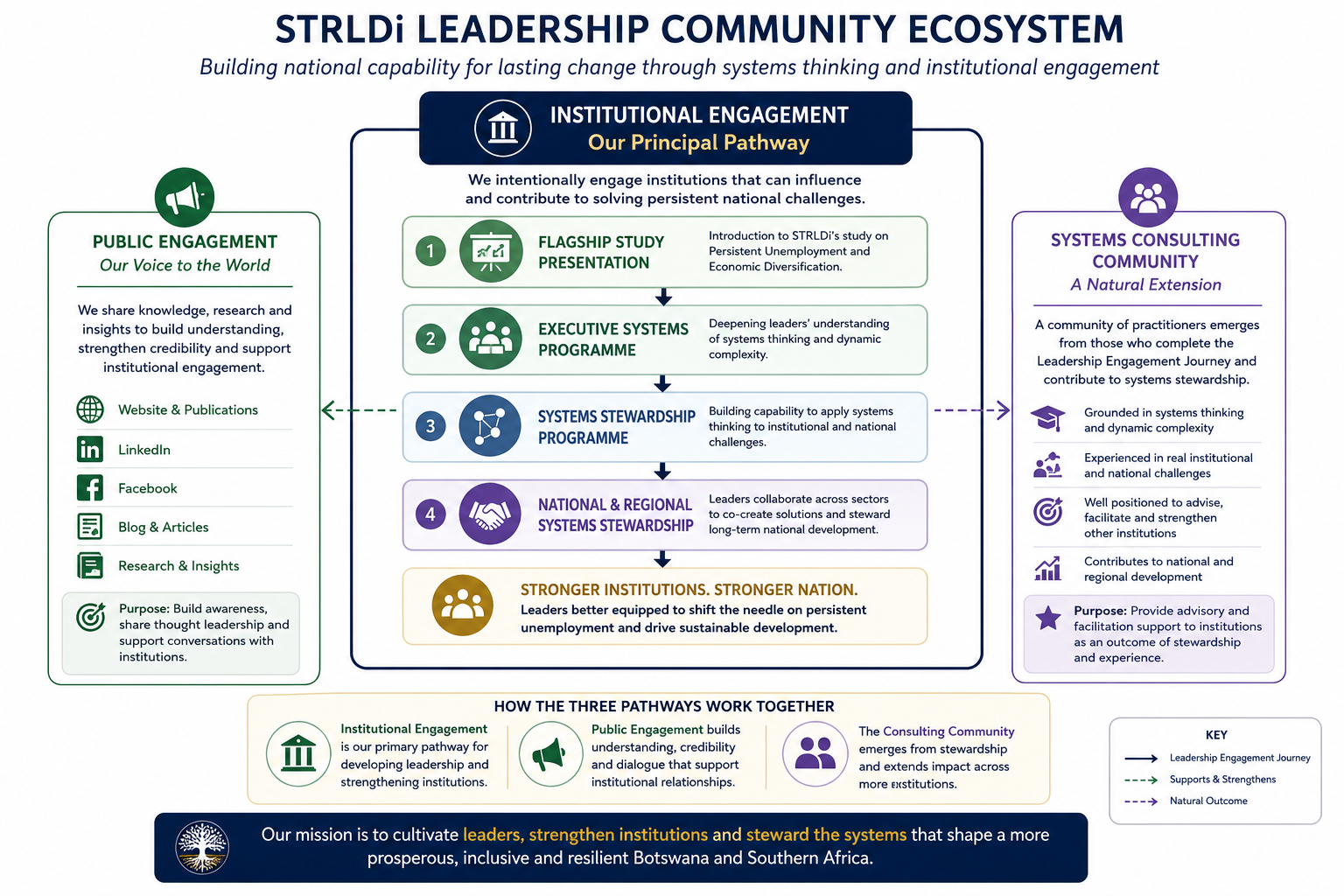
The Institute therefore distinguishes between Institutional Engagement, Public Engagement and the Development of a Systems Consulting Community. Together, these create a complementary ecosystem for building understanding, strengthening leadership capability and supporting national and regional systems stewardship.
Institutional Engagement
Institutional engagement is STRLDi’s principal pathway for developing leadership capable of contributing to national and regional transformation.
Through the Liaison Offices, the Institute deliberately identifies institutions whose leadership, influence, or implementation capability positions them to contribute meaningfully to addressing persistent unemployment, strengthening economic diversification, and advancing long-term development.
These institutions are invited into the Leadership Engagement Journey, beginning with an introduction to STRLDi’s flagship study on the resistant nature of persistent unemployment and the country’s efforts at diversifying its economy. Leaders who wish to explore the methodology further progress through the Executive Systems Programme and, ultimately, the Systems Stewardship Programme.
The objective is not to maximise programme participation. It is to cultivate a growing community of institutions whose leaders are progressively better equipped to work alongside national leadership in understanding persistent structural challenges, strengthening institutional capability and stewarding long-term national development.
Institutional engagement therefore remains STRLDi’s primary pathway for building national capability.
Public Engagement
Public engagement complements, but does not replace, institutional engagement.
Through its website, publications, blog and professional social media platforms, STRLDi shares research, reflections and examples of its work to make systems thinking more accessible, strengthen the Institute’s public profile and provide institutions with an opportunity to become familiar with its methodology before engaging directly.
While public engagement will naturally generate interest and enquiries, it is not intended to serve as STRLDi’s principal recruitment mechanism. Instead, it supports institutional engagement by building credibility, demonstrating thought leadership and making the Institute’s body of work publicly available.
In this way, public engagement strengthens the conversations already taking place with institutions and contributes to a broader appreciation of systems thinking within society.
Developing the Systems Consulting Community
As the Leadership Engagement Journey matures, a community of systems practitioners will naturally emerge from those who have progressed through the Institute’s programmes and systems stewardship initiatives.
STRLDi does not seek to build a consulting community as its starting point. Rather, it seeks to develop leaders who understand dynamic complexity, appreciate the systemic nature of persistent challenges and have participated in collaborative efforts to strengthen national and regional capability.
For many participants, consulting, facilitation and advisory work will become a natural extension of that experience. Having developed their understanding through research, executive learning and systems stewardship, they will be well positioned to support institutions in strengthening their own capability and applying systems thinking within their respective contexts.
In this way, STRLDi contributes not only to national leadership development but also to the gradual emergence of a community of practitioners capable of supporting Botswana’s and the region’s long-term development through systems thinking.
Relationship Between the Three Pathways
The three pathways work together to support STRLDi’s mission.
- Institutional Engagement builds trusted relationships with strategic institutions and serves as the Institute’s primary pathway for leadership development.
- Public Engagement shares STRLDi’s thinking more broadly, strengthens institutional confidence and supports ongoing dialogue.
- The Systems Consulting Community emerges naturally from leaders who have completed the Leadership Engagement Journey and wish to continue contributing through advisory, facilitation and institutional development work.
Together, these pathways create a sustainable ecosystem for developing leaders, strengthening institutions and building the long-term systems stewardship needed to address Botswana’s and the region’s most persistent structural challenges.
Standard Operating Procedure for Liaison Directors
Step 1 – Identify Strategic Institutions
Identify institutions whose leadership has the capacity to influence national or regional systems relating to unemployment, economic diversification and long-term development.
Step 2 – Research and Understand
Develop a sound understanding of the institution before making contact. Review its mandate, strategic priorities, current initiatives, leadership responsibilities and areas where STRLDi’s work may be relevant.
Step 3 – Shape the Engagement
Meet with the Institute Director to discuss your research and jointly shape the most appropriate introduction. Together, determine how STRLDi’s flagship study is likely to resonate with the institution and identify the issues most relevant to its leadership.
Step 4 – Arrange the Introduction
Engage the institution and request an opportunity for the Institute Director to present STRLDi’s flagship study. The purpose at this stage is to begin a meaningful conversation rather than promote a programme.
Step 5 – Present the Flagship Study
The Institute Director presents the flagship study, introduces STRLDi’s systems thinking methodology and facilitates discussion around the structural nature of persistent unemployment and economic diversification.
Step 6 – Extend an Invitation
Where interest is expressed, invite leaders to participate in the Executive Systems Programme as the natural next step in their learning journey.
Step 7 – Steward the Relationship
Maintain regular contact, share relevant publications and continue strengthening the relationship. Trust and understanding should develop over time rather than through a single engagement.
Step 8 – Build Long-Term Partnership
As relationships mature, identify opportunities for participation in the Systems Stewardship Programme and, ultimately, for collaboration in national and regional systems stewardship initiatives.
Guiding Principle
The role of the Liaison Officer is not to recruit participants but to cultivate trusted relationships with institutions that have the potential to shape the future of Botswana and the region. Every conversation should strengthen understanding, build confidence in STRLDi’s work and contribute to a growing community of leaders committed to addressing persistent structural challenges together.
STRLDi Institutional Engagement Portfolio
Building Relationships for National and Regional Systems Stewardship
Purpose
The STRLDi Institutional Engagement Portfolio is the standard resource used by Liaison Officers when engaging institutions whose leadership, influence, or implementation capabilities can contribute to addressing persistent unemployment, strengthening economic diversification, and advancing long-term national and regional development.
The Portfolio ensures that every institution experiences a consistent introduction to STRLDi while allowing each Liaison Officer to tailor conversations to the institution’s mandate, priorities and strategic interests.
It is designed to cultivate understanding before commitment, relationships before programmes and stewardship before implementation.
Portfolio Structure
Section 1
Letter of Introduction
A personalised letter from the Liaison Officer introducing STRLDi and requesting an opportunity for the Institute Director to present the flagship study.
The letter should:
- acknowledge the institution’s contribution
- explain why STRLDi believes the institution is strategically important
- request a brief introductory meeting
- introduce the flagship study
- emphasise that the purpose is dialogue rather than programme promotion
Section 2
STRLDi Institutional Profile
A concise profile explaining:
- Why STRLDi was established
- Vision
- Mission
- Philosophy
- Areas of work
- Institutional Architecture
- Systems Thinking as STRLDi’s organising discipline
- Botswana, regional and international aspirations
Length:
4–6 pages
Section 3
The Flagship Study
Executive Brief
Understanding the Persistent Nature of Unemployment and Why Economic Diversification Has Resisted National Efforts Through the Lens of Peter Senge’s The Fifth Discipline
Contents:
- Why this study began
- Botswana’s persistent challenge
- Why previous efforts have produced limited structural change
- The Systems Thinking perspective
- Dynamic Complexity
- Behaviour Over Time
- Feedback Structures
- Early observations
- Questions for national leadership
This becomes STRLDi’s principal conversation starter.
Section 4
Why Systems Thinking Matters
A short publication explaining:
- Why complex problems resist simple solutions
- Persistent versus episodic problems
- Systems Thinking
- The Fifth Discipline
- Why collective leadership matters
This allows leaders unfamiliar with systems thinking to understand the intellectual foundation before attending a programme.
Section 5
Leadership Engagement Journey
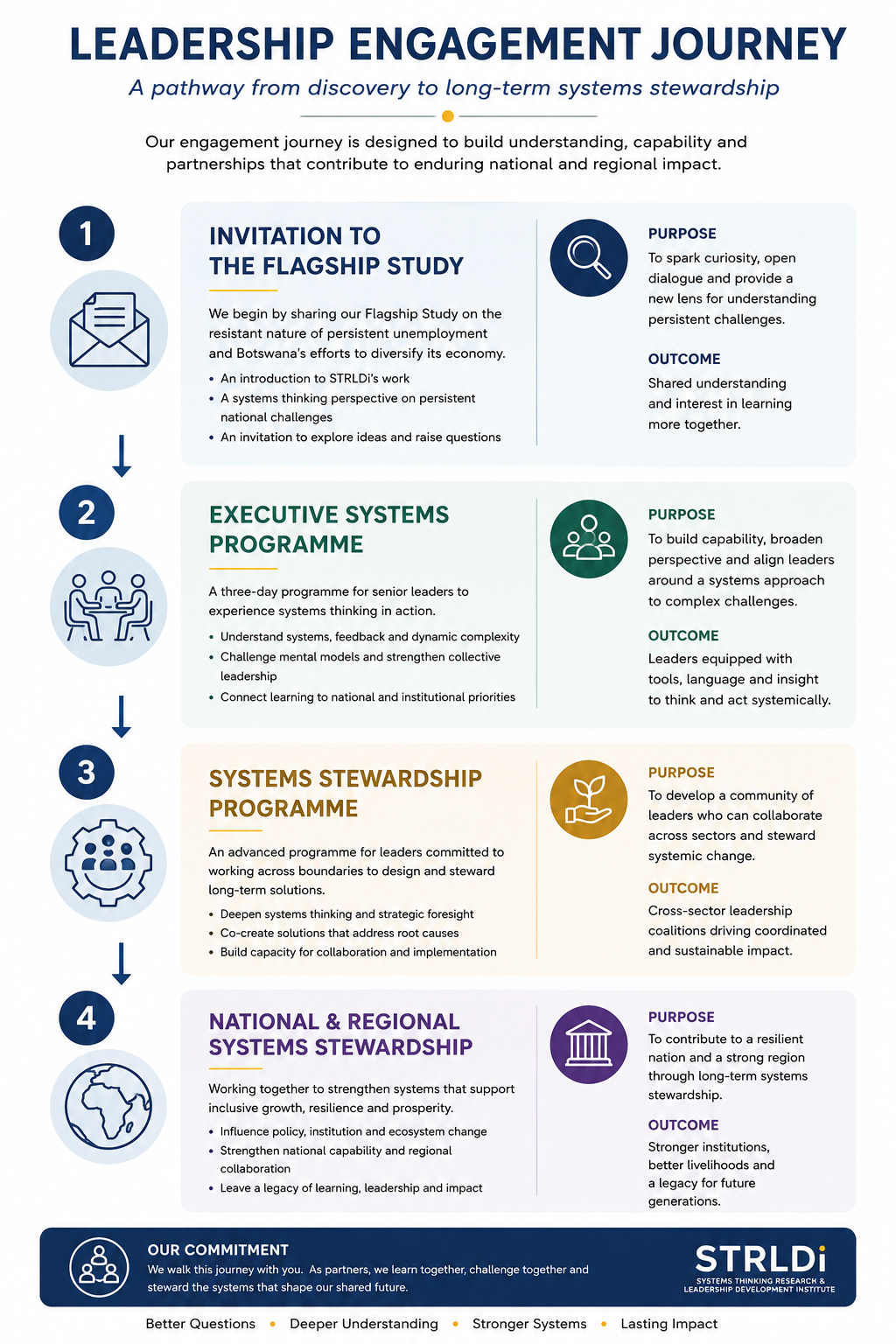
This becomes the relationship roadmap.
Section 6
Executive Systems Programme
A professionally designed programme guide including:
- Programme purpose
- Learning journey
- Audience
- Learning outcomes
- Programme format
- Frequently Asked Questions
- Registration process
Section 7
Strategic Partnerships & Growth
A concise overview of Pillar III, explaining:
- Network Centres
- Partnership stewardship
- Long-term relationship philosophy
- Institutional collaboration
- National capability building
This helps institutions understand that STRLDi is cultivating enduring partnerships rather than delivering one-off training events.
Section 8
About the Institute Director
A professional profile including:
- Background
- Development of the flagship study
- Systems Thinking practice
- Experience working with government and institutional leadership
- Vision for STRLDi
Institutions often want to understand the person leading the work before committing to further engagement.
Section 9
Frequently Asked Questions
Examples include:
- Why unemployment?
- Why systems thinking?
- Why Peter Senge?
- Why a three-day programme?
- Who should attend?
- Is this consultancy?
- Is STRLDi politically aligned?
- What happens after the programme?
Section 10
Next Steps
A clear summary of what happens following the introductory meeting:
- Director presents the flagship study.
- Leaders reflect and ask questions.
- Institutions identify colleagues who may benefit.
- Invitation to the Executive Systems Programme.
- Continued dialogue.
- Long-term partnership.
Internal Liaison Director Resources
These remain internal to STRLDi.
A. Engagement SOP
The complete Standard Operating Procedure you have already drafted.
B. Institution Research Template
Before any contact, the Liaison Officer prepares a briefing covering:
- Mandate
- Strategic priorities
- Current challenges
- Leadership structure
- Existing partnerships
- Areas where STRLDi may contribute
- Potential strategic alignment
C. Director Engagement Brief
Once research is complete, the Liaison Officer meets with the Institute Director to shape the engagement.
The briefing includes:
- Institution overview
- Why this institution matters
- Current strategic priorities
- Potential entry points
- Recommended framing of the flagship study
- Likely questions
- Desired outcomes
- Recommended follow-up
This ensures every engagement is thoughtfully prepared and tailored to the institution rather than delivered as a standard presentation.
D. Meeting Record
Completed immediately after every engagement.
Includes:
- Participants
- Main discussion
- Questions raised
- Areas of interest
- Concerns
- Opportunities
- Agreed actions
- Recommended follow-up
- Suggested invitation to Executive Systems Programme
E. Relationship Stewardship Record
A living document tracking:
- Meetings
- Calls
- Publications shared
- Programme participation
- Areas of collaboration
- Partnership opportunities
- Future engagements
Guiding Philosophy
The STRLDi Institutional Engagement Portfolio is not a marketing pack. It is a stewardship resource. Its purpose is to help Liaison Officers introduce STRLDi thoughtfully, engage institutions respectfully and cultivate relationships that can mature into long-term partnerships for national and regional systems stewardship.
Every engagement begins with listening, is grounded in the Institute’s flagship study on persistent unemployment and economic diversification, and progresses only as trust, understanding and shared purpose develop. In this way, STRLDi seeks not merely to recruit participants, but to build a community of leaders committed to strengthening the nation’s capacity to address its most enduring structural challenges.
Executive Letters of Introduction
The Institutional Liaison Office has developed three Executive Letters of Introduction, each tailored to the leadership audience being engaged. While the core message remains consistent, each letter has been adapted to reflect the responsibilities, perspectives and strategic interests of the respective audience.
The purpose of these letters is to introduce STRLDi, invite institutions to an Executive Briefing and begin a trusted institutional relationship through the Institute’s Leadership Engagement Journey.
1. Executive Letter of Introduction to National Leadership
Primary Audience
- Presidents
- Prime Ministers
- Speakers of Parliament
- Ministers
- Permanent Secretaries
Purpose
Introduces STRLDi’s work in relation to national leadership, persistent public policy challenges and long-term institutional transformation. The Executive Briefing presents the Flagship Study and opens a dialogue on systems leadership, national capability and cross-sector collaboration.
View Letter
https://strldi.weebly.com/executive-letter-of-introduction-to-national-leadership.html
2. Executive Letter of Introduction to Institutional Leadership
Primary Audience
- Chief Executive Officers
- Universities and Vice Chancellors
- Professional Bodies
- Development Agencies
- State-Owned Enterprises
- Business Associations
Purpose
Introduces STRLDi as a strategic partner in strengthening institutional capability, organisational learning and collaborative leadership. The Executive Briefing explores how systems thinking can support institutional performance, innovation and long-term organisational resilience.
View Letter
https://strldi.weebly.com/executive-letter-of-introduction-to-institutional-leadership.html
3. Executive Letter of Introduction to Regional Leadership
Primary Audience
- Southern African Development Community (SADC)
- African Union (AU)
- Regional Development Banks
- Regional Universities
- International Development Partners
Purpose
Introduces STRLDi’s regional vision and invites collaboration around systems leadership, institutional learning and cross-border capability development. The Executive Briefing explores opportunities for shared learning, regional stewardship and strengthening institutions across Southern Africa and the African continent.
View Letter
https://strldi.weebly.com/executive-letter-of-introduction-to-regional-leadership.html
A Common Purpose
Although each letter has been tailored for a specific leadership audience, all three share a common objective:
- Introduce the Systems Thinking Research & Leadership Development Institute (STRLDi).
- Present the Institute’s Flagship Study through an Executive Briefing.
- Establish trusted institutional relationships.
- Invite leaders to begin the STRLDi Leadership Engagement Journey with their executive team.
- Explore opportunities for long-term collaboration to strengthen leadership, institutions, and systems stewardship.
The Executive Letter of Introduction therefore serves as the formal gateway through which institutions begin their engagement with STRLDi. It is the first step in building enduring partnerships founded on mutual respect, shared learning and a commitment to addressing persistent national and regional challenges through systems thinking.
To provide some context ahead of a possible meeting, we have assembled a small portfolio of online publications introducing STRLDi and the work we are developing.
Institutional Engagement Portfolio
1. About STRLDi
Introducing the Institute, our purpose, philosophy and areas of work.
https://strldi.weebly.com/strldi.html
2. Our Flagship Study
Understanding the Persistent Nature of Unemployment and Why Botswana’s Efforts to Diversify its Economy Have Continued to Resist Change.
https://strldi.weebly.com/blog/the-long-road-to-seeing
3. Why Systems Thinking?
An introduction to Peter Senge’s The Fifth Discipline and why systems thinking offers a different perspective on persistent national challenges.
https://strldi.weebly.com/why-systems-thinking.html
4. STRLDi Leadership Engagement Journey
How institutions engage with STRLDi—from the flagship study through executive learning to long-term systems stewardship.
https://sheilasingapore.blog/portfolio/strldi-leadership-engagement-journey/
5. Executive Systems Programme
An overview of STRLDi’s three-day public programme for senior leaders.
https://strldi.weebly.com/executive-systems-programme-landingpage.html
6. Strategic Partnerships & Growth
How STRLDi develops long-term partnerships with institutions committed to strengthening national and regional capability.
https://strldi.weebly.com/servicesbw.html
7. About the Institute Director
An introduction to the Director and the development of STRLDi’s work.
https://strldi.weebly.com/sheiladamodaran.html
8. Frequently Asked Questions
Responses to common questions about STRLDi, our methodology and our programmes.
https://strldi.weebly.com/why-systems-thinking.html
We hope these publications provide a useful introduction to STRLDi and the journey we are building with leaders and institutions committed to strengthening Botswana’s and the region’s long-term capability.
Should the work resonate with your institution, we would be pleased to arrange a meeting at a time convenient to you.
We appreciate your consideration and look forward to the opportunity of introducing STRLDi to you.
Yours sincerely,
[Name]
Director [Name of Portfolio]
Liaison Office
Systems Thinking Research & Leadership Development Institute (STRLDi)
Institutional Engagement Correspondence
This section contains the standard correspondence used by STRLDi Liaison Officers throughout the Leadership Engagement Journey. The communications support a progressive engagement process—from the initial introduction of STRLDi and its flagship study, through executive learning, to the development of long-term institutional partnerships and systems stewardship. While the templates provide consistency, Liaison Officers are encouraged to personalise each communication to reflect the institution, its leadership and the context of the engagement.
It contains:
- Cover Note
- Letter of Introduction
- Follow-up Note
- Meeting Confirmation
- Thank You Note
- Executive Systems Programme Invitation
- Ongoing Relationship Updates
1. Cover Note
Accompanying the Institutional Engagement Portfolio
Subject: Introducing STRLDi and Our Flagship Study
Dear [Title and Name],
I hope you are keeping well.
Please find attached a brief introduction to the Systems Thinking Research & Leadership Development Institute (STRLDi) and a curated portfolio of online publications introducing our work.
The inserted link is here: [Insert correct link of Executive Letter of Introduction here]
Our Institute has grown from a flagship study exploring the resistant nature of persistent unemployment and Botswana’s efforts to diversify its economy, viewed through the discipline of systems thinking and the work of Peter Senge’s The Fifth Discipline.
We believe this work may be of interest to your institution and would value the opportunity, at a time convenient to you, for our Institute Director to present the study and exchange perspectives with your leadership team.
The accompanying publications are intended simply to provide context ahead of any future conversation.
We hope you find them useful and look forward to the possibility of meeting with you.
Kind regards,
[Name]
Director [Name of Portfolio]
Liaison Office
STRLDi
2. Follow-up Note (One Week Later)
Subject: Following Up on STRLDi’s Introduction
Dear [Title and Name],
I hope you have had an opportunity to browse some of the STRLDi publications shared last week.
I simply wanted to follow up and enquire whether any aspect of the work resonated with you or prompted questions.
Our intention is not to present a programme at this stage, but rather to introduce our flagship study and begin a conversation around one of Botswana’s most persistent national challenges—the resistant nature of unemployment and the country’s efforts to diversify its economy.
If you feel the work may be relevant to your institution, we would be pleased to arrange a short introductory session with our Institute Director at a time that suits you.
Thank you once again for your time and consideration.
Kind regards,
[Name]
3. Meeting Confirmation
Subject: Confirmation of STRLDi Introductory Discussion
Dear [Title and Name],
Thank you for agreeing to meet with us.
We look forward to introducing STRLDi’s flagship study and sharing the systems thinking perspective that has shaped our work on persistent unemployment and economic diversification.
The discussion is intended to be exploratory and conversational. We look forward equally to learning from your perspectives and understanding how your institution sees these challenges.
We appreciate your time and look forward to meeting you.
Kind regards,
[Name]
4. Thank You Note
Subject: Thank You
Dear [Title and Name],
Thank you for meeting with us and for the thoughtful discussion.
We greatly appreciated the opportunity to introduce STRLDi’s flagship study and to hear your perspectives on the challenges facing Botswana and the region.
The questions and reflections you shared will help inform our continuing work, and we look forward to exploring opportunities for continued dialogue and collaboration.
Should it be of interest, we would be delighted to welcome members of your leadership team to a future Executive Systems Programme, where the systems thinking methodology is explored in greater depth.
Thank you once again for your time and engagement.
Kind regards,
[Name]
5. Invitation to the Executive Systems Programme
Subject: Invitation to the STRLDi Executive Systems Programme
Dear [Title and Name],
Following our recent discussion, I would like to extend an invitation for you, or members of your leadership team, to participate in STRLDi’s Executive Systems Programme.
The three-day programme provides an introduction to systems thinking, dynamic complexity and the methodology that underpins our flagship study. It is designed for senior leaders seeking to better understand persistent structural challenges and to explore new ways of thinking about long-term national and institutional development.
Further information can be found here:
Executive Systems Programme
https://strldi.weebly.com/executive-systems-programme-landingpage.html
We would be honoured to welcome your participation.
Kind regards,
[Name]
Relationship Stewardship Schedule
Developing trusted institutional relationships requires consistency, discipline and thoughtful follow-through. STRLDi’s engagement philosophy recognises that meaningful partnerships are built progressively through dialogue, shared learning and sustained interaction rather than through isolated meetings or one-off invitations.
The Relationship Stewardship Schedule provides a standard rhythm for engaging strategic institutions while allowing Liaison Officers to adapt the pace and nature of communication to each institution’s circumstances and interests. The objective is not to accelerate participation, but to cultivate understanding, trust and long-term collaboration.
Day 0 – Institutional Introduction
The engagement begins with the Cover Note and the Institutional Engagement Portfolio.
The Portfolio introduces STRLDi, presents the Institute’s flagship study on the resistant nature of persistent unemployment and Botswana’s efforts to diversify its economy, and explains the Leadership Engagement Journey. At this stage, the objective is simply to provide context and invite reflection.
Day 7 – Courtesy Follow-up
Approximately one week after the Portfolio has been shared, the Liaison Officer makes a courteous follow-up contact.
The purpose is not to seek a decision, but to enquire whether the publications have raised any questions or reflections and whether the institution would welcome an introductory discussion with the Institute Director.
Upon Expression of Interest – Director’s Presentation
Where interest is expressed, the Liaison Officer coordinates an introductory meeting with the Institute Director.
The Director presents STRLDi’s flagship study, shares the systems thinking perspective that has shaped the Institute’s work and facilitates a discussion around the persistent nature of unemployment and economic diversification. This conversation establishes the foundation for any future relationship.
Within Three Working Days – Appreciation and Follow-up
Within three working days of the meeting, the Liaison Officer sends a letter of appreciation thanking the institution for its time and engagement.
Any publications, references or additional resources requested during the meeting should accompany this correspondence, together with confirmation of any agreed follow-up actions.
Executive Systems Programme Invitation
Where the introductory discussion has generated genuine interest, the institution is invited to participate in the Executive Systems Programme.
The invitation should position the programme as the natural next step in the Leadership Engagement Journey, enabling participants to explore the systems thinking methodology in greater depth before considering longer-term engagement through STRLDi’s Systems Stewardship Programme.
Ongoing Relationship Stewardship
Institutional relationships continue well beyond programme participation.
As a guide, Liaison Officers should maintain contact at least once each quarter by sharing a substantive STRLDi publication, research insight, leadership article or invitation to an Institute dialogue. These engagements help sustain the relationship, encourage continued learning and identify opportunities for future collaboration.
Every interaction should add value to the institution and reinforce STRLDi’s commitment to thoughtful, long-term partnership.
Guiding Principle
The Relationship Stewardship Schedule is intended to ensure that every institution experiences a consistent and professional engagement with STRLDi. While the sequence provides a common framework, Liaison Officers should always exercise sound judgement, respecting each institution’s priorities, pace and preferred mode of engagement.
The objective is not simply to invite participation in programmes, but to cultivate enduring relationships with institutions that have the capacity to contribute meaningfully to strengthening Botswana’s and the region’s capability to address persistent structural challenges through systems thinking, collaborative leadership and systems stewardship.tent, thoughtful engagement rather than one-off communications.


