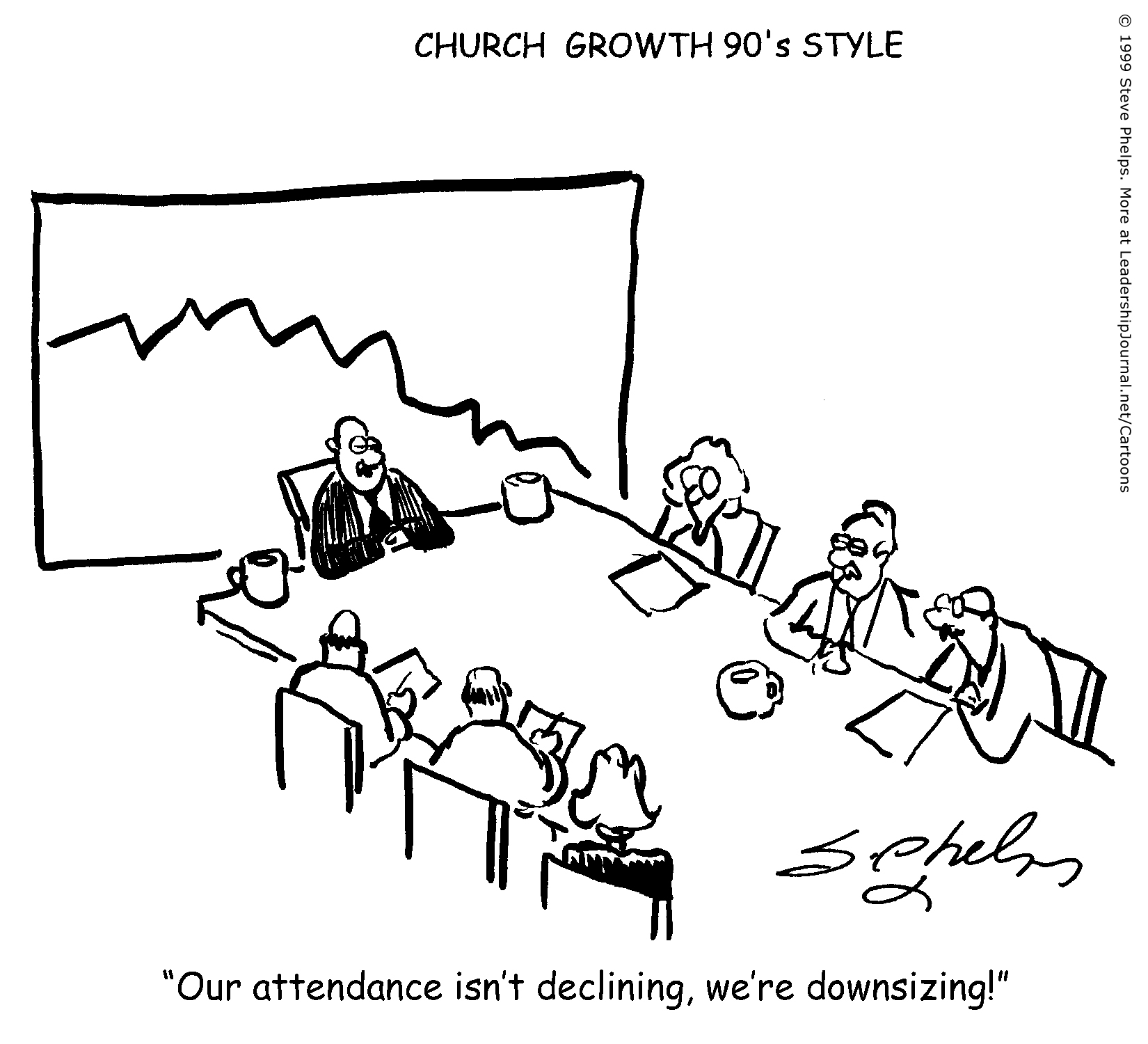
“Why should we worry about problems we do not have? We’re growing tremendously. (A little later …), “Sure there are some problems, but all we have to do is go back to what was working before.” Still later … “The harder we run, the more we stay in the same place.”
EVENT
WHAT THE STRUCTURE LOOKS LIKE AT A POINT IN TIME (AS AN EVENT)
Whatever we try to do, we are not getting the success we used to get. Somebody is not doing their job well. It feels like a pressure cooker here.
The same things that got us success in the past are not helping us to get as much success as before and seem to be making things worse!
THE STORY OF UNANTICIPATED CONSTRAINTS
PATTERN
A MANAGEMENT STORY ILLUSTRATING THE STRUCTURE PLAYING OUT OVER TIME (BOT / VIDEO)
“Marketing and Service Department” / “Volunteers and Regulars”
- The Sales Manager introduces successful marketing and sales strategies (the engine of growth), resulting in increased computer sales.
- As sales grow, the number of computers requiring servicing and repairs also increases. However, the technical team lacks the capacity to handle the growing after-sales workload, creating an unanticipated constraint.
- The resulting delays and poor after-sales service begin to undermine the company’s reputation, eventually leading to a decline in sales.
The underlying lesson: The very success that drives growth creates additional demands on the system. Unless the organisation develops the capacity to support that growth, its earlier success becomes the source of its eventual decline.
BEHAVIOUR OF THE GRAPH (PATTERN) OVER TIME

STRUCTURE
DESCRIPTION OF THE ARCHETYPE
Success or growth is leveling off or declining.
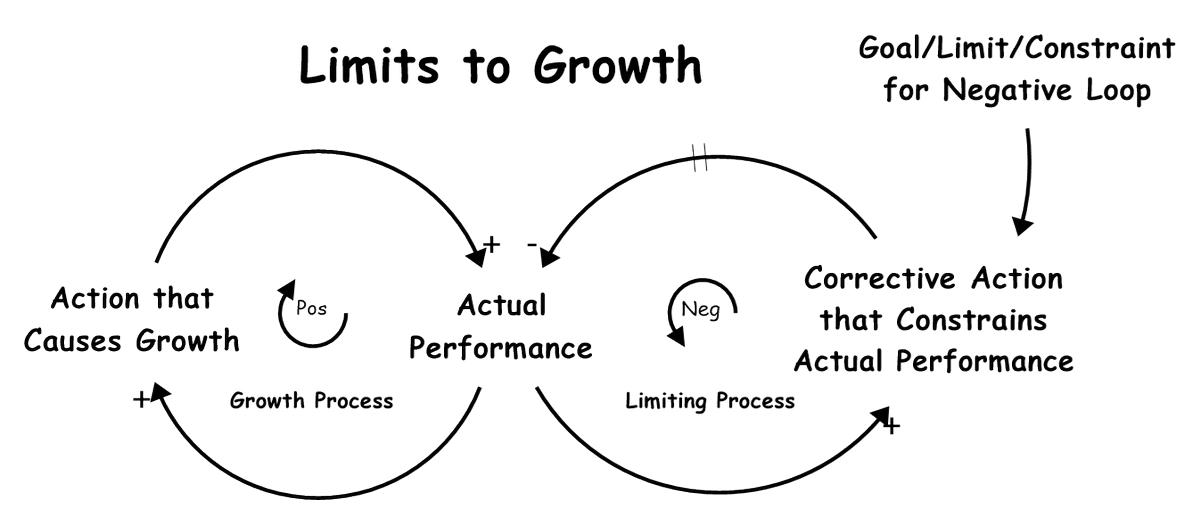
The Growth Process
Success or growth initially produces more success. The greater the effort invested in a growth process, the greater the results it generates. These results encourage further effort, which in turn produces more growth. This is the reinforcing process at the heart of the Limits to Growth archetype: success feeds further success, creating a cycle of increasing results. As the growth wheel gains momentum, the system appears to be moving towards ever-increasing success.
The Limiting Process
However, as the growth process continues, it generates demands and pressures elsewhere in the system. These demands give rise to a limiting condition that begins to work against the very growth the reinforcing process is producing. The limiting condition may be some distance from the activity driving growth and may not be immediately apparent. Consequently, attention remains concentrated on the growth process, while the emerging constraint elsewhere in the system receives insufficient attention.
As the growth wheel gets bigger, so does the limiting wheel. As growth accelerates, the demands and pressures generated elsewhere in the system increase, causing the limiting process to gather strength at an increasing pace. The two processes therefore operate in opposing directions: one drives growth, while the other increasingly restricts it.
The Two Wheels Turning in Opposing Directions
I like to think of the two loops as two bicycle wheels turning in opposing directions. The growth wheel continues to reinforce itself, pushing to generate more results through the very process that produced its earlier success. It does not see what is slowing it down. Meanwhile, the limiting wheel is gaining strength, progressively working against the growth wheel.
Think of the friction of brakes being applied or gears grinding against one another. The growth wheel puts up a fight, continuing to push forward, but the harder it pushes against the growing resistance, the more the limiting process gains influence. The more the growth process intensifies without addressing the limiting condition, the more powerful the limiting process becomes. Eventually, the limiting wheel overpowers the growth wheel, progressively eroding the results until the growth process itself is brought to a halt and may be wiped out.
Behaviour Over Time
This dynamic is reflected in the characteristic S-curve of the Limits to Growth archetype. Initially, the reinforcing process produces rapid growth. As the limiting process gathers strength, growth begins to slow, eventually reaching a plateau. If the limiting process continues to strengthen, the trajectory may turn into decline. What appeared to be an increasingly successful growth process is progressively undermined by the limiting process operating alongside it.
Purpose of the Archetype
The purpose of this archetype is to help us recognise the limiting process that is working against the growth process. It directs our attention beyond the activity producing visible results, towards the constraint that is progressively restricting those results. Without recognising both processes, we may continue to intensify the very effort that initially produced success, without seeing why the system is no longer responding as it did before.
The central lesson is that growth carries within its own development the conditions that can progressively limit it. The task is to see both wheels turning, rather than concentrating only on the one driving growth.
Sources:
- Peter M. Senge, The Fifth Discipline: The Art and Practice of the Learning Organization, Chapter 6, “Systems Archetypes,” especially “Limits to Growth.” Read the Limits to Growth definition.
- Peter Senge, et al., The Fifth Discipline Fieldbook: Strategies for Building a Learning Organization, “Limits to Growth” template and discussion. Read the Fieldbook extract.
- Peter M. Senge, “The Leader’s New Work: Building Learning Organizations,” for the description of growth grinding to a halt and potentially reversing. Read the paper.
MENTAL MODEL
OUTLOOK THAT CAUSES THE STRUCTURE TO PERSIST DESPITE OUR EFFORTS TO SOLVE IT / RESISTS PROBLEM-SOLVING:
“We’ll get bigger and better by continuing to do more of what we are doing now.”
FEAR OF FAILURE. LEARNING: LET IT GO SO AS NOT TO LET THE FEAR AFFECT THE WAY YOU SHAPE YOUR OUTLOOK, PERSPECTIVES AND DECISION-MAKING.
MAKING A SYSTEMIC INTERVENTION
TREATING THE STRUCTURE
BREAKING ORGANISATIONAL GRIDLOCK
PLANNING
If we don’t plan for limits, we are planning for failure. By mapping out the growth engines and potential danger points in advance, we can anticipate future problems and eliminate them.
Intervention:
- The archetype is most helpful when it is used ahead of any problems, to see how the cumulative effects of continued success might lead to future problems
- Use the archetypes to explore questions such as “What kinds of pressures are building up in the organization as a result of growth?”
- Look for ways to relieve pressures or remove limits before success blows over – may need to consider slowing down the growth to have resources long enough to overcome the limits
What it looks like if the system was working well:
- “We can overcome limits by planning for them.”
- We identify, evaluate, and plan for limits.
- We discover shared visions that resolve the Success to the Successful, Escalation, Shifting the Burden, Fixes that Backfire, and Drifting Goals archetypes and get us out of the stuckness together.w


Where past successes and successors become obstacles to unravel organizational learning disabilities – case in point: Singapore Incorporated.
LikeLike