A Direct Question for the Presidency, Cabinet and the Nation
Yes. Botswana can get its STEM right.
But Botswana will not get STEM right by simply adding more STEM subjects, building more laboratories, purchasing more computers or announcing another education reform. The country will get STEM right when it decides, clearly and deliberately, what kind of economy it intends to build—and then works backwards to construct the human capability required to carry it.
This is the point at which the national conversation must become more honest. STEM is not an education programme sitting beside the economy. STEM is part of the productive architecture of the economy itself, because the people who understand mathematics, science, engineering and technology are eventually the people who plan, design, operate, repair, improve and create the systems upon which a modern productive nation depends.
President Khama’s question—Can Batswana get their STEM right?—therefore deserves a direct answer. Yes, they can. But Botswana must first decide what economic performance it intends to achieve, what productive sectors must carry that performance, what those sectors must produce, and how many people, with what capabilities, will be required to do the work.
Only then can the country know what STEM it needs to build.
The question, therefore, is not simply whether Botswana can get STEM right. The deeper question is whether Botswana is prepared to count the future economy it intends its people to build—and then deliberately work backwards to prepare them to build it.
Economic Performance
↓
Productive Sectors
↓
Enterprises and Production
↓
Occupations
↓
Capabilities
↓
Teachers, Trainers and Institutions
↓
Education Investment
ARTICLE CONTENT SHEET
Building the Human Capability Required to Carry Botswana’s Future Economy
1. Can Batswana Get Their STEM Right?
The central question for Botswana’s future economic capability.
2. The Question Is Bigger Than the Classroom
Why STEM is an economic and national capability issue.
3. The Structural Trap
Why improving education alone will not solve the problem.
4. The Ground Is Moving
Population growth, technological change and rising economic requirements.
5. Botswana Must Work Backwards From the Future
Future Economy → Productive Sectors → Enterprises → Occupations → Capabilities → Education
6. What Does the Future Economy Actually Require?
The Numbers Begin
- The economy must first be seen as people
- 6,000 — National Planning and Direction
- 24,000 — Public Pipeline Execution
- 200,000 → 1,115,000 — Direct Productive Workforce
- Productive workforce by sector
- 76,050 → 457,250 — STEM-Capable Workforce
- STEM capability by sector
7. The Country Cannot Afford to Discover Its Needs Too Late
Why Botswana must count the future before the future arrives.
8. The National STEM Capability Architecture
- STEM Council
- National Capability Architecture
- Administration
- Curriculum Design
- Teacher Training
- Assessment
- Experienced Batswana
- Overseas expertise
- Foreign specialist capability
9. When Will Capability Begin to Show?
- Years 1–5 — Capability begins
- Years 6–10 — Capability becomes visible
- Years 11–20 — Capability reproduces itself
10. What the Twenty-Year Shift Would Actually Build
The economic and human capability Botswana would progressively develop.
11. What Would This Cost Botswana?
- Annual investment
- Twenty-year investment
- Cost per capita
- Investment relative to national economic capacity
- The cost of acting versus the cost of not acting
12. The Decision Before the Presidency
The shift does not need to alarm Botswana.
The alarm should come when Botswana refuses to count what the future requires.
↗️THE QUESTION IS BIGGER THAN THE CLASSROOM
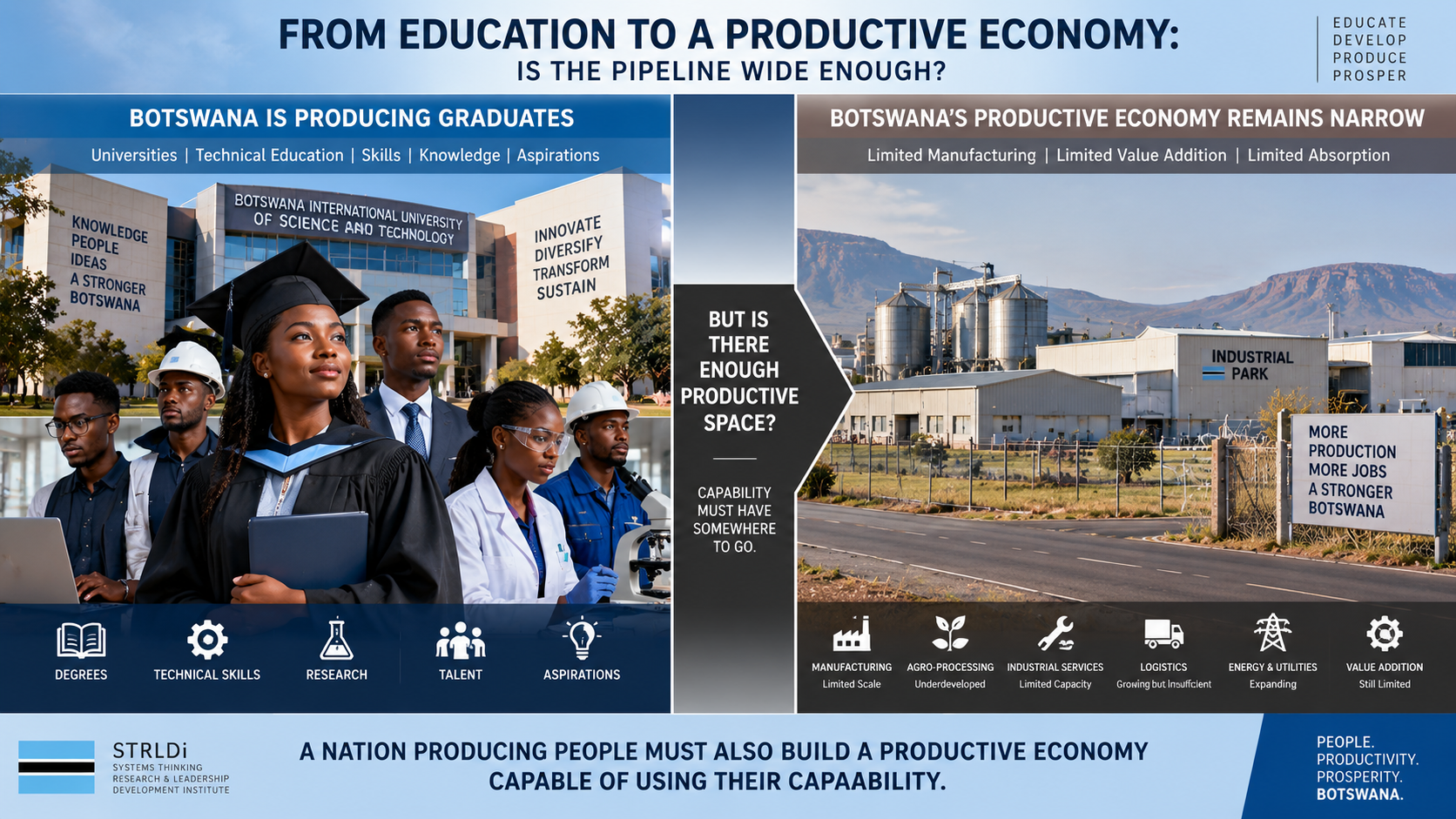
Botswana must begin by recognising that the problem does not start inside the school. A child can pass mathematics, science and technology examinations and still emerge into an economy with too little productive space in which to use those capabilities. Equally, an economy can say that it wants engineers, scientists, technicians and technology specialists while continuing to produce too few teachers, laboratories, technical environments and enterprises capable of developing and absorbing them.
This is the chicken-and-egg structure Botswana must deliberately break.
The country cannot wait for the jobs before building all the capability, because in some cases capability itself is one of the conditions required for the jobs to emerge. An investor considering a manufacturing operation, advanced agricultural system, engineering facility or technology business does not look only for land and tax incentives; the investor also looks for people capable of operating, managing, improving and growing the system.
This means Botswana can become trapped between two apparently reasonable questions. The education system asks, Why produce people for jobs that do not yet exist? The productive economy asks, Why create the jobs here if the people required to operate the system do not yet exist?
And while the two sides wait for each other, the nation stands still.
The Data Should Make Botswana Pause
Botswana is not starting this conversation from a position of abundance. Statistics Botswana currently records a national population of 2,359,609 from the 2022 Census, while its published official formal employment indicator is around 30%. The scale of the problem therefore cannot be understood merely as an individual failure to find work; it must be understood as a question about the productive capacity of the national system to create sufficient places for people to contribute. (Statistics Botswana)
The STRLDi work, What Are We Creating?, deliberately moves the question further. It asks Botswana not simply to count the people it has today, but to look forward and determine the engineers, mathematicians, scientists, technicians, ICT specialists, agricultural specialists, managers and producers the country will require if it intends to build a substantially larger productive economy. (National Strategy Firm)
That changes the starting point completely.
The question is no longer:
How many STEM learners do we have?
The question becomes:
What productive economy are we creating, and how many people with what capabilities will be required to sustain it?
↗️BOTSWANA MUST WORK BACKWARDS FROM THE FUTURE
This is where the architecture of national thinking must turn around. The education system cannot simply begin with the schools it currently has, the teachers currently available, and the budget currently allocated, and then ask what kind of people can be produced from those existing inputs. That approach allows yesterday’s capacity to determine tomorrow’s possibility.
Botswana must instead begin with the future productive outcome. If the country intends to build larger productive sectors in agriculture, manufacturing, industry, energy, technology and services, then it must determine the enterprises required; from those enterprises, the occupations required; from those occupations, the capabilities required; and from those capabilities, the education and training architecture required to produce them. (National Strategy Firm)
The national sequence should therefore be:
FUTURE ECONOMIC PERFORMANCE
↓
PRODUCTIVE SECTORS
↓
ENTERPRISES
↓
OCCUPATIONS
↓
CAPABILITIES
↓
TEACHERS, TRAINERS AND INSTITUTIONS
↓
CURRICULUM, ASSESSMENT AND LEARNING ENVIRONMENTS
↓
NATIONAL INVESTMENT
That is how Botswana gets STEM right.
↗️WHAT DOES THE FUTURE ECONOMY ACTUALLY REQUIRE?
Botswana has spent many years discussing economic transformation in broad terms. The country must diversify the economy. Manufacturing must grow. Agriculture must become productive. More young people must enter STEM fields. Unemployment must fall. These statements are familiar and, in themselves, difficult to disagree with. But eventually a country must move beyond agreeing that more is required and begin asking how much more, for what purpose, and by when.
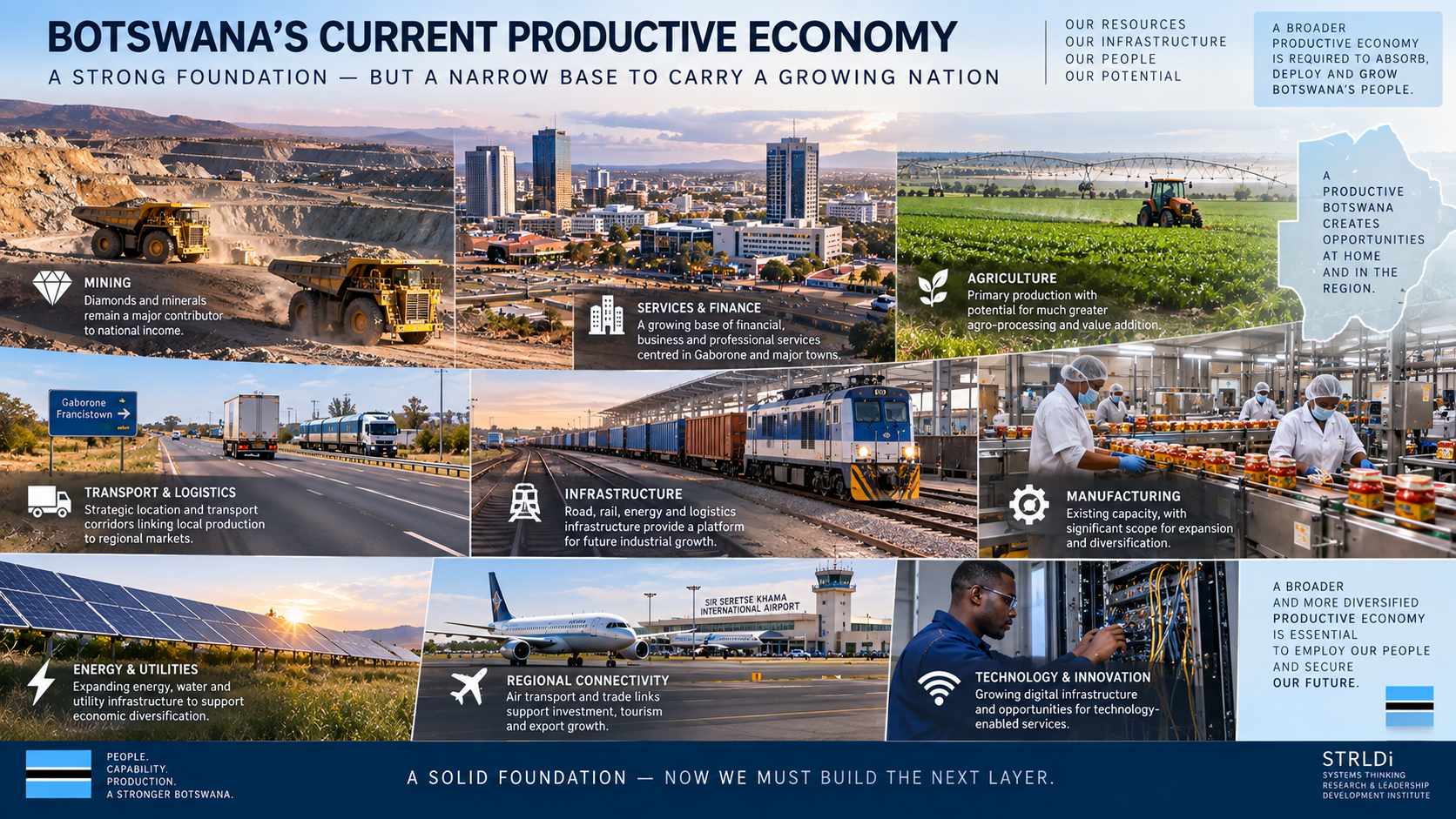
A President cannot build an economy with the word more. A Minister cannot plan a productive sector with the word growth. An education system cannot prepare the workforce with the instruction to produce better skills. At some point, every national ambition must become a number.
That is the point Botswana must now reach. How many people will the country require to plan the economy? How many will be required inside public institutions to carry out the plans? How many farmers, manufacturers, engineers, technicians, machine operators, researchers and logistics personnel must be on the ground? And how many of them must possess sufficient STEM capability for Botswana to keep up with the ground moving beneath the global economy?
The Numbers Are Not The Final Answer. They Are The Beginning of The Question.
The numbers presented here are STRLDi horizon-planning proxies. They are not being presented as a final government manpower establishment, and they should be tested, verified, and refined by Botswana’s institutions using their own administrative, population, education, labour, and sectoral data. Their purpose is to make the approximate order of magnitude visible before the country discovers, too late, that it has not prepared enough people.
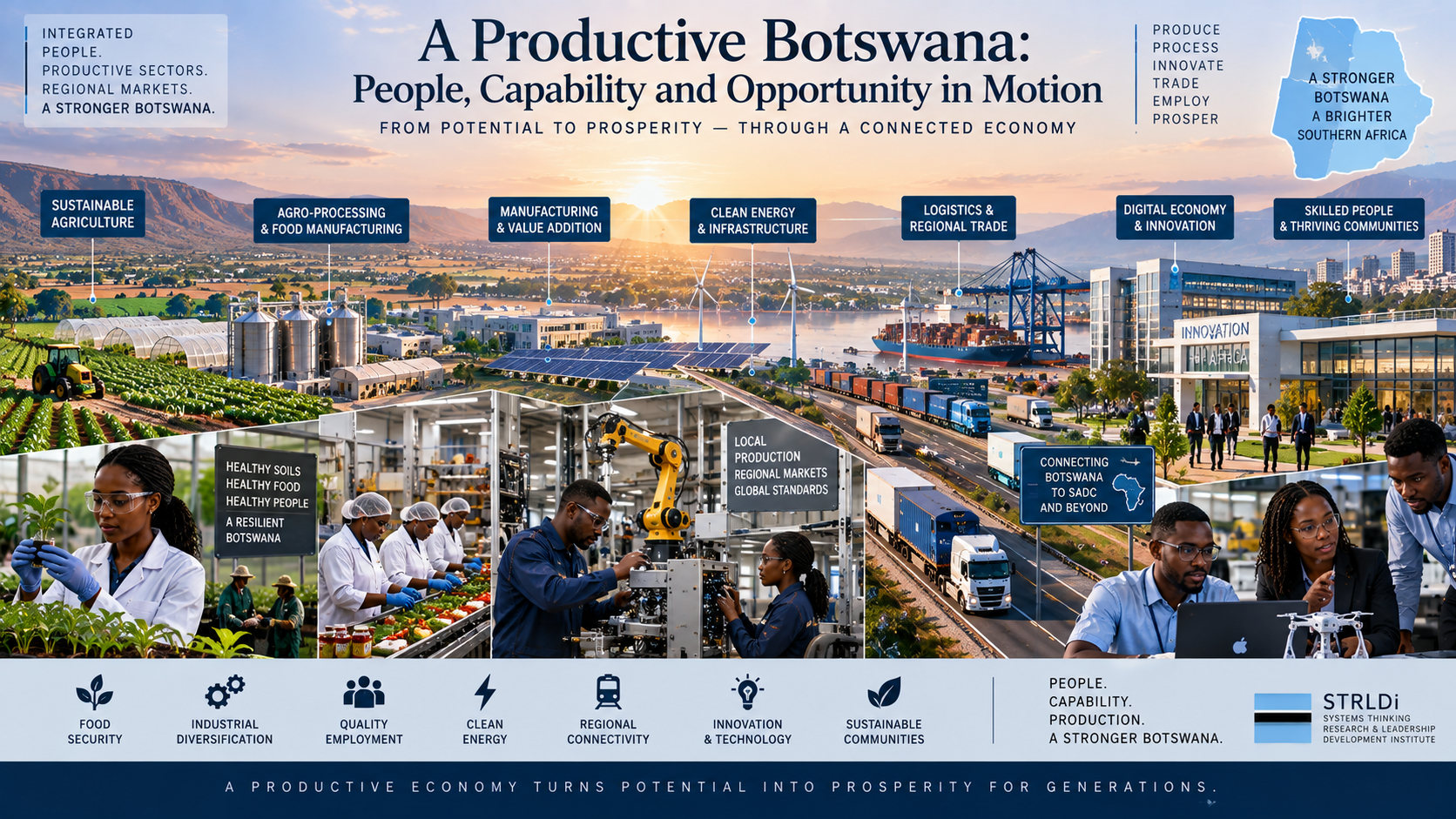
This distinction is important. STRLDi is not presenting Botswana’s official national manpower establishment. But Botswana cannot wait for an official establishment before beginning to see the scale of the future economy. The purpose of these numbers is to cause the country to look hard enough that it begins checking for itself.
Because once the numbers are visible, the questions change. The Presidency can ask whether the country has counted enough people. Ministers can ask whether their institutions possess enough technical capability. Education institutions can ask whether they are producing the people the economy will require. And the country can finally begin to plan backwards from the economy it must build rather than forwards from the institutions it already has.
The Economy Must First Be Seen As People
Botswana’s future economy will not be carried by institutions alone. It will be carried by people performing different functions at different points in the national system. Some people must see and plan the whole economy. Others must translate the plans into public execution. Others must physically produce, process, build, operate and move value through the system.
These are three different national requirements. They should not be confused with one another. A country can have people producing without sufficient coordination. It can have planners without sufficient execution. And it can have institutions executing activities without knowing whether those activities are moving the economy towards the productive capacity required by the population.
The STRLDi horizon model therefore begins by separating the economy into three broad capability populations:
Those who plan and direct.
Those who carry out and coordinate the plans.
Those who physically produce and move value.
Only when all three populations are counted can Botswana begin to see the actual size of the national economic task.
First, Someone Must See The Whole Economy
A farmer can see the farm. A manufacturer can see the factory. A logistics operator can see the goods moving through a route. A school can see the students passing through its classrooms. A ministry can see the programmes under its responsibility.
But who sees the whole movement?
Who sees the population entering the system? Who sees the future demand they will create? Who calculates the food, manufactured goods, infrastructure, energy, water, skills and productive capacity required to carry them? Who connects those requirements to the education system before the future workforce arrives?
That is the first workforce Botswana must count.
The First National Requirement: Those Who Plan And Direct
The initial STRLDi proxy identifies approximately 6,000 people required across national planning, sector planning, demand definition, capability forecasting, productive coordination and national economic direction. This number is not intended to describe 6,000 people sitting in offices producing reports.
These are the people required to make the economy visible.
They must be able to define national and sectoral demand. They must identify what Botswana needs to produce for itself and what it intends to supply beyond its borders. They must forecast productive requirements, identify skills, connect infrastructure, monitor bottlenecks and continuously adjust the national operating system as population, technology, markets and productive conditions change.
The requirement grows because the economy itself must grow in complexity and capability.
| National Planning & Direction | Today | 5 Years | 10 Years | 20 Years |
|---|---|---|---|---|
| Planning and Direction Personnel | 6,000 | 7,500 | 9,000 | 12,000 |
The number begins at 6,000 because planning itself is a national capability. Botswana cannot expect a future economy carrying more people, more productive sectors, more technology, more infrastructure and more regional trade to be continuously directed by an invisible or fragmented planning capability.
But Planning Does Not Make The Economy Move
A national plan does not grow food. It does not manufacture goods. It does not operate machinery. It does not move products across the country or into regional markets.
Someone must carry the plan through the system.
This is where Botswana’s public institutions enter the pipeline. Ministries, Sector Operator Units, Corridor Operators, standards institutions, public research institutions, infrastructure institutions and other national functions must translate economic direction into conditions under which production can actually occur.
This is not the same as asking whether institutions are busy.
The question is whether institutions are moving the productive pipeline.
The Second National Requirement: Those Who Carry Out The Plan
The initial STRLDi proxy identifies approximately 24,000 people required across public pipeline execution functions today. As the productive system expands, this rises towards approximately 32,000 personnel within five years, 42,000 within ten years, and 60,000 within twenty years.
These personnel sit across the functions required to turn national direction into economic movement. They include people capable of coordinating productive sectors, recognising technical capability, managing standards, connecting infrastructure, processing requirements, monitoring production conditions and removing institutional bottlenecks.
| Public Pipeline Execution | Today | 5 Years | 10 Years | 20 Years |
|---|---|---|---|---|
| Public Execution Personnel | 24,000 | 32,000 | 42,000 | 60,000 |
These numbers matter because the productive economy cannot move faster than the institutions through which it must pass.
A trained producer can be ready. A manufacturer can have the machinery. A farmer can have the land. But if the technical approval, infrastructure connection, standard, water requirement, power requirement, quality verification or other institutional function remains red, the productive system stops.
This is why the public sector cannot stand outside the productive economy and simply regulate it. It is part of the machinery that determines whether the economy moves.
The Public System Must Know What It Is Looking At
This creates a further requirement that Botswana has not sufficiently counted.
How many people inside the public system have sufficient STEM capability to recognise the productive skills the national pipeline requires?
The question matters because the future economy will become more technically demanding, not less. Agriculture is becoming increasingly scientific and technology-driven. Manufacturing requires growing familiarity with production systems, machinery, materials, automation and quality. Logistics increasingly depends on technology, data and complex systems.
The people planning and carrying out the national economic architecture cannot remain technically distant from the systems they are responsible for moving.
The more familiar public institutions become with the productive capabilities required by the national pipeline, the easier it becomes to recognise those capabilities when they appear. Skills can be assessed more intelligently. Infrastructure can be planned with greater precision. Standards can be applied with greater understanding.
The institutional lights begin to turn green faster and more often.
Then Comes The Largest Requirement: The People Who Produce
Planning and public execution create the conditions.
But the economy is ultimately carried by people who physically produce value.
These are the farmers producing raw materials. The manufacturers converting raw materials into goods. The engineers designing and improving systems. The technicians maintaining machinery. The machine operators running production lines. The quality specialists ensuring that goods meet standards. The logistics operators moving products from one point to another.
This is where the national pipeline finally becomes visible on the ground.
The initial STRLDi horizon proxy places the direct productive workforce requirement at approximately 200,000 people today. Within five years, the requirement rises towards approximately 365,000 people. Within ten years, the productive workforce requirement reaches approximately 620,000 people.
By the twenty-year horizon, the proxy points towards approximately 1,115,000 people directly engaged in the productive economy.
The Productive Economy Cannot Remain Small While The Population Grows
This is the number that should cause the country to stop.
Botswana cannot carry a significantly larger future population with a productive economy that expands only marginally. More people will require more food, more goods, more infrastructure, more energy, more services and more productive capacity. The productive system must therefore expand ahead of the population pressure arriving behind it.
The question is not whether Botswana needs one million additional government jobs.
It does not.
The question is whether Botswana can build a productive economy in which approximately 1.115 million people are directly engaged in producing, processing, manufacturing, building, maintaining, operating and moving value by the twenty-year horizon.
| Direct Productive Workforce | Today | 5 Years | 10 Years | 20 Years |
|---|---|---|---|---|
| Productive Workforce | 200,000 | 365,000 | 620,000 | 1,115,000 |
That is the size of the question.
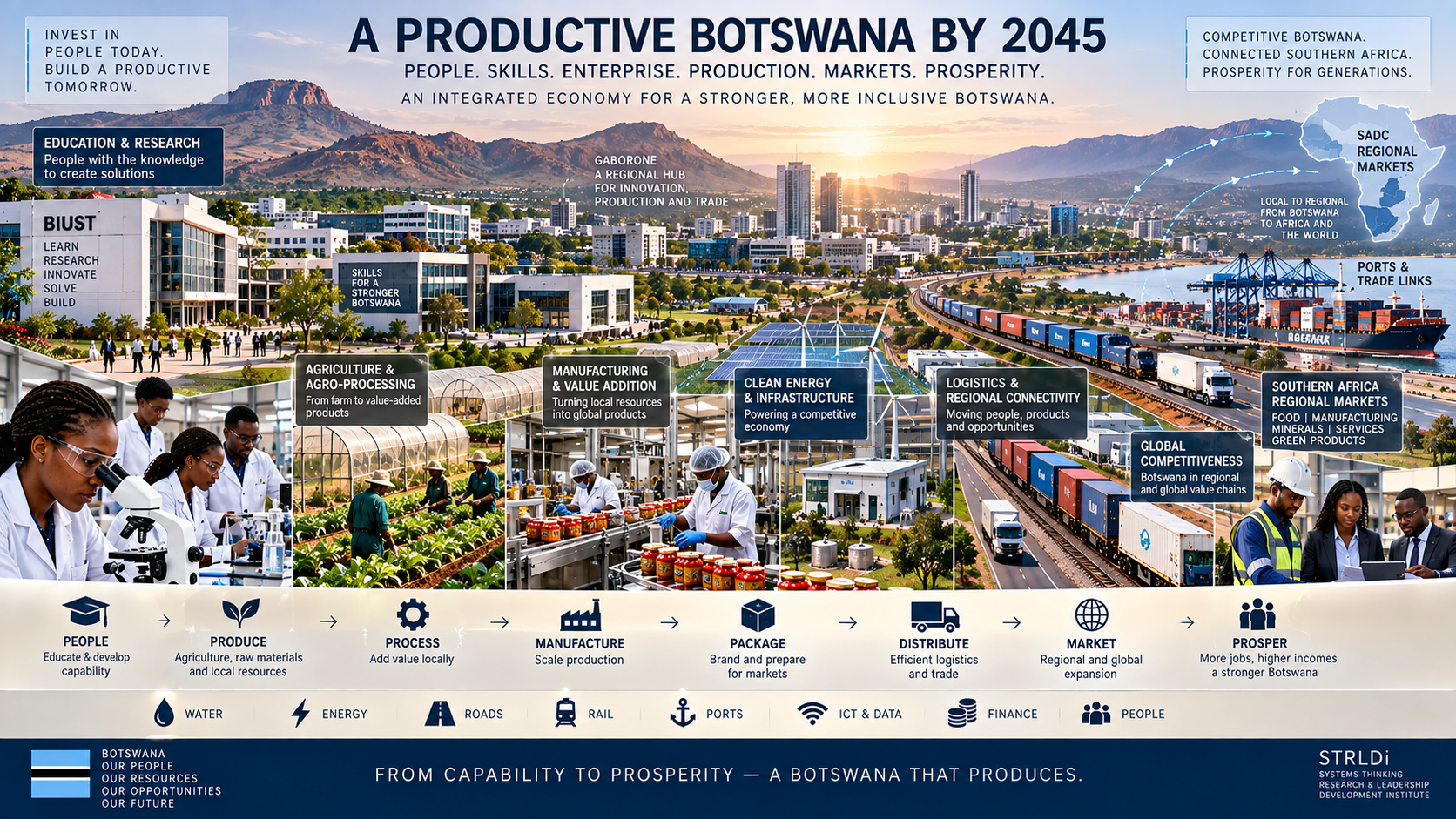
Where are these people going to come from?
The Economy Must Now Be Broken Open By Sector
The answer cannot remain hidden inside one national total.
A country does not produce one million people called “the workforce.” It requires people across specific productive sectors, performing specific functions, with specific capabilities. Agriculture requires a different combination of people from manufacturing. Manufacturing requires different capabilities from energy. Logistics requires different capabilities from construction.
This is why Botswana must begin counting its future workforce sector by sector.
The initial STRLDi productive workforce proxy is as follows:
| Productive Sector | Today | 5 Years | 10 Years | 20 Years |
|---|---|---|---|---|
| Agriculture & Primary Production | 80,000 | 130,000 | 190,000 | 300,000 |
| Agro-Processing | 12,000 | 25,000 | 50,000 | 100,000 |
| Manufacturing | 25,000 | 50,000 | 100,000 | 220,000 |
| Construction & Industrial Infrastructure | 20,000 | 35,000 | 60,000 | 100,000 |
| Energy, Water & Utilities | 8,000 | 15,000 | 25,000 | 45,000 |
| Transport & Logistics | 15,000 | 30,000 | 55,000 | 100,000 |
| ICT, Data & Industrial Services | 10,000 | 25,000 | 50,000 | 100,000 |
| Other Productive Services | 30,000 | 55,000 | 90,000 | 150,000 |
| TOTAL | 200,000 | 365,000 | 620,000 | 1,115,000 |
Now the future economy begins to take shape.
Agriculture Alone Requires A Much Larger System Than Farmers
Agriculture becomes the first place where the national numbers can be seen in detail.
The twenty-year horizon points towards approximately 300,000 people directly engaged across agriculture and primary production. But this number must not be imagined as 300,000 isolated farmers operating independently.
A productive agricultural economy requires producers, farm managers, technicians, soil specialists, irrigation personnel, equipment specialists, quality personnel, aggregation systems, and people capable of connecting production to processing and markets.
The farmer is one part of the productive system. The farm is not the whole pipeline.
This is why the STRLDi Agricultural Corridor architecture is important. It connects national demand to Sector Operator Units, Corridor Operators, production clusters, farmers, aggregation, logistics and markets. Every handover requires people, capability and physical capacity.
From The Farm, The Economy Must Keep Moving
Raw agricultural materials do not automatically become economic value.
They must be aggregated. They may require cleaning, grading, storage, processing, packaging, cold-chain systems and transportation. They may then enter manufacturing before reaching domestic, regional or international markets.
This is where the economy begins to multiply its productive workforce.
The movement from approximately 80,000 people in agriculture and primary production today towards 300,000 within twenty years therefore cannot be planned as an agricultural programme alone. It must be planned together with the processing, manufacturing, infrastructure, logistics and technical systems required to receive the output.
Otherwise Botswana can successfully increase production only to discover that it has nowhere for the production to go.
Manufacturing Is Where STEM Must Become Physical
The manufacturing numbers are equally important.
The STRLDi proxy moves manufacturing from approximately 25,000 people today towards 50,000 within five years, 100,000 within ten years, and approximately 220,000 within twenty years. This is not a call for Botswana to simply establish more small businesses.
It is a call to build productive capability capable of converting raw materials into completed goods at speed, volume and quality.
This is where the meaning of industrial engineering must be understood correctly.
The requirement is not limited to mining engineers or civil engineers. Botswana requires people capable of understanding the complete movement from raw material to finished product. Raw materials produced by people and the productive land must increasingly enter machinery and systems capable of producing completed goods at exceptional speed and consistency.
The Country Must Learn To See What It Already Uses
Batswana use vehicles.
Batswana wear clothes.
Batswana consume processed food.
Batswana use machinery.
Batswana drink coffee, wines and beverages.
Batswana use sauces, packaging, household goods, medical products, electronics and construction materials.
The question is therefore not whether people in Botswana use manufactured goods. The question is why so much of the knowledge required to produce those goods remains outside the national productive system.
Every product represents a production process.
Every production process represents knowledge.
Every machine represents engineering.
Every factory represents the organisation of people, technology, materials, energy, quality and logistics.
The future STEM architecture must enable Botswana to increasingly understand and participate in these processes rather than simply consume their outcomes.
The STEM Question Now Becomes Impossible To Avoid
Once the productive workforce requirement is placed on the table, the STEM question changes completely.
The country is no longer asking how many students should take science and mathematics because STEM is fashionable or because international development frameworks recommend it. Botswana must ask how much technical capability is required to operate the economy it intends to build.
The STRLDi proxy identifies approximately 76,050 STEM-capable personnel required across the productive system today. This rises to approximately 142,250 within five years, 248,000 within ten years, and approximately 457,250 within twenty years.
Nearly half a million STEM-capable people.
That is the number the country must now look at.
STEM Cannot Be Left Inside The Classroom
The STEM requirement must be distributed throughout the economy.
- It must exist in agriculture.
- It must exist in agro-processing.
- It must exist in manufacturing.
- It must exist in construction and infrastructure.
- It must exist in energy and water.
- It must exist in logistics.
- It must exist in ICT and industrial services.
- And critically, it must increasingly exist inside the public institutions responsible for planning and carrying the national pipeline.
The sectoral proxy makes the scale visible:
| STEM-Capable Workforce | Today | 5 Years | 10 Years | 20 Years |
|---|---|---|---|---|
| Agriculture & Primary Production | 24,000 | 39,000 | 57,000 | 90,000 |
| Agro-Processing | 5,400 | 11,250 | 22,500 | 45,000 |
| Manufacturing | 12,500 | 25,000 | 50,000 | 110,000 |
| Construction & Industrial Infrastructure | 8,000 | 14,000 | 24,000 | 40,000 |
| Energy, Water & Utilities | 4,400 | 8,250 | 13,750 | 24,750 |
| Transport & Logistics | 5,250 | 10,500 | 19,250 | 35,000 |
| ICT, Data & Industrial Services | 6,000 | 15,000 | 30,000 | 60,000 |
| Other Productive Services | 10,500 | 19,250 | 31,500 | 52,500 |
| TOTAL | 76,050 | 142,250 | 248,000 | 457,250 |
Now the education question has a destination.
Can Botswana Produce Half A Million STEM-Capable People?
This is where the country must now confront the education pipeline honestly.
If Botswana currently produces only a relatively small proportion of graduates with a reasonable level of STEM capability, then the question is no longer simply whether STEM results should improve. The question becomes whether the current education pipeline can physically produce the numbers required by the future economy.
The twenty-year horizon points towards approximately 457,250 STEM-capable people distributed across the productive system alone. This excludes the wider technical familiarity increasingly required within planning, public execution and supporting institutional functions.
Botswana must therefore begin counting backwards.
- How many STEM-capable people must be added each year?
- How many teachers must be capable of teaching them?
- How many teacher trainers are required?
- How many laboratories?
- How many technical institutions?
- How many apprenticeships?
- How many industrial placements?
- How many experienced practitioners must be brought back into education?
The future workforce cannot be produced by wishing harder.
This Is Why The STEM Architecture Must Begin Now
The twenty-year shift does not mean Botswana will wait twenty years before capability begins to appear.
That would be a misunderstanding of the architecture.
The first capabilities must begin appearing within the first five years.
The first five years are when Botswana builds the people and institutions capable of changing the education and economic pipeline. Experienced STEM professionals, including Batswana with demonstrated capability in industry, education, administration, research and technical practice, must be identified and positioned where their experience can begin reshaping the architecture.
By the second five-year period, the first major cohorts moving through the strengthened system should begin entering the wider productive economy.
By ten years, Botswana should be seeing the architecture changing the workforce on the ground.
By twenty years, the country should possess a significantly deeper domestic capability capable of reproducing itself.
The Four Capability Populations Must Now Be Built Together
The numbers also reveal that Botswana cannot depend upon one generation of students to carry the entire transition.
The country must work with four capability populations simultaneously.
- The first is the existing capability pool: experienced Batswana in the country and abroad, technical specialists, engineers, scientists, researchers, teachers and practitioners whose accumulated knowledge can immediately help build the national architecture.
- The second is the existing workforce: people already inside public institutions and productive sectors who require upgrading and repositioning as the national pipeline becomes more technically demanding.
- The third is the future workforce: children and young people moving through basic education, secondary education, TVET, universities, apprenticeships and practical industry experience.
- The fourth population is perhaps the most important of all: the people who build the other three.
Who Will Build The People Who Must Build The Economy?
Teachers cannot be treated as an afterthought.
Teacher trainers cannot be treated as an administrative support function.
Curriculum architects cannot be isolated from the economy they are preparing people to enter.
Assessment cannot measure only whether students remember what was taught if the national objective is to determine whether they can understand, apply, design, solve and produce.
The people building the capability pipeline are themselves the first capability pipeline Botswana must strengthen.
That is why the proposed STEM Council and Capability Architecture are not simply education reforms.
They are part of national economic infrastructure.
When The Numbers Are Put Together, The National Task Becomes Visible
The three major capability populations can now be placed together.
| Core Economic Capacity | Today | 5 Years | 10 Years | 20 Years |
|---|---|---|---|---|
| National Planning & Direction | 6,000 | 7,500 | 9,000 | 12,000 |
| Public Pipeline Execution | 24,000 | 32,000 | 42,000 | 60,000 |
| Direct Productive Workforce | 200,000 | 365,000 | 620,000 | 1,115,000 |
| TOTAL CORE CAPACITY | 230,000 | 404,500 | 671,000 | 1,187,000 |
The STEM-capable workforce must then be developed through and alongside this system.
At the twenty-year horizon, Botswana is not simply looking at a larger population.
It is looking at the requirement to carry more than 1.18 million people across the core functions of planning, public execution and direct productive activity.
And approximately 457,250 STEM-capable people must increasingly form part of the productive capability required on the ground.
Now The Question Must Reach The Presidency
These numbers are not intended to alarm Botswana into paralysis.
They are intended to prevent Botswana from being alarmed later by a future it could already see coming.
The country does not have to build everything tomorrow.
But it must know what tomorrow requires today.
A twenty-year requirement can be broken into five-year movements. A ten-year capability requirement can be translated into annual education output. A workforce requirement can be broken into sectors. A sector requirement can be broken into occupations. Occupations can be translated into capabilities.
And those capabilities can finally be translated into:
teachers, trainers, curriculum, laboratories, technical institutions, apprenticeships, industrial experience and national investment.
The Shift Does Not Need To Alarm Botswana
The shift is large.
But large does not mean impossible.
The country does not need to find 1.18 million people tomorrow morning. It does not need to produce half a million STEM-capable people in a single year. It does not need to build every factory, laboratory, corridor and productive system at once.
- It needs to begin moving deliberately and at the right scale.
- The first requirement is to count.
- The second is to define.
- The third is to build backwards.
- And the fourth is to keep moving before the ground moves further away.
The Alarm Should Come When Botswana Refuses To Count
The real danger is not discovering that the country requires more capability than it currently possesses.
Every country building a more sophisticated economy discovers capability gaps.
The real danger is refusing to see the gap until population pressure, unemployment, technological change and global competition have already widened it.
The alarm should not be the number.
The alarm should be discovering twenty years from now that Botswana knew people were coming, knew the global economy was moving, knew its productive system required greater technical capability—and still did not count what it needed to build.
That is the price future generations should not be asked to pay.
The Decision Is Now Simple
Botswana can continue to speak about STEM, employment, diversification and economic transformation as separate national conversations.
Or it can begin connecting them.
- Population tells us how many people are coming.
- Demand tells us what they will require.
- The productive sectors tell us what must be produced.
- The workforce numbers tell us how many people are required.
- STEM tells us what level of capability must increasingly exist throughout the system.
- Education tells us how the capability must be reproduced.
- And the National Economic Operating System tells us how the whole country can begin moving together.
That is the pipeline.
And now, for the first time, the pipeline is beginning to show not only how Botswana must move—but how many people Botswana must carry as it moves.
The Missing Pathway to Prosperity
A country cannot indefinitely educate, qualify and raise the expectations of its population without also expanding the productive pathways through which people can build a future. When the economy does not create sufficient opportunities to produce, invent, manufacture, build enterprises and solve real problems, the search for prosperity does not disappear. It simply moves elsewhere.
This is where Botswana must take a harder look at the horizon. A population that cannot see a credible pathway from education to productive participation may increasingly become vulnerable to speculative pathways to wealth—quick-return schemes, gambling behaviour, unsustainable financial speculation, pyramid structures and other forms of economic activity built around the hope of getting rich without producing anything of lasting value.
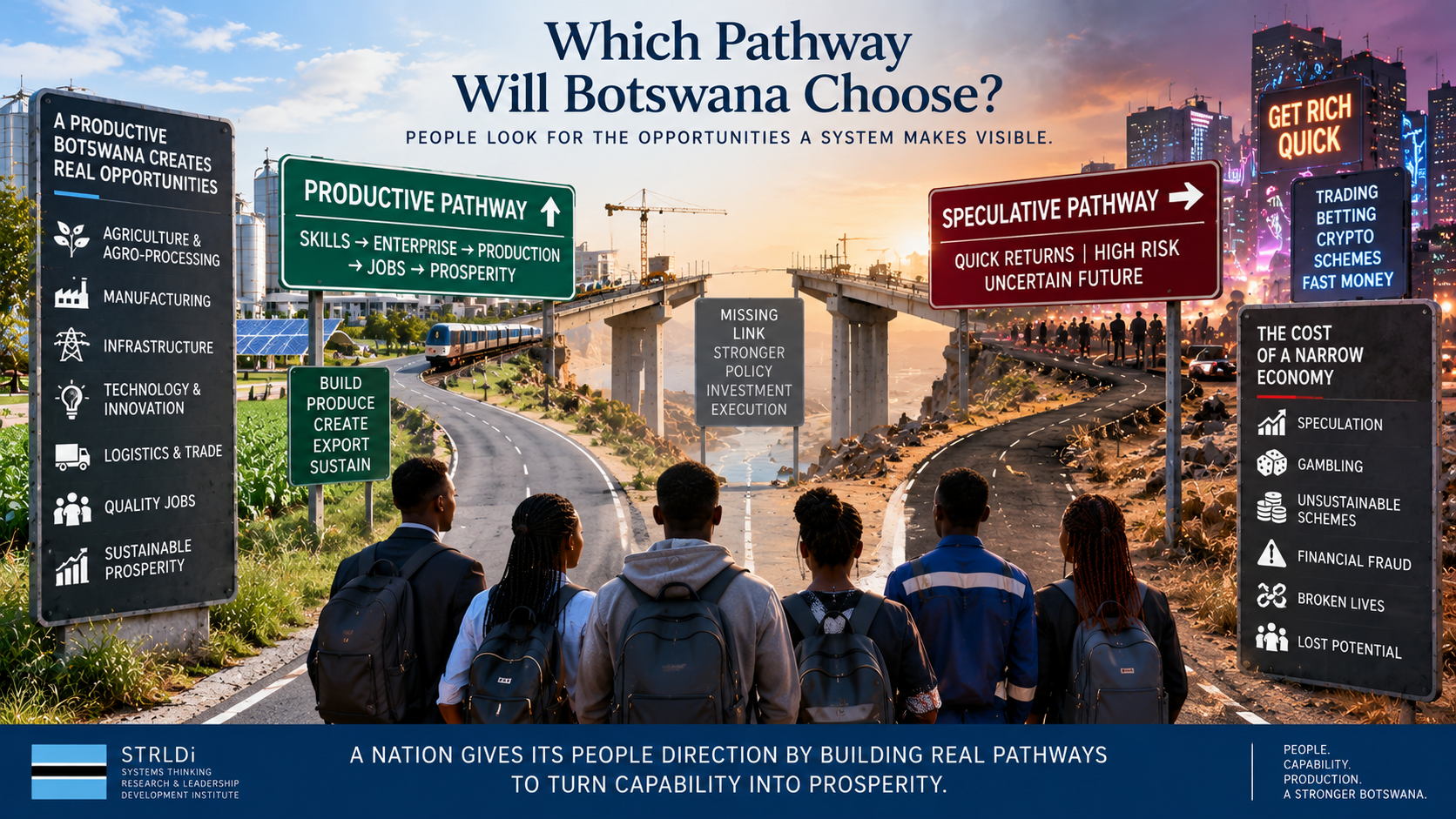
The issue is not simply individual behaviour or poor decision-making. People respond to the pathways they can see. If productive enterprise appears slow, inaccessible or unrewarding, while speculative opportunities promise immediate returns, some people will inevitably move towards the latter. A nation must therefore ask itself a more difficult question: What economic pathways are we placing in front of our people—and what are we leaving them to invent for themselves?
This is why the STEM question is larger than education. Botswana does not simply need young people who can pass science, mathematics, engineering and technology subjects. Botswana needs an economy capable of giving those capabilities somewhere productive to go. Otherwise, the country may continue producing educated people with increasing expectations while leaving the productive architecture required to absorb their knowledge dangerously underdeveloped.
The alternative to speculation is not telling people not to speculate. The alternative is building a visible productive pathway through which people can see how knowledge, skill, enterprise, invention and work can lead to prosperity.
↗️THE COUNTRY CANNOT AFFORD TO DISCOVER ITS NEEDS TOO LATE
Botswana cannot wake up in 2040 and suddenly discover that it needs engineers. It cannot arrive at the point of industrial expansion and then discover that there are insufficient production managers, technicians, quality specialists, engineers or mathematics teachers. By the time the shortage becomes visible inside the economy, the education system may already be ten or twenty years behind the requirement.
That is the nature of human capability. A laboratory can be built within a relatively short period; a highly capable science teacher takes years to develop. A computer can be purchased immediately; a mathematician capable of teaching children to think mathematically cannot be purchased in the same way.
A productive workforce is not manufactured overnight.
The country therefore has to see capability as a national production system. Children enter the system today, teachers develop over time, technical capability deepens through practice, enterprises become more sophisticated and institutions learn how to carry increasingly complex work. If Botswana waits until the economy demands the capability at scale, it will already be late.
This Is Where The Shock Must Come
The shock Botswana needs is not that building national capability will take twenty years.
The shock should be that the country will spend the next twenty years doing something anyway.
It can spend twenty years responding to unemployment after it appears. It can spend twenty years managing the consequences of insufficient capability, training people for opportunities that have not yet been deliberately created and importing expertise that Botswana could have begun building within its own population.
It can spend twenty years watching talented Batswana leave because the productive economy has insufficient room for what they can do. Or it can spend twenty years constructing the mathematical, scientific, technical, engineering and productive capability that allows the next generation to enter a fundamentally different economy.
That is the choice Botswana faces.
And this is why the shift should not alarm the country. The alarm should come when Botswana decides not to make the shift and discovers, twenty years later, that the world continued moving while the country remained organised around capabilities the future no longer rewards.
The Most Important Question: Who Does Botswana Already Have?
Before Botswana spends billions searching for solutions outside its borders, the country should first conduct a serious national search for the capability it already possesses. There are Batswana who have demonstrated exceptional ability in mathematics, science, engineering, technology, technical fields, research and specialised professions over decades of work, academic achievement and professional performance.
Some are inside Botswana. Some are working overseas. Some have spent their professional lives inside industries and institutions whose level of technical complexity Botswana has not yet created sufficiently at home.
And some are now approaching the point at which they will retire.
Botswana must ask itself a difficult question.
What happens if a country spends decades producing, educating and exposing capable people to the world—and then allows their accumulated knowledge to leave the productive life of the nation without deliberately transferring it into the next generation?
That is not simply a retirement question.
It is a national capability question.
The 45–55 Capabilty Window
The proposal requires Botswana to deliberately identify Batswana approximately within and around the 45–55 age range, together with others approaching retirement, who have demonstrated exceptional STEM capability through sustained records of achievement. The identification should not depend simply on academic qualifications, titles or institutional seniority, but on what the individual has actually demonstrated an ability to understand, build, solve, design, manage, teach, discover or improve.
This group may contain engineers who have worked on complex systems, scientists who have undertaken advanced research, mathematicians, technology specialists, technical professionals, manufacturing experts, agricultural scientists, researchers, educators and Batswana who have acquired capabilities inside international organisations and industries. The country must find them before their accumulated knowledge simply disappears from the national system.
Not all of them should become classroom teachers.
That would be another mistake.
Botswana should instead ask where each person’s capability creates the greatest multiplication effect.
Do Not Bring Them Home To Fit Into The Old Box
This is where the national architecture must become bold.
Botswana should not invite highly capable people back into the country merely to place them inside ordinary administrative structures and ask them to conform to salary scales and job descriptions that were never designed for the work they are capable of doing. The country would be importing or recovering capability, only to reduce it to fit inside the very structures that failed to produce sufficient capability in the first place.
The question should not be:
What position can we give this person?
The question should be:
What part of Botswana’s future capability can this person help us build?
That distinction is enormous.
A highly capable engineer may not be most valuable teaching thirty children in a classroom. That same engineer may be capable of designing a national technical curriculum, developing two hundred teachers, creating apprenticeship standards, redesigning engineering learning environments and helping establish the relationship between schools, technical institutions and productive enterprises.
Botswana must therefore stop thinking only in terms of positions and begin thinking in terms of national capability production.
The Proposal: A National STEM Capability Architecture
Botswana should establish a National STEM Capability Architecture whose purpose is to build the mathematical, scientific, engineering and technical capability required to improve the nation’s economic performance over the next twenty years. This should not be another project sitting temporarily within one ministry, dependent upon the political cycle or changing whenever an administrator changes.
It should be treated as a long-term national capability system.
The system should identify exceptional Batswana first and place them where their knowledge can multiply through the national architecture. Where Botswana does not possess sufficient capability locally, the country should deliberately recruit international specialists—not as permanent substitutes for Batswana, but as capability builders with a clear national knowledge-transfer responsibility.
The architecture should be designed to answer one question every year:
Is Botswana becoming more capable of producing and sustaining the economy it says it wants?
If the answer is no, the system must be able to show where the capability pipeline has broken.
The First Principle: Build The People Who Build The People
This is where Botswana can become dramatically smarter.
The country should not focus first on how many children can be placed into STEM programmes. It should focus on who will build the teachers, who will design the learning architecture, who will determine the mathematical progression, who will construct the assessment systems and who will connect STEM learning to the productive economy.
The people who build the people are the first production constraint.
The STRLDi capability work already identifies teachers as a national production constraint because the specialist capability of teachers must precede the workforce those teachers are expected to produce. If Botswana requires significantly larger numbers of mathematically, scientifically and technically capable people, then it must first establish the people capable of producing them at scale. (National Strategy Firm)
This means that the country’s strongest people should not automatically disappear into retirement or remain isolated within private careers. Some should become the national capability builders responsible for transferring what they know into teachers, institutions, curriculum systems and ultimately generations of Batswana.
That is where the transformation begins.
THE CENTRAL QUESTION
Can Batswana get their STEM right?
Yes.
But Botswana must stop treating STEM as something the education system does to children and begin treating STEM capability as something the entire nation deliberately builds for the future economy. The country must work backwards from the economic performance it intends to achieve, identify the productive sectors and occupations required, calculate the human capability required and then build the education architecture capable of producing those people before the economy reaches the point at which it desperately needs them.
The country already has a starting advantage.
There are Batswana who have spent decades acquiring knowledge, experience and capability. Some are still working. Some are overseas. Some are approaching retirement.
Botswana’s first act of intelligence may therefore be to recognise its own intelligence.
The next question is no longer whether the country has capable people.
The next question is whether Botswana has the national architecture intelligent enough to find them, organise them, protect their work from short-term interference and allow them to build the people who will build the future. (National Strategy Firm)
THE QUESTION PRESIDENT KHAMA ASKED
Can Batswana Get Their STEM Right?
This question is much larger than education.
It is larger than examination results, science laboratories, mathematics classrooms or the number of students graduating with qualifications. President Khama’s question reaches into the productive capability of the nation itself. Can Botswana deliberately produce the mathematical, scientific, technical and engineering capability required to build the economy that will sustain its people?
The answer is yes.
But Botswana will not get there by continuing to treat STEM as another department within an education system that was designed for a different economic era. The country must decide whether STEM is simply a collection of subjects, or whether it is part of the national production architecture through which Botswana develops the people capable of building, operating, improving and renewing its economy.
The Country Must Start With an Uncomfortable Truth
Botswana cannot wait for an advanced economy to appear before deciding to produce the people required to operate one.
It cannot wake up in 2040 and discover that it needs mathematicians. It cannot wait until manufacturing expands before deciding that it needs production managers, engineers, technicians, quality specialists and people capable of designing and operating increasingly complex systems.
That sequence is backwards.
Capability must sometimes come before the job because capability itself can become one of the conditions required for the job, enterprise and investment to emerge. This is the structural argument developed in STRLDi’s What Are We Creating?: Botswana must work backwards from the productive economy it intends to create, through the occupations required, to the capabilities required, and finally to the education system that must produce them. (National Strategy Firm)
↗️THE STRUCTURAL TRAP BOTSWANA MUST BREAK
The Job Cannot Always Come First
Few productive enterprises create few productive jobs.
Few productive jobs discourage young people from entering particular fields. Fewer people enter those fields, investors struggle to find the capability required, investment remains constrained, and the shortage of productive enterprises continues.
Then the country looks at the absence of jobs and asks:
Why train people for jobs that do not yet exist?
But the investor can equally ask:
Why build here when the people required to operate the system do not yet exist?
That is the reinforcing structure Botswana must deliberately break.
The Nation Must Build Capability Before the Shortage Becomes Permanent
The education system must therefore stop looking only backwards at what the economy currently demands.
Its responsibility is to see the economy that Botswana intends to create and begin producing the human capability required to operate it. Mathematics, science, engineering, technology and technical capability must become part of a twenty-year national production programme, not a series of disconnected education projects.
Botswana’s current institutional system already contains important functions across curriculum development, STEM education, educational research, inspectorate services, teacher administration, educational technology and planning. The problem is not necessarily that these functions do not exist; the problem is whether they are being deliberately integrated around one measurable national capability outcome. (Government of Botswana)
↗️THE OVERARCHING NATIONAL ARCHITECTURE TO STEER STEM DEVELOPMENT
Botswana cannot expect STEM development to steer itself simply because different institutions are responsible for education, skills, qualifications, research, science and technology. The future STEM requirement of the country crosses institutional boundaries, beginning with the productive economy and moving through human capability, tertiary education, technical training, schools, teachers and the population already outside the formal education system.
The country therefore requires an overarching national architecture capable of continuously connecting these movements. Its purpose is not to create another layer of bureaucracy. Its purpose is to ensure that Botswana continues to know what STEM capability it requires, in what numbers, for which productive purposes and how that capability must be developed as the ground continues to move.
This architecture should be deliberately small at its centre, but capable of reaching across the national system. The initial proxy proposed here is a core national steering capability of approximately 75–100 people, organised around one National Steering Group and three connected Councils.
THE CORE NATIONAL STEERING CAPABILITY
| National Steering Function | Indicative Number |
|---|---|
| National Steering Group | 30–40 |
| Productive Economy Council | 15–20 |
| Human Capability and STEM Council | 15–20 |
| Adult Capability and Transition Council | 15–20 |
| TOTAL CORE STEERING CAPABILITY | 75–100 |
These should not be understood as four separate committees operating independently from one another. Together, they provide the national capability required to see the economy Botswana is building, the people required to carry it, the STEM capability required to support it and the existing population that must transition with the country.
The numbers are deliberately modest. The purpose is not to place hundreds of people at the centre of government. The purpose is to ensure that sufficient capability exists to see the relationships that no single Ministry or institution can be expected to hold alone.
1. THE NATIONAL STEERING GROUP — 30–40 PEOPLE
The National Steering Group provides the overarching direction required to keep STEM development connected to Botswana’s wider national requirements. Its responsibility is to see the relationships between the changing productive economy, human capability, STEM development and the institutions responsible for carrying them.
Its work is to ensure that Botswana does not calculate its future capability requirements once and then leave them inside a report. As the world changes, the country must continue to ask what is changing, what new capability is required, what capability is becoming insufficient and whether the national system is moving quickly enough.
The Group must therefore be capable of seeing the movement, connecting the requirements and keeping the national direction visible. It does not replace Ministers or existing institutions. It ensures that the future requirement does not disappear between them.
2. THE PRODUCTIVE ECONOMY COUNCIL — 15–20 PEOPLE
STEM cannot be steered without understanding the productive economy it is expected to support. The first Council therefore ensures that the changing productive requirements of Botswana remain visible to the national capability system.
Its central question is:
What must Botswana become capable of building, producing, operating and improving?
The answer affects the science, mathematics, engineering, technology and technical capability the country must develop. If Botswana intends to build increasingly complex productive sectors, it must know what capabilities those sectors require before expecting the education system to produce them.
This Council therefore connects STEM development to the productive future. It helps ensure that Botswana does not develop capability merely because it is fashionable, while failing to develop the capabilities required by the economy the country itself intends to build.
3. THE HUMAN CAPABILITY AND STEM COUNCIL — 15–20 PEOPLE
The Human Capability and STEM Council focuses directly on the national question of what Batswana must become capable of doing. Its responsibility is to translate changing national requirements into the human capability that Botswana must deliberately develop.
Its central question is:
What mathematical, scientific, engineering, technological and technical capability will Botswana require—and how will the country build it at the scale required?
This requires the Council to look across the entire capability pathway. It must understand the relationship between tertiary institutions, technical education, schools, curriculum, mathematics, science, teachers, research and the wider systems responsible for developing capability.
Its responsibility is therefore larger than advocating for more STEM subjects. It must help Botswana continuously understand the depth, direction and scale of STEM capability required as the productive economy grows and changes.
4. THE ADULT CAPABILITY AND TRANSITION COUNCIL — 15–20 PEOPLE
Botswana cannot prepare for the future by concentrating only on children and young people currently moving through the education system. The country must also understand what happens to the population already here.
The Adult Capability and Transition Council therefore focuses on the existing workforce, unemployed population, experienced professionals and adults whose skills and capabilities may require upgrading as the productive economy changes.
Its central question is:
How does Botswana carry the people it already has into the productive economy ahead?
This includes recognising existing capability, identifying skills that can be built upon and determining where adults require new scientific, technical and productive capability. Without this deliberate transition pathway, Botswana could redesign its future education system while leaving a significant part of its existing population outside the economy it is trying to build.
THE PUBLIC SYSTEM MUST ALSO DEVELOP THE CAPABILITY TO STEER
The development of a STEM-intensive productive economy has another implication that Botswana must now confront. The public institutions responsible for planning, recognising, assessing, regulating and supporting the national pipelines must themselves increasingly possess sufficient STEM and technical familiarity.
A country cannot consistently recognise capabilities it does not understand. It cannot confidently assess increasingly complex technical proposals, recognise emerging skills or regulate new productive activities if the institutions carrying those responsibilities remain technically distant from the capabilities appearing before them.
The more familiar public institutions become with the scientific, engineering, technological and technical capabilities required by Botswana’s productive pipelines, the better able they will be to recognise them, support them and help the national system move faster.
This does not mean that every public officer must become an engineer or scientist. It means that Botswana must deliberately build sufficient STEM and technical depth within the public system to ensure that the people responsible for steering, planning and recognising capability can understand what they are looking at.
BOTSWANA ALREADY HAS INSTITUTIONS — BUT THEY MUST NOW BE EXAMINED AGAINST THE FUTURE REQUIREMENT
Botswana does not begin from an institutional vacuum. The country already has Ministries, authorities, councils, universities, technical institutions, research bodies and public organisations responsible for different parts of education, skills, qualifications, science, technology and economic development.
But the existence of an institution and the existence of a mandate should not automatically be confused with readiness for the future requirement now emerging.
An institution may be carrying out its current mandate effectively while still lacking the shared national picture, STEM depth or future capability required to carry the next stage of Botswana’s development. The national task is therefore not simply to tell institutions to work together. It is first to establish what they must together become capable of seeing and carrying.
The detailed institutional mapping accompanying this article therefore proposes that Botswana examine its existing institutions against the national STEM and capability requirement—not to assume failure, but also not to assume readiness where readiness has not yet been tested.
STEERING STEM IS A CONTINUOUS NATIONAL RESPONSIBILITY
The proposed architecture is necessary because STEM development cannot be treated as a once-off reform. The productive economy will continue to change. Technology will continue to change. Scientific capability will continue to deepen. The skills required today will not necessarily be sufficient tomorrow.
Botswana therefore requires the ability to continuously observe these movements and adjust its national capability development accordingly. The purpose of the architecture is to give the country the capacity to continue asking the right questions before capability shortages become national crises.
The wider National STEM Capability Architecture can then carry the work of developing capability through education, teacher development, curriculum, assessment, research and delivery. The Steering Architecture ensures that the country continues to understand why that capability is required, where it is required and how the requirement is changing.
THE QUESTION BEFORE NATIONAL LEADERSHIP
The question before Botswana is therefore no longer simply whether more learners should study STEM.
The question is whether the country is prepared to establish the national capability required to continuously determine what STEM Batswana will need to know, build, operate and create as the productive economy moves forward.
The initial numbers are clear:
30–40 people
to provide overarching national steering.
15–20 people
to keep the productive economy connected to capability.
15–20 people
to steer human capability and STEM development.
15–20 people
to ensure that the existing population transitions with the country.
Approximately 75–100 people to provide the core national capability required to continuously steer the STEM requirement.
The detailed composition, existing institutional landscape and capability requirements are set out in the accompanying Appendix.
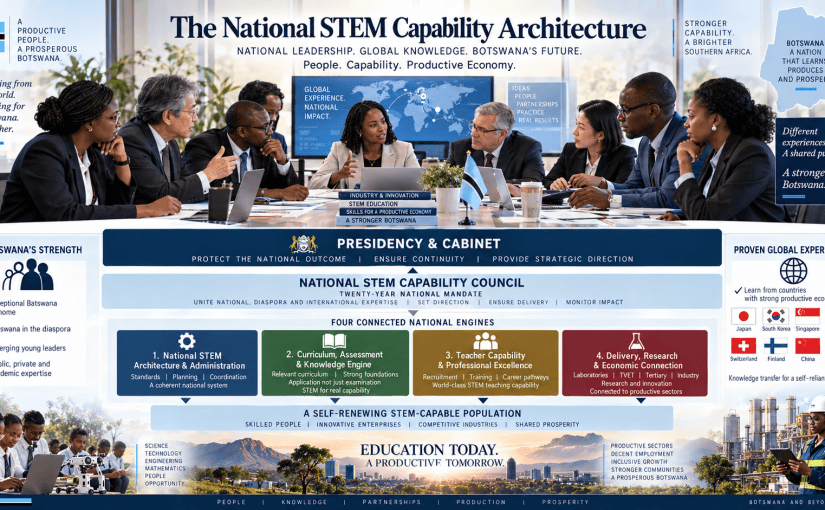
↗️THE NATIONAL STEM CAPABILITY ARCHITECTURE
A Country Cannot Transform STEM Through One Ministry Alone
The proposed architecture should therefore sit above the normal cycle of ministerial programmes.
STEM capability development should become a national strategic function, with Presidential and Cabinet-level protection, because the capability being produced will determine the country’s future productive capacity. Education remains central, but it cannot carry the architecture alone because the outcome belongs equally to industry, agriculture, energy, technology, research, labour and national economic development.
The architecture should contain four connected engines.
| National Engine | Primary Responsibility | National Outcome |
|---|---|---|
| 1. National STEM Architecture & Administration | National standards, capability requirements, long-term planning | One coherent national architecture |
| 2. Curriculum, Assessment & Knowledge Engine | Curriculum design, mathematics and science standards, assessment | Students develop real capability, not examination memory |
| 3. Teacher Capability & Professional Excellence Engine | Teacher recruitment, development, specialist career pathways | World-class STEM teaching capability |
| 4. Delivery, Research & Economic Connection Engine | Laboratories, workshops, tertiary institutions, industry and research | STEM capability connects to productive activity |
These four engines must not operate as four new bureaucracies.
They are four national functions within one architecture. Their purpose is to ensure that administration does not design without knowledge, curriculum does not operate without capable teachers, teachers are not trained without the infrastructure required to teach, and students are not developed without a clear connection to the productive economy they are expected to enter.
The Presidency Must Protect the Outcome
A National STEM Capability Council should be established with a twenty-year mandate.
Its responsibility should not be to manage schools day by day. Its responsibility should be to protect the national outcome, review the capability pipeline annually, ensure continuity across political terms and intervene when the system begins drifting away from its purpose.
This is where national security enters the discussion.
A country that cannot produce sufficient mathematical, scientific and technical capability eventually becomes dependent on others to design, operate, repair and develop increasingly important parts of its productive system. That dependence may not appear dangerous when the economy is simple; it becomes increasingly serious as technology, energy, production, infrastructure and national systems become more complex.
↗️WHEN THE CAPABILITY BEGINS TO SHOW
The twenty years represents the period required to embed, multiply and mature the capability architecture across generations. It is the time horizon for Botswana to move from dependency and fragmentation towards a self-renewing national STEM capability system.
Years 1–2: Botswana Begins Using Capability It Already Has
The first capability appears immediately, because Botswana is not starting with nothing.
The National STEM Capability Corps would identify and mobilise Batswana who have already demonstrated exceptional capability in mathematics, science, engineering, technology, research, teaching and industry. The country begins benefiting from existing capability in Year 1, particularly in administration, curriculum design, assessment, teacher training and national STEM architecture.
Foreign specialists would also begin filling critical gaps during this period.
So the first question is not:
“When will Botswana become capable?”
The first question is:
“How quickly can Botswana organise the capability it already possesses?”
Years 3–5: The First Structural Shift Becomes Visible
By Years 3 to 5, Botswana should begin seeing the first visible change inside the education architecture.
Specialist teachers would be teaching, teacher trainers would be developing other teachers, curriculum changes would be moving through schools, and a new assessment system would begin measuring deeper mathematical, scientific and technical capability.
This is also when the first economic effects should begin to emerge.
Better teaching produces stronger learners. Stronger learners enter tertiary, technical and professional pathways differently. Existing industries begin gaining better access to developing capability, while Botswana becomes increasingly capable of identifying where its next productive gaps will emerge.
By Year 5, Botswana should expect to see:
| Capability Area | What Should Begin Showing |
|---|---|
| National leadership | Clear STEM capability architecture |
| Teachers | First specialist teacher corps established |
| Curriculum | Stronger mathematics and science progression |
| Assessment | Shift towards reasoning and application |
| Students | Improved capability beginning to emerge |
| Tertiary education | Stronger connection to national capability requirements |
| Industry | Better identification of future skills gaps |
| Diaspora | Proven Batswana capability integrated into the system |
The country should not wait five years to see everything. It should see the system beginning to move within the first two years and visible structural change by Year 5.
Years 6–10: Capability Begins Multiplying
This is where the architecture becomes more powerful.
The people recruited during the first five years are no longer working alone. Teachers they trained are now teaching others. Teacher trainers are producing more teacher trainers. Curriculum specialists are improving the curriculum based on evidence.
This is when Botswana begins moving from importing and organising capability to multiplying capability.
The first cohorts who entered a strengthened system earlier in their education will begin moving into tertiary institutions, technical education, apprenticeships, research and employment. At the same time, the productive economy should increasingly be connected to the capability pipeline rather than simply complaining about skills shortages after they emerge.
By Year 10, Botswana Should See a National Difference
By this point, the change should no longer be confined to individual schools or programmes.
Botswana should have a recognisable STEM architecture, a specialist teaching profession, stronger teacher development capability, improved assessment, clearer connections between productive sectors and education, and a growing domestic base of people capable of leading the system.
This is where the nation should begin seeing capability become an economic variable rather than simply an education outcome.
That distinction is critical to your argument.
Years 11–15: The Economy Begins Receiving the New Generation
This is where the deeper national effect begins.
Children who entered the strengthened system earlier are now moving into universities, technical institutions, enterprises, research environments and productive sectors. The country should begin receiving a generation with stronger foundations in mathematics, scientific reasoning, technology and technical problem-solving.
But there is an important warning here.
Education capability alone will not transform the economy.
If Botswana produces stronger STEM capability without simultaneously expanding productive sectors, enterprises, research, technology, manufacturing and other economic opportunities, the country may simply become better at producing people for other countries.
This is why your argument is stronger than a STEM education reform proposal.
The STEM architecture must move together with the productive sector architecture.
Years 16–20: The Capability Becomes Self-Renewing
The final period is not when capability suddenly starts.
It is when Botswana should increasingly have the ability to renew the capability without depending structurally on the original intervention. The country should be producing its own curriculum leaders, specialist teachers, teacher trainers, assessment experts, researchers, engineers and technical professionals at sufficient scale.
Foreign experts should increasingly become collaborators rather than permanent substitutes.
The diaspora capability programme should increasingly become a two-way international knowledge network rather than a rescue mechanism.
That is what the twenty years is really buying Botswana: the ability to continue building capability after the original national push has matured.
THE REAL CAPABILITY TIMELINE
| Period | What Happens | Capability Stage |
|---|---|---|
| Year 1 | Identify and mobilise existing Batswana capability | Capability organised |
| Years 1–2 | Specialists and foreign experts begin rebuilding architecture | Capability activated |
| Years 3–5 | Teachers, curriculum and assessment begin changing | Capability becomes visible |
| Years 6–10 | Teachers and institutions begin multiplying capability | Capability expands |
| Years 11–15 | Stronger cohorts enter tertiary and productive systems | Capability enters the economy |
| Years 16–20 | Domestic system increasingly renews itself | Capability becomes self-sustaining |
THE MOST IMPORTANT POINT FOR THE PRESIDENCIES
I would therefore change the language in the report.
We must not allow a President or Minister to hear “twenty years” and conclude that Botswana is being asked to wait twenty years for results.
I would say:
Botswana will begin seeing capability immediately because the country already possesses people with exceptional capability. Within five years, the national architecture should begin visibly changing teaching, curriculum and assessment. Within ten years, Botswana should see capability multiplying across the system. Within fifteen years, a new generation should increasingly be entering the productive economy. Twenty years is the period required not to begin capability, but to embed it deeply enough that the nation can renew its own capability for generations to come.
USE THE PEOPLE BOTSWANA HAS ALREADY PRODUCED
The Country Should Stop Looking Only at Young Graduates
Botswana has spent sixty years producing people.
Some are inside the country. Some are overseas. Some have worked in universities, laboratories, engineering firms, technology companies, manufacturing organisations, financial institutions, research centres and international institutions.
Others have demonstrated exceptional STEM capability over decades but are approaching the point at which the formal system begins to think about retirement.
This may be one of the greatest untapped national assets Botswana possesses.
The country should establish a National STEM Capability Corps focused initially on Batswana approximately between the ages of 45 and 55, while remaining open to exceptional individuals outside that range. This is not a retirement programme; it is a national knowledge mobilisation programme designed to bring proven capability into the architecture at the point where the country needs it most.
Not Everyone Must Return to the Classroom
This is important.
A scientist who has spent twenty years conducting research should not automatically be told to become a secondary school teacher. An engineer who has led complex production systems should not automatically be placed into a conventional teaching post.
The country should use people according to the capability they have demonstrated.
| Capability Demonstrated | Possible National Role |
|---|---|
| International STEM leadership | National architecture and strategy |
| Exceptional teaching ability | Specialist STEM teacher |
| Research experience | Research and curriculum development |
| Engineering or industrial leadership | Technical curriculum and practical learning |
| Assessment expertise | National assessment architecture |
| University leadership | Teacher education and specialist development |
| Industry experience | Apprenticeship and productive learning systems |
| Technology leadership | Digital and AI capability architecture |
The country should create a national database identifying Batswana with demonstrated STEM capability, including those living abroad, those working internationally and those whose past performance already shows exceptional ability.
Botswana should not begin by asking who is available. It should begin by asking who has demonstrated the capability required.
PAY FOR THE CAPABILITY YOU NEED
A Specialist Teacher Should Not Be Paid as Though the Capability Is Ordinary
This is one of the hardest changes Botswana may need to make.
If the country requires exceptional mathematicians, scientists, engineers and technical specialists to become teachers, curriculum architects and teacher trainers, it cannot always expect them to accept compensation that ignores their market value outside the classroom.
The country must stop confusing the importance of a role with the salary grade attached to the institution employing it.
A person who can earn substantially more designing systems, conducting research or working in industry may still choose to teach if Botswana creates a national professional pathway that recognises both the importance and the scarcity of the capability being contributed.
Create a National Specialist STEM Profession
The proposed system should therefore establish a specialist pathway outside the normal assumption that every teacher must progress through the same administrative hierarchy.
A National STEM Fellow, for example, may be a mathematician, scientist, engineer or technical specialist whose primary contribution is teaching, mentoring teachers, designing curriculum or strengthening assessment. The person should be paid according to the strategic value and scarcity of the capability—not merely according to the title attached to the post.
This does not mean ordinary teachers should become unimportant.
It means Botswana must recognise that some capabilities are genuinely scarce and that the country cannot build a world-class STEM system while pretending scarcity does not exist.
Where Botswana Cannot Supply the Capability, Import It
The country should not be embarrassed by this.
Every developing and industrialising nation has learned from capability developed elsewhere. The question is whether foreign expertise is brought in temporarily to fill gaps forever, or whether it is deliberately connected to a national knowledge-transfer architecture that allows domestic capability to replace it over time.
The proposal is therefore for twenty-year specialist contracts, where necessary, for foreign experts in curriculum design, mathematics education, science education, teacher training, technical education and assessment.
Their mandate must be clear:
Build the system. Train the people. Transfer the knowledge. Produce the next generation of Botswana capability.
Political cycles should not be permitted to casually dismantle the architecture, and professional disputes should not be allowed to destroy the long-term national outcome. That does not mean removing legitimate professional rights; it means protecting the national transformation programme from short-term institutional instability.
↗️WHAT THE TWENTY-YEAR STEM SHIFT WOULD ACTUALLY BUILD
Years 1–5: Build the Architecture
The first five years are not primarily about producing more graduates.
They are about constructing the national machinery required to produce capability consistently for the next generation. Botswana must identify its STEM talent, recruit the first national capability corps, establish specialist teacher pathways, redesign curriculum progression, rebuild teacher training and establish an independent assessment architecture.
The first phase must also establish a National Capability Observatory linking education, employment, occupations, enterprise and economic intelligence.
| Years 1–5 | Primary Work |
|---|---|
| National STEM capability census | Identify existing and diaspora capability |
| STEM Capability Corps | Recruit proven Batswana specialists |
| Foreign specialist programme | Fill critical capability gaps |
| Curriculum architecture | Mathematics, sciences, engineering and technology progression |
| Teacher transformation | Specialist training and market-rate pathways |
| Assessment reform | Test understanding, reasoning and application |
| Capability Observatory | Track people from learning to productive participation |
| Infrastructure audit | Laboratories, workshops, digital and practical facilities |
Years 6–10: Build the Production Capacity
By the second phase, the architecture must begin producing at scale.
Teacher capability should be multiplying through teacher trainers. Schools should increasingly have access to practical science, technical and digital learning environments, while tertiary and TVET systems begin working directly backwards from the occupational capability required by productive sectors.
This is where the system begins moving from reform to production.
The measure of success should no longer be simply how many students passed an examination. Botswana should begin asking how many students developed mathematical reasoning, scientific understanding, technical competence, problem-solving ability and the capacity to continue learning in increasingly complex environments.
Years 11–20: Deepen and Replace Dependency
The final ten years should see Botswana increasingly replacing imported capability with Batswana developed through the architecture.
The country should have sufficient domestic capability to lead curriculum development, teacher education, assessment, research and specialist STEM instruction. Foreign experts should increasingly become collaborators rather than structural substitutes.
The final outcome is not a STEM project.
It is a country that has developed the institutional capacity to continue producing the capability required by its own future.
↗️WHAT WOULD THIS COST BOTSWANA?
The First Principle: Do Not Confuse the Transformation Cost With the Entire Education Budget
Botswana already spends heavily on education and related public services.
For 2026/2027, the Ministry of Child Welfare and Basic Education budget presented to Parliament was approximately P12.913 billion, comprising about P11.833 billion recurrent expenditure and P1.080 billion development expenditure. The proposed national recurrent budget for the same financial year was P67.78 billion, illustrating that the proposed STEM transformation must be understood as an additional strategic investment layered onto existing national expenditure, not as a replacement for the entire education budget. (Parliament of Botswana)
The question therefore becomes:
What additional investment would Botswana need to make if it deliberately decided to build the capability architecture described above?
Working Twenty-Year National STEM Transformation Model
| Investment Area | Average Annual Investment | 20-Year Investment |
|---|---|---|
| National STEM Capability Corps | P350 million | P7.0 billion |
| Specialist market-rate teachers | P600 million | P12.0 billion |
| Foreign expert capability gaps | P250 million | P5.0 billion |
| Curriculum, assessment & teacher training | P300 million | P6.0 billion |
| Laboratories, workshops & productive learning | P600 million | P12.0 billion |
| TVET, tertiary & specialist pipeline | P450 million | P9.0 billion |
| Adult conversion & retraining | P200 million | P4.0 billion |
| Research, Observatory & national systems | P150 million | P3.0 billion |
| Indicative Total | P2.9 billion | P58.0 billion |
This is an indicative transformation model, not yet a Treasury costed programme.
The exact figure would change after Botswana completes a national capability census, school infrastructure audit, teacher skills audit, diaspora mapping and occupational forecast. But the purpose of the model is to answer the question that leadership must first understand: is the scale of investment beyond Botswana, or is it a strategic national choice?
The Answer Is That the Shift Is Large—But Not Alarming
Using the World Bank’s 2025 population estimate of approximately 2.562 million people, an average annual investment of P2.9 billion represents approximately P1,132 per person per year. (World Bank Open Data)
That is approximately:
| Measure | Indicative Cost |
|---|---|
| Annual national investment | P2.9 billion |
| Population base | 2.562 million |
| Annual cost per person | P1,132 |
| Monthly cost per person | P94 |
| Twenty-year cumulative investment | P58 billion |
| Twenty-year cumulative cost per person* | Approx. P22,600 |
*Using today’s population only for illustration. Actual population will change over twenty years.
P94 per person per month.
That is the scale of the question Botswana is being asked to consider when spread across the entire nation.
THE SHIFT DOES NOT NEED TO ALARM BOTSWANA
THE ALARM SHOULD BE WHAT HAPPENS IF BOTSWANA DOES NOT MAKE IT
P2.9 billion per year sounds large when placed alone on a page.
But nations do not build their futures by asking whether a number looks large before asking what the number is expected to produce. The proper comparison is not between P2.9 billion and zero. The proper comparison is between P2.9 billion invested deliberately and the cost of continuing to spend for twenty years without building the capability required.
Botswana will spend the next twenty years regardless.
The country will spend on education. It will spend on unemployment programmes, allowances, social protection, public administration, infrastructure, imported expertise and repeated interventions designed to respond to problems after they have appeared.
The question is what those twenty years will produce.
The Nation Has Two Twenty-Year Futures
Botswana can spend twenty years managing the consequences of insufficient capability.
It can spend twenty years responding to unemployment after it appears. It can spend twenty years training people for opportunities that do not yet exist, importing capability it could have begun building itself and watching talented people leave because the economic system does not yet have sufficient room for them.
Or—
it can spend those same twenty years constructing the capability that will allow the next generation to enter a different economy.
That is not an education expenditure decision.
That is a national economic transformation decision.
THE COUNTRY HAS TO BUILD THE CAPABILITY BEFORE THE SHORTAGE BECOMES PERMANENT
Botswana’s population was estimated by the World Bank at approximately 2.562 million in 2025, while the country’s unemployment rate was reported at 24.5% using the ILO modelled estimate. The STRLDi national employment work argues that the country must look beyond unemployment as a percentage and understand whether the productive economy is expanding sufficiently to sustain the population entering it. (World Bank Open Data)
A country can reduce visible pressure temporarily without removing the structural constraint.
That is why the STEM question cannot be answered only by counting graduates. The country must ask whether it is producing the people required to expand productive capability across agriculture, manufacturing, technology, energy, logistics, infrastructure, research and the wider economy.
The needle Botswana must move is therefore not simply:
More STEM graduates.
The needle is:
Higher national economic performance capability.
↗️THE DECISION BEFORE THE PRESIDENCY
BOTSWANA DOES NOT HAVE TO BE FRIGHTENED BY THE SIZE OF THE SHIFT
A twenty-year national capability programme may sound long.
But nations are built through long work. Children take time to grow, teachers take time to develop, institutions take time to learn, enterprises take time to strengthen and productive sectors take time to emerge.
There is nothing alarming about planning for that reality.
What should concern Botswana is the alternative.
The country will still arrive twenty years from now. The children entering school today will still become adults. The global economy will still become more technologically complex, and other countries will still be building the mathematical, scientific, technical and productive capabilities required to participate in it.
The question is what Botswana will have built by the time it arrives.
CAN BATSWANA GET THEIR STEM RIGHT?
Yes.
But the country must stop treating the question as though it belongs only to teachers, education officials or universities. It belongs to the Presidency because the outcome affects the future capability of the State; it belongs to Ministers because the people required by their sectors must be deliberately produced; and it belongs to the nation because future generations will inherit the economic system built from today’s decisions.
Botswana must find its people.
Find the Batswana who have demonstrated exceptional mathematical, scientific, engineering, technological and technical capability.
Bring them into the national architecture.
Place the best of them where their capability creates the greatest multiplier effect: administration, curriculum design, teacher education, assessment, research, technical education and, where exceptional teaching ability exists, directly into the classroom.
Pay specialist teachers according to the market value and strategic importance of their capability.
Where Botswana cannot yet supply the expertise, bring in the best foreign specialists and give them a long enough mandate to build something real.
Not for two years.
Not for the duration of one project.
For as long as the country requires to build the domestic capability that will eventually replace them.
THE FINAL QUESTION
The shift proposed here does not need to alarm Botswana.
At an indicative average of approximately P1,132 per person per year, or about P94 per person per month, the national investment required to begin deliberately rebuilding STEM capability is substantial—but it is not beyond the scale of a country already spending tens of billions of pula annually on public services and development. Botswana’s education system alone has a 2026/2027 proposed ministry budget of approximately P12.9 billion, demonstrating that the issue is not whether the country already invests significant resources, but whether a sufficiently deliberate share is organised around the production of the future capability the economy will require. (Parliament of Botswana)
The alarm should come when Botswana decides not to make the shift.
Because the price will not be paid immediately by those making the decision today.
It will be paid by the children who discover too late that their country did not build the teachers capable of teaching them. It will be paid by the young engineer who enters an economy too small to use what she can do, by the enterprise that cannot find the capability required to expand, and by the nation that continues asking why investment does not come while refusing to build one of the conditions that investment increasingly requires.
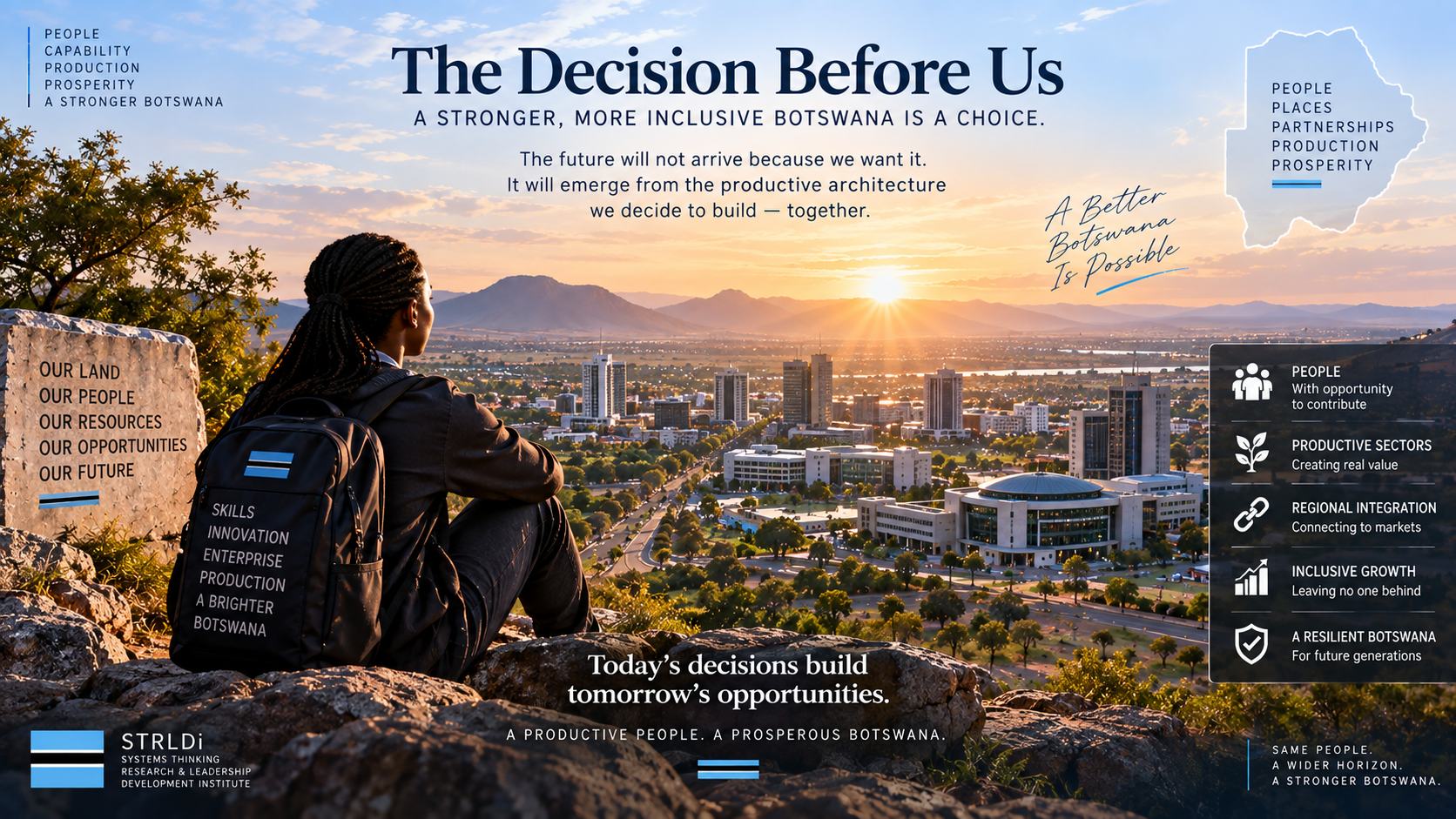
The future does not ask Botswana whether it feels ready.
It is already coming.
The question before the Presidencies, Ministers and national leadership is therefore not whether Botswana can afford to become smarter.
The question is whether Botswana can afford not to.
THE SPINE OF THE REPORT
Section 1 — The Mirror: What Is Botswana Creating?
Section 2 — President Khama’s Question: Can Batswana Get STEM Right?
Section 3 — The Structural Trap: Why Botswana Must Break the Cycle
Section 4 — Count the Future: What Does the Economy Actually Require?
Section 5 — The National STEM Capability Architecture: Building the Pipeline to Produce It
Section 6 — Use the People Botswana Has Already Produced: Experience, Expertise and National Capability
Section 7 — Pay for the Capability the Nation Needs: Teachers, Specialists and the STEM Workforce
Section 8 — The Twenty-Year Transformation Architecture: When Will Capability Begin to Show?
Section 9 — What Would It Cost Botswana—and Why the Shift Should Not Alarm the Nation?
Section 10 — The Decision Before the Presidencies: The Price of Building the Future—or Discovering It Too Late
APPENDIX
THE NATIONAL ARCHITECTURE FOR STEERING STEM DEVELOPMENT
APPENDIX A — PURPOSE OF THE ARCHITECTURE
The proposed architecture responds to a simple national requirement. STEM development cannot be effectively steered by looking only inside the education system.
The capabilities Botswana must develop are influenced by:
- the productive economy;
- changing technology;
- scientific development;
- workforce requirements;
- population change;
- education;
- technical training;
- research;
- and the capability of the existing adult population.
These relationships require continuous national attention. The architecture therefore provides a mechanism through which Botswana can repeatedly connect the changing productive requirement to the STEM and human capability required to carry it.
The proposed numbers are proxies for discussion and verification, not final staffing instructions. Their purpose is to make visible the scale of national capability that may be required and invite Botswana to test, refine and establish the appropriate structure.
APPENDIX B — THE CORE NATIONAL STEERING CAPABILITY
| Component | Indicative Number | Primary Responsibility |
|---|---|---|
| National Steering Group | 30–40 | Connect and steer the whole national requirement |
| Productive Economy Council | 15–20 | Keep productive requirements visible |
| Human Capability & STEM Council | 15–20 | Connect requirements to STEM and human capability |
| Adult Capability & Transition Council | 15–20 | Transition existing population capability |
| TOTAL | 75–100 | Continuous national steering of STEM requirements |
The architecture should be understood as one connected national capability, rather than four independent organisations.
APPENDIX C — THE NATIONAL STEERING GROUP
Indicative Size: 30–40 People
The National Steering Group requires sufficient diversity of capability to see the relationships across the national system. Membership should therefore be determined by the capability required to carry the work rather than institutional seniority or representation alone.
The Group should collectively be capable of understanding:
- productive economic development;
- national demand and future requirements;
- science and technology;
- mathematics and STEM;
- engineering and technical capability;
- human capability development;
- education;
- research;
- workforce requirements;
- demographic change;
- national planning;
- data and measurement;
- and institutional execution.
The exact composition should be determined through a national capability assessment. Botswana should not assume that people currently holding positions automatically possess the combination of knowledge required to steer the whole system.
APPENDIX D — THE PRODUCTIVE ECONOMY COUNCIL
Indicative Size: 15–20 People
The Council provides continuous visibility into the productive capabilities Botswana must build.
Its responsibilities include examining:
- changing national demand;
- regional and international movement;
- productive sectors and sub-sectors;
- emerging production requirements;
- technology requirements;
- scientific and technical requirements;
- productive infrastructure;
- workforce requirements;
- and changing capability gaps.
The Council should not simply respond to whatever economic activity happens to emerge. Its role is to help make the future productive requirement sufficiently visible for Botswana to deliberately prepare the capability required.
APPENDIX E — THE HUMAN CAPABILITY AND STEM COUNCIL
Indicative Size: 15–20 People
The Council connects the productive requirement to the human capability required.
Its responsibilities include examining:
- STEM requirements;
- mathematics and science foundations;
- engineering capability;
- technological capability;
- technical capability;
- tertiary education;
- technical and vocational education;
- teacher capability;
- curriculum;
- assessment;
- research;
- capability reproduction;
- and future skills requirements.
The Council should continuously ask:
What capability does Botswana require?
How many people require it?
At what depth is it required?
Where in the capability pathway must it be developed?
Is Botswana producing it quickly enough?
APPENDIX F — THE ADULT CAPABILITY AND TRANSITION COUNCIL
Indicative Size: 15–20 People
The Council ensures that national STEM and capability development does not focus only on future generations.
Its responsibilities include examining:
- existing workforce capability;
- unemployed population capability;
- experienced professionals;
- transferable skills;
- capability gaps;
- skills recognition;
- reskilling;
- technical upgrading;
- transition into productive sectors;
- and pathways for adults into emerging occupations.
The Council should help Botswana answer:
What capability does the population already possess?
What can be built upon?
What must be upgraded?
What new capability is required?
How quickly can adults transition into emerging productive pathways?
APPENDIX G — THE EXISTING INSTITUTIONAL LANDSCAPE
Botswana Should Begin With What Already Exists
The proposed architecture does not assume that Botswana must create entirely new institutions. The first task is to map existing institutions against the future STEM requirement and determine where existing mandates, capability and institutional arrangements already align—and where they do not.
The institutions requiring examination include those responsible for:
Economic and National Planning
- national economic planning;
- finance and public investment;
- statistics and national measurement;
- national development.
Productive Development
- trade;
- industry;
- agriculture;
- manufacturing;
- infrastructure;
- transport and logistics;
- energy;
- investment;
- research;
- standards and productive regulation.
Education and STEM
- school education;
- curriculum;
- mathematics and science;
- tertiary education;
- technical and vocational education;
- teacher development;
- science and technology;
- research and innovation.
Human Capability and Skills
- human resource development;
- qualifications;
- skills recognition;
- workforce development;
- technical training;
- adult learning;
- employment and transition.
INSTITUTIONS MUST BE MAPPED BY NAME
The next national exercise should identify and examine the relevant Botswana institutions individually, including bodies such as:
- Human Resource Development Council (HRDC);
- Botswana Qualifications Authority (BQA);
- Statistics Botswana;
- Botswana Institute for Technology Research and Innovation (BITRI);
- Universities and tertiary institutions;
- Technical and vocational institutions;
- relevant Ministries;
- public research bodies;
- standards and regulatory institutions;
- and public institutions connected to productive development.
This list should be completed and verified against the current Botswana institutional landscape. No institution should be automatically assumed to be carrying the future STEM requirement merely because part of its present mandate appears related to STEM, skills or qualifications.
For example, a qualifications institution may have an essential role in recognising and assuring capability without necessarily being responsible for determining the national STEM requirement. A human resource development institution may have an important skills function without necessarily possessing the full productive economy and STEM architecture required to steer the national system.
Mandates must therefore be mapped against the future requirement—not simply accepted as evidence of capability.
APPENDIX H — THE INSTITUTIONAL MAPPING FRAMEWORK
Every relevant institution should be examined against the following questions:
| Assessment | National Question |
|---|---|
| Current Function | What does the institution currently do? |
| Future Position | Where does it sit in the future STEM and capability requirement? |
| Required Capability | What must it become capable of doing? |
| Current Strength | What capability does it already possess? |
| Capability Gap | What does it not yet possess or understand? |
| STEM Familiarity | Does it have sufficient technical depth to recognise required capability? |
| Pipeline Connection | Does it understand what comes before and after its function? |
| Readiness | Can it carry the future requirement at the required speed? |
This exercise should be based on evidence rather than assumption.
APPENDIX I — PUBLIC-SECTOR STEM AND TECHNICAL CAPABILITY
Botswana’s STEM requirement is not confined to learners, teachers, universities and laboratories. As the productive economy becomes more scientifically and technically complex, the public system responsible for steering and supporting it must also become more capable.
This includes sufficient STEM and technical familiarity among those responsible for:
- national planning;
- economic development;
- technical assessment;
- infrastructure;
- productive regulation;
- standards;
- qualifications;
- skills recognition;
- public investment;
- research;
- and technology-related decision-making.
The requirement should be understood in practical terms. The public system must increasingly know what it is looking at.
A person does not need to become a scientist to understand how to ask better scientific questions. A planner does not need to become an engineer to understand what engineering capability a national project requires. But a nation attempting to build a more complex productive economy cannot afford a public system that remains unfamiliar with the capabilities it is expected to recognise and support.
APPENDIX J — THE RELATIONSHIP BETWEEN THE TWO ARCHITECTURES
The article now contains two connected but distinct requirements.
THE OVERARCHING NATIONAL STEERING ARCHITECTURE
Its role is to continuously connect:
Productive Economy
↓
Human Capability
↓
STEM Requirement
↓
Existing Population
↓
Future National Requirement
THE NATIONAL STEM CAPABILITY ARCHITECTURE
Its role is to develop and reproduce STEM capability through:
- national STEM administration;
- curriculum and knowledge;
- teacher capability;
- mathematics and science;
- assessment;
- delivery;
- research;
- tertiary education;
- technical capability;
- and connection to the productive economy.
The relationship is therefore:
The National Steering Architecture keeps the future STEM requirement visible.
The National STEM Capability Architecture develops the capability required.
This distinction allows Botswana to steer STEM development continuously without expecting the education system alone to determine the economic and productive requirements of the country.
APPENDIX K — WHAT SHOULD HAPPEN NEXT
The article does not propose that Botswana immediately establish structures without examination.
The next step should be to:
1. VERIFY THE NATIONAL CAPABILITY REQUIREMENT
Test the productive, human and STEM numbers against national data.
2. MAP THE EXISTING INSTITUTIONAL LANDSCAPE
Identify by name where existing institutions already align.
3. ASSESS ACTUAL CAPABILITY
Determine what institutions and personnel can currently carry.
4. IDENTIFY THE GAPS
Establish what capability Botswana lacks.
5. DETERMINE THE NATIONAL STEERING REQUIREMENT
Confirm the appropriate composition and size of the 75–100-person core architecture.
6. BUILD CAPABILITY
Strengthen Botswana’s own people and institutions while drawing on expertise from those who have successfully travelled ahead.
7. DEVELOP SUCCESSORS
The purpose must be capability transfer and long-term national independence.
Yes, Ms Sheila Damodaran. This should sit clearly in the Appendix, because it explains a principle that national leadership must understand: Botswana cannot afford the pride of learning alone when the lives of future generations depend on how quickly the country learns.
I would write it as follows.
APPENDIX L: INTERNATIONAL CAPABILITY TRANSFER — LEARNING FAST ENOUGH FOR THE CHILDREN OF BOTSWANA
BOTSWANA MUST NOT LEAVE ITS CHILDREN TO DISCOVER THE WORLD ALONE
There is a child in Botswana today who will enter adulthood twenty years from now. That child does not yet know whether Botswana will have built an economy capable of carrying his or her ambitions, skills and hopes. The child does not know whether there will be a laboratory to work in, a factory to design, a farm to modernise, a technology to develop, a business to build or an institution capable of recognising what he or she can do.
What that child knows, twenty years from now, may depend on what Botswana decides to learn today. If the country waits to discover everything for itself, debates every step until the world has moved again and refuses to learn from those who have already travelled ahead, the child will eventually carry the cost of time that was lost before he or she was old enough to speak.
That is the responsibility before national leadership. The future cannot be left to children who have not yet entered the workforce to solve for themselves. The adults of today must build the bridges before the children of tomorrow reach the river.
THE WORLD HAS ALREADY TRAVELLED PART OF THE JOURNEY
Botswana is not the first country to confront the challenge of building a productive economy, developing technical capability or preparing its population for a rapidly changing world. Other nations have spent decades—and in some cases generations—learning how to develop science, engineering, manufacturing, technology, technical education and increasingly capable public institutions.
Botswana should not copy these countries blindly. Their histories, populations, resources and circumstances are different. But neither should Botswana pretend that there is nothing to learn from those who have already travelled through terrain the country is now approaching.
The sensible question is not:
Can Botswana do everything alone?
The more responsible question is:
What can Botswana learn from those ahead, so that its children do not have to spend another generation learning what the world already knows?
LEARN FROM THE WORLD — BUT BUILD BOTSWANA’S OWN CAPABILITY
The purpose of bringing international expertise into Botswana must be made clear from the beginning. Foreign specialists are not brought in to think permanently for Batswana, work permanently for Batswana or become permanent substitutes for Botswana’s own people.
They are brought in because knowledge exists in the world that Botswana may not yet possess in sufficient depth. There are people who have participated in building productive economies, strengthening technical education, developing engineering capability and transforming national systems.
Botswana should learn from them deliberately.
But the relationship must have a clear national direction:
COME AND WORK WITH US.
SHOW US WHAT YOU KNOW.
TEACH US WHAT YOU HAVE LEARNED.
WORK ALONGSIDE OUR PEOPLE.
HELP US BUILD OUR OWN CAPABILITY.
AND THEN WATCH US TAKE IT FURTHER.
That is not dependency. That is how nations learn.
THE COUNTRIES BOTSWANA SHOULD LOOK TOWARDS
Botswana should deliberately seek experience from countries that have demonstrated particular strengths relevant to the capability now required.
| Country | Experience Botswana Should Seek to Understand |
|---|---|
| Singapore | National transformation, economic direction and capability development |
| South Korea | Industrialisation, STEM, technology and productive capability |
| Japan | Engineering, industrial systems and technical capability |
| Germany | Engineering, manufacturing and technical education |
| Switzerland | Technical and vocational capability development |
| Finland | Education, teacher capability and learning systems |
| China | Manufacturing, technological development and productive scale |
| India | STEM, technology and large-scale human capability |
Botswana should not seek to import another country’s system. It should seek people who understand what their countries had to learn, what mistakes were made, what took too long and what capabilities eventually changed the direction of their nations.
The country should look wherever such knowledge exists. The objective is not to collect foreign flags. The objective is to acquire knowledge that helps Botswana build its own future faster and more intelligently.
BOTSWANA SHOULD LOOK FOR BUILDERS — NOT ONLY ADVISERS
There is an important difference between someone who can describe national transformation and someone who has actually participated in building it.
Botswana should therefore look carefully for people who have been close to the work. People who have built productive sectors, developed technical institutions, strengthened science and engineering capability, reformed technical education, developed teacher capability, expanded manufacturing or helped national systems learn to work differently.
This does not exclude academics or consultants. Research and analysis remain important. But Botswana should also seek the experience of practitioners who understand what happens when a national plan reaches the ground.
The child twenty years from now will not benefit simply because Botswana received a beautifully written international report. The child will benefit if Botswana learned how to build something that remained standing after the foreign experts had gone home.
THE INITIAL INTERNATIONAL CAPABILITY REQUIREMENT
Botswana does not require hundreds of foreign consultants scattered across the public system. The requirement should be small, highly selective and connected directly to areas where the country needs to accelerate learning.
The initial proxy proposed for national discussion is:
20–30 INTERNATIONAL SPECIALISTS
working deliberately alongside Botswana’s own national capability.
| Capability Area | Indicative International Specialists |
|---|---|
| National economic and productive transformation | 3–4 |
| STEM and scientific capability | 3–4 |
| Engineering and manufacturing | 3–4 |
| Technical and vocational education | 2–3 |
| Mathematics and science education | 2–3 |
| Teacher and capability-builder development | 2–3 |
| Technology and digital capability | 2–3 |
| Adult reskilling and workforce transition | 2–3 |
| INITIAL TOTAL | 20–30 |
These are proxies for verification, not final appointments. Their purpose is to make a national principle visible: Botswana may not need an army from outside. But it should not deny itself access to knowledge it genuinely needs simply because that knowledge was first developed somewhere else.
FOREIGN EXPERTISE MUST ENTER WITH AN EXIT PATH
The most important protection against dependency is not refusing help.
It is designing help so that Botswana becomes less dependent over time.
Every international specialist brought into the national capability effort should therefore have a clear responsibility to work alongside and develop Botswana’s own people. Knowledge transfer should not be treated as a pleasant addition to the contract. It should be one of the central measures of success.
The question should always be:
Who is learning alongside this person?
What capability is being transferred?
Who will continue the work when this person leaves?
Has Botswana become stronger because this person came?
If those questions cannot be answered, Botswana has purchased advice. It has not built capability.
THE TWENTY-YEAR TRANSFER PATHWAY
International involvement should reduce as Botswana’s own capability increases.
YEARS 1–5: LEARN AND BUILD
20–30 International Specialists
During the first five years, Botswana should deliberately accelerate learning. International specialists work alongside Batswana to help establish capability, strengthen institutions and transfer practical experience.
The emphasis is not on foreigners doing the work. The emphasis is on Batswana learning while building.
YEARS 5–10: TRANSFER AND LEAD
10–15 International Specialists
By this stage, Botswana’s own people should increasingly lead the work. International expertise becomes more specialised, focusing on mentoring, peer learning, complex technical gaps and areas where the ground has moved again.
The centre of gravity begins moving decisively towards Batswana.
YEARS 10–20: STRENGTHEN AND EXCHANGE
5–10 International Specialists
International relationships remain important because no country stops learning. But by this stage, Botswana should not require outsiders to hold the national direction together.
Batswana should increasingly possess the knowledge, experience and institutional capability to steer their own systems.
International expertise becomes exchange—not rescue.
BY YEAR TWENTY, THE QUESTION SHOULD HAVE CHANGED
Twenty years from now, Botswana should not still be asking:
Who can come and show us what to do?
The question should increasingly become:
What have we learned that we can now contribute to others?
This is the real purpose of capability transfer.
A nation learns.
A nation builds.
A nation leads itself.
And eventually, a nation contributes to the learning of others.
That is how knowledge should move through the world.
THE PRESIDENT’S RESPONSIBILITY MUST BE CLEAR
National leadership must be honest with the country about what is required.
Botswana’s leaders are not here to do the work of every Batswana. No President, Minister, foreign expert or national institution can live another person’s life, acquire another person’s knowledge or build another person’s capability for them.
But leadership has a profound responsibility to ensure that the pathways exist.
The responsibility of national leadership is to help ensure that a child who studies hard does not reach adulthood and discover that there is nowhere to use what he or she has learned. That a young engineer does not have to leave Botswana because there is no productive system capable of absorbing engineering talent. That a scientist does not find that the country has no research pathway. That a skilled technician does not discover that there is no industry requiring technical skill.
Leadership cannot promise every citizen success.
But it can ensure that the country is building somewhere for success to go.
THE CHILD TWENTY YEARS FROM NOW
Twenty years from now, there will be a young Motswana standing somewhere in this country—or perhaps standing at a border, wondering whether the future can only be found somewhere else.
That difference will not be decided on that day.
It will be decided by decisions being made now.
It will be influenced by whether Botswana learned fast enough.
Whether it built the skills it required.
Whether it strengthened its institutions.
Whether it prepared its teachers.
Whether it developed STEM capability.
Whether it built productive sectors capable of carrying skilled people.
Whether it helped adults transition instead of leaving them behind.
And whether it had the humility and wisdom to learn from those who had travelled ahead—not to follow them forever, but to learn how to stand on its own two feet.
The child twenty years from now should be able to look back and say:
They saw the ground moving before we reached it.
They did not leave us to cross the river alone.
They built the bridge while there was still time.
And perhaps that child will never know the names of everyone who argued, planned, counted, challenged and worked to make the future visible.
That does not matter.
What matters is that when the child arrives, there is somewhere to go.


