
Why This Law Matters
One of the greatest obstacles to solving complex problems is not the absence of intelligence, resources or commitment. It is the tendency to return repeatedly to solutions that have become familiar through experience. Organisations naturally develop confidence in interventions that have produced results in the past, and over time these interventions become accepted as the normal way of responding whenever similar problems arise. Yet dynamic complexity teaches us that yesterday’s successful intervention may no longer address today’s underlying causes.
This law is particularly important because it explains why organisations, industries and even governments often become trapped in recurring cycles of intervention. When a problem reappears, the instinctive response is to intensify the existing solution rather than question whether the problem has changed or whether the original understanding was incomplete. Additional funding is allocated, programmes are expanded, regulations are strengthened and new targets are introduced, yet the behaviour stubbornly persists. The organisation concludes that it has not done enough, when in reality it may simply be doing more of the wrong thing.
The Fourth Law therefore challenges one of the most deeply embedded assumptions in management—that persistence alone eventually produces success. In systems characterised by dynamic complexity, persistence without understanding can strengthen the very conditions that allow the problem to survive. The easy way out is not necessarily easy because it requires little effort; it is easy because it allows us to remain within the comfort of familiar thinking while avoiding the more demanding task of understanding the deeper structures producing the behaviour.
Understanding the Law
At first glance, this law appears almost counterintuitive. If an intervention worked previously, common sense suggests that applying it again should produce the same result. This reasoning is valid in simple systems where cause and effect remain close together in time and space. However, organisations, economies and societies are dynamic systems whose behaviour emerges from networks of interacting feedback loops rather than isolated events. As these structures evolve, the conditions that originally justified an intervention may also change, reducing its effectiveness or producing entirely different consequences.
The Fourth Law reminds us that complex problems rarely remain stationary. While managers concentrate on visible symptoms, the underlying structures continue adapting beneath the surface. Repeating familiar interventions may therefore provide temporary reassurance because they demonstrate action, yet they often leave the causal mechanisms untouched. Over time, the system responds by producing the same behaviour once again, giving the appearance that the original intervention has somehow failed.
Understanding this law therefore requires a shift in perspective. Rather than asking, “What worked before?”, systems thinking encourages us to ask, “What structure is continuing to produce this behaviour?” The quality of the intervention depends less on how well it addresses the symptom than on whether it reaches the structure responsible for generating the observed pattern.
Peter Senge’s Demonstration
Peter Senge introduces this law through a modern adaptation of an ancient Sufi story. A passerby notices a drunk searching for his house keys beneath a street lamp and offers to help. After searching unsuccessfully for several minutes, the passerby asks where the keys were actually lost. The drunk calmly replies that he dropped them outside his front door. Puzzled, the passerby asks why he is searching beneath the lamp instead. The drunk answers simply, “Because there is no light by my doorway.”
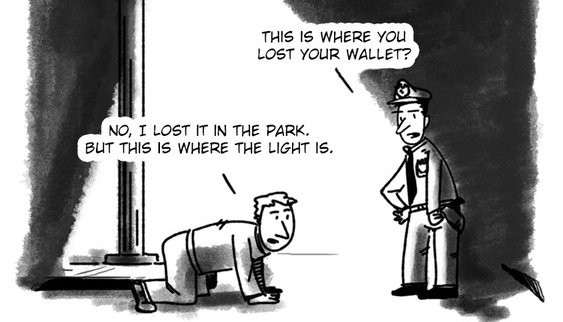
The humour of the story conceals a profound lesson about organisational behaviour. The drunk is not searching where the keys are most likely to be found; he is searching where it is easiest to see. Likewise, organisations frequently investigate the parts of a problem that are visible, measurable and familiar rather than the places where the underlying causes actually reside. The availability of information, organisational authority or established expertise often determines where attention is directed, even when experience suggests that the true source of the problem lies elsewhere.
Senge argues that this pattern becomes evident whenever organisations repeatedly apply familiar solutions while fundamental problems persist or worsen. His description of the “bigger hammer syndrome” captures the temptation to intensify existing interventions simply because they are known and readily available. Rather than questioning whether the intervention addresses the correct part of the system, organisations conclude that the answer is to apply greater force. The Fourth Law reminds us that increasing effort within the wrong part of the system rarely produces lasting improvement; instead, it often leads the organisation back to the very problem it was attempting to solve.
The STRLDi Interpretation
The Easy Way Out: A Seasonal Farming System That Recreates Its Own Constraints
One of the central findings emerging from the STRLDi study is that the easy way out is often not the result of poor decision-making, but of inherited practice. Over many generations, farmers sought to increase food production by cultivating their land during the rainy season and waiting for the next rains before planting again. This approach appeared entirely rational because rainfall determined when crops could be grown. As the rainy season ended, agricultural activity largely ceased, and farmers left their fields unattended for many months, believing there was little else that could be done until the rains returned. Over time, this seasonal rhythm became accepted as the normal way of farming and was passed from one generation to the next without questioning its long-term systemic consequences.
The Hidden System Continues Working
While farming activity came to a halt, the ecological system beneath the surface did not. During the long dry months, many plants entered a period of dormancy, a natural process in which metabolism, growth and energy consumption slow dramatically in response to environmental conditions. Although this enables many plants to survive prolonged periods without rainfall, the soil itself continues to undergo important physical, chemical and biological changes. Without continuous vegetative cover and active root systems, the biological processes that sustain healthy soils begin to diminish, gradually altering the productive capacity of the land even though these changes remain largely invisible to the farmer.
The Gradual Decline of Soil Health
As soil moisture declines, microbial activity also decreases. The bacteria, fungi and other soil organisms responsible for decomposing organic matter become far less active, reducing the formation of humus—the stable organic component of soil created through the decomposition of plant and animal material by soil microorganisms. Humus plays a critical role in storing nutrients, improving soil structure and enhancing the soil’s capacity to retain moisture. With fewer living roots, reduced biological activity and declining organic matter, the soil progressively loses both its fertility and its resilience. Each successive dry season therefore leaves the land slightly less capable of supporting productive agriculture than before.
The System Begins to Reinforce Decline
When the rains finally return, the degraded soil is no longer able to absorb and retain water as effectively as it once did. Rainfall that would previously have infiltrated the soil increasingly flows across the surface, carrying away loosened topsoil together with valuable nutrients and organic matter. Instead of restoring the land, each rainy season unintentionally accelerates soil erosion and degradation. Farmers therefore experience declining productivity, not simply because rainfall varies from year to year, but because the productive structure of the soil has been steadily weakened through the repeated continuation of the same seasonal farming practice.
Looking Beyond the Symptom
The significance of this example extends beyond agriculture. Farmers did not intentionally degrade their land, nor were they making irrational decisions. They were responding to the conditions they could see and working within a farming system that had become accepted as normal. Yet the easy way out—cultivating only during the rainy season and leaving the land biologically inactive for much of the year—gradually created the very conditions that made farming increasingly difficult. The intervention addressed the immediate need to grow crops when rain was available, but it did not address the underlying ecological processes required to sustain healthy, productive soils throughout the year.
This is the essence of the Fourth Law of Dynamic Complexity. The easy way out usually leads back in because familiar practices can become self-reinforcing structures. They continue to produce the very conditions that require the same responses, trapping individuals, organisations and even nations in recurring cycles of intervention while the underlying system steadily moves in the opposite direction.
When we choose to take the easy way out, we are avoiding the harder of the solutions. And so, it also goes without saying that the harder it is to make a solution work for the problem, the less likely we shall be led back into the problem. On the other hand, when we choose to ignore the harder solution, the cure can be worse than the disease (Law #5).
Previous < — Law #3 Next –> Law #5


You must be logged in to post a comment.