
Pre-Session Reading
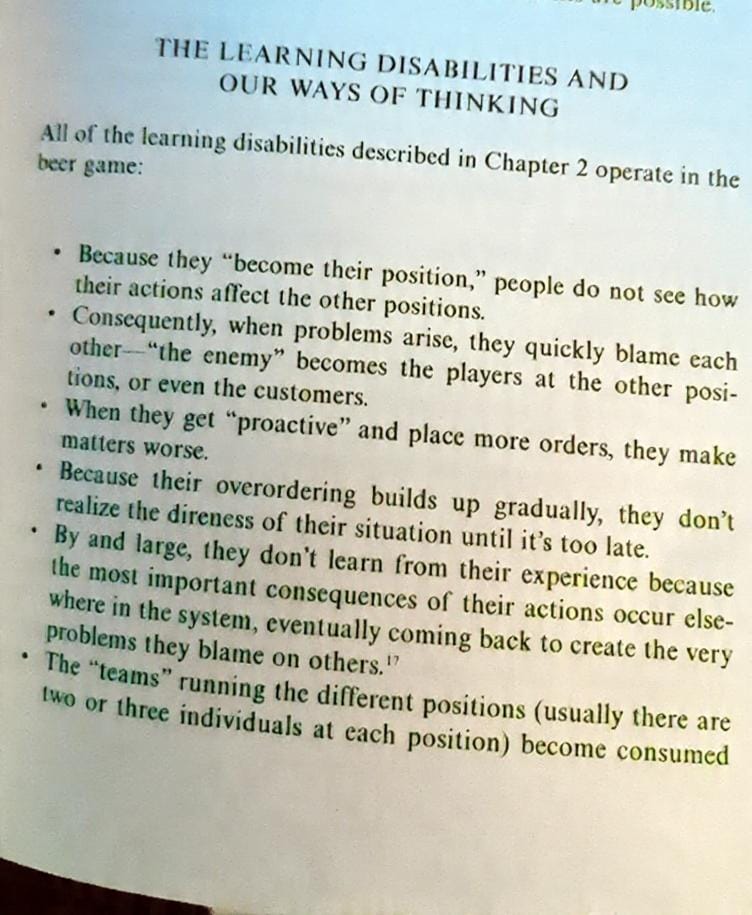
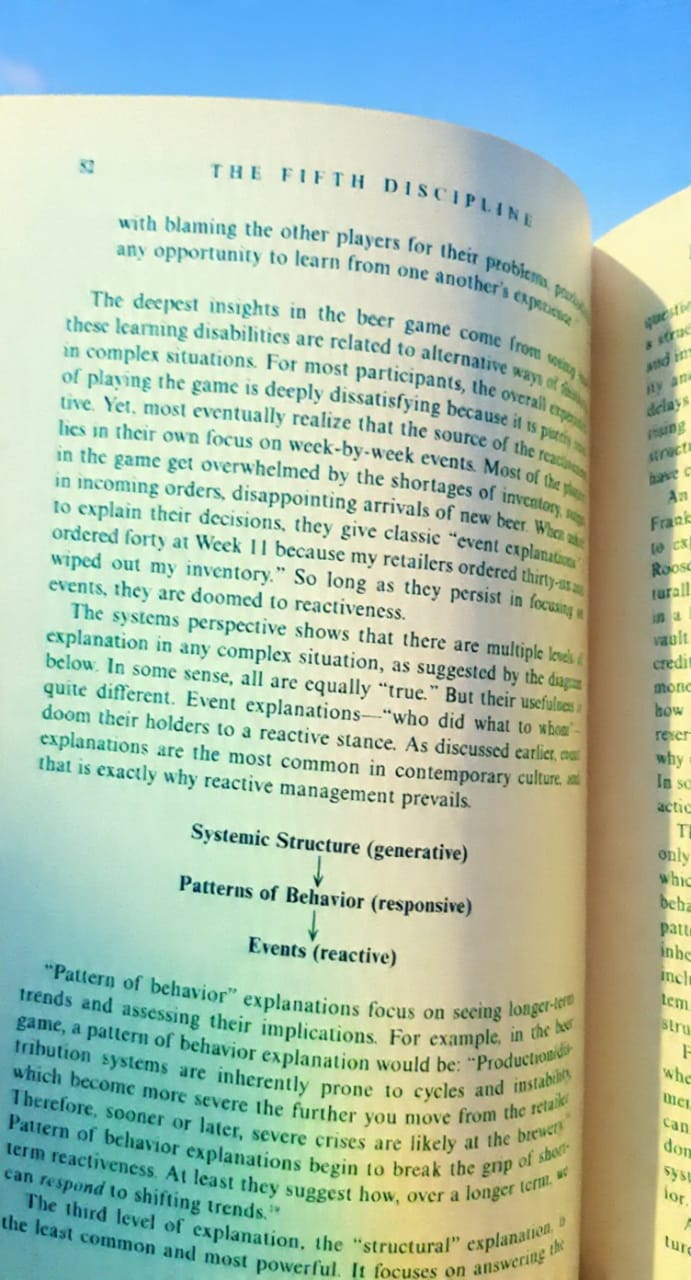
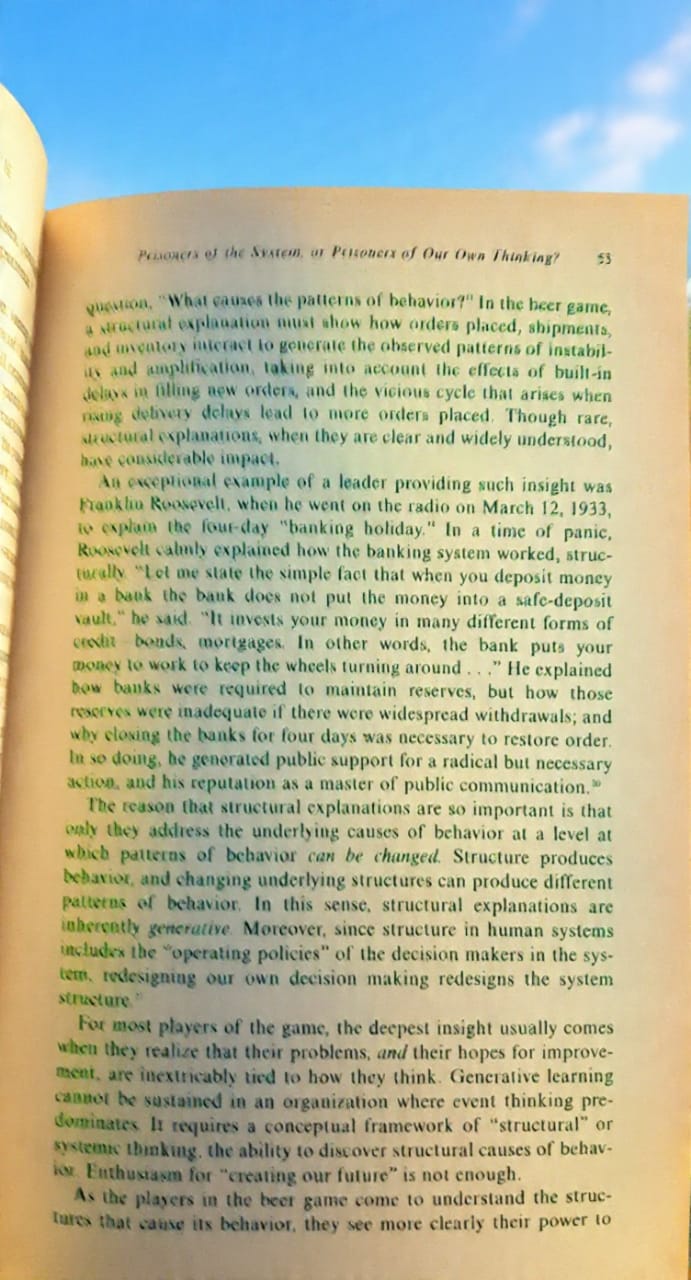
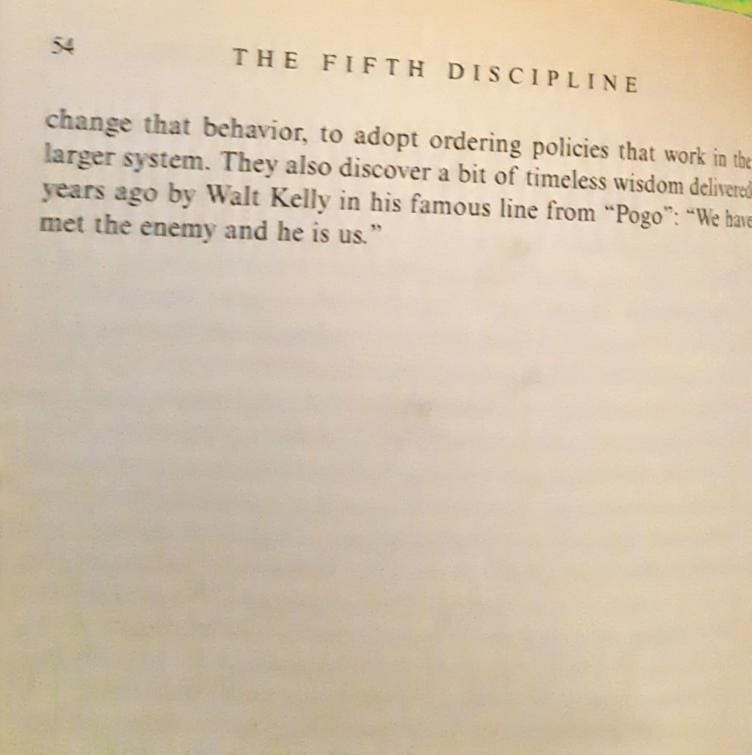
The Fifth Discipline – The Learning Disabilities and Our Ways of Thinking (the pages immediately preceding The Laws of Dynamic Complexity), Page 51-54, The Fifth Discipline, Edition 2
Approach this reading as a student of systems, not as a judge of people. Resist the temptation to personalise every example by immediately thinking of a particular individual, organisation, or past experience. Instead, concentrate on understanding the principles Senge is developing and the logic of his argument. Your first responsibility is to learn to see the system. Only after you have understood the concepts should you begin considering how they might apply to your own organisation, profession, or national context.
Instructions
Read the pages preceding The Laws of Dynamic Complexity without discussion. Watch Sterman’s Beer Game demonstration in full (see links below), taking notes on every point where participants begin blaming one another or increasing orders. Re-read the same pages and ask, “What did I not see the first time?”
Read these pages slowly and repeatedly. Resist the temptation to skim. Do not attempt to identify the “main idea” after a single reading. Instead, observe how Senge progressively develops his argument from the Beer Game to the three levels of explanation, and finally to the importance of structural thinking.
Suspend both agreement and disagreement during your first reading. Your task is not to decide whether Senge is right or wrong, but to understand precisely what he is saying and why he constructs his argument in the sequence that he does. Critical evaluation comes after disciplined comprehension.
Reflection Questions
Part I – Understanding the Argument
- Why does Senge begin with the Beer Game rather than immediately introducing systems thinking?
- What evidence does Senge provide that the learning disabilities described earlier are not individual failures but systemic phenomena?
- Why do intelligent people repeatedly make poor decisions in the Beer Game?
Part II – Three Levels of Explanation
- Explain the differences between:
- Event explanations
- Pattern-of-behaviour explanations
- Structural explanations
- Why does Senge describe structural explanations as generative?
- Can patterns of behaviour exist without underlying systemic structures? Defend your position.
Part III – Leadership
- Why does Senge use Roosevelt’s banking address as an illustration of systemic leadership?
- What distinguishes a leader who manages events from one who changes structures?
- What assumptions about leadership are challenged in these pages?
Part IV – Critical Analysis
- Which paragraph do you believe represents the turning point of the chapter? Explain why.
- Which sentence required you to stop and rethink your own assumptions?
- What mental models does Senge appear to be challenging?
Part V – Application
- Apply the three levels of explanation to a persistent national challenge in Botswana.
- How would a minister operating at the Event level respond?
- How would a minister operating at the Pattern level respond?
- How would a minister operating at the Structural level respond?
Part VI – STRLDi Extension
- How does this reading prepare the ground for the Onion Model?
- In what ways does STRLDi extend Senge’s three levels of explanation?
- Why is diagnosing systemic structure more difficult than identifying events?
- After completing this reading, what does Senge mean by the statement:
“We have met the enemy and he is us.”
Discuss this statement in the context of institutional decision-making rather than individual behaviour.
RESOURCES:
1. The Original Full Beer Game Video with MIT Professor John D. Sterman
The Original Full Beer Game Video with MIT Professor John D. Sterman
This is the classic demonstration in which Professor John Sterman runs the Beer Game with MIT students and then conducts the debrief. It illustrates exactly the dynamics that Senge discusses in Chapters 3 and 4 of The Fifth Discipline:
- oscillations,
- amplification,
- delays,
- blaming others,
- the bullwhip effect,
- and the fundamental insight that structure produces behaviour.
- MIT Sloan Beer Game Online – an interactive version developed under John Sterman’s direction. This allows participants to experience the simulation firsthand rather than just watch it. MIT Sloan Beer Game Online
- MIT OpenCourseWare – Beer Game – part of the graduate System Dynamics course taught by John Sterman and Hazhir Rahmandad. It includes course material surrounding the simulation. MIT OpenCourseWare Beer Game resources
- The Beer Game – Mastering Supply Chains. https://www.youtube.com/watch?v=fleFn9AO3uo
2. Daniel Kim — The Iceberg Model (Highest Recommendation)
Daniel Kim is probably the clearest teacher of the progression:
Events → Patterns → Systemic Structure → Mental Models
He developed the Iceberg Model into a practical learning framework that has become a standard teaching tool in systems thinking. The model emphasizes that events are only the visible tip, while recurring patterns arise from underlying structures, which themselves are shaped by mental models.
His classic work is:
- Introduction to Systems Thinking
- The Systems Thinker learning materials
For STRLDi, Daniel Kim provides the best bridge between Senge’s three levels of explanation and your extension through the Onion Model.
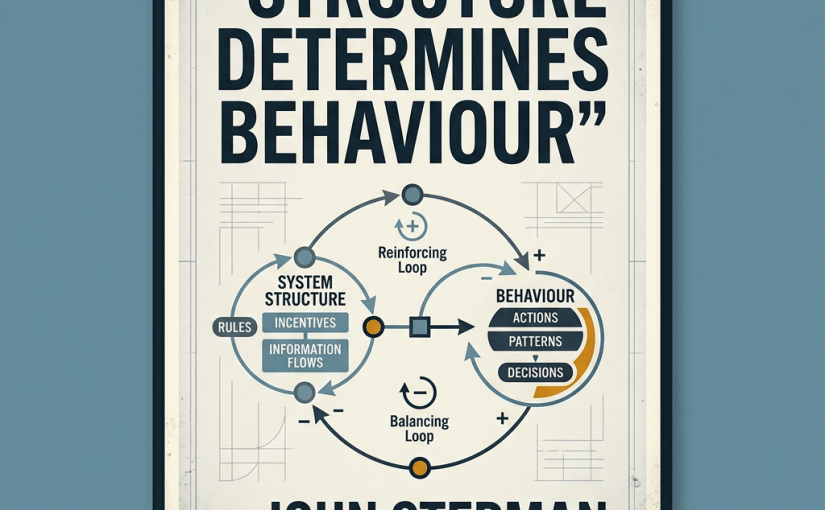
3. John Sterman — Structure Determines Behaviour
Sterman rarely teaches using the Iceberg graphic itself. Instead, he teaches the same idea through system dynamics.
His central message is:
People are not the problem. The structure of the system generates the behaviour.
This is exactly what participants experience in the Beer Game. The recurring shortages, inventory oscillations, and blaming behaviour emerge from the structure of the supply chain rather than from poor intentions. Sterman’s recent MIT Sloan webinar continues this focus on identifying the root causes of recurring problems and designing high-leverage structural interventions.
4. The MIT Progression
Taken together, the three thinkers form a remarkably coherent learning journey.
| Author | Primary Contribution |
|---|---|
| Peter Senge | Introduces the three levels: Events, Patterns of Behaviour, Structural Explanation. |
| John Sterman | Demonstrates experimentally that system structure generates behaviour through feedback, delays, and decision rules. |
| Daniel Kim | Organises these ideas into the Iceberg Model, adding Mental Models beneath systemic structure. |
This sequence is ideal for postgraduate teaching because each thinker deepens the previous one rather than replacing it.


