

STRLDi Programme Office Manual
PART I – OUR IDENTITY
Why the Programme Office Exists
The STRLDi Programme Office exists to ensure that every public Foundation Programme reflects the standards, professionalism and learning philosophy of the Systems Thinking Research & Leadership Development Institute (STRLDi).
The Programme Office is not simply responsible for organising training events. It exists to create an environment in which participants can devote their full attention to learning while the Lead Trainer devotes her full attention to teaching. Every communication, every registration, every meeting, every venue, every piece of participant correspondence and every follow-up contributes to the participant’s experience of STRLDi.
Participants should never experience confusion, uncertainty or poor organisation. They should experience a programme that is carefully planned, professionally coordinated and delivered with genuine care. Our responsibility is to make this happen consistently.
The Programme Office therefore protects not only the quality of each programme but also the reputation of STRLDi. Every interaction either strengthens or weakens that reputation. Every programme should strengthen it.
Our Vision
We share a vision of establishing STRLDi as a recognised centre for the practical application of The Fifth Discipline®, Systems Thinking and the Learning Organisation.
Every public programme contributes to this vision. We are not simply teaching concepts. We are helping develop leaders who are able to understand persistent organisational, institutional and national issues through disciplined observation, thoughtful inquiry and Systems Thinking.
Our work extends beyond the classroom. Every participant becomes part of an expanding learning community. Every organisation that sends participants becomes a potential long-term partner. Every programme provides an opportunity to demonstrate the standards, professionalism and values of STRLDi.
For this reason, we should never think of ourselves as organising courses. We are building relationships, strengthening leadership practice and helping establish the reputation of the Institute through every programme we deliver.
Our Leadership Philosophy
Leadership within the Programme Office is based upon stewardship rather than hierarchy.
Each member of the team has different responsibilities, yet every responsibility exists to strengthen the work of others. Success is achieved through collaboration, mutual support, and shared responsibility rather than individual achievement.
Leadership means noticing what needs attention before problems develop. It means helping colleagues succeed, supporting participants, maintaining high standards and continually improving the quality of every programme.
Every member of the Programme Office should therefore think beyond their individual responsibilities and ask, “How can I strengthen the work of the team today?”
Programme Office Values
Everything we do reflects the values of STRLDi.
Stewardship
We care for the Institute, its participants, its reputation and one another. We recognise that every programme contributes to something much larger than a single event.
Professionalism
We prepare thoroughly, communicate clearly, honour our commitments and maintain high standards in every aspect of our work.
Learning
We remain curious, reflective and open to improvement. Every programme teaches us something that can strengthen the next.
Service
We exist to support one another and to create an outstanding learning experience for every participant.
Collaboration
We work together as one team. We willingly assist one another and recognise that the participant experiences one STRLDi rather than individual roles.
Integrity
We conduct ourselves honestly, respectfully and responsibly in every interaction.
Excellence
We continually seek to improve. We are satisfied only when participants experience a programme that reflects the quality and standards of STRLDi.
Operating Principles
Our work is guided by several simple principles.
We prepare before we perform.
We anticipate rather than react.
We solve problems early rather than allowing them to grow.
We strengthen relationships before transactions.
We support one another before seeking recognition.
We reflect after every programme and continuously improve.
We protect the reputation of STRLDi through every decision and every interaction.
PART II – LEADERSHIP & GOVERNANCE
The Lead Trainer
The Lead Trainer provides the intellectual leadership of the Foundation Programme.
Responsibilities include developing the curriculum, conducting research, preparing learning materials, facilitating the programme, developing assignments and continuously strengthening STRLDi’s body of work. The Lead Trainer is also responsible for maintaining the academic quality and integrity of every programme.
The Programme Office exists to protect the Lead Trainer’s time by managing programme operations, participant administration and logistical matters. During programme delivery, the Lead Trainer should remain focused on teaching and participant learning rather than operational issues.
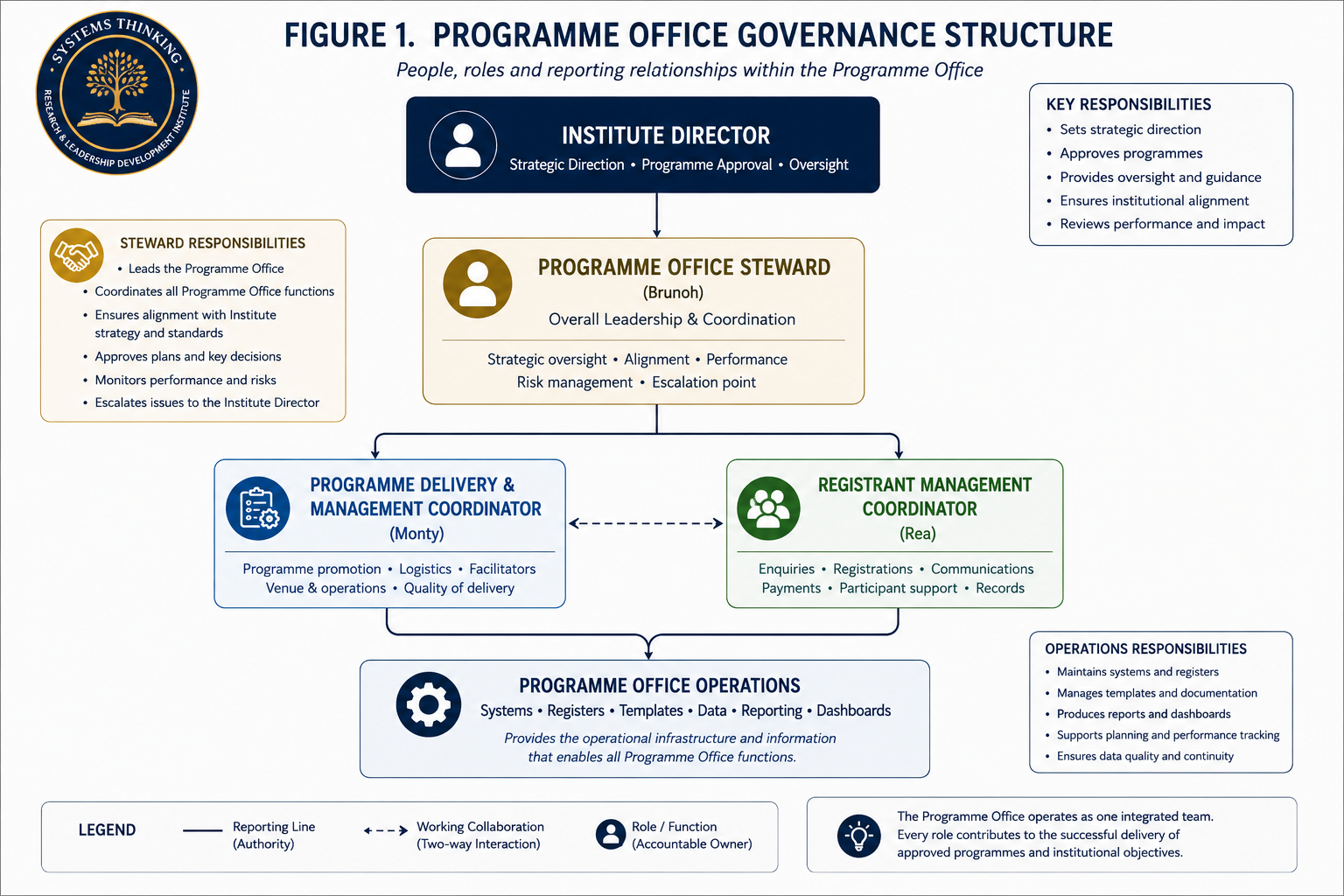
Programme Lead
Brunoh serves as the Programme Lead.
His responsibility is to steward the Programme Office and ensure that the entire team functions effectively. He is responsible for creating an environment in which every member of the team is able to perform at their best while ensuring that participants receive the standard of service expected of STRLDi.
The Programme Lead supports the Lead Trainer by protecting her time and ensuring operational matters are managed effectively. He supports the Programme Coordinator by helping remove barriers to progress and ensuring priorities remain clear. He supports the Participant Engagement Coordinator by ensuring that participant needs receive timely attention and that communication remains professional and responsive.
The Programme Lead continually observes the health of the team. He notices when additional support is required, encourages collaboration, helps resolve challenges and ensures that no member of the team works in isolation.
His success is measured by the success of the entire Programme Office.
He continually asks:
- Are we working well together?
- Does anyone require support?
- Are participants receiving an outstanding experience?
- Are we maintaining the standards expected of STRLDi?
- What can we improve before the next programme?
His leadership is expressed through stewardship, guidance, encouragement and service.
Programme Coordinator
Monty serves as the Programme Coordinator.
He leads the work.
His responsibility is to ensure that every programme continues moving forward according to plan. He coordinates activities, monitors progress, follows up outstanding actions, organises meetings and ensures that deadlines are achieved.
The Programme Coordinator maintains visibility over every aspect of programme preparation and delivery. He works closely with Brunoh and Rea to ensure that all activities are progressing according to schedule and that potential delays are identified early.
He continually asks:
- What must happen next?
- Are we on schedule?
- Which actions remain outstanding?
- Who requires follow-up?
- What should be completed before the next milestone?
His success is measured by the quality of programme coordination and the timely completion of programme activities.
Participant Engagement Coordinator
Rea serves as the Participant Engagement Coordinator.
She is responsible for the participant journey from the first enquiry until well after the programme has concluded.
She manages participant communication, registrations, confirmations, reading materials, WhatsApp groups, attendance, assignments, evaluations, certificates and alumni communication. She ensures that participants feel welcomed, informed and supported throughout their engagement with STRLDi.
She continually asks:
- Have participants received the information they need?
- Is anyone being left behind?
- Have we communicated clearly?
- How can we strengthen the participant experience?
Her success is reflected in participant satisfaction, responsiveness and the quality of participant relationships.
Working Together
The Programme Office functions as one integrated leadership team.
Brunoh strengthens the team.
Monty coordinates the work.
Rea nurtures the participant experience.
The Lead Trainer develops and delivers the learning.
Although responsibilities are clearly defined, everyone is expected to assist wherever needed. Participants should experience one coordinated STRLDi team rather than separate functions.
Decision Making
Routine operational decisions should be made confidently within the Programme Office.
Where different opinions arise, the team should discuss the matter openly and seek the solution that best serves participants and STRLDi. The objective is not to determine who is right but to determine what is best.
Where Monty and Brunoh disagree, they should first work together to reach agreement. If necessary, Rea should be included in the discussion before the matter is referred to the Lead Trainer.
The Lead Trainer should be consulted when decisions affect:
- Programme content.
- Learning quality.
- Intellectual property.
- Institutional reputation.
- Strategic partnerships.
- Significant financial expenditure.
- New policies.
Escalation
The Programme Office is expected to resolve operational matters independently wherever possible.
Issues should only be escalated where they involve significant financial commitments, serious participant complaints, reputational risks, curriculum changes, legal concerns or matters likely to affect the strategic direction of STRLDi.
Escalation is part of responsible leadership and should never be viewed as a failure.
PART III – PROGRAMME DELIVERY
The Programme Cycle
Every STRLDi Foundation Programme follows the same planning cycle.
Six Weeks Before
The Programme Office confirms dates, venue, budget and marketing activities. Registration opens, marketing materials are published and previous participants, partner organisations and prospective participants are contacted.
Four Weeks Before
Participant recruitment becomes the priority. Registrations are monitored, payments followed up, organisations invited and marketing activities intensified. Progress is reviewed each week against agreed targets.
Two Weeks Before
Participant preparation begins. Welcome emails, reading materials, assignment information, WhatsApp groups and programme guidance are distributed. Participants should already feel that their learning journey has begun.
One Week Before
The Programme Office conducts a full readiness review. Venues, equipment, learning materials, participant lists, name badges, catering, photography and certificates are confirmed. No significant uncertainty should remain.
Programme Days
The Lead Trainer teaches.
The Programme Office manages everything else.
Participants should experience professional registration, warm hospitality, excellent communication, well-managed logistics and immediate assistance whenever required. The Programme Office should anticipate participant needs before they become problems.
Within Twenty-Four Hours
Participants receive a thank-you message, follow-up information, assignment reminders, photographs where appropriate and guidance on next steps.
Within One Week
The Programme Office completes its review of the programme, analyses participant feedback, documents lessons learned, finalises financial reconciliation and identifies improvements for the next programme.
Every programme should strengthen the next.
Weekly Rhythm
The Programme Office works throughout the year.
Monday focuses on planning, reviewing priorities and allocating responsibilities.
Tuesday is dedicated to marketing, recruitment and follow-up of enquiries.
Wednesday focuses on partnerships, organisational engagement and programme development.
Thursday is dedicated to participant communication, logistics and programme readiness.
Friday is reserved for review, reflection, improvement and preparation for the following week.
Maintaining this rhythm helps the team remain proactive rather than reactive.
Weekly Programme Office Meeting
The Programme Office meets once each week.
The agenda includes:
- Progress review.
- Registrations.
- Marketing.
- Partnerships.
- Participant support.
- Operational readiness.
- Risks.
- Actions and deadlines.
Every meeting concludes with clearly allocated responsibilities and agreed completion dates.
PART IV – MARKETING & GROWTH
Growing Every Programme
Marketing is not an activity that begins shortly before a programme. It is a continuous responsibility of the Programme Office.
The objective is not simply to fill the next programme but to build long-term awareness of STRLDi and develop lasting relationships with organisations, institutions and leaders.
The Programme Office should continually strengthen relationships with:
- Government departments.
- Local authorities.
- Universities.
- Professional bodies.
- Corporate organisations.
- Development agencies.
- Alumni.
- Previous participants.
Every enquiry should be viewed as the beginning of a relationship rather than a potential registration.
Between Programmes
The Programme Office never becomes inactive.
Between programmes the team continues to:
- Strengthen partnerships.
- Follow up participants.
- Build alumni relationships.
- Expand marketing.
- Improve operational systems.
- Prepare future programmes.
- Review participant feedback.
- Identify new programme opportunities.
Every completed programme should leave STRLDi stronger, better organised and better known than before.
Success Measures
Success is measured by contribution rather than activity.
The Lead Trainer is measured by learning quality and intellectual excellence.
The Programme Lead is measured by the health of the team, collaboration and programme quality.
The Programme Coordinator is measured by timely programme delivery and effective coordination.
The Participant Engagement Coordinator is measured by participant satisfaction, communication and participant care.
Together, the Programme Office measures success by asking:
- Are participants recommending STRLDi?
- Are organisations returning?
- Is our reputation growing?
- Is every programme stronger than the previous one?
- Are we building lasting relationships?
If the answer to these questions is consistently “yes”, then we are fulfilling our responsibility.
Our Commitment
Every participant who joins STRLDi places confidence in our Institute.
Our responsibility is to honour that confidence by demonstrating professionalism, care, integrity and excellence in everything we do. Every programme we deliver contributes to the reputation of STRLDi and to the development of leaders who are committed to understanding and addressing persistent issues through the disciplined practice of Systems Thinking.
We therefore commit ourselves to serving one another, serving our participants and strengthening STRLDi through every programme we deliver. Our goal is not simply to organise successful events but to create learning experiences that participants remember for their quality, professionalism and lasting impact.
Related Links:
- Participant Fee Structure: https://strldi.weebly.com/servicesbw.html


