Why This Law Matters
One of the greatest frustrations experienced by leaders is discovering that tremendous effort often produces very little lasting improvement. Organisations introduce new policies, governments launch ambitious programmes, and communities invest significant resources into solving persistent challenges, only to find that the problems either remain unchanged or quietly return after a period of apparent success. The natural response is usually to work harder, invest more resources or introduce even larger interventions.
The Eighth Law challenges this assumption completely. It suggests that lasting transformation is rarely achieved through the largest intervention. Instead, enduring change often results from identifying a small but highly influential point within the structure of the system where a relatively modest action produces disproportionately large and lasting effects. Systems thinkers refer to this principle as leverage.
Understanding leverage fundamentally changes the role of leadership. Rather than asking, “How much more effort is required?”, leaders begin asking, “Where should effort be applied?” The difference between these two questions often determines whether a problem continues to persist or whether it begins to resolve itself naturally.
Understanding the Law
The law states:
Small changes can produce big results—but the areas of highest leverage are often the least obvious.
The emphasis is not on the size of the intervention but on where the intervention is applied. A small action directed towards a high-leverage point may permanently alter the behaviour of an entire system. Conversely, a large intervention directed towards a low-leverage point may consume enormous resources while producing only temporary improvements.
This principle explains why many persistent issues appear resistant to change. We naturally direct our attention towards the most visible symptoms because they appear to demand immediate action. Yet symptoms rarely contain the leverage required to change the structure producing them. The leverage usually lies somewhere else—often far removed from the visible problem in both time and space.
Finding leverage therefore requires a different way of thinking. Rather than reacting to events, systems thinkers learn to investigate the underlying structures producing recurring patterns of behaviour. As previous laws have shown, today’s problems frequently originate from yesterday’s solutions, behaviour often improves before it worsens, and causes are rarely located near their visible effects. The Eighth Law brings these insights together by showing that the highest leverage is usually discovered only after we have learned to see beyond events and recognise the deeper structures generating them.
Peter Senge’s Demonstrations
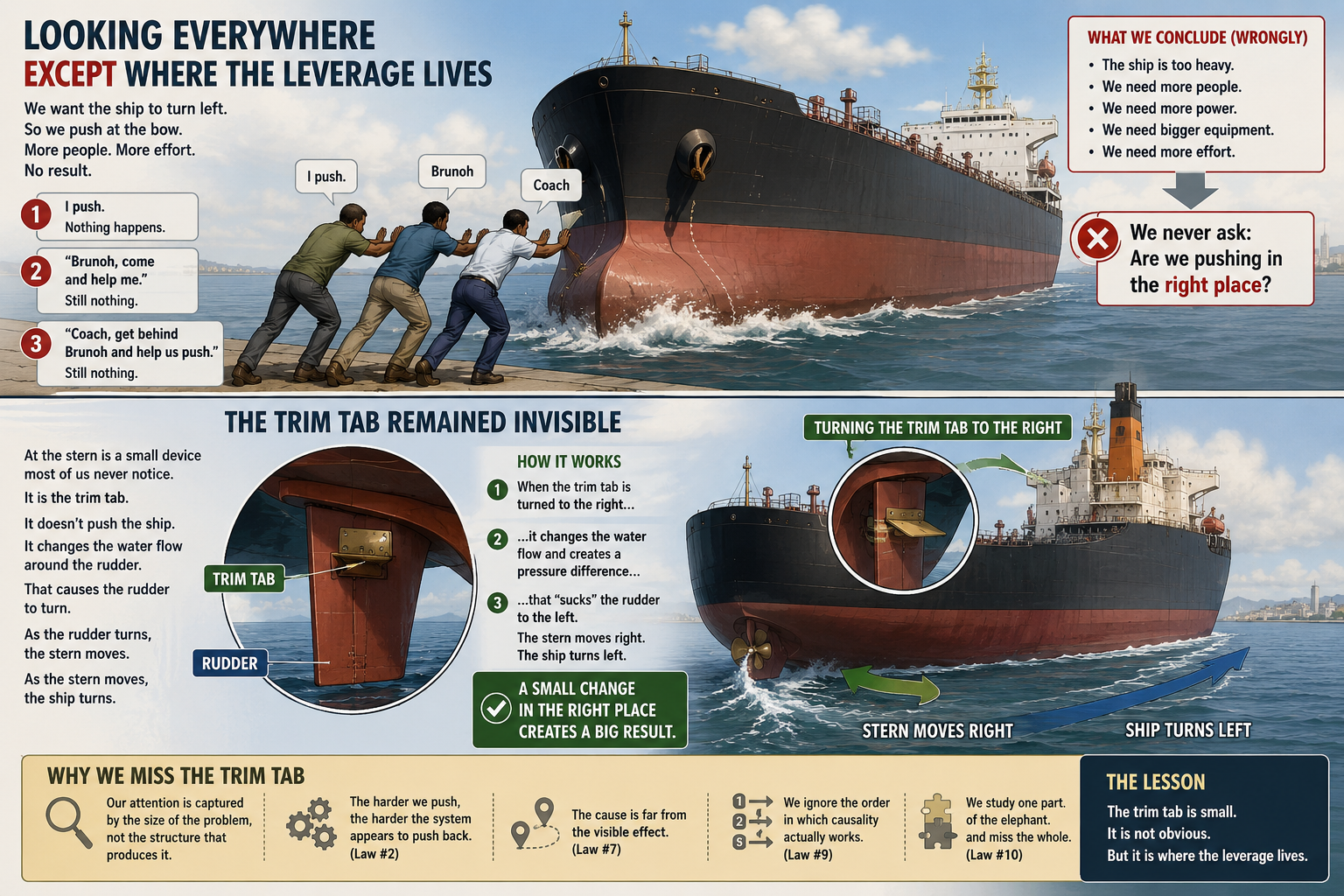
Peter Senge introduces the concept of leverage through one of engineering’s most elegant designs—the trim tab. A trim tab is a very small control surface attached to the trailing edge of a ship’s much larger rudder. Although it represents only a tiny fraction of the rudder’s size, it plays a decisive role in steering the vessel.
When the trim tab is moved, it creates a small pressure differential in the water flowing around the rudder. That pressure difference causes the much larger rudder to turn. Once the rudder turns, the movement of the water around it causes the stern of the ship to swing, changing the direction of the entire vessel. The trim tab never pushes the ship directly. Yet its small movement eventually changes the course of thousands of tonnes of steel moving through the ocean.
This makes the trim tab a powerful metaphor for systemic leverage. If someone unfamiliar with hydrodynamics wished to change the direction of a large oil tanker, they would most likely attempt to push against the bow because that is where the direction appears to be determined. The effort would be enormous and almost entirely ineffective. The leverage does not lie where the movement is most visible. It lies deep within the steering mechanism where a very small adjustment produces a much larger response throughout the system.
Senge concludes that human systems behave in remarkably similar ways. The highest-leverage interventions are rarely obvious because they are hidden within the underlying structures that generate behaviour. They are seldom located near the visible symptoms and often cannot be discovered until leaders stop focusing on isolated events and begin understanding the system as a whole. Learning to see structures rather than events, and processes of change rather than isolated snapshots, therefore becomes the foundation for discovering leverage.
This sets up our STRLDi Interpretation perfectly. We now begin immediately with the lever, move naturally into Law #7 (the further from the fulcrum…), then into the trim tab, the paper-folding exercise, and finally our Botswana unemployment study, where participants discover that the highest leverage is not in employment policy alone but in the reinforcing structures that reproduce capability, family resilience and productive participation across generations.
Law #8 is the first law where STRLDi clearly moves beyond explaining Senge and begins extending him. It is where our work starts showing how to find leverage in persistent national issues, not merely how to understand that leverage exists.
The STRLDi Interpretation
Part I – Everyone Wants Bigger Results
We all want bigger results.
Governments want stronger economies. Organisations want greater productivity. Families want more stable relationships. Farmers want larger harvests. Communities want safer neighbourhoods. Regardless of where we begin, our aspirations are remarkably similar. We all seek improvement. Yet, whenever those improvements fail to appear, our instinctive response is almost always the same. We assume that greater results require greater effort. We work longer hours, allocate larger budgets, create additional programmes and increase pressure on people and institutions. The assumption appears perfectly reasonable.
The Eighth Law quietly overturns that assumption. It suggests that lasting transformation rarely depends upon the size of the intervention. Instead, it depends upon where the intervention is applied. A very small action, introduced at a point of high leverage, may eventually produce far greater and more enduring change than the largest intervention directed at the wrong place.
This immediately raises a different question. If bigger effort is not necessarily the answer, where does leverage actually live?
Part II – The Rock That Refused to Move
Imagine attempting to move a large rock lying across a pathway. You push with all your strength. The rock barely moves. Others join you. Together you push harder. Still nothing happens. Eventually someone quietly arrives carrying nothing more than a long metal bar. They place one end beneath the rock, rest it upon a smaller stone and gently press down on the opposite end. Almost effortlessly, the rock begins to move.
What changed?
The rock did not become lighter. The people did not become stronger. The effort itself became dramatically smaller. The only thing that changed was where the force was applied.
That is leverage.
Most people remember the lever. Few remember the small stone supporting it.
Part III – The Fulcrum Was the Real Teacher
The true lesson does not lie in the lever.
It lies in the fulcrum.
Notice what happens as the effort moves progressively further away from the fulcrum. The force required becomes smaller while the movement produced becomes larger. The relationship between effort and results changes completely.
This is no longer simply a lesson in mechanics. It quietly introduces Law #7. The greatest influence often lies furthest from the visible outcome. The further upstream we discover the causal structure producing the behaviour, the less likely the visible problem is to return because we are no longer responding to symptoms. We are changing the structure generating them.
The principle of leverage therefore begins long before we discover the intervention. It begins by learning where not to push.

Archimedes proved the Law of the Lever and applied the law in a variety of inventions. Historian John Tzetzes, writing in the 12th century, wrote that Archimedes said: “Give me a place to stand, and with a lever, I will move the world.”Archimedes proved the Law of the Lever and applied the law in a variety of inventions. Historian John Tzetzes, writing in the 12th century, wrote that Archimedes said: “Give me a place to stand, and with a lever, I will move the world.”
Part IV – The Ship Nobody Could Turn
Buckminster Fuller believed one of the greatest demonstrations of leverage ever designed was not the lever itself but the trim tab.
Most people know that ships are steered by a rudder. Few know that attached to the rudder is a much smaller surface called the trim tab. This tiny device never turns the ship directly. Instead, it creates a slight pressure difference in the water flowing around the rudder. That pressure difference causes the rudder to turn. As the rudder turns, the stern swings, and eventually thousands of tonnes of steel begin changing direction.
The trim tab never pushes the ship.
It changes the conditions that allow the ship to turn on its.
Part V – Brunoh, Come and Help Me Push
Looking Everywhere Except Where the Leverage Lives
Suppose we were standing on the shoreline watching a large oil tanker approaching the harbour. Suddenly, someone shouted, “Turn the ship!” Most of us would immediately run towards the front of the vessel. After all, if we wanted the ship to turn left, surely we should push the front of the ship towards the left.
So, I lean my shoulder against the bow and begin pushing.
Nothing happens.
I look around and shout, “Brunoh! Will you come and help me?”
Brunoh joins me. Together we push with everything we have. Still, the ship refuses to move. Perhaps we simply need more people. “Coach,” I shout, “will you get behind Brunoh and help us push?” Three of us are now pushing with all our strength. More effort. More people. More determination. Yet the ship continues moving exactly as before.
What conclusion do we naturally reach?
We probably conclude that the ship is simply too heavy. Perhaps we need a hundred people. Perhaps we need a thousand. Perhaps we need a bulldozer. Every conclusion points towards more effort. Almost nobody stops to ask a much simpler question.
Are we pushing in the right place?
The Trim Tab Remained Invisible
The remarkable thing about this story is not that we were weak.
It is that we never even looked for the trim tab.
Our attention remained fixed upon the size of the ship. The larger the problem appeared, the larger the effort we believed was required. The trim tab was quietly doing exactly what it had always done, yet because it was small, almost invisible and unfamiliar to us, it never entered our thinking.
This is exactly how persistent national issues behave.
The larger the problem appears, the more governments increase budgets, establish programmes, reorganise ministries and introduce larger interventions. Yet the trim tab often remains untouched because it is hidden within a reinforcing structure that few people are even looking for.
Why We Miss the Trim Tab
The trim tab is not difficult to operate.
It is difficult to notice.
That is Peter Senge’s point when he tells us that the areas of highest leverage are often the least obvious. The difficulty is not that leverage does not exist. The difficulty is that our mental models have already decided where solutions ought to be found. We look where the light is brightest, not where causality actually lives.
Notice how many of the previous laws quietly appear again.
Because we kept pushing, Law #2 appeared. The harder we pushed, the harder the system appeared to push back.
Because we ignored the steering mechanism, Law #9 appeared. We failed to respect the order in which causality actually operates.
Because we never asked what was producing the ship’s movement in the first place, Law #7 appeared. The cause remained hidden, distant from the visible effect.
And because we were looking only at the bow rather than the entire steering system, Law #10 quietly appeared as well. We were studying one part of the elephant while completely missing the whole.
Part VI – Small Does Not Mean Weak
Many people misunderstand this law because they confuse small interventions with small results.
The law says nothing of the sort.
Small changes are capable of producing very large results, provided they are applied at points of high leverage. The intervention is small. The outcome is anything but small.
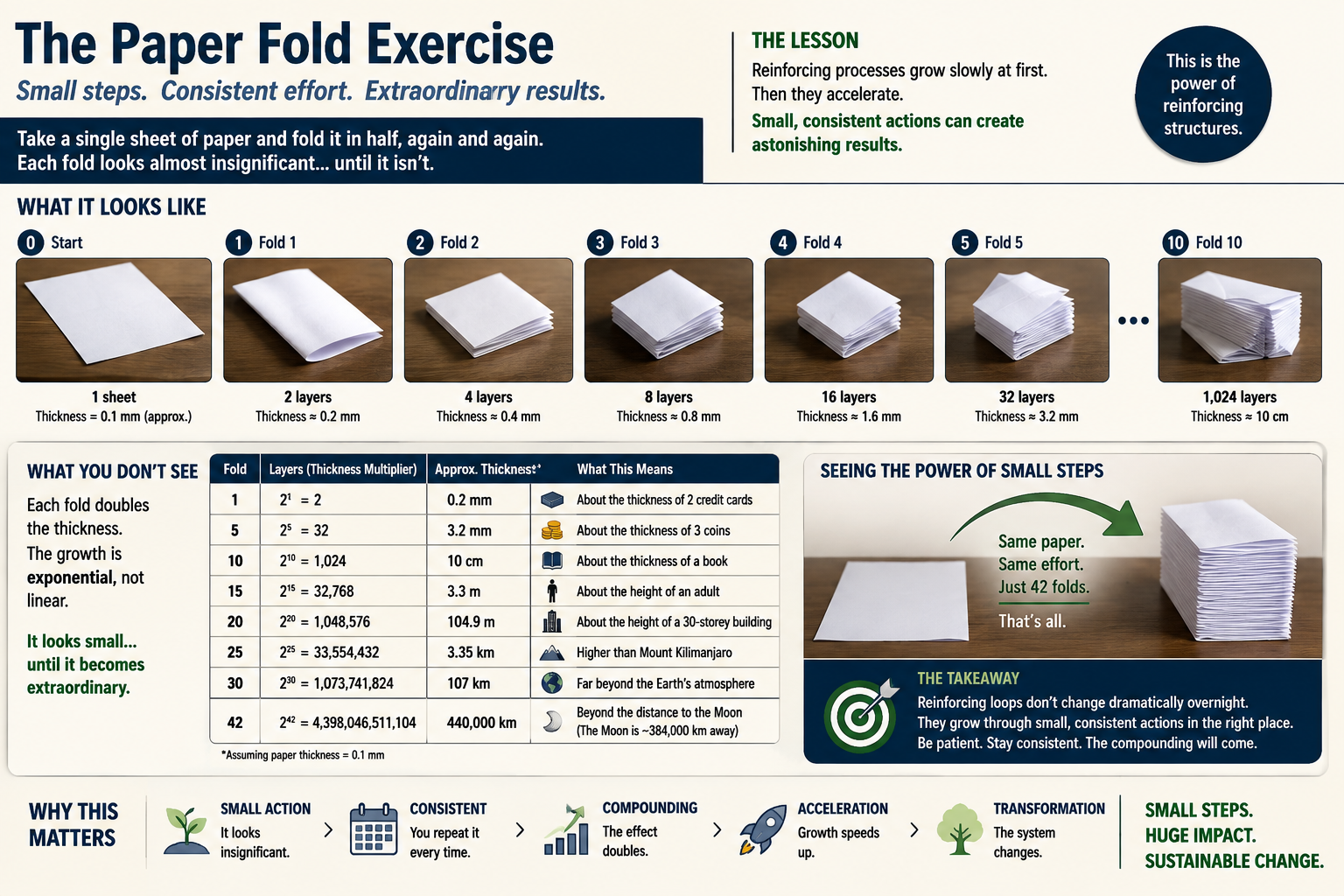
This also distinguishes reinforcing loops from balancing loops. Balancing loops generally produce proportional responses. Reinforcing loops quietly accumulate small changes until the entire behaviour of the system begins transforming. The change appears insignificant for a long time before suddenly becoming impossible to ignore.
To experience this for yourself, pause here and complete the following exercise.
Paper Folding Exercise
As you work through the exercise, pay particular attention to the first few folds. They appear almost meaningless. Yet every fold contributes to what eventually becomes an astonishing result. Ask yourself what this teaches us about consistency, patience and reinforcing growth. How different is this from the way we usually attempt to solve persistent problems?
Part VII – Why the Highest Leverage Is the Least Obvious
Peter Senge reminds us that the areas of highest leverage are often the least obvious.
Why?
Because leverage is rarely found within the events we observe. It is hidden inside the structures producing those events. That is precisely why the previous laws matter. Each one has quietly been teaching us to move further away from symptoms and progressively closer towards the underlying structure. We learnt that today’s problems often come from yesterday’s solutions. We learnt that behaviour frequently improves before it worsens. We learnt that causes are rarely located close to their visible effects. We learnt to stop dividing the elephant into disconnected parts.
Only after learning these lessons do we become capable of recognising leverage.
Part VIII – The Healing Poison
Engineering has now taken us as far as it can.
It is time to enter a living human system.
Before continuing, read the following story.
The Healing Poison Story
Do not analyse it immediately.
Simply read it once.
Then read it again, this time as a systems thinker.
Ask yourself:
- What exactly did the uncle change?
- What did he deliberately choose not to change?
- Where was the leverage?
- Which of the Laws of Dynamic Complexity quietly appeared throughout the story?
- Why did such a remarkably small intervention permanently change the behaviour of the entire family?
Complete this reflection individually before discussing it with your learning partner. Resist the temptation to rush towards the answer. This exercise is designed to develop something far more valuable than simply identifying leverage. It develops the ability to recognise leverage while it is still hidden.
Part IX – The Nation Was Looking at the Wrong End of the Ship
We Measure the Wrong Things
By now, the principle of leverage should no longer surprise us. We have moved a rock with a lever, turned an oil tanker with a trim tab and watched an entire family transform through one small but carefully placed intervention. The question before us is therefore no longer whether leverage exists. The question is whether we have been looking for it in the right place.
The Botswana Persistent Unemployment Study suggests that we have not. Like those pushing against the bow of the ship, much of our national attention has been directed towards the visible outcomes of the system. We measure unemployment, poverty, crime, educational performance, gender-based violence, welfare dependency and declining productivity because these are the issues confronting us daily. Yet, according to the Eighth Law, the highest leverage seldom lies where the greatest concern is being expressed.
This is precisely what makes the trim tab so difficult to discover. The larger the visible problem becomes, the more confidently we assume that equally large interventions must be required to solve it.
Detailed Complexity Replaces Dynamic Complexity
Notice how naturally our thinking shifts towards detailed complexity.
We establish another programme. We increase another budget. We create another department. We launch another strategy. We strengthen another policy. Each intervention appears entirely reasonable because it responds directly to a visible concern. Yet, while the concerns continue multiplying, the reinforcing structures quietly producing those concerns remain largely unchanged.
The unemployment study therefore asks a different question.
What if unemployment is not where the leverage lies?
Part X – The Trim Tab Was Hidden Inside the Household
Completing the Causal Loop
Earlier in this chapter, we recognised that household dynamics influence the nation’s productive capability. That observation was important, but it represented only part of the reinforcing structure. To stop there would still leave the causal loop incomplete.
Persistent unemployment weakens households. Weakened households then become part of the reinforcing structure that reproduces persistent unemployment across the next generation. The household therefore becomes both an outcome of the system and one of the structures continually recreating it. The loop has now closed.
This changes everything.
The Household Is Not the Destination
It is tempting to conclude that strengthening families is the solution to unemployment. That would still be linear thinking.
The household is not the destination. It is one of the nation’s highest leverage structures because it continually reproduces the emotional, behavioural and relational capabilities upon which every productive economy ultimately depends. Long before children become employees, entrepreneurs, engineers, teachers or farmers, they first become sons, daughters, brothers and sisters within a household.
Capability therefore begins long before employment begins.
Part XI – The Nation’s Hidden Infrastructure
Infrastructure We Rarely Recognise
When governments speak about infrastructure, they naturally refer to roads, railways, airports, ports, electricity, telecommunications and water systems. These investments are essential because they enable goods, services and people to move efficiently throughout the economy.
Yet another form of infrastructure quietly operates beneath them all.
Healthy relationships.
Strong households.
Capable parents.
Secure children.
Disciplined young adults.
These are not merely social outcomes. They are the human infrastructure through which productive capability is continually reproduced across generations.
The Twelve Emotional Needs as a Reinforcing Structure

The work of Dr John Gray and Helen Andelin becomes particularly significant when viewed through systems thinking. Their contribution is not simply that men and women experience different emotional needs. Their deeper contribution is that meeting one emotional need naturally increases the capacity to meet another, creating a reinforcing structure that strengthens the relationship itself.
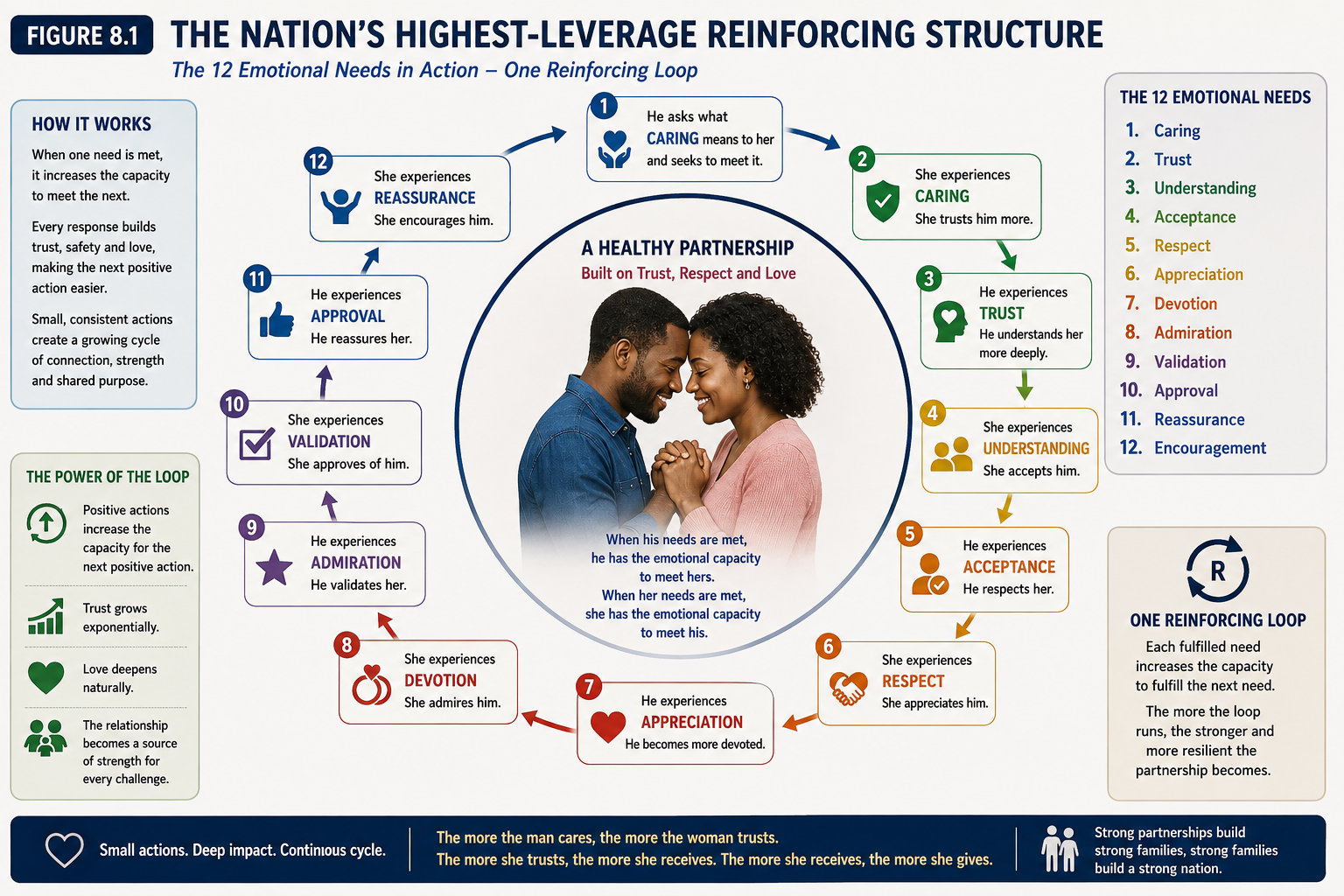
Suppose a husband genuinely seeks to understand what caring looks like to his wife rather than assuming he already knows. As she experiences that care, trust naturally begins growing. As trust grows, she becomes increasingly willing to accept him for who he is rather than continually trying to reshape him. Experiencing acceptance, he finds it easier to respect her deeply, not because of her achievements or status, but because she is his wife. Feeling respected, she increasingly appreciates his efforts to provide, protect and contribute to the household.
Notice what has happened.
No dramatic intervention has occurred.
These should be behavioural examples, not definitions. Each one should answer the question:
“What does meeting this need actually look like?”
| Need Being Met | Everyday Example |
|---|---|
| 1. Caring | He notices she has had a difficult day, asks what she needs instead of assuming, and makes time to be present with her. |
| 2. Trust | She confidently entrusts him with an important family decision because she believes he has the family’s best interests at heart. |
| 3. Understanding | He listens without interrupting, correcting or solving the problem, allowing her to feel fully heard before offering advice. |
| 4. Acceptance | She accepts his personality, strengths and weaknesses without constantly trying to change him into someone else. |
| 5. Respect | He speaks to her courteously, values her opinions and honours her dignity even when they disagree. |
| 6. Appreciation | She thanks him sincerely for working hard, providing for the family or doing thoughtful things that might otherwise go unnoticed. |
| 7. Devotion | He deliberately makes her and the family a priority by protecting time, attention and commitment for the relationship. |
| 8. Admiration | She openly expresses pride in his character, decisions, courage or integrity rather than only recognising achievements. |
| 9. Validation | He acknowledges that her feelings make sense from her perspective, even when he experiences the situation differently. |
| 10. Approval | She communicates confidence in his decisions and lets him know she believes he is moving in the right direction. |
| 11. Reassurance | He consistently reminds her through both words and actions that she is loved, valued, and secure in the relationship. |
| 12. Encouragement | She encourages him to pursue his calling, persevere through setbacks, and continue growing without fear of criticism. |
Notice what happens when you read them in sequence.
Each response quietly increases the capacity for the next response. Caring strengthens trust. Trust strengthens understanding. Understanding strengthens acceptance. Acceptance strengthens respect. Respect strengthens appreciation. Appreciation strengthens devotion. Devotion strengthens admiration. Admiration strengthens validation. Validation strengthens approval. Approval strengthens reassurance. Reassurance strengthens encouragement. Encouragement, in turn, makes caring easier once again.
Each action creates the emotional capacity for the next response. That is precisely why they form one reinforcing loop rather than twelve independent emotional needs. The loop demonstrates that small, consistent relational actions compound over time, producing stronger partnerships, healthier families and, in the context of the unemployment study, one of the nation’s highest-leverage reinforcing structures.
The reinforcing loop quietly begins reproducing itself.
Part XII – Small Actions That Build Nations
The Pattern Never Stops at the Couple – The Least Obvious Leverage Point
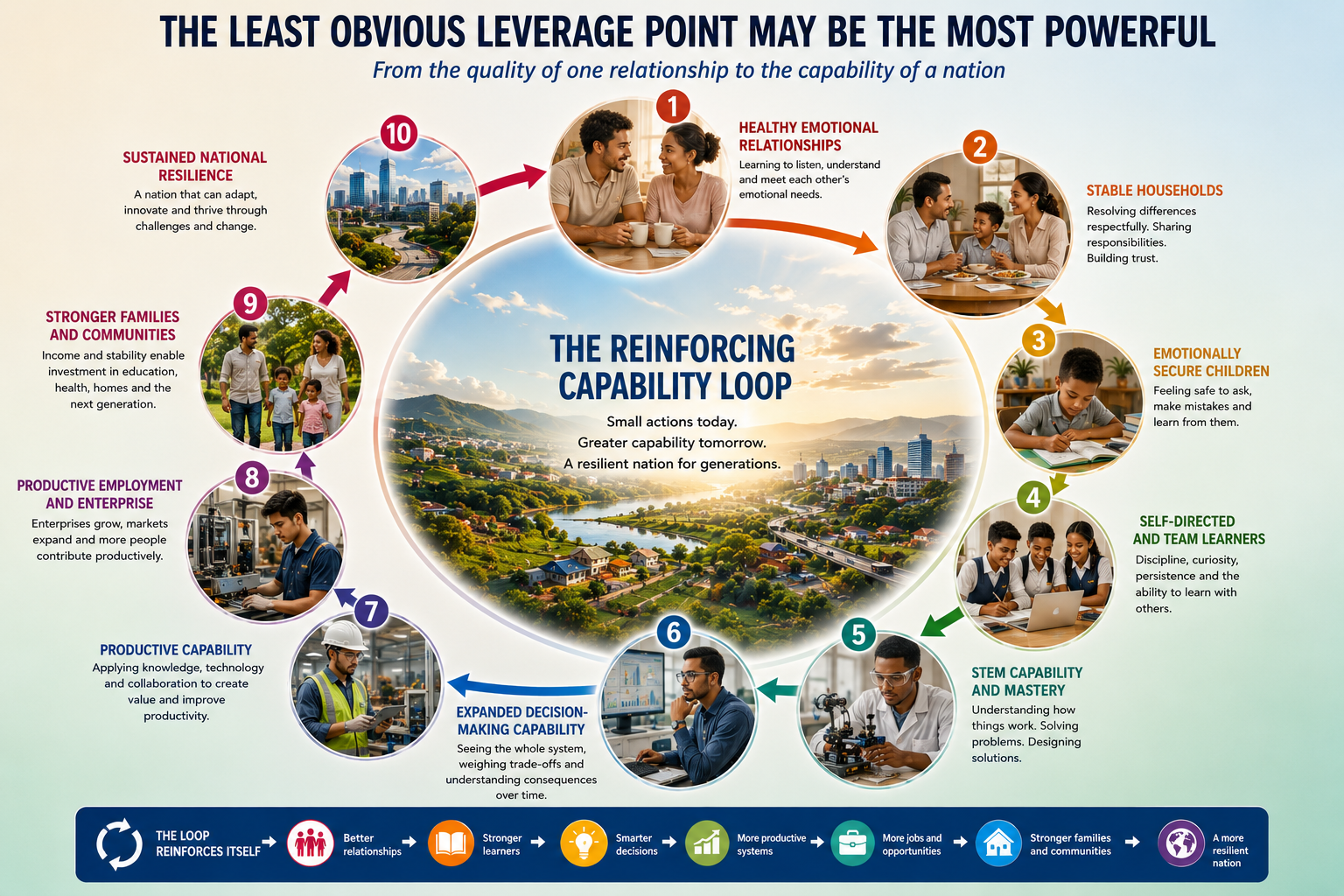
Reinforcing loops rarely remain confined to the place where they begin. A relationship between two adults can shape a household; the household shapes a child’s emotional development; that development influences how the child learns and works with others; those capabilities influence education, STEM mastery, productive capability and eventually the nation’s capacity to make and implement consequential decisions. The leverage point may therefore sit far upstream from the outcome we are trying to change.
This is why the quality of the couple relationship deserves far more attention than it usually receives.
A couple is not simply another social relationship. Most people learn how to relate to parents, siblings, peers, elders and authority figures within familiar cultural structures. Age, family role, social position and organisational hierarchy provide expectations that help define those relationships. Cultural norms exist partly because generations have accumulated ways of managing these relationships.
The lifelong couple relationship is different. Two people who did not grow up together, may have very different histories and mental models, and may have different emotional needs, are choosing to build a life together without a predetermined script for how every disagreement, sacrifice, expectation or change will be handled. They have to learn how to understand and meet the 12 emotional needs of two different people, rather than assuming that what works for one will work for the other.
That makes the couple relationship one of humanity’s most demanding learning environments. It requires listening rather than assuming, negotiating rather than imposing, repairing rather than withdrawing, and learning to recognise needs that are not one’s own. This is where emotional capability is built (see segement above on The Twelve Emotional Needs as a Reinforcing Structure).
Yet this is also one of the areas we are most likely to pass over lightly because it is the least obvious place to look for national leverage.
What Kind of Family Are You About to Create?
The relevant question is therefore not simply whether two people intend to marry or establish a household. It is:
What kind of family are you about to create?
That question moves the focus from the couple as a private unit to the capabilities that their relationship will begin to transmit to the next generation. Children observe how their parents disagree, resolve problems, take responsibility, honour commitments, respond to mistakes and treat one another when circumstances are difficult. They absorb these patterns long before they encounter formal lessons on leadership, teamwork or citizenship.
A healthy couple therefore creates more than a stable household. It creates an environment in which children can develop emotional security, confidence, trust and the ability to learn without fear. Those qualities become foundations for how they later work with others, respond to difficulty and take responsibility for their own development.
From Relationship Capability to National Capability
The progression is not automatic, but it is reinforcing.
A child who feels emotionally secure is better positioned to ask questions, admit mistakes, accept correction and persist when learning becomes difficult. Over time, this can develop into the ability to learn independently while also learning with and contributing to others. The family has begun to teach something that every effective organisation eventually requires: how to work and learn with other people.
But relational and team capability alone are not sufficient for the increasingly complex decisions required in a modern economy and state. The individual must also develop the capacity to understand the systems upon which those decisions act.
This is where STEM capability becomes critical. Mathematics, science, technology and engineering develop disciplined ways of reasoning from evidence, understanding relationships, identifying constraints, testing assumptions, modelling systems and designing solutions. STEM does not simply prepare people for technical occupations; it expands what they are capable of seeing and therefore expands the decision space from which they can act.
The Railway Test
Consider the instruction:
“Make the railway profitable.”
A graduate without strong STEM capability may still be intelligent, educated, collaborative and capable of making a decision. They may examine fares, staffing, maintenance, operating costs, marketing or subsidies. Those are legitimate considerations, but the decision remains largely within the existing frame:
railway → transport service → revenue and cost → profitability.
A graduate with developed STEM capability can potentially see a much larger system. They can ask what flows the railway could carry, where production is located, where markets are, what volumes could move, what the movement costs, where the bottlenecks are, how rail connects with roads and ports, and how agriculture, mining, manufacturing and regional trade affect those flows.
The railway is then no longer simply an organisation that must become profitable. It becomes part of a national production and logistics system whose economic flows can be redesigned.
The difference is not simply decisiveness. It is the capability to see more of the system upon which the decision acts.
This is why consequential national decision-making requires the combination of relational capability, team-learning capability, STEM capability and systems thinking. The first enables people to work with people. The second enables collective learning. STEM strengthens the ability to understand complex reality. Systems thinking connects the parts and their behaviour over time. Together, they create a larger and more capable decision space.
From Capability to Productive Employment
When these capabilities are applied to the economy, they become productive capability. An engineer designing a more efficient irrigation system, a manufacturer redesigning a production process, or a logistics team improving the movement of goods is converting knowledge and systems understanding into productive value.
The progression is therefore not simply:
STEM → employment.
It is:
healthy relationships → emotional capability → team learning → STEM capability → expanded decision-making capability → productive capability → productive employment.
Employment itself is an outcome of productive systems. A manufacturing company does not hire ten technicians merely because ten technicians exist; it hires them because production has expanded, markets are viable and the enterprise requires their capabilities. This is why human capability and productive capability must develop together.
The Loop Returns to the Household
When productive employment generates stable income, the effect returns to the household. Families can invest more consistently in education, healthcare, nutrition, security and the developmental environment in which children grow. The stronger household then provides better conditions for the next generation to develop the capabilities from which the loop began.
At national scale, the accumulated effect is resilience. A resilient nation is not simply one whose citizens are expected to cope with shocks without government assistance. It is a nation whose people, enterprises and institutions have the capability to learn, collaborate, innovate, reorganise production and respond intelligently when circumstances change.
The Reinforcing Capability Loop
| Reinforcing Stage | Capability Being Built | Everyday / National Example | What It Enables Next |
|---|---|---|---|
| 1. Healthy Emotional Relationships | Emotional and relational capability — learning to understand, communicate and meet the emotional needs of another person who is different from oneself. | A husband notices that his wife is overwhelmed and asks, “How can I support you today?” rather than assuming what she needs. Over time, two people learn how to listen, negotiate, repair, compromise and build trust across their differences. | The couple becomes the child’s first experience of how people can work through difference and build something together. |
| 2. Stable Households | Collaborative capability — sharing responsibility, resolving differences, repairing relationships and sustaining a common purpose. | Parents disagree but work through the disagreement respectfully rather than turning conflict into fear or insecurity for their children. | Children observe that relationships can withstand disagreement and that problems can be worked through rather than avoided or won. |
| 3. Emotionally Secure Children | Learning confidence and psychological safety — asking questions, admitting mistakes, receiving correction and trying again. | A child can say, “I made a mistake,” because home is a place where mistakes can be corrected and learned from rather than hidden. | The child becomes more able to explore, learn, take responsibility and engage with others. |
| 4. Self-Directed and Team Learners | Personal mastery and team learning — taking responsibility for one’s own development while learning with and contributing to others. | A learner persists with difficult work, asks for help when needed and contributes constructively when a group is solving a problem. | The individual develops the ability to work and learn with others, while continuing to build personal capability. |
| 5. STEM Capability and Mastery | Analytical and technical capability — reasoning from evidence, understanding relationships, identifying constraints, testing assumptions, solving problems and designing solutions. | A student studying physics or engineering learns not simply to remember an answer, but to determine why a system behaves as it does and what could change it. | The person’s decision space expands: they can see relationships, possibilities and constraints that are not immediately visible. |
| 6. Expanded Decision-Making Capability | Human + STEM + systems capability — combining relational and team capability with the ability to understand complex systems, trade-offs and consequences over time. | Asked to “make the railway profitable,” a decision-maker looks beyond fares, staffing and costs to examine production centres, freight and passenger flows, markets, ports, roads, infrastructure, bottlenecks and regional trade. | The person can move from managing the visible organisation to redesigning the system in which it operates. |
| 7. Productive Capability | Value-creation capability — applying knowledge, technology, collaboration and systems understanding to create, improve and scale productive activity. | An engineer improves an irrigation system; a manufacturer redesigns a production process; a logistics team identifies a more efficient route for moving goods. | Capability becomes economic value, creating the basis for viable enterprises, value chains and markets. |
| 8. Productive Employment and Enterprise | Economic participation — people become producers, technicians, professionals, entrepreneurs and employers within viable productive systems. | A manufacturing company expands because its products are competitive and hires additional technicians because production and market demand have grown. | Productive employment generates income, enterprise growth and stronger economic participation. |
| 9. Stronger Families and Communities | Intergenerational capability — using productive income and stability to strengthen the conditions from which the next generation develops. | Stable income enables parents to invest in children’s education, health, security and development, while communities gain stronger productive and social foundations. | The next generation begins with stronger human and relational foundations, reinforcing Stage 1. |
| 10. Sustained National Resilience | Collective adaptive capability — people, enterprises and institutions learn, collaborate, innovate and reorganise in response to changing conditions. | During an economic shock, capable citizens, firms and institutions develop new products, markets, technologies and ways of organising production rather than simply absorbing the shock. | Resilience protects and strengthens the conditions in which the next generation can continue developing capability. |
| Enabling Condition | Role in the Reinforcing System |
|---|---|
| Natural Foundations | Healthy soil, clean water, biodiversity and ecological balance provide the natural foundations on which households, agriculture, industry and economic activity depend. Productive capability that destroys these foundations ultimately weakens the loop. |
| Effective Institutions and Execution | Governance, sound policy, administration, infrastructure, financing, coordination and accountability convert collective capability and shared intent into action. Seeing the system is not enough; institutions must be capable of executing what has been understood. |
| Shared Purpose and Values | Trust, integrity, service, solidarity, inclusion, fairness and responsibility help align individual and institutional choices around purposes that can be sustained across generations. |
Why This Is Law #8
The obvious place to intervene in unemployment is unemployment. The obvious place to intervene in weak productivity is productivity. The obvious place to intervene in poor national decision-making is the decision-maker. Law #8 asks us to look further upstream.
The leverage may lie in the quality of a relationship that appears entirely private: two adults learning to understand and meet the emotional needs of another person who is different from themselves. That relationship can influence the emotional security of a child; emotional security can influence learning; learning can develop the capacity to work with others; STEM can expand the capacity to understand complex systems; those capabilities can strengthen productive and decision-making capability; productive capability can create employment; and employment can strengthen the household from which the next generation begins.
The intervention may therefore be small, early and almost invisible while its eventual consequences are national.
That is the nature of reinforcing systems.
The highest-leverage intervention is often not where the problem is most visible. It is where a relatively small change can strengthen the next capability, which strengthens the next, until the accumulated effect begins to reproduce a different national outcome.
The reinforcing loop has become national.
Part XIII – Discovering Botswana’s Trim Tab
Where the Highest Leverage May Lie
The unemployment study therefore arrives at an unexpected conclusion.
Botswana’s highest leverage may not lie primarily in employment policy, industrial incentives or labour legislation. Those interventions remain important, but they operate further downstream within the reinforcing structure. The nation’s trim tab may instead lie much earlier, where productive capability itself is quietly being formed through healthy relationships, resilient households and disciplined capability formation.
This does not diminish the importance of economic policy.
It simply reminds us that economies are ultimately built by people, and people are first formed within relationships long before they enter labour markets.
Replacing Worry With Leverage
Today we often replace leverage with worry.
We replace reinforcing structures with programmes.
We replace capability formation with crisis management.
We replace dynamic complexity with detailed complexity.
The Eighth Law invites us to reverse that habit. Before asking how much more we should do, it asks us to understand where the system is already quietly reproducing itself. Once that reinforcing structure becomes visible, remarkably small and consistent interventions begin producing results that previously seemed impossible.
The ship finally changes direction—not because more people gathered at the bow, but because someone quietly discovered the trim tab.
Finding the Trim Tab
So, the key to this law is not simply that the trim tab is remarkably effective. Its true significance is that almost nobody notices it. The trim tab is hidden in plain sight because our attention is naturally drawn towards the largest and most visible parts of the system. We therefore spend most of our time pushing the ship while overlooking the tiny structure that quietly determines where the ship will eventually go.
The practical application of this law therefore consists of three deliberate steps. These steps do not guarantee that we will immediately discover the leverage point, but they significantly improve our ability to recognise it while it is still hidden.
Step 1 — See the Structure Before Looking for the Leverage
The first task is not to search for solutions.
It is to see and understand the underlying structure generating the behaviour. This means working with the System Archetypes, the Onion Model, or any other structural representation that allows us to understand how the parts of the system interact with one another. Until the structure becomes visible, every intervention remains little more than an educated guess because we still do not know what is producing the behaviour we wish to change.
Step 2 — Notice What We Are Not Looking At
Once the structure has been made visible, shift your attention away from the parts that everyone is already discussing. Ask a very different question.
What parts of this structure are we paying little or no attention to?
Our mental models naturally draw our attention towards the visible, the urgent and the familiar. Yet the Eighth Law reminds us that leverage is rarely found there. The trim tab usually occupies the quiet corners of the structure, waiting for someone willing to look where everyone else has chosen not to.
Step 3 — Look for the Least Obvious
The final step is perhaps the simplest.
Ask everyone involved in the discussion to identify what they believe the highest leverage point might be. Then compare the responses. Quite often, the points receiving the least attention deserve the greatest investigation. Sometimes the trim tab is not a policy, a budget or a programme at all. Sometimes the highest leverage lies in seeing the whole structure simultaneously, because once the mind grasps the whole, decisions begin changing almost immediately and delays caused by fragmented thinking simply disappear.
The Urgent File Case Study
Think back to the Urgent File Case Study.
Where did most participants initially place their attention? They naturally focused on the visible event—the urgent file itself, the delays, the people involved and the immediate actions required. Yet as the reinforcing and balancing structures gradually became visible, attention shifted away from the file and towards the interactions producing the behaviour. The leverage was never the file. The leverage lay within the structure governing how the work moved through the system.
Notice what happened the moment the whole structure became visible.
The discussion changed almost immediately. Participants stopped debating individual events and began discussing relationships, feedback loops and patterns of behaviour. Nothing physical in the organisation had changed. Yet everything about how the issue was understood changed. Sometimes, the highest leverage is not a new intervention at all. It is enabling people to see the whole system at once. Once that happens, the trim tab has already begun turning the ship.
What is its trim tab? Notice the process you use to arrive at the systemic intervention. Notice also, how much does it cost?
Why do we not see these trim tabs more often? To understand the question, go to Law #10.
In Summary … STRLDi Interpretation Outline
Part I – Everyone Wants Bigger Results
1.1 The Human Search for Bigger Outcomes
- Why governments, organisations and families instinctively pursue bigger interventions.
- The hidden assumption that bigger problems require bigger effort.
1.2 The Law Challenges Our Assumption
- Small interventions. Big outcomes.
- Why leverage, not effort, determines transformation.
Part II – Learning What Leverage Really Means
2.1 The Lever and the Rock
- Why the rock did not become lighter.
- The lever changes where force is applied.
2.2 The Fulcrum Changes Everything
- Why the fulcrum—not the lever—is the real lesson.
- Link to Law #7 (cause furthest from the effect).
Figure 8.1
The Lever and the Fulcrum
Part III – The Trim Tab
3.1 Buckminster Fuller’s Gift
- Explain the trim tab technically.
- Why the smallest component changes the largest object.
3.2 Brunoh, Come Help Me Push
- Pushing the bow.
- Coach joins.
- Everyone pushes.
- Nothing moves.
3.3 Why We Never Saw the Trim Tab
- The obvious attracts attention.
- The leverage remains invisible.
Figure 8.2
The Bow versus the Trim Tab
Part IV – The Reinforcing Nature of Small Changes
4.1 Small Does Not Mean Weak
- Difference between reinforcing and balancing loops.
4.2 Folding Paper to the Moon
- Small.
- Consistent.
- Compounding.
- Exponential.
Exercise
Paper Folding Exercise
Part V – Finding the Trim Tab
5.1 Step One
See the Structure
- Onion.
- Archetypes.
- Causal loops.
5.2 Step Two
Notice What Nobody Is Looking At
- Shift attention away from visible symptoms.
5.3 Step Three
Look for the Least Obvious
- Straw poll.
- Why the least obvious deserves the greatest investigation.
5.4 The Urgent File Case Study
- Discovering the trim tab.
- Why the solution cost almost nothing.
Part VI – Healing the Poison
6.1 Read the Story
Exercise
Healing the Poison
6.2 What Did the Uncle Actually Change?
Reflection Questions
- What did he do?
- What didn’t he do?
- Where was the leverage?
- Which laws appeared?
6.3 The Family Changed Itself
Part VII – Returning to Botswana
7.1 We Were Looking at the Wrong End of the Ship
- Why unemployment is not the beginning.
7.2 Detailed Complexity Replaces Dynamic Complexity
Instead of leverage we discuss:
- unemployment
- poverty
- GBV
- welfare
- crime
- education
- productivity
All downstream.
Part VIII – Completing the Reinforcing Structure
8.1 The Household Is Not the Beginning
- Unemployment weakens households.
- Households reproduce unemployment.
Complete the reinforcing loop.
8.2 Seeing the Whole Structure
- Employment is one node.
- Household dynamics another.
- Capability formation another.
Part IX – The Nation’s Hidden Infrastructure
9.1 Infrastructure We Can See
Roads.
Ports.
Electricity.
Rail.
Water.
9.2 Infrastructure We Cannot See
Relationships.
Trust.
Families.
Character.
Responsibility.
Capability.
9.3 The Trim Tab Was Hidden Here
Part X – The Twelve Emotional Needs as a Reinforcing Loop
Figure 8.3
The Twelve Emotional Needs as One Reinforcing Loop
Part XI – From Relationships to National Capability
Figure 8.4
From Emotional Needs to National Capability
Part XII – Botswana’s Trim Tab
12.1 The Nation’s Highest-Leverage Reinforcing Structure
The unemployment study’s central insight.
12.2 Replacing Worry with Leverage
Today we discuss:
- unemployment
- budgets
- policy
- programmes
Instead of strengthening the reinforcing structures quietly reproducing national capability.
12.3 The Real Meaning of Law #8
Small.
Consistent.
Least obvious.
Highest leverage.
Closing Reflection
Persistent national issues rarely disappear because governments push harder. They begin changing when leaders discover the reinforcing structures quietly reproducing those issues and place their effort where the leverage truly lies.
Previous < — Law #7 Next –> Law #9


You must be logged in to post a comment.