
Strategic Partnerships & Growth
Building the Relationships Through Which Transformation Becomes Possible
“No institution transforms a nation alone. Lasting transformation emerges when relationships become purposeful, knowledge becomes shared and diverse institutions learn to steward change together.”
Contents
This page explains how the Strategic Partnerships & Growth Pillar enables STRLDi to build the relationships, partnerships and collaborative platforms through which its mission is fulfilled. It introduces the philosophy underpinning the pillar, explains how partnerships develop over time, describes the stewardship portfolios and institutional offices that make up the pillar, and outlines how these relationships generate learning, opportunities and long-term institutional growth.
The page is organised into the following sections:
1. Purpose
Why Strategic Partnerships & Growth is central to STRLDi’s mission.
2. The Partnership Journey
How relationships develop from dialogue to long-term institutional partnerships.
3. Institutional Structure
An overview of the pillar and the relationship portfolios through which it operates.
4. Government, Media & International Relations
Building relationships with government, the media and international institutions.
5. Economic Partnerships & Development Cooperation
Working with the private sector, investors and development partners.
6. Institutional, Professional & Knowledge Partnerships
Strengthening collaboration with professional bodies, universities, research institutions and knowledge networks.
7. Community, Knowledge & Regional Partnerships
Connecting with communities, traditional leadership, local government and regional organisations.
8. Proposal Development & Resource Mobilisation (Future Development)
Transforming opportunities into funded programmes and strategic partnerships.
9. Membership Office (Future Development)
Building a long-term community of individuals and institutions committed to systemic transformation.
10. Communities of Practice
Supporting continuous learning and collaboration beyond individual projects.
11. Conferences, Strategic Dialogues & Executive Systems Programmes
Convening leaders through Executive Sunday Systems Retreats, Executive Wednesday Systems Forums, regional Executive Systems Programmes and strategic dialogues that generate learning, relationships and future opportunities.
12. Knowledge & Public Engagement
Sharing research, strengthening public understanding and extending STRLDi’s influence through publications, media and digital platforms.
13. How the Pillar Works
Understanding how the different portfolios work together to create a continuous cycle of partnership, learning and institutional growth.
14. Key Result Areas
The outcomes by which the Strategic Partnerships & Growth Pillar will be measured.
15. Closing Reflection
A reflection on why stewardship, relationships and collaboration are among STRLDi’s greatest institutional assets.
Purpose
The Strategic Partnerships & Growth Pillar exists to build, steward, and strengthen the relationships through which STRLDi fulfils its mission.
Persistent national and regional issues rarely exist within the boundaries of a single organisation, ministry or profession. They emerge through the interaction of many actors whose decisions, priorities, and actions continually influence one another. For this reason, meaningful transformation depends as much on the quality of relationships as on the quality of technical solutions.
STRLDi therefore views partnership development not as an activity undertaken after research is completed or programmes are designed. Partnership is itself a strategic capability. It enables diverse institutions to discover shared purpose, develop mutual trust and mobilise collective action around issues that no single organisation can address independently.
This pillar cultivates the institutional ecosystem within which STRLDi’s research, leadership development, and strategy stewardship can flourish. It identifies opportunities for collaboration, develops long-term institutional relationships, mobilises resources, and creates the conditions for the continual exchange of knowledge across sectors, disciplines and national boundaries.
In doing so, Strategic Partnerships & Growth strengthens not only the Institute itself but also the broader communities of practice committed to systemic transformation.
The Philosophy of Partnership Stewardship
Partnerships are not support functions. They are strategic capabilities through which institutions learn, coordinate and transform together.
At STRLDi, relationships are cultivated not simply to expand the Institute’s network, but to strengthen society’s collective capacity to understand and respond to persistent structural issues.
Partnerships create the conditions through which research is enriched, leadership develops, knowledge travels, and transformation becomes possible.
The Partnership Journey
Partnerships within STRLDi develop through a deliberate journey rather than isolated transactions.
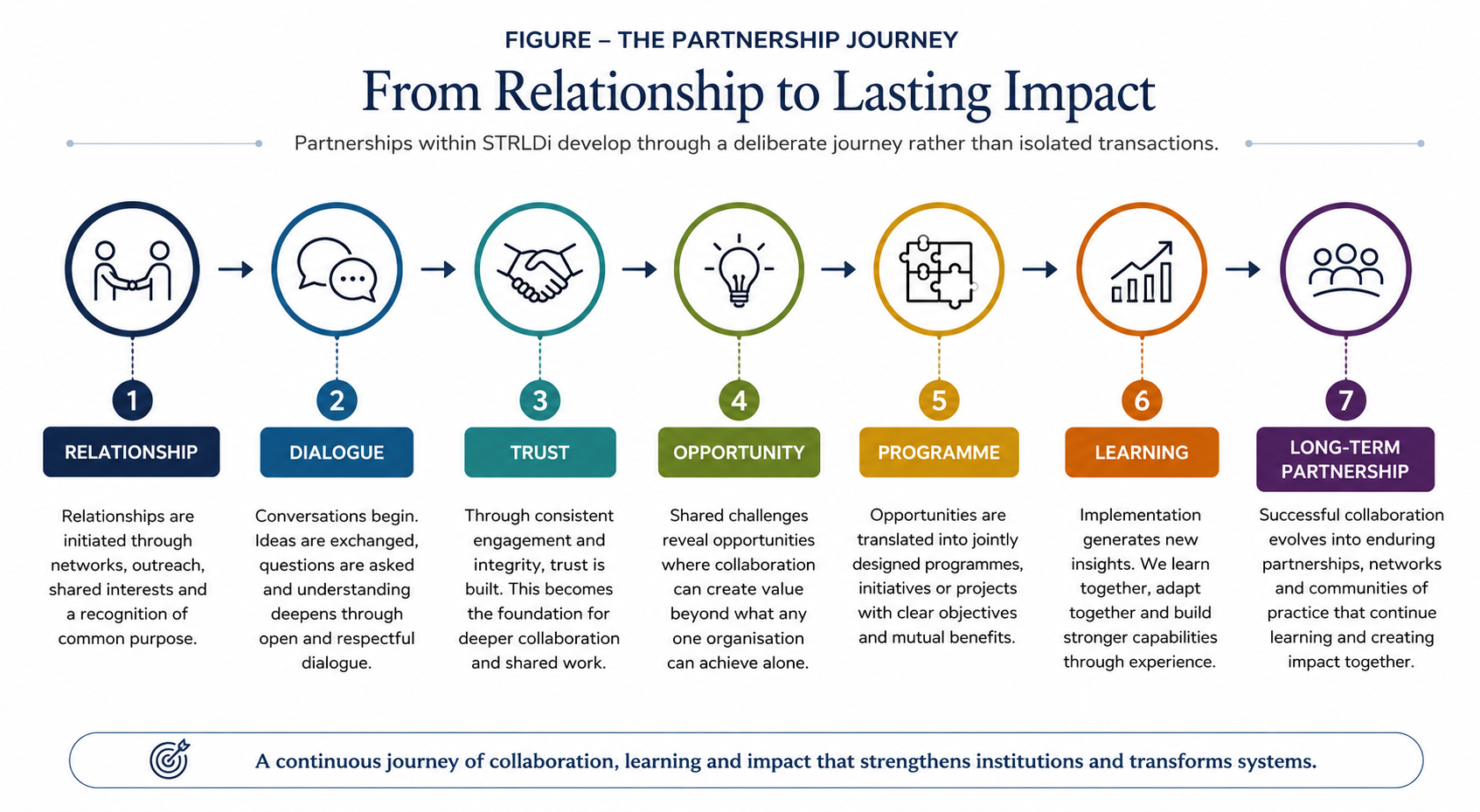
Relationships begin through dialogue and shared inquiry. As trust develops, opportunities for collaboration emerge naturally. These opportunities are translated into jointly designed programmes, research initiatives and leadership engagements that create value for all participants.
Implementation generates further learning, strengthening both the relationship and the institutional capability of those involved. Over time, individual collaborations evolve into enduring partnerships, professional networks, and communities of practice that continue learning together long after individual projects have concluded.
In this way, partnerships become living systems of learning rather than contractual arrangements.
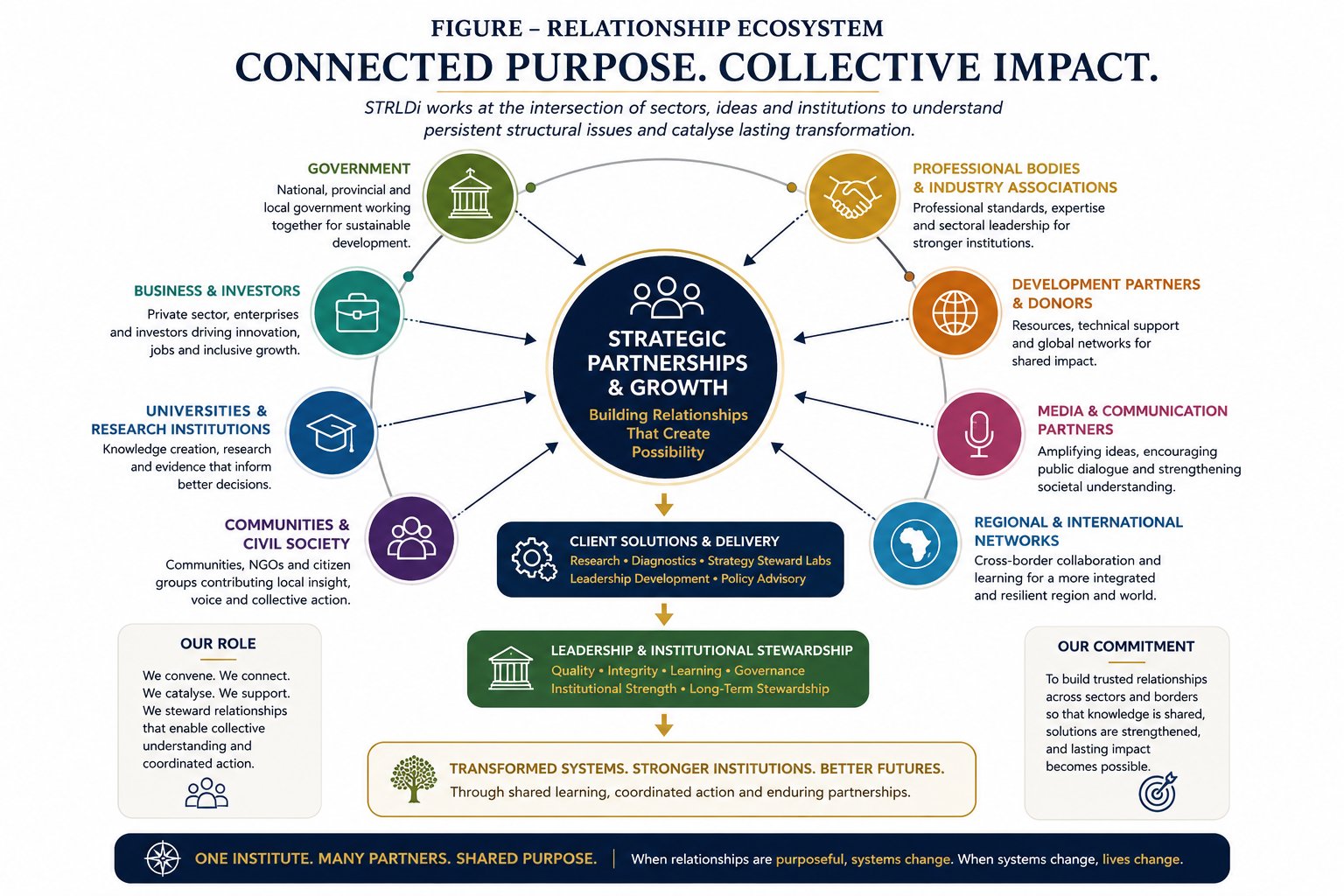
The Strategic Partnership Ecosystem
Institutional Structure
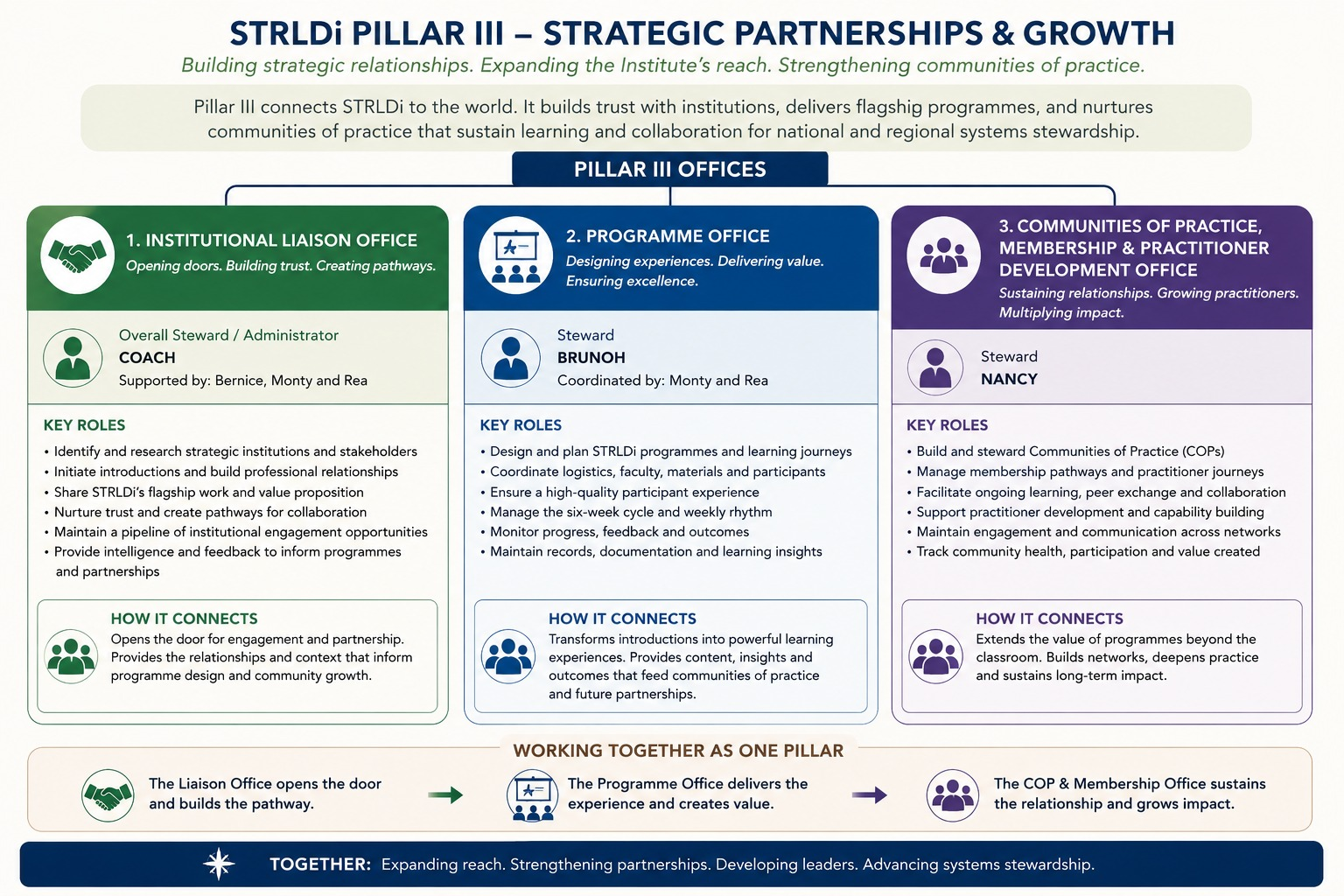
The Strategic Partnerships & Growth Pillar is organised through specialised relationship portfolios that together ensure every major stakeholder group receives intentional stewardship while remaining connected to STRLDi’s broader mission.
1. Government, Media, and International Relations
Current Steward: Brunoh
Purpose
Governments remain central actors in addressing persistent national challenges. This office cultivates trusted relationships with ministries, departments, public service leadership and national planning institutions, creating opportunities for collaborative inquiry, leadership development and institutional transformation.
It also serves as the principal channel through which STRLDi communicates its work to the wider public, ensuring that research findings and institutional learning contribute meaningfully to national discourse.
Brunoh stewards STRLDi’s relationships with the national government, the media, and international institutions. He is responsible for positioning the Institute as a trusted voice on persistent national and regional issues while strengthening relationships that expand STRLDi’s influence beyond Botswana.
Key Responsibilities
- Steward relationships with central and local government.
- Engage ministries, departments, and agencies.
- Coordinate executive briefings and government dialogues.
- Support public-sector leadership engagement.
- Develop strategic communication initiatives.
- Strengthen public understanding of systemic issues.
Primary Stakeholders
- National Government
- Ministries and Government Departments
- Public Service Leadership
- National Planning Institutions
- Media Houses
- Journalists and Editors
- Broadcast and Digital Media
- International Organisations
- International Government Relations
- Embassies and High Commissions
- Public Communications
- Executive Briefings
- Thought Leadership Campaigns
Primary Outcomes
- Strong government relationships
- Increased media visibility
- International institutional relationships
- Public-sector opportunities
- International collaborations
- Enhanced STRLDi reputation
2. Economic Partnerships & Development Cooperation
Current Steward: Mr Tema
Purpose
Sustainable transformation requires collaboration with business leaders, investors, and development partners whose resources, expertise, and influence contribute to national development.
This office develops relationships with the private sector, international development agencies, philanthropic organisations and multilateral institutions, aligning shared interests around long-term systemic transformation.
Key Responsibilities
- Build private-sector partnerships.
- Develop relationships with development partners.
- Facilitate donor engagement.
- Identify investment opportunities.
- Support resource mobilisation.
- Coordinate international cooperation.
Key Result Areas
- Development partnerships.
- Private-sector collaboration.
- Resource mobilisation.
- International cooperation.
3. Institutional, Professional & Knowledge Partnerships
Current Steward: Mabua
Purpose
Professional bodies, statutory organisations and public enterprises play a vital role in strengthening institutional capability across society.
This office builds enduring relationships with these organisations, encouraging collaborative learning, joint research and professional development while creating opportunities for broader institutional transformation.
Key Responsibilities
- Steward relationships with parastatals.
- Engage professional associations.
- Build institutional networks.
- Coordinate sector-specific collaboration.
- Support professional learning initiatives.
Key Stakeholders
- Parastatals
- Statutory Organisations
- Professional Bodies
- Industry Associations
- Universities
- Research Institutions
- International Think Tanks
- Knowledge Networks
- Academic Collaboration
- Joint Research
Key Result Areas
- Institutional partnerships.
- Professional collaboration.
- Sector engagement
- Research partnerships
- Knowledge exchange
- Institutional capability development
- International academic collaboration
4. Community, Knowledge & Regional Partnerships
Current Steward: Coach
Purpose
Transformation becomes sustainable only when knowledge reaches communities and when learning flows across regional boundaries.
This office strengthens relationships with local government, traditional leadership, universities, research institutions, civil society organisations and regional bodies, particularly within the Southern African Development Community.
Its work ensures that STRLDi remains connected to the lived realities of communities while contributing to regional learning and cooperation.
Key Responsibilities
- Engage local authorities.
- Build relationships with Bogosi.
- Develop university partnerships.
- Coordinate regional collaboration.
- Support academic cooperation.
- Strengthen community engagement.
Key Result Areas
- Community partnerships.
- Academic collaboration.
- Regional cooperation.
- Knowledge exchange.
5. Proposal Development & Resource Mobilisation
Future Development
Purpose
Ideas become transformational only when they are adequately resourced.
This office converts emerging partnership opportunities into funded programmes, consultancy assignments, research initiatives and long-term institutional collaborations.
Its work enables STRLDi to sustain and expand its mission while ensuring that proposals remain grounded in the Institute’s philosophy and standards of professional practice.
Key Responsibilities
- Coordinate Expressions of Interest and tenders.
- Develop grant proposals.
- Prepare consultancy submissions.
- Negotiate partnership agreements.
- Support contract development.
- Maintain proposal quality.
Key Result Areas
- Successful proposals.
- Contract awards.
- Programme funding.
- Strategic investments.
6. Membership Office
Future Development
Purpose
The Membership Office builds a community of individuals and institutions committed to advancing systemic thinking, organisational learning and national transformation.
Membership extends the Institute’s reach beyond individual projects by creating a network of practitioners, researchers, leaders, and supporters who continue learning together over time.
The Office will also steward Fellows, Associates, Alumni, and Institutional Members, strengthening long-term relationships while generating recurring support for the Institute’s work.
Key Responsibilities
- Manage membership programmes.
- Coordinate Fellows and Associates.
- Develop institutional membership.
- Maintain alumni engagement.
- Support member services.
- Grow the learning community.
Key Result Areas
- Membership growth.
- Member engagement.
- Institutional loyalty.
- Community development.
7. Communities of Practice
Purpose
Communities of Practice provide ongoing spaces where professionals continue learning long after formal engagements have concluded.
Rather than functioning as networking groups alone, these communities become living laboratories through which knowledge is shared, practice evolves, and collaborative innovation emerges across sectors and disciplines.
Key Responsibilities
- Establish thematic Communities of Practice.
- Facilitate professional dialogue.
- Encourage peer learning.
- Share emerging research.
- Strengthen collaborative problem-solving.
Key Result Areas
- Active communities.
- Professional learning.
- Cross-sector collaboration.
- Knowledge exchange.
8. Executive Programmes
Purpose
National and regional transformation requires spaces where diverse perspectives can meet in disciplined conversation.
This office designs and coordinates conferences, executive forums, public lectures, and strategic dialogues that bring together leaders from government, business, academia, development agencies, and civil society to explore emerging issues and strengthen collective understanding.
These gatherings also provide opportunities for disseminating research, showcasing innovation, and cultivating new partnerships.
Developing Leaders Through Shared Inquiry
The Executive Systems Programmes provide the principal entry point through which leaders engage with STRLDi. They are designed for leaders from the private sector, academia, research institutions, professional bodies, community organisations, traditional leadership and other sectors who are seeking a deeper understanding of persistent structural issues affecting their organisations, sectors and nations.
Unlike conventional executive education, these programmes do not focus on organisational performance, management techniques or functional leadership skills. Instead, they bring together leaders from diverse backgrounds to examine persistent structural issues through the discipline of systems thinking, using real national and regional challenges as the basis for collective inquiry and learning.
Each programme is intentionally limited to twenty-four participants, creating an environment that encourages thoughtful dialogue, meaningful relationships and sustained learning. Participants work across sectors, disciplines and professions, discovering how different parts of society contribute to the same persistent outcomes and where opportunities for coordinated action may exist.
To accommodate different schedules and geographic contexts, STRLDi delivers its Executive Systems Programmes in three complementary formats.
Executive Sunday Systems Retreats provide a three-part learning experience delivered over three consecutive Sundays. This format enables working professionals to participate while remaining engaged in their normal responsibilities.
Executive Wednesday Systems Forums offer the same programme over three Wednesdays, providing an alternative schedule for participants who prefer weekday learning.
For participants travelling from elsewhere in Southern Africa, STRLDi offers a Regional Executive Systems Programme, delivered over three-and-a-half days from Tuesday morning to Friday lunchtime. This format maximises learning while reducing travel demands.
The Executive Systems Programmes are not an end in themselves. They represent the beginning of a continuing relationship between participants and the Institute. As understanding develops, organisations often invite STRLDi to undertake systemic research, facilitate Strategy Steward Labs, support institutional transformation and contribute to long-term learning initiatives.
Key Responsibilities
- Coordinate conferences.
- Design executive dialogues.
- Organise public lectures.
- Facilitate strategic forums.
- Support knowledge dissemination.
Key Result Areas
- High-quality events.
- Executive participation.
- Knowledge sharing.
- Partnership development.
9. Conferences, Strategic Dialogues & Executive Forums
Convening Leaders Around Persistent Structural Issues
Many of the challenges confronting nations cannot be addressed by individual organisations acting independently. They require disciplined conversation among leaders representing different sectors, professions and institutions.
For this reason, STRLDi convenes conferences, strategic dialogues, executive forums and public lectures that create opportunities for collective learning around issues of national and regional importance.
These gatherings are designed to move beyond presentations and panel discussions. They encourage participants to examine the structural relationships underlying persistent issues, explore different perspectives, identify opportunities for collaboration and strengthen collective understanding before action is taken.
Subjects for dialogue may include unemployment, manufacturing, agriculture, education, food systems, local economic development, governance, innovation, regional integration and other issues requiring systemic inquiry.
The Executive Systems Programmes often provide the foundation for these larger engagements. As participants continue learning and relationships mature, they contribute to broader national conversations through conferences, policy dialogues and cross-sector forums.
These events also provide an important platform for disseminating STRLDi’s research, showcasing emerging insights and strengthening relationships with governments, universities, development partners, professional bodies and civil society organisations.
Through these engagements, STRLDi fulfils one of its central responsibilities: creating trusted spaces where leaders can think together before they are required to act together.
10. Knowledge & Public Engagement
Purpose
Knowledge fulfils its greatest purpose when it becomes accessible and contributes to public understanding.
This office ensures that STRLDi’s research, publications, digital platforms and media engagement reach diverse audiences in ways that encourage informed dialogue, thoughtful reflection and broader societal learning.
It also strengthens the Institute’s reputation as a trusted source of insight into persistent national and regional issues.
Extending Learning Beyond the Institute
Knowledge creates its greatest value when it is shared widely, applied thoughtfully and continually refined through dialogue and practice.
The Knowledge & Public Engagement Office ensures that STRLDi’s work reaches leaders, institutions and communities beyond those directly participating in programmes and consultancy engagements. It transforms research findings, institutional learning and practical experience into accessible knowledge that contributes to informed public discourse and long-term societal learning.
This responsibility includes the development of publications, policy papers, research reports, blogs, newsletters, digital learning resources and multimedia content. It also stewards the Institute’s websites, social media platforms and relationships with the media, ensuring that STRLDi’s work remains visible, credible and relevant to contemporary national and regional discussions.
Public engagement is not viewed simply as communication. It is an extension of the Institute’s learning mission. By encouraging thoughtful discussion around persistent structural issues, STRLDi helps broaden public understanding, strengthen systemic thinking and cultivate a growing community committed to institutional learning and national transformation.
Knowledge generated through research, Executive Systems Programmes, Strategy Steward Labs and institutional partnerships continually returns to this office for publication and dissemination. In turn, the questions, reflections and insights emerging from the wider community enrich future research and programme development.
Knowledge therefore moves in two directions. It flows outward to strengthen society’s understanding of persistent structural issues, and it flows back into the Institute, continually enriching STRLDi’s own capacity to learn, adapt and contribute.
Key Responsibilities
- Develop institutional publications.
- Coordinate media engagement.
- Manage digital communications.
- Support website development.
- Promote research dissemination.
- Strengthen public engagement.
Key Result Areas
- Public visibility.
- Knowledge dissemination.
- Media presence.
- Institutional reputation.
12. Revenue Generation & Institutional Sustainability
Building a Sustainable Institute Through Service, Learning and Partnership
STRLDi is committed to building an institution that is both intellectually independent and financially sustainable. Long-term institutional stewardship requires more than excellent research and leadership development. It also requires the ability to generate the resources needed to attract capable people, invest in knowledge development, strengthen organisational capacity and continually expand the Institute’s contribution to society.
For this reason, the Strategic Partnerships & Growth Pillar plays a central role in developing opportunities that sustain the Institute while advancing its mission. Revenue generation is not pursued as an end in itself. Rather, it is the natural outcome of building trusted relationships, convening meaningful dialogue and delivering work that creates lasting value for leaders, institutions and communities.
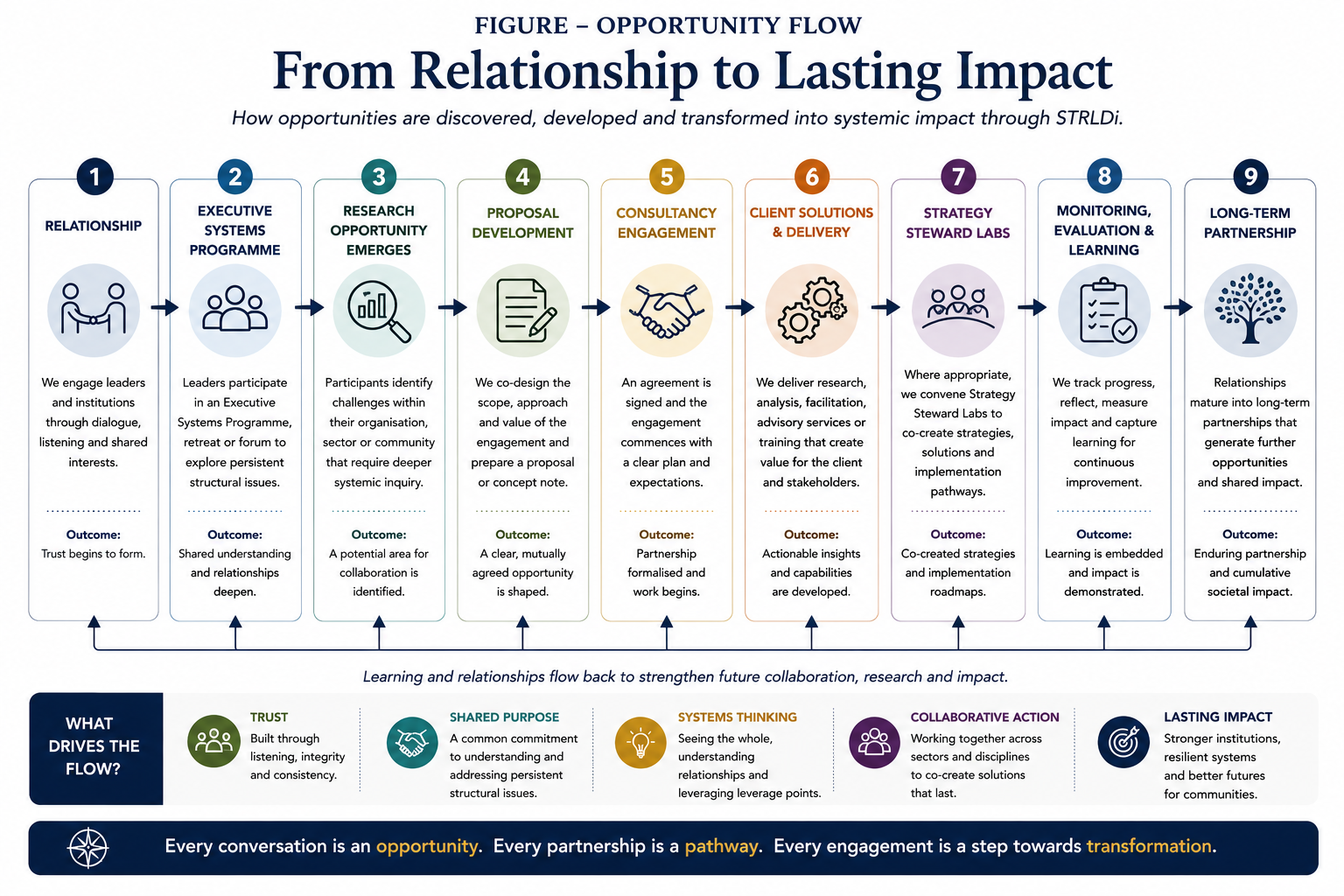
The Executive Systems Programmes provide the principal entry point into this journey. Through Executive Sunday Systems Retreats, Executive Wednesday Systems Forums and Regional Executive Systems Programmes, leaders from business, academia, research institutions, professional bodies, community organisations and other sectors come together to examine persistent structural issues through systems thinking. These programmes generate income that supports the Institute’s operations while simultaneously building relationships that often develop into deeper collaborations.
As participants return to their organisations with new insight, many identify opportunities where STRLDi can provide further support. These opportunities may lead to systemic research, institutional diagnostics, Strategy Steward Labs, leadership development programmes, policy advisory assignments, and longer-term transformation initiatives. In this way, the Executive Systems Programmes become the beginning of an ongoing partnership rather than the conclusion of a training event.
Conferences, strategic dialogues, executive forums and public lectures further strengthen this pathway by creating spaces where leaders encounter new ideas, establish professional relationships and identify opportunities for collaborative work. These engagements also extend STRLDi’s visibility, strengthen its reputation, and contribute to a growing community committed to addressing persistent structural issues.
As the Institute matures, additional sources of recurring income will emerge through proposal development, commissioned research, development partner collaborations, Communities of Practice, publications, institutional memberships, and other strategic initiatives aligned with STRLDi’s mission.
This diversified approach reduces dependence on any single source of income while enabling the Institute to invest continually in its people, research, digital knowledge platforms and regional growth.
The objective is therefore not simply to generate revenue. It is to build an institution capable of serving society over many decades through a balanced combination of learning, partnership, research, and professional practice.
13. Institutional Revenue Pathway
The Strategic Partnerships & Growth Pillar develops opportunities through a deliberate progression:
Executive Systems Programmes
↓
Conferences, Strategic Dialogues & Executive Forums
↓
Relationships Built Through Shared Learning
↓
Research & Diagnostic Opportunities
↓
Strategy Steward Labs
↓
Policy Advisory & Institutional Transformation
↓
Long-Term Institutional Partnerships
↓
Knowledge Development, Organisational Growth & Institutional Sustainability
14. How the Pillar Works
Strategic Partnerships & Growth serves as the outward-facing relationship system of STRLDi.

Each office stewards a distinct community of relationships while remaining connected through a shared institutional purpose. Government engagement informs research priorities. Development partners enable programme implementation. Professional bodies strengthen learning communities. Universities enrich research. Communities contribute lived experience. Conferences stimulate dialogue. Membership sustains long-term engagement. Public communication extends learning beyond institutional boundaries.
Together, these relationships generate opportunities that flow naturally into the Client Solutions & Delivery Pillar, where they become research assignments, leadership programmes, Strategy Steward Labs and policy advisory engagements. As these engagements conclude, the knowledge and relationships they produce return to strengthen the partnership ecosystem, creating a continuous cycle of learning, collaboration and institutional growth.
15. Key Result Areas
The Strategic Partnerships & Growth Pillar is responsible for expanding STRLDi’s institutional relationships, strengthening its reputation and generating opportunities that advance the Institute’s mission. Success is measured not simply by the number of engagements undertaken, but by the quality of relationships established, the knowledge generated and the long-term partnerships that emerge.
The Pillar is guided by the following Key Result Areas.
1. Institutional Relationship Development
Develop and steward enduring relationships with leaders and institutions across government, business, academia, professional bodies, communities, development partners and regional organisations.
Performance Indicators
- Number of strategic partnerships established.
- Number of active institutional relationships.
- Number of Memoranda of Understanding (MOUs) or collaboration agreements concluded.
- Number of repeat engagements with existing partners.
- Partner satisfaction and relationship quality.
2. Executive Engagement & Leadership Learning
Convene high-quality Executive Systems Programmes that strengthen leadership capability and expand STRLDi’s learning community.
Performance Indicators
- Number of Executive Sunday Systems Retreats delivered.
- Number of Executive Wednesday Systems Forums delivered.
- Number of Regional Executive Systems Programmes conducted.
- Total participant enrolment.
- Participant satisfaction and programme evaluation.
- Percentage of returning participants.
3. Conferences, Strategic Dialogues & Executive Forums
Create trusted spaces where leaders collectively examine persistent structural issues and identify opportunities for collaborative action.
Performance Indicators
- Number of conferences convened.
- Number of executive dialogues facilitated.
- Number of sector forums conducted.
- Number of participating organisations.
- Number of cross-sector collaborations initiated.
4. Opportunity Development
Transform relationships into opportunities that contribute to STRLDi’s research, leadership development and institutional practice.
Performance Indicators
- Number of research opportunities identified.
- Number of consultancy enquiries generated.
- Number of proposals submitted.
- Proposal success rate.
- Value of consultancy opportunities secured.
5. Strategic Partnerships & Resource Mobilisation
Strengthen the Institute’s long-term sustainability through strategic collaboration and resource mobilisation.
Performance Indicators
- Number of development partner engagements.
- Number of collaborative research initiatives.
- Number of jointly funded projects.
- Value of external funding secured.
- Number of regional and international partnerships established.
6. Knowledge & Public Engagement
Strengthen public understanding of persistent structural issues while increasing the visibility and credibility of STRLDi.
Performance Indicators
- Number of publications produced.
- Research papers and policy briefs released.
- Public lectures and webinars conducted.
- Media engagements.
- Growth in website and digital platform reach.
- Growth in professional networks and online engagement.
7. Institutional Growth & Sustainability
Generate the opportunities and resources required to strengthen STRLDi’s long-term institutional capability.
Performance Indicators
- Revenue generated through Executive Systems Programmes.
- Revenue generated through conferences and executive dialogues.
- Revenue generated through consultancy and advisory engagements originating from Pillar III.
- Percentage of recurring institutional partnerships.
- Contribution of Pillar III to STRLDi’s annual operating budget.
8. Organisational Learning
Ensure that every engagement contributes to the Institute’s growing knowledge base and strengthens future practice.
Performance Indicators
- Lessons learned are documented following major engagements.
- Partnership reflections completed.
- New methodologies developed.
- Case studies published.
- Improvements incorporated into future programmes.
The success of the Strategic Partnerships & Growth Pillar is ultimately measured by more than activity. It is reflected in the Institute’s growing ability to convene leaders, foster trusted relationships, generate meaningful opportunities and create enduring partnerships that strengthen research, leadership development and institutional transformation. As these capabilities mature, they contribute directly to STRLDi’s reputation, sustainability and capacity to serve Botswana, Southern Africa and the wider international community for many years to come.
16. Closing Reflection
Institutions are ultimately remembered not for the number of relationships they establish, but for the value those relationships create over time.
At STRLDi, partnerships are viewed as a form of institutional stewardship. Every conversation is an opportunity to learn. Every relationship is an opportunity to deepen understanding. Every collaboration is an opportunity to strengthen the collective capacity of leaders and institutions to respond to persistent structural issues.
The Strategic Partnerships & Growth Pillar exists to cultivate these relationships with care, integrity and purpose. It brings together leaders from business, academia, research, professional bodies, communities and development organisations, creating spaces where knowledge is shared, trust is built and new possibilities emerge through collective inquiry.
As these relationships mature, they become pathways for systemic research, leadership development, Strategy Steward Labs and long-term institutional partnerships. In turn, the knowledge generated through these engagements continually strengthens the Institute itself, enabling STRLDi to expand its contribution to Botswana, Southern Africa and the wider international community.
In this way, partnership becomes more than collaboration. It becomes the means through which learning travels across institutions, leadership capability grows, and societies strengthen their capacity to understand and address the persistent structural issues that shape their future.
Relationships create understanding. Understanding enables coordinated action. Coordinated action creates lasting transformation. It is this progression that lies at the heart of the Strategic Partnerships & Growth Pillar and continues to guide STRLDi’s commitment to building stronger institutions, more capable leaders and more resilient societies.
Related Links:
https://strldi.weebly.com/servicesbw.html
This page outlines STRLDi’s professional programmes, consultancy services and engagement framework, including Executive Systems Programmes, systemic research, leadership development, Strategy Steward Labs and long-term institutional partnerships, together with the Institute’s professional fee structure.


One thought on “PILLAR III”