
ESCALATION: WHEN THE NEED TO WIN BECOMES MORE IMPORTANT THAN THE OUTCOME
1. Event: What the Structure Looks Like at a Point in Time
There is no end in sight!

When I define my success by where my position stands relative to the other party, there is no natural point at which the competition is complete. Whatever advantage I gain can be challenged, and whatever advantage the other party gains becomes a reason for me to act again.
The Story of One-Upmanship: Unintended Proliferation
The harder one party pushes to gain an advantage, the harder the competitor pushes back.
The Human Story: It All Started with an Orange Peel
The consequences of the Escalation archetype range from a disagreement between two people to assaults, land grabbing, marital conflict, divorce, price wars, and ultimately, international conflict and war. At its extreme, it can lead to nuclear confrontation. What makes this archetype particularly costly is that the parties may continue escalating long after the original issue has lost its significance, consuming relationships, money, time, and other resources in a struggle neither party can afford to lose.It can spawn global wars. It is a very expensive archetype — it consumes a lot of resources.
Escalation in Real Life: The Everitt Road Neighbour Feud
Escalation is not confined to international relations, corporate competition or political conflict. It can develop between neighbours living behind adjoining garden fences, where an initial disagreement gradually becomes a prolonged struggle involving retaliation, complaints, legal proceedings and the departure of families from their homes. The Everitt Road dispute in Joo Chiat, Singapore, provides a documented example of how a conflict can persist for years, despite attempts at mediation and intervention by the authorities.
The dispute reportedly began in 1993 over parking space. By the early 2000s, it had involved several families and a range of confrontations, with the consequences extending well beyond the original disagreement. Contemporary reporting and subsequent accounts allow us to examine the behaviour of the conflict over time, without requiring the people involved to have recognised the systemic pattern in which they were caught.
Read the contemporary and retrospective accounts:
▪️ “Tired of reality TV? Try the Everitt Road show” — November 2002
▪️ “Everitt Road spat: Fine set aside” — 15 August 2009
▪️ “Three of the feuding families have moved out” — 15 August 2009
It all started with an orange peel.
A family had recently moved into a new neighbourhood, hoping to make a fresh start after relationships in their previous neighbourhood had soured. After a few weeks, the father decided to take a stroll around his new garden. As he walked beside the fence separating his property from his neighbour’s, he noticed a peel from an orange lying on his side of the garden. He had not bought oranges for the household in several weeks. Where, then, had the peel come from?
Looking over the fence, he saw his neighbour in his house and concluded that someone from the neighbouring property must have thrown the peel into his garden. He reasoned that such behaviour might have been acceptable when the previous occupants lived there, but not now that he and his family had moved in. The problems he had experienced in the old neighbourhood, he decided, would not be allowed to follow him into the new one. Something had to be done, and the neighbours needed to be taught a lesson they would not forget.
The following day, as the new neighbour walked towards his car, he noticed a foul smell. Someone had dumped a load of rubbish from a household bin onto the windscreen of his car. To his dismay, he also noticed that the car had been facing towards his neighbour’s house. He washed the car, but the incident stayed with him. Surely, he had done nothing to deserve this. And if his neighbour was doing this again, he needed to put a stop to it once and for all.
What did he do next?
What would you do next?
2. What Is Happening Beneath the Story?
Notice how little it took to begin this sequence of events. An orange peel became evidence of deliberate disrespect; an assumption became a conviction; and that conviction created a perceived need to act. The second incident was then interpreted through the first, reinforcing the belief that the neighbour was hostile and that stronger action was necessary.
Neither neighbour may have intended the conflict that eventually develops. Yet each can become increasingly convinced that his actions are justified by what the other has done. The original incident becomes progressively less important than the need to defend one’s dignity, restore one’s position, or ensure that the other party does not prevail.
This is the human face of Escalation. As Virginia Anderson’s The Systems Thinker article, Introducing the Systems Archetypes: Escalation, explains through examples ranging from playground arguments to international arms races, the actions of one party can be perceived as a threat by another, provoking a response that creates an even greater sense of threat for the first party. Each side may be trying to restore its own sense of security, while the interaction between them progressively intensifies the conflict.
The critical distinction is between what happened, what we believe happened, and what we do because of what we believe. When assumptions about another party’s intentions are treated as established facts, each subsequent action can reinforce the very interpretation that justified it. The parties stop responding only to events; they begin responding to the meaning they have assigned to one another’s behaviour.
3. Behaviour Over Time (BOT): How Escalation Develops
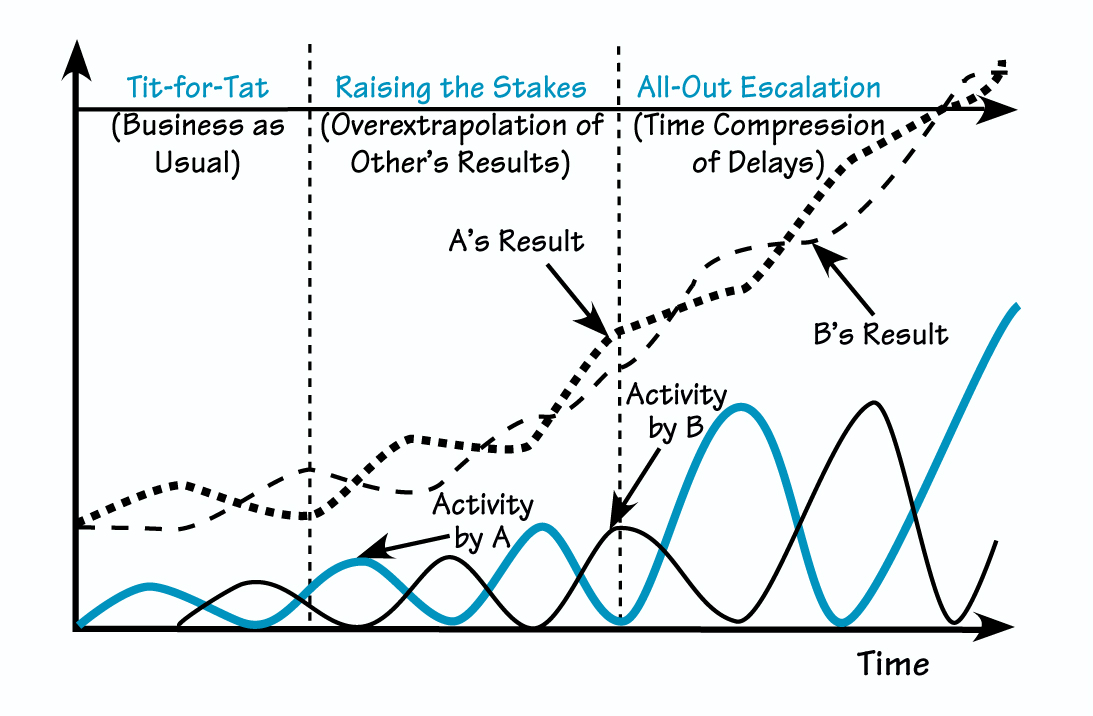
Escalation does not necessarily begin with extreme behaviour. It develops through successive rounds of action and reaction, with each party attempting to protect or improve its position relative to the other. The behaviour over time can be understood through three broad stages.
Stage 1: Tit-for-Tat — Business as Usual
Initially, the parties respond to one another in relatively limited ways. One makes a remark, the other answers; one takes a competitive action, the other counters. The responses may appear proportionate, and the parties may believe that they can control the situation. At this stage, the conflict may still be contained, and opportunities to clarify intentions or resolve the original issue remain available.
Stage 2: Raising the Stakes — Over-extrapolating the Other’s Results
As the interaction continues, each party begins to interpret the other’s actions as evidence of a growing threat. Rather than waiting to establish what the other party intends, each responds to what it anticipates the other might do next. Actions become stronger, defensive positions harden, and the parties begin to raise the stakes to prevent the other from gaining an advantage. As Daniel H. Kim discusses in Escalation: The Underlying Structure of War, this dynamic can be amplified by delays and distorted interpretations of the other party’s activities.
Stage 3: All-Out Escalation — Time Compression and Increasing Volatility
Eventually, the parties may reach a point at which they no longer feel able to wait and assess the consequences of their actions. Each anticipates the next move and acts before the other can gain an advantage. The interval between action and reaction shortens, responses become more volatile, and the intensity of the conflict can rise sharply. At this stage, neither party may feel in control, even as both devote increasing resources to winning.
The BOT graph makes this progression visible. It can show the rising intensity of each party’s activity, the changing results achieved by each, and the increasingly volatile pattern as the conflict develops. The point is not simply that activity increases, but that each party’s attempt to improve its relative position provokes a response that drives further escalation.
A particularly important warning is that an improving result does not necessarily indicate a healthy system. In a commercial price war, for example, both competitors may initially increase sales while promotional costs rise faster and profit margins deteriorate. The visible measure of success can therefore improve while the underlying viability of both businesses weakens.
Source for the corresponding escalation stages and competitive dynamics: Daniel H. Kim, “Escalation: The Underlying Structure of War,” The Systems Thinker.
4. Description of the Archetype
The Escalation Archetype occurs when each party perceives the other’s actions as a threat and responds in ways that intensify the threat to the other. Each party’s response becomes a further reason for the other to act, creating a self-reinforcing cycle in which both sides continually increase their efforts to protect or improve their relative position.
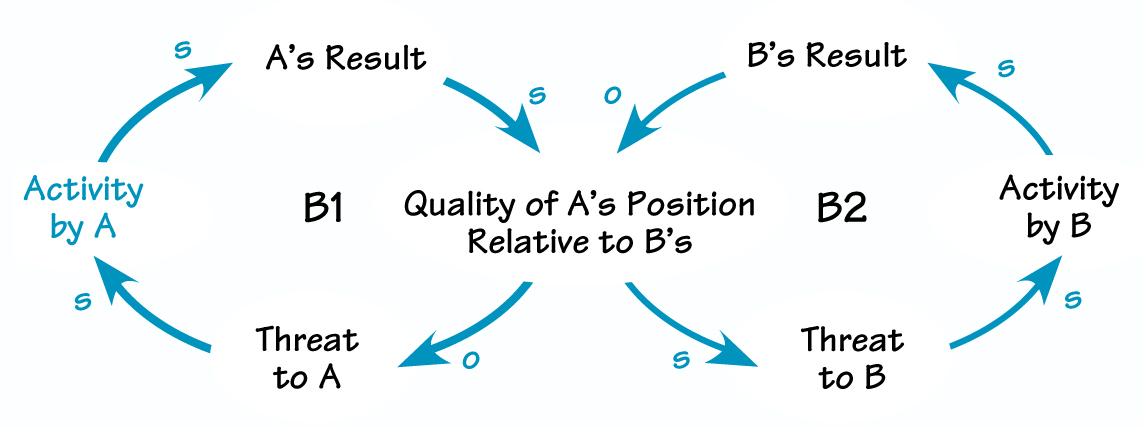
Causal-loop diagram of the Escalation System Archetype. Source: The Systems Thinker.
This archetype can emerge whenever two or more people or groups see their survival, security, status or success as dependent on their position relative to one another. When one party perceives that its position has been undermined, it may choose to withdraw (flight), although this may not always be viable, or to confront the other party (fight), often perceived as the more acceptable response when losing face is at stake. Alternatively, the parties may take actions that allow them to improve their respective positions without undermining one another, but this requires a different understanding of competition and success.
The causal-loop diagram illustrates how the activities of Party A and Party B affect their respective results and the perceived quality of each party’s position relative to the other. When one party improves its position, the other may experience this as a threat and respond with further action. That response, in turn, threatens the first party and prompts another reaction. As the cycle repeats, both parties can become increasingly committed to outdoing one another, even when their actions consume substantial resources and leave both worse off than they might otherwise have been.
The pattern can continue long after the original parties or circumstances have changed, drawing other people, relationships and resources into the conflict. Its consequences may range from an argument or assault between individuals, through disputes within families and organisations, to land-grabbing, divorce, price wars and armed conflict between nations. At its most destructive, escalation can contribute to the threat or outbreak of nuclear war. It is an expensive archetype because the resources consumed in trying to gain or preserve a relative advantage can become more important than the original purpose for which those resources were deployed.
5. Mental Model
Outlook That Causes the Structure to Persist Despite Our Efforts to Solve the Problem
“We are under attack or being threatened, and we need to take action to defend ourselves.”
Fear of Failure — Learning to Let Go
We must learn to let go of the fear that shapes our outlook, perspectives and decision-making. Unless we recognise how fear influences our interpretation of events and our responses to others, we risk perpetuating the very conditions we are trying to resolve.
MAKING SYSTEMIC INTERVENTIONS: TREATING THE STRUCTURE
6. Managing Competition
One reason parties become trapped in escalation is their understanding of competition. When success is defined primarily in relation to another party’s performance, the other party’s improvement can be interpreted as one’s own loss. The objective quietly shifts from achieving a worthwhile outcome to ensuring that the other party does not win.
The intervention, therefore, is not simply to tell people to stop fighting or to communicate better. It is to examine the conditions that make continued escalation appear necessary, including the measures of success being used, the assumptions beneath the parties’ actions, and the delays that distort their understanding of the situation.
Questions for systemic intervention
1. Identify the competitive measure.
What is the relative measure that pits one party against the other? Is it market share, price, territory, status, influence, recognition or control? Can the measure be changed so that one party’s improvement does not automatically imply a loss for the other?
2. Identify the key players and what is threatened.
Who are the parties caught in the dynamic, and what do they believe they stand to lose? Is the actual threat to security, livelihood, reputation, market position, authority or identity? Are the actions being taken to address the real threat, or primarily to preserve values and positions that may no longer serve the wider purpose?
3. Examine delays and distorted perceptions.
What information is each party using to judge the other’s intentions and capabilities? Are there delays between actions and their consequences that lead either party to exaggerate the threat or respond prematurely? What evidence would help distinguish an actual threat from an anticipated one?
4. Surface the underlying assumptions.
What beliefs are driving the actions being taken? Does a party believe that yielding ground will be interpreted as weakness, that the other party cannot be trusted, or that only a decisive victory can restore its position? Which of these assumptions are supported by evidence, and which are being reinforced by the conflict itself?
5. Identify the silent parties and their interests.
Is the escalation being sustained solely by the parties visibly engaged in the conflict, or are there other parties influencing its continuation? A third party, or several silent parties, may benefit from continued confrontation by reinforcing perceptions of threat, supplying resources, shaping the narrative or discouraging resolution. Their interests may remain unrecognised while the principal parties bear the costs of the conflict.
Use the KSL (Key Success Loop) and Onion Model to examine the underlying goals, interests, assumptions and relationships that sustain the dynamic. Who else is influencing the behaviour of the principal parties? What do these silent parties stand to gain or lose? What evidence supports these conclusions? The objective is to understand whose interests the existing structure serves and whether the incentives or relationships that sustain escalation can be changed. This inquiry should remain evidence-based; the existence of a hidden instigator must not be assumed simply because a conflict persists.
6. Develop an internal ruler for progress through personal mastery.
In many escalation dynamics, one or more parties use the movement of their perceived competitors to calibrate their own progress. This is the keeping up with the Joneses syndrome: another party’s achievement becomes the reference point for deciding whether one is advancing, falling behind or losing ground. This can occur in school grades, career progression, organisational status, business performance and national development. Progress becomes a relative measure: I am succeeding only if I am doing better than you, or at least keeping pace with you.
The systemic problem is that one’s direction and pace of movement become dependent on another party. When the other advances, the pressure to catch up increases; when the other changes direction, the reference point shifts. Even genuine achievements may bring little satisfaction because the standard for success keeps moving. The reinforcing cycle persists because the parties have not established an independent basis for determining what progress means or when it is sufficient.
The intervention is to develop personal mastery: the capacity to establish and use an internal ruler for one’s own progression. Each person, team or organisation must clarify what it cares about creating, the contribution it intends to make, the capabilities it needs to develop, and the standards by which it will assess its own progress. The question shifts from “How far ahead am I of the other party?” to “What am I seeking to create, and how far have I progressed towards it?”
This does not mean ignoring competitors, external benchmarks or feedback. These can provide useful information, but they should inform judgement rather than determine one’s direction. The objective is to shift from competitor-dependent progress to purpose-directed progress. When parties establish meaningful measures of their own success, another party’s advancement no longer automatically constitutes a threat, and competition can become a source of learning rather than a trigger for escalation.
7. Establish a larger, shared goal.
What outcome could the parties achieve together that would serve their legitimate interests better than continued competition? Can they move beyond a narrow win–lose measure towards a larger goal that requires their respective capabilities and contributions? In an industry, for example, this may mean protecting the long-term viability of the market rather than pursuing competitive measures that ultimately weaken every participant.
A shared goal does not require the parties to abandon their distinct interests or agree on everything. It requires them to recognise that their individual success may depend on how effectively they contribute to an outcome that neither could achieve alone. The goal must be credible, meaningful and sufficiently compelling to change how the parties define success, allocate resources and work with one another. The intervention is to shift the focus from overcoming the other party to achieving the larger purpose, while retaining clear responsibilities and accountability for each party’s contribution.
An illustration of this principle is NASA’s Apollo programme, in which the goal of landing a man on the Moon and returning him safely to Earth before the end of the decade required different teams and organisations to coordinate their expertise towards a shared mission. See Appendix A: The Apollo Programme — From Competition to a Shared Mission.
8. Design a way out of the escalation.
What action could reduce the perceived threat without requiring either party to surrender its legitimate interests? Could one party change the basis of competition, initiate a credible de-escalation, or propose a different measure of success? What changes to incentives, information flows, decision-making arrangements or relationships would prevent the same responses from being triggered again?
The objective is to change the conditions that keep provoking retaliation, rather than merely suppressing the latest expression of conflict. An intervention should therefore specify who must do what, how the other parties are likely to respond, what delays or unintended consequences may arise, and how progress will be assessed over time. The desired outcome is not simply a temporary pause in hostilities, but a change in the system that makes continued escalation less necessary and a more constructive outcome more sustainable.
These questions draw on the intervention guidance presented in The Systems Thinker on escalation, insecurity, relative measures, delays, underlying assumptions and larger shared goals. The additional questions on silent parties and personal mastery extend the inquiry by examining the wider interests that may sustain escalation and the dependence on competitors as measures of progress.
6. What Would the System Look Like If It Were Working Well?
A well-functioning system does not require parties to abandon ambition, competition, or the defence of legitimate interests. It requires them to distinguish healthy competition from a struggle in which the other party’s success is treated as an unacceptable threat. Competition can then become a means of improving performance rather than a mechanism for perpetuating conflict.
The desired shift is from “I must win so that you cannot prevail” to “We can each succeed without making the other’s success a threat to our own.” In an organisation, this may mean competing through distinct value propositions rather than copying and countering every move made by a rival. In a community, it may mean resolving a dispute without turning it into a contest over dignity or dominance. Between nations, it may mean recognising that security cannot be sustained indefinitely through measures that make every other party feel less secure.
The practical objective is to create a system of collaborative competition in which each party can excel in its own right, while remaining accountable for the consequences of its actions on the wider system. Where the relationship permits it, a credible unilateral act of de-escalation may be enough to interrupt the cycle by reducing the threat that the other party feels compelled to answer. Where the conflict is deeply entrenched, more deliberate changes to incentives, rules, communication, and measures of success may be required.
The decisive question is not simply who wins the next round.
It is whether the way the parties are competing allows either of them to win sustainably.
References
- Virginia Anderson, Introducing the Systems Archetypes: Escalation, The Systems Thinker. Read the article.
- Daniel H. Kim, Escalation: The Underlying Structure of War, The Systems Thinker. Read the article.
- Escalation: The Dynamics of Insecurity, The Systems Thinker. Read the article.
The orange-peel narrative is retained as the illustrative story. The explanatory sections integrate and paraphrase the corresponding concepts and intervention questions from the cited systems-thinking literature.
Appendix A: The Apollo Programme — From Competition to a Shared Mission
NASA’s Apollo programme is an excellent example for explaining “Establish a Larger, Shared Goal” because it illustrates how an ambitious common objective can change the basis on which people and organisations work together. President John F. Kennedy’s 1961 commitment was to land a man on the Moon and return him safely to Earth before the decade was out. The goal was not simply to improve the performance of individual departments; it required an unprecedented level of coordination across scientific research, engineering, manufacturing, computing, testing, flight operations and human spaceflight.
The systems-thinking lesson is that the success of each component had to be understood in relation to the success of the whole mission. A team could meet its own technical targets and still contribute to mission failure if its work did not integrate with the work of others. The larger goal therefore required NASA and its contractors to coordinate their decisions, resolve technical differences, share information and align their work to a common deadline. This is the shift from treating another team as a competitor to recognising it as a contributor on whom one’s own success depends.
7. Establish a Larger, Shared Goal: The Apollo Moon Landing


6
What changed when the goal became bigger than the individual teams?
On 25 May 1961, President Kennedy announced the goal of landing a man on the Moon and returning him safely to Earth before the end of the decade. NASA achieved this with Apollo 11 in July 1969. At the time the goal was announced, NASA had not yet settled on the precise technical approach it would use to accomplish the mission. The deadline gave the agency a common destination against which competing technical proposals, organisational priorities and resource decisions could be evaluated.
NASA
+1
The important systems-thinking lesson is that the larger goal changed the basis on which different teams had to work together. NASA’s centres, contractors and university partners possessed different capabilities, interests and organisational cultures. The task was not to eliminate their differences or prevent disagreement. It was to ensure that their work contributed to a mission no single team could accomplish independently. NASA’s historical account of Apollo describes the lunar objective as a unifying force that helped balance the conflicts and power struggles that arose among participating organisations.
nasa.gov
+1
What did this look like in practice?

Example 1: Technical disagreement became a problem to solve together.
NASA engineers considered several ways to reach and land on the Moon. Lunar-orbit rendezvous was initially unpopular with some officials because of its perceived complexity and risk. Langley researchers helped demonstrate its feasibility and advantages, and NASA selected this approach in 1962. The decision illustrates the distinction between defending one’s preferred solution and evaluating which solution best serves the overall mission.
NASA

Example 2: Separate organisations had to design for integration.
North American Aviation developed the Apollo Command and Service Modules, while Grumman developed the Lunar Module. These were not independent products whose success could be judged in isolation. The spacecraft had to work together as parts of one mission, with compatible interfaces, systems and operational procedures. NASA’s integration history documents the extensive coordination needed across centres, contractors and launch operations to bring these elements together.
NASA
+1

Example 3: Specialist expertise had to serve a common mission.
MIT’s Instrumentation Laboratory worked on the Apollo Guidance Computer, which supported spacecraft navigation, guidance and control. Its contribution had to function within the wider spacecraft and mission architecture, not merely succeed as a computing project. Apollo therefore required specialist teams to solve demanding problems while coordinating their work with the requirements and constraints of other teams.
nasa.gov
+1

Example 4: The mission took precedence over organisational boundaries.
NASA’s lessons-learned record describes an engineering culture characterised by open communication, attention to detail, challenging technical assumptions and a focus on the mission rather than the organisation. At Grumman, NASA personnel and contractor engineers could challenge one another’s technical judgements. The objective was not to establish which organisation was right, but to identify and resolve problems before they jeopardised the mission.
llis.nasa.gov
What does this teach us about escalation?
The Apollo programme did not eliminate competition, internal disagreement or struggles for influence. Nor should we assume that every manager automatically abandoned organisational interests. The historical record shows that NASA had to actively build and maintain a coalition across government, industry, universities and its own centres. The larger goal provided a shared basis for resolving differences; management arrangements, technical integration and sustained coordination made collaboration possible.
nasa.gov
+1
This is the critical distinction for the Escalation Archetype. Where success is defined by relative position, another team’s achievement can appear to diminish one’s own standing. Where success is defined by a shared mission, the same team’s achievement can become a necessary contribution to the whole. The question changes from “How do I overcome my competitor?” to “What must we each contribute, and how must our contributions fit together, for the mission to succeed?”
The systemic intervention is not simply to ask people to collaborate. It is to establish a goal, measures of success and working arrangements that make collaboration essential to achieving the result. Individual teams still need clear responsibilities and accountability, but these must be aligned with the performance of the whole system.
For NASA, the ultimate test was not whether each department had outperformed another department. It was whether the integrated system could land astronauts on the Moon and return them safely to Earth before the decade ended.
That is the principle to carry into organisational leadership: when the shared goal becomes more important than winning against one another, the basis for competition can change from one-upmanship to complementary contribution.

