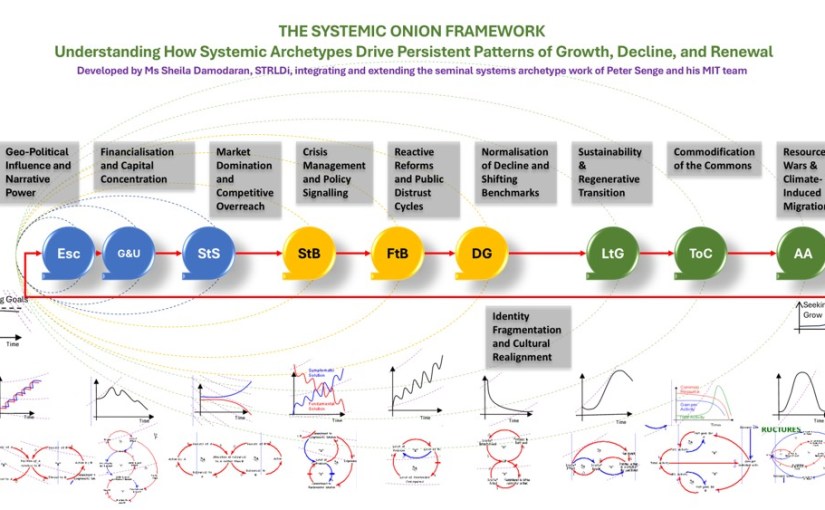
Developed by Sheila Damodaran, Systems Thinking Research & Leadership Development Institute (STRLDi) (Building upon the systemic archetype foundations of Peter Senge and his MIT team)
Excerpt: Discovering the Logic Beneath the World We See
The Onion was born from the search to understand why our biggest problems — unemployment, inequality, policy failure, and ecological decline — keep repeating (or reinforcing) despite our best efforts to solve them.
It reveals that behind every crisis lies a pattern, and behind every pattern, a structure.
By learning to see these structures — the system archetypes — we begin to uncover the invisible logic that shapes nations, organisations, and lives.
[Explore how The Onion was discovered →]
Thinking about systems requires a very different kind of lens.
When we want to see details smaller than the eye can perceive, we reach for magnifying lenses or microscopes. When we want to see far beyond our immediate sight, we turn to telescopes. In both cases, we are zooming in to understand parts more closely.
But what if the problem is not that we can’t see the parts clearly — but that we can’t see how their interrelations fit together?
After decades of “zooming in” — analysing root causes, breaking down sectors, dividing mandates — many of our most persistent national and organisational challenges are not problems of detail, but of structure. We have lost the capacity to zoom out — to see how our actions, incentives, and fears interact across the larger system.
When we zoom out, something powerful happens.
Take a look at this clip here and notice your experience. What do you see?
We begin to notice recurring patterns — loops of cause and effect that repeat across time and sectors. These are the hidden engines behind economic stagnation, unemployment, corruption, social polarisation, or environmental collapse.
This is where The Onion comes in.
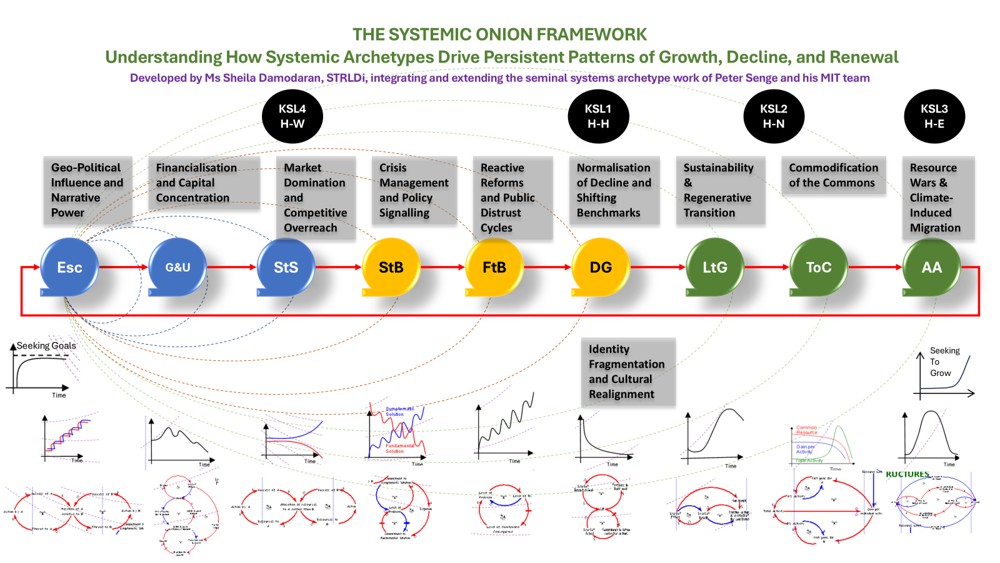
First Global Presentation @ Pegasus Conference 2006
Updated 2018, 2019, 2025
[BL] [Esc] [G&U] [StS] [StB] [FtB] [DG] [LtG] [ToC] [AA] [RL]
The Systemic Onion Framework: Fear Drivers, Behavioural Compulsions, and Archetypal Progression

| Archetype | Systemic Domain (Where It Operates) | Modern Expression (How It Appears) | Underlying Fear Driver | Core Compulsion / Illusion (Red Loop Driver) | How It Feels Inside the System | Explanation / Fit to Archetype | Feeds Next Archetype |
|---|---|---|---|---|---|---|---|
| 1. Escalation (Esc) | Global Political Systems | Narrative Power & Geopolitical Control | Fear of Irrelevance | The compulsion to outdo. Reacting to every move of the other to prove strength and superiority. | A tightening spiral of rivalry that feels self-driven but is system-driven. | Nations and blocs compete for ideological influence, digital dominance, and attention. The fear is of losing voice or relevance. | Success to the Successful (StS) |
| 2. Success to the Successful (StS) | Financial & Capital Systems | Algorithmic Wealth & Capital Concentration | Fear of Instability | The distortion of allocation. Prioritising speed and visibility over shared systemic success. | A quiet slide into inequality that feels like pragmatic decision-making. | Financialisation and automation create fragility. Power consolidates to avoid volatility, reinforcing inequality. | Growth & Underinvestment (G&U) |
| 3. Growth & Underinvestment (G&U) | Production & Industrial Systems | Manufacturing, R&D, Agricultural Productivity | Fear of Loss of Control | The illusion of sufficiency. Believing current capacity can sustain growth despite rising limits. | Optimism turning into stagnation that feels like “market saturation.” | Economies fear overextension, underinvest in capacity, and stagnate. Innovation slows; regeneration is deferred. | Shifting the Burden (StB) |
| 4. Shifting the Burden (StB) | Governance Systems | Policy Agility & Crisis Management | Fear of Accountability | Dependency on symptomatic relief. Choosing fast fixes over deep reform. | Temporary relief followed by fatigue and cynicism. | Governments substitute policy signals for capacity-building. Leadership appears competent but defers structural reform. | Fixes that Fail (FtF) |
| 5. Fixes that Fail (FtF) | Public & Organisational Systems | Reactive Reforms and Performance Cycles | Fear of Failure | The faith in repetition. Doing more of what once worked, even as it worsens the issue. | Short-term relief masking long-term decline. | Institutions double down on failing reforms to maintain legitimacy, producing cycles of burnout and disappointment. | Drifting Goals (DG) |
| 6. Drifting Goals (DG) | Societal & Cultural Systems | Normalisation of Decline and Value Drift | Fear of Rejection | The normalisation of decline. Lowering standards to avoid confrontation or loss of belonging. | Slow decay disguised as realism. | Societies redefine “good enough” to maintain belonging. Decline is rebranded as pragmatism or cultural adaptation. | Limits to Growth (LtG) |
| 7. Limits to Growth (LtG) | Production & Regenerative Systems | Sustainability & Transition Fatigue | Fear of Loss of Control | Fixation on the growth driver. Pushing harder on what once worked instead of nurturing constraints. | Frustration that more effort yields less progress. | Growth obsession blinds actors to systemic limits. Regenerative change is delayed until collapse forces transition. | Tragedy of the Commons (ToC) |
| 8. Tragedy of the Commons (ToC) | Commons & Environmental Systems | Commodification and Overuse of Shared Resources | Fear of Scarcity | The self-interest reflex. Extracting from the commons before others do. | Collective depletion mistaken for individual success. | The anxiety that “if I don’t take it, someone else will” drives depletion of land, trust, and resources. | Accidental Adversaries (AA) |
| 9. Accidental Adversaries (AA) | Human & Identity Systems | Cultural Realignment and Identity Fragmentation | Fear of Isolation | The betrayal reflex. Protecting one’s group or vision at the expense of a shared goal. | Loss of trust and connection; isolation feels like self-preservation. | Individuals and groups fracture under competing loyalties. Cooperation collapses into rivalry or withdrawal. | Returns to Escalation (Esc) |
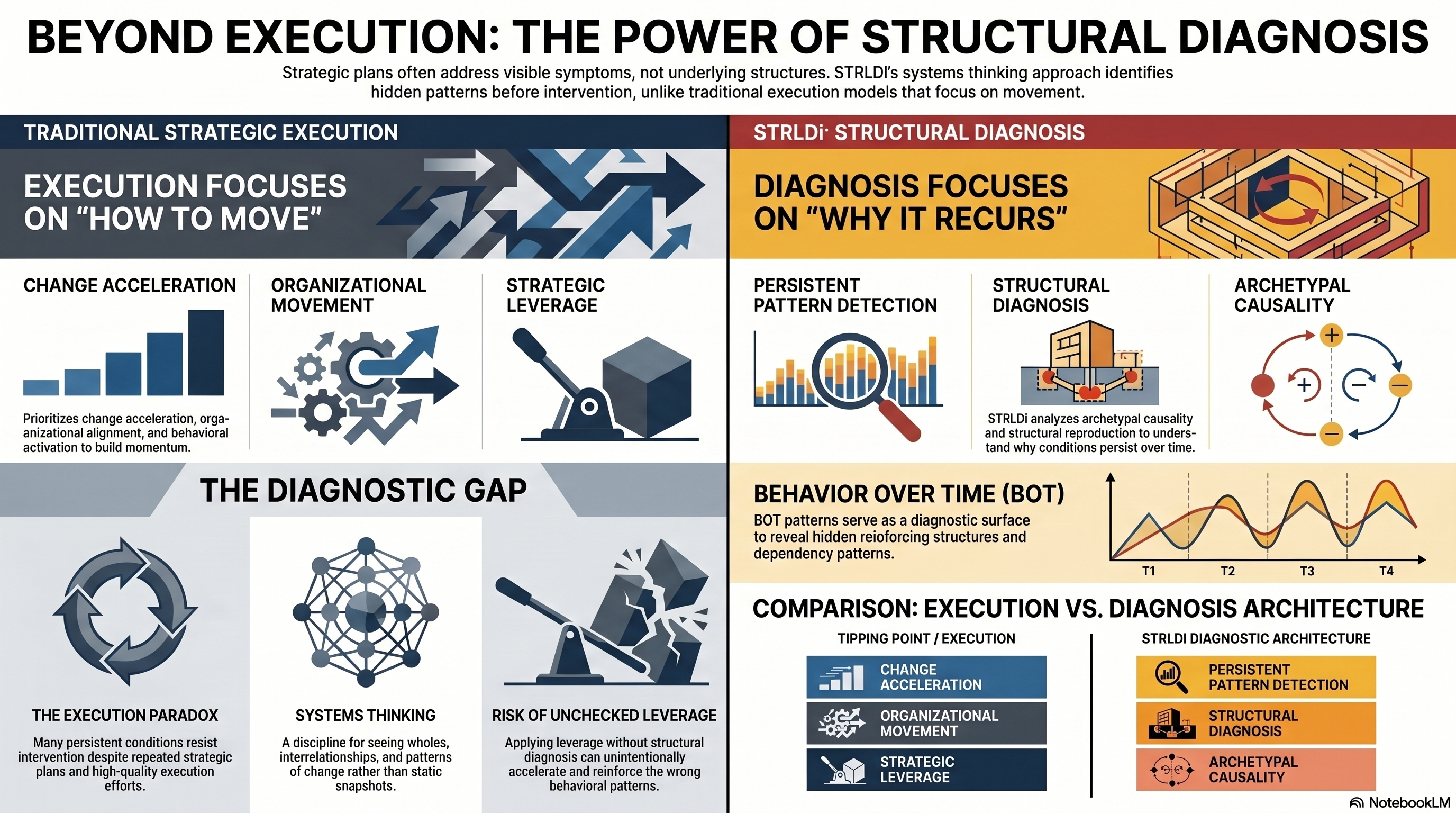
The Onion is a framework that helps us see our world as a set of interlocking patterns — what we call system archetypes. Each archetype represents a distinct behaviour over time — a kind of fingerprint of how human systems behave under pressure.
Developed through my work at STRLDi and informed by the pioneering research of Peter Senge and the MIT Systems Thinking team, The Onion provides a disciplined way to “zoom out” — shifting perspective from the trees to the forest. It lets policymakers, investors, and citizens see:
- Why well-intentioned reforms backfire
- Why progress accelerates in some areas and stalls in others
- How different ministries, markets, or communities unknowingly reinforce one another’s limits
- And where a small, well-placed change can shift the entire system
In other words, The Onion and the system archetypes is not esoteric or whimsical or a theory — it’s a map of how the world of interrelationships works when no one is watching the whole.
Through this framework, we can begin to identify:
- The invisible loops that keep poverty, unemployment, and inefficiency alive
- The fears and beliefs that fuel those loops
- And the leverage points where real transformation can begin
This is what we mean by “zooming out.” It is the discipline of seeing the forest — and how the trees, soil, water, and roots depend on one another.
And once we can see the forest, we can finally begin to restore it — not by cutting or pruning, but by regenerating the system itself.
The Two Levels of “Zooming Out” in Systems Thinking
The practice of zooming out in systems thinking happens at two distinct but interdependent levels.
Level 1: Seeing the Whole Archetype
At first, the mind learns to zoom out from the individual factors within an archetype — the events, the actors, the visible symptoms — to perceive the archetype itself.
This step is like realizing that the recurring problem in front of you is not isolated but part of a pattern of cause and effect. The moment we can see that pattern — its reinforcing and balancing loops, its hidden delays, its “O’s and S’s” of causality — we step beyond reacting to symptoms and begin to see the structure that generates them.
Level 2: Seeing Across Archetypes
The second level of zooming out is to look across archetypes — to notice the adjoining structures, the ones that come before and after in the sequence of The Onion.
This broader view reveals that no archetype operates alone. Each acts like a gear turning the next, transmitting momentum and consequence through the system.
When the mind traces this motion, it begins to see the entire Onion — not as a static diagram, but as a living, breathing system of interlinked loops unfolding through time.
Holding Forest and Trees Together
This double movement — from the factor to the archetype, and from the archetype to the Onion — trains the practitioner to hold both the forest and the trees in view.
You no longer lose sight of the details when seeing the whole, nor lose the whole in the details. This capacity to think at both scales simultaneously is the hallmark of systemic intelligence.
The Doorway to Leverage
Once this perspective stabilizes, leverage points begin to emerge.
They are not dramatic interventions, but small, consistent actions applied at key structural junctures — often invisible to the untrained eye — that can gradually weaken the negative reinforcing cycles and convert them into generative ones instread.
This is how systems within dynamic complexity truly change: not by force or command, but by understanding and realigning their internal logic.
✳️ Why this works for our audience
- For politicians: it shows systems thinking as a leadership skill, not academic theory
- For policymakers: it connects directly to failed reforms and governance silos
- For private sector leaders: it frames the Onion as a decision-intelligence tool, a way to read patterns before they become crises
- For the public: it humanizes the concept and relates it to lived experience (“the forest through the trees”)
Key Success Loop 1: HUMAN & HUMAN INTERRELATIONS
- SDG 4: Quality Education
- (THE BLIND SPOT: SYNERGY OF CORE INTACT FAMILIES, SYNERGY OF COMMUNITIES)
Key Success Loop 2: HUMAN & NATURE INTERRELATIONS
- SDG 3: Good Health and Well-Being
- SDG 6: Clean Water and Sanitation
- SDG 7: Affordable & Clean Energy
- SDG 11: Sustainable Cities and Communities
- SDG 13: Climate Action
- SDG 14: Life Below Water
- SDG 15: Life On Land
- (THE BLIND SPOT: LIFE OF THE AIR)
Key Success Loop 3: HUMAN & ECONOMY INTERRELATIONS
- SDG 1: No Poverty
- SDG 2: Zero Hunger
- SDG 5: Gender Equality
- SDG 8: Decent Work and Economic Growth
- SDG 9: Industry, Innovation and Infrastructure
- SDG 10: Reduced Inequalities
- SDG 12: Responsible Consumption and Production
- (THE BLIND SPOT: SYNERGISTIC MATRIX-ED VALUE CHAINS FOR THE REGION & WITH THE WORLD)
Key Success Loop 4: HUMAN & WORLD INTERRELATIONS
- SDG 16: Peace, Justice and Strong Institutions
- SDG 17: Partnerships for the Goals
- (THE BLIND SPOT: SYNERGISTIC RELATIONSHIPS WITH THE WORLD)
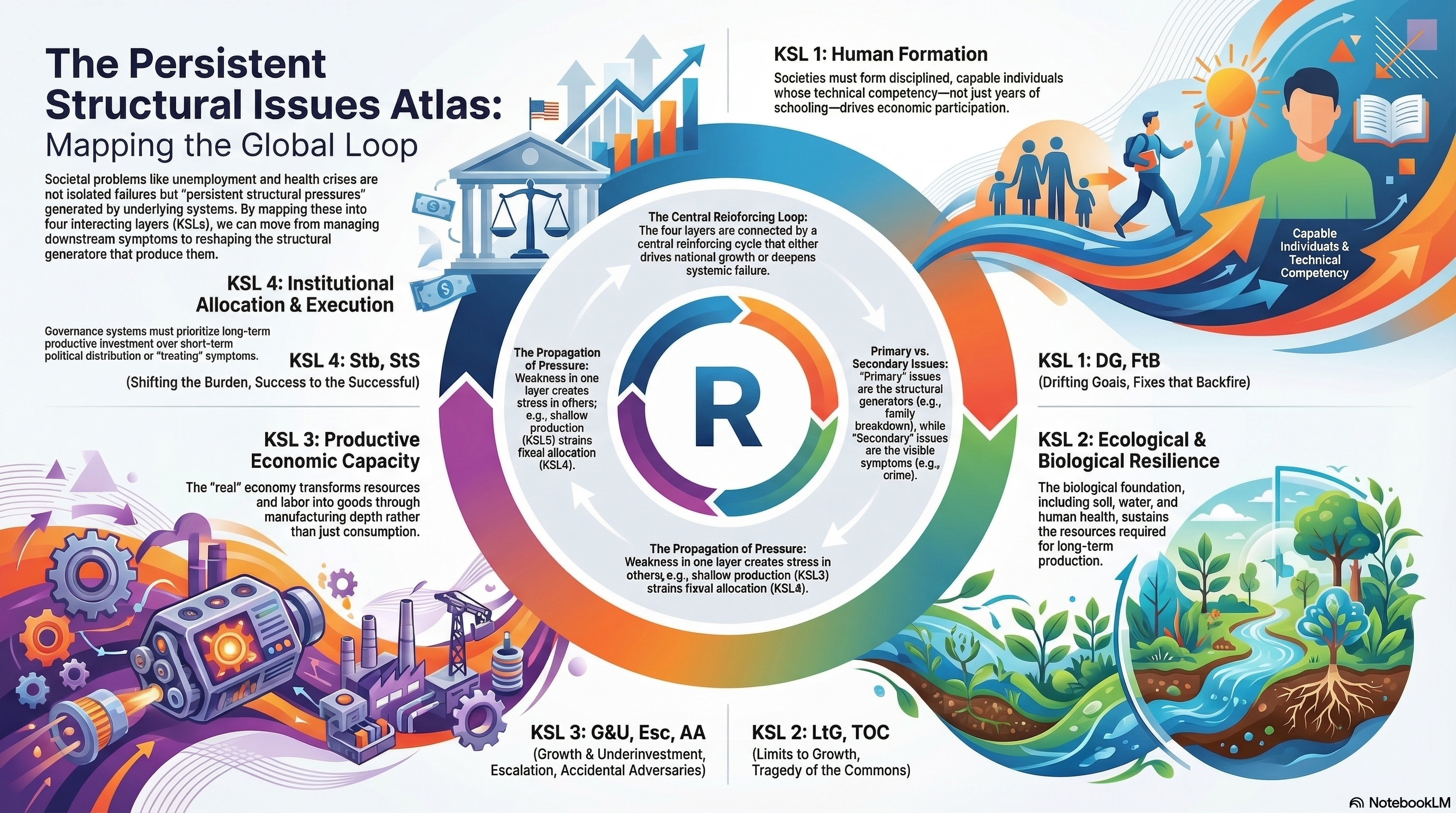
HOW TO READ THE 4-QUADRANT SYSTEMS FRAMEWORK
This framework was developed to help readers move beyond seeing problems as isolated events, sectors, or ministry-specific failures.
Most national issues are approached as though they belong to a single department, a single programme, or a single intervention point. But persistent issues do not behave that way. They move across people, institutions, economies, and natural systems over time — reinforcing one another through feedback.
The purpose of this framework is to help us see those interrelationships clearly.
Related Link – Dynamic Complexity: Why Persistent Systems Cannot Be Understood Through Detail Complexity Alone: https://sheilasingapore.blog/2026/05/08/dynamic-complexity-why-persistent-systems-cannot-be-understood-through-detail-complexity-alone/
THE SYSTEM IS ONE
At the centre of the diagram sits a simple but critical insight:
The system is one.
This means that no quadrant operates independently. What happens in one area eventually influences the others — either strengthening the whole system or weakening it over time.
The arrows moving clockwise around the framework represent this continuous movement:
▪ Human ↔ Human
→ Human ↔ Nature
→ Human ↔ Economy
→ Human ↔ Governance
→ back again into Human ↔ Human
This loop repeats continuously.
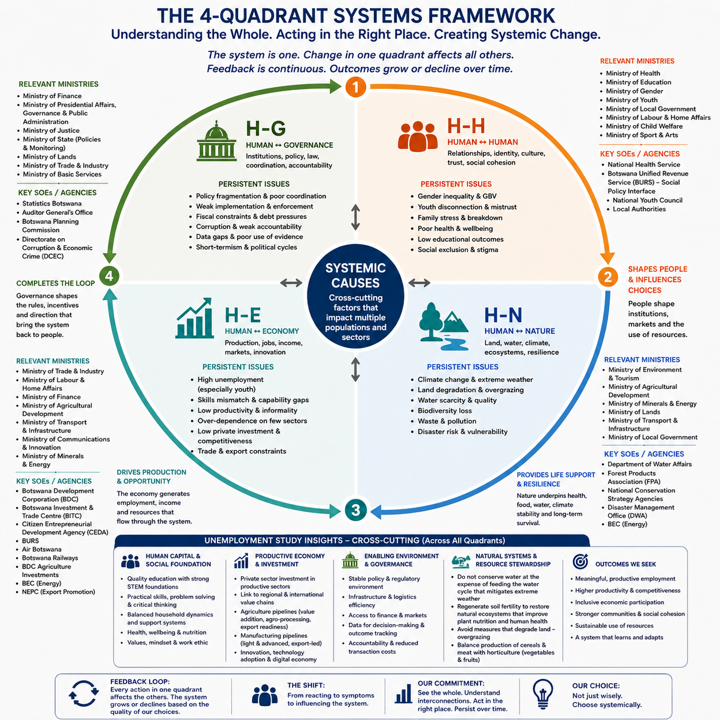
Feedback is continuous. Outcomes either grow stronger or deteriorate over time depending on how these relationships interact.
QUADRANT 1 — H-H (HUMAN ↔ HUMAN)
This quadrant focuses on relationships between people.
It includes family structures, trust, identity, leadership, education, culture, emotional wellbeing, and the broader social field that shapes how populations think and respond.
Many persistent national issues begin quietly here long before they become visible elsewhere in the system.
For example:
▪ family stress
▪ educational disengagement
▪ breakdown of trust
▪ poor health and wellbeing
▪ weak social cohesion
These are often treated as “social issues,” but the framework shows something deeper.
The condition of human relationships influences every other quadrant.
A population struggling with instability, fear, weak educational grounding, or fractured household dynamics eventually influences labour systems, governance systems, environmental stewardship, and economic productivity.
This is why the unemployment study placed importance on:
▪ strong STEM foundations
▪ balanced household dynamics
▪ practical problem-solving capability
▪ health and wellbeing
▪ values, mindset, and work ethic
Not because these operate separately from the economy — but because they eventually shape the economy itself.
QUADRANT 2 — H-N (HUMAN ↔ NATURE)
This quadrant examines the relationship between human systems and natural systems.
Land, water, ecosystems, biodiversity, climate, soil fertility, and resilience all sit here.
Modern systems often approach nature as a resource to extract from, conserve narrowly, or regulate administratively. But natural systems behave dynamically. They respond over time to cumulative interactions.
This is why the framework includes insights such as:
▪ not conserving water at the expense of feeding the water cycle
▪ regenerating soil fertility to restore ecosystem health
▪ avoiding land degradation and overgrazing
▪ balancing cereals and meat production with horticulture
These are not isolated environmental concerns.
They influence rainfall behaviour, food systems, human nutrition, migration pressures, public health, and eventually economic stability.
Nature is not sitting outside the economy.
Nature underpins the conditions that allow economies and populations to function.
QUADRANT 3 — H-E (HUMAN ↔ ECONOMY)
This quadrant focuses on productive systems.
Employment, agriculture, manufacturing, logistics, infrastructure, exports, labour capability, enterprise development, and investment all interact here.
The unemployment study showed repeatedly that persistent unemployment is not simply a labour issue.
It reflects broader interrelationships between:
▪ education systems
▪ household dynamics
▪ productive sector depth
▪ investment patterns
▪ infrastructure
▪ regional trade positioning
▪ governance coordination
This is why the framework emphasises:
▪ private sector investment into productive sectors
▪ plugging into regional and international productive systems
▪ strengthening agriculture and manufacturing pipelines
▪ increasing value addition and agro-processing
▪ export readiness and industrial capability
The issue is not merely creating jobs.
The deeper question is whether the economy is structurally capable of absorbing and developing human capability over time.
QUADRANT 4 — H-G (HUMAN ↔ GOVERNANCE)
This quadrant addresses governance systems.
Policy, ministries, regulation, budgeting, infrastructure coordination, incentives, public institutions, SOEs, and long-term national direction all sit here.
Governance is often mistaken for administration. But administration alone does not shape systems well.
The framework instead positions governance as:
▪ creating conditions
▪ coordinating direction
▪ reducing fragmentation
▪ aligning incentives
▪ enabling productive participation across the system
This is why persistent governance issues tend to appear as:
▪ weak coordination
▪ short-term planning
▪ fragmented execution
▪ policy inconsistency
▪ poor evidence use
▪ weak accountability structures
Over time, governance decisions loop back into households, economies, and environmental systems.
And then the cycle begins again.
WHY THE MINISTRIES AND SOEs SIT OUTSIDE THE QUADRANTS
The ministries and SOEs are intentionally placed around the outside of the framework rather than inside it.
This is important.
The framework is not attempting to say that ministries “own” systems.
Instead, ministries and SOEs interact with systems from different entry points.
For example:
▪ Agriculture may touch H-N, H-E, and H-G simultaneously
▪ Education influences H-H, H-E, and H-G
▪ Water systems affect all four quadrants over time
This arrangement helps prevent linear thinking where one institution assumes that a persistent issue belongs only to itself.
THE UNEMPLOYMENT STUDY INSIGHTS SECTION
The lower section of the diagram brings together cross-cutting insights from the unemployment study.
This section does not sit within one quadrant because the study itself showed that persistent unemployment emerges through interactions across the entire system.
For example:
▪ household dynamics influence educational performance
▪ education, particularly STEM, influences labour capability and discipline
▪ labour capability influences investment attractiveness
▪ investment patterns influence productive sectors
▪ productive sectors influence incomes and stability
▪ environmental pressures influence food systems and migration
▪ governance affects coordination across all of them
The study therefore does not isolate unemployment as a “job problem.”
It approaches unemployment as part of a wider systemic structure influencing multiple populations over time.
THE MOST IMPORTANT IDEA IN THE DIAGRAM
The final statement at the bottom of the framework is deliberate:
Not just wisely. Choose systemically.
Wise decisions made in isolation can still weaken the larger system.
A policy may succeed financially while damaging households.
An environmental intervention may conserve water while weakening rainfall systems.
An economic programme may increase activity while hollowing out productive capability.
The framework therefore asks a different question:
What happens to the rest of the system when this decision is made repeatedly over time?
That is where systems thinking begins.
Videos of Interest To Watch:
What does seeing the forest and the trees mean
When The People Speaks …. A Systems Story in our Lives as Family
When Nature Speaks … Seeing the Forest. Literally
When the Economy Speaks … The Value of Systems Thinking at the Work Place


You must be logged in to post a comment.