The Structures Beneath the Surface: Why Persistent Problems Don’t Stay in Their Lane
When a country’s unemployment rises, the response is usually a labour policy. When food imports climb, agricultural reform gets discussed. When corruption surfaces, governance fixes are proposed. When mental health deteriorates, healthcare budgets get adjusted. Each problem gets its own lane, its own ministry, its own set of experts.
The trouble is that the problems don’t stay in their lanes.
This piece is drawn from a study that began with unemployment and gradually widened — because it had to. The more the data was examined, the more the pressures refused to stay separate. Labour oversupply showed up alongside weakened productive absorption. Educational expansion appeared alongside declining technical capability. Agricultural decline appeared alongside migration pressures and weakening generational continuity. The harder you looked at any one pressure, the more the others were already there beneath it.
What emerged from that widening is a framework for understanding how persistent issues actually move through society — not as isolated events requiring targeted fixes, but as interacting structural movements that propagate across generations, often long before anyone measures them.
The Gap Between Where Problems Appear and Where They Begin
The most important distinction in this entire framework is deceptively simple: the visible location of a problem and the generative location of a problem are not the same thing.
Take corruption. It becomes visible institutionally — in tender processes, in allocation decisions, in procurement scandals. But its behavioural roots often emerge much earlier: in weakened long-horizon thinking, in survival pressures normalised during upbringing, in the gradual acceptance of shortcuts within wider society. By the time it registers as a governance problem, the conditions producing it may have been quietly accumulating for a generation.
Or take institutional fragmentation. It appears within governance systems. But its deeper roots frequently emerge upstream in weakening continuity structures within human formation — in how people are raised, what values are transmitted across generations, how long-term thinking is cultivated or eroded.
Societies often intervene where pressures become visible rather than where they are structurally generated. This is not a failure of intelligence. It is a predictable consequence of how institutions are organised: by sector, by ministry, by profession. The problem is that persistent issues rarely respect those boundaries.
A Framework for Seeing Across Sectors
To organise the growing number of interacting variables without fragmenting their relationships, the study developed a four-quadrant framework. The quadrants are not rigid categories — they are lenses, each revealing where pressures are primarily generated, where they tend to become visible, and how they flow.
H-H — Human Formation The formation of capability, behaviour, discipline structures, educational orientation, labour identity, and long-horizon thinking.
H-E — Productive Economic Capacity Agriculture, manufacturing, productive enterprise formation, labour absorption, value creation systems, and infrastructure.
H-G — Institutional Allocation & Execution Governance systems, policy allocation, land administration, institutional coordination, investment priorities, and societal response mechanisms.
These four quadrants interact continuously. A pressure emerging in human formation may eventually surface economically through weakened productivity. Ecological pressures may become visible institutionally through fiscal strain or migration surges. The framework doesn’t try to eliminate that complexity — it tries to make it navigable.
The Onion: A Sequence of Systemic Behaviours
As the study widened, recurring structural behaviours kept surfacing — not randomly, but in recognisable patterns that systems thinkers call archetypes. What became increasingly clear was that these archetypes were not independent of one another. The pressures generated within one archetype appeared capable of tipping variables into the conditions required for the next one to emerge.
This gave rise to what the study calls the Onion framework: a causally linked sequence of system archetypes that describes how unresolved pressures tend to propagate through society over time.
The sequence is:
Accidental Adversaries (AA) → Escalation (Esc) → Growth & Underinvestment (G&U) → Success to the Successful (StS) → Shifting the Burden (StB) → Fixes that Fail (FtF) → Drifting Goals (DG) → Limits to Growth (LtG) → Tragedy of the Commons (ToC) → back to Accidental Adversaries (AA)
This is not a deterministic cycle. Human societies are adaptive, relational, and capable of renewal at any point. The Onion is better understood as a propagation-awareness framework — a way of seeing how pressures tend to move if underlying structures go unaddressed for long enough.
The sections that follow walk through each quadrant, showing the variables at play, which archetypes dominate, and where the pressures flow.
H-H — Human Formation
Dominant archetypes: Drifting Goals → Fixes That Fail (with Shifting the Burden emerging later)
Many pressures that later become visible economically or institutionally have earlier formative roots in how people are raised, educated, and shaped. The weakening of long-horizon thinking, practical capability formation, productive identity, and disciplined stewardship often appears upstream of much that later shows up in labour systems, governance, and enterprise.
The study also found that some adaptive behaviours emerging under difficult conditions temporarily relieve immediate pressure while simultaneously weakening long-term regenerative capability. Survival-oriented economic behaviour, opportunistic adaptation, weakened delayed gratification — these emerge gradually under sustained systemic stress. Short-term adaptation and long-term continuity do not always move in the same direction.
Variable
Generated In
Dominant Archetype
Detected In
Consequence Flows Into
Births outside stable marriages
H-H
DG
H-H
H-H → H-E → H-G
Male absence in households
H-H
FtF
H-H
H-H → H-G
Weak masculine continuity
H-H
FtF
H-H
H-E → H-G
Weak intergenerational transfer
H-H
FtF
H-H
H-E
Weak long-horizon thinking
H-H
DG
H-H
All quadrants
Emotionally unstable environments
H-H
FtF
H-H
H-N → H-E
Survival-oriented upbringing
H-H
StB
H-H
H-E
Crime
H-E / H-H
StB
H-H
H-N → H-E
STEM avoidance
H-H
DG
H-H / H-E
H-E → H-G
Fear of mathematically intensive disciplines
H-H
DG
H-H
H-E
Office-job orientation
H-H
StB
H-E
H-E → H-G
Credential accumulation mentality
H-H
FtF
H-E
H-E
Theory-heavy education
H-H
FtF
H-H / H-E
H-E
Weak apprenticeship systems
H-H
FtF
H-E
H-E
Weak practical application
H-H
FtF
H-E
H-E
Weak technical competency
H-H
DG
H-E
H-E → H-G
Reduced deep work capability
H-H
DG
H-H
H-E
Labour oversupply
H-E
LtG
H-E
H-G
Graduate oversupply
H-H
FtF
H-E
H-E → H-G
Education–Employment Mismatch
H-E
DG
H-E
H-E → H-G→ H-H
Underemployment
H-E
LtG
H-E
H-G
Survival psychology
H-H
StB
H-H
H-E → H-G
Status signalling
H-H
Esc
H-H
H-E
Visibility competition
H-H
Esc
H-H
H-G
Side-hustle normalization
H-H / H-E
StB
H-E
H-G
Opportunistic adaptation
H-H
StB
H-G
H-G
Rule-bending normalization
H-H
DG
H-G
H-G
Penal-code proximity
H-H / H-E
ToC
H-G
H-G
Drift toward organized crime
H-H / H-E
ToC
H-G
H-G
What the table reveals is that pressures appearing later in labour, governance, and productive systems often have earlier roots in formation structures. Human formation pressures rarely remain confined to the quadrant in which they originate.
H-N — Ecological & Biological Resilience
Dominant archetypes: Limits to Growth → Tragedy of the Commons (with Accidental Adversaries and Shifting the Burden transitional)
Human societies don’t operate independently from the biological and ecological conditions that sustain them. Productive systems, migration patterns, food systems, labour systems, and institutional pressures are all shaped by ecological carrying capacity over long periods.
A critical distinction surfaced here: survival adaptation and regenerative reversal are not the same process. Drought-resistant crops, low-water agricultural systems, and survival-oriented production methods may help populations endure worsening conditions. But enduring deterioration and reversing the underlying trajectory that produces it are fundamentally different things. Some systems successfully help societies survive decline while simultaneously failing to address what is causing it.
Variable
Generated In
Dominant Archetype
Detected In
Consequence Flows Into
Declining rainfall systems
H-N
LtG
H-N
H-E
Increasing drought frequency
H-N
LtG
H-N
H-E
Extreme weather intensification
H-N
LtG
H-N
All quadrants
Reduced carrying capacity
H-N
LtG
H-N
H-E → H-G
Soil degradation
H-N
ToC
H-N
H-E
Water stress
H-N
LtG
H-N / H-G
H-E → H-G
Indigenous drought-resistant systems
H-N
AA
H-N
H-E
Low-water survival agriculture
H-N
StB
H-N
H-E
Weak ecological reversal systems
H-N
ToC
H-N
H-E
Weak evapotranspiration restoration
H-N
ToC
H-N
H-N
Weak biodiversity regeneration
H-N
ToC
H-N
H-E
Weak landscape restoration
H-N
ToC
H-N
H-E
Declining agricultural profitability
H-E / H-N
LtG
H-E
H-G
Aging farmers
H-H / H-N
LtG
H-E
H-E
Weak generational farming continuity
H-H
FtF
H-E
H-E
Youth agricultural disengagement
H-H
DG
H-E
H-E
Male migration into mining systems
H-N / H-E
Esc
H-E
H-H
Rising food imports
H-E
StB
H-G
H-G
Reduced food sovereignty
H-N / H-E
ToC
H-G
H-G
Climate vulnerability
H-N
LtG
H-G
All quadrants
Health / Disease Outcomes
H-E
FtB
H-N
All quadrants
Childhood nutrition weaknesses
H-N
LtG
H-N
H-H
Processed food dependency
H-N
StB
H-N
H-H
Micronutrient deficiencies
H-N
LtG
H-N
H-H
Reduced cognitive resilience
H-N
LtG
H-H
H-H
Emotional regulation instability
H-N
LtG
H-H
H-H
Chronic disease rise
H-N
ToC
H-N
H-E
Diabetes
H-N
ToC
H-N
H-E
Hypertension
H-N
ToC
H-N
H-E
Fatigue economies
H-N
LtG
H-E
H-E
Mental health deterioration
H-N
LtG
H-H
H-E
Reduced productive lifespan
H-N
LtG
H-E
H-G
Ecological commons depletion
H-N
ToC
H-G
H-G
Notice how biological resilience flows into educational performance, labour productivity, and institutional behaviour. Nutrition quality, cognitive resilience, emotional regulation stability — these are not soft concerns. They shape the productive and institutional capacity of entire societies over time.
Economic weakness, as the study increasingly revealed, is rarely a standalone financial event. It tends to emerge as the interacting outcome of human formation pressures, ecological pressures, institutional allocation patterns, and productive underinvestment accumulating simultaneously over long periods. Productive systems inherit conditions from multiple upstream structures at once.
The study drew a sharpening distinction between productive enterprise formation and survival circulation systems. Some economic activity creates productive depth, technical capability, value addition, and long-term labour absorption. Other activity primarily circulates limited value within already constrained systems. Over time, the expansion of survival-oriented circulation — retail growth, import dependency, multi-income hustle strategies — can help societies adapt temporarily while steadily weakening their capacity to generate new productive depth.
Variable
Generated In
Dominant Archetype
Detected In
Consequence Flows Into
Weak agricultural reinvestment
H-E
G&U
H-E
H-G
Weak manufacturing ecosystems
H-E
G&U
H-E
H-G
Weak industrial deepening
H-E
G&U
H-E
H-G
Weak engineering ecosystems
H-H / H-E
G&U
H-E
H-G
Weak research ecosystems
H-H / H-E
G&U
H-E
H-G
Weak agricultural financing
H-G / H-E
G&U
H-E
H-G
High capital barriers
H-G
G&U
H-E
H-H
Weak agricultural banking
H-G
G&U
H-E
H-E
Weak enterprise incubation
H-G
G&U
H-E
H-E
Retail profitability dominance
H-E
Esc
H-E
H-G
Import-based circulation economy
H-E
StB
H-E / H-G
H-G
Government-employment prestige
H-H / H-G
StS
H-E
H-H
Tenderpreneurship expansion
H-G
StS
H-E
H-G
Investments shifting to circulation
H-E
Esc
H-E
H-G
Productive labour shifting to retail
H-E
Esc
H-E
H-H
Administrative expansion without production
H-G
FtF
H-E
H-G
Reduced productive entrepreneurship
H-H / H-E
G&U
H-E
H-G
Small-scale survival businesses
H-E
StB
H-E
H-G
Weak scaling capability
H-E
G&U
H-E
H-G
Weak value-chain integration
H-E
AA
H-E
H-G
Import dependency
H-E
StB
H-G
H-G
Weak local value addition
H-E
G&U
H-E
H-G
Weak industrial competitiveness
H-E
LtG
H-E
H-G
Reduced labour absorption
H-E
LtG
H-E
H-H
Informal circulation systems
H-E
StB
H-E
H-G
Multi-income survival systems
H-H / H-E
StB
H-E
H-G
Short-horizon enterprise behaviour
H-H
DG
H-E
H-G
Declining productivity per worker
H-E
LtG
H-E
H-G
Labour dilution into low-value sectors
H-E
Esc
H-E
H-G
External energy dependency
H-E
LtG
H-G
H-G
Weak industrial infrastructure
H-G
G&U
H-E
H-G
Electricity fragility
H-G / H-N
LtG
H-E
H-G
Rising production costs
H-E / H-N
LtG
H-E
H-G
What the productive quadrant reveals most clearly is that economic outcomes are downstream of structural conditions across multiple layers simultaneously. You don’t fix a hollow productive economy by targeting the economy alone.
H-G — Institutional Allocation & Execution
Dominant archetypes: Escalation → Success to the Successful → Shifting the Burden (with Tragedy of the Commons emerging later)
Governance systems sit in a uniquely difficult position. They are both detectors and responders to pressures generated across the entire civilisational structure. They are asked to stabilise labour pressures, ecological pressures, productive weakness, social fragmentation, and rising instability — often simultaneously — using policy allocation, resource distribution, welfare mechanisms, and political coordination.
The problem is that institutions themselves begin adapting under sustained pressure. Short political cycles, fragmented coordination, symptomatic policy responses, and expanding administrative management systems emerge progressively. Institutions start adapting to the pressure rather than resolving the structures generating it. Some governance responses — welfare expansion, import dependency management, reactive policy cycles — temporarily relieve immediate instability while reinforcing deeper structural dependencies. Short-term stabilisation and long-term regeneration are not the same thing institutionally.
Variable
Generated In
Dominant Archetype
Detected In
Consequence Flows Into
Short political cycles
H-H
StS
H-G
H-G
Weak long-term planning
H-H
StS
H-G
All quadrants
Weak civilizational horizon thinking
H-H
StS
H-G
All quadrants
Political responsiveness over structural investment
H-G
StS
H-G
H-E
Fragmented ministries
H-H
StS
H-G
H-G
Weak systems integration
H-H
StS
H-G
All quadrants
Weak policy continuity
H-H
StB
H-G
H-G
Repeated policy resets
H-G
StB
H-G
H-G
Public-Service Performance / Frustration
H-H
DG
H-G
H-E
Resource leakage
H-H
StB
H-G
H-G
Corruption
H-H
StB
H-G
H-G
Patronage systems
H-G
StS
H-G
H-G
Tenderpreneurial incentives
H-G
StS
H-G
H-E
Land Conflict / Land-Use Conflict
H-N
Esc
H-G
H-E
Land banking
H-H / H-E
StS
H-G
H-E
Housing Challenges
H-G
G&U
H-H
H-E
Elite accumulation
H-E
StS
H-G
H-G
Weak youth access
H-G
StS
H-G
H-H / H-E
Delayed productive deployment
H-G
StB
H-G
H-E
Corruption
H-H
StB
H-E
H-G
Corrupt allocation systems
H-H
StB
H-G
H-G
Underinvestment in STEM
H-H
StS
H-G
H-H / H-E
Underinvestment in regenerative agriculture
H-N
StS
H-G
H-N
Underinvestment in water systems
H-N
StS
H-G
H-N
Underinvestment in manufacturing ecosystems
H-E
StS
H-G
H-E
Underinvestment in apprenticeship systems
H-H
StS
H-G
H-H
Welfare dependence
H-H / H-E
StB
H-G
H-H
Youth grants without ecosystems
H-G
StB
H-G
H-H / H-E
Import dependency management
H-E
StB
H-G
H-E
Administrative expansion
H-G
StB
H-G
H-G
Retail licensing expansion
H-E
StB
H-G
H-E
Distrust in productive effort
H-H
StB
H-G
H-H
Rule-bending normalization
H-H
StB
H-G
H-H
Reduced civic cohesion
H-H
StS
H-G
H-H
Institutional fatigue
H-H / H-G
StB
H-G
H-G
Ecological depletion
H-N
ToC
H-G
H-N
Fiscal depletion
H-E
ToC
H-G
H-G
Institutional depletion
H-G
ToC
H-G
H-G
Governance legitimacy stress
All quadrants
ToC
H-G
All quadrants
Reduced long-horizon coordination capacity
H-H
ToC
H-G
All quadrants
Reduced regenerative capability
H-N / H-E
ToC
H-G
All quadrants
Increased systemic fragility
All quadrants
ToC
H-G
AA restart
The governance quadrant is where the accumulated pressures of human formation, ecological resilience, and productive capacity all converge and become measurable. It is, in a sense, the final detection layer — but rarely the origin of what it’s detecting.
The Quadrants in Motion
The four quadrants don’t operate in sequence. They interact continuously. Human formation shapes ecological stewardship. Ecological conditions reshape productive systems. Productive systems influence governance behaviour. Governance responses influence educational orientation, economic adaptation, and long-term societal behaviour in return.
This continuous interaction means pressures rarely stay contained where they first emerge. Declining ecological resilience propagates later into labour migration, food imports, fiscal strain, and institutional fatigue. Weak productive absorption propagates later into household stability, psychological adaptation, educational orientation, and governance pressure.
This is also why some interventions produce only temporary relief. If societies continuously intervene where pressures become visible while neglecting where they are structurally generated, many conditions gradually re-emerge elsewhere. The structure keeps producing what it was always structured to produce.
Interconnected Pressures, Interconnected Leverage
One of the most important observations to emerge from this study is that interconnected systems carry both interconnected pressures and interconnected possibilities for renewal.
Strengthening long-horizon human capability formation may later influence productive behaviour, institutional resilience, educational orientation, labour absorption, and governance quality simultaneously. Strengthening regenerative ecological systems may later influence food resilience, migration pressure, biological resilience, productive continuity, and fiscal stability. Strengthening productive capacity may later influence family stability, psychological adaptation, institutional pressure, and long-term societal confidence.
This doesn’t mean persistent issues yield to simple single-point interventions — human societies are too complex and historically layered for that. But it does suggest that long-term regenerative movement becomes more possible when societies start seeing the interacting structures beneath visible realities rather than treating each pressure as a standalone problem. The ability to perceive interrelationships may itself be part of the intervention.
Closing: What Persistent Unemployment Actually Reflects
Persistent unemployment may represent more than the absence of jobs. It may reflect simultaneous movements in human formation, ecological systems, productive systems, and institutional structures over long periods of time — educational orientation, ecological resilience, labour absorption, governance adaptation, social continuity, and psychological adaptation all interacting more closely than they appear when examined separately.
Organisations will continue managing themselves through sectors, departments, and ministries — that operational logic has its own validity. But persistent issues don’t respect those boundaries. They move across them, reinforce themselves through them, and reveal the same underlying structures expressing themselves differently in different parts of society.
The challenge isn’t only to solve isolated problems more efficiently. It’s to develop the capacity to see the interacting structures beneath them — patiently, coherently, and across generations. That capacity for systemic perception may be one of the most important things a society can cultivate.
Your thinking is incisive — and it touches a painful global fault line.
🔵 INTRODUCTION
Fifty years ago, and even twenty years ago, eyes would quietly roll. This happened even just five years ago whenever I presented the unemployment case study. I called for the expansion of our economic base into agriculture and manufacturing. The analysis didn’t align with what many in Botswana held close to their hearts:
That the best jobs were in government. That the safest path was one with proximity to the national coffers. That careers worth pursuing were those of teachers, police officers, lawyers, and doctors. These roles are seen as stable, respected, and state-salaried.
In that worldview, STEM was invisible. It was neither prioritized nor financed. STEM has powered the rise of every economy now leading the world into the AI age. It is evident in Physics, Chemistry, and Mathematics.
But fifty years have passed. And the reality today no longer matches the dream.
The government coffers are no longer overflowing. Public sector job creation has slowed. And those trained in roles of the past now find themselves unskilled for a private sector that never fully materialized.
Looking back, we can forgive the choices of the early years. Botswana was young — trying to find its way. But the next 50 years will not wait. And it will not be gentle.
The time has come to name a reality many have quietly lived with. We must do so with compassion but also clarity. The reality is that STEM evokes pain. For many, it stirs memories of failure. It triggers feelings of not being good enough. People remember being left behind in schoolrooms that favoured quick calculations over poetic thought. Avoidance is no longer an option. We live in a world where everything we eat, wear, or build is grounded in the sciences. We operate everything through AI, except perhaps politics.
This is not to dismiss the Arts. They are necessary. They help us make meaning of what we have just lived through. But they are languages of the past. They draw their strength from nostalgia, memory, and reflection. They do not engineer propulsion. To leap into the future, we need STEM. It should not only be a subject in school. It should be the architecture of economic survival, governance, and production.
Every country has lived through that pain. Every person who has had to reckon with their place in this rapidly changing world has experienced it. You’re not alone in having struggled with STEM. But at some point, as individuals and as nations, we must find the courage to move forward with it anyway.
The future will not pause while we make peace with our past. We don’t have to pretend it was easy. But we also can’t let that pain define what comes next. It’s time to rise — not because it’s easy, but because it’s necessary.
This post explores three possible trajectories for Botswana from this point forward. The purpose is not to predict the future — but to sharpen our awareness of what we are choosing today. Each path is plausible. Each has its own consequences. But only one, I believe, leads to durable sovereignty, economic coherence, and generational uplift.
Looking back, we can forgive the choices of 50 years ago. It was Botswana’s first united front — a young nation trying to find its way. But the next 50 years will not wait.
So the question is no longer: What happened?
The real question now is: What must we be prepared for?
✳️ Introductory Paragraph:
The world is not waiting. Nations are restructuring their economies, education systems, and regulatory frameworks to meet the demands of an AI-powered, STEM-led global future. That shift was happening as far back as 200 years ago. In the span of a single generation, decisions made today in classrooms will determine the fate of countries. Ministries and boardrooms also play a crucial role in shaping the future. These choices will show if they fall behind or rise to global relevance.
Botswana stands at a crossroads. Will it continue on its current path — redistributing value instead of building it? Will it adopt surface-level AI tools without a real production engine? Or will it invest deeply in science, technology, engineering, and mathematics (STEM) to build resilient systems and regional value chains?
This post presents three strategic scenarios for Botswana’s future. Each scenario is shaped by the country’s choices around STEM investment. Governance models also play a role. Additionally, it depends on its willingness to lead rather than follow. These scenarios are not predictions. They are tools for clarity, planning, and courage.
✳️ Rationale for Developing the Scenarios:
These scenarios were developed in response to a growing national unease. This unease is about youth unemployment, growing regulation, policy stagnation, and technological disruption. They build on insights from systems thinking, development planning, and decades of underutilised potential in Botswana’s public and private sectors.
More urgently, they offer a language to speak about what we stand to gain or lose. This depends on whether we choose to centre STEM. It applies not only in education but also in governance, regulation, and production. It affects how we imagine our collective future.
Let’s walk through a likely 20-year scenario for Botswana (and similarly placed countries) if the current structural discomfort with STEM continues and the world’s STEM giants surge ahead:
🛰️ Scenario 1 for Botswana 2045: The Global Tech Divide Is Permanent — and Botswana Is on the Losing Side
1. STEM-Powered Superstates Set the Rules
China, India, Europe, and the STEM-enabled Middle East now own the AI, bioengineering, fusion power, agri-robotics, and climate-tech markets.
These regions no longer just produce the technologies. They have embedded them deeply into how society is governed. They also affect how infrastructure is maintained and how jobs are distributed.
2. Botswana is a Spectator to AI, Quantum, and Bio Revolutions
Botswana becomes a net consumer without a critical mass of home-grown STEM thinkers. It becomes a net consumer, not a producer. Botswana is not even a critical consumer.
The few tech services it can afford are scaled-down versions, pre-processed for Global South clients.
“It’s like drinking recycled water from a smart city you never helped design.”
3. The Global North No Longer Needs Botswana’s Minerals
Rare earths and diamonds are either:
Synthesized artificially (lab-grown diamonds, mineral extraction from space debris),
Or sourced from more politically stable, tech-integrated African countries (e.g., Rwanda, Kenya, Egypt).
The era of passive mineral wealth is over. The illusion that foreign spending will keep the country afloat is gone.
4. Socialist Redistribution Politics Struggle Without Revenue
With mining income gone and agriculture un-modernized, the state has less to redistribute.
Workers expect “entitlements,” but there is no productivity beneath to fund them.
The gap between promises and possibilities widens — leading to unrest, brain drain, and populist distraction politics.
5. Botswana’s Youth Are Angry — But Undertrained
With AI displacing traditional white-collar jobs, and no local STEM industries to absorb the loss, youth feel betrayed.
Ironically, many turn to the very influencers and entertainers the system elevated. They then realise that the real wealth and influence now sits in the STEM world. This is a world they were never invited into.
6. Global Tech Powers Pick and Choose African Partners
STEM-rich countries like Egypt, Tunisia, Kenya, and Rwanda become African nodes for future development partnerships.
Countries like Botswana are offered climate preservation roles, or eco-tourism zones — but not a seat at the decision-making table.
Foreign powers may still invest in:
Preserving biodiversity, not industrialising it.
Buying carbon credits, not helping industrial growth.
Charitable tech access, not capacity building.
In other words: you may be preserved, but not empowered.
✋ And Yet, It Was Preventable
This isn’t a natural outcome. It’s a choice — or rather, a series of avoided choices.
Countries like Botswana had 20 years to:
Rewire education to prioritise STEM (especially Physics, Chemistry, and Mathematics).
Reform leadership pipelines to demand STEM literacy in public service.
Stop glamorising “soft visibility” professions and reward quiet technical mastery.
🌱 But All Is Not Lost — If Action Starts Now
“The best time to plant a tree was 20 years ago. The second-best time is today.”
If Botswana invests now in building a critical mass of 35–40% STEM graduates, with integrity-based leadership:
It can leapfrog into renewable energy, regenerative agriculture, AI-supported public infrastructure, and STEM-backed governance.
It can serve as a regional hub for climate-tech, AI-integrated agriculture, or precision medicine.
That pivot requires courageous honesty about where things stand now. It also demands a break from the illusions of safety in visibility, poetry, or legacy mineral rents.
⚠️ Scenario 2 for Botswana 2045: Decoupled Growth – AI Without Foundations
“Digitised but unrooted. Tech glitters, but the soil is hollow.”
Botswana aggressively adopts AI technologies. This occurs in government, banking, security, and communication. However, the country is not building a foundational STEM ecosystem in its schools, industries, and governance systems.
Short-term gains (next 5–10 years):
Government digitises services.
Youth pick up quick AI tools (prompting, low-code apps, etc.).
Startups and donor-funded tech incubators emerge.
But…
Medium-term outcomes (by 2045):
Local talent cannot maintain or advance AI systems they adopt.
Manufacturing and agriculture remain underserved and unautomated.
Foreign firms dominate data, tools, cloud access — Botswana becomes a data client state.
This scenario creates a false sense of progress, masking the lack of sovereign technical depth.
If Botswana boldly shifts today, it can achieve a 60% STEM throughput within 10 years. This effort will allow them to catch up on lost time. By 2045, a radically different future is not just possible, it is probable.
Let’s explore that future in contrast to the previous scenario:
🌍 Scenario 3 for Botswana 2045 — The STEM Leapfrog Nation
“It was once called ‘the locomotive of Africa’ — now, it’s the driver of the engine.”
🔁 1. From Extractive to Generative Economy
Botswana no longer relies solely on mining rents; it now exports AI-driven agri-solutions, climate engineering services, and biotech intellectual property.
Former mining towns have been converted into STEM production corridors: solar microgrids, geothermal research hubs, fusion training centres.
Local manufacturing has revived — not cheap and dirty, but clean, precise, and export-oriented, led by engineers and digital technicians.
🧠 2. Public Sector Transformed: Led by Technocrats
60% STEM throughput means that half or more of public officers now have backgrounds in Physics, Chemistry, Mathematics, or Engineering.
Ministries no longer “consult” technical experts. They are the technical experts.
Policies are evidence-led, deeply simulated using systems models, and include impact foresight.
Regulatory culture shifts from defensive overreach to agile risk-tolerant frameworks — because people finally understand scale, feedback, and irreversibility.
“The government is no longer a referee of progress. It is the architect of it.”
👩🏽🌾 3. Botswana Becomes Africa’s Agri-Tech Command Centre
With climate volatility peaking, Botswana leads in regenerative precision agriculture, satellite-aided irrigation, and AI crop disease forecasting.
Thousands of rural youth are trained as agri-coders, drone operators, soil lab analysts, and seed technologists.
Regions like the Kgalagadi have become agro-innovation testing zones in collaboration with Indian and Dutch research stations.
The African Development Bank labels Botswana “The First Resilient Farm Nation.”
💼 4. Unemployment Nearly Eliminated — But It’s Not the Old Jobs
While mining and retail decline, jobs in:
Cybersecurity
Energy systems
AI governance
STEM teaching
Circular economy manufacturing grow rapidly.
Rather than waiting for jobs, young people are founding companies that export services and products into Africa and beyond.
The informal sector shrinks as people shift from hustle to mastery.
🧬 5. A New Botswana Identity Emerges
The national identity is no longer rooted in “a proud past” alone — but in a shared, technical future.
Botswana celebrates its engineers, data scientists, agronomists, and inventors — as deeply as it once celebrated singers and soldiers.
National TV channels run prime-time STEM storytelling, and annual “Botswana Grand Challenges” inspire national innovation sprints.
Even Setswana proverbs are being re-interpreted to align with scientific insights — grounding STEM in culture.
“Ga se ka lerumo le le bogale fela — le ka ntlha ya boikwetliso jwa gagwe.” It is not only because of a sharp spear — but because of the preparation of the one who wields it.”
🤝 6. Global Partnerships on Botswana’s Terms
Rather than waiting for Global North investors, Botswana becomes a technical equal.
It co-develops AI laws with Europe, shares data infrastructure with India, and hosts Africa’s Southern AI Observatory.
The Global STEM Diaspora is returning — not to visit, but to invest and teach.
Botswana is now chairing continental panels on STEM ethics, regenerative governance, and space economy for Africa.
⚖️ 7. The Political Culture Matures
The age of “elite populism” fades, replaced by civic science culture.
Parliamentary debates begin with simulations and systems maps.
Leaders are elected not by slogans, but by demonstrated grasp of complexity and ability to lead multi-disciplinary teams.
Even the military has STEM-led strategic units in cyber, space, and climate security.
🎓 8. The Ripple to SADC and the World
Botswana exports:
Curricula for STEM-primary schooling
Faculty to newly launched universities in Angola, DRC, and Zambia
Policy blueprints for AI regulation and STEM justice
Motswana professors are now guest lecturers at MIT, NUS, ETH Zurich.
Regional neighbours model their youth employment strategies on Botswana’s STEM value-chain training.
🛤️ How Did It Happen?
Through a radical national reckoning — and 3 unshakable reforms:
A National STEM Commitment Charter — enshrined in law.
Public Service STEM Track — 60% of new hires must be from Physics, Chemistry, Mathematics, and Engineering fields.
STEM x Culture Narrative Rewrite — using schools, churches, influencers, and village elders to normalise technical ambition.
Botswana can catch up on lost time if it boldly shifts today. It must commit to a 60% STEM throughput within 10 years. Then by 2045, a radically different future is not just possible, it is probable.
Let’s explore that future in contrast to the previous scenario:
We will next develop the three scenarios for Botswana’s future — arranged in a clear, escalating arc:
As the world accelerates in AI, biotech, manufacturing and advanced agriculture, Botswana stands at a pivotal crossroads. The choices made today will determine whether it builds systems. They will also determine if it becomes a dependent participant. It may also end up as a bystander in decline.
Here are three strategic scenarios to frame Botswana’s possible futures:
🚩 Scenario 1: Status Quo – STEM Neglect and Decline
“Redistribution without production. Regulation without understanding.”
Botswana continues on its current path:
Low STEM enrolment (9%) persists, with youth drawn to tenderpreneurship, arts, and political sciences.
Regulations remain tight — not due to strategic caution, but due to lack of internal technical fluency.
Tenders dominate local opportunity, sidelining hands-on production and systems-building.
Foreign experts parachuted in but fail to leave lasting capacity or ecosystems.
Socialism is used as political cover, redistributing limited gains but failing to grow new wealth.
Consequences by 2045:
Botswana becomes a pass-through state, relying on outside systems and consultants.
AI, engineering, and biotech are imported, not created.
Economic sovereignty weakens as the country remains resource-dependent (diamonds, minerals, tourism).
Society grows more fragile, with growing unemployment and state spending pressures.
🧨 Trigger signs already visible:
9% STEM graduation rate.
P800M procurement losses vs P80M in value.
Tight, reactive regulation vs anticipatory system design.
⚠️ Scenario 2: Decoupled Growth – AI Without Foundations
“Digitised but unrooted. Tech glitters, but the soil is hollow.”
Botswana aggressively adopts AI technologies — in government, banking, security, and communication. However, it does so without building a foundational STEM ecosystem in its schools, industries, and governance systems.
Short-term gains (next 5–10 years):
Government digitises services.
Youth pick up quick AI tools (prompting, low-code apps, etc.).
Startups and donor-funded tech incubators emerge.
But…
Medium-term outcomes (by 2045):
Local talent cannot maintain or advance AI systems they adopt.
Manufacturing and agriculture remain underserved and unautomated.
Foreign firms dominate data, tools, cloud access — Botswana becomes a data client state.
Main visual: Flowchart-style illustration showing system traps (feedback loops and delays). (Ensure this visual is saved or embedded when republishing.)
Why Manufacturing and Agriculture Struggle to Grow The education-sector mismatch and weak value chain integration
The Family Structure and the STEM Gap How early cognitive development affects long-term workforce capacity
The Entrepreneurial Trap Why relying solely on entrepreneurship won’t solve systemic unemployment
Building a National Economic Coordination Engine The missing institution to align government, industry, and communities for transformation
Sector Strategy: Plugging into Regional Demand Opportunities to scale manufacturing across SADC and beyond
Closing Reflections and Next Steps Call to action for government, private sector, and citizen co-creators
Opening Paragraph: Digging Deeper into the System
From Structural Insight to Societal Design
In Part 1, we uncovered how Botswana’s unemployment crisis is not simply an economic issue—it is the result of a system that was never structurally designed to absorb all its people into productive work. We explored how this system creates persistent gaps between education, enterprise, and employment, and why sectors like agriculture and manufacturing—though full of potential—have remained underutilized.
Part 2 continues this journey with a deeper look into the social systems and feedback loops that silently reinforce the status quo. It expands the lens to include:
The education pipeline and its disconnect from labour market realities
The overlooked influence of family structure in shaping national STEM capacity
The limits of entrepreneurship as a one-size-fits-all solution
And the capabilities mindset needed to rebuild a labour market that generates meaningful, inclusive employment
Together, these insights challenge us to move from temporary fixes to structural redesign—not just of the economy, but of the cultural, educational, and institutional systems that make it work.
Section 1: The Labour Absorption Gap
At the heart of Botswana’s unemployment crisis lies a structural gap: the economy is not designed to absorb its own people into productive, formal employment.
Every year, thousands of young people complete their education and enter the labour market. This is not a surprise—it is a predictable outcome of birth and schooling patterns observed 15 to 20 years earlier. Yet, despite this foresight, there is no built-in mechanism to ensure the economy expands in ways that absorb this growing workforce.
“We know when children are born, but we do not prepare the economy to receive them as workers.”
Instead of proactive planning, job creation is often treated as a reactive policy issue, tackled after economic pressures surface. The result is a growing backlog of underutilized talent, particularly among the youth, and rising social and economic strain.
What makes this more serious is that the labour force continues to grow, while the sectors best positioned to absorb labour—such as agriculture, manufacturing, and STEM-related services—remain either underdeveloped or stagnant. The informal sector temporarily absorbs some of this pressure, but it lacks the structure, protections, and scalability needed for long-term national prosperity.
This labour absorption gap is not a failure of individuals—it is a failure of system design. And until it is addressed at the structural level, any attempt to reduce unemployment will only scratch the surface.
Section 2: Skills Mismatch
LIMITS TO GROWTH OF MANUFACTURING & AGRICULTURE ECONOMIC SECTORS IN BOTSWANA
At the heart of Botswana’s labour market stagnation lies a persistent misalignment between education outcomes and economic sector needs. Despite steady investments in schooling and training, the pipeline from education to employment—especially in high-absorption sectors like agriculture and manufacturing—remains weak.
A System Designed Without Absorptive Capacity
A systems diagnosis reveals that the current configuration of the education system is structurally geared toward soft sciences—fields such as business studies, humanities, social sciences, and education. While these disciplines are valuable to a functioning society, they do not offer the absorptive scale or productivity gains necessary for industrial growth, economic self-sufficiency, or widespread job creation.
As a result, Botswana’s two most labour-intensive sectors—agriculture and manufacturing—remain underdeveloped, contributing a fraction of what the retail and service sectors do. In some cases, they generate as little as one-fiftieth the revenue of the retail sector.
“An economy that avoids production cannot scale employment. It can only circulate consumption.”
What’s Limiting the Shift?
Despite widespread awareness of the need for STEM-related skills, the transition has been slow. Several interlocking factors explain this:
Educational history and social perception: STEM disciplines are widely perceived as harder, less accessible, and more intimidating—especially in communities with weak early exposure to math and science.
Limited technical infrastructure: Vocational and technical training institutions remain under-resourced and under-prioritized.
Career pipeline uncertainties: Even employers in STEM-related industries often struggle to offer long-term pathways for growth or specialization, discouraging students from entering or staying in the field.
Policy fragmentation: Education policy, economic planning, and labour market development operate in silos, with limited coordination or shared goals.
The Resulting Skill Mismatch
Only 10% of graduates complete qualifications in science or applied science fields. Of this:
About 6% are in engineering
About 7% in the hard sciences
Less than 1% have training relevant to manufacturing
These proportions reflect tertiary-educated populations, meaning even fewer within the broader labour force possess the hard science and technical skills required for scaling production and industrial competitiveness.
Meanwhile, fields that don’t require economies of scale—such as nursing, teaching, or civil service—continue to grow, because they are state-funded and do not face direct market pressure to turn a profit.
This creates a self-justifying narrative: “We are better off pursuing white-collar jobs, where the money and security lie,” even though these sectors offer limited employment elasticity.
Where STEM Skills Still Matter
The paradox is that even in non-STEM jobs, transferable STEM skills—critical thinking, problem-solving, data literacy—are becoming more valuable across all sectors. Yet, Botswana’s slow pivot to STEM is not just about curriculum—it reflects a deep structural dependency on government employment and a lack of market-driven pathways for applied science fields.
What’s Needed
To unblock this feedback loop, Botswana must:
Rebalance tertiary education priorities, with aggressive incentives for STEM fields
Strengthen early exposure to math, science, and technical learning in primary and secondary schools
Invest in technical colleges and vocational training centres with modern equipment, qualified instructors, and employer partnerships
Create visible career ladders in agriculture, manufacturing, and industrial trades, backed by both private investment and public policy
Change the story: Productivity-driven work—whether on farms, in factories, or in labs—must be reframed as noble, necessary, and rewarding.
This is not only a matter of jobs. It’s about redesigning the architecture of Botswana’s future—where learning meets labour, and effort meets opportunity.
Section 3: The Role of the Household
Source: Statistcs Botswana
The data indicate a growing trend of children being born into households without a resident male figure, with ex-nuptial births rising to over 84% in 2022 and projected to reach near-universal levels by 2030. This represents a profound shift in family structure, where mothers—often unsupported by partners—assume the full responsibility of child-rearing. Many of these mothers are themselves unemployed and reliant on social support or informal networks, which further compounds the vulnerability of the household. This dynamic has socio-educational implications for children, particularly in shaping their early exposure to diverse intellectual development influences.
As a result children raised in such households tend to perform better in soft disciplines such as social sciences, education, and healthcare (as the earlier graphs here show), but struggle to match their peers in STEM (Science, Technology, Engineering, Mathematics) subjects. This pattern is linked to the absence of consistent male mentorship, which tends to play a formative role in developing a child’s abstract reasoning and spatial cognition—skills foundational to mastery in mathematics, physics, and technical fields. As STEM demands greater persistence and conceptual integration, children from single-parent households may face systemic disadvantages in accessing these domains, both cognitively and structurally.
This learning gap carries serious consequences for Botswana’s broader economic aspirations. The manufacturing and agriculture sectors—critical to national productivity—depend on a technically skilled workforce proficient in mathematics, science, and language. Without a strong STEM pipeline, these sectors remain underdeveloped, with low profitability and a limited base of competent talent to scale operations. If current trends persist, the absence of foundational male-led household balance will widen the STEM gap, constraining Botswana’s ability to build resilient, innovation-driven value chains in agriculture and manufacturing—further entrenching unemployment and economic fragility.
FROM PRODUCTIVE IDENTITY TO SURVIVAL ADAPTATION
As productive absorption weakens across societies for prolonged periods, populations do not simply stop adapting economically. Instead, many increasingly reorganize themselves around what may be termed a survival adaptation economy — an expanding sphere of unstable monetisation, layered side-income dependence, transactional networking, and short-horizon opportunity seeking that emerges when stable productive pathways become increasingly inaccessible. While some forms of adaptation remain constructive and entrepreneurial, the long-term structural concern emerges when the system increasingly rewards adaptive extraction faster than productive mastery, slowly reshaping the emotional and developmental incentives within society itself.
Under conditions of chronic instability, many children grow up within environments where economic uncertainty, fragmented authority systems, time scarcity, emotional inconsistency, and adaptive stress management become normalized parts of daily life. Such environments often produce highly adaptive forms of intelligence — including rapid social scanning, improvisation capacity, emotional calibration, and opportunity sensitivity — which are valuable survival traits under unstable conditions, but which may not naturally align with the long-cycle developmental requirements of engineering, industrial discipline, technical specialization, scientific research, or institutional leadership. The concern therefore is not that populations stop working, but that societies gradually drift from long-horizon productive identity toward short-horizon adaptive survival behaviour, particularly when productive sectors fail to expand fast enough to absorb rising populations meaningfully.
THE GLOBAL EXPANSION OF THE HUSTLING ECONOMY
This phenomenon is not unique to Botswana. Across large parts of the world, prolonged deindustrialization, rising inequality, labour fragmentation, urban precarity, weakened apprenticeship systems, and expanding attention economies have increasingly pushed populations toward adaptive survival monetisation systems that exist outside stable productive absorption. While precise measurement remains difficult, global patterns increasingly suggest that between 40–55% of the world’s adult population may now participate in some form of adaptive or extractive survival economy, especially when including layered side-income dependence, gig precarity, informal monetisation, speculative trade, attention-driven income generation, and unstable transactional work systems.
Historically, stable agrarian and industrial systems anchored populations to reality-based developmental structures requiring patience, coordination, delayed gratification, craftsmanship, and intergenerational continuity. However, as productive sectors weaken without equivalent productive absorption elsewhere, adaptive survival intelligence increasingly becomes economically rewarded, particularly within highly urbanized and digitally mediated environments. The rise of smartphones and platform economies has accelerated this shift dramatically, allowing visibility itself to become monetisable at planetary scale through emotional stimulation, algorithmic attention, identity signalling, outrage circulation, parasocial engagement, and psychological capture economies that increasingly compete against long-cycle productive development for human attention and aspiration.
ESCALATION WITHIN THE HUSTLING ECONOMY
As larger portions of populations enter unstable monetisation systems simultaneously, the hustling economy begins generating its own reinforcing pressures through the dynamics of the Escalation archetype. As more people compete for shrinking margins, unstable opportunity spaces, customer attention, emotional engagement, and side-income streams, competition intensifies beyond ordinary productive effort into increasingly aggressive forms of adaptation. Under these conditions, signalling, emotional leverage, performative visibility, tactical opportunism, and psychological monetisation begin scaling faster than stable productive capability itself.
Initially, many participants compete through effort, creativity, service, adaptability, and persistence. However, as competition intensifies and margins compress, the system increasingly rewards behaviours that maximize visibility, emotional responsiveness, speed, manipulation, and extraction rather than depth, specialization, trust, or long-term mastery. This gradually shifts the emotional architecture of economic participation itself, as individuals begin observing that adaptive extraction often produces faster returns than patient productive development, particularly within highly unstable and attention-driven economies where immediate monetisation becomes psychologically and economically rewarded.
Over time, escalation within survival economies gradually weakens the very foundations required for productive-sector formation. Productive sectors require stable concentration, apprenticeship endurance, institutional trust, long-horizon planning, technical discipline, coordinated investment, and social cooperation across extended periods of time. Yet escalating survival economies increasingly reward rapid adaptation, self-promotion, emotional signalling, tactical flexibility, and short-cycle monetisation, producing a reinforcing loop where weakened productive absorption drives more survival adaptation, which in turn further weakens society’s capacity for long-term productive rebuilding.
WHEN EXTRACTION BECOMES NORMALIZED
One of the deepest dangers within prolonged survival economies is not unemployment alone, but the gradual normalization of extraction as a legitimate pathway toward survival, recognition, stability, and identity. Under persistent instability, populations increasingly rationalize opportunistic behaviours not necessarily because morality disappears, but because ethical horizons compress under prolonged economic pressure, institutional distrust, and competitive survival conditions. Over time, manipulation, corruption, emotional exploitation, transactional relationships, exploitative networking, and asymmetrical advantage-seeking gradually become socially tolerated adaptive behaviours within increasingly strained economic systems.
Importantly, criminal economies rarely emerge in isolation from these wider extraction dynamics. Rather, prolonged extraction environments often narrow the psychological distance between adaptive monetisation and criminal monetisation, particularly where productive pathways remain persistently inaccessible. Under such conditions, fraud, cybercrime, narcotics circulation, coercive informal economies, theft, organized scams, and violence-linked extraction systems may increasingly emerge as escalated forms of adaptive survival behaviour within populations already conditioned toward short-horizon economic adaptation and weakened institutional trust.
THE WEAKENING OF THE PRODUCTIVE ECONOMY
The long-term danger for nations is that productive economies are not built merely through infrastructure, policy announcements, or financial capital alone. Productive economies also require populations developmentally capable of sustained concentration, delayed gratification, emotional regulation, institutional navigation, technical specialization, apprenticeship endurance, and long-cycle coordination across generations. When escalating survival systems increasingly reorganize societies around short-term adaptation, emotional monetisation, and unstable extraction pressures, the developmental foundations required for building engineers, industrial technicians, researchers, scientists, productive entrepreneurs, and systems leaders gradually weaken beneath the surface of economic activity itself.
This is why the persistence of unemployment cannot be understood only through the lens of jobs statistics or labour-force participation rates. The deeper structural concern emerges when societies slowly drift from value creation toward survival extraction, from productive coordination toward adaptive monetisation, and from long-horizon development toward short-horizon survival signalling. Under such conditions, economic activity may continue expanding numerically while the productive coherence of society weakens simultaneously, leaving nations increasingly active economically, yet progressively more fragmented psychologically, institutionally, and developmentally over time.
RESTORING BALANCE: REBUILDING FAMILY FOUNDATIONS TO STRENGTHEN NATIONAL RESILIENCE
To reverse the trend of growing male absence in households and its downstream effects on education and national productivity, national policy must shift from reactive punishment of gendered violence toward proactive systems that support healthy family formation and gender-balanced co-parenting. Families, communities, and institutions must be reoriented to treat fatherhood not merely as financial provision, but as an equally critical emotional and cognitive presence in the home.
Policies should focus on school-based and community-led programs that rebuild male identity around accountability, purpose, and interdependence—particularly in how boys learn to process emotions, resolve conflict, and lead without coercion. At the same time, national strategies must foster environments where young women are empowered to choose family partnerships from a position of strength and mutual respect, not economic desperation. Only through restoring dignity and functional roles for both genders within the household can Botswana shift the trajectory of family fragmentation and rebuild the foundational conditions for STEM learning, employment, and long-term national resilience.
Botswana’s persistent unemployment is not only economic or educational in origin—it is deeply social and familial. A closer look reveals that the very foundations of how children are raised, mentored, and prepared for the world of work carry profound implications for the country’s STEM capacity, labour readiness, and economic diversification.
Cognitive Development Starts at Home
By 2022, 84% of births in Botswana were ex-nuptial, with projections pointing to near-universal levels by 2030. This marks a dramatic restructuring of family life, where female-headed households—often without resident male support—carry the weight of child-rearing, often under significant economic strain. Many of these women are themselves unemployed or dependent on informal networks or social grants, which limits their ability to provide sustained cognitive enrichment for children.
The long-term implication? A large portion of Botswana’s youth develops strong capacities in social, emotional, and communicative skills, but lags behind in STEM disciplines—especially in mathematics, engineering, and physical sciences.
Research and behavioural patterns show that male mentorship—particularly through father figures—plays a critical role in fostering abstract reasoning, spatial cognition, and systems thinking, all of which are foundational to technical mastery in STEM fields.
“Botswana’s children are not failing STEM. STEM is failing to meet them where they are—and failing to reach the homes where foundational development should begin.”
Downstream Effects on National Sectors
This learning gap doesn’t stop at school. It extends into the economy. Sectors like agriculture and manufacturing, which rely on technical, spatial, and mechanical reasoning, continue to suffer from a lack of skilled labour. Despite their potential to absorb large segments of the unemployed population, these sectors remain underdeveloped and uncompetitive—not because of funding alone, but because of a shortage in the foundational STEM capabilities that underpin profitable, scalable operations.
Without a deliberate strategy to rebuild the cognitive and emotional ecosystem in households, Botswana risks reinforcing the very structural traps that sustain long-term unemployment.
Why the Family System Matters to Economic Planning
This is not just a moral or cultural concern—it is a strategic one.
Economic growth, industrial competitiveness, and technological innovation begin with brain development, mentorship, and multi-parental support in the early years. Without that, later reforms in education, vocational training, or entrepreneurship will not yield the intended systemic shift.
This family structure imbalance has also supported the expansion of employment in white-collar and social service roles (e.g. healthcare, teaching, government), which tend to be more forgiving of emotional labour gaps but do not require technical scale or global competitiveness.
Meanwhile, more masculine-coded, production-driven industries, which demand precision, long-term focus, and mechanical thinking, are either avoided or underutilised—widening the skills gap and deepening economic fragility.
The role of intact families in economic transformation is often misunderstood as moral or cultural. It is neither. As this study shows, productive economies—particularly those requiring STEM depth, manufacturing precision, and systems competence—depend on long-horizon learning and apprenticeship. Those capacities are not transmitted episodically through short-term training or policy cycles; they are compounded slowly through stable relational environments. Where families are intact, children inherit patience, delayed reward, and confidence in continuity. Where families are structurally fragile, learning horizons shorten and skill accumulation leaks. A companion analysis (“Violence Starts in Silence”) examines how prolonged unemployment, migration, and economic exclusion thin family stability itself—creating a reinforcing loop in which weakened families further undermine the very skill base productive economies require. Economic strategy, therefore, cannot be separated from the conditions that allow families to form, stabilise, and transmit belief forward.
To reverse these trends, Botswana must design holistic interventions that reframe fatherhood—not merely as financial contribution—but as an essential cognitive and emotional pillar in national development.
Key strategies include:
Shifting public policy from reactive punishment of gender-based violence to proactive support for healthy family formation and co-parenting
Embedding father-positive identity work in schools and communities: teaching boys to resolve conflict, lead with emotional intelligence, and value interdependence
Empowering girls and young women to choose family partnerships out of mutual respect, not economic survival
Developing curricula and parenting models that recognise the neurocognitive link between household stability and STEM success
“When we restore balance at home, we lay the cognitive and emotional groundwork for economic resilience in the nation.”
Build A Nation Ready to Compete Starts at Home: Building Botswana’s Production-Ready Future
Reclaim the household as the first economy—the place where work ethic, discipline, resilience, and self-sufficiency are formed. Botswana’s pathway to enduring prosperity lies not in aid or consumption, but in cultivating a tech-smart, production-ready workforce—an engine of national transformation that can power the next generation of agriculture, manufacturing, and export-oriented enterprises.
We must train not just for employment, but for global competitiveness. This means equipping citizens with technical competence, entrepreneurial mindset, and systems thinking—alongside a national culture that values efficiency, learning, and precision. It is no longer enough to aim for participation in the economy. We must become builders of it.
Industrial growth must be anchored in people-powered productivity. Let us shift from a model of aid-dependent employment to one of export-led livelihoods—grounded in long-term strategy, backed by modern infrastructure, and evaluated by how much value we create and retain at home.
Small Nation, Global Standards
Botswana’s size is not a constraint. It is our strategic advantage. We can move faster, integrate lessons quicker, and manage costs more smartly than our global competitors. With the right tools and mindset, Botswana can outperform much larger economies by focusing on high-efficiency production and smart value-chain integration.
If we focus our energy on cultivating a labour force designed for precision, discipline, and innovation, there is no reason Botswana cannot become a sought-after hub—first in SADC, then the continent, and globally.
This is our opportunity to lead—not just because we must, but because we can.
Summary of Implications
Unemployment is not only about a lack of jobs, but about a shortage of readiness—cognitively, emotionally, and structurally
The STEM education gap begins in early childhood, especially in father-absent homes
Key sectors cannot expand without a technically skilled labour force
White-collar sector growth is not absorbing enough workers to sustain economic growth
Economic dependence models (on grants, remittances, and retail) are crowding out productivity models
To break this cycle, Botswana must invest in:
Foundational household systems
STEM pathways starting from early childhood
Gender-balanced parenting
Sector strategies tied to human development
Section 4: Feedback Loops in Action
When seen through a systems lens, Botswana’s unemployment crisis is not a series of disconnected challenges—it is a tightly woven pattern of reinforcing feedback loops.
Each of the structural issues explored so far—labour absorption gaps, skills mismatches, and household instability—feeds into and amplifies the others.
This creates a self-reinforcing cycle, where the effects of one issue become the causes of another:
At the national level, these loops trap Botswana in a cycle where investments yield minimal systemic return, because they do not address the structures that are recreating the problem.
What appears to be a policy gap or implementation failure is, in fact, the behaviour of a system designed in such a way that it continually reinforces its own stagnation.
Until these feedback loops are disrupted, interventions will continue to treat symptoms rather than shift outcomes. Short-term successes will be absorbed into long-term patterns—and unemployment will persist.
“In systems thinking, the challenge is not to find someone to blame—it’s to find the loop you need to work at to reverse its effects – from its negative to its positive form.”
Section 5: The Entrepreneurial Trap
Why relying solely on entrepreneurship won’t solve systemic unemployment
Botswana, like many emerging economies, has championed entrepreneurship as the primary solution to unemployment. While entrepreneurship is an essential part of a dynamic economy, the push for everyone to become a “job creator” overlooks deeper structural realities.
Our study finds that entrepreneurship alone cannot solve persistent unemployment for three key reasons:
Structural Barriers Remain: Many aspiring entrepreneurs face systemic constraints—such as limited access to startup capital, weak value chains, low local demand, and inadequate market infrastructure. These barriers prevent even the most enterprising individuals from succeeding at scale.
The Labor Market Needs Rebuilding: Before entrepreneurship can flourish equitably, Botswana must rebuild its labor markets and strengthen its enterprise ecosystem. That means creating a broader base of functional, mid-sized firms that can employ others, mentor smaller startups, and stimulate demand.
Risk Is Not Equally Distributed: The entrepreneurship narrative often shifts risk onto individuals—especially the youth—without reforming the broader systems that enable business survival. In effect, many young people are encouraged to pursue entrepreneurship out of necessity, not opportunity, which only deepens economic insecurity.
Instead of promoting entrepreneurship as a standalone solution, the study recommends investing in sectors that can:
Absorb large numbers of skilled and unskilled workers;
Offer stable jobs and structured career pathways;
Foster local supplier networks where entrepreneurship can take root with institutional support.
Only 10% of the population is entrepreneurs.
Of these, 70% are survivalist / opportunitistic entrepreneurs, with no long-term plan to employ workers, while only 30% are growth-oriented.
This highlights why entrepreneurship—on its own—cannot carry the weight of systemic job creation.
When entrepreneurship is nested within a productive, coordinated value-chained economy—rather than seen as a replacement for it—it becomes a powerful tool for resilience and innovation.
Section 6: Coordinating the Economy for Systemic Transformation
Despite years of targeted reforms and investment initiatives, Botswana’s economy continues to fall short of its employment, productivity, and diversification targets. Our study shows that this is not due to a lack of will or capital, but to the absence of systemic coordination, misaligned leverage points, and the failure to embed long-term competitiveness in foundational sectors.
1. The Need for a National Economic Coordination Engine
Botswana’s current transformation framework is led through ministry silos, isolated reform units, and project teams. While well-intentioned, this approach lacks the capacity to synchronize cross-sector planning, create enduring institutional memory, and drive multi-year industrial development.
A central economic coordination engine is urgently needed—one that:
Connects MITI, BITC, private producers, educational institutions, and investor ecosystems
Sequences industrial development (upstream → midstream → downstream)
Sequencing value-chain development across time and geography
Tracks workforce readiness and adapts education-to-labour pipelines in real time
Functions outside short-term political and project cycles
“We cannot build an economy through siloed enthusiasm. It needs a brain that sees the whole body and coordinates its movement.”
Be empowered to guide long-term industrial sequencing and regional trade competitiveness
Monitor workforce readiness and gaps in real time
Anchor its work in both national development and systems thinking
Operate beyond political or project cycles
Without this coordination mechanism, reform will continue to stall and progress will be patchy, fragile, and reversible.
2. Household Systems Are the Hidden Leverage for STEM and Productivity
The study has shown a powerful, overlooked factor: household structure. Over 84% of children today are born outside of formal unions—many into single-parent homes where financial, emotional, and cognitive resources are limited.
This fragmentation hinders:
Early development in abstract and spatial reasoning (vital for STEM)
The confidence and discipline required to pursue science-based careers
Gender-balanced learning environments that support persistence and long-term planning
Only 10% of graduates are trained in applied sciences or engineering. This is not just an education problem—it’s a social systems issue, stemming from the ground-up. Without deliberate intervention, our factories and farms will continue to struggle—not from lack of capital, but from a weak pipeline of technically competent talent.
3. Build to Sustain a Strong, Self-Resilient Economy
Botswana is uniquely positioned to expand its manufacturing base by tapping into unmet regional demand—especially within the SADC region, where intra-African trade remains underdeveloped.
Rather than continuing to depend on extractive industries or retail imports, Botswana can reposition itself as a regional producer of essential goods. The key is to plug into value chain gaps and high-demand products that are currently being sourced from outside the continent.
📌 Why it matters: Many countries import 70–90% of these—Botswana can build a clean, trusted base for production.
⚙️ Automotive and Machinery Assembly
Farm tools, vehicle spares, irrigation kits
📌 Why it matters: Regional farmers depend on imports—Botswana can be a reliable assembly and service base.
🔌 Packaging Materials
Plastic, cardboard, labels, paper-based packaging
📌 Why it matters: Every regional producer needs packaging—Botswana can become a packaging hub.
✅ Implementation Strategy:
Locate industrial clusters along trade corridors (e.g., Lobatse, Francistown, Palapye)
Leverage SACU and SADC agreements for near-captive regional markets
Attract anchor firms with procurement incentives and public-private partnerships
Align skills development with product-specific industrial goals
Use AfCFTA to eventually scale toward continental market leadership
“We are not short on vision. We are short on synchronised execution. A well-planned manufacturing base will create the jobs our economy desperately needs.”
4. Building an Industrial Base Requires More than Capital Injection
Historically, Botswana’s agriculture and manufacturing sectors have consistently failed to generate sustained profits or absorb labour. This is not for lack of funding, but because:
Productivity remains low,
Input costs remain high,
Workforce skills are mismatched,
And sectors operate in silos with no connected value chains.
We cannot build these sectors organically. They must be engineered deliberately, with intentional sequencing, backward-forward linkages, and a consistent domestic and regional market focus.
5. Embed Job Creation into Economic Expansion
Economic growth alone will not solve unemployment. Botswana must intentionally embed employment outcomes into its development plans.
That means:
Prioritising labour-absorbing sectors like agriculture, local manufacturing, and service supply chains
Moving from extractive and retail dependency to production-based economies
Creating incentives for firms to adopt scalable, competitive, and job-generating models
Redesigning vocational and tertiary education to serve the production economy—not just the government or service economy
“True transformation happens when economic activity creates income, dignity, and participation at scale—not just profit.”
Key Quote (pullout):
“Unless employment is built into the structure of the economy, the workforce will keep outgrowing opportunities—and the cycle will continue.”
Yes, we do have content that aligns with “Closing Reflections and Next Steps” from the final sections of Part 2. Below is a refined version that fits the tone and purpose of a call to action for government, private sector, and citizen co-creators:
Section 7: Closing Reflections and Next Steps
A Call to Action for Government, Private Sector, and Citizen Co-Creators
The study reveals that persistent unemployment in Botswana is not just an outcome of economic underperformance—it is a structural reality reinforced by deep, interconnected systems: weak sectoral coordination, a misaligned education pipeline, fragmented family structures, and economic dependence on a narrow base of extractive and retail activity.
To reduce the effects of this negative cycle and harness its positive effects instead, we must stop viewing unemployment as a standalone problem and begin to see it as a system to be redesigned. This means:
🔹 For Government:
Create a National Economic Coordination Engine that aligns ministries, industry, educators, and communities.
Shift from ministry-specific projects to a shared, long-term strategy that strengthens productive value chains.
Rebuild trust and traction through inclusive planning platforms that invite cross-sector leadership and long-range thinking.
🔹 For the Private Sector:
Recognize your role not just as investors, but as co-creators of national productivity and employment ecosystems.
Invest in skills development and vocational pipelines aligned with the needs of agro-processing, manufacturing, and strategic services.
Partner in building regional supply chains—with local procurement strategies and scalable models that anchor growth.
🔹 For Citizens and Households:
Reclaim the household as the first economy—the place where work ethic, discipline, resilience, and self-sufficiency are formed.
Advocate for STEM literacy and family balance, not just as personal goals, but as national priorities.
Reimagine employment as a shared, societal outcome—not just the responsibility of the state or market.
“Botswana has what it takes to shift from economic fragility to generative resilience. But the shift won’t come from another round of spending—it will come from a new commitment to learning, alignment, and long-range systems design.”
Let us not lose this moment. Let us design together—across sectors, institutions, and generations. This study is not the final word; it is the invitation.
Conclusion: From Insight to Action
This study offers not just analysis, but a roadmap for redesign. Through systems thinking, we can move beyond short-term fixes and begin building a structure where every Batswana has a fair shot at meaningful work.
Botswana is not short of effort, intention, or resources. What it lacks is a system that can absorb, develop, and circulate human potential at scale. This study has shown that unemployment is not a policy failure—it is a structural consequence of how we’ve designed, connected, and reinforced our core institutions.
But systems can be redesigned.
Through systems thinking, we can now see the loops, gaps, and leverage points clearly. We know where to shift. The choice ahead is whether we will continue to operate on inherited assumptions—or rise to redesign the economy for inclusion, productivity, and regeneration.
“The future will not be built by accident. It must be structured.”

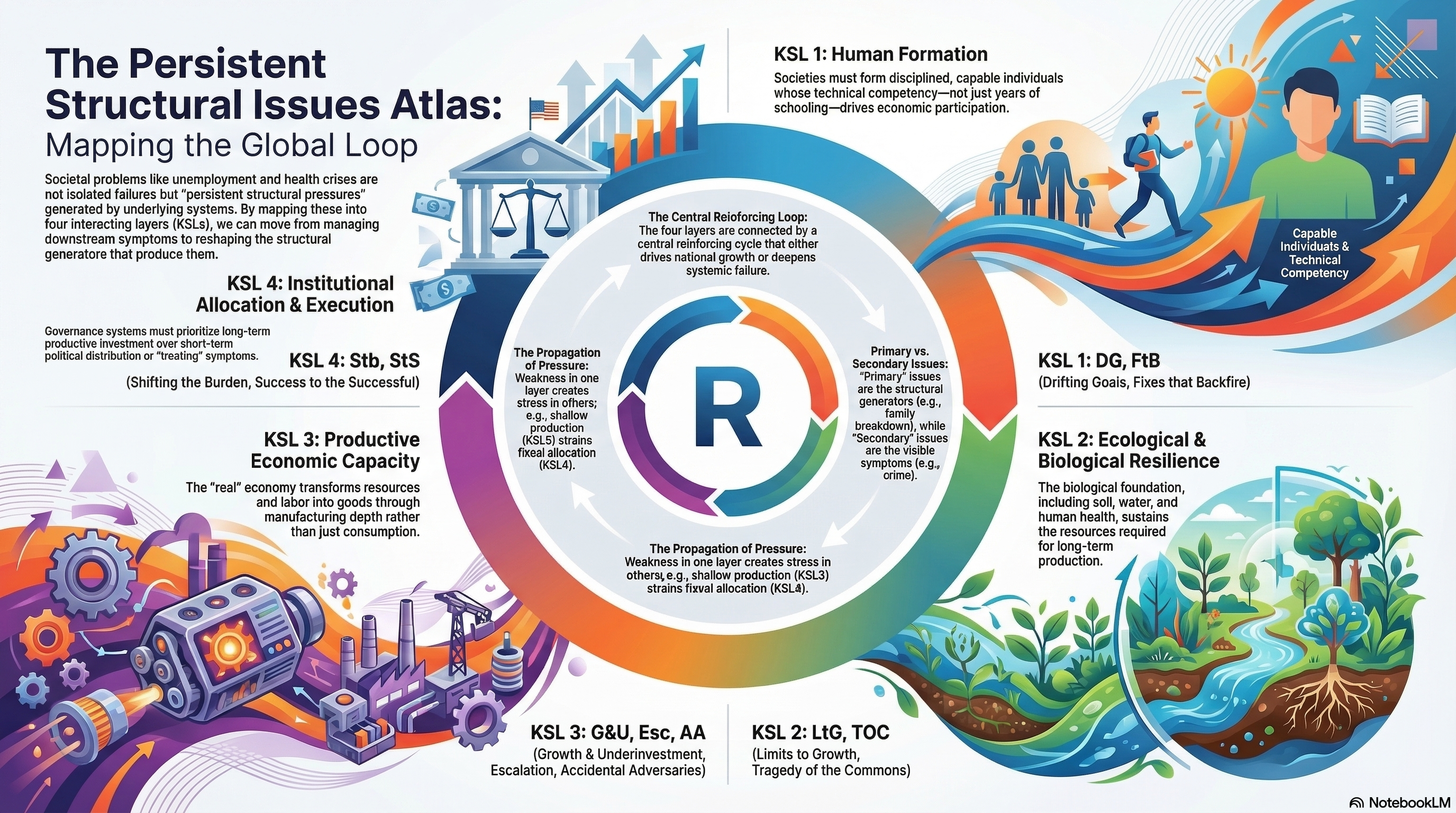
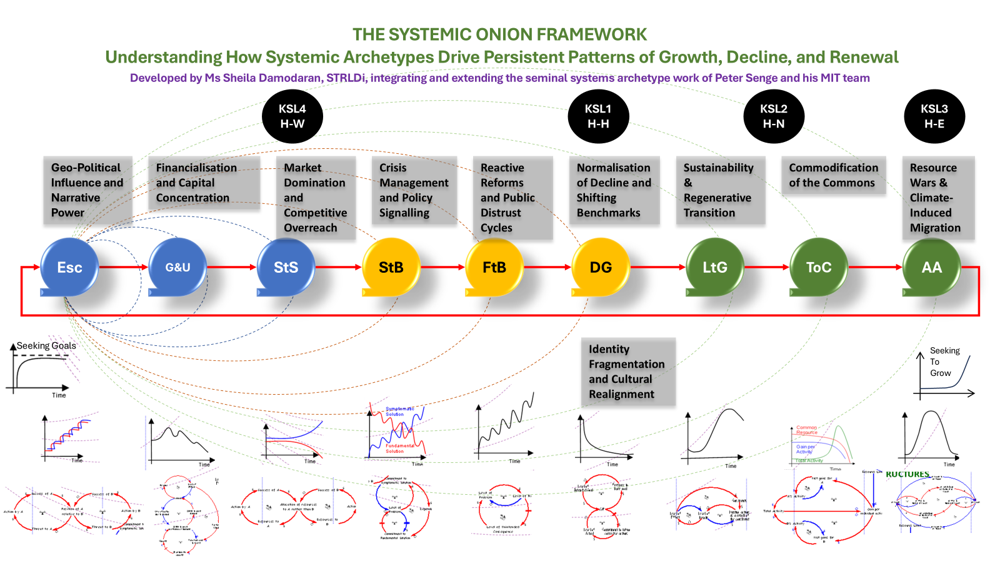



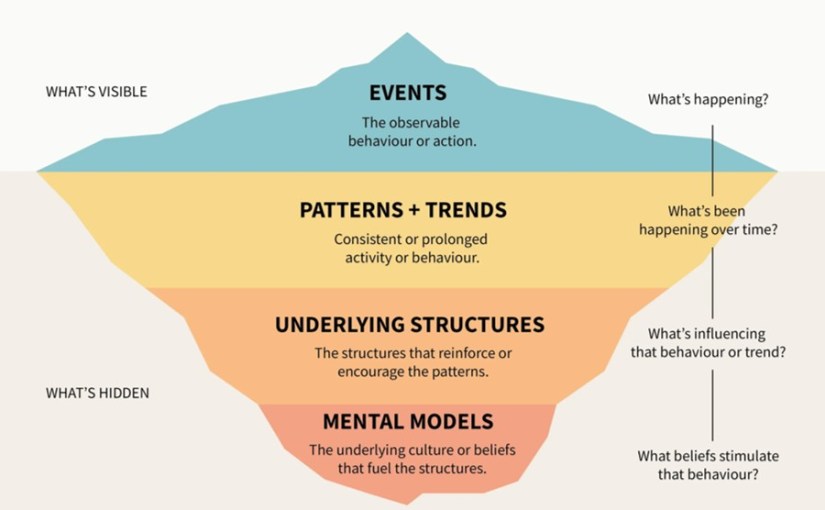

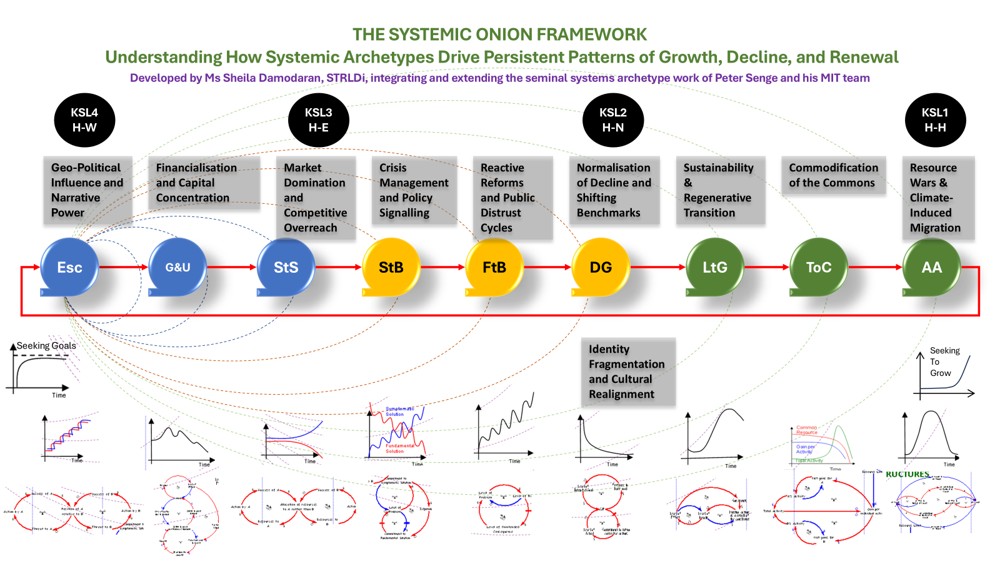
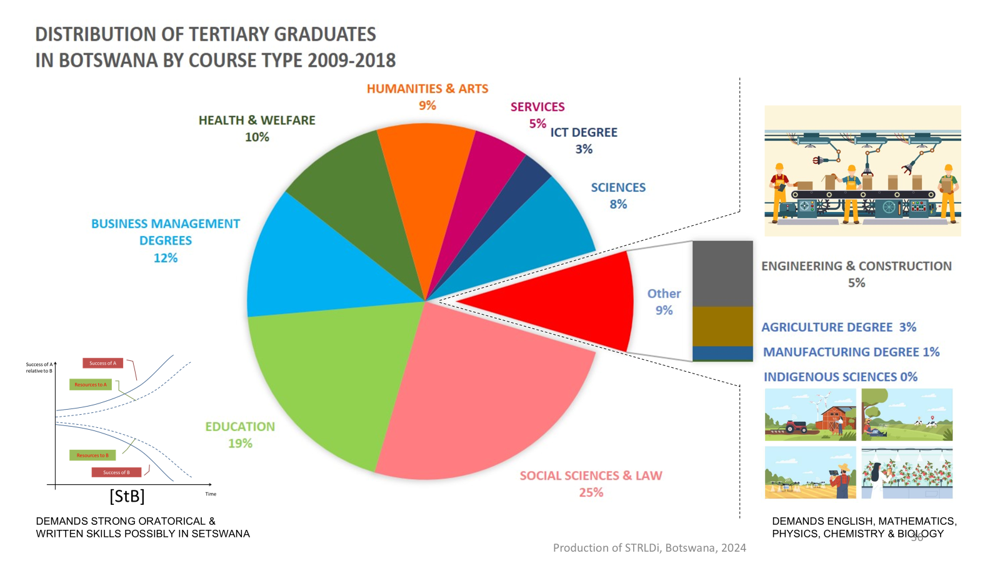
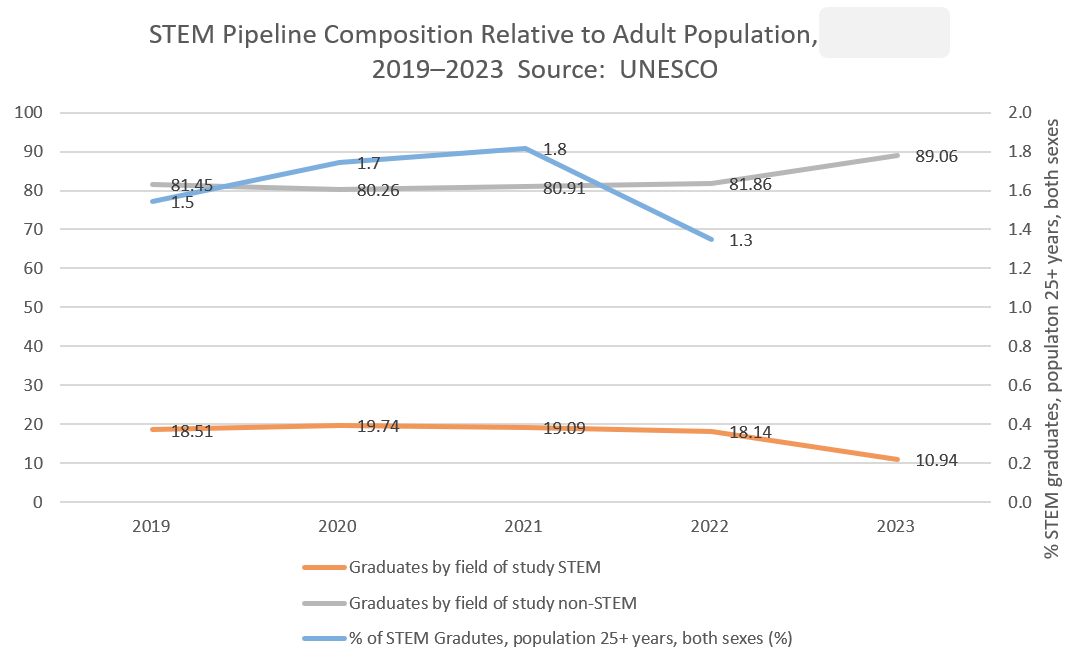
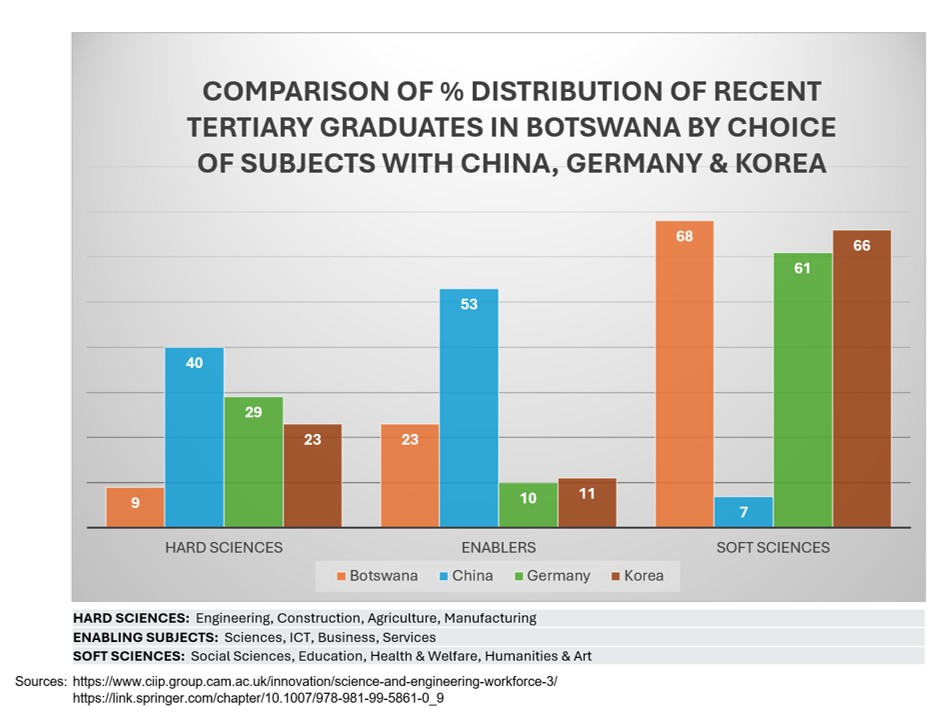

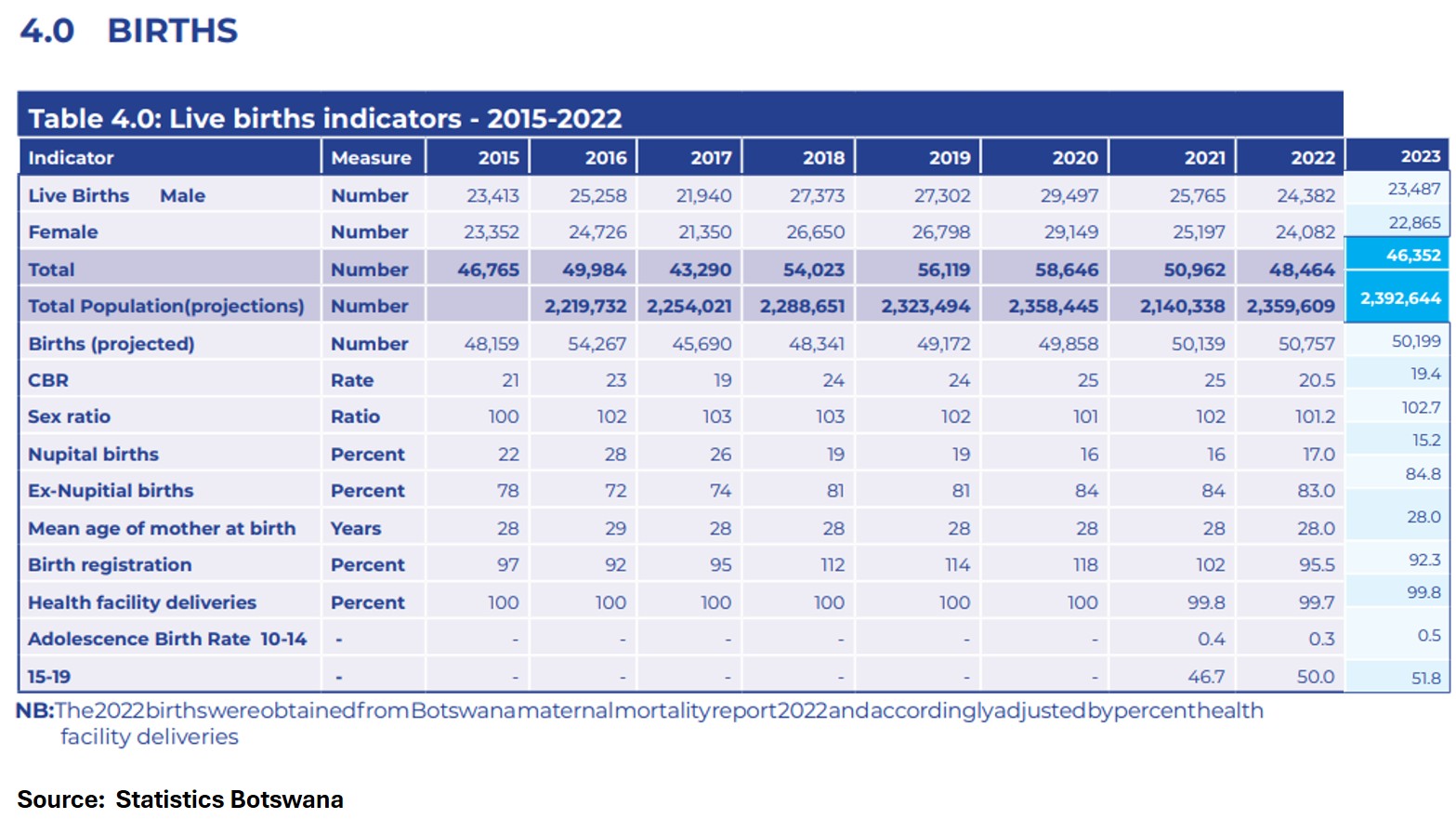
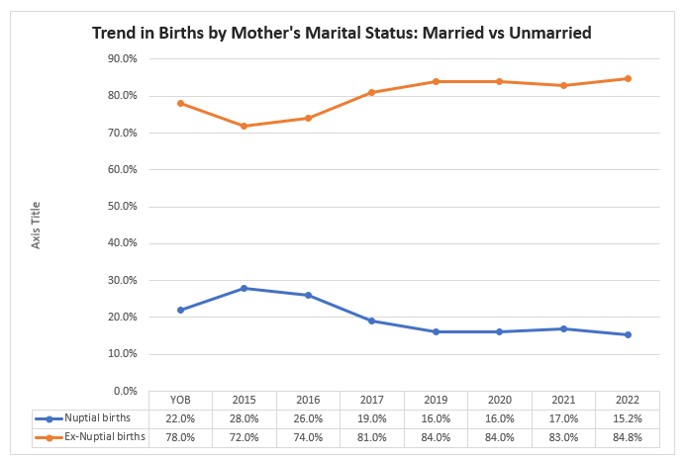

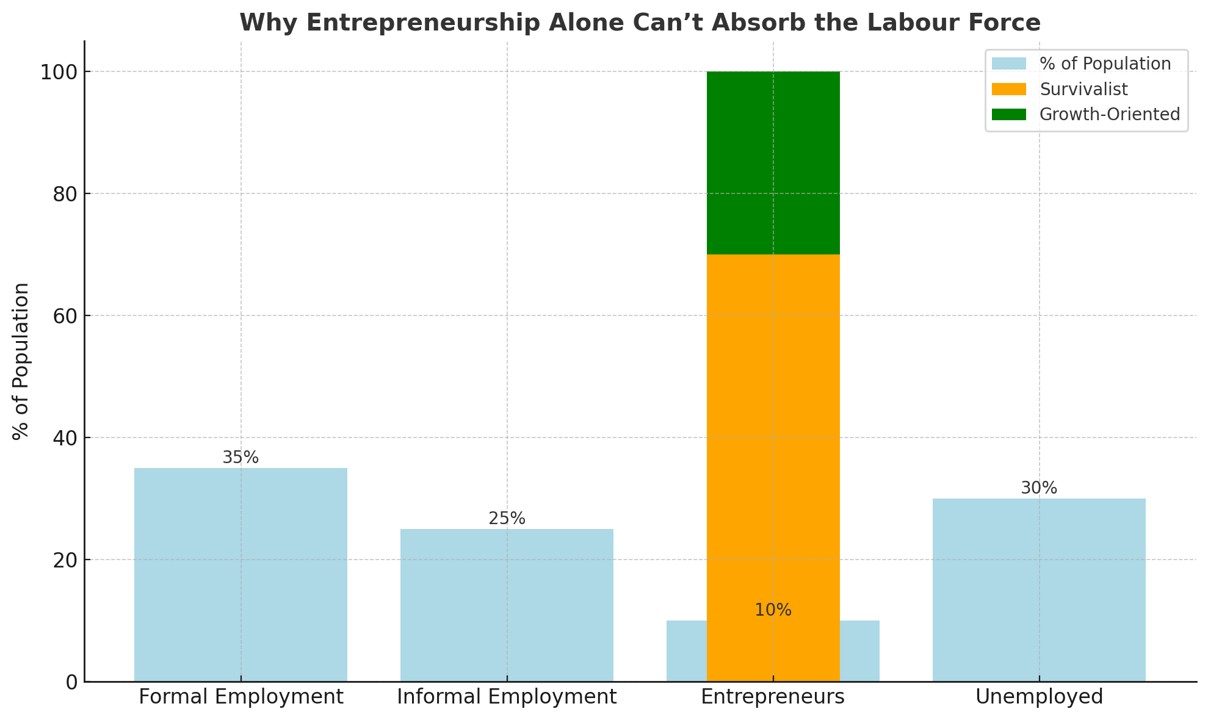


You must be logged in to post a comment.