

1. Purpose of the Programme Office
The Programme Office exists to transform the intellectual work of the Systems Thinking Research and Leadership Development Institute into professionally managed leadership development programmes, executive learning experiences, conferences, strategic dialogues, executive forums and other approved institutional engagements. It provides the organisational discipline through which approved programmes move from concept to public delivery while ensuring that participants, organisational partners and stakeholders experience the Institute through consistently high professional standards.
The establishment of the Programme Office reflects the Institute’s recognition that programme excellence cannot depend upon individual effort alone. As the Institute grows, programmes increase in complexity, participant numbers expand, organisational partnerships deepen and expectations regarding quality continue to rise. Sustainable growth therefore requires a dedicated office capable of managing programme operations systematically while protecting the educational integrity and professional reputation of the Institute.
The Programme Office is established under Pillar III – Strategic Partnerships and Growth. Within this Pillar, the Office serves as the Institute’s principal operational mechanism for converting approved intellectual work into recurring public engagements that strengthen institutional relationships, expand the Institute’s influence and contribute to the long-term financial sustainability of STRLDi.
Stewarding the Institute’s Public Engagement
The Programme Office does not exist merely to organise events.
Its purpose is to steward the Institute’s public engagements from the moment a programme is approved until participants complete their learning journey and formally become members of the STRLDi Alumni Community. Every activity undertaken by the Office should therefore strengthen the confidence that participants, organisations and partners place in the Institute.
The Office supports a diverse portfolio of institutional engagements. These include Executive Programmes, Conferences, Strategic Dialogues, Executive Forums, Leadership Retreats, Masterclasses, Public Lectures and other approved learning initiatives. Although these engagements differ in purpose, duration and audience, they are governed through a common operational philosophy that emphasises professional stewardship, systematic execution and continuous improvement.
Building Institutional Capability
The Programme Office also performs an important institutional function.
Rather than allowing programme knowledge to remain with individual staff members, the Office captures experience through standard operating procedures, operational registers, templates, performance reviews and institutional records. In doing so, it converts individual experience into organisational capability that strengthens the Institute over time.
Every programme delivered should therefore leave two lasting outcomes. The first is the development of capable leaders who apply systems thinking within their organisations and communities. The second is a stronger Programme Office that has refined its methods, strengthened its systems and increased its capacity to support future programmes. In this way, the Office contributes not only to successful programme delivery but also to the continuous development of the Institute itself.
2. Mission of the Programme Office
The mission of the Programme Office is to plan, coordinate, deliver and continuously improve the portfolio of programmes and strategic engagements approved by the Institute while providing every participant, organisation and stakeholder with a professional experience that reflects the values, standards and aspirations of the Systems Thinking Research and Leadership Development Institute.
The Office fulfils this mission by applying disciplined systems, clear governance, professional programme stewardship and continuous operational improvement to every stage of programme delivery. Its work extends beyond administrative coordination to the careful management of relationships, resources and operational processes that collectively determine the quality of the Institute’s public work.
The Programme Office should therefore regard every programme as an opportunity to strengthen the Institute’s reputation, deepen organisational relationships, develop future leaders and contribute to the long-term growth of STRLDi.
Translating Strategy into Professional Delivery
The Institute’s research, leadership philosophy and systems thinking practice achieve their greatest influence only when they are experienced by people and organisations. The Programme Office provides the organisational capability through which this occurs.
Working in partnership with the Institute Director, the Institutional Liaison Office and other functions of the Institute, the Programme Office translates approved programmes into well-managed public engagements that are delivered consistently, professionally and in accordance with Institute standards. In doing so, the Office enables the Institute’s intellectual work to move beyond publications and research into practical leadership development and institutional transformation.
Every programme should therefore demonstrate the same qualities that define the Institute itself: clarity of purpose, professional excellence, systems thinking, discipline, respect for participants and continuous learning.
Supporting Strategic Partnerships and Growth
The Programme Office forms an integral part of Pillar III – Strategic Partnerships and Growth. While the Institutional Liaison Office establishes and nurtures strategic institutional relationships, the Programme Office provides the professional delivery capability through which many of those relationships are strengthened and sustained.
A successfully delivered Executive Programme, Strategic Dialogue or Conference should not be viewed as the completion of an event. It should be understood as the strengthening of a long-term institutional relationship. Every programme provides an opportunity to demonstrate the Institute’s competence, professionalism and commitment to addressing complex organisational and societal challenges through systems thinking and leadership development.
The Office therefore contributes directly to the Institute’s strategic growth by ensuring that programmes consistently reinforce confidence in STRLDi and encourage organisations and leaders to continue engaging with the Institute over time.
Stewardship Rather Than Administration
The Programme Office should not measure its success solely by the number of programmes delivered or participants registered. Such measures describe activity but do not necessarily demonstrate institutional value.
Success should instead be reflected in the quality of programme execution, the strength of participant experience, the confidence of organisational partners, the growth of the STRLDi Alumni Community and the increasing capability of the Programme Office itself. These outcomes require careful stewardship rather than routine administration.
Every member of the Programme Office should therefore understand that their work contributes to something larger than programme logistics. Through disciplined execution, thoughtful coordination and professional service, they help advance the Institute’s mission of developing leaders capable of addressing persistent organisational, national and societal challenges through systems thinking.
3. Scope of Responsibility
The Programme Office is responsible for the operational stewardship of all programmes and approved public engagements conducted by the Systems Thinking Research and Leadership Development Institute. Its responsibility begins once a programme has been authorised for development and continues until participants have completed their learning journey and have been formally transitioned into the STRLDi Alumni Community.
The Office operates within clearly defined institutional boundaries. It supports the Institute Director during programme development but does not determine the educational philosophy, intellectual content or strategic direction of the Institute. Similarly, it works closely with the Institutional Liaison Office in preparing programmes for organisations and strategic partners, but it does not assume responsibility for institutional relationship management or partnership development. These responsibilities remain with their respective governance functions.
This distinction is fundamental to the governance of the Institute. Every office contributes specialised capability while respecting the responsibilities of other offices. The Programme Office therefore succeeds by performing its own work exceptionally well and by coordinating effectively with the wider institutional system.
Stewardship of the Programme Portfolio
The Programme Office exercises operational responsibility for the Institute’s approved programme portfolio. Although individual engagements differ in purpose and audience, they are managed through a common system of planning, preparation, delivery and continuous improvement.
The portfolio includes, but is not limited to:
- Executive Programmes
- Executive Education Programmes
- Conferences
- Strategic Dialogues
- Executive Forums
- Leadership Retreats
- Masterclasses
- Public Lectures
- Online Learning Programmes
- Institution-specific Leadership Programmes
- Other programmes approved by the Institute Director
The Office is responsible for ensuring that each engagement is planned, coordinated and delivered in accordance with Institute standards, regardless of its size or duration.
Programme Development Responsibilities
During programme development, the Programme Office provides administrative, organisational and operational support to the Institute Director.
Its responsibilities include:
- Establishing Programme Development Files.
- Coordinating programme development activities.
- Maintaining programme documentation.
- Scheduling development meetings.
- Recording development decisions.
- Coordinating internal programme reviews.
- Preparing programmes for approval.
- Transferring approved programmes to the Programme Delivery and Management function.
The Office facilitates programme development without assuming responsibility for the intellectual design of programmes.
Programme Delivery Responsibilities
Once a programme has been approved, the Programme Office assumes responsibility for preparing it for public delivery.
This responsibility includes:
- Preparing programme communication.
- Managing programme promotion.
- Coordinating organisational participation.
- Managing ambassador engagement.
- Preparing venues and delivery environments.
- Coordinating external service providers.
- Supporting facilitators.
- Managing programme operations during delivery.
- Coordinating programme closure.
The objective is to ensure that every programme is delivered professionally, consistently and in accordance with approved Institute standards.
Registrant Management Responsibilities
The Programme Office is responsible for stewarding the participant journey from initial expression of interest to transition into the STRLDi Alumni Community.
These responsibilities include:
- Managing expressions of interest.
- Responding to participant enquiries.
- Processing programme registrations.
- Confirming participant enrolment.
- Maintaining participant records.
- Preparing participants before programme commencement.
- Managing participant attendance.
- Issuing programme communications.
- Coordinating participant support.
- Transitioning participants into the Alumni Community.
The Office should regard every participant relationship as an opportunity to strengthen the Institute’s long-term community of practice.
Operational Responsibilities
In addition to programme-specific work, the Programme Office is responsible for maintaining the operational systems that enable the Office to function efficiently and consistently.
These responsibilities include:
- Maintaining operational registers.
- Managing Programme Office documentation.
- Coordinating office meetings.
- Monitoring office performance.
- Maintaining quality standards.
- Supporting continuous improvement.
- Developing Programme Office capability.
- Preparing annual operational plans.
- Preserving institutional knowledge.
These activities ensure that the Office develops as a professional institutional function rather than remaining dependent upon individual experience.
Responsibilities Beyond the Programme Office
The Programme Office should also understand the limits of its authority.
The Office does not:
- Determine Institute strategy.
- Approve new programmes.
- Develop programme curriculum.
- Manage institutional finances.
- Negotiate strategic partnerships.
- Conduct institutional research.
- Appoint Institute personnel.
- Establish Institute policy.
These responsibilities belong to other governance functions within STRLDi.
Respecting these boundaries enables the Programme Office to concentrate its expertise upon professional programme stewardship while contributing effectively to the wider work of the Institute.
4. Programme Office Governance Structure
The Programme Office operates within the governance framework of the Systems Thinking Research and Leadership Development Institute and forms part of Pillar III – Strategic Partnerships and Growth. Its governance structure establishes clear lines of authority, accountability and operational responsibility so that programmes are managed consistently and decisions are made at the appropriate level.
Professional Programme Offices are characterised by clarity of governance rather than dependence upon personalities. Every member of the Office should understand who provides strategic direction, who exercises operational stewardship, who coordinates programme delivery and who manages participant relationships. When these responsibilities are clearly understood, work flows efficiently, accountability is strengthened and unnecessary duplication is avoided.
The governance structure presented in this Manual should therefore be regarded as a permanent organisational framework rather than a description of current staffing. As the Institute grows, additional personnel may be appointed, but the principles of governance established here shall remain unchanged.
Governance Hierarchy
The Programme Office functions under the executive leadership of the Institute Director, who exercises overall authority for the Institute and approves every programme prior to public release. The Institute Director establishes the Institute’s strategic direction, determines programme priorities and safeguards the intellectual integrity of all educational offerings.
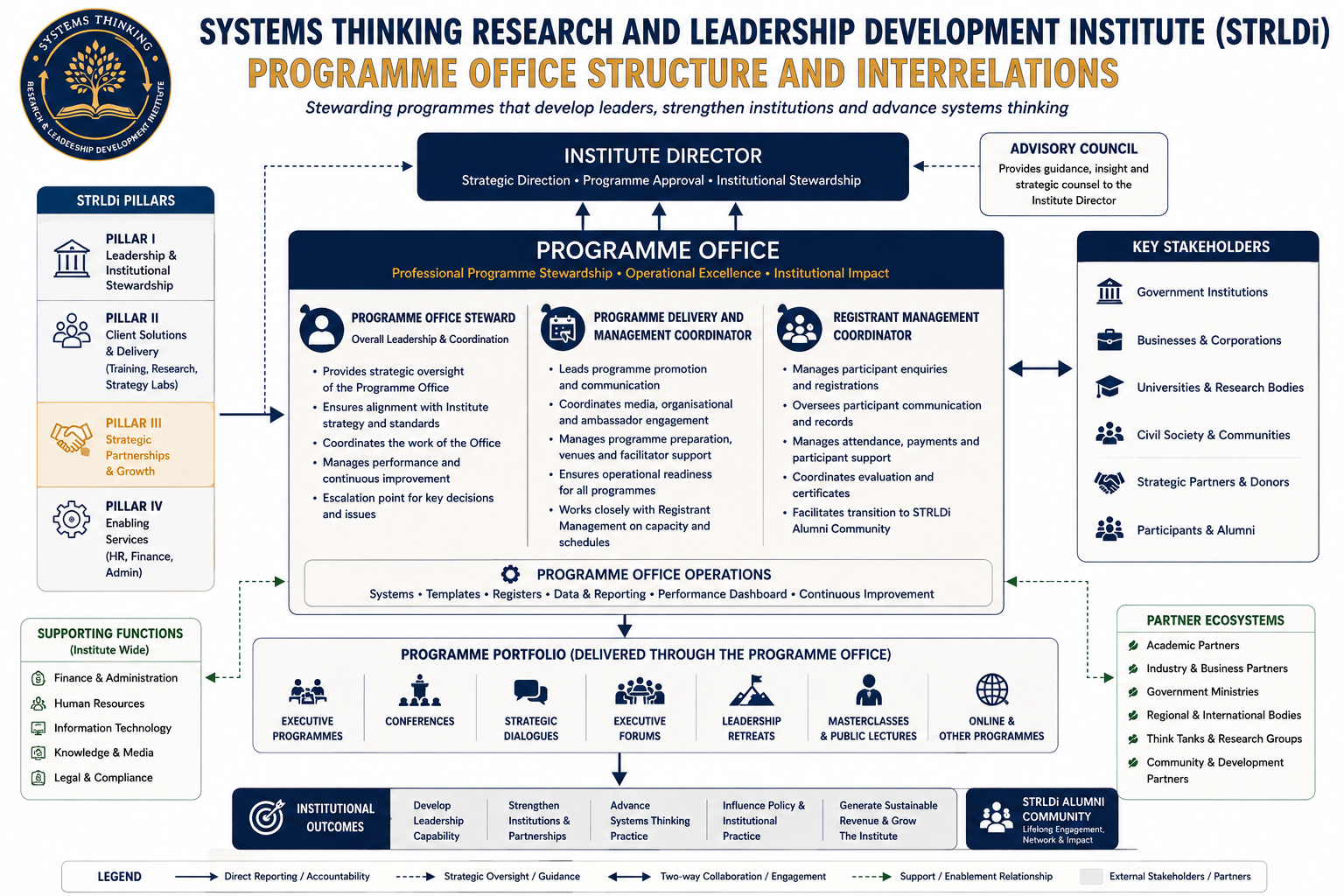
Figure 1. Programme Office Structure and Institutional Interrelationships
The day-to-day stewardship of the Programme Office is delegated to the Programme Office Steward. Acting on behalf of the Institute Director, the Steward provides operational leadership to the Office, ensures that approved policies and procedures are implemented consistently and oversees the work of all Programme Office personnel. The Steward is accountable for the effective performance of the Office and serves as the principal point of coordination between the Programme Office and the Institute’s other governance functions.
Reporting to the Programme Office Steward are two operational coordinators, each responsible for a distinct area of professional practice. The Programme Delivery and Management Coordinator oversees the planning, promotion, preparation and operational delivery of programmes and strategic engagements. The Registrant Management Coordinator oversees the participant journey from initial enquiry through registration, attendance and transition into the STRLDi Alumni Community.
Programme Office Governance Responsibilities
The Institute Director is responsible for:
- Providing strategic direction for the Programme Office.
- Approving new programmes and major programme revisions.
- Approving the annual Programme Portfolio.
- Approving major conferences, executive forums and strategic dialogues.
- Providing executive oversight of Programme Office performance.
The Programme Office Steward is responsible for:
- Leading the Programme Office.
- Supervising Programme Office personnel.
- Coordinating the annual programme portfolio.
- Monitoring Programme Office performance.
- Ensuring compliance with Institute policies and Standard Operating Procedures.
- Coordinating work between the Programme Office and other Institute functions.
- Reporting Programme Office performance to the Institute Director.
- Leading continuous improvement within the Office.
The Programme Delivery and Management Coordinator is responsible for:
- Managing approved programmes through the delivery life cycle.
- Coordinating programme communication and promotion.
- Managing programme readiness.
- Coordinating conferences, executive forums and strategic dialogues.
- Coordinating facilitators, venues and service providers.
- Monitoring programme delivery performance.
The Registrant Management Coordinator is responsible for:
- Managing participant enquiries.
- Processing registrations.
- Maintaining participant records.
- Coordinating participant communication.
- Managing attendance.
- Transitioning participants into the STRLDi Alumni Community.
- Maintaining registrant information and operational registers.
Governance Through Stewardship
The Programme Office Steward exercises leadership through stewardship rather than supervision alone. Stewardship requires maintaining a constant awareness of programme progress, supporting staff members in fulfilling their responsibilities, removing operational barriers and ensuring that every programme reflects the standards expected of STRLDi.
The Steward should continually monitor the interaction between Programme Delivery and Registrant Management. These two operational functions are closely connected and should never operate independently of one another. Programme promotion should not proceed without the capacity to manage registrations effectively, and participant management should always remain aligned with programme readiness and delivery schedules.
The Steward therefore serves as the principal integrator of Programme Office activities, ensuring that all operational functions contribute to a single, coordinated programme delivery system.
Accountability and Decision-Making
Professional governance requires that authority, responsibility and accountability remain aligned.
Every significant decision within the Programme Office should have a clearly identified decision-maker, and every operational activity should have a clearly identified owner. Responsibility should not be shared ambiguously across several individuals, nor should important decisions remain unresolved because authority has not been established.
The Programme Office shall therefore operate according to three governing principles.
- Strategic decisions remain the responsibility of the Institute Director.
- Operational decisions remain the responsibility of the Programme Office Steward.
- Functional decisions remain the responsibility of the relevant Programme Office Coordinator.
This framework ensures that decisions are made promptly, responsibilities remain clear and the Office continues to operate as a disciplined professional function capable of supporting the long-term growth of the Institute.
5. Roles and Responsibilities
The effectiveness of the Programme Office depends not only upon well-designed procedures but also upon the disciplined execution of clearly defined responsibilities. Every position within the Office contributes a distinct capability to the Institute and performs work that complements, rather than duplicates, the responsibilities of others.
The governance of the Programme Office is therefore founded upon the principle of single-point accountability. Every major function of the Office shall have one person responsible for its coordination and performance. While collaboration is expected across the Office, accountability should never become diffused through shared ownership or uncertain reporting relationships.
The Programme Office should operate as an integrated professional system in which leadership, programme delivery and participant stewardship reinforce one another to produce consistently high standards of execution.
The Institute Director
The Institute Director provides the strategic leadership under which the Programme Office operates. The Director determines the educational direction of the Institute, establishes the annual programme priorities and safeguards the intellectual integrity of every programme delivered by STRLDi.
The Institute Director is responsible for matters that shape the long-term development of the Institute rather than the routine administration of Programme Office activities. Accordingly, the Director should devote time to research, thought leadership, programme development, institutional strategy and strategic partnerships, while delegating the operational stewardship of the Programme Office to the Programme Office Steward.
The responsibilities of the Institute Director include:
- Providing strategic direction for the Programme Office.
- Approving new programmes and programme revisions.
- Approving the annual Programme Portfolio.
- Approving major Conferences, Strategic Dialogues and Executive Forums.
- Providing executive oversight of Programme Office performance.
- Mentoring the Programme Office Steward.
- Representing the Institute in major strategic engagements.
The Programme Office Steward
The Programme Office Steward is the operational leader of the Programme Office and is responsible for ensuring that the Office functions as a disciplined, professional and continuously improving organisational unit. Acting under the authority of the Institute Director, the Steward provides leadership to the Office, coordinates its activities and ensures that approved programmes are delivered in accordance with Institute standards.
The Steward’s primary responsibility is not to manage individual programmes, but to govern the system through which programmes are developed, promoted, delivered and evaluated. The Steward should therefore maintain constant oversight of Programme Office performance, remove operational barriers, coordinate work across functions and ensure that the Office remains aligned with the strategic objectives of Pillar III – Strategic Partnerships and Growth.
The responsibilities of the Programme Office Steward include:
- Leading the Programme Office.
- Supervising Programme Office personnel.
- Coordinating Programme Office operations.
- Monitoring implementation of Standard Operating Procedures.
- Approving operational work plans.
- Reviewing programme readiness.
- Monitoring Programme Office performance.
- Coordinating work with the Institutional Liaison Office and other Institute functions.
- Reporting Programme Office performance to the Institute Director.
- Leading continuous improvement initiatives.
The Steward should spend the majority of their time leading systems, developing people and improving organisational capability, rather than undertaking routine administrative work.
The Programme Delivery and Management Coordinator
The Programme Delivery and Management Coordinator is responsible for the public-facing management of the Institute’s approved programme portfolio. This role transforms approved programmes into professionally managed public engagements by coordinating communication, promotion, programme preparation and operational delivery.
The Coordinator works under the guidance of the Programme Office Steward and serves as the principal operational link between programme approval and programme implementation. Every Executive Programme, Conference, Strategic Dialogue and Executive Forum should pass through this function before being delivered to participants.
The responsibilities of the Programme Delivery and Management Coordinator include:
- Preparing Programme Communication Plans.
- Developing Media Engagement Plans.
- Managing programme promotion.
- Coordinating organisational participation.
- Managing Ambassador engagement.
- Monitoring programme registrations.
- Preparing programmes for delivery.
- Coordinating programme venues and facilities.
- Coordinating facilitators and external service providers.
- Managing programme delivery.
- Conducting programme closure activities.
The Coordinator should continually monitor public interest in approved programmes and ensure that communication activities remain aligned with programme capacity and delivery schedules.
The Registrant Management Coordinator
The Registrant Management Coordinator is responsible for the professional stewardship of participants throughout their relationship with the Institute. Beginning with an initial enquiry and concluding with transition into the STRLDi Alumni Community, this role ensures that every participant experiences consistent, responsive and professional support.
The Coordinator serves as the principal point of contact for participants and should therefore demonstrate exceptional standards of communication, organisation and professional service. Every interaction should reinforce confidence in the Institute and strengthen the participant’s commitment to continued engagement.
The responsibilities of the Registrant Management Coordinator include:
- Managing participant enquiries.
- Processing registrations.
- Confirming programme enrolment.
- Maintaining participant records.
- Coordinating participant communication.
- Managing attendance.
- Supporting participants during programme delivery.
- Coordinating certificates of participation.
- Maintaining the Alumni Register.
- Transitioning participants into the STRLDi Alumni Community.
The Registrant Management Coordinator should regard every participant not as a registration to be processed, but as a future member of the Institute’s growing leadership community.
Working as One Programme Office
Although responsibilities are allocated to specific positions, the Programme Office should never operate as a collection of independent functions. Programme Delivery and Management, Registrant Management and Programme Office Operations are interdependent systems whose effectiveness depends upon disciplined coordination and mutual support.
The Programme Office Steward should continually foster collaboration across the Office by encouraging regular communication, coordinated planning and shared awareness of programme progress. Operational success should be regarded as a collective achievement, while accountability for specific responsibilities remains clearly defined.
Every member of the Programme Office should therefore understand two responsibilities. The first is to perform their own work to the highest professional standard. The second is to contribute actively to the effective functioning of the Office as a whole. Through this balance of individual accountability and collective stewardship, the Programme Office develops the organisational capability required to support the continuing growth and influence of the Systems Thinking Research and Leadership Development Institute.
6. Principles of Programme Stewardship
The Programme Office exists to steward one of the Institute’s most valuable assets—its programmes and public engagements. Every Executive Programme, Conference, Strategic Dialogue and Executive Forum represents an opportunity to strengthen the Institute’s reputation, develop leadership capability and build enduring institutional relationships. Programme stewardship therefore extends far beyond administrative coordination. It requires professional judgement, disciplined execution and a continual commitment to institutional excellence.
The principles contained within this section establish the professional philosophy that governs the work of the Programme Office. While the Standard Operating Procedures describe how work should be performed, these principles explain how Programme Office personnel should think when undertaking that work. Procedures may evolve as the Institute grows, but these principles should remain constant because they express the values that underpin professional programme stewardship.
Every member of the Programme Office should understand that these principles are not aspirational statements. They are operating principles against which decisions, priorities and daily work should be judged.
Steward the Institution Before the Programme
The first responsibility of the Programme Office is not to protect a programme schedule. It is to protect the reputation, credibility and professional standing of the Systems Thinking Research and Leadership Development Institute.
Every programme represents the Institute in the public domain. Participants frequently judge the quality of the Institute long before the first learning session begins. They form opinions through the quality of communication they receive, the professionalism of programme administration, the preparedness of the venue, the responsiveness of staff and the consistency with which commitments are honoured. Programme stewardship therefore begins well before programme delivery and continues long after participants have returned to their organisations.
Whenever operational decisions become difficult, Programme Office personnel should ask a simple question:
“Which course of action best protects the long-term interests of the Institute?”
That question should guide professional judgement throughout the Office.
Plan Before Acting
Professional Programme Offices do not operate through urgency.
They operate through planning, preparation and anticipation.
Most operational crises are not caused by complexity. They arise because important activities were not anticipated early enough. The Programme Office should therefore cultivate the discipline of looking ahead continually. Programme schedules, communication activities, participant registrations, venue preparation and facilitator support should all be planned sufficiently in advance to allow thoughtful execution rather than hurried reaction.
Planning should become the normal operating rhythm of the Office. Daily planning supports weekly execution, weekly planning supports successful programme delivery and annual planning enables the Institute to build a coherent programme portfolio that advances its strategic objectives.
Build Systems Rather Than Depend Upon Individuals
The long-term capability of the Institute should never depend upon the experience, memory or personal habits of a single individual.
Professional institutions develop systems that enable capable people to work consistently, transfer knowledge effectively and maintain high standards regardless of changes in personnel. The Programme Office therefore places great emphasis upon Standard Operating Procedures, operational registers, approved templates, document control and institutional learning.
Every improvement made by one member of the Programme Office should become an improvement available to every future member of the Office. In this way, individual experience is converted into institutional capability and the Office becomes progressively stronger with every programme delivered.
Think in Systems
As part of the Systems Thinking Research and Leadership Development Institute, the Programme Office should demonstrate the very principles that the Institute teaches.
Programme Office personnel should therefore avoid treating operational problems as isolated events. Delayed registrations, recurring participant questions, programme preparation difficulties or communication failures should be examined as symptoms of the underlying systems that produced them. Rather than repeatedly correcting individual errors, the Office should seek to improve the systems that prevent those errors from occurring.
This commitment to systems thinking enables the Programme Office to become a learning organisation in its own right. Every programme provides an opportunity to strengthen procedures, improve coordination and refine professional practice.
Serve Through Professional Excellence
Professional service is demonstrated through discipline, consistency, courtesy and attention to detail.
Participants should experience the Programme Office as organised, responsive and dependable. Organisational partners should recognise that commitments made by the Institute will be fulfilled. Facilitators should receive the operational support required to concentrate fully upon learning and leadership development.
Professional excellence is seldom achieved through dramatic actions. It is built through the consistent execution of hundreds of small responsibilities performed well. Every communication answered promptly, every venue prepared carefully, every participant welcomed professionally and every programme concluded systematically contributes to the Institute’s reputation.
Leave Every Programme Stronger Than You Found It
The final principle of Programme Stewardship is one of continuous improvement.
Every programme should leave behind more than participant evaluations and administrative records. It should leave improved procedures, stronger templates, refined operational practices and greater institutional knowledge. The Programme Office should therefore regard every programme as both a learning experience for participants and a learning opportunity for the Institute itself.
A Programme Office that applies this principle consistently will become progressively more capable each year. Its programmes will become more professional, its systems more refined and its contribution to Pillar III – Strategic Partnerships and Growth increasingly significant. Through disciplined stewardship and continuous learning, the Programme Office becomes not merely an administrative function but a permanent institutional capability that supports the long-term development of STRLDi.
7. Programme Office Work Rhythm
The Programme Office should operate according to a disciplined and predictable work rhythm that enables programmes to progress systematically throughout the year. While individual activities may vary according to programme schedules and organisational priorities, the rhythm of the Office should remain stable. Stability creates organisational discipline, enables better planning and allows Programme Office personnel to anticipate work rather than continually reacting to immediate demands.
Professional Programme Offices distinguish themselves by their consistency. They do not begin each day by deciding what to do next. Instead, they operate within an established rhythm that aligns daily activities with weekly priorities, monthly objectives and the Institute’s Annual Programme Calendar. This rhythm enables the Office to maintain momentum across multiple programmes while ensuring that important responsibilities receive sustained attention.
The Programme Office Work Rhythm should therefore serve as the Office’s operating cadence. Every member of the Office should understand how work flows during the week, when coordination takes place, when planning occurs and when performance is reviewed. Although exceptional circumstances may occasionally require adjustment, the established rhythm should remain the normal pattern of work.
Daily Work Rhythm
Each working day should begin with planning rather than activity. Before responding to correspondence, attending meetings or commencing programme work, the Programme Office should establish a shared understanding of the day’s priorities. This disciplined beginning enables the Office to direct its effort towards work that advances programme delivery rather than allowing external interruptions to determine its agenda.
The working day should conclude with an equally disciplined review. Outstanding actions should be updated, operational registers maintained, responsibilities confirmed and priorities prepared for the following day. In this manner, each day becomes a continuation of planned work rather than the beginning of a new search for direction.
The normal daily rhythm should consist of:
- Office Opening Review
- Daily Programme Office Briefing
- Programme and participant management
- Coordination with internal and external stakeholders
- Progress review
- End-of-day operational review
This rhythm establishes continuity between successive working days and reduces the likelihood that important operational matters will be overlooked.
Weekly Work Rhythm
The Programme Office should also establish a consistent weekly rhythm through which major responsibilities are distributed across the working week. While urgent operational matters will always receive immediate attention, certain activities require uninterrupted time if they are to be undertaken professionally.
A recommended weekly rhythm is presented below.
| Day | Primary Focus |
|---|---|
| Monday | Programme planning, Programme Office coordination, review of the Annual Programme Calendar and allocation of responsibilities. |
| Tuesday | Programme communication, media engagement, organisational communication and promotion of approved programmes. |
| Wednesday | Organisational engagement, Ambassador engagement, conferences, strategic dialogues and executive forum coordination. |
| Thursday | Participant stewardship, registration management, programme readiness and facilitator coordination. |
| Friday | Programme Office administration, performance review, systems improvement, record management and preparation for the following week. |
This rhythm should not be interpreted rigidly. Rather, it provides an organisational framework that protects important work from being displaced continually by urgent operational demands.
Monthly and Annual Rhythm
The Programme Office should operate with an awareness of monthly, quarterly and annual planning cycles. Professional programme delivery requires decisions to be made well in advance of programme dates. Venue preparation, organisational engagement, programme communication and participant recruitment should therefore be scheduled within a longer planning horizon rather than being undertaken only a few weeks before programme delivery.
Each month should conclude with a structured Programme Office Performance Review led by the Programme Office Steward. The purpose of this review is to evaluate programme progress, participant engagement, operational performance, workload distribution and opportunities for improvement. Recommendations arising from these reviews should be incorporated into future work rather than remaining as observations without action.
At the beginning of each year, the Programme Office should prepare its work around the Annual Programme Calendar approved by the Institute Director. This calendar becomes the principal planning instrument for the Office and establishes the rhythm through which Executive Programmes, Conferences, Strategic Dialogues, Executive Forums and other approved engagements are coordinated throughout the year.
Protecting Time for Strategic Work
One of the greatest threats to Programme Office effectiveness is the gradual replacement of important work by urgent work. Professional offices recognise that strategic planning, programme improvement, organisational engagement and capability development rarely appear urgent on a particular day, yet neglecting them gradually weakens the Office over time.
The Programme Office Steward should therefore protect dedicated time for planning, reflection, staff development and systems improvement. These activities should not be postponed indefinitely because programmes are busy or operational demands are increasing. They represent investments in the future capability of the Office and contribute directly to the Institute’s long-term growth.
The Programme Office should therefore be recognised not only by the quality of the programmes it delivers, but also by the discipline with which it manages its own work. A consistent work rhythm creates predictability, strengthens accountability and enables the Office to support an expanding programme portfolio without sacrificing professional standards. It is through this disciplined rhythm that the Programme Office develops the operational maturity required to support the continuing growth and influence of the Systems Thinking Research and Leadership Development Institute.
8. The Programme Portfolio
The Programme Office exists to steward a carefully designed portfolio of leadership development and institutional engagement programmes approved by the Institute Director. Rather than viewing each programme as an isolated activity, the Office should understand the Programme Portfolio as a coordinated system through which the Systems Thinking Research and Leadership Development Institute advances its mission, strengthens institutional relationships and contributes to Pillar III – Strategic Partnerships and Growth.
A professional Programme Portfolio achieves far more than the delivery of individual learning events. It provides the Institute with a balanced mechanism through which different audiences are engaged, different organisational needs are addressed and different forms of leadership practice are developed. Executive education, strategic dialogue, institutional learning and public engagement should therefore be viewed as complementary elements of one integrated portfolio rather than independent activities competing for organisational attention.
The Programme Office is responsible for ensuring that every programme within the Portfolio is managed according to common operational standards while recognising that different programme types require different methods of preparation, communication and delivery.
Purpose of the Programme Portfolio
The Programme Portfolio provides the operational framework through which the Institute fulfils its public leadership development responsibilities. Each programme should contribute to at least one of four institutional purposes.
First, programmes should develop leadership capability by strengthening the systems thinking knowledge, leadership practice and institutional stewardship of participants.
Second, programmes should strengthen institutional relationships by providing meaningful opportunities for governments, businesses, universities, civil society organisations and community leaders to engage with the Institute.
Third, programmes should advance the Institute’s intellectual work by creating opportunities to communicate research, test emerging ideas and stimulate informed dialogue around persistent organisational and societal challenges.
Finally, programmes should contribute to the long-term financial sustainability of the Institute by generating recurring revenue that supports research, programme development and institutional growth.
Every programme undertaken by the Office should therefore contribute simultaneously to learning, institutional influence, relationship development and organisational sustainability.
Managing a Balanced Portfolio
Professional Programme Offices do not judge success solely by the number of programmes delivered during the year.
They manage a balanced portfolio that serves different participant communities, responds to different organisational needs and creates opportunities for continued engagement with the Institute. The Programme Portfolio should therefore contain programmes of varying duration, complexity and purpose, allowing organisations and individuals to engage with STRLDi at different stages of their leadership journey.
The Programme Office should also maintain an appropriate balance between programmes designed for broad public participation and those developed specifically for individual organisations or strategic partners. This balance enables the Institute to strengthen its public influence while responding effectively to emerging institutional opportunities.
When reviewing the Annual Programme Calendar, the Programme Office Steward should consider the overall composition of the Portfolio rather than focusing upon individual programmes in isolation.
Executive Programmes
Executive Programmes represent the Institute’s principal leadership development offerings. They provide structured learning experiences through which executives, senior managers, public sector leaders and organisational decision-makers strengthen their capability to understand and address complex organisational and societal challenges through systems thinking.
Executive Programmes are typically delivered over one or more days and combine conceptual learning with practical application, facilitated dialogue and collaborative reflection. They form the foundation of the Institute’s continuing leadership development activities and should consistently reflect the highest standards of educational quality and professional programme delivery.
Conferences
Conferences provide opportunities for the Institute to convene diverse groups of leaders, researchers, practitioners and decision-makers around issues of national, regional or international significance. Their purpose extends beyond knowledge dissemination to the creation of shared understanding, collaborative relationships and strategic conversations capable of influencing institutional practice.
The Programme Office is responsible for ensuring that Conferences are professionally planned, effectively coordinated and delivered in a manner consistent with the Institute’s reputation for intellectual rigour and operational excellence.
Strategic Dialogues
Strategic Dialogues provide structured forums through which senior leaders explore persistent challenges that cannot be resolved through conventional discussion alone. Unlike conferences, which primarily disseminate knowledge, Strategic Dialogues encourage collective inquiry, careful reflection and the exploration of alternative perspectives using the principles of systems thinking.
The Programme Office should recognise that the success of a Strategic Dialogue depends as much upon the quality of preparation and facilitation as upon the expertise of those participating. Programme planning should therefore place particular emphasis upon participant selection, dialogue design and the creation of an environment that encourages thoughtful engagement.
Executive Forums
Executive Forums provide recurring opportunities for senior leaders to examine emerging issues, exchange professional experience and strengthen relationships within a trusted community of practice. They encourage continuing engagement with the Institute between major programmes and contribute to the development of a sustained leadership network.
Executive Forums should be planned as part of the Institute’s annual programme cycle rather than as isolated events. The Programme Office should ensure that each Forum builds upon previous discussions and contributes to the continuing development of participants and organisational relationships.
Other Approved Programmes
The Programme Portfolio may also include Leadership Retreats, Masterclasses, Public Lectures, Online Programmes, Organisation-specific Leadership Programmes and other learning initiatives approved by the Institute Director.
Although these programmes differ in duration, format and intended audience, they should all be managed according to the governance principles and operational standards established within this Manual. The Programme Office should therefore apply consistent methods of planning, preparation, communication, delivery and evaluation across the Portfolio while adapting operational arrangements to the specific requirements of each programme.
Stewarding the Portfolio
The Programme Portfolio should be regarded as one of the Institute’s most important strategic assets.
Its value lies not only in the number of programmes delivered, but in its ability to develop leaders, strengthen institutions, advance systems thinking practice, generate sustainable revenue and expand the influence of STRLDi over many years. The responsibility of the Programme Office is therefore to steward the Portfolio with discipline, foresight and professional excellence, ensuring that every programme contributes meaningfully to the mission and long-term development of the Institute.
With this section complete, the reader has been introduced to why the Office exists, how it is governed, who performs the work, the principles that guide it, its operating rhythm and the programme portfolio it stewards. The next section should naturally be 9. Programme Life Cycle, which provides the conceptual bridge into the four Standard Operating Procedures that follow.
9. Programme Life Cycle
The Programme Life Cycle describes the complete journey through which every approved programme progresses within the Systems Thinking Research and Leadership Development Institute. It establishes a common operating model for the Programme Office and provides the framework within which every member of the Office performs their responsibilities.
Regardless of whether the Institute is delivering an Executive Programme, Conference, Strategic Dialogue, Executive Forum, Leadership Retreat or another approved engagement, every programme should progress through the same disciplined sequence of planning, preparation, delivery and continuous improvement. While individual programme types may require different operational arrangements, the governance of the Programme Life Cycle remains consistent across the entire Programme Portfolio.
The Programme Life Cycle should therefore be understood as the operating system of the Programme Office. Every Standard Operating Procedure described within this Manual supports one or more stages of this Life Cycle, enabling work to pass systematically from one function to the next while maintaining professional standards, operational discipline and institutional continuity.
The Programme Life Cycle
Every programme undertaken by the Institute progresses through the following stages.
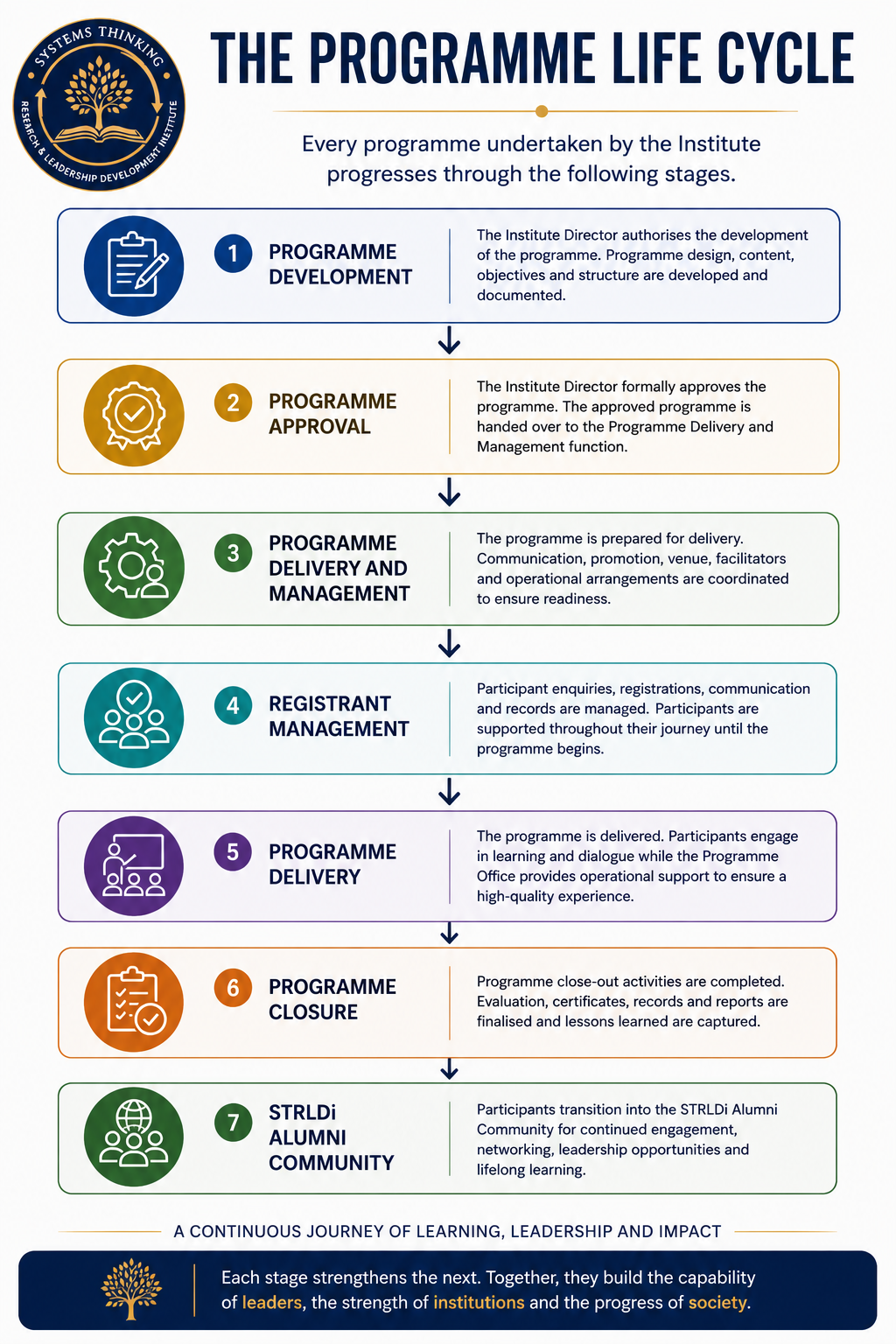
Figure 2. Programme Life Cycle
Each stage represents a distinct operational responsibility with clearly defined inputs, outputs and accountabilities. No stage should commence until the preceding stage has been completed and formally handed over.
This disciplined progression enables the Programme Office to manage multiple programmes simultaneously without confusion regarding responsibility or programme status.
Programme Development
The Programme Life Cycle begins when the Institute Director authorises the development of a new programme.
During this stage, the Programme Office supports the Institute Director by coordinating programme development, maintaining programme documentation, recording development decisions and preparing the programme for approval. Responsibility for the intellectual design of the programme remains with the Institute Director throughout this stage.
Programme Development concludes only when the programme has received formal approval and has been transferred to the Programme Delivery and Management function.
Programme Delivery and Management
Following approval, responsibility passes to the Programme Delivery and Management function.
This stage transforms an approved programme into a professionally managed public engagement. It includes programme communication, media engagement, organisational engagement, ambassador engagement, programme preparation, venue coordination, facilitator support and operational readiness.
The objective is to ensure that the programme is fully prepared before participant delivery begins.
Registrant Management
While programme preparation proceeds, the Registrant Management function manages the participant journey.
Beginning with the first expression of interest, this function coordinates participant enquiries, programme registrations, communication, attendance management, participant support and transition into the STRLDi Alumni Community.
The Registrant Management function should operate in close coordination with Programme Delivery and Management to ensure that programme capacity, participant readiness and programme preparation remain fully aligned.
Programme Delivery
Programme Delivery represents the point at which the Institute fulfils its public commitment to participants.
During delivery, the Programme Office provides operational support to facilitators, manages programme logistics, coordinates participant requirements, responds to operational issues and ensures that the programme proceeds in accordance with the approved programme schedule.
The responsibility of the Programme Office during delivery is to create an environment in which facilitators may concentrate fully upon leadership development while participants experience a professionally managed learning environment.
Programme Closure
Programme delivery does not conclude when the final session ends.
Professional Programme Offices conclude programmes systematically by completing operational close-out activities, finalising programme records, coordinating participant communication, issuing certificates of participation, updating operational registers and conducting programme reviews.
Programme Closure also provides the first opportunity for the Office to identify operational improvements before attention shifts to the next programme.
Transition to the STRLDi Alumni Community
The final stage of the Programme Life Cycle is the transition of participants into the STRLDi Alumni Community.
The Institute regards programme completion not as the end of the participant relationship but as the beginning of a continuing professional association. Programme graduates become part of an expanding community of leaders committed to advancing systems thinking, institutional leadership and national development.
The Programme Office should therefore ensure that every participant leaves the programme with a clear understanding of opportunities for continued engagement through future programmes, Executive Forums, Strategic Dialogues, Conferences, research initiatives and other activities of the Institute.
Connecting the Standard Operating Procedures
The four Standard Operating Procedures contained within this Manual provide the operational framework through which the Programme Life Cycle is managed.
- Standard Operating Procedure 1 – Programme Development governs the development and approval of new programmes.
- Standard Operating Procedure 2 – Programme Delivery and Management governs the preparation, promotion and operational delivery of approved programmes.
- Standard Operating Procedure 3 – Registrant Management governs the participant journey from initial enquiry to transition into the STRLDi Alumni Community.
- Standard Operating Procedure 4 – Programme Office Operations governs the daily operation, management and continuous improvement of the Programme Office itself.
Together, these four Standard Operating Procedures form an integrated operating system. Each has a distinct purpose, each has clearly defined responsibilities and each transfers work systematically to the next. Collectively, they enable the Programme Office to operate as a disciplined professional function capable of supporting the continuing growth of the Systems Thinking Research and Leadership Development Institute while advancing the objectives of Pillar III – Strategic Partnerships and Growth.
10. Programme Office Governance Framework
The Programme Office operates within an established governance framework that ensures programmes are developed, managed and delivered consistently across the Systems Thinking Research and Leadership Development Institute. Governance provides the organisational discipline through which authority is exercised, responsibilities are discharged and decisions are made in a manner that protects the interests of the Institute while maintaining the confidence of participants, organisational partners and stakeholders.
Effective governance does not seek to control every activity undertaken by the Programme Office. Rather, it establishes the principles, structures and decision-making processes that enable personnel to perform their responsibilities confidently while remaining aligned with the strategic direction of the Institute. Good governance therefore reduces uncertainty, strengthens accountability and promotes consistency across the Programme Portfolio.
The Programme Office shall conduct all of its work in accordance with the governance principles established within this Manual. Operational decisions should be informed not only by immediate programme requirements but also by the long-term interests of the Institute, recognising that every programme contributes to the development of the Institute’s reputation, institutional relationships and organisational capability.
Governance Through Accountability
Professional governance depends upon clear accountability.
Every responsibility undertaken by the Programme Office shall have an identified owner, every significant decision shall have an authorised decision-maker and every operational activity shall contribute to an approved programme or organisational objective. Accountability should never become diluted through uncertainty regarding responsibility or authority.
The Programme Office shall therefore distinguish clearly between strategic leadership, operational stewardship, functional coordination and administrative execution. Each level performs an essential role within the governance framework, and each supports the others through disciplined communication and professional collaboration.
The Programme Office Steward is responsible for ensuring that these governance arrangements remain visible and consistently applied throughout the Office.
Governance Through Standardisation
The Programme Office shall perform its work through approved institutional standards rather than personal preference.
Every recurring activity should be supported by approved procedures, standard templates, operational registers and documented work practices. Standardisation enables programmes to be delivered consistently regardless of who performs the work and allows the Institute to maintain professional quality as the Programme Portfolio expands.
Standardisation should never discourage professional judgement. Instead, it establishes a reliable foundation upon which informed judgement may be exercised when circumstances require adaptation or innovation.
The Programme Office Steward shall ensure that approved standards remain current, relevant and aligned with the continuing development of the Institute.
Governance Through Evidence
Programme Office decisions should be supported by evidence rather than assumption.
Operational reviews, programme evaluations, participant feedback, registration trends, communication performance and Programme Office records provide valuable information that enables the Office to improve its performance over time. Decisions regarding programme scheduling, communication strategies, participant engagement and operational improvement should therefore be informed by reliable information rather than individual opinion.
The Programme Office should cultivate a culture in which information is collected systematically, reviewed regularly and used constructively to strengthen institutional capability.
Governance Through Continuous Improvement
Governance is strengthened when the Programme Office continually evaluates its own performance.
Every programme should provide opportunities to improve procedures, strengthen operational systems and refine professional practice. Improvements should be incorporated into approved standards so that they become part of the permanent capability of the Institute rather than remaining as individual experience.
The Programme Office should therefore regard governance as a dynamic process rather than a static collection of rules. As the Institute grows, the Office should continue strengthening its systems while preserving the principles that define professional stewardship, operational discipline and institutional excellence.
Through this commitment to clear accountability, consistent standards, evidence-informed decision-making and continuous improvement, the Programme Office establishes the governance foundation required to support an expanding Programme Portfolio and the long-term strategic objectives of Pillar III – Strategic Partnerships and Growth.
11. Programme Office Operating Model
The Programme Office Operating Model establishes the framework through which work is organised, coordinated and executed within the Systems Thinking Research and Leadership Development Institute. It explains how the various responsibilities of the Programme Office interact to create a coherent operating system capable of supporting a growing portfolio of Executive Programmes, Conferences, Strategic Dialogues, Executive Forums and other approved institutional engagements.
The Operating Model should be understood as the working architecture of the Office. While individual responsibilities are assigned to specific personnel, successful programme delivery depends upon the continuous interaction of all Programme Office functions. Programme Development, Programme Delivery, Registrant Management and Programme Office Operations are therefore not independent activities. They form a single operational system in which information, decisions and responsibilities move systematically from one function to another.
Every member of the Programme Office should understand both the work for which they are personally responsible and the way in which that work contributes to the effective operation of the Office as a whole. Professional capability develops when individuals understand the complete system rather than only their own responsibilities.
Operating as an Integrated System
The Programme Office shall operate as one integrated professional office.
Although responsibilities are distributed between the Programme Office Steward, the Programme Delivery and Management Coordinator and the Registrant Management Coordinator, the work of the Office should never become fragmented into separate administrative activities. Each function contributes to the successful delivery of every programme, and each depends upon timely information and coordinated action from the others.
Programme Delivery and Management cannot promote a programme effectively unless accurate programme information has been received from Programme Development. Registrant Management cannot confirm participant enrolment until Programme Delivery and Management has established programme schedules, venue arrangements and programme capacity. Similarly, Programme Office Operations provides the administrative systems, documentation, performance monitoring and organisational discipline upon which both operational functions depend.
The Office should therefore regard coordination as one of its principal professional responsibilities. Effective coordination reduces duplication, strengthens communication and enables programmes to progress efficiently through the Institute.
The Flow of Work
Every programme should progress through the Programme Office according to an organised sequence of activities.
The Office should avoid situations in which work moves informally between personnel or where responsibilities become uncertain because information has not been transferred systematically. Programme information should move through approved documentation, scheduled coordination meetings and clearly defined operational handovers.
The Operating Model therefore requires that every significant activity produces an identifiable output that becomes the input for the next activity. This discipline ensures continuity, protects programme quality and enables the Office to maintain accurate institutional records throughout the programme life cycle.
Operational handovers should always be deliberate, documented and acknowledged by the receiving function.
Coordination Rather Than Supervision
The Programme Office Steward should lead the Office through coordination rather than constant supervision.
Professional staff should understand their responsibilities sufficiently to manage routine operational work independently while recognising when matters require consultation or escalation. The role of the Steward is therefore to maintain visibility across the Office, remove barriers to progress, coordinate work between functions and ensure that operational priorities remain aligned with the Institute’s strategic objectives.
Regular coordination meetings, shared operational registers and disciplined planning enable the Steward to maintain oversight without becoming unnecessarily involved in routine administrative activities.
As the Institute grows, this approach allows additional Programme Office personnel to be incorporated into the Office without changing its fundamental operating model.
Operational Discipline
The effectiveness of the Programme Office depends upon operational discipline.
Programme schedules should be honoured, operational registers should remain current, responsibilities should be fulfilled within agreed timeframes and communication should occur before problems begin to affect programme delivery. Staff members should not wait for reminders before completing responsibilities assigned to them. They should manage their work proactively and maintain a clear awareness of programme priorities.
Operational discipline also requires that the Office maintain accurate records of decisions, actions and programme progress. The Programme Office should always be able to determine the current status of every programme, every participant group and every significant operational activity without relying upon individual memory.
Professional discipline creates confidence. Participants develop confidence in the Institute because programmes are delivered consistently. Organisations develop confidence because commitments are honoured. The Institute Director develops confidence because the Programme Office can be relied upon to execute its responsibilities with competence and consistency.
Building a Scalable Operating System
The Operating Model has been designed not merely for the current Programme Office but for the future development of the Institute.
As the Programme Portfolio expands, additional coordinators, programme managers and administrative personnel may be appointed. The governance structure may become larger, but the Operating Model should remain unchanged. Every new member of the Programme Office should enter an existing professional system rather than creating a new way of working.
This commitment to scalability, consistency and institutional learning enables the Programme Office to support the continuing regional and international growth of the Systems Thinking Research and Leadership Development Institute while preserving the professional standards upon which its reputation has been built.
I think there is one final governance section before the appendices.
The Liaison Office Manual does something well—it finishes by establishing the standards expected of the Office before sending the reader into the working documents.
This manual should do the same.
12. Standards of Professional Practice
The Programme Office represents the Systems Thinking Research and Leadership Development Institute in almost every interaction that participants, organisations and strategic partners have with the Institute. For many people, the Programme Office becomes the public face of STRLDi long before they encounter its research, publications or educational programmes. The standards demonstrated by the Office therefore shape confidence in the Institute and influence the willingness of organisations to establish long-term relationships with STRLDi.
Professional practice is not determined solely by competence. It is reflected equally in conduct, discipline, professional judgement, consistency and attention to detail. Every Programme Office member should therefore recognise that the quality of their work contributes directly to the reputation, credibility and long-term growth of the Institute.
These standards establish the level of professional conduct expected throughout the Programme Office. They should guide behaviour, decision-making and daily work regardless of programme type, organisational partner or participant group.
Commitment to Professional Excellence
Every activity undertaken by the Programme Office should demonstrate professional excellence.
Professional excellence requires that work is planned carefully, executed systematically and completed to a consistently high standard. Programme Office personnel should never regard routine administrative activities as insignificant. Every telephone call answered promptly, every participant welcomed courteously, every venue prepared thoroughly and every communication issued accurately contributes to the professional experience of those engaging with the Institute.
The Office should therefore strive for consistency rather than occasional excellence. Participants and organisational partners should receive the same professional standard regardless of the size of the programme or the individual performing the work.
Commitment to Professional Conduct
Members of the Programme Office shall conduct themselves with integrity, professionalism, respect and courtesy in every interaction undertaken on behalf of the Institute.
Professional conduct requires staff members to communicate clearly, honour commitments, respect confidentiality and demonstrate impartiality in their dealings with participants, facilitators, suppliers and organisational representatives. Disagreements should be managed constructively, operational challenges addressed calmly and institutional decisions communicated respectfully.
Every member of the Programme Office should recognise that they represent the Institute at all times while undertaking official responsibilities.
Commitment to Quality
The Programme Office shall maintain a constant commitment to quality.
Quality is achieved not through inspection at the conclusion of a programme but through disciplined attention to every stage of planning, preparation, communication and delivery. The Office should continually verify that work has been completed correctly before progressing to the next stage of programme preparation.
Programme quality should be regarded as the cumulative result of hundreds of well-executed activities rather than one exceptional performance during programme delivery.
Commitment to Reliability
Professional institutions are recognised by their reliability.
The Programme Office should honour agreed deadlines, maintain accurate records, respond promptly to enquiries and fulfil commitments made to participants and organisations. Reliability builds confidence, while inconsistency gradually weakens institutional credibility.
Programme Office personnel should therefore complete assigned responsibilities within agreed timeframes and communicate promptly whenever circumstances require adjustment to previously agreed arrangements.
Commitment to Continuous Learning
The Programme Office forms part of a learning organisation and should therefore demonstrate the learning behaviours that the Institute encourages in others.
Every programme, meeting, conference, strategic dialogue and executive forum provides opportunities to strengthen professional capability. Staff members should therefore review their work regularly, identify opportunities for improvement and contribute actively to the refinement of Programme Office systems and practices.
Learning should become part of the Office’s normal operating rhythm rather than an activity undertaken only when difficulties arise.
Commitment to Institutional Stewardship
Every Programme Office member is entrusted with responsibilities that extend beyond programme administration.
The Office stewards the Institute’s public reputation, professional relationships, institutional knowledge and programme portfolio. Decisions should therefore be guided by the long-term interests of STRLDi rather than immediate operational convenience.
Institutional stewardship requires personnel to think beyond the successful completion of today’s programme. They should continually consider how their decisions influence future programmes, future organisational relationships and the continuing development of the Institute.
Professional stewardship is demonstrated when every programme leaves the Institute stronger than it was before.
Appendices
The Appendices provide the approved operational documents that support the governance framework established in this Manual. These documents form part of the Institute’s controlled management system and should be used in accordance with the relevant Standard Operating Procedures.
The Appendices should be reviewed and updated periodically to reflect improvements in Programme Office practice while maintaining consistency with the governance principles established within this Manual.
The Appendices include:
Appendix A – Programme Development Standard Operating Procedure
Appendix B – Programme Delivery and Management Standard Operating Procedure
Appendix C – Registrant Management Standard Operating Procedure
Appendix D – Programme Office Operations Standard Operating Procedure
Appendix E – Programme Office Forms and Templates
Appendix F – Programme Office Registers
Appendix G – Programme Office Checklists
Appendix H – Programme Office Performance Dashboard
Appendix I – Annual Programme Calendar
Appendix J – Document Control Register


