

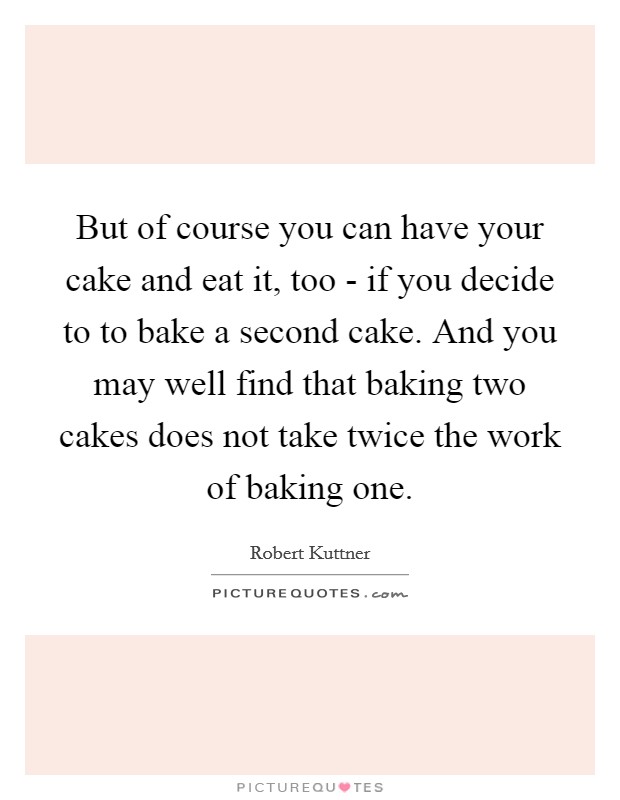
LAW #9: You Can Have Your Cake and Eat It Too
“You can have your cake and eat it too—but not at once.”
— Peter M. Senge, The Fifth Discipline
Understanding the Law
Among the eleven Laws of Dynamic Complexity, this law is perhaps the one that challenges conventional management thinking most directly. Long before Peter Senge adopted the expression in The Fifth Discipline, it had existed as a familiar English proverb that reads, “You cannot simultaneously retain your cake and eat it.” Similar expressions include “You cannot have it both ways,” and “You cannot have the best of both worlds.” They all communicate essentially the same message: life is about making choices, accepting compromise and living with the consequences of what we decide not to pursue.
Before accepting that conclusion, however, let us pause and ask a simple question.
Whose voice is speaking?
Is it the voice of the explorer searching for possibilities that others have not yet discovered? Is it the voice of the scientist investigating relationships that remain hidden? Is it the voice of the entrepreneur determined to overcome what appears impossible? Or is it the voice of the judge, declaring from the outset what cannot be done?
The distinction is important because the two voices lead leadership in completely different directions. One closes inquiry before it begins. The other begins by assuming that there may still be something important about the system that we have yet to understand.
Within the context of the Laws of Dynamic Complexity, this familiar proverb reads very differently.
It says,
You can.
How is that possible?
The STRLDi Interpretation
STRLDi proposes the following interpretation.
You can have your cake and eat it too, provided we respect the order in which causality happens.
Those few additional words fundamentally change the meaning of the law.
When we understand and respect the order in which causality unfolds, many of the dilemmas confronting organisations disappear. When we do not respect that order, we immediately return to the original proverb. We find ourselves believing that one objective must inevitably be sacrificed for another because we have not yet discovered the relationships connecting them.
This law therefore does not suggest that everything can be achieved simultaneously. Rather, it teaches us that many goals become simultaneously achievable once leadership understands the sequence through which one goal creates the conditions necessary for the next.
When Should We Use This Law?
This law becomes particularly valuable whenever organisations, sectors or nations find themselves forced to choose between two or more desirable objectives. Leadership may become trapped between competing policies, competing priorities or competing stakeholder expectations. Sometimes the organisation is dissatisfied with the solution it has chosen. At other times it simply becomes curious enough to ask a much larger question.
Must we really choose?
Systems thinking encourages us to suspend judgement.
Instead of asking which objective should be sacrificed, it asks a more fundamental question.
What relationships have we not yet understood?
A Discovery That Changes Leadership
Here is perhaps the most important insight.
No one ever told us that a complex system can tolerate any number of goals.
Leadership literature frequently teaches us to prioritise objectives, rank competing demands and negotiate compromise. While prioritisation certainly has its place, systems thinking introduces another possibility altogether. Governments simultaneously pursue economic growth, employment, public health, education, environmental stewardship, national security and social cohesion. Businesses pursue profitability, innovation, customer satisfaction, employee wellbeing and long-term resilience. Universities pursue teaching excellence, research impact and financial sustainability.
The problem is not that organisations have too many goals.
The problem is that leadership often fails to understand how those goals are causally connected.
Some goals create the conditions necessary for others to emerge. Some objectives cannot be achieved sustainably until more fundamental capabilities have first been established. Sometimes leadership must be willing to wait while one goal matures because it will eventually enable the next. This is not delay. It is disciplined stewardship.
Law #2 Revisited
This is precisely where Law #9 reconnects with Law #2.
Whenever we ignore the order in which causality unfolds, we naturally compensate by pushing harder. We invest more resources. We tighten controls. We increase pressure. We accelerate implementation. Yet the harder we push, the harder the system pushes back because we are attempting to force outcomes that have not yet been structurally enabled.
Law #2 explains the behaviour.
Law #9 explains how to avoid it.
The answer is not greater effort.
The answer is greater understanding.
Pulling Views Together
How then do we discover the order in which causality happens?
The answer begins by pulling views together.
Every stakeholder sees a different part of the system. Engineers observe technical relationships. Finance departments observe resource flows. Frontline staff experience operational realities. Customers experience service quality. Communities experience long-term consequences. No single perspective is sufficient to understand the whole system.
Leadership therefore becomes an exercise in disciplined inquiry rather than rapid decision making. The objective is not to defend existing positions but to assemble enough perspectives for the underlying causal structure to become visible. As understanding grows, questions gradually replace assumptions and relationships begin replacing compromise.
Only then do we begin recognising sequences such as these.
When quality improves, costs eventually decline.
When trust increases, collaboration improves.
When collaboration improves, productivity follows.
When learning deepens, performance improves.
The challenge is not identifying the goals.
The challenge is discovering which goal creates the conditions for the next.
A National Institutional Experience
In the late 1990s, as Singapore responded to a global economic slowdown, the government began reviewing opportunities to improve productivity and eliminate unnecessary duplication across the public sector. One proposal explored whether two important organisations responsible for different aspects of the national transport system—the Land Transport Authority and the Traffic Police—might be merged into a single institution.
At first glance the proposal appeared sensible. Both organisations operated within the same transport system. Both influenced the movement of people and goods throughout the country. Both contributed directly to national productivity. Yet as discussions progressed, a much deeper systemic question gradually emerged.
The transport system is central to Singapore’s economic survival. The country imports raw materials, transforms them into higher-value products and exports those products to international markets. Every delay within the transport system affects the efficiency of ports, manufacturing, logistics and ultimately national competitiveness. Movement is therefore not simply about roads. It is about economic performance.
Both organisations were essential.
Yet they appeared to be pursuing different immediate objectives.
The Land Transport Authority focused its attention on improving the efficiency of movement. To improve efficiency often meant improving traffic flow and reducing unnecessary delays.
The Traffic Police focused their attention on road safety. Their message was simple.
Speed kills.
Suddenly what appeared to be a straightforward organisational merger became a collision between two seemingly legitimate objectives.
To one organisation,
speed meant efficiency.
To the other,
speed meant death.


If we merged those two ways of thinking without first understanding their relationship, we might jokingly describe the result as “efficient death.”
That, however, was not the real issue.
The real question was never whether efficiency and safety could coexist.
The real question was:
Which one creates the conditions for the other?
That is because we think of mergers to mean that it looks like something like this:


The underlying assumption is that two organisations simply come together, combine their structures, merge their functions and eventually become one. While this may appear logical from an organisational chart, it tells us very little about whether the purposes, needs and causal relationships that gave rise to each organisation have also been understood. Merging structures is relatively easy. Merging purposes is considerably more difficult.
However, when we begin respecting Law #9, the picture changes completely.


The emphasis is no longer on combining organisations. Instead, the emphasis shifts towards understanding how the success of one purpose creates the conditions for the success of another. Rather than forcing different agendas together, leadership begins discovering the causal relationships that naturally connect them. The question therefore changes from “How do we merge these organisations?” to “How do these organisations help one another succeed?”
The question we should therefore ask is this:
How does working to satisfy your need contribute to your success, which in turn helps satisfy my need and enables my success? Moreover, how does my success subsequently reinforce yours so that, together, we generate the sustained achievement and growth of both goals as one integrated system?
Notice how different this conversation becomes.
Instead of negotiating compromises, we begin searching for reinforcing relationships. Instead of debating whose priorities should dominate, we investigate how one priority creates the conditions necessary for another. Leadership moves away from bargaining and towards understanding.
Let us therefore return to our two organisations.
What were their real needs?
The Land Transport Authority appeared to focus its attention on speed. Yet speed was never its fundamental purpose. Its deeper need was the efficient movement of people and goods throughout Singapore’s transport system. Speed was simply one of several possible means of achieving that outcome.
The Traffic Police, on the other hand, appeared to focus their attention on slowing vehicles down. Again, that was not their fundamental purpose. They were not trying to reduce speed for its own sake. Their deeper need was safety on the roads.
Reducing speed was merely one intervention through which they sought to prevent injury and loss of life.
This distinction is crucial.
One organisation’s attention was directed towards speed.
Its need was efficiency.
The other organisation’s attention was directed towards reducing speed.
Its need was safety.
Once leadership distinguishes between attention and need, the apparent conflict begins to dissolve.
We now arrive at the most important question in this chapter.
Which of these two needs comes first in the order of causality?
Does greater efficiency naturally produce safer roads?
Or does a safer transport system create the conditions that allow transport efficiency to grow?
This is not a question of opinion.
It is a question of systemic structure.
It asks us to identify which condition, if strengthened first, will naturally reinforce the growth of the other. Once that causal sequence becomes visible, the apparent dilemma disappears because both organisations are now working towards the same systemic outcome rather than competing institutional agendas.
This is precisely why compromise is rarely the highest expression of leadership.
Compromise usually means that every party gives up something important, leaving no one fully satisfied and the system no stronger than before. It often feels reasonable, but it rarely feels empowering because it assumes that the only available solution is to reduce everyone’s aspirations.
Systems thinking offers another possibility.
Instead of asking “What should each side give up?”, it asks “What sequence of causality allows every legitimate objective to be achieved?” Once that sequence is understood, compromise gives way to cooperation because the success of one objective begins creating the conditions for the success of the next.
So, which one comes first?
That is a discussion we shall explore together during the workshop.
For now, remember the central lesson of Law #9.
You can indeed have your cake and eat it too. The challenge is not deciding between worthy goals. The challenge is discovering and respecting the order in which causality—not merely action—happens.
Large-scale systemic intervention exercise: click here – https://sheilasingapore.blog/portfolio/exercise-reconstructing-the-causal-order/
Previous < — Law #8 Next –> Law #10


You must be logged in to post a comment.