
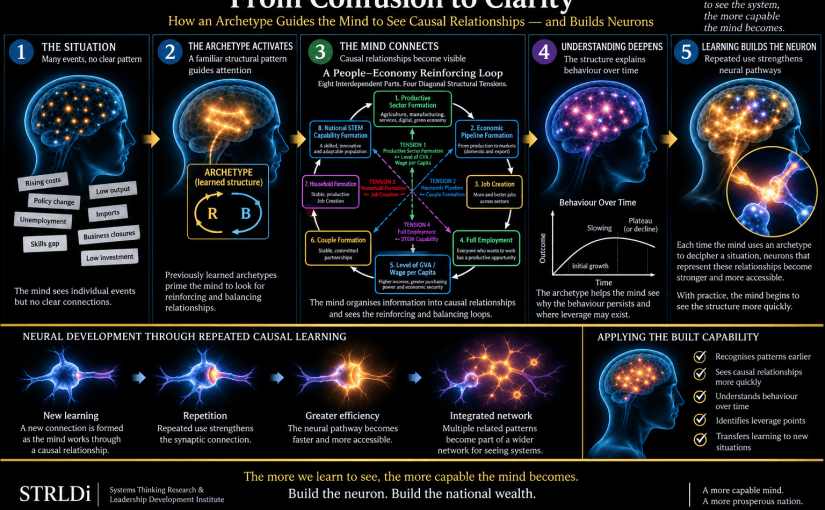
Neurobiology, Causal Discovery and the Architecture of Productive Capability
By Sheila Damodaran | STRLDi Systems Diagnostics & Policy Architecture
Executive Summary
When a Nation Learns to See
Neurobiology, Causal Discovery and the Architecture of Productive Capability
Sheila Damodaran | STRLDi Systems Diagnostics & Policy Architecture
A nation’s productive capacity begins before the factory, the farm, the laboratory or the technology. It begins in the cognitive architecture of the people who will have to create, operate, improve and reproduce those systems. Learning changes that architecture: repeated experience strengthens and reorganises neural networks, making previously learned relationships increasingly available for recognition and use. (STRLDi)
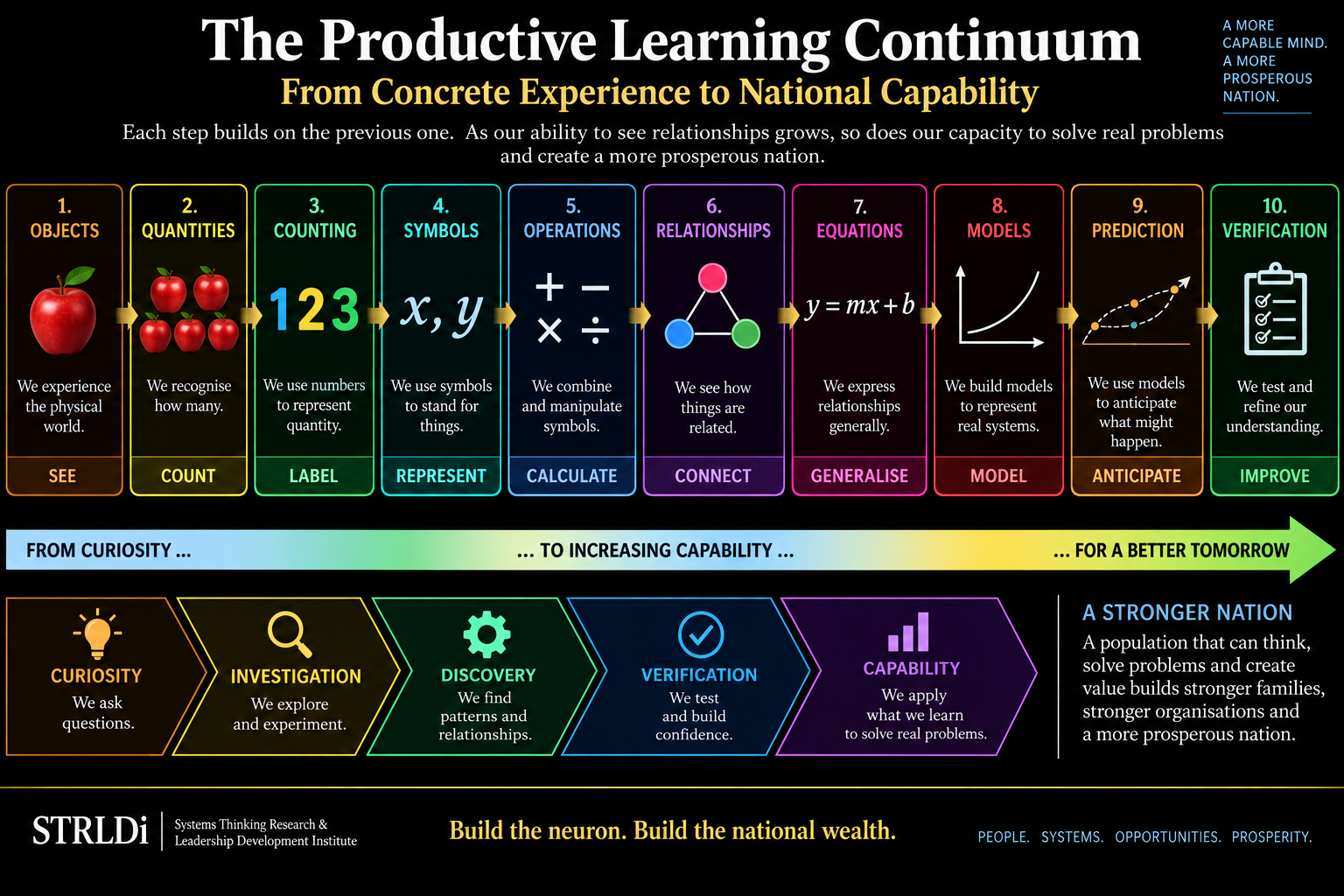
The article examines what happens when learning moves beyond receiving information to discovering relationships. Mathematics provides a clear progression: Objects → Quantities → Counting → Symbols → Operations → Relationships → Equations → Models → Prediction → Verification. STEM repeatedly exercises this movement from observation to relationship, causality, modelling and verification. This matters because productive economies depend upon people who can discover how things work, reproduce what works and improve it.
The article then makes a critical distinction between productive and speculative orientations. Productive learning follows Observe → Measure → Connect → Model → Test → Produce → Improve. A speculative orientation can pursue results through authority, consensus, trends and anticipated gain without understanding the relationships producing the result. The national question is therefore not simply how many people have been educated, but what cognitive practices the education system has repeatedly exercised across the population.
For national leadership, this becomes an economic question. A country may possess extensive information, qualified people and numerous strategies while continuing to intervene at the level of visible events because the structures producing those events remain unseen. Causal capability changes the question from “What is happening?” to “What relationship is producing it?” and then to “Where can we intervene to change the behaviour of the system?” (STRLDi)
For Botswana and Africa, the implications are material: productive capability underpins agriculture, manufacturing, engineering, technology, healthcare, infrastructure, employment and household income. The educational choices made today therefore help determine the cognitive capabilities available to build tomorrow’s productive economy.
The article’s central challenge to national leadership is consequently:
What are we teaching the brains that will have to think for the nation?
Read the full article: When a Nation Learns to See
A. WHAT HAPPENS WHEN WE LEARN?
There is a moment in learning that is easy to overlook because it happens so quickly. We encounter something that is present before us, but its relationship to other things is not yet visible; we look again, work with it, turn it around in our minds, and then suddenly we see it. The world has not necessarily changed in that moment. Our capacity to represent the world has changed. Something that was previously experienced as separate pieces has become a relationship.
Consider a child given 11 apples and then another 12 apples. At first there are simply two groups of objects. The child can count the first group, count the second, bring the quantities together, and eventually recognise that 11 + 12 = 23. What has been learned is much larger than the number 23: the child has connected objects to quantities, quantities to symbols, symbols to operations, and operations to a result. The child is beginning to construct a representation that can be used again.
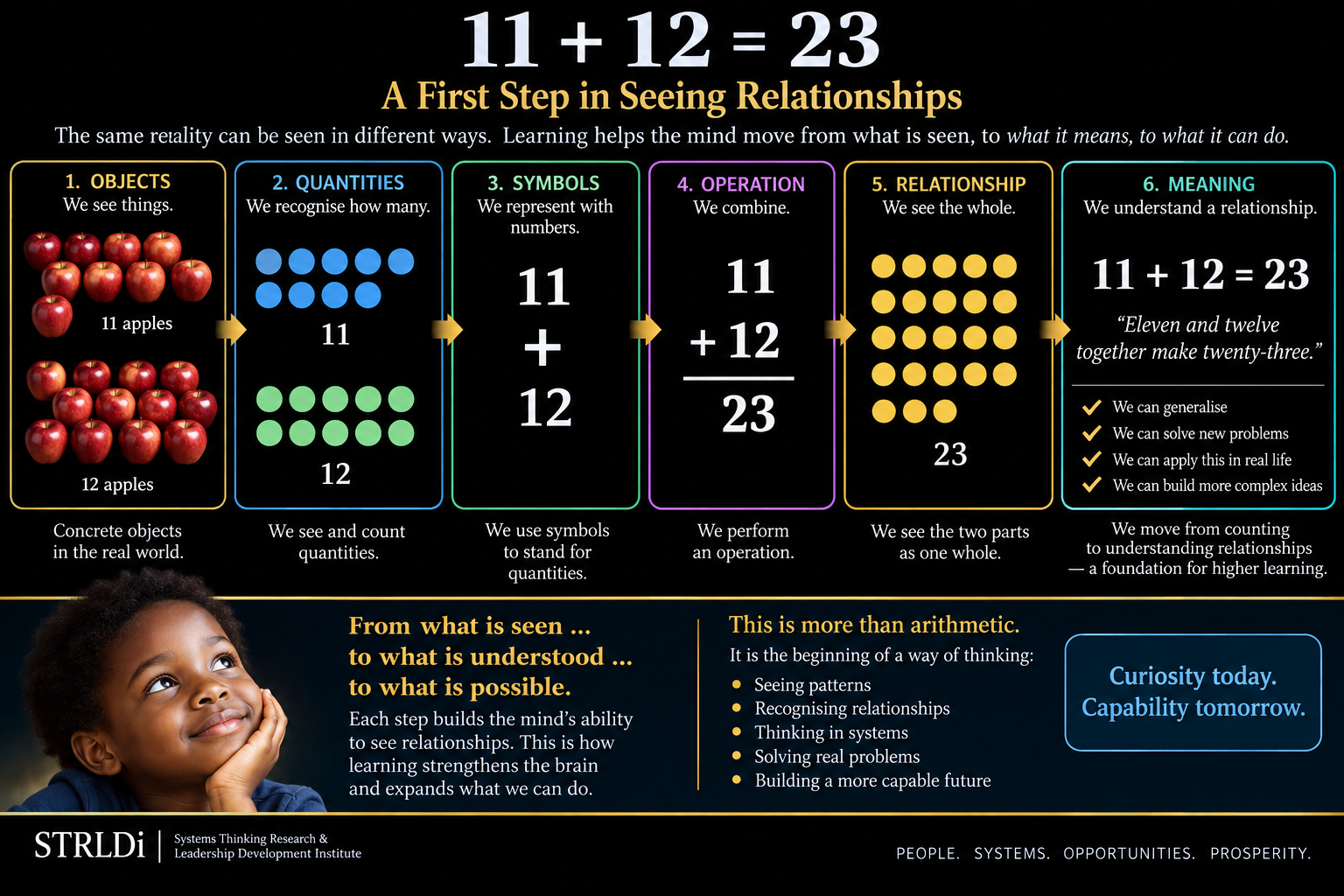
This is an important distinction because learning is not exhausted by receiving information. The learner has to establish relationships among representations and be able to retrieve and use those relationships when the situation changes. The difference becomes particularly important when we move from learning an answer to learning how one thing produces another.
The question that follows is therefore more interesting than whether the child remembers that 11 + 12 equals 23. What happened in the learner that made the relationship available for the next time? And what happens when the relationship being learned is no longer as simple as two groups of apples, but a relationship among people, institutions, resources, incentives, behaviour and time?
That is where the biology of learning begins to matter for strategy.
The brain as a changing architecture
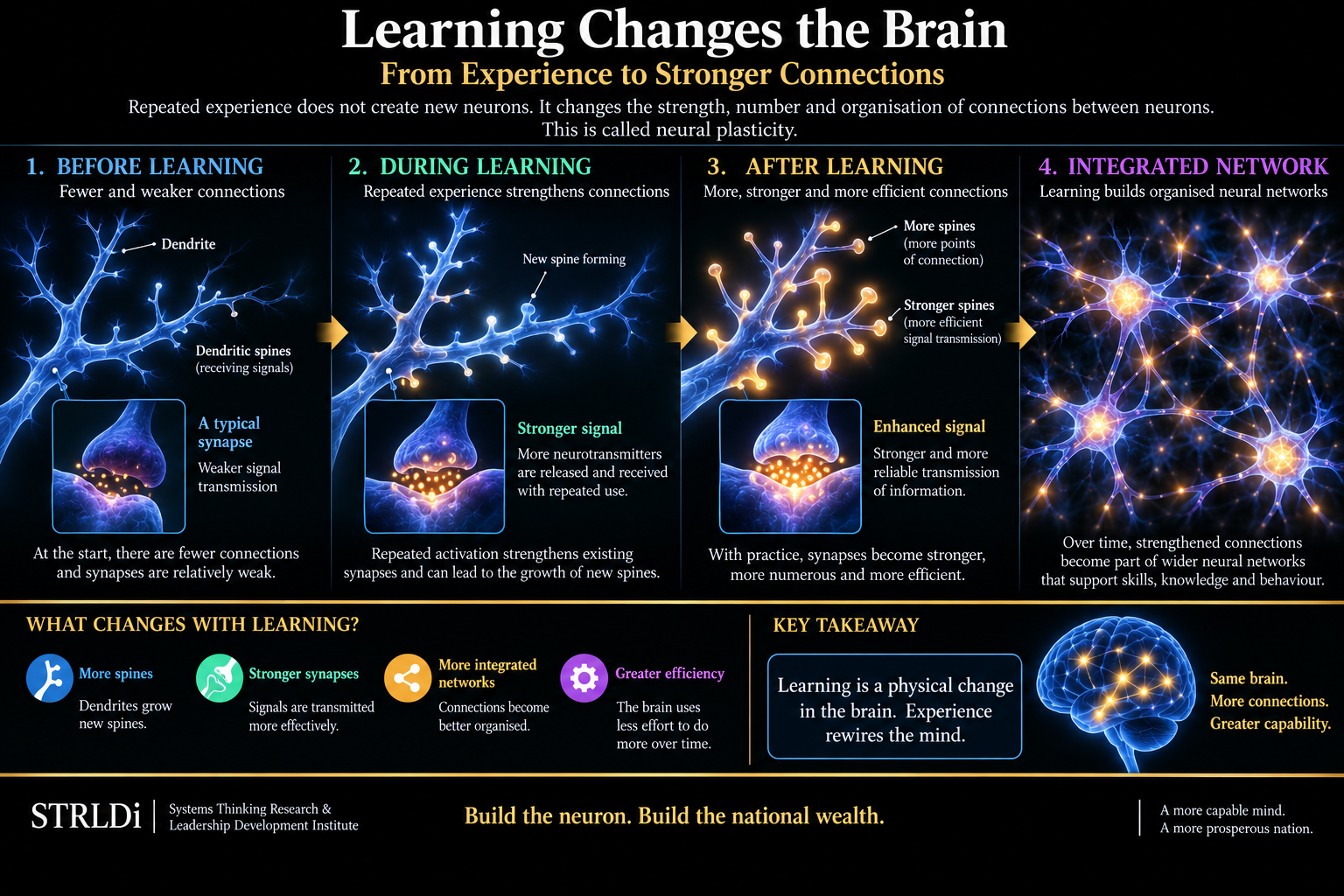
The brain is not a static container into which information is deposited. Learning involves changes in the function and organisation of neural circuits: existing connections can become stronger or weaker, new synaptic connections can form and stabilise, dendritic spines can change, and networks can be reorganised through experience. The important point for our purposes is that experience changes the machinery through which subsequent experience is interpreted.
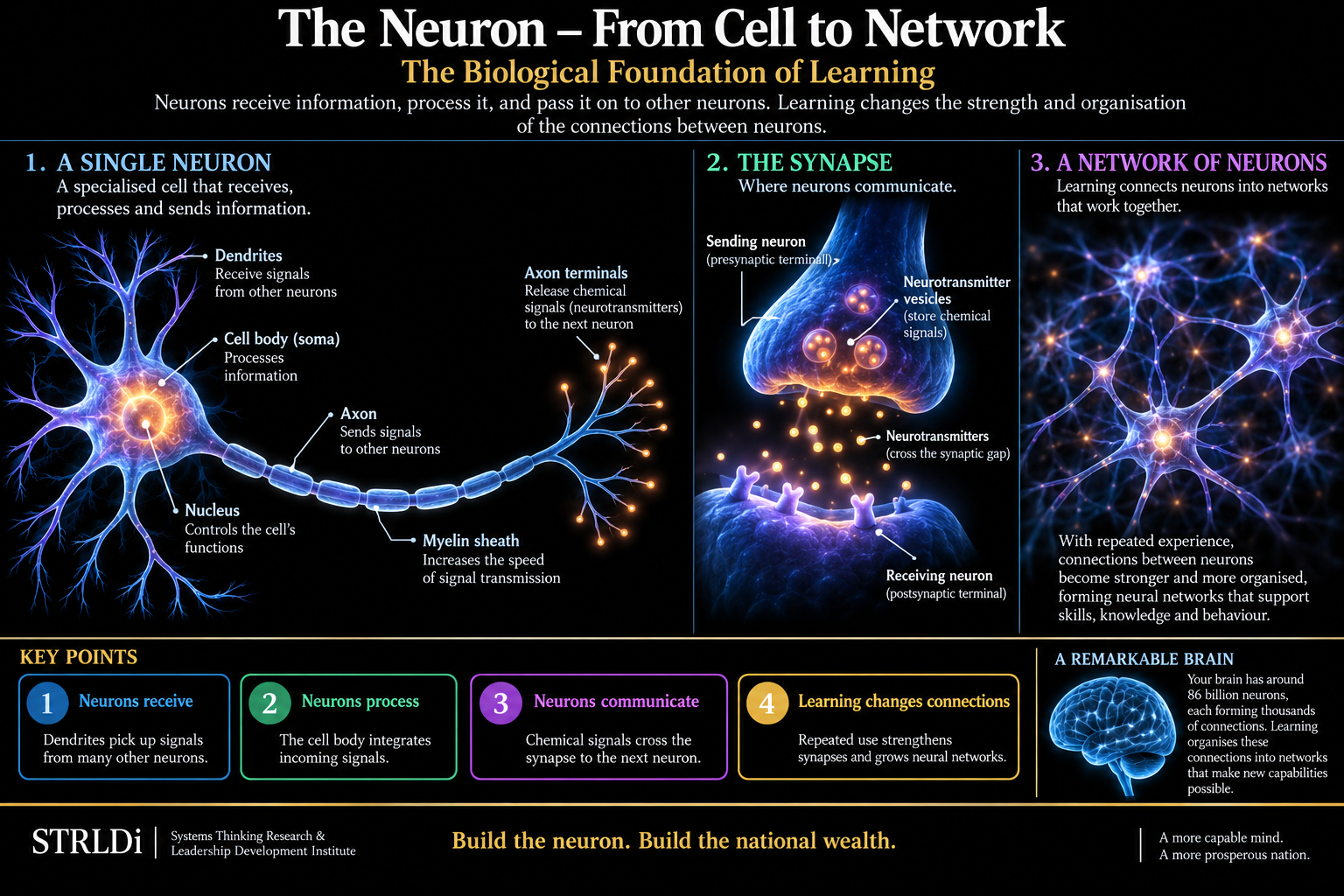
At a synapse, coordinated activity can engage mechanisms of synaptic plasticity. At many excitatory synapses, activity involving NMDA receptors permits calcium to enter the postsynaptic neuron, initiating intracellular processes that can increase the effectiveness and number of AMPA receptors. This is one mechanism associated with long-term potentiation, through which a connection becomes more readily activated in the future.
The process can extend beyond changes in synaptic strength. Dendritic spines—the small protrusions on dendrites where many excitatory synapses occur—can change in size, shape and stability. Research using longitudinal imaging has shown that motor learning is accompanied by structural changes in dendritic spines, including the formation and stabilisation of new spines and the organisation of newly formed connections into functional clusters.
This matters because the language of “making connections” is therefore more than a convenient metaphor. Learning can alter the physical and functional organisation of the networks through which relationships are represented. We should be precise about the claim: we cannot look into a living human brain and watch an individual synapse appear every time someone understands an idea. Much of the detailed microscopic evidence comes from animal models, while human research gives us complementary evidence about learning and brain plasticity. But the broader biological principle is well established: experience-dependent plasticity changes the learner.
The implications become more interesting when the experience being repeated is not simply exposure to information, but active discovery of relationships.
What exactly is being learned?
Return to the apples. The child does not need to retain an isolated fact called “23.” The useful learning lies in the relationship that makes 23 the result of combining 11 and 12. Once that relationship is understood, it can be used to solve another problem: 14 + 9, 27 − 8, or a problem that has never previously been encountered.
The learner has therefore acquired something that can travel. The representation can be retrieved, applied, tested and extended. A relationship discovered in one situation becomes available as a structure for understanding another. Learning has moved from possession of information toward capability.
Now imagine replacing the apples with something far more consequential.
A country experiences rising unemployment. At the same time, imports increase, domestic production remains weak, businesses struggle to expand, young people leave certain sectors, foreign exchange comes under pressure and household purchasing power changes. Each observation can be reported separately. Each can generate a policy response. Yet the relationships among them may remain invisible.
The national strategist therefore faces a problem that is structurally similar to the child’s problem, although vastly more complex: how do we move from seeing separate things to seeing the relationships among them?
That is the question this article follows.
B. THE JOY OF SEEING
There is another feature of learning that deserves our attention before we go further. The joy of discovery does not have to be manufactured from outside the learner. Curiosity arises because something is unresolved; exploration follows; a relationship becomes visible; and the joy arrives with the discovery itself. The learner does not first calculate that understanding will produce a reward and then decide to pursue it. The experience of seeing what was previously unseen carries its own satisfaction.
The child who discovers that 11 + 12 = 23 experiences something different from receiving a sweet for getting the answer right. The sweet is an externally supplied reward; the discovery changes what the child can do. The child can now recognise the relationship again, use it somewhere else, and begin asking another question. The mind can generate its own reward when it discovers that it has become more capable of seeing.
This gives us a much more interesting learning loop:
Curiosity → Exploration → Discovery → Joy → Curiosity
The joy is not a prize placed at the end of the process. It is part of the experience of the relationship becoming visible. Because the learner has changed, the next question can be approached from a new position of capability, and that new capability opens another field of curiosity.
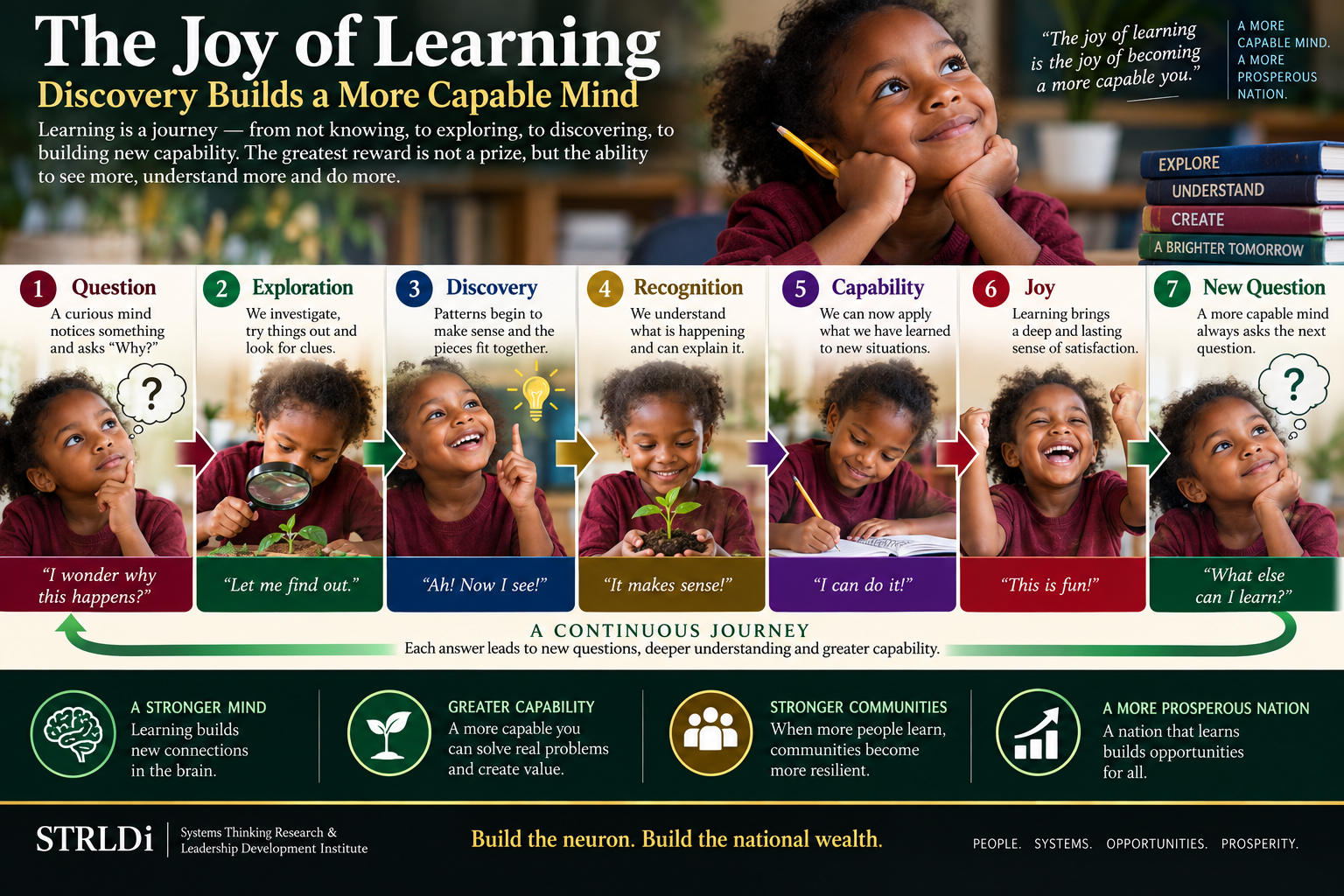
This matters enormously when the relationship being discovered is causal. A person working through a causal diagram may begin with several apparently unrelated events. They identify variables, trace relationships, follow consequences through time, discover that an effect feeds back into an earlier condition, and suddenly the behaviour of the whole system begins to make sense. The moment of recognition is itself an experience of increased capability.
This may be one reason why the joy of genuine learning can be so powerful. It does not depend on consuming something that has been placed outside the learner; it arises from the learner’s own transformation. A farmer who discovers why a crop is failing, an engineer who discovers why a machine is repeatedly breaking down, a scientist who sees a relationship in the evidence, a manufacturer who identifies the constraint in a production process, and a systems practitioner who suddenly sees the loop producing a persistent national problem are all experiencing different versions of the same phenomenon: the world has become more intelligible because the mind has become more capable of seeing it.
The significance for education and national capability is therefore profound. If the experience of becoming more capable can itself generate curiosity and joy, then the question is not simply how to motivate people to learn. It is also whether our learning environments give people enough opportunity to experience the satisfaction of discovering something that they can subsequently use.
When the reward comes from somewhere else
This provides a useful contrast with substance use, which we will examine more fully in the appendix. Psychoactive substances can alter neurotransmission and systems involved in reward, attention, memory, perception, inhibition and decision-making, while repeated exposure can produce adaptation and strengthen the significance of substance-related cues.
The systems question is therefore worth asking in both cases: what has repeated experience been teaching the brain to attend to, pursue, remember and reward? In learning, curiosity can lead to discovery and the discovery itself can generate joy; in substance use, the desired external stimulus can become increasingly embedded in patterns of reward, expectation and behaviour.
Experience shapes the learner. That proposition will become increasingly important as we move from individual learning to the learning of causal structures.
C. WHEN SEEING CHANGES
Consider a stereogram.
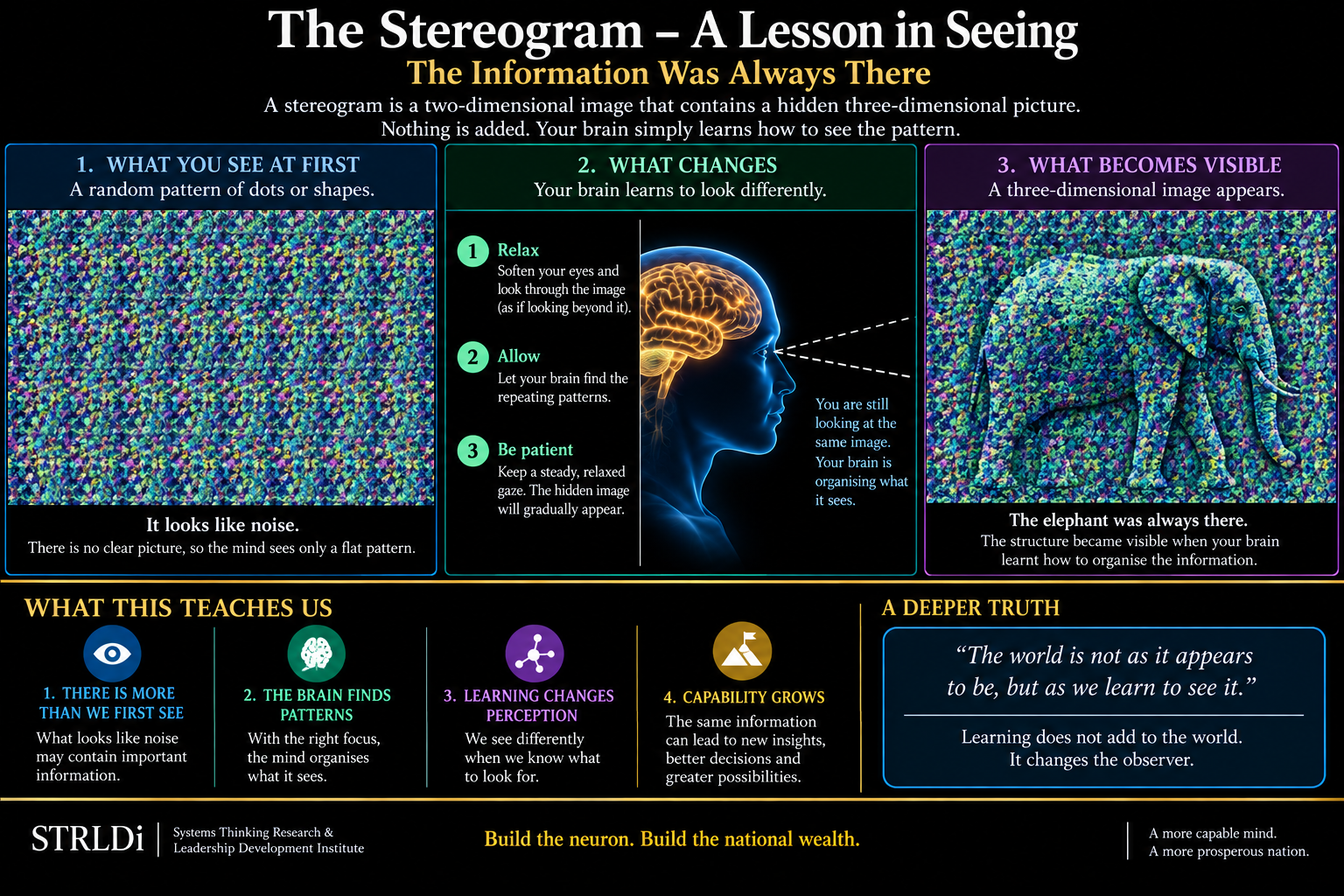
The page appears to contain a field of dots. Nothing announces the hidden image. The dots themselves do not rearrange when the three-dimensional form suddenly appears. Yet after the perceptual shift, many people can look at the same image again and find the structure much more readily.
What changed?
The image did not.
The observer’s capacity to organise the information changed.
The significance of this experience is not that a stereogram teaches systems thinking by itself. It gives us a concrete experience of a phenomenon that matters greatly in systems work: something can be present in the information before us while remaining unavailable to our current way of seeing. The challenge is not always a lack of data. Sometimes the challenge is that we have not yet acquired the representation through which the relationships in the data become perceptible.
This is why the discipline of staying with the information matters. When the dots initially appear meaningless, the temptation is to force an interpretation, search for a familiar answer or abandon the exercise. The more productive question is different: What did I do differently when I could not see the structure and then suddenly could?
That question takes us directly into causal discovery.
D. LEARNING TO SEE CAUSALITY
The stereogram gives us an experience that is central to systems thinking. The information is already present, yet the structure is initially invisible; then, through a change in the way we attend to and organise the information, the relationship appears. The dots have not moved. What has changed is the capacity of the observer to see what the dots collectively contain.
This is where learning causal relationships begins. We encounter an event, but the event is only what is visible at a particular moment; we begin to ask whether it belongs to a pattern, what variables are moving, what affects what, and what follows from the relationship we have identified. The mind moves progressively from Event → Pattern → Variable → Relationship → Causality.
Once a causal relationship has been identified, the learner follows it. What does this change produce? What does that consequence change? What happens after that? The learner follows the river of causes, allowing the consequences to lead to the next relationship rather than stopping at the first explanation that seems plausible.
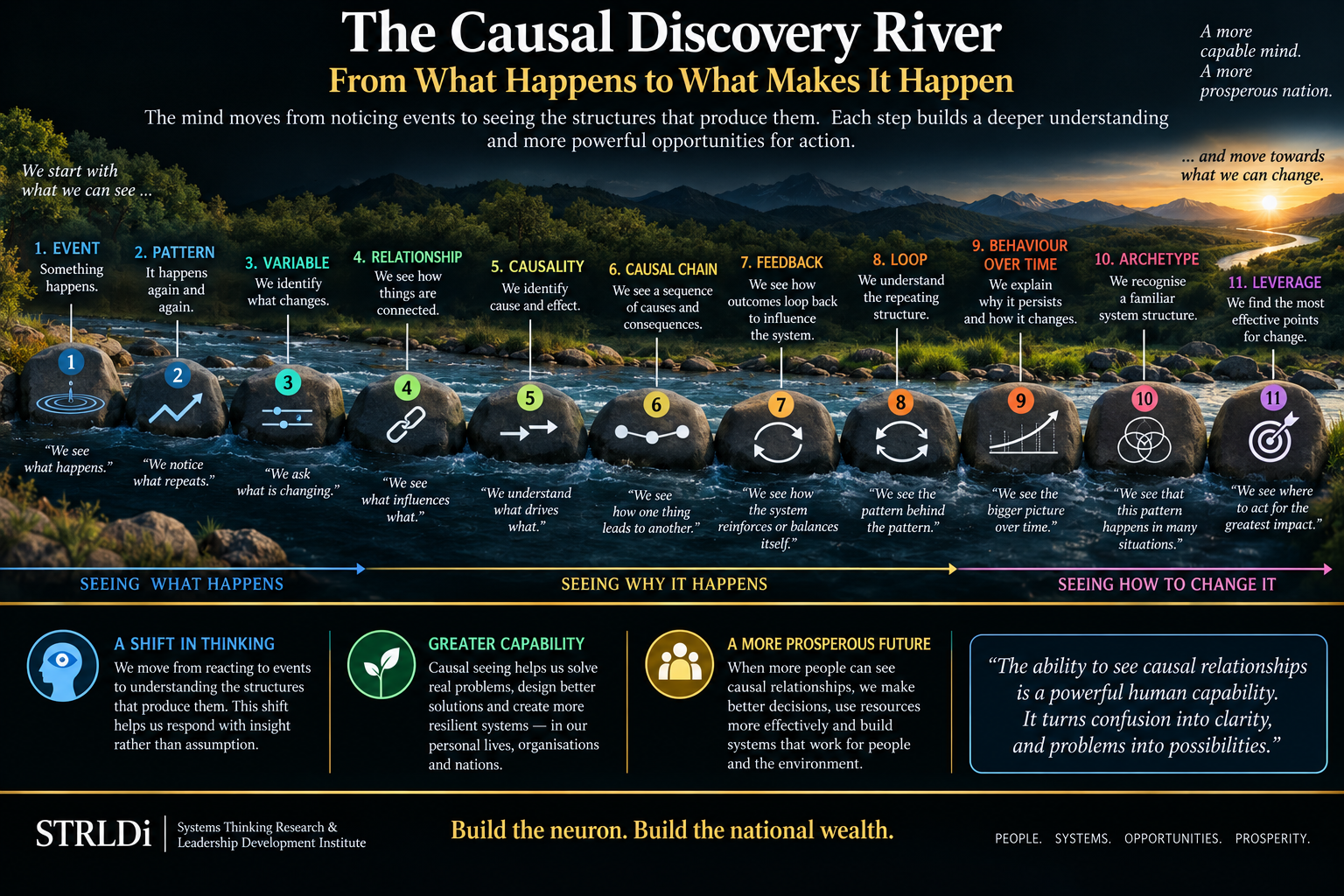
The chain may cross levels of the system. An individual action can affect a household; household behaviour can affect an organisation; organisational behaviour can affect an institution; institutional behaviour can affect a sector; sector behaviour can affect the national economy. At each stage, the learner asks the same question: what does this change produce, and what does that consequence change?
Eventually, the causal chain can return to the condition with which it began. An effect becomes part of the conditions that influence its own cause, and feedback becomes visible. We can then begin to distinguish between reinforcing structures, in which change feeds further change, and balancing structures, in which forces work to counteract change.
The progression has now become:
Event → Pattern → Variable → Relationship → Causality → Causal Chain → Feedback → Loop → Behaviour Over Time
The final test is whether the structure we have identified can explain the behaviour we actually observe. Measurement over time allows the learner to compare the behaviour of the system with the behaviour implied by the model. The diagram is therefore not an ornament or a story about the system; it is a proposition about how the system works, available to be tested against reality.
From the diagram to recognition
Only then does the systems archetype become important. An archetype is not something the learner needs to memorise before beginning the investigation; it is something that can be recognised after the relationships have been followed sufficiently far for the underlying structure to become visible. A learner who has worked through several apparently different situations may eventually encounter a new one and recognise that the same structural pattern is operating beneath a different surface story.
That moment matters. The learner has acquired a structure that can travel.
The farmer may encounter it in production, the business leader in growth, the public servant in administration, and the national strategist in economic policy. The events differ, the language changes, and the actors are different, yet the learner begins to recognise the relationship pattern.
The progression therefore continues:
Event → Pattern → Variable → Relationship → Causality → Causal Chain → Feedback → Loop → Behaviour Over Time → Archetype
And then comes the question that matters most to strategy:
Where can the structure be changed?
The most visible symptom is not necessarily the point at which the system is most responsive. Once the learner can see the structure, attention can move towards leverage: the point at which changing one part of the system can alter the behaviour of the whole. When we do see it, the mind learns to move the forest, not just the tree.
E. FROM TEACHABILITY TO NATIONAL PRODUCTIVE CAPABILITY
When Learning Changes the Learner
What happens when a person repeatedly travels the pathway from observation to relationship, causality and verification? They observe, question, identify variables, construct relationships, follow consequences, test explanations, recognise structures and apply what they have learned to another situation. Learning is therefore doing more than adding information to memory; experience participates in changing the organisation of the neural systems through which subsequent experience is interpreted.
Neuroscience gives us several ways of understanding this. Synaptic connections can change in strength; dendritic spines can change in size, shape and stability; new synaptic connections can form and stabilise; and axonal structures can be remodelled through learning. Research using longitudinal imaging has directly observed structural changes associated with learning, including the formation and stabilisation of new dendritic spines and changes in axonal boutons during motor learning.
The point is that repeated experience changes the learner. When a person repeatedly constructs and retrieves relationships, tests them against experience and applies them in new contexts, the brain is repeatedly engaged in representing those relationships. Over time, those representations can become increasingly accessible, allowing the learner to recognise structures that previously remained invisible.
This is what makes the transition from drawing a causal loop to seeing a causal loop so important. At first, the learner needs the diagram to make the relationships visible; with practice, the learner can begin to perceive the relationships before the diagram has been completed. The diagram has become part of the learner’s way of seeing.
That capacity begins earlier than the systems diagram. It begins with something very simple: the willingness to keep looking when the answer has not yet been found.
Teachability Keeps the Question Open
A child begins with a question because something in the world does not yet make sense. Curiosity keeps the question open; teachability allows the learner to remain open long enough for experience, evidence and discovery to change what the learner understands. The movement is therefore not simply from question to answer, but through Curiosity → Exploration → Discovery → Capability → Joy → New Curiosity.
Teachability is important because the learner must be able to let an existing representation change. A question can lead to an answer that confirms what was already believed, or it can lead to a discovery that reorganises what the learner thought was possible. The capacity to learn is therefore also the capacity to have one’s representation of reality changed by what reality reveals.
This is where the joy of discovery becomes part of the learning system. Something unresolved creates curiosity; exploration exposes relationships; discovery produces recognition; recognition produces capability; and capability opens another question. The learner can therefore become increasingly willing to explore because the reward is contained in becoming more capable of seeing.
The same thing happens when a systems archetype becomes visible. A person may have looked at unemployment, poverty, imports, weak production or household distress as separate conditions, and then suddenly see the relationships connecting them; the behaviour over time begins to make sense because the learner has discovered the structure beneath the events. A new way of seeing has become available.
STEM: Building and Expanding the Architecture for Seeing Relationships
We can now ask what kinds of learning repeatedly place the developing mind on this pathway from observation to relationship, causality and verification.
Consider mathematics. It begins with objects that can be counted and quantities that can be compared. Quantities become numbers; numbers become symbols; symbols are manipulated through operations; operations reveal relationships; relationships become equations; equations become models; models generate predictions; and predictions can be tested against reality.
Objects → Quantities → Counting → Symbols → Operations → Relationships → Equations → Models → Prediction → Verification
The movement can begin with 11 apples and 12 apples and eventually reach money, time, distance, rates, fractions, decimals, algebra, trigonometry, physics and chemistry. At each stage, the learner is repeatedly moving between representations and reality, establishing relationships, carrying those relationships into another context, making predictions and discovering whether the predictions hold.
This repeated movement builds and expands the neural architecture. Existing pathways can become stronger and more accessible while new representations and relationships become connected to the architecture already built. The learner is progressively building an expanding architecture for seeing relationships.
The significance is cumulative. The child does not learn counting and then leave that architecture behind; counting becomes available for arithmetic, arithmetic for algebra, algebra for modelling, modelling for prediction, and prediction for verification. The architecture becomes increasingly capable of representing relationships that cannot be seen directly.
That is the movement from seeing the tree to seeing the forest. The learner no longer depends entirely on the immediate physical object because an internal representation of the relationship has become available for use. STEM therefore provides a sustained developmental pathway through which the learner repeatedly practises moving from what is observed to what is related, from relationship to causality, and from causality to something that can be tested.
NON-STEM: What Is the Learner Being Trained to Do?
The distinction becomes important here because education can organise learning around different forms of cognitive practice. Where the learner is predominantly trained through received accounts, interpretation, memory, reproduction and authority, the learner can become highly capable at handling and reproducing representations while receiving less sustained practice in establishing relationships against observable reality through measurement, modelling, prediction and verification.
The learner encounters events, people, societies, ideas and interpretations through accounts that have already been constructed by others. History provides an interpretation of an event; literature provides interpretations of meaning; law provides interpretations of rules and cases; economics and social sciences provide explanations of behaviour and outcomes. The learner can become highly knowledgeable within these fields while the causal relationships underlying the account remain mediated through interpretation.
The learner therefore becomes accustomed to a different relationship with knowledge: receive the account, understand the interpretation, remember it and reproduce it. Where the underlying relationships have not been established and verified by the learner, the explanation can move from evidence into interpretation and from interpretation into speculation.
This distinction is about what the learner repeatedly practises the brain to do. The brain develops through what it repeatedly does, and therefore the question is not simply how much information a population has accumulated, but what kinds of relationships its people have spent years learning to see, test, reproduce and improve.
Productive Capability and Speculative Capability
The difference becomes visible in the pathway each form of learning tends to support.
A productive orientation asks: What do we have? What can we make from it? What relationship produces the result? Can we reproduce it? Can we improve it? What happens if we change this variable? Its movement is:
Observe → Measure → Connect → Model → Test → Produce → Improve
The productive learner continually returns to reality to discover whether the relationship holds. The farmer observes soil, water, seed and yield; the engineer works with force, material and design; the manufacturer works with inputs, processes, variation and output; the technician works through relationships among components to identify what is producing the observed behaviour.
A speculative orientation moves differently. It can ask: Who says it? Who believes it? What is trending? What might happen? What can I gain if I get in early? What does the market think? The emphasis moves toward social confirmation, authority, expectation, attention and anticipated gain while the underlying causal structure can remain unexamined.
Its reinforcing sequence becomes:
Social Reinforcement → Trending → Speculation → Authority → Consensus → Anticipated Gain → Repetition
One pathway continually asks how the result is produced. The other can proceed through what people believe will produce the result.
A productive society is therefore one that learns to discover and reproduce the relationships that produce results. A speculative society can pursue results without understanding the relationships that produce them. That distinction reaches beyond education because the cognitive orientation eventually enters the workplace, the enterprise, the institution and the economy.
The Employment Each Economy Naturally Creates
The type of economy a society builds creates its own employment structure. A productive economy requires people who can create, operate, maintain, measure, diagnose, improve and scale productive systems. Its employment therefore extends through agriculture, engineering, manufacturing, construction, energy, water, infrastructure, technology, ICT, logistics, maintenance, technical operations, science, production management and the productive services that connect these systems to markets.
The engineer works with forces, materials and structures. The agricultural scientist works with soil, water, nutrients, plant physiology and yield. The manufacturer works with inputs, process, quality, throughput, cost and demand. The technician works through relationships among components to diagnose behaviour and restore or improve system performance. The scale changes; the cognitive act remains: discover the relationships that produce the behaviour.
A speculative economy generates a different centre of gravity. Its employment naturally expands around administration, representation, communication, allocation, brokerage, sales, advocacy, negotiation, compliance, promotion, coordination and the circulation of information and claims. These occupations can be necessary within a productive economy as well, but where the productive base is thin, more human effort is concentrated around distributing, administering, representing and managing what already exists rather than continuously expanding the systems that produce new value.
The distinction is therefore between the economy that produces the things people need and the economy that principally moves, allocates, represents or interprets what has already been produced. The balance between these forms of activity determines the depth of productive capability available to the population.
From the Brain to the Economy
The causal chain now becomes visible:
Childhood Learning → Neural Development → Cognitive Capability → Technical Capability → Productive Capability → Productive Systems → Employment → Income → Household Capacity → National Productive Capacity
The individual brain is connected to the economy through a long river of causes. A child learning to see relationships becomes an adult capable of working with increasingly complex relationships; those capabilities become embedded in enterprises and institutions; enterprises and institutions become part of production systems; production systems create employment and income; and the resulting economy becomes the environment in which the next generation is formed.
This is the Self → Nation → Self relationship. What the individual learns becomes part of what the institution can do; what institutions can do becomes part of what the economy produces; what the economy produces shapes the opportunities available to the next generation. Human formation therefore becomes economic formation, and economic formation becomes the environment for the next generation of human formation.
The Scale of the Challenge
Southern Africa is home to approximately 400 million people. The scale of formal employment within that population is considerably smaller.
| Southern Africa | People |
|---|---|
| Total population | ~400 million |
| Labour force | ~147 million |
| Employed | ~133 million |
| Informal employment | ~85 million |
| Formal employment | ~24–48 million, depending on definition/year |
For this argument, we use 50 million formal jobs as the working figure.
If 5% productive capability supports 50 million formally employed people, and the objective is to reach 300 million formally employed people, the mathematics is straightforward:
300 million ÷ 50 million = 6
The productive capability therefore needs to grow sixfold.
5% × 6 = 30%
| Today | Required | |
|---|---|---|
| Population | 400 million | 400 million |
| Formal employment | 50 million | 300 million |
| Productive capability | 5% | 30% |
| People representing that capability | 20 million | 120 million |
Therefore:
400 million × 30% = 120 million people.
The scale is now visible. The productive capability represented by 5% of the population has to become 30% if the same relationship between productive capability and formal employment is used to explore a sixfold increase from 50 million to 300 million formal jobs.
What Percentage of the Population Needs STEM-Based Capability?
There is an important distinction between STEM occupations and the much larger population whose work depends upon STEM-based productive capability. The relevant question is therefore not simply how many people carry a STEM occupational title, but how many people have developed the capability to participate in creating, operating, maintaining and improving the productive systems on which the region depends.
For the Southern African question, 30% is the planning number emerging from the sixfold calculation in this argument: approximately 120 million people out of 400 million participating in the STEM-based and STEM-enabled productive capability required to build and operate the productive systems of the region.
That number gives the educational question a very different scale. We are no longer looking at the formation of a small technical minority; we are looking at the development of a substantial proportion of the population whose formative years have prepared them to work with relationships, systems, measurement, modelling, prediction, verification and improvement.
The question therefore becomes:
How many people must spend their formative years building and expanding the cognitive architecture required to understand, create, operate, maintain and improve the productive systems through which 400 million people can live and work?
The answer begins with the child.
Build the neuron. Build the capability. Build the productive system. Build the employment. Build the national wealth.
F. FROM SEEING STRUCTURES TO NATIONAL CAPABILITY
A national economy can be presented as a collection of indicators: unemployment, inflation, exchange rates, investment, imports, exports, productivity, wages, skills and production. Each number can be reported and debated while the relationships producing the pattern remain invisible. Causal learning changes the question: what does rising import dependence do to domestic production; what does weak production do to foreign-exchange demand; what does foreign-exchange pressure do to input costs; what happens to businesses when working capital is eroded; and what happens to production capacity as businesses contract?
The question then becomes where does the consequence return? Making the arrow visible allows the relationship to be investigated, measured, revised and tested. A causal diagram turns an implicit theory of the system into something that can be examined against reality, moving the learner from event → pattern → relationship → causality → feedback → archetype → leverage.
Once the structure is visible, strategy can move upstream from symptom to cause and from cause to leverage. The most visible part of a problem is not necessarily where the system is most responsive, and the learner who can see the structure can begin to change the forest rather than continually treating the tree. Seeing the structure changes what becomes possible to change.
The individual learner and the nation then become part of the same system:
Self → Nation → Self
The individual learns within institutions created by society; the capabilities developed by individuals accumulate within organisations and institutions; and those institutions shape the productive, social and learning environment in which the next generation develops. What the individual learns becomes part of what the institution can do, and what the institution can do becomes part of the environment in which another individual learns.

This is why national capability begins before the strategy document. It begins with what people have learned to see, how they have learned to establish relationships, how they have learned to test what they believe to be true, and whether they can turn that understanding into productive action. A country can have enormous quantities of information, qualified people, strategies and policies while the structures producing persistent outcomes remain invisible.
The opportunity is therefore to develop a population capable of moving from event to pattern, pattern to relationship, relationship to causality, causality to feedback, feedback to archetype and archetype to leverage. That is the capability through which a population can begin to understand the systems it has inherited and develop the capacity to change the relationships through which those systems reproduce themselves.
G. WHEN A NATION LEARNS TO SEE
The argument began with a child learning that 11 + 12 = 23. The child learned more than an answer; the child learned a relationship that could travel, be retrieved, applied and extended. At national scale, the same developmental principle becomes a question of whether enough people have built and expanded the cognitive architecture required to see relationships among production, employment, income, institutions, technology, resources, behaviour and time.
This is where the individual brain and the productive economy meet. Childhood learning → neural development → cognitive capability → technical capability → productive capability → productive systems → employment → income → household capacity → national productive capacity. The population therefore carries within its people the capabilities from which its productive systems can be built, operated, maintained and improved.
The scale we have reached in this argument is therefore significant. 400 million people; 50 million formal jobs; 5% productive capability; 300 million formal jobs as the working employment objective; 30% productive capability; 120 million people. The calculation gives us a way to see the scale of human capability that would have to be built and expanded for the productive economy to operate at that level.
BUILD THE NEURON. BUILD THE NATIONAL WEALTH.
Education therefore becomes inseparable from national productive capability because what is repeatedly exercised in the developing brain eventually becomes part of what people are capable of doing in the economy. The question is what proportion of the population will spend its formative years learning to observe, measure, connect, model, test, produce and improve, and therefore become capable of participating in the productive systems required by the population.
This brings the biological argument and the economic argument into the same frame. The child who learns to see relationships is developing a capability; the adult who carries that capability into agriculture, manufacturing, engineering, technology, construction, energy, infrastructure, health, logistics or other productive work becomes part of a productive system; and that productive system creates the goods, services, enterprises and employment through which people live.
The relationship is therefore:
Neural architecture → Human capability → Productive capability → Productive systems → Formal employment → Income → National wealth.
The article has travelled from the child to the neuron, from the neuron to capability, from capability to productive systems, from productive systems to employment, and from employment to the scale of the population that has to be supported. The relationship is now visible: human formation is part of productive formation, and productive formation determines the capacity of an economy to create the work through which its people live.
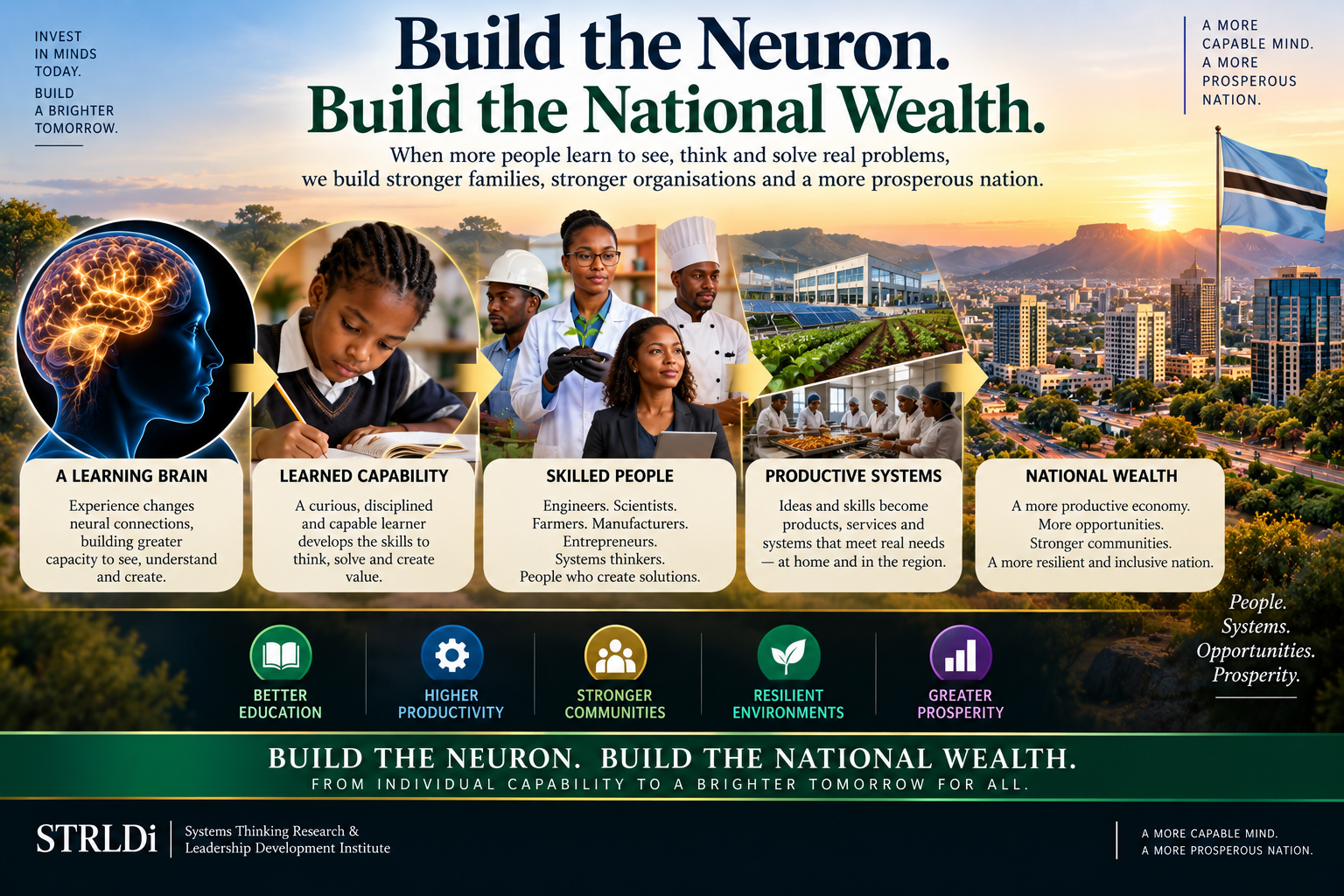
When the relationships become visible, the question changes. It is no longer simply what a nation knows, how many people it has educated, or how many qualifications it has issued; it becomes what its people have learned to see, what they have learned to build from what they see, and whether the resulting capability is large enough for the population they must support.
And that brings the argument back to the child with the question.
What are we teaching the brains that will have to think for the nation?
APPENDIX
A. NEUROBIOLOGY OF LEARNING AND STRUCTURAL CHANGE
The central argument of this article begins with a simple proposition: experience changes the learner. Neuroscience gives us several mechanisms through which this can occur, including changes in synaptic strength, dendritic spine structure, formation and stabilisation of synaptic connections, axonal organisation and network-level reorganisation. These processes are collectively part of the broader phenomenon of neural plasticity.
A neuron receives and integrates information through its dendrites and cell body and communicates with other cells through its axon. Communication between neurons commonly occurs at synapses, where chemical or electrical signals are transmitted from one cell to another. Dendritic spines are small structures on dendrites that frequently contain excitatory synapses and can change structurally in response to activity.
Key terms
Synapse — a specialised junction through which one neuron communicates with another neuron or another target cell.
Synaptogenesis — the formation of synaptic connections.
Synaptic plasticity — activity-dependent changes in the strength or efficacy of synaptic connections.
Long-term potentiation (LTP) — a form of persistent strengthening of synaptic transmission following particular patterns of activity. Research has shown that LTP can be accompanied by structural enlargement of individual dendritic spines and changes in AMPA-receptor-mediated currents.
Dendritic spine — a small protrusion from a dendrite where many excitatory synapses are formed. Spines can change in size, shape and stability as part of activity-dependent plasticity.
Experience-dependent plasticity — changes in neural structure or function associated with experience and learning.
The scientific literature does not support the simplistic proposition that every new fact produces one new synapse. Learning involves existing networks becoming stronger or weaker, connections being reorganised, and in some circumstances new synaptic structures being formed and stabilised. The more useful statement for this article is therefore: learning changes the organisation and function of neural networks through experience-dependent plasticity.
Learning and new synaptic connections
Research has provided unusually direct visual evidence of structural change during learning. Hedrick and colleagues used longitudinal in-vivo two-photon imaging together with correlated electron microscopy to examine dendritic spines in the motor cortex of mice during motor learning. They found that learning induced new excitatory synapses in the form of dendritic spines and that new spines were incorporated into functional clusters associated with learned movement.
This is particularly relevant to the argument developed in the article because the research concerns the binding of new information into existing functional organisation. The finding does not demonstrate that learning a systems archetype in a human produces a particular microscopic synaptic pattern. It does, however, provide biological evidence for a broader principle: learning can involve the formation, selection, stabilisation and functional organisation of new connections.
More recent research has extended the observation beyond postsynaptic dendritic spines. A 2025 Nature study using longitudinal two-photon imaging found that motor learning dynamically remodelled corticostriatal axonal boutons in awake mice. Newly formed boutons were more likely to be associated with rewarded movements and to be stabilised during learning, while some boutons associated with unrewarded movements were eliminated.
The significance is not that causal diagramming should be equated with motor learning. The significance is that learning is biologically active. Behavioural experience can participate in the reorganisation of the structures through which information is selected, represented and transmitted.
APPENDIX B. THE SYSTEMS THINKING / ARCHETYPE METHOD
The purpose of causal diagramming is to make relationships explicit enough to examine.
The practitioner begins with an observed event or condition and asks whether it forms part of a pattern over time. Variables are then identified, relationships between variables are examined, and causal chains are followed until feedback becomes visible. Once the loop is understood and its behaviour over time examined, a recurring structural pattern may be recognised as a systems archetype.
The progression used in STRLDi is:
Event → Pattern → Variable → Relationship → Causality → Causal Chain → Feedback → Loop → Behaviour Over Time → Archetype → Leverage
The important learning transition occurs when the practitioner encounters a new situation and recognises a structure previously learned elsewhere. The surface story changes, but the underlying relationship pattern becomes familiar.
This is consistent with the broader systems-thinking literature on archetypes. Systems archetypes are intended to help practitioners recognise recurring structural patterns beneath apparently different events; as the patterns become internalised, situations can be understood as larger systemic structures rather than isolated occurrences.
The language of causal links
In causal loop diagramming, S or same-direction relationships indicate that a change in one variable produces a change in the same direction in another, while O or opposite-direction relationships indicate a change in the opposite direction. Feedback structures are then identified as reinforcing (R) or balancing (B) loops. The Systems Thinker provides a useful reference on this language and the associated archetype structures.
The discipline is deliberately empirical. A causal link is a proposition to be examined, not a fact simply because an arrow has been drawn. The diagram makes the practitioner’s theory visible so that evidence, measurement and further observation can challenge or strengthen it.
APPENDIX C. SUBSTANCE USE: WHEN THE BRAIN LEARNS THAT THE REWARD MUST COME FROM OUTSIDE
Substance use provides a powerful counterpoint to the joy of learning because it shows that the brain learns from whatever experience is repeatedly reinforced. Psychoactive substances can directly alter systems involved in reward, motivation, attention, memory, perception, inhibition and decision-making; with repeated exposure, the brain adapts to the substance, while cues associated with its use can acquire the power to trigger anticipation, craving and drug-seeking. NIDA describes how repeated exposure can produce tolerance and withdrawal, and how, over time, drug use may shift from seeking pleasure to seeking relief from the distress that appears when the drug is absent. (NIDA IRP)
This creates a profound change in the relationship between reward and the learner. The joy of discovery arises when the mind discovers that it can now see, understand or do something it could not previously see, understand or do; the capability itself becomes rewarding. With a substance, the pleasurable state is produced externally by the pharmacological action of the substance, and repeated experience can teach the brain to want that externally produced state again. The desire therefore becomes increasingly attached to the return of the reward, rather than to the development of the capability that generated the reward.
This is where dependence becomes particularly important to the systems argument. As repeated exposure changes reward and stress systems, and as environmental cues become predictors of drug effects, the absence of the substance can itself become a signal of threat or distress. NIDA describes withdrawal-related anxiety, irritability and unease and notes that, with increasing drug use, a person may use the drug to obtain relief from this discomfort rather than simply to experience the original high. (NIDA IRP) In severe dependence, the learned relationship can therefore become something like: substance → relief/normality; absence → distress/threat → urgent desire for substance. That does not mean every dependent person literally believes they will die without the substance, but the brain can learn the substance as something it urgently needs, and for some substances withdrawal itself can be medically dangerous.
The contrast with learning is therefore sharper than simply natural reward versus drug reward. In discovery, the sequence can be:
Question → Exploration → Discovery → Capability → Joy → New Question
The reward is generated by becoming more capable, and that capability remains available to the learner. With repeated substance reinforcement, the sequence can become:
Substance → Pharmacological Reward → Relief/Pleasure → Anticipation → Desire → Repetition → Adaptation → Greater Need for the Substance
The systems question is therefore no longer merely What gives the brain pleasure? It is:
What is the brain learning that it needs in order to experience joy?
One pathway teaches the brain, I can discover something and become more capable. The other can teach the brain, I need something outside myself to produce the state I want to feel. That distinction matters because repeated experience does more than produce a momentary feeling: it teaches the brain what to pursue, what to anticipate, what to remember and what it comes to regard as necessary. (NIDA Archives)
APPENDIX D. ROAD ACCIDENTS: WHEN THE BRAIN CANNOT SEE THE CONSEQUENCE
A road accident appears first as an event: a vehicle collides with another vehicle, a pedestrian, an object or the road environment. Systems thinking takes us further by asking what was happening in the moments before the collision, what conditions shaped those moments, and what consequences continue long after the vehicle has stopped. Driving under the influence of a psychoactive substance brings the brain itself into the causal structure, because the substance can alter perception, attention, coordination, judgement and the capacity to process what is happening on the road.
The immediate relationship is therefore straightforward:
Substance → altered brain function → impaired perception/judgement/reaction → poorer driving decisions → increased crash risk → injury or death
WHO identifies driving under the influence of alcohol and other psychoactive substances as a significant road-traffic risk factor. The effects vary by substance, but psychoactive substances can impair functions required for safe driving; WHO also identifies speed, unsafe vehicles, unsafe infrastructure and inadequate post-crash care as other interacting risk factors. (World Health Organization)
The deeper question concerns what repeated substance exposure does to the learner. NIDA describes changes associated with addiction in brain systems involved in reward, stress, judgement, decision-making, learning, memory and behavioural control. With repeated exposure, reward circuitry adapts to the presence of the drug, while changes involving stress and prefrontal systems can contribute to compulsive use and reduced impulse control. (National Institute on Drug Abuse)
This matters because seeing a consequence requires more than having eyes on the road. The brain has to hold the present action together with what may happen next: speed with stopping distance, intoxication with impaired judgement, crossing the centre line with collision, collision with injury, injury with consequences for a family, and repeated risky behaviour with the possibility of eventually producing a pattern of harm. Learning depends on neural plasticity — connections are strengthened, weakened, formed and remodelled through experience. Substance exposure can alter these systems, which means that the capacity to connect action → consequence can itself become part of the problem.
The road therefore becomes a real-time test of consequence-processing. A driver under the influence may have the physical ability to see another vehicle while having impaired capacity to judge its speed, distance or significance; the driver may see the pedestrian while failing to integrate the information rapidly enough to produce the appropriate response. WHO reports that psychoactive substances increase crash risk, while cannabis, for example, can impair psychomotor performance, divided attention and the organisation and integration of complex information. (World Health Organization)
The longer-term system can be represented as:
Repeated Substance Exposure → Neural Adaptation → Altered Reward/Stress/Control Systems → Impaired Learning, Judgement & Self-Control → Greater Difficulty Connecting Action with Consequence → Repeated Risk → Greater Exposure
And the road-accident system then extends outward:
Impaired Brain Function → Driving Behaviour → Crash Risk → Injury/Death → Emergency Response → Health Burden → Household Consequences → Economic Consequences
The two chains meet in the driver. The immediate accident is the visible event; the altered capacity to see and process consequences can be part of the structure beneath the event. This is why the systems question cannot stop at the collision, the driver or the substance. We have to follow the river of causes backwards into the brain and forwards through the road, the household, the health system and the economy.
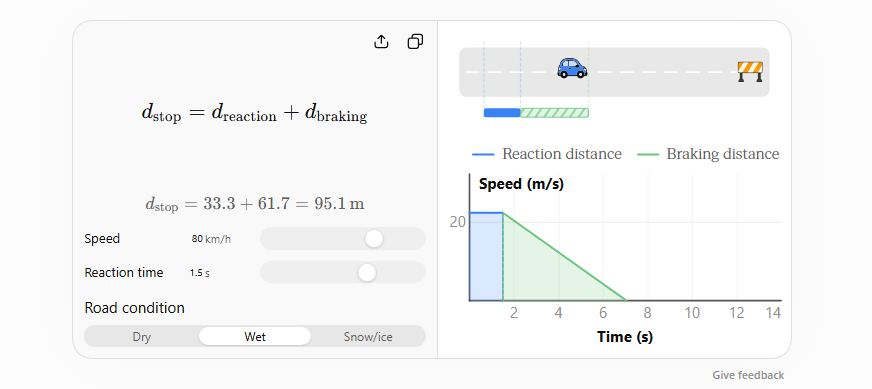
Speed gives us another way to see the same principle. Under constant braking conditions, stopping distance contains both the distance travelled while the driver reacts and the distance required to brake; as speed rises, the braking component rises approximately with the square of speed. A substance that delays perception or reaction therefore enters a physical system in which the road continues to move while the brain is still processing what it has seen.
The consequence may arrive in seconds. The neural and social consequences may continue for years.
That is the systems-thinking shift: from the accident we can see, to the brain that was processing the situation, to the relationships that produced the behaviour, to the consequences that continue after the event.
APPENDIX E. GENDERED VIOLENCE AND HOMICIDE: WHEN THE CONSEQUENCE DISAPPEARS FROM VIEW
A murder arising within an intimate relationship appears first as an event: one person has killed another. The event is visible and final, yet the causal structure surrounding it may have been developing for months or years through controlling behaviour, jealousy, repeated conflict, threats, violence, separation, economic dependence, substance use, access to weapons and the social conditions surrounding the relationship. WHO describes intimate partner violence as involving physical, sexual and psychological harm as well as controlling behaviours, and identifies interacting individual, relationship, community and societal factors associated with violence against women. (World Health Organization)
The systems question therefore begins before the murder:
Relationship Tension → Perceived Threat/Loss → Emotional Activation → Interpretation → Action → Immediate Consequence → Relationship Consequence → Further Emotional Activation
Where violence has already entered the relationship, the structure can become reinforcing:
Control → Resistance → Conflict → Escalation → Violence → Fear/Submission → Increased Control
The violence itself then changes the conditions from which the next episode emerges. WHO identifies controlling behaviour, power inequality, attitudes that justify violence, harmful alcohol use and exposure to violence in childhood among factors associated with intimate partner and sexual violence. These factors operate across individual, relationship, community and societal levels, so the event cannot adequately be understood by examining the final act alone. (World Health Organization)
The brain has to see what happens next
This brings the neurological question directly into the system.
To restrain an action, the brain has to connect what I am experiencing now with what this action will produce next. Anger, jealousy, perceived rejection or humiliation can narrow attention toward the immediate emotional experience; emotion-regulation difficulties have also been found to be associated with intimate-partner-violence perpetration in a meta-analysis of 62 samples. (PubMed)
Substances can enter the same structure. Alcohol and other psychoactive substances can alter judgement, inhibition, perception and emotional processing, while harmful alcohol use is identified by WHO as a risk factor associated with intimate partner violence. (World Health Organization) The resulting problem is therefore larger than the question of whether someone was angry or intoxicated at the moment of the killing: what has happened to the person’s learned capacity to connect an immediate impulse with its downstream consequences?
The causal chain may look like this:
Perceived Threat → Emotional Activation → Narrowed Attention → Reduced Consequence Processing → Aggressive Action → Immediate Relief/Resolution → Severe Consequence
The immediate consequence may be experienced by the perpetrator as the ending of an unbearable emotional state. The longer causal chain may contain consequences that the brain, in that moment, fails to integrate: death, imprisonment, children losing a parent, families losing both people, economic disruption, trauma and years of social consequences.
This is where the phrase passion can become analytically interesting. The event may appear to be a sudden explosion, yet the system may have been accumulating structure long before the explosion: a pattern of control, interpretation, emotional activation, conflict and reinforcement. The killing is the visible event at the end of a river of causes.
From the individual to the system
The consequences then travel outward:
Violent Act → Death/Injury → Children and Family → Household Disruption → Economic and Social Consequences → Community/Institutional Response
And the river can travel backwards as well:
Gender Norms/Power Relations → Relationship Expectations → Controlling Behaviour → Conflict → Violence → Normalisation/Fear → Reinforcement of the Relationship Structure
This wider structure matters because gender-related killings are not simply a collection of isolated interpersonal events. UNODC estimates that in 2024 almost 60% of all women and girls intentionally killed globally were killed by intimate partners or other family members, compared with 11% of male homicide victims killed in the private sphere. The UNODC data therefore reveal a distinct relationship between gender, intimate relationships and lethal violence. (UNODC)
The systems perspective allows us to hold both levels simultaneously: the person made the action, while the action occurred within a structure that had been forming around the person. Understanding that structure does not remove individual responsibility; it makes visible the points at which the trajectory could have changed.
That is the deeper connection with the road-accident example. In both cases, the final event is preceded by a failure or alteration in the processing of consequences. On the road, the driver may fail to integrate speed, perception, reaction and stopping distance quickly enough; in relationship violence, an escalating emotional and relational structure can overwhelm the capacity to connect the immediate action with the human consequences that follow.
The systems question becomes:
What has to be learned, reinforced, weakened or interrupted in the brain, the relationship and the surrounding system so that the next consequence can be seen before the action produces it?
That takes us directly from the murder as an event to the architecture that made the event possible — and therefore to the points at which the architecture can be changed.
The systems practitioner therefore keeps asking:
What happens next?
And then:
What does that consequence change?
That is how an event becomes a causal structure.
APPENDIX F. OTHER STRLDi CASE APPLICATIONS
Human–Wildlife Conflict: Escalation
Human–wildlife conflict can be examined as an escalation structure when actions taken by one side alter the behaviour of the other, which then generates further response from the first. The value of the archetype is that it allows the practitioner to move beyond the sequence of individual incidents and examine the feedback structure sustaining the escalation.
Unemployment: The Onion
The unemployment study provides a particularly useful illustration of moving beneath the visible event. The number of unemployed people is an observable condition, but the system producing persistent unemployment may involve multiple layers of education, skills, production, investment, enterprise formation, labour demand, institutional arrangements and economic structure.
The Onion archetype provides a way to ask what lies beneath the visible condition and what relationships repeatedly reproduce it.
Urgent Files: VDM Case
The urgent-files case illustrates another important distinction: organisations often respond to the most visible and immediate event while the structures generating recurring urgency remain intact. The Vision Deployment Matrix provides a complementary way of moving across levels of perspective—from events and patterns toward systemic structures, mental models and vision.
Daniel H. Kim’s Vision Deployment Matrix was developed as a framework for understanding current reality and desired future reality across multiple levels and for identifying the gaps and actions required to move between them.
STRLDi’s use of the VDM builds on this lineage while integrating it into its broader systems-diagnostic practice. The purpose is ultimately the same: to change the level at which a situation can be seen, and therefore the level at which it can be acted upon.
APPENDIX G. RESEARCH, REFERENCES AND VISUAL EVIDENCE
Neurobiology and learning
Hedrick et al., 2022 — Learning binds new inputs into functional synaptic clusters via spinogenesis.
The study used longitudinal in-vivo two-photon imaging and correlated electron microscopy to examine learning-related spine formation in mouse motor cortex.
Nature Neuroscience — Learning binds new inputs into functional synaptic clusters via spinogenesis
Sheng et al., 2025 — Remodelling of corticostriatal axonal boutons during motor learning.
The study tracked thousands of axonal boutons during motor learning and found dynamic structural and functional remodelling associated with learning.
Nature — Remodelling of corticostriatal axonal boutons during motor learning
Matsuzaki et al., 2004 — Structural basis of long-term potentiation in single dendritic spines.
This study demonstrated activity-dependent structural enlargement of individual dendritic spines associated with synaptic potentiation.
Nature — Structural basis of long-term potentiation in single dendritic spines
Lamprecht & LeDoux, 2004 — Structural plasticity and memory.
A review examining evidence connecting learning, memory and enduring changes in synaptic structure and function.
Nature Reviews Neuroscience — Structural plasticity and memory
Systems thinking and archetypes
Daniel H. Kim — Vision Deployment Matrix: A Framework for Large-Scale Change.
Kim’s framework describes five levels of perspective and provides a way of connecting current reality, desired future reality, gaps and action.
The Systems Thinker — Vision Deployment Matrix
Systems Archetypes as Structural Pattern Templates.
This reference explains how archetypes can function as recurring structural patterns that help practitioners recognise similar dynamics across apparently different situations.
The Systems Thinker — Systems Archetypes as Structural Pattern Templates
Systems Archetypes Basics.
A reference covering reinforcing and balancing processes, causal-loop language and related systems-thinking concepts.
The Systems Thinker — Systems Archetypes Basics
Substance use
National Institute on Drug Abuse — Drugs, Brains, and Behavior: The Science of Addiction
NIDA’s material provides the scientific background for the appendix discussion of reward, repeated exposure, brain adaptation and addiction.
Road safety
World Health Organization — Road Traffic Injuries
World Health Organization — Road Safety
These sources provide the evidence base for the discussion of speed, human error, safe-system design and the interaction of road, vehicle and human factors.
Gendered violence
World Health Organization — Violence Against Women
WHO — Violence Against Women: 2023 Prevalence Estimates
These provide current global evidence on prevalence and the interacting individual, relationship, community and societal factors associated with violence against women.
APPENDIX H — STEREOGRAM: EXPERIENCE THE SHIFT IN SEEING
The stereogram is included in the article as an experience, not simply as an illustration. The reader is asked to look at a repeated pattern and discover a three-dimensional structure that is already encoded in the image. The important moment is the perceptual shift: the pattern remains the same, while the organisation of what the observer sees changes.
Try a stereogram yourself: Magic Eye — How to See 3D
The official Magic Eye instructions recommend bringing the image close to the face, allowing the eyes to relax as though looking through the image into the distance, and slowly moving the image away until the hidden structure emerges. Once the hidden image is perceived, the depth becomes increasingly apparent. (Magic Eye)
For readers who want to understand the technique in more detail:
- How to View Stereograms — Hidden3DImage — explains the parallel-viewing method and provides practice exercises.
- How to View 3D Stereograms — Hidden 3D — provides several viewing methods, including the guiding-dot technique.
- Magic Eye 3D — The Complete Guide — provides a step-by-step explanation of how to relax the eyes and allow the hidden image to emerge.
The scientific principle is stereopsis: the visual system combines slightly different information from the two eyes to construct depth. Autostereograms exploit this mechanism by embedding repeated patterns with carefully controlled horizontal shifts, allowing a three-dimensional form to emerge when the visual system fuses the appropriate elements. (Sinauer Associates)
Why it belongs in this article
The stereogram provides a small but powerful experience of the distinction between information being present and structure being seen. The reader initially has the same visual information as before the hidden image appears; what changes is the organisation through which that information is perceived. That makes the stereogram a useful bridge into the article’s larger question: what happens when learning gives the mind a new structure through which relationships that were previously invisible become visible?
And importantly, the stereogram should appear in the body of the article itself, in Section C, with the appendix providing the instructions and external resources for readers who want to try it. The reader should experience the phenomenon first and read the technical explanation afterwards.
APPENDIX I — STRLDi REFERENCES: SYSTEMS THINKING, CAUSAL DISCOVERY AND SYSTEM ARCHETYPES
The systems-thinking component of this article builds on the body of work developed by Sheila Damodaran and the Systems Thinking Research & Leadership Development Institute (STRLDi) through research, practice, training and application across persistent organisational, societal and national issues.
1. What are System Archetypes?
This provides the foundational STRLDi treatment of system archetypes as recurring structural patterns composed of interacting reinforcing and balancing feedback loops that generate characteristic behaviour over time. It also establishes the distinction between archetypes as diagnostic structures and their use as narrative or facilitation devices. (STRLDi)
STRLDi — What are System Archetypes?
2. Uncovering System Archetypes — Systemic Structures
This reference sets out the practical discipline of causal-loop construction, including variables, S/O relationships and the even–odd O rule for distinguishing reinforcing and balancing loops. It is particularly relevant to this article’s progression from variable → relationship → causality → loop → archetype. (STRLDi)
STRLDi — Uncovering System Archetypes
3. Seeing Dynamic Complexity
STRLDi’s treatment of dynamic complexity distinguishes the visible event from the behaviour over time and systemic structure producing persistent behaviour. It provides an important foundation for the article’s proposition that learning to see means moving progressively beneath events toward relationships, feedback and structural persistence. (STRLDi)
STRLDi — Seeing Dynamic Complexity
4. Shared Vision: Envisioning the Whole for the Future
This work develops the movement across Events, Patterns, Systemic Structures, Mental Models and Vision, and includes STRLDi’s treatment of the Vision Deployment Matrix. It is relevant to the article’s movement from observing reality toward understanding the structures that generate it and then identifying where change can occur. (STRLDi)
STRLDi — Shared Vision: Envisioning the Whole for the Future
5. Practicing the Five Disciplines — STRLDi Compendium
The STRLDi Compendium brings together Behaviour Over Time, Causal Loop Diagrams, Vision Deployment Matrix, leadership reflection and the Laws of Dynamic Complexity as a repeated learning rhythm. This is especially relevant to the article’s argument that systems thinking is developed through practice: seeing a pattern, uncovering its structure, identifying leverage and learning to recognise the structure again. (STRLDi)
STRLDi — Practicing the Five Disciplines
6. How the Onion Was Discovered
The Onion represents Sheila Damodaran’s development of a way of seeing the whole system through recurring systemic structures. Its significance for this article is particularly strong because it illustrates the transition from individual archetypes toward interconnected structures operating across persistent national and societal issues. (STRLDi)
STRLDi — How the Onion Was Discovered
7. STRLDi Management Tools Framework
This framework places System Archetypes, the Onion Model and Causal Loop Diagrams at the structural level, distinguishing them from tools concerned primarily with events, patterns, alignment or execution. It provides a useful reference for the article’s argument that different tools enable different levels of seeing. (STRLDi)
STRLDi — Management Tools Framework
8. STRLDi Training: Deepening the Systems Thinking Discipline
This programme material documents the deliberate training pathway through which learners move from causal loops and behaviour-over-time graphs to system archetypes and strategic intervention. Of particular relevance to this article is the description of the learner acquiring a new way of seeing the behaviour of reinforcing and balancing loops over time. (STRLDi)
STRLDi — Deepening the Practice of Systems Thinking
9. The STRLDi Archetype Handbook
STRLDi’s comprehensive archetype reference brings together the major archetypes—including Reinforcing and Balancing Loops, Fixes That Fail, Shifting the Burden, Limits to Growth, Escalation, Success to the Successful, Drifting Goals, Growth and Underinvestment, Tragedy of the Commons and Accidental Adversaries—as a practical working reference. (STRLDi)
STRLDi — Systems Thinking Archetypes Handbook
10. The STRLDi Journey
The development of this work extends over decades of practice, beginning with the observation of recurring patterns and developing through Behaviour Over Time, System Archetypes, organisational learning and the application of systems thinking to organisational, national and global issues. (STRLDi)
STRLDi — Mastering the Architecture of Change
11. Vision Deployment Matrix — Daniel H. Kim
STRLDi explicitly acknowledges Dr Daniel H. Kim for the creation of the Vision Deployment Matrix™, published in The Systems Thinker in 1995. The STRLDi work builds on this foundation as part of its broader practice of moving between events, patterns, systemic structures, mental models and vision. (STRLDi)
STRLDi — Introducing the Compendium and acknowledgement of Dr Daniel H. Kim
Why Appendix I matters
These references establish that the systems-thinking portion of When a Nation Learns to See is not being assembled from generic descriptions of systems thinking. It emerges from STRLDi’s own body of practice and inquiry into persistent behaviour, causal structures, system archetypes, dynamic complexity, the Vision Deployment Matrix and the development of systemic interventions.
The article’s learning progression—
Event → Pattern → Variable → Relationship → Causality → Causal Chain → Feedback → Loop → Behaviour Over Time → Archetype → Leverage
—should therefore be presented as part of the intellectual and practical development of this work, with the individual STRLDi references above allowing readers to follow the deeper material.
And I would make Appendix I the author’s reference base, while the preceding scientific appendix remains the evidence base for the neurobiology. That cleanly separates the two: the neuroscience tells us what is known about learning and neural plasticity; the STRLDi references show the body of systems-thinking practice through which we have developed the question of what happens when people learn to see causal structure.
A FINAL NOTE ON THE EVIDENCE
The central proposition of this article is deliberately broader than any single neuroscience experiment. The research establishes that learning is accompanied by changes in neural function and, in relevant experimental settings, by structural changes in synapses, dendritic spines and axonal boutons. The systems-thinking proposition is that repeated practice in representing and recognising causal relationships can develop a transferable capability for seeing recurring structures.
The bridge between those two bodies of knowledge should therefore be stated carefully. We do not have evidence that learning a particular systems archetype creates a particular identifiable synapse, nor should we claim that a causal-loop diagram maps directly onto a microscopic neural structure. What the evidence permits us to say is more useful: the brain is plastic, experience changes neural organisation, and deliberate learning can develop new capabilities of perception, representation, retrieval and application.
The national proposition follows from there. If causal structures can be learned, recognised and transferred across situations, then a society can deliberately cultivate people who are increasingly capable of seeing the relationships that produce persistent outcomes. That makes systems intelligence a candidate for national capability formation—not because the brain is a metaphor for the nation, but because the people who constitute the nation’s institutions are the brains through which its strategies are conceived.








You must be logged in to post a comment.