Three Pathways of The Practice of Personal Mastery:


FROM EVERYDAY ACTS TO ORGANISATIONAL TRANSFORMATION

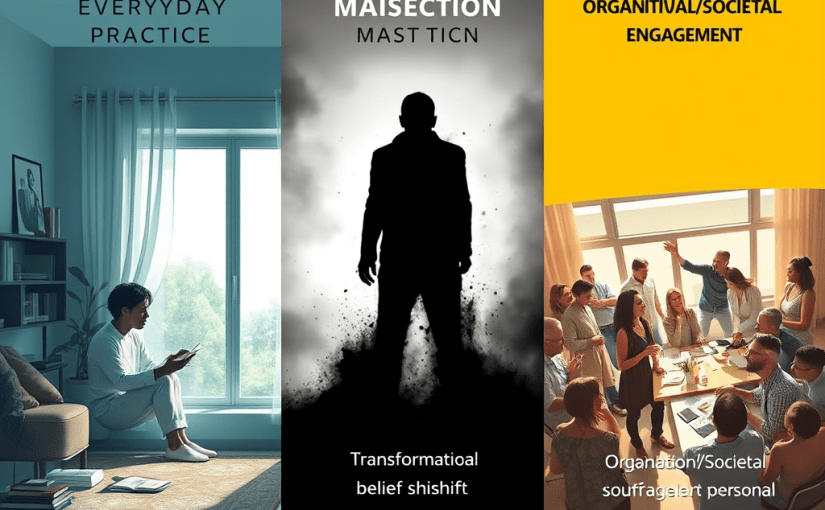
This guide outlines the full scope and texture of personal mastery as a living discipline. Drawing from real experiences, case studies, and foundational tools from The Fifth Discipline, it shows how personal mastery unfolds across three intensities of engagement: Everyday Practice, Transformational Belief Shift, and Organisational/Societal Engagement.


SITUATION 1: Everyday Practice
Simple, repeatable acts that build awareness, intention, and alignment.

Examples:

  • Practice personal visioning in daily activities. For instance, upon seeing a pile of dirty dishes, resist reacting out of obligation. Instead, pause and imagine the end state: dishes gleaming, neatly stacked, and a space restored. This subtle shift from reacting to envisioning invites energy to rise from within, aligned with what we want to create.
  • Check internal state before responding. Before replying in a difficult meeting, pause and notice: Am I reacting to a threat or responding with purpose?
  • Daily journaling. Reflect on the difference between what you did and what you wanted to create.

Purpose:
Makes personal mastery accessible. Builds inner steadiness and intentionality. Trains attention to stay rooted in vision, not reactivity.


SITUATION 2: Transformational Practice Rooted in Deep Belief (“The Shift”)
Facing and transforming invisible mental models that sustain stagnation or self-sabotage.

Illustrated by the 2011 newspaper incident:

  • A public article misrepresented a complex initiative, distorting intent and impact.
  • The silence from allies was louder than the criticism. Shame crept in.
  • A new mental model formed: “Don’t make noise. Stay safe. Visibility brings danger.”

The Shift Process:

Name the Triggering Event. What incident caused a rupture or contraction?

Identify the Belief Formed. What unconscious story began? E.g. “Visibility is unsafe.”

Observe Its Impact. How has it shaped decisions, posture, and relationships?

Distinguish Past from Present. “That article was misinformed. It no longer gets to define me.”

Reframe Power and Identity. “Their silence is not my shame to carry.”

Create a New Internal Commitment. “I now speak to serve, not to be validated.”

Purpose:
Acts as a doorway to deeper authenticity. Enables structural shifts in identity and self-concept. Builds the resilience to lead without waiting for permission.


SITUATION 3: Organisational / Field / Societal
Where personal mastery scales to systems-level change through collective learning.

Practices:

  • Co-evolve mental model dialogues into shared team learning. Bring individual reflections into safe spaces for group discovery.
  • Map systemic structures using the Onion Model.
    • Example: The national unemployment study in Botswana used this model to surface feedback loops, delays, archetypes, and mental models.
  • Apply scenario planning to test future pathways.
  • Facilitate visioning to build cross-functional teams around shared purpose.

Objectives:

  • Enable collaborative strategy design.
  • Cultivate systems leadership across silos.
  • Create “learning organisations” capable of sensing, reflecting, and evolving.

Purpose:
Personal mastery at this level becomes a catalyst for systemic transformation. It is no longer about individual growth, but the growth of capacity in the system to hold complexity, to envision together, and to act with courage.


Closing Note:
Whether practiced quietly at a kitchen sink, or enacted across national strategy tables, personal mastery is the unseen discipline that makes meaningful change possible. All three pathways matter. All three prepare us to become who we must be for the futures we long to create.


Mastery Is Not a Metaphor: Honouring the Depth of The Fifth Discipline


THE ANTI-THESIS: The Misjudged Simplicity of Deep Work

Too often, we assume that knowledge—especially the kind required for leadership and systems transformation—can be transferred in slides, soundbites, or summaries. But The Fifth Discipline is not that kind of work. It was never meant to be packaged, diluted, or consumed at speed.

UNDERSTANDING TACIT KNOWLEDGE

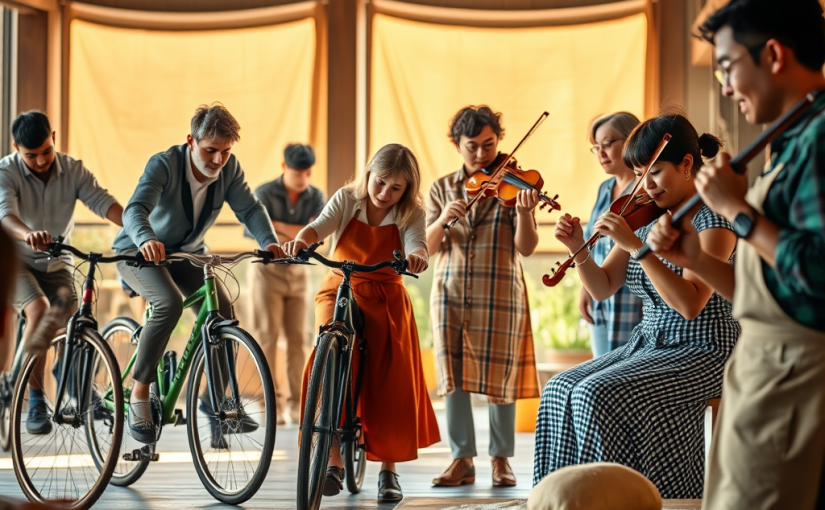
Tacit knowledge, unlike explicit knowledge, cannot be codified or easily conveyed. It lives in practice, reflection, embodiment, and often in the unspoken. Riding a bicycle, kneading dough, playing a violin—these are skills we acquire not by reading about them, but by doing them. Again and again.

THE ROOTS OF THE FIFTH DISCIPLINE: A Tapestry of Tacit Mastery

The creation of The Fifth Discipline was no accident. It emerged from over three decades of tacit learning, inquiry, and applied practice—primarily driven by early post-war scholars, practitioners, and industry leaders who watched the collapse of pre-war industrial management tenets in the face of a rapidly changing world. The post-World War II period saw not only the reconstruction of global economies, but a population boom and the emergence of unprecedented complexity in business, society, and technology. Traditional hierarchical models, which had served wartime economies, quickly began to show their limits in a more networked, volatile, and interdependent world.

This led pioneers such as Jay Forrester to develop systems dynamics at MIT in the 1950s—a new way to understand the nonlinear, feedback-driven behavior of complex systems. Donella Meadows expanded on this in the 1970s with The Limits to Growth, illuminating how system structures create persistent global challenges. Chris Argyris’s work on action science and organizational learning further emphasized the role of mental models and reflective practice.

Peter Senge, synthesizing and building on this lineage, collaborated with Robert Fritz, Daniel Kim, Michael Goodman, Art Kleiner, and many others to develop a holistic, practice-based framework for learning organizations. Their work unfolded across industries, education, government, and communities from the 1960s through the early 1990s. It culminated in the founding of the Society for Organizational Learning (SoL), initially housed at the Massachusetts Institute of Technology (MIT), which sought to institutionalize these principles in real-world settings.

THE MOMENT OF EMERGENCE: A Watershed in 1990

When Senge published The Fifth Discipline in 1990, it took the world by storm—not because it was flashy, but because it named what many already felt but couldn’t yet articulate. It offered an integrated way to see, think, and lead that resonated with a world beginning to feel the cracks of mechanistic, siloed models of management.

WHAT HE ENVISIONED: Mastery, Complexity, and Capacity

Senge envisioned future organizations as living systems—learning to handle more complex environments, motivated by their own evolving capacity to learn. Not just coping, but growing through challenge. Not just reacting, but cultivating systemic resilience.

WHAT ABOUT YOU? WHAT DO YOU WANT?

This is not a rhetorical question. Each of us, in coming to this work, must ask: What are we reaching for? Do we want the language of systems thinking—or the capacity? Do we want the titles and frameworks—or the transformation?

MATCHING DEPTH WITH DEPTH

My answer has been clear: to meet the depth of this work with equal commitment to learning it. I’ve studied it through one-day sessions, year-long programs, deep facilitation with originators of the field, and years of application. Each layer brought more agility, more groundedness, and more grace in applying the five disciplines—not as tools, but as a way of seeing and being.

THE BOOK IS NOT ENOUGH

Reading The Fifth Discipline cannot replace the practice it demands. If you want to embody this work, it must become part of you—your language, your inquiry, your response to life and complexity. That takes time. And practice. And courage.

THE INVITATION TO PRACTICE: Beyond the 2-Hour Workshop

This is not a 2-hour certificate program. The state of leadership, institutions, and systems today reflects that illusion. The kind of leadership the world needs now requires immersion, not consumption.

A CALL TO EDUCATION: The Work Belongs in Tertiary Institutions

We must elevate this work to the level it deserves. The Fifth Discipline should be embedded as a postgraduate program across global institutions. Let leaders take real time—months, not hours—to step into mastery, and emerge not just trained, but transformed.


THE PRICE OF CODIFICATION WITHOUT EMBODIMENT

Humanity is paying a steep price for its over-reliance on codified, explicit knowledge. We see it in:

  • Policy failures that repeat the same errors because deeper mental models are not examined.
  • Institutional burnout where staff are trained, but not transformed.
  • Climate action plans written in beautiful language, yet unable to shift entrenched systems.
  • Education systems that produce credentialed individuals but not adaptive leaders.
  • Health systems that understand illness biologically but not socially or systemically.

The consequence? We keep accelerating into crises without the reflexivity to course-correct.

Only a return to tacit learning, systemic awareness, and collective mastery will equip us to build and sustain futures worth living for.


If this speaks to your practice, your institution, or your leadership journey—reach out. The work ahead demands more than content. It calls for character, commitment, and the courage to learn together.

Newspaper Column #11: Why do some problems defy, no, NOT change? – Part III


As it appeared in the Sunday Standard, Botswana on Sunday Jan 13, 2013 edition.

Change Happens at the Speed of Thinking about the Whole rather than of Our Part

What causes change to be real?  Understanding it with a story: “The Healing Poison”

Hope all of you had fabulous New Year festivities with family loved ones!  And of course, wishing all of you a bright and promising year in 2013!

Just before Christmas, this column began running the story of the uncle, the daughter-in-law and mother-in-law.  Over the holidays, I had many of you asking how does the story end.  I am sure you have figured how it ends!

It was meant to illustrate how we turn around and solve persistent issues.  These are issues that resist efforts to change.   In short, for any causality cycle that is vicious, are they unemployment or greening the country or HIV or crime.

Well, here’s a recap of the beginning of that story.

The Story

Both daughter-in-law (DIL) and mother-in-law (MIL) started their relationship with each other really well.  As we all do.  Except over time, they find themselves in an increasingly difficult relationship!  That happens too.

In frustration, the DIL shares her problem with her favorite uncle.  She now believes if she gets rid of MIL, she would have got rid of the problem.  She has come to her uncle to seek for help on how to get rid of her MIL.

The uncle advises her, giving her first a small bottle with some liquid inside, that she drops two drops of it in a hot cup of milk and present the cup of milk to her MIL.  She must make sure that MIL drinks one cup for every night for the next six months.

And when she hands the cup of milk to her MIL, she must do so, with a smile.  He assured her that by the end of six months, the MIL will be gone.

So, what do you think happened next?

Well, as difficult as it was now to smile at her MIL, the DIL had been so bent on getting rid of the problem; she decides to put the plan to action right away.

That night, just before her MIL approached her bed-time, she carefully boiled a cup of milk on the stove, dropped the two drops of the liquid her uncle gave her and she proceeded to her MIL’s room.

On the way, she spots a mirror, preens into it and tests her smile in the reflection.  Happy with what she saw, she then knocks on the door and steps into her MIL’s room.  With a smile.  Just as the uncle prescribed it!

She then says, “MIL, I have prepared a hot cup of milk for you.  I know how tired you must be after a hard day at work for all of us.  Please drink it.

Being her first night at this, she left the cup of milk next to the MIL’s bedside and quickly walked out of the room.  Except, she was not sure, if the MIL actually drank it.  She could not sleep the whole night.

The next day, she made her way back to her MIL’s room.  To check.  True enough.  The MIL had drunk the milk.

MIL had been tired and so she actually welcomed the drink.  When she drank she had a restful sleep.

Smiling quietly, the DIL thinks, “Good one night down, six more months to go!”  And so, the DIL resolves to make this a nightly ritual with her MIL for the next six months.

So, what do you think happened next?

Well, let’s switch the story over to MIL.  What does she see?  She sees her DIL present the cup of milk with a smile.  And when she drinks it, she finds her sleep improves and she now sleeps like a baby.  When she gets up in the morning, she is refreshed.

Over time, as her body rejuvenates, she finds herself completing the daily chores in a jiffy and even finds time to spend with her two grandchildren. In the past, she would feel tired to do so, but these days she enjoys their time together.

A few weeks later, as her moods begin to lift, she decides to gather a group of her close friends to dabble in her favourite past time – a round of cards.  And because she sleeps better, she finds herself concentrating better on the game and soon learns to win better with each try.

Since they play for the money, after just a few weeks, she was learning to bring home a tidy sum of money.   A few months on, she was actually, bringing in 500 pula each time!  She was overjoyed.  This was at month No. 2.

One afternoon, as she sipped her tea on the veranda, she began to realize that life indeed seems to feel different.  She is energized these days and she is now enjoying her time with family and friends and she wondered, what caused it.

She then realized things had begun to change, from the time her DIL started giving her the cup of milk.  She felt grateful for the action.  And then, there is something about when our attitudes go up by themselves, our willingness to return that favour on our volition (choice), goes up too.

The next day, she decides she should return the favour to DIL.  So that evening, when the DIL returns home, tired and hungry from work, she spots a hot piping supper on the table.  She could not believe her eyes!

The MIL comes out of the kitchen and says to her, “I have prepared this meal for you.  Do have it.”  The MIL then pops back into the kitchen.  Out of gratitude, the DIL sits down at the table, to have the meal.  When the MIL comes out a few minutes later, she notices that the DIL has accepted the meal.  She feels happy, and decides she will continue to make the meal for her DIL.

So, what do you think happened next?

Well, the DIL finds she does not need to make supper, she decides to use that time to help her children with their schoolworks.  And because the mother has time to inspire their learning, the children find it easier to focus in the classroom, and soon find their grades improve.

When the grades began to grow, the mother finds herself better able to focus at the workplace.  With improved focus, she finds herself diligent not just completing but also leading her work.  When the boss notices the change in her, he is pleased and says to her, “Keep that up, and you will be promoted”.  This was now month No. 4.

The DIL could not believe her ears!  The boss had always been on her back, but these days, he is talking about her promotion!  What happened?  Her relations in the family and at work are improving and she has never been happier.  What caused it, she wonders.

She then realizes that things began to change, when her MIL began to prepare her supper.  She felt grateful for the action.  And then, there is something about when our attitudes go up by themselves, our willingness to return that favour on our volition (choice), goes up too.

The next day, DIL decides, she should return that favour to MIL.  MIL is already out of the house, playing cards with her friends.  When she returns, with now 900 pula in her pockets and she crosses the threshold into the house, a gasp escapes her lips.  She notices a very clean and tidy house!  DIL has cleaned the whole house and she is stunned by its beauty.  She says to herself, “What a great DIL  I have!”

As she moves around admiring the newly spanked home, she begins to wonder to herself, “Why are we still quarrelling?”

And then she decides (herself), she is going to change things once and for all.

She quickly goes to the kitchen, boils two cups of tea and proceeds to look for her DIL.  When she finds her, she sits down with her, and with a smile she asks, “Shall we call it truce?”

The DIL was delighted, of course!  ….

What do you think happened next?  Have things changed?  For good?

This concept of managing change is new to most of us.  We could escape ourselves by miring in addictions or resign to stay in depressions, but there is another way.   And it can start with anyone or anywhere.

As we learn to see and turn the cycle around, the cycle takes over and helps to create new experiences that are felt by its participants.  This gives birth to new attitudes from within the participants and therefore these lead to new actions by the participants themselves.

Since it is led by experiences that are real for them rather than suggested or set for them, the change will not revert.

Otherwise, nothing would have changed, would it?

Do you remember how it all started?  Question is, what caused the change?  What caused the circle to turn around?

This will make a great supper discussion with your own family, would it not?  That will be the subject of discussion in Part IV of this instalment.

Psst …. Did you ask you want to know what came of the liquid in the bottle?  That’s coming next week!  Smile.

Wishing you a great week ahead of discovery and learning.

Ms Sheila Damodaran, originally from Singapore, is an international Strategy Development Consultant focussed on assisting national commissions tasked with strategy development.  She welcomes comments at sheila@loatwork.com.  For upcoming programmes, refer to www.loatwork.com/Senior_Leadership_Introduction.html.

Article 2: Setting goals is the easy part. Reaching them is not!


REACHING THE GOALS YOU HAVE SET IS NOT EASY TILL …. WE FACE AND DEAL WITH STUBBORN PROBLEMS

It is a management question.

Are you there yet?  What are you doing to get there?  Have you set goals for you and your team?

Yet, setting of goals is really the easy part.  And there are tons of research and help on how we may do so and even on how to manage the settings.  Making out a list of “Things to do today” is one such everyday activity and we are pretty good at it.

However, reaching them is another story.  And there is not as much research on why it does not happen or how it may happen for our organizations.  And not to say, much help.

It is an area that we stay quiet on.  Sometimes, even a undiscussable.

WHAT IS HAPPENING?

And we learn over time with experience that using charisma, meeting of heads, efforts at cascading, seeking to agree, cajole, counsel and sometimes even assuming punitive stances does not realistically make that much of a difference in reaching those goals or implementing programmes as an institution or as a nation in a sustainable way.

And we may carry out various activities to do so.  Be it implementing performance management systems, setting of directives, designing project management, re-engineering business processes, coaching, mentoring, going for corporate retreats, organizing seminars, conferences, district and village meetings and signing of memorandums, monitoring and evaluation and so on.  The list of work required to reach those goals is seemingly endless and appears necessary.  But the price we pay as a nation is heavy (including for our attorneys).

We all know this deeply; though we may not necessarily say it out aloud.  We do lead ourselves to believe they work, and yet sometimes we would rather choose to continue to lower our standards in reality to meet realistic levels of achievement over time and not understand what’s getting in the way of reaching those goals.   The former is easier.  The latter is harder.  And we are sometimes not aware that such things may be happening to us.  Often we assume the reason is the fault of the employee, or of the team manager or of the market or of the citizens or even the global recession.  And we get away by blaming “them out there”.  We get away with crime!

However, the bottom line is the ability of the organization and / or of the nation to sustain itself.

When we do not do so, it usually shows up in our balance sheets as deficits.  Eventually.  Sometimes sooner than we expect leading us to make call outs to government for bailouts, bank loans or grants and aids.  Nevertheless, we would start the same rigmarole all over again when given a second chance.

SO GIVEN THE ABOVE, WHY DOES IT HAPPEN AND WHAT COULD WE DO ABOUT IT?

What are we not learning?

The reasons cited above are what we see on the tip.  The obvious reasons.

The ones the problems present to us if we are not careful in search for the reasons more deeply.  Those are usually not the real ones.

If you have come this far, I am sure you are not surprised by this conclusion.  The real reasons are less obvious because they have become what we call cyclical in nature or assumes a systemic quality.   Systemic because of key interrelationships (vicious circles) that have taken on a quality of recurrent influence / causality over time.

When they assume that recurrent influence, they also tend to worsen in each iteration of the cycle and therefore these cycles grows deeper and away from our everyday perceptions of reality (underlying).  These structures do also one more thing.  They typically learn to defy any efforts on our part to ‘correct’ the situation or a problem with the programmes or initiatives institutions come up with.  Therefore programme or activity implementation efforts tend to stand to fail or do not reach the goals set for them.

Identifying these vicious circles require investigation and a tactic that is very different from the straight-line approaches we are used to when dealing with them.  One that requires the mind ‘to bend’.  The causality is not that much different from one nation to another (and so much less differences exist between institutions), nevertheless, rather than leave participants with the solution, I prefer participants learn to discover the reasons jointly with each other whilst with the facilitator.  This is strategic.

In this way, the participants learn to leave the sessions carrying with them in their minds and hearts ways to continue to deepen their practice with each other over time to get to the bottom of the issue, and eventually to reach there by themselves.