Three Pathways of The Practice of Personal Mastery:


FROM EVERYDAY ACTS TO ORGANISATIONAL TRANSFORMATION

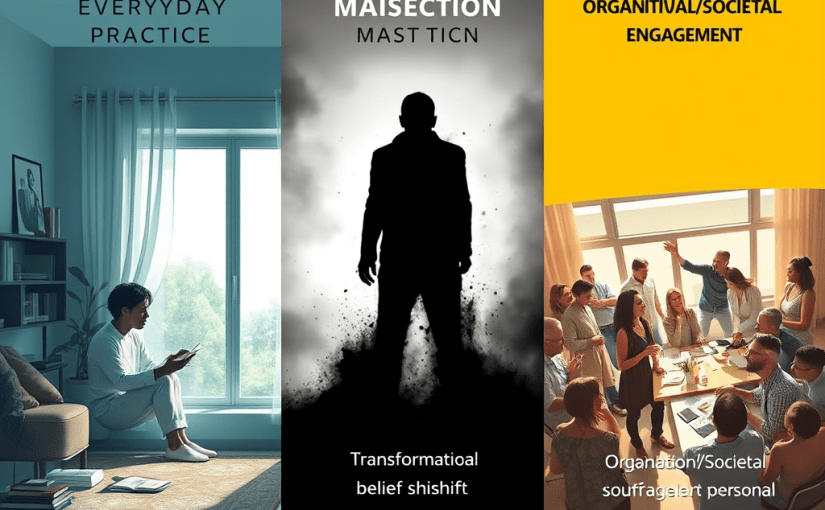
This guide outlines the full scope and texture of personal mastery as a living discipline. Drawing from real experiences, case studies, and foundational tools from The Fifth Discipline, it shows how personal mastery unfolds across three intensities of engagement: Everyday Practice, Transformational Belief Shift, and Organisational/Societal Engagement.


SITUATION 1: Everyday Practice
Simple, repeatable acts that build awareness, intention, and alignment.

Examples:

  • Practice personal visioning in daily activities. For instance, upon seeing a pile of dirty dishes, resist reacting out of obligation. Instead, pause and imagine the end state: dishes gleaming, neatly stacked, and a space restored. This subtle shift from reacting to envisioning invites energy to rise from within, aligned with what we want to create.
  • Check internal state before responding. Before replying in a difficult meeting, pause and notice: Am I reacting to a threat or responding with purpose?
  • Daily journaling. Reflect on the difference between what you did and what you wanted to create.

Purpose:
Makes personal mastery accessible. Builds inner steadiness and intentionality. Trains attention to stay rooted in vision, not reactivity.


SITUATION 2: Transformational Practice Rooted in Deep Belief (“The Shift”)
Facing and transforming invisible mental models that sustain stagnation or self-sabotage.

Illustrated by the 2011 newspaper incident:

  • A public article misrepresented a complex initiative, distorting intent and impact.
  • The silence from allies was louder than the criticism. Shame crept in.
  • A new mental model formed: “Don’t make noise. Stay safe. Visibility brings danger.”

The Shift Process:

Name the Triggering Event. What incident caused a rupture or contraction?

Identify the Belief Formed. What unconscious story began? E.g. “Visibility is unsafe.”

Observe Its Impact. How has it shaped decisions, posture, and relationships?

Distinguish Past from Present. “That article was misinformed. It no longer gets to define me.”

Reframe Power and Identity. “Their silence is not my shame to carry.”

Create a New Internal Commitment. “I now speak to serve, not to be validated.”

Purpose:
Acts as a doorway to deeper authenticity. Enables structural shifts in identity and self-concept. Builds the resilience to lead without waiting for permission.


SITUATION 3: Organisational / Field / Societal
Where personal mastery scales to systems-level change through collective learning.

Practices:

  • Co-evolve mental model dialogues into shared team learning. Bring individual reflections into safe spaces for group discovery.
  • Map systemic structures using the Onion Model.
    • Example: The national unemployment study in Botswana used this model to surface feedback loops, delays, archetypes, and mental models.
  • Apply scenario planning to test future pathways.
  • Facilitate visioning to build cross-functional teams around shared purpose.

Objectives:

  • Enable collaborative strategy design.
  • Cultivate systems leadership across silos.
  • Create “learning organisations” capable of sensing, reflecting, and evolving.

Purpose:
Personal mastery at this level becomes a catalyst for systemic transformation. It is no longer about individual growth, but the growth of capacity in the system to hold complexity, to envision together, and to act with courage.


Closing Note:
Whether practiced quietly at a kitchen sink, or enacted across national strategy tables, personal mastery is the unseen discipline that makes meaningful change possible. All three pathways matter. All three prepare us to become who we must be for the futures we long to create.


Mastery Is Not a Metaphor: Honouring the Depth of The Fifth Discipline


THE ANTI-THESIS: The Misjudged Simplicity of Deep Work

Too often, we assume that knowledge—especially the kind required for leadership and systems transformation—can be transferred in slides, soundbites, or summaries. But The Fifth Discipline is not that kind of work. It was never meant to be packaged, diluted, or consumed at speed.

UNDERSTANDING TACIT KNOWLEDGE

Tacit knowledge, unlike explicit knowledge, cannot be codified or easily conveyed. It lives in practice, reflection, embodiment, and often in the unspoken. Riding a bicycle, kneading dough, playing a violin—these are skills we acquire not by reading about them, but by doing them. Again and again.

THE ROOTS OF THE FIFTH DISCIPLINE: A Tapestry of Tacit Mastery

The creation of The Fifth Discipline was no accident. It emerged from over three decades of tacit learning, inquiry, and applied practice—primarily driven by early post-war scholars, practitioners, and industry leaders who watched the collapse of pre-war industrial management tenets in the face of a rapidly changing world. The post-World War II period saw not only the reconstruction of global economies, but a population boom and the emergence of unprecedented complexity in business, society, and technology. Traditional hierarchical models, which had served wartime economies, quickly began to show their limits in a more networked, volatile, and interdependent world.

This led pioneers such as Jay Forrester to develop systems dynamics at MIT in the 1950s—a new way to understand the nonlinear, feedback-driven behavior of complex systems. Donella Meadows expanded on this in the 1970s with The Limits to Growth, illuminating how system structures create persistent global challenges. Chris Argyris’s work on action science and organizational learning further emphasized the role of mental models and reflective practice.

Peter Senge, synthesizing and building on this lineage, collaborated with Robert Fritz, Daniel Kim, Michael Goodman, Art Kleiner, and many others to develop a holistic, practice-based framework for learning organizations. Their work unfolded across industries, education, government, and communities from the 1960s through the early 1990s. It culminated in the founding of the Society for Organizational Learning (SoL), initially housed at the Massachusetts Institute of Technology (MIT), which sought to institutionalize these principles in real-world settings.

THE MOMENT OF EMERGENCE: A Watershed in 1990

When Senge published The Fifth Discipline in 1990, it took the world by storm—not because it was flashy, but because it named what many already felt but couldn’t yet articulate. It offered an integrated way to see, think, and lead that resonated with a world beginning to feel the cracks of mechanistic, siloed models of management.

WHAT HE ENVISIONED: Mastery, Complexity, and Capacity

Senge envisioned future organizations as living systems—learning to handle more complex environments, motivated by their own evolving capacity to learn. Not just coping, but growing through challenge. Not just reacting, but cultivating systemic resilience.

WHAT ABOUT YOU? WHAT DO YOU WANT?

This is not a rhetorical question. Each of us, in coming to this work, must ask: What are we reaching for? Do we want the language of systems thinking—or the capacity? Do we want the titles and frameworks—or the transformation?

MATCHING DEPTH WITH DEPTH

My answer has been clear: to meet the depth of this work with equal commitment to learning it. I’ve studied it through one-day sessions, year-long programs, deep facilitation with originators of the field, and years of application. Each layer brought more agility, more groundedness, and more grace in applying the five disciplines—not as tools, but as a way of seeing and being.

THE BOOK IS NOT ENOUGH

Reading The Fifth Discipline cannot replace the practice it demands. If you want to embody this work, it must become part of you—your language, your inquiry, your response to life and complexity. That takes time. And practice. And courage.

THE INVITATION TO PRACTICE: Beyond the 2-Hour Workshop

This is not a 2-hour certificate program. The state of leadership, institutions, and systems today reflects that illusion. The kind of leadership the world needs now requires immersion, not consumption.

A CALL TO EDUCATION: The Work Belongs in Tertiary Institutions

We must elevate this work to the level it deserves. The Fifth Discipline should be embedded as a postgraduate program across global institutions. Let leaders take real time—months, not hours—to step into mastery, and emerge not just trained, but transformed.


THE PRICE OF CODIFICATION WITHOUT EMBODIMENT

Humanity is paying a steep price for its over-reliance on codified, explicit knowledge. We see it in:

  • Policy failures that repeat the same errors because deeper mental models are not examined.
  • Institutional burnout where staff are trained, but not transformed.
  • Climate action plans written in beautiful language, yet unable to shift entrenched systems.
  • Education systems that produce credentialed individuals but not adaptive leaders.
  • Health systems that understand illness biologically but not socially or systemically.

The consequence? We keep accelerating into crises without the reflexivity to course-correct.

Only a return to tacit learning, systemic awareness, and collective mastery will equip us to build and sustain futures worth living for.


If this speaks to your practice, your institution, or your leadership journey—reach out. The work ahead demands more than content. It calls for character, commitment, and the courage to learn together.