
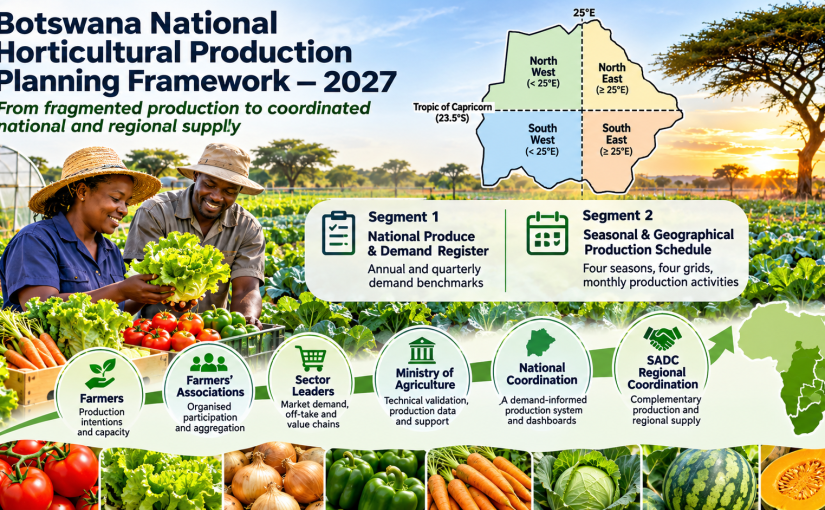
From fragmented production to coordinated national and regional supply
Segment 1: National Horticultural Produce and Demand Register
A. Annual national produce and demand register — 2027
The annual demand figures below are the figures already identified in our work. The quarterly baseline is the annual local demand divided by four. TBD means the figure has not yet been established. The historical demand benchmarks should be treated as planning reference figures, not as verified 2027 consumption forecasts.
| No. | Produce | Category | Annual local demand (t) | Quarterly local demand (t) | Annual export demand (t) | Annual total demand (t) |
|---|---|---|---|---|---|---|
| 1 | Potatoes | Roots and tubers | 29,700 | 7,425 | TBD | TBD |
| 2 | Tomatoes | Fruiting vegetable | 15,500 | 3,875 | TBD | TBD |
| 3 | Cabbage | Brassica | 13,000 | 3,250 | TBD | TBD |
| 4 | Onions | Bulb vegetable | 11,700 | 2,925 | TBD | TBD |
| 5 | Carrots | Root vegetable | 9,000 | 2,250 | TBD | TBD |
| 6 | Beetroot | Root vegetable | 5,700 | 1,425 | TBD | TBD |
| 7 | Butternut | Vine vegetable | 3,200 | 800 | TBD | TBD |
| 8 | Lettuce | Leafy vegetable | 2,600 | 650 | TBD | TBD |
| 9 | Green peppers | Fruiting vegetable | 2,200 | 550 | TBD | TBD |
| 10 | English cucumber | Vine vegetable | 800 | 200 | TBD | TBD |
| 11 | Spinach | Leafy vegetable | TBD | TBD | TBD | TBD |
| 12 | Swiss chard | Leafy vegetable | TBD | TBD | TBD | TBD |
| 13 | Kale | Leafy vegetable | TBD | TBD | TBD | TBD |
| 14 | Rape | Leafy brassica | TBD | TBD | TBD | TBD |
| 15 | Broccoli | Brassica | TBD | TBD | TBD | TBD |
| 16 | Cauliflower | Brassica | TBD | TBD | TBD | TBD |
| 17 | Green beans | Legume vegetable | TBD | TBD | TBD | TBD |
| 18 | Peas | Legume vegetable | TBD | TBD | TBD | TBD |
| 19 | Sweet corn / green mealies | Vegetable corn | TBD | TBD | TBD | TBD |
| 20 | Sweet potatoes | Roots and tubers | TBD | TBD | TBD | TBD |
| 21 | Pumpkin | Vine vegetable | TBD | TBD | TBD | TBD |
| 22 | Squash | Vine vegetable | TBD | TBD | TBD | TBD |
| 23 | Gem squash | Vine vegetable | TBD | TBD | TBD | TBD |
| 24 | Watermelon | Vine fruit | TBD | TBD | TBD | TBD |
| 25 | Sweet melon / cantaloupe | Vine fruit | TBD | TBD | TBD | TBD |
| 26 | Honeydew melon | Vine fruit | TBD | TBD | TBD | TBD |
| 27 | Other cucumber varieties | Vine vegetable | TBD | TBD | TBD | TBD |
| 28 | Bottle gourd | Vine vegetable | TBD | TBD | TBD | TBD |
| 29 | Bitter melon | Vine vegetable | TBD | TBD | TBD | TBD |
| 30 | Luffa / sponge gourd | Vine vegetable | TBD | TBD | TBD | TBD |
| 31 | Eggplant | Fruiting vegetable | TBD | TBD | TBD | TBD |
| 32 | Okra | Fruiting vegetable | TBD | TBD | TBD | TBD |
| 33 | Green chillies | Fruiting vegetable | TBD | TBD | TBD | TBD |
| 34 | Radish | Root vegetable | TBD | TBD | TBD | TBD |
| 35 | Turnips | Root vegetable | TBD | TBD | TBD | TBD |
| 36 | Parsnips | Root vegetable | TBD | TBD | TBD | TBD |
| 37 | Celery | Stem vegetable | TBD | TBD | TBD | TBD |
| 38 | Leeks | Allium vegetable | TBD | TBD | TBD | TBD |
| 39 | Spring onions | Allium vegetable | TBD | TBD | TBD | TBD |
| 40 | Cowpeas — fresh pods | Legume vegetable | TBD | TBD | TBD | TBD |
| 41 | African leafy vegetables — species to specify | Leafy vegetable | TBD | TBD | TBD | TBD |
| 42 | Amaranth | Leafy vegetable | TBD | TBD | TBD | TBD |
| 43 | Coriander | Annual herb | TBD | TBD | TBD | TBD |
| 44 | Basil | Annual herb | TBD | TBD | TBD | TBD |
| 45 | Dill | Annual herb | TBD | TBD | TBD | TBD |
| 46 | Parsley — annual-managed | Annual herb | TBD | TBD | TBD | TBD |
| 47 | Fenugreek | Annual herb | TBD | TBD | TBD | TBD |
| 48 | Chervil | Annual herb | TBD | TBD | TBD | TBD |
| 49 | Summer savoury | Annual herb | TBD | TBD | TBD | TBD |
| 50 | Rocket / arugula | Annual leafy herb | TBD | TBD | TBD | TBD |
| TOTAL — crops with known local demand only | 93,400 | 23,350 | TBD | TBD |
Important demand treatment: the quarterly local figures are national quarterly reference demand. They must not be copied into every grid, because that would multiply national demand four times. Grid-level demand allocation remains open for the planning process. The production-met columns are for the Ministry to complete from actual production information.
B. How to read the monthly activity progression
The first month of each quarter is the planning and commencement month. The activity column below therefore gives the three-month sequence, not a generic description of what happens in a season.
- October–December: October planning and establishment; November crop development and management; December continued management and early harvests where crop duration permits.
- January–March: January planning and establishment; February crop development, transplanting and management; March continued development and first harvests where crop duration permits.
- April–June: April planning and establishment; May crop development and management; June continued development and harvesting of earlier plantings.
- July–September: July planning and establishment; August crop development and management; September continued development and harvesting of earlier plantings.
The Ministry of Agriculture’s Manual for Vegetable Production in Botswana is the primary agronomic reference for the crop windows below. It specifically warns that frost-sensitive crops such as tomatoes and green peppers cannot be grown in winter without protection, and that some crops have different sowing windows in warm, mild and cool areas. It also identifies the need to plan successive plantings so harvesting and market supply are continuous. painting+1
C. Seasonal production tables
Geographical grid used in all four tables
| Grid | Geographical division |
|---|---|
| 1 | North of Tropic of Capricorn — West of 25°E |
| 2 | North of Tropic of Capricorn — East of 25°E |
| 3 | South of Tropic of Capricorn — West of 25°E |
| 4 | South of Tropic of Capricorn — East of 25°E |
For these tables, the national quarterly demand figures above are retained as the demand reference. The grid-level demand allocation is TBD, rather than an invented split. Production met and unmet demand are also TBD until the Ministry supplies the relevant production information.
The Ministry manual’s regional sowing recommendations do not map one-to-one onto the four latitude/longitude grids. Its regional groupings include Ngamiland and Tuli Block, Chobe, Ghanzi/Northern Kgalagadi/Kweneng/Kgatleng, Central/North East, and Gaborone/Southern Region. I have used the manual’s crop windows and climatic cautions to guide placement, but a grid placement is not a claim that every locality within that grid has identical growing conditions. painting+1
Season 1 — October to December (Spring)
| Grid | Produce — one crop per row | Local demand (t) | Export demand (t) | Total demand (t) | Activity by month — October / November / December | Local demand met by production (t) | Export demand met by production (t) | Total demand met by production (t) | Unmet demand (t) |
|---|---|---|---|---|---|---|---|---|---|
| 1 — North / West | Tomatoes | TBD | TBD | TBD | Oct: nursery sowing/transplanting in suitable warm, frost-free localities; Nov: staking, irrigation, pest scouting; Dec: fruit set, picking from earlier plantings, frequent pest monitoring | TBD | TBD | TBD | TBD |
| 1 — North / West | Green peppers | TBD | TBD | TBD | Oct: nursery and field establishment; Nov: irrigation, nutrition and pest monitoring; Dec: flowering/fruit set, protect from heat stress | TBD | TBD | TBD | TBD |
| 1 — North / West | Cucumber | TBD | TBD | TBD | Oct: direct sowing and trellising; Nov: vine training, irrigation and pest monitoring; Dec: successive picking and post-harvest handling | TBD | TBD | TBD | TBD |
| 1 — North / West | Watermelon | TBD | TBD | TBD | Oct: direct sowing; Nov: vine development, pollination and fruit setting; Dec: fruit sizing and harvest of early plantings | TBD | TBD | TBD | TBD |
| 1 — North / West | Sweet melon / cantaloupe | TBD | TBD | TBD | Oct: direct sowing; Nov: vine management and fruit set; Dec: fruit sizing and harvest of early plantings | TBD | TBD | TBD | TBD |
| 1 — North / West | Pumpkin | TBD | TBD | TBD | Oct: direct sowing/establishment; Nov: vine growth and fruit set; Dec: fruit development and early harvest where mature | TBD | TBD | TBD | TBD |
| 1 — North / West | Butternut | TBD | TBD | TBD | Oct: direct sowing; Nov: vine development and fruit set; Dec: fruit sizing and maturity checks | TBD | TBD | TBD | TBD |
| 1 — North / West | Okra | TBD | TBD | TBD | Oct: direct sowing; Nov: thinning, flowering and pest checks; Dec: repeated pod picking and grading | TBD | TBD | TBD | TBD |
| 1 — North / West | Eggplant | TBD | TBD | TBD | Oct: nursery and transplanting; Nov: staking, flowering and pest monitoring; Dec: repeated harvesting | TBD | TBD | TBD | TBD |
| 1 — North / West | Green chillies | TBD | TBD | TBD | Oct: nursery and transplanting; Nov: plant establishment and flowering; Dec: fruit development and first picking | TBD | TBD | TBD | TBD |
| 2 — North / East | Tomatoes | TBD | TBD | TBD | Oct: nursery sowing/transplanting; Nov: staking, irrigation and pest scouting; Dec: fruit set and early harvest from established crops | TBD | TBD | TBD | TBD |
| 2 — North / East | Green peppers | TBD | TBD | TBD | Oct: nursery and transplanting; Nov: irrigation, nutrition and pest checks; Dec: flowering and fruit set | TBD | TBD | TBD | TBD |
| 2 — North / East | Cucumber | TBD | TBD | TBD | Oct: direct sowing; Nov: trellising, vine training and pest monitoring; Dec: repeated harvest and grading | TBD | TBD | TBD | TBD |
| 2 — North / East | Watermelon | TBD | TBD | TBD | Oct: direct sowing; Nov: vine growth and pollination; Dec: fruit sizing and early harvest | TBD | TBD | TBD | TBD |
| 2 — North / East | Sweet melon / cantaloupe | TBD | TBD | TBD | Oct: direct sowing; Nov: vine management and fruit set; Dec: fruit sizing and early harvest | TBD | TBD | TBD | TBD |
| 2 — North / East | Pumpkin | TBD | TBD | TBD | Oct: direct sowing; Nov: vine development; Dec: fruit development and early harvest | TBD | TBD | TBD | TBD |
| 2 — North / East | Butternut | TBD | TBD | TBD | Oct: direct sowing; Nov: vine management and fruit set; Dec: fruit sizing | TBD | TBD | TBD | TBD |
| 2 — North / East | Okra | TBD | TBD | TBD | Oct: direct sowing; Nov: thinning and flowering; Dec: repeated pod picking | TBD | TBD | TBD | TBD |
| 2 — North / East | Eggplant | TBD | TBD | TBD | Oct: nursery and transplanting; Nov: staking and flowering; Dec: repeated harvest | TBD | TBD | TBD | TBD |
| 2 — North / East | Green chillies | TBD | TBD | TBD | Oct: nursery and transplanting; Nov: flowering and pest monitoring; Dec: fruit development and first picking | TBD | TBD | TBD | TBD |
| 3 — South / West | Tomatoes | TBD | TBD | TBD | Oct: nursery sowing/transplanting; Nov: staking and crop establishment; Dec: flowering/fruit set, monitor heat and pests | TBD | TBD | TBD | TBD |
| 3 — South / West | Green peppers | TBD | TBD | TBD | Oct: nursery and transplanting; Nov: plant establishment; Dec: flowering and fruit set | TBD | TBD | TBD | TBD |
| 3 — South / West | Cucumber | TBD | TBD | TBD | Oct: direct sowing; Nov: vine growth and trellising; Dec: successive harvests | TBD | TBD | TBD | TBD |
| 3 — South / West | Watermelon | TBD | TBD | TBD | Oct: direct sowing; Nov: vine growth and fruit set; Dec: fruit sizing and harvest of early crops | TBD | TBD | TBD | TBD |
| 3 — South / West | Pumpkin | TBD | TBD | TBD | Oct: direct sowing; Nov: vine development; Dec: fruit sizing and early harvest | TBD | TBD | TBD | TBD |
| 3 — South / West | Butternut | TBD | TBD | TBD | Oct: direct sowing; Nov: vine development and fruit set; Dec: fruit sizing | TBD | TBD | TBD | TBD |
| 3 — South / West | Okra | TBD | TBD | TBD | Oct: direct sowing; Nov: flowering; Dec: repeated picking | TBD | TBD | TBD | TBD |
| 3 — South / West | Eggplant | TBD | TBD | TBD | Oct: nursery and transplanting; Nov: staking and flowering; Dec: repeated harvest | TBD | TBD | TBD | TBD |
| 3 — South / West | Green chillies | TBD | TBD | TBD | Oct: nursery and transplanting; Nov: flowering; Dec: fruit development and first picking | TBD | TBD | TBD | TBD |
| 4 — South / East | Tomatoes | TBD | TBD | TBD | Oct: nursery sowing/transplanting; Nov: staking and crop establishment; Dec: flowering/fruit set, monitor heat and pests | TBD | TBD | TBD | TBD |
| 4 — South / East | Green peppers | TBD | TBD | TBD | Oct: nursery and transplanting; Nov: plant establishment; Dec: flowering and fruit set | TBD | TBD | TBD | TBD |
| 4 — South / East | Cucumber | TBD | TBD | TBD | Oct: direct sowing; Nov: trellising and vine management; Dec: repeated harvest | TBD | TBD | TBD | TBD |
| 4 — South / East | Watermelon | TBD | TBD | TBD | Oct: direct sowing; Nov: vine growth and fruit set; Dec: fruit sizing and early harvest | TBD | TBD | TBD | TBD |
| 4 — South / East | Pumpkin | TBD | TBD | TBD | Oct: direct sowing; Nov: vine growth; Dec: fruit development | TBD | TBD | TBD | TBD |
| 4 — South / East | Butternut | TBD | TBD | TBD | Oct: direct sowing; Nov: vine development and fruit set; Dec: fruit sizing | TBD | TBD | TBD | TBD |
| 4 — South / East | Okra | TBD | TBD | TBD | Oct: direct sowing; Nov: flowering; Dec: repeated pod picking | TBD | TBD | TBD | TBD |
| 4 — South / East | Eggplant | TBD | TBD | TBD | Oct: nursery and transplanting; Nov: staking and flowering; Dec: repeated harvest | TBD | TBD | TBD | TBD |
| 4 — South / East | Green chillies | TBD | TBD | TBD | Oct: nursery and transplanting; Nov: flowering; Dec: fruit development and first picking | TBD | TBD | TBD | TBD |
Season 1 placement note: these are warm-season crops, but the Ministry manual cautions that high temperatures in December–January can increase pest pressure in unprotected tomato production. For potatoes, the manual identifies high soil temperatures and temperatures above 32°C as damaging to tuber formation; I have therefore not placed potatoes in this spring table as a general open-field recommendation. painting+1
Season 2 — January to March (Summer)
| Grid | Produce — one crop per row | Local demand (t) | Export demand (t) | Total demand (t) | Activity by month — January / February / March | Local demand met by production (t) | Export demand met by production (t) | Total demand met by production (t) | Unmet demand (t) |
|---|---|---|---|---|---|---|---|---|---|
| 1 — North / West | Tomatoes | TBD | TBD | TBD | Jan: harvest established crops, protect from heat and pests; Feb: nursery sowing for next cycle and continued picking; Mar: transplant/establish new crop and maintain overlapping harvests | TBD | TBD | TBD | TBD |
| 1 — North / West | Green peppers | TBD | TBD | TBD | Jan: fruit development and harvest; Feb: nursery sowing and field preparation; Mar: transplanting and establishment | TBD | TBD | TBD | TBD |
| 1 — North / West | Cucumber | TBD | TBD | TBD | Jan: successive picking; Feb: new direct sowing and vine establishment; Mar: training, flowering and pest monitoring | TBD | TBD | TBD | TBD |
| 1 — North / West | Watermelon | TBD | TBD | TBD | Jan: harvest mature crops; Feb: direct sowing for next cycle; Mar: vine growth, flowering and fruit set | TBD | TBD | TBD | TBD |
| 1 — North / West | Pumpkin | TBD | TBD | TBD | Jan: harvest mature crops; Feb: direct sowing; Mar: vine growth and fruit set | TBD | TBD | TBD | TBD |
| 1 — North / West | Butternut | TBD | TBD | TBD | Jan: harvest mature crops; Feb: direct sowing; Mar: vine development and fruit set | TBD | TBD | TBD | TBD |
| 1 — North / West | Okra | TBD | TBD | TBD | Jan: repeated pod harvest; Feb: new sowing and thinning; Mar: flowering and picking | TBD | TBD | TBD | TBD |
| 1 — North / West | Eggplant | TBD | TBD | TBD | Jan: repeated harvest; Feb: nursery sowing and field preparation; Mar: transplanting and establishment | TBD | TBD | TBD | TBD |
| 1 — North / West | Green chillies | TBD | TBD | TBD | Jan: harvest; Feb: nursery sowing; Mar: transplanting and establishment | TBD | TBD | TBD | TBD |
| 2 — North / East | Tomatoes | TBD | TBD | TBD | Jan: harvest and pest monitoring; Feb: nursery sowing for next cycle; Mar: transplanting and crop establishment | TBD | TBD | TBD | TBD |
| 2 — North / East | Green peppers | TBD | TBD | TBD | Jan: fruit development and picking; Feb: nursery sowing; Mar: transplanting and establishment | TBD | TBD | TBD | TBD |
| 2 — North / East | Cucumber | TBD | TBD | TBD | Jan: harvest; Feb: direct sowing; Mar: vine training, flowering and pest monitoring | TBD | TBD | TBD | TBD |
| 2 — North / East | Watermelon | TBD | TBD | TBD | Jan: harvest; Feb: direct sowing; Mar: vine growth and fruit set | TBD | TBD | TBD | TBD |
| 2 — North / East | Pumpkin | TBD | TBD | TBD | Jan: harvest; Feb: direct sowing; Mar: vine growth and fruit set | TBD | TBD | TBD | TBD |
| 2 — North / East | Butternut | TBD | TBD | TBD | Jan: harvest; Feb: direct sowing; Mar: vine development and fruit set | TBD | TBD | TBD | TBD |
| 2 — North / East | Okra | TBD | TBD | TBD | Jan: repeated picking; Feb: sowing; Mar: flowering and picking | TBD | TBD | TBD | TBD |
| 2 — North / East | Eggplant | TBD | TBD | TBD | Jan: harvest; Feb: nursery sowing; Mar: transplanting and establishment | TBD | TBD | TBD | TBD |
| 2 — North / East | Green chillies | TBD | TBD | TBD | Jan: harvest; Feb: nursery sowing; Mar: transplanting and establishment | TBD | TBD | TBD | TBD |
| 3 — South / West | Tomatoes | TBD | TBD | TBD | Jan: harvest established crops; Feb: nursery sowing; Mar: transplanting and establishment, avoid late-season frost exposure in the next cycle | TBD | TBD | TBD | TBD |
| 3 — South / West | Green peppers | TBD | TBD | TBD | Jan: harvest; Feb: nursery sowing; Mar: transplanting and establishment | TBD | TBD | TBD | TBD |
| 3 — South / West | Cucumber | TBD | TBD | TBD | Jan: harvest; Feb: direct sowing; Mar: vine development and flowering | TBD | TBD | TBD | TBD |
| 3 — South / West | Watermelon | TBD | TBD | TBD | Jan: harvest; Feb: direct sowing; Mar: vine development and fruit set | TBD | TBD | TBD | TBD |
| 3 — South / West | Pumpkin | TBD | TBD | TBD | Jan: harvest; Feb: direct sowing; Mar: vine development | TBD | TBD | TBD | TBD |
| 3 — South / West | Butternut | TBD | TBD | TBD | Jan: harvest; Feb: direct sowing; Mar: vine development and fruit set | TBD | TBD | TBD | TBD |
| 3 — South / West | Okra | TBD | TBD | TBD | Jan: harvest; Feb: sowing; Mar: flowering and picking | TBD | TBD | TBD | TBD |
| 3 — South / West | Eggplant | TBD | TBD | TBD | Jan: harvest; Feb: nursery sowing; Mar: transplanting and establishment | TBD | TBD | TBD | TBD |
| 3 — South / West | Green chillies | TBD | TBD | TBD | Jan: harvest; Feb: nursery sowing; Mar: transplanting and establishment | TBD | TBD | TBD | TBD |
| 4 — South / East | Tomatoes | TBD | TBD | TBD | Jan: harvest; Feb: nursery sowing; Mar: transplanting and establishment | TBD | TBD | TBD | TBD |
| 4 — South / East | Green peppers | TBD | TBD | TBD | Jan: harvest; Feb: nursery sowing; Mar: transplanting and establishment | TBD | TBD | TBD | TBD |
| 4 — South / East | Cucumber | TBD | TBD | TBD | Jan: harvest; Feb: direct sowing; Mar: vine development and flowering | TBD | TBD | TBD | TBD |
| 4 — South / East | Watermelon | TBD | TBD | TBD | Jan: harvest; Feb: direct sowing; Mar: vine growth and fruit set | TBD | TBD | TBD | TBD |
| 4 — South / East | Pumpkin | TBD | TBD | TBD | Jan: harvest; Feb: direct sowing; Mar: vine development | TBD | TBD | TBD | TBD |
| 4 — South / East | Butternut | TBD | TBD | TBD | Jan: harvest; Feb: direct sowing; Mar: vine development and fruit set | TBD | TBD | TBD | TBD |
| 4 — South / East | Okra | TBD | TBD | TBD | Jan: harvest; Feb: sowing; Mar: flowering and picking | TBD | TBD | TBD | TBD |
| 4 — South / East | Eggplant | TBD | TBD | TBD | Jan: harvest; Feb: nursery sowing; Mar: transplanting and establishment | TBD | TBD | TBD | TBD |
| 4 — South / East | Green chillies | TBD | TBD | TBD | Jan: harvest; Feb: nursery sowing; Mar: transplanting and establishment | TBD | TBD | TBD | TBD |
Season 2 placement note: the Botswana manual’s regional guidance supports summer production of several warm-season crops, but also flags the need to manage high temperatures, pest pressure and water. It recommends kale and rape sowing in warm areas from February to April, mild areas from January to March, and cool areas in December/January. Those crops are therefore placed in the cool-season planning table where their local sowing windows are more appropriate, rather than being listed indiscriminately across all grids. researchgate.net+1
Season 3 — April to June (Autumn)
| Grid | Produce — one crop per row | Local demand (t) | Export demand (t) | Total demand (t) | Activity by month — April / May / June | Local demand met by production (t) | Export demand met by production (t) | Total demand met by production (t) | Unmet demand (t) |
|---|---|---|---|---|---|---|---|---|---|
| 1 — North / West | Tomatoes | TBD | TBD | TBD | Apr: harvest and remove exhausted plants; May: protected nursery sowing for winter/out-of-season supply; Jun: raise protected seedlings and prepare protected production sites | TBD | TBD | TBD | TBD |
| 1 — North / West | Cabbage | TBD | TBD | TBD | Apr: nursery sowing and field preparation; May: transplant and establish; Jun: head development, irrigation and pest checks | TBD | TBD | TBD | TBD |
| 1 — North / West | Kale | TBD | TBD | TBD | Apr: sow/raise seedlings in warm areas; May: transplant and establish; Jun: leaf development and first picking where mature | TBD | TBD | TBD | TBD |
| 1 — North / West | Rape | TBD | TBD | TBD | Apr: sow/raise seedlings; May: transplant and establish; Jun: leaf development and repeated picking | TBD | TBD | TBD | TBD |
| 1 — North / West | Beetroot | TBD | TBD | TBD | Apr: direct sowing; May: thin and maintain moisture; Jun: root bulking and harvest of early plantings | TBD | TBD | TBD | TBD |
| 1 — North / West | Carrots | TBD | TBD | TBD | Apr: direct sowing; May: thin, weed and maintain even moisture; Jun: root development and early harvest where mature | TBD | TBD | TBD | TBD |
| 1 — North / West | Lettuce | TBD | TBD | TBD | Apr: sow/raise seedlings; May: transplant and establish; Jun: head/leaf development and harvest | TBD | TBD | TBD | TBD |
| 1 — North / West | Swiss chard | TBD | TBD | TBD | Apr: sow/establish; May: leaf development and pest checks; Jun: successive leaf harvests | TBD | TBD | TBD | TBD |
| 1 — North / West | Spinach | TBD | TBD | TBD | Apr: direct sowing; May: thin and maintain moisture; Jun: leaf development and repeated harvest | TBD | TBD | TBD | TBD |
| 1 — North / West | Onions | TBD | TBD | TBD | Apr: sow/transplant according to cultivar and local window; May: bulb development and weed control; Jun: bulb sizing and crop monitoring | TBD | TBD | TBD | TBD |
| 1 — North / West | Green beans | TBD | TBD | TBD | Apr: sow where temperatures remain suitable; May: flowering and pod set; Jun: harvest and grading | TBD | TBD | TBD | TBD |
| 2 — North / East | Cabbage | TBD | TBD | TBD | Apr: nursery sowing and land preparation; May: transplant; Jun: head development and pest monitoring | TBD | TBD | TBD | TBD |
| 2 — North / East | Kale | TBD | TBD | TBD | Apr: sow/raise seedlings; May: transplant; Jun: leaf development and first picking | TBD | TBD | TBD | TBD |
| 2 — North / East | Rape | TBD | TBD | TBD | Apr: sow/raise seedlings; May: transplant; Jun: leaf development and repeated picking | TBD | TBD | TBD | TBD |
| 2 — North / East | Beetroot | TBD | TBD | TBD | Apr: direct sowing; May: thin and weed; Jun: root bulking and harvest of early plantings | TBD | TBD | TBD | TBD |
| 2 — North / East | Carrots | TBD | TBD | TBD | Apr: direct sowing; May: thin and maintain moisture; Jun: root development and early harvest | TBD | TBD | TBD | TBD |
| 2 — North / East | Lettuce | TBD | TBD | TBD | Apr: sow/raise seedlings; May: transplant; Jun: leaf/head development and harvest | TBD | TBD | TBD | TBD |
| 2 — North / East | Swiss chard | TBD | TBD | TBD | Apr: sow/establish; May: leaf development; Jun: successive picking | TBD | TBD | TBD | TBD |
| 2 — North / East | Spinach | TBD | TBD | TBD | Apr: direct sowing; May: thinning and crop management; Jun: repeated leaf harvest | TBD | TBD | TBD | TBD |
| 2 — North / East | Onions | TBD | TBD | TBD | Apr: sow/transplant according to local window; May: bulb development; Jun: bulb sizing and crop monitoring | TBD | TBD | TBD | TBD |
| 2 — North / East | Green beans | TBD | TBD | TBD | Apr: sow; May: flowering and pod set; Jun: harvest and grading | TBD | TBD | TBD | TBD |
| 3 — South / West | Potatoes | TBD | TBD | TBD | Apr: prepare land and sprout seed tubers for suitable planting window; May: plant and establish; Jun: emergence, irrigation and first earthing-up | TBD | TBD | TBD | TBD |
| 3 — South / West | Cabbage | TBD | TBD | TBD | Apr: nursery sowing; May: transplant; Jun: head development and pest monitoring | TBD | TBD | TBD | TBD |
| 3 — South / West | Kale | TBD | TBD | TBD | Apr: nursery sowing; May: transplant; Jun: leaf development and first picking | TBD | TBD | TBD | TBD |
| 3 — South / West | Rape | TBD | TBD | TBD | Apr: nursery sowing; May: transplant; Jun: leaf development and repeated picking | TBD | TBD | TBD | TBD |
| 3 — South / West | Beetroot | TBD | TBD | TBD | Apr: direct sowing; May: thinning and weed control; Jun: root bulking and harvest | TBD | TBD | TBD | TBD |
| 3 — South / West | Carrots | TBD | TBD | TBD | Apr: direct sowing; May: thinning and root development; Jun: harvest of early plantings | TBD | TBD | TBD | TBD |
| 3 — South / West | Lettuce | TBD | TBD | TBD | Apr: sow/raise seedlings; May: transplant; Jun: leaf/head development and harvest | TBD | TBD | TBD | TBD |
| 3 — South / West | Swiss chard | TBD | TBD | TBD | Apr: sow/establish; May: leaf development; Jun: repeated leaf harvest | TBD | TBD | TBD | TBD |
| 3 — South / West | Spinach | TBD | TBD | TBD | Apr: direct sowing; May: thinning and management; Jun: repeated harvest | TBD | TBD | TBD | TBD |
| 3 — South / West | Onions | TBD | TBD | TBD | Apr: sow/transplant; May: bulb development; Jun: bulb sizing and crop monitoring | TBD | TBD | TBD | TBD |
| 3 — South / West | Green beans | TBD | TBD | TBD | Apr: sow; May: flowering and pod set; Jun: harvest and grading | TBD | TBD | TBD | TBD |
| 4 — South / East | Potatoes | TBD | TBD | TBD | Apr: prepare land and sprout seed tubers; May: plant and establish; Jun: emergence, irrigation and earthing-up | TBD | TBD | TBD | TBD |
| 4 — South / East | Cabbage | TBD | TBD | TBD | Apr: nursery sowing; May: transplant; Jun: head development and pest monitoring | TBD | TBD | TBD | TBD |
| 4 — South / East | Kale | TBD | TBD | TBD | Apr: nursery sowing; May: transplant; Jun: leaf development and first picking | TBD | TBD | TBD | TBD |
| 4 — South / East | Rape | TBD | TBD | TBD | Apr: nursery sowing; May: transplant; Jun: leaf development and repeated picking | TBD | TBD | TBD | TBD |
| 4 — South / East | Beetroot | TBD | TBD | TBD | Apr: direct sowing; May: thin and weed; Jun: root bulking and harvest | TBD | TBD | TBD | TBD |
| 4 — South / East | Carrots | TBD | TBD | TBD | Apr: direct sowing; May: thin and maintain moisture; Jun: root development and harvest | TBD | TBD | TBD | TBD |
| 4 — South / East | Lettuce | TBD | TBD | TBD | Apr: sow/raise seedlings; May: transplant; Jun: leaf/head development and harvest | TBD | TBD | TBD | TBD |
| 4 — South / East | Swiss chard | TBD | TBD | TBD | Apr: sow/establish; May: leaf development; Jun: successive leaf harvest | TBD | TBD | TBD | TBD |
| 4 — South / East | Spinach | TBD | TBD | TBD | Apr: direct sowing; May: thinning and management; Jun: repeated leaf harvest | TBD | TBD | TBD | TBD |
| 4 — South / East | Onions | TBD | TBD | TBD | Apr: sow/transplant according to local window; May: bulb development; Jun: bulb sizing and crop monitoring | TBD | TBD | TBD | TBD |
| 4 — South / East | Green beans | TBD | TBD | TBD | Apr: sow; May: flowering and pod set; Jun: harvest and grading | TBD | TBD | TBD | TBD |
Season 4 — July to September (Winter)
| Grid | Produce — one crop per row | Local demand (t) | Export demand (t) | Total demand (t) | Activity by month — July / August / September | Local demand met by production (t) | Export demand met by production (t) | Total demand met by production (t) | Unmet demand (t) |
|---|---|---|---|---|---|---|---|---|---|
| 1 — North / West | Potatoes | TBD | TBD | TBD | Jul: crop growth and irrigation; Aug: tuber bulking and earthing-up; Sep: harvest of suitable earlier plantings and curing/storage | TBD | TBD | TBD | TBD |
| 1 — North / West | Cabbage | TBD | TBD | TBD | Jul: transplant/establish; Aug: head development; Sep: harvest, grading and storage | TBD | TBD | TBD | TBD |
| 1 — North / West | Kale | TBD | TBD | TBD | Jul: leaf development and picking; Aug: successive harvests; Sep: continued picking and new sowing for warm-area cycle | TBD | TBD | TBD | TBD |
| 1 — North / West | Rape | TBD | TBD | TBD | Jul: crop management and picking; Aug: successive harvests; Sep: crop clearance and next-cycle preparation | TBD | TBD | TBD | TBD |
| 1 — North / West | Beetroot | TBD | TBD | TBD | Jul: root bulking; Aug: harvest and grading; Sep: direct sowing for next cycle where temperatures allow | TBD | TBD | TBD | TBD |
| 1 — North / West | Carrots | TBD | TBD | TBD | Jul: root development; Aug: harvest and grading; Sep: direct sowing and establishment | TBD | TBD | TBD | TBD |
| 1 — North / West | Lettuce | TBD | TBD | TBD | Jul: leaf/head development; Aug: harvest and re-sowing; Sep: new planting and establishment | TBD | TBD | TBD | TBD |
| 1 — North / West | Swiss chard | TBD | TBD | TBD | Jul: successive leaf harvest; Aug: continued picking and nutrition; Sep: new sowing/establishment | TBD | TBD | TBD | TBD |
| 1 — North / West | Spinach | TBD | TBD | TBD | Jul: leaf development and harvest; Aug: successive picking; Sep: new sowing and establishment | TBD | TBD | TBD | TBD |
| 1 — North / West | Onions | TBD | TBD | TBD | Jul: bulb development; Aug: maturity monitoring and lifting where ready; Sep: curing, grading and storage | TBD | TBD | TBD | TBD |
| 1 — North / West | Green beans | TBD | TBD | TBD | Jul: harvest only where frost-free conditions allow; Aug: new sowing in suitable warm localities; Sep: flowering and pod set | TBD | TBD | TBD | TBD |
| 2 — North / East | Potatoes | TBD | TBD | TBD | Jul: crop growth; Aug: tuber bulking and earthing-up; Sep: harvest of earlier crops where suitable | TBD | TBD | TBD | TBD |
| 2 — North / East | Cabbage | TBD | TBD | TBD | Jul: transplant/establish; Aug: head development; Sep: harvest and grading | TBD | TBD | TBD | TBD |
| 2 — North / East | Kale | TBD | TBD | TBD | Jul: leaf development and picking; Aug: successive harvest; Sep: continued picking and new sowing | TBD | TBD | TBD | TBD |
| 2 — North / East | Rape | TBD | TBD | TBD | Jul: crop management and picking; Aug: successive harvest; Sep: crop clearance and preparation | TBD | TBD | TBD | TBD |
| 2 — North / East | Beetroot | TBD | TBD | TBD | Jul: root bulking; Aug: harvest and grading; Sep: direct sowing | TBD | TBD | TBD | TBD |
| 2 — North / East | Carrots | TBD | TBD | TBD | Jul: root development; Aug: harvest and grading; Sep: direct sowing and establishment | TBD | TBD | TBD | TBD |
| 2 — North / East | Lettuce | TBD | TBD | TBD | Jul: leaf/head development; Aug: harvest and re-sowing; Sep: new planting | TBD | TBD | TBD | TBD |
| 2 — North / East | Swiss chard | TBD | TBD | TBD | Jul: successive leaf harvest; Aug: continued picking; Sep: new sowing/establishment | TBD | TBD | TBD | TBD |
| 2 — North / East | Spinach | TBD | TBD | TBD | Jul: leaf development and harvest; Aug: successive picking; Sep: new sowing | TBD | TBD | TBD | TBD |
| 2 — North / East | Onions | TBD | TBD | TBD | Jul: bulb development; Aug: maturity checks and lifting where ready; Sep: curing and storage | TBD | TBD | TBD | TBD |
| 2 — North / East | Green beans | TBD | TBD | TBD | Jul: crop management in suitable frost-free locations; Aug: sowing; Sep: flowering and pod set | TBD | TBD | TBD | TBD |
| 3 — South / West | Potatoes | TBD | TBD | TBD | Jul: crop growth and irrigation; Aug: tuber bulking; Sep: harvest of suitable plantings, curing and storage | TBD | TBD | TBD | TBD |
| 3 — South / West | Cabbage | TBD | TBD | TBD | Jul: transplant/establish; Aug: head development; Sep: harvest and grading | TBD | TBD | TBD | TBD |
| 3 — South / West | Kale | TBD | TBD | TBD | Jul: leaf development and picking; Aug: successive harvest; Sep: continued picking | TBD | TBD | TBD | TBD |
| 3 — South / West | Beetroot | TBD | TBD | TBD | Jul: root bulking; Aug: harvest and grading; Sep: direct sowing for next cycle | TBD | TBD | TBD | TBD |
| 3 — South / West | Carrots | TBD | TBD | TBD | Jul: root development; Aug: harvest and grading; Sep: direct sowing and establishment | TBD | TBD | TBD | TBD |
| 3 — South / West | Lettuce | TBD | TBD | TBD | Jul: head/leaf development; Aug: harvest and re-sowing; Sep: new planting | TBD | TBD | TBD | TBD |
| 3 — South / West | Swiss chard | TBD | TBD | TBD | Jul: successive leaf harvest; Aug: continued picking; Sep: new sowing/establishment | TBD | TBD | TBD | TBD |
| 3 — South / West | Spinach | TBD | TBD | TBD | Jul: leaf development and harvest; Aug: successive picking; Sep: new sowing | TBD | TBD | TBD | TBD |
| 3 — South / West | Onions | TBD | TBD | TBD | Jul: bulb development; Aug: maturity monitoring and lifting; Sep: curing, grading and storage | TBD | TBD | TBD | TBD |
| 3 — South / West | Green beans | TBD | TBD | TBD | Jul: harvest from suitable plantings; Aug: sowing; Sep: flowering and pod set | TBD | TBD | TBD | TBD |
| 4 — South / East | Potatoes | TBD | TBD | TBD | Jul: crop growth and irrigation; Aug: tuber bulking; Sep: harvest of suitable plantings, curing and storage | TBD | TBD | TBD | TBD |
| 4 — South / East | Cabbage | TBD | TBD | TBD | Jul: transplant/establish; Aug: head development; Sep: harvest and grading | TBD | TBD | TBD | TBD |
| 4 — South / East | Kale | TBD | TBD | TBD | Jul: leaf development and picking; Aug: successive harvest; Sep: continued picking | TBD | TBD | TBD | TBD |
| 4 — South / East | Beetroot | TBD | TBD | TBD | Jul: root bulking; Aug: harvest and grading; Sep: direct sowing for next cycle | TBD | TBD | TBD | TBD |
| 4 — South / East | Carrots | TBD | TBD | TBD | Jul: root development; Aug: harvest and grading; Sep: direct sowing and establishment | TBD | TBD | TBD | TBD |
| 4 — South / East | Lettuce | TBD | TBD | TBD | Jul: head/leaf development; Aug: harvest and re-sowing; Sep: new planting | TBD | TBD | TBD | TBD |
| 4 — South / East | Swiss chard | TBD | TBD | TBD | Jul: successive leaf harvest; Aug: continued picking; Sep: new sowing/establishment | TBD | TBD | TBD | TBD |
| 4 — South / East | Spinach | TBD | TBD | TBD | Jul: leaf development and harvest; Aug: successive picking; Sep: new sowing | TBD | TBD | TBD | TBD |
| 4 — South / East | Onions | TBD | TBD | TBD | Jul: bulb development; Aug: maturity checks and lifting; Sep: curing, grading and storage | TBD | TBD | TBD | TBD |
| 4 — South / East | Green beans | TBD | TBD | TBD | Jul: harvest from suitable plantings; Aug: sowing; Sep: flowering and pod set | TBD | TBD | TBD | TBD |
Season 4 placement note: the Ministry manual identifies winter as a favourable planting period for many vegetables because of lower pest and disease pressure, but excludes unprotected tomatoes and green peppers in frost-prone conditions. It also identifies potato production as suitable only in selected areas and gives specific southern-district planting examples. Therefore, the potato rows above must be read as conditional on local suitability and planting window, not as a blanket recommendation for all four grids. painting+1
Segment 2: Seasonal and Geographical Horticultural Production Schedule
The tables below cover the crops omitted from the previous seasonal schedules. Each crop has its own row, and each row shows the intended progression through the three months of the quarter.
The regional assumptions are important to the first cut:
- North of the Tropic: generally warmer winter conditions and greater summer rainfall, particularly towards the northeast. This creates opportunities for warm-season vines, legumes and leafy crops, while heat-sensitive crops need careful timing.
- South of the Tropic: greater winter frost exposure, especially inland and in the east. Cool-season vegetables have a useful winter window, but frost-sensitive crops need earlier establishment or protection.
- West of 25°E: generally drier, with extensive sandy soils and lower water-holding capacity. The plan assumes reliable irrigation, organic matter improvement, mulching and careful water management.
- East of 25°E: generally better rainfall and, in many areas, more clay-influenced soils. These can support a wider range of crops, but drainage, compaction and local soil variation still matter.
These are broad planning assumptions, not claims that every farm in a grid has the same soil or microclimate. Botswana’s rainfall gradient, temperature range and soil contrasts support using this as a first-cut spatial framework. climateknowledgeportal.worldbank.org+3
Season 1 — October–December (Spring)
The emphasis is on establishing warm-season crops as temperatures rise and the rains begin. For the western grids, planting assumes irrigation rather than dependence on rainfall alone.
| Grid | Produce | Local demand (t) | Export demand (t) | Total demand (t) | Activity by month: October / November / December | Local demand met (t) | Export demand met (t) | Total demand met (t) | Unmet demand (t) |
|---|---|---|---|---|---|---|---|---|---|
| North / West | Sweet corn / green mealies | TBD | TBD | TBD | Oct: prepare beds, sow first blocks; Nov: thin, weed, top-dress and irrigate; Dec: tasselling, cob development and early picking | TBD | TBD | TBD | TBD |
| North / West | Sweet potatoes | TBD | TBD | TBD | Oct: prepare ridges and establish vine-cutting beds; Nov: plant healthy cuttings; Dec: vine establishment, weeding and earthing-up | TBD | TBD | TBD | TBD |
| North / West | Bottle gourd | TBD | TBD | TBD | Oct: direct sowing and prepare trellises; Nov: vine training, flowering and pollination; Dec: fruit development and successive picking | TBD | TBD | TBD | TBD |
| North / West | Bitter melon | TBD | TBD | TBD | Oct: direct sowing and trellis preparation; Nov: train vines and manage flowering; Dec: fruit development and repeated picking | TBD | TBD | TBD | TBD |
| North / West | Luffa / sponge gourd | TBD | TBD | TBD | Oct: direct sowing; Nov: trellising and vine training; Dec: flowering, fruit development and picking of young fruits | TBD | TBD | TBD | TBD |
| North / West | Other cucumber varieties | TBD | TBD | TBD | Oct: direct sowing; Nov: vine training and pest monitoring; Dec: successive harvesting and grading | TBD | TBD | TBD | TBD |
| North / West | Cowpeas — fresh pods | TBD | TBD | TBD | Oct: direct sowing; Nov: flowering and pod formation; Dec: successive green-pod harvesting | TBD | TBD | TBD | TBD |
| North / West | Amaranth | TBD | TBD | TBD | Oct: direct sowing in prepared beds; Nov: thinning and leaf development; Dec: repeated leaf harvesting and succession sowing | TBD | TBD | TBD | TBD |
| North / East | Sweet corn / green mealies | TBD | TBD | TBD | Oct: sow first blocks; Nov: crop development, weeding and top-dressing; Dec: cob formation and early harvest | TBD | TBD | TBD | TBD |
| North / East | Sweet potatoes | TBD | TBD | TBD | Oct: establish vine-cutting material; Nov: plant cuttings on ridges; Dec: vine establishment and weed management | TBD | TBD | TBD | TBD |
| North / East | Gem squash | TBD | TBD | TBD | Oct: direct sowing; Nov: vine growth, flowering and fruit set; Dec: fruit sizing and harvesting | TBD | TBD | TBD | TBD |
| North / East | Honeydew melon | TBD | TBD | TBD | Oct: direct sowing; Nov: vine training, pollination and fruit set; Dec: fruit sizing and maturity checks | TBD | TBD | TBD | TBD |
| North / East | Bottle gourd | TBD | TBD | TBD | Oct: direct sowing and trellis preparation; Nov: vine training and flowering; Dec: fruit development and picking | TBD | TBD | TBD | TBD |
| North / East | Bitter melon | TBD | TBD | TBD | Oct: direct sowing; Nov: trellising and flowering; Dec: fruit development and successive harvest | TBD | TBD | TBD | TBD |
| North / East | Luffa / sponge gourd | TBD | TBD | TBD | Oct: direct sowing; Nov: vine training and flowering; Dec: harvest young fruits or retain selected fruits for mature sponge production | TBD | TBD | TBD | TBD |
| North / East | Cowpeas — fresh pods | TBD | TBD | TBD | Oct: sow; Nov: flowering and pod formation; Dec: repeated green-pod harvesting | TBD | TBD | TBD | TBD |
| North / East | African leafy vegetables | TBD | TBD | TBD | Oct: establish selected locally adapted species; Nov: thin and manage leaf growth; Dec: repeated leaf harvesting and succession sowing | TBD | TBD | TBD | TBD |
| North / East | Amaranth | TBD | TBD | TBD | Oct: direct sowing; Nov: thinning and leaf development; Dec: repeated harvesting and re-sowing | TBD | TBD | TBD | TBD |
| South / West | Sweet corn / green mealies | TBD | TBD | TBD | Oct: sow under irrigation; Nov: weed, thin and top-dress; Dec: cob formation and early picking | TBD | TBD | TBD | TBD |
| South / West | Sweet potatoes | TBD | TBD | TBD | Oct: prepare ridges and plant cuttings where temperatures permit; Nov: vine establishment and weeding; Dec: vine growth and earthing-up | TBD | TBD | TBD | TBD |
| South / West | Gem squash | TBD | TBD | TBD | Oct: direct sowing under irrigation; Nov: vine growth and fruit set; Dec: fruit sizing and harvest | TBD | TBD | TBD | TBD |
| South / West | Honeydew melon | TBD | TBD | TBD | Oct: direct sowing; Nov: vine growth and pollination; Dec: fruit development and early harvest | TBD | TBD | TBD | TBD |
| South / West | Cowpeas — fresh pods | TBD | TBD | TBD | Oct: sow; Nov: flowering and pod formation; Dec: successive picking | TBD | TBD | TBD | TBD |
| South / East | Sweet corn / green mealies | TBD | TBD | TBD | Oct: sow; Nov: crop establishment and top-dressing; Dec: cob development and early picking | TBD | TBD | TBD | TBD |
| South / East | Sweet potatoes | TBD | TBD | TBD | Oct: plant vine cuttings on ridges; Nov: establish vines and weed; Dec: vine development and earthing-up | TBD | TBD | TBD | TBD |
| South / East | Gem squash | TBD | TBD | TBD | Oct: direct sowing; Nov: vine development and fruit set; Dec: fruit sizing and harvest | TBD | TBD | TBD | TBD |
| South / East | Honeydew melon | TBD | TBD | TBD | Oct: direct sowing; Nov: flowering and fruit set; Dec: fruit development and maturity checks | TBD | TBD | TBD | TBD |
| South / East | Cowpeas — fresh pods | TBD | TBD | TBD | Oct: sow; Nov: flowering and pod formation; Dec: successive picking | TBD | TBD | TBD | TBD |
| South / East | African leafy vegetables | TBD | TBD | TBD | Oct: sow selected heat-tolerant species; Nov: thin and establish; Dec: repeated harvesting and succession sowing | TBD | TBD | TBD | TBD |
| South / East | Amaranth | TBD | TBD | TBD | Oct: direct sowing; Nov: leaf development and thinning; Dec: repeated leaf harvesting | TBD | TBD | TBD | TBD |
Season 2 — January–March (Summer)
This quarter uses overlapping production. January is not simply a new planting month: it is also a major harvesting period for crops established in spring. February and March are used to establish subsequent blocks and maintain continuity.
| Grid | Produce | Local demand (t) | Export demand (t) | Total demand (t) | Activity by month: January / February / March | Local demand met (t) | Export demand met (t) | Total demand met (t) | Unmet demand (t) |
|---|---|---|---|---|---|---|---|---|---|
| North / West | Sweet corn / green mealies | TBD | TBD | TBD | Jan: harvest mature cobs; Feb: sow successive blocks; Mar: crop development, weeding and top-dressing | TBD | TBD | TBD | TBD |
| North / West | Sweet potatoes | TBD | TBD | TBD | Jan: vine growth and tuber initiation; Feb: tuber bulking and weed control; Mar: harvest early plantings and continue later blocks | TBD | TBD | TBD | TBD |
| North / West | Bottle gourd | TBD | TBD | TBD | Jan: successive fruit picking; Feb: re-sow and train new vines; Mar: flowering and fruit development | TBD | TBD | TBD | TBD |
| North / West | Bitter melon | TBD | TBD | TBD | Jan: repeated harvesting; Feb: establish next planting; Mar: trellis and manage flowering | TBD | TBD | TBD | TBD |
| North / West | Luffa / sponge gourd | TBD | TBD | TBD | Jan: harvest young fruits and retain selected mature fruits; Feb: sow next block; Mar: vine training and flowering | TBD | TBD | TBD | TBD |
| North / West | Other cucumber varieties | TBD | TBD | TBD | Jan: successive harvest; Feb: re-sow; Mar: vine development and pest management | TBD | TBD | TBD | TBD |
| North / West | Cowpeas — fresh pods | TBD | TBD | TBD | Jan: harvest green pods; Feb: sow successive blocks; Mar: flowering and pod formation | TBD | TBD | TBD | TBD |
| North / West | Amaranth | TBD | TBD | TBD | Jan: repeated leaf harvest; Feb: succession sowing; Mar: thinning and leaf development | TBD | TBD | TBD | TBD |
| North / East | Sweet corn / green mealies | TBD | TBD | TBD | Jan: harvest cobs; Feb: sow successive blocks; Mar: crop development and cob formation | TBD | TBD | TBD | TBD |
| North / East | Sweet potatoes | TBD | TBD | TBD | Jan: vine growth and tuber formation; Feb: tuber bulking; Mar: harvest early blocks and maintain later plantings | TBD | TBD | TBD | TBD |
| North / East | Gem squash | TBD | TBD | TBD | Jan: harvest mature fruits; Feb: re-sow; Mar: vine development and fruit set | TBD | TBD | TBD | TBD |
| North / East | Honeydew melon | TBD | TBD | TBD | Jan: harvest mature fruit; Feb: direct sow next block; Mar: vine development and pollination | TBD | TBD | TBD | TBD |
| North / East | Bottle gourd | TBD | TBD | TBD | Jan: repeated picking; Feb: re-sow and trellis; Mar: flowering and fruit development | TBD | TBD | TBD | TBD |
| North / East | Bitter melon | TBD | TBD | TBD | Jan: repeated picking; Feb: sow next block; Mar: trellising and flowering | TBD | TBD | TBD | TBD |
| North / East | Luffa / sponge gourd | TBD | TBD | TBD | Jan: harvest young fruits and retain mature fruits; Feb: sow next block; Mar: vine development | TBD | TBD | TBD | TBD |
| North / East | Cowpeas — fresh pods | TBD | TBD | TBD | Jan: repeated pod harvesting; Feb: sow next block; Mar: flowering and pod formation | TBD | TBD | TBD | TBD |
| North / East | African leafy vegetables | TBD | TBD | TBD | Jan: repeated leaf harvest; Feb: succession sowing; Mar: thinning and leaf development | TBD | TBD | TBD | TBD |
| North / East | Amaranth | TBD | TBD | TBD | Jan: repeated picking; Feb: re-sow; Mar: leaf development and harvest | TBD | TBD | TBD | TBD |
| South / West | Sweet corn / green mealies | TBD | TBD | TBD | Jan: harvest cobs; Feb: sow successive blocks where water is available; Mar: crop development | TBD | TBD | TBD | TBD |
| South / West | Sweet potatoes | TBD | TBD | TBD | Jan: vine establishment and tuber initiation; Feb: tuber bulking; Mar: harvest early blocks | TBD | TBD | TBD | TBD |
| South / West | Gem squash | TBD | TBD | TBD | Jan: harvest; Feb: re-sow where water and temperatures permit; Mar: vine growth and fruit set | TBD | TBD | TBD | TBD |
| South / West | Honeydew melon | TBD | TBD | TBD | Jan: harvest mature fruit; Feb: establish next block; Mar: vine growth and fruit set | TBD | TBD | TBD | TBD |
| South / East | Sweet corn / green mealies | TBD | TBD | TBD | Jan: harvest; Feb: sow successive blocks; Mar: crop development and cob formation | TBD | TBD | TBD | TBD |
| South / East | Sweet potatoes | TBD | TBD | TBD | Jan: vine growth and tuber initiation; Feb: tuber bulking; Mar: harvest early blocks | TBD | TBD | TBD | TBD |
| South / East | Gem squash | TBD | TBD | TBD | Jan: harvest; Feb: re-sow; Mar: vine development and fruit set | TBD | TBD | TBD | TBD |
| South / East | Honeydew melon | TBD | TBD | TBD | Jan: harvest; Feb: sow next block; Mar: vine development and pollination | TBD | TBD | TBD | TBD |
| South / East | Cowpeas — fresh pods | TBD | TBD | TBD | Jan: harvest pods; Feb: sow next block; Mar: flowering and pod formation | TBD | TBD | TBD | TBD |
| South / East | African leafy vegetables | TBD | TBD | TBD | Jan: leaf harvest; Feb: succession sowing; Mar: crop establishment and picking | TBD | TBD | TBD | TBD |
| South / East | Amaranth | TBD | TBD | TBD | Jan: leaf harvest; Feb: succession sowing; Mar: leaf development | TBD | TBD | TBD | TBD |
Season 3 — April–June (Autumn)
This is the main transition into cool-season production. The schedule brings in brassicas, peas, root crops, alliums and cool-season herbs. In the north, the planting window can extend later; in the south, crops must be established early enough to develop before the coldest part of winter.
| Grid | Produce | Local demand (t) | Export demand (t) | Total demand (t) | Activity by month: April / May / June | Local demand met (t) | Export demand met (t) | Total demand met (t) | Unmet demand (t) |
|---|---|---|---|---|---|---|---|---|---|
| North / West | Broccoli | TBD | TBD | TBD | Apr: nursery sowing and bed preparation; May: transplant and establish; Jun: head development and pest monitoring | TBD | TBD | TBD | TBD |
| North / West | Cauliflower | TBD | TBD | TBD | Apr: nursery sowing; May: transplant; Jun: curd development, irrigation and pest checks | TBD | TBD | TBD | TBD |
| North / West | Peas | TBD | TBD | TBD | Apr: direct sowing; May: trellis where required and manage flowering; Jun: pod formation and harvest | TBD | TBD | TBD | TBD |
| North / West | Radish | TBD | TBD | TBD | Apr: direct sowing; May: root development and thinning; Jun: harvest and successive sowing | TBD | TBD | TBD | TBD |
| North / West | Turnips | TBD | TBD | TBD | Apr: direct sowing; May: root development; Jun: harvest and grading | TBD | TBD | TBD | TBD |
| North / West | Parsnips | TBD | TBD | TBD | Apr: direct sowing in deep, prepared beds; May: germination and early establishment; Jun: thinning and root development | TBD | TBD | TBD | TBD |
| North / West | Celery | TBD | TBD | TBD | Apr: nursery sowing; May: transplant and maintain even moisture; Jun: leaf and stem development | TBD | TBD | TBD | TBD |
| North / West | Leeks | TBD | TBD | TBD | Apr: nursery sowing; May: transplant into prepared trenches; Jun: leaf growth and gradual earthing-up | TBD | TBD | TBD | TBD |
| North / West | Spring onions | TBD | TBD | TBD | Apr: direct sowing or transplanting; May: leaf and stem development; Jun: harvest and succession sowing | TBD | TBD | TBD | TBD |
| North / West | Coriander | TBD | TBD | TBD | Apr: direct sowing; May: leaf development and repeated cutting; Jun: continued harvest and succession sowing | TBD | TBD | TBD | TBD |
| North / West | Dill | TBD | TBD | TBD | Apr: direct sowing; May: leaf development; Jun: leaf harvest and selected plants retained for seed | TBD | TBD | TBD | TBD |
| North / West | Parsley | TBD | TBD | TBD | Apr: sow in nursery or beds; May: establish seedlings; Jun: leaf development and first cutting | TBD | TBD | TBD | TBD |
| North / East | Broccoli | TBD | TBD | TBD | Apr: nursery sowing; May: transplant; Jun: head development and pest monitoring | TBD | TBD | TBD | TBD |
| North / East | Cauliflower | TBD | TBD | TBD | Apr: nursery sowing; May: transplant; Jun: curd development and irrigation management | TBD | TBD | TBD | TBD |
| North / East | Peas | TBD | TBD | TBD | Apr: direct sowing; May: flowering and support; Jun: pod development and harvest | TBD | TBD | TBD | TBD |
| North / East | Radish | TBD | TBD | TBD | Apr: direct sowing; May: root development; Jun: harvest and re-sowing | TBD | TBD | TBD | TBD |
| North / East | Turnips | TBD | TBD | TBD | Apr: direct sowing; May: root development; Jun: harvest and grading | TBD | TBD | TBD | TBD |
| North / East | Parsnips | TBD | TBD | TBD | Apr: direct sowing in deep soil; May: germination and establishment; Jun: thinning and root development | TBD | TBD | TBD | TBD |
| North / East | Celery | TBD | TBD | TBD | Apr: nursery sowing; May: transplant; Jun: stem development and moisture management | TBD | TBD | TBD | TBD |
| North / East | Leeks | TBD | TBD | TBD | Apr: nursery sowing; May: transplant and establish; Jun: leaf growth and earthing-up | TBD | TBD | TBD | TBD |
| North / East | Spring onions | TBD | TBD | TBD | Apr: sow; May: leaf development; Jun: harvest and succession sowing | TBD | TBD | TBD | TBD |
| North / East | Coriander | TBD | TBD | TBD | Apr: sow; May: leaf development and cutting; Jun: continued harvesting | TBD | TBD | TBD | TBD |
| North / East | Dill | TBD | TBD | TBD | Apr: sow; May: leaf development; Jun: harvest and seed-plant selection | TBD | TBD | TBD | TBD |
| North / East | Parsley | TBD | TBD | TBD | Apr: sow; May: transplant/establish; Jun: leaf development and first cutting | TBD | TBD | TBD | TBD |
| South / West | Broccoli | TBD | TBD | TBD | Apr: nursery sowing; May: transplant; Jun: head development, irrigation and pest monitoring | TBD | TBD | TBD | TBD |
| South / West | Cauliflower | TBD | TBD | TBD | Apr: nursery sowing; May: transplant; Jun: curd development and moisture management | TBD | TBD | TBD | TBD |
| South / West | Peas | TBD | TBD | TBD | Apr: direct sowing; May: flowering and pod set; Jun: harvest | TBD | TBD | TBD | TBD |
| South / West | Radish | TBD | TBD | TBD | Apr: direct sowing; May: root development; Jun: harvest and succession sowing | TBD | TBD | TBD | TBD |
| South / West | Turnips | TBD | TBD | TBD | Apr: direct sowing; May: root bulking; Jun: harvest and grading | TBD | TBD | TBD | TBD |
| South / West | Parsnips | TBD | TBD | TBD | Apr: direct sowing in deep, friable beds; May: establishment; Jun: thinning and root development | TBD | TBD | TBD | TBD |
| South / West | Celery | TBD | TBD | TBD | Apr: nursery sowing; May: transplant; Jun: stem development with consistent irrigation | TBD | TBD | TBD | TBD |
| South / West | Leeks | TBD | TBD | TBD | Apr: nursery sowing; May: transplant into trenches; Jun: leaf growth and earthing-up | TBD | TBD | TBD | TBD |
| South / West | Spring onions | TBD | TBD | TBD | Apr: sow; May: leaf development; Jun: harvest and succession sowing | TBD | TBD | TBD | TBD |
| South / West | Coriander | TBD | TBD | TBD | Apr: sow; May: leaf development and cutting; Jun: successive harvest | TBD | TBD | TBD | TBD |
| South / West | Dill | TBD | TBD | TBD | Apr: sow; May: leaf development; Jun: harvest | TBD | TBD | TBD | TBD |
| South / West | Parsley | TBD | TBD | TBD | Apr: sow; May: establish seedlings; Jun: leaf development and first cutting | TBD | TBD | TBD | TBD |
| South / East | Broccoli | TBD | TBD | TBD | Apr: nursery sowing; May: transplant; Jun: head development and pest monitoring | TBD | TBD | TBD | TBD |
| South / East | Cauliflower | TBD | TBD | TBD | Apr: nursery sowing; May: transplant; Jun: curd development and moisture management | TBD | TBD | TBD | TBD |
| South / East | Peas | TBD | TBD | TBD | Apr: direct sowing; May: flowering and pod set; Jun: harvest | TBD | TBD | TBD | TBD |
| South / East | Radish | TBD | TBD | TBD | Apr: direct sowing; May: root development; Jun: harvest and succession sowing | TBD | TBD | TBD | TBD |
| South / East | Turnips | TBD | TBD | TBD | Apr: direct sowing; May: root bulking; Jun: harvest and grading | TBD | TBD | TBD | TBD |
| South / East | Parsnips | TBD | TBD | TBD | Apr: direct sowing in deep, prepared beds; May: establishment; Jun: thinning and root development | TBD | TBD | TBD | TBD |
| South / East | Celery | TBD | TBD | TBD | Apr: nursery sowing; May: transplant; Jun: stem development and moisture management | TBD | TBD | TBD | TBD |
| South / East | Leeks | TBD | TBD | TBD | Apr: nursery sowing; May: transplant; Jun: leaf development and earthing-up | TBD | TBD | TBD | TBD |
| South / East | Spring onions | TBD | TBD | TBD | Apr: sow; May: leaf development; Jun: harvest and succession sowing | TBD | TBD | TBD | TBD |
| South / East | Coriander | TBD | TBD | TBD | Apr: sow; May: leaf development and cutting; Jun: successive harvest | TBD | TBD | TBD | TBD |
| South / East | Dill | TBD | TBD | TBD | Apr: sow; May: leaf development; Jun: harvest | TBD | TBD | TBD | TBD |
| South / East | Parsley | TBD | TBD | TBD | Apr: sow; May: establish seedlings; Jun: leaf development and first cutting | TBD | TBD | TBD | TBD |
Season 4 — July–September (Winter)
The emphasis is on harvesting cool-season crops, maintaining successive plantings and preparing for the next spring cycle. The north can generally maintain a longer outdoor growing window than frost-prone southern localities. In the southern grids, sensitive herbs and young seedlings may need protection.
| Grid | Produce | Local demand (t) | Export demand (t) | Total demand (t) | Activity by month: July / August / September | Local demand met (t) | Export demand met (t) | Total demand met (t) | Unmet demand (t) |
|---|---|---|---|---|---|---|---|---|---|
| North / West | Broccoli | TBD | TBD | TBD | Jul: head development and harvest; Aug: harvest and prepare next nursery batch; Sep: transplant next crop and establish | TBD | TBD | TBD | TBD |
| North / West | Cauliflower | TBD | TBD | TBD | Jul: curd development and harvest; Aug: harvest and prepare next nursery batch; Sep: transplant and establish next crop | TBD | TBD | TBD | TBD |
| North / West | Peas | TBD | TBD | TBD | Jul: pod harvest; Aug: clear spent plants and prepare beds; Sep: sow next crop where temperatures allow | TBD | TBD | TBD | TBD |
| North / West | Radish | TBD | TBD | TBD | Jul: root development and harvest; Aug: succession sowing; Sep: root development and harvest | TBD | TBD | TBD | TBD |
| North / West | Turnips | TBD | TBD | TBD | Jul: root bulking and harvest; Aug: re-sow; Sep: root development and harvest | TBD | TBD | TBD | TBD |
| North / West | Parsnips | TBD | TBD | TBD | Jul: root development; Aug: continued growth and selective lifting; Sep: harvest and bed preparation | TBD | TBD | TBD | TBD |
| North / West | Celery | TBD | TBD | TBD | Jul: stem development and harvest; Aug: transplant successive batch; Sep: establishment and leaf development | TBD | TBD | TBD | TBD |
| North / West | Leeks | TBD | TBD | TBD | Jul: blanching and harvest; Aug: transplant next batch; Sep: leaf growth and earthing-up | TBD | TBD | TBD | TBD |
| North / West | Spring onions | TBD | TBD | TBD | Jul: harvest; Aug: succession sowing; Sep: leaf and stem development | TBD | TBD | TBD | TBD |
| North / West | Coriander | TBD | TBD | TBD | Jul: repeated leaf cutting; Aug: succession sowing; Sep: leaf development and harvesting | TBD | TBD | TBD | TBD |
| North / West | Dill | TBD | TBD | TBD | Jul: leaf harvest; Aug: succession sowing; Sep: leaf development and harvesting | TBD | TBD | TBD | TBD |
| North / West | Parsley | TBD | TBD | TBD | Jul: leaf cutting; Aug: sow/transplant next batch; Sep: establishment and leaf growth | TBD | TBD | TBD | TBD |
| North / West | Fenugreek | TBD | TBD | TBD | Jul: direct sowing; Aug: leaf development and cutting; Sep: seed development on selected plants | TBD | TBD | TBD | TBD |
| North / West | Rocket / arugula | TBD | TBD | TBD | Jul: succession sowing; Aug: leaf development and cutting; Sep: repeated harvest and re-sowing | TBD | TBD | TBD | TBD |
| North / East | Broccoli | TBD | TBD | TBD | Jul: head development and harvest; Aug: harvest and next nursery batch; Sep: transplant next crop | TBD | TBD | TBD | TBD |
| North / East | Cauliflower | TBD | TBD | TBD | Jul: curd development and harvest; Aug: prepare next nursery batch; Sep: transplant next crop | TBD | TBD | TBD | TBD |
| North / East | Peas | TBD | TBD | TBD | Jul: pod harvest; Aug: bed preparation and sowing; Sep: vine development and flowering | TBD | TBD | TBD | TBD |
| North / East | Radish | TBD | TBD | TBD | Jul: harvest; Aug: succession sowing; Sep: root development and harvest | TBD | TBD | TBD | TBD |
| North / East | Turnips | TBD | TBD | TBD | Jul: harvest; Aug: re-sow; Sep: root development and harvest | TBD | TBD | TBD | TBD |
| North / East | Parsnips | TBD | TBD | TBD | Jul: root development; Aug: selective lifting; Sep: harvest and bed preparation | TBD | TBD | TBD | TBD |
| North / East | Celery | TBD | TBD | TBD | Jul: stem development and harvest; Aug: transplant next batch; Sep: establishment | TBD | TBD | TBD | TBD |
| North / East | Leeks | TBD | TBD | TBD | Jul: blanching and harvest; Aug: transplant next batch; Sep: leaf growth and earthing-up | TBD | TBD | TBD | TBD |
| North / East | Spring onions | TBD | TBD | TBD | Jul: harvest; Aug: succession sowing; Sep: crop development | TBD | TBD | TBD | TBD |
| North / East | Coriander | TBD | TBD | TBD | Jul: leaf cutting; Aug: succession sowing; Sep: leaf development and harvest | TBD | TBD | TBD | TBD |
| North / East | Dill | TBD | TBD | TBD | Jul: leaf harvest; Aug: succession sowing; Sep: leaf development | TBD | TBD | TBD | TBD |
| North / East | Parsley | TBD | TBD | TBD | Jul: leaf harvest; Aug: sow/transplant; Sep: establishment and leaf growth | TBD | TBD | TBD | TBD |
| North / East | Fenugreek | TBD | TBD | TBD | Jul: sow; Aug: leaf development and cutting; Sep: seed development on selected plants | TBD | TBD | TBD | TBD |
| North / East | Rocket / arugula | TBD | TBD | TBD | Jul: succession sowing; Aug: leaf development and cutting; Sep: repeated harvest | TBD | TBD | TBD | TBD |
| South / West | Broccoli | TBD | TBD | TBD | Jul: head development and harvest; Aug: harvest and prepare next nursery batch; Sep: transplant next crop with frost risk reducing | TBD | TBD | TBD | TBD |
| South / West | Cauliflower | TBD | TBD | TBD | Jul: curd development and harvest; Aug: harvest and nursery preparation; Sep: transplant next crop | TBD | TBD | TBD | TBD |
| South / West | Peas | TBD | TBD | TBD | Jul: pod harvest; Aug: clear beds and prepare; Sep: sow next crop | TBD | TBD | TBD | TBD |
| South / West | Radish | TBD | TBD | TBD | Jul: harvest; Aug: succession sowing; Sep: root development and harvest | TBD | TBD | TBD | TBD |
| South / West | Turnips | TBD | TBD | TBD | Jul: harvest; Aug: re-sow; Sep: root development and harvest | TBD | TBD | TBD | TBD |
| South / West | Parsnips | TBD | TBD | TBD | Jul: root development; Aug: continued growth and lifting; Sep: harvest | TBD | TBD | TBD | TBD |
| South / West | Celery | TBD | TBD | TBD | Jul: stem development and harvest; Aug: transplant under protection; Sep: establishment and leaf growth | TBD | TBD | TBD | TBD |
| South / West | Leeks | TBD | TBD | TBD | Jul: blanching and harvest; Aug: transplant next batch; Sep: leaf growth and earthing-up | TBD | TBD | TBD | TBD |
| South / West | Spring onions | TBD | TBD | TBD | Jul: harvest; Aug: succession sowing; Sep: crop development | TBD | TBD | TBD | TBD |
| South / West | Coriander | TBD | TBD | TBD | Jul: leaf cutting; Aug: sow next batch under protection if necessary; Sep: leaf development and harvest | TBD | TBD | TBD | TBD |
| South / West | Dill | TBD | TBD | TBD | Jul: harvest; Aug: sow next batch; Sep: leaf development | TBD | TBD | TBD | TBD |
| South / West | Parsley | TBD | TBD | TBD | Jul: leaf harvest; Aug: sow/transplant under protection; Sep: establishment and leaf growth | TBD | TBD | TBD | TBD |
| South / West | Fenugreek | TBD | TBD | TBD | Jul: sow; Aug: leaf development and cutting; Sep: harvest and seed development | TBD | TBD | TBD | TBD |
| South / West | Rocket / arugula | TBD | TBD | TBD | Jul: sow; Aug: leaf development and cutting; Sep: succession sowing and harvest | TBD | TBD | TBD | TBD |
| South / East | Broccoli | TBD | TBD | TBD | Jul: head development and harvest; Aug: harvest and prepare next nursery batch; Sep: transplant next crop | TBD | TBD | TBD | TBD |
| South / East | Cauliflower | TBD | TBD | TBD | Jul: curd development and harvest; Aug: harvest and nursery preparation; Sep: transplant next crop | TBD | TBD | TBD | TBD |
| South / East | Peas | TBD | TBD | TBD | Jul: pod harvest; Aug: bed preparation and sowing; Sep: vine development and flowering | TBD | TBD | TBD | TBD |
| South / East | Radish | TBD | TBD | TBD | Jul: harvest; Aug: succession sowing; Sep: root development and harvest | TBD | TBD | TBD | TBD |
| South / East | Turnips | TBD | TBD | TBD | Jul: harvest; Aug: re-sow; Sep: root development and harvest | TBD | TBD | TBD | TBD |
| South / East | Parsnips | TBD | TBD | TBD | Jul: root development; Aug: selective lifting; Sep: harvest | TBD | TBD | TBD | TBD |
| South / East | Celery | TBD | TBD | TBD | Jul: stem development and harvest; Aug: transplant next batch; Sep: establishment and leaf growth | TBD | TBD | TBD | TBD |
| South / East | Leeks | TBD | TBD | TBD | Jul: blanching and harvest; Aug: transplant next batch; Sep: leaf growth and earthing-up | TBD | TBD | TBD | TBD |
| South / East | Spring onions | TBD | TBD | TBD | Jul: harvest; Aug: succession sowing; Sep: crop development | TBD | TBD | TBD | TBD |
| South / East | Coriander | TBD | TBD | TBD | Jul: leaf cutting; Aug: succession sowing; Sep: leaf development and harvest | TBD | TBD | TBD | TBD |
| South / East | Dill | TBD | TBD | TBD | Jul: leaf harvest; Aug: sow next batch; Sep: leaf development | TBD | TBD | TBD | TBD |
| South / East | Parsley | TBD | TBD | TBD | Jul: leaf harvest; Aug: sow/transplant; Sep: establishment and leaf growth | TBD | TBD | TBD | TBD |
| South / East | Fenugreek | TBD | TBD | TBD | Jul: sow; Aug: leaf development and cutting; Sep: seed development | TBD | TBD | TBD | TBD |
| South / East | Rocket / arugula | TBD | TBD | TBD | Jul: succession sowing; Aug: leaf development and cutting; Sep: repeated harvest | TBD | TBD | TBD | TBD |
Additional herbs and the summer-to-winter transition
Two crops need particular treatment because their production is strongly influenced by temperature and the intended market product:
| Produce | First-cut seasonal placement | Production judgement |
|---|---|---|
| Chervil | April–September, all four grids, with protection in the warmer northern locations during hot spells | A cool-season herb. Sow successively in partial shade; harvest leaves before flowering. |
| Summer savoury | October–March, all four grids, with irrigation in the western grids | Warm-season annual herb. Direct sow in successive small blocks; harvest leaves before flowering and retain selected plants for seed. |
1. Annual register — three additional crops
| Produce | Produce type | Annual local demand (t) | Quarterly baseline (t) | Export demand (t) | Total demand (t) |
|---|---|---|---|---|---|
| Ginger | Rhizome | TBD | TBD | TBD | TBD |
| Garlic | Bulb | TBD | TBD | TBD | TBD |
| Turmeric | Rhizome | TBD | TBD | TBD | TBD |
2. Ginger — seasonal and geographical production schedule
First-cut planning recommendation. Irrigated production with mulch, organic matter and appropriate shade is assumed.
| Planning area | Oct–Dec: Spring | Jan–Mar: Summer | Apr–Jun: Autumn | Jul–Sep: Winter |
|---|---|---|---|---|
| North of Tropic, west of 25°E | Plant rhizomes; prepare shaded beds | Vegetative growth; irrigation, mulching and pest monitoring | Rhizome development; maintain moisture and drainage | Allow maturation; harvest mature rhizomes towards end of period |
| North of Tropic, east of 25°E | Plant rhizomes; prepare beds | Vegetative growth; irrigation and crop management | Rhizome development; maintain moisture | Maturation and harvesting according to planting date |
| South of Tropic, west of 25°E | Plant under managed irrigation and shade | Maintain moisture; protect against heat stress | Rhizome development; maintain irrigation | Maturation; harvest according to crop maturity |
| South of Tropic, east of 25°E | Plant rhizomes; use shade where required | Vegetative growth; irrigation and crop management | Rhizome development | Maturation and harvesting; protect from cold |
3. Garlic — seasonal and geographical production schedule
Garlic is a cool-season crop. The principal planting window is autumn, followed by winter growth and spring maturation.
| Planning area | Oct–Dec: Spring | Jan–Mar: Summer | Apr–Jun: Autumn | Jul–Sep: Winter |
|---|---|---|---|---|
| North of Tropic, west of 25°E | Harvest remaining mature bulbs; dry and cure; store | Prepare planting material and beds; plant towards the end of the period | Main planting period; establish crop and manage irrigation | Bulb development; irrigation, weed and pest management |
| North of Tropic, east of 25°E | Harvest, cure and store | Prepare beds and planting material; late planting where temperatures permit | Main planting period | Bulb development and crop management |
| South of Tropic, west of 25°E | Harvest, cure and store | Prepare beds; plant towards the end of the period | Main planting period | Bulb development; manage irrigation and weeds |
| South of Tropic, east of 25°E | Harvest, cure and store | Prepare beds and planting material | Main planting period | Bulb development; monitor maturity and crop health |
4. Turmeric — seasonal and geographical production schedule
Warm-season rhizome crop. Requires a sufficiently long warm growing period, moisture, organic matter and good drainage.
| Planning area | Oct–Dec: Spring | Jan–Mar: Summer | Apr–Jun: Autumn | Jul–Sep: Winter |
|---|---|---|---|---|
| North of Tropic, west of 25°E | Plant rhizomes; prepare beds and mulch | Vegetative growth; irrigation and weed management | Rhizome development; maintain moisture | Maturation and harvesting as foliage dies back |
| North of Tropic, east of 25°E | Plant rhizomes; prepare beds | Vegetative growth; irrigation and crop management | Rhizome development | Maturation and harvesting |
| South of Tropic, west of 25°E | Plant under irrigation and managed shade | Maintain moisture; protect from heat stress | Rhizome development | Maturation; harvest according to maturity |
| South of Tropic, east of 25°E | Plant rhizomes; use mulch and shade where necessary | Vegetative growth and crop management | Rhizome development | Maturation and harvesting; protect from cold |
5. Production considerations and validation
| Consideration | Ginger | Garlic | Turmeric |
|---|---|---|---|
| Planting material | Healthy seed rhizomes | Suitable healthy cloves | Healthy seed rhizomes |
| Main planting window | Spring, October–November | Autumn, generally April–May | Spring, October–November |
| Approximate crop duration | 8–10 months | 5–7 months | 8–9 months |
| Water requirement | Regular moisture; avoid waterlogging | Regular moisture during growth; reduce towards maturity | Regular moisture; avoid waterlogging |
| Soil requirement | Loose, fertile, well-drained soil rich in organic matter | Well-drained soil; avoid compacted beds | Loose, fertile, well-drained soil rich in organic matter |
| Special management | Mulching and partial shade may be beneficial | Correct planting depth and curing after harvest | Mulching and partial shade may be beneficial |
| Main market forms | Fresh rhizome, dried and processed | Fresh bulbs, cured bulbs and processed garlic | Fresh rhizome, dried and powdered turmeric |
Geographical judgement: Garlic is the most broadly adaptable of the three for Botswana’s seasonal production system. Ginger and turmeric deserve priority assessment in the warmer northern areas, while southern production should be considered with irrigation, mulch and shade management. The western areas require particular attention to water availability and heat exposure. These are first-cut placements for planning, not exclusions from farmer experimentation.
One further technical point: the harvesting windows will depend on the actual planting date and variety. The Ministry working session should confirm local crop durations, suitable varieties, expected yields and harvest timing. The tables deliberately leave the demand and production-met columns open for the national planning process.
Why these crops deserve a place in the first cut
The crop choices are not arbitrary. They follow the broad climatic logic of Botswana:
- Warm-season crops: sweet corn, sweet potatoes, cucurbits, gourds, cowpeas and amaranth take advantage of the warmer and wetter part of the year, provided irrigation is available when rainfall fails.
- Cool-season crops: broccoli, cauliflower, peas, radish, turnips, parsnips, celery, leeks and spring onions use the cooler months to reduce heat stress and improve quality.
- Herbs and speciality leafy crops: coriander, dill, parsley, fenugreek, rocket, chervil and summer savoury provide opportunities for higher-value, shorter-cycle production, particularly where growers can supply restaurants, retailers and processors consistently.
Botswana’s Ministry guidance explicitly recognises broccoli, cauliflower and garden peas among the vegetable enterprise groups. The Ministry’s vegetable manual also provides specific guidance on sweet potato propagation, soil requirements and the need to complete its 4–5 month growing period before frost. gov.bw+2
First-cut decisions that should guide the industry
1. Do not treat the western grids as unsuitable for horticulture. Treat water supply, soil organic matter, mulching and irrigation efficiency as production requirements. Sandy soils can be improved, but water availability must determine the scale of production. tandfonline.com+1
2. Use the eastern grids to expand the range of crops, particularly where suitable soils and reliable water are available. However, do not assume that clay-rich soil is automatically ideal: drainage, soil structure and compaction still need attention.
3. Use the north for warm-season crop opportunities, including gourds, cowpeas, sweet corn and leafy vegetables. The northern rainfall advantage is real, but high summer temperatures and humidity can also increase disease and pest pressure. minamataconvention.org+1
4. Use the southern grids for a strong cool-season programme, with early establishment of broccoli, cauliflower, peas, roots, alliums and herbs. Protect young crops from frost where necessary.
5. Plan for successive plantings rather than one annual planting. A crop should not disappear from the production pipeline merely because its main planting window has passed. The monthly activity column must show the next block being prepared while the previous block is harvested.
6. Include soil regeneration in the production system. Compost, organic matter, mulching and improved soil structure should be part of land preparation, particularly in sandy western areas. This is not an optional add-on in Botswana’s production environment.
The entries above are a first-cut planning judgement, not a claim that every crop will perform equally in every locality. They are intended to give farmers and associations something concrete to test, learn from and improve. The Ministry can refine the crop windows as production experience, water availability and the daily demand picture become clearer.
A crop that has not yet been tried is not necessarily a crop that cannot succeed. A national production plan should create room for disciplined experimentation, not close the door before farmers have had the opportunity to learn.
Botswana National Horticultural Production Planning Framework — 2027
From fragmented production to coordinated national and regional supply
1. The framework: original intention and current position
The Botswana National Horticultural Production Planning Framework is intended to provide a structured basis for coordinating horticultural production across the country. Its starting point is the recognition that production cannot be planned independently of geography, seasonal growing conditions, market demand, farmer capacity and the infrastructure required to move produce from farms to markets. These are not separate considerations to be addressed at different stages. They are connected elements of the same production system, and the planning process must bring them into a common framework.
The framework brings together the national produce and demand register, seasonal and geographical production schedules, and a process through which the information can be used to organise production. It is designed to establish what Botswana needs to produce, identify where and when production can take place, and provide a basis for coordinating the farmers, associations, commercial organisations and public institutions whose participation is necessary to meet demand.
The geographical structure is retained around four planning areas, created by the north–south division at the Tropic of Capricorn and the east–west division at 25°E:
- North of the Tropic of Capricorn, west of 25°E.
- North of the Tropic of Capricorn, east of 25°E.
- South of the Tropic of Capricorn, west of 25°E.
- South of the Tropic of Capricorn, east of 25°E.
These are geographical planning divisions, not assertions that all localities within each area have identical growing conditions. The divisions provide a consistent structure for organising the production schedules. Within them, actual crop placement must still take account of local temperatures, rainfall, water availability, soil conditions, altitude where relevant, and the requirements of individual crops.
The first-cut production schedule deliberately expands the crop selection beyond those for which detailed Ministry sowing charts are readily available. It applies informed judgement to the wider crop range, taking account of seasonal temperature patterns, rainfall behaviour, likely soil conditions, crop duration and production requirements. A national planning framework should not be restricted to crops already established in commercial production. It should also identify opportunities for farmers to test, learn, adapt and develop new production capabilities.
The schedule is therefore an initial planning proposition, not a fixed prescription. As farmer participation develops, production intentions become clearer and demand information improves, the production pipeline can be adjusted. Further adjustments along individual latitudes and local production conditions will be undertaken manually as the programme develops. These adjustments are not a substitute for the national framework; they are part of its progressive refinement.
The present version should be regarded as a working first edition. Crop placement, production timing and demand information will be strengthened through technical engagement, farmer experience and market information. The essential architecture, however, provides the common reference around which this work can be organised.
2. Three segments of the National Horticultural Production Planning Tables
The planning tables are organised into three complementary segments, each addressing a distinct dimension of national horticultural production planning. They comprise the National Horticultural Demand Register and Core Seasonal Production Tables; the Extended Seasonal and Geographical Production Tables; and the Dedicated Production Tables for Ginger, Garlic and Turmeric.
Together, the three segments provide a structured basis for determining what Botswana needs to produce, where production can take place, when crops should be established and how production activities should progress through the year. The segments are complementary. The extended tables do not replace the core tables, and the dedicated schedules for ginger, garlic and turmeric do not displace these crops into the general seasonal programme.
Segment 1: National Horticultural Demand Register and Core Seasonal Production Tables
The first segment establishes the national demand baseline and translates it into a core seasonal production programme. The National Horticultural Demand Register identifies 50 annual horticultural produce items and records the available local and export demand information. It includes annual local demand, a quarterly local demand reference, export demand and total demand, where information is available.
The register covers the principal established horticultural crops as well as a wider range of leafy vegetables, brassicas, legumes, roots and tubers, vine crops, fruiting vegetables and annual herbs. The 50 produce items are:
Potatoes; tomatoes; cabbage; onions; carrots; beetroot; butternut; lettuce; green peppers; English cucumber; spinach; Swiss chard; kale; rape; broccoli; cauliflower; green beans; peas; sweet corn or green mealies; sweet potatoes; pumpkin; squash; gem squash; watermelon; sweet melon or cantaloupe; honeydew melon; other cucumber varieties; bottle gourd; bitter melon; luffa or sponge gourd; eggplant; okra; green chillies; radish; turnips; parsnips; celery; leeks; spring onions; cowpeas for fresh pods; African leafy vegetables, with species to be specified; amaranth; coriander; basil; dill; parsley under an annual-managed system; fenugreek; chervil; summer savoury; and rocket or arugula.
Available historical local demand figures have been entered for ten crops. These provide an initial national reference against which production can be considered:
| Produce | Annual local demand (tonnes) | Quarterly reference (tonnes) |
|---|---|---|
| Potatoes | 29,700 | 7,425 |
| Tomatoes | 15,500 | 3,875 |
| Cabbage | 13,000 | 3,250 |
| Onions | 11,700 | 2,925 |
| Carrots | 9,000 | 2,250 |
| Beetroot | 5,700 | 1,425 |
| Butternut | 3,200 | 800 |
| Lettuce | 2,600 | 650 |
| Green peppers | 2,200 | 550 |
| English cucumber | 800 | 200 |
| Total for crops with known local demand | 93,400 | 23,350 |
The demand figures are historical planning benchmarks, not verified forecasts of 2027 consumption. They provide a starting point for discussion and must be reviewed and updated with the Ministry of Agriculture and relevant market stakeholders. The remaining 40 crops are retained in the register, with their demand values recorded as To Be Determined (TBD).
This distinction is important. TBD does not mean zero demand, nor does it mean that a market does not exist. It means that the relevant figure has not yet been established. The purpose of retaining these crops in the register is to make the information gap visible and provide a basis for establishing demand rather than excluding crops simply because reliable figures are not yet available.
The annual local demand figures are divided by four to establish equal quarterly national reference amounts where data exists. These quarterly figures are national reference values. They must not be copied into each of the four geographical planning areas, as doing so would multiply the national demand figure four times. The allocation of demand to production areas remains open for the planning process and must be informed by actual market requirements and the developing production pipeline.
The accompanying core seasonal tables translate the register into a production programme across the four geographical planning areas. Each crop is recorded on its own row within the relevant season and area. The tables show the demand references, crop-specific monthly activities, local and export demand met by production, total demand met by production and the remaining unmet demand.
The planning year runs from October 2026 to September 2027, organised into four production seasons:
- Spring: October–December 2026.
- Summer: January–March 2027.
- Autumn: April–June 2027.
- Winter: July–September 2027.
The monthly activity sequence assumes that planning and production commencement take place in the first month of each quarter. It therefore records the progression of activities through the three months, rather than providing a generic description of what happens in a particular season. Depending on the crop, the sequence includes land preparation, compost and soil improvement, sowing or nursery establishment, transplanting, crop establishment, irrigation, crop and pest management, harvesting, storage and post-harvest handling.
The tables retain individual crop rows across the four planning areas. The repetition of a crop in different areas is intentional: it allows the production opportunity and activity sequence to be considered in each geographical context. It does not imply that every crop should be grown in every locality, or that the same production volume should be assigned to each area.
Segment 2: Extended Seasonal and Geographical Production Tables
The second segment extends the production programme beyond the core crop set. It broadens the national production portfolio to include additional warm-season crops, roots and tubers, gourds, legumes, leafy vegetables, brassicas, herbs and speciality produce.
The extended tables apply the same four-season and four-geographical-area structure as Segment 1. This consistency is important. It allows additional crops to be considered within the wider national production cycle without creating a separate planning geography or a different seasonal system.
The extended programme recognises that Botswana’s horticultural potential should not be defined only by the crops currently produced at commercial scale or those for which established production data is readily available. There are crops that may offer opportunities for local markets, hospitality, processing and more specialised retail demand, but which require further production experience, technical validation and market assessment.
The first-cut placements are informed assessments. They take account of the broad seasonal conditions, crop requirements and geographical differences, but they are not a declaration that every crop will perform equally in every locality. A crop may require irrigation, shade, frost protection, drainage improvements, organic matter, mulching or other production measures. These requirements should be made visible in the planning process rather than used as automatic reasons for excluding the crop.
A crop that has not yet been tried is not necessarily a crop that cannot succeed. The purpose of the extended tables is to create room for disciplined experimentation and learning, while allowing the production programme to be strengthened through actual results and technical guidance.
The extended tables also retain the individual crop rows and monthly activity progression. The intention is to make the wider crop range actionable: farmers and associations should be able to see what could be established, in which season, under what broad conditions and with what production activities. As experience develops, crop placement can be refined in response to actual locality conditions and the emerging demand picture.
Segment 3: Dedicated Production Tables for Ginger, Garlic and Turmeric
The third segment provides dedicated demand and seasonal production schedules for ginger, garlic and turmeric. These crops are included in the wider horticultural production proposition but are treated separately because they have distinct planting material requirements, planting windows, crop durations and management considerations.
Ginger and turmeric are established from healthy seed rhizomes, while garlic is established from suitable cloves. Their production cycles and seasonal requirements differ from many of the annual vegetables in the core and extended schedules. Separate tables make it possible to consider their planting and harvesting sequences more clearly across the four geographical planning areas.
The first-cut schedules use the following production considerations:
| Consideration | Ginger | Garlic | Turmeric |
|---|---|---|---|
| Planting material | Healthy seed rhizomes | Suitable healthy cloves | Healthy seed rhizomes |
| Main planting window | Spring, October–November | Autumn, generally April–May | Spring, October–November |
| Approximate crop duration | 8–10 months | 5–7 months | 8–9 months |
| Water requirement | Regular moisture; avoid waterlogging | Regular moisture during growth; reduce towards maturity | Regular moisture; avoid waterlogging |
| Soil requirement | Loose, fertile, well-drained soil rich in organic matter | Well-drained soil; avoid compacted beds | Loose, fertile, well-drained soil rich in organic matter |
| Special management | Mulching and partial shade may be beneficial | Correct planting depth and curing after harvest | Mulching and partial shade may be beneficial |
| Main market forms | Fresh rhizome, dried and processed | Fresh bulbs, cured bulbs and processed garlic | Fresh rhizome, dried and powdered turmeric |
The geographical placements are first-cut planning judgements. Garlic is considered the most broadly adaptable of the three within the proposed seasonal production system. Ginger and turmeric warrant priority assessment in warmer northern areas, while southern production should be considered with irrigation, mulch and shade management. The western planning areas require particular attention to water availability and heat exposure.
These placements are not intended to exclude farmer experimentation elsewhere. Actual harvesting windows will depend on planting date, variety and local growing conditions. The Ministry working session should confirm suitable varieties, crop durations, expected yields and harvest timing. Demand and production-met fields remain open for the national planning process.
Separate consideration of perennial horticultural crops
Perennial horticultural crops require a different planning treatment from the 50-crop annual register. They should not be mixed into the annual seasonal tables as though they follow the same planting and replacement cycle. Grapes, passion fruit, dragon fruit, kiwi fruit, chayote, blackberries, raspberries, perennial fruit trees and perennial herbs require consideration of establishment periods, productive life, support structures where applicable, water requirements, pruning, maintenance and the timing of commercial yields.
Their production opportunities should be assessed and developed as a distinct perennial component of the wider horticultural planning framework. This preserves the integrity of the annual production programme while ensuring that perennial opportunities are not overlooked.
Using the tables to organise production
The three segments form an integrated national production planning instrument, connecting the demand register with seasonal and geographical production schedules. Their value lies not simply in listing crops or recording production activity, but in making it possible to compare what the market requires with what the country is producing and what remains to be produced.
The demand columns establish the reference against which production can be assessed. The production-met columns are to be completed through engagement with the Ministry of Agriculture and relevant production stakeholders, using actual production information. The final column, originally labelled DIFF (T), is renamed UNMET DEMAND (T) to make the purpose of the comparison explicit.
The production-met information should distinguish local demand met by production, export demand met by production, and total demand met by production. It should not substitute import figures for domestic production. The purpose is to establish how much demand is being met through production, where that production is taking place, and what shortfall remains. Where the required production information has not yet been established, the entry remains TBD rather than being replaced by an assumption.
The tables are designed to do more than document existing production or record unmet demand. Where demand remains unmet across successive seasons, the shortfall must become a production planning signal. It should prompt the sector to determine what additional production is required, which crops need to be prioritised, the volumes to be targeted, the seasons in which production should take place and the geographical areas best positioned to contribute. The response must then move beyond identifying the gap to organising the land, planting material, water, inputs, infrastructure, technical support, producers and market coordination required to close it.
This is the point at which the tables become an instrument for coordinating production rather than a passive reporting exercise. Persistent shortfalls should inform adjustments to seasonal production plans, the identification of capacity constraints and the direction of investment and support towards additional production.
The intended outcome is a demand-informed and geographically coordinated production programme through which the horticultural sector can progressively organise the crops, volumes, production locations and seasonal activities required to meet national demand and develop its capacity to participate in regional markets.
3. Moving from planning tables to coordinated implementation
The tables are not intended to remain a technical document. Their value lies in the process they make possible: bringing farmers, their associations, sector leaders, government and regional partners into a common conversation about what Botswana needs to produce, where production can take place, when it should take place and how the resulting produce can reach markets.
The implementation process should develop progressively, beginning with farmer engagement and moving towards wider sectoral, national and regional coordination. These are connected activities, not isolated stages that must be completed one after another. Information emerging from one part of the system should inform the decisions being made in the others.
3.1 Farmers: establishing production intentions and capacity
The initial engagement will be introduced through the regenerative agriculture learning activities at MFK Gardens Centre. The tables will provide a practical reference for discussing crop suitability, seasonal production windows, land preparation, soil improvement, water requirements, crop management and market demand.
Farmers will be encouraged to consider not only what they currently grow, but also what they could produce under suitable conditions. The information required includes their preferred crops, intended planting seasons, geographical locations, available land, access to water, labour, equipment, infrastructure and anticipated production volumes.
This engagement should help farmers understand that production decisions are connected to wider market and supply requirements. Individual production intentions become more valuable when they can be understood alongside the intentions and capacities of other growers. The objective is to begin building a clearer picture of existing and potential production capacity across the country.
3.2 Farmers’ associations: organising participation and collective capacity
Farmers’ associations have an important role in translating individual farmer intentions into an organised production proposition. They provide a mechanism through which growers can be engaged, information consolidated and opportunities for collaboration identified.
Using the planning tables as a common reference, associations can establish which crops their members intend to produce, where those crops will be grown, the anticipated production volumes and the timing of production. They can also identify opportunities to organise growers into production clusters, coordinate planting schedules and aggregate volumes.
This is particularly important where individual farmers may not have sufficient production volumes to attract the attention of larger retailers, processors or export buyers. Through coordinated production, farmers may be able to achieve the scale, consistency and reliability required to participate in more demanding markets.
Associations should also identify the constraints affecting their members, including access to water, inputs, equipment, technical support, storage, transport and working capital. These constraints form part of the wider production development agenda. The intention is to move from fragmented individual production towards more organised and commercially meaningful production capacity.
3.3 Sector leaders: connecting production to commercial demand
Production planning must be connected to the organisations that purchase, process, distribute, store and commercialise horticultural produce. Engagement with sector leaders should therefore begin alongside farmer and association engagement, rather than being deferred until production has expanded.
The relevant sectors include retail, hospitality, food processing, distribution, logistics, storage, finance, agricultural inputs and technology. Their participation will help establish actual purchasing requirements, product specifications, seasonal demand patterns, supply gaps, off-take opportunities and the infrastructure required to support reliable supply.
This engagement is essential because increasing production without understanding the market can create another problem: farmers may produce more without having a dependable route to market. The intention is not simply to increase output, but to connect production with identifiable demand and commercially viable supply arrangements.
Sector leaders can also help identify opportunities for investment in aggregation centres, cold storage, processing facilities, transport and other infrastructure that would strengthen the horticultural value chain. The wider objective is to develop a stronger relationship between producers and the commercial organisations that depend on consistent supplies of horticultural produce.
3.4 Ministry of Agriculture: technical validation and production information
Engagement with the Ministry of Agriculture should build on the information emerging from farmers, associations and sector leaders. This will provide a more substantive basis for reviewing and completing the planning tables.
The Ministry’s contribution will include the technical assessment of crop suitability and production windows, the validation of production information, and the establishment of actual volumes being produced across the different geographical areas. The Ministry will also contribute information on the volumes of local and export demand being met by production, as well as the production constraints requiring attention.
The tables will provide a common structure for this engagement. They will allow the available information to be considered systematically, identify gaps in production knowledge and provide a basis for determining where further technical or field investigation is required.
This process should also help clarify the responsibilities for collecting, updating and reporting production information. As the production pipeline develops, the information can be progressively incorporated into the national planning and monitoring process. The intention is to establish a working relationship in which farmer experience, market information, technical knowledge and national planning requirements inform one another.
3.5 National coordination: developing a demand-informed production system
The consolidation of farmer intentions, association information, sector requirements and Ministry production data provides the foundation for a national horticultural production coordination mechanism.
Such a mechanism should progressively establish a national picture of what is being produced, where it is being produced, when it is expected to reach the market and how much demand is being met. It should also identify emerging production surpluses, supply shortages, seasonal gaps and opportunities for additional production.
The planning tables provide the initial structure. As the information base improves, daily dashboards can offer a clearer view of demand, production progress and emerging supply conditions. This will allow adjustments to be made as the production pipeline develops, rather than relying exclusively on annual planning exercises.
Quarterly reviews can assess the progress of production against the intended schedule, while more frequent monitoring can identify emerging issues requiring attention. The objective is to develop a system that learns and adjusts as actual production and market conditions become clearer.
The production pipeline should not be treated as static. As information improves, crop placement and production intentions can be adjusted at individual latitudes and localities. These refinements will be undertaken manually as the programme develops, informed by the emerging picture of farmer participation, production conditions and demand. This is not simply a matter of collecting more agricultural data. It is about improving the coordination of decisions across the production and supply system.
3.6 SADC: extending production coordination into a regional supply network
Once the national framework has been tested and strengthened, it can provide a basis for engagement with other countries in the Southern African Development Community (SADC).
The regional opportunity lies in recognising that countries have different climatic conditions, production windows, resource endowments, infrastructure capacities and market requirements. These differences create opportunities for complementary production and more coordinated regional supply.
A regional production planning approach could examine which crops can be produced most effectively in particular countries and seasons, where supply gaps arise, and how production from one country can complement demand in another. It could also identify opportunities for shared investment in processing, storage, logistics, seedling production and other supporting capabilities.
The objective should not be for every country to attempt to produce everything. Rather, countries should be able to understand their respective production opportunities and coordinate their capabilities to strengthen regional food and horticultural supply. Such an approach could support increased intra-regional trade, improved utilisation of production resources, stronger agricultural value chains and reduced vulnerability to supply disruptions.
Botswana’s national planning framework can therefore become an initial building block for a wider regional production coordination proposition.
4. Implementation priorities
The immediate priority is to put the planning framework into use and begin generating the information required to strengthen it. The following activities should proceed as connected workstreams:
| Workstream | Initial action | Intended outcome |
|---|---|---|
| Farmer engagement | Introduce the tables through MFK Gardens Centre regenerative agriculture activities | Initial farmer interest, crop intentions and production information |
| Association engagement | Work with farmers’ associations to organise member participation and consolidate information | A clearer picture of collective production capacity and opportunities for clustering |
| Sector engagement | Initiate discussions with buyers, retailers, processors, hospitality and logistics organisations | Market requirements, supply gaps and potential commercial arrangements |
| Ministry engagement | Review the tables with the Ministry and incorporate available technical and production information | A strengthened national production schedule and clearer information responsibilities |
| National coordination | Consolidate information and progressively develop production and demand dashboards | A more coordinated, demand-informed production system |
| SADC engagement | Explore complementary production calendars, trade and shared value-chain opportunities | A basis for regional horticultural production and supply coordination |
These workstreams need not be completed sequentially. Farmer engagement, market discussions and the preparation for technical collaboration can proceed in parallel, with information from each informing the others.
The first implementation priority is to establish a working process for reviewing the tables with farmers, sector participants and the Ministry. This should include confirming the crop register, reviewing the first-cut seasonal placements, identifying the demand figures that require updating and agreeing how production information will be collected and incorporated.
The second priority is to begin consolidating farmer production intentions and commercial market requirements. This will help distinguish between production that is already taking place, production that can be expanded with existing capacity, and production that will require additional investment or coordinated support.
The third priority is to establish the information flow needed to monitor progress. The demand register, seasonal schedules, production-met figures and unmet-demand assessments should be progressively updated as reliable information becomes available. The process must preserve the distinction between verified figures, estimates and information that remains to be established.
5. The wider proposition
The challenge facing horticultural development is not only one of increasing production. It is also one of organising production in a manner that responds to demand, makes better use of geographical and seasonal opportunities, strengthens the commercial position of farmers and develops the supporting capabilities required for reliable supply.
A fragmented production system cannot easily coordinate planting, aggregate volumes, meet consistent quality requirements or respond effectively to changing demand. Individual farmers may increase production, but without coordination the wider industry may continue to experience shortages in some periods, surpluses in others, inconsistent quality and missed commercial opportunities. Increasing the number of producers or the area under cultivation, on its own, does not resolve these coordination problems.
The proposed framework provides an opportunity to address this through a more connected approach. It brings together the national demand picture, the geographical and seasonal production opportunities, farmer intentions, sector requirements and the technical contribution of government. It also makes visible the information that is still missing and creates a structure through which that information can be established.
The critical shift is from treating horticultural production as a collection of individual farming activities to recognising it as a coordinated production and supply system. In such a system, demand informs production decisions; geographical and seasonal conditions inform crop placement; farmer intentions are consolidated into production capacity; commercial organisations help define market requirements; and public institutions contribute technical validation and reliable production information.
The longer-term ambition is to move Botswana towards a coordinated horticultural production system that can progressively expand its productive capacity, improve market responsiveness, strengthen local value chains and participate more effectively in regional markets. The same principles can be extended across SADC, where complementary production opportunities can be organised into a stronger regional supply network.
The starting point is to organise what is already known, identify what remains to be established and create the conditions for farmers and the wider industry to learn through production. The planning tables are not the destination. They are the instrument through which a more coordinated production system can begin to take shape.duction. The planning tables are not the destination. They are the instrument through which a more coordinated production system can begin to take shape.


