
1. Establishing national and future consumer demand
Determine what consumers require, in what quantities, quality specifications, grades, and delivery schedules, both now and over the longer term. This establishes the market the country needs to serve, rather than existing farmer capacity defining production limits.
2. Determining the national production requirement
Translate demand into production targets by commodity, location, season, and volume. Establish the difference between projected demand and current domestic productive capacity. This identifies the actual production gap and the scale of expansion required.
3. Directing agricultural investment and infrastructure
Once production requirements are known, determine where investment is needed in land development, irrigation, climate adaptation, smart agriculture, mechanisation, packhouses, aggregation, cold storage, processing and distribution. Investment follows the production plan rather than being developed in isolation.
4. Organising the national horticultural pipeline
Coordinate farmers, production clusters, planting schedules, harvesting, aggregation, grading, storage, processing, logistics and market delivery. This aligns production with the requirements of buyers and reduces fragmented, uncoordinated supply.
5. Creating demand for skills and STEM capabilities
Translate the production and infrastructure requirements into occupational and technical skills requirements. This gives the Ministry of Education and Skills Development a clear basis for planning STEM education, specialised training, technical qualifications and workforce development. The absence of skills becomes a capacity-building requirement, not a reason to postpone implementation.
6. Improving market transparency and price intelligence
Provide visibility over production volumes, market demand, supply movements, inventory, imports, exports, losses and prices. This creates the evidence base for price discovery, indicative reference prices and informed commercial negotiations.
7. Strengthening competition, oversight and accountability
Make production, land use, operating arrangements, volumes and market destinations more visible. Over time, this can help identify anti-competitive conduct, unlawful farming arrangements, market concentration and other practices that undermine fair participation. Better traceability and oversight can also reduce opportunities for associated economic crime.
8. Strengthening the position of local farmers
Give farmers clearer information about what the market needs, the quantities required, quality standards, production schedules, and potential market destinations. This allows them to make better investment and production decisions and participate more effectively in the value chain. The objective is to ensure that local farmers are not simply producing into a market controlled by others, but are organised participants in a planned national industry.
9. Reducing food imports and strengthening national food security
Align domestic production with actual consumption requirements, identify supply gaps and progressively build the capacity to meet more national demand locally. Production planning also identifies opportunities for processing, surplus management and regional exports.
10. Creating employment and building a regional production economy
Define the workforce, infrastructure, enterprise capacity and investment required across the entire pipeline. This creates employment beyond farming itself—in logistics, engineering, technology, quality assurance, processing, storage, distribution, research and commercial management. Once domestic capacity is organised, the same architecture can support regional production planning and trade.
The underlying planning sequence:
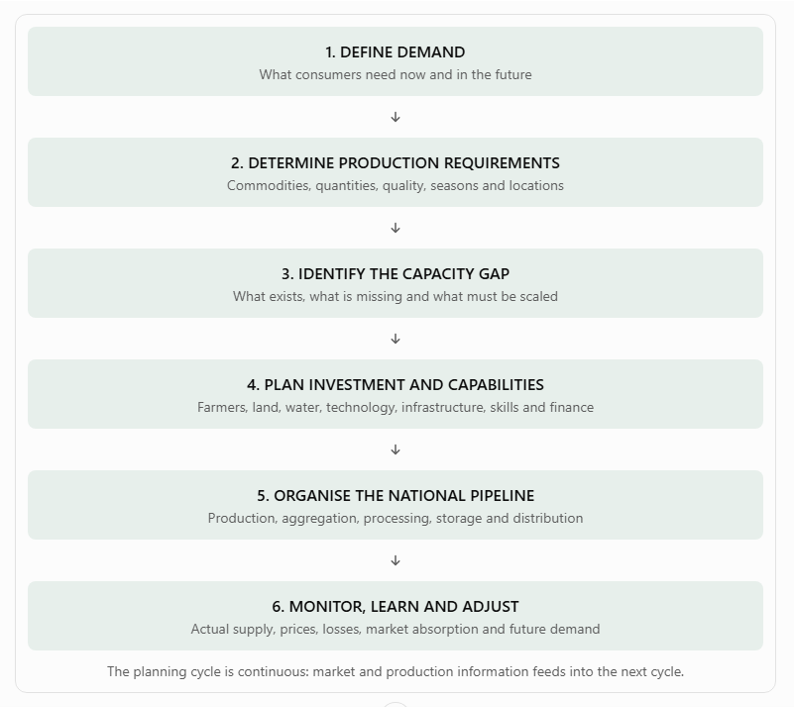
The important distinction
There are two different starting points that should not be confused:
- Supply-led thinking: What are farmers currently producing, and where can we sell it?
- Demand-led planning: What does the country need, what must we produce to meet that need, and what productive capacity must we build?
Farmers’ preferences, existing capacity and commercial interests remain important inputs. They inform how the production requirement can be achieved. They do not determine the full extent of national demand.
And this brings us to a particularly important conclusion for the Ministry of Education and Skills Development: the country cannot plan the skills it needs until the productive economy articulates what it intends to build. Demand for skills must emerge from demand for production, infrastructure, technology and services.
The choice is therefore not simply whether Botswana should plan its horticulture industry. It is whether the country wants to organise the industry deliberately around national needs or continue absorbing the economic, employment and food-security consequences of fragmented decisions.
Demand defines the destination. Planning determines the capacity required. The pipeline organises the means of getting there.
The Skills Required to Organise and Manage the Pipeline
Accompanying Article: [The Pipeline Imperative] (https://sheilasingapore.blog/2026/11/13/the-pipeline-imperative-creating-national-employment-and-sovereign-food-security-beyond-the-middleman-trap/), makes clear the range of skills required to organise and manage such a pipeline.
Not having all these skills today is not a reason for postponing implementation. It is a reason to identify the required skills, create demand for them, and build the necessary capacity. This is also where the Ministry of Education needs a clear signal. Without an expressed national demand for particular capabilities, how would the Ministry know which STEM disciplines, specialisations and training pathways the economy needs to develop? We cannot expect education and training to anticipate requirements that the productive economy itself has not articulated.
The Economic Cost of Missing Demand-Led Planning
What does it cost a country when it produces without first establishing what its market requires, in what quantities, at what quality, where and when? The cost is considerably greater than the value of produce that spoils. It is the cumulative economic cost of operating a productive industry without the planning function that connects consumer demand, production capacity, investment, infrastructure, skills and markets.
Botswana’s horticultural production has expanded significantly, reaching an estimated 140,881 metric tonnes in 2025/26, compared with 58,715 tonnes in 2019. Yet the available strategy estimates that approximately 35,881 tonnes are lost annually through in-field losses, post-harvest deterioration and market rejection. The estimated value of this lost produce exceeds P250 million in farm revenue every year. In other words, the country is investing in production capacity but is still losing a substantial portion of the economic value that capacity should generate.
1. What the country pays for today
The absence of demand-led planning creates several connected economic costs:
▪️ Production and demand mismatch. Farmers make production decisions without sufficient visibility of national and future market requirements. Several producers may harvest the same commodity at the same time, creating localised oversupply and collapsing farm-gate prices, while other commodities remain dependent on imports. The result is simultaneous surplus and shortage within the same national industry.
▪️ Lost farmer income and productive capital. When produce cannot reach buyers in the required quantities, quality, or delivery windows, farmers lose the value of their harvest. The estimated P250 million in annual uncollected farm revenue represents capital that could otherwise support farm operations, wages, reinvestment and expansion.
▪️ Higher costs for consumers. Spoilage, rejected deliveries, fragmented transport, duplicated handling, and intermediary charges become part of the cost of getting produce to retail shelves. The strategy’s illustrative price comparison places a one-kilogram produce basket at P17 under a fragmented spot-market model against P12 under an integrated pipeline model. This suggests a potential P5 difference per kilogram, or approximately 29%. These are illustrative model figures, not a verified national retail price survey.
▪️ Misallocated investment. Without a reliable assessment of present and future demand, investment in irrigation, climate adaptation, protected cultivation, packhouses, cold storage, processing and transport can become fragmented. Infrastructure may be developed without sufficient throughput, while critical gaps elsewhere remain unresolved. Demand-led planning gives investment a defined productive purpose.
▪️ Missed employment and skills development. A national horticultural pipeline requires people in production planning, agronomy, engineering, refrigeration, logistics, food science, quality assurance, data analytics, processing and commercial management. Without expressing this demand, education and training institutions have no sufficiently defined national workforce requirement against which to plan specialist programmes. The strategy estimates a potential footprint of more than 15,000 direct, pipeline and indirect jobs. This is a proposed employment opportunity associated with an integrated pipeline, not a count of jobs currently lost solely because demand-led planning is absent.
▪️ Weaker market oversight and price transparency. When production volumes, planting schedules, harvests, inventories, market destinations and actual sales are fragmented across individual operators, the country has limited visibility of how supply moves through the industry. This makes it harder to identify persistent bottlenecks, unexplained price differences, market concentration, artificial scarcity or practices that undermine competition.
▪️ Lost regional market opportunities. Without coordinated production volumes, quality standards, processing capacity and delivery schedules, Botswana cannot reliably build the supply relationships required to compete in regional markets. Surplus that could become a processed product or an export consignment instead becomes a disposal problem.
These are not independent problems. They reinforce one another. Weak demand intelligence leads to poorly coordinated production; fragmented production undermines aggregation and logistics; inadequate throughput increases losses; losses weaken farmer profitability; and weak profitability limits the investment needed to improve production. The country is left managing the consequences of fragmentation rather than organising the system that produces them.
2. Putting a price on the absence of this function
The most immediate measurable cost is the estimated P250 million in annual farm revenue lost through produce that does not successfully reach the market.
The following calculation illustrates what happens if that annual loss continues.
| Cost measure | Estimated economic cost |
|---|---|
| Annual lost farm revenue at the current baseline | P250 million |
| Five years, with the annual loss unchanged | P1.25 billion |
| Ten years, with the annual loss unchanged | P2.50 billion |
These are cumulative costs expressed in today’s pula, assuming the annual loss remains at the current estimated level. They exclude inflation, growth in production, additional investment requirements and the wider opportunity costs described above.
There is also a nominal scenario. If the annual economic cost rises by an illustrative 5% each year, the cumulative cost over ten years would be approximately P3.14 billion, with the annual cost reaching approximately P389 million in year ten. The 5% rate is a modelling assumption, not an inflation forecast or a prediction of future agricultural losses.
3. The ten-year cost of continuing without demand-led planning
| Measure | Today | Ten-year continuation scenario |
|---|---|---|
| Annual estimated lost farm revenue | P250 million | Approximately P389 million in year ten, at 5% annual escalation |
| Cumulative lost farm revenue | P250 million per year | P2.50 billion in today’s pula, or approximately P3.14 billion in nominal escalated terms |
| Produce lost annually | 35,881 MT | Not projected; depends on production growth, demand and loss rates |
| Employment opportunity | More than 15,000 potential jobs under the proposed pipeline | Opportunity remains unrealised to the extent that the pipeline is not developed |
The ten-year figures are a cost-of-inaction scenario, not a forecast of what Botswana will necessarily lose. They isolate the recurring farm-revenue loss already identified in the strategy. They do not add the value of missed exports, import substitution, consumer savings, investment multipliers or employment, because doing so without a separate economic model would risk double-counting.
4. The alternative: turning losses into productive value
The purpose of demand-led planning is to change the trajectory. It begins by establishing what consumers and markets require, then determines the production capacity, infrastructure, skills, and investment needed to meet that demand.
The strategy’s 2028 production scenario illustrates the scale of the opportunity: increasing national production to 185,000 tonnes, while reducing post-harvest losses to below 5%, or fewer than 9,250 tonnes. Against the current estimated loss of 35,881 tonnes, this would represent a substantial improvement in the volume of produce reaching markets.
The economic value of that improvement would extend beyond the farm gate. More produce reaching consumers means more reliable supply, stronger farmer revenues, improved utilisation of infrastructure, greater demand for technical and professional skills, increased processing opportunities and a stronger basis for regional trade.
The economic question is therefore not simply how much it costs to establish a national planning function. It is how much the country continues to lose by operating without one.
A national demand-led planning capability would be an investment in the coordination of the entire horticultural economy. Its cost should be assessed against the value it helps protect and create: farmer income, consumer purchasing power, employment, investment efficiency, food security and regional competitiveness.
Demand defines the destination. Planning determines the capacity required. The pipeline organises the means of getting there.
Who is this article for?
This article is intended for those who have a role in shaping Botswana’s horticultural industry and the wider economic environment in which it operates. It is particularly relevant to the Ministry of Trade and Entrepreneurship, which has a role in understanding present and future market demand; the Ministry of Lands and Agriculture, which must translate that demand into production requirements and agricultural capacity; and the Ministry of Education, which needs to understand the technical and professional capabilities that the productive economy will require.
It is equally relevant to those responsible for investment, infrastructure, transport, climate adaptation, food processing and commercial development, as well as financial institutions, private-sector investors, retailers, processors, farmers and agricultural organisations. Each has a part to play in developing the capabilities and connections that allow production to move efficiently from the farm to the consumer.
For farmers and horticultural businesses, the discussion raises a fundamental question: how can individual production decisions become part of a coordinated national industry in which market demand, production capacity, infrastructure and commercial opportunities are better aligned?
For policymakers and institutional leaders, the challenge is to look beyond individual projects, facilities or market interventions and consider how the functions fit together. The objective is not simply to increase horticultural production. It is to organise the conditions under which production can grow, farmers can participate meaningfully, investment can be directed productively, employment can expand, and Botswana can strengthen its food security while developing regional markets.
This article is an invitation to examine that national architecture and the institutional collaboration required to make it work. It is not a comprehensive economic transformation plan. It focuses on one productive industry through which Botswana can begin to put the principles of demand-led planning and coordinated economic development into practice.
Related Articles:
Nov 14, 2026: The functions of demand-led planning in the horticulture industry:
Nov 13, 2026: The Pipeline Imperative: Creating National Employment and Sovereign Food Security Beyond the Middleman Trap
Nov 12, 2026: Botswana’s Horticultural Transformation: Who Controls Production, Who Controls the Market, and Where Do Local Farmers Fit?
#BotswanaAgriculture #Horticulture #DemandLedPlanning #FoodSecurity #AgriculturalTransformation #Agribusiness #AgriculturalValueChains #ClimateSmartAgriculture #SmartAgriculture #EconomicDiversification #LocalProduction #RegionalTrade #SystemsThinking #NationalDevelopment


