

INTRODUCTION: WHEN EFFORT DOES NOT CHANGE THE PATTERN
Many persistent societal conditions remain difficult not because people are unintelligent, under-qualified, or unwilling to act, but because the underlying system is being approached primarily through detail complexity rather than dynamic complexity. Policies are revised, investment strategies refreshed, institutional structures reorganised, and implementation teams expanded, yet the overall Behaviour Over Time often remains materially unchanged across administrations and decades. When this happens repeatedly, the question gradually shifts from “What intervention is missing?” to “What structure continues reproducing the persistence beneath these interventions?”
This distinction matters because the two forms of complexity do not ask the same questions, nor do they produce the same kind of seeing. Detail complexity focuses on the number of variables, actors, projects, moving parts, and implementation requirements involved in a situation. Dynamic complexity, however, concerns how cause and effect unfold with delay across time, often across institutions, sectors, and generations, such that actions that appear reasonable in isolation unintentionally strengthen the very conditions they seek to change.
It is within this second territory that much of STRLDi’s work operates.
As Peter Senge explains in The Fifth Discipline, Systems Thinking is:
“to discipline us in seeing and understanding patterns — looking beyond events — to deeper structures that control events, and discovering the leverage that lies hidden in these structures.”
The emphasis here is important. Systems Thinking is not merely the study of complexity. It is a discipline of seeing.
DETAIL COMPLEXITY: WHEN THE SYSTEM IS APPROACHED THROUGH PARTS
Detail complexity is often the dominant language of institutions because it aligns naturally with administration, planning, budgeting, implementation, and measurement. Organisations identify variables, assign responsibilities, monitor indicators, establish targets, and attempt to optimise interactions between different operational components. This work is necessary. Large systems cannot function without it.
Within organisational settings, detail complexity may include:
▪️ Multiple departments
▪️ Large project portfolios
▪️ Regulatory requirements
▪️ Budget allocations
▪️ Stakeholder coordination
▪️ Technology integration
▪️ Performance management systems
The challenge within detail complexity is usually one of coordination, sequencing, execution, or technical integration. The system is assumed to be broadly understood, and the work therefore concentrates on improving performance within that frame.
This becomes particularly visible in conventional change-management processes where organisations:
▪️ Define strategy
▪️ Identify intervention points
▪️ Establish implementation variables
▪️ Simulate outcomes
▪️ Measure performance
▪️ Adjust execution pathways
These approaches are useful, particularly where the system boundary is reasonably visible and the relationships between actions and outcomes are relatively immediate.
But many persistent societal conditions do not behave this way.
DYNAMIC COMPLEXITY: WHEN CAUSE AND EFFECT ARE SEPARATED ACROSS TIME
Dynamic complexity emerges when the relationship between cause and effect becomes difficult to see because it unfolds across long horizons, across sectors, and through interacting layers of reinforcement. The difficulty no longer lies primarily in the number of variables, but in the fact that actions taken in one part of the system may only reveal their consequences years or decades later in another part of the system.
This is why persistent conditions often survive:
▪️ Electoral cycles
▪️ Administrative reforms
▪️ Investment programmes
▪️ Institutional redesigns
▪️ Leadership transitions
The visible events change. The deeper Behaviour Over Time does not.
In dynamic complexity, the system cannot be understood adequately through isolated snapshots because the structure expresses itself longitudinally. What appears disconnected at the level of events may reveal itself as tightly related when viewed over twenty, thirty, or forty years.
A nation may, for example:
▪️ Expand tertiary enrolment
▪️ Increase social spending
▪️ Attract investment
▪️ Improve retail circulation
▪️ Expand infrastructure
…and yet still remain structurally weak in the sectors required to absorb labour at scale. The issue here is not implementation failure alone. It is that the underlying relationships organising the system may remain materially unchanged.
This is why STRLDi’s work begins not with interventions, but with Behaviour Over Time.
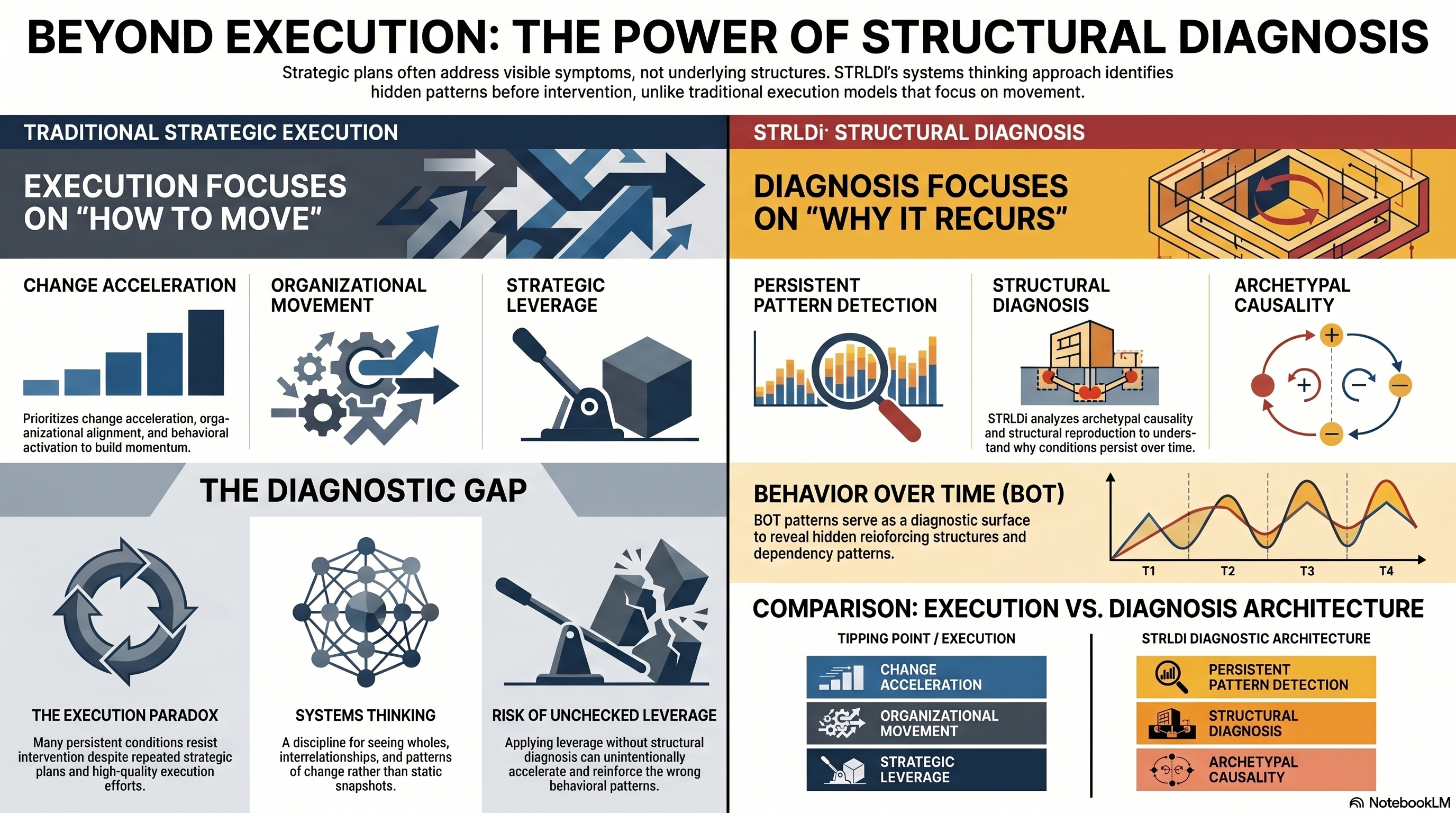
BEHAVIOUR OVER TIME: THE ENTRY POINT INTO STRUCTURE
At STRLDi, the first question is often not:
“What should we do?”
The first question is:
“What pattern refuses to move?”
This distinction is fundamental.
Persistent conditions leave behind behavioural signatures. When plotted longitudinally, these signatures reveal relationships that are often invisible at the level of events. Rising demographic inflow alongside persistently weak labour absorption, repeated downstream healthcare expenditure without corresponding upstream prevention improvement, or agricultural expansion without proportional manufacturing depth may all appear unrelated when viewed episodically. Over time, however, they may reveal the same underlying structural imbalance.
Behaviour Over Time therefore becomes more than a graphing exercise. It becomes a diagnostic doorway into dynamic complexity.
The emphasis shifts:
| DETAIL COMPLEXITY | DYNAMIC COMPLEXITY |
|---|---|
| Events | Behaviour Over Time |
| Variables | Relationships |
| Interventions | Structural persistence |
| Immediate outcomes | Delayed consequences |
| Organisational optimisation | Longitudinal diagnosis |
| Isolated sectors | Cross-domain interaction |
| Technical coordination | Behavioural reproduction |
This does not make detail complexity unimportant. It simply means that detail complexity alone cannot adequately explain why certain conditions remain materially unchanged despite sustained intervention.
SYSTEM ARCHETYPES: RECURRING STRUCTURES OF PERSISTENCE
Once Behaviour Over Time becomes visible, another question emerges:
What kind of structure produces this pattern repeatedly?
This is where system archetypes become important.
At STRLDi, archetypes are not treated primarily as facilitation tools or conceptual diagrams. They are approached as recurring structural patterns that leave identifiable behavioural traces across time. A persistent widening gap between labour inflow and absorption, for example, may reveal the behavioural characteristics of Success to the Successful, where sectors already structurally advantaged continue deepening while weaker sectors struggle to accumulate capability proportionately.
Similarly:
▪️ Repeated symptomatic interventions may reveal Shifting the Burden
▪️ Resource strain from expanding participation without proportional capacity deepening may reflect Limits to Growth
▪️ Competitive extraction between sectors may reveal Tragedy of the Commons
The archetype is therefore not imposed onto the system. It is surfaced through the Behaviour Over Time the system leaves behind.
This distinction matters greatly.
The work is not asking:
“Which archetype should we use?”
The work is asking:
“What archetypal behaviour is already expressing itself?”
THE ONION: WHY PERSISTENCE REPRODUCES ITSELF
Persistent systems rarely sustain themselves through one variable alone. They reproduce themselves through layers.
This is where the Onion Model becomes important within STRLDi’s work. The Onion is not merely a conceptual illustration; it is a layered diagnostic architecture involving system archetypes that helps explain how persistent conditions continue reproducing themselves across sectors and generations.
At the outer layers sit visible events:
▪️ unemployment
▪️ weak sector growth
▪️ rising healthcare burdens
▪️ institutional strain
Beneath these sit institutional responses, sectoral relationships, reinforcing interactions, mental models, historical assumptions, and societal beliefs as system archetypes, that quietly shape how decisions continue being made.
This layered reproduction matters because interventions often concentrate on the visible layer while leaving the deeper organising relationships materially unchanged.
The result is familiar:
movement without transformation.
Related links:
System Archeypes. Click here for the link: https://sheilasingapore.blog/training-learning-to-work-with-systemic-experiences/systemic-archetypes-running-our-realities/system-archetypes-2/
The Onion Model. Click here for the link: https://sheilasingapore.blog/the-onion/model/
WHY THIS DISTINCTION MATTERS FOR STRLDI
STRLDi’s work does not oppose simulation, facilitation, organisational learning, or implementation design. These become critically important once the dominant structure has already become sufficiently visible.
But the work enters earlier.
It enters at the point where societies, institutions, or sectors are still mistaking persistent structural behaviour for isolated events, leadership failure, funding shortages, or implementation weakness alone. The role of the facilitator, therefore, is not primarily to optimise execution pathways. It is to help bring the underlying structure into view.
This requires:
▪️ Longitudinal observation
▪️ Behaviour Over Time analysis
▪️ Archetypal diagnosis
▪️ Cross-sector comparison
▪️ Shared structural seeing
▪️ Generative conversation across custodians
Because when persistent conditions survive administrations, reforms, investments, and institutional redesigns, the question is no longer whether effort was sincere.
The question becomes:
What structure has remained materially unchanged beneath them?
CONCLUSION: FROM EVENTS TO STRUCTURE
Many systems remain difficult not because nobody cares, but because the structure producing the persistence remains insufficiently visible across roles. Institutions continue responding to symptoms while the underlying relationships quietly deepen beneath them. Over time, the pattern begins to appear inevitable, even though it is structurally produced.
This is why Systems Thinking, as Senge framed it, remains so important. It disciplines us to move beyond events into patterns, beyond patterns into structures, and beyond structures into the relationships that quietly organise Behaviour Over Time.
The work, then, is not merely to solve problems faster.
It is to see clearly enough that the system can no longer hide inside the events it produces.



You must be logged in to post a comment.