Part I — A Comparative View of Cultural Wisdom
Across very different traditions, one finds recurring attempts to understand why human suffering, conflict and disorder persist, and what allows a different pattern to emerge. The languages are different, and the underlying philosophies should not be collapsed into systems-thinking terminology, but there are striking points of convergence.
| Cultural wisdom | What it says about recurring patterns | Response to the vicious pattern | Similarity to Healing the Poison | Important distinction |
|---|---|---|---|---|
| Hindu traditions — Karma, Samsara, Dharma | Actions and dispositions participate in recurring cycles of consequence and rebirth. | Change conduct, consciousness and alignment with Dharma; ultimately seek liberation from the cycle. | The pattern is not treated as a single event; transformation occurs through changed practice. | Strongly metaphysical and spiritual; liberation from the cycle is central. |
| Buddhism — Dependent Origination | Suffering arises through interconnected causes and conditions; changing conditions can alter the continuation of suffering. (Stanford Encyclopedia of Philosophy) | Remove or transform the conditions sustaining suffering. | Looks beyond the visible suffering to what continually produces it. | The emphasis is cessation of suffering and liberation, rather than redirecting a social relationship into a virtuous reinforcing loop. |
| Daoism — Dao, Yin-Yang, Wu Wei | Reality is dynamic, relational and continuously changing; forceful intervention can work against the way things naturally unfold. | Work with the movement of the system rather than imposing unnecessary force. | Strong resonance with working with existing forces rather than fighting them. | Its philosophical centre is harmony with the Dao, not specifically the healing of a reinforcing interpersonal structure. |
| Chinese Five Elements / Wu Xing | Conditions continually transform and influence one another through cycles of generation and control. | Restore balance within the relationships between the elements. | Recognises that changing one relationship can alter the behaviour of the wider pattern. | More explicitly cyclical and cosmological than the relational intervention in Healing the Poison. |
| Jainism — Karma and Ahimsa | Actions create consequences that bind the individual to recurring cycles. | Discipline action, reduce harm and progressively purify conduct. | Small disciplined changes in behaviour matter over time. | The objective is liberation from karmic bondage rather than redirecting an existing social reinforcing structure. |
| Shinto — Renewal and purification | Disorder, impurity and imbalance require restoration and renewal. | Purification, restoration and renewed relationship with the sacred and community. | Does not necessarily destroy what is damaged; restoration is possible. | Its framework is religious and ritual rather than causal-structural. |
| Indigenous American traditions — Medicine Wheel / Seven Generations | Life is relational and consequences extend across people, generations and the natural world. | Restore relationship, balance and responsibility across the wider community and future generations. | Strong emphasis on the whole relationship system, not merely the immediate event. | Traditions differ substantially among Indigenous nations and should not be treated as one unified philosophy. |
| African wisdom / Ubuntu | A person’s humanity is constituted through relationships with other people; individual and community flourishing are interconnected. (IUScholarWorks) | Restore relationship, dignity, belonging and communal harmony. | The health of the relationship becomes the medium through which the people within it change. | Ubuntu is broader than a method for reversing a vicious loop; it is a conception of personhood and ethical life. |
| Norse traditions — cycles of destruction and renewal | Even great orders can enter cycles of destruction and renewal. | Renewal follows destruction and transformation. | Recognises that systems can move through recurring patterns rather than linear progress. | Much more concerned with cosmic destiny and renewal than deliberate human intervention. |
| Sufi traditions — descent and return | Human life can be understood as movement away from and back towards the source. | Inner transformation, remembrance and return. | The response is transformative rather than simply removing an external problem. | Primarily spiritual and inward. |
| Kabbalah — Tree of Life | Reality is understood through interconnected dimensions and flows. | Restoration, alignment and repair. | Strong resonance with the idea that the health of the whole depends upon relationships within the whole. | Metaphysical and theological framework rather than an empirical systems methodology. |
| Greco-Roman / Stoic traditions | Human beings live within larger orders they cannot fully control. | Change one’s response, exercise virtue and live according to reason and nature. | Focuses on changing one’s own contribution rather than attempting to control everything around oneself. | More focused on individual virtue and acceptance than on redirecting a relational feedback structure. |
| Biblical wisdom | Repeated human responses can deepen either disorder or peace; evil is not to be repaid with evil. The New Testament explicitly calls for living in peace and overcoming evil with good. (Bible Gateway) | Forgiveness, reconciliation, restraint, love and doing good in response to wrongdoing. | Particularly close to the idea of changing the quality of the response so that the next response can be different. | The biblical framework grounds this transformation in relationship with God, sin, grace and moral responsibility. |
| Quranic wisdom | Human conflict can be transformed through patience, goodness and reconciliation. Qur’an 41:34 explicitly describes responding to evil with what is better, such that enmity may become friendship; 49:10 calls believers to make peace between disputing brothers. (Quran.com) | Respond to wrongdoing with what is better; reconcile and restore peace. | Perhaps one of the clearest parallels: a different response can change the relationship itself. | The framework is explicitly theological and ethical, grounded in obedience to Allah rather than systems theory. |
What the comparison reveals
The similarities are therefore not trivial. Across traditions, we repeatedly encounter the recognition that what we repeatedly do to one another becomes part of what happens next; that responding to harm with more harm can perpetuate the condition; that patience, restraint, compassion, forgiveness, discipline or reconciliation can alter the trajectory; and that transformation often requires more than eliminating the immediate event.
But there is also an important distinction. Cultural wisdom generally tells us how to live; systems thinking gives us a way to see the structure through which those behaviours produce consequences. The former may provide the wisdom for the action; the latter can help us understand why the action may have systemic consequences.
That distinction becomes particularly interesting when we turn to Ubuntu.
Part II — Ubuntu: From “I Am Because We Are” to a Healing Structure
Ubuntu is often expressed through the phrase umuntu ngumuntu ngabantu — “a person is a person through other persons.” Contemporary scholarship treats Ubuntu not simply as a slogan about kindness, but as a relational conception of personhood: who we become is constituted through our relationships with others, and communal life is therefore fundamental to human flourishing. (IUScholarWorks)
That immediately creates an interesting point of contact with Healing the Poison.
The uncle did not regard the mother-in-law and daughter-in-law as two isolated individuals, each carrying an independent problem. He saw a relationship in which each person’s behaviour was becoming part of the conditions shaping the behaviour of the other. Ubuntu begins from a different philosophical position, but it reaches toward a similar relational insight: the person cannot be fully understood apart from the relationships through which that person lives and becomes.
Ubuntu Does Not Ask Only, “Who Is Wrong?”
Consider the difference this makes.
If the mother-in-law is declared to be the problem, then the obvious intervention is to change the mother-in-law.
If the daughter-in-law is declared to be the problem, then the obvious intervention is to change the daughter-in-law.
If both are declared to be the problem, we may call a meeting, establish rules, appoint an arbitrator or separate them.
All of these approaches can be useful in particular circumstances. But they remain largely focused on the participants and their behaviour.
Ubuntu shifts the moral gaze towards the relationship. The question becomes not only “What has this person done?” but “What is happening between us, and what kind of people are we becoming through this relationship?”
That is much closer to the uncle’s intervention.
Ubuntu and the Reinforcing Nature of Relationship
Here is where the comparison becomes particularly powerful.
If I treat you with dignity, your response to me may become more trusting.
If you trust me, I may become more willing to listen.
If I listen, you may feel understood.
If you feel understood, you may become more willing to understand me.
Each response becomes part of the condition for the next response.
This is precisely where Ubuntu can be read through a systems-thinking lens without claiming that Ubuntu itself is systems thinking.
The relationship can reinforce humaneness, just as it can reinforce hostility.
Respect can make respect easier.
Trust can make trust easier.
Generosity can make generosity easier.
Humiliation can produce defensiveness.
Defensiveness can produce aggression.
Aggression can produce retaliation.
Retaliation can provide further evidence that the other person cannot be trusted.
The structure is still reinforcing.
What changes is what the reinforcement is producing.
That is remarkably close to the insight contained in Healing the Poison.
Where Ubuntu and the Uncle’s Intervention Meet
The uncle’s intervention can therefore be read as having several points of resonance with Ubuntu.
First, he did not isolate the person from the relationship. The relationship was where the problem lived, and therefore the relationship was also where the possibility of healing existed.
Second, he did not begin with punishment. His intervention did not humiliate the mother-in-law or condemn Li-Li. This resonates with a relational ethic in which restoring humanity is more important than establishing the superiority of one individual over another.
Third, he worked through relationship. Li-Li changed her behaviour, but the objective was not simply to make Li-Li a “better person”. Her changed behaviour altered the interaction, which altered the mother-in-law’s response, which altered Li-Li’s experience again.
Fourth, the change became reciprocal. This is critical. The uncle did not permanently manage the relationship. Once the interaction began producing different responses, those responses began reinforcing one another.
That is the point at which Ubuntu and reinforcing structures meet most powerfully: human relationships can become self-strengthening.
But Ubuntu Is Not the Healing Poison
The distinction is equally important.
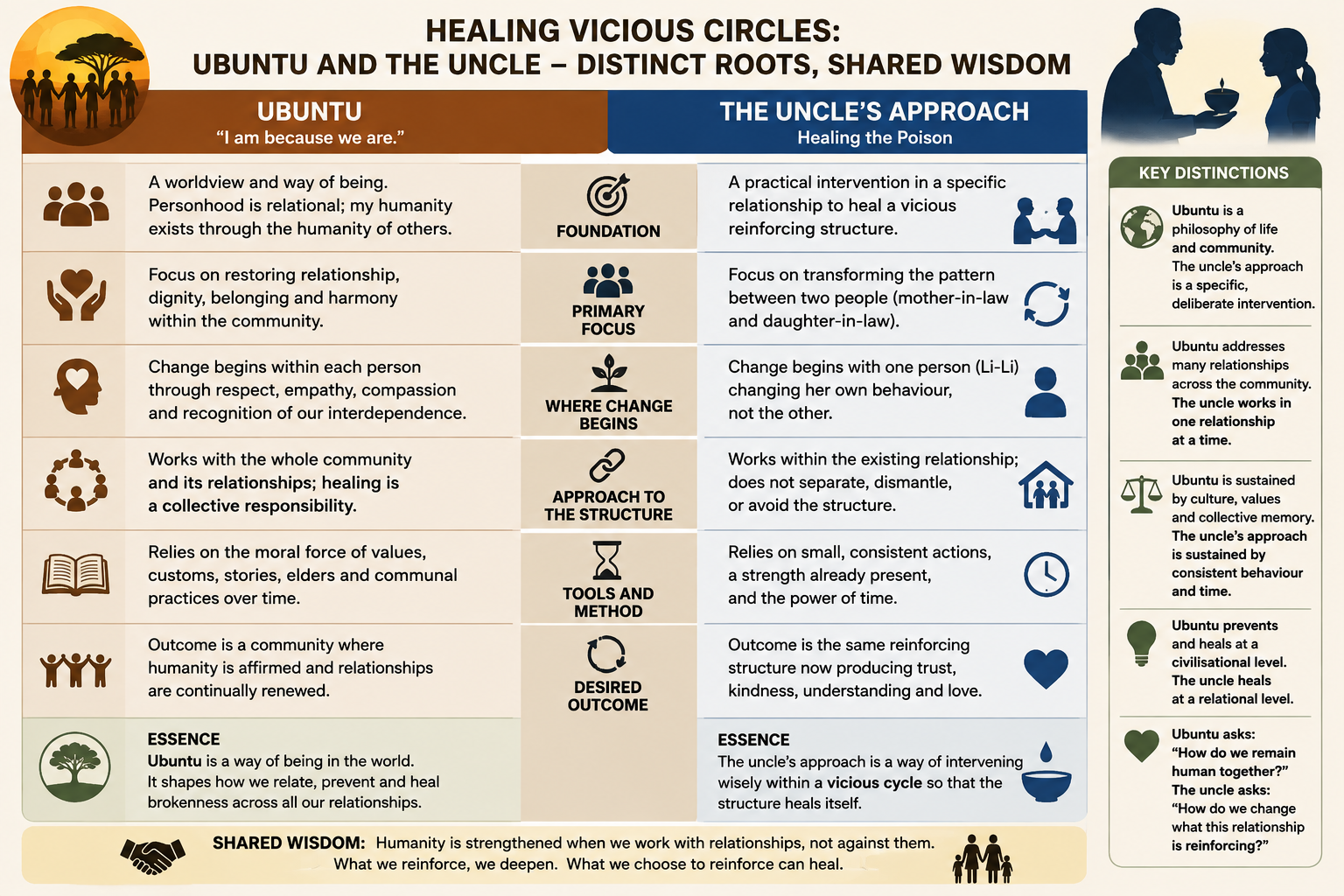
Ubuntu does not give us a systems archetype diagram. It does not tell us to draw a reinforcing loop, identify a polarity, locate a delay or search systematically for leverage.
Nor should we force it into those categories.
Ubuntu begins from a much deeper proposition: human being itself is relational. The person is not fully understood as an isolated unit who subsequently enters relationships. Relationship is constitutive of personhood. (IUScholarWorks)
Systems thinking begins somewhere different. It asks us to see patterns of interaction, feedback, causality and structure.
The two therefore illuminate different aspects of the same human reality.
Ubuntu can tell us:
You are a person through other persons.
Systems thinking can ask:
What happens to the relationship when the way you treat one another becomes mutually reinforcing?
And Healing the Poison adds another question:
Can we change what the relationship reinforces without destroying the relationship itself?
The Most Interesting Convergence
This may be where the comparison becomes genuinely useful for STRLDi.
Ubuntu does not merely tell us to be nice to one another. At its deeper level, it suggests that my humanity and yours are not independent variables. What happens between us contributes to what each of us becomes.
The uncle’s intervention makes that dynamic visible.
Li-Li changes.
The mother-in-law responds differently.
Li-Li experiences the different response.
Her capacity to continue behaving differently increases.
The mother-in-law experiences the new relationship.
Her own response changes further.
The relationship begins teaching both participants how to behave differently within it.
That is a reinforcing structure.
But it is now reinforcing Ubuntu-like qualities of relationship rather than hostility.
The Distinction STRLDi Can Add
This is where I think the comparison becomes more than an exercise in finding similarities.
Cultural wisdom may have known for centuries that how we treat one another changes what happens between us. Ubuntu gives that insight a profound philosophical foundation: I am because we are. The Bible and Quran similarly contain powerful teachings about refusing to return evil for evil, pursuing peace, reconciliation and responding to wrongdoing with goodness. (Bible Gateway)
Systems thinking gives us another language for examining how those behaviours accumulate.
It allows us to ask: What happens when this response becomes the cause of the next response? What happens when that pattern repeats? When does it become self-reinforcing? What does it reinforce? And where could one intervene so that the structure begins strengthening something different?
That is not replacing Ubuntu with systems thinking.
It is seeing more deeply into what Ubuntu may already have been telling us.
And perhaps this is the more interesting question for cultural wisdom generally:
Did systems thinking discover these patterns—or did human beings learn to live with them long before we learned to draw them?
The contribution of systems thinking may not be to claim ownership of the wisdom.
It may be to make the structure visible.












You must be logged in to post a comment.