

A Trade question before it is a railway question

On 11 August, President Duma Boko spoke about the urgency with which Botswana must begin to execute. In the remarks shared by Ray Mafoko, he returned to Botswana Railways as an example. He had set a deadline for the railway to become profitable. December came; it was not profitable. His response was blunt: decisions had to be made, the country could not remain “supine” in the face of challenges, and Botswana was in a race against time. Ray Mafoko’s publication of President Boko’s remarks
The statement can be heard simply as an instruction to Botswana Railways: become profitable. But perhaps we should slow down long enough to ask what that instruction actually requires of the economy around the railway. A railway cannot manufacture profitability by instruction. It becomes profitable when there is sufficient economically viable freight to move, when it can move that freight reliably and competitively, and when the productive economy continues to generate more freight as the railway expands. The more useful question, therefore, is not only how do we make Botswana Railways profitable? It is what must Botswana produce, process, sell and move for Botswana Railways to become increasingly profitable?
That takes us into territory that belongs initially to Trade. It takes us beyond the familiar regulatory role of controlling standards, licences, borders and commercial rules and into the economic work of understanding markets, defining demand, organising production opportunities and connecting them to the infrastructure that must carry the resulting goods. Botswana Railways then becomes part of that economic architecture, rather than being left at the end of the system to ask where it will find enough freight.
First, Let Us Look at the Railway We Have
In May 2026, Botswana Railways reported that it had been moving around one million tonnes of freight annually, while approximately 1.4 million tonnes a year were required to cover expenses. At the same time, only 11 of 34 locomotives and fewer than 200 of 1,155 wagons were operational. BR had also recorded an operating loss of P235 million between 2021 and 2024. (Daily News)
The natural response is to look at the 1.4 million tonnes and say: get BR to 1.4 million tonnes.
But that is where we need to be careful. 1.4 million tonnes is a financial threshold. It is not an economic ambition. If we make break-even the destination, we risk designing the railway around survival: reach the line, stay above it, contain costs, avoid taking risks and wait for the next problem. That is a balancing logic. It can keep an organisation alive without necessarily creating the conditions for it to become a growing economic engine.
The alternative is to understand profitability as feedback within a reinforcing economic loop. More viable production creates more freight; more freight creates railway revenue; revenue and investment create more capacity; more capacity allows more production to move; and increased production creates more opportunities for markets, investment and further freight. The question is therefore not simply how BR gets to the break-even line, but what size of productive economy Botswana needs to build around the railway so that the railway can keep growing with it.
Four Stages Give Us Something We Can Actually See
Let us use a simple eight-year planning model in which BR moves from 11 operational locomotives to 20, then 30, then 40. If we use the reported 1.4 million tonnes as the initial working capacity at 11 locomotives and scale the planning capacity proportionally with operational locomotives, the numbers look like this:
| BR stage | Operational locomotives | Annual planning capacity | Average per day |
|---|---|---|---|
| Stage 1 | 11 | 1.40m tonnes | 3,836 t/day |
| Stage 2 | 20 | 2.55m tonnes | 6,973 t/day |
| Stage 3 | 30 | 3.82m tonnes | 10,460 t/day |
| Stage 4 | 40 | 5.09m tonnes | 13,948 t/day |
These are planning numbers, not an engineering forecast of BR’s physical capacity. Actual capacity would depend on locomotives, wagons, track, signalling, loading and unloading facilities, maintenance, crews, turnaround times and the ability of the network to handle the resulting train movements. The purpose of the calculation is different. It allows us to see the scale of the productive economy that would need to grow if Botswana progressively restores and expands railway capacity.
Now apply the original planning allocation of 45% agriculture, 35% manufacturing and 20% mining:
| BR stage | Total capacity | Agriculture 45% | Manufacturing 35% | Mining 20% |
|---|---|---|---|---|
| 11 locomotives | 1.40m | 630,000 t | 490,000 t | 280,000 t |
| 20 locomotives | 2.55m | 1.145m t | 891,000 t | 509,000 t |
| 30 locomotives | 3.82m | 1.718m t | 1.336m t | 764,000 t |
| 40 locomotives | 5.09m | 2.291m t | 1.782m t | 1.018m t |
Now stop at the last line for a moment.
At 40 operational locomotives, this planning model would require approximately 2.29 million tonnes of agricultural freight and 1.78 million tonnes of manufactured freight, in addition to approximately 1.02 million tonnes of mining freight. The railway cannot create those goods. Agriculture, manufacturing and mining must create them, markets must absorb them, and the logistics system must be capable of moving them.
So the question becomes very simple:
What will Botswana put on 40 locomotives?
The Goods Are Already Moving
The answer does not begin with a blank sheet of paper. Botswana already has a substantial goods economy moving through its borders.
The 2024 International Merchandise Trade Statistics recorded 2.332 million tonnes of goods excluding oil imported into Botswana. Food and live animals accounted for 667,708 tonnes. Manufactured goods classified chiefly by material accounted for 1.101 million tonnes, machinery and transport equipment another 99,101 tonnes, and miscellaneous manufactured articles 58,476 tonnes. (GBoS Data)
The latter three manufacturing-related categories therefore amounted to approximately:
1,101,325+99,101+58,476 = 1.259 million tonnes
Add food and live animals:
667,708+1,258,902=1.927 million tonnes
Botswana therefore already imported approximately 1.927 million tonnes of food and manufacturing-related goods in 2024 within these categories. That is more than the 1.4 million tonnes that BR has identified as the level required to cover its expenses.
We should not make the foolish conclusion that all 1.927 million tonnes should now move by rail. Some goods are more appropriately moved by road; some are time-sensitive; some are high-value and relatively low-volume; some require short-haul distribution; and some goods will continue to be imported because producing them in Botswana would not be economically sensible.
The significance of the number is elsewhere. The freight market already exists. Botswana is already buying these goods, already paying for them, already bringing them through its borders and already moving them to consumers and businesses.
The question for Trade is therefore not simply where can BR find more freight? It is: which of these existing goods flows are economically suitable for rail, which imports could realistically be replaced by domestic production, and what additional markets could Botswana develop so that production grows beyond the domestic market?
That is a much more productive starting point.
Now Put Today’s Production Beside Tomorrow’s Requirement
Botswana is also not starting its productive economy from zero.
During the 2024/25 cropping season, Botswana reported approximately 144,000 tonnes of crop production, while horticultural production reached 88,670 tonnes, including vegetables and fruit. (Daily News) Government has also reported substantial livestock production, including approximately 69,000 tonnes of beef and 49,000 tonnes of poultry meat in 2022/23.
Using these documented quantities as a working production floor gives:
144,000+88,670+69,000+49,000=350,670 tonnes
This is not a claim that Botswana’s total agricultural production is only 350,670 tonnes. It is a conservative working number from the physical production quantities we can presently place side by side. Eggs have not been converted into tonnes, and other livestock and agricultural products have not been added.
But even this incomplete number is enough to expose the scale of the work ahead.
| BR stage | Agriculture freight requirement | Working local production | Today’s production as % of requirement | Production gap |
|---|---|---|---|---|
| 11 locomotives | 630,000 t | ~351,000 t | 55.7% | ~279,000 t |
| 20 locomotives | 1.145m t | ~351,000 t | 30.6% | ~794,000 t |
| 30 locomotives | 1.718m t | ~351,000 t | 20.4% | ~1.367m t |
| 40 locomotives | 2.291m t | ~351,000 t | 15.3% | ~1.940m t |
The point is not that Botswana cannot get there. The point is that today’s production is not the economy required by a 40-locomotive railway.
Today’s production is the starting point from which that economy has to grow.
At 11 locomotives, the working agricultural production floor represents approximately 56% of the agricultural freight requirement. At 20 locomotives, it represents about 31%. At 30 locomotives, approximately 20%. By 40 locomotives, it represents approximately 15%.
That is the productive gap.
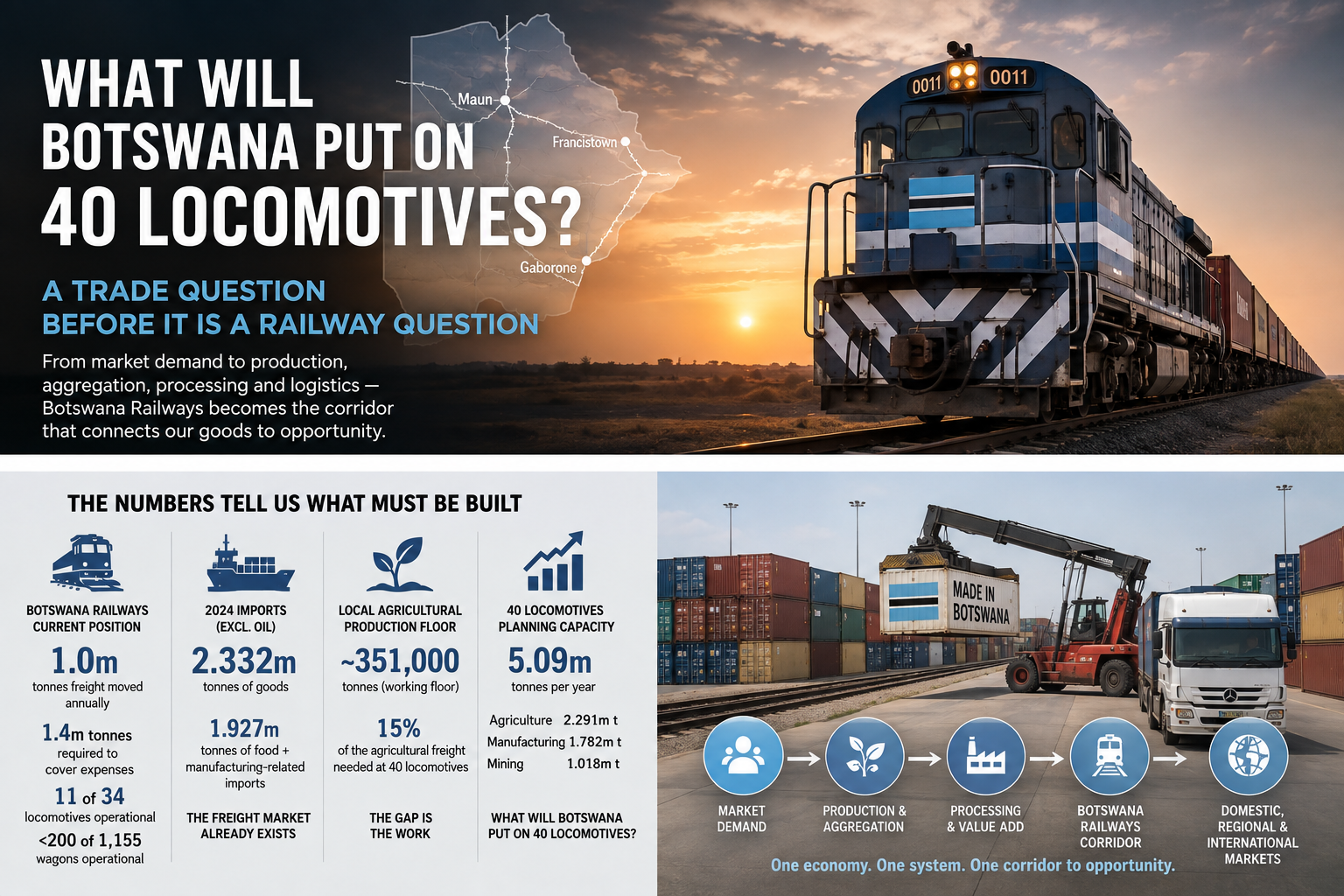
And the productive gap is not a reason to stop.
It is the work.
This Is Where Trade Needs Another Muscle
Trade’s regulatory role remains necessary. Botswana needs standards, licensing, customs, competition rules, consumer protection and a functioning commercial environment. But a country that wants to move from importing a large proportion of its goods to producing, processing and exporting substantially more cannot ask its economic-development ministry to stop at regulating commerce.
Trade has to know where the markets are.
It needs to know what Botswana buys, from whom, in what quantities and at what value. It needs to know which goods are growing in demand, which markets are opening, which imports might be competitively replaced, which products Botswana could export, and what quantities buyers would actually take.
The work then moves backwards from the market. If a buyer requires 20,000 tonnes of a product a year, at a particular specification, during particular months and at a particular price, that is not yet an agricultural programme. It is a market requirement. The next calculation is what production capacity is needed to meet it, who can produce it, where it can be produced, what inputs and infrastructure are required, what processing is necessary, how the output will be aggregated and how it will reach the buyer.
That is where the Ministry’s economic-development mandate becomes different from simply saying “produce more.”
There is another danger here: each part of the economy can become concerned mainly with whether the problem is occurring at its own end. Trade can look at regulation, Agriculture at production, manufacturers at markets, farmers at buyers, logistics operators at freight and Botswana Railways at its available tonnage. Each may have a perfectly reasonable explanation for why its own part cannot move faster. But if the economic system is treated as a collection of separate responsibilities rather than as one connected production-and-market system, the country can spend years improving individual parts while the whole system continues to take on water.

The problem is not necessarily at the end where the water is visible. It may be in the connections between the ends.
What Should the Trade Economic-Development Manual Contain?
If Trade is given an economic-development directive alongside its regulatory mandate, I would expect its operating manual to contain at least the following:
| Function | What Trade must actually do |
|---|---|
| Market intelligence | Maintain a live picture of what Botswana buys, from whom, in what quantity, value and trajectory. |
| Demand definition | Quantify domestic, SADC and international demand by product, volume, specification, price and timing. |
| Import replacement | Identify imports that Botswana could realistically produce or process competitively. |
| Export development | Identify products and markets where Botswana can credibly gain market share. |
| Product prioritisation | Rank opportunities by market size, margin, feasibility, employment, infrastructure and strategic value. |
| Production requirements | Translate markets into tonnes, quality, timing, land, water, inputs, technology and processing requirements. |
| Producer mapping | Know who can produce what, where, at what scale and with what reliability. |
| Aggregation architecture | Organise dispersed production into commercial volumes, consistent quality and predictable delivery. |
| Processing | Identify where raw production must be graded, stored, chilled, processed, packaged or transformed. |
| Buyer development | Build relationships with retailers, processors, institutions, hospitality and regional/international buyers. |
| Commercial contracting | Develop forward orders, specifications, supply schedules and commercial arrangements that give producers a production signal. |
| Logistics planning | Map movement from producer to aggregation, processing, distribution and market. |
| Freight-demand planning | Convert production and markets into tonnes, origins, destinations, seasonality and frequency. |
| Rail–road allocation | Determine which movements are economically suited to rail, road or intermodal transport. |
| Investment pipeline | Turn identified market and production gaps into investable projects. |
| Capability development | Identify missing skills, technology, equipment, finance and management capability. |
| Production monitoring | Track hectares, yields, throughput, quality, delivery and variance from plan. |
| Market performance | Measure actual import replacement, market share, exports, prices and commercial returns. |
| Economic feedback | Feed actual results back into the model and continuously adjust the production programme. |
| Corridor development | Translate production and market flows into the Botswana Railways corridor: origins, aggregation points, processing nodes, destinations, seasonality, train frequency and capacity requirements. |
This does not mean that Trade becomes the farmer, manufacturer, processor, investor, logistics operator or railway. Its job is to see the economic system and organise the information, relationships and decisions that allow those actors to work together.
The sequence is therefore:

That is what makes the railway part of an economic corridor rather than simply a railway company trying to sell transport capacity.
Where Does the Farmer Fit?
This distinction matters because a farmer who asks, “Who will buy what I produce?” is asking a legitimate commercial question. It should not be the farmer’s responsibility to discover the market after production has already taken place. The responsibility for identifying demand, quantifying it, developing buyers and translating that demand into production opportunities belongs within the economic-development function of Trade.
Once that market signal exists, the farmer’s responsibility becomes much clearer. The farmer can determine whether the required crop, livestock or other product can be produced at the required volume, quality, price and time. A Farmers Association or a Centre can then help aggregate production, coordinate growers, improve consistency and organise delivery against that identified demand.
This is where a Centre or Farmers Association can eventually become financially stronger. It does not have to become the buyer of everything, and it should not promise farmers that every crop will automatically be sold. Its role can increasingly be to organise supply against a market that has already been identified, reducing the randomness between production and sale.
The farmer therefore does not have to invent the market.
Trade develops and organises the market opportunity; producers build the capacity to supply it; associations and Centres aggregate that supply; processors add value; investors build missing capacity; logistics operators move the goods; and Botswana Railways becomes the corridor through which an increasing share of the economically suitable long-haul movement can flow.
That is a system in which each participant can see where his or her responsibility begins and ends.
Road Does Not Have to Lose for Rail to Grow
There is also no need to turn this into a fight between Botswana Railways and the freight companies already operating on the roads. A growing productive economy should create more freight, not simply move the same freight from one operator to another. Road remains essential for collection, short-haul distribution and last-mile delivery, while rail can progressively take more of the long-haul, bulk and consolidated movements for which it is economically suited.
We already have a practical illustration of what that can mean. In July 2026, Botswana Railways reported that the share of fuel imports transported by rail had fallen from approximately 70% to below 20% after its fuel tankers were withdrawn from service. The refurbished tankers now returning to service can carry 55,000 litres each, while a full train can move approximately 1.87 million litres, equivalent to roughly 50 fuel trucks. (Daily News)
The point is not that every truck should become a train. The point is that different transport modes can be allocated according to the economics of the movement. As the total productive economy grows, the appropriate share for rail can grow with it. Road operators can become part of the aggregation, distribution and intermodal system rather than being treated as an obstacle to railway recovery.
That is a much more sensible way to think about the relationship.
The Numbers Now Give Us a Different Question
At 11 locomotives, the planning capacity is approximately 3,836 tonnes a day. At 20 locomotives, it is approximately 6,973 tonnes a day. At 30 locomotives, it rises to 10,460 tonnes a day, and at 40 it reaches approximately 13,948 tonnes a day.
The question is not whether Botswana can magically produce enough goods tomorrow to fill 40 locomotives. It cannot. The question is whether Botswana can deliberately build the productive economy that will require 40 locomotives when that capacity becomes available.
That requires Trade to work ahead of the railway. It requires Agriculture to understand the production requirements of identified markets. It requires manufacturers and processors to see opportunities in the goods Botswana currently imports. It requires investors to see bankable production opportunities rather than simply waiting for a fully formed market to appear. It requires farmer organisations to become capable of aggregating commercial supply. And it requires logistics planning to connect all of this physical production to actual buyers.
At 20 locomotives, the planning model calls for approximately 1.145 million tonnes of agricultural freight and 891,000 tonnes of manufactured freight. At 30, those figures rise to 1.718 million and 1.336 million tonnes. At 40, they reach 2.291 million and 1.782 million tonnes.
Those numbers should not make us say, “Botswana cannot do this.”
They should make us ask:
What has to be built for Botswana to do this?
That is the difference between looking at a gap as evidence of impossibility and looking at a gap as a development programme.
Profitability Is Not the Destination
This is why I am reluctant to make the 1.4-million-tonne break-even number the centre of the discussion.
If the system is told repeatedly that BR must reach 1.4 million tonnes, the organisation can become oriented towards achieving and protecting that threshold. The resulting behaviour can become cautious: contain expenditure, protect the existing customer base, avoid capacity commitments, avoid risk and attempt to remain just above the line. The balancing loop then becomes stronger, while the productive economy around the railway remains weak.
A different structure starts with growing demand.

In this structure, profitability is not ignored. It becomes an essential feedback signal. If the additional freight does not produce adequate revenue, the system has to ask why: is the product wrong, is the market wrong, is the price wrong, is the route wrong, is utilisation too low, are turnaround times too long, or is the cost structure too high?
Profitability tells the system whether the reinforcing loop is working. It does not define the size of the economy we should be satisfied with.
That is why the ambition should not be “keep BR above break-even.” The ambition should be to build a productive economy in which BR can progressively increase its capacity because the economy is producing the freight that makes that capacity economically valuable.
So, What Will Botswana Put on 40 Locomotives?
We already have some of the answer.
Botswana is already importing the goods. Botswana is already producing agricultural goods. Botswana already has farmers, manufacturers, processors, freight companies, investors, buyers and a railway corridor. The missing piece is not the complete absence of economic activity. The missing piece is the deliberate connection of these activities at the scale required to transform the productive economy.
That is the work that must now become visible.
Trade can identify the demand and develop the market. Agriculture and producers can build the production capability. Farmer organisations and Centres can aggregate supply. Manufacturers and processors can add value. Investors can build the missing capacity. Logistics operators can collect, consolidate and distribute. Botswana Railways can become the long-haul corridor connecting that growing production to domestic, regional and international markets.
Then the railway is no longer sitting at the end of the system asking:
“Where will I find freight?”
The economic system is feeding the corridor.
Perhaps President Boko knows this.
Perhaps the statement on 11 August was intended to make the country uncomfortable enough to ask what “make Botswana Railways profitable” actually means.
Because the easier question is:
How do we get BR to 1.4 million tonnes?
The harder question is:
What are we going to build in Botswana that will make 40 locomotives necessary?
That question belongs to Trade.
It belongs to Agriculture and Manufacturing.
It belongs to farmers, producer organisations, processors, investors and logistics operators.
And it belongs to Botswana Railways.
Most importantly, it is not a question that requires Botswana to wait until it has all the answers before beginning. The numbers tell us where the gaps are. The gaps tell us what has to be built. And once the country can see what has to be built, the question changes from “Can we do it?” to “What do we need to do first?”
Sources:
- President Duma Boko’s remarks on Botswana Railways and the urgency of national execution, as shared by Ray Mafoko, 11 August 2026. Ray Mafoko — publication of President Boko’s remarks
- Botswana Railways: freight volumes, break-even requirement, locomotive and wagon availability, and operating losses. DailyNews, 21 May 2026. Botswana Railways records P235 million loss
- Botswana’s International Merchandise Trade Statistics. Statistics Botswana — official source for customs-based import and export data. Statistics Botswana explains that the underlying merchandise-trade data originate with BURS Customs & Excise and are transferred to Statistics Botswana for processing. (Statistics Botswana) International Merchandise Trade Statistics — December 2024
- Botswana crop and horticultural production, 2024/25. President’s State of the Nation Address reporting approximately 144,000 tonnes of crop production and 88,670 tonnes of horticultural production. DailyNews/BOPA, 11 November 2025. (Daily News) 2024/25 crop and horticultural production figures
- Botswana horticultural production and market development. DailyNews, 31 March 2026. This provides the more recent figure of 140,881 tonnes of horticultural production from April 2025 to January 2026, including 114,080 tonnes of vegetables and 26,800 tonnes of fruit, and notes that production exceeded national vegetable demand by 1.8%. (Daily News) Progress in horticultural production
- Horticultural import restrictions and domestic production. DailyNews, 29 April 2024. The report records horticultural production rising from 67,000 tonnes in 2021 to 86,000 tonnes in 2023, alongside a substantial reduction in the horticultural import bill. (Daily News) Horticultural import ban and local production
- Botswana Railways fuel-corridor example. DailyNews, 15 July 2026. The report states that the share of fuel imports transported by rail had fallen from approximately 70% to below 20%, that a refurbished tanker carries 55,000 litres, and that a full train can carry approximately 1.87 million litres, equivalent to about 50 fuel trucks. (Daily News) Botswana Railways fuel tanker refurbishment and rail freight capacity
One correction:
We would not retain the earlier statement that the 2024 agricultural production floor is exactly 350,670 tonnes without a qualification. The crop/horticulture figure of 144,000 + 88,670 is from 2024/25, while the beef and poultry figures cited are from 2022/23. They are useful for demonstrating scale, but they are not a clean same-year agricultural balance.
More importantly, we now have a newer horticulture figure of 140,881 tonnes for April 2025–January 2026. (Daily News)
So for a publication intended to withstand scrutiny, we retain the ~351,000-tonne figure explicitly as a “working production floor assembled from available documented production series”.


