
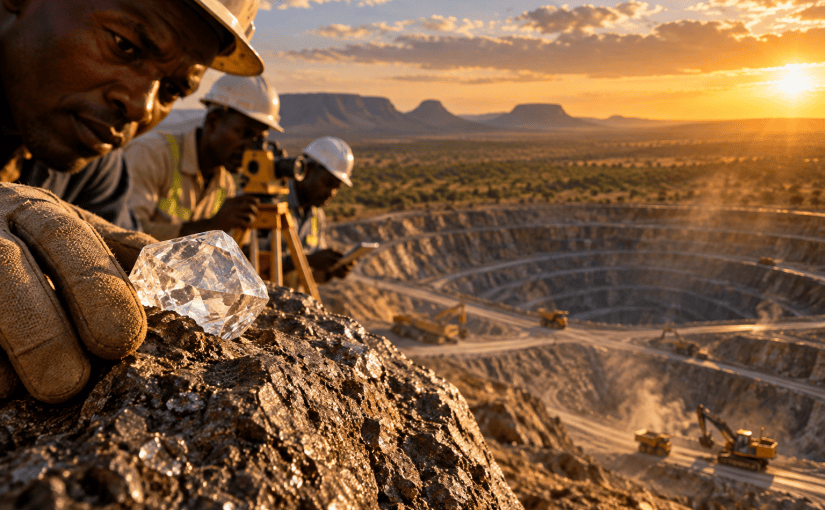
Closing Exercise: You Have Just Discovered Diamonds
Imagine that you are sitting in Botswana at the moment the diamond discovery is made.
You now know everything the teams have learned from reconstructing the causal loop.
You know the pushes and pulls.
You know where immediate gratification entered the system.
You know what happened when the successful solution reinforced itself.
You know what happens when the fundamental solution is postponed.
Your challenge
You have just been given responsibility for managing Botswana’s diamond discovery. What would you do?
You have the opportunity to design the system before the reinforcing loop takes hold.
You have to decide:
▪️ How much diamond wealth would you use immediately?
▪️ What would you deliberately not spend it on?
▪️ How would you sequence STEM education, agriculture, manufacturing and mining?
▪️ What capabilities would you build before increasing extraction?
▪️ How would you structure executive rewards so that they reinforce national capability, not simply production?
▪️ What would you do about processing and value addition?
▪️ How would you protect the mineral surplus from being absorbed by immediate political, private or institutional pressures?
▪️ How would you manage loans and diversification ventures?
▪️ How would you prepare for synthetic diamonds, changing markets and global warming before they become crises?
▪️ When would you deliberately bite the bullet and accept a slower immediate return?
▪️ What would you do when political or economic pressure demands the quick solution?
The final test
Draw your proposed system.
Then answer:
What is the first causal decision you would make differently?
And:
What reinforcing loop would you deliberately create instead?
Finally:
If your strategy works, at what point should Botswana become less dependent on the diamonds that made the strategy possible?
That last question is important.
The objective is not to manage diamonds forever.
It is to manage the diamond discovery so successfully that Botswana eventually does not need diamonds to remain successful.
Purpose
The history of Botswana’s diamond economy contains many events, decisions, pressures and consequences. They did not occur randomly. Each response changed the conditions that produced the next response.
Your task is to reconstruct the causal sequence.
Do not begin by looking for Success to the Successful, Shifting the Burden or Fixes That Fail.
First reconstruct the causality.
Part 1 — The causal pieces are deliberately jumbled
Exercise: Reconstruct the Causal Loop
Team challenge
Each variable is written on a separate sticky note.
The variables below are deliberately jumbled. Do not assume that the order in which they appear has any meaning.
Move the variables around and construct ONE causal loop.
Variables
▪️ Synthetic diamonds
▪️ Need to create employment for citizens
▪️ Executive performance incentives and bonuses
▪️ Weak manufacturing capability
▪️ Funding of political events
▪️ Discovery and development of diamonds
▪️ Global warming and carbon pressure
▪️ Loans or financial arrangements involving officials
▪️ Increasing difficulty and cost of extraction
▪️ Agricultural development initiatives
▪️ Foreign exchange requirements
▪️ Limited downstream processing and value addition
▪️ Private opportunities arising from mineral wealth
▪️ Need for government revenue
▪️ Development of infrastructure
▪️ Misleading or unsuccessful diversification ventures
▪️ Increasing concentration of resources, expertise and influence around the mineral economy
▪️ Insufficient STEM capability
▪️ Expansion of mining capacity
▪️ Land and asset acquisition
▪️ Changing global diamond demand
▪️ Weak agricultural productive capacity
▪️ Political expenditure
▪️ Rapid diamond revenue growth
▪️ Pressure to maintain or increase production
▪️ Institutional development and kgotla-like oversight
▪️ Corrupt practices
▪️ Loans and financial arrangements
▪️ Employment pressure
▪️ Rapid extraction
▪️ Deeper and larger mining operations
▪️ Need for alternative sources of national income
▪️ Coercion or blackmail
▪️ Continued dependence on mineral extraction
▪️ National development expenditure
▪️ Industrial and technical skills shortages
▪️ Agricultural and farming ventures
▪️ Search for another mineral
▪️ Visible national development
▪️ Diamond-sector success
▪️ Mineral wealth relieving immediate economic and social pressures
▪️ Local participation and citizen economic inclusion
▪️ Information about future diamond technologies and markets
▪️ Resistance to downstream processing
▪️ Mineral-generated financial surplus
▪️ Changing economics of natural versus synthetic diamonds
▪️ Institutional capability for productive economic transformation
▪️ Pressure created by unemployment
▪️ Depletion of accessible/high-value resources
Part 2 — Put the causality in order
Arrange the factors into a causal chain, not merely a historical chronology.
For every arrow, ask:
What caused what?
For example:
A → B
Ask:
Did A create a pressure that produced B?
Then:
What did B change in the system?
Then:
Did that change create the conditions for C?
Continue until the chain closes back on itself.
Your task
Construct one reinforcing loop from the factors above.
Do not create several independent loops.
Show where the loop reinforces itself.
Part 3 — Identify the push and the pull
Once the causal sequence is constructed, identify:
The push:
What problem or pressure forced the system to act?
The pull:
What solution attracted the system because it appeared to offer the greatest or fastest benefit?
Then continue through the sequence.
For each major intervention ask:
What pressure was this intervention responding to?
and:
What new pressure did the intervention create?
This is important because an intervention does not simply end a problem.
It changes the system.
Part 4 — Find the immediate gratification
Now go back through your causal chain.
Identify every point at which the system could obtain a benefit immediately instead of waiting for a deeper solution.
Examples might include:
more mineral revenue
more production
higher executive rewards
political relief
financial relief
employment relief
infrastructure spending
diversification projects
another loan
another mineral
For each one ask:
What fundamental problem did this immediate solution leave unresolved?
Part 5 — The critical question
Now identify the point where Botswana could have chosen:
immediate relief
or
fundamental capability-building.
For example:
diamond revenue → immediate consumption/investment
versus
diamond revenue → STEM → technical capability → productive sectors → future revenue.
The second pathway may produce less gratification initially.
That is deliberate.
Part 6 — What does biting the bullet mean under Law 9?
Now answer:
What does biting the bullet mean under Law 9 in this system?
Do not answer simply:
waiting.
Ask instead:
What would Botswana have had to accept or sacrifice in the short term in order to change the long-term causal structure?
Consider:
▪️ accepting slower visible economic returns from diversification
▪️ investing in STEM before it produced an economic payoff
▪️ allowing agriculture and manufacturing to mature rather than demanding immediate results
▪️ resisting the temptation to solve every fiscal or political pressure through mineral revenue
▪️ accepting lower immediate gratification from the mineral surplus
▪️ building processing and industrial capability before it became financially attractive
▪️ allowing new productive sectors time to fail, learn and become capable
▪️ changing incentives that rewarded extraction more immediately than capability-building
But then take the question one level deeper:
What would biting the bullet have had to reverse in the reinforcing loop?
That is the healing question.
Part 7 — Healing the loop
Draw the original reinforcing loop.
Then draw a second loop showing the healed causal sequence.
The original might emerge as:
Weak productive capability
→ need for revenue
→ mining
→ revenue
→ immediate relief/reward
→ greater concentration around mining
→ insufficient alternative capability
→ weak productive sectors
→ employment/revenue pressure
→ greater dependence on mining
→ more pressure for extraction
Then ask participants to reverse the reinforcing direction.
What happens if:
Mineral revenue
→ STEM capability
→ technical capability
→ agriculture/manufacturing/industrial production
→ employment
→ exports
→ reinvestment
→ stronger productive capability
→ less dependence on minerals
→ less pressure for extraction
Now ask:
Where did the system have to bite the bullet for the healing loop to become stronger than the old loop?

Final question
Only after the participants have completed all of this:
Having reconstructed the causal sequence, where do you now see Success to the Successful, Shifting the Burden and Fixes That Fail?
And one final national strategy question:
If Botswana does not heal the reinforcing loop, what happens when the next mineral becomes the new source of immediate gratification?
That last question moves the exercise beyond the diamond story.
The objective is not to decide whether diamonds were good or bad.
It is to discover how a successful solution can become the reinforcing mechanism that prevents the fundamental solution from maturing — and how respecting causal order can be used to heal that system.
Exercise: Reconstruct the Causal Loop
Team challenge
You are about to reconstruct a national economic system from the inside.
Have fun with it. Move things around. Argue with each other. Test your thinking. There is no prescribed starting point.
Instructions
- Each variable is written on a separate sticky paper.
- Spread all the sticky papers out where the whole team can see them.
- Move the variables around and organise them into ONE causal loop.
- You are not organising them according to chronology alone. You are trying to establish causal order.
- Ask yourselves after every connection:
- What causes this?
- What does this cause?
- What pressure does this create?
- What does that pressure pull the system toward?
- Every variable belongs in the loop. Do not remove a variable because it seems unrelated or inconvenient. Find where it fits and explain why.
- You may move the sticky papers as many times as necessary. Your first arrangement is unlikely to be your final arrangement.
- When your team believes you have the causal loop, draw arrows between all the variables.
- Identify where the loop reinforces itself.
- Give your loop a name.
The challenge
Once your team has completed the loop, answer:
Where in this loop did the system repeatedly choose immediate gratification instead of waiting for the deeper solution?
Then:
What would “biting the bullet” under Law 9 mean at that point?
And finally:
Where would you intervene to heal the loop — without simply creating another version of the same problem?
Remember
You are not trying to find the “right” historical sequence first.
You are trying to discover how the variables cause one another and eventually return to reinforce the starting condition.
All variables fit. Your job is to find how.
Exercise: Reconstruct the Causal Loop
From discovery to dependency
This exercise asks participants to reconstruct the development system rather than being given its explanation.
Each variable is placed on a separate sticky paper. Spread all the variables across the table. The task is to move them around and organise them into one causal loop.
Do not arrange them simply as a historical timeline.
Ask:
What causes what?
What creates pressure?
What relieves the pressure?
What consequence does that relief create elsewhere in the system?
Every variable belongs somewhere in the loop. The challenge is to discover how.
Teams should draw arrows between the variables, identify the direction of causality and determine whether the resulting structure reinforces itself.
Only after the teams have constructed and defended their causal structure should the facilitator introduce the systems archetypes.
Additional evidence cards
The teams are then given three additional pieces of evidence.
Evidence Card 1: The physical scale of extraction
Debswana’s 2023 production data provide an important physical dimension to the diamond economy.
Approximately:
- 122.7 million tonnes of material were mined.
- 24.7 million carats were recovered.
- This represents approximately 5 tonnes of material mined for every carat recovered, across Debswana as a whole.
The figure varies substantially between individual mines and should not be interpreted as a universal diamond-mining ratio.
The purpose of the evidence is different.
It allows participants to see the physical scale of the natural-diamond extraction system behind each carat produced.
The diamond is the visible product.
The material moved to obtain it is largely invisible in the economic story.
Evidence Card 2: Energy and carbon
Participants are introduced to a second comparison: the energy and carbon implications of natural and synthetic diamonds.
Available studies indicate that energy requirements vary considerably according to mining operation, synthetic technology, reactor configuration, production scale and electricity source.
Reported benchmarks include approximately:
- 150 kWh per carat for a De Beers mining benchmark.
- Approximately 36 kWh per carat for one HPHT synthetic-diamond configuration.
- Approximately 77–215 kWh per carat for different CVD configurations.
Carbon emissions cannot simply be inferred from energy consumption. The electricity source and the wider production system matter.
A De Beers/Sphera benchmark has been reported at approximately 47 kg CO₂e per carat from mine to sightholder, but this should be treated as a specific lifecycle benchmark rather than a universal value for all natural diamonds.
The purpose of the exercise is not to declare one technology universally superior.
It is to make visible another dimension of the system:
The natural diamond economy carries a physical extraction burden, an energy burden and a carbon burden. Synthetic production changes the structure of those burdens.
Participants should therefore consider how technological change, climate pressure and changing consumer preferences could eventually affect a development model heavily dependent on natural-diamond extraction.
Evidence Card 3: The knowledge trajectory around synthetic diamonds
The third evidence card concerns what was known, by whom and when.
Synthetic-diamond technology was not a recent invention.
Industrial synthetic-diamond research emerged internationally during the mid-twentieth century. De Beers subsequently developed its own synthetic-diamond research and moved into commercial industrial synthetic production during the 1960s.
By the 1970s, De Beers researchers were experimenting with gem-quality synthetic diamonds.
In 1987, the Gemological Institute of America documented De Beers gem-quality synthetic crystals of significant size produced in limited experimental quantities.
De Beers continued research into synthetic diamonds and technologies capable of identifying them.
Commercial jewellery sales of laboratory-grown diamonds came much later. In 2018, De Beers launched Lightbox, bringing laboratory-grown diamonds into the jewellery market commercially.
The historical evidence therefore establishes a long technological trajectory:
industrial synthetics → synthetic research → experimental gem-quality diamonds → detection technology → eventual commercial laboratory-grown jewellery.
But the evidence does not establish what De Beers believed the ultimate commercial consequences of synthetic gem-quality diamonds would be decades earlier.
That distinction matters.
The question for the teams
The participants should now return to their causal loop.
Ask them:
Does this additional evidence change the structure you have constructed?
If so, where?
Does the physical scale of extraction change how you understand the natural-diamond production system?
Does the energy and carbon comparison introduce another pressure into the system?
Does the history of synthetic-diamond research change your understanding of the information available to the different actors?
Then introduce the harder question:
What did De Beers see?
Do not ask participants to assume an answer.
Ask them to identify what evidence would be required to determine what De Beers knew about the technological trajectory of synthetic diamonds, what Botswana knew, when each knew it, and what information was shared through the joint-venture relationship.
This moves the exercise from speculation to investigation.
The issue is not whether De Beers knew synthetic diamonds existed. The historical record makes that clear.
The issue is what the organisation understood about their future technological, commercial and strategic significance, and whether that understanding differed materially from what was available to Botswana’s decision-makers.
The deeper systems question
The participants should now reconsider the production decisions within this wider context.
Botswana was converting a finite natural resource into government revenue, foreign exchange, infrastructure and national development.
At the same time:
- the physical effort required to recover each carat was substantial;
- diamond mining was becoming increasingly capital intensive;
- diamond demand could fluctuate;
- the international market had mechanisms for restricting production when supply exceeded demand;
- synthetic-diamond technology was developing;
- climate pressures would eventually become more significant;
- and Botswana’s productive capabilities outside mining remained a central national challenge.
The question is therefore no longer simply whether Botswana made good use of its diamonds.
The systems question is:
What was being built alongside the extraction of the diamonds that would allow Botswana eventually to need the diamonds less?
That is the point at which the exercise moves from resource management to national strategy.
Final Challenge
The participants are now given the responsibility for managing Botswana’s diamond discovery from the beginning.
They must decide what the country should do with the resource.
Not what Botswana historically did.
What they would do.
They must consider:
- the rate at which the resource should be converted into revenue;
- how much revenue should be consumed and how much should build future capability;
- the development of STEM capability;
- agriculture and manufacturing;
- industrial and technical capability;
- downstream processing and value addition;
- employment;
- executive and production incentives;
- market volatility;
- resource depletion;
- synthetic-diamond technology;
- climate and carbon pressures;
- investment and diversification;
- and the point at which the country should deliberately reduce its dependence on mineral extraction.
The final question is:
You have just been given responsibility for managing Botswana’s diamond discovery. What would you do?
The objective is not to manage diamonds forever.
The objective is to manage the diamond discovery so successfully that Botswana eventually does not need diamonds to remain successful.


