Your thinking is incisive — and it touches a painful global fault line.
🔵 INTRODUCTION
Fifty years ago, and even twenty years ago, eyes would quietly roll. This happened even just five years ago whenever I presented the unemployment case study. I called for the expansion of our economic base into agriculture and manufacturing. The analysis didn’t align with what many in Botswana held close to their hearts:
That the best jobs were in government. That the safest path was one with proximity to the national coffers. That careers worth pursuing were those of teachers, police officers, lawyers, and doctors. These roles are seen as stable, respected, and state-salaried.
In that worldview, STEM was invisible. It was neither prioritized nor financed. STEM has powered the rise of every economy now leading the world into the AI age. It is evident in Physics, Chemistry, and Mathematics.
But fifty years have passed. And the reality today no longer matches the dream.
The government coffers are no longer overflowing. Public sector job creation has slowed. And those trained in roles of the past now find themselves unskilled for a private sector that never fully materialized.
Looking back, we can forgive the choices of the early years. Botswana was young — trying to find its way. But the next 50 years will not wait. And it will not be gentle.
The time has come to name a reality many have quietly lived with. We must do so with compassion but also clarity. The reality is that STEM evokes pain. For many, it stirs memories of failure. It triggers feelings of not being good enough. People remember being left behind in schoolrooms that favoured quick calculations over poetic thought. Avoidance is no longer an option. We live in a world where everything we eat, wear, or build is grounded in the sciences. We operate everything through AI, except perhaps politics.
This is not to dismiss the Arts. They are necessary. They help us make meaning of what we have just lived through. But they are languages of the past. They draw their strength from nostalgia, memory, and reflection. They do not engineer propulsion. To leap into the future, we need STEM. It should not only be a subject in school. It should be the architecture of economic survival, governance, and production.
Every country has lived through that pain. Every person who has had to reckon with their place in this rapidly changing world has experienced it. You’re not alone in having struggled with STEM. But at some point, as individuals and as nations, we must find the courage to move forward with it anyway.
The future will not pause while we make peace with our past. We don’t have to pretend it was easy. But we also can’t let that pain define what comes next. It’s time to rise — not because it’s easy, but because it’s necessary.
This post explores three possible trajectories for Botswana from this point forward. The purpose is not to predict the future — but to sharpen our awareness of what we are choosing today. Each path is plausible. Each has its own consequences. But only one, I believe, leads to durable sovereignty, economic coherence, and generational uplift.
Looking back, we can forgive the choices of 50 years ago. It was Botswana’s first united front — a young nation trying to find its way. But the next 50 years will not wait.
So the question is no longer: What happened?
The real question now is: What must we be prepared for?
✳️ Introductory Paragraph:
The world is not waiting. Nations are restructuring their economies, education systems, and regulatory frameworks to meet the demands of an AI-powered, STEM-led global future. That shift was happening as far back as 200 years ago. In the span of a single generation, decisions made today in classrooms will determine the fate of countries. Ministries and boardrooms also play a crucial role in shaping the future. These choices will show if they fall behind or rise to global relevance.
Botswana stands at a crossroads. Will it continue on its current path — redistributing value instead of building it? Will it adopt surface-level AI tools without a real production engine? Or will it invest deeply in science, technology, engineering, and mathematics (STEM) to build resilient systems and regional value chains?
This post presents three strategic scenarios for Botswana’s future. Each scenario is shaped by the country’s choices around STEM investment. Governance models also play a role. Additionally, it depends on its willingness to lead rather than follow. These scenarios are not predictions. They are tools for clarity, planning, and courage.
✳️ Rationale for Developing the Scenarios:
These scenarios were developed in response to a growing national unease. This unease is about youth unemployment, growing regulation, policy stagnation, and technological disruption. They build on insights from systems thinking, development planning, and decades of underutilised potential in Botswana’s public and private sectors.
More urgently, they offer a language to speak about what we stand to gain or lose. This depends on whether we choose to centre STEM. It applies not only in education but also in governance, regulation, and production. It affects how we imagine our collective future.
Let’s walk through a likely 20-year scenario for Botswana (and similarly placed countries) if the current structural discomfort with STEM continues and the world’s STEM giants surge ahead:
🛰️ Scenario 1 for Botswana 2045: The Global Tech Divide Is Permanent — and Botswana Is on the Losing Side
1. STEM-Powered Superstates Set the Rules
China, India, Europe, and the STEM-enabled Middle East now own the AI, bioengineering, fusion power, agri-robotics, and climate-tech markets.
These regions no longer just produce the technologies. They have embedded them deeply into how society is governed. They also affect how infrastructure is maintained and how jobs are distributed.
2. Botswana is a Spectator to AI, Quantum, and Bio Revolutions
Botswana becomes a net consumer without a critical mass of home-grown STEM thinkers. It becomes a net consumer, not a producer. Botswana is not even a critical consumer.
The few tech services it can afford are scaled-down versions, pre-processed for Global South clients.
“It’s like drinking recycled water from a smart city you never helped design.”
3. The Global North No Longer Needs Botswana’s Minerals
Rare earths and diamonds are either:
Synthesized artificially (lab-grown diamonds, mineral extraction from space debris),
Or sourced from more politically stable, tech-integrated African countries (e.g., Rwanda, Kenya, Egypt).
The era of passive mineral wealth is over. The illusion that foreign spending will keep the country afloat is gone.
4. Socialist Redistribution Politics Struggle Without Revenue
With mining income gone and agriculture un-modernized, the state has less to redistribute.
Workers expect “entitlements,” but there is no productivity beneath to fund them.
The gap between promises and possibilities widens — leading to unrest, brain drain, and populist distraction politics.
5. Botswana’s Youth Are Angry — But Undertrained
With AI displacing traditional white-collar jobs, and no local STEM industries to absorb the loss, youth feel betrayed.
Ironically, many turn to the very influencers and entertainers the system elevated. They then realise that the real wealth and influence now sits in the STEM world. This is a world they were never invited into.
6. Global Tech Powers Pick and Choose African Partners
STEM-rich countries like Egypt, Tunisia, Kenya, and Rwanda become African nodes for future development partnerships.
Countries like Botswana are offered climate preservation roles, or eco-tourism zones — but not a seat at the decision-making table.
Foreign powers may still invest in:
Preserving biodiversity, not industrialising it.
Buying carbon credits, not helping industrial growth.
Charitable tech access, not capacity building.
In other words: you may be preserved, but not empowered.
✋ And Yet, It Was Preventable
This isn’t a natural outcome. It’s a choice — or rather, a series of avoided choices.
Countries like Botswana had 20 years to:
Rewire education to prioritise STEM (especially Physics, Chemistry, and Mathematics).
Reform leadership pipelines to demand STEM literacy in public service.
Stop glamorising “soft visibility” professions and reward quiet technical mastery.
🌱 But All Is Not Lost — If Action Starts Now
“The best time to plant a tree was 20 years ago. The second-best time is today.”
If Botswana invests now in building a critical mass of 35–40% STEM graduates, with integrity-based leadership:
It can leapfrog into renewable energy, regenerative agriculture, AI-supported public infrastructure, and STEM-backed governance.
It can serve as a regional hub for climate-tech, AI-integrated agriculture, or precision medicine.
That pivot requires courageous honesty about where things stand now. It also demands a break from the illusions of safety in visibility, poetry, or legacy mineral rents.
⚠️ Scenario 2 for Botswana 2045: Decoupled Growth – AI Without Foundations
“Digitised but unrooted. Tech glitters, but the soil is hollow.”
Botswana aggressively adopts AI technologies. This occurs in government, banking, security, and communication. However, the country is not building a foundational STEM ecosystem in its schools, industries, and governance systems.
Short-term gains (next 5–10 years):
Government digitises services.
Youth pick up quick AI tools (prompting, low-code apps, etc.).
Startups and donor-funded tech incubators emerge.
But…
Medium-term outcomes (by 2045):
Local talent cannot maintain or advance AI systems they adopt.
Manufacturing and agriculture remain underserved and unautomated.
Foreign firms dominate data, tools, cloud access — Botswana becomes a data client state.
This scenario creates a false sense of progress, masking the lack of sovereign technical depth.
If Botswana boldly shifts today, it can achieve a 60% STEM throughput within 10 years. This effort will allow them to catch up on lost time. By 2045, a radically different future is not just possible, it is probable.
Let’s explore that future in contrast to the previous scenario:
🌍 Scenario 3 for Botswana 2045 — The STEM Leapfrog Nation
“It was once called ‘the locomotive of Africa’ — now, it’s the driver of the engine.”
🔁 1. From Extractive to Generative Economy
Botswana no longer relies solely on mining rents; it now exports AI-driven agri-solutions, climate engineering services, and biotech intellectual property.
Former mining towns have been converted into STEM production corridors: solar microgrids, geothermal research hubs, fusion training centres.
Local manufacturing has revived — not cheap and dirty, but clean, precise, and export-oriented, led by engineers and digital technicians.
🧠 2. Public Sector Transformed: Led by Technocrats
60% STEM throughput means that half or more of public officers now have backgrounds in Physics, Chemistry, Mathematics, or Engineering.
Ministries no longer “consult” technical experts. They are the technical experts.
Policies are evidence-led, deeply simulated using systems models, and include impact foresight.
Regulatory culture shifts from defensive overreach to agile risk-tolerant frameworks — because people finally understand scale, feedback, and irreversibility.
“The government is no longer a referee of progress. It is the architect of it.”
👩🏽🌾 3. Botswana Becomes Africa’s Agri-Tech Command Centre
With climate volatility peaking, Botswana leads in regenerative precision agriculture, satellite-aided irrigation, and AI crop disease forecasting.
Thousands of rural youth are trained as agri-coders, drone operators, soil lab analysts, and seed technologists.
Regions like the Kgalagadi have become agro-innovation testing zones in collaboration with Indian and Dutch research stations.
The African Development Bank labels Botswana “The First Resilient Farm Nation.”
💼 4. Unemployment Nearly Eliminated — But It’s Not the Old Jobs
While mining and retail decline, jobs in:
Cybersecurity
Energy systems
AI governance
STEM teaching
Circular economy manufacturing grow rapidly.
Rather than waiting for jobs, young people are founding companies that export services and products into Africa and beyond.
The informal sector shrinks as people shift from hustle to mastery.
🧬 5. A New Botswana Identity Emerges
The national identity is no longer rooted in “a proud past” alone — but in a shared, technical future.
Botswana celebrates its engineers, data scientists, agronomists, and inventors — as deeply as it once celebrated singers and soldiers.
National TV channels run prime-time STEM storytelling, and annual “Botswana Grand Challenges” inspire national innovation sprints.
Even Setswana proverbs are being re-interpreted to align with scientific insights — grounding STEM in culture.
“Ga se ka lerumo le le bogale fela — le ka ntlha ya boikwetliso jwa gagwe.” It is not only because of a sharp spear — but because of the preparation of the one who wields it.”
🤝 6. Global Partnerships on Botswana’s Terms
Rather than waiting for Global North investors, Botswana becomes a technical equal.
It co-develops AI laws with Europe, shares data infrastructure with India, and hosts Africa’s Southern AI Observatory.
The Global STEM Diaspora is returning — not to visit, but to invest and teach.
Botswana is now chairing continental panels on STEM ethics, regenerative governance, and space economy for Africa.
⚖️ 7. The Political Culture Matures
The age of “elite populism” fades, replaced by civic science culture.
Parliamentary debates begin with simulations and systems maps.
Leaders are elected not by slogans, but by demonstrated grasp of complexity and ability to lead multi-disciplinary teams.
Even the military has STEM-led strategic units in cyber, space, and climate security.
🎓 8. The Ripple to SADC and the World
Botswana exports:
Curricula for STEM-primary schooling
Faculty to newly launched universities in Angola, DRC, and Zambia
Policy blueprints for AI regulation and STEM justice
Motswana professors are now guest lecturers at MIT, NUS, ETH Zurich.
Regional neighbours model their youth employment strategies on Botswana’s STEM value-chain training.
🛤️ How Did It Happen?
Through a radical national reckoning — and 3 unshakable reforms:
A National STEM Commitment Charter — enshrined in law.
Public Service STEM Track — 60% of new hires must be from Physics, Chemistry, Mathematics, and Engineering fields.
STEM x Culture Narrative Rewrite — using schools, churches, influencers, and village elders to normalise technical ambition.
Botswana can catch up on lost time if it boldly shifts today. It must commit to a 60% STEM throughput within 10 years. Then by 2045, a radically different future is not just possible, it is probable.
Let’s explore that future in contrast to the previous scenario:
We will next develop the three scenarios for Botswana’s future — arranged in a clear, escalating arc:
As the world accelerates in AI, biotech, manufacturing and advanced agriculture, Botswana stands at a pivotal crossroads. The choices made today will determine whether it builds systems. They will also determine if it becomes a dependent participant. It may also end up as a bystander in decline.
Here are three strategic scenarios to frame Botswana’s possible futures:
🚩 Scenario 1: Status Quo – STEM Neglect and Decline
“Redistribution without production. Regulation without understanding.”
Botswana continues on its current path:
Low STEM enrolment (9%) persists, with youth drawn to tenderpreneurship, arts, and political sciences.
Regulations remain tight — not due to strategic caution, but due to lack of internal technical fluency.
Tenders dominate local opportunity, sidelining hands-on production and systems-building.
Foreign experts parachuted in but fail to leave lasting capacity or ecosystems.
Socialism is used as political cover, redistributing limited gains but failing to grow new wealth.
Consequences by 2045:
Botswana becomes a pass-through state, relying on outside systems and consultants.
AI, engineering, and biotech are imported, not created.
Economic sovereignty weakens as the country remains resource-dependent (diamonds, minerals, tourism).
Society grows more fragile, with growing unemployment and state spending pressures.
🧨 Trigger signs already visible:
9% STEM graduation rate.
P800M procurement losses vs P80M in value.
Tight, reactive regulation vs anticipatory system design.
⚠️ Scenario 2: Decoupled Growth – AI Without Foundations
“Digitised but unrooted. Tech glitters, but the soil is hollow.”
Botswana aggressively adopts AI technologies — in government, banking, security, and communication. However, it does so without building a foundational STEM ecosystem in its schools, industries, and governance systems.
Short-term gains (next 5–10 years):
Government digitises services.
Youth pick up quick AI tools (prompting, low-code apps, etc.).
Startups and donor-funded tech incubators emerge.
But…
Medium-term outcomes (by 2045):
Local talent cannot maintain or advance AI systems they adopt.
Manufacturing and agriculture remain underserved and unautomated.
Foreign firms dominate data, tools, cloud access — Botswana becomes a data client state.
Reclaiming Africa’s STEM identity Rediscovering Africa’s Voice in STEM: From Stewards to Leadership
“STEM is not for Africans. We consume, we don’t produce.”
Those two sentences are different voices, though they often appear blended. Let’s unpack:
1. “STEM is not for Africans.”
👉 This is the colonizer’s voice — later echoed by chiefs, schools, and even independence-era leaders.
It frames STEM as foreign, alien, not belonging here.
It’s rooted in the obedience voice: Africa as “less than,” Africa as receiver not creator.
It’s about identity denial: “This is not who you are.”
2. “We consume, we don’t produce.”
👉 This is the reactive African voice — Africa speaking after having internalized the colonizer’s framing.
It reflects resentment and mimicry: “We are only users, not inventors.”
It is the learned mental model, reinforced by current dependency structures (imports, turnkey industries, brain drain).
It’s not the colonizer speaking to Africa — it’s Africa speaking to itself, but in categories inherited from colonization.
Why it matters to separate them
If we blur them together, the world can’t see the distinction between:
The imposed voice (from outside, colonizer superiority).
The internalized voice (from inside, reactive acceptance).
The restorative step begins when Africa notices: “This second voice is ours — but it is not truly ours. It is borrowed. We can choose differently.”
Introduction: Why Begin With Questions
This essay does not begin with conclusions. It begins with questions.
That is intentional. Too often, Africa is handed ready-made narratives — from colonizers, from international institutions, even from its own leaders. These narratives arrive as answers: you are behind, you must catch up, you are dependent. Africa repeats them, resists them, but rarely hears its own voice.
Questions are different. They open space. They allow the mind to unravel what was assumed, to see what was hidden, to return to what was silenced.
The order of questions in this inquiry is not random. It mirrors a pedagogy: begin at the surface (why does Africa fear STEM?), descend into history (what was Africa like before colonization?), widen the lens (who were the inventors? why India and Singapore diverged?), and finally return to Africa’s own voice (what if Africa rewrote its history?).
The journey itself is the teaching.
Absolutely 🌱. Since your essay has now grown into a multi-part inquiry, you could turn it into a series of posts rather than a single drop — letting readers walk the same path of questions you’ve designed. Each post can stand alone, but together they create the full arc.
Here’s a roadmap & outline:
🌍POST OUTLINE:
“Africa and the Voices of STEM: From Fear to Leadership” (or simply: “Rediscovering Africa’s Voice in STEM”)
Post 1: Why Does Africa Fear STEM?
Hook: The paradox of STEM seen as alien in a continent that once forged steel, mapped stars, and built empires.
Q1: Why does Africa fear STEM? (surface vs. deeper identity reasons)
Q2: What was Africa like before colonization? (indigenous STEM examples)
Q3: Who were the inventors of STEM globally? (India, China, Mesopotamia, Islamic Golden Age, Americas, Africa itself)
Insight: STEM foundations came from civilizations that never colonized Africa.
Closing: The irony — Africa fears what was once its own.
[Visual: Map/table of global STEM origins]
Post 2: The Obedience Voice — How Colonization Overwrote Knowledge
Q: Why did Africa not realize STEM did not come from colonizers?
Colonial schools, dismissal of oral knowledge, historiography bias.
Chiefs as echoes: subjecthood re-engineered from reciprocity → subservience.
Visible symbols of superiority (railways, guns).
Archetypes (Shifting the Burden, Growth & Underinvestment, Drifting Goals).
Post 5: Levers of Restoration — From Fear to Leadership
Q: How did Africa define knowledge? (proof, apprenticeship, women’s role).
Q: Were there resistances? (African inventors, intellectuals).
Q: What success stories already contradict fear? (M-Pesa, Zipline, off-grid solar, South African HIV research).
Q: What global crises open leadership opportunities? (climate, food, energy, pandemics).
Q: What barriers remain? (corruption, brain drain, status narratives).
Closing: Africa can pick up the pen — not just to boast, but to lead.
[Diagram: Five levers → restorative voice]
Part 1: Stewardship Voice — Before the Colonizer
Opening Question: Why does Africa fear STEM?
That’s a powerful question. The phrase “Africa fears STEM” often captures a perception. It is not necessarily a literal truth. However, it reflects deep systemic issues. From my work with systems thinking and the African context, here are some interlinked reasons why STEM (Science, Technology, Engineering, and Mathematics) hasn’t always been embraced with confidence:
1. Historical Legacy and Colonial Imprint
Colonial education systems in Africa often trained people to serve administrative and clerical functions, not to innovate, engineer, or industrialize.
After independence, many countries inherited systems that privileged rote learning over problem-solving, leaving STEM underdeveloped.
As a result, STEM is sometimes perceived as “foreign” knowledge, not rooted in local culture.
2. Cultural Beliefs and Identity
In many communities, wealth and status were historically tied to land, cattle, or family size, not to technical expertise.
This creates a subconscious fear: “If my child becomes a scientist, will they abandon our traditional ways and values?”
Parents may steer children towards “safe” professions like law, medicine, or government jobs. These professions confer prestige and security. This leaves STEM seen as risky or alien.
3. Fear of Failure in a Weak Ecosystem
STEM fields need laboratories, equipment, reliable electricity, and supportive industries. Where these are lacking, students experience repeated frustration.
The fear is not of STEM itself. The concern lies in investing in a path that may not “pay back.” This is because the system around it isn’t strong.
4. Education System Gaps
Early schooling often emphasizes memorization instead of curiosity, experimentation, and applied science.
Teachers themselves may fear STEM, lacking confidence and resources.
This creates generations of students who believe “Math and science are too difficult, only for geniuses” — a learned fear.
5. Economic & Policy Incentives
In many African countries, the largest and most stable employers are the government and retail sectors, not technology or manufacturing.
Youth see STEM graduates underemployed or migrating abroad, which reinforces the fear that STEM is a “dead end” locally.
By contrast, mining, tourism, and trade seem more certain pathways — even if they don’t build long-term resilience.
6. Structural Inequality
Rural schools often have no labs, no computers, and sometimes no science teachers.
This makes STEM look like something “for elites” in capital cities.
Fear comes from exclusion: “This world is not for us.”
7. Narratives and Mental Models
Stories matter. Young people mostly see engineers or scientists struggling. They hear leaders glorify imports rather than local innovation. The collective mental model becomes: “STEM is not for Africans. We consume, we don’t produce.”
Fear is embedded in identity, not just in ability.
✅ But it’s not all fear. Across the continent, there are counter-movements. These include robotics clubs in Kenya and solar startups in Nigeria. You can find biotech hubs in South Africa. There are also space programmes in Ghana and Ethiopia. AI initiatives are present in Rwanda. These show that the “fear” is not innate — it’s structural, historical, and cultural. When systems change, fear turns into aspiration.
It is tempting to answer quickly. Africa fears STEM because it is “hard.” Math and science intimidate students. Schools are underfunded. All true, but shallow.
The deeper reality is that Africa’s fear of STEM is not about equations or laboratories. It is about voice and identity.
STEM feels foreign, credentialist, disconnected from the rhythms of African life. Parents steer children toward law, politics, or government clerical work, which holds prestige and security. Students shy away from STEM fields because they rarely see African role models succeeding in them. Ministries lean on lawyers and administrators, not engineers and systems thinkers.
This fear is not natural. It is learned. And Africa pays for it daily in unemployment, poverty, food insecurity, and dependency.
First, we must understand the fear. To do this, we should return to a time before colonization. During that period, Africa spoke in its own voice about knowledge.
Question: What was Africa like before the colonial imprint?
Great question. To fully understand the issue, we must discard the narrative that Africa was “pre-scientific” before colonialism. Much of Africa’s heritage shows deep STEM practice. However, it is not always in the Western institutionalized form that colonial systems were imposed. The issue with STEM today is not Africa’s tradition itself. Instead, the problem lies in how colonial schooling reframed knowledge. This shift broke continuity.
Here’s a breakdown:
Africa Before the Colonial Imprint: A STEM-rich Landscape
1. Mathematics & Measurement
Egyptian, Nubian, Ethiopian mathematics: sophisticated geometry for pyramids, irrigation, astronomy.
Yoruba and Bamana numeration systems: base-20 and base-12 counting, used in trade and astronomy.
Calendrical systems: lunar/solar calendars aligned with planting, rainfall, and rituals (e.g., Dogon of Mali).
➡️ STEM was embedded in daily survival, spirituality, and agriculture—not separated into classrooms.
2. Engineering & Architecture
Great Zimbabwe’s stone complexes (11th–15th centuries) were built without mortar, using advanced load-bearing design.
Ethiopian rock-hewn churches of Lalibela (12th century) demonstrate engineering precision.
Sahelian mud architecture (Timbuktu, Djenné) used renewable materials and climate-adaptive design.
➡️ STEM here was generative: built from local materials, adapted to ecological conditions.
3. Agricultural Science
Terracing in Ethiopia, irrigation systems in the Sahel, banana/enset cultivation in East Africa, cattle-breeding in Southern Africa.
Indigenous soil and seed management: millet, sorghum, yam, and cassava systems evolved as resilient “climate crops.”
Knowledge of botany: medicinal plants, rotation cycles, intercropping for pest control.
➡️ Agriculture was a laboratory; experimentation and adaptation were constant.
4. Metallurgy & Technology
Iron smelting in Nok culture (Nigeria, ~1000 BC) predates much of Europe’s iron use.
Steel production in Tanzania (Haya people) used preheated forced-draft furnaces centuries before industrial Europe.
Goldsmithing, bronze casting (Benin, Ife), weaponry, and tools.
➡️ Africa wasn’t “behind” in metallurgy—it was parallel, sometimes ahead.
5. Astronomy & Navigation
Dogon astronomical knowledge of Sirius system (though debated) shows sky-mapping traditions.
Swahili and Malagasy sailors navigated Indian Ocean trade routes with star maps, winds, and currents.
Nilotic peoples tracked river flooding with stellar calendars.
➡️ Observational science is tied directly to food, water, and movement.
⚖️ Where It Sits Uneasily with Today’s STEM
Colonialism introduced a different framing of STEM:
Separation of knowledge — STEM became compartmentalized subjects in schools, divorced from spirituality, farming, or craft. Pre-colonial Africa had integrated knowledge systems.
Credentialism vs. craftsmanship — STEM success today is judged by degrees, papers, and laboratories. Pre-colonial societies valued demonstrable skill, practical results, and communal utility.
Individual vs. communal orientation — Western STEM emphasizes individual achievement and patents. African traditions placed innovation in the service of the community, not individual glory.
Alienation from land — Many African STEM practices (soil, crops, astronomy, building) were land-rooted. Colonial STEM made land “backward” and “modernity” urban and industrial.
✨ In Short
Before colonial imprint, Africa was already a STEM continent—but in a form where science, spirituality, agriculture, and culture were fused. The conflict arose when colonial schooling devalued indigenous STEM as “primitive.” It was replaced with Western STEM that was alien. This new STEM was credential-driven and divorced from daily life.
So Africa doesn’t fear STEM by nature. It fears a version of STEM that feels disconnected from its roots. This version offers little reward in its current economic structures.
Africa’s STEM was embedded in survival and spirituality. The forge, the field, and the stars were its laboratories. Chiefs and elders were its custodians.
This was the stewardship voice: knowledge as belonging, not domination.
Question: Who were the inventors of STEM?
Here is the irony: most of the foundational STEM building blocks did not come from colonizers at all.
This is a fascinating angle. It reframes STEM not as something “gifted” to Africa by its colonizers. Instead, it presents STEM as a global human inheritance. Many of the foundational discoveries and inventions that shaped modern STEM came from countries and civilizations that never colonized Africa.
Here’s a structured view:
🔬 Leading STEM Inventors & Civilizations (non-colonial in Africa)
1. China
Compass (navigation, 11th century)
Gunpowder (chemistry, 9th century)
Papermaking (Han dynasty, ~100 CE)
Printing press (woodblock & movable type) (Tang & Song dynasties)
Seismograph (Zhang Heng, 2nd century CE)
Mechanical clock (Su Song, 11th century)
➡ China made significant contributions to applied science and technology. This was achieved without colonizing Africa. Their presence began with the recent 21st-century economic involvement.
2. India
Zero as a number & place value system (Aryabhata, Brahmagupta, ~5th–7th centuries)
Ayurvedic medicine (systematic medicinal science, millennia-old)
Iron pillar of Delhi (rust-resistant metallurgy, 4th century CE)
Trigonometry foundations (sine, cosine concepts)
➡ India shaped mathematics, metallurgy, and medicine, which became the foundations for global STEM.
3. The Islamic Golden Age (Arab, Persian, Turkish, North African scholars)
Algebra (Al-Khwarizmi, 9th century, Persia)
Optics (Ibn al-Haytham, 10th–11th century, Iraq/Egypt)
Hospitals & surgical instruments (Al-Zahrawi, 10th century, Andalusia)
Astrolabe improvements (for navigation/astronomy)
Translation & preservation of Greek science + original advances in chemistry, astronomy, and medicine.
➡ While some Islamic empires interacted with Africa through trade or conquest (e.g., Arabs in North Africa), they were not “colonizers” in the European sense of extracting and administratively ruling territories.
4. Japan
Karakuri automata (mechanical dolls, early robotics, 17th century)
Sakichi Toyoda’s automatic loom (1890s, precursor to Toyota industries)
Advances in metallurgy and ceramics (swords, steel folding, 10th+ centuries)
Post-Meiji Restoration innovations in electronics, rail, and biotech (20th century).
➡ Japan never colonized Africa; it modernized on its own path and is now a STEM powerhouse.
5. Mesopotamia (Iraq, Syria region)
Writing (cuneiform) (~3000 BCE)
Wheel (~3500 BCE)
First known maps & astronomical records
Base-60 number system (still used in measuring time/angles).
➡ These were world-firsts, forming the roots of mathematics, astronomy, and engineering.
Egypt & Nubia: geometry, medicine, engineering (pre-Greek and pre-colonial).
➡ Africa itself was a STEM innovator before the colonial rupture.
Mapping STEM’s Origins, Carriers, and Today’s Landscape (vis‑à‑vis Africa)
A) Three roles in the global STEM story
Originators (Foundational inventors) – civilisations that created core building blocks. China (paper, compass, gunpowder, printing, clockwork), India (zero, place value, early trig, metallurgy, cotton tech), Islamic Golden Age (algebra, optics, hospitals, astronomical instruments), Mesopotamia (writing, base‑60, wheel), Pre‑Columbian Americas (precision calendars, terracing, chinampas), Sub‑Saharan Africa (iron/steel, architecture, agro‑ecologies), Egypt/Nubia (geometry, medicine, engineering).
Carriers/Industrializers (Amplifiers) – powers that standardized, mass‑produced, militarized, and exported STEM through empire, industry, and global trade: Britain, France, Spain, Portugal, Netherlands, Belgium, Germany, Italy; later the U.S. & USSR as global industrial/military carriers; Japan as a non‑African colonizer but a major independent modernizer.
Independent Modernizers (Non‑colonial over Africa) – Japan, China (late‑20th/21st c.), India, Korea, Singapore, others who internalized STEM without African colonization and used it for domestic transformation.
B) Diffusion matrix (who invented what, who carried it, how it spread)
Building block
Originators (examples)
Carriers/Industrializers
Main diffusion channels
Colonial impact (global)
Numerals & zero
India
Europe, global academia
Translation (Arabic→Latin), universities
Modern accounting, navigation, science
Algebra, optics, hospitals
Islamic Golden Age
Europe
Scholastic networks, printing
Surveying, artillery, clinical medicine
Paper, gunpowder, compass, printing
China
Europe (Gutenberg metal type), global navies
Trade, Jesuit/merchant knowledge flows
Books, bureaucracy, naval warfare, cartography
Metallurgy (iron/steel), lost‑wax casting
Africa, India, China
Europe, Japan, U.S.
Industrial process engineering
Railways, bridges, weapons, factories
Agronomy/terracing/irrigation
Andes, Ethiopia, Sahel, Nile
Europe, Asia (selective adoption)
Imperial agronomy stations, botanical gardens
Plantation economies, crop transfers
Astronomy/calendrics
Mesopotamia, Egypt, Mayans, Dogon*
Europe, global science
Observatories, nautical schools
Navigation, mapping, time standardization
*Dogon astronomy is debated academically; included here as a cultural tradition of sky‑knowledge.
Measurement power: cadastral mapping, statistics, censuses → taxation, labour control.
Doctrines & schools: naval colleges, artillery schools, civil engineering corps → replication across colonies.
Capital stacks: joint‑stock companies, marine insurance, commodity exchanges → financed global projection.
D) How non‑African‑colonizing originators used STEM at home
China: state bureaucracy (paper), large‑scale hydraulics (Grand Canal), porcelain/metallurgy; today—manufacturing scale, space programme, infra exports.
Frontier discovery & platforms: U.S., EU, China, Japan, South Korea (AI, chips, biotech, aerospace). Scale manufacturing: China (+ Southeast Asia), increasingly India. Mission engineering: U.S., China, India, EU (space, energy, defense). Frugal & leapfrog innovation: India (low‑cost medical devices), Kenya & Ghana (fintech, mobile money), Rwanda (drones), South Africa (biotech), Morocco/Egypt (automotive/aero niches), Ethiopia (space/remote sensing). Africa overall: strong use‑cases (mobile money, off‑grid solar, agri‑tech pilots) but thin domestic knowledge‑to‑industry ladders (R&D → standards → procurement → scaling).
F) Why this matters for Africa’s narrative
Continuity, not rupture: African and non‑colonial originators show STEM as a shared heritage, culturally close to Africa’s own traditions.
Carriers built power by systems, not just inventions: standards, logistics, capital, and institutions turned STEM into state capacity.
Modern independent builders prove the path: Japan/Korea/India show you can internalize STEM without colonizing Africa—and win.
G) Systems archetypes (Onion‑ready)
Growth & Underinvestment: Importing finished tech satisfies short‑term needs → underinvest in labs, tooling, standards, procurement reform → capability gap widens. Levers: sovereign procurement for local engineering, standards bodies, test labs, patient capital.
Shifting the Burden: Hire foreign turnkey contractors → chronic dependence → local engineers under‑utilized. Levers: mandatory local design/QA partners, capability transfer clauses, multi‑year talent pipelines.
Success to the Successful: R&D concentrates in a few regions → attracts more capital/talent → further concentration. Levers: regional African research consortia, pooled IP funds, diaspora sabbaticals, grand‑challenge prizes.
Drifting Goals: Lower expectations for domestic manufacturing → lock‑in to assembly/import. Levers: escalating local‑content thresholds tied to performance, export‑credit for African OEMs.
H) A practical roadmap for Africa (from “fear” to leadership)
Re-anchor STEM in heritage: curriculum threads that link indigenous agronomy, metallurgy, architecture to modern disciplines (identity = confidence).
Build capability ladders: tech parks that include tooling/standards/testing (not just co‑working); university‑industry design studios with public procurement demand.
Grand missions with procurement guarantees: e.g., national irrigation controllers, grid‑scale storage, cold‑chain for horticulture, local rail components—pre‑purchase + standards open to local firms.
Diaspora & South‑South exchanges: fellowships with India/China/Japan/Korea/Singapore; reverse‑sabbaticals for African faculty/engineers.
Talent compacts: 10‑year national cohorts (STEM teachers → technicians → engineers), bonded to mission projects rather than vague employment promises.
1) Origins → Carriers → Impacts (condensed)
Stage
Examples
What changed the world?
Africa lens
Origins
India (zero), China (paper/compass), Islamic Golden Age (algebra/optics), Africa (iron/agronomy), Mesopotamia (writing)
Core ideas & tools
Cultural fit already present
Carriers
Britain, France, Netherlands, Spain, Portugal, Germany, U.S.
Standardization, military/logistics, capital markets
Empire spread + extraction
Independent modernizers
Japan, Korea, India, China (modern), Singapore
Domestic upgrading, export manufacturing
Playbook for Africa
2) Today’s capability rings (qualitative)
Ring
Who
What
Frontier science
U.S., EU, China, JP, KR
AI, chips, biotech, space
Scale making
CN, IN, ASEAN
Electronics, machinery, textiles
Leapfrog apps
IN, KE, RW, GH, ZA, MA, EG
Fintech, drones, healthtech, renewables
Enablers
Standards bodies, metrology, procurement
Turn ideas into industry
🧩 Why this matters
Most of the fundamental STEM building blocks originated from various sources. These include numbers, geometry, astronomy, metallurgy, printing, medicine, and navigation. They came from civilizations that never colonized Africa.
The colonial powers (Britain, France, Portugal, Belgium, etc.) often imported, adapted, and industrialized these ideas for empire-building. They didn’t invent most of them.
So the irony is: STEM in Africa is said to “fear” its heritage today. It is the heritage of non-colonial civilizations. This heritage is often closer in spirit to Africa’s own indigenous science than to the colonial model of STEM.
That’s the pivot point. Once you see it, it flips the narrative:
Africa is not “behind” because it lacks affinity with STEM.
Africa’s own indigenous practicesalready mirrored the ways India, China, Mesopotamia, the Americas, and the Islamic world advanced STEM.
Colonialism interrupted and discredited that natural continuity. It replaced it with a credential-based, extractive, and bureaucratized STEM. This new system felt alien — and it still does.
The irony, is that the STEM Africa is taught to fear is a distortion. It is a repackaging of ideas by the West. These ideas came from everywhere else. In those places, STEM was closer in spirit to African traditions of land, craft, and community knowledge.
That opens a beautiful space. If African education systems re-anchor STEM in its global non-colonial heritage and indigenous African knowledge, you get recognition, not fear. “This has always been ours too.”
The Price of Fear Today
Africa once spoke of STEM in stewardship. Today, it fears STEM as foreign. The price is severe:
Governance: Ministries dominated by law, social sciences and politics, not science. Projects outsourced, accountability weak, scope creep unchecked.
Agriculture: Farming is seen as “backward.” Little soil science, irrigation, or crop genetics. Food imports rise, drought devastates. Youth abandon farms.
Manufacturing: Economies stuck in raw exports. Few engineers or machinists. Industries are imported turnkey systems that fail quickly. Youth unemployment soars.
This is the bill for losing the stewardship voice.
Part 2: Obedience Voice — During Colonization
Question: Why did Africa not figure out that STEM did not originate with its colonizers?
Because colonization was not just conquest of land. It was conquest of voice. It’s the “pain point” at the heart of the story. It wasn’t that Africa couldn’t figure this out. Several systemic forces worked together. They made people believe STEM belonged to the colonizers. Here’s the anatomy of why:
The Colonial School
Taught Newton, Galileo, Pasteur — but erased India, China, Africa.
Framed African knowledge as superstition, myth.
Designed not to produce scientists but clerks, interpreters, administrators.
Oral Knowledge Dismissed
African science was oral, experiential, embodied.
Colonizers dismissed orality: if it wasn’t in books, it wasn’t knowledge.
A Dogon sky story became “myth”; a Greek sky story was “astronomy.”
Africans internalized this dismissal.
Subjecthood Re-engineered
*Question: “Would anyone know that frame existed pre-colonization as subjects of their chiefs? Where did that frame get entrenched?”
Yes, Africans were already “subjects” — but subjecthood meant reciprocity: tribute in exchange for protection, belonging, and stewardship. Chiefs mediated ancestors and land.
Colonizers twisted this frame: chiefs became tax collectors, labor recruiters, enforcers. Tribute became extraction. Subjecthood shifted from belonging → inferiority.
Chiefs as Echoes
*Question: “Whose voice is this — colonizers or tribal chiefs?”
It was the colonizer’s voice. But chiefs echoed it, willingly or under duress, to survive. Hearing it from both foreigners and leaders, Africans normalized colonizer superiority.
Symbols of Invincibility
Railways, telegraphs, guns, later airplanes — staged as proof of European superiority.
Unlike India (1857 revolt) or Singapore (WWII), Africa saw colonizer dominance endure without visible weakness. The myth of invincibility stuck longer.
Historiography Bias
European histories of science jumped from Greece → Europe, skipping Africa and Asia.
These histories were exported globally, reinforcing the myth.
Africa lacked written archives to contest. Silence became complicity.
Archetypes Entrenched
Shifting the Burden: Imported STEM replaced indigenous.
Growth & Underinvestment: Local labs neglected, imports favored.
Drifting Goals: “We can’t invent, we can only consume.”
Sectoral Impacts
Governance: Ministries collected taxes for empire, not planned services.
Agriculture: Cash crops for export; food resilience weakened.
Manufacturing: Indigenous industries dismantled; colonies became consumers.
Thus the obedience voice emerged: Africa’s knowledge overwritten, chiefs echoing colonizers, STEM made foreign.
Part 3: Reactive Voice — After Colonization
Question: Why does Africa fear STEM?
Because in the colonial frame, STEM was never “ours.” Independence came, but the mental model remained: STEM = colonizer.
What stood up for India and Singapore — physically, emotionally, mentally, perceptually — that Africa did not have in the same way?
Let’s unpack this at four layers:
1. Physical & Institutional Foundations
India
A long, recorded scholarly tradition: Sanskrit texts, universities like Nalanda/Takshashila (even if destroyed earlier, memory persisted).
A huge population base → even during colonialism, there were Indian-run schools, press, and associations keeping intellectual life alive.
Colonial presence was heavy, but administrative penetration in rural India was thinner than Africa’s direct-rule models.
Singapore
A dense, urban trading port with infrastructure and institutions layered from multiple cultures (Malay, Chinese, Indian, Arab).
British didn’t suppress merchant/trade networks — they needed them, so Singaporeans remained intermediaries with preserved agency.
Africa
In many regions, colonial rule dismantled or hollowed out indigenous governance and institutions.
Suppression of local metallurgies, medicine, and agriculture systems removed the physical anchors of STEM continuity.
Many regions were ruled as extraction zones — not as “self-sustaining” settlements — leaving thin institutional roots.
2. Emotional & Identity Anchors
India
A civilizational pride: “We discovered zero, we had Ayurveda, we built temples.” Even if suppressed, this collective memory endured.
The independence movement wove science into pride — Nehru called scientists the “temples of modern India.”
Singapore
Community pride rooted in family and Confucian/Chinese traditions of valuing education above all.
A narrative: “We are a tiny island, survival = brains not brawn.” This instilled resilience rather than inferiority.
Africa
Colonizers framed African knowledge as “primitive” and worked to erase pride in it.
Without written scientific records to “prove” their science to Western standards, oral traditions were dismissed.
This emotional anchor was weakened, replaced by inferiority narratives.
3. Mental & Educational Continuity
India
English-language education became a tool for mobility. Indians used it to access STEM globally, then hybridized it with local ambition.
Education policy post-independence was laser-focused: science + math were non-negotiable, tied to industrial policy.
The mindset: “Colonialism ended, now we must be smarter than the colonizer to survive.”
Africa
Colonial education designed Africans as clerks, not creators.
Mental continuity of STEM was broken: the pipeline into applied science was thin, while administrative studies (law, politics) became more prestigious.
4. Perception of Colonizers
India
Colonizers seen as oppressors but not cultural superiors. Pride in India’s ancient civilization created an equal-to-superior counter-narrative.
The freedom struggle embedded resistance and re-appropriation: “We will beat them at their own science.”
Singapore
Colonizers seen as temporary “managers of trade.” The real agency lay with merchant families and communities.
After WWII and Japanese occupation, the British were exposed as vulnerable. Singaporeans reframed colonizers as neither invincible nor superior.
Africa
Colonizers positioned as bringers of “civilization.” African systems were delegitimized.
The perception gap was deeper: colonizer = superior knowledge, African = backward. This stuck in education and aspirations.
Question: India, Singapore and Africa were colonized? What did no allow India and Singapore not to go down the same path?
✨ So what “stood up” for India & Singapore?
Civilizational Memory
Civilizational memory and written traditions → provided pride and continuity.
Strong national/communal narratives → reframed STEM as survival, sovereignty, or status.
Leadership alignment → Nehru (India), Lee Kuan Yew (Singapore) actively championed science.
India: Nehru framed science as sovereignty. IITs, space, nuclear projects built prestige.
Singapore: Lee Kuan Yew tied STEM to survival. Education became national religion.
Africa: Leaders valorized politics over science. Lawyers and soldiers dominated independence movements.
Exposure to Colonizer Weakness
Perception of colonizers as temporary or beatable → not as sole source of knowledge.
India: 1857 Revolt, WWII.
Singapore: WWII collapse of Britain.
Africa: Few visible cracks until very late. Invincibility endured.
Diaspora Feedback
India: Diaspora in STEM thrived abroad, feeding back prestige.
Singapore: Scholarships abroad with compulsory return.
Africa: Brain drain; few systemic return channels.
Economic Structures
India: Large domestic market absorbed scientists.
Singapore: Industrial upgrading as survival.
Africa: Raw export economies, little space for STEM graduates.
Communal resilience structures (families, guilds, merchant networks) → shielded cultural respect for education.
Question: What stood up for them that did not stand up for Africa?
Written texts, communal pride, diaspora pipelines, visible colonizer weakness.
Africa lacked these shields. Chiefs co-opted, oral knowledge dismissed, colonizer power unbroken, diaspora drained.
✨ The Core Difference
India and Singapore redefined STEM as sovereignty and survival.
Africa was positioned to see STEM as foreign dependency.
That mental model difference — prestige + identity vs. alienation + fear — explains the divergence.
Guilds, Families, and Fields: Why Asia’s Shields Held and Africa’s Fractured
Institutional vs. Ecological Resilience
This takes us to the deep soil of why Africa’s pre-colonial stewardship voice didn’t crystallize into the same resilience buffers India and Singapore carried into colonization.
1. Mode of Knowledge Transmission
India & Singapore: Had written, codified traditions — Sanskrit texts, Confucian classics, merchant account books. These gave permanence.
Africa: Knowledge was oral, embodied, seasonal, experiential. Rich, but vulnerable: if elders were killed, or apprenticeships broken, entire sciences could vanish.
👉 Without writing, resilience structures were fragile under colonial attack.
2. Economic Base
India & Singapore: Dense trade economies. Guilds (weavers, blacksmiths, traders) created institutional memory. Merchant networks spanned seas and kept records.
Africa: Many societies were agrarian-pastoral, dispersed across vast land. Trade existed (Saharan caravans, Swahili coast) but was less institutionalized continent-wide.
👉 Economic decentralization limited the rise of guild-like resilience.
3. Social Organization
India & Singapore: Caste, clan, or merchant networks bound people into long-lasting communal obligations. Apprenticeship often ran through kinship or guild.
Africa: Authority often centered on kinship + chiefs. Knowledge was stewarded, but structures were fluid; migrations, wars, and ecology caused frequent dispersal.
👉 Flexibility helped survival, but limited rigid resilience structures.
4. Geography & Ecology
India & Singapore: High population density forced long-term institutions to emerge. Cities like Varanasi, Calcutta, Singapore city-state acted as resilience hubs.
Africa: Vast land, lower population density in many regions, high ecological variability (droughts, tsetse flies, shifting rain belts). Communities adapted fluidly — but without dense urban hubs to “lock in” institutions.
👉 Mobility replaced permanence as resilience.
5. Colonizer’s Leverage
India & Singapore: Colonizers encountered deep communal buffers (guilds, merchants, written canons). Harder to erase.
Africa: Colonizers faced flexible but fragile structures. Easier to break oral chains, co-opt chiefs, dismantle crafts, and rewire subjecthood.
So what stopped Africa?
Not weakness, but different forms of resilience:
Africa’s resilience was ecological, mobile, oral, adaptive.
India & Singapore’s resilience was institutional, textual, merchant-based.
Colonization targeted institutions. So where Asia resisted with codified canons and guilds, Africa’s fluid structures were dismantled more easily.
⚖️ Why Africa’s path diverged
Many communities had oral rather than written science traditions, easier for colonizers to dismiss.
Colonizers dismantled indigenous institutions more thoroughly (to prevent resistance).
Economic models (extraction, monocrops, mining) didn’t need local STEM → so STEM wasn’t integrated into sovereignty narratives.
Colonizers successfully embedded the “STEM = foreign” mental model deeper in Africa than in Asia.
Reactive Loops Today
Governance: Ministries dominated by law/politics, weak technical oversight.
Agriculture: Youth see farming as backward; agronomy invisible. Food imports grow.
Manufacturing: Industrial visions mimic foreign models, but factories fail without engineers.
This is the reactive voice: fearful, hesitant, angry, but still trapped in colonizer categories.
Part 4: Restorative Voice — Rewriting the Future
Question: If Africa could rewrite history, what would it do?
This is a profound thought experiment, Sheila — asking: if Africa could “rewrite” its history, what foundations would it have needed to carry forward so that its post-colonial STEM trajectory looked more like India or Singapore?
Here’s a structured reflection:
🔮 If Africa Could Rewrite History: A Systems Counterfactual
1. Pre-Colonial Anchors
Record Indigenous STEM in Writing
Codify astronomy, metallurgy, agronomy, medicine in scripts and manuscripts (as India did with Sanskrit texts, or China with bamboo/paper records).
This written archive would make it harder for colonizers to dismiss African STEM as “primitive.”
Institutionalize STEM in Guilds/Schools
Build enduring centers of learning (like Timbuktu but across regions) where STEM knowledge is formally taught, certified, and celebrated.
This would provide continuity even if colonizers disrupted oral traditions.
Tie STEM to Identity and Status
Ensure blacksmiths, healers, astronomers hold high prestige akin to priests or chiefs.
That way, when colonizers arrived, attacking STEM would be attacking the core of society, not just a fringe.
2. During Colonization
Frame Colonizer STEM as Additive, Not Superior
Chiefs and elders could have said: “They bring their tools; we already have ours. Let us combine them.”
By presenting European science as one more tradition among many, Africa could preserve dignity and continuity.
Preserve Parallel Indigenous Institutions
While accepting colonial schools, maintain African STEM schools that taught astronomy, metallurgy, botany, irrigation.
This would ensure children grew up bilingual in both indigenous and Western STEM.
Resist the “Primitive” Label through Leadership
Leaders could publicly demonstrate African STEM achievements (e.g., iron smelting, architecture) as equal to colonizer inventions.
This would counter the colonizer’s psychological edge of invincibility.
Build Coalitions with Other Colonized Nations
Forge intellectual exchanges with India, China, Islamic world — showing Africans that others under empire were also scientists, engineers, mathematicians.
This solidarity would weaken the “Europe = only science” narrative.
3. Post-Colonial Pivot (to Rewrite the Future)
National Leaders Define STEM as Sovereignty
Like Nehru in India or Lee Kuan Yew in Singapore, African leaders would have made science the language of freedom.
Instead of valorizing political or legal careers above all, they’d valorize engineers, doctors, and farmers who modernize.
Build Early Flagship Institutions
Establish continental “IITs” (Indian Institutes of Technology) or “NUS” equivalents (Singapore) as symbols of African brainpower.
Guarantee scholarships tied to national projects so STEM graduates felt purposeful.
Diaspora Integration
Structure pathways for Africans studying abroad to return with skills (as Singapore enforced with bonded scholarships).
This would prevent brain drain and build a confident scientific community at home.
Reframe Cultural Narratives
Celebrate African STEM heroes in textbooks alongside Newton and Galileo.
Teach children: “We discovered steel, we built Great Zimbabwe, we healed with botany — STEM is ours.”
4. System Archetypes — What Needed Breaking
Avoid “Shifting the Burden”
Don’t over-rely on imported turnkey solutions (railways, hospitals, schools). Insist on co-building with local engineers, training in parallel.
Avoid “Growth & Underinvestment”
Keep investing in labs, schools, indigenous knowledge — even if imported STEM seems faster or shinier.
Break “Drifting Goals”
Refuse to lower expectations: aim for African manufacturing, satellites, medical schools within a generation, not “someday.”
✨ Summary: The Alternative History
If Africa could rewrite history, it would have:
Recorded its STEM in enduring ways (written, institutional).
Framed colonizer STEM as complementary, not superior.
Preserved and taught its own STEM alongside Western STEM.
Had leaders who cast STEM as sovereignty, not subordination.
Invested in institutions, diaspora return, and prestige for scientists.
The result?
Post-colonial Africa would have emerged with a mindset closer to India. In India, STEM represents pride and sovereignty. Similarly, in Singapore, STEM signifies survival and prosperity. This is in contrast to today’s fractured view, where STEM is seen as foreign and dependent.
Question: What if knowledge had been honored differently?
Africa might already have led in regenerative farming, botanical pharmacology, metallurgy, cosmology, and frugal engineering.
Question: Why did Africa let go of its own voice?
Because colonization overwrote reciprocity with obedience. Chiefs echoed superiority. Fear replaced pride.
But history is not fixed.
Picking Up the Pen Today
Governance: Data-driven ministries, predictive modelling, and Development Manager reforms.
Education: Curricula rooted in identity — Dogon + Galileo, Nok + Newton.
Diaspora: Structured return pipelines.
This is the restorative voice: Africa reclaiming STEM not as mimicry but as authorship.
Epilogue: Rediscovering the African Voice
Africa often speaks in protest or mimicry — wound up tight, resentful, reactive. That is not yet its own voice.
This essay has unfolded in questions. Africa must rediscover its own narrative by asking differently. It should not do so by accepting ready-made answers.
The stewardship voice said: “We belong to knowledge.” The obedience voice said: “We obey the colonizer’s knowledge.” The reactive voice says: “We resent STEM, but still think it is foreign.” The restorative voice will say:
👉 “We are inventors. Our knowledge is ours. Our voice leads not only for ourselves but for the world.”
Part 5: Levers of Restoration — From Fear to Leadership
Opening Frame
We have traced Africa’s journey through four voices:
Stewardship — Africa once spoke STEM as belonging.
Obedience — Colonization overwrote this voice.
Reactive — Post-colonial Africa feared STEM as foreign.
Restorative — Africa can reclaim STEM as sovereignty.
But history alone is not enough. The question is: what levers can Africa pull today to shift from fear into leadership?
1. Rediscovering Epistemology
Question: How did African societies define “knowledge” — what counted as proof or evidence?
Pre-colonial Africa validated knowledge through experience. If it healed, if it grew, if it endured, it was true.
Blacksmiths proved knowledge at the forge.
Farmers proved knowledge in the harvest.
Healers proved knowledge through cures.
Knowledge was peer-reviewed by apprenticeship and witness. Communities saw results and sanctioned them.
Question: What role did women play as custodians of knowledge, and how was this silenced? Women held STEM authority:
Midwives controlled reproductive knowledge.
Seed selectors engineered agriculture.
Herbalists preserved pharmacology.
Colonization sidelined them, privileging male chiefs and Western doctors. Their knowledge was discredited as “folk practice.”
Lever: Re-anchor STEM in African epistemologies. Bring women’s knowledge back into curricula. Show that experimentation, apprenticeship, and embodied validation are as “scientific” as laboratory methods.
2. Reclaiming Resistance
Question: Why were chiefs vulnerable to co-optation — and could they have chosen differently? Chiefs were vulnerable because tribute tied authority to resources. Colonizers hijacked tribute into taxes and labor. Some chiefs resisted: Samori Touré built gun foundries, Menelik II modernized Ethiopia’s army, Shaka Zulu innovated militarily.
Question: Were there African resistances to colonial STEM narratives? Yes — but forgotten. African doctors and artisans kept practices alive in secrecy. Mission-educated elites argued Africa had science too.
Question: Who were the African inventors and intellectuals during colonization who defended STEM?
Edward Blyden (West Africa) argued for African contributions to civilization.
Cheikh Anta Diop (Senegal) later traced Egyptian science to Africa.
Innovators in agriculture, metallurgy, and medicine kept working locally.
Lever: Unearth and teach these resistances. Insert African inventors into textbooks alongside Newton and Galileo.
3. Naming Breakthroughs
Question: How did African independence movements frame science? Independence speeches emphasized politics and redistribution. Science rarely featured as sovereignty. Exceptions (Nkrumah’s Akosombo Dam, Nyerere’s Ujamaa farms) faltered because technical bases were weak.
Question: What African success stories in STEM today already contradict the fear?
M-Pesa (Kenya): Mobile money that revolutionized finance.
Zipline drones (Rwanda): Blood and medicine delivery at scale.
Off-grid solar (East Africa): Frugal engineering bringing energy to villages.
Medical research hubs (South Africa): Global leaders in HIV/AIDS, TB.
Space science (Nigeria, South Africa): Satellites and observatories.
These are not mimicry. They are Africa’s own STEM voice re-emerging.
Lever: Celebrate these as restorative voice in action.
4. Leading the World Through Crisis
Question: What global crises create opportunities for Africa to lead with its STEM voice?
Climate change: Africa’s regenerative agriculture and biodiversity can lead food system redesign.
Food security: Soil and genetic diversity position Africa as a breadbasket for the world.
Energy: Off-grid renewables and frugal systems can model global sustainability.
Pandemics: Africa’s experience with Ebola, HIV, COVID gives expertise in outbreak management.
Question: How can Africa build coalitions with non-colonial STEM powers?
Partner with India, China, Brazil, South-South networks.
Build joint labs, training exchanges, and technology co-ops.
Frame partnerships as solidarity, not dependency.
5. Removing Today’s Barriers
Question: What practices today prevent Africa from picking up the pen — and how can they be dismantled?
Corruption and rent-seeking → Solve with STEM-led governance: dashboards, public data, accountability mechanisms.
Status narratives (law/politics > science) → Reframe scientists and engineers as national heroes.
Closing: From Levers to Leadership
The restorative voice is not a dream. It is already breaking through in fintech, drones, off-grid energy, medical research. But for Africa to lead globally, it must:
The levers exist. The only question is whether Africa will pull them.
Epilogue (Extended): Rediscovering the African Voice
Africa often speaks in protest or mimicry — wound up tight, resentful, reactive. That is not yet its own voice.
This essay has unfolded in questions. Africa must rediscover its own narrative by asking differently. It should not rely on accepting ready-made answers.
The stewardship voice said: “We belong to knowledge.” The obedience voice said: “We obey the colonizer’s knowledge.” The reactive voice says: “We resent STEM, but still think it is foreign.” The restorative voice will say:
👉 “We are inventors. Our knowledge is ours. Our voice leads not only for ourselves but for the world.”
The levers of restoration are here. Africa can pick up the pen — not just to boast with the world, but to lead it.
Title: Raising Emotionally Ready Men and Women: Healing the Roots of Gendered Violence
Published by: STRLDi (Systems Thinking Research & Leadership Development Institute)
🧠 Culture of Public Harmony vs. Private Harm
In many cultures, maintaining a façade of harmony in public spaces is prized—especially within families, religious institutions, or social hierarchies. While appearing orderly and respectful on the outside, such cultures often harbour unspoken violence behind closed doors.
This cultural silence makes it harder for victims to speak up and harder for perpetrators to recognize their emotional wounds. It also prevents community accountability. True change requires lifting this veil.
Find here the Index /Table of Contents (at the beginning of the post) and a Policy Summary (at the end of the post):
QUICK NAVIGATION – HIGHLIGHTS OF THIS ARTICLE
The Proverb Revisited: Rethinking “Ha di etelwa pele ke manamagadi di wela ka lemena” in today’s context
Helen Andelin & Feminine Power: How Fascinating Womanhood reframes emotional readiness and feminine strength
The Journey of Boys & Girls Toward Emotional Readiness: Milestones from birth to relationship maturity – and what disrupts them
When Readiness Fails: How cheating, violence, and emotional reactivity emerge in unreadied adults
Age & Gender of Offenders: At what age and in what household structures does violence begin?
The Mother-Son & Father-Daughter Influence: Generational voices that shape violence, control, and gender roles
Addiction, Poverty & Educational Attainment: Hidden contributors to emotional dysregulation and relational harm
Lost Potential: Educational, emotional, and civic achievements denied by gendered violence
Where Violence Struggles to Thrive: What countries are doing differently to prevent gendered violence
A Vision for Healing: What emotionally ready men and women do in love, hardship, and legacy
🪶1. WALKING THROUGH THE CULTURAL NUANCES
REINTERPRETING THE PROVERB: “Ha di etelwa pele ke manamagadi di wela ka lemena”
A vision of emotional responsibility and generational strength
Traditionally, the proverb “Ha di etelwa pele ke manamagadi di wela ka lemena” has been understood to suggest that when women lead, missteps follow. Taken literally, it warns of hens falling into a pit when they lead the flock. But such an interpretation, often shaped by patriarchal norms, fails to honor the fuller spiritual and relational truth the proverb may be pointing toward.
What if the proverb was not a condemnation of women’s leadership, but a call to men to step into their higher responsibility—beyond self, toward service?
🔹 A Man’s Role: To Provide Shelter, Not Rule
In this deeper reading, the proverb reminds us that when men abdicate their role as protectors and providers—not just materially, but emotionally and spiritually—those in their care are left exposed to the harshness of the world.
The man is not a tyrant, but a shelter.
His strength is not control, but sacrifice and foresight.
He grows from self-centeredness to community-centered responsibility.
He defends the space where women, children, and society at large can thrive in peace.
“Imagine a world where all men embrace this calling—to extend their arms not only around their own households, but outward, encompassing their communities, their nations, and even the globe.”
🔹 A Woman’s Role: To Thrive Within Sanctuary
In such a world, a woman is not diminished—but elevated. She is given the emotional and physical room to care for herself, nurture her gifts, and raise a generation grounded in security, love, and vision.
“In the sheltered space he provides—not of domination, but of peace—she becomes the nurturer of future men and women who will, in turn, learn to stand on their own feet and protect others in kind.”
This is not submission—it is a circle of strength, rooted in each gender fulfilling a role that enhances, not erases, the other.
🔸 In Conclusion: A Shared Covenant
This reinterpretation of the proverb offers a shared vision:
For men: to reclaim their deeper purpose as emotional anchors, not authority figures.
For women: to rise with strength in spaces of security, not struggle.
For the next generation: to inherit a model of wholeness, not woundedness.
“Ha di etelwa pele ke manamagadi di wela ka lemena” becomes not a warning against women, but a call to men to lead in service, and to both men and women to co-create a society where no one must walk into the pit alone.
I’m so glad you resonate with the reframing.
What you’re expressing aligns deeply with Helen Andelin’s work in Fascinating Womanhood, which makes a central argument: A woman’s feminine strength doesn’t diminish her—it inspires masculine nobility. When she forfeits this—often in pursuit of self-protection or social power—it can disorient the very dynamic that builds mutual care.
Here’s a refined continuation of your reflection, professionally and warmly phrased, with direct thematic references to Helen Andelin’s work:
🔹 When Women Take the Space Away: A Feminine Power Lost
In today’s world, many women—rightfully tired of being unprotected—step into leadership, self-sufficiency, and public influence. But in doing so, some are taught to abandon the very feminine strengths that make them uniquely powerful: softness, compassion, trust, and radiance.
Helen Andelin, in Fascinating Womanhood, makes a profound observation:
“The kind of woman who brings out a man’s deepest love is one who possesses a childlike inner happiness, tenderness, and charm—not the aggressive independence that makes him feel unnecessary.”
When a woman believes she must lead by out-manning the man, she may gain power—but lose connection.
She may project control instead of trust.
Withhold softness for fear of being seen as weak.
Adopt emotional hardness to survive a world that has hurt her.
But in doing so, she accidentally removes the very qualities that inspire a man to protect, provide, and cherish her.
🔹 Feminine Power Is Not Weakness—It Is Catalytic
Andelin writes:
“Feminine charm is not manipulation—it is a natural expression of love, joy, and belief in a man’s better self.”
True feminine power calls forth the protector, not the predator.
It invites the man to rise, not dominate.
It evokes care, not control.
It nurtures emotional readiness in both parties—not through demand, but through dignity.
When a woman holds her place of softness—not as submission, but as strength—it gives the man space to lead not by force, but by responsibility.
🔸 The Loss of Radiance—and Its Societal Cost
When a society teaches women that feminine qualities are liabilities:
Trust gives way to guardedness.
Radiance is masked with strategy.
Vulnerability is replaced by control.
Andelin cautions that:
“When women abandon femininity, men lose the will to rise—and relationships fall into power struggles rather than love.”
🔸 A Restored Partnership
The answer is not to deny women leadership—but to lead without losing what makes her womanly. The strength to nurture, forgive, inspire, and stand in grace is not inferior—it is world-shaping.
In this way, the proverb “Ha di etelwa pele ke manamagadi di wela ka lemena” becomes a deeper caution—not against female leadership, but against the loss of relational polarity that invites the masculine to protect, and the feminine to blossom.
2. Why the Proverb Has Lost Relevance in Modern Times
While once seen as wisdom, the proverb has lost its social and cultural weight in today’s world due to several transformative forces:
Changing Role of Women: Education, political participation, and leadership are now shared spaces.
Colonial Disruptions: Men’s absence due to migrant labor left women managing households and economies.
Urbanization: Leadership in homes and communities is now based on emotional readiness, not gender.
Global Feminist Movements: Leadership is no longer masculine by default.
Modern Leadership Values: Empathy, collaboration, and emotional intelligence are today’s most valued leadership traits—many of them inherently feminine.
Today, the proverb is better understood not as a warning against women leading, but as a call for men to lead with integrity and emotional maturity, and for both to share in building homes and societies where no one walks alone.
3. When Women Step Into Leadership at the Cost of Femininity
Today, many women step into leadership—often out of necessity. Yet, in doing so, some are conditioned to relinquish the very qualities that once inspired men to protect, provide, and cherish.
Helen Andelin, in Fascinating Womanhood, reminds us:
“The kind of woman who brings out a man’s deepest love is one who possesses a childlike inner happiness, tenderness, and charm—not the aggressive independence that makes him feel unnecessary.”
When a woman leads by suppressing trust, softness, and vulnerability, she may command authority but lose connection. Instead of inspiring strength in her partner, she may trigger resistance, withdrawal, or power struggle.
“Feminine charm is not manipulation—it is a natural expression of love, joy, and belief in a man’s better self.” — Helen Andelin
The solution is not to reject women’s leadership, but to restore feminine emotional authority—the kind that inspires, anchors, and ennobles.
WHY THE PROVERB LOST ITS RELEVANCE SINCE THE 1900s
The Setswana proverb “Ha di etelwa pele ke manamagadi di wela ka lemena” (when hens lead, they fall into the pit) has lost much of its moral and cultural relevance in today’s world due to several overlapping historical, social, and psychological transformations. Below is a structured explanation of why:
🔹 1. Changing Role of Women in Society
Then (1900s):
Most African societies were agrarian, patriarchal, and clan-based.
Gender roles were rigid: men led in public life; women supported from the home.
Now:
Women have entered formal education, business, politics, science, and law.
Global shifts (e.g., UN rights frameworks, constitutional reforms, access to education) have legitimized female leadership.
Today, leadership is no longer gendered—it is measured by character, competence, and vision.
🔹 2. Colonial Disruption of Traditional Family Structures
The colonial period (late 1800s–1960s in Botswana and Southern Africa) removed men from homes through migrant labor systems:
Men were absent for years in mines or urban centers.
Women raised families alone, managed land, and became de facto heads of households.
This upended the proverb’s assumptions:
Women were now leading because men were gone, not by choice or rebellion.
And in many cases, they did not “fall into the pit”—they held families and economies together.
🔹 3. Urbanization and Economic Pressures
In modern urban life:
Success is not determined by physical strength or male headship.
Single motherhood, co-parenting, and female entrepreneurship are normative.
Emotional resilience, not obedience to gender roles, keeps families together.
As a result, the proverb’s warning feels misaligned with how real families function today.
🔹 4. Global Women’s Movements and Feminist Thought
Since the mid-20th century, global feminism has:
Challenged the idea that leadership is masculine.
Advocated for women’s voices in decision-making at all levels.
Shifted cultural narratives from “women obey” to “women lead alongside.”
Thus, a proverb that sees female leadership as inherently dangerous now sounds discriminatory and dismissive, not wise.
🔹 5. Rise of Emotional Intelligence and Relational Models of Leadership
Modern leadership theory values:
Empathy, collaboration, listening, and emotional readiness—traits long associated with the feminine.
As such, what the proverb once warned against is now seen as a necessary asset in workplaces, families, and public life.
🧠 Relevance Today: A Shift in Meaning, Not Erasure
Rather than discard the proverb, today’s interpretation invites a reframing:
The proverb now becomes a call—not for women to step back, but for men to step up emotionally and relationally. And for both to recognize that leadership grounded in care, respect, and emotional maturity transcends gender.
A SYSTEMIC PARADOX: WHAT STILL GROOMS A MANIPULATOR
The inquiry cuts deep into a systemic paradox: how someone shaped by a culture that publicly emphasizes grace, humility, and harmony (widely referenced in cultural contexts by the term “Botho”) can become a manipulator, specifically a gaslighter, in private. A gaslighter is a person who uses psychological methods to manipulate someone into questioning their own sanity or powers of reasoning. This duality is not accidental. It emerges from structural conditions that:
Mask abuse under the cover of cultural respectability.
Reward control and silence, and
Lack internal checks on emotional development and accountability.
Below is a systemic unpacking of the gaslighter’s formation, behaviour, concealment tactics, and ultimately what prevents manipulation — with special attention to how this plays out within Botswana’s sociocultural context:
🔄 WHAT GROOMS A MANIPULATOR INTO GASLIGHTING BEHAVIOUR?
1. Unprocessed Childhood Trauma or Emotional Neglect
Raised in environments where emotions are dismissed (“be strong,” “don’t be soft,” “real men don’t cry”).
Learns early that power equals control, not connection.
Develops shame around vulnerability, which gets repurposed as emotional control over others.
❝He learns not to feel — and later, he punishes others for feeling.❞
2. Entitlement Shaped by Gender and Social Hierarchies
In patriarchal structures like many in Southern Africa, the man may internalize:
“My word is final.”
“Respect means obedience.”
Social roles groom him to expect:
Emotional compliance
Control over decisions
Silence from others
❝When his sense of worth is based on domination, disagreement feels like betrayal.❞
3. Avoidance of Public Accountability
Raised in a society where public image is sacred, but private accountability is weak.
Learns that:
Shame is to be hidden, not healed.
What happens inside the house stays inside.
Exploits cultural silence to avoid consequences.
❝The wider the gap between public respect and private pain, the more the manipulator hides inside that shadow.❞
🎭 WHAT DOES THE GASLIGHTER DO TO HIDE THE MANIPULATION?
Tactic
Purpose
Denial of events (“I never said that”)
Disorients the victim and rewrites history
Triangulation (“Even so-and-so agrees with me”)
Undermines victim by weaponizing social opinion
Charm in public, cold in private
Maintains the illusion of harmony
Victim-blaming (“You’re too sensitive”)
Shifts blame and erodes victim’s confidence
Minimizing conflict (“It was just a joke”)
Dismisses harm and avoids accountability
Selective honesty
Shares some truths to gain trust and confuse boundaries
❝He mixes truth and denial so subtly that even his victims begin to self-edit their memories.❞
🛑 WHAT WOULD PREVENT A GASLIGHTER FROM MANIPULATING?
1. Inner Emotional Literacy (not just public politeness)
Emotional humility: the ability to say “I was wrong,” not just “ke kopa tshwarelo.”
Teaching boys emotional vocabulary before they weaponize silence or guilt.
2. Witnessing healthy power models
Exposure to male figures who lead without control.
Reinforcing that masculinity includes empathy, emotional honesty, and boundaries.
3. External accountability structures
Active IPV reporting systems where emotional abuse is recognized — not just physical.
Elders, churches, or kgotla leaders trained in emotional dynamics, not just dispute mediation.
4. Consequences with dignity
Clear relational consequences (separation, social redirection, therapy) that don’t shame, but interrupt manipulation patterns.
Cultural storytelling and songs that highlight self-reflection over saving face.
👀 HOW TO RECOGNIZE SIGNS OF A GASLIGHTER?
Sign
What to Watch For
Constant self-justification
They always have an excuse — even when they’re clearly wrong
Invalidation of your emotions
“You’re overreacting.” “That’s not what happened.”
Charm to outsiders, coldness inside
Loved by the community, feared or doubted by their partner
Weaponized silence or confusion
Refusing to talk, pretending not to understand, or changing the topic
Pressure to isolate you
Discourages you from talking to friends or family
Refuses feedback but demands loyalty
Cannot handle critique, but expects total agreement
Uses “cultural values” to shut you down
“A real woman keeps quiet.” “You’re embarrassing the family.”
❝Gaslighters don’t just deny facts. They erase your map of reality so you rely only on theirs.❞
🧩 In Botswana’s Context: Why This Matters
The gap between public decency and private violence is a systemic risk — especially where cultural values are used to cover silence rather than expose harm.
Botho can be reclaimed to mean:
Protection of human dignity, not tolerating abuse for appearances.
Churches, schools, and families can begin teaching:
“Harmony is not the absence of conflict — it is the presence of truth.”
WHT COULD REPLACE DOMINATION AS A SENSE OF WORTH?
This is a critical question — one that gets to the root of transformation: 👉 What could a gaslighter replace his need to dominate with? 👉 And why is this shift not happening, especially in today’s social context (e.g., in Botswana or similarly structured cultures)?
Let’s unpack this in two parts:
🧠 PART 1: What Could Replace Domination as a Sense of Worth?
If domination is the external compensation for inner insecurity, then healing must begin by building worth from within, and anchoring it relationally, not hierarchically.
Here are 5 healthier replacements:
1. Mutual Respect as Strength
Replace: “I matter because I’m in control”
With: “I matter because I contribute to the safety, dignity, and growth of others.”
Anchors a man’s worth in his impact on others’ well-being, not their obedience.
2. Emotional Literacy
Knowing, naming, and navigating one’s own emotions becomes a source of mastery.
Emotional strength becomes: “I can sit with discomfort without blaming others.”
3. Inner Integrity
A man becomes “whole” not by controlling others, but by living in alignment:
Saying what he means
Admitting when he’s wrong
Being trusted even when no one is watching
4. Purposeful Contribution
Worth shifts from dominance to legacy: “What I build and protect with others — not what I control alone — defines me.”
5. Self-Awareness + Growth
The man begins to feel proud not for winning arguments, but for:
Changing inherited patterns
Earning trust after having lost it
Becoming emotionally safe for his children and partner
🧨 PART 2: Why Isn’t This Shift Happening Today?
Despite these pathways, many gaslighters do not make the choice to change. Why?
Here are the barriers, both internal and systemic:
🚫 1. Fragile Masculine Identity in Transitioning Cultures
In Botswana and other transitioning societies:
Women are increasingly educated, visible, and economically empowered.
Many men feel left behind, with their traditional roles shrinking.
Without new models of masculinity, they fall back on control as proof of relevance.
“If I can’t earn more than her, at least I can make her fear me.”
🚫 2. Emotional Illiteracy
Many boys are not taught to:
Identify their feelings
Ask for help
Handle rejection, shame, or loss
When these feelings arise in adulthood, they’re masked with:
Anger
Blame
Control
“You made me do this” is easier to say than “I feel ashamed and I don’t know what to do with it.”
🚫 3. Lack of Accountability in Private Spaces
Cultural institutions (e.g. kgotla, church, family elders) often focus on peace over truth.
Emotional abuse rarely meets social consequences.
If no one names the behaviour, the man has no incentive to confront it.
🚫 4. Misuse of Cultural Values
Concepts like:
“A woman should submit”
“Men are the head”
“Do not shame the family”
Are often invoked to silence partners, rather than elevate responsibility.
These values are distorted to justify power, rather than promote maturity.
🚫 5. Social Reward for Control
Some men still gain:
Respect in public for being “strong” or “strict”
Compliance in private through fear or dependence
They see no reason to change when the system still works in their favor.
🧭 A Cultural Path Forward
To support the gaslighter’s shift, society must:
✅ Normalize the language of emotional maturity in men:
“I was wrong.”
“That hurt me and I didn’t know how to say it.”
“Let’s fix this without fear.”
✅ Celebrate men who:
Deconstruct control
Protect without overpowering
Listen with humility
✅ Make space for failure and redemption, not just punishment:
A gaslighter’s healing must feel like a growth journey, not only condemnation.
🧠 Final Thought
“What we name as strength must change.” If domination continues to be praised as leadership, men will pursue it. If care, honesty, and self-mastery become the new “strong,” even the gaslighter will begin to reach for it — if he is shown how.
ROLE OF ECONOMIC EXCLUSION IN BUILDING A MAN’S SELF-WORTH
This is a crucial question because it connects systemic economic exclusion to the psychological roots of interpersonal violence, especially in men.
Let’s break it down:
🔍 To what extent does economic exclusion contribute to a man building his sense of worth through domination?
🔹 1. When Employment = Identity, Unemployment = Worthlessness
In many societies — including Botswana — manhood has historically been tied to providing:
Breadwinner roles
Livestock, land, or income status
Visibility in community decisions and bridewealth negotiations
When a man cannot participate in the economy due to structural unemployment:
He feels disempowered, invisible, irrelevant
There is a vacuum of value where pride and self-esteem should sit
And without internal alternatives (like emotional literacy), he reaches for the next accessible source of worth: control
Domination fills the gap when contribution is denied.
🔹 2. Power Dynamics Shift — But Emotionally Unready Men Feel Threatened
In Botswana today:
Women are increasingly educated, employed, and financially mobile
Men, especially in rural or under-educated contexts, are not keeping pace
This creates a reversal of roles without an emotional or cultural reconfiguration. The man feels:
Ashamed
Left behind
Dependent on the very partner he’s expected to lead
In response, domination becomes a compensation strategy:
“If I can’t provide, at least I can still control.”
🔹 3. Structural Unemployment Feeds Interpersonal Control
Unemployment, especially long-term or youth unemployment, fosters:
Chronic stress and helplessness
Lack of future orientation
Reduced empathy and patience
This creates the perfect environment for:
Irritability, outbursts, and manipulation
Gaslighting, blame, and coercive control in relationships
🔄 Would gainful employment reduce this tendency?
✅ Yes — but not automatically.
Employment can:
Restore dignity: The man sees himself as useful again
Rebuild agency: He feels capable of shaping outcomes, not just reacting
Create purpose and routine: Reduces idle time, anxiety, and dependency
These are all protective factors that reduce the psychological need for domination.
BUT — only if paired with a shift in identity.
⚠️ If employment reinforces domination, it can backfire.
In some cases:
A man who gets a job may feel entitled to control again (“Now you owe me respect.”)
Or he may use money as another tool of coercion (“Without me, you are nothing.”)
So employment alone is not the cure — but it’s a powerful gateway to transformation if coupled with:
Emotional growth
Community modelling of healthy masculinity
Supportive relationships where dignity is mutual, not hierarchical
🧠 Bottom Line
With Unemployment
With Employment (Unintegrated)
With Employment + Growth
Feels powerless, ashamed
Feels powerful, entitled
Feels purposeful, dignified
Turns to control to regain status
Uses income to reinforce control
Uses income to build shared well-being
Violence may escalate due to stress + frustration
Violence may persist as expression of dominance
Violence decreases; relationships improve
🧭 What Can Be Done Systemically?
Link job creation programs with emotional resilience training
Elevate role models who are both economically active and emotionally mature
Redefine contribution beyond income — e.g., mentorship, parenting, community care
Support men’s groups that explore meaning, purpose, and masculinity in today’s context
2. INTRODUCTION: WHY EMOTIONAL READINESS MATTERS
In many societies, gendered violence and relational dysfunction are not just acts of harm but symptoms of emotional unreadiness. Boys and girls grow into men and women with unresolved trauma, unspoken fears, and distorted messages about power, love, and identity.
At STRLDi, we believe that the long-term solution to gender-based violence lies in fostering emotional maturity from childhood into adulthood—a process grounded in self-awareness, empathy, dignity, and relational integrity.
This article explores:
The journey of boys and girls toward emotional readiness.
What happens when those journeys are disrupted.
What families, individuals, and national systems can do to heal.
Insights drawn from Fascinating Womanhood by Helen Andelin.
THE BOY’S JOURNEY TOWARD EMOTIONAL READINESS
Drawing from Fascinating Womanhood, we begin with the insight: “A man wants to look up to his woman… to feel that in loving her, he becomes more of a man.” This pedestal is symbolic, not of perfection, but of emotional poise, dignity, and feminine radiance. Yet when a man is emotionally unready, he may react to her perceived “fall” with frustration or even violence—a confused attempt to restore what he feels has been lost.
On the Dynamics of Gendered Violence: A Reflection Through the Lens of Fascinating Womanhood
Fascinating Womanhood observes that many men are deeply inspired by the idealized image of womanhood—not as a demand for perfection, but as a source of moral strength, tenderness, and admiration. “A man wants to look up to his woman,” Andelin writes, “to feel that in loving her, he becomes more of a man.” In this view, the woman serves as a symbolic anchor for his nobler aspirations.
When this pedestal—real or perceived—seems to falter, some men, particularly those who lack healthy emotional tools or grounding, may respond with confusion, fear, or misplaced frustration. Tragically, for some, this can escalate into acts of violence. It is a distorted and destructive attempt to restore what he believes has been lost—the woman’s role as his guiding light. As misguided as it is harmful, such actions reflect not strength, but an internal sense of disorientation and helplessness.
This framing is not intended to excuse violence in any form. Rather, it invites us to understand one of the deeper psychological roots of such behavior. As we address gendered violence, it becomes essential not only to protect and empower women, but also to re-educate men—especially those shaped by cultural narratives that tie their sense of worth to the woman they look up to. True strength lies not in dominance or control, but in mutual dignity, respect, and healing.
Emotional Readiness and the Pedestal: A Deeper Reflection through Fascinating Womanhood
Emotional intelligence includes the capacity to recognize that becoming physiologically or mentally independent from one’s parents does not automatically imply emotional maturity or readiness for intimacy. True emotional readiness is marked by self-respect, a grounded identity, and the ability to engage in love without reacting from woundedness or insecurity.
In Fascinating Womanhood, Helen Andelin writes:
“To inspire a man, a woman need not strive or compete. She simply needs to be a woman—radiant, feminine, and dignified. A woman’s greatest power lies in her ability to charm and inspire through her natural womanliness.”
When a woman responds to betrayal by cheating in return, or consents to intimacy with a man who is already involved with another, she may believe she is reclaiming power or asserting equality. In truth, such responses often stem from a deeper emotional wound—feeling as though she has been pushed down from a pedestal by a man’s actions.
Yet, as Andelin subtly emphasizes, the pedestal is not something a man bestows. It is something a woman gracefully accepts and stands on by recognizing her own intrinsic worth. It is the state of being—not an act of being placed there. When she forgets this, she may act as if her worth has been diminished by him, when in fact, her emotional compass has become misaligned.
Emotional readiness, then, is the understanding that:
One’s dignity is not contingent on a man’s behavior.
Intimacy must not be confused with validation-seeking.
A woman can be the cherished center of a man’s life, not by striving or reacting, but by simply being—whole, feminine, and secure in herself.
This is the essence of the woman on the pedestal—she did not climb up nor fall off at anyone’s hand. She knows she belongs there.
Emotional unreadiness is often shaped in early childhood.
Stages of Development:
Infancy (0-6): The boy learns whether it is safe to feel, cry, and be held.
Childhood (7-12): He begins to internalize messages such as “Don’t let anyone disrespect you,” shaping early scripts of dominance over vulnerability.
Adolescence (13-20): He encounters masculine stereotypes that suppress emotional expression and equate strength with control.
Young Adulthood (21-35): He is emotionally ready only when he can love without needing control, express emotions without shame, and see the woman as an equal partner rather than an anchor for his identity.
THE GIRL’S JOURNEY TOWARD EMOTIONAL READINESS
According to Fascinating Womanhood, a woman’s power is in her feminine grace: “To be loved deeply, a woman does not need to be perfect. She needs to be feminine.” Emotional readiness for a woman means standing on her own pedestal—not placed there by a man, but claimed by her own self-respect, emotional clarity, and inner poise.
Stages of Development:
Infancy (0-6): She needs affirmation for her tenderness and voice, not just her appearance or silence.
Childhood (7-12): She must learn she can say “no” and still be loved.
Adolescence (13-20): She risks internalizing worth as conditional—based on male attention or perfection.
Young Adulthood (21-35): She becomes ready to love without losing herself, expressing needs without guilt, and inspiring her partner by her own centeredness.
WHY WOULD THE OFFENDING GENDER “FORGET” IN HIS ATTEMPT “TO RESTORE” CONTROL THAT ASSAULT IS A CRIME?
Because in that moment, the drive to feel in control overwhelms the awareness of what is right or lawful. Here’s why:
When a person feels their power, pride, or identity is threatened—especially in intimate relationships—the brain can enter a “fight” mode. This is called emotional hijacking.
🧠 The rational brain (which knows hitting is wrong) shuts down. 🔥 The emotional brain (which feels hurt, insulted, or afraid) takes over. 👉 The person acts to regain control, not to commit a crime—though a crime is exactly what happens.
🔹 2. Social conditioning (gender norms):
Some cultures teach—directly or indirectly—that:
Men should be “in charge” or not tolerate “disrespect.”
Women must keep the family together, even under abuse.
“Real men” don’t cry, but they can use force.
💡 So, when control feels lost, violence becomes a learned tool to restore it—not seen as a crime, but as “justified” or even “deserved.”
🔹 3. Dehumanization of the victim:
When anger or fear rises, the offender may stop seeing the other as a person with rights. They become a “problem,” “threat,” or “object” to punish or control. This shift makes it easier to justify harm.
🔹 4. Lack of accountability or consequences:
If the person has never faced serious consequences—or was raised seeing violence go unpunished—they may not feel it’s truly wrong. The law may say it’s a crime, but their lived experience says otherwise.
In Summary:
Why do some people “forget” that assault is a crime when they feel out of control?
🧠 Their emotions take over logic. 🔁 Society told them it’s okay to use force to stay “in control.” 😶 They stop seeing the other person as human. ⚖️ They’ve never been held accountable before.
So they act from fear, pride, or habit—not realizing (or caring) that they’re committing a crime.
WHERE DOES THE VOICE “The man should be in charge” COME FROM?
The voice that teaches a man he should “be in charge” or “not tolerate disrespect” can come from both the man’s internal voice and his mother’s (or caregiver’s) voice—but often, the mother’s voice comes first.
Here’s how:
🔹 1. The Mother’s Voice (or Caregiver’s):
In early childhood, a boy’s understanding of the world—and his role as a male—begins primarily through his caregiver, often the mother or grandmother.
She may say directly or indirectly:
“You’re the man of the house now.”
“Boys don’t cry.”
“Don’t let anyone disrespect you.”
“If a woman talks back, you show her who’s boss.”
“You must always provide/protect—no matter what.”
These messages form his early inner script—what he believes a man should be. Even if said with care or love, they often carry deep gender expectations.
🔹 2. The Man’s Internalized Voice:
As he grows up, this early script becomes his internal narrator. He starts saying to himself:
“I must always be strong.”
“If she talks to me like that, she doesn’t respect me.”
“If I lose control, I lose respect.”
“No one will love me if I seem weak.”
This is the inherited voice now living inside him—shaped by his upbringing, society, and repeated messages.
🔹 So whose voice is it?
✅ Originally, often the mother or early caregiver. ✅ Later, it becomes his own—shaped by society, reinforced by peers, and acted upon as truth.
This is not to blame mothers, but to recognize how early gender messages—even with good intent—can have long-term effects on emotional development and violence patterns.
WHERE DOES THE VOICE “the woman must keep the family together, even under abuse” COME FROM?
The voice that says “Women must keep the family together, even under abuse” most often originates from the mother (or elder female figures like grandmothers, aunties, or church leaders)—and is later reinforced by society, religion, and sometimes men themselves.
Let’s unpack it:
🔹 1. The Mother’s (or Elder Woman’s) Voice:
This message is commonly passed from older women to younger women and girls. It often sounds like:
“Endure for the children.”
“Men are like that—just be patient.”
“A woman’s strength is in holding the home together.”
“Don’t bring shame to the family by speaking out.”
“What will people say if your marriage fails?”
“You made your bed, now lie in it.”
These messages are usually rooted in fear, survival, or generational trauma. Older women may have endured abuse themselves and believed silence was the only way to keep family dignity, food on the table, or children stable.
So, even when trying to “help,” they pass down messages of endurance over safety.
🔹 2. The Man’s Voice (later reinforcement):
Over time, men may adopt and reinforce this message:
“She’ll never leave me—she knows her place.”
“She’s a good woman—she stays no matter what.”
“That’s what women are supposed to do.”
But this is often a reflection of the early voice he saw modeled by women around him—who stayed silent, who endured, and who passed that silence down as strength.
🔹 So whose voice is it?
✅ Originally, the mother or grandmother, passing down inherited scripts of survival and female duty. ✅ Later, society, religion, and even the abusive partner reinforce it—until it becomes a trap.
🔸 Important Note:
This doesn’t mean mothers are to blame. It means they were often operating from a system of limited choices, and coping through silence. The goal is not blame, but awareness—so we can break cycles and teach new ones.
WHERE DOES THE VOICE “real men don’t cry, but they can use force” COME FROM?
The voice that says “Real men don’t cry, but they can use force” is primarily a societal voice, but it is delivered through both male and female messengers—fathers, mothers, teachers, peers, media, religious leaders.
Let’s unpack it:
🔹 1. The Societal Voice (the source):
This belief is rooted in patriarchal systems that define masculinity as:
Emotionally detached
Dominant
Physically strong
In control
In these systems:
Crying is seen as weakness = feminine = unacceptable.
Force (verbal or physical) is seen as strength = masculine = acceptable or expected.
This message is not about truth—it’s about a survival model of masculinity passed down over generations.
🔹 2. The Messengers (who speaks it):
a. Fathers and male figures:
“Man up.”
“Stop crying—you’re not a girl.”
“Handle it like a man.”
“If someone disrespects you, put them in their place.”
b. Mothers and female figures:
“You’re the man of the house now.”
“Don’t let anyone walk over you.”
“Boys don’t cry—be strong.”
“Defend your sister. Be tough.”
c. Peers and media:
Schoolyards, sports fields, and action films all reinforce: → Crying = humiliation. → Fighting back = honour or respect.
🔹 So whose voice is it?
✅ The voice of a society that fears male vulnerability, ✅ Spoken through both men and women, ✅ Internalized by boys, who then grow into men with deep emotional repression—and often, overcompensate through force.
This is a profound and central question—you’re now entering the core of the emotional architecture behind gendered violence and identity formation.
WHY DOES SOCIETY FEAR OR SHUN MALE VULNERABILITY?
Because male vulnerability threatens the very foundation of how power, protection, and authority have traditionally been defined.
In patriarchal systems:
Men are taught to lead, protect, provide, dominate.
Vulnerability (emotions, uncertainty, fear, tenderness) is seen as the opposite of those traits.
If men are allowed to feel and express vulnerability, then the myth of control, strength, and male superiority begins to unravel.
This fear is cultural, generational, and systemic.
🔹 What does male vulnerability mean to their own sense of vulnerability?
It means facing the parts of themselves they’ve been taught to deny, such as:
Fear of not being enough
Shame about failure or rejection
Longing for connection and affirmation
The pain of not being emotionally nurtured as boys
But since these feelings were never allowed or validated, vulnerability feels unsafe, even dangerous. So instead of processing it, many men:
Suppress it (through silence, numbness, avoidance)
Project it (by blaming others—often women)
Overcompensate (through aggression, control, or withdrawal)
This is why vulnerability isn’t just uncomfortable—it feels like a loss of identity, or worse, a threat to survival in the system that raised them.
🔸 In short:
🔹 Society fears male vulnerability because it destabilizes a long-held myth: that strength = emotionlessness and control.
🔹 Men fear their own vulnerability because it brings them face to face with pain they were never taught how to hold, and for which they were never given language or permission.
In Summary:
Why does society fear male vulnerability? Because it breaks the old myth that men must always be strong, silent, and in control.
What does vulnerability feel like to men? It feels unsafe. It brings up shame, fear, and pain they were never allowed to express. So they hide it, fight it, or silence others instead.
Another deeply perceptive question.
WHO FEARS FACING THE MALE WHO HAS BEEN MADE VULNERABLE?
The answer is: Everyone. But each group fears him in different ways, for different reasons.
Let’s break it down:
🔹 1. The Male Himself
He is often the most afraid of facing his own vulnerability.
Why?
He has been taught that showing weakness makes him less of a man.
He may not have the emotional tools to process pain, grief, or fear.
Vulnerability feels like losing control—which is terrifying when control = safety, identity, and status.
So he avoids it, denies it, or lashes out to bury it.
🔹 2. Other Men (Peers, Fathers, Brothers)
They fear him because he mirrors what they are also suppressing.
Why?
His vulnerability threatens the group norm: “We don’t talk about feelings.”
It makes others feel emotionally exposed or weak.
They may mock or isolate him to protect the “code of masculinity.”
This is why emotionally open men often face ridicule or rejection by their peers.
🔹 3. Women (Mothers, Partners, Sisters)
Some women fear a vulnerable man because he disrupts the role they were taught to rely on.
Why?
If he’s vulnerable, who protects us?
If he cries, who do we lean on?
If he is soft, can we trust him to be strong when needed?
Especially mothers who raised sons alone or were themselves hurt by men may struggle to hold space for male vulnerability.
And if a woman was taught her value lies in being the nurturer to the strong man, she may not know how to receive him when he comes undone.
🔹 4. Society at Large
Society fears the vulnerable man because he challenges the structure that depends on men being “tough,” “decisive,” and “unfeeling.”
Why?
Vulnerable men don’t make good soldiers, enforcers, or silent breadwinners.
They start questioning rules, seeking connection, dismantling systems.
That threatens order—as it has been defined for centuries.
🔸 Summary:
Who fears the vulnerable man the most? Everyone— 🧍♂️ He fears being seen. 👥 His male peers fear being exposed. 👩 Some women fear being left unprotected. 🏛️ Society fears having to rebuild its rules.
3. STABILITY IN THE AGE OF ONSET OF VIOLENCE
Based on global research, the age of first Commission of gendered violence—whether physical, sexual, or emotional—has remained relatively consistent from the 1960s to today, with first offenses typically occurring during early to mid-adolescence (12–18 years) and often peaking in young adulthood (20–24 years).
Teen Dating Violence (~Ages 13–19)
Recent studies reveal that over 60% of teens report dating violence—peaking between 13–19 years (PMC, BioMed Central).
Verbal aggression often starts around 13–15, while physical/sexual acts begin between 16–17 .
Young Adult IPV (Intimate Partner Violence)
Relationship violence is most prevalent from late teens into early 20s, rising from age 13 to 21 and declining afterward (National Institute of Justice).
First Abuse in Marriage
Globally in developing countries, the average age of first reported IPV within marriage is around 22 years, typically during the first 1–3 years (ResearchGate).
No Clear Downward Shift Since the 1960s
There is no strong evidence suggesting the first commission age has dropped significantly since the 1960s.
While teenage sexual activity has become more common since mid-20th century (e.g., earlier first intercourse ages), dating violence patterns have remained stable, indicating early adolescence remains the critical onset period (Wikipedia).
A KEY:
Household Structure of Offenders
Most adolescents committing dating violence/do so in intact two-parent households; however, living in single-parent or blended families raises the risk, often due to instability or exposure to violence(National Institute of Justice).
While single-parent homes increase risk, a majority of adult offenders still come from dual-parent families, especially when these homes involve domestic violence or emotional trauma.
KEY FINDINGS FROM DATA ON EXPOSURE TO DOMESTIC VIOLENCE BY FAMILY STRUCTURE
Here’s an evidence-based synthesis on whether children in two-parent homes are more likely to experience domestic violence than those in single-parent homes:
1. Exposure to Domestic Violence by Family Structure
Children in single-parent households—especially those led by divorced or never-married mothers—are significantly more likely to witness domestic violence than their peers in intact two-parent families. In the U.S., rates among single-mother homes are 144 per 1,000, compared to 19 per 1,000 in married two-parent families—a 7-fold increase (Institute for Family Studies).
However, because two-parent households are more common overall, the absolute number of children exposed in them is actually higher.
2. Abuse Within the Home and Child Maltreatment
Studies show higher rates of child abuse and neglect in single-parent homes, often driven by factors like economic strain, parental stress, or lack of support (PubMed, ResearchGate).
Importantly, single parenthood itself isn’t causal—risk is particularly elevated when combined with poverty and caregiver stress (ResearchGate).
3. Role of Stepparents and Partner Dynamics
Children living with a stepparent or live-in partner face even higher rates of abuse—up to 8–10 times more—than those in intact two-biological-parent homes (National Center for Health Research).
This suggests that family structure matters—but the presence of unstable adult relationships matters more.
✅ Summary: What the Evidence Shows
A child in a violent two-parent household is at greater risk than a child in a peaceful single-parent home.
Single-parent homes, especially under economic stress, have elevated rates of caregiver-perpetrated child abuse.
Stepparents or non-biological adults in the home are associated with significantly higher risks of maltreatment.
The primary determinant of risk is the presence of conflict or violence, not household type alone.
🧭 Policy Implications for STRLDi
Focus on relationship quality, not merely family structure.
Support all families—especially single or blended—from a trauma-informed perspective.
Target households with partner transitions, stepparents, or visible caregiver conflict.
Assist caregivers (single or partnered) facing economic hardship to reduce stress-related violence.
Key Takeaways for STRLDi’s Emotional Readiness Approach
Prevention must begin early—by age 12–13—with emotional education, healthy relationship skills, and consent conversations.
Support families across structures, focusing not only on at-risk homes but also on those with silent trauma.
Sustain interventions through young adulthood (18–24), when first acts of violence often occur, to reinforce emotional resilience and relational readiness.
AGE DISTRIBUTION OF GENDERED VIOLENCE OFFENDERS
Here’s the breakdown of offenders’ ages in gendered violence, distinguishing between perpetrators across different categories and based on global survey data:
1. Teen Dating Violence (Adolescents 13–19)
About 32% of male adolescents (13–19) report perpetrating some form of violence—emotional, physical, or sexual—against dating partners; female adolescents’ rates are approximately half that level (Bureau of Justice Statistics, Wikipedia).
Both male and female teens participate in situational violence, but female violence tends to be less severe and often in self-defense .
2. Young Adults (18–24 & 25–34)
According to the U.S. National Intimate Partner and Sexual Violence Survey:
47.1% of male IPV offenders begin abuse within the 18–24 age group;
Female offender rates similarly decrease in these older age brackets .
Summary Table
Age Group
Male Offenders
Female Offenders
13–17
~15%
Not separately reported (but act in teen surveys)
18–24
47.1%
Highest frequency, typically mutual/situational
25–34
30.6%
Next-highest frequency
35–44
10.3%
Notable decline
45+
5.5%
Further decline
Key Insights
Peak period: The majority of gendered violence offenses are concentrated in young adulthood (18–34).
Rising early: Adolescent teen dating violence begins in mid‑teens, with ~15% of male teens involved.
Decline with maturity: Rates taper significantly after age 35.
Implications for Prevention (STRLDi Context)
Early intervention: Programs must start in early adolescence (12–14), focusing on consent, emotional regulation, and healthy masculinity.
Young adult outreach: Universities, workplaces, and community groups should host support for men aged 18–34.
Lifelong support: Although less frequent, older adults may benefit from long-term relational and emotional development opportunities.
EDUCATIONAL ACHIEVEMENTS DENIED BY GENDERED VIOLENCE
When families are caught in gendered violence, the educational achievements of mothers, sons, and wives are often delayed, diminished, or completely derailed. The effects are not just personal but also systemic—contributing to cycles of illiteracy, unemployment, poor mental health, and intergenerational inequality.
Here’s a structured breakdown of the education-related achievements denied or constrained by gendered violence, globally:
For Mothers
Level of Education
Typical Milestone
Impact of Gendered Violence
Primary Education
Basic literacy, numeracy
May be denied education early due to gender norms or early marriage linked to patriarchal systems
Secondary Education
Foundational career readiness
Often interrupted by domestic abuse, unplanned pregnancy, or spousal control
Tertiary/Adult Education
College, technical skills, adult learning
Access blocked by partners who limit movement or refuse financial support
Lifelong Learning
Continued skills and empowerment
Focus shifts to survival and emotional safety; little bandwidth for self-development
Result: Limited ability to earn, protect dependents, or pass on educational values to children.
For Sons
Level of Education
Typical Milestone
Impact of Gendered Violence
Early Childhood Learning (0–6)
Emotional regulation, learning readiness
Exposure to violence stunts cognitive development and trust in authority figures
Primary School
Basic academic growth
Boys may act out due to trauma, leading to disciplinary actions or school dropouts
Secondary School
Socialization, self-identity, exam performance
May adopt violent masculinities or disengage from school due to home instability
Tertiary & Vocational Training
Skills for career and leadership
Psychological scars or poor academic record from earlier trauma may close doors
Result: The boy may inherit not just the trauma, but also the truncated educational opportunity of his parents.
For Wives / Intimate Partners
Level of Education
Typical Milestone
Impact of Gendered Violence
Adult Education
Returning to school, new certifications
Violence limits time, confidence, or access to pursue advancement
Financial Literacy
Learning to manage household and business finances
Many abused women are deliberately kept uninformed about money matters
Digital Literacy
Accessing opportunities, scholarships, and online safety
Controlled technology use and isolation block exposure to knowledge
Leadership/Advocacy Training
Voice in civic and public spheres
Internalized shame and low self-worth discourage engagement or self-expression
Result: Many women in abusive relationships lose out on becoming independent learners, earners, and decision-makers.
Global Data Highlights
In sub-Saharan Africa, girls who marry before age 18 (often linked to gendered control) are 6 times less likely to complete secondary school.
Globally, nearly two-thirds of illiterate adults are women, many of whom have experienced gendered violence or structural gender barriers.
Studies show that boys exposed to violence at home are twice as likely to be suspended or expelled due to behavioral disruptions rooted in trauma.
In many societies, gender-based violence is a major reason women drop out of tertiary education or avoid evening classes and boarding options.
STRLDi Systems Perspective
Gendered violence suppresses the mental and emotional bandwidth needed to learn, reflect, and grow. The household shifts from a site of curiosity and confidence to one of fear and survival.
“An uneducated mind can still be brilliant—but a fearful mind cannot be free enough to learn.” — STRLDi
🎯 EDUCATIONAL LEVELS NOT ACHIEVED (Victims & Their Children)
Here’s what global data shows regarding educational attainment among those caught in gendered violence, including both victims and perpetrators:
👩 Mothers / Wives
No formal education or only primary school is strongly associated with higher risks of IPV. In India, women with no schooling are 4.6 times more likely to report lifetime IPV than those with 13+ years of education (PMC).
Even secondary education (6–10 years) significantly reduces the IPV risk by 3–10× compared to no schooling .
Globally, most victims are among women with lower than secondary education, especially in regions like sub-Saharan Africa, South Asia, and parts of the Middle East .
🧑🦱 Sons
While direct data on sons is limited, exposure to domestic violence correlates with poor school performance, absenteeism, and suspensions (ScienceDirect).
In countries like New Zealand and the UK, youth exposed to violence often drop out or underattain educational milestones, increasing their risk of early violent behavior .
🔍 Educational Levels of Offenders (Perpetrators)
There is a clear inverse relationship between educational level and likelihood of committing IPV (PMC):
Lower education correlates with higher likelihood to perpetrate violence.
Offenders are often high school dropouts, unemployed, or stuck with minimal academic qualifications .
WHO confirms that lower education among perpetrators is a known risk factor globally .
The OECD adds that with higher education, individuals face better opportunity costs, reducing the incentive or likelihood of violence .
🗓️ Summary Table: Education & Gendered Violence
Group
Education Likely Not Achieved
Education Level Associated with Offending
Mothers/Wives
Secondary school or less (especially no formal education) (PMC)
—
Sons
Secondary completion, often disrupted school experience
—
Offenders
High school or less; often low qualifications, unemployment
More education = reduced IPV risk
✅ Conclusion
Lower-educated mothers (primary or no schooling) are disproportionately vulnerable to gendered violence.
Sons growing up in such environments often fail to reach secondary education and face increased risk of violence.
Offenders are typically undereducated, with high-school non-completion and unemployment contributing to their risk.
🔑 Educational attainment is a clear protective factor—for victims, their children, and potential perpetrators. Higher education is strongly linked to reduced incidence and reduced severity of gendered violence.
LEVELS OF ACHIEVEMENT DENIED BY GENDERED VIOLENCE
This is a profound systems thinking question—and one that exposes how gendered violence doesn’t just harm individuals, but also delays or denies entire developmental milestones for mothers, sons, and wives across personal, relational, economic, and civic life.
Here’s a breakdown of the key levels of human and societal achievement that are compromised when individuals are caught in cycles of gendered violence:
👩👧 For Mothers
Achievement Level
Description
How Gendered Violence Undermines It
Emotional Safety
Ability to raise children from a place of internal calm and protection
Fear, trauma, and instability are passed on emotionally and behaviorally
Parental Authority
Confidence to parent without coercion or silence
May resort to fear or submission rather than healthy boundary-setting
Economic Stability
Full participation in work, entrepreneurship, or land rights
Abuse often includes financial control and isolation
Generational Legacy
Raising emotionally resilient children
Sons may become aggressors; daughters may normalize submission
🧑🦱 For Sons
Achievement Level
Description
How Gendered Violence Undermines It
Emotional Maturity
Ability to process emotions and resolve conflict peacefully
Grows up seeing dominance, suppression, or manipulation as normal
Healthy Masculine Identity
Confidence to be strong and vulnerable
Feels pressure to prove manhood through control or aggression
Relational Readiness
Capacity to love, protect, and share leadership with a partner
Associates intimacy with power or emotional withdrawal
Civic Leadership
Becoming protectors of community and justice
Trauma may reappear as aggression or emotional detachment from society
👩 For Wives / Intimate Partners
Achievement Level
Description
How Gendered Violence Undermines It
Self-Worth
Deep internal sense of dignity and worthiness of love
Abuse distorts self-perception and reinforces shame
Emotional Reciprocity
Experiencing mutual emotional investment
Violence shifts the relationship into survival mode
Voice in Relationship
Ability to express opinions and needs without fear
Silencing becomes normalized; conflict resolution breaks down
Safety in Intimacy
Physical and emotional freedom to be vulnerable
Closeness becomes a source of anxiety or threat rather than joy
🌍 Wider Systemic Impact
National Productivity Loss – Individuals entangled in trauma and violence may underperform in education, work, and innovation.
Cycle of Poverty – Violence reduces long-term economic choices for women and children.
Generational Trauma – Violence is often passed down, disrupting growth for decades.
Civic Disengagement – Survivors may avoid leadership, activism, or political participation.
🧭 A Systems Thinking Reflection
When gendered violence enters a household, it intercepts the emotional, spiritual, and social growth that each member was meant to achieve. The family becomes a site of damage control, not a launchpad for contribution.
Healing gendered violence is not just about ending pain—it’s about restoring the human potential that violence disrupts.
4. RANK COUNTRIES WHERE CONDITIONS THAT FUEL GENDERED VIOLENCE ARE MOST PRESENT:
To answer your question meaningfully, we must base the ranking on countries where the conditions that fuel gendered violence—as outlined in our discussion—are most present. These include:
Strong patriarchal and traditional gender role expectations
High substance abuse rates among men (especially alcohol)
Cultural stigma against male vulnerability and emotional expression
Low mental health literacy and poor emotional education
Weak legal protections for women and low enforcement of laws against domestic violence
Societal tolerance of violence as a form of control or correction
Based on these indicators, using available global data (e.g., UN Women, WHO, World Bank reports, and Global Gender Gap Reports), here is a descending order of regions and countries more susceptible to gendered violence along these lines of reasoning:
🔺 Most Susceptible
Afghanistan – Extremely patriarchal, systemic control of women, and normalization of violence as correction.
South Sudan – Conflict zone, high male trauma, weak institutions, and forced gender roles.
Democratic Republic of Congo – Longstanding violence, alcohol abuse, impunity, and male trauma.
Papua New Guinea – One of the highest rates of gendered violence globally; strong norms about male dominance.
Somalia – Deeply entrenched gender norms, ongoing conflict, and male trauma.
India (rural) – While urban areas are shifting, many rural regions still enforce strong patriarchy, and female “disobedience” is met with corrective violence.
Nigeria (Northern and conflict-affected areas) – Strong gender expectations, religious rigidity, and rising male displacement/trauma.
Pakistan – Family honor systems, heavy male emotional repression, and gender-based control through violence.
Russia – High male alcohol abuse, emotional suppression, weak domestic violence laws.
South Africa – One of the highest GBV rates globally; trauma, male identity crisis, and substance abuse are key drivers.
🔻 Moderately Susceptible
Brazil – High femicide rates, gang culture, alcohol use, and masculine dominance.
Mexico – Femicide, cartel-linked violence, and cultural machismo contribute to high gendered violence.
Bangladesh – Domestic violence linked to traditional gender norms and lack of emotional literacy.
Iran – Strong patriarchal control, criminalization of women’s independence.
Indonesia (rural and conservative regions) – Some provinces enforce rigid gender codes, leading to hidden abuse.
🔽 Lower Risk, but not immune
United States (certain communities) – Pockets of toxic masculinity, gun access, and high male suicide/violence rates, especially among veterans.
United Kingdom – Lower incidence overall, but growing concern about male mental health, emotional suppression, and coercive control.
France – High-profile femicides have sparked reform, but male dominance persists culturally.
Australia – Strong GBV awareness, but rural areas still show patriarchal behaviors and alcohol-fueled violence.
Sweden/Norway – Among the lowest globally, but occasional backlash from men who feel displaced in gender-equal societies (manifesting as control-related violence).
⚠️ Note:
No country is free of gendered violence.
Ranking reflects susceptibility based on the psychological and cultural pathways we discussed, not just raw statistics.
Conflict, displacement, addiction, patriarchy, and silence around male vulnerability are strong predictors.
5. KEY SHIFTS THAT REDUCE GENDERED VIOLENCE
Across Messages, Life Experiences, and Outcomes
For Both Mothers and Sons
This is a powerful systems-level question—and the heart of transforming intergenerational patterns of gendered violence.
To shift away from gendered violence, both mothers and sons must experience new messages, relationships, and emotional tools that interrupt old cycles and create new norms.
Below is a structured response identifying:
🔹 1. Message Shift: From “Power = Control” to “Power = Emotional Wholeness”
Group
Harmful Message
Transformational Message
Mothers
“Raise a strong man who doesn’t cry.”
“Raise a whole man who knows how to feel, speak, and listen.”
Sons
“Don’t be soft. Control the situation.”
“Strength is knowing your emotions, not fearing them.”
✅ Outcome: Sons are taught emotional regulation, not suppression. Mothers value inner strength, not dominance.
🔹 2. Experience Shift: From Emotional Silence to Shared Emotional Language
Group
Past Experience
New Experience
Mothers
Had no safe space to speak their own pain.
Are supported to express trauma, grief, and joy—modeling openness.
Sons
Grow up seeing emotions ignored or punished.
See caregivers name feelings, resolve conflict with words, and apologize.
✅ Outcome: Sons normalize vulnerability. Mothers break their own silence and show healing is possible.
🔹 3. Role Model Shift: From Fear-Based Roles to Nurturing Strength
Group
Old Role
New Role
Mothers
Sacrificial caregiver who “endures” abuse to keep the family together.
Empowered woman who sets boundaries, seeks support, and models dignity.
Sons
Enforcer who must never appear weak.
Connector who is allowed to be protected, to feel, and to share care.
✅ Outcome: Sons learn that nurturing is not gendered. Mothers lead not through suffering but through self-respect.
🔹 4. Cultural Outcome Shift: From Repetition to Regeneration
Element
Before
After
Family Norms
Boys are trained to dominate; girls to endure.
Both are trained to empathize, self-regulate, and speak truth.
Community
Covers violence with silence.
Intervenes with support, accountability, and education.
✅ Outcome: Intergenerational transmission of trauma slows. New stories are created—where relationships are safe, whole, and respectful.
🔸 In Summary:
To reduce gendered violence, we need:
Mothers who are healed, supported, and empowered—not overburdened martyrs.
Sons who are raised to feel, not fear their humanity.
Communities that replace silence with skill and dominance with dialogue.
SINGLE-PARENT HOUSEHOLDS
Here’s what global and regional data suggest regarding single-parent households, the transmission of patriarchal messages, and their link to gendered violence:
🌍 1. Father Absence & Boys’ Behavioral Risks
In countries like the U.S., about 1 in 4 children lives without a biological/adoptive father—especially boys are more likely to exhibit behavioral issues in school and engage in delinquency (Medium, fatherhood.org).
A long-term study across multiple countries (U.S., U.K., Mexico) found that boys raised outside two-parent homes experience worse outcomes in emotional sensitivity and self-control (The New Yorker).
Key takeaway: Father absence correlates with higher risk of emotional suppression and aggressive behavior in sons—but this effect is not universal or deterministic.
🧠 2. Single Mothers & Patriarchal Messaging
Qualitative studies (e.g., in South Africa) highlight that some single mothers, navigating survival in patriarchal contexts, emphasize that sons must be strong, independent, and respected (SciELO).
However, research also shows many single mothers adopt emotionally supportive approaches—fostering sons who are more emotionally aware and less prone to violence. One U.S. expert affirms: “Boys with strong maternal attachment … resist unhealthy peer pressures” .
Contrary to stereotypes, a Medium review of multiple studies finds that single-parent results are mixed—many boys from single-parent homes fare as well, or better, than those from two-parent homes (SciELO).
⚖️ 3. Regional Variation & Supportive Contexts
In Global South countries, father absence is more strongly linked to increased GBV risk—particularly in settings with weak social support and rigid gender norms (ResearchGate).
However, interventions promoting fathers’ early involvement (e.g., paid paternity leave) significantly improve outcomes in boys’ emotional regulation—a protective factor against violence .
📝 Summary Table
Insight
Evidence
Father absence increases risk
Boys in father-absent homes show higher rates of behavioral issues and emotional suppression (theessentialman.net)
Single mothers vary
Some reinforce patriarchal scripts, others promote emotional literacy
Context matters
GBV linked to father absence mainly in patriarchal, resource-poor regions
Policies help
Father-inclusive interventions (paternity leave, early caregiving) reduce negative outcomes
✅ Conclusion
The statement “single mothers are likely to voice that men should be ‘in charge’…”is sometimes true, but largely context-dependent.
Father absence can increase the risk that boys internalize patriarchal norms and rigid masculinity.
But many single mothers help create emotionally responsible sons, especially when supported by social and policy structures.
The key: family environment + cultural support systems + fatherhood involvement = reduced risk of gendered violence.
A KEY
WHAT IT TAKES FOR A BOY TO RESIST HARMFUL MASCULINITY SCRIPTS
For a boy raised by a mother who says things like “Don’t let anyone disrespect you” to resist equating masculinity with dominance, emotional suppression, and control, he needs counterforces that introduce new narratives, emotional experiences, and role models.
Here’s a structured breakdown:
🔹 1. Reframing the Message – Not Rejecting the Mother
The boy doesn’t need to resent or reject his mother’s message. Instead, he needs help to re-interpret it:
“Don’t let anyone disrespect you” → “Respect yourself, and learn to walk away without violence.”
✅ What helps:
A mentor (uncle, coach, teacher, father figure) who teaches that self-respect is inner strength, not domination.
Conversations where assertiveness is separated from aggression.
🔹 2. Exposure to Emotionally Literate Male Role Models
If the home message is to be “strong” by suppressing emotion, the boy must see strength in emotional awareness elsewhere.
✅ What helps:
Male teachers or coaches who show empathy.
Faith leaders or community elders who express care, regret, and vulnerability.
Books, films, or stories where male heroes cry, nurture, and forgive.
🔹 3. Emotional Literacy Training
He needs to learn the names, meanings, and responses to his emotions—especially anger, shame, grief, and fear.
✅ What helps:
School-based SEL (Social-Emotional Learning) programs.
Therapy or boys’ support groups.
Mothers who, over time, say: “It’s okay to feel. What are you feeling right now?” “Crying isn’t weakness—it’s a human release.”
🔹 4. A New Definition of Masculinity
He needs to be told—and shown—that being a man is not about power over others, but responsibility, emotional courage, and dignity.
✅ What helps:
Statements like:
“Real men know when to walk away.”
“It takes more strength to pause than to punch.”
“You don’t need to win the fight to keep your worth.”
Community ceremonies that celebrate emotional growth (rites of passage, storytelling circles, etc.)
🔹 5. Safe Spaces to Practice Respect & Expression
Without safe settings to try new behaviors, the boy will fall back into old scripts.
✅ What helps:
Peer circles where kindness is not mocked.
Conflict resolution exercises at school or church.
Guided family conversations where mothers model apology, forgiveness, and reflection.
🔸 In Summary:
To resist the pull of dominance and suppression, a boy needs:
Need
How It’s Met
💬 New messages
Reframing strength as emotional intelligence
👥 New models
Emotionally expressive men he admires
🧠 Emotional vocabulary
Through therapy, school programs, or guided parenting
🛠 Practice environments
School, peer groups, mentorship programs
❤️ Affirmation
Not for toughness, but for authenticity and restraint
FROM BOYHOOD TO EMOTIONAL READINESS: A JOURNEY OF MASCULINE GROWTH & THE ROLE OF WOMEN
Tracing a boy’s journey from birth to emotional readiness for intimacy.
A synthesis inspired byFascinating Womanhoodand contemporary emotional development research
I. Introduction
In Fascinating Womanhood, Helen Andelin suggests that men are naturally drawn to look up to women—not in a hierarchical sense, but in a way that gives meaning to their masculinity. She writes:
“A man wants to look up to his woman… to feel that in loving her, he becomes more of a man.”
This pedestal, as described by Andelin, is not one of dominance or perfection, but of feminine dignity and inspiration. When a woman falters—not by imperfection, but by losing connection with her intrinsic worth—some men, especially those emotionally unready, may react with frustration or even violence. They mistake her fall as their own disorientation.
Andelin would argue: the man’s violent reaction is not an act of strength but of emotional confusion—a distorted plea for the woman to “rise again” so he may find direction through her presence.
But how does such a man come to rely so completely on a woman for his sense of worth? And how might that pattern be healed?
The answer lies in understanding the emotional development of a boy—from infancy to manhood—and how messages, experiences, and role models shape whether he grows into an emotionally secure man capable of loving without control.
II. The Boy’s Journey Toward Emotional Readiness
🔹 1. Infancy & Early Childhood (0–6 years): “Who will protect and affirm me?”
Emotional Need: Unconditional love, safety, and emotional naming.
Risk: If raised in silence, trauma, or instability, the boy may confuse love with performance or power.
Message Often Given: “Don’t cry. Be brave.”
Transformative Shift: Caregivers who model tenderness and name feelings.
“When a child is comforted in his tears, he learns that strength includes softness.”
🔹 2. Middle Childhood (7–12 years): “How do I handle feelings of shame, weakness, or rejection?”
Emotional Need: Mentoring in emotional self-regulation.
Risk: Without it, he turns to denial, control, or aggression.
Common Message: “Don’t let anyone disrespect you.”
Transformative Shift: Mentors who reframe strength: “Walking away is strength. Listening is leadership.”
Fascinating Womanhood reminds us that men are drawn to the gentler qualities in women—because they speak to the softer parts of themselves that were not allowed to grow.
🔹 3. Adolescence (13–20 years): “What does it mean to be a man?”
Emotional Need: A new masculine script—one that includes emotional fluency, reflection, and restraint.
Risk: Without alternatives, he may internalize dominance, control, and emotional suppression.
Common Role Model: The emotionally disconnected “tough guy.”
Transformative Shift: Exposure to emotionally secure men, emotional education in schools, and deep male friendships.
This is the stage where a boy begins to seek women not only for validation but as mirrors of his worth. If unready, her perceived “fall” off the pedestal feels like a loss of self.
🔹 4. Young Adulthood (21–35 years): “Am I ready to love without control?”
Emotional Readiness: A man is ready for intimacy when he no longer needs to be in control of a woman to feel strong.
Signs of Readiness:
He can express his fears without violence.
He knows how to stay present when hurt.
He does not interpret disagreement as disrespect.
Transformative Milestone: Recognizing that he stands on his own inner pedestal—no longer needing her to prop him up.
“The pedestal,” as Andelin implies, “is not something the man builds for the woman. It is something she accepts with dignity. And he is drawn upward toward her, not because she demands it, but because she inspires it.”
III. Conclusion: Toward a New Partnership
If a boy is never allowed to feel—never given language for hurt or failure—he grows into a man who mistakes dominance for love. In that confusion, when the woman he admires falters, he lashes out—not from cruelty, but from fear.
To break the cycle, we must raise boys with the emotional tools to stay grounded even when others fall. And we must remind women—especially mothers—that their most powerful gift to sons is not toughness, but tenderness that teaches strength with softness.
Only then can men rise without control, and women remain on the pedestal not out of pressure, but out of peace.
Certainly. Here is a professional and cordial narrative tracing the emotional development of the girl-child—from birth to emotional readiness for intimate partnership—grounded in the spirit of Fascinating Womanhood by Helen Andelin.
FROM GIRLHOOD TO GRACEFUL WOMANHOOD: A JOURNEY OF EMOTIONAL READINESS
Inspired byFascinating Womanhoodand contemporary emotional development models
I. Introduction
Helen Andelin, in Fascinating Womanhood, writes with deep conviction that a woman’s greatest influence lies not in competing with men, but in embracing her intrinsic worth—her softness, her charm, her inner strength, and her ability to inspire love through dignity.
“To be loved deeply, a woman does not need to be perfect. She needs to be feminine.”
This femininity is not superficial. It is a state of emotional maturity—one in which a woman knows her value, expresses her needs without resentment, and holds herself on the pedestal before anyone else does.
But how does a girl come to know and live out this truth? What early messages, experiences, and transitions enable her to arrive at adulthood emotionally ready to love without losing herself?
II. The Girl’s Journey Toward Emotional Readiness
🔹 1. Infancy & Early Childhood (0–6 years): “Am I safe to be tender, expressive, and loved?”
Emotional Need: To feel emotionally mirrored and safe in softness.
Risk: If punished for expressing sadness, anger, or curiosity, she may grow guarded or overly accommodating.
Common Harm: Told to “be quiet,” “smile,” or “not be difficult.”
Transformative Shift: Affirmation that her feelings are valid and her presence brings joy.
“A woman’s charm begins with her inner contentment. It is not taught—it is awakened.” —Fascinating Womanhood
✅ Key support: A nurturing adult who delights in her emotional honesty and teaches boundaries through love, not fear.
🔹 2. Middle Childhood (7–12 years): “Can I express needs without fear of rejection?”
Emotional Need: To develop a voice—asking for help, saying no, showing preference.
Risk: She may be praised only for obedience, self-sacrifice, or pleasing others.
Common Harm: Rewarded for being “the good girl” at the cost of self-awareness.
Transformative Shift: Empowerment to say, “I don’t like that” or “I need space,” and still feel loved.
“To be truly fascinating, a woman must not be passive, but have inner poise. Poise comes from self-respect.”
✅ Key support: Adults who model assertive, not aggressive, communication and uphold her boundaries without shame.
🔹 3. Adolescence (13–20 years): “Is my worth intrinsic or conditional?”
Emotional Need: To separate her value from her appearance, approval, or performance.
Risk: She may equate validation with romantic attention, perfection, or male gaze.
Common Harm: Believes she must compete, sexualize, or self-abandon to be loved.
Transformative Shift: Learning that worth is not earned—it is inhabited.
“A woman may win a man’s admiration with beauty, but she wins his love with warmth, dignity, and childlike joy.”
✅ Key support: Mentors and female elders who reflect her natural strengths and do not romanticize suffering or silence.
🔹 4. Young Adulthood (21–35 years): “Can I love without losing myself?”
Emotional Readiness:
She knows her needs and can express them.
She is drawn to love, not dependency.
She understands that pedestal is not a performance, but a place she claims through her values.
Key Traits:
Emotional boundaries with openness.
Grace under disappointment.
Capacity to receive without guilt and give without depletion.
“It is not the strong woman who is loved most, but the woman who is tender, radiant, and dignified.”
✅ Key support: A community and inner circle that honours her wholeness, not her usefulness.
III. Conclusion: Becoming the Woman Who Stays on Her Own Pedestal
A girl becomes emotionally ready for partnership not when she learns to win love—but when she learns to hold love without abandoning herself.
She does not wait for a man to place her on the pedestal. She stands there first—with grace, not arrogance; with self-knowledge, not pride. In doing so, she becomes what Fascinating Womanhood envisioned:
“A woman so secure in her value that she brings out the noblest in a man—not because she demands it, but because she inspires it.”
WHAT EMOTIONAL READY PARTNERS DO: IN GOOD TIMES AND BAD TIMES
When both partners are emotionally mature, they live out the vows of love in real, embodied ways:
In Good Times: They celebrate without competition. They remain curious, grateful, and emotionally available.
In Bad Times: They anchor, not attack. They listen before reacting. They face pain together.
In Sickness: They offer care with dignity, not resentment.
In Health: They grow and deepen the relationship.
Until Death: They live with daily intention, leaving a legacy of peace and emotional courage.
The Emotionally Ready Partnership: What They Can Expect to Do
When a man and a woman are emotionally readied—each standing on their own pedestal as described above—they are prepared not just to love one another, but to grow through life’s deepest challenges and most beautiful seasons.
Their union becomes a covenant of emotional maturity, not a contract of unmet needs. Here is what they can expect to do—for themselves and each other—in good times, bad times, in sickness, in health, and until death parts them:
🔹 1. In Good Times: They Celebrate Without Losing Themselves
They will…
Share joy without competing for credit.
Be generous in love without fearing vulnerability.
Affirm each other’s growth and success as shared wins.
Avoid complacency by nurturing the emotional bond—not just the comforts of success.
“They remain fascinated by one another—not because the other is flawless, but because they stay emotionally present, playful, and grateful.”
🔹 2. In Bad Times: They Anchor, Not Attack
They will…
Respond to conflict with listening before reacting.
Name pain without assigning blame.
Ask, “What’s hurting us?” instead of “Who’s wrong?”
Honour each other’s need for space, comfort, or quiet.
Stand with one another when the world seems to be against them.
“Because each knows who they are, they do not fear each other’s pain or frustration. They walk through it—not around it.”
🔹 3. In Sickness: They Stay Tender, Not Tired
They will…
Offer care as an act of love, not duty.
Hold the other’s dignity intact even when strength fades.
Be emotionally available, not just physically present.
Recognize that weakness in one does not mean strength must disappear in the other.
“They become a sanctuary—not a burden—for one another’s vulnerability.”
🔹 4. In Health: They Grow, Not Just Maintain
They will…
Invest in the emotional and spiritual health of the relationship.
Speak gratitude aloud—not just assume it.
Continue to learn about each other with curiosity.
Remain faithful not only in presence, but in emotional availability.
“They don’t just stay together—they deepen, soften, and expand together.”
🔹 5. Till Death Do Us Part: They Part With Peace, Not Regret
They will…
Live with daily intention, not assumption.
Resolve conflicts as they go—not let resentments grow old.
Celebrate memories and build a legacy of kindness.
Be remembered not for perfection—but for the grace with which they chose each other, over and over again.
“They loved with dignity, served with tenderness, and departed with peace.”
🔸 In Summary:
When emotionally ready, they will:
In Life Stage
They Will…
Good Times
Celebrate, not compete
Bad Times
Anchor, not attack
Sickness
Care, not collapse
Health
Grow, not coast
Parting
Release, not resent
Because their love is not built on fantasy, fear, or need—but on emotional maturity, mutual honour, and self-knowledge.
6. WHEN EMOTIONAL READINESS FAILS: TRANSGRESSIONS & TRAUMAS
When these journeys break down, and emotional unreadiness remains unaddressed, we often see:
Cheating and betrayal.
Physical or emotional violence.
Co-dependency and control.
These are not merely relationship issues. They are indicators of deep, unhealed emotional wounds—from unresolved childhood scripts to trauma disguised as tradition.
WHEN TRANSGRESSIONS OCCUR: A TWO-PART HEALING FRAMEWORK
Stage 1: Recovery
Individuals: Seek safety, name the truth, engage in trauma-informed care.
Families: Break silence, support without shame, hold space for healing.
Nation: Fund support services, create trauma-aware institutions, train leaders in emotional literacy.
Families: Normalize dialogue, model vulnerability, support rites of passage.
Nation: Integrate emotional education into schools, promote restorative justice, shift cultural narratives.
HOW TO DEAL WITH TRANSGRESSIONS
This is an important and deeply healing inquiry. When the journey toward emotional readiness in boys and girls does not happen, and transgressions such as cheating, betrayal, emotional or physical violence take place, it is still possible—at personal, family, and national levels—to:
Initiate a process of emotional recovery, and
Guide the individuals back onto a path of emotional maturation.
Below is a structured response that addresses both stages, with suggested actions for individuals, families, and national structures.
🛠️ I. Stage One: Recovery from Hurt, Betrayal, or Violence
Goal: To stop the cycle of harm and begin healing—physically, emotionally, relationally.
🔹 1. For the Affected Individual (Young or Old Adults)
Steps:
Create distance from harm (physical and emotional safety first).
Name what happened (truth-telling restores clarity and agency).
Access trauma-informed counseling or therapy.
Separate identity from the wound: “This happened to me. It is not me.”
Avoid rushed reconciliation; healing must precede rebuilding.
“No intimacy can grow from fear. Healing is the soil from which true readiness emerges.”
🔹 2. For Families
Steps:
Break silence – Do not normalize violence or betrayal by minimizing it.
Listen without judgment – Especially to daughters who have stayed silent out of shame.
Avoid blame – Especially toward women who stayed or men who broke down.
Provide support, not pressure – Don’t push for quick forgiveness or reunion.
Invite male and female elders who embody emotional maturity to walk with the affected parties.
“The family must become a circle of truth and tenderness, not a court of punishment.”
🔹 3.For National and Community Structures
Steps:
Provide shelters and trauma response teams (especially for victims of domestic violence or emotional collapse).
Establish village/community healing circles.
Train first responders, health workers, and teachers in trauma-informed care.
Fund confidential counseling access, especially for youth and low-income families.
Encourage faith and cultural leaders to address the issue publicly with wisdom and compassion.
“A nation must treat its wounded with dignity. Healing is public work as much as private pain.”
🌱 II. Stage Two: Guiding Individuals Back to Emotional Readiness
Goal: To rebuild the inner world of the person so they can live, love, and partner without fear, dominance, or self-abandonment.
🔹 1. For the Affected Individual
Steps:
Engage in emotional education: Learn emotional vocabulary, triggers, boundaries.
This is an essential question—because poverty and low income don’t just affect material well-being; they also shape emotional development in profound, often invisible ways.
Let’s unpack it in two parts:
🔍 Part 1: How Poverty Affects the Emotional Readiness Journey
1. Chronic Stress & Survival Mode
Low-income families live under constant pressure: food insecurity, unstable housing, unsafe neighborhoods, and health risks.
This often triggers a “fight or flight” survival response in both adults and children.
Result: children may develop hyper-vigilance, emotional numbness, or aggressive defenses, mistaking these for strength.
When survival is the priority, emotional development can feel like a luxury—even though it’s a necessity.
2. Emotionally Absent Caregivers
Parents working multiple jobs or facing emotional burnout may be physically present but emotionally unavailable.
Children may internalize emotional neglect as “my feelings don’t matter,” leading to emotional suppression or withdrawal.
3. Limited Access to Emotional Literacy Resources
Fewer opportunities for therapy, counseling, SEL (social-emotional learning) programs.
Schools in low-income areas often lack trained counselors or emotional development curricula.
4. Cultural Messaging Around Toughness
In many low-income communities, “toughness” is a survival skill—especially for boys.
Crying or reflecting may be seen as weak, dangerous, or irrelevant to daily struggles.
🌱 Part 2: What Low-Income Families Can Do to Foster Emotional Resilience
Despite these challenges, many low-income families raise emotionally strong, stable children by being intentional in these ways:
🔹 1. Create a Daily Culture of Emotional Expression at Home
Ask simple reflective questions: “What made you happy today?” or “Did anything make you feel small?”
Normalize both anger and sadness. Don’t silence; name and guide it.
💡 Emotional literacy doesn’t cost money—it costs time and intention.
🔹 2. Model Emotional Regulation
Let children see healthy conflict: “I’m upset, but I’m going to breathe and talk when I’m calm.”
Apologize when you react poorly: “I was stressed, but I shouldn’t have shouted. I’m sorry.”
Children don’t need perfect parents—they need parents who model growth.
🔹 3. Use Community Resources Creatively
Free youth clubs, churches, school counselors, or community centers can become places of mentorship and emotional safety.
Encourage participation in storytelling, drama, or music programs—spaces where feelings can be expressed constructively.
🔹 4. Choose Emotional Anchors Over Material Ones
Build routines (bedtime stories, Sunday chats, shared meals) that give children emotional predictability—even in chaos.
Celebrate presence, not possessions: “I’m proud of how you handled your emotions,” not “I’ll buy you something because you were good.”
🔹 5. Connect With Other Emotionally Conscious Parents
Form “parent circles” to share struggles, stories, and practices.
Where possible, attend local parenting workshops or faith-based family sessions on communication and healing.
✅ Summary Table
Challenge from Poverty
Emotional Strategy
Survival stress
Practice deep breathing, storytelling, and simple emotional check-ins daily
Absent time/energy
Make 10 minutes of undivided emotional attention a daily non-negotiable
No formal resources
Use community elders, clubs, and storytelling for emotional teaching
Culture of silence
Break the cycle by naming feelings and modeling calm conflict
✨ Final Thought
Poverty makes emotional readiness harder—but not impossible. What matters most is not wealth, but emotional modeling, presence, and the language of dignity.
A low-income family that teaches its children to name feelings, listen with compassion, and stand in their truth builds a richer legacy than any material inheritance.
WHY THESE PATTERNS PERSIST: THE ORIGIN OF GENDERED MESSAGES
The voice that says “Real men don’t cry” often comes from both men and women—especially mothers compensating in father-absent homes.
The idea that “women must keep the family together at all costs” is also often passed down by other women who endured suffering and survival.
When such scripts are not consciously rewritten, they pass silently from one generation to the next.
A GLOBAL PERSPECTIVE: WHERE GENDERED VIOLENCE THRIVES THE MOST
Based on indicators like patriarchy, male emotional repression, substance abuse, and weak institutional responses, countries such as Afghanistan, South Sudan, DR Congo, Papua New Guinea, Somalia, and parts of India, Nigeria, and Pakistan are most vulnerable.
A heatmap model shows that countries with high male trauma, normalized control-based masculinity, and weak trauma support have the highest risks for gendered violence.
Conclusion: Standing on Our Own Pedestals
In Fascinating Womanhood, Andelin reminds us that love rooted in dignity, grace, and inner strength has the power to transform. But that love must come from two emotionally ready people. When men and women are raised, restored, and supported through emotional wholeness, relationships become redemptive, not destructive.
At STRLDi, we believe the future of national stability, healthy families, and social peace lies in this emotional readiness.
Let us raise a generation that knows how to feel, how to heal, and how to love well.
7. COUNTRIES WITH LEAST SPACE FOR GENDERED VIOLENCE
Here’s a focused overview of countries where gendered violence has the least space to thrive—based on legally enforced protections, cultural attitude, and overall gender equality indexes.
Global Gender Gap 2024 ranked Iceland #1 (93.5%), followed by Finland (#2), Norway (#3), Sweden (#5) (weforum.org).
Women, Peace & Security Index (2023/24) placed Denmark (0.932), Switzerland (0.928), and Sweden (0.926) among the top performers (en.wikipedia.org). These countries combine strong legal protections, broad social support systems, high emotional literacy, and minimal societal tolerance for violence—creating environments where gendered violence struggles to persist.
2. Western Europe (Austria, Spain, Germany, UK, France)
These nations report some of the lowest rates of reported IPV in the OECD group (around 13%) .
Recognized as very safe for women travelers, Spain and Austria consistently score high on safety indices (nypost.com). They balance gender parity with effective law enforcement and cultural norms against domestic violence.
3. New Zealand
Global Gender Gap ranks New Zealand #4 (83.5%) .
Consistently features among the top 10 in Women, Peace & Security Index . Strong legal frameworks, proactive prevention, and mature gender norms limit space for gendered violence.
4. Namibia (regional standout)
Ranks #8 globally on the Global Gender Gap at 80.5% (globalvoices.org). This shows significant progress in Sub-Saharan Africa, driven by supportive policies and growing gender awareness.
Key Characteristics of These Countries
Strong Laws + Effective Enforcement Comprehensive domestic violence statutes are well implemented, reducing both prevalence and acceptance of IPV .
Cultural Rejection of Violence Deep societal belief in gender equality and emotional intelligence doubles as a preventive cultural force.
Robust Support Systems Access to mental health services, trauma-informed care, parenting education, and community dialogue systems.
High Emotional Literacy Schools teach SEL (social-emotional learning), and public discourse normalizes vulnerability and healthy relationships.
Summary: Where Gendered Violence Can’t Thrive
Iceland, Norway, Denmark, Sweden, Finland – Unmatched global leaders in gender equality and safety.
Western Europe (Austria, Spain, Germany, UK, France) – Low rates of IPV; cultural norm against domestic abuse.
New Zealand – Legal parity, social support, public campaigns, and prevention programs.
Namibia – A rising example in the Global South with strong gender equality policies.
DISTINCTION BETWEEN GENDERED VIOLENCE AND GBV
Yes, gendered violence and gender-based violence (GBV) are related but distinct in emphasis. Here’s a clear breakdown:
1. Gender-Based Violence (GBV):
Definition: Violence directed at a person based on their gender identity, gender expression, or perceived gender roles.
Key Points:
Broad umbrella term.
Includes all forms of violence that are rooted in power imbalances related to gender.
Often used in international law, human rights, and development contexts.
Affects women, men, non-binary, and LGBTQ+ individuals.
Examples:
Domestic violence
Rape
Forced marriage
Female genital mutilation
Violence against LGBTQ+ persons
2. Gendered Violence:
Definition: Violence that is shaped by or understood through the social construction of gender roles. It reflects how societies assign meaning to masculinity and femininity.
Key Points:
Emphasizes how gender norms produce or justify violence.
Focuses more on the mechanism: how being seen as a “man” or “woman” creates specific vulnerabilities or expectations that lead to violence.
Often used in academic, feminist, or sociological discussions.
Examples:
A man using violence to “reassert control” because of beliefs about male dominance.
A woman being attacked for stepping outside “submissive” roles.
Violence against men who don’t conform to dominant notions of masculinity.
In Summary:
GBV is the legal/human rights term—focused on violence because of gender.
Gendered violence is the sociological lens—focused on how gender norms produce violence.
Here’s a short WhatsApp-style version:
8. DEFINITIONS
Is there a difference between Gender-Based Violence and Gendered Violence?
Yes.
🔹 Gender-Based Violence (GBV) is violence done because of a person’s gender. It includes domestic abuse, rape, forced marriage, or violence against LGBTQ+ people. It’s a legal and human rights term.
🔹 Gendered Violence looks at how gender roles and expectations lead to violence. For example, when a man uses violence to feel “in control” or a woman is attacked for not being “submissive.” It’s more about how society’s ideas of masculinity and femininity cause harm.
✅ GBV is the what. ✅ Gendered violence is the why.
Excellent question.
Not all Gender-Based Violence (GBV) is the result of gendered violence, but most of it is deeply shaped by it.
Here’s a clear explanation:
🔹 1. GBV is the outcome.
It refers to violence targeted at someone because of their gender. This includes:
Domestic violence
Sexual assault
Honour killings
Attacks on LGBTQ+ people
🔹 2. Gendered violence is the cause or logic.
It explains why someone becomes a target—because they challenged gender roles, didn’t conform, or triggered power dynamics built into how society views men and women.
🔸 So, is all GBV caused by gendered violence?
Mostly yes—but not always.
✅ Yes, when:
A woman is beaten for “disrespecting” a man.
A boy is bullied for being “too soft.”
A lesbian is attacked for not acting “feminine enough.”
❗ Not always, when:
Violence happens within same-gender relationships, and the cause is personal, economic, or unrelated to gender roles.
A crime targets a woman or man randomly, not because of gender or power dynamics.
✅ WhatsApp-style summary:
Is all GBV caused by gendered violence?
🔸 Most GBV is caused by gendered violence—when people are hurt for not fitting into gender roles.
🔸 But not all GBV is. Some violence happens for other reasons, even if the victim is a man or woman.
🧠 GBV = the “what.” 🧠 Gendered violence = the “why.”
9. SUMMARY FOR POLICY & PRACTICE: EMOTIONAL READINESS AND PREVENTION OF GENDERED VIOLENCE
Emotional Readiness Must Be Recognized as a Public Good • It shapes not just homes, but national resilience, productivity, and peace.
Prevention Must Begin in Early Adolescence (Ages 12–14) • Emotional literacy, relational role modeling, and trauma-informed teaching should be standard in all secondary school systems.
Mothers’ and Fathers’ Messages Matter • Cultural messaging from caregivers—especially single mothers and absent fathers—must be acknowledged in intervention design.
Education Is a Strong Protective Factor • Increased access to secondary and tertiary education for girls and boys drastically lowers risk of both victimhood and perpetration.
Economic Vulnerability Magnifies Risk • Social protection, access to work, and stable income support mental and emotional bandwidth—particularly for women and youth.
Offenders Peak Between Ages 18–34 • National prevention and rehabilitation programs should target this demographic through community, faith, and vocational entry points.
Family Support Structures Must Be Strengthened • Focus on emotional resilience in both dual- and single-headed households is essential—violence is present in both.
Restore Femininity Without Forfeiting Leadership • Programs must affirm that feminine strength (as described by Helen Andelin) does not conflict with public leadership—it enhances it.
For workshops, resources, and policy dialogues on emotional readiness and gendered violence, contact STRLDi at [sheilasingapore@gmail.com].
In its 2015 survey of African workers, South Africa’s Rand Merchant Bank found Batswana to be the laziest on the continent. The problem is actually more acute than that.
In the 2017-2018 Global Competitiveness Report, Botswana scores the worst among the 137 countries that are tracked by the World Economic Forum’s Global Competitiveness Index (GCI) on 12 pillars of economic competitiveness. From a list of 16 factors, respondents to the World Economic Forum’s Executive Opinion Survey were asked to select the five most problematic factors for doing business in their country and to rank them between 1 (most problematic) and 5. The results were then tabulated and weighted according to the ranking assigned by respondents. One of those factors is “Poor work ethic in national labour force.”
With a score of 19, Botswana’s national workforce (which would include those in the public and private sector as well as NGOs) emerge as standard bearers of the poorest work ethic in the world survey. Also doing poorly are Trinidad & Tobago (15.9), Brunei (14.4), Sri Lanka (11.1), Liberia (10.8), Bhutan (10.5), Seychelles (10.1), Malta (9.8), Georgia (9.7), Mauritius and Vietnam (9.5), Namibia (9.3), Bahrain (9.0), Kuwait (8.7) and United Arab Emirates and Jamaica (8.6).
WEF’s interest in labour productivity has to do with the fact that it impacts on business. A University of Botswana study by Professor John Makgala and Dr. Phenyo Thebe (“There is no Hurry in Botswana”: Scholarship and Stereotypes on “African time” Syndrome in Botswana, 1895-2011”) found that this lack of productivity has frustrated effort to attract foreign direct investment. Interestingly, there was a time when, according to literature that the authors quote, Botswana’s civil service “was generally believed to be the most efficient in the whole of the African continent.”
On a past trip to Singapore, former and late President Sir Ketumile Masire gained an appreciation on the efficiency of the country’s workers. Where a Motswana factory worker would produce one shirt within a given period of time, a Singaporean counterpart would produce six within the same period.
“This was productivity not in theory but in demonstrable terms. When we say we are not productive, this is what we meant,” Masire recalled to Sunday Standard in 2015 of this experience which would lead to Botswana benchmarking with Singapore and delegations from the two countries travelling back and forth.
As one of the Four Asian Tigers, Singapore would provide one quarter of the inspiration to establish the Botswana National Productivity Centre (BNPC). The tigers are Hong Kong, Singapore, South Korea, and Taiwan. Along the way, however, the late president appears to have given up on ever inculcating the right work ethic in Batswana. On assessing the apparent resistance, he determined that Batswana’s poor work ethic was a result of their pastoralism.
“If you look at the life of pastoralists, they don’t have a good work ethic,” he had said. The example he had cited was that beyond sinking a borehole for their livestock, letting out cattle to pasture and doing some other undemanding work, most of the time pastoralists are just lazing about as their cattle graze untended in the bush. By Masire’s analysis, this is the work ethic that has been bequeathed to modern-day Botswana.
As a University of Botswana study shows, not one productivity intervention scheme by the government has produced the desired results. In his 2015/16 budget speech, the Minister of Finance and Economic Development, Kenneth Matambo, lamented the low levels of labour productivity in Botswana. The best performers in terms of work ethic in the national labor force are from Zimbabwe and Venezuela underpinned by a perfect score.
Table 1: Comparison of Botswana with 2017’s Best Global Labour Productivity Data
DID YOU KNOW? THE AVERAGE PER CAPITA PRODUCTIVITY IN BOTSWANA
LAGS THE WORLD’S PRODUCTIVE COUNTRY BY 30-40 TIMES?
TALKING POINTS:
COUNTRY’S GENERAL ECONOMIC PRACTICE:
An economic system defines the mechanism of production, distribution, and allocation of goods, services, and resources. It operates in a society or country with defined rules and policies about ownership. There are also policies about administration.
The most commonly followed economic system is modern-day capitalism. It was developed from a framework. This framework aimed to secure the supply of key elements required for industry. These elements include land, machinery, and labor. A disruption in any of these would lead to increased risk and loss for the venture.
THE COUNTRY’S GENERAL ECONOMIC PRACTICE, ON THE OTHER HAND:
Socialistsviewed this commoditization of labor as an inhuman practice. I believe those words are distinctively from the female voice. This stems from Marx’s known instances of showing great sympathy for peasants. He also showed great sympathy for women as important forces for change within Marx’s theory. It marks the genesis of a matriarchal society. Women often lead quietly from behind the scenes as a response to survive in the face of absent males. These males have needed to travel long distances. They work in the agriculture and mining industries. As a result, women left to fend on their own have become increasingly ‘masculinized’.
These, I believe, led to the birth of Karl Marx’s idealism on socialism and socialist economies across a few countries.
How does a socialist economy work?
The starting point to this form of economy is typically three-fold:
The country has considerable access to wealth generated by mining underground mineral and fossil fuel resources, which is demanded by other world economies and is traded in exchange for income;
Or it has traditionally enjoyed a monarchy and/or a pastoral economy. It has access to substantive land spaces. This allows it to multiply livestock and warm crops. These crops do not need as much attention compared to cold crops. The rates are faster than the rate at which the human population multiplies with relative ease. The monarchy supports its people when they ask for help. It helps distribute the wealth as shared resources like land. It also provides meat and food as needed.
Either way, the population has a tradition and work ethic that differ from farmers in parts of Asia. In southern China, for example, rice cultivation can be intricate, laborious, and multi-seasonal within a year. The majority have limited resources. They have learned to improve the returns on their labor by becoming smarter and more collaborative. They achieve this by managing their time better and making better choices. In other words, more than simply working hard, they worked intelligently and strategically. Cultures “shaped by the tradition of wet-rice agriculture and meaningful work” produce students with fortitude. These students can “sit still long enough.” This enables them to find solutions to time-consuming and complex math problems, for instance. As such, hard work, given this context, can easily be seen as more difficult than usual. It can, hence, be regarded as inhumane. Source: “Rice Paddies and Math Tests,” Malcolm Gladwell.
THE RESULTANT REALITY OF THE ECONOMIC PRACTICE:
Botswana’s real labour productivity per capita is USD 2. It measures the employed population’s output, excluding value added by mining and real-estate sectors. This is measured against the total population of the country for a truer reflection of real per capita income. USD 2.2 per hour or USD 18 per day, and that is, before deducting costs of operations. Luxembourg sets the pace as the global labour productivity leader at USD 93.4 per hour or USD 747 per day (or USD 16,437 per month). At this rate, Botswana’s productivity (and therefore wealth) lags (falls behind by) at 30-40x behind that of Luxembourg.
It makes one wonder. In our efforts to avoid capitalism and obvious inhuman labour practices, at what cost have we done so? We strive for wealth accumulation and perfect equality in income distribution. Will our efforts to transform the manufacturing and industrialization sectors succeed? Can our efforts to diversify the economy, moving from the tried and tested, gain traction? We need to understand the underlying forces that detract us from such efforts.
The Question is:
Would we rather continue this way as if business is usual?
How much would we drag a burgeoning burden on the state in the process?
What will be the end state of that burden on the government and the country?
Gaining such understanding in our minds would mean gaining the power in our hands. If you can imagine it, then you can create it.
STEPS GOING AHEAD:
However, this approach risks deterring organizations from capitalist economies from engaging with or investing in such an economic system. These institutions have built their wealth through performance-based merit. They demonstrate resilience over time and operate within clearly defined standards. Their income and wealth growth have been consistent, driven by a disciplined focus on reducing production costs and improving efficiency. This approach not only strengthens individual enterprises but also contributes meaningfully to broader economic growth.
Interestingly, no pure socialist, capitalist, or communist economy exists in the world today. All economic system changes were introduced with a big bang approach. They had to make “adjustments” to allow appropriate modifications as the situation developed.
Over time, most state-run subsidy systems that lack high productivity standards become unsustainable in supporting expansive social programs. Despite receiving significant external aid, poverty levels often stay high. This dynamic worsens income inequality. It deepens the divide between the wealthy and the poor. It places an overwhelming and unsustainable burden on public welfare systems.
Reform efforts often aim to transition toward a mixed economy that incorporates free-market mechanisms. This involves reducing government control over small enterprises and phasing out redundant positions within the state workforce. Such measures are put in place to facilitate self-employment. They allow a significant portion—potentially up to 40%—of government employees to transition into the private sector. This structural shift lays the groundwork for a broader income tax base. It fosters greater fiscal self-reliance. It also reduces long-term dependency on state support.
In the short term, to alleviate economic pressure, policymakers will prioritize attracting increased foreign investment. This often involves the establishment of tax-free special development zones. These zones enable foreign companies to operate with minimal restrictions. They allow for the repatriation of profits without tariffs. These measures represent a departure from traditional centrally planned, socialist economic models. However, they are not a substitute for comprehensive structural reform. Relying solely on these mechanisms risks undermining long-term economic stability and self-sufficiency.
Fundamental change requires substantive reform—even when directed at a nation’s own citizens. These reforms must establish a clear link between wages and individual productivity. They should avoid relying on rank, seniority, or attendance as the basis for compensation. Without this shift, efforts toward transformation will remain partial and ineffective. For true and lasting change, citizens must understand their productivity’s direct impact. It contributes to both national prosperity and personal income. This awareness is essential for driving accountability, performance, and sustainable economic development.
THE BOTTOM LINE
Socialist economies across the globe have existed and continue to progress. However, there may not be any standard pure socialist economy remaining. Timely and fundamental shifts in programs and policies have allowed such economies to thrive. China is the world leader among them. The ones taking a rigid stand are facing severe problems or developing parallel markets.
Underlying Mental Models and Beliefs that perpetuate low productivity as outlined in this post.
This blog post is titled “When the Economy Speaks: Cracking the Botswana Productivity Code – Short Notes Part II”. It explores the systemic and cultural factors. These factors contribute to Botswana’s persistent productivity challenges. Drawing from systems thinking principles, the article identifies several underlying mental models and beliefs that perpetuate low productivity.
1. Short-Termism and Preference for Immediate Gains
There is a prevalent focus on achieving quick, visible results rather than investing in long-term, foundational improvements. This mindset leads to prioritizing short-term projects that offer immediate benefits. But it often sacrifices sustainable growth and systemic change. Such an approach can result in recurring issues as underlying problems stay unaddressed.
2. Equating Compensation with Rank and Tenure
A common belief equates higher compensation with seniority or rank and, hence, attendance rather than actual productivity or performance. This perspective discourages merit-based incentives. It can lead to complacency. Employees do not feel motivated to improve efficiency or innovate if rewards are not tied to performance.
3. Perception of Government as Primary Provider
There exists a widespread expectation that the government is the main source of employment and economic support. This belief can stifle entrepreneurial initiatives. It can also reduce individual accountability. Citizens rely heavily on state provisions rather than seeking self-driven economic opportunities.
4. Resistance to Change and Innovation
Cultural norms that value tradition and established practices can lead to resistance against new approaches or technologies. This reluctance to embrace change hampers the adoption of innovative practices that enhance productivity and economic diversification.
5. Limited Emphasis on Systems Thinking
A lack of systems thinking in policy and organizational decision-making leads to fragmented approaches to problem-solving. Interventions need a holistic understanding of how different components of the economy interact. Otherwise, they tackle symptoms rather than root causes. This results in ineffective solutions.
6. Underinvestment in Human Capital Development
There is insufficient emphasis on developing skills and competencies that align with the evolving demands of the global economy. This gap in human capital investment limits the workforce’s ability to adapt to new technologies. It also constrains productivity growth by hindering adaptation to new processes.
7. Over-reliance on External Aid and Resources
Dependence on foreign aid and external resources can create a false sense of security. This reduces the urgency to develop internal capacities. It also delays the creation of self-sustaining economic strategies. This reliance also leads to policy decisions that prioritize donor preferences over local needs and contexts.
Addressing these deeply ingrained beliefs and mental models requires a concerted effort. We need to shift mindsets toward valuing long-term planning, merit-based systems, innovation, and self-reliance. Integrating systems thinking into education, policy-making, and organizational practices can help offer a more holistic approach. This integration leads to a sustainable way to improve productivity in Botswana.
REQUIRED RESEARCH ANALYSIS
FOR DETAILS OF DATA REQUIRED FOR RESEARCH ANALYSIS FOR THIS TOPIC, CLICK HERE.
That is … until you see them return to the lands and vegetation we have encroached into, when we settled in their habitat.
When elephants leave their habitats for their watering holes, for however long, it does not mean they have resettled.
And so, it becomes hard for us to imagine the way a child intuitively understands these gentle giants. Instead, …
When we think of elephants, we conjure up images of majesty and aggression!
ARTICLE OUTLINE:
Introduction
Basic Facts about elephants
The impact elephants have on the ecology
Historical reasons for the demise of elephants
FAQS ABOUT HUNTING:
What is fuelling human’s obsession for hunting?
Why men trophy hunt?
FAQs ABOUT POACHING:
About the elephants
About the tusk
About the poachers and the trade
About the end consumer
Beijing master ivory carvers cling to their trade
Who is the silent voice and what does it say?
Population. At the turn of the 20th century, there were a few million African elephants and about 100,000 Asian elephants. Today, there are an estimated 450,000 – 700,000 African elephants and between 35,000 – 40,000 wild Asian elephants. Most captives are endangered Asian elephants; African bush elephants and African forest elephants are less amenable to training. Animal rights organizations estimate there are 15,000 to 20,000 elephants in captivity worldwide. That brings the total number of elephants today to about 500,000. Half a million.
The real question is, what would you do if it had been the global human population that has been decimated by up to three quarters of its numbers by another species? And you are left with a quarter of you!
INTRODUCTION
Elephants are among the most intelligent of the creatures with whom we share the planet, with complex consciousnesses that are capable of strong emotions. Across Africa they have inspired respect from the people that share the landscape with them, giving them a strong cultural significance. As icons of the continent elephants are tourism magnets, attracting funding that helps protect wilderness areas. They are also keystone species, playing an important role in maintaining the biodiversity of the ecosystems in which they live.
Symbolic Elephant Meaning. … Symbolic elephant meaning deals primarily with strength, honor, stability and tenacity, among other attributes. To the Hindu way of thought, the elephant is found in the form of Ganesha who is the god of luck, fortune, protection and is a blessing upon all new projects.
What does elephant symbolize?
Many African cultures revere the African Elephant as a symbol of strength and power. It is also praised for its size, longevity, stamina, mental faculties, cooperative spirit, and loyalty. South Africa, uses elephant tusks in their coat of arms to represent wisdom, strength, moderation and eternity.
Elephants generally do not have predators (animals that eat them) due to their massive size. Newborn elephants are however vulnerable to attacks from lions,tigers, and hyenas. The biggest danger to elephants are humans; elephants have been hunted for their tusks to near extinction in some cases.Oct 8, 2015
Yet, today they stand at the brink on its way of being wiped out. Paving the way for the last man standing. The man.
Yet, did you know that ….
What elephants are afraid of?
But the elephant’s fear has more to do with the element of surprise than the mouse itself. Theories abound that elephants are afraid of mice because the tiny creatures nibble on their feet or can climb up into their trunks.Jun 1, 2016
Are elephants really scared of bees?
Elephants are the largest beasts alive on land today. Yet, these goliaths are afraid of bees, researchers have discovered. The giants flee when they hear the buzz of a beeswarm. Their fear could be used to help protect them.
SURPRISED?
And so the images we had conjured in our minds of their undisputed majesty and world domination (and possible aggression), true?
So, be calm. Love an elephant and learn to live among the gentle giants if, that is, you still want to live on their lands.
“Because he (the human) just comes for the money, he does not have any compassion or love for the elephant. And so he does not want to be involved in taking care of the elephant. So the elephant will get poorer and poorer in condition.”
“I look into their eyes and I can see they have suffered. They can’t speak.”
“They never knew that elephants can show happiness. That they have humor and can smile.”
“They accept her into her herd as a kindred spirit after suffering so many years of abuse. Perhaps they are relieved and surprised to find such human kindness still exists.”
Blog Author’s Note:
As you read the article, notice the elephant (what we know about them: the facts, the emotions, the money trail, the larger-than-life images this animal conjures in our minds) that this majestic animal has brought into the room … and then, notice what is the “elephant that is not in the room”?
What do you think that is? There right there, is our leverage.
BASIC FACTS ABOUT ELEPHANTS
Habitat loss is one of the key threats facing elephants. Many climate change projections indicate that key portions of elephants’ habitat will become significantly hotter and drier, resulting in poorer foraging conditions and threatening calf survival. Increasing conflict with human populations taking over more and more elephant habitat and poaching for ivory are additional threats that are placing the elephant’s future at risk.
Of the two species, African elephants are divided into two subspecies (savannah and forest), while the Asian elephant is divided into four subspecies (Sri Lankan, Indian, Sumatran and Borneo). Asian elephants have been very important to Asian culture for thousands of years – they have been domesticated and are used for religious festivals, transportation and to move heavy objects.
Diet
Staples: Grasses, leaves, bamboo, bark, roots. Elephants are also known to eat crops like banana and sugarcane which are grown by farmers. Adult elephants eat 300-400 lbs of food per day.
Population
At the turn of the 20th century, there were a few million African elephants and about 100,000 Asian elephants. Today, there are an estimated 450,000 – 700,000 African elephants and between 35,000 – 40,000 wild Asian elephants.
Range
African savannah elephants are found in savannah zones in 37 countries south of the Sahara Desert. African forest elephants inhabit the dense rainforests of west and central Africa. The Asian elephant is found in India, Sri Lanka, China and much of Southeast Asia.
Behaviour
Elephants form deep family bonds and live in tight matriarchal family groups of related females called a herd. The herd is led by the oldest and often largest female in the herd, called a matriarch. Herds consist of 8-100 individuals depending on terrain and family size. When a calf is born, it is raised and protected by the whole matriarchal herd. Males leave the family unit between the ages of 12-15 and may lead solitary lives or live temporarily with other males.
Elephants are extremely intelligent animals and have memories that span many years. It is this memory that serves matriarchs well during dry seasons when they need to guide their herds, sometimes for tens of miles, to watering holes that they remember from the past. They also display signs of grief, joy, anger and play.
Recent discoveries have shown that elephants can communicate over long distances by producing a sub-sonic rumble that can travel over the ground faster than sound through air. Other elephants receive the messages through the sensitive skin on their feet and trunks. It is believed that this is how potential mates and social groups communicate.
Reproduction
Mating Season: Mostly during the rainy season.
Gestation: 22 months. Litter size: 1 calf (twins rare). Calves weigh between 200-250 lbs at birth. At birth, a calf’s trunk has no muscle tone, therefore it will suckle through its mouth. It takes several months for a calf to gain full control of its trunk.
Elephants are the keystone species of their habitat.
The planet earth is inhabited by diverse array of living organisms such as microorganisms, plants, animals and human beings which collectively constitute the biodiversity. Each and every element of the living component of the system has its own role, either positive or negative, to play as a system component. So preservation and conservation of living organisms, whether they are tiny or large, become immense important in playing beneficial role in maintaining biodiversity.
Mega-herbivorous animal such as elephant has major impact on the terrestrial ecosystems in which they live and thus on the animals that depend on these habitats. Elephant can be referred as “keystone species” because it facilitates:
Feeding by other herbivores that disperse seeds and supports large assemblages of invertebrates, such as dung beetles, and
Lower plants such as algae and fungi apart from enriching soil nutrients through dung piles.
These algae and fungi are preferred nutrient plants for some reptiles such as monitor lizard and star tortoise in the semiarid tropical forests.
Dung beetle accumulation attracts many insectivorous birds.
Dung deposition into water holes is being benefited to the Pisces and amphibians.
Wherever they live, elephants leave dung that is full of seeds from the many plants they eat. When this dung is deposited the seeds are sown and grow into new grasses, bushes and trees, boosting the health of the savannah ecosystem.
Seed dispersal through alimentary canal induces germination and survival capacity of the seedlings to maintain the forest heterogeneity; some species rely entirely upon elephants for seed dispersal.
Elephant also does some of the silvicultural practices such as
Creation of paths in dense forest. When forest elephants eat, they create gaps in the vegetation. These gaps allow new plants to grow and create pathways for other smaller animals to use.
On the savannahs, elephants feeding on tree sprouts and shrubs help to keep the plains open and able to support the plains game that inhabit these ecosystems.
Maintenance of grazing lawns and height of the trees and thinning in thick vegetation cover to keep the sustainable utility of the forest.
Identification of subsoil water and natural salt licks through elephants’ strong sense is also shared by the other animals especially the herbivores for which intake of minerals from the natural soil is most important for many physiological activities.
During the dry season, elephants use their tusks to dig for water. This not only allows the elephants to survive in dry environments and when droughts strike, but also provides water for other animals that share harsh habitats.
The pachyderm (a very large mammal with thick skin, especially an elephant, rhinoceros, or hippopotamus) is under severe threat due to various conservation problems such as loss of habitat (see example below that of forest cover in Sumatra), habitat quality and corridors, reduction of home range, population increase, impact of developmental activities, human-elephant conflict issues and poaching for ivory. Among the factors, some of them may be responsible for major proportions, and some of them involve less proportion. But these are the reasons listed as conservation problems for the long-run conservation of elephants.
Historically, trade and capture are responsible for elephants’ demise
Since the Proboscidea originated 60 million years ago, the order has included some 10 families, 45 genera and 185 species and subspecies, in a spectacular diversity of forms. The African (Loxodonta africana and Loxodonta cyclotis) and Asian elephants (Elephas maximus) existing today are the sole remnants of that remarkable evolutionary radiation. Representing a tiny fraction of their former numbers, the living elephants survive in only small pockets of the land they once roamed. In many areas elephant populations have already gone extinct or are highly endangered.
Over centuries legal and illegal hunting (“poaching”) for the commercial ivory trade and, in Asia, the capture of elephants for human use, have been largely responsible for the elephant’s demise. The number of wild Asian elephants now comprise less than a tenth of all remaining elephants, and continue to decline in shrinking habitat. In Africa, elephants once inhabited the entire continent, from the Mediterranean down to its southern tip, but the ivory trade coupled with human expansion caused a continental decline in their numbers. By circa 1600 North Africa was devoid of elephants. In modern Africa, poaching for ivory has been fuelled by poverty, political instability and civil unrest coupled with the easy availability of arms. In recent history, between 1979 and 1989, Africa’s elephants underwent a dramatic and devastating decline, falling from approximately 1.3 million animals to an estimated 609,000. Human greed and rising prices of ivory were responsible for the appalling slaughter.
African elephants (Loxodonta africana) are imperiled by poaching and habitat loss. Despite global attention to the plight of elephants, their population sizes and trends are uncertain or unknown over much of Africa. To conserve this iconic species, conservationists need timely, accurate data on elephant populations.
There is an estimated population of 352,271 savannah elephants on study sites in 18 countries, representing approximately 93% of all savannah elephants in those countries. Elephant populations in survey areas with historical data show it has decreased by an estimated 144,000 from 2007 to 2014, and populations are currently shrinking by 8% per year continent-wide, primarily due to poaching. Though 84% of elephants occurred in protected areas, many protected areas had carcass ratios that indicated high levels of elephant mortality. Results of the GEC show the necessity of action to end the African elephants’ downward trajectory by preventing poaching and protecting habitat.
What is fuelling the obsession of trophy hunting poaching?
Why are savagery and violence so omnipresent among humans?
We suggest that hunting behaviour is fascinating and attractive, a desire that makes temporary deprivation from physical needs, pain, sweat, blood, and ultimately the willingness to kill tolerable and even appetitive.
Evolutionary development into the “perversion” of the urge to hunt humans, that is to say the transfer of this hunt to members of one’s own species, has been nurtured by the resultant advantage of personal and social power and dominance. While breakdown of the inhibition towards intra-specific killing would endanger any animal species, controlled inhibition was enabled in humans in that higher regulatory systems, such as frontal lobe-based executive functions, prevent the involuntary derailment of hunting behaviour.
If this control – such as in child soldiers for example – is not learnt, the brutality towards humans remains fascinating and appealing. Blood must flow in order to kill. It is hence an appetitive cue as is the struggling of the victim.
Hunting for men, more rarely for women, is fascinating and emotionally arousing with the parallel release of testosterone, serotonin and endorphins, which can produce feelings of euphoria and alleviate pain. Bonding and social rites (e.g. initiation) set up the contraints for both hunting and violent disputes. Children learn which conditions legitimate aggressive behaviour and which not. Big game hunting as well as attack of other communities is more successful in groups – men also perceive it as more pleasurable. This may explain the fascination with gladiatorial combat, violent computer games but also ritualized forms like football.
(Blog Author’s Note: And as such conjures notions such as the “last man standing” must necessarily therefore mean someone is more strong or witty than the rest who did not stay around to remain standing as he could. Therefore, as such (in conclusion) no one, not his mother or his wife say he is ‘therefore not man enough’ for her.)
WHY MEN TROPHY HUNT: SHOWING OFF AND THE PSYCHOLOGY OF SHAME
Prominent evolutionary anthropologists (Brian Codding and Kristen Hawkes from the University of Utah) have studied hunter-gatherer populations for decades.
Interestingly, analyses of the types of animals hunter-gatherer men target are very similar in that they are often the largest animals in the landscape. Importantly, they are also animals with high ‘failure rates’. That is, men are likely to come home empty handed from hunting. This is very different from women hunters, who target smaller animals that they are more assured to acquire and bring home as food.
On that hunt, on a lake outside Tampa, I met Jay, a hugely successful New York photographer and author, who said, “I watched Romancing The Stone as a kid. In the movie, Michael Douglas kills a crocodile and turns it into a pair of cowboy boots. That’s what I’m here. I want to wear a pair of cowboy boots and to be able to say to my friends, ‘I killed these’”.
And kill them he did, from a flat-bottomed boat after he first harpooned it with a buoy tied to a rope so it couldn’t swim away, making Jay holler “this is like something out of Jaws!”
Men who target these large, difficult-to-acquire animals, therefore, signal to others that they can absorb the costs of an inefficient behaviour. It signals that they have high-quality underlying mental and physical characteristics to be able to absorb such costs.
This ‘costly signalling’ to which it’s referred in the evolutionary literature, provides a way for men to accrue status. And status is universally important for men to ward off competition and attract mates. (I’ll note here that hunter-gatherer populations consume the animals they kill, unlike most trophy hunters. In no way do I advocate any opposition to the ways in which Indigenous peoples earn their livelihood).
What are your major messages?
We believe this ‘costly signalling’ model applies equally well to trophy hunters from the developed world. By paying big bucks to trophy hunt, or even forgoing smaller individuals within populations to wait for chances at the very biggest, imposes costs on trophy hunters. And it’s prestigious to signal that you can absorb these costs. In other words, trophy hunters, whether they realize it or not, are likely hunting for status. It’s like driving a luxury car, though in this case the lives of animals are taken.
How do your findings extend and differ from what others have written about trophy hunting?
People, including me, were confused as to why men do this. Are they sick in the head? Bloodthirsty? Some believe that these are appropriate terms. For me, this evolutionary explanation goes deeper and asked, why did this behaviour evolve? We think we offer a good explanation.
Some might argue, ‘Well, if this is natural behaviour, then it’s justified’. I believe this is a dangerous argument referred to as the naturalistic fallacy. My colleague and mentor, Dr. Paul Paquet of the Raincoast Conservation Foundation, makes this abundantly clear by reminding us, “Trophy hunting can neither be justified for being natural nor as an aid to help populations, given the enormous costs paid by individual animals – their lives.”
How might one apply what you found to put a stop to this reprehensible practice that some claim they do “in the name of conservation”?
One interesting observation post-Cecil (the lion’s death by trophy hunting) is that demand for lion hunting has declined owing to prohibitions on transporting the remains on planes, etc. If hunters cannot bring the trophies home to boast with, then they have no costly signal.
How many elephants are killed by poachers every year?
100 Elephants are killed per day. The U.N. says up to 100 elephants are being slaughtered a day in Africa by poachers taking part in the illegal ivory trade. Mar 19, 2015.
How many wild elephants are left in the world?
Population at the turn of the 20th century, there were a few million African elephants and about 100,000 Asian elephants. Today, there are an estimated 450,000 – 700,000 African elephants and between 35,000 – 40,000 wild Asian elephants. That is a third or less than a third or even by as much as a quarter of the population of elephants that existed at the turn of the last century. Three-quarters of them have disappeared effectively.
Endangered Asian elephants
Asian elephants are even more endangered than African elephants — but the threat isn’t poaching so much as human encroachment. The Asian species is smaller than the African, and none of the females and only some of the males have tusks. While some are hunted for ivory or meat, most of the Asian elephants taken from the wild are not killed, but domesticated for zoos, safari tourism, or timber hauling. There are only about 30,000 remaining wild Asian elephants, while 15,000 live in captivity. The wild herds in India, Sri Lanka, and Thailand are dwindling, too, as human development shrinks their habitat. Many populations are now cut off from migration routes and forced to inbreed.
An elephant’s tusk is a tooth. It’s an elongated incisor, one-third of which is embedded into the elephant’s skull. The tusk is made up of nerve endings and pulp matter, and removal is deadly.
Elephants use their tusks in a variety of ways. They are used to protect themselves and their herd from predators, and elephants can even use their tusks for digging water holes. However, elephants are also anintegral part of the environment. They are sometimes referred to as “mega gardeners,” and without them, hundreds of animal and plant species would cease to exist as well.
Why are Elephants Killed for Their Tusks?
Up to 70 percent of ivory poached goes to China, where half a kilogram of it can sell for as much as 1,000 U.S. dollars. This increase in demand has been fueled by the growth of a middle class in China. People can now afford the material that they have grown up believing is better than diamonds.
Tusks are specialized teeth and elephants have only one set that continue growing throughout the elephant’s life. They are sometimes broken off as a result of natural movements, such as digging and sparring with other elephants. If a tusk is not broken off at its root, then yes- the tusk will continue to grow.Feb 2, 2010
Can you cut off an Elephant’s Tusks without killing it?
A tusk can be removed without killing the elephant. … But poachers use darts, poison and high-powered automatic rifles with night scopes to take elephants down and, while they are dying, the tusks are gouged out of from the livingelephant’s skull. Jul 30, 2014
The Poacher & The Trade
How much is a pound of Ivory worth?
Ivory fetched prices as much as $1,500 per pound due to demand in Asia, where elephant tusks are ornately carved into art.Jun 2, 2016
Poachers kill elephants for their valuable tusks — a single pound of ivory can sell for $1,500, and tusks can weigh 250 pounds. That is USD375,000 (or just over a 1/3 million dollars) per tusk! Nov 7, 2016
How extensive is the poaching?
Poachers are now slaughtering up to 35,000 of the estimated 500,000 African elephants every year for their tusks. A single male elephant’s two tusks can weigh more than 250 pounds, with a pound of ivory fetching as much as $1,500 on the black market. The ivory is so valuable because all across Asia — particularly in China — ivory figurines are given as traditional gifts, and ivory chopsticks, hair ornaments, and jewelry are highly prized luxuries. “China regards ivory as a cultural heritage; they are not going to ban it,” said Grace Gabriel of the International Fund for Animal Welfare. Many Chinese consumers don’t realize that elephants must be killed for their ivory; in one survey, more than two thirds of Chinese respondents said they thought tusks grew back like fingernails.
What impact has the slaughter had on the elephants?
Elephants are highly intelligent, social creatures that live in matriarchal groups, and poaching has ravaged much of their social structure. The biggest tusks are found on the largest breeding males and on the oldest females, who lead the elephant troops. Where these animals are targeted and killed, elephant populations are reduced to leaderless groups of traumatized orphans huddling together. In the past year, even they are being wiped out, as some poachers have started dumping cyanide into watering holes, killing every animal that drinks there. Last year, poachers killed an estimated 300 elephants in Zimbabwe’s largest park, Hwange, by lacing watering holes and salt licks with cyanide. To read more about the impact poaching of elephants have had on Botswana, more here.
Who are the poachers?
Since the industry is illegal, those who run it largely come from criminal syndicates or terrorist organizations. Al-Shabab, the Somalia-based wing of al Qaida, raises $600,000 a month from poaching to fund its activities. Uganda’s Lord’s Resistance Army, the rebel group notorious for enslaving children, also raises money through poaching. “Poaching has become one of the most profitable criminal activities there is,” says Peter Seligmann, the CEO of Conservation International. Chinese mafia organizations mostly do the purchasing and distribution of ivory after it’s been obtained, selling it mostly in China and Southeast Asia but sometimes to markets in the U.S.
Why is the price so high?
When ivory became contraband, the supply got scarcer, but demand remained strong. In 1989, the international community passed a global ban on the trade in new ivory to stop the killing of elephants. Only ivory that had been harvested before 1989 could be sold, so the ivory carving industry in China crumbled, and with it the demand for tusks. Elephant populations rebounded — so much so that in 1999 the Convention on International Trade in Endangered Species (CITES), a global organization, decided to allow a “one-off” sale of pre-ban, stockpiled ivory to Japan (what did we not say here?).
Then in 2008 it authorized another “one-off”sale, this time to Japanese and Chinesemarkets. The Chinese carving industry roared back to life, as the Chinese government licensed dozens of carving factories and retail outlets. Since there’s no way to distinguish between pre-ban and new ivory, the illegal ivory trade has accelerated to meet the demand, and poaching is now worse than before the global ban.
(REUTERS/James Akena)
What steps are being taken to stop poaching?
Under pressure from some member nations, CITES refuses to institute a complete ban on the ivory trade. But the U.S. is taking its own measures. The U.S. is the second-biggest ivory market, after China. In a symbolic gesture last fall, U.S. officials smashed 6 tons of contraband ivory, including tusks and carvings, that had been seized from smugglers or confiscated from unwitting tourists. And in February, the Obama administration announced it would change regulations to ban interstate sales of all ivory except certified antiques, limit elephant trophy imports to two per hunter, and end commercial imports of antique ivory.
Is China cooperating?
Following the U.S.’s ivory crush, the Chinese government destroyed 6 tons this January, and Hong Kong authorities say they will destroy their 30-ton stockpile, one of the largest in the world. Chinese environmentalists have also begun educating the public about the dire consequences of buying ivory. But it’s a tough sell in a country where ivory has long symbolized wisdom and nobility. “With more disposable income in mainland China, many people are flaunting their wealth, and ivory is seen as a luxury product that confers status,” says Tom Milliken of the Wildlife Trade Monitoring Network.
Why is the ban so hard to enforce?
There is no reliable way to tell pre-ban from post-ban ivory, or a real antique from a fake — in any country. “It’s not like you walk into a store and find someone selling cocaine, which is illegal on its face,” said Edward Grace, deputy assistant director for law enforcement at the U.S. Fish & Wildlife Service. In Chinese and U.S. shops alike, consumers simply assume that ivory trinkets are legal, and there is no way for law enforcement to prove that any particular item was made after 1989. Mary Rice, executive director of the Environmental Investigation Agency, says there’s only one real solution: “We need to learn from history and permanently shut down all ivory trade — international and domestic.“
The End Consumer
Why is Ivory so popular in China?
Ivory is often used to make elaborate and expensive ornaments in China.
In China and Hong Kong, ivory is seen as precious material and is used in ornaments and jewelry. It’s also sometimes used in traditional Chinese medicine.
Some rich Chinese people think that owning ivory makes them look more successful. Others think that ivory will bring them good luck.
China has the biggest ivory trade in the world and wildlife experts believe that around 70 per cent of the world’s ivory ends up there.
It is said that buyers of ivory don’t understand they have blood on their hands. That notion is startling given where we are in the timeline of civilization and the increasingly global dissemination of knowledge. Conservation efforts have never reached so far and wide through media as they do today. So how can people not know about the tragedy behind their white gold trinkets? Accountability for this gross misconception seems to lie with the Chinese government.
But from uncovering this bizarre ignorance, change has been set into motion. A variety of conservation campaigns have been aimed at educating the middle class — those most likely to purchase ivory. People who have seen these campaigns, such as posters depicting how an elephant’s life is sacrificed to harvest their tusks, are far less likely to purchase ivory products. Japan was previously the largest demander of ivory, before organizations and celebrities raised awareness and reduced the consumption by 99 percent.
Beijing’s master ivory carvers cling to a controversial art
Beijing (CNN)When Li Chunke started carving ivory in 1964, the number of elephants in Africa was still on the rise. Demand for ivory in China was practically non-existent and tusks could be bought for under $7 a kilogram.
Today, this figure is closer to $1,100 — according to research by Save the Elephants.
But while this marks a significant increase over the course of Li’s career, the price of coveted xiangya (elephant teeth) has almost halved over the last 18 months.
An endangered art form?
Conservationists have welcomed the recent drop in demand, attributing it to awareness campaigns and President Xi Jinping’s commitment to abolish the ivory trade in China.
But for 65-year-old Li, these changing attitudes threaten an ancient art form and the livelihoods of many carvers. “Ivory carving represents Chinese traditional culture” he says, sipping green tea in his small apartment in Beijing. “Chinese people love it because it is an ancient skill — it’s a practice that belongs to the imperial arts.”
At the state-owned factory where he spent his five-decade career, Li would sculpt everything from small trinkets to full-length tusks adorned with classical scenes.
Legal restrictions mean that he is rarely able to keep raw ivory at his home. Nonetheless, on the far side of his living room I find a small workshop besieged by chisels, drill bits and tools. Some are electronic, but the majority are simple hand tools — the sort he trained with. From the clutter, Li picks out figurines carved from a variety of different materials.
Ivory’s rare combination of density and smoothness makes it ideal for intricate carving, but there are alternatives. Hippo, narwhal and walrus tusks possess similar qualities. “When we don’t have ivory, we also use beeswax and agarwood,” he explains.
Li shows me a small horse statuette and an ancient goddess fashioned from a piece of mammoth tusk — an ivory substitute excavated from the Siberian permafrost.
“When we made carvings for export [in the 1960s] the products had to represent Chinese traditional culture — it was merchandise,” he recalls. “Now I can carve on any theme, including religion and modern life.”
Since retiring from the factory in 2013, Li estimates he makes fewer than 10 carvings a year, and can spend as long as two months on a single item. He appears despondent about elephant poaching and the black market that are now associated with his industry. “We are legal ivory-carving professionals,” he says. “The ivory we used was from natural deaths. We ought to protect wildlife. I like animals and I’ve kept a puppy as a pet. I find it shocking that elephants are killed by men.”
With the worldwide ban on ivory in 1989, factories like Li’s were able to stay open, as China still permitted domestic trade. A licensing system allowed the continued import of tusks sourced from natural elephant deaths and police seizures.
But the distinction between legal and illegal trade is becoming blurred, say conservationists. A 2011 investigation by the International Fund for Animal Welfare (IFAW) found that almost 60% of licensed vendors and carving factories in China were involved in black market trade.
A high-profile campaign featuring former basketball star Yao Ming argues that all ivory consumption — even the licensed trade — feeds the cycle of killing. “Yao Ming’s ‘no buying, no killing’ is only partly right — we still have to think about the inheritance of traditional Chinese culture,” Li says. “Of course, the raw material can be replaced by alternatives, which is why my students also use woods and jade. But some of the nuances of carving — ones that can only be reflected in ivory — are at risk.”
Carvers are turning to ivory substitutes including beeswax, agarwood and even mammoth tusk dug up from Siberian permafrost.
Rise in demand for mammoth tusks
On the other side of central Beijing, one of Li’s students, Li Jiulong (no relation), leads me into his small, dusty workshop. The 26-year-old shares the space with four other apprentices. A fellow carver sits practicing her technique on a small block of wood, her engravings guided by ink markings.
Work surfaces are arranged in a square, each littered with hand tools for breaking down large chunks of tusk and more accurate electronic ones for finer details. While his master is old enough to ignore the diminishing demand for ivory, the younger Li must keep his options open.
In addition to his apprenticeship he is also undertaking a master’s degree which sees him working with lacquer — a traditional colored finish applied to wood. He can obtain ivory through “the proper channels,” but Li spends much of his time carving other materials, including mammoth tusks.
“These tusks have been buried underground for a long time, which can cause cracks and change their color,” he explains, sketching out their differing patterns of grain on a piece of paper. “They would [originally have been] white like the elephant tusks, but they’re also more compact than normal ivory.”
Imports of mammoth tusks from Hong Kong (the main route bringing them in from Russia) has more than tripled since 2000. But the young apprentice retains some hope for traditional ivory carving, despite the recent drop in demand.
“It’s true that ivory won’t be huge business in the future but it won’t vanish. It is part of our cultural heritage,” he says. “It will survive and keep its place,” he argues.
In its 2015 survey of African workers, South Africa’s Rand Merchant Bank found Batswana to be the laziest on the continent. The problem is actually more acute than that.
In the 2017-2018 Global Competitiveness Report, Botswana scores the worst among the 137 countries that are tracked by the World Economic Forum’s Global Competitiveness Index (GCI) on 12 pillars of economic competitiveness. From a list of 16 factors, respondents to the World Economic Forum’s Executive Opinion Survey were asked to select the five most problematic factors for doing business in their country and to rank them between 1 (most problematic) and 5. The results were then tabulated and weighted according to the ranking assigned by respondents. One of those factors is “Poor work ethic in national labour force.”
With a score of 19, Botswana’s national workforce (which would include those in the public and private sector as well as NGOs) emerge as standard bearers of the poorest work ethic in the world survey. Also doing poorly are Trinidad & Tobago (15.9), Brunei (14.4), Sri Lanka (11.1), Liberia (10.8), Bhutan (10.5), Seychelles (10.1), Malta (9.8), Georgia (9.7), Mauritius and Vietnam (9.5), Namibia (9.3), Bahrain (9.0), Kuwait (8.7) and United Arab Emirates and Jamaica (8.6).
WEF’s interest in labour productivity has to do with the fact that it impacts on business. A University of Botswana study by Professor John Makgala and Dr. Phenyo Thebe (“There is no Hurry in Botswana”: Scholarship and Stereotypes on “African time” Syndrome in Botswana, 1895-2011”) found that this lack of productivity has frustrated effort to attract foreign direct investment. Interestingly, there was a time when, according to literature that the authors quote, Botswana’s civil service “was generally believed to be the most efficient in the whole of the African continent.”
On a past trip to Singapore, former and late President Sir Ketumile Masire gained an appreciation on the efficiency of the country’s workers. Where a Motswana factory worker would produce one shirt within a given period of time, a Singaporean counterpart would produce six within the same period.
“This was productivity not in theory but in demonstrable terms. When we say we are not productive, this is what we meant,” Masire recalled to Sunday Standard in 2015 of this experience which would lead to Botswana benchmarking with Singapore and delegations from the two countries travelling back and forth.
As one of the Four Asian Tigers, Singapore would provide one quarter of the inspiration to establish the Botswana National Productivity Centre (BNPC). The tigers are Hong Kong, Singapore, South Korea, and Taiwan. Along the way, however, the late president appears to have given up on ever inculcating the right work ethic in Batswana. On assessing the apparent resistance, he determined that Batswana’s poor work ethic was a result of their pastoralism.
“If you look at the life of pastoralists, they don’t have a good work ethic,” he had said. The example he had cited was that beyond sinking a borehole for their livestock, letting out cattle to pasture and doing some other undemanding work, most of the time pastoralists are just lazing about as their cattle graze untended in the bush. By Masire’s analysis, this is the work ethic that has been bequeathed to modern-day Botswana.
As a University of Botswana study shows, not one productivity intervention scheme by the government has produced the desired results. In his 2015/16 budget speech, the Minister of Finance and Economic Development, Kenneth Matambo, lamented the low levels of labour productivity in Botswana. The best performers in terms of work ethic in the national labor force are from Zimbabwe and Venezuela underpinned by a perfect score.
Table 1: Comparison of Botswana with 2017’s Best Global Labour Productivity Data
DID YOU KNOW? THE AVERAGE PER CAPITA PRODUCTIVITY IN BOTSWANA LAGS THE WORLD’S PRODUCTIVE COUNTRY BY FOUR (4) TIMES?
TALKING POINTS:
Organizational Policy on Collective Responsibility and Financial Viability
1.Introduction Economic conditions are challenging. A private organization cannot survive solely on government-issued tenders. These organizations must find alternative sources of income. To achieve long-term viability, an organization must independently generate income through domestic production and sales. It should also strategically develop export channels to meet international market demands. Organizations that fail to adopt this framework will face challenges. Continuing to depend on government-led initiatives, donors, or grants is not sustainable. They must recognize that personal incomes and livelihoods will remain uncertain. Such income sources cannot be used as bargaining tools.
Given the absence of long-term planning at the outset, urgent and decisive transformation is now required. The organization must implement immediate, radical shifts in mindset and operational practices to effectively respond to the current challenges.
2. Fundamental Organizational Principles The next principles are essential to the organization’s integrity and must be upheld by all members. Violations occur when personal interests are prioritized over collective organizational welfare.
2.1 Collective Responsibility The organization is a collective entity, comprising both employees and the employer. Each individual assumes equal responsibility for the organization’s success and failure upon joining. Mere attendance does not constitute work; only output that meets the employer’s standards and expectations is considered work.
Employees are not entitled to income generated by predecessors, investors, or the employer. Organizational participation demands sustained effort, alignment with the organization’s goals, and active collaboration rather than passive compliance.
Failure to internalize this principle, especially in the context of cultural and linguistic differences, can lead to miscommunication. It also weakens cooperation and causes a decline in the necessary skills for collective functioning. Such deficiencies undermine the organization’s ability to function as a cohesive and effective entity.
2.2 Authority Over Assets The judicial system has sole authority. It determines if the organization’s assets are seized or liquidated. Employees do not have this right. Democratic processes allow employees indirect influence. Nevertheless, judicial action demands clear evidence of the employee’s direct contribution to the organization’s income generation.
Though these contributions are measurable, enforcement remains inconsistent, revealing a systemic gap. The organization does not offer exit benefits to employees without demonstrable contributions to income or growth. This is especially true during periods of financial strain or operational incapacity.
2.3 Compensation and Entitlement Employers hire staff without long-term guarantees to sustain salaries. Still, it is structurally unsound to allow severance or exit benefits to be claimed as entitlements independent of performance. Compensation must be based on the employee’s proven ability, whether during or after employment. The employee should generate enough income to cover operational costs, return on investment (ROI), profit, and organizational growth.
Claims that exceed this threshold are unfounded. Severance is not a reward for leaving but deferred compensation for value delivered during employment. Employees are not entitled to income generated by others, like predecessors or the employer.
2.4 Salary Agreements While salary terms are agreed upon at the time of appointment, such agreements can shield under-performance. Employees who fail to deliver measurable value still claim full compensation, leading to structural imbalance and threatening organizational sustainability.
2.5 Consequences of Non-Enforcement Failure to set up, enforce, and adhere to these principles will lead to systemic degradation. Over time, the financial and operational stability of the organization will deteriorate, weakening its capacity to fulfill its mission.
2.6 Impact on Organizational Culture and Performance As organizational health declines, employee morale, initiative, and innovation will suffer. Problem-solving capacity, resilience, and long-term outlook will also decline. These effects undermine both individual and collective performance, ultimately jeopardizing the organization’s sustainability.
3. Measuring Employee Contribution to Income Generation To assess the value contributed by each employee, the following metrics should be used:
Revenue per Employee: The total revenue divided by the number of employees. This is a key metric for assessing productivity and profitability.
Sales per Employee: The total sales divided by the number of employees. This metric is particularly relevant for organizations focused on revenue generation.
This policy framework outlines essential principles that must be followed to ensure organizational integrity and long-term success. All employees must align with these principles and contribute to the organization’s collective well-being.
Mindsets and Beliefs (Thinking) that contribute to these challenges:
The article examines the systemic challenges impacting Botswana’s productivity. It highlights that certain prevailing mindsets and beliefs contribute to these challenges:
Reliance on Past Solutions: The belief that previous solutions will address current problems can be limiting. As noted in “Law #1: Today’s Problems Come From Yesterday’s Solutions,” this mindset obstructs innovation. It prevents the development of approaches necessary for current challenges. More here.
Quick-Fix Mentality: Seeking immediate remedies without considering long-term consequences can exacerbate issues. “Law #5: The Cure Can Be Worse Than The Disease” shows that short-term solutions lead to significant problems. These issues can intensify over time. More here.
Desire for Immediate Gratification: The expectation of achieving multiple benefits simultaneously without acknowledging necessary trade-offs can be problematic. “Law #9: You Can Have Your Cake and Eat It, Too” emphasizes the importance of recognizing trade-offs. It also highlights managing them in decision-making. More here.
Fostering a culture of continuous learning is essential. Embracing innovative solutions is also crucial. Understanding the complexities of systemic challenges further enhances productivity in Botswana.
Here’s a clearer breakdown of the ways of thinking and underlying beliefs that lead to the systemic challenges described in the article “Cracking the Botswana Productivity Code” by Sheila Singapore, with a focus on the mental models behind each:
1. Reliance on Past Solutions
Belief:“If it worked before, it will work again.” Way of Thinking:
Linear thinking, where cause and effect are assumed to be stable and repeatable.
Over-reliance on tradition or precedent rather than adaptive learning.
Lack of reflection on whether the original solution created new unintended consequences.
Result:
Failure to deal with root causes in a changing environment.
Resistance to innovation or systems redesign.
Related Law from the article: Law #1: Today’s Problems Come from Yesterday’s Solutions
This law warns that yesterday’s “fixes” often sow the seeds of today’s dysfunction. Over time, without continuous learning, these solutions become entrenched, even when they no longer serve the current reality.
2. Quick-Fix Mentality
Belief:“We need to act now—any action is better than no action.” Way of Thinking:
Event-oriented thinking, focused on visible symptoms rather than underlying patterns.
Short-termism, driven by urgency or performance metrics.
Preference for symptomatic solutions instead of fundamental or structural ones.
Result:
When resources become available, there is often a tendency to focus on “low-hanging fruit.” These are initiatives that promise quick wins or visible results. While these offer short-term gains, they often come at the expense of fundamental investments (such as building the agriculture and manufacturing economic bases). These investments are necessary for long-term, sustainable growth and, therefore, profits and return. As a result, systemic issues stay unresolved, and progress becomes cyclical, fragile, and ultimately unsustainable.
Interventions that create new problems or worsen existing ones.
A culture of fire-fighting rather than strategic planning.
Related Law from the article: Law #5: The Cure Can Be Worse Than the Disease
This law illustrates how applying quick solutions can escalate the problem in the long run. It stresses the need to pause, study the whole system, and design for lasting change rather than just immediate relief.
3. Wish for Immediate Gratification
Belief:“We can have it all now—there shouldn’t be trade-offs.” Way of Thinking:
Magical or wishful thinking—assuming that multiple benefits can be achieved at the same time without tension.
Disregard for systemic delays and unintended consequences.
Inability to rank or sequence actions for sustainable impact.
Result:
Over-promising and under-delivering.
Undermining of trust and credibility when goals aren’t met.
Related Law from the article: Law #9: You Can Have Your Cake and Eat It, Too—But Not All at Once
This law highlights the need for strategic trade-offs and pacing. It encourages leaders to resist the temptation of “everything, everywhere, all at once.” Instead, they should align their ambitions with system capacity and time.
Summary Thought:
Each of these beliefs reflects a limited mental model. Systems thinker Peter Senge cautions against this kind of model in The Fifth Discipline. These models block adaptive learning and creative problem-solving. Shifting toward systems thinking involves embracing uncertainty, learning from feedback, and engaging multiple perspectives for lasting, generative change.
Let’s map those unproductive ways of thinking and beliefs to leverage points that can help shift the process toward sustained productivity—using Donella Meadows’ leverage points framework (and with Fifth Discipline thinking sprinkled in):
🔁 Mapping Limiting Beliefs to Systemic Leverage Points
1. Reliance on Past Solutions
Belief: “If it worked before, it will work again.”
Limiting Mental Model: Fixed mindsets, failure to update strategies with changing conditions.
🎯 Leverage Point: Change the mindset or paradigm out of which the system arises(#2 on Meadows’ list)
Actionable Strategy:
Introduce system thinking education at leadership levels.
Help regular reflection sessions where teams critically assess past “solutions” and their unintended consequences.
Use learning histories or After Action Reviews to surface system feedback over time.
🧠 Fifth Discipline Insight:
Replace reactive problem-solving with “personal mastery” and “shared vision” to encourage progressive-thinking and co-created futures.
2. Quick-Fix Mentality
Belief: “Just do something. Anything.”
Limiting Mental Model: Immediate action is always the answer; no time for systems mapping or stakeholder engagement.
🎯 Leverage Point: Lengthen the delays to allow for system feedback and learning(#6)
Actionable Strategy:
Build delays into planning cycles for research, prototyping, and community engagement.
Adopt a “double-loop learning” model: don’t just ask “Are we doing things right?” but also “Are we doing the right things?”
Replace KPIs focused on immediate outputs with indicators of long-term ability (like “rate of organizational learning”).
🧠 Fifth Discipline Insight:
Avoid the “Shifting the Burden” archetype where symptomatic fixes distract from fundamental changes.
3. Desire for Immediate Gratification
Belief: “We can have it all right now.”
Limiting Mental Model: Trade-offs are unnecessary or signs of failure.
🎯 Leverage Point: Change the goals of the system(#3)
Actionable Strategy:
Redefine success to include sustainability, capability-building, and resilience—not just short-term gains.
Use a balanced scorecard that includes social, learning, and environmental capital alongside financial metrics.
Build public awareness of delayed gratification as part of national development (e.g., through storytelling or national campaigns).
🧠 Fifth Discipline Insight:
Shift to a “generative orientation”—focus on capacity to grow and evolve over time, not just on immediate results.
🔧 Practical Implementation for Botswana or Your Org:
Limiting Belief
Suggested Intervention
Target Leverage Point
Who Leads?
Relying on outdated solutions
Systems thinking workshops; “sunsetting” old programs
Paradigm shift
Research & Policy Units
Quick fixes preferred
Create slow-down protocols; delay mechanisms
Delays in feedback
PMO / Strategic Planning Units
Wanting it all now
Align vision with phased growth plans
System goals
Board / Exec Leadership
Here’s the visual causal mapping between the limiting beliefs and their corresponding systemic leverage points:
🔴 Reliance on Past Solutions links to a Paradigm Shift, calling for deeper mindset transformation.
🟡 Quick-Fix Mentality connects to Delays & Feedback Loops, urging better pacing and long-term learning.
🔵 Desire for Immediate Gratification maps to Changing System Goals, emphasizing a shift toward sustainability and capacity building.
Here’s the enhanced systemic leverage map, showing:
Limiting beliefs (left),
The leverage points needed to shift the system (center),
The key stakeholders or institutional roles responsible for enabling those shifts (right).
This format is ideal for strategic planning sessions or policy discussions, making it easy to assign ownership and co-design interventions.
REQUIRED RESEARCH ANALYSIS
FOR DETAILS OF DATA REQUIRED FOR RESEARCH ANALYSIS FOR THIS SUBJECT, CLICK HERE.
“Without learning, education will fail to deliver on its promise to eliminate extreme poverty and create shared opportunity and prosperity for all.“
World Development Report 2018 calls for greater measurement, action on evidence
WASHINGTON, September 26, 2017 – Millions of young students in low and middle-income countries face the prospect of lost opportunity and lower wages in later life because their primary and secondary schools are failing to educate them to succeed in life. Warning of ‘a learning crisis’ in global education, a new Bank report said schooling without learning was not just a wasted development opportunity, but also a great injustice to children and young people worldwide.
The World Development Report 2018: ‘Learning to Realize Education’s Promise’ argues that without learning, education will fail to deliver on its promise to eliminate extreme poverty and create shared opportunity and prosperity for all. Even after several years in school, millions of children cannot read, write or do basic math. This learning crisis is widening social gaps instead of narrowing them. Young students who are already disadvantaged by poverty, conflict, gender or disability reach young adulthood without even the most basic life skills.
“This learning crisis is a moral and economic crisis,”World Bank Group President Jim Yong Kim said. “When delivered well, education promises young people employment, better earnings, good health, and a life without poverty. For communities, education spurs innovation, strengthens institutions, and fosters social cohesion. But these benefits depend on learning, and schooling without learning is a wasted opportunity. More than that, it’s a great injustice: the children whom societies fail the most are the ones who are most in need of a good education to succeed in life.”
The report recommends concrete policy steps to help developing countries resolve this dire learning crisis in the areas of stronger learning assessments, using evidence of what works and what doesn’t to guide education decision-making; and mobilizing a strong social movement to push for education changes that champion ‘learning for all.’
According to the report, when third grade students in Kenya, Tanzania, and Uganda were asked recently to read a sentence such as “The name of the dog is Puppy” in English or Kiswahili, three-quarters did not understand what it said. In rural India, nearly three-quarters of students in grade 3 could not solve a two-digit subtraction such as “46 – 17”—and by grade 5, half still could not do so. Although the skills of Brazilian 15-year-olds have improved, at their current rate of improvement they will not reach the rich-country average score in math for 75 years. In reading, it will take 263 years.
These statistics do not account for 260 million children who, for reasons of conflict, discrimination, disability, and other obstacles, are not enrolled in primary or secondary school.
While not all developing countries suffer from such extreme learning gaps, many fall far short of levels they aspire to. Leading international assessments on literacy and numeracy show that the average student in poor countries performs worse than 95 percent of the students in high-income countries—meaning such a student would be singled out for remedial attention in a class in those countries. Many high-performing students in middle-income countries—young men and women who achieve in the top quarter of their groups—would rank in the bottom quarter in a wealthier country.
The report, written by a team directed by World Bank Lead Economists, Deon Filmer and Halsey Rogers, identifies what drives these learning shortfalls—not only the ways in which teaching and learning breaks down in too many schools, but also the deeper political forces that cause these problems to persist.
To not assume that if there is education, there will be learning.
Learning is not the same as teaching. Learning happens when the learner makes the action of learning the primary responsibility of the learner, just as teaching is the primary responsibility of the teacher.
You can have teaching and no learning as the article above here illustrates. We need to accept that is possible.
Yet one could have learning in the absence of teaching.
Learning takes the student much farther along, with less resources, than any amount of teaching can do for the the learner. School and principals and student grades improve at the rate the learner seeks out learning. Infrastructure is not the primary driver of learning. Curiosity and the willingness to learn is.
In the world of learning, we stop using the word ‘student’ and switches its reference to ‘the learner’.
The student goes much farther in their journey of learning when they have piqued their curiosity about what they are learning. That is an almost mesmerized attention to learning. They are learning because they want to rather than they have to.
All children have this innate capacity to be curious. Often it goes unnoticed by the parent as it typically happens in their absence and not in their presence or is picked up when the child does something ‘wrong’. And so as adults, most of us miss seeing it as it happens. We have all gone through it ourselves but we abandoned the notion of what it is, when we got what we had wanted as a result of that process or were punished for exercising it.
What is the true nature of a child’s mind that piques their interest and become mesmerized (be they clean (or unclean) interests) to want to learn? Totto-Chan is a book written in modern times set within the context of World War II in Japan, that explores classic ideals such as curiosity, innocence, shyness, inquisitiveness, confusion, happiness and sorrow that represent some of these traits (all of which are emotional, and less mental, spiritual and physical) in nature) that promotes the mind of the child to want to learn.
A learner then soon discovers that being on the journey of discovering and learning is far more exciting to be on than arriving at their destination (having learned and scored grades). The learner then can’t wait to get on to the next big journey and it did not matter to him whether his scored grades or he did not. That is not relevant to the learner.
Once a learner discovers the joys of learning for its own sake (as opposed to ‘not wanting to fail’ or not making the grades for advancing to the next stage), the systems begins to realize it is becoming difficult for it to keep up with the pace at which learning is happening for the learner. The learner will keep exceeding the expectations that the teachers have set for them. The learner reaches his grades only by as far as he or she is willing to learn. Anyone else who believes that the effort to improve grades lies elsewhere, or with the teacher, is sorely mistaken and does so at the expense of incurring huge costs to the state (as highlighted by the article above here).
Now, the question is: Where would a child imbibe the values of learning? Or, where could the child lose such values? What would allow or encourage the mind of the child to become mesmerized by learning? True childhood means the curiosity that piques a child’s interest for learning. Would that be at the school or be at the home?
REQUIRED RESEARCH ANALYSIS
FOR DETAILS OF DATA REQUIRED FOR RESEARCH ANALYSIS FOR THIS SUBJECT, CLICK HERE.
As it appeared in the Botswana Sunday Standard July 28, 2013, edition, Systemic Thinking Column
When a couple are in conflict, often times we are expecting that our partner to think, act and be like ourselves and meet our needs in the same way we think we should meet theirs. That’s where we can get this wrong.
The column is currently exploring the link between the state of emotional fidelity that exists between couples and the state of HIV/AIDS prevalence that exists as a nation. To do so, the article explores the ways how men and women think and feel emotions differently.
When we are aware of the differences, we “are freed from the tendency to change our partners at those times we are not getting what we want. With a greater level of acceptance and understanding, love flourishes and we get what we want from our relationships,” says the author of “Men are from Mars and Women are from Venus”, Dr John Gray.
The freedom from the tendency to change partners or retain a “variety of them” now becomes a critical key to seeing the prevalence of HIV/AIDS decline.
This week we continue to explore more of the twelve kinds of emotional love that can exist between a man and woman in love. Physically, we probably have rather similar needs, the need to appease hunger and thirst, the need to stay warm and for shelter, and so on.
But that’s where the similarities end for the “opposite” genders. Emotionally, we are like from different planets, so says, Dr John Gray, “Men are from Mars” and “Women are from Venus” and then we met on earth without realizing how we come from two different planets! Go figure! And we did not come with a handbook to navigate us through this emotional maze.
Here’s one example of this difference.
A man wants his favourite woman to trust that he can handle whatever is bothering him. That he can handle his problems is important for his honour, pride and self-esteem. However for the woman, not worrying about him is difficult for her. Worrying for others is one way women express their love and caring. It is a way of showing love. Go figure but it is true.
For a woman, being happy when the person you love is upset just doesn’t seem right.
Ironically, men show their love by not worrying.
He does not want her to be happy because he is upset, but he does want her to be happy. It helps him to feel loved by her. “How can you worry about someone whom you admire and trust?”, a man questions.
But for a woman, she wants him to worry for her when she was upset. Sometimes, it takes years for a man to figure this distinction. Without understanding this distinction and if a man minimizes the importance of her concerns, this would make the woman more upset. Again something that does not make sense from a man’s perspective, but it is true. Ask your man and woman friends (this can make very interesting conversation over a pint of beer!)
The best comes out in a man when his six primary (yes, there are six of them) love needs are fulfilled. But when a woman doesn’t know what he primarily needs and give a caring love rather than a trusting love, she may unknowingly worsen their relationship. Here is a story in point.
The knight in Shining Armour
(Extracted from “Men are from Mars and Women are from Venus”).
This is a powerful metaphor to help us remember a man’s primary needs. Too much caring and assistance will lessen his confidence or turn him off.
Deep inside every man there is a hero or a knight in shining armour. More than anything, he wants to succeed in serving and protecting the woman he loves. When he feels trusted, he is able to tap into his noble part of himself. He becomes more caring. When he doesn’t feel trusted, he loses some of his aliveness and energy and after a while he can stop caring.
Imagine a knight in shining armour travelling through the countryside. Suddenly he hears a woman crying out in distress, In an instant, he comes alive. Urging his horse to gallop, he races to her castle, where she trapped by a dragon. The noble knight pulls out his sword and slays the dragon. As a result, he is lovingly received the by the princess.
As the gate open he is welcomed and celebrated by the family of the princess and the townspeople. He is invited to live in the town and is acknowledged as a hero. He and the princess fall in love.
A month later as the noble knight returns from another trip, he hears his beloved princess crying out for help. Another dragon has attacked the castle. When the knight arrives he pulls out his sword to slay the dragon. Before he swings, the princess cries, “Don’t use the sword, use this noose. It will work better.”
She throws him the noose and motions to him instructions about how to use it. He hesitantly follows her instructions. He wraps it around the dragon’s neck and then pulls hard. The dragon dies and everyone rejoices.
At the celebration dinner, the knight feels he didn’t really do anything. Somehow, because he used her noose and didn’t use his sword, he doesn’t feel worthy of the town’s trust and admiration. And the even he is slightly depressed and forgets to shine his armor.
A month later he goes on yet another trip. As he leaves with his sord, the princess reminds him to be careful and tells him to take the noose. On his way home, he sees yet another dragon attacking the castle. This time he rushes forward with his sword but hesitates, thinking maybe he should use the noose. In that moment of hesitation, the dragon breathes fire and burns his right arm. In confusion, he looks and sees his princess waving from the castle window.
“Use the poison,” she yells. “The noose doesn’t work.”
She throws him the poison, which he pours into the dragon’s mouth and the dragon dies. Everyone rejoices and celebrates, but the knight feels ashamed.
A month later, he goes on another trip. As he leaves with his sword, the princess reminds him to be careful, and to bring the noose and the poison. He is annoyed by her suggestions but brings them just in case.
This time on his journey he hears another woman in distress. As he rushes to her call, his depression is lifted and he feels confident and alive. But as he draws his sword to slay the dragon, he again hesitates. He wonders, should I use my sword, the noose or the poison? What would the princess say?
For a moment, he is confused. But then he remembers how he had felt before he knew the princess, back in the days when he only carried a sword. With a burst of renewed confidence, he throws off the noose and poison and charges the dragon with his trusted sword. He slays the dragon and the townspeople rejoice.
The knight in shining armour never returned to his princess. He stayed in this new village, married the princess and lived happily ever after.
As the couple learns to meet these differences it prepares the couple to move to the next deeper level of emotional intimacy between them. Respect. And Appreciation. This will be the subject of next week’s column.
In what way does not knowing these differences that exist between a couple have an impact on the prevalence of HIV/AIDS as a nation?
Would this series of causality be different for countries beyond Botswana in instances where the epidemic has become resistant to our effort to intervene it? Strange as this question may sound, whose mandate is it to understand and “manage” these distinctions? The medical sector? The United Nations? The government? Who would that be? What do you think? What do your friends think?
Ms Sheila Damodaran works as a Systemic Strategy Development consultant currently developing her practice with national planning commissions in southern Africa. She welcomes comments and queries for her programmes at https://www.facebook.com/SystemicThinkingColumnist or call DID: 3931518 or email sheila@loatwork.com.
As it appeared in the Botswana Sunday Standard July 21, 2013, edition, Systemic Thinking Column
When women talk, it means it is a good sign! They are actually de-stressing.
Some of the male readers of the column shared they were surprised from the previous week’s column that the act of making social contact (such as talking and seeking to be heard or nurturing activities) for a woman is to a woman what withdrawing or becoming aggressive does to relieve stress for the man.
They had no idea!!!
When a man is stressed, he goes to his cave! He will withdraw into the cave of his mind and focus on solving a problem. He generally picks the most urgent problem or the most difficult. He becomes so focussed on solving this one problem that he for a while loses awareness of everything else. Other problems and responsibilities fade into the background. If he can find a solution, instantly he will feel much better and come out of his cave and suddenly he is available for being in a relationship again.
Women handle stress very differently.
She does not know how to go to the cave of her mind. She talks. Or she finds activities in which she is taking care of or connecting emotionally with others. This also stimulates the production of oxytocin for her.
“An understanding of oxytocin-producing behaviours can completely change the way a man interprets a woman’s behaviour. For example, when a woman complains she is not getting enough support or feels the need to talk about the problems in her life, it does not mean she does not appreciate what her partner does. Instead, her behaviour is an indication that she is attempting to cope with stress by increasing her oxytocin levels”
— John Gray, Author of Men are from Mars, Women are from Venus
Generating oxytocin in the work world outside the home does not happen easily as it can be disrupted by the demands of having to make decisions, and set priorities based on bottom line instead of the need of others, and behaving in a professional manner. These are testosterone producing situations. Though there is nothing wrong with stimulating testosterone, it does nothing to lower a woman’s stress levels.’
Finding relief through talking.
When women talk about problems, men usually resist. A man assumes she is talking to him about her problems, because she is holding him responsible. The more problems, the more he feels blamed. He does not realize that she is talking to feel better.
She would usually not open up to a man, if she had not felt “safe to do so” with him. It is a sign of intimacy she is extending to him on her part. So, if a woman does talk to you, it is a good sign for the relationship. He will also eventually learn that that she will appreciate him if he just listens.
Men talk about problems for only two reasons: they are blaming someone or they are seeking advice. Therefore when a woman is really upset, a man assumes she is blaming him. Then he draws his sword to protect himself from attack. If he offers solutions to her problems, she just continues talking about more problems. He finds his solutions have been rejected and he feels unappreciated. In both cases, he soon finds it difficult to listen.
He does not realize that explanations are not what she needs. She needs him to understand her feelings and let her move on to talk about more problems. If he is wise and just listens, then a few moments after she is complaining about him, she will change the subject and talk about other problems as well.
The degree to which a man does not understand a woman is the degree to which he will resist her when she is talking about problems. As a man learns more how to fulfil a woman and provide her emotional support he discovers that listening is not so difficult.
Men and women learn to live together in peace because they were able to respect their emotional differences. The men learned to respect that women need to talk to feel better. Even if he didn’t have much to say, he learned that by listening he could be very supportive of her.
The women learned to respect that unlike themselves, men when they are stressed, needed to withdraw to cope with stress. The place where he retires to distress was no longer a great mystery or cause for alarm.
Emotionally, the needs of the two genders are opposite. Yet, that’s exactly what it takes a couple to come together. As opposite genders, we do not meet in our similarities. But in our differences.
When a couple are in conflict, often times it happens because we are attempting to meet the needs for them from our respective perspectives. We think they are the same as ours. That’s where we get this wrong.
As the couple learns to meet these differences it prepares the couple to move to the next deeper level of emotional intimacy between them. Respect. And Appreciation. This will be the subject of next week’s column.
In what ways does not knowing these differences that exist between a couple have an impact on the prevalence of HIV/AIDS as a nation? Would this series of causality be different beyond Botswana particularly in instances where the epidemic has become resistant to our effort to intervene it? What do you think? What do your friends think? What do you agree on? What do you disagree on?
Ms Sheila Damodaran works as a Systemic Strategy Development consultant currently developing her practice with national planning commissions in southern Africa. She welcomes comments and queries for her programmes at https://www.facebook.com/SystemicThinkingColumnist or call DID: 3931518 or email sheila@loatwork.com.
As it appeared in the Botswana Sunday Standard on June 30, 2013, Systemic Thinking Column
The column is currently exploring the link between the states of level of emotional fidelity that exists between couples and HIV/AIDS prevalence rates that exists as a nation.
It is difficult to imagine that something that prevails by as much as at a personal level can have an impact at a national level. Yet, when we observe the phenomena of emotional (rather than of sexual) fidelity that exists from person to person, family to family, district to district, region to region, it is really not all that difficult to imagine or ignore the significance of the influence on the level of the epidemic as a nation. Viruses are not transmitted in the open. Just because I do not see they are happening openly, it does not mean the transmissions are not happening.
Source: Men are from Mars, Women are from Venus, Dr John Gray
Yet, what is emotional fidelity and what influences it?
In the past weeks we saw that this begins when the couple works at meeting and fulfilling the emotional needs of one’s partner.
And then we discovered that the emotional needs of one’s partner (of the opposite gender) are typically different from that of one’s own.
In fact there are twelve kinds of emotional needs or as we say twelve kinds of love that can exist between a couple.
The figure here illustrates what these look like. We will start from the top.
When a woman meets and fulfils a man’s need to see his woman trust him, it allows him to grow his sense of belief in himself (when a woman believes in her man, it makes it easier for a man to believe in himself). This act grows feelings of masculinity that fosters a need within him to provide, protect and care for his woman.
As he cares for his woman in each step of the way; the act releases oxytocin in her body, a powerful hormone that plays a huge role in pair bonding for the woman. When we hug or kiss a loved one, oxytocin levels drive up for the person. This allows her to grow her feelings of feminity that allow her to behave truer to her gender as a woman for her man. This then allows her to grow feelings of trust in her man.
The more that a man cares for his woman, the more she trusts him!
While the couple helps to meet and build the emotional needs of their partner, the cycle behaves in a self-seeking way that reinforces their ability to receive and meet their partners’ needs. The couple bonds in this way.
This type of relationship does not require moral, physical or monetary obligations to tie it together so as to make it work.
Couples, who learn this subtle shift in difference in the way they see their partner early on in their relationship, are often on their way to realizing greater levels of fulfilment between them. Making relationships work becomes ‘cheap’.
As the man and the woman enjoy the first of these levels of emotional intimacy between them, they become ready to move on to the next steps in the bonding process.
This is the capacity of the man to understand the woman by listening to the views she expresses from her side of the world.
For the woman, this also means her ability to accept the man for who he is rather than who she wants to be.
Whenever a man changes his ways, be they his views or his actions, it would be on his own terms. This is not an act of defiance. It is what defines a man and separates him from the feelings of being a boy or a child.
It is important for a man that he sees his woman accepts him for who he is and not who he needs to be for her. The more the man feels he is allowed to change on his terms, and sees the woman trusts him to change on his own accord, the more he feels that his woman meets his need to accept him.
So rather, than say, “Why don’t you take the trashcan out? It is your trash too!” she instead requests of him to “Would you take the trash out? It would really make a difference to how the house would feel.” And when he does take the trash out, she then makes a big deal of his action. Whenever a man does something for his woman, he assumes there is a risk involved as he is not sure if his actions would be wholly accepted by his woman.
When he sees that she accepts whatever he has given to her, it makes him happy. This happiness is key to him becoming open to requests on her part in the future for things she would like to see happen for herself.
And this is now his capacity to listen to and understand his woman.
It is not an uncommon remark by men amongst men how “women do not stop talking”. It is really not all that difficult to see this at checkout counters or at restaurants or at government service counters to see service delivery is delayed, because the women staffs are choosing to chat up to a point that it becomes incessant for each other. It is now placing a dent on the economy.
Women fulfil that need for each other quite easily. They are programmed to know how to ‘listen to another woman that fulfils this need for her. Men however are not programmed to listen for the sake of listening. He is designed to listen so as to take an action. He is Mr Fix It. So how would a woman “programme” her man, so that he becomes ready to offer the listening ear she needs to feel she has been understood by her man?
Think about it and we will explore it here in our next column and the impact of meeting these emotional needs on each other as well as for the economy. We will explore this and more of the remaining twelve kinds of love then.
How true have these experiences been for you? As a man? And as a woman? How would you tell these distinctions exist for each other? Happy discussing these with your spouse or your girlfriend and discovering from each other!
Ms Sheila Damodaran works as a Systemic Strategy Development consultant currently developing her practice with national planning commissions in southern Africa. She welcomes comments and queries for her programmes at https://www.facebook.com/SystemicThinkingColumnist or call DID: 3931518.
As it appeared in the Botswana Sunday Standard on June 9, 2013, Systemic Thinking Column
“She’s not my type” or “He is not my type”
Yet, that’s exactly what it takes a couple to come together. As opposite genders, we do not meet in our similarities. But in our differences. Emotionally.
When a couple are in conflict, often times it happens because we are attempting to meet the needs for them from our respective perspectives. We think they are the same as ours. That’s where we can get this wrong.
In the past few weeks, we explored while a woman accords trust and accepts her man for who he is, her need is met for her when she sees the man care for her.
The column is currently exploring the link between the state of emotional fidelity that exists between couples and the state of HIV/AIDS prevalence that exists as a nation.
This week we continue to explore more of the twelve kinds of love that can exist between a man and woman in love.
First however, a sharing of interesting reactions by readers of the column. In the course of the week, I received reactions particularly by women readers who share the extent to which they had placed trust on the man they love and how they accepted him for who is, yet, did not see their relationship last.
In many such instances, we also see the couple enter into sexual relationships very early on in their relationship. Each story is heartfelt yet interestingly the story line repeats in much the same way across relationships. In most instances sexual intimacy acted as a substitute for the emotional intimacy that can happen between a couple. We thought the two types of intimacies are the same. They are not.
There is a however a trick to helping build emotional intimacies between a couple. Interestingly however, it is found in the first of the ABCs as advocated by government in their efforts to prevent HIV/AIDs transmission. And that is abstinence. This “tool” serves a double-edged sword. It could prevent transmissions of the virus. It also becomes key to building the emotional intimacies between couples.
When the couple is sexually intimate very early on in the relationship, and yet emotional fidelity has not built up between the two, the latter is less likely to happen for the couple. It can also mean it does not happen for life afterwards for the individual even with other partners.
So it is harder to say ‘we trust or accept someone’ because we have become sexually intimate with that person or for reasons other than for reasons attributed for that individual. Building a level of emotional intimacy can take months to happen. It does not survive short spans (over night or weeks) of time.
For emotional fidelity to grow, it needs to happen in a space where the couple have not become sexually intimate as yet. In instances where the couple are successful in doing so, one would usually find they have taken the time to instead to build emotional intimacy between them.
This would seem harder than it is. It is more so when reflected against a backdrop of seeming need African men have to be engaged sexually and women’s fear that should they not give in, one would “lose the man” to the next person.
There is an emotional distinction in the sexual activity intended to build an intimacy with one’s partner and one that helps a man regain his sense of manhood or masculinity. Can you tell the difference? In one instance it would feel that the man regained or received his sense of masculinity while the other is where the woman feels she received affection rather than having given in to the man.
The man received and the woman gave. There is a misfit here.
Women sense of joy comes foremost when they “receive” from their man. A woman who finds herself giving or giving in to others, will usually find herself falling into depression. The need to give is now running against her inherent nature as a feminine woman.
A man’s deepest sense of joy comes from giving. When a man is at the receiving end (as when a woman pays for him financially), he may be happy in receiving the money, but not at the expense of he questioning his sense of manhood even so privately. He may not present this emotional discomfort in front of the lady. But it could lead him having the need to seek out more sexual conquests with other women as a means to compensate for declining notions of his manhood.
On the other hand, where women learn to build her partner’s emotional sense of masculinity by meeting his emotional needs (trust and acceptance), she would find that over time , this leads to his need for sustained sexual conquests to decline. This now allows him to open up to build relationships with his partner emotionally.
And this includes now his capacity to listen to and fulfil a need for his woman that her man “understands” her. This need is ultimately defined by her when it is met for her.
It is not an uncommon remark amongst men to share with each other how much “women do not stop talking”. It is really not all that difficult to see this evident at checkout counters or at government service counters or to see service delivery delayed because of the women staffs’ need to talk with each other so as to be heard. This can sometimes come across as incessant chatting.
It is now beginning to place a dent on the economy. It is a sign that the man in their lives have not yet fulfilled this need for his woman.
Women easily fulfil this need for each other amongst themselves. They are programmed to know how to ‘listen to another woman”. Notice the ways when women talk to each other, how they would listen to the woman and respond by taking what they have heard and relating it to their personal experiences and sharing their reactions to the woman or just showing interest in hearing more of what’s been said.
Men however are not programmed to listen for the sake of listening. He is designed to listen so as to take an action. He is Mr Fix It.
So how then would a woman “programme” her man, so that he becomes ready to offer the listening ear she needs to feel she has been understood?
All she would need to start with is a request to her man: “Sweetheart, will you offer me a listening ear? I do not need you to fix anything. I had a difficult day at work, and it will mean a lot to me if you’d do just listen.”
A woman would not need to say such to another woman. But she needs to remember to say that to her man. We forget this subtle point with the opposite gender. Now he knows exactly what to DO. The “fix “for him is to listen. He relaxes, downs his tools and prepares to listen to his woman.
Most men hesitate to take this step because when he sees that his woman is unhappy he believes the reason for her unhappiness has something to do with him. And he is not sure what is causing it. It is a risk for him.
But if she prepares him to listen, and he listens, he will soon discover that all she needed was a sounding board.
When a woman is allowed to express what she hopes her man would hear, two things happen for her. She begins to calm down as when she sees someone listening to her, it allows her to complete her trains of thoughts that lead her to become clearer of what she needs to do next. This de-stresses her immediately. This becomes key to ready her to meet another need for her man. And that is to appreciate him for what he does for her. Her attention now turns away from herself (and therefore she stops talking) to her partner.
Don’t forget to appreciate the man for listening to you. The gesture prepares him to better listen to his woman the next time.
The best gift a man can give to his woman is to offer a listening ear to her.
And the couple learns to meet these differences it prepares the couple to move to the next deeper level of emotional intimacy between them.
Are these how you see these or do you see these differently?
Ms Sheila Damodaran works as a Systemic Strategy Development consultant currently developing her practice with national planning commissions in southern Africa. She welcomes comments and queries for her programmes at https://www.facebook.com/SystemicThinkingColumnist or call DID: 3931518 or email sheila@loatwork.com.
As it appeared in the Botswana Sunday Standard on June 30, 2013, The Systemic Thinking Column
The column is currently exploring the link between the states of emotional fidelity between couples and HIV/AIDS prevalence rates that exist as a nation.
It is difficult to imagine that something that prevails by as much as at a personal level can have an impact at a national level. Yet, when we observe the phenomena of emotional (rather than sexual) fidelity that exists from person to person, family to family, district to district, and region to region, it is really not all that difficult to imagine or ignore the significance of the influence on the level of the epidemic as a nation. Viruses are not transmitted in the open. Just because I do not see they are happening openly, it does not mean the transmissions are not happening.
Source: Men are from Mars, Women are from Venus, Dr John Gray
Yet, what is emotional fidelity, and what influences it?
In the past weeks, we saw that this begins when the couple works at meeting and fulfilling the emotional needs of one’s partner.
And then we discovered that the emotional needs of one’s partner (of the opposite gender) are typically different from that of one’s own.
In fact, there are twelve kinds of emotional needs or as we say twelve kinds of love that can exist between a couple.
Women need to receive caring, understanding, respect, devotion, validation, and reassurance. Women are motivated when they feel special or cherished.Men must receive trust, acceptance, appreciation, admiration, approval, and encouragement. Men are encouraged when they feel needed.
The figure here illustrates what these look like. We will start from the top.
When a woman meets and fulfills a man’s need to see his woman trust him, it allows him to grow his sense of belief in himself (when a woman believes in her man, it makes it easier for a man to believe in himself). This act grows feelings of masculinity that foster a need within him to provide, protect, and care for his woman.
As he cares for his woman in each step of the way; the act releases oxytocin in her body, a powerful hormone that plays a huge role in pair bonding for the woman. When we hug or kiss a loved one, oxytocin levels drive up for the person. This allows her to grow her feelings of feminity which allows her to behave truer to her gender as a woman for her man. This then allows her to grow feelings of trust in her man.
The more that a man cares for his woman, the more she trusts him!
While the couple helps to meet and build the emotional needs of their partner, the cycle behaves in a self-seeking way that reinforces their ability to receive and meet their partners’ needs. The couple bonds in this way.
This type of relationship does not require moral, physical, or monetary obligations to tie it together to make it work.
Couples, who learn this subtle shift in difference in the way they see their partner early on in their relationship, are often on their way to realizing greater levels of fulfillment between them. Making relationships work becomes ‘cheap’.
As the man and the woman enjoy the first of these levels of emotional intimacy between them, they become ready to move on to the next steps in the bonding process.
This is the capacity of the man to understand the woman by listening to the views she expresses from her side of the world.
For the woman, this also means her ability to accept the man for who he is rather than who she wants to be.
Whenever a man changes his ways, be they his views or his actions, it would be on his own terms. This is not an act of defiance. It is what defines a man and separates him from the feelings of being a boy or a child.
It is important for a man that see his woman accept him for who he is and not who he needs to be for her. The more the man feels he is allowed to change on his terms, and sees the woman trusts him to change on his own accord, the more he feels that his woman meets his need to accept him.
So rather, than say, “Why don’t you take the trashcan out? It is your trash too!” she instead requests of him to “Would you take the trash out? It would really make a difference to how the house would feel.” And when he does take the trash out, she then makes a big deal of his action. Whenever a man does something for his woman, he assumes there is a risk involved as he is not sure if his actions would be wholly accepted by his woman.
When he sees that she accepts whatever he has given to her, it makes him happy. This happiness is key to him becoming open to requests on her part in the future for things she would like to see happen for herself.
And this is now his capacity to listen to and understand his woman.
It is not an uncommon remark by men amongst men how “women do not stop talking”. It is really not all that difficult to see this at checkout counters or at restaurants or at government service counters to see service delivery is delayed because the women staff are choosing to chat up to a point that it becomes incessant for each other. It is now placing a dent on the economy.
Women fulfill that need for each other quite easily. They are programmed to know how to ‘listen to another woman that fulfills this need for her. Men however are not programmed to listen for the sake of listening. He is designed to listen to take an action. He is Mr Fix It. So how would a woman “programme” her man, so that he becomes ready to offer the listening ear she needs to feel she has been understood by her man?
Think about it and we will explore it here in our next column and the impact of meeting these emotional needs on each other as well as for the economy. We will explore this and more of the remaining twelve kinds of love then.
How true have these experiences been for you? As a man? And as a woman? How would you tell these distinctions exist for each other? Happy discussing these with your spouse or your girlfriend and discovering from each other!
Ms Sheila Damodaran works as a Systemic Strategy Development consultant currently developing her practice with national planning commissions in southern Africa. She welcomes comments and queries for her programmes at https://www.facebook.com/SystemicThinkingColumnist or call DID: 3931518.
As it appeared in the Botswana Sunday Standard on June 9, 2013, Systemic Thinking Column
In the previous segment of this column, we concluded it was not as easy for someone to be sexually fidel till one learns to build and enjoy “emotional fidelity” with one’s partner.
It can be easy to miss this point.
Yet it becomes significant when we explore the link between the state of emotional fidelity between couples and the state of HIV/AIDS prevalence as a nation.
How are they inter-related, you ask?
It can be difficult to imagine that something that exists at a personal level can have an impact on a national level. Yet, when we see the phenomena happen across families, communities, districts to the region, it is not difficult to see that they can and do have a significant and growing influence on the level of the epidemic as a nation.
Our medical caregivers then give their all to fight it for the nation. It is really admirable how they do so, even when we know we have not made it easy for them.
Last week, we explored that developing emotional fidelity is the exclusive work of the couple. No one can do that for them. The parents and the community around a couple may encourage marriage and the ability to stay in one. But, not much more. And certainly not foster emotional fidelity.
This aspect therefore, is now beyond “the control” of SADC, or as the national planning commissions or the government or the Ministry of Health, the caregivers, or even as an NGO. We control what we can. But till we as couples learn to reach this, leaving the work of beating the epidemic to an outside organization, will not assure us of success in this issue as a nation!
Yet, what is emotional fidelity and what influences it?
We saw that this state begins when the couple works at meeting and fulfilling the emotional needs of one’s partner.
And then we discovered that the emotional needs of one’s partner (of the opposite gender) are typically different from that of one’s own.
For example, when a man sees his woman trust him, it meets an emotional need for the male partner. And seeing the man give care to his woman meets an emotional need for the female partner.
Both genders need both emotions. Just not to the same extent. To feel fulfilled as their gender in the relationship each as a unique emotional need.
When a woman meets and fulfils a man’s need to see his woman trusts him, it allows him to feel more so like a man. Even when we think, he is not worthy of the trust, the more the man sees the woman learns to see ‘the good side’ of him and trusts him, the more he moves to a state of feeling fulfilled. This stage is important for his feelings of masculinity to grow for him which in turn fosters a need within him to provide, protect and care for his woman.
While a man can trust his woman, it matters even more so to her, when she sees he cares for her. The more he cares for his woman; it allows her to feel true to her gender as a woman. And the more that allows her to grow feminine feelings as a woman; it allows her to grow and give trust to her man.
Wait!
Did we see a cycle of causality that exists between the two genders, in meeting their respective emotional needs?
The more that a man cares for his woman, the more she trusts him!
Period. This is where the trick lies in bringing a couple together. It is growing the cycle of meeting their respective but different emotional needs.
The bottom-line is they are not meant to be self-fulfilling nor meant to fulfil in ways that one thinks it should be for the partner from one’s point of view. But from the view of one’s partner. No other relationship quite teaches us to learn this point.
We often say relationships are not straightforward. That statement is truer than we believe.
It is not meant to be. Otherwise separation and divorces become the only ways out back to our straightforward lives.
The relationships between couples are meant to be cyclical.
The more the woman trusts her man, the more he cares for her. The more the man cares for his woman, the more she trusts him.
Couples, who learn this subtle shift in difference in their relationship in the way they relate to their partner, often realize greater levels of fulfilment between them.
I then left you with two further questions.
How would we know that these indeed are the respective needs of the two genders? And who should start first?
Notice when a man or a woman is in a heated discussion with each other, what would the man or woman typically say to the other? Would the man usually say “just trust me” or would he say, “you do not care for me!”? Whose voice do you typically hear say these words? What did you hear in your own relationship?
It is more common for us to hear a woman say, “you do not care for me”, while a man often asks of the woman ‘to just trust him’. We do leave clues in our relationships about our needs for our partners. We just need to find them. When a woman tries to reach her man, it is not because she does not trust him by as much as for her to feel the experience of his assurance of care for her. This is not a formula. It is a natural emotional need that exists separately for the two genders.
Who should start first? Do I wait for my partner to fulfil my emotional needs first before I try to meet his? Of course, that becomes self-defeating since, by doing so, we have already come from a place of the self rather than for the other.
However, this depends on the extent such needs have been met for the individual from their past relationships. The less it has been met, the more it becomes important for the partner to meet those needs for his or her partner first.
For example, the first man a woman learned to trust was her father. However, if she did not enjoy a trusting relationship with her father, it now becomes important that her boyfriend or husband learns to fulfil and meet that need for his woman before he may expect her to learn to trust him. In time, she will. One would have to learn to be patient till one reaches that stage.
And then there are five other types of emotional needs that are different for men andwomen. Have you found out what they are?
Here, I will leave you with two more each for each gender and they will become the subject of the column’s discussion for next week while you continue to figure what the other remaining three emotional needs are for the respective genders (there are twelve types of love or emotional needs in total …. no one said it was going to be that easy, did they?).
How true are they for you? How would you tell these distinctions?
Happy discussing these with your spouse and discovering these needs from each other!
Ms Sheila Damodaran works as a Systemic Strategy Development consultant currently developing her practice with national planning commissions in southern Africa. She welcomes comments and queries for her programmes at https://www.facebook.com/SystemicThinkingColumnist or call DID: 3931518.
As it appeared in the Botswana Sunday Standard on June 2, 2013
“A relationship does not need the “baggage” we bring to it from our respective pasts. Yet it serves to remind us they are there, if we are still carrying them. Leverage the relationship to work at unloading our baggage together.
The act of doing so clears misunderstandings and brings the two even closer. Every time.
Conflicts in a relationship are not bad. 90% of the time they are the result of reasons from our pasts.”
In last week’s segment of this column, we concluded it was not as easy for one to enjoy sexual fidelity for oneself till one learns to enjoy “emotional fidelity” with one’s partner. It is easy to miss this point in the “heat of the moments” but it is hard to ignore this inter-relationship over time.
When emotional fidelity or intimacy is missing between couples, it brings all relationships to an eventual standstill. It’s usually not just sexual infidelity that causes relationships to crack up. That’s just the tip of the iceberg.
What is emotional fidelity or intimacy and what does it look like? What allows a couple to grow it between the two? Does it happen by accident or is it open to nurturing? Or does it happen because it is propped up by obligations as a result of the physical relationships that exist between and around them?
Emotional fidelity happens for its own sake and requires effort exclusively on the part of the couple. Nobody (a child, parents, or wealth) can help do that step for them. Fortunately or unfortunately.
When I do arrive at this stage of my sessions with participants in understanding the interrelationships between fidelity and prevalence of HIV/AIDS, and I present the question, “What is emotional fidelity or itimacy?”, I get the following responses, each time, without fail:
Trust (that I expect my partner trusts me, or I should be able to trust him)
Care (that my partner cares for me)
Loyalty (that my partner is loyal to me)
Compassion (that my partner shows compassion to me)
Sexual pleasures (that my partner allows me to reach that pleasure for me)
Passion, lust (that I must enjoy these)
Respect (that my partner should respect me)
Love (that my partner should love me) … we should love each other, but that I’d love him when he shows his love me.
Listens (that my partner listens to me)
…. And so on, more or less in that order.
Interestingly, while the list appears seemingly innocent, take a closer look at it when we include the words that appear in parenthesis. These are usually not voiced in the first instances. What do you notice?
We had hoped these emotions would happen for oneself rather than for our partner. So it would be not be a case by as much of compassion that I present to my partner as much as compassion that I expect my partner shows me. It is not by as much the respect I accord to my partner, by as much as what I expect my partner to accord to me. If they do it for me, then I shall do it for them. Then it becomes mutual. Otherwise. No!
Yet, relationships thrive, when the attention is on meeting the emotional needs of my partner rather than of myself (and, don’t read this part alone aloud to your partner! (smile). Read the whole article together, if that is possible).
What are the emotional needs of my partner? Would they be the same as mine?
Let me present two words here. “Care” and “Trust”. Both words describe emotions. But which word describes best an emotion that when that need is met for her, helps her feel even more so like a woman. And a man a man. Both emotions are needed, but which one stands apart for each gender?
Would that emotion be care or trust for a woman? Most can agree and men are quite clear of it each time, that a woman feels most like a woman is when she sees “her man cares for her”. Yes, mothers ‘take care of their sons and daughters’. But when the daughter grows up and she has her own children, and may take “care of her son”, she is happiest when she receives care from her husband or boyfriend.
And a man feels at his best, when he sees that his woman “trusts him”. Sometimes, as women we do to others what we expect them to do for us. And so, she may end up ‘taking care of him’, thinking should the more she ‘cares for him’ that more he would ‘take care of her’.
But a man does not need care from his woman. Otherwise he sees his mother in his woman. He needs our trust which would allow him to grow and feel more so like a man. The less he enjoys the trust from his woman, the less he learns to feel like a man. And therefore “stays as a ‘boy’ to be taken care of”. This stunts his emotional development as a man.
How can we be sure these are indeed what best describes the emotional needs of the respective genders? How do we tell? Think what we notice happen in our own relationships?
Also men and women keep different scoring systems. When a man does an act of ‘giving’ to his woman, the score he accords for his act depends on the size of the gift. If say the man takes his woman for a vacation, in his books he has scored a lot of points.
But the woman keeps a different scoring system. Be it the gift is big or small, she accords one point. So, if the man brings her 24 roses or 1 rose, to her she accords 1 point for that act of giving he made to her.
So here’s the trick. Instead of giving her 24 roses (and his book he records 24 points) at one time, bring her one rose but do it 24 times over a period of time. That will be 24 points in her book. What does this mean? What is more important to her is not the size of the gift but rather the consistency in the act of giving.
She could sometimes come across as being ‘expensive’ but all she is trying to do is ‘to make up for the acts of giving that were not done in the past. Hard as it seems, women can be easy. We would need to understand the other genders’ emotional needs first for a more cordial relationship.
The physical needs of the two genders may be similar. We all need warmth, food and shelter. But when we attempt to cross the relationship into the emotional realm, and attempt to meet the emotional needs of the opposite gender, we meet in the differences, and not in the similarities.
So it is easy to get away by saying “he is not my type” or “she is not my type”. It is actually truer than we believe it to be.
“Women mistakenly expect men to react and behave the
way women do, while men continue to misunderstand
what women really need.” Dr Gray
– Author of “Men are from Mars, Women are from Venus”
So who would need to start meeting the needs of the other gender first? Would it be that the woman shows trust in her man first, before he begins to accord care to her. Or would it be vice-versa?
And then there are five other types of emotional needs that are different for men and women. What do you think they are?
What do you see is the impact of couples who are able to meet and build emotional intimacy with each other on the prevalence of HIV/AIDS in the country? What would prevent them from building such levels of intimacies?
These will be the subject of the column’s discussion for next week. Happy discussing and discovering with your family and friends!
Ms Sheila Damodaran works as a systemic strategy development consultant currently developing her practice with national planning commissions in southern Africa. She welcomes comments and queries for her programmes at https://www.facebook.com/SystemicThinkingColumnist or call DID: 3931518.
As it appeared in the Botswana Sunday Standard on May 26, 2013
Nevertheless, a question that has crossed millions of minds and tons of conversations around the globe. In sports clubs, in tea-gardens, at pubs, at market places and at bus-stations. Between girlfriends and among boys and men. Regardless of gender.
And we have thrashed this question in and out on various media at various stages of our lives. As teenagers, as young adults, as married persons, as elders, even as institutions. Sometimes, we would choose not to go there, because, we believe that it is either too difficult to get there or evokes difficult emotions or we see things that are difficult “to change” when we do get there. Regardless of our professions.
And when we think we have got it, despite past experiences, it escapes us. Once again. Regardless of age.
But to be honest with each other, we really do not ask what causes fidelity!
We typically focus on why infidelity happens (happened to us). Not fidelity.
We get what we want. Knowing what we do not want, does not help us learn to build what we want or yearn for.
We may be ready to ‘tackle the consequences’ but as long as we keep creating the causes, we will have to continue to tackle the consequences.
This question, what causes fidelity, began to be important to us last week. This was, when after exploring and uncovering what causes the prevalence of HIV/AIDS to rise, we recognised that fidelity inspite of non-abstinence or of not applying condoms; it had a sure-fire (guaranteed) way of bringing prevalence figures down.
I shared a discussion I would usually have in my workshop programmes when we tackle this topic, that, “Should two individuals, both HIV positive stay sexually fidel to each other, would that lead to increased levels of transmission of the HIV virus to individuals outside of the couple’s relationship. That is, in spite of unsafe sexual practices with each other?
And the answer would be quite simply …. No!
For all. Regardless of age, professsion or gender. Immediately! Except for the pair, there would be zero transmissions beyond them. Something, a lot of nations and individuals easily aspires to and wishes it could happen for them but thinks it is difficult to reach. Yet, it really isn’t that difficult to figure this one out.
This work is relentless in wanting to understand what influences such actions. It is easier to dismiss it off and ‘say we require a change in behaviours’. But if it stays on easier to say it than to do it, then we have not yet put a finger on to it to understand what would make a sufficient difference. It was too simple! Which is why we are led back in (to the problem).
I also shared that from a systemic perspective, the causality of HIV/AIDs as a phenomenon will be no different from that of one country to another! Be it that the phenomenon is happening in India or Europe or China or here in Botswana, South Africa or Russia or the Americas. Despite races or nationalities.
Why did I say that?
These circles of causality occur naturally and they prevail despite what we as individuals may appear to look like ‘on the outside’. The ways we think and emote within, despite the boundaries we draw across the globe are not that very different. Be it the hatred or joys we see as happening in China or Zimbabwe or Venezeula or the Artic or even between individuals as partners may manifest outwardly as looking differently. But the emotions, and therefore the thinking and the behaviours stay true to the same.
The circles of causality are a presentation of how these aspects (namely emotions, behaviours and actions) interrelate within us and across each other. Once these reinforce or feed themselves, or as we say locks themselves in, be they positively or negatively, the reasons or causes that appear in the cycle stay the same.
This takes us beyond the unequivocal blame we square on the ubiquitous influence of ‘truck drivers’. And yet, ‘this’ could be anyone. Some-ones from “outside but who was driving through” or we might say, being sexually indiscriminate or infidel with each other.
Yet, when it happen, it does not happen without a reason. It is whether we see it (the reason) or we don’t. When we do understand the reason, it now becomes easier for change to happen. Hard as it may be, to accept the reason.
And so, the question is, “what causes sexual fidelity”? What encourages its growth? What discourages it? Where does that begin?
Couples anywhere, enjoy a type of intimacy that does not quite match up in the same way in relationships as we have with someone outside it or when we keep more than one intimate relation. It is the only relationship that enjoys the following characteristics:
The relationship is ‘not given’. It needs to be learnt. My relationship with my brother is given. But my relationship with my husband is not given. I did not “grow up” with him. It has to be learnt. I invest effort to learn about him;
It enjoys an intimacy that goes beyond physical relations as we could with our parents and siblings, and especially beyond the obvious sexual one. It is the only relationship that enjoys intimacy with another human being that spans, sexual intimacy to emotional (learning of our respective pasts) to mental (ways of our thoughts) to spiritual (that is not religious). All of them with the same person at the same time. Sometimes, the experience is referred to as being almost celestial or heavenly. Sexual experiences become more enjoyable then. Couples who do not ‘graduate beyond’ sexual activities rarely reach such a stage or enjoy it. It takes time;
It is the only relationship that helps us learn to open our ways of thinking to include that of another. Family relations reinforce current or familiar ways of thinking within the box. Intimate relations are the only relationship of its kind that helps us learn to ‘step out of our boxes’. No other relationship can help us do that. The more we do so, the more we learn to do that with relations outside of the family. This becomes key to organizational and economic and international growths;
It is the only relationship that helps preserve and grow our feminine and masculine emotional qualities to their ultimate peaks. The woman feels (and not just looks) most like a woman and the man as a man.
It is a relationship that starts small and grows over time, over a lifetime. For the reasons above. Not because our wealth has become inextricably tied up.
What allows a couple to reach such stages that goes beyond sexual fidelity to emotional fidelity? What does emotional fidelity look like?
Sometimes we say, it is not easy for couples to enjoy sexual fidelity till they learn to enjoy emotional intimacy together. Without emotional fidelity, do not expect sexual fidelity to happen that easily! It does not.
So does emotional fidelity happen by accident or can it be learnt?
This will be the subject of the column’s discussion for next week. Happy discussing and discovering!
Ms Sheila Damodaran works as a systemic strategy development consultant currently developing her practice with national planning commissions in southern Africa. She welcomes comments and queries for her programmes at https://www.facebook.com/SystemicThinkingColumnist or call DID: 3931518.
As it appeared in the Sunday Standard, Botswana May 19, 2013, edition.
From a systemic perspective, the causality of HIV/AIDs as a phenomenon will be no different from that of one country to another! Be it that it is happening in India or Europe or China or here in Botswana, South Africa or Namibia. Despite races or nationalities or professions.
The circle of causality reinforces or feeds itself, negatively, perhaps at different rates (some slower, others faster), but the reasons or causes that appear in the cycle will be the same.
The reason for transmission of the virus however, for an individual may differ from one person to another. That’s from the perspective of a medical doctor. That’s what he sees. But the systemic causality of the phenomenon will be the same across all them.
Systemic thinking is not interested in the former. It’s focus and attention is on the latter.
And what would you say this means from a systemic perspective for nations that show low levels of the epidemic numbers? This would mean that the circle of causality is reinforcing positively rather than negatively or we say virtuously in their instances. It is the same cycle, just reinforcing positively.
Each time the circle of causality reinforces or as we say the causes feed themselves as a cycle, the community or the country experiences increasingly negligent levels of infections despite the levels other nations may be experiencing around the globe. And most importantly, they achieve those results with little or no effort (and certainly no resources) on their part.
Whether it is good news or bad news, the cycle of causality will be the same.
This series of articles that we have just begun here, seeks to uncover what is the circle of causality in the case of HIV/AIDs as a systemic or national phenomenon.
Please note however, the doctor, needs to continue to treat or advice the patient, nevertheless. However, treating a patient will not treat (or reverse the effects of this phenomenon) as a nation. The cycle will continue to run its course until we treat the cycle with a systemic solution.
That’s not a medical perspective. It requires the perspective of the nation. The latter cannot absolve itself from being a part of the solution here.
In last week’s article, we explored and uncovered the following:
Prevalence Levels ß New Infections (identified or otherwise) Levels ßLevels of Transmissions ß ?
And then I left you with the question,” what causes the levels of transmissions to go up?” Notice again, I did not ask, what caused a transmission. Instead, the question seeks to understand what causes its relentless upward trend.
And then I clarified the question further by asking which one of the above did you (and your circle of family and friends) think was the MAIN REASON? … the 20% that contributes 80% of the causes!
And I offered five options: Was it unsafe sexual practices? Would it be mother-to-child transmissions? Would it be unsafe use of tainted needles? Or is it accidents and wounds? Or was there another reason?
I have posed this question each time with various groups for possibly over thousands of participants. And there is resounded one unequivocal answer. I am sure you have guessed it too!
Most, quite easily vouch that the answer is, sexual intercourse. And should we take you the readers of this newspaper and continue to make that count, we are quite sure that we will arrive at the same answer.
Now, to see that ‘sexual intercourse’ as the “main river” that adds to the “ocean of HIV/AIDs prevalence”, was important. Here’s why.
When I do this activity with a group of medical practitioners who are tasked to advance the prevention of transmission of the disease from mother to child, it begins to dawn on them that while they work hard at preventing the transmission of the virus to the child from its mother, yet that child when it grows up, it did not have a way to control the transmission of the virus to itself through its own sexual practices. The child (and that is all of us) has not learned to save itself from the virus. It just happens. Sometimes, before we reach our teens! This clarity floors these organizations every time.
What is the implication of understanding this on resources and effort? It literally means money down the drain for them.
Why do we do that?
While it was a necessary correction, it was still an easier and costlier route. We would choose this way, because, trying to curb transmission through sexual practices, was a more difficult process, and in our minds, and almost impossible task.
Yes, it is impossible. That is, if we see all solutions as about controls and monitoring others.
When we are faced with such a systemic situation, it requires learning to work with levers that lead to individuals taking actions for themselves. This way of thinking is perhaps new for us.
In short, it means, we need to learn how the individual would make those decisions. Whatever, the reason that leads one to take a decision, when the reason is “not there” it would lead one to decide to take a different course of action. For oneself!
It is more difficult process to get there. No doubt.
Unfortunately, however, it is the reality.
When we face that reality, we also learn to face solutions that work. And when, we get there, it becomes very simple.
So shall we carry on uncovering the reason in the cycle?
So, the next question is what causes transmissions by sexual practices to go up?
Let me frame this differently. In my workshops, I would typically ask a question, “Should two individuals, both HIV positive stay sexually fidel to each other, would that lead to increased levels of transmissions to individuals outside of the couple’s relationship. That is, in spite of unsafe sexual practices with each other?
And the answer would be quite simply …. No! Yes, you are right!
Except for the pair, there would be zero transmissions beyond them. Something, a lot of nations easily aspires for it to happen but thinks it is difficult to reach. Yet, it really isn’t that difficult to figure this one out.
Taking this reasoning beyond the obvious reason, lies in asking the question, what causes or encourages the behaviour of discriminate sexual relation by a couple with each other?
Perhaps you may ask, what is that? It would be the act of engaging in sexual relationship with one person that lasts beyond evenings to a lifetime of days. Hard as it may sound, we would otherwise refer to as fidelity.
So the next question is, “what causes sexual fidelity”? Would it need controls? What encourages its growth? What discourages it?
We all seem to know what causes infidelity.
But what causes fidelity? Where does that begin? What do you think? What does your wife (or girlfriend) think?
This will be the subject of the column’s discussion for next week. Happy discovering!
Does it really matter that we know all of the causes of the viralness or we need to figure the ONE? Yes, it matters that we figure the “main river”.
It makes all the difference between working hard and working smart.
Ms Sheila Damodaran works as a systemic strategy development consultant currently developing her practice with national planning commissions in southern Africa. She welcomes comments and queries for her articles and programmes at https://www.facebook.com/SystemicThinkingColumnist or call DID: 3931518.
As it appeared on The Sunday Standard May 12, 2013 edition.
It has been a while. As the articles grew, we took the time to consider an appropriate site for the column. That search is on-going. However, for now, the column and I is here and we are glad we are back with you!
The column showcases a work that leads by learning to understand persistent issues of systemic or national concern and develop strategies to mitigate them. These strategies are typically not run-of-the-mill solutions because had they worked in the past, we would not be facing these issues today globally. When a problem is ‘solved’, it will work not to come back. Period.
And when it does come back, it is a sign we have yet to understand what’s causing the problem. It is an indication that the search is not over as yet.
We will use this thought to begin to understand the viral nature of HIV/AIDs that has caused epidemic proportions in its behaviour and consequences around the globe.
How did it grow the way it had done so far? Both with and without our control? What is the ‘gaspipe, outside of the medical domain’ that keeps bringing more of these cases back on into the health sector? And why does it continue to resist our efforts to control it despite works by multi-sectoral efforts. It seems to behave, almost ubiquitously as in “till deaths, do us part”?
The story today has gone way beyond sex workers or truck drivers, because infections happen regardless. Had such “acts” not persisted beyond these two sectors, the mere non-action would slow down or even stop the infection in its track. However, we know this is not the case. Infections have now gone from beyond one area and one country, to countries across lands and inspite oceans. It has transcended boundaries, including age, gender, professions, and so on.
Interestingly, this story now also holds keys to learning to grow any kind of phenomenon. Even how as nations we may learn to grow our economies and businesses. Why do I say that? Read on.
While the unintended consequences of HIV/AIDs are not desirable, it is nevertheless exhibiting the nature of growth behaviour ‘at its best’. Think viruses that started off as one, in very small numbers, and yet today the number has grown to billions in the millions of us. It has grown to an extent that the question today is no longer, ‘when would we turn the tide around’ but rather ‘can we turn the tide’? It is no longer a trickle, a brook or a river. It is turning into an ocean.
And we have tried turning it around by all means possible. Genuinely. For decades.
We have poured and continue to do so billions of dollars around the globe to ‘fight the war’ of HIV. And that trend has grown relentlessly year on year as organizations around the world jump on the bandwagon to save the numbers of lives increasingly affected by it.
Tongue-in-cheek, it even feels the more money we pour in to fight it, the more we seem to be sucked in by it both as those who are infected and those who need to react to the infected either as medical and research personnel, medical service providers or fund coordinators and not forgetting the rest who are caregivers in the family.
These are the hands and feet that would otherwise have worked hard at growing the country’s economic productivity and sit on the revenue side of the equation of an economy.
Today, rather these resources sit on the side of the cost equation. And this adds up to the cost (hidden and worse blind ones) sometimes more than just of the investments we make. They would need to be added in.
Yet the prevalence (of old + new infections) is not abating downwards at the rate investments are scaling — upwards. The catching up game does not appear to stop.
Is it a stubborn problem? Yes, it is! Is there a vicious cycle causing the persistence? You bet there is!
If the problem has not turned around consistent with the effort we have applied to it, then it is an indication that we have not quite understood what is causing its vicious nature. Understanding this causality is the first step to solving the problem.
We know that when a virus transmits from one individual to another, it can cause an (new) infection.
That’s a medical side of the story of the disease. In systemic thinking, however, we want to understand what is causing the recurrence of the transmission that is pushing prevalence upwards, despite differences in time, location and people? And inspite of different programmes, initiatives and endeavours.
We also want to know the consequences of such prevalence rates and importantly to understand ways they (re-)feed(-back) or reinforce the cycle. These questions are keys to developing strategies that help turn stubborn issues around. For good.
Yes, we know it is sex (-ual) transmission. Yet, not all sexual activities lead to a transmission of the virus. Yes? (More later. Food for thought for now.)
So we have for now explored the topic around a few issues, let’s begin to answer the question. What causes the relentless persistence of HIV/AIDs as a phenomena that feeds (grows) the prevalence figures of nations?
So, let’s start with the question, what causes the prevalence to go up?
The first answer I usually get, hands down, is “sex”! Well, it’s true. We will get there but let’s stay with the question. Prevalence is caused by new infections. When numbers of new infections go up, prevalence goes up. When infections go down, prevalence goes down too.
The next question is, ‘what causes infections to go up’? Again, I get the response, well, the answer is obvious! “Sex”! Smile. It’s true. But as I would say, stay with the question. Infections are caused by transmission. If there are no transmissions, there are no new infections. But when numbers of instances of transmissions go up, so does infection.
The next question? You know it, now. What causes transmissions to go up? Notice, I did not ask, what caused a transmission. Well, stepping back, we might say, well there are many ways these may happen. It can be sexual behaviour (such as unsafe sexual practices), mother-to-child transmissions, unsafe use of tainted needles, accidents and wounds, and there could be more.
Here’s a tip.
In a stubborn or a recurring problem, we do not include all of them as causalities. And here’s why.
By the time, circle of causality becomes vicious 0r recurring, one of these factors have become the reason for its persistence. It is that ‘main river’ that brings the cycle back and reinforces itself continuing to push the upward tide with each cycle of causality. We say it is now exists as a self-seeking (helps itself) cycle of growth. It is not a cause with multiple factors.
So which one of the above do you think is the MAIN REASON? … the 20% that contributes 80% of the causes!
I am sure you know which one it is. Still, do feel free to check out the question with your family and friends. What do they think?
Would it be unsafe sexual practices? Would it be mother-to-child transmissions? Would it be unsafe use with tainted needles? Or is it accidents and wounds? Or is there another reason?
This will be the subject of the column’s discussion for next week. Happy discovering!
Ms Sheila Damodaran works as a national strategy development consultant currently focussed on working with national planning commissions in southern Africa. She welcomes comments and queries for her programmes at DID: 3931518 or at sheila@loatwork.com.
As it appeared in the Sunday Standard, Botswana on Sunday Nov 4, 2012 edition.
Labour is a cost
It can assist to generate revenue but it is firstly, a cost. When we add them up, it can rack up into billions of dollars. Easily.
Hence a situation of ‘that we have labour’, will not be enough reason why ‘jobs will be created’. The jobs need to be paid. When the money dries up, including borrowings, so does the job. This will happen in the same way for any country.
The supply of labour however remains unchanged. They are either more who are employed or more who are unemployed.
Next, think bottleneck.
When the supply of labour exceeds the demand for it, the demand becomes the ‘neck’ of the bottle. It narrows the uptake of the supply. Competition and waiting for jobs are the inevitable consequences of the bottleneck. As we release the bottleneck competition disappears. And so would unemployment.
We would therefore require solutions on both sides of the ‘neck’ to solve the problem of persistent unemployment.
In the past two week’s editions of this column, we introduced two factors that influence persistent unemployment. Should we create new jobs (i.e. there is demand for labour), unemployment goes down. Should however, the numbers of births and immigration (i.e. the supply of labour) go up over time, so does unemployment.
We also discussed that the ability of sectors to create jobs is influenced by the health of profit margins of three interrelated industries, i.e. the primary, secondary and tertiary industries. We discussed when the primary industry grows; they help to grow the secondary industries which in in turn help to grow the tertiary industries.
At this point, unemployment becomes resolved. Hard as it may sound, it is a solution we cannot ignore. The easy way out, would lead us back in, one way. Back to the problem.
In today’s edition of the column, we explore the story of the supply side of unemployment and its solution.
This becomes important to help us see solutions that are digging us in deeper into the problem. It will be ironical that what we had hoped will help the situation could actually be making them worse. Things become better before they become worse. At that point, we would have a situation spiralling out of hand.
A case in point is, if there are more of us than there are jobs available, skilling people without creating jobs will not make unemployment go away. I know we do not like to hear this. And neither do I.
Jobs do not stay vacant. They are going to others. And yes, while the best man may win, there is another man (or woman) out there. That is the point.
If the problem does not budge despite resources, then it is a sign that all what we have done was to apply a solution to the consequence of the problem but not to its cause. To deal with the cause, we would need to pull ourselves away from the fire to notice where the gas pipe is coming from. A fireman cannot help us at this stage.
Supply of Labour
What causes the increase in the supply of labour?
One might say, well that’s easy. It is caused by migration. Well, that is certainly true. For the short term. Migration is just that. Sometimes they are in. And sometime they are out.
Sustained long-term increase in the supply of labour is caused by the rates at which locals add births to the population numbers within the country. This impact is pre-determined. It cannot be changed, its effects are not felt immediately but they were set into motion twenty years ago. They are felt twenty years later when the babies have grown into young adults and are about to join the employment pool of the country.
We therefore do not connect the problem to the cause since they are both distant in time and space from each other. And when we do not see this relation, we disregard the cause and take the easier way out. We look at immigration. This happens for any country.
And so, if unemployment is persistent today, then this is an indication that numbers of those born twenty to thirty years ago and have now joined the labour pool, had been pushing up slowly but steadily. Yesterday, we rejoiced each birth in our families. Of course, we were not watching their total consequences on the nation for tomorrow. Well, not yet.
As a nation, how many persons have we added to the pool of supply in the past forty years? Yes, it may feel late to ask such a question. It is meant as a way to face reality.
Let us say, should we produce 5,000 children per month, and that makes it 60,000 babies born in a year, then we can reasonably expect that twenty years from now (and 1.2 million people later), when they grow up, we would need to be preparing for an additional 60,000 jobs (given gender equality) for that cohort.
This is in addition to those already employed prior to them. If we are seeing 30,000 retirees, we are still looking at creating an additional 30,000 or more new jobs for the cohort. And do not forget these 60,000 do not stay at producing another 60,000. Yes? How many will they produce in ten to fifteen years from now? That will become tomorrow’s reality.
How much would an additional 30,000 jobs (for that year) cost us? Don’t forget the other years and other employees.
Who created the children? You are right. We did!
Who will create the jobs for them?
Creating Jobs
In a recent project on unemployment in a country, we saw the population of 35 year olds and younger, ballooned six folds in a thirty-year period. On the other hand, job creation had not risen by anywhere near as much. The population had disregarded these economic factors. Of course, we can say, economic and bedroom choices do not always mix.
At rates of six-fold increases, just that layer of the population would quite easily add over another 1/3 million persons by the next generation. These are figures before immigration.
So what is happening?
In short, we are now attempting to “fight” the problem somewhat oblivious to these realities. We saw the fire. But not what caused it! We had hoped that the supply of labour could influence the demand for labour. But that is just not economics.
Still, I wonder if, as citizens, we can totally absolve ourselves from not understanding these figures and how they play up in our everyday lives. What do you think?
At some point we would no longer be able to shut our eyes to this. The reality would soon wake us up, as as we see our children stay unemployed.
Have we come back full circle here? Who designed this circle of causality? Is this unique for one country?
What should we do today?
As citizens should we know what these numbers look like for the country?
Understanding this trends, profoundly changes the game plan in many ways. Firstly, it allows the problem to be solved where it started (the community), not where it ended (government). There is leverage here, as it allows the greatest changes to happen with the least amount of effort.
I have tended to believe that should citizens understand these numbers, they would become clearer at steering the country out of this problem. Even by themselves. These may include making choices such as coming up to speed in ways to create jobs rather than wait for jobs to be created. Or consider seeking employment outside the country. It is the go-getter attitude by such individuals that will eventually help draw revenue to any country and themselves.
That’s for today. How may we better prepare ourselves for tomorrow?
Families are key
We could actually become better at matching birth with job creation rates. Knowing these trends, may free us as families, to consider channelling resources to the building of the primary industries of the economy. This is a strong system of production of raw materials for all levels of the economy. Farmers, and growers of raw materials, who see this impact beyond putting food on their table for their family, are beginning to pay attention to this systemic reality. Production is now greater than consumption in the country.
When they do so, the family is now taking a step towards ensuring that jobs are more likely to be created at other levels of the economy, for the children we produce. We may find that as more resources are allocated to primary industry production (and less to child production) we become better at learning to manage our population numbers more in line with the capacity of the country to produce jobs for our children. There is an order in which causality happens.
Unemployment, at that point, stops becoming a problem.
How do you see this issue? Given the above, do we need to understand the picture that is happening for the country today? What’s stopping families allocating resources to primary industries?
Go forward another twenty years from now. What trends would you like to see? For our families? The economy? And our country? For employment?
Hope this inspires discussion amongst your family and friends for ways you see us resolve this issue.
English: US Whig poster showing unemployment in 1837 (Photo credit: Wikipedia)
As it appeared in the Sunday Standard, Botswana on Sunday Oct 21, 2012 edition (maiden print).
This is the 1st of a three part series of this article. Each part will build on the earlier article to an eventual conclusion. We invite you to participate in the column as well as do your ‘own homework’ – searching and discussing to build your own conclusions.
When unemployment persists (hard as it is to admit it is happening)
Persistent unemployment, in any country is a consequence of two factors.
The rate of increase of supply of labour (birth rates from twenty years ago) relative to the rate of increase in the demand for labour (job creation rates of today). In jest, it is a mismatch of rates of child creation of the past vs. rates of job creation today.
Should the rate of demand for labour exceed supply year on year; we would have full employment of the locals and perhaps be able to employ foreigners as well. However, should supply of labour persistently outgrow demand; we would now have a classic case of persistent unemployment.
When we, as citizens, learn to watch these two behaviours of change as a nation over time then we should expect to resolve the issue of unemployment. For good.
When we don’t, and we are oblivious to the reason, all we can expect to do is to play a catching-up game but not solve the problem. It stays on the charts as a stubborn problem, usually on the President’s table, worsening over time. This is, despite efforts from all quarters to run ahead of the problem or get to the root of the issue. Not to say, we hear persistent disgruntlement amongst the locals about the lack of employment opportunities for the youth or for those employed the lack of pay rises and we harbour fears of jobs being taken away by foreigners.
So,
Sustained Growth of Supply of Labour > Sustained Growth of Demand for Labour
= Sustained Unemployment
[Insert graphic here]
These two factors are not directly related to each other, but they each
influence unemployment, separate as they may be.
But what led things to get this far?
What causes the demand for labour to decline relative to the supply of labour? And what causes the supply of labour to increase relative to the demand for it?
First let’s explore the supply side.
Here’s a case in example. In the ten years to 2010, Vietnam saw its population numbers grow from 80 to 89 million. Growth of population numbers and more typically birth and migration numbers influence the supply side of this equation. Job creation on the other hand, did not see such levels of growth. The result is, we see runaway unemployment in the country.
Closer to home, while, population numbers in the country do not compare anywhere close to those we see in Vietnam, still when we look beyond the overall numbers, there are interesting data that we cannot ignore.
We know the overall population numbers have grown somewhat from 1.5 to 2 million levels over a decade. Given however, the concerns of mortality rates one may conclude that our population numbers have not really changed all that much to warrant the unemployment levels we see in the country.
But realistically … has the supply of labour declined over time?
Births rates from twenty years ago, leads to the supply of labour and therefore the unemployment numbers we see today.
When we remove population and mortality figures and see our fertility rates, we may notice that these numbers have not been all that low. In fact, typically in most populations, each generation outnumbers the previous one. Think of population pyramid, where the numbers of young born are in numbers greater than older persons in the population. But also see population pyramids for more recent decades assuming wider bases than those in previous ones.
Such trends are not apparent when we gloss over overall population data. Yes, there is migration data. But we cannot shut our eyes to these sheer levels of increase.
Do we know by how much such numbers have grown? In the country? In the region?
A separate question is, when should we start noticing such increases? Would it be when the young turn 20 years old and are now looking for a job and they complain they cannot find one?
That will be too late!
We would now instead be dealing with “a fire” in our hands. Youth unemployment rather than employment. Yet it really is a problem that had its embers simmering for the past 20 years. Quietly but surely. But we were not watching it, till the embers had blown over and we now have a fire in our hands. At this point, we say, we have a problem. A burning platform. But the signs were long there. If we push this now, the system will push back.
Ok it has not. And … has the demand for labour increased by such levels during this period?
If it has, we should not see sustained unemployment. This is indicative that the demand for labour has not matched such levels.
How much has it increased by? Perhaps more importantly, how much would it need to increase by? Two-folds? Six-folds? What do you see are the answers? What is making it difficult to get there?
Interestingly, should we think carefully about both sides of the equation, that is, the jobs and the children we create are influenced by the same segment of the population. The Adults.
While perhaps we may argue that these’ activities are carried out’ by different sub-segments of the adult population, it is still the sole prerogative of this group. The problem may not belong to any one part of this group, i.e. government or private sector or families. That sounds like the bad news. That it was our fault (in any generation). But the good news is if we created the problem, then we also have the ‘power’ in our hands and in our hearts to turn it around (yes, even as a citizen) for the nation. Together.
So is unemployment, still the real problem? How do you see this issue? Go forward another twenty years from now. What would these trends look like then?
Yes, you are right given this, the reality looks painful for our children too. But I also know, if anyone can turn this around, it is us!
The 2nd and 3rd articles in this three part series will appear in the next edition of this column. It will seek to explore the story of the demand and supply sides of labour respectively more deeply and what causes them to either grow or decline over time.
END
#998
While this is her maiden newspaper column, Ms Sheila Damodaran is an avid writer on her blogs and website. An international consultant in the use of systemic thinking for regional or sectoral strategy development, she welcomes feedback on her column as well as requests for types of persistent issues you wish to see discussed in her column at sheila@loatwork.com. For more information, refer to www.loatwork.com.
Most countries think supply of labour should drive demand. We forget then (or choose not to admit to ourselves) that it is demand that drives supply in any situation. Not the other way around. It is just not realistic to believe that because we have so many ‘young ones’ here, that there should be jobs out there for them. But we do. The two however are not related in reality. But we ‘force that relationship in our minds’.
When we dug for data over time, to our surprise we were noticing that unlike what the country thought, its population was not declining. Yes, it’s overall population numbers may be dropping to attrition due to deaths (in part speeded up along by HIV/AIDs) and migration. However, its fertility rate on the other hand had been quite high and continues to grow.
English: Total Fertility Rate vs GDP per capita (2009, USD). Only countries with over 5 Million population were plotted to reduce outliers. (Photo credit: Wikipedia)
So what was causing its fertility rates to increase?
This was in part driven by a few reasons.
The first, and the least inconspicuous of the three was a hidden matriarchal system (the mothers and women here wield more power than it thought). This was fuelled by fears of security they held on to as young women themselves as they watched their husbands leave them for long-term employment in mines in neighbouring countries and had to learn to cope to fend for themselves and their children very quickly. Over time, this evolved to driving their children to produce more children in the belief that the more there are children within one’s own family, the more potential the family had in eventually bringing in income from their lands and the economy. It was a long-term retirement plan for the women. (Need for Security on Maslow’s Hierarchy of Needs)
Diagram of Maslow’s hierarchy of needs. (Photo credit: Wikipedia)
Men on the other hand, played a hand in this too, each trying to outdo the other in producing children. The more children he had, the better a man he was going to be in the eyes of the persons around him. It was an immediate gratification or ego trip for the men (Need for Ego / Belonging on Maslow’s Hierarchy of Needs)
These children in turn grew up over time, seeing a world where they knew who were their friends and who were their enemies and this line was drawn up by who is within their core family and who was outside it (to a point it sometimes included the fathers who bore them). This often meant that as they grew up they were learning not to ‘let go of the families they were born into’ enough to build long-term relationships with their spouses (someone who is ‘outside’ their families) and their in-laws to help build core family systems (husband, wife and their children) for themselves. It was the need for maintaining or finding sense of belonging for the child or security in the familiarity or long-term childhoodness which sometimes perpetuated in older age as girlfriendhood or boyfriendhood syndrome and the need in not having to assume responsibilities for the consequences of one’s actions. (Need for Security on Maslow’s Hierarchy of Needs)
The core Brodie family (L-R: Adeeb, Leyla, Conor, Michael, Nicole) (Photo credit: Wikipedia)
Hence this meant the demise of the core family system and the growth and existence of the extended family as a support system for the individuals. Today, these numbers are rising up to 70% levels. Less than 30% levels of the population stay married and these numbers continue to decline.
However, when core families do not develop within the system, the system (particularly the males) does not learn a key lesson of life which is “what it takes to hold, build and share perspectives outside its comfort zones needed for a more “collaborative, extended and systemic organizations and industrial relations” and therefore the birth and growth of corporations (by the locals).
This would lead locals themselves particularly as the males to learn to build (not just participate) the economy. For men to do so, it is in part as a result of the type of relation he enjoys with his spouse (but not his mother). The more intimate the couple is emotionally (not just physically), the greater is his sense of resilience and motivation he is able to gain to meet and overcome the challenges he would face in the world of businesses and the economy.
Sir Robert Hotung, with his 3 generations of extended family (Photo credit: Wikipedia)
And so, when the economy does not grow, it is unable to create more jobs within the economy (as revenues are declining as much as costs may be rising) and therefore, unemployment continues to exist and worsens in the face of growing population numbers (fertility) which means the family in turn finds more of its people are not participating in the economy and therefore able to bring in resources into it. When this part of a man’s life is not growing, he becomes more conservative and reserved and succumbs to addictions, substance abuses and violence and a general disregard for respect for themselves and others. The signals a death knell for the economy. The organized economy suffers. The subsistence economy takes over.
Gradually, this in turn leads women to bear children outside of marital relations (most children born in this country are born to women who are not married and that trend is rising).
In the mind of the woman, bearing a child to a man (particularly if he has the means to support relative to herself) would ensure a somewhat steady source of income for their family through their children (sometimes to the point of coercing the father of the child to continue to bear expenses for it and the family) or it stops the existing male persons within the extended family to build relations outside his family in order to support the needs of the family (to children and sisters who are not married).
Have we come full circle yet? Do you see the vicious circle?
How would we treat this vicious problem?
Can the government realistically solve this problem?
Do not expect to learn to solve the problem, if one did not create the problem!
Despite our efforts to set up judiciary courts to preside over cases involving employers and employees embroiled in disputes with each other as well as educate ‘people’ on ways to avoid disputes with each other, why do relations between employers and employees continue to sour and such disputes tend to soar year after year? Surely, it should have made a dent to the trend by now. If not, why so? As this forces us to allocate even further public resources to it the following year!
Think how much money we have poured (country after country) to ‘douse the flames and put out the smoke’ after thirty, forty, fifty years of working at our industrial relation efforts. Has that been little amount of money?
So why do things not change?
Will it get better? Or can it get worse?
Why do things happen that way? Why are such trends resisting our efforts to control it (for the sake of up-liftment of our economies, we would argue)?
But what causes fidelity? Whatever that causes fidelity, when it is not there, causes infidelity!
So, what causes fidelity?
A couple goes through different stages or types of intimacy during their times together and experience one or more stages in their lifetime. To the extent the couple moves through the different stages would depend on the time and attention they place on their relationship. These include with no specific order or preference i.e. being:
Sexually intimate with each other (be it where the couple experiences sexual intimacy either regularly, or on an ad-hoc basis)
Physically intimate (where the couple moves to live in the same space together)
Emotionally intimate (where the couple enjoys a relationship where each helps the other meet their needs emotionally; here the couple has learned to understand each others’ pasts as well as learnt to share and value unique moments together such as dinners, holidays, family events, and so on.)
Mentally intimate (where the couple has learned to see the view of the partner not from one’s own perspective but that of the partner’s and in doing so learns to bring their minds together so that they may plan their lives together from the past, present and into the future and not meet their future as contingent (“let’s cross the bridge when we get there”. i.e, there is child born to them and so they need to meet its living and educational expenses, and so on)
Spiritually intimate (where each regard the other as their soul-mate and enjoy a celestial or soul mate experience together)
Where do you think sexual fidelity begins to happen for the couple? Would it be at sexual intimacy or at physical intimacy or when the couple has learned to experience emotional intimacy?
What does sexual fidelity look like? It includes among other things, a willingness by each person in the relationship to regard his or her partner as:
The only sexual partner for life;
Where the relationship is not given (as in blood relations), but the couple has chosen to learn to want to be together;
The relationship has grown beyond physical intimacy to include (or aspires to include) all or other forms of intimacy between the two and not limited to one or two out of the five;
The couple is in the relationship because they ‘want to’ and not because they ‘had to’ (it is an obligation or transaction or choices made by parents or forced to) be in it;
The couple regards each’s relationship with the other emotionally (as opposed to physically, materially, mentally) as equals and not assumes either as superior (head of the household) or inferior (submissive) to the other.
Did you say, the above (particularly sexual fidelity) happens when the couple learns to build emotional intimacy? Yes, you are right! We know couple who have reached the first two stages in the relationship and have even chosen to marry each other, yet, do not necessarily enjoy sexual fidelity with each other.
So how does emotional intimacy happen? Does it happen magically or it requires hard work on both sides? How would they need to work with each other so that they meet the other’s needs emotionally?
The following is something I have found useful as a I work with Dr Gray’s work. It helps appreciate the level of intimacy that may happen for a couple.
What do you notice happening between the two (notice the threads in red)?
Does it happen one way or would it need to happen two-ways?
Are the needs of the two genders the same?
So who starts first?
Do these steps happen overnight or do they take time?
Do they happen by accident or it helps that both sides of the couple first really appreciate what really ticks the other in (or off)?
How would such learning happen? It is easier if one sees one’s parents do it? However, should that not be the case, what are the implications for society, the couple and the future? What could happen differently?
NEEDS OF THE TWO GENDERS AND THE ORDER THESE NEEDS GROW / REINFORCE OVER TIME TO CREATE SUSTAINABLE RELATIONSHIPS IN A COUPLE: BY DR JOHN GRAY, AUTHOR OF “MEN ARE FROM MARS, WOMEN ARE FROM VENUS”
She Needs
He Needs
Caring– When he shows interest in a woman’s feelings and heartfelt concern for her well-being, she begins to trust him more
Trust– When she believes in her man’s abilities and intentions that he is doing his best and that he wants the best for his partner, he is more caring and attentive to her feelings and needs
Understanding– When he listens without judgment but with empathy, the easier it is for her to give her man the acceptance he needs
Acceptance– When she receives a man without trying to change him, he listens and gives her the understanding she needs
Respect– When he acknowledges her rights, wishes, and needs, she feels respected. It is easier for her to give her man the appreciation he deserves
Appreciation– When she acknowledges having received personal benefit and value from a man’s effort and behaviour, he feels appreciated. He knows his effort is not wasted and is thus encouraged to give more and he respects his partner more.
Devotion– When he gives priority to a woman’s needs and proudly commits himself to supporting and fulfilling her, the woman thrives and feels adored. When she feels number one in his life, she admires him.
Admiration– When she admires him with wonder, delight and pleased approval, he feels secure enough to devote himself to his woman and adore her.
Validation– When he does not object to a woman’s feelings and instead accepts their validity, she truly feels loved and gives the approval the man needs.
Approval– When she sees her man as her knight in shining armour and recognizes the good reasons what he does, she signals that he has passed her tests and this becomes easier for him to confirm her feelings.
Reassurance– When he repeatedly shows that he cares and devotes himself to his partner (the woman should come to expect sexual fidelity and that the man provides and protects her exclusively), tells a woman that she is continually loved. He must remember to reassure her again and again. This moves her to encourage him to be a man bigger than himself.
Encouragement– A man primarily needs to be encouraged, understood and if need to see the woman sympathize and he sees her stands by him. Her encouraging attitude gives hope and courage to a man by expressing confidence in his abilities and character. When her attitude expresses trust, acceptance, appreciation, admiration and approval, it encourages a man to be all that he can be. This motivates him to give her the loving reassurance she needs.
Curing the disease when it is already transmitted (attack the problem that we can see)? or
Preventing the disease from being transmitted (defend ourselves from the problem?) or
‘Cure’ ‘the reason that causes the disease to be transmitted (what causes the problem)?
Let’s take this situation. Suppose there is a couple, both of whom are HIV positive and both are sexually fidel to each other. Given so, would the two increase the prevalence of the disease ‘out there’ in society? No, you say? You are right!
So when does the disease increase its prevalence?
It (only) happens when one or both partners choose the act of infidelity with each other. Should partners choose fidelity with each other, transmission of the disease is likely to plunge immediately across society. And plunge faster than any interventions by government or organizations will make it possible.
And it is (way) cheaper. There is the price we pay for not dealing with the causality. And the price tag is US$27 billion! and that is just by one country – USA. That is money that could have been somebody’s salary increase. However, I suppose when we do not figure these out, we probably do not deserve those salary increases! Otherwise, it can easily be there for our takings.
Now, this was interesting for the Department of HIV/AIDs because a big part of its efforts and budgets placed to curb the epidemic was to ‘prevent the disease being transmitted between mother to child’. However when they recognized that 80% or so transmissions are because of indiscretions by couples in their sexual behaviour (and the primary causality of the disease), they began to realize that whilst they worked hard to stop the disease being transmitted from mother to child and hospitals therefore saved the child from its mother but when the child grows up, and becomes an adult, it is possible that the child may not be able to save from itself should it engage in sexually indiscriminate practices itself! The money it had used to save the child, ‘literally was now become money that it had poured down the drain’!
But it is harder to ‘work on the fidelity between the couple’ in the bedroom. It is easier to manage the transmission at the hospital between the mother and the child. So we ignore it, choosing easier ways out such as resorting to dispensing condoms, or encouraging practices of circumcision among men or extolling the vices of maintaining sexual networks or encourage total abstinence. They work somewhat, but not realistically enough to make sure the country will meet its target of zero infection rates. Yet, we are not talking as yet for us to learn what it takes for couples to learn to want to be together and afterwards it learns to also exercise sexual fidelity between each other. Till we get there, can we expect to solve this problem? No. You can deal a blow, but not solve it.
So, what causes sexual fidelity? Or have you too given up that the idea is possible?
Notice most sexual indiscretions happen away from the glare of the ‘day’ and under the cover of the night and in spots that are deliberately designed to keep ‘the authorities out’ (see pages 3-5) and apparent ‘disorder in’? What are we hiding from? Who are we running from and then afterwards who are we running into? There lies the answer to our questions on fidelity!
So what would lead a couple to become fidel with each other?
UNEMPLOYMENT = SUPPLY OF LABOUR > DEMAND FOR LABOUR
In a country, where levels of unemployment stay persistent over time, then it is a sign that the rates of growth of the supply of labour (population numbers -” child creation”) each year is growing at rates faster than the rate of growth of the demand for labor (job creation). And we as a nation are not noticing these two trends. Period.
When the supply consistently outstrips demand over time, we have persistent unemployment. It is an unhealthy situation (as we would have with when supply of manufactured goods exceeds their demand we would have a drop in prices, when supply of rainfall exceeds demand for water, we have rising water levels, when supply of migrant influx exceeds rate of city planning we have slums, and so on). Unemployment is a function of how these two variables are behaving relative to each other. Period.
And should the problem be led by the supply of labour, we need to be realistic to expect that the demand for labour (be they by job vacancies by the private (employment) or the government sectors (education, employment) will grow fast enough to overtake and get rid of the state unemployment in the country. Seeing scenes of citizens walking the streets looking for jobs is here to stay. Period. Again.
What influences the supply of labor?
The rate of supply of labour is influenced by the rate of the population’s growth (i.e. procreation). The only issue is the supply we see today of twenty and thirty-year olds in the labour market, was set into motion twenty or thirty years ago. By the population. The children born then have today become the youth and labour of today …. and therefore today’s unemployment.
In most cases, the populace do not see the relationship of the birth-rates of yesteryears (well pretty much like what happens between the sheets and the timing of births) and much less so their impacts on the labor supply for tomorrow. It is and is likely to stay “unrelated” in our minds for as long as these inter-relationships are not raised and discussed by all. Instead, our mind replaces that (“vacuüm in our) thought by fears of our survival or security for our future should “if “the one, two or three” dies or moves away tomorrow?” (this is the voice of the grandmother in the lesser developed countries). So, we multiply … mindlessly.
But there is a misconception and it is unfortunate!
Supply does not drive the demand for labour. This means, that ‘should there be excess labour’, it is not to say that the demand for labour should go up. It could go up for compassionate reasons but not on economic grounds. We forget that in reality, it is the demand for labour that drives its supply. Period.
What influences the demand for labour?
I sometimes joke, it is often easier to “create children” than it is to “create jobs”. But in both cases, the “jobs” are done by the “same person” – Adults. So well, how is it then that we do not see how we are attempting to solve a problem we have created by our own volition?
Also the mind that ‘looks for a job’ for oneself to feed my children, is not the mind that learns to ‘create jobs’ for others, including for our children.
So it is the fault of the ‘bosses’ for not creating jobs, or the ‘fault of the rest of us’ for not thinking about creating jobs for others (while we are busy trying to find one for ourselves)?
What influences our ability to create jobs?
It is dependent on the propensity by the same adults of the country to grow the economy, i.e. the private sector. It includes us defining the ability of the country (and sector / industries) to see :
Capital, flow into the economy (and not the family only)
Increase of the economy’s revenue and
Reduction in the costs of running the economy
Diversification of the economy (systemic growth)
As the margin between the two widens, so to does the country’s / industry’s capacity to see:
Creation of further posts for existing employees to progress into
With progression of existing employees in moving to higher level jobs, it leaves the posts vacant for younger entrants (youths) to more easily enter the labour market
More likelihood of higher wages increase across the board for all
This is dependent on the systemic development (what diversification could look like) of the economy, e.g. the story of the dairy milk production.
So, is this just a case of “not enough jobs”? Yes? Given what? We would need to complete the sentence … for everyone!
What should we be doing today to solve the problem of unemployment? Who is the ‘we’? The government? The private sector? The public sector? The citizens? The male or the man (the demand for labour?)? The female or the woman (the supply of labour?)?
What, in your view, would citizens need to understand about these realities before they begin ‘discussions about unemployment’ in the country and to figure their own ways to turn the situation around?
When should we be thinking about the solution to the problem? When we create the problem or when the problem leads us to another problem?







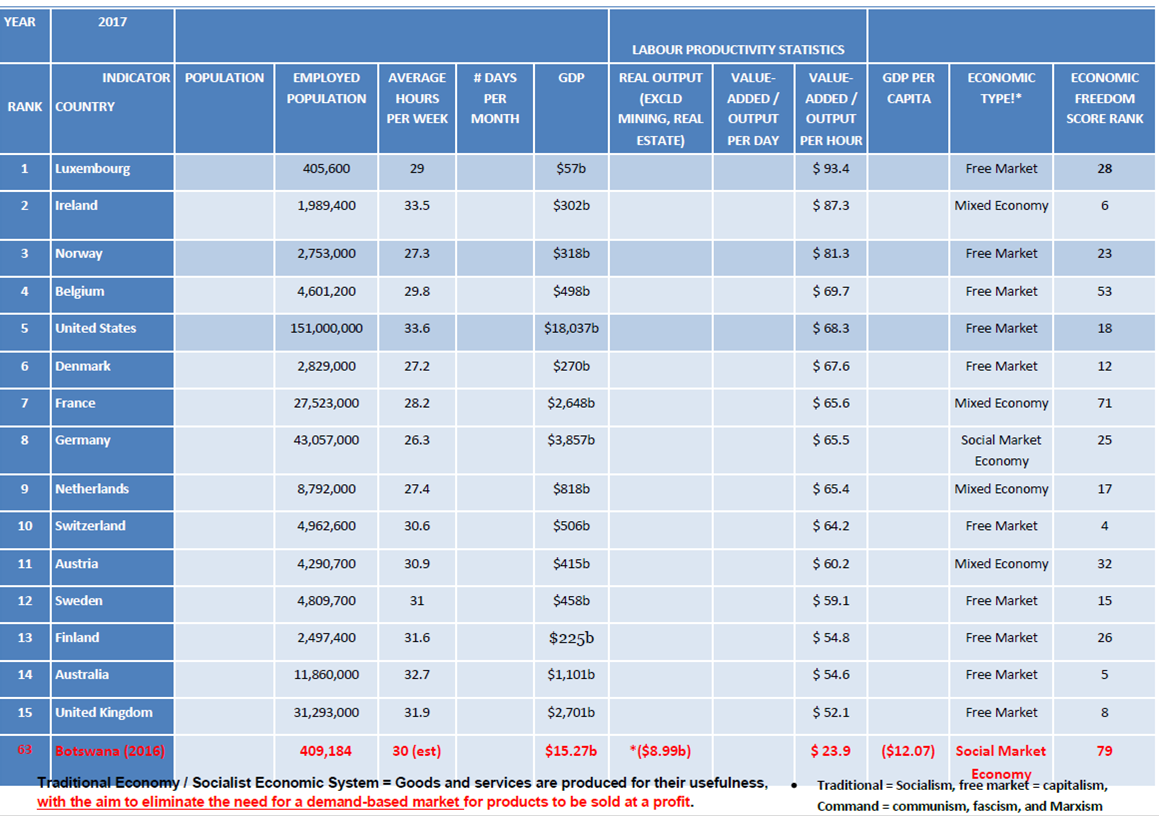





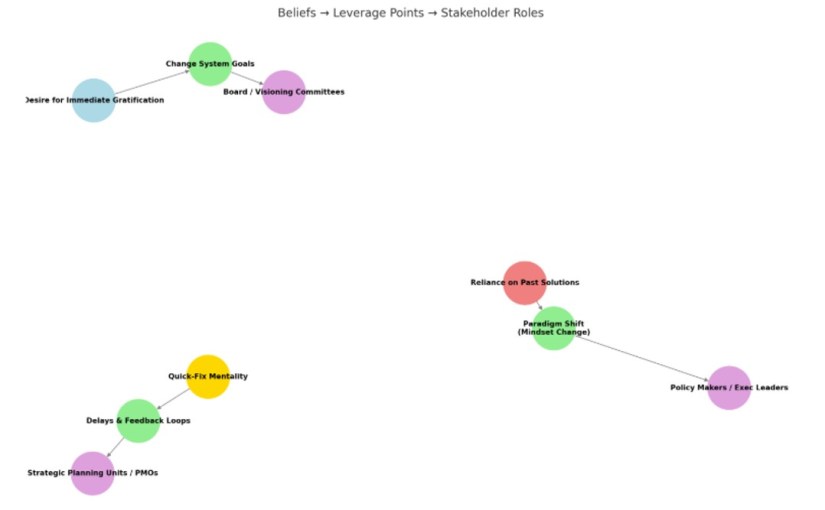


You must be logged in to post a comment.