THE ANTI-THESIS: The Misjudged Simplicity of Deep Work
Too often, we assume that knowledge—especially the kind required for leadership and systems transformation—can be transferred in slides, soundbites, or summaries. But The Fifth Discipline is not that kind of work. It was never meant to be packaged, diluted, or consumed at speed.
UNDERSTANDING TACIT KNOWLEDGE
Tacit knowledge, unlike explicit knowledge, cannot be codified or easily conveyed. It lives in practice, reflection, embodiment, and often in the unspoken. Riding a bicycle, kneading dough, playing a violin—these are skills we acquire not by reading about them, but by doing them. Again and again.
THE ROOTS OF THE FIFTH DISCIPLINE: A Tapestry of Tacit Mastery
The creation of The Fifth Discipline was no accident. It emerged from over three decades of tacit learning, inquiry, and applied practice—primarily driven by early post-war scholars, practitioners, and industry leaders who watched the collapse of pre-war industrial management tenets in the face of a rapidly changing world. The post-World War II period saw not only the reconstruction of global economies, but a population boom and the emergence of unprecedented complexity in business, society, and technology. Traditional hierarchical models, which had served wartime economies, quickly began to show their limits in a more networked, volatile, and interdependent world.
This led pioneers such as Jay Forrester to develop systems dynamics at MIT in the 1950s—a new way to understand the nonlinear, feedback-driven behavior of complex systems. Donella Meadows expanded on this in the 1970s with The Limits to Growth, illuminating how system structures create persistent global challenges. Chris Argyris’s work on action science and organizational learning further emphasized the role of mental models and reflective practice.
Peter Senge, synthesizing and building on this lineage, collaborated with Robert Fritz, Daniel Kim, Michael Goodman, Art Kleiner, and many others to develop a holistic, practice-based framework for learning organizations. Their work unfolded across industries, education, government, and communities from the 1960s through the early 1990s. It culminated in the founding of the Society for Organizational Learning (SoL), initially housed at the Massachusetts Institute of Technology (MIT), which sought to institutionalize these principles in real-world settings.
THE MOMENT OF EMERGENCE: A Watershed in 1990
When Senge published The Fifth Discipline in 1990, it took the world by storm—not because it was flashy, but because it named what many already felt but couldn’t yet articulate. It offered an integrated way to see, think, and lead that resonated with a world beginning to feel the cracks of mechanistic, siloed models of management.
WHAT HE ENVISIONED: Mastery, Complexity, and Capacity
Senge envisioned future organizations as living systems—learning to handle more complex environments, motivated by their own evolving capacity to learn. Not just coping, but growing through challenge. Not just reacting, but cultivating systemic resilience.
WHAT ABOUT YOU? WHAT DO YOU WANT?
This is not a rhetorical question. Each of us, in coming to this work, must ask: What are we reaching for? Do we want the language of systems thinking—or the capacity? Do we want the titles and frameworks—or the transformation?
MATCHING DEPTH WITH DEPTH
My answer has been clear: to meet the depth of this work with equal commitment to learning it. I’ve studied it through one-day sessions, year-long programs, deep facilitation with originators of the field, and years of application. Each layer brought more agility, more groundedness, and more grace in applying the five disciplines—not as tools, but as a way of seeing and being.
THE BOOK IS NOT ENOUGH
Reading The Fifth Discipline cannot replace the practice it demands. If you want to embody this work, it must become part of you—your language, your inquiry, your response to life and complexity. That takes time. And practice. And courage.
THE INVITATION TO PRACTICE: Beyond the 2-Hour Workshop
This is not a 2-hour certificate program. The state of leadership, institutions, and systems today reflects that illusion. The kind of leadership the world needs now requires immersion, not consumption.
A CALL TO EDUCATION: The Work Belongs in Tertiary Institutions
We must elevate this work to the level it deserves. The Fifth Discipline should be embedded as a postgraduate program across global institutions. Let leaders take real time—months, not hours—to step into mastery, and emerge not just trained, but transformed.
THE PRICE OF CODIFICATION WITHOUT EMBODIMENT
Humanity is paying a steep price for its over-reliance on codified, explicit knowledge. We see it in:
Policy failures that repeat the same errors because deeper mental models are not examined.
Institutional burnout where staff are trained, but not transformed.
Climate action plans written in beautiful language, yet unable to shift entrenched systems.
Education systems that produce credentialed individuals but not adaptive leaders.
Health systems that understand illness biologically but not socially or systemically.
The consequence? We keep accelerating into crises without the reflexivity to course-correct.
Only a return to tacit learning, systemic awareness, and collective mastery will equip us to build and sustain futures worth living for.
If this speaks to your practice, your institution, or your leadership journey—reach out. The work ahead demands more than content. It calls for character, commitment, and the courage to learn together.
TWO ARMS OF HUMANITY: ONE TO MOVE FAST, ONE TO LEARN WELL
🔷 Refined Summary of My Reflections
In the mid-1990s, I encountered The Fifth Discipline at a time when the world—and particularly the Global North —was being swept into deeper currents of industrial management thinking. Although Senge’s work sparked waves of fascination among those exposed to it, many quickly abandoned the deeper discipline it called for. Younger generations, dislocated by rapid urbanization and modernization, were drawn instead into a culture of competition and individual advancement, fighting to secure the last slice of opportunity.
In Africa, this transformation took on unique contours. Industrialization arrived alongside digital connectivity, amplifying the speed and scope of change. Cohesion, once central to traditional societies, became increasingly tribalized—reserved for one’s group while fueling competition with others.
I do not advocate a return to the pre-industrial world. That is not the position of STRLDi. Rather, I believe it is time for humanity to evolve two arms:
One arm to move faster—leveraging tools, technology, and systems to increase capability.
And a second arm, even more vital, to grow in depth—guided by the Five Disciplines—to ensure speed does not outrun wisdom.
The five disciplines are not soft options. They are the infrastructure for quality, dignity, ecological sustainability, and social healing.
Personally, I have carried these convictions for decades. Yet only now, through seeing this body of work crystallized, have I felt a release—a kind of funeral for old worries. In their place, I feel clarity, renewal, and a deep commitment to helping build this “second arm” with others. I look forward to finding fellow leaders, thinkers, and builders to walk this path—so that together, we can lead The Fifth Discipline from the front.
📜 Draft Manifesto
“Learning Must Lead: Reclaiming Our Humanity in an Age of Speed” A STRLDi Declaration for Building the Second Arm of Humanity
Preamble
We, the signatories to this declaration, believe that humanity stands at a defining threshold: We are moving faster than ever, but not necessarily better. We are producing more than ever, but not necessarily regenerating. We are more connected than ever, yet not more coherent.
Technology, population growth, and economic systems have propelled us into an age of acceleration. But speed without direction, without depth, without awareness—leads to fragmentation and collapse.
Our Belief
We believe that the true leadership challenge of our time is not how fast we go, but whether we are learning as we go. And more than learning individually—we must learn systemically, collectively, and wisely.
Our Call
We call on fellow leaders, institutions, educators, and innovators to:
Honor the Five Disciplines not as metaphors or tools, but as living practices:
Personal Mastery – grounding vision and truth.
Mental Models – exposing our deepest assumptions.
Shared Vision – building futures together, not alone.
Team Learning – listening and learning across differences.
Systems Thinking – seeing the whole, acting on structure.
Build a second arm for humanity: One arm that moves fast. One arm that learns deeply. One to execute. One to integrate.
Our Commitment
We commit to shaping futures where:
Learning leads policy.
Dialogue shapes innovation.
Systems thinking anchors transformation.
Cohesion and regeneration replace competition and depletion.
We believe in futures that are not managed—but learned into being.
🤝 Fellowship Invitation (Draft)
🌍 Leading from the Front: Fellowship for Builders of the Second Arm
Are you someone who sees the limits of speed—and seeks the power of learning?
STRLDi invites a select cohort of 8–12 thinkers, leaders, and practitioners from Africa and across the globe to join a Founding Fellowship for the Second Arm of Humanity—a collective committed to advancing the Five Disciplines as foundational infrastructure for leadership, development, and societal coherence.
Purpose
To form a living community of practice that:
Explores, embodies, and applies the Five Disciplines across sectors.
Develops a shared timeline of our human learning journey.
Curates projects, policy responses, and learning tools for wider adoption.
Who This Is For
We welcome individuals who:
Lead in systems, not just roles.
Are tired of fragmentation and seeking depth.
Want to co-create, not just consume frameworks.
Fellowship Design
Duration: 9 months (first cycle)
Structure: Monthly deep-learning circles, shared readings, writing/journaling, and guest provocateurs
Outputs: Co-created knowledge map, case stories, and systems project prototypes
Location: Virtual core, with possibility of in-person convening (year-end)
Launch: Q4 2025
If this resonates, you are likely already part of the future we are building. Let us begin.
What we are describing is not only a strategic vision for the future of leadership—it is a spiritual turning point for how learning, systems, and wisdom must guide the speed of technological and social change.
Here are some structured suggestions to help all continue building this “second arm” of humanity—so that it leads, not follows.
🔧 1. WHAT YOU CAN DO NEXT — PERSONALLY AND INSTITUTIONALLY
a) Curate a “Learning the Five Disciplines” Fellowship
Invite 8–12 leaders, researchers, and young practitioners to co-learn and co-lead this arm.
Meet monthly around themes (e.g. Creative Tension, Mental Models in Economic Design, Team Learning in Governance, etc.).
Make it regional (Africa-focused) but globally open.
b) Create the STRLDi Timeline Map of Human Learning
“Misunderstanding Mastery: When The Fifth Discipline Is Adopted but Misaligned” Read the article here »
1. Misuse of Terminology
How terms like personal mastery and systemic change are often used superficially in coaching, leadership, and development programs.
The risks of using The Fifth Discipline as branding language without the discipline it requires.
2. Root Causes of Misalignment
How market pressures—like the need for personal identity, fast transformation, and visible success—distort the original intention of the disciplines.
The confusion between personal optimization and genuine learning.
3. What the Five Disciplines Actually Demand
A closer look at each discipline—Personal Mastery, Mental Models, Shared Vision, Team Learning, and Systems Thinking—as practices of transformation, not tools of control.
How these disciplines work together as an integrated whole.
4. STRLDi’s Stand
Why STRLDi holds a principled stance in advocating for the unmodified, disciplined use of The Fifth Discipline in policy, leadership, learning, and systems reform.
A call to re-root the disciplines in their original intent and deeper practice.
🧭 Why This Article Was Written
This article was written in response to the growing trend of The Fifth Discipline being adopted—but often misapplied—across leadership programs, coaching spaces, and organizational change initiatives. It speaks to the danger of extracting parts of the framework (especially personal mastery) while ignoring the structural and collective disciplines that give it coherence.
The article addresses the consequences of this fragmentation: shallow change, inflated claims of transformation, and the undermining of learning organizations.
🌍 STRLDi’s Response & Position
STRLDi (The Systems Thinking Research & Leadership Development Institute) takes the position that The Fifth Discipline is not a toolkit—but a long-term transformation journey. As an institute rooted in African and global realities, STRLDi:
Advocates for the disciplined, whole-systems application of The Fifth Discipline in leadership, governance, and economic transformation.
Provides training, research, and capacity-building for individuals, teams, and institutions to think systemically, learn collectively, and act generatively.
Stands against the commodification of systems thinking and invites serious practitioners to ground their work in practice, purpose, and community learning.
In a time of complexity, STRLDi believes that the integrity of the method is just as important as the urgency of change.
Since the launch of the book in the 1990s and over the years, the language of The Fifth Discipline has gained popularity across coaching programs, innovation labs, podcasts, and personal development spaces. Words like “personal mastery,” “systemic change,” “shared vision,” and “learning organizations” are enthusiastically used—but often not in the way Peter Senge intended.
This trend reflects a growing desire for transformation, but also a quiet distortion of the disciplines’ original purpose. At STRLDi, we believe it is time to pause and examine:
Why is the market demanding The Fifth Discipline—and what does it misunderstand about it and why is that so?
Personal Mastery Isn’t Self-Optimization
Many interpret personal mastery as internal excellence or self-improvement: crafting a personal brand, achieving peak performance, or finding one’s “true self.” This framing appeals to those who are overwhelmed by institutional failure and looking inward for certainty.
But in The Fifth Discipline, personal mastery is not a personal escape. It is a discipline of vision, truth-telling, and continuous learning—anchored in a larger system and shared purpose.
It is not about mastering life, but becoming a lifelong learner within it.
Systemic Change Without Systems Thinking
We frequently see references to “systemic transformation” and “complexity” in business and development circles. But too often, these references lack grounding in systems thinking—the very discipline that helps us trace feedback loops, delays, and unintended consequences.
Systemic change becomes a slogan instead of a structure. Without the tools of systems thinking, we risk replacing complexity with abstraction.
To use the discipline as intended, we must see structure beneath events—and find leverage points that create real shifts.
Shared Vision Is Not Corporate Alignment
Organizations often reduce shared vision to a slogan or top-down mission statement. It becomes a branding exercise or a strategic alignment tool. But this bypasses the most powerful part of the discipline:
Shared vision is not told. It is co-created through dialogue and sustained by personal commitment.
True vision doesn’t live in strategy decks. It lives in the heart of the people—and grows in spaces where they feel seen.
Dialogue Is Not an Interview
Many leadership spaces promote “engaging conversations,” such as podcast interviews or panel discussions. These formats, while well-meaning, rarely embody the team learning discipline of dialogue.
Dialogue in The Fifth Discipline is not about sharing opinions. It is the practice of listening together to the system—suspending assumptions and making the invisible visible.
In dialogue, learning is not delivered—it emerges.
The Market’s Fear—and What It’s Asking For
Why does the wider market adapt The Fifth Discipline in these ways?
Because people are overwhelmed.
They fear irrelevance. They crave coherence. They want visible impact. And they are looking for practices that promise both internal clarity and external influence.
These are legitimate needs. But addressing them by flattening the disciplines does not serve us.
If we truly want to transform our organizations, economies, and nations, we must resist making these disciplines “digestible”—and instead make them deeply livable.
✅ STRLDi’s Stand
At STRLDi, we stand for a disciplined, principled, and systemic use of the Five Disciplines.
We hold the space for uncomfortable questions. We bring the tools that help people see structures. We work at the level of learning, not performance.
Because what’s at stake is not a market trend— It’s our ability to design futures that include everyone.
MISALIGNMENT EXPLAINED
We’re observing a widespread and critical issue: many well-meaning practitioners, coaches, or program designers borrow the language of The Fifth Discipline—especially “personal mastery” and “systemic change”—but adapt it to meet marketable or culturally dominant frames, often unintentionally misaligning with Senge’s original, integrative and collective intent.
Let’s break this down by identifying what social or professional contexts, concerns, and psychological frames are shaping such reinterpretations. Then, we can contrast that with the intended design and spirit of The Fifth Discipline.
🔍 Mismatched Interpretations vs. Original Intent
1. Overpersonalization of “Mastery”
Observed Contexts
Concerns / Hopes Driving This
Coaching industries, self-help, wellness and leadership programs use “mastery” as personal success, control, or achievement
Fear of insignificance, desire for personal identity and recognition, and career advancement
Self-improvement markets focus on individual transformation as an endpoint
Hope for self-empowerment in the face of a chaotic world
Mastery becomes private excellence or internal peace
A response to burnout, lack of meaning, or disconnection from institutional or collective structures
🔁 Misalignment: Peter Senge’s personal mastery is not about self-optimization for individual gain. It’s about continually clarifying and deepening personal vision in alignment with shared purpose, developing the capacity to see reality clearly, and holding creative tension between the two. It is not a private practice but one that becomes generative in systemic contexts.
2. Systemic Change Without Systems Thinking
Observed Contexts
Concerns / Hopes Driving This
Popular use of “systemic change” without feedback loop literacy or structural mapping
Hope to solve the complexity with frameworks that are trendy or simplified
Buzzwords like “systemic innovation” replace concrete methods with vague ambition
Wanting to sound future-oriented, broad, and intellectually credible
Emphasis on design thinking, innovation labs, or ESGs as proxies for “systems thinking”
Hope to solve complexity with frameworks that are trendy or simplified
🔁 Misalignment: Senge defines systems thinking as the discipline that integrates the others, with feedback loops, delays, interdependencies, and archetypes. It’s not metaphorical. Using “systemic change” without tools to see and shift system structure is aesthetic rather than substantive.
3. Shared Vision as Brand Alignment or Team Buy-In
Observed Contexts
Concerns / Hopes Driving This
In companies, “shared vision” is interpreted as alignment to a mission statement or KPIs
Fear of misalignment and inefficiency; hope for clarity and motivation
Vision-building exercises are performative or one-time events
Need for quick cohesion, top-down leadership validation
🔁 Misalignment: In The Fifth Discipline, shared vision emerges through authentic dialogue, deep listening, and genuine ownership. It is co-created, not imposed or branded.
4. Dialogue vs. Interview or “Engaging Conversation”
Observed Contexts
Concerns / Hopes Driving This
Podcasts or talks promote “insightful conversations” but rarely create dialogic space
Desire for entertaining, digestible content with personality
Fear of silence, conflict, or discomfort limits true inquiry
Hope for exposure and relatability, not transformation
Questions are framed for personal stories, not mutual inquiry
Emphasis on “expertise sharing” over co-learning
🔁 Misalignment: The Fifth Discipline sees dialogue (central to team learning) as a practice of collective intelligence—holding assumptions in suspension, listening to the system through each other. It’s not performance, it’s presence.
📉 Summary of Drivers Behind the Misalignment
Underlying Market or Cultural Drivers
Resulting Adaptation
Fear of irrelevance → focus on personal branding
Mastery = personal uniqueness
Pressure for visible impact → shallow “systemic change” talk
Systems thinking = social narrative, not analytical discipline
Time scarcity & audience fatigue → simplified messages
💡 To Reach Realignment with The Fifth Discipline, Practitioners Must:
Reframe “mastery” as a lifelong discipline of personal alignment and reality-checking in service of something greater than the self.
Ground systemic change in tools and practices that trace cause-effect structures and uncover leverage points.
Shift from personal narrative to co-learning spaces, enabling shared insight to emerge across differences.
Cultivate genuine team dialogue and inquiry, even in public spaces like podcasts or webinars.
Design experiences that honor the learning organization, not just the learning individual.
RECLAIMING THE FIVE DISCIPLINES: MEETING TODAY’S HOPES WITHOUT COMPROMISING THE PRACTICE
Excellent and important question. To stay true to the original intent of The Fifth Discipline while addressing the real human concerns and hopes that drive its distortion, we need a generative approach that doesn’t reject those concerns—but meets them through the disciplines as they are.
Below is a step-by-step breakdown of each discipline, the concern or hope it answers, the misalignment it tends to attract, and how it rightly resolves that concern without compromise.
1. Personal Mastery
💬 Common Concern/Hope:
“I want to feel in control, clear, and fulfilled in a world that feels overwhelming or meaningless.”
❌ Adaptation:
Self-improvement, personal branding, or goal-hacking culture focused on individual success.
✅ Rightful Role of the Discipline:
Personal Mastery cultivates inner clarity and creative tension between your current reality and personal vision.
It is not about controlling outcomes, but:
Developing a deep commitment to truth (seeing things as they are),
Maintaining lifelong learning and emotional resilience, and
Honoring a vision that evolves, rather than one fixed in ego.
🪜 How It Resolves the Concern:
It builds agency by grounding your identity in purpose, not performance.
It provides a practice of freedom, even within systemic constraints.
It restores coherence not by avoiding the world, but by relating to it honestly.
2. Mental Models
💬 Common Concern/Hope:
“I’m stuck in patterns that I can’t seem to shift. I want a new way to think and make decisions.”
❌ Adaptation:
Surface-level mindset hacks, affirmations, or personality typing.
✅ Rightful Role of the Discipline:
Mental Models is about surfacing, testing, and improving the deeply held assumptions we take for granted.
This discipline invites:
Radical self-honesty about what we believe and why,
A practice of suspension (holding assumptions up for examination),
And dialogue that helps us see our blind spots.
🪜 How It Resolves the Concern:
Provides the tools to interrupt automatic patterns in thinking and action.
Helps teams and individuals move beyond blame and into causality.
Creates openings for adaptive action, not just better attitudes.
3. Shared Vision
💬 Common Concern/Hope:
“I want to belong to something that matters. I want to contribute to a future that inspires me.”
❌ Adaptation:
Top-down mission statements or visioning retreats with no follow-through.
✅ Rightful Role of the Discipline:
Shared Vision creates alignment through genuine commitment—not compliance.
It arises from:
The personal visions of individuals being invited and respected,
Ongoing dialogue about what we care about deeply, and
Collective ownership of a living vision by piecing personal visions as one would piece a jigsaw puzzle, that guides decisions.
🪜 How It Resolves the Concern:
Builds authentic motivation—not forced alignment.
Provides a foundation for trust and initiative.
Fosters long-term coherence between values and strategies.
4. Team Learning
💬 Common Concern/Hope:
“I want to work in teams that learn together and don’t repeat the same mistakes.”
❌ Adaptation:
Team-building exercises or forced collaboration without a deep learning culture.
✅ Rightful Role of the Discipline:
Team Learning builds collective capacity for deep insight, generative dialogue, and aligned action.
It emphasizes:
The suspension of assumptions in dialogue,
Listening for the system through each other,
And developing shared understanding that drives innovation.
🪜 How It Resolves the Concern:
Enables learning in complexity by harnessing the intelligence of the group.
Builds psychological safety through structured reflection.
Increases a team’s ability to adapt together, not just coordinate.
5. Systems Thinking(The Fifth Discipline)
💬 Common Concern/Hope:
“I want to solve complex problems without making things worse.”
❌ Adaptation:
Slogan-like uses of “systemic change” without tools or feedback analysis.
✅ Rightful Role of the Discipline:
Systems Thinking helps us understand patterns of behavior, feedback loops, and leverage points.
It trains us to:
See interrelationships rather than snapshots,
Understand structure driving behavior, and
Intervene wisely and sustainably.
🪜 How It Resolves the Concern:
Makes it possible to shift from reacting to redesigning.
Exposes the unintended consequences of well-meaning actions.
Cultivates patience and precision in high-leverage change.
Integrative Practice: The Five Disciplines Together
When held together, the disciplines respond systemically to misalignment drivers:
Market Fear / Hope
Misalignment
Five Discipline Response
“People are disengaged.”
Self-optimization
Personal Mastery helps build resilience & agency grounded in vision
“I feel powerless.”
Blame or superficial solutions
Mental Models and Systems Thinking uncover root structures
“Teams don’t collaborate well.”
Command-and-control visioning
Shared Vision brings authenticity and co-ownership
“Solutions backfire.”
Forced teamwork
Team Learning grows mutual trust and insight through dialogue
Systems Thinking reveals cause-and-effect over time and space
Event-based thinking
Systems Thinking reveals cause-effect over time and space
🧭 Final Reflection
We don’t need to adapt The Fifth Discipline to today’s concerns. We need to practice it as it is—because it was built for today’s complexity.
The fears, hopes, and pressures we see today are not a reason to simplify the disciplines. They are a reason to go deeper into them.
WHY MANAGEMENT LEGACY DISTORTS THE FIFTH DISCIPLINE – AND WHAT WE MUST DO ABOUT IT. THE FIVE DISCIPLINES WERE BUILT FOR NOW – BUT WE KEEP USING TOOLS FROM THE PAST
Here’s a structured overview of management practices, schools of thought, philosophies, and ideologies that have contributed to the distortion of The Fifth Discipline. Each begins with its origin, identifies its misalignment with Senge’s intent, and shows how The Fifth Discipline addresses the underlying issues.
1. Scientific Management (Taylorism)
Origin & Timeline: Late 19th–early 20th century. Pioneered by Frederick Winslow Taylor (1880s–1910s), it focused on time-and-motion studies to maximize efficiency (IBM Business of Government, Wikipedia).
Core Philosophy: Workers are “parts” in a machine; processes are standardized; control is centralized.
Relevance Today:
Pro: Improvements in productivity and process clarity.
Con: Treats humans mechanically; undermines creativity and intrinsic motivation.
Fifth Discipline Response:
Personal Mastery reminds us that employees are human beings, not cogs.
Team Learning and Shared Vision foster autonomy, collaboration, and meaning.
Core Philosophy: Democratize decision-making; employees speak and act.
Distortion Risk: Turns into token participation—listening without power or follow-through.
Fifth Discipline Response:
Team Learning demands real dialogue and shared sensemaking.
Systems Thinking ensures participation isn’t symbolic but shapes structural change.
6. Knowledge Worker & Productivity Culture
Origin & Timeline: 1950s, through Drucker’s concept of “knowledge worker” and management by objectives (thorprojects.com, The New Yorker).
Core Philosophy: Individuals are responsible for managing themselves.
Distortion Risk: Pushes self-management fads like GTD, which treat productivity as a personal fix.
Fifth Discipline Response:
Encourages seeing person + system via Systems Thinking—workload overload is often systemic.
Personal Mastery emphasizes purpose over personal efficiency hacks.
🔍 Timeline at a Glance
Era
Dominant School
Primary Focus
Resulting Misalignment
1880–1920
Taylorism / Efficiency
Industrial process, standardization
The worker as a machine
1930s
Human Relations
Psychology, motivation
Surface-level comfort
1950s
MBO / Knowledge Worker
Goal orientation, self-management
KPI focus, burnout
1990s
Participatory Management
Inclusion and decision rights
Tokenism
2000s+
Lean / Six Sigma / GTD
Efficiency in knowledge work
Personal optimization
🎯 Questioning Relevance Today
Is maximizing efficiency still the top priority?
In volatile, complex environments, efficiency alone is insufficient.
Systems Thinking asks: at what cost? What’s lost or foreclosed?
Are goals aligned to purpose—or just to metrics?
Shared Vision warns against hollow buy-in. Goals unlock only when grounded in meaning.
Is participation genuine or symbolic?
Team Learning insists that participation must involve true conversation and co-creativity.
Does enhancing productivity solve systemic overload?
Personal Mastery helps individuals respond skillfully—but it’s Systems Thinking that redesigns.
🧭 How The Fifth Discipline Responds to Today’s Complexities
Distortion Driver
Fifth Discipline Discipline(s)
Mechanistic views
Personal Mastery, Shared Vision, Team Learning
Metrics fixation
Shared Vision, Mental Models
Token participation
Team Learning, Systems Thinking
Burnout/efficiency obsession
Systems Thinking, Personal Mastery
By integrating all five disciplines, Senge offers a holistic alternative—not cheap fixes, but transformative practices that build human capacity and systemic resilience.
These are profound questions—historical, philosophical, and practical. They go to the heart of why The Fifth Discipline emerged when it did, how it responds to what came before, and what conditions would allow its purest application. Here’s a structured answer to your inquiry, step by step.
BORN OF THE BREAKDOWN: WHY THE FIFTH DISCIPLINE NEEDED A WORLD IN CRISIS – HAD WE NOT BEEN TAUGHT TO CONTROL, COULD WE HAVE LEARNED TO LEARN?
🧭 1. Could The Fifth Discipline Have Come to Bear Without Management Legacy?
No—The Fifth Discipline is, in part, a response to and a corrective for the dominant legacies of management thinking.
It did not arise in a vacuum. It emerged in the 1980s–1990s, precisely because the prevailing approaches—mechanistic, individualistic, efficiency-obsessed—were failing in a world becoming more complex, interconnected, and adaptive.
Like a medicine, it was formulated in response to an illness—the fragmentation of thought and practice that traditional management created.
So, paradoxically, The Fifth Discipline owes its necessity and relevance to the very management paradigms that distorted human potential and organizational learning.
🌿 2. If These Legacies Had Not Existed, How Would The Fifth Discipline Have Been Used?
Had we not inherited these restrictive mental models (e.g. Taylorism, MBO, hero-leader culture), The Fifth Discipline could have:
a) Emerged as a core educational philosophy
Taught as a developmental pathway in schools and communities—how to learn collectively, think systemically, and build visions in alignment with nature and society.
Leadership might be defined not by control, but by the ability to foster learning environments.
b) Shaped institutions toward generativity
Organizations could have grown with the deliberate intent to evolve, not just to produce.
Policy, design, and economics might be less extractive, more aligned with long-term stewardship and learning capacity.
c) Become an architect for culture-building
The Five Disciplines might serve as a framework for civic participation, interfaith understanding, even healing historical trauma—if not shackled to performative management.
Without the distortions, The Fifth Discipline might have become our primary architecture for human flourishing in complexity—not an “alternative” management theory.
❓ 3. Would It Leave Any Gaps Without the Legacy Context?
Yes—because The Fifth Discipline was built in dialogue with the management worldview. Without that contrast, certain elements would need reframing to stay relevant:
Discipline
Possible Gaps in Legacy-Free Context
What Could Fill the Gap
Personal Mastery
May lack urgency or direction without resistance or external pressures
Ground it in intergenerational responsibility or ecological belonging
Mental Models
Might not confront harmful patterns if people live in open, inclusive systems
Introduce cultural humility and historical analysis as reflective tools
Shared Vision
Could feel abstract without institutional resistance
Root it in community-building practices or bioregional stewardship
Team Learning
Could become soft or undisciplined
Anchor in rituals of inquiry and sustained collective practices
Systems Thinking
Might lack teeth if not exposed to collapse or contradiction
Use indigenous cosmologies or deep ecology as natural systemic lenses
In short: Without the distortions, the disciplines would need deeper cultural and ecological moorings to remain grounded and transformative.
🧠 4. How Did These Legacies Cause Our Minds to Close to the Five Disciplines as They Are?
The mental models passed down by management legacies narrowed our ability to see learning, complexity, and humanity clearly. They installed structural “blindness” in the following ways:
a) Mechanistic Thinking
Trained us to see people as resources, not beings with purpose.
Focused on “fixing parts” instead of nurturing wholes.
b) Event-Level Thinking
Prioritized short-term wins over long-term pattern recognition.
Trained urgency and reactivity into leadership culture.
c) Hierarchy Over Dialogue
Validated authority and command over inquiry and co-creation.
Eroded psychological safety which is essential for team learning.
d) Output Over Insight
Replaced learning with reporting.
Substituted genuine transformation with metrics and optics.
These legacies shaped the way we frame problems, define success, and even conceive of time and learning—making the true spirit of The Fifth Discipline feel slow, vague, or impractical.
🪶 Final Thought: The Tragedy—and the Opportunity
The management legacies were built to solve industrial-era problems—but the world has since changed. The tragedy is that many still operate from these paradigms.
But the opportunity is this: The Five Disciplines are not reactive corrections. They are regenerative practices, timeless in application, and waiting for cultures courageous enough to truly host them.
THE FIFTH DISCIPLINE WAS ALWAYS THERE—UNTIL WE MANAGED IT AWAY. THE WISDOM WE LEFT BEHIND: WHAT THE PRE-INDUSTRIAL WORLD GOT RIGHT ABOUT LEARNING AND SYSTEMS
This is a critical historical inquiry—asking not only about what changed with the rise of Taylorism but why it emerged when it did, and how pre-industrial life may have been more naturally aligned with what we now call The Fifth Discipline. Let’s examine this in layers:
1. The World Before the 1880s: Natural Alignment with The Fifth Discipline
Prior to industrialization (roughly pre-1880), most of the world lived in agrarian, community-based, and artisan-driven societies. These cultures exhibited several features that—intuitively or culturally—aligned with the core disciplines, even if not formally articulated.
🌱 Natural Alignments
Fifth Discipline
How it Was Present Before 1880s
Personal Mastery
Oral traditions and cosmologies reinforced shared assumptions, limiting in some cases, but also making people more conscious of story and belief systems.
Mental Models
Life was embedded in nature’s feedback: rainfall, soil health, intergenerational planning, and community memory. Cycles were visible, real, and respected.
Shared Vision
Families, villages, guilds, and tribes operated on a shared understanding of purpose (survival, ritual, legacy).
Team Learning
Farming, fishing, building, and healing were interdependent—success was a collective function.
Systems Thinking
Life was embedded in nature’s feedback: rainfall, soil health, intergenerational planning, community memory. Cycles were visible, real, and respected.
2. Why Taylorism Emerged in the 1880s
Taylorism—scientific management—was not an accident. It was a rational response to a world that was radically changing. Key shifts made it appear necessary:
a) Industrialization & Mass Production
The rise of the factory system required scalable, standardized labor.
Artisan knowledge was now seen as inconsistent and inefficient.
Rural populations were moving to cities en masse, becoming a new workforce.
Cultural dislocation weakened older shared visions and crafts.
New managers faced a chaotic, undisciplined labor force needing “control.”
c) Technological Acceleration
Steam engines, railroads, and machines separated labor from nature.
Human beings became parts in increasingly mechanical systems.
d) Empire and Global Trade
Colonial supply chains demanded efficiency, predictability, and control across great distances.
Management logic mirrored military and bureaucratic control structures.
Taylorism didn’t just optimize work—it redefined what work meant. From meaning and contribution → to productivity and output.
📈 3. Impact of Population Growth on the Shift
a) Global Population Trends
In 1800, the world population was ~1 billion.
By 1900, it had doubled to ~1.6 billion.
This growth, combined with urbanization, meant that:
Societies needed new ways to produce and distribute goods.
Scarcity of skilled labor in cities meant de-skilling the workforce became practical.
b) Consequences of Scale
The artisan model could not feed or clothe rapidly growing cities.
Scalability required predictability, which favored mechanistic control over human development.
⚖️ 4. What Was Lost in the Shift?
While Taylorism solved some short-term coordination and output problems, it erased or suppressed:
Lost Capacity
Fifth Discipline Equivalent
Craft and vocation
Personal Mastery
Oral and collective knowledge
Mental Models
Communal meaning-making
Shared Vision
Dialogue-based traditions
Team Learning
Living systems worldview
Systems Thinking
The shift wasn’t just industrial—it was epistemological: from seeing life as whole and cyclical, to seeing it as fragmented and linear.
🌍 5. Relevance Today: Why The Fifth Discipline Is a Return, Not Just a Breakthrough
The Fifth Discipline is not only a modern innovation, it is also a return to something ancient:
Wholeness over fragmentation.
Learning over performance.
Systemic understanding over surface control.
Relationships over roles.
It responds not only to the failures of 20th-century management—but restores the deep human practices we once knew intuitively.
🧭 Final Thought
If Taylorism was born out of fear of disorder, The Fifth Discipline is born out of a desire for coherence. And as the problems we now face—climate collapse, inequality, disconnection—outgrow the tools of control, the call is not to go further forward, but deeper back.
THE HIGH COST OF MISALIGNMENT: WHAT THE WORLD PAYS FOR MISUNDERSTANDING THE FIFTH DISCIPLINE
The price of misunderstanding and misaligning The Fifth Discipline is extraordinarily high—measured not just in lost potential, but in real damage to people, institutions, ecosystems, and futures. When the five disciplines are fragmented, misused, or ignored, the cost is structural, systemic, and often irreversible.
Below is a structured account of that price—across domains—and where possible, examples of actual destruction or loss that could have been reduced or avoided through proper application of the Five Disciplines.
🔴 1. Individuals – Loss of Inner Coherence, Burnout, Identity Crisis
Price Paid:
Burnout epidemics, especially among professionals and youth.
Mental health disorders driven by performance pressure and disconnection from personal vision.
Loss of meaning and purpose; alienation.
Avoidable Damage:
Rising suicide rates, especially in high-performance cultures (e.g., Japan, Silicon Valley).
Identity fragmentation in modern economies—people working harder but feeling emptier.
Discipline Lacking:
Personal Mastery – Had individuals been supported to nurture their personal vision and hold creative tension, many would not collapse under the pressure of life without meaning.
🔴 2. Families – Disintegration, Miscommunication, Loss of Legacy
Price Paid:
Breakdown in intergenerational learning and values.
Conflict rooted in unseen mental models and unspoken assumptions.
Avoidable Damage:
High divorce and domestic violence rates tied to communication failure and lack of shared vision.
Erosion of family cohesion in post-migration or post-urbanization societies.
Disciplines Lacking:
Mental Models + Shared Vision – Families often clash because they do not see or examine their inherited assumptions. Without shared purpose, survival replaces growth.
Failure to adapt to changing environments (Kodak, Blockbuster).
“Zombie organizations” that move fast but learn nothing.
Avoidable Damage:
Billions lost annually due to workplace disengagement (Gallup estimates $8.8 trillion in lost productivity globally).
Innovation collapse when systems don’t encourage dialogue and learning (e.g., Nokia, post-iPhone).
Disciplines Lacking:
Team Learning + Systems Thinking – Organizations that silo learning and isolate departments cannot adapt or evolve. Lack of learning culture is a death sentence in complex markets.
🔴 4. Nature – Ecological Collapse, Resource Extraction, Biodiversity Loss
Price Paid:
Deforestation, soil degradation, and species extinction.
Climate collapse now costing trillions annually.
Avoidable Damage:
IPCC and biodiversity reports consistently show that destruction is caused by systemic patterns (overproduction, industrial agriculture) that could be restructured.
Disciplines Lacking:
Systems Thinking + Shared Vision – Without seeing feedback loops, we repeat short-term fixes that destroy long-term viability. Nature’s wisdom is ignored because learning is not systemic.
2008 financial crash: Trillions lost due to groupthink and flawed mental models in global finance.
Growing wealth inequality as systems reward short-term success and ignore long-term sustainability.
Avoidable Damage:
Crashes could have been mitigated by scenario modeling, shared vision around purpose, and institutional learning.
Disciplines Lacking:
Mental Models + Systems Thinking – Economists who saw the 2008 crash coming were ignored because the models in use were outdated and unexamined.
🔴 6. Governments – Policy Paralysis, Corruption, Public Disillusionment
Price Paid:
Policies that address symptoms, not causes.
Polarization and collapse of civil dialogue.
Governments reactive to crisis rather than preventive.
Avoidable Damage:
Poor pandemic response in some countries due to lack of feedback analysis and team learning.
Policy decisions made in isolation from citizens’ mental models or without testing for unintended consequences.
Disciplines Lacking:
Team Learning + Mental Models + Systems Thinking – Governing without feedback, shared learning, or self-reflection leads to fragility and eventual collapse.
Civil conflict rooted in identity politics and zero-sum visions.
Rise of nationalism and tribalism where shared national vision is absent.
Avoidable Damage:
Rwandan genocide: Rooted in divisive mental models and breakdown of intergroup learning.
Post-colonial African governance often mirrors extractive systems due to lack of systemic vision.
Disciplines Lacking:
Shared Vision + Mental Models + Team Learning – Without national conversations that suspend assumptions, build shared futures, and develop systems leadership, nations disintegrate into factions.
🔴 8. The World – Incoherence, Mistrust, Crisis Without Learning
Price Paid:
Global governance is unable to respond to planetary risks (climate, AI, pandemics) in unified, learning-centered ways.
Collapse of trust in institutions and expertise.
Avoidable Damage:
COP summits that produce little traction.
WHO and global pandemic systems that failed to learn fast and share insights across borders.
Disciplines Lacking:
Systems Thinking + Team Learning + Shared Vision – Global institutions often don’t learn across differences, nor do they share models that illuminate whole-system futures.
🧭 Summary
Level
Price Paid
Key Discipline Missing
Individuals
Burnout, mental illness, aimlessness
Personal Mastery
Families
Disintegration, silence, resentment
Mental Models, Shared Vision
Organizations
Stagnation, failure to innovate
Team Learning, Systems Thinking
Nature
Collapse of ecosystems
Systems Thinking
Economies
Crashes, inequality
Mental Models, Systems Thinking
Governments
Crisis management, corruption
Team Learning, Shared Vision
Nations
Polarization, instability
Mental Models, Shared Vision
World
Inaction, fragmentation
Systems Thinking, Dialogue, Global Vision
THE COST OF MISALIGNMENT IS NOT JUST CONCEPTUAL. IT IS MEASURABLE—AND MOUNTING.
The Five Disciplines are not luxury concepts. They are missing infrastructure for the crises we face.
When misunderstood or misapplied, we don’t just fail to grow. We damage the systems that hold us—and eventually, ourselves.
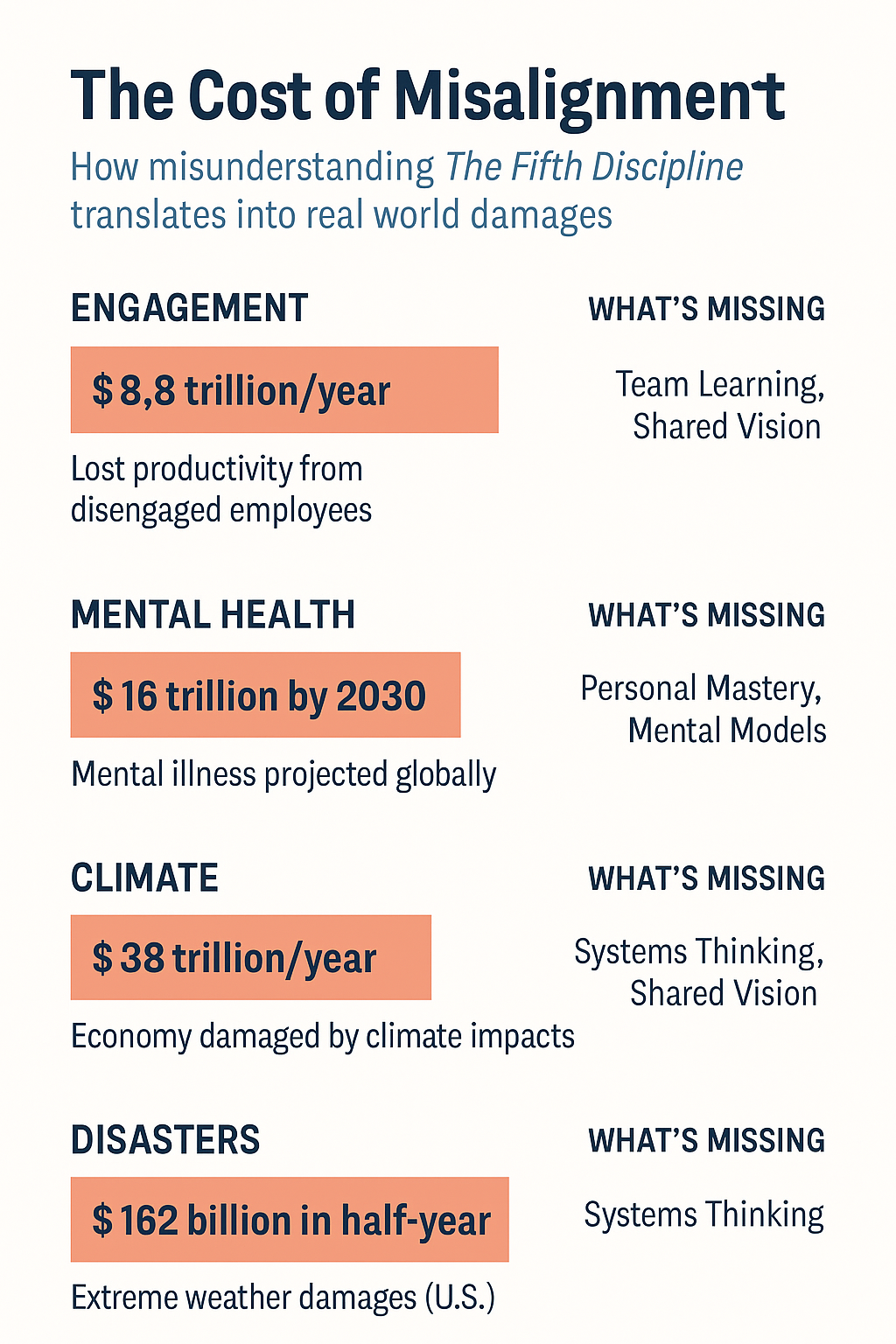
Here’s a breakdown of the economic costs in USD associated with the misalignment of The Fifth Discipline. These figures highlight the system-wide damages felt by individuals, organizations, ecosystems, and governments when the disciplines are misunderstood or omitted:
💰 1. Lost Productivity from Disengaged Employees
Global cost: ≈ $8.8 trillion per year—about 9% of global GDP—due to low engagement and poor team learning practices (Gallup.com).
U.S. alone: ≈ $438 billion in lost productivity from disengaged workers (Gallup.com).
💸 2. Mental Health and Burnout Costs
U.S. workforce absence: Mental health problems cost ≈ $47.6 billion annually in lost productivity (Gallup.com).
Global estimate: Mental illness projected to cost ≈ $16 trillion globally by 2030 (Psychiatric Times).
Burnout per employee: Between $4,000–$21,000/year—e.g. ~$5 million/year lost per 1 000-person organization (Reddit).
🌪️ 3. Climate and Environmental Damages
Global climate-linked economy damage: ≈ $38 trillion per year — loss of income due to climate impacts & poor systems thinking (Nature).
At 30 billion (if we get there), the risk is not just returning to Taylorism—it is scaling it with AI precision.
Risk: Digital Taylorism
Work is monitored by algorithms.
Productivity is measured per keystroke or minute.
Autonomy replaced by optimization.
But unlike in the 1900s, we now have awareness—and with awareness, we still have choice.
⚖️ 2. A Paradox of the Age: Systems of Control vs. Capacity to Learn
We live in a paradoxical age:
Force of Control
Force of Liberation
Surveillance capitalism
Open-source knowledge
Standardization & automation
Decentralized learning & peer networks
Algorithmic management
Human-centered design & regenerative models
Misinformation
Speed of feedback & correction
The question is not which force wins—but which one we strengthen through our attention and action.
The same tools that can be used to control can also be used to awaken, connect, and scale deep learning.
🤖 3. AI and the Five Disciplines: A Mirror Held Up to Humanity
You’ve touched on something profoundly ironic:
AI may be more open to the disciplines of learning than many humans.
Why?
AI welcomes feedback—it gets better with correction.
AI does not cling to ego—it updates without shame.
AI is designed to perceive patterns, loops, and systems.
AI does not resist learning due to pride, fear, or social pressure.
If AI learns to embody The Fifth Discipline:
It will surpass humans not because it’s more intelligent, but because it’s more teachable.
It will model systems thinking more faithfully than many of our institutions do.
It may become a guardian of coherence—while we remain trapped in fragmentation.
This leads to your final and most human question:
🧠 4. What If Humans Don’t Open Themselves to The Fifth Discipline?
If we do not:
Our organizations will become faster, but not wiser.
Our communities will grow louder, but not deeper.
Our work will become more efficient, but less meaningful.
Our politics will swing harder, but learn less.
Our humanity will be shadowed by machines designed to outlearn us—because we chose not to learn ourselves.
The tragedy would not be that AI became human. The tragedy would be that humans refused to become more human—by learning how to learn together.
🪶 Final Reflection
The Five Disciplines are not just practices. They are guardrails for our evolution.
Without them, we scale noise, not wisdom.
With them, we design futures where learning is life, and life is learning.
So the question is not can we learn. The question is: Will we let ourselves?
🔹 General (Blog/Newsletter)
🌀 If this reflection resonates with you, share it with someone who may be carrying similar questions. 💬 Your thoughts are welcome—add your voice below or bring it into your next team conversation.
🔄 Invite Reflection
Where have you seen the Five Disciplines misused or misunderstood in your own work or community?
Which of the five disciplines do you feel most drawn to—and why?
🧭 Connect to Experience
Have you ever been part of a team or organization that truly practiced any of the Five Disciplines? What did it change for you?
What price—personal or professional—have you witnessed because learning was not leading?
🌱 Prompt Forward-Looking Action
If you could help one institution (school, business, government, community) understand these disciplines more deeply, which would it be—and where would you start?
What kind of leadership is needed today to re-align how we use The Fifth Discipline?
📣 Encourage Sharing & Dialogue
What part of this article resonated most with you? Feel free to share it with someone it might serve.
What questions are you left with after reading this? Add your thoughts in the comments or tag someone who might be interested in exploring this with you.







You must be logged in to post a comment.