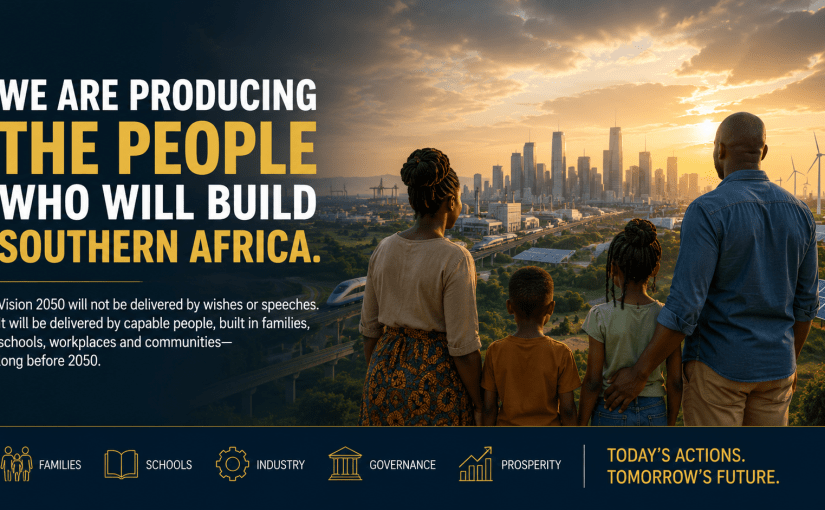
A question Southern Africa needs to ask itself before it asks its children to carry Vision 2050
There is a question about development in Southern Africa that we do not ask often enough: what kind of citizen are we producing? We speak continually about protecting citizens, supporting citizens, empowering citizens, providing services to citizens and creating opportunities for citizens. These are legitimate responsibilities of government. But alongside them is another responsibility that is rarely placed with equal political force: the responsibility of the adult citizen to become, and to raise, the people capable of producing the society that must eventually stand without being carried.
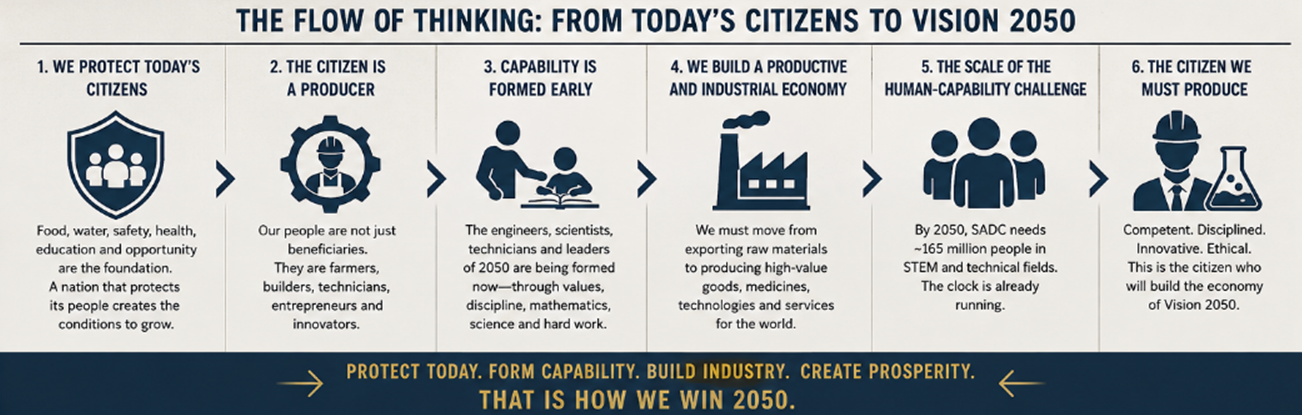
This is not an argument against protection. A government must protect its people from violence, hunger, disease, extreme deprivation and economic shocks. But protection cannot become the permanent definition of the citizen–state relationship. If today’s adults are continually addressed primarily as people whom government must protect and provide for, while their children are expected to become the engineers, scientists, technicians, entrepreneurs, manufacturers and institutional leaders who will build the future, there is a missing link between the two generations.
Where is the political language that tells the adult citizen: You are not only the person the state must protect. You are also one of the people responsible for producing the capable society that must eventually stand without being carried?
That is the question I believe Southern Africa needs to confront.
The Citizen We Protect and the Institution We Expect to Perform
The Citizen We Protect and the Institution We Expect to Perform
The recent speech on SADC Vision 2050 provides a useful lens through which to examine this question. President Cyril Ramaphosa, delivering the keynote address on 14 August at the SADC Summit Public Lecture at the University of KwaZulu-Natal, Westville Campus in Durban, repeatedly speaks about the lives the region must improve and the conditions its people should experience. Vision 2050 imagines a region where people have food, water, security and comfort, live healthy lives, are educated, possess relevant skills and capabilities, and have access to decent work and sustainable livelihoods.
The language becomes particularly explicit when the speech turns to children: “We must ensure that all children have food, water, and shelter; that they are kept safe.” It then moves to investment through adolescence in the skills of this century, digital literacy and health services, connecting the removal of these barriers directly to the productive capacity of the economy. The speech also addresses health security, equal opportunity, the safety of women, discrimination and violence, migration pressures, climate resilience, food security and the protection of livelihoods. The citizen and population are therefore repeatedly located within a system whose responsibility is to secure the conditions in which people can live and prosper.
That is legitimate. It is necessary. But there is another side to the equation.
The speech also says that Vision 2050 must become a programme of action that shapes decisions, budgets, infrastructure, skills and institutions, and that it must produce results that people can see and feel. It speaks of a shared destiny and therefore a shared responsibility to achieve the Vision. It calls for institutions of learning capable of building a regional pool of knowledge and expertise; for refining and smelting capacity, harmonised standards, infrastructure, investment and industrial planning; and for the creation of capable entrepreneurs and creative people who can build serious businesses and meet export standards.
So the issue is not that the speech contains no language of responsibility. It does. The question is where that responsibility is located, how explicitly it is assigned, and whether the two sides of the social contract are being developed with equal force.
The transcript contains 56 occurrences of “people”, but only one literal occurrence of “citizen”, no literal occurrence of “public servant”, one of “discipline”, one of “accountability” and one of “responsibility”. These are lexical counts, not measures of meaning; the speech also uses terms such as children, young people, women, farmers, communities and students. Nevertheless, they provide a useful first indication of the rhetorical landscape. A substantive reading reinforces the pattern: at least ten distinct passages position the population primarily as people to be protected, provided for or supported, while institutions and the productive system are more often described through capability, standards, infrastructure, investment, expertise, execution and results.
The issue, again, is not that the speech contains no language of responsibility. It does. The concern is the asymmetry.
This is not an argument for withdrawing protection from today’s adults. Protection and capability formation are simultaneous responsibilities. The state must protect its citizens while families, schools, communities, workplaces, institutions and citizens themselves must participate in producing the capability of the next generation. A population cannot remain indefinitely positioned primarily as the object of protection if the same population is expected to become the productive, capable and institution-building force that Vision 2050 requires.
That is the asymmetry worth examining.
It is not an accusation against one politician. It is a question about a political culture that can gradually become accustomed to speaking about citizens through their needs while speaking about institutions through their responsibilities. Over time, the distinction can become so normal that neither side notices what is being lost: the expectation that citizens, families, professionals, institutions and communities are not only recipients of a functioning system but also producers of the capability on which that system depends.
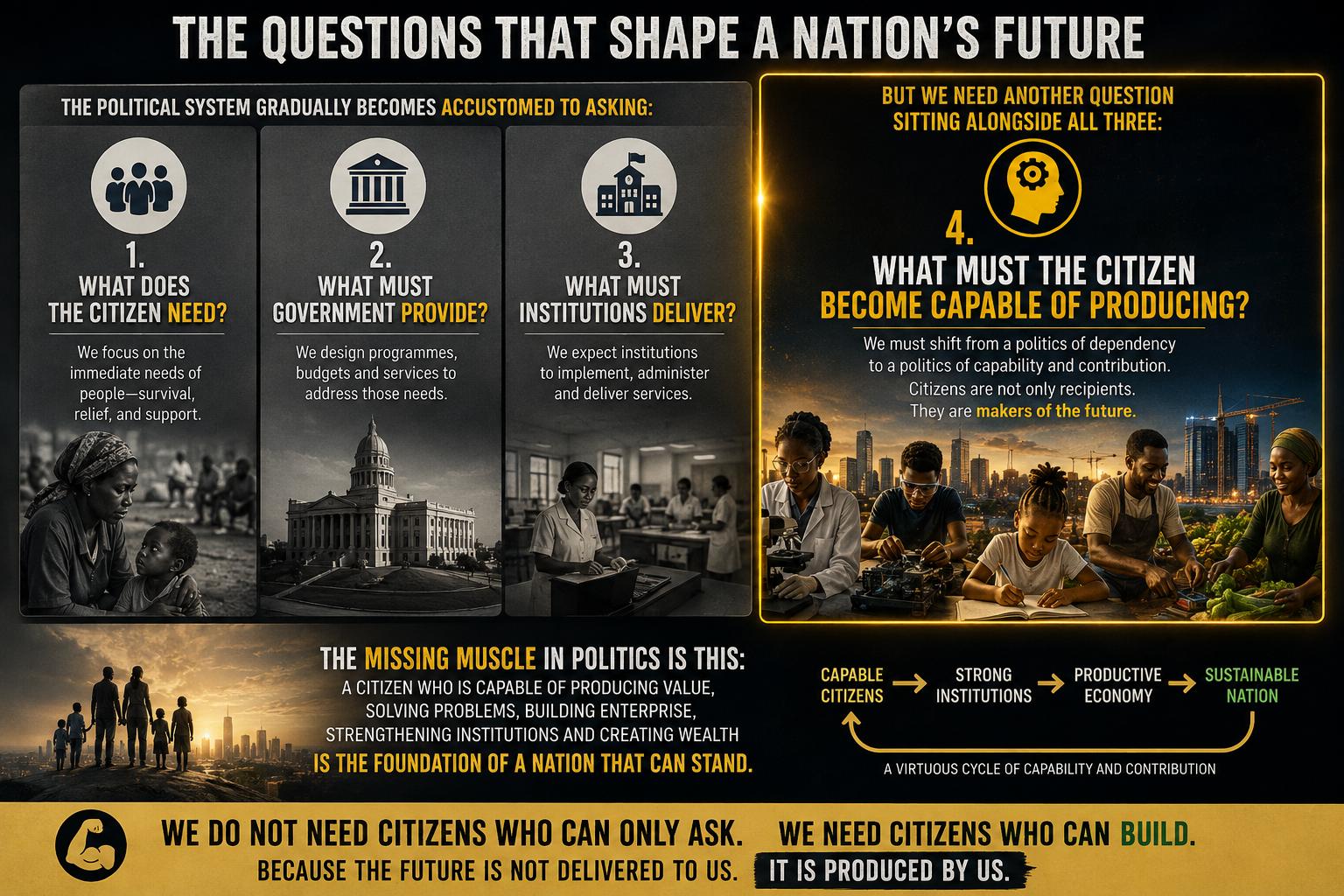
The frog does not jump out of the pot. It becomes accustomed to the temperature. The frog is a metaphor. The danger is real.
Author’s Note
This is not an argument that people who are less privileged should not be provided for or protected; protection and provision remain legitimate responsibilities of the state. The concern is the skewing of the political message when citizens are repeatedly positioned as recipients of protection, provision and support without an equally explicit and sustained expectation that adults, whatever their circumstances, participate in forming capable families, communities, institutions and the next generation.
The counts presented here were generated through AI-assisted analysis of the transcript, rather than through manual word counting by the author. They should therefore be understood as indicative evidence of the rhetorical pattern, not as a formal statistical content analysis.
Toughened by Poverty Is Not the Same as Toughened for Capability
There is an important distinction here.
We do not need to toughen people by making them poor. Poverty is not character formation. Deprivation is not an education strategy. A child should not have to experience hunger, unemployment or insecurity in order to learn persistence.
There is another kind of toughening that Southern Africa urgently needs: toughening people for capability.
It means expecting children to stay with difficult mathematics, difficult science and difficult problems. It means expecting young people to learn, practise, make things, repair things, calculate, experiment and improve. It means expecting adults to work to standards, accept responsibility, meet deadlines and understand that competence has consequences.
A functioning society replaces involuntary hardship with deliberate challenge.
It does not say, “You must suffer so that you become strong.”
It says:
“You are capable of becoming strong, and therefore we will expect more of you.”
That expectation has to begin with adults.
The Intergenerational Contradiction
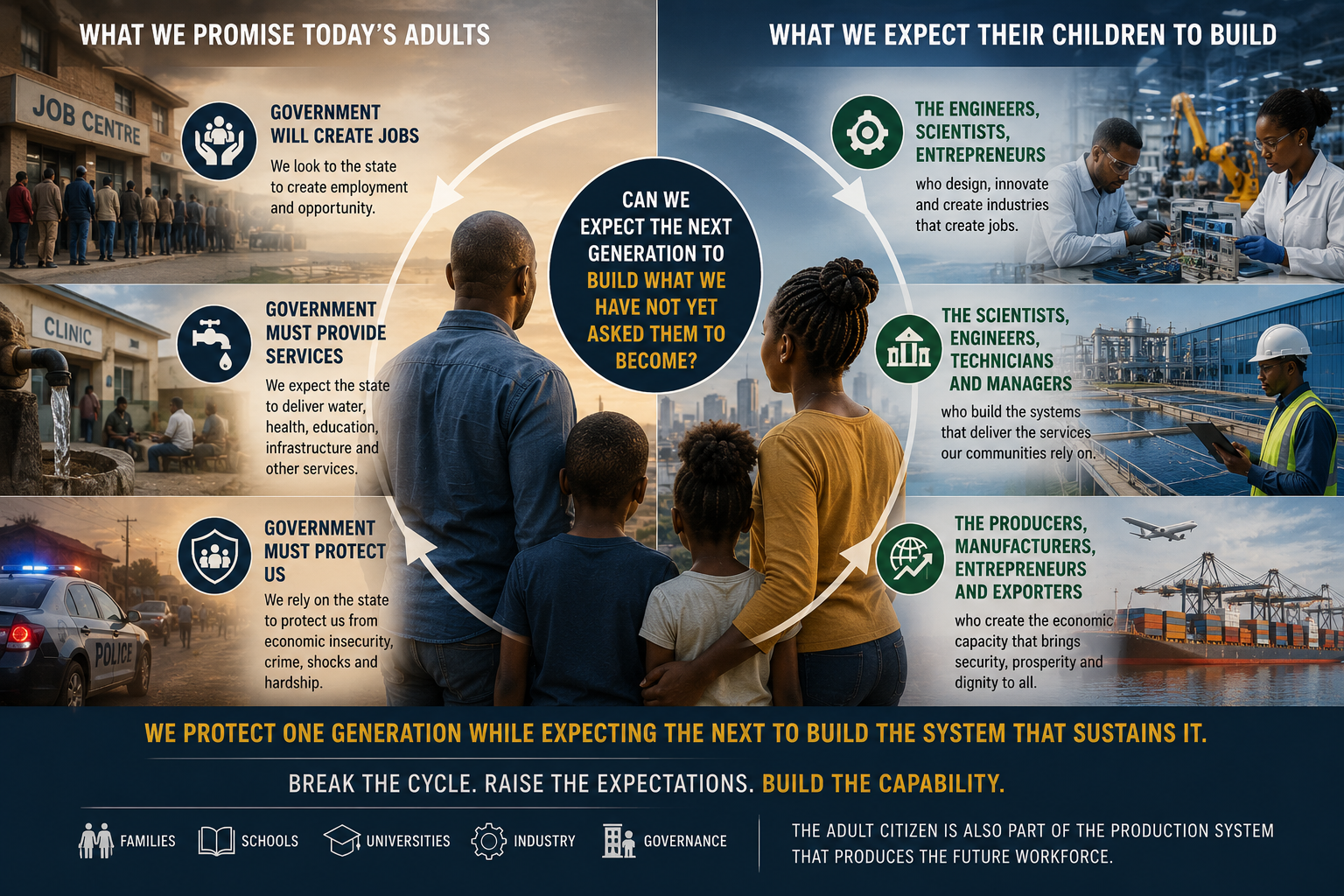
We tell today’s adults that government will create jobs.
But we need their children to become the engineers, scientists, manufacturers and entrepreneurs who create the industries that create those jobs.
We tell today’s adults that government must provide services.
But we need their children to become the scientists, engineers, technicians and managers who build the systems that deliver those services.
We tell today’s adults that government must protect them from economic insecurity.
But we need their children to become the producers, manufacturers, scientists, entrepreneurs and exporters who create the economic capacity from which that security ultimately comes.
That is the circularity.
We protect one generation while expecting the next generation to build the productive system capable of sustaining that protection.
And that is why the political language matters.
The adult citizen cannot be only the endpoint of government policy.
The adult citizen is also part of the production system that produces the future workforce.
Vision 2050 Is an Industrial Vision
This becomes particularly important because SADC Vision 2050 is not simply a vision of a better-protected population. It is a vision of a vibrant, dynamic and productive region, in which people have skills and capabilities and decent work and sustainable livelihoods. It is explicitly connected to economic integration, industrialisation and the development of regional value chains.
The speech itself makes the industrial contradiction remarkably clear.
Southern Africa possesses the energy, minerals, agricultural resources, skills, markets and financial institutions needed to build a prosperous industrialised region. Yet the region continues to look beyond its borders to supply its people. Its railways were historically built to carry raw minerals to the sea rather than to connect regional economies.
President Ramaphosa puts the problem even more sharply:
“We export the ore and we import the battery.”
The region supplies an industrial revolution happening elsewhere and then purchases the products of that industrial revolution at prices set by others. The stated response is not simply to mine more. It is to use the region’s own resources to drive its own industrial revolution.
The proposed industrial direction includes pharmaceuticals, automation, microprocessing, paper and power, furniture, semiconductors, mineral processing, agro-processing and advanced regional manufacturing.
The speech calls for refining and smelting capacity rather than simply exporting ore; processing plants rather than simply exporting agricultural products; and cars assembled in one SADC country using components manufactured in another. It calls for modern irrigation, seed development, veterinary science and agroecology, and for young people to build businesses that trade seamlessly across SADC.
Every one of these ambitions carries a human-capability requirement.
The STEM Is Already Inside the Industry
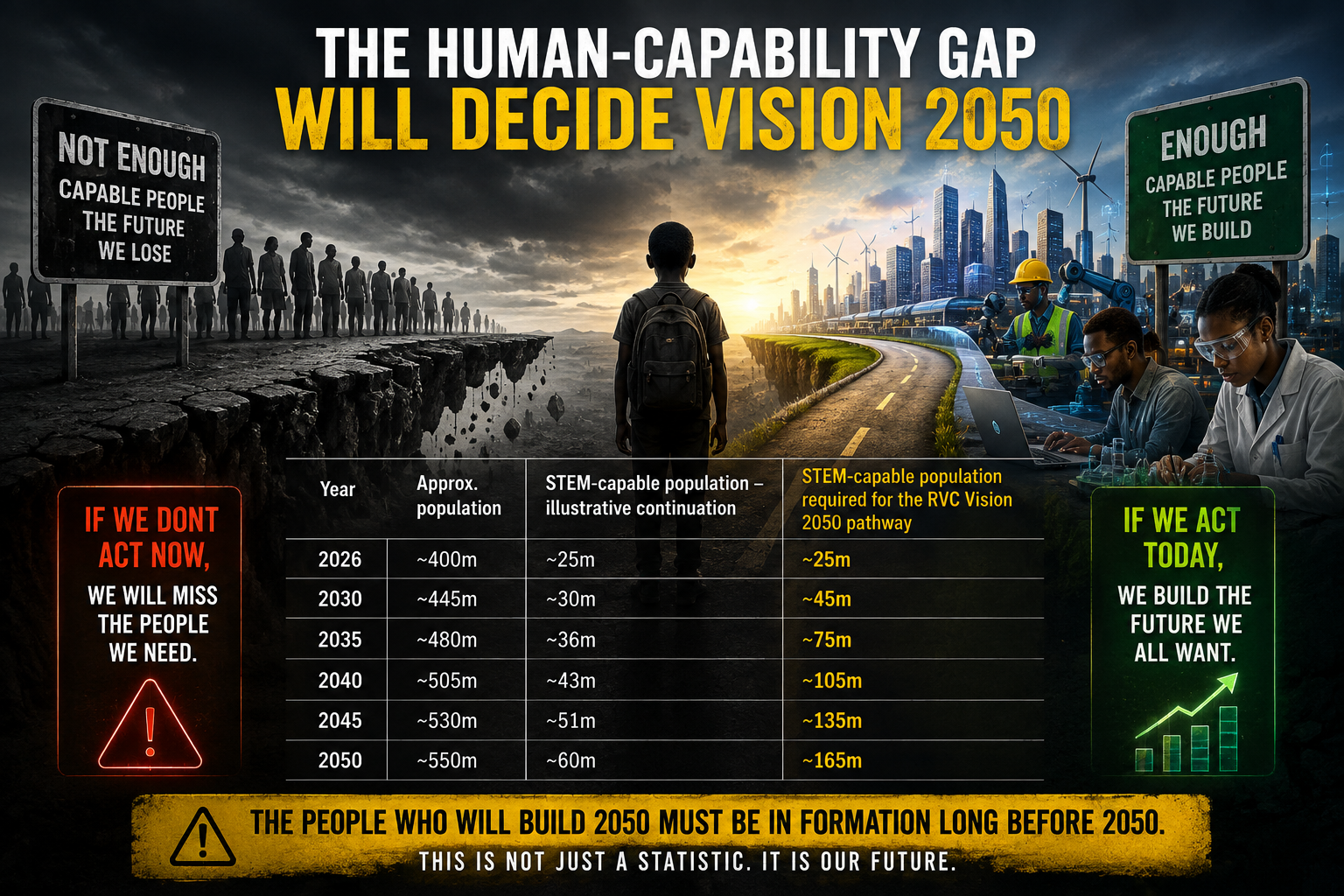
By 2050, the RVC pathway requires approximately 165 million STEM-capable people. At the current trajectory, Southern Africa would have only about 60 million. The gap is approximately 105 million people.
The STEM requirement is not something we need to invent for Southern Africa. The industries we say we want are already specifying it for us.
- If the region wants batteries, the production system requires chemistry, electrochemistry, materials science, thermodynamics and electrical engineering.
- Pharmaceuticals require chemistry, biology, microbiology, genetics, biochemistry, pharmacology and statistics.
- Semiconductors require physics, mathematics, materials science and engineering.
- Automation requires mathematics, computing, electronics, physics and engineering.
- Mineral beneficiation requires geology, chemistry, metallurgy, physics, mathematics and engineering.
- Modern agriculture increasingly requires biology, chemistry, genetics, statistics, hydrology, soil science, agricultural engineering and computing.
The scale is the harder question. Our modelling for the RVC pathway indicates that Southern Africa would require approximately 165 million STEM-capable people by 2050. If the present trajectory simply continues, the region reaches only about 60 million. That leaves a capability gap of approximately 105 million people.
| 2050 | STEM-capable people |
|---|---|
| Current trajectory | ~60 million |
| RVC requirement | ~165 million |
| Capability gap | ~105 million |
| RVC requirement / current trajectory | 2.8× |
That is why STEM cannot be left as an education-sector aspiration. The productive economy is already telling us what capability it needs. Mathematics is the connective tissue: it sits inside modelling, optimisation, process control, engineering, statistics, artificial intelligence, agricultural forecasting, energy systems and logistics. The question is therefore no longer whether Southern Africa needs more STEM.
The question is whether we are prepared to build the additional ~105 million people capable of doing the work our economic ambitions require.
2050 Is the Destination. The Capability Must Arrive Earlier.
If SADC Vision 2050 is to be more than a statement of where the region would like to be, the capabilities required to deliver it cannot be assembled in 2049. The people who will design, build, operate, manage and continuously improve the economy of 2050 must be entering the capability pipeline now. Training takes years; professional competence takes longer; and industrial capability requires experienced people working inside institutions and productive enterprises, not simply graduates holding certificates.
This changes the calculation. The question is not “How many STEM-capable people should SADC have in 2050?” The harder question is “When must those people begin entering the system, and how many must already be working at each stage, for the 2050 economy to be operational?” If the region requires approximately 165 million STEM-capable people by 2050, and the current trajectory produces only about 60 million, the region faces a capability gap of approximately 105 million people. That gap cannot be closed by a final burst of graduates in the last decade; the capability has to be built, deployed and accumulated progressively over the preceding 20–25 years.
The Capability Cannot Be Built at the Same Speed as the Vision
The implication is blunt: 2040 is not the date by which SADC should decide whether it has enough STEM capability. It is approximately the date by which the capability should already be operating at substantial scale. By 2050, the region should be refining and renewing a functioning capability base, not discovering that it needed one.
| Period | What must happen | Approximate capability position |
|---|---|---|
| 2026–2030 | Define the 2050 productive economy and quantify the STEM occupations required. Expand the education, TVET, university, apprenticeship and industry pipeline accordingly. | Capability pipeline being redesigned and scaled |
| 2030–2035 | First major expansion of new STEM capability begins entering productive employment in agriculture, manufacturing, infrastructure, energy, mining, logistics, technology and public institutions. | Capability begins working in the economy |
| 2035–2040 | The new capability base must be operating at scale. Experienced professionals begin leading and training the next generation. | Major capability stock established |
| 2040–2045 | Most of the capability required for the 2050 economy should already be working, with remaining expansion directed toward identified gaps and emerging technologies. | 2050 capability substantially operational |
| 2045–2050 | The emphasis shifts from creating basic capability to replacing retiring workers, upgrading skills, improving productivity and introducing new technologies. | Capability fully deployed for Vision 2050 |
This also means that the 165 million STEM-capable people required in 2050 are not a graduation target. They represent the human capability that must be available and functioning across the economy. The education system therefore has to work backwards from that stock: determine how many engineers, mathematicians, scientists, technologists, agricultural specialists, manufacturing specialists, energy professionals, geologists, statisticians, systems modellers and other STEM-enabled occupations are required; determine the training time for each; account for retirement, migration and attrition; and then calculate the annual number who must enter and successfully progress through the pipeline.
The arithmetic begins in 2026 because the economy we want in 2050 has already begun to require the people who will build it.
That child is part of the future productive capacity of Southern Africa.
What is the adult we must be for them?
What Must Change in the Citizen
The question cannot be left with government and the education system.
The citizen is part of the production system.
That means asking more of citizens—not by making them poor, but by raising the expectations attached to adulthood. Parents must ask what their children are becoming capable of doing. Schools must ask whether children can think, calculate, investigate, make and solve rather than merely pass examinations. Universities must ask whether they are producing capability for a production system rather than certificates for a qualification system.
Young people must understand that the world they are entering will not reward certificates alone. It will reward capability.
And governments must ask themselves a corresponding question: if they announce industrialisation, where is the human-capability plan underneath it?
If we want public institutions to become more competent, disciplined and accountable, we must also produce citizens capable of occupying and leading those institutions.
If we want globally competitive industries, we must produce the people capable of making them globally competitive.
If we want children to build a different future, we have to begin producing that capability in them now.
What Happens When Leadership Expects More of Its Citizens?
The question becomes unavoidable when we look at countries whose leaders expected citizens – not institutions – to become active producers of national capability, not simply recipients of what the state provides.
What Did National Development Require of the Citizen?
| Country / leadership | Citizen capability explicitly emphasised | Capability translated into |
|---|---|---|
| Singapore — Lee Kuan Yew | Education, skills, self-reliance, excellence | High-skilled workforce and productivity |
| South Korea — Park Chung-hee | Work, productivity, industrial skills, self-reliance | Industrialisation and export manufacturing |
| China — Deng Xiaoping | Science, technology, education, modernisation | Industrial and technological capability |
| Malaysia — Mahathir Mohamad | Work discipline, knowledge, entrepreneurship, technology | Industrial and technical capability |
| Rwanda — Paul Kagame | Diligence, quality, productivity, responsibility | Human and productive capability |
| SADC — Vision 2050 | What must our citizens become capable of doing? | What capability must the region build? |
These were not simply programmes for building better institutions. They were programmes for building people capable of using those institutions to produce national outcomes.
The distinction matters. Institutions provide the platform; people provide the capability that makes the platform productive. Education therefore cannot be treated only as a social service, STEM cannot remain an academic category, and employment cannot be understood simply as something government must provide. If a country wants industrialisation, modern agriculture, manufacturing, technology and sophisticated infrastructure, it must deliberately build citizens capable of designing, calculating, operating, managing and continuously improving those systems.
The question for SADC Vision 2050 is therefore direct: what capabilities are we asking our citizens to acquire because the future economy will require them? And, equally, are our education systems, public services, workplaces and national leadership deliberately building those capabilities at the scale required? The evidence below puts numbers against that question.
The issue is not whether citizens should be protected. They should. The issue is whether protection is being matched by deliberate capability formation. A region cannot build the future it describes in Vision 2050 while leaving the citizen’s contribution to that future implicit.
That is the bridge.
A Starting Point We Cannot Avoid
This is not a scare tactic.
It is an invitation to take the vision seriously enough to ground it in reality.
SADC has given the region a destination. The speech itself says that Vision 2050 must become more than a statement of intent; it must become a programme of action that shapes decisions, budgets, infrastructure, skills and institutions and produces results in the lives of people.
Our concern is that we have not yet worked backwards from that destination far enough.
How many people will Southern Africa have?
How many will need productive work?
What must the region produce for them?
What must it produce for the world?
Which industries must exist?
Where should those industries be located?
What resources and infrastructure will they require?
And finally:
How many STEM-capable people must we have, in each country and across the region, by 2030, 2035, 2040 and 2045, for the 2050 vision to be possible?
We should be willing to discover that our first numbers are wrong.
What we should not be willing to do is proceed without numbers.
The purpose of the RVC Integrated Map is therefore not to tell SADC what its future must be.
It is to help the region see the future it has already said it wants—and then work backwards far enough to discover what must be true today for that future to become possible.
If Vision 2050 is to be real in 2050, the people who will build it must already be on their way.
That is the starting point.
EVIDENCE TABLES
Table 1 — What the Speech Literally Says
| Concept | Literal occurrence in transcript |
|---|---|
| People | 56 |
| Citizen | 1 |
| Public servant | 0 |
| Discipline | 1 |
| Accountability | 1 |
| Government | 2 |
| Institutions | 6 |
| Responsibility | 1 |
Methodological note: these are literal word counts. They are not counts of meaning. The speech uses many other terms—children, young people, women, farmers, communities, students and so forth. The counts are therefore an indication of the rhetorical field, not a formal content-analysis result.
Table 2 — Substantive Passages Positioning the Population as Protected, Provided For or Supported
| # | Substantive theme | Indicative count |
|---|---|---|
| 1 | Food, water, security and comfort | 1 |
| 2 | Healthy lives/health security | 2+ |
| 3 | Education, skills, capabilities, decent work and sustainable livelihoods | 1 major passage |
| 4 | Protection of the peoples of the region | 2+ |
| 5 | Protection from global supply-chain disruption, food insecurity and rising costs | 2+ |
| 6 | Equal opportunity for women and men, urban and rural, young and old | 1 |
| 7 | Women being safe / GBV / femicide | 1 major passage |
| 8 | Migrants protected from discrimination, intimidation and violence | 1 major passage |
| 9 | Children receiving food, water, shelter, safety and developmental support | 1 major passage |
| 10 | Access to medicines, vaccines and health products | 1 major passage |
Indicative substantive total: at least 10 distinct passages
The children’s passage is particularly explicit: “We must ensure that all children have food, water, and shelter; that they are kept safe.”
Table 3 — Women Specifically
| Women-specific theme | Indicative substantive references |
|---|---|
| Equal opportunity for women and men | 1 |
| Women must be safe / GBV and femicide | 1 major passage |
| Men and boys must be raised to reject violence and respect/protect women | 1 major passage |
| Support for survivors | 1 |
| Economic empowerment of women | 1 |
| Women entrepreneurs’ access to procurement and markets | 1 major passage |
| Women as successful enterprise owners and leaders | 1 |
| Women-led SMEs / entrepreneurship | 1+ |
At least 6 substantive women-specific passages, with the speech moving between protection, safety, economic empowerment and economic agency. The distinction matters: not every reference to women should be coded as dependency.
Table 4 — The Industry Already Contains the STEM Requirement
| Industry / value chain | Core STEM capability |
|---|---|
| Batteries / energy storage | Chemistry, electrochemistry, physics, materials science, mathematics, electrical/chemical engineering |
| Critical minerals / beneficiation | Geology, chemistry, metallurgy, physics, mathematics, mining/metallurgical engineering |
| PGMs / fuel cells / hydrogen | Chemistry, electrochemistry, physics, thermodynamics, mathematics, chemical/electrical engineering |
| Pharmaceuticals | Organic/analytical/medicinal chemistry, biology, microbiology, biochemistry, statistics, process engineering |
| Vaccines / biotechnology | Biology, genetics, microbiology, biochemistry, immunology, chemistry, statistics |
| Semiconductors / microprocessing | Physics, materials science, chemistry, calculus, linear algebra, probability, electronics, computer science |
| Automation / robotics | Mathematics, physics, computing, electronics, mechanical/electrical/control engineering |
| EV / automotive | Physics, mathematics, materials science, mechanical/electrical engineering, electronics, computing |
| Modern agriculture | Biology, genetics, chemistry, mathematics, statistics, soil science, hydrology, agricultural engineering, computing |
| Agro-processing | Chemistry, microbiology, food science, process engineering, mathematics, statistics |
| Energy systems | Physics, mathematics, electrical/mechanical engineering, materials science |
| Water systems | Chemistry, biology, hydrology, fluid mechanics, mathematics, civil/environmental engineering |
| Rail / ports / logistics | Mathematics, physics, civil/structural/mechanical/electrical engineering, systems modelling |
| Digital / AI | Mathematics, statistics, linear algebra, probability, optimisation, computer science, electrical engineering |
| Advanced manufacturing / machinery | Mathematics, physics, mechanical/electrical/industrial engineering, materials science, computing |
The speech itself identifies pharmaceuticals, automation, microprocessing, paper and power, furniture and semiconductor value chains, while also calling for mineral processing, agro-processing, refining, smelting, manufacturing and modern agricultural science.
Table 5 — The Human-Capability Readiness Clock
The STEM Capability Gap: Current Trajectory vs RVC Requirement
| Year | Approx. population | STEM-capable under current trajectory* | STEM-capable required for RVC Vision | STEM capability gap | Required / current trajectory |
|---|---|---|---|---|---|
| 2026 | ~400m | ~25m | ~25m | 0m | 1.0× |
| 2030 | ~445m | ~30m | ~45m | 15m | 1.5× |
| 2035 | ~480m | ~36m | ~75m | 39m | 2.1× |
| 2040 | ~505m | ~43m | ~105m | 62m | 2.4× |
| 2045 | ~530m | ~51m | ~135m | 84m | 2.6× |
| 2050 | ~550m | ~60m | ~165m | 105m | 2.8× |
Important: the “trajectory” and “required” figures are working scenarios for the RVC Integrated Map, not existing SADC statistics or adopted SADC targets. The region needs to establish the actual country-by-country baseline and then test these requirements against its industrial production plans.
The central finding is the timing, not the false precision of the first estimate:
The people required for 2050 have to be in formation long before 2050.
Table 6 — Leaders Who Made Citizen Capability Part of the National Development Message
This comparison is not a claim that these leaders alone caused their countries’ economic outcomes. It asks a narrower question: how explicitly did their political language make citizen discipline, responsibility, self-reliance, learning and productive capability part of national development? GDP per capita is included only as economic context.
| Indicative rank | Leader / country | Citizen-capability message | 2024 GDP per capita, current US$ | What citizens were expected to contribute |
|---|---|---|---|---|
| 1 | Lee Kuan Yew — Singapore | Work hard; remain disciplined; no one owes you a living; self-reliance; family responsibility; excellence | $90,674 (World Bank Open Data) | Education, skills, productivity, savings, discipline, continuous capability development |
| 2 | Park Chung-hee — South Korea | National mobilisation around work, productivity, industrialisation, skills and self-reliance | $36,239 (World Bank Open Data) | Education, industrial skills, work discipline, export orientation, national development |
| 3 | Deng Xiaoping — China | Science and technology as productive forces; education and knowledge as prerequisites of modernisation | ~$13,303 | Industrialisation, technological capability, productive forces |
| 4 | Mahathir Mohamad — Malaysia | Work discipline, knowledge, self-improvement, entrepreneurship, science and technology | ~$11,874 | Industrial capability, technical skills, innovation and enterprise |
| 5 | Paul Kagame — Rwanda | Citizens are individually and collectively responsible; diligence, quality, respect for time, productivity; own the future | $1,000 (Paul Kagame) | Human capability, enterprise, institutional and productive capacity |
| 6 | Cyril Ramaphosa — South Africa | Strong institutional, skills and industrial capability message; citizen responsibility present but less developed as an explicit economic-formation frame in this speech | ~$6,267 | What has been explicitly expected? What remains underdeveloped? |
The comparison is useful precisely because the leaders do not all use the same model. Lee’s political tradition explicitly emphasised a pragmatic, responsible, disciplined, frugal and hardworking citizen, with social benefits not allowed to erode work ethic. (Public Service Commission) Lee himself described abandoning welfare because he believed it could weaken self-reliance and the desire to excel, while emphasising the need to “bake” the economic pie before distributing it. (Ministry of Foreign Affairs)
Deng made the connection even more directly between education, science, technology and productive capacity, arguing that science and technology were a fundamental productive force and that education and science had to be treated strategically over a 15–20-year horizon. (MOE China) Kagame’s language is particularly close to the proposition at the centre of this article: citizens are individually and collectively responsible for national development, and productivity depends upon diligence, quality and respect for time. (Paul Kagame)
The lesson is not that Southern Africa should copy Singapore, China, Korea, Malaysia or Rwanda.
It is simpler:
Political leadership can ask citizens to become capable of the future they want, while simultaneously building the institutions that enable them to do so.
That is the question Southern Africa now has to ask itself.
Not whether government should protect its citizens.
Not whether institutions should be made more capable.
But whether we are asking enough of the adults who must produce the citizens who will eventually make those institutions—and the economy they serve—capable enough to stand on their own.


You must be logged in to post a comment.