In its 2015 survey of African workers, South Africa’s Rand Merchant Bank found Batswana to be the laziest on the continent. The problem is actually more acute than that.
In the 2017-2018 Global Competitiveness Report, Botswana scores the worst among the 137 countries that are tracked by the World Economic Forum’s Global Competitiveness Index (GCI) on 12 pillars of economic competitiveness. From a list of 16 factors, respondents to the World Economic Forum’s Executive Opinion Survey were asked to select the five most problematic factors for doing business in their country and to rank them between 1 (most problematic) and 5. The results were then tabulated and weighted according to the ranking assigned by respondents. One of those factors is “Poor work ethic in national labour force.”
With a score of 19, Botswana’s national workforce (which would include those in the public and private sector as well as NGOs) emerge as standard bearers of the poorest work ethic in the world survey. Also doing poorly are Trinidad & Tobago (15.9), Brunei (14.4), Sri Lanka (11.1), Liberia (10.8), Bhutan (10.5), Seychelles (10.1), Malta (9.8), Georgia (9.7), Mauritius and Vietnam (9.5), Namibia (9.3), Bahrain (9.0), Kuwait (8.7) and United Arab Emirates and Jamaica (8.6).
WEF’s interest in labour productivity has to do with the fact that it impacts on business. A University of Botswana study by Professor John Makgala and Dr. Phenyo Thebe (“There is no Hurry in Botswana”: Scholarship and Stereotypes on “African time” Syndrome in Botswana, 1895-2011”) found that this lack of productivity has frustrated effort to attract foreign direct investment. Interestingly, there was a time when, according to literature that the authors quote, Botswana’s civil service “was generally believed to be the most efficient in the whole of the African continent.”
On a past trip to Singapore, former and late President Sir Ketumile Masire gained an appreciation on the efficiency of the country’s workers. Where a Motswana factory worker would produce one shirt within a given period of time, a Singaporean counterpart would produce six within the same period.
“This was productivity not in theory but in demonstrable terms. When we say we are not productive, this is what we meant,” Masire recalled to Sunday Standard in 2015 of this experience which would lead to Botswana benchmarking with Singapore and delegations from the two countries travelling back and forth.
As one of the Four Asian Tigers, Singapore would provide one quarter of the inspiration to establish the Botswana National Productivity Centre (BNPC). The tigers are Hong Kong, Singapore, South Korea, and Taiwan. Along the way, however, the late president appears to have given up on ever inculcating the right work ethic in Batswana. On assessing the apparent resistance, he determined that Batswana’s poor work ethic was a result of their pastoralism.
“If you look at the life of pastoralists, they don’t have a good work ethic,” he had said. The example he had cited was that beyond sinking a borehole for their livestock, letting out cattle to pasture and doing some other undemanding work, most of the time pastoralists are just lazing about as their cattle graze untended in the bush. By Masire’s analysis, this is the work ethic that has been bequeathed to modern-day Botswana.
As a University of Botswana study shows, not one productivity intervention scheme by the government has produced the desired results. In his 2015/16 budget speech, the Minister of Finance and Economic Development, Kenneth Matambo, lamented the low levels of labour productivity in Botswana. The best performers in terms of work ethic in the national labor force are from Zimbabwe and Venezuela underpinned by a perfect score.
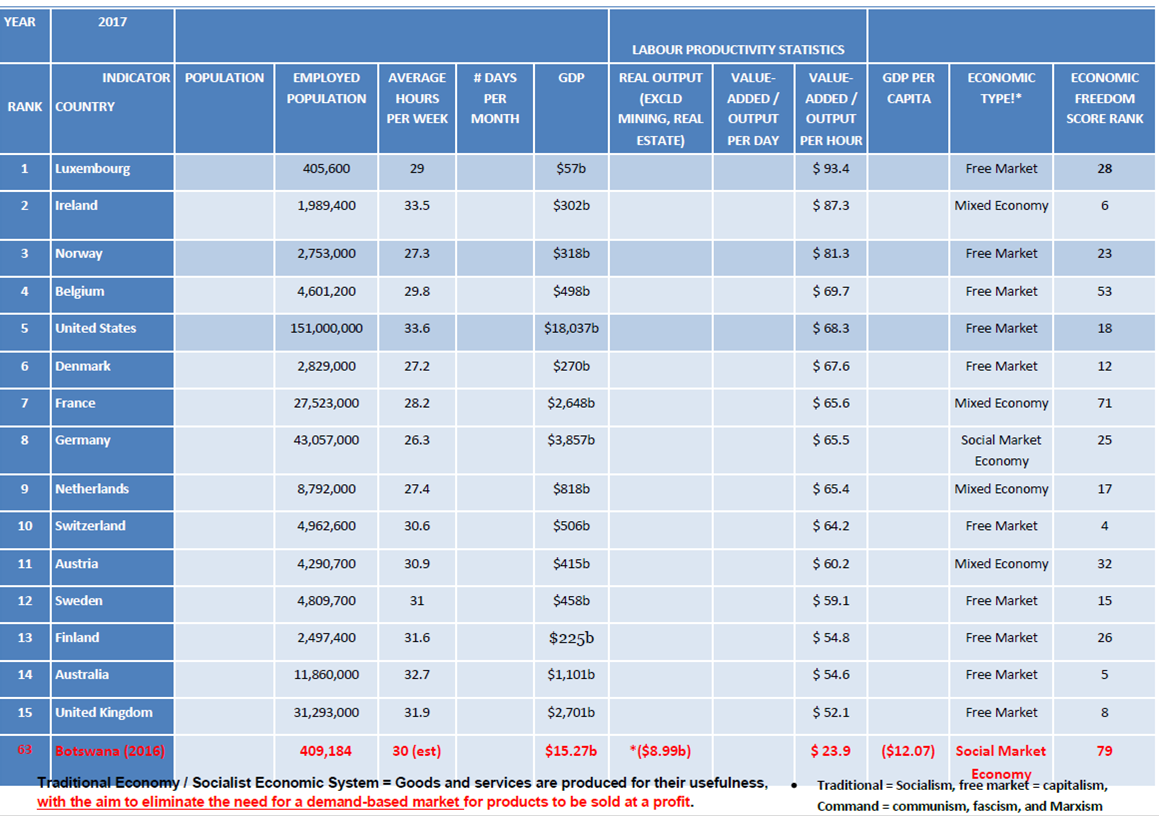
Table 1: Comparison of Botswana with 2017’s Best Global Labour Productivity Data
DID YOU KNOW? THE AVERAGE PER CAPITA PRODUCTIVITY IN BOTSWANA
LAGS THE WORLD’S PRODUCTIVE COUNTRY BY 30-40 TIMES?
TALKING POINTS:
COUNTRY’S GENERAL ECONOMIC PRACTICE:
An economic system defines the mechanism of production, distribution, and allocation of goods, services, and resources. It operates in a society or country with defined rules and policies about ownership. There are also policies about administration.
The most commonly followed economic system is modern-day capitalism. It was developed from a framework. This framework aimed to secure the supply of key elements required for industry. These elements include land, machinery, and labor. A disruption in any of these would lead to increased risk and loss for the venture.
THE COUNTRY’S GENERAL ECONOMIC PRACTICE, ON THE OTHER HAND:
Socialistsviewed this commoditization of labor as an inhuman practice. I believe those words are distinctively from the female voice. This stems from Marx’s known instances of showing great sympathy for peasants. He also showed great sympathy for women as important forces for change within Marx’s theory. It marks the genesis of a matriarchal society. Women often lead quietly from behind the scenes as a response to survive in the face of absent males. These males have needed to travel long distances. They work in the agriculture and mining industries. As a result, women left to fend on their own have become increasingly ‘masculinized’.
These, I believe, led to the birth of Karl Marx’s idealism on socialism and socialist economies across a few countries.
How does a socialist economy work?
The starting point to this form of economy is typically three-fold:
The country has considerable access to wealth generated by mining underground mineral and fossil fuel resources, which is demanded by other world economies and is traded in exchange for income;
Or it has traditionally enjoyed a monarchy and/or a pastoral economy. It has access to substantive land spaces. This allows it to multiply livestock and warm crops. These crops do not need as much attention compared to cold crops. The rates are faster than the rate at which the human population multiplies with relative ease. The monarchy supports its people when they ask for help. It helps distribute the wealth as shared resources like land. It also provides meat and food as needed.
Either way, the population has a tradition and work ethic that differ from farmers in parts of Asia. In southern China, for example, rice cultivation can be intricate, laborious, and multi-seasonal within a year. The majority have limited resources. They have learned to improve the returns on their labor by becoming smarter and more collaborative. They achieve this by managing their time better and making better choices. In other words, more than simply working hard, they worked intelligently and strategically. Cultures “shaped by the tradition of wet-rice agriculture and meaningful work” produce students with fortitude. These students can “sit still long enough.” This enables them to find solutions to time-consuming and complex math problems, for instance. As such, hard work, given this context, can easily be seen as more difficult than usual. It can, hence, be regarded as inhumane. Source: “Rice Paddies and Math Tests,” Malcolm Gladwell.
THE RESULTANT REALITY OF THE ECONOMIC PRACTICE:
Botswana’s real labour productivity per capita is USD 2. It measures the employed population’s output, excluding value added by mining and real-estate sectors. This is measured against the total population of the country for a truer reflection of real per capita income. USD 2.2 per hour or USD 18 per day, and that is, before deducting costs of operations. Luxembourg sets the pace as the global labour productivity leader at USD 93.4 per hour or USD 747 per day (or USD 16,437 per month). At this rate, Botswana’s productivity (and therefore wealth) lags (falls behind by) at 30-40x behind that of Luxembourg.
It makes one wonder. In our efforts to avoid capitalism and obvious inhuman labour practices, at what cost have we done so? We strive for wealth accumulation and perfect equality in income distribution. Will our efforts to transform the manufacturing and industrialization sectors succeed? Can our efforts to diversify the economy, moving from the tried and tested, gain traction? We need to understand the underlying forces that detract us from such efforts.
The Question is:
Would we rather continue this way as if business is usual?
How much would we drag a burgeoning burden on the state in the process?
What will be the end state of that burden on the government and the country?
Gaining such understanding in our minds would mean gaining the power in our hands. If you can imagine it, then you can create it.
STEPS GOING AHEAD:
However, this approach risks deterring organizations from capitalist economies from engaging with or investing in such an economic system. These institutions have built their wealth through performance-based merit. They demonstrate resilience over time and operate within clearly defined standards. Their income and wealth growth have been consistent, driven by a disciplined focus on reducing production costs and improving efficiency. This approach not only strengthens individual enterprises but also contributes meaningfully to broader economic growth.
Interestingly, no pure socialist, capitalist, or communist economy exists in the world today. All economic system changes were introduced with a big bang approach. They had to make “adjustments” to allow appropriate modifications as the situation developed.
Over time, most state-run subsidy systems that lack high productivity standards become unsustainable in supporting expansive social programs. Despite receiving significant external aid, poverty levels often stay high. This dynamic worsens income inequality. It deepens the divide between the wealthy and the poor. It places an overwhelming and unsustainable burden on public welfare systems.
Reform efforts often aim to transition toward a mixed economy that incorporates free-market mechanisms. This involves reducing government control over small enterprises and phasing out redundant positions within the state workforce. Such measures are put in place to facilitate self-employment. They allow a significant portion—potentially up to 40%—of government employees to transition into the private sector. This structural shift lays the groundwork for a broader income tax base. It fosters greater fiscal self-reliance. It also reduces long-term dependency on state support.
In the short term, to alleviate economic pressure, policymakers will prioritize attracting increased foreign investment. This often involves the establishment of tax-free special development zones. These zones enable foreign companies to operate with minimal restrictions. They allow for the repatriation of profits without tariffs. These measures represent a departure from traditional centrally planned, socialist economic models. However, they are not a substitute for comprehensive structural reform. Relying solely on these mechanisms risks undermining long-term economic stability and self-sufficiency.
Fundamental change requires substantive reform—even when directed at a nation’s own citizens. These reforms must establish a clear link between wages and individual productivity. They should avoid relying on rank, seniority, or attendance as the basis for compensation. Without this shift, efforts toward transformation will remain partial and ineffective. For true and lasting change, citizens must understand their productivity’s direct impact. It contributes to both national prosperity and personal income. This awareness is essential for driving accountability, performance, and sustainable economic development.
THE BOTTOM LINE
Socialist economies across the globe have existed and continue to progress. However, there may not be any standard pure socialist economy remaining. Timely and fundamental shifts in programs and policies have allowed such economies to thrive. China is the world leader among them. The ones taking a rigid stand are facing severe problems or developing parallel markets.
Underlying Mental Models and Beliefs that perpetuate low productivity as outlined in this post.
This blog post is titled “When the Economy Speaks: Cracking the Botswana Productivity Code – Short Notes Part II”. It explores the systemic and cultural factors. These factors contribute to Botswana’s persistent productivity challenges. Drawing from systems thinking principles, the article identifies several underlying mental models and beliefs that perpetuate low productivity.
1. Short-Termism and Preference for Immediate Gains
There is a prevalent focus on achieving quick, visible results rather than investing in long-term, foundational improvements. This mindset leads to prioritizing short-term projects that offer immediate benefits. But it often sacrifices sustainable growth and systemic change. Such an approach can result in recurring issues as underlying problems stay unaddressed.
2. Equating Compensation with Rank and Tenure
A common belief equates higher compensation with seniority or rank and, hence, attendance rather than actual productivity or performance. This perspective discourages merit-based incentives. It can lead to complacency. Employees do not feel motivated to improve efficiency or innovate if rewards are not tied to performance.
3. Perception of Government as Primary Provider
There exists a widespread expectation that the government is the main source of employment and economic support. This belief can stifle entrepreneurial initiatives. It can also reduce individual accountability. Citizens rely heavily on state provisions rather than seeking self-driven economic opportunities.
4. Resistance to Change and Innovation
Cultural norms that value tradition and established practices can lead to resistance against new approaches or technologies. This reluctance to embrace change hampers the adoption of innovative practices that enhance productivity and economic diversification.
5. Limited Emphasis on Systems Thinking
A lack of systems thinking in policy and organizational decision-making leads to fragmented approaches to problem-solving. Interventions need a holistic understanding of how different components of the economy interact. Otherwise, they tackle symptoms rather than root causes. This results in ineffective solutions.
6. Underinvestment in Human Capital Development
There is insufficient emphasis on developing skills and competencies that align with the evolving demands of the global economy. This gap in human capital investment limits the workforce’s ability to adapt to new technologies. It also constrains productivity growth by hindering adaptation to new processes.
7. Over-reliance on External Aid and Resources
Dependence on foreign aid and external resources can create a false sense of security. This reduces the urgency to develop internal capacities. It also delays the creation of self-sustaining economic strategies. This reliance also leads to policy decisions that prioritize donor preferences over local needs and contexts.
Addressing these deeply ingrained beliefs and mental models requires a concerted effort. We need to shift mindsets toward valuing long-term planning, merit-based systems, innovation, and self-reliance. Integrating systems thinking into education, policy-making, and organizational practices can help offer a more holistic approach. This integration leads to a sustainable way to improve productivity in Botswana.
REQUIRED RESEARCH ANALYSIS
FOR DETAILS OF DATA REQUIRED FOR RESEARCH ANALYSIS FOR THIS TOPIC, CLICK HERE.
That is … until you see them return to the lands and vegetation we have encroached into, when we settled in their habitat.
When elephants leave their habitats for their watering holes, for however long, it does not mean they have resettled.
And so, it becomes hard for us to imagine the way a child intuitively understands these gentle giants. Instead, …
When we think of elephants, we conjure up images of majesty and aggression!
ARTICLE OUTLINE:
Introduction
Basic Facts about elephants
The impact elephants have on the ecology
Historical reasons for the demise of elephants
FAQS ABOUT HUNTING:
What is fuelling human’s obsession for hunting?
Why men trophy hunt?
FAQs ABOUT POACHING:
About the elephants
About the tusk
About the poachers and the trade
About the end consumer
Beijing master ivory carvers cling to their trade
Who is the silent voice and what does it say?
Population. At the turn of the 20th century, there were a few million African elephants and about 100,000 Asian elephants. Today, there are an estimated 450,000 – 700,000 African elephants and between 35,000 – 40,000 wild Asian elephants. Most captives are endangered Asian elephants; African bush elephants and African forest elephants are less amenable to training. Animal rights organizations estimate there are 15,000 to 20,000 elephants in captivity worldwide. That brings the total number of elephants today to about 500,000. Half a million.
The real question is, what would you do if it had been the global human population that has been decimated by up to three quarters of its numbers by another species? And you are left with a quarter of you!
INTRODUCTION
Elephants are among the most intelligent of the creatures with whom we share the planet, with complex consciousnesses that are capable of strong emotions. Across Africa they have inspired respect from the people that share the landscape with them, giving them a strong cultural significance. As icons of the continent elephants are tourism magnets, attracting funding that helps protect wilderness areas. They are also keystone species, playing an important role in maintaining the biodiversity of the ecosystems in which they live.
Symbolic Elephant Meaning. … Symbolic elephant meaning deals primarily with strength, honor, stability and tenacity, among other attributes. To the Hindu way of thought, the elephant is found in the form of Ganesha who is the god of luck, fortune, protection and is a blessing upon all new projects.
What does elephant symbolize?
Many African cultures revere the African Elephant as a symbol of strength and power. It is also praised for its size, longevity, stamina, mental faculties, cooperative spirit, and loyalty. South Africa, uses elephant tusks in their coat of arms to represent wisdom, strength, moderation and eternity.
Elephants generally do not have predators (animals that eat them) due to their massive size. Newborn elephants are however vulnerable to attacks from lions,tigers, and hyenas. The biggest danger to elephants are humans; elephants have been hunted for their tusks to near extinction in some cases.Oct 8, 2015
Yet, today they stand at the brink on its way of being wiped out. Paving the way for the last man standing. The man.
Yet, did you know that ….
What elephants are afraid of?
But the elephant’s fear has more to do with the element of surprise than the mouse itself. Theories abound that elephants are afraid of mice because the tiny creatures nibble on their feet or can climb up into their trunks.Jun 1, 2016
Are elephants really scared of bees?
Elephants are the largest beasts alive on land today. Yet, these goliaths are afraid of bees, researchers have discovered. The giants flee when they hear the buzz of a beeswarm. Their fear could be used to help protect them.
SURPRISED?
And so the images we had conjured in our minds of their undisputed majesty and world domination (and possible aggression), true?
So, be calm. Love an elephant and learn to live among the gentle giants if, that is, you still want to live on their lands.
“Because he (the human) just comes for the money, he does not have any compassion or love for the elephant. And so he does not want to be involved in taking care of the elephant. So the elephant will get poorer and poorer in condition.”
“I look into their eyes and I can see they have suffered. They can’t speak.”
“They never knew that elephants can show happiness. That they have humor and can smile.”
“They accept her into her herd as a kindred spirit after suffering so many years of abuse. Perhaps they are relieved and surprised to find such human kindness still exists.”
Blog Author’s Note:
As you read the article, notice the elephant (what we know about them: the facts, the emotions, the money trail, the larger-than-life images this animal conjures in our minds) that this majestic animal has brought into the room … and then, notice what is the “elephant that is not in the room”?
What do you think that is? There right there, is our leverage.
BASIC FACTS ABOUT ELEPHANTS
Habitat loss is one of the key threats facing elephants. Many climate change projections indicate that key portions of elephants’ habitat will become significantly hotter and drier, resulting in poorer foraging conditions and threatening calf survival. Increasing conflict with human populations taking over more and more elephant habitat and poaching for ivory are additional threats that are placing the elephant’s future at risk.
Of the two species, African elephants are divided into two subspecies (savannah and forest), while the Asian elephant is divided into four subspecies (Sri Lankan, Indian, Sumatran and Borneo). Asian elephants have been very important to Asian culture for thousands of years – they have been domesticated and are used for religious festivals, transportation and to move heavy objects.
Diet
Staples: Grasses, leaves, bamboo, bark, roots. Elephants are also known to eat crops like banana and sugarcane which are grown by farmers. Adult elephants eat 300-400 lbs of food per day.
Population
At the turn of the 20th century, there were a few million African elephants and about 100,000 Asian elephants. Today, there are an estimated 450,000 – 700,000 African elephants and between 35,000 – 40,000 wild Asian elephants.
Range
African savannah elephants are found in savannah zones in 37 countries south of the Sahara Desert. African forest elephants inhabit the dense rainforests of west and central Africa. The Asian elephant is found in India, Sri Lanka, China and much of Southeast Asia.
Behaviour
Elephants form deep family bonds and live in tight matriarchal family groups of related females called a herd. The herd is led by the oldest and often largest female in the herd, called a matriarch. Herds consist of 8-100 individuals depending on terrain and family size. When a calf is born, it is raised and protected by the whole matriarchal herd. Males leave the family unit between the ages of 12-15 and may lead solitary lives or live temporarily with other males.
Elephants are extremely intelligent animals and have memories that span many years. It is this memory that serves matriarchs well during dry seasons when they need to guide their herds, sometimes for tens of miles, to watering holes that they remember from the past. They also display signs of grief, joy, anger and play.
Recent discoveries have shown that elephants can communicate over long distances by producing a sub-sonic rumble that can travel over the ground faster than sound through air. Other elephants receive the messages through the sensitive skin on their feet and trunks. It is believed that this is how potential mates and social groups communicate.
Reproduction
Mating Season: Mostly during the rainy season.
Gestation: 22 months. Litter size: 1 calf (twins rare). Calves weigh between 200-250 lbs at birth. At birth, a calf’s trunk has no muscle tone, therefore it will suckle through its mouth. It takes several months for a calf to gain full control of its trunk.
Elephants are the keystone species of their habitat.
The planet earth is inhabited by diverse array of living organisms such as microorganisms, plants, animals and human beings which collectively constitute the biodiversity. Each and every element of the living component of the system has its own role, either positive or negative, to play as a system component. So preservation and conservation of living organisms, whether they are tiny or large, become immense important in playing beneficial role in maintaining biodiversity.
Mega-herbivorous animal such as elephant has major impact on the terrestrial ecosystems in which they live and thus on the animals that depend on these habitats. Elephant can be referred as “keystone species” because it facilitates:
Feeding by other herbivores that disperse seeds and supports large assemblages of invertebrates, such as dung beetles, and
Lower plants such as algae and fungi apart from enriching soil nutrients through dung piles.
These algae and fungi are preferred nutrient plants for some reptiles such as monitor lizard and star tortoise in the semiarid tropical forests.
Dung beetle accumulation attracts many insectivorous birds.
Dung deposition into water holes is being benefited to the Pisces and amphibians.
Wherever they live, elephants leave dung that is full of seeds from the many plants they eat. When this dung is deposited the seeds are sown and grow into new grasses, bushes and trees, boosting the health of the savannah ecosystem.
Seed dispersal through alimentary canal induces germination and survival capacity of the seedlings to maintain the forest heterogeneity; some species rely entirely upon elephants for seed dispersal.
Elephant also does some of the silvicultural practices such as
Creation of paths in dense forest. When forest elephants eat, they create gaps in the vegetation. These gaps allow new plants to grow and create pathways for other smaller animals to use.
On the savannahs, elephants feeding on tree sprouts and shrubs help to keep the plains open and able to support the plains game that inhabit these ecosystems.
Maintenance of grazing lawns and height of the trees and thinning in thick vegetation cover to keep the sustainable utility of the forest.
Identification of subsoil water and natural salt licks through elephants’ strong sense is also shared by the other animals especially the herbivores for which intake of minerals from the natural soil is most important for many physiological activities.
During the dry season, elephants use their tusks to dig for water. This not only allows the elephants to survive in dry environments and when droughts strike, but also provides water for other animals that share harsh habitats.
The pachyderm (a very large mammal with thick skin, especially an elephant, rhinoceros, or hippopotamus) is under severe threat due to various conservation problems such as loss of habitat (see example below that of forest cover in Sumatra), habitat quality and corridors, reduction of home range, population increase, impact of developmental activities, human-elephant conflict issues and poaching for ivory. Among the factors, some of them may be responsible for major proportions, and some of them involve less proportion. But these are the reasons listed as conservation problems for the long-run conservation of elephants.
Historically, trade and capture are responsible for elephants’ demise
Since the Proboscidea originated 60 million years ago, the order has included some 10 families, 45 genera and 185 species and subspecies, in a spectacular diversity of forms. The African (Loxodonta africana and Loxodonta cyclotis) and Asian elephants (Elephas maximus) existing today are the sole remnants of that remarkable evolutionary radiation. Representing a tiny fraction of their former numbers, the living elephants survive in only small pockets of the land they once roamed. In many areas elephant populations have already gone extinct or are highly endangered.
Over centuries legal and illegal hunting (“poaching”) for the commercial ivory trade and, in Asia, the capture of elephants for human use, have been largely responsible for the elephant’s demise. The number of wild Asian elephants now comprise less than a tenth of all remaining elephants, and continue to decline in shrinking habitat. In Africa, elephants once inhabited the entire continent, from the Mediterranean down to its southern tip, but the ivory trade coupled with human expansion caused a continental decline in their numbers. By circa 1600 North Africa was devoid of elephants. In modern Africa, poaching for ivory has been fuelled by poverty, political instability and civil unrest coupled with the easy availability of arms. In recent history, between 1979 and 1989, Africa’s elephants underwent a dramatic and devastating decline, falling from approximately 1.3 million animals to an estimated 609,000. Human greed and rising prices of ivory were responsible for the appalling slaughter.
African elephants (Loxodonta africana) are imperiled by poaching and habitat loss. Despite global attention to the plight of elephants, their population sizes and trends are uncertain or unknown over much of Africa. To conserve this iconic species, conservationists need timely, accurate data on elephant populations.
There is an estimated population of 352,271 savannah elephants on study sites in 18 countries, representing approximately 93% of all savannah elephants in those countries. Elephant populations in survey areas with historical data show it has decreased by an estimated 144,000 from 2007 to 2014, and populations are currently shrinking by 8% per year continent-wide, primarily due to poaching. Though 84% of elephants occurred in protected areas, many protected areas had carcass ratios that indicated high levels of elephant mortality. Results of the GEC show the necessity of action to end the African elephants’ downward trajectory by preventing poaching and protecting habitat.
What is fuelling the obsession of trophy hunting poaching?
Why are savagery and violence so omnipresent among humans?
We suggest that hunting behaviour is fascinating and attractive, a desire that makes temporary deprivation from physical needs, pain, sweat, blood, and ultimately the willingness to kill tolerable and even appetitive.
Evolutionary development into the “perversion” of the urge to hunt humans, that is to say the transfer of this hunt to members of one’s own species, has been nurtured by the resultant advantage of personal and social power and dominance. While breakdown of the inhibition towards intra-specific killing would endanger any animal species, controlled inhibition was enabled in humans in that higher regulatory systems, such as frontal lobe-based executive functions, prevent the involuntary derailment of hunting behaviour.
If this control – such as in child soldiers for example – is not learnt, the brutality towards humans remains fascinating and appealing. Blood must flow in order to kill. It is hence an appetitive cue as is the struggling of the victim.
Hunting for men, more rarely for women, is fascinating and emotionally arousing with the parallel release of testosterone, serotonin and endorphins, which can produce feelings of euphoria and alleviate pain. Bonding and social rites (e.g. initiation) set up the contraints for both hunting and violent disputes. Children learn which conditions legitimate aggressive behaviour and which not. Big game hunting as well as attack of other communities is more successful in groups – men also perceive it as more pleasurable. This may explain the fascination with gladiatorial combat, violent computer games but also ritualized forms like football.
(Blog Author’s Note: And as such conjures notions such as the “last man standing” must necessarily therefore mean someone is more strong or witty than the rest who did not stay around to remain standing as he could. Therefore, as such (in conclusion) no one, not his mother or his wife say he is ‘therefore not man enough’ for her.)
WHY MEN TROPHY HUNT: SHOWING OFF AND THE PSYCHOLOGY OF SHAME
Prominent evolutionary anthropologists (Brian Codding and Kristen Hawkes from the University of Utah) have studied hunter-gatherer populations for decades.
Interestingly, analyses of the types of animals hunter-gatherer men target are very similar in that they are often the largest animals in the landscape. Importantly, they are also animals with high ‘failure rates’. That is, men are likely to come home empty handed from hunting. This is very different from women hunters, who target smaller animals that they are more assured to acquire and bring home as food.
On that hunt, on a lake outside Tampa, I met Jay, a hugely successful New York photographer and author, who said, “I watched Romancing The Stone as a kid. In the movie, Michael Douglas kills a crocodile and turns it into a pair of cowboy boots. That’s what I’m here. I want to wear a pair of cowboy boots and to be able to say to my friends, ‘I killed these’”.
And kill them he did, from a flat-bottomed boat after he first harpooned it with a buoy tied to a rope so it couldn’t swim away, making Jay holler “this is like something out of Jaws!”
Men who target these large, difficult-to-acquire animals, therefore, signal to others that they can absorb the costs of an inefficient behaviour. It signals that they have high-quality underlying mental and physical characteristics to be able to absorb such costs.
This ‘costly signalling’ to which it’s referred in the evolutionary literature, provides a way for men to accrue status. And status is universally important for men to ward off competition and attract mates. (I’ll note here that hunter-gatherer populations consume the animals they kill, unlike most trophy hunters. In no way do I advocate any opposition to the ways in which Indigenous peoples earn their livelihood).
What are your major messages?
We believe this ‘costly signalling’ model applies equally well to trophy hunters from the developed world. By paying big bucks to trophy hunt, or even forgoing smaller individuals within populations to wait for chances at the very biggest, imposes costs on trophy hunters. And it’s prestigious to signal that you can absorb these costs. In other words, trophy hunters, whether they realize it or not, are likely hunting for status. It’s like driving a luxury car, though in this case the lives of animals are taken.
How do your findings extend and differ from what others have written about trophy hunting?
People, including me, were confused as to why men do this. Are they sick in the head? Bloodthirsty? Some believe that these are appropriate terms. For me, this evolutionary explanation goes deeper and asked, why did this behaviour evolve? We think we offer a good explanation.
Some might argue, ‘Well, if this is natural behaviour, then it’s justified’. I believe this is a dangerous argument referred to as the naturalistic fallacy. My colleague and mentor, Dr. Paul Paquet of the Raincoast Conservation Foundation, makes this abundantly clear by reminding us, “Trophy hunting can neither be justified for being natural nor as an aid to help populations, given the enormous costs paid by individual animals – their lives.”
How might one apply what you found to put a stop to this reprehensible practice that some claim they do “in the name of conservation”?
One interesting observation post-Cecil (the lion’s death by trophy hunting) is that demand for lion hunting has declined owing to prohibitions on transporting the remains on planes, etc. If hunters cannot bring the trophies home to boast with, then they have no costly signal.
How many elephants are killed by poachers every year?
100 Elephants are killed per day. The U.N. says up to 100 elephants are being slaughtered a day in Africa by poachers taking part in the illegal ivory trade. Mar 19, 2015.
How many wild elephants are left in the world?
Population at the turn of the 20th century, there were a few million African elephants and about 100,000 Asian elephants. Today, there are an estimated 450,000 – 700,000 African elephants and between 35,000 – 40,000 wild Asian elephants. That is a third or less than a third or even by as much as a quarter of the population of elephants that existed at the turn of the last century. Three-quarters of them have disappeared effectively.
Endangered Asian elephants
Asian elephants are even more endangered than African elephants — but the threat isn’t poaching so much as human encroachment. The Asian species is smaller than the African, and none of the females and only some of the males have tusks. While some are hunted for ivory or meat, most of the Asian elephants taken from the wild are not killed, but domesticated for zoos, safari tourism, or timber hauling. There are only about 30,000 remaining wild Asian elephants, while 15,000 live in captivity. The wild herds in India, Sri Lanka, and Thailand are dwindling, too, as human development shrinks their habitat. Many populations are now cut off from migration routes and forced to inbreed.
An elephant’s tusk is a tooth. It’s an elongated incisor, one-third of which is embedded into the elephant’s skull. The tusk is made up of nerve endings and pulp matter, and removal is deadly.
Elephants use their tusks in a variety of ways. They are used to protect themselves and their herd from predators, and elephants can even use their tusks for digging water holes. However, elephants are also anintegral part of the environment. They are sometimes referred to as “mega gardeners,” and without them, hundreds of animal and plant species would cease to exist as well.
Why are Elephants Killed for Their Tusks?
Up to 70 percent of ivory poached goes to China, where half a kilogram of it can sell for as much as 1,000 U.S. dollars. This increase in demand has been fueled by the growth of a middle class in China. People can now afford the material that they have grown up believing is better than diamonds.
Tusks are specialized teeth and elephants have only one set that continue growing throughout the elephant’s life. They are sometimes broken off as a result of natural movements, such as digging and sparring with other elephants. If a tusk is not broken off at its root, then yes- the tusk will continue to grow.Feb 2, 2010
Can you cut off an Elephant’s Tusks without killing it?
A tusk can be removed without killing the elephant. … But poachers use darts, poison and high-powered automatic rifles with night scopes to take elephants down and, while they are dying, the tusks are gouged out of from the livingelephant’s skull. Jul 30, 2014
The Poacher & The Trade
How much is a pound of Ivory worth?
Ivory fetched prices as much as $1,500 per pound due to demand in Asia, where elephant tusks are ornately carved into art.Jun 2, 2016
Poachers kill elephants for their valuable tusks — a single pound of ivory can sell for $1,500, and tusks can weigh 250 pounds. That is USD375,000 (or just over a 1/3 million dollars) per tusk! Nov 7, 2016
How extensive is the poaching?
Poachers are now slaughtering up to 35,000 of the estimated 500,000 African elephants every year for their tusks. A single male elephant’s two tusks can weigh more than 250 pounds, with a pound of ivory fetching as much as $1,500 on the black market. The ivory is so valuable because all across Asia — particularly in China — ivory figurines are given as traditional gifts, and ivory chopsticks, hair ornaments, and jewelry are highly prized luxuries. “China regards ivory as a cultural heritage; they are not going to ban it,” said Grace Gabriel of the International Fund for Animal Welfare. Many Chinese consumers don’t realize that elephants must be killed for their ivory; in one survey, more than two thirds of Chinese respondents said they thought tusks grew back like fingernails.
What impact has the slaughter had on the elephants?
Elephants are highly intelligent, social creatures that live in matriarchal groups, and poaching has ravaged much of their social structure. The biggest tusks are found on the largest breeding males and on the oldest females, who lead the elephant troops. Where these animals are targeted and killed, elephant populations are reduced to leaderless groups of traumatized orphans huddling together. In the past year, even they are being wiped out, as some poachers have started dumping cyanide into watering holes, killing every animal that drinks there. Last year, poachers killed an estimated 300 elephants in Zimbabwe’s largest park, Hwange, by lacing watering holes and salt licks with cyanide. To read more about the impact poaching of elephants have had on Botswana, more here.
Who are the poachers?
Since the industry is illegal, those who run it largely come from criminal syndicates or terrorist organizations. Al-Shabab, the Somalia-based wing of al Qaida, raises $600,000 a month from poaching to fund its activities. Uganda’s Lord’s Resistance Army, the rebel group notorious for enslaving children, also raises money through poaching. “Poaching has become one of the most profitable criminal activities there is,” says Peter Seligmann, the CEO of Conservation International. Chinese mafia organizations mostly do the purchasing and distribution of ivory after it’s been obtained, selling it mostly in China and Southeast Asia but sometimes to markets in the U.S.
Why is the price so high?
When ivory became contraband, the supply got scarcer, but demand remained strong. In 1989, the international community passed a global ban on the trade in new ivory to stop the killing of elephants. Only ivory that had been harvested before 1989 could be sold, so the ivory carving industry in China crumbled, and with it the demand for tusks. Elephant populations rebounded — so much so that in 1999 the Convention on International Trade in Endangered Species (CITES), a global organization, decided to allow a “one-off” sale of pre-ban, stockpiled ivory to Japan (what did we not say here?).
Then in 2008 it authorized another “one-off”sale, this time to Japanese and Chinesemarkets. The Chinese carving industry roared back to life, as the Chinese government licensed dozens of carving factories and retail outlets. Since there’s no way to distinguish between pre-ban and new ivory, the illegal ivory trade has accelerated to meet the demand, and poaching is now worse than before the global ban.
(REUTERS/James Akena)
What steps are being taken to stop poaching?
Under pressure from some member nations, CITES refuses to institute a complete ban on the ivory trade. But the U.S. is taking its own measures. The U.S. is the second-biggest ivory market, after China. In a symbolic gesture last fall, U.S. officials smashed 6 tons of contraband ivory, including tusks and carvings, that had been seized from smugglers or confiscated from unwitting tourists. And in February, the Obama administration announced it would change regulations to ban interstate sales of all ivory except certified antiques, limit elephant trophy imports to two per hunter, and end commercial imports of antique ivory.
Is China cooperating?
Following the U.S.’s ivory crush, the Chinese government destroyed 6 tons this January, and Hong Kong authorities say they will destroy their 30-ton stockpile, one of the largest in the world. Chinese environmentalists have also begun educating the public about the dire consequences of buying ivory. But it’s a tough sell in a country where ivory has long symbolized wisdom and nobility. “With more disposable income in mainland China, many people are flaunting their wealth, and ivory is seen as a luxury product that confers status,” says Tom Milliken of the Wildlife Trade Monitoring Network.
Why is the ban so hard to enforce?
There is no reliable way to tell pre-ban from post-ban ivory, or a real antique from a fake — in any country. “It’s not like you walk into a store and find someone selling cocaine, which is illegal on its face,” said Edward Grace, deputy assistant director for law enforcement at the U.S. Fish & Wildlife Service. In Chinese and U.S. shops alike, consumers simply assume that ivory trinkets are legal, and there is no way for law enforcement to prove that any particular item was made after 1989. Mary Rice, executive director of the Environmental Investigation Agency, says there’s only one real solution: “We need to learn from history and permanently shut down all ivory trade — international and domestic.“
The End Consumer
Why is Ivory so popular in China?
Ivory is often used to make elaborate and expensive ornaments in China.
In China and Hong Kong, ivory is seen as precious material and is used in ornaments and jewelry. It’s also sometimes used in traditional Chinese medicine.
Some rich Chinese people think that owning ivory makes them look more successful. Others think that ivory will bring them good luck.
China has the biggest ivory trade in the world and wildlife experts believe that around 70 per cent of the world’s ivory ends up there.
It is said that buyers of ivory don’t understand they have blood on their hands. That notion is startling given where we are in the timeline of civilization and the increasingly global dissemination of knowledge. Conservation efforts have never reached so far and wide through media as they do today. So how can people not know about the tragedy behind their white gold trinkets? Accountability for this gross misconception seems to lie with the Chinese government.
But from uncovering this bizarre ignorance, change has been set into motion. A variety of conservation campaigns have been aimed at educating the middle class — those most likely to purchase ivory. People who have seen these campaigns, such as posters depicting how an elephant’s life is sacrificed to harvest their tusks, are far less likely to purchase ivory products. Japan was previously the largest demander of ivory, before organizations and celebrities raised awareness and reduced the consumption by 99 percent.
Beijing’s master ivory carvers cling to a controversial art
Beijing (CNN)When Li Chunke started carving ivory in 1964, the number of elephants in Africa was still on the rise. Demand for ivory in China was practically non-existent and tusks could be bought for under $7 a kilogram.
Today, this figure is closer to $1,100 — according to research by Save the Elephants.
But while this marks a significant increase over the course of Li’s career, the price of coveted xiangya (elephant teeth) has almost halved over the last 18 months.
An endangered art form?
Conservationists have welcomed the recent drop in demand, attributing it to awareness campaigns and President Xi Jinping’s commitment to abolish the ivory trade in China.
But for 65-year-old Li, these changing attitudes threaten an ancient art form and the livelihoods of many carvers. “Ivory carving represents Chinese traditional culture” he says, sipping green tea in his small apartment in Beijing. “Chinese people love it because it is an ancient skill — it’s a practice that belongs to the imperial arts.”
At the state-owned factory where he spent his five-decade career, Li would sculpt everything from small trinkets to full-length tusks adorned with classical scenes.
Legal restrictions mean that he is rarely able to keep raw ivory at his home. Nonetheless, on the far side of his living room I find a small workshop besieged by chisels, drill bits and tools. Some are electronic, but the majority are simple hand tools — the sort he trained with. From the clutter, Li picks out figurines carved from a variety of different materials.
Ivory’s rare combination of density and smoothness makes it ideal for intricate carving, but there are alternatives. Hippo, narwhal and walrus tusks possess similar qualities. “When we don’t have ivory, we also use beeswax and agarwood,” he explains.
Li shows me a small horse statuette and an ancient goddess fashioned from a piece of mammoth tusk — an ivory substitute excavated from the Siberian permafrost.
“When we made carvings for export [in the 1960s] the products had to represent Chinese traditional culture — it was merchandise,” he recalls. “Now I can carve on any theme, including religion and modern life.”
Since retiring from the factory in 2013, Li estimates he makes fewer than 10 carvings a year, and can spend as long as two months on a single item. He appears despondent about elephant poaching and the black market that are now associated with his industry. “We are legal ivory-carving professionals,” he says. “The ivory we used was from natural deaths. We ought to protect wildlife. I like animals and I’ve kept a puppy as a pet. I find it shocking that elephants are killed by men.”
With the worldwide ban on ivory in 1989, factories like Li’s were able to stay open, as China still permitted domestic trade. A licensing system allowed the continued import of tusks sourced from natural elephant deaths and police seizures.
But the distinction between legal and illegal trade is becoming blurred, say conservationists. A 2011 investigation by the International Fund for Animal Welfare (IFAW) found that almost 60% of licensed vendors and carving factories in China were involved in black market trade.
A high-profile campaign featuring former basketball star Yao Ming argues that all ivory consumption — even the licensed trade — feeds the cycle of killing. “Yao Ming’s ‘no buying, no killing’ is only partly right — we still have to think about the inheritance of traditional Chinese culture,” Li says. “Of course, the raw material can be replaced by alternatives, which is why my students also use woods and jade. But some of the nuances of carving — ones that can only be reflected in ivory — are at risk.”
Carvers are turning to ivory substitutes including beeswax, agarwood and even mammoth tusk dug up from Siberian permafrost.
Rise in demand for mammoth tusks
On the other side of central Beijing, one of Li’s students, Li Jiulong (no relation), leads me into his small, dusty workshop. The 26-year-old shares the space with four other apprentices. A fellow carver sits practicing her technique on a small block of wood, her engravings guided by ink markings.
Work surfaces are arranged in a square, each littered with hand tools for breaking down large chunks of tusk and more accurate electronic ones for finer details. While his master is old enough to ignore the diminishing demand for ivory, the younger Li must keep his options open.
In addition to his apprenticeship he is also undertaking a master’s degree which sees him working with lacquer — a traditional colored finish applied to wood. He can obtain ivory through “the proper channels,” but Li spends much of his time carving other materials, including mammoth tusks.
“These tusks have been buried underground for a long time, which can cause cracks and change their color,” he explains, sketching out their differing patterns of grain on a piece of paper. “They would [originally have been] white like the elephant tusks, but they’re also more compact than normal ivory.”
Imports of mammoth tusks from Hong Kong (the main route bringing them in from Russia) has more than tripled since 2000. But the young apprentice retains some hope for traditional ivory carving, despite the recent drop in demand.
“It’s true that ivory won’t be huge business in the future but it won’t vanish. It is part of our cultural heritage,” he says. “It will survive and keep its place,” he argues.
In its 2015 survey of African workers, South Africa’s Rand Merchant Bank found Batswana to be the laziest on the continent. The problem is actually more acute than that.
In the 2017-2018 Global Competitiveness Report, Botswana scores the worst among the 137 countries that are tracked by the World Economic Forum’s Global Competitiveness Index (GCI) on 12 pillars of economic competitiveness. From a list of 16 factors, respondents to the World Economic Forum’s Executive Opinion Survey were asked to select the five most problematic factors for doing business in their country and to rank them between 1 (most problematic) and 5. The results were then tabulated and weighted according to the ranking assigned by respondents. One of those factors is “Poor work ethic in national labour force.”
With a score of 19, Botswana’s national workforce (which would include those in the public and private sector as well as NGOs) emerge as standard bearers of the poorest work ethic in the world survey. Also doing poorly are Trinidad & Tobago (15.9), Brunei (14.4), Sri Lanka (11.1), Liberia (10.8), Bhutan (10.5), Seychelles (10.1), Malta (9.8), Georgia (9.7), Mauritius and Vietnam (9.5), Namibia (9.3), Bahrain (9.0), Kuwait (8.7) and United Arab Emirates and Jamaica (8.6).
WEF’s interest in labour productivity has to do with the fact that it impacts on business. A University of Botswana study by Professor John Makgala and Dr. Phenyo Thebe (“There is no Hurry in Botswana”: Scholarship and Stereotypes on “African time” Syndrome in Botswana, 1895-2011”) found that this lack of productivity has frustrated effort to attract foreign direct investment. Interestingly, there was a time when, according to literature that the authors quote, Botswana’s civil service “was generally believed to be the most efficient in the whole of the African continent.”
On a past trip to Singapore, former and late President Sir Ketumile Masire gained an appreciation on the efficiency of the country’s workers. Where a Motswana factory worker would produce one shirt within a given period of time, a Singaporean counterpart would produce six within the same period.
“This was productivity not in theory but in demonstrable terms. When we say we are not productive, this is what we meant,” Masire recalled to Sunday Standard in 2015 of this experience which would lead to Botswana benchmarking with Singapore and delegations from the two countries travelling back and forth.
As one of the Four Asian Tigers, Singapore would provide one quarter of the inspiration to establish the Botswana National Productivity Centre (BNPC). The tigers are Hong Kong, Singapore, South Korea, and Taiwan. Along the way, however, the late president appears to have given up on ever inculcating the right work ethic in Batswana. On assessing the apparent resistance, he determined that Batswana’s poor work ethic was a result of their pastoralism.
“If you look at the life of pastoralists, they don’t have a good work ethic,” he had said. The example he had cited was that beyond sinking a borehole for their livestock, letting out cattle to pasture and doing some other undemanding work, most of the time pastoralists are just lazing about as their cattle graze untended in the bush. By Masire’s analysis, this is the work ethic that has been bequeathed to modern-day Botswana.
As a University of Botswana study shows, not one productivity intervention scheme by the government has produced the desired results. In his 2015/16 budget speech, the Minister of Finance and Economic Development, Kenneth Matambo, lamented the low levels of labour productivity in Botswana. The best performers in terms of work ethic in the national labor force are from Zimbabwe and Venezuela underpinned by a perfect score.
Table 1: Comparison of Botswana with 2017’s Best Global Labour Productivity Data
DID YOU KNOW? THE AVERAGE PER CAPITA PRODUCTIVITY IN BOTSWANA LAGS THE WORLD’S PRODUCTIVE COUNTRY BY FOUR (4) TIMES?
TALKING POINTS:
Organizational Policy on Collective Responsibility and Financial Viability
1.Introduction Economic conditions are challenging. A private organization cannot survive solely on government-issued tenders. These organizations must find alternative sources of income. To achieve long-term viability, an organization must independently generate income through domestic production and sales. It should also strategically develop export channels to meet international market demands. Organizations that fail to adopt this framework will face challenges. Continuing to depend on government-led initiatives, donors, or grants is not sustainable. They must recognize that personal incomes and livelihoods will remain uncertain. Such income sources cannot be used as bargaining tools.
Given the absence of long-term planning at the outset, urgent and decisive transformation is now required. The organization must implement immediate, radical shifts in mindset and operational practices to effectively respond to the current challenges.
2. Fundamental Organizational Principles The next principles are essential to the organization’s integrity and must be upheld by all members. Violations occur when personal interests are prioritized over collective organizational welfare.
2.1 Collective Responsibility The organization is a collective entity, comprising both employees and the employer. Each individual assumes equal responsibility for the organization’s success and failure upon joining. Mere attendance does not constitute work; only output that meets the employer’s standards and expectations is considered work.
Employees are not entitled to income generated by predecessors, investors, or the employer. Organizational participation demands sustained effort, alignment with the organization’s goals, and active collaboration rather than passive compliance.
Failure to internalize this principle, especially in the context of cultural and linguistic differences, can lead to miscommunication. It also weakens cooperation and causes a decline in the necessary skills for collective functioning. Such deficiencies undermine the organization’s ability to function as a cohesive and effective entity.
2.2 Authority Over Assets The judicial system has sole authority. It determines if the organization’s assets are seized or liquidated. Employees do not have this right. Democratic processes allow employees indirect influence. Nevertheless, judicial action demands clear evidence of the employee’s direct contribution to the organization’s income generation.
Though these contributions are measurable, enforcement remains inconsistent, revealing a systemic gap. The organization does not offer exit benefits to employees without demonstrable contributions to income or growth. This is especially true during periods of financial strain or operational incapacity.
2.3 Compensation and Entitlement Employers hire staff without long-term guarantees to sustain salaries. Still, it is structurally unsound to allow severance or exit benefits to be claimed as entitlements independent of performance. Compensation must be based on the employee’s proven ability, whether during or after employment. The employee should generate enough income to cover operational costs, return on investment (ROI), profit, and organizational growth.
Claims that exceed this threshold are unfounded. Severance is not a reward for leaving but deferred compensation for value delivered during employment. Employees are not entitled to income generated by others, like predecessors or the employer.
2.4 Salary Agreements While salary terms are agreed upon at the time of appointment, such agreements can shield under-performance. Employees who fail to deliver measurable value still claim full compensation, leading to structural imbalance and threatening organizational sustainability.
2.5 Consequences of Non-Enforcement Failure to set up, enforce, and adhere to these principles will lead to systemic degradation. Over time, the financial and operational stability of the organization will deteriorate, weakening its capacity to fulfill its mission.
2.6 Impact on Organizational Culture and Performance As organizational health declines, employee morale, initiative, and innovation will suffer. Problem-solving capacity, resilience, and long-term outlook will also decline. These effects undermine both individual and collective performance, ultimately jeopardizing the organization’s sustainability.
3. Measuring Employee Contribution to Income Generation To assess the value contributed by each employee, the following metrics should be used:
Revenue per Employee: The total revenue divided by the number of employees. This is a key metric for assessing productivity and profitability.
Sales per Employee: The total sales divided by the number of employees. This metric is particularly relevant for organizations focused on revenue generation.
This policy framework outlines essential principles that must be followed to ensure organizational integrity and long-term success. All employees must align with these principles and contribute to the organization’s collective well-being.
Mindsets and Beliefs (Thinking) that contribute to these challenges:
The article examines the systemic challenges impacting Botswana’s productivity. It highlights that certain prevailing mindsets and beliefs contribute to these challenges:
Reliance on Past Solutions: The belief that previous solutions will address current problems can be limiting. As noted in “Law #1: Today’s Problems Come From Yesterday’s Solutions,” this mindset obstructs innovation. It prevents the development of approaches necessary for current challenges. More here.
Quick-Fix Mentality: Seeking immediate remedies without considering long-term consequences can exacerbate issues. “Law #5: The Cure Can Be Worse Than The Disease” shows that short-term solutions lead to significant problems. These issues can intensify over time. More here.
Desire for Immediate Gratification: The expectation of achieving multiple benefits simultaneously without acknowledging necessary trade-offs can be problematic. “Law #9: You Can Have Your Cake and Eat It, Too” emphasizes the importance of recognizing trade-offs. It also highlights managing them in decision-making. More here.
Fostering a culture of continuous learning is essential. Embracing innovative solutions is also crucial. Understanding the complexities of systemic challenges further enhances productivity in Botswana.
Here’s a clearer breakdown of the ways of thinking and underlying beliefs that lead to the systemic challenges described in the article “Cracking the Botswana Productivity Code” by Sheila Singapore, with a focus on the mental models behind each:
1. Reliance on Past Solutions
Belief:“If it worked before, it will work again.” Way of Thinking:
Linear thinking, where cause and effect are assumed to be stable and repeatable.
Over-reliance on tradition or precedent rather than adaptive learning.
Lack of reflection on whether the original solution created new unintended consequences.
Result:
Failure to deal with root causes in a changing environment.
Resistance to innovation or systems redesign.
Related Law from the article: Law #1: Today’s Problems Come from Yesterday’s Solutions
This law warns that yesterday’s “fixes” often sow the seeds of today’s dysfunction. Over time, without continuous learning, these solutions become entrenched, even when they no longer serve the current reality.
2. Quick-Fix Mentality
Belief:“We need to act now—any action is better than no action.” Way of Thinking:
Event-oriented thinking, focused on visible symptoms rather than underlying patterns.
Short-termism, driven by urgency or performance metrics.
Preference for symptomatic solutions instead of fundamental or structural ones.
Result:
When resources become available, there is often a tendency to focus on “low-hanging fruit.” These are initiatives that promise quick wins or visible results. While these offer short-term gains, they often come at the expense of fundamental investments (such as building the agriculture and manufacturing economic bases). These investments are necessary for long-term, sustainable growth and, therefore, profits and return. As a result, systemic issues stay unresolved, and progress becomes cyclical, fragile, and ultimately unsustainable.
Interventions that create new problems or worsen existing ones.
A culture of fire-fighting rather than strategic planning.
Related Law from the article: Law #5: The Cure Can Be Worse Than the Disease
This law illustrates how applying quick solutions can escalate the problem in the long run. It stresses the need to pause, study the whole system, and design for lasting change rather than just immediate relief.
3. Wish for Immediate Gratification
Belief:“We can have it all now—there shouldn’t be trade-offs.” Way of Thinking:
Magical or wishful thinking—assuming that multiple benefits can be achieved at the same time without tension.
Disregard for systemic delays and unintended consequences.
Inability to rank or sequence actions for sustainable impact.
Result:
Over-promising and under-delivering.
Undermining of trust and credibility when goals aren’t met.
Related Law from the article: Law #9: You Can Have Your Cake and Eat It, Too—But Not All at Once
This law highlights the need for strategic trade-offs and pacing. It encourages leaders to resist the temptation of “everything, everywhere, all at once.” Instead, they should align their ambitions with system capacity and time.
Summary Thought:
Each of these beliefs reflects a limited mental model. Systems thinker Peter Senge cautions against this kind of model in The Fifth Discipline. These models block adaptive learning and creative problem-solving. Shifting toward systems thinking involves embracing uncertainty, learning from feedback, and engaging multiple perspectives for lasting, generative change.
Let’s map those unproductive ways of thinking and beliefs to leverage points that can help shift the process toward sustained productivity—using Donella Meadows’ leverage points framework (and with Fifth Discipline thinking sprinkled in):
🔁 Mapping Limiting Beliefs to Systemic Leverage Points
1. Reliance on Past Solutions
Belief: “If it worked before, it will work again.”
Limiting Mental Model: Fixed mindsets, failure to update strategies with changing conditions.
🎯 Leverage Point: Change the mindset or paradigm out of which the system arises(#2 on Meadows’ list)
Actionable Strategy:
Introduce system thinking education at leadership levels.
Help regular reflection sessions where teams critically assess past “solutions” and their unintended consequences.
Use learning histories or After Action Reviews to surface system feedback over time.
🧠 Fifth Discipline Insight:
Replace reactive problem-solving with “personal mastery” and “shared vision” to encourage progressive-thinking and co-created futures.
2. Quick-Fix Mentality
Belief: “Just do something. Anything.”
Limiting Mental Model: Immediate action is always the answer; no time for systems mapping or stakeholder engagement.
🎯 Leverage Point: Lengthen the delays to allow for system feedback and learning(#6)
Actionable Strategy:
Build delays into planning cycles for research, prototyping, and community engagement.
Adopt a “double-loop learning” model: don’t just ask “Are we doing things right?” but also “Are we doing the right things?”
Replace KPIs focused on immediate outputs with indicators of long-term ability (like “rate of organizational learning”).
🧠 Fifth Discipline Insight:
Avoid the “Shifting the Burden” archetype where symptomatic fixes distract from fundamental changes.
3. Desire for Immediate Gratification
Belief: “We can have it all right now.”
Limiting Mental Model: Trade-offs are unnecessary or signs of failure.
🎯 Leverage Point: Change the goals of the system(#3)
Actionable Strategy:
Redefine success to include sustainability, capability-building, and resilience—not just short-term gains.
Use a balanced scorecard that includes social, learning, and environmental capital alongside financial metrics.
Build public awareness of delayed gratification as part of national development (e.g., through storytelling or national campaigns).
🧠 Fifth Discipline Insight:
Shift to a “generative orientation”—focus on capacity to grow and evolve over time, not just on immediate results.
🔧 Practical Implementation for Botswana or Your Org:
Limiting Belief
Suggested Intervention
Target Leverage Point
Who Leads?
Relying on outdated solutions
Systems thinking workshops; “sunsetting” old programs
Paradigm shift
Research & Policy Units
Quick fixes preferred
Create slow-down protocols; delay mechanisms
Delays in feedback
PMO / Strategic Planning Units
Wanting it all now
Align vision with phased growth plans
System goals
Board / Exec Leadership
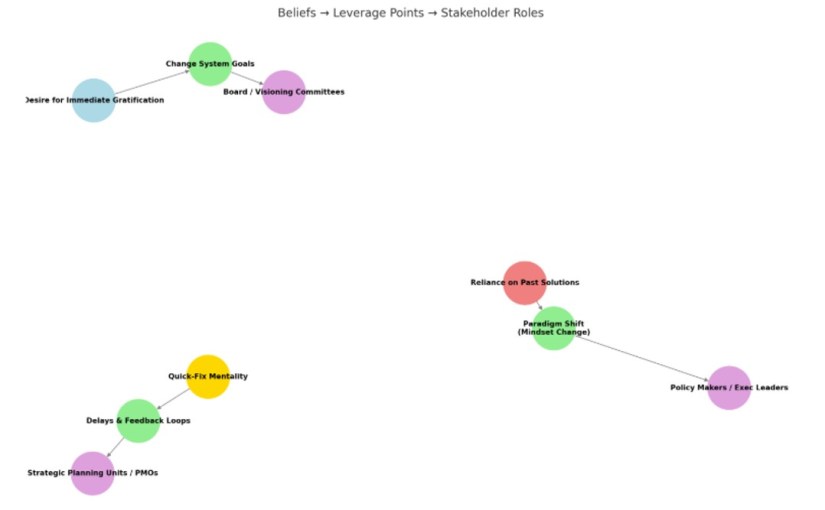
Here’s the visual causal mapping between the limiting beliefs and their corresponding systemic leverage points:
🔴 Reliance on Past Solutions links to a Paradigm Shift, calling for deeper mindset transformation.
🟡 Quick-Fix Mentality connects to Delays & Feedback Loops, urging better pacing and long-term learning.
🔵 Desire for Immediate Gratification maps to Changing System Goals, emphasizing a shift toward sustainability and capacity building.
Here’s the enhanced systemic leverage map, showing:
Limiting beliefs (left),
The leverage points needed to shift the system (center),
The key stakeholders or institutional roles responsible for enabling those shifts (right).
This format is ideal for strategic planning sessions or policy discussions, making it easy to assign ownership and co-design interventions.
REQUIRED RESEARCH ANALYSIS
FOR DETAILS OF DATA REQUIRED FOR RESEARCH ANALYSIS FOR THIS SUBJECT, CLICK HERE.
But wait! Read between the lines. It tells us something more that is not obvious immediately!
Pascal Marianna, who is a labour markets statistician at the OECD says: “The Greek labour market is composed of a large number of people who are self-employed, meaning farmers and shop-keepers who are working long hours.” Self-employed workers tend to work more than those who have specified hours in an employment contract.
The second reason Mr Marianna points to is the different number of part-time workers in each country. “In Germany, the share of employees working part-time is quite high. This represents something like one in four,” he says. As these annual hours figures are for all workers, the large proportion who work part-time in Germany is bringing down the overall average.
In Greece, far fewer people work part-time. If you account for these factors by stripping away part-time and self-employed people and look only at full-time salaried workers, the Greeks are still working almost 10% more hours than the Germans.
What do you notice?
Question:
Which of the two countries do you notice has people who are willing to work for and with others. Which one is not as willing to do so? Would that be Germany or would it be Greece?
Which country do you think is more likely to go into debts. Those whose people could work with each other or those who prefer to work alone?
So, is the story of debts in Greece a surprise or had it all along been ‘a bomb waiting to go off!’? But the world did not know better?
Which countries in your view would see their revenues far exceeding their costs? Which ones would not?
What is the price we are paying as a nation? As the world with the Greece bailouts!









You must be logged in to post a comment.