Category: Management
-

#4: Testing the Limits of Each Thinking by Situation Series: Siblings – Different Gender
Siblings 👭Gendered care expectations and inheritance The situation for Siblings – Different Genders is now mapped with its mental model, self-discipline practice, and responses across the seven developmental stages. The structure continues seamlessly, showing how rigid gender roles can be sustained or challenged depending on the dominant mental model framework at play. 🧑🤝🧑 Siblings –…
-

#3: Testing the Limits of Each Thinking by Situation Series: Siblings – Same Gender
Siblings 👭“Unspoken rivalry”: Unspoken competition or comparison Assumption: “They always get more recognition/love.” Surfacing this allows new appreciation and empathy for each other’s journeys. Mental model: “Love is scarce; only one can be favored.” Self-discipline: Recognize and reframe the zero-sum belief.
-

#2: Testing the Limits of Each Thinking by Situation Series: Individual – Repeated Career Dissatisfaction Syndrome
The content discusses an individual’s career dissatisfaction stemming from a mental model that equates hard work and pleasing others with eventual rewards. It emphasizes the importance of self-discipline in reassessing inherited definitions of success and questioning whose approval is pursued, highlighting the need for clarity in one’s internal narrative.
-

#1: Testing the Limits of Each Thinking by Situation Series: Individual – Self-doubt and Imposter Syndrome
Individual 🧍Individual : Self-doubt and Imposter Syndrome Mental model: “I’m not good enough; people will find out I don’t belong here.” Self-discipline: Observe the internal narrative, test assumptions, and begin re-authoring a new story of worth. Surfacing the mental model helps clarify the internal narrative and test it against evidence.
-

#9: Testing the Limits of Each Thinking by Situation Series: Governments
Governments face policy inertia regarding unemployment, driven by distrust in citizens’ voices. The prevailing assumption emphasizes top-down control to maintain stability, overlooking public insight. Encouraging self-discipline and creating forums for sharing lived experiences can enhance empathy and appreciation among individuals, potentially leading to more relevant and effective policies.
-

Are the Unconscious Stories We Tell Ourselves The Same As The Stories We Hide or Mask from Others?
The content explores the distinction and relationship between unconscious stories we tell ourselves and the deliberate narratives we present to others. While unconscious stories shape our perceptions unknowingly, masked stories are crafted consciously to influence others. Both types can trap us, impacting personal growth and integrity, highlighting the importance of self-awareness.
-

What led Senge to Develop His Ideas on The Discipline of Mental Models
Peter Senge expanded on Chris Argyris’s work by integrating mental models into a systemic learning framework. While Argyris focused on interpersonal effectiveness and individual accountability, Senge shifted emphasis to team-based learning and organizational change. He contextualized tools within systems thinking, facilitating a deeper collective transformation process.
-
What led Argyris and Schön to Their Ideas?
Chris Argyris and Donald Schön developed the concept of reflection-in-action to address failures in learning and leadership within organizations. They distinguished between single-loop and double-loop learning, emphasizing the importance of real-time reflection. Their work integrated philosophical ideas, focusing on social practice and revealing defensive reasoning, ultimately promoting reflective professionals and learning organizations.
-
What led Craik to His Ideas?
Kenneth Craik introduced “mental models” in his 1943 book, exploring how humans understand and act in the world. He was influenced by early cybernetics, dissatisfaction with behaviorism, and his background in psychology and physiology. Craik’s insights laid the groundwork for cognitive science, AI, and the impact of beliefs on decision-making.
-
Reaction Against Behaviorism
Cognitive psychology emerged in the mid-20th century as a response to the limitations of behaviorism, which ignored internal mental processes. Key catalysts like World War II, information theory, and advancements in computer science prompted a shift toward studying the mind’s role in processing information, leading to foundational concepts and figures in the field.
-

What led Plato and Kanto to Their Ideas?
Plato and Kant addressed the nature of knowledge and reality under different circumstances. Plato viewed true knowledge as attainable through reason, positing eternal Forms beyond sensory perception. In contrast, Kant sought to reconcile empiricism and rationalism, asserting that the mind actively shapes our experiences, meaning we perceive phenomena, not the noumenon directly.
-
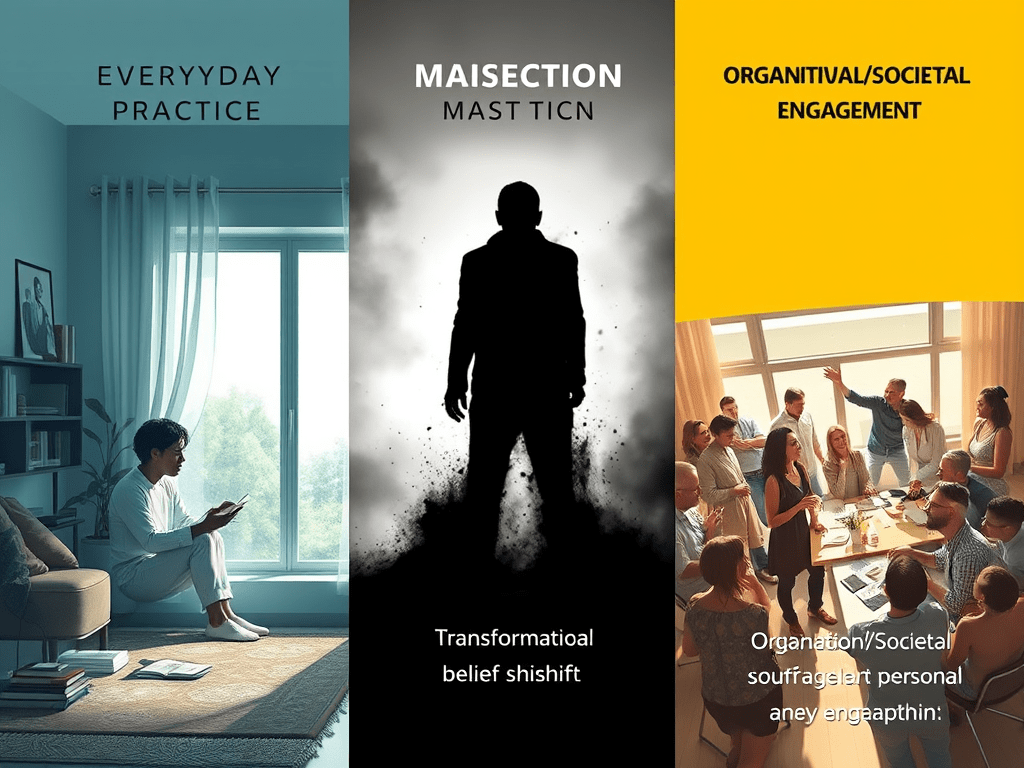
Three Pathways of The Practice of Personal Mastery:
FROM EVERYDAY ACTS TO ORGANISATIONAL TRANSFORMATION This guide outlines the full scope and texture of personal mastery as a living discipline. Drawing from real experiences, case studies, and foundational tools from The Fifth Discipline, it shows how personal mastery unfolds across three intensities of engagement: Everyday Practice, Transformational Belief Shift, and Organisational/Societal Engagement. SITUATION 1:…
-

Holding the Line of Transformation: From Steam Engines to Systems Thinking
This post explores transformative innovations throughout history that significantly reshaped society, emphasizing their intentional impact beyond mere technological advances. It highlights the evolution of ideas leading to The Fifth Discipline, which fosters complexity and tacit knowledge essential for effective adaptation. The text calls for a deeper engagement in transformative practices to address modern challenges.
-

Mastery Is Not a Metaphor: Honouring the Depth of The Fifth Discipline
THE ANTI-THESIS: The Misjudged Simplicity of Deep Work Too often, we assume that knowledge—especially the kind required for leadership and systems transformation—can be transferred in slides, soundbites, or summaries. But The Fifth Discipline is not that kind of work. It was never meant to be packaged, diluted, or consumed at speed. UNDERSTANDING TACIT KNOWLEDGE Tacit…
-

Building the Second Arm of Humanity: When Learning Must Lead
TWO ARMS OF HUMANITY: ONE TO MOVE FAST, ONE TO LEARN WELL 🔷 Refined Summary of My Reflections In the mid-1990s, I encountered The Fifth Discipline at a time when the world—and particularly the Global North —was being swept into deeper currents of industrial management thinking. Although Senge’s work sparked waves of fascination among those…
-

Misunderstanding The Disciplines: When The Fifth Discipline Is Adopted but Misaligned
🔑 KEY THEMES FROM THE POST “Misunderstanding Mastery: When The Fifth Discipline Is Adopted but Misaligned”Read the article here » 1. Misuse of Terminology 2. Root Causes of Misalignment 3. What the Five Disciplines Actually Demand 4. STRLDi’s Stand 🧭 Why This Article Was Written This article was written in response to the growing trend…
-
When Community Speaks …. Transitioning from Hustling to Industry Requires More Than a New Dress Code—it Demands a New Way of Thinking … By All Hustlers.
Here are the key themes and main topics covered here: 📘 Themes Covered Mindset Transformation Emphasis on shifting from survival-based hustle to structured, growth-driven thinking. Cultural & Psychological Dimensions The need to reframe identity, autonomy, and risk to integrate into organized manufacturing. Structural Barriers & Social Biases The role of systemic inequity, including gender, education…
-
When the Economy Speaks …. AU + AfCFTA Comparison with global regional economic cooperation platforms
Africa is not just an emerging market. It is a strategic axis between East and West. With the world’s youngest population and growing global demand for value-added goods, the AfCFTA is our opportunity to lead. No one needs to ask permission to trade—or even to exist. When we believe we do, we risk becoming either…
-
When the Community Speaks Personal Career Choices & Personal Emotional Drives
Meets needs fueled by Fear of Death or Overcome Fear of Failure or Battling Rejection and Seeking Acceptance. Occupations that attract individuals motivated by the need to be alive or to avoid death: Certain occupations attract individuals who are motivated by the need to avoid death or confront their deepest fears in a way that…
-
National Agriculture Development Matrix
Here is a draft policy statement for the National Agriculture Sector Policy for Botswana. It is grounded in the core themes here: Policy Statement: National Agriculture Sector Policy – Republic of Botswana That Botswana commits to developing a regenerative, market-aligned agriculture sector that ensures food sovereignty, inclusive growth, and climate resilience. The Government of Botswana…
-
When Community Speaks … Superpowers
As part of upcoming projects. Contact us if you want to commission us to do a systemic study in this topic area. Contact: +267-75987534 / sheilasingapore@gmail.com
-
When the World Speaks China’s Path to Growth Part I
China’s journey to becoming the global economic powerhouse it is today was built over several decades. It was marked by strategic decisions. It involved long-term planning and evolving priorities. Below is an overview of how China grew its capacities, what it emphasized over time, and what it has discontinued or started paying attention to in…
 Systems Thinking Research & Leadership Development Institute (STRLDi)