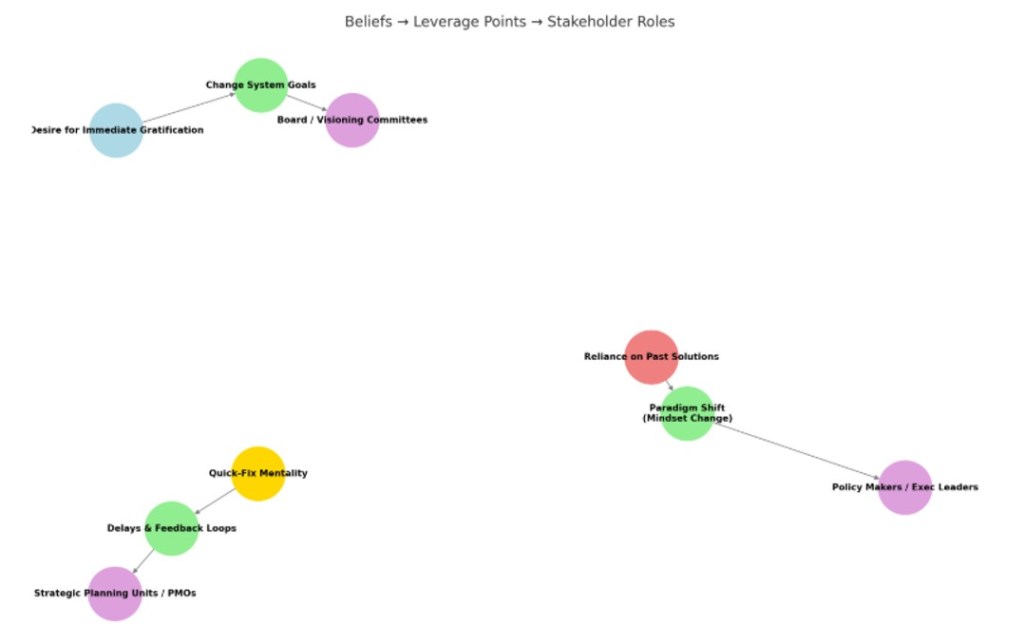
Builders or Bystanders? Three Strategic Scenarios for Botswana’s STEM Future


Your thinking is incisive — and it touches a painful global fault line. ✳️ Introductory Paragraph: The world is not waiting. Nations are restructuring their economies, education systems, and regulatory frameworks to meet the demands of an AI-powered, STEM-led global future. That shift was happening as far back as 200 years ago. In the span … Continue reading Builders or Bystanders? Three Strategic Scenarios for Botswana’s STEM Future

When the World Speaks … Africa & STEM


The essay explores Africa’s complex relationship with STEM, differentiated into four voices: stewardship, obedience, reactive, and restorative. The stewardship voice reflects Africa’s historical contributions to STEM, while the obedience voice signifies colonial influences that framed STEM as foreign. The reactive voice depicts contemporary fears rooted in this colonial legacy, whereas the restorative voice emphasizes reclaiming and celebrating indigenous knowledge and innovations. The essay argues that Africa can redefine its STEM identity by recognizing historical legacies, enhancing education, and fostering local innovation to reclaim leadership in global STEM discourse.

When the Community Speaks … Gendered Violence


Title: Raising Emotionally Ready Men and Women: Healing the Roots of Gendered Violence Published by: STRLDi (Systems Thinking Research & Leadership Development Institute) 🧠 Culture of Public Harmony vs. Private Harm In many cultures, maintaining a façade of harmony in public spaces is prized—especially within families, religious institutions, or social hierarchies. While appearing orderly and … Continue reading When the Community Speaks … Gendered Violence

When The Community Speaks … Cracking the Botswana Productivity Code. Short Notes. Part II


A 2017 report from the World Economic Forum ranked Botswana as having the world’s poorest work ethic, impacting its economic competitiveness and foreign investment. The low productivity is attributed to cultural factors, with a historical background of pastoralism resulting in a lack of urgency and innovation. Addressing these issues requires systemic reform focused on productivity and merit-based incentives.

When Nature Speaks … Wildlife. Be calm. Love an elephant. What everybody should know about these gentle giants.


That is … until you see them return to the lands and vegetation we have encroached into, when we settled in their habitat. When elephants leave their habitats for their watering holes, for however long, it does not mean they have resettled. And so, it becomes hard for us to imagine the way a child intuitively understands … Continue reading Be calm. Love an elephant. What everybody should know about these gentle giants.

When The Community Speaks … Cracking the Botswana Productivity Code. Short Notes. Part I


    BATSWANA HAVE THE WORST WORK ETHIC IN THE WORLD – REPORT Sunday Standard Reporter 30 Oct 2017 In its 2015 survey of African workers, South Africa’s Rand Merchant Bank found Batswana to be the laziest on the continent.  The problem is actually more acute than that. In the 2017-2018 Global Competitiveness Report, Botswana … Continue reading When The Community Speaks … Cracking the Botswana Productivity Code. Short Notes. Part I

Newspaper Column Article 22: The Viralness of HIV/AIDs – Part IX: Caring Love for Her. Trusting Love for Him


As it appeared in the Botswana Sunday Standard July 28, 2013, edition, Systemic Thinking Column  When a couple are in conflict, often times we are expecting that our partner to think, act and be like ourselves and meet our needs in the same way we think we should meet theirs.  That’s where we can get … Continue reading Newspaper Column Article 22: The Viralness of HIV/AIDs – Part IX: Caring Love for Her. Trusting Love for Him

Newspaper Column Article 21: The Viralness of HIV/AIDs – Part VIII: To de-stress, “Men Go to Their Cave, Women Talk”


As it appeared in the Botswana Sunday Standard July 21, 2013, edition, Systemic Thinking Column  When women talk, it means it is a good sign!  They are actually de-stressing. Some of the male readers of the column shared they were surprised from the previous week’s column that the act of making social contact (such as … Continue reading Newspaper Column Article 21: The Viralness of HIV/AIDs – Part VIII: To de-stress, “Men Go to Their Cave, Women Talk”

Newspaper Column Article #19: The Viralness of HIV/AIDs – Part VI: The Twelve Kinds of Love


As it appeared in the Botswana Sunday Standard on June 30, 2013, Systemic Thinking Column The column is currently exploring the link between the states of level of emotional fidelity that exists between couples and HIV/AIDS prevalence rates that exists as a nation. It is difficult to imagine that something that prevails by as much … Continue reading Newspaper Column Article #19: The Viralness of HIV/AIDs – Part VI: The Twelve Kinds of Love

Newspaper Column Article #20: The Viralness of HIV/AIDs – Part VII: Men and women in love meet in our differences – not similarities


As it appeared in the Botswana Sunday Standard on June 9, 2013, Systemic Thinking Column “She’s not my type” or “He is not my type” Yet, that’s exactly what it takes a couple to come together.  As opposite genders, we do not meet in our similarities.  But in our differences.  Emotionally. When a couple are … Continue reading Newspaper Column Article #20: The Viralness of HIV/AIDs – Part VII: Men and women in love meet in our differences – not similarities

The Viralness of HIV/AIDs – Part VI: The Twelve Kinds of Love


As it appeared in the Botswana Sunday Standard on June 30, 2013, The Systemic Thinking Column The column is currently exploring the link between the states of emotional fidelity between couples and HIV/AIDS prevalence rates that exist as a nation. It is difficult to imagine that something that prevails by as much as at a … Continue reading The Viralness of HIV/AIDs – Part VI: The Twelve Kinds of Love

Newspaper Column Article #18: The Viralness of HIV/AIDs – Part V: His emotional needs. Her emotional needs.


As it appeared in the Botswana Sunday Standard on June 9, 2013, Systemic Thinking Column In the previous segment of this column, we concluded it was not as easy for someone to be sexually fidel till one learns to build and enjoy “emotional fidelity” with one’s partner. It can be easy to miss this point. … Continue reading Newspaper Column Article #18: The Viralness of HIV/AIDs – Part V: His emotional needs. Her emotional needs.

Newspaper Column #17: The Viralness of HIV/AIDs – Part IV: What Causes Emotional Fidelity?


As it appeared in the Botswana Sunday Standard on June 2, 2013 “A relationship does not need the “baggage” we bring to it from our respective pasts.  Yet it serves to remind us they are there, if we are still carrying them.  Leverage the relationship to work at unloading our baggage together. The act of … Continue reading Newspaper Column #17: The Viralness of HIV/AIDs – Part IV: What Causes Emotional Fidelity?

Newspaper Column #16: The Viralness of HIV/AIDs – Part III: What causes fidelity? Not infidelity.


As it appeared in the Botswana Sunday Standard on May 26, 2013 Nevertheless, a question that has crossed millions of minds and tons of conversations around the globe.  In sports clubs, in tea-gardens, at pubs, at market places and at bus-stations.  Between girlfriends and among boys and men.  Regardless of gender. And we have thrashed … Continue reading Newspaper Column #16: The Viralness of HIV/AIDs – Part III: What causes fidelity? Not infidelity.

Newspaper Column #15: The Viralness of HIV/AIDs – Part II: The Difference Between Working Hard and Working Smart.


As it appeared in the Sunday Standard, Botswana May 19, 2013, edition. From a systemic perspective, the causality of HIV/AIDs as a phenomenon will be no different from that of one country to another!  Be it that it is happening in India or Europe or China or here in Botswana, South Africa or Namibia.  Despite … Continue reading Newspaper Column #15: The Viralness of HIV/AIDs – Part II: The Difference Between Working Hard and Working Smart.

Newspaper Column #14: The Viralness of HIV/AIDs – Part I: How Does Viralness Grow?


As it appeared on The Sunday Standard May 12, 2013 edition. It has been a while.  As the articles grew, we took the time to consider an appropriate site for the column.  That search is on-going.  However, for now, the column and I is here and we are glad we are back with you! The … Continue reading Newspaper Column #14: The Viralness of HIV/AIDs – Part I: How Does Viralness Grow?

Newspaper Column #3: Is unemployment, the real problem? The Story of Supply of Labour – Part III


As it appeared in the Sunday Standard, Botswana on  Sunday Nov 4, 2012 edition. Labour is a cost It can assist to generate revenue but it is firstly, a cost.  When we add them up, it can rack up into billions of dollars.  Easily. Hence a situation of ‘that we have labour’, will not be enough reason why … Continue reading Newspaper Column #3: Is unemployment, the real problem? The Story of Supply of Labour – Part III

Newspaper Column #1: Is unmployment the real problem – Part I


As it appeared in the Sunday Standard, Botswana on  Sunday Oct 21, 2012 edition (maiden print). This is the 1st of a three part series of this article.  Each part will build on the earlier article to an eventual conclusion.  We invite you to participate in the column as well as do your ‘own homework’ – searching and … Continue reading Newspaper Column #1: Is unmployment the real problem – Part I

Regional Article 23: Unemployment, labour disputes, economic diversification and fertility


  Most countries think supply of labour should drive demand.  We forget then (or choose not to admit to ourselves) that it is demand that drives supply in any situation.  Not the other way around.  It is just not realistic to believe that because we have so many ‘young ones’ here, that there should be jobs … Continue reading Regional Article 23: Unemployment, labour disputes, economic diversification and fertility

Regional Article 20: Why do disputes by labor (with unions) and employers go up?


Despite our efforts to set up judiciary courts to preside over cases involving employers and employees embroiled in disputes with each other as well as educate ‘people’ on ways to avoid disputes with each other, why do relations between employers and employees continue to sour and such disputes tend to soar year after year?  Surely, … Continue reading Regional Article 20: Why do disputes by labor (with unions) and employers go up?

National Article 19: What causes fidelity?


We know what causes infidelity? But what causes fidelity?  Whatever that causes fidelity, when it is not there, causes infidelity! So, what causes fidelity? A couple goes through different stages or types of intimacy during their times together and experience one or more stages in their lifetime.  To the extent the couple moves through the … Continue reading National Article 19: What causes fidelity?

National Article 18: What would it take to ‘cure’ HIV?


Should we pay attention to: Curing the disease when it is already transmitted (attack the problem that we can see)? or Preventing the disease from being transmitted (defend ourselves from the problem?) or ‘Cure’ ‘the reason that causes the disease to be transmitted (what causes the problem)? Let’s take this situation.  Suppose there is a couple, both … Continue reading National Article 18: What would it take to ‘cure’ HIV?

Regional Article 17: Is unemployment real?


UNEMPLOYMENT = SUPPLY OF LABOUR > DEMAND FOR LABOUR In a country, where levels of unemployment stay persistent over time, then it is a sign that the rates of growth of the supply of labour (population numbers -” child creation”) each year is growing at rates faster than the rate of growth of the demand for … Continue reading Regional Article 17: Is unemployment real?