FROM EVERYDAY ACTS TO ORGANISATIONAL TRANSFORMATION
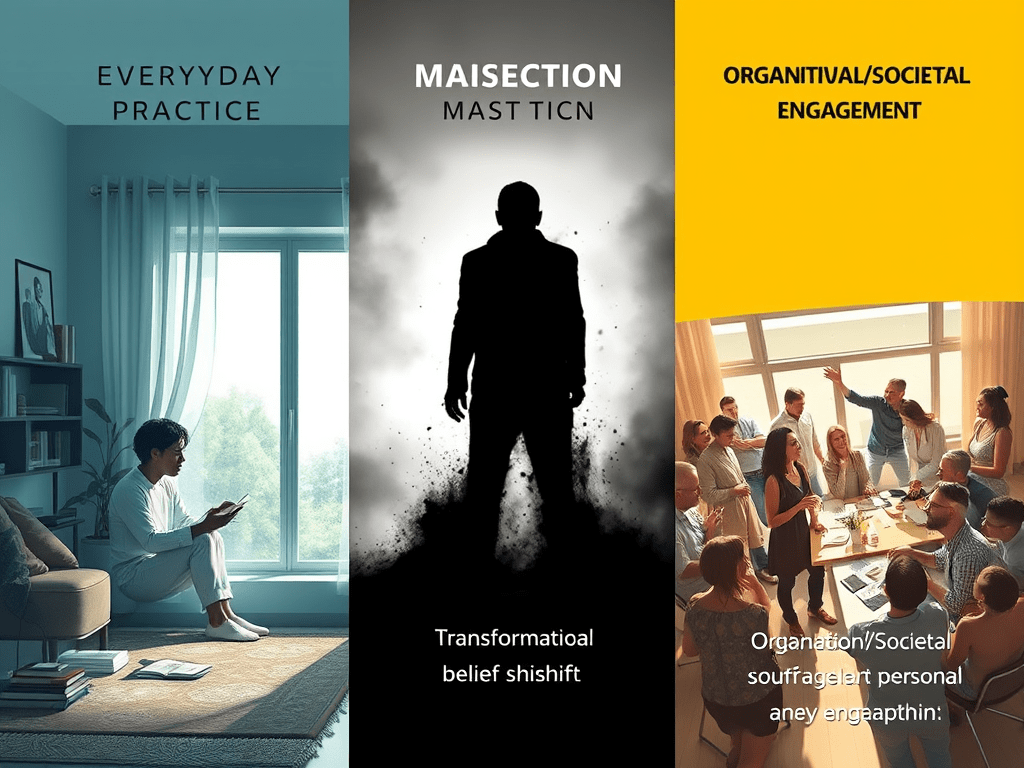
This guide outlines the full scope and texture of personal mastery as a living discipline. Drawing from real experiences, case studies, and foundational tools from The Fifth Discipline, it shows how personal mastery unfolds across three intensities of engagement: Everyday Practice, Transformational Belief Shift, and Organisational/Societal Engagement.

SITUATION 1: Everyday Practice
Simple, repeatable acts that build awareness, intention, and alignment.
Examples:
- Practice personal visioning in daily activities. For instance, upon seeing a pile of dirty dishes, resist reacting out of obligation. Instead, pause and imagine the end state: dishes gleaming, neatly stacked, and a space restored. This subtle shift from reacting to envisioning invites energy to rise from within, aligned with what we want to create.
- Check internal state before responding. Before replying in a difficult meeting, pause and notice: Am I reacting to a threat or responding with purpose?
- Daily journaling. Reflect on the difference between what you did and what you wanted to create.
Purpose:
Makes personal mastery accessible. Builds inner steadiness and intentionality. Trains attention to stay rooted in vision, not reactivity.
SITUATION 2: Transformational Practice Rooted in Deep Belief (“The Shift”)
Facing and transforming invisible mental models that sustain stagnation or self-sabotage.
Illustrated by the 2011 newspaper incident:
- A public article misrepresented a complex initiative, distorting intent and impact.
- The silence from allies was louder than the criticism. Shame crept in.
- A new mental model formed: “Don’t make noise. Stay safe. Visibility brings danger.”
The Shift Process:
Name the Triggering Event. What incident caused a rupture or contraction?
Identify the Belief Formed. What unconscious story began? E.g. “Visibility is unsafe.”
Observe Its Impact. How has it shaped decisions, posture, and relationships?
Distinguish Past from Present. “That article was misinformed. It no longer gets to define me.”
Reframe Power and Identity. “Their silence is not my shame to carry.”
Create a New Internal Commitment. “I now speak to serve, not to be validated.”
Purpose:
Acts as a doorway to deeper authenticity. Enables structural shifts in identity and self-concept. Builds the resilience to lead without waiting for permission.
SITUATION 3: Organisational / Field / Societal
Where personal mastery scales to systems-level change through collective learning.
Practices:
- Co-evolve mental model dialogues into shared team learning. Bring individual reflections into safe spaces for group discovery.
- Map systemic structures using the Onion Model.
- Example: The national unemployment study in Botswana used this model to surface feedback loops, delays, archetypes, and mental models.
- Apply scenario planning to test future pathways.
- Facilitate visioning to build cross-functional teams around shared purpose.
Objectives:
- Enable collaborative strategy design.
- Cultivate systems leadership across silos.
- Create “learning organisations” capable of sensing, reflecting, and evolving.
Purpose:
Personal mastery at this level becomes a catalyst for systemic transformation. It is no longer about individual growth, but the growth of capacity in the system to hold complexity, to envision together, and to act with courage.
Closing Note:
Whether practiced quietly at a kitchen sink, or enacted across national strategy tables, personal mastery is the unseen discipline that makes meaningful change possible. All three pathways matter. All three prepare us to become who we must be for the futures we long to create.
 Systems Thinking Research & Leadership Development Institute (STRLDi)
Leave a comment