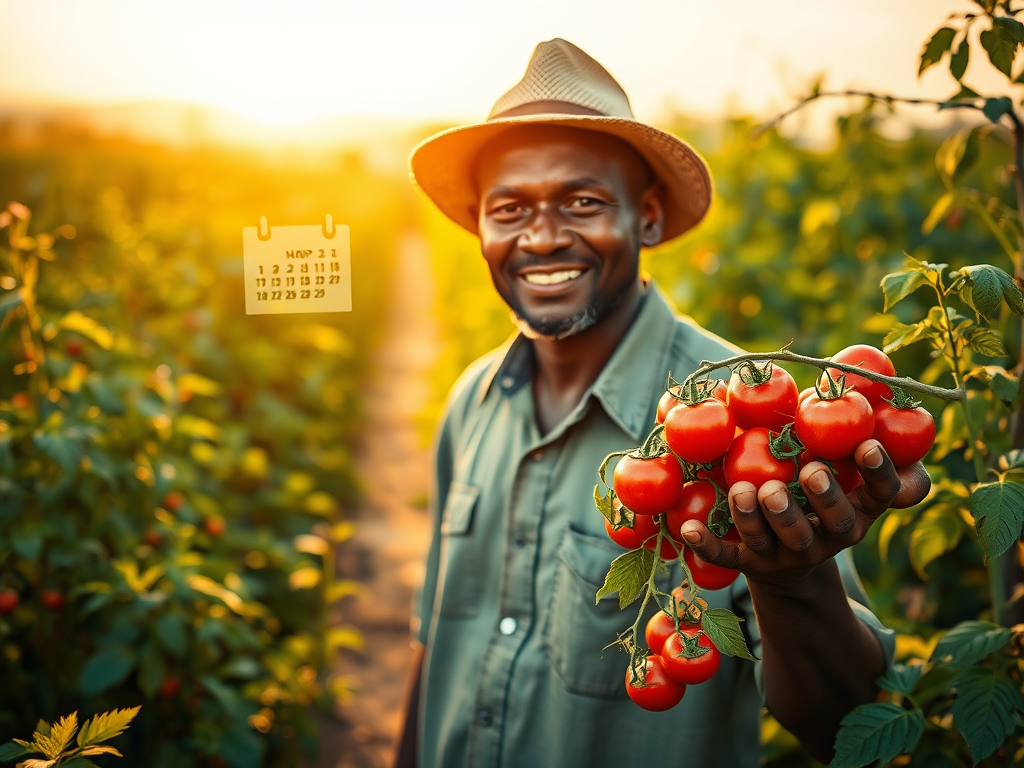
She had done everything right.
Bought the seeds. Paid for inputs. Hired labour. Measured every drop of water. Watched over her crop with the kind of personal care only farmers understand. After weeks of nurturing, her cherry tomatoes gleamed on the vines — plump, red, and ready.
She took them to the retailer who once told her, “When you have them, bring them.”
But when she arrived with her harvest, the same buyer turned her away.
“Who placed an order for cherry tomatoes?” the retailer asked.
No order meant no sale. Hours of sweet labour, investment, and determination — side-stepped.
And here’s the bitter twist (and a true story). Those very tomatoes had just won first prize at the national agricultural show. The nation had applauded her produce, yet her local retail shelves never saw it. By the time the retail chain placed its order, it was for imported cherry tomatoes. They simply did not know that, in their own backyard, a farmer was already producing prize-winning fruit.
Why this matters
This is not just one farmer’s story. It is a mirror of the system we all work within.
- Horticulture farmers plant blind, not knowing what demand will look like when the crop matures.
- Retailers scramble, relying on imports because there is no coordinated calendar of who is growing what, where, and when.
- Policymakers toggle between bans and openings, without a real-time picture of supply gaps or gluts.
The result? Crops are wasted in fields. Empty shelves in shops. Rising import bills. And declining confidence among the very farmers we need to carry this sector forward.
The bigger issue
This story is not about one farmer. It is about a system where demand lives with Trade. Supply oversight sits with Agriculture. The bridge in between is missing. Farmers plant in hope, retailers stock in panic, and national policy oscillates between bans and openings.
How did other countries solve this?
How other countries broke the cycle
- Netherlands: transparent flower and vegetable auctions give growers and buyers the same daily data.
- Spain’s Almería region: cooperatives coordinate planting schedules, logistics, and marketing so no farmer is left stranded.
- Kenya: a single horticulture directorate oversees both production and marketing, ending the “split brain” between ministries.
- India’s Operation Greens: real-time demand intelligence and price stabilization prevent wipeouts from gluts and shortages.

This picture (which shows the split between Ministry of Agriculture and Ministry of Trade, and the missing coordination in the middle):
Note:
This picture highlights a critical gap in Botswana’s horticulture sector.
- On one side of each vertical line, the Ministry of Agriculture oversees farmers, extension, and production.
- On the other, the Ministry of Trade manages retail, imports, and demand data.
- In the interim, there is no coordinating mechanism. It is unclear who grows what, where, and when to match the actual demand in shops and institutions.
The result is wasted crops, empty shelves, and farmers discouraged from investing further.
A National Horticulture Coordination Unit can bridge this gap. It links production to market demand. It publishes clear crop calendars. This unit ensures imports are guided by real data—not guesswork.
Without this bridge, farmers will continue to plant blind. With it, Botswana can move from meeting 70% of its demand to achieving 100% and beyond.
Each of these countries built what Botswana lacks. It is a coordination spine that maps demand to supply. This gives both farmers and retailers a reliable compass.
What Botswana can do
Establish a National Horticulture Coordination Unit – jointly housed by Trade and Agriculture, with clear legal authority.
Publish a Horticulture Market Observatory – weekly retailer data (sales, volumes, gaps) made visible to farmers and policymakers.
Issue crop calendars by district – so farmers know when and how much to plant.
Invest in packhouses and cold chain hubs – so produce doesn’t die at the farm gate.
Set transparent import triggers – clear rules on when imports open and close, avoiding last-minute surprises.
We found several existing or emerging initiatives in Botswana. They partly touch on what we’re describing. Some are close to the supply-demand pipeline we want to build. Others are still missing elements. These might be things you can link into or build upon.
Snapshot: what exists, strengths, and gaps
| Initiative (owner) | What it covers | Strengths we can leverage | Gap vs. “coordination spine” | Quick next step |
|---|---|---|---|---|
| Letsema Horticulture Market (Gaborone, Block 3) | Centralized wholesale-style market; farmer aggregation; quality/price transparency ambitions. | Physical node; recognizable brand; farmer access; early digital footprint. (Letsemahm) | Not yet a nationwide demand-forecast or pre-order system; weak link to retailer SKU forecasts and planting calendars. | Pilot weekly pre-orders from major retailers + simple demand dashboard posted every Friday. |
| Tokafala Horticulture Programme (Debswana) | A 3-year, demand-driven horticulture program to support SMMEs. | Explicit demand orientation; private-sector discipline; delivery capacity. (Debswana) | Not yet publicly tied to national import rules or district planting calendars. | Invite Tokafala to share anonymized demand signals to a public Market Observatory (see below). |
| PYEC – Horticulture Readiness (OP/PSRU) | TVET + change-management workshop to stream youth into horticulture. | National convening power; change-management tooling; youth pipeline. (Your doc.) | On-ramp for talent, but no market-signal backbone—risk of youth repeating old frustrations. | Make “Market Observatory + crop calendars” a deliverable of PYEC’s action plan. |
| NAMPAADD (MoA) | Long-standing plan to modernize arable agriculture; identifies under-used horticulture potential and calls for coordinated cropping. | Policy legitimacy; extension footprint; precedent for coordination. (FAOLEX Database) | Never fully operationalized into weekly demand data, rules-based imports, or public calendars. | Refresh NAMPAADD’s horticulture chapter with district-level sow/harvest targets tied to retailer data. |
| FAO Hand-in-Hand (HiH) | Evidence-based, country-led investment planning; typology tools. | Data tools & geospatial analytics that can power targeting and calendars. (FAOHome) | Not yet configured as retail demand → farm supply pipeline for Botswana SKUs. | Request FAO HiH support to stand up a lightweight Market Observatory (see below). |
| NDB / Grants & Finance windows | Credit & recent horticulture grant guidelines; blended finance possibilities. | Can nudge compliance (e.g., finance only when farmer slots align to calendars). (NDB) | Finance currently decoupled from demand forecasts and import triggers. | Make finance conditional on calendar-aligned offtake (pre-order or market slot). |
| IFAD / FAO field schools & ASSP-type support | Capacity, “farming as a business,” climate-smart practices. | Training backbone that can teach market-aligned production. (IFAD) | Training often production-centric, not demand-calibrated. | Add a Market Intelligence module + weekly planning ritual. |
What’s still missing (and how to add it quickly)
The missing piece is a public, rules-based, demand→supply pipeline that everyone can see.
Horticulture Market Observatory (public web page + PDF weekly)
Retailers/markets submit weekly SKU volumes, price bands, stockouts (simple template).
Publish a Friday snapshot + 8-week rolling forecast by district/crop.
Use FAO HiH tooling for the analytics layer. (FAOHome)
District Crop Calendars & Planting Targets
Start with top 8–10 veg; publish sow/harvest windows + target tonnage per district (refresh monthly).
Base targets on the Observatory forecast + Letsema/Tokafala signals. (Letsemahm)
Transparent Import Trigger Bands
Example: if projected supply <85% of demand for 4–6 weeks, open imports; >110% triggers processing/price-stabilization measures.
Announce changes via the Observatory (predictability for farmers and retailers).
Finance/Grant Conditionality
NDB/other windows require an assigned market slot (pre-order or auction) or alignment to district targets. (NDB)
90-day stitching plan (practical)
- Week 0–2: Form a small Working Cell (MoA, MoT, Letsema, Tokafala, two retailers, NDB, FAO HiH).
- Week 2–6: Stand up v1 Market Observatory (Google Sheet → public webpage); collect first 4 weeks of retailer SKUs.
- Week 4–8: Publish draft crop calendars for two corridors (Gaborone–South, Francistown–North); recruit 50 pilot farmers via PYEC/TVET.
- Week 6–10: Pilot Friday pre-order window at Letsema (listing + minimum volumes); Tokafala farmers prioritize listed SKUs. (Letsemahm)
- Week 10–12: Announce import-trigger bands for those SKUs; align NDB grant/loan approvals to calendar slots.
The prize-winning tomatoes that never reached the shelf
The farmer in our story is not unique. Across Botswana, farmers are working with grit, faith, and long hours. They produce quality food. This food too often fails to meet the market. It is not because of their shortcomings. It is because the system has no bridge between production and demand.
Her cherry tomatoes were good enough to win the nation’s top prize. Yet they could not win a spot on the nation’s dinner tables.
That gap is what a National Horticulture Production Management System is meant to close.
Closing thought
Farmers can’t plant blind.
Retailers can’t stock empty shelves.
Policymakers can’t steer an economy on partial data.
Botswana’s farmers have already reached about 70% of local demand under difficult conditions. With coordination, transparency, and investment in the missing middle, that 70% can become 100% — and beyond.
The prize-winning tomatoes are proof that quality is here. Now it’s time to build the system that ensures such produce doesn’t just win awards. It must also win its rightful place on our tables.

 Systems Thinking Research & Leadership Development Institute (STRLDi)
Leave a comment