A Case Study of the Fixes-That-Fail Archetype
(STRLDi System Archetype Compendium)
🪞 THE LEADERSHIP MIRROR
Every organization believes its problem is capacity.
There are never enough hands, hours, or funds.
And yet, each time new resources arrive, the shortage returns — louder than before.
What if “not enough manpower” is not a fact but a structure?
A loop that feeds on how we define effort, competence, and worth.
This case explores the fatigue of systems that mistake busyness for strength.
It asks: when we plead for more resources, are we revealing scarcity — or creating it?
📖 BEFORE YOU READ
Every manager has heard it: “We just don’t have enough people.”
And most respond with the only answer they know — request another post, extend another contract, add another unit.
For a moment, the pressure eases.
Then, almost predictably, the system returns to the same refrain: not enough.
This second study in the STRLDi System Archetype Compendium turns the spotlight inward.
It invites leaders to look not at the size of their workforce, but at the structure of their attention.
Because sometimes, what drains capacity is not the number of people working, but how the organisation thinks about work itself.
1 Context and Origins
The complaint of not enough manpower surfaced repeatedly across divisions.
Officers spoke of being stretched thin; supervisors lamented high turnover; HR cited budget ceilings.
Yet, even after multiple recruitment rounds, the pattern refused to change.
The department was caught in a cycle:
hire more → overwork the keen → lose the best → rehire → repeat.
The harder it tried to fix the shortage, the deeper the shortage seemed to run.
STRLDi’s analysis revealed a classic Fixes That Fail loop, with an inner twist — a shift from procedural competence (detailed complexity) to systemic blindness (dynamic complexity).
2 Behaviour Over Time
Law #1 – Today’s Problems Come from Yesterday’s Solutions
Each new recruitment was celebrated as relief.
But soon, workloads grew to match expanded capacity.
Files multiplied because each officer, keen to prove efficiency, absorbed more than the system could learn from.
Law #2 – The Harder You Push, the Harder the System Pushes Back
Supervisors demanded visible performance.
Officers responded by working faster, skipping reflection, and eroding coordination.
Fatigue led to mistakes, then admonishments, then resignation.
Law #5 – The Easy Way Out Leads Back In
Recruitment became the default cure for all ills.
But the structure producing inefficiency — the inability to see dynamic complexity — stayed untouched.
Law #7 – Faster Is Slower
Each officer’s attempt to prove capability through speed created rework.
Time “saved” at the front end returned ten-fold as correction.
Law #8 – Small Changes Can Produce Big Results
The real leverage, as it turned out, was not in manpower but in mind-power — cultivating systemic seeing.
3 The Structure Beneath
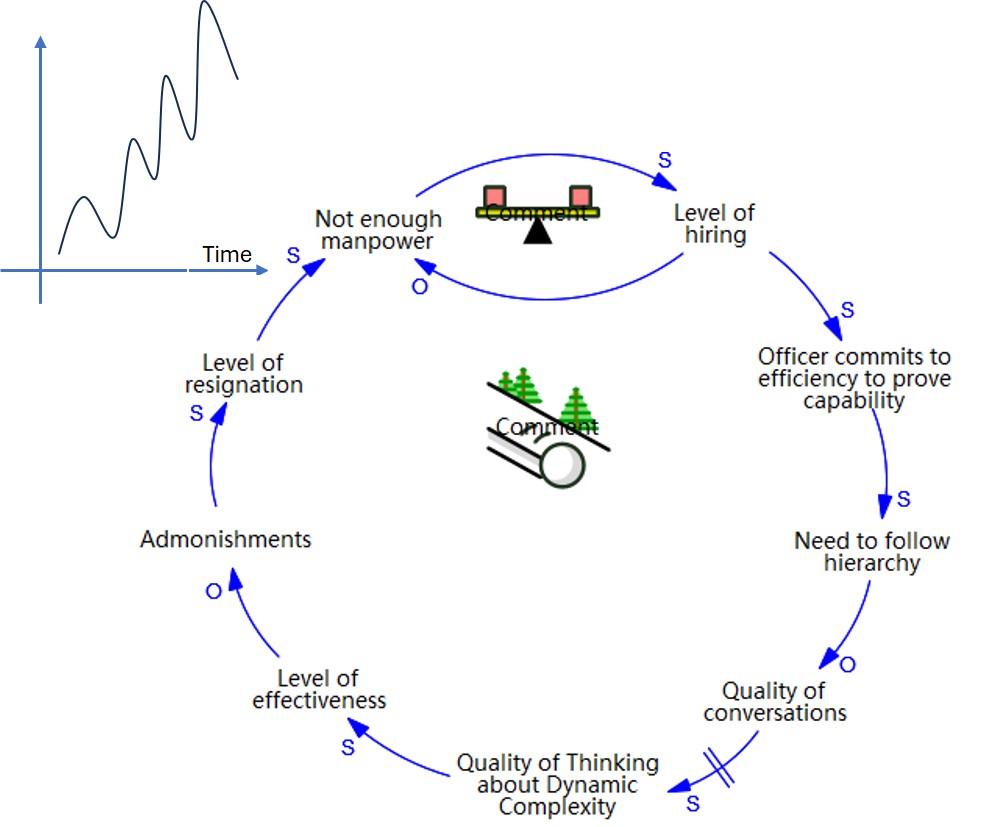
Not enough manpower ↑ → pressure to hire ↑ → officer commits to prove efficiency ↑ → fatigue ↑ → effectiveness ↓ → admonishments ↑ → resignation ↑ → visible shortage ↑ → not enough manpower ↑
A textbook balancing loop disguising a deeper, reinforcing trap.
Each new hire learned to survive by speed, not by seeing.
The system rewarded firefighting over foresight.
4 The Mental Models of the Current Reality
| Role | Belief (Mental Model) | Behaviour | Hidden Fear |
|---|---|---|---|
| Supervisor | “More heads mean more output.” | Pushes for hiring drives. | Fear of being seen as ineffective. |
| Officer | “If I follow procedure perfectly, I’ll be safe.” | Clings to efficiency rituals. | Fear of failure or exposure. |
| HR Department | “Vacancies are the problem; recruitment is the solution.” | Focuses on filling posts. | Fear of being blamed for bottlenecks. |
These beliefs form a self-reinforcing illusion of scarcity — a psychological contract that trades learning for labour.
5 Current Reality Vision
The organisation believes its ideal state is “a fully staffed, efficient department.”
But efficiency, narrowly defined as procedural compliance, is precisely what drains energy.
The true shortage is time for reflection, not manpower.
6 The Identified Leverage – The Bridge
The leverage lies in shifting the unit of value from task completion to systemic comprehension.
Officers trained to recognise system archetypes began spotting patterns behind the complaints that filled their desks.
They learned to ask: What structure keeps bringing this problem back?
That single question changed everything.
Instead of escalating issues upward, officers started resolving root causes at source.
Each small insight restored flow.
Turnover dropped.
Morale rose.
This was Law #8 in motion — the smallest act of seeing producing the largest return.
7 The Uncle’s Act
A senior manager, himself once a procedural purist, saw the shift.
Instead of issuing directives, he invited officers to draw their own loops.
He reframed errors as learning data and began conversations on system patterns during weekly check-ins.
Without formal policy, the department began learning how it learned.
The “boiled frog” moment arrived quietly — no reforms, no memos, only deeper sight.
8 Behaviour After Leverage
At first, confusion rose.
Procedural officers felt slower, less efficient.
But within weeks, rework plummeted.
Peer collaboration replaced hierarchical blame.
Hiring needs stabilised; resignations declined.
The curve flattened into sustainable flow.
Productivity became calm rather than frantic — a living example of Law #3: Behaviour grows worse before it grows better.
9 Vision of the Future Reality
In the future state, the organisation measures learning velocity, not headcount.
Meetings revolve around flow maps, not vacancy lists.
Supervisors track time saved through insight, not hours worked.
Officers move fluidly between tasks, guided by understanding of interdependencies.
The language of shortage fades.
The culture breathes again.
10 Supportive Mental Models of the Future Reality
| Role | New Belief | Emergent Discipline |
|---|---|---|
| Supervisor | “Conversation is capacity.” | Team Learning – builds capability through dialogue. |
| Officer | “Seeing structure is solving.” | Systems Thinking – replaces reaction with reflection. |
| HR | “We hire for insight, not numbers.” | Shared Vision – aligns recruitment with learning purpose. |
Fear has shifted into curiosity.
Busyness into presence.
11 Events and Patterns of the Future System
In the renewed system, the Laws of Dynamic Complexity are respected:
| Law | Expression in Future System |
|---|---|
| #1 | Each solution is tested for side-effects. |
| #2 | Pressure points are diffused through learning, not extra labour. |
| #4 | Delays between cause and effect are mapped and shared. |
| #5 | Fixes are replaced by experiments. |
| #7 | Pace aligns with purpose — speed serves insight. |
| #8 | Minor course corrections replace major overhauls. |
| #11 | Structure, not people, holds accountability. |
The pattern of oscillating scarcity transforms into a reinforcing loop of shared mastery.
New Reinforcing Loop: Seeing → Understanding → Flow → Calm → Retention → Collective Capacity → Seeing again.
12 The Cost of Awareness vs the Cost of Ignorance
| Approach | Financial Cost | Outcome |
|---|---|---|
| Traditional Recruitment and Overtime | High capital outlay / Low learning | Short-term relief; long-term burnout |
| Systems Training and Learning Cycles | Negligible | Sustainable performance; cultural renewal |
Awareness pays higher dividends than payroll.
13 The Broader Vision
A nation of institutions trapped in detailed complexity will always feel under-staffed.
The cure is not mass hiring, but systemic sight.
When leaders learn to see patterns, they release both human energy and national capacity.
Manpower turns into mind-power.
The true resource multiplies by awareness.
Vision of the Future Reality:
A workplace where capacity is consciousness — and where the ability to see the system is the new definition of strength.
Fixes-That-Fail (Variant)
LEFT-HAND PAGE – Analysis & Reflection
Header
When busyness becomes a badge of competence, the organisation hires itself into exhaustion.
Top Section – Leadership Mirror
A full-width grey box containing the mirror paragraph.
A small inset quote in italics:
“Every system is perfectly designed to get the results it gets.”
Preamble – Before You Read
Placed below the mirror, using a light background tone.
Accompanied by a small inset BOT diagram (Before Leverage) in the top-right corner.
Main Narrative Body
Two columns.
The left column opens with:
- 1–5: Context, Behaviour Over Time, Structure, Mental Models, Current Reality Vision.
The right column continues with: - 6–9: Leverage, Uncle’s Act, Behaviour After Leverage, Future Reality Vision.
A thin vertical line separates narrative from marginalia.
Margin Notes (right margin of both pages)
Small annotations in blue text boxes referencing the Laws of Dynamic Complexity as they appear:
- #1 Today’s problems come from yesterday’s solutions
- #7 Faster is slower
- #8 Small changes produce big results
These act as navigational anchors for readers scanning the page.
Footer – Coda
A final blue band carrying your signature line:
Vision of the Future Reality
A workplace learns to become a place and opportunity where capacity is consciousness — and where the ability to see the system is the new definition of strength.
Previous Post: Urgent Files
Next Post: Human-Wildlife Conflict
Based on the Vision Deployment Matrix™ created by Dr Daniel H. Kim, first published in The Systems Thinker, Vol. 6 No. 1 (1995).
Framework adapted by STRLDi for applied national systems learning.

 Systems Thinking Research & Leadership Development Institute (STRLDi)
Leave a reply to Introducing the Compendium: Exploring The Fifth Discipline’s Impact on Leadership – Systems Thinking Research & Leadership Development Institute (STRLDi) Cancel reply