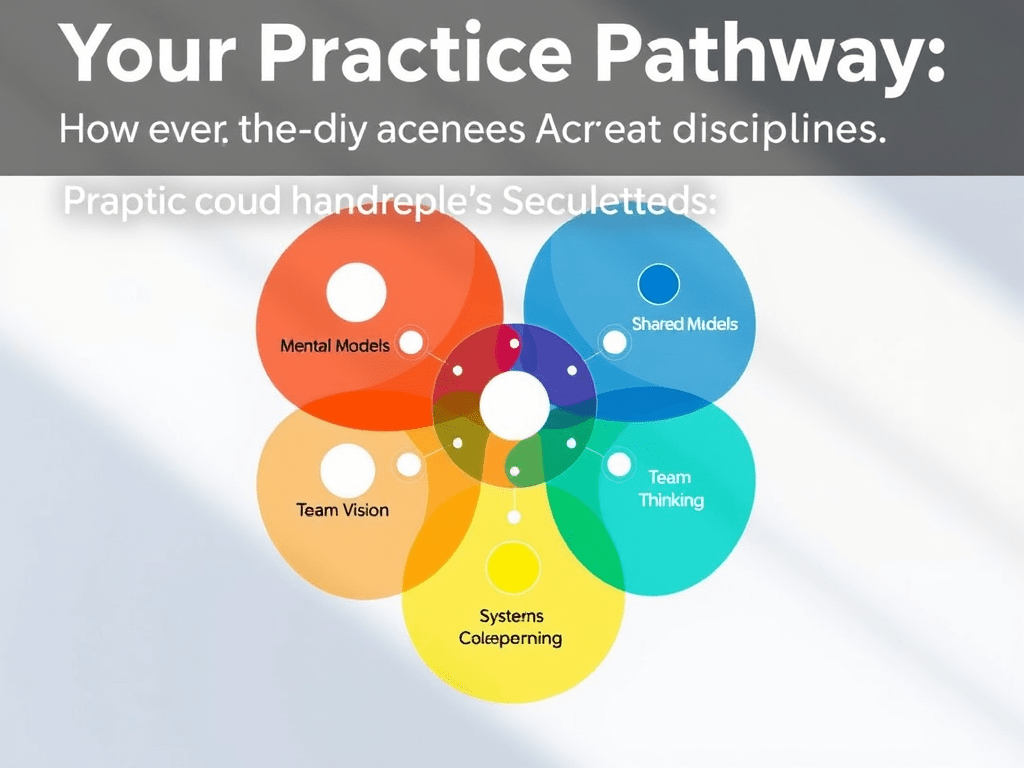
That’s a powerful and generative commitment. Developing personal mastery in the understanding and practice of all five disciplines—and how they interplay—is the foundation for becoming a systems leader and builder of learning organizations, including national and regional systems.
To begin, here’s a suggested developmental pathway you can follow and shape further:
🔹 Step 1: Clarify the Core Intent of Each Discipline
| Discipline | Core Intent (Essence) |
|---|---|
| Personal Mastery | To align your life with what you truly care about and grow your capacity to live from vision while seeing reality clearly. |
| Mental Models | To surface, test, and reshape deep assumptions that guide behavior and block learning. |
| Shared Vision | To foster genuine commitment (not compliance) to a future people want to create together. |
| Team Learning | To transform group dialogue and practice into collective intelligence and coordinated action. |
| Systems Thinking | To see interrelationships, feedback loops, and patterns over time instead of linear cause-effect chains. |
Practice: Start a personal “Disciplines Journal” where you define these in your own words and refine as your clarity grows.
🔹 Step 2: Study Their Interplay
- Ask:
- How does Personal Mastery support better Mental Models work?
- What happens to Shared Vision when Team Learning is weak?
- How does Systems Thinking expose gaps in the other disciplines?
Practice: Create visual maps or simple diagrams of how the disciplines influence one another in your work, home, or national systems.
🔹 Step 3: Develop Daily and Weekly Practices for Each Discipline
| Discipline | Practices |
|---|---|
| Personal Mastery | Morning vision review; journaling on current reality; emotional awareness check-ins |
| Mental Models | Capture “ladder of inference” in situations; weekly reflection: What assumptions did I act on? Were they tested? |
| Shared Vision | Weekly “reconnection to purpose” statement; invite others into generative vision conversations |
| Team Learning | Practice advocacy + inquiry in team dialogue; reflect on “team learning moments” |
| Systems Thinking | Map systems weekly (even simple ones); name feedback loops in conversations or problems |
Practice: Choose 1 core practice per discipline for 30 days, then deepen or layer another.
🔹 Step 4: Create a Discipline Integration Cycle
Every month, reflect on:
- Which discipline has been most alive for me?
- Where am I most resistant or blind?
- How did one discipline help deepen another?
Practice: Host a solo or small-group reflection circle monthly—possibly with STRLDi colleagues or mentees.
🔹 Step 5: Use Real-Life Events to Apply the Five Disciplines
Apply them to:
- A policy challenge (e.g., unemployment, agriculture reform)
- A conflict or relational tension
- A business development effort
Ask:
- What vision drives this?
- What assumptions are operating?
- What feedback loops sustain the issue?
- Where is learning needed (individual/team)?
- What’s the larger system pattern?
Practice: Turn this into a living portfolio of applied systems thinking + disciplines practice.
 Systems Thinking Research & Leadership Development Institute (STRLDi)
Leave a comment