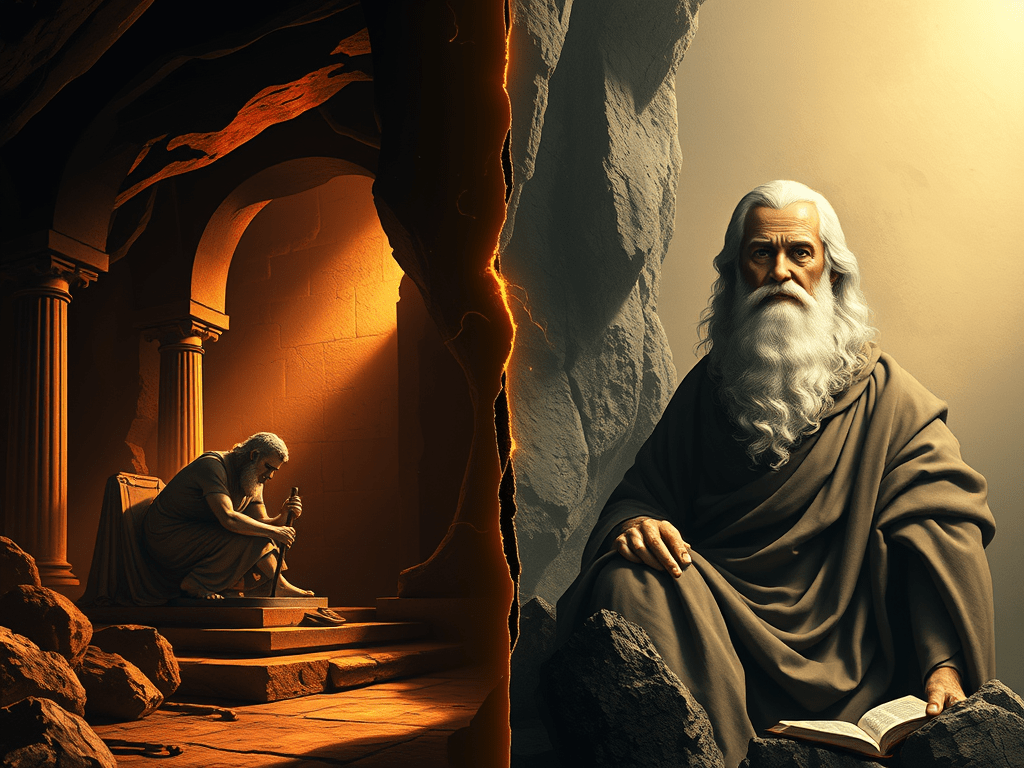
What led Plato and Immanuel Kant to generate their respective notions of perception and reason was their grappling with a fundamental human concern: how do we know what is real, and how can we trust our knowledge of it?
Both philosophers sought to explain the relationship between the mind and the world, but they did so in very different historical and intellectual contexts.
Here is a brief description of what drove each:
🏛️ Plato (427–347 BCE): The Quest for Unchanging Truth in a Changing World
Historical Context
- Plato lived during a time of political instability in ancient Athens, after the Peloponnesian War.
- The Sophists — influential teachers of rhetoric — claimed that truth was relative, and power came from persuasion.
- Socrates (Plato’s teacher) challenged this relativism by insisting that some truths were objective and could be known through reason, not persuasion.
What Led Plato to His Ideas
- Plato was deeply disturbed by the unreliability of the senses — the world constantly changes, people deceive, and perceptions vary.
- He concluded that the visible world was not the true source of knowledge.
- Instead, he proposed the existence of unchanging, eternal Forms or Ideas (e.g., Justice, Beauty, Goodness) which could only be known by the rational soul, not by the senses.
🔹 “What we see are shadows; true reality lies in the world of Forms.” (The Allegory of the Cave)
Key Insight
- Reason (not perception) is the path to truth.
- What we “see” is filtered and partial; truth resides in abstract, intelligible reality.
🎩 Immanuel Kant (1724–1804): Reconciling Empiricism and Rationalism
Historical Context
- Kant lived during the Enlightenment, an era defined by scientific discovery and philosophical debate.
- He inherited a major intellectual conflict:
- Rationalists (like Descartes) argued knowledge comes from reason alone.
- Empiricists (like Hume) argued knowledge comes only from sensory experience.
- David Hume’s skepticism (that we can’t know causality or necessity) deeply shocked Kant — it “awoke him from his dogmatic slumber.”
What Led Kant to His Ideas
- Kant wanted to preserve science and certainty, but also acknowledge Hume’s critique.
- He proposed a “Copernican Revolution in philosophy”: that the mind does not passively receive the world, but actively shapes our experience of it.
🔹 “Thoughts without content are empty; intuitions without concepts are blind.”
Key Insight
- Perception (intuition) and reason (understanding) work together.
- Our mind structures what we perceive — using categories like time, space, and causality — meaning we never know the “thing-in-itself” (noumenon), only how it appears to us (phenomenon).
📌 Summary Comparison
| Thinker | What Led to the Idea | Key Claim | Perception vs. Reason |
|---|---|---|---|
| Plato | Disillusionment with sensory world and Sophist relativism | True knowledge comes from rational insight into eternal Forms | Perception deceives; reason reveals truth |
| Kant | Attempt to resolve rationalist–empiricist debate | The mind actively structures experience; we know appearances, not things-in-themselves | Perception and reason co-construct experience |
 Systems Thinking Research & Leadership Development Institute (STRLDi)
Leave a comment